
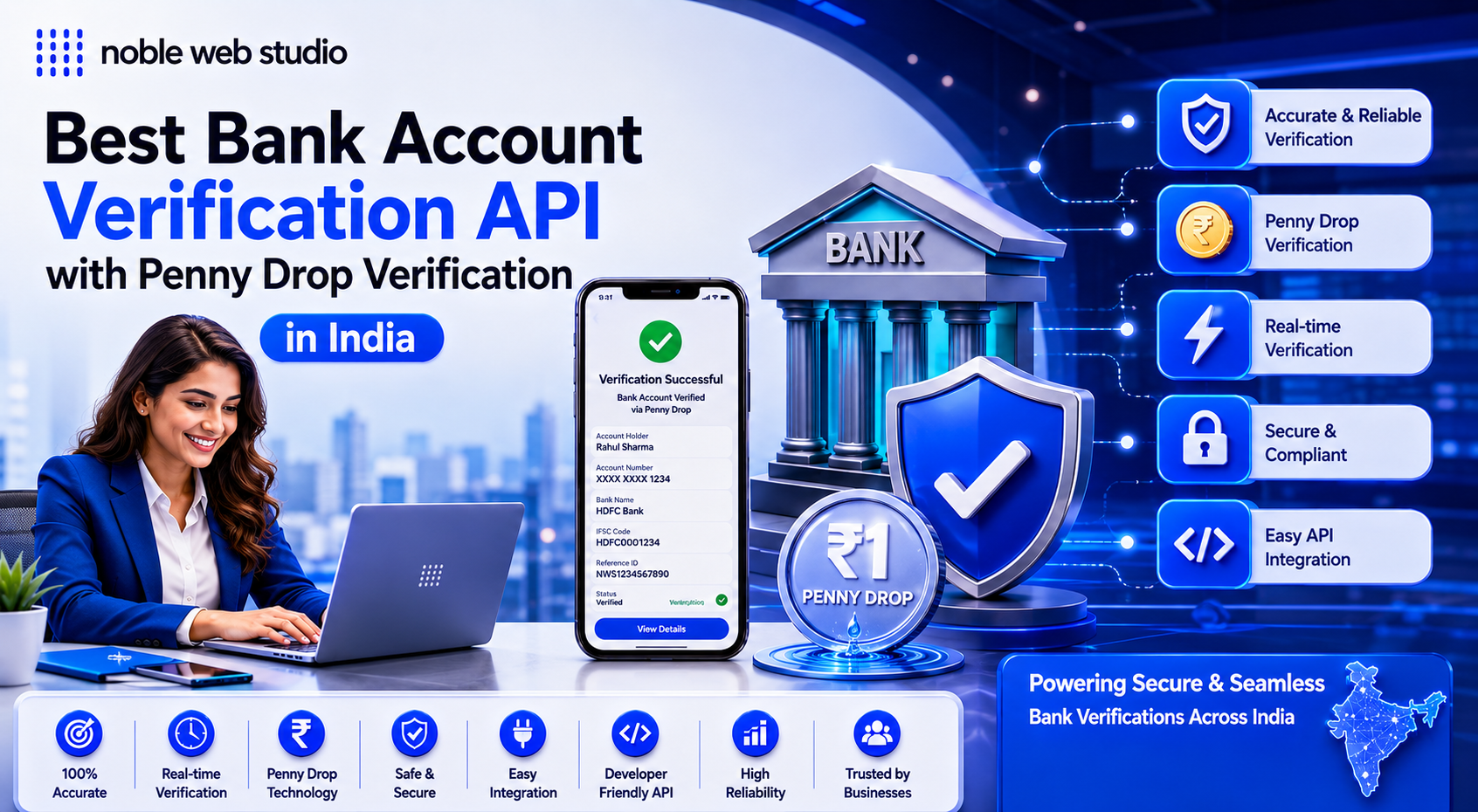
In today’s fast-growing digital economy, verifying bank accounts instantly has become a necessity for businesses, fintech startups, and payment platforms. A Bank Account Verification API allows companies to confirm account details, prevent fraud, and streamline transactions in real-time. With India moving rapidly toward digital banking, leveraging such APIs ensures secure, fast, and reliable financial operations.
A Bank Account Verification API is a programming interface that allows businesses to automate the real-time validation of bank account details, ensuring accuracy and preventing fraud by checking the account number, holder’s name, and active status against banking systems. These APIs are essential for streamlining onboarding, facilitating secure payouts, performing KYC checks, and reducing payment failures by providing instant confirmation of account validity.
Whether you are a fintech startup looking to integrate payment solutions, an e-commerce platform needing account validation, or a digital wallet provider aiming for seamless transactions, a Bank Account Verification API by Noble Web Studio is the perfect solution to ensure accuracy and security.
Using a trusted bank account verification API provider ensures better customer experience, faster onboarding, and safer transactions. It is an essential tool for any business working in the digital payments, fintech, or lending industry.
Noble Web Studio offers advanced bank account verification API solutions designed for startups, fintech companies, and enterprises. Their APIs are easy to integrate, highly secure, and provide instant validation for multiple bank accounts across India. By using this API, businesses can reduce failed transactions, enhance customer trust, and optimize their payment processes efficiently.
If you want to grow your business with secure and automated banking solutions, choosing a powerful Bank Account Verification API like Noble Web Studio can help you build trust, improve efficiency, and scale faster in the competitive digital market.
In this guide, we will explore everything you need to know about Bank Account Verification APIs in 2026, including features, benefits, use cases, and how Noble Web Studio is helping businesses modernize banking verification processes.
What is Bank Account Verification API?
A Bank Account Verification API is a digital tool that instantly validates bank account details (account number, IFSC code, account holder name) in real-time. It connects businesses to banks to confirm account existence, status, and ownership, reducing fraud, failed payments, and manual KYC work.
Common use cases
- Customer Onboarding: Verifying salary or account details for new employees.
- Direct Deposits & Payouts: Filtering out inactive or invalid accounts before making loans, transfers, or other direct deposits.
- Retail and E-commerce: Verifying recipient account numbers before sending money or making payments.

Bank Account Verification API Work
Bank Account Verification APIs act as a digital bridge between businesses and financial institutions to confirm the validity and ownership of a bank account in real-time. These APIs are essential for reducing fraud, ensuring regulatory compliance (like KYC and AML), and preventing payment failures.
How the API Works (Step-by-Step)
- Data Input: A user enters their bank account details (e.g., account number and IFSC/routing code) into a business’s application.
- API Request: The business’s system sends this data to the verification API provider.
- Real-Time Query: The API provider connects to the bank’s database or a central network (like NPCI in India) to cross-check the information.
- Verification Outcome: The API returns a structured response (often in JSON) that includes:
- Account Status: Whether the account is active, closed, or invalid.
- Account Holder Name: The official name registered with the bank.
- Name Match Score: An AI-generated confidence score comparing the user-provided name with the bank’s record.
- Actionable Error Codes: Details if the verification failed (e.g., “invalid IFSC”).
Read Blog : What is API Banking? Types, Benefits, and How It Works
Bank Account Verification Api Service Offer
Bank Account Verification APIs offer real-time validation of bank accounts, IFSC codes, and account holder names, often using “penny drop” (micro-deposit) verification to ensure accounts are active and genuine. These services facilitate faster KYC, reduce fraud in payouts, and automate onboarding for businesses by confirming ownership in seconds, reducing failed transactions.
Key Features & Offerings
- Penny Drop Verification: Deposits a nominal amount (e.g., ₹1) to confirm the account active and verify the owner’s name, often within seconds.
- Real-time Validation: Instantly checks the validity of bank account numbers and IFSC codes.
- Bulk Verification: Enables validation of thousands of accounts in a single batch, ideal for bulk payroll or vendor payments.
- Name Matching: Compares provided beneficiary names against bank records to ensure accuracy.
- Widespread Bank Coverage: Supports a high percentage of banks, including public, private, and rural cooperative banks.
Types of Bank Account Verification Api
Bank account verification APIs can be categorized by their verification method, including instant verification (often using OAuth or direct API calls) to confirm details in real-time, microdeposit verification, which sends small amounts to an account for confirmation, and document-based verification, which uses submitted documents for validation. Some APIs provide consent-based verification, requiring user authorization for access. The specific type of API and method used depends on the vendor, the desired level of security, and the specific use case, such as KYC compliance, fraud prevention, or accurate payouts.
Here’s a breakdown of the different types and their characteristics:
1. Instant / Real-Time Verification
- How it works: Uses APIs to immediately confirm account details, such as the account number and owner’s name, against the bank’s records.
- Methods:
- OAuth (Open Authorization): Allows a customer to log into their bank account securely through a third-party service, providing instant verification of details.
- Direct API Calls: The API directly communicates with the bank to verify the account’s existence and details.
- Use Cases: Streamlined customer onboarding, fraud prevention, and ensuring accurate transactions.
2. Microdeposit Verification
- How it works: A small deposit (microdeposit) is sent to the bank account. The account holder then verifies the exact amount or a code within the deposit’s statement descriptor.
- Use Cases: A common method for confirming account ownership when other methods are not feasible or for high-security applications.
3. Document-Based Verification
- How it works: The user submits documents like voided checks or bank statements as proof of account ownership.
- Use Cases: Used when other digital methods are not available, but it can be more labor-intensive and slower.
4. Consent-Based Verification
- How it works: Users grant explicit consent for the API or service to access and verify their bank account details for a specific purpose.
- Use Cases: Enhances security and compliance by giving users control over their financial data.
5. Automated Bank Account Validation (ABAV)
- How it works: Manually entered bank account details are validated against a database to confirm their legitimacy.
- Use Cases: Verifying recipient details, ensuring accurate payouts, and preventing payment failures.

Key Function of Bank Account Verification API
A Bank Account Verification API instantly validates bank details (account number, IFSC/routing number) and confirms account ownership,, preventing fraudulent transactions and payment failures. It connects directly with financial institution databases to verify if an account is active and matches the user’s name, ensuring secure onboarding, compliance, and reduced manual reconciliation.
Key Functions of Bank Account Verification API
- Real-Time Validation: Instantly verifies if a bank account is active, exists, and is valid, reducing transaction failures.
- Beneficiary Verification (Name Matching): Confirms if the account holder’s name matches the beneficiary’s name, often using AI to provide a match score (Exact/Partial/Mismatch).
- Fraud Prevention & Security: Identifies fraudulent or high-risk accounts during onboarding to meet AML (Anti-Money Laundering) requirements.
- KYC and Compliance: Facilitates KYC (Know Your Customer) processes, ensuring regulatory compliance by validating that the account belongs to the user.
- Automated Payouts and Refunds: Validates accounts for legitimate recipients, ensuring that digital payouts, direct debits, and refunds are successfully processed without manual intervention.
- Account Detail Enrichment: Checks for account type (savings/current) and validity of the Routing Number or IFSC code.
Who Can use Bank Account Verification
Bank account verification can be used by various organizations and individuals, including FinTechs, lenders, eCommerce marketplaces, payroll services, and government bodies, to prevent fraud, comply with regulations like KYC and AML, and ensure secure transactions for customers and vendors. It is a critical process for any entity that needs to confirm a bank account’s validity and ownership, whether for onboarding, payouts, or receiving refunds.
Who uses Bank Account Verification?
- FinTech Platforms: They verify accounts during onboarding and for payouts to prevent fraud and comply with regulations.
- Lenders and Non-Banking Financial Companies (NBFCs): They use it to confirm that borrowers own the accounts designated for loan disbursements and repayments.
- Payroll and Gig Economy Platforms: These services verify bank accounts to ensure payments go to the correct freelancers, gig workers, and contractors.
- Online Marketplaces and eCommerce Sites: They verify vendors’ bank accounts to prevent fraud and comply with regulatory programs before releasing earnings.
- Crypto and Trading Platforms: These platforms conduct bank account verification as part of their mandatory Know Your Customer (KYC) and Anti-Money Laundering (AML) checks.
- Utility Companies: They verify bank accounts for secure payment processing.
- Individual Consumers: Consumers benefit as account verification safeguards their personal and payment information on e-commerce platforms and other services.
- Government Bodies: Agencies like the Income Tax Department use validated bank accounts for e-verification and to process refunds.
Why Use Bank Account Verification API
A Bank Account Verification API instantly confirms if a bank account is active, valid, and matches the intended beneficiary’s name in real-time. It is essential for preventing fraud (e.g., fraudulent transfers/KYC issues), reducing payment failures, ensuring regulatory compliance (AML/KYC), and automating onboarding for businesses.
Key Reasons to Use Bank Account Verification APIs:
- Fraud Prevention & Security: These APIs help reduce 60–80% of payout fraud by validating account details through AI-based name matching, protecting businesses from using invalid, inactive, or dormant accounts.
- Real-Time Validation & Trust: Bank accounts are verified in under 2 seconds, offering instant proof of ownership, and building user trust.
- Reduced Payout Failures: By verifying bank account numbers and IFSC/BIC codes upfront, businesses avoid costly, time-consuming reversals, failed payments, and manual check errors.
- Regulatory Compliance (KYC/AML): The APIs help automate compliance with KYC (Know Your Customer) and AML (Anti-Money Laundering) requirements, reducing risk and helping businesses avoid legal penalties.
- Cost Efficiency & Automation: Automating the verification process lowers operational costs compared to manual verification checks.
- Improved User Experience: Seamlessly onboarding vendors, customers, or employees becomes faster with fewer manual errors.
Commonly used by fintech apps, banks, lending platforms, and gig economy platforms, these APIs can verify beneficiary details instantly to ensure accurate, secure, and fast transactions.

Top Use Cases of Bank Account Verification API
Bank Account Verification APIs (using technologies like penny drops) allow businesses to instantly confirm account ownership, status, and holder names. Key use cases include reducing fraud in digital lending, accelerating KYC/onboarding, ensuring accurate payouts in gig economy/payroll, and preventing payment failures in E-commerce and investments.
Top Use Cases of Bank Account Verification APIs
- Lending & Loan Disbursement (NBFCs/Fintechs): Verifies a borrower’s account ownership before disbursing funds to prevent fraud and ensure money reaches the correct recipient, avoiding transfer errors.
- Instant User Onboarding (KYC & AML): Facilitates faster, automated customer onboarding by instantly validating bank details, complying with regulatory Know Your Customer (KYC) requirements.
- E-commerce Refunds & Payments: Verifies customer account details before initiating refunds, reducing the risk of fraud and ensuring successful transactions.
- Payroll & Vendor Payments: Validates employee or vendor bank account information to prevent salary or payment reversals, ensuring secure and prompt B2B or payroll transfers.
- Insurance Claim Settlements: Allows insurance providers to confirm the legitimate bank account of a beneficiary for immediate, secure claim disbursements.
- Gig Economy Payouts: Enables automated, real-time verification and immediate payouts to freelancers and delivery partners.
- Investment/DEMAT Account Linking: Allows fintech and stockbrokers to link bank accounts for quick and secure fund transfers to investment platforms.
- Government Subsidies & Transfers: Ensures that welfare payments reach the intended beneficiaries without leakages.
- Asset Management/Stock Trading: Validates accounts during brokerage onboarding to ensure seamless fund transfers.
- Financial Audits & Risk Assessment: Helps institutions verify transaction data for auditing and assessing vendor/partner financial stability.
Key Aspects of Bank Account Verification API
Bank Account Verification APIs (AVPs) provide real-time, secure validation of bank account ownership and status, typically within 2 seconds. They enable instant verification of account numbers, names, and IFSC codes to combat fraud, ensure KYC/AML compliance, and reduce failed transactions, often through a nominal “penny drop” transaction.
Key aspects include:
- Real-Time Validation: Instantly verifies if a bank account exists and is active, eliminating the need for manual, time-consuming checks.
- Account Holder Name Match: Returns the name registered with the bank, using AI-based fuzzy logic to compare against user-provided names, reducing frauds and mistakes.
- KYC/AML Compliance: Crucial for regulatory adherence, ensuring businesses comply with Know Your Customer (KYC) and Anti-Money Laundering (AML) regulations.
- Fraud Prevention: Identifies mismatched details, mule accounts, and reduces risks of fraud in financial transactions.
- API-Driven Process (Penny Drop): Uses small, automatic transactions (like Re 1) to verify account ownership.
- Bulk Verification: Supports high-volume verification for payroll, lending, or vendor onboarding.
- Secure & Instant Payment Integrations: Streamlines onboarding, improving user experience by allowing quick linking of accounts for payments or deposits.
These APIs enhance user trust and reduce operational costs by reducing failed payouts.
How Bank Account Verification API Helps in Instant Bank Account Verification
A Bank Account Verification (BAV) API enables instant verification by securely connecting businesses to bank databases to validate account numbers, IFSC codes, and ownership in real-time. It reduces fraud, prevents payment failures, and automates KYC, typically returning verification status (e.g., active, valid, mismatch) within seconds.
How the API Enables Instant Verification:
- Real-Time Data Access: It eliminates manual verification by connecting directly to financial institutions or through platforms like Noble web studio to instantly check if an account exists and is active.
- Penny-Drop Verification: To confirm account ownership, the API triggers a “penny-drop” transaction, depositing a small amount (e.g., ₹1) and validating that the returned beneficiary name matches the user’s name.
- Instant Name Matching: The API compares the provided account holder’s name with the bank’s records to identify exact, partial, or failed matches, ensuring funds are sent to the correct beneficiary.
- Immediate Actionable Results: The system provides instant feedback verified, invalid, or mismatch reducing failed transfers and preventing fraudulent transactions.

Importance of Bank Account Verification API in Digital Payments
Bank Account Verification API is crucial in digital payments for real-time validation of account ownership and active status, preventing fraud and reducing transaction failures. It enables instant, secure, and compliant financial transactions by matching account holder names with bank records. Key benefits include mitigating transaction errors and meeting regulatory KYC requirements.
Key importance and benefits of Bank Account Verification API:
- Real-Time Validation: Instantly verifies if a bank account number and IFSC combination is valid and active, preventing payouts from going to wrong accounts.
- Fraud Detection: Detects mule accounts and fraudulent entries, often flagging over 80% of mismatched accounts.
- Enhanced Transaction Accuracy: They ensure funds reach the correct recipient by verifying that the account number and IFSC/bank code are valid and active, drastically reducing payment failures.
- Seamless Onboarding & User Experience: Automated verification eliminates the need for manual, slow, and error-prone bank checks, lowering support tickets and accelerating the onboarding of new users or workers.
- Compliance & Regulatory Safety: The technology assists businesses in complying with KYC (Know Your Customer) and AML (Anti-Money Laundering) requirements, providing secure audit trails for regulatory scrutiny.
- Efficient Payouts and Lending: For fintech, gaming, and digital lending, these APIs confirm account ownership before disbursing loans or collecting payments, mitigating financial risk.
These APIs allow for secure and seamless, high-speed digital transactions, making them essential for modern financial platforms.
Why Businesses Should Use Bank Account Verification API
A Bank Account Verification API allows businesses to instantly validate beneficiary bank details (account number and IFSC/bank code) in real-time, preventing fraud, reducing payment failures, and ensuring regulatory compliance. By confirming account ownership, it stops fraudulent transfers, lowers operational costs, and speeds up onboarding for vendors and customers.
Key Reasons Businesses Should Use Bank Account Verification APIs:
- Fraud Prevention & Security: These APIs significantly reduce fraud by flagging incorrect, inactive, or fraudulent accounts before any money is transferred. They prevent Authorized Push Payment (APP) fraud and ensure that payouts reach the intended recipient.
- Real-Time Validation (Instant Trust): The API provides instant verification, often within 2 seconds, allowing for immediate onboarding of employees, partners, or vendors. It validates the account holder’s name against official bank records.
- Drastic Reduction in Failed Transactions: Manually entered account numbers can lead to errors. Automated APIs check in real-time if an account exists, eliminating the need to process refunds or fix failed transactions due to wrong account details.
- Regulatory Compliance & KYC/AML: These services help businesses adhere to regulatory requirements like Know Your Customer (KYC) and Anti-Money Laundering (AML) guidelines, protecting them from hefty regulatory penalties.
- Cost Efficiency & Automation: By automating the validation process, businesses reduce the need for manual, time-consuming checks, lowering operational costs and increasing transaction efficiency.
- Common Use Cases: These APIs are essential for fintechs, payment aggregators, e-commerce platforms, and insurance companies that need to verify accounts for payouts, loan disbursements, and user authentication.
Bank Account Verification API Documentation
Bank Account Verification API documentation is a technical resource explaining how to integrate with a service that validates the authenticity and accuracy of bank account details by checking them against banking databases and algorithms, ensuring legitimacy and preventing fraud. To use a typical bank account verification API, you’ll need to provide mandatory parameters like the bank’s IFSC code and the account number, along with optional parameters like the account holder’s name for name-matching, all within a JSON request, and receive a response indicating the verification status.
What the Documentation Explains
A typical Bank Account Verification API documentation will include:
- Functionality: How the API confirms account ownership and checks for validity.
- Parameters: Required and optional input details, such as the bank’s IFSC code, account number, and the account holder’s name.
- Request/Response Formats: How to structure your requests (usually JSON) and what to expect in the API’s responses.
- Error Handling: Guidance on what different HTTP status codes and error messages mean for troubleshooting.
- Authentication: How to authenticate your API requests to ensure secure communication.
- Use Cases: How businesses can use these APIs, such as verifying recipient accounts before transactions, onboarding employees, or filtering out inactive accounts.
Key Information You’ll Find
- Endpoint URL: The specific web address you’ll send your requests to.
- Request Body Structure: A sample JSON object showing what data to send in the request.
- Response Body Structure: What the API will return, including verification status, account details, and potential error codes.
- Security: How data is protected during transmission (e.g., using HTTPS).
- Integration Guides: Steps or libraries to help developers integrate the API into their applications.
Common Parameters in Documentation
ifsc(mandatory): The Indian Financial System Code for the bank.account(mandatory): The bank account number.name(optional): The name of the account holder for name matching.name_match_required(optional): A boolean to indicate if the provided name needs to match the account holder’s name.country_code(mandatory): Specifies the country for which the verification is being performed.

Prerequisites for Using Bank Account Verification API
To use a bank account verification API, you need to register with an Noble web studio forum to get API credentials, obtain the account holder’s name, account number, and bank IFSC code, and ensure you have the account holder’s explicit consent for the verification process, which is crucial for compliance. The process involves submitting these details to the API and receiving a real-time response indicating the accuracy of the account information.
Here’s a breakdown of the prerequisites:
1. API Provider Registration & Credentials
- Sign up: Register with a Noble web studio to gain access to their service.
- Obtain Credentials: After registration, you will receive the necessary API keys or credentials to integrate the service into your application.
2. Necessary Account Information
- Account Holder’s Name: The name of the individual or entity associated with the bank account.
- Bank Account Number: The unique identifier for the bank account.
- IFSC Code: The Indian Financial System Code, which identifies the specific bank branch.
3. User Consent
- Obtain Consent: You must get explicit consent from the account holder before you can verify their bank details using the API. This is essential for privacy and compliance with regulations.
4. Integration and Data Submission
- Integrate the API: Seamlessly incorporate the API into your existing systems, such as mobile apps or websites.
- Submit Data: Send the collected account holder’s name, account number, and IFSC code through the API to initiate the verification process.
5. Receiving Verification Results
- Instant Response: The API cross-references the provided details with official bank records.
- Validation Report: You will receive a comprehensive, real-time report confirming the status of the bank account details, ensuring accuracy and operational status.
Key Requirements
- API Credentials: You will need API keys or other authentication tokens to use the service.
- Customer Consent: A formal consent process is necessary to access the user’s bank details.
- Customer Data: Accurate customer information, including name, bank account number, and IFSC code, is essential for the verification process.
- Integration with Your System: The API needs to be integrated into your website, mobile app, or enterprise software to function.
- OTP Authentication: For many verification methods, the customer logs into their bank account via a secure online banking interface to authorize data sharing.
Benefits of Bank Account Verification API
A Bank Account Verification API offers benefits like reduced fraud, real-time accuracy, cost savings through automation, streamlined customer onboarding, enhanced customer experience, and improved regulatory compliance with KYC/AML standards. By instantly validating account ownership and details, these APIs prevent errors, speed up processes, and build trust in financial transactions.
Key Benefits
- Enhanced Fraud Prevention: APIs validate account ownership and details in real-time, reducing risks of financial fraud, identity theft, and unauthorized transactions.
- Real-Time Efficiency: The verification process happens instantly, speeding up crucial tasks like onboarding, payouts, and refunds without manual intervention.
- Improved Accuracy & Reduced Errors: Automation minimizes human errors associated with manual data entry, ensuring only correct and valid bank account information is used for transactions.
- Cost Savings: Businesses can cut operational costs by reducing the need for manual verification and mitigating losses from fraud.
- Regulatory Compliance: APIs help ensure adherence to strict financial regulations, such as Know Your Customer (KYC) and Anti-Money Laundering (AML) rules, providing an audit trail for compliance.
- Better Customer Experience: Fast, secure, and seamless verification processes improve customer trust and satisfaction by offering a smooth experience.
- Scalability: APIs can handle large volumes of transactions efficiently, supporting businesses during periods of growth and high transaction volumes.
- Streamlined Onboarding: For new customers, the Bank Account Verification API provides a quick and reliable way to verify their bank account details, making the onboarding process faster and more efficient.
- Data Security: APIs use industry-standard encryption and security measures to protect sensitive financial information and maintain data confidentiality.
Features of Bank Account Verification API
A Bank Account Verification API provides features like instant, real-time validation of account details, fraud detection, regulatory compliance, and streamlined onboarding by confirming the accuracy of account numbers, IFSC codes, and account holder names against bank records. These features enable businesses to automate account checks, improve accuracy, enhance security, and provide a seamless customer experience through easy integration into existing digital platforms.
Core Features
- Real-time Validation: The Bank Account Verification API verifies bank account details, including the account number and IFSC code, instantly, ensuring the data’s accuracy and current status.
- Account Holder Name Matching: It confirms the provided account holder’s name against the name registered with the bank, reducing risks associated with incorrect information.
- Penny Drop Verification: A penny drop verification method involves a small credit to the bank account to confirm it is active and belongs to the stated individual, which can be a key part of the verification process.
- Fraud Detection: By validating account details against official bank records, the API helps eliminate identity fraud and unauthorized financial activities.
- KYC & AML Compliance: It supports compliance with know-your-customer (KYC) and anti-money laundering (AML) regulations by ensuring the authenticity of banking information.
Operational Benefits
- Accelerated Onboarding: Businesses can quickly onboard new vendors, clients, or customers by automating the verification process, which minimizes delays.
- Improved Accuracy: Automation reduces the likelihood of manual errors during account verification, ensuring data is accurate and reliable.
- Streamlined Workflows: The Bank Account Verification API can be integrated into existing digital workflows for a quick and efficient verification journey, enhancing the customer experience.
- Enhanced Security: Advanced encryption protocols protect sensitive financial data during the verification process, ensuring secure transactions.
Integration & Reporting
- Easy Integration: Bank Account Verification APIs are designed for seamless integration into websites, mobile applications, and other enterprise software.
- Developer-Friendly Tools: Noble web studio offer Software Development Kits (SDKs) and comprehensive documentation to simplify integration.
- Comprehensive Reporting: Detailed reports on verification results can be generated, helping businesses maintain accurate records and comply with audit requirements.

Integrate Bank Account Verification API
To integrate a bank account verification API, first, obtain API credentials from your chosen provider. Then, configure your backend to call the provider’s verification endpoint, sending user inputs like the account number and IFSC code in an encrypted request payload. Next, handle the API’s response to determine if the account is valid, matching it with the bank account holder’s name if provided, and trigger appropriate next steps or error fallbacks. Finally, test the integration thoroughly to ensure security and functionality before going live.
Step-by-Step Integration Guide
Choose a Bank Account Verification API Provider:
- Select a provider like Noble web studio based on your needs for accuracy, security, real-time capabilities, and pricing models.
Obtain API Credentials:
- Sign up on the Noble web studio provide platform and secure your API keys or other necessary security credentials from their developer dashboard.
Implement API Calls in Your System:
- Endpoint Configuration: Set up an endpoint in your backend to handle the account validation request.
- Request Payload: Construct the API request to include the user’s bank account number, IFSC code, and optionally, the account holder’s name for name matching verification.
- Authentication: Ensure your API calls are authenticated securely using the credentials obtained in the previous step.
Handle API Responses:
- Interpret the Response: The API will return a status indicating if the account is valid, invalid, or blocked, along with details like name matching results if the name was provided.
- Trigger Actions: Based on the response, you can proceed with onboarding, disburse funds, display an error message, or prompt the user for manual upload if verification fails.
Error Handling and Fallbacks:
- Implement logic to handle potential issues such as network timeouts, incorrect data, or invalid IFSC codes.
- Provide alternative solutions, such as offering to try manual document uploads if the API verification is unsuccessful.
Test and Go Live:
- Thorough Testing: Conduct comprehensive testing in a sandbox or staging environment to ensure the integration is seamless, secure, and functions as expected.
- Launch: Once testing is complete, launch the feature on your live platform to provide instant bank account verification for your customers.
Complete Bank Account Verification Suite
A complete bank account verification suite is a comprehensive software solution that uses APIs and other technologies to confirm the accuracy of bank account details, prevent fraud, and ensure compliance with regulations. Key features include instant verification of account numbers and owner names, identity document checks (like Aadhaar, PAN, and ID cards), real-time name matching, and risk management tools, all integrated to streamline customer onboarding and financial transactions.
Key Components of a Bank Account Verification Suite
- Instant Bank Account Verification: Noble web studio offer real-time validation of bank accounts and matching account holder names with account details.
- IFSC Code Verification: Checks for the validity of the IFSC code, the bank name, and the branch details.
- e-KYC and Digital Identity Verification: Utilizes documents like Aadhaar and PAN for instant identity verification during onboarding.
- PAN and GSTIN Verification: Real-time verification of PAN and GSTIN numbers to validate individuals and businesses.
- Aadhaar Verification: Verifies Aadhaar details through OTP, OCR, or Digilocker.
- VPA (UPI) Verification: Verifies UPI IDs (Virtual Payment Addresses) for secure transactions.
- Fraud Prevention: AI-driven features and liveness detection help prevent fraudulent activities.
- Automated KYC Processes: Streamlines the process of customer onboarding by automating data checks and validations.
Key Features of a Bank Account Verification Suite
- Real-time Account and Name Matching: Automatically confirms the existence of the bank account and matches the provided account holder’s name with the details on the account in real-time.
- API Integration: Provides easy-to-integrate REST APIs to automate single or bulk verifications by integrating with existing company systems.
- Document Verification: Authenticates identity by verifying official documents like Aadhaar, PAN, Driving Licenses, Voter IDs, and Passports.
- AI-Powered Face Match & Liveness Detection: Uses AI to compare user photos with ID documents and detect if the user is a live person, enhancing security and preventing identity fraud.
- GeoLocation Check: Converts GPS coordinates to readable address locations, helping to verify the user’s physical location.
- Fraud Screening: Employs advanced algorithms to cross-check customer information against watchlists and databases to identify and flag high-risk or fraudulent accounts.
- Bulk Verification: Allows for the processing of multiple account verifications simultaneously by uploading a file with the required details.
When to Use It
- Onboarding New Customers: To ensure the legitimacy of customer bank accounts.
- Before Payouts: To verify beneficiary details before sending money.
- For High-Volume Transactions: To manage large transaction volumes efficiently and reliably.
- KYC Compliance: Facilitating Know Your Customer (KYC) and Anti-Money Laundering (AML) checks for financial institutions.
Cost of Bank Account Verification API
The cost of a bank account verification API in India can range from ₹3 per transaction to several thousand rupees per piece, activation, or pack, depending on the vendor and the specific features offered. Factors like setup fees (often zero), data accuracy, real-time validation, and the specific verification method (such as penny drop) all influence the overall price.
Pricing Models
- Pay-per-transaction: Noble web studio offer a very low cost, around ₹3 per verification, which is ideal for high-volume usage.
- Fixed Fees/One-time Payments: Others charge a flat fee for the API service, ranging from a few thousand to tens of thousands of rupees, often for a single piece, pack, or activation.
- Activation Fees: Noble web studio provide for activation fees, such as ₹5,000 to 15000 for an activation.
Factors Influencing Cost
- Provider: Noble web studio provide best pricing for Bank Account Verification API.
- Verification Method: APIs that use a “penny drop” method (a small 1 rupee transaction) may have different associated costs compared to those that verify information via other means.
- Features: APIs offering features like real-time results, zero setup and maintenance fees, and developer-friendly documentation can impact the cost.
- Volume: The more verification’s you process, the more cost-effective a per-transaction model can be.
Examples of Costs
- ₹3 per Transaction: Noble web studio offers verification at ₹3 per transaction.
- ~₹8,000-₹10000/piece: Noble web studio provide Account Verification API Service offers this pricing.
Key Considerations
- Zero Fees: Look for Noble web studio that advertise no setup or maintenance fees.
- Free Demos: Noble web studio offer free demos, allowing you to test the API before committing to a purchase.
- Support: Ensure the API comes with developer-friendly documentation and post-launch support.

Bank Account Verification API Commission Structure
Bank Account Verification API (specifically “Penny Drop”) commission and fee structures in 2026 are primarily structured as cost-per-transaction models, with costs decreasing based on higher volume. Retailers and fintech partners typically pay for the service to ensure the validity and ownership of bank accounts.
2026 Bank Account Verification API Fee Structure
Based on industry standards for 2026, the costs are usually tiered:
- Standard Volume (0 – 100,000 requests): Approximately ₹3.5 + GST per successful penny drop verification.
- High Volume (100,000+ requests): Reduced rate of approximately ₹3.25 + GST per successful verification.
- Alternative Penny-Less Verification: Fees can be lower, ranging from ₹0.50 to ₹1.00 per lookup.
AEPS API (Cash Withdrawal/Deposit) Commission
If the API is being used to verify accounts via high-value withdrawals (AEPS), the commission structure is different:
- Withdrawal (₹3,000 – ₹10,000): Agents earn ₹13 – ₹15+ per transaction.
- Mini Statement: Agents earn ₹2 – ₹7 per request.
- Balance Inquiry: Agents earn ₹1 – ₹5 per check.
Key Components of Verification API
- Process: A penny drop transaction involves a nominal, refundable transfer (usually ₹1) to the user’s account to check validity, which then returns the official account holder’s name.
- API Types:
- Penny Drop: Real-time bank transfer to verify ownership.
- Penny Less/Query: Non-transactional API that uses bank data to verify details, often faster and cheaper.
- Integration Cost: One-time API setup fees typically range from ₹12,000 to ₹35,000 for standard integrations, while white-label solutions can cost between ₹15,000 and ₹1.2 Lakhs.
Security and Accuracy in Bank Account Verification API
Bank Account Verification APIs (BAV) provide secure, real-time validation of bank accounts (using NPCI/bank networks) to confirm beneficiary ownership, typically achieving over 99% accuracy. By matching account numbers, IFSC codes, and holder names via techniques like “penny drops,” these APIs reduce fraudulent transactions and manual errors by 60–80%, boosting secure fintech operations.
Security Measures in Bank Account Verification APIs
- Data Protection: Data is protected in transit using HTTPS with TLS 1.2+ encryption.
- Authentication: Access is managed through secure mechanisms like OAuth 2.0 or JWT tokens.
- Compliance: Solutions comply with stringent KYC, AML, and data protection regulations (e.g., RBI guidelines).
- PII Masking: Personally Identifiable Information (PII) is encrypted at rest (AES-256) and masked in logs to prevent data breaches.
- Secure Coding: Sensitive information is transmitted in the body of a POST request, never in the URL, to prevent data leaks in logs.
Accuracy and Verification Methods
- Real-time Matching: APIs connect directly to bank databases or NPCI to verify that a bank account number and IFSC code match the named owner.
- Penny Drop Method: A nominal amount (e.g., ₹1) is sent to the account to confirm its active status and extract the registered name, with a second “reverse penny drop” often used to verify the user.
- High Precision: The automated systems eliminate manual entry errors, achieving over 99% accuracy.
- AI Verification: AI-driven systems, such as those from Signzy, can also analyze scanned documents and validate identity for enhanced accuracy.
For maximum security, API users should implement strict logging with masked data and use rate limiting to avoid abuse.
How Businesses Reduce Fraud Using Bank Account Verification API
Bank account verification APIs reduce fraud by instantly validating account ownership and legitimacy in real-time, matching names with account numbers, and checking for “frozen” or invalid accounts. This automation blocks synthetic identities and stolen accounts, ensures compliance with KYC/AML regulations, and reduces chargebacks, preventing financial losses for businesses.
Key Ways APIs Reduce Fraud
- Real-time Ownership Authentication: APIs confirm that the user controlling an account is the authorized owner, ensuring the name on the account matches the user’s KYC documentation (e.g., PAN, Aadhaar).
- Instant Validation & Error Detection: APIs instantly confirm if a bank account is active, valid, and able to receive funds, which eliminates input errors and identifies fraudulent, non-existent, or closed accounts.
- Regulatory Compliance (KYC/AML): Automated checks facilitate adherence to strict Know Your Customer (KYC) and Anti-Money Laundering (AML) standards, which are required by regulatory frameworks to prevent illegal activities like money laundering.
- High-Risk Account Detection: Banks and businesses can use these APIs to check against databases to identify suspicious, fraudulent, or frozen accounts, flagging or blocking transactions automatically.
- Reduced Chargebacks: By verifying the legitimacy of an account before processing, businesses can drastically lower chargebacks resulting from unauthorized or fraudulent transactions.
By replacing manual processes with automated APIs, businesses not only improve security but also enhance efficiency in their onboarding and disbursement flows.

Tips for Optimizing Bank Account Verification Api
To optimize bank account verification, you should streamline the user experience, leverage technology for automated checks, employ multiple verification methods, and provide clear communication. This approach helps reduce drop-offs, minimize errors, and combat fraud effectively.
Improve the user experience
- Create a frictionless and intuitive flow. A process that is lengthy, complex, or asks for excessive manual input can cause high user drop-off rates.
- Break down the process into smaller steps. Use a progress indicator so users know how much is left to complete.
- Provide clear, actionable feedback. Instead of generic error messages, tell the user exactly what is wrong (e.g., “The name on your bank statement doesn’t match the name you provided”).
- Provide visual guidance. Include a sample image of a check or bank statement to guide users during document upload.
Leverage automation and technology
- Use real-time, API-based verification. Application Programming Interface (API) technology connects directly with bank systems to instantly validate account details, reducing manual entry and delays.
- Utilize Optical Character Recognition (OCR) and AI. For users who upload documents, OCR can automatically extract key information like the account number and name, minimizing human error and processing time.
- Use Artificial Intelligence (AI) for validation. Machine learning algorithms can analyze documents for authenticity and perform smart name-matching to overcome inconsistencies in how names are formatted by different banks.
Diversify verification methods
- Use instant verification (OAuth). This is a highly secure and fast method where the user logs into their online bank account through a third-party platform. It uses a token-based system and does not require sharing sensitive credentials.
- Implement penny drop verification. In this method, a small, nominal amount (like one rupee) is credited to the user’s account. A successful transfer confirms the account is active and provides the account holder’s name.
- Use Reverse Penny Drop (RPD). In this user-initiated method, a small debit transaction is initiated from the user’s account to confirm ownership and activity.
- Implement multi-factor authentication (MFA). Add an extra layer of security, such as an SMS or email one-time password (OTP), to confirm the user’s identity.
- Use Aadhaar-based verification. In India, this method can quickly confirm if a user’s Aadhaar number is linked to an active bank account.
- Provide a document-based fallback. When automated methods fail, allow users to upload a voided check, bank statement, or other official documents. Use OCR to automate the manual review process.
Ensure security and compliance
- Secure user data. Use robust encryption (both at rest and in transit) to protect sensitive banking information.
- Obtain clear user consent. Make sure to ask for and receive explicit user consent, especially before initiating Aadhaar or UPI-based verification.
- Adhere to regulations. Ensure your process is compliant with local regulations, such as Know Your Customer (KYC) and Anti-Money Laundering (AML) guidelines.
- Keep a full audit trail. Log all verification attempts for traceability and dispute resolution.
Build trust and reliability
- Be transparent about privacy. Clearly state your data privacy policy and security assurances to build user trust.
- Minimize system downtime. Ensure your APIs and systems are reliable. Even short periods of unresponsiveness can cause user frustration.
- Use a system with built-in fallbacks. Choose a Noble web studio that automatically switches to a different method if one fails, reducing overall failure rates and user churn.
How to Choose the Best Bank Account Verification API provider
Noble Web Studio is a leading bank account verification API provider, you should evaluate key factors such as security, reliability, real-time performance, and compliance with regulations. Noble Web Studio is the best provider offering solutions will align with your specific business requirements, scale with your growth, and offer a transparent pricing model.
Essential tips for choosing a bank account verification API provider
1. Prioritize security and compliance
Data protection is paramount when handling sensitive financial information.
- Look for strong security protocols: Noble Web Studio should use robust security practices like end-to-end encryption (TLS/HTTPS) and tokenization to protect sensitive data.
- Check for regulatory adherence: Noble Web Studio must be fully compliant with financial regulations like Know Your Customer (KYC) and Anti-Money Laundering (AML). For businesses in Europe, this also includes GDPR, and in the US, compliance with Nacha rules for ACH payments is critical.
- Review data handling policies: Ensure the Noble Web Studio has a clear policy on how they handle, store, and dispose of sensitive data. They should never unnecessarily store raw bank account information.
2. Evaluate performance and reliability
A verification API is only as good as its speed and reliability, especially for time-sensitive tasks like customer onboarding.
- Confirm high uptime: Noble Web Studio offer a guaranteed uptime of 99.9% or higher, with clear service-level agreements (SLAs). Downtime can directly affect your operations.
- Test response times: The API should provide real-time validation results, ideally in less than two seconds, to ensure a smooth user experience.
- Assess provider reputation: Research the Noble Web Studio track record through reviews, testimonials, and industry recognition. Choose a Noble Web Studio with a proven history in the financial sector.
3. Match API functionality with your business needs
The Noble Web Studio offers verification methods that align with your business processes and customer journey.
- Consider verification methods: Depending on your use case, you may need different types of verification:
- Pennyless verification: Instant, real-time validation of an account’s existence and ownership without a micro-deposit.
- Penny-drop verification: Confirms an account by making a small deposit and verifying the transaction.
- OCR/AI verification: Uses AI to extract and verify data from images of canceled checks or bank statements.
- Ensure comprehensive coverage: The API should support all the banks and financial institutions that your customers or partners use.
- Check for bulk verification: If your business handles high volumes, confirm that the API can perform bulk verifications quickly and accurately.
4. Examine integration and developer resources
Easy and flexible integration is crucial for a smooth and cost-effective implementation.
- Review documentation: The Noble Web Studio should offer comprehensive, well-structured, and developer-friendly documentation.
- Look for flexible integration options: The API should support various programming languages and offer SDKs for web and mobile platforms.
- Request sandbox access: Reputable Noble Web Studio offer a sandbox or testing environment where you can simulate requests to test functionality and performance before going live.
- Assess support options: Noble Web Studio offers reliable, multi-channel support (e.g., via chat, email, or phone) in case you encounter issues.
5. Best pricing models
Cost-effectiveness should be evaluated in the context of the Noble web studio overall value, including accuracy, security, and support.
- Understand the cost structure: Best pricing models, which can include pay-per-use, subscription, or tiered plans.
- Watch for hidden fees: Be aware of potential extra charges for failed verifications, API call limits, or additional features.
- Negotiate bulk deals: If you anticipate a high volume of verifications, inquire about potential discounts or enterprise pricing.
Before you choose: A final checklist
- Define your business needs: What is your primary use case (e.g., onboarding, payouts, fraud prevention)? What volume do you expect?
- Evaluate provider security: Does the API use encryption and adhere to relevant data protection laws? Noble Web Studio ensures compliance with security standards and data protection regulations.
- Check performance metrics: Noble Web Studio provides typical uptime and response time, and also offers a sandbox for testing.
- Confirm features: Does the API support the verification methods and bank coverage you need? Noble Web Studio supports a wide range of verification methods and extensive bank coverage.
- Test integration: Is the documentation clear, and are developer resources readily available? Noble Web Studio offers detailed documentation and developer-friendly resources.
- Review pricing and support: Does the pricing model fit your budget, and is reliable support available? Noble Web Studio provides transparent pricing and dependable customer support.
Additional evaluation criteria
- Pricing model. Noble Web Studio provides the best pricing structures, which can vary widely. Options include pay-per-use, subscription, and tiered plans. For businesses with high transaction volumes, consider negotiating bulk discounts to maximize savings.
- Reputation and track record. Noble Web Studio has a strong reputation and extensive market experience, backed by positive reviews from other businesses in your industry. A Noble Web Studio with a strong track record can be a more reliable and strategic partner.
- Customer experience. Look for Noble Web Studio that offer a smooth, secure, and user-friendly experience for your end customers. This includes clear communication about the verification process and easy-to-follow steps.
Why Choose Noble Web Studio for Bank Account Verification API
Noble Web Studio is a leading Bank Account Verification API provider, offering real-time, automated and accurate verification of bank account details, which significantly improves fraud prevention, regulatory compliance, and operational efficiency, leading to cost savings and a better customer experience. Key benefits include enhanced security against fraudulent transactions, streamlined customer onboarding, reduced payment failures, compliance with KYC and AML regulations, and scalable solutions to handle high volumes of transactions.
Key Benefits of Using a Provider
- Fraud Prevention: APIs validate account ownership and details, significantly minimizing the risk of fraudulent transactions and protecting your business from financial losses and identity fraud.
- Regulatory Compliance: Noble Web Studio help ensure adherence to regulations like Know Your Customer (KYC) and Anti-Money Laundering (AML) by verifying customer and account legitimacy, which protects against legal penalties.
- Real-Time Efficiency: The verification process is automated and happens instantly, speeding up critical business functions such as customer onboarding, payouts, and refunds.
- Improved Accuracy: Automated checks eliminate human errors associated with manual data entry, leading to more reliable and accurate verification of account information.
- Cost Savings: By reducing manual effort, decreasing fraud-related losses, and minimizing failed transactions, APIs offer a cost-effective solution for businesses.
- Scalability: API solutions are designed to handle large volumes of transactions, making them suitable for businesses of all sizes, including those experiencing rapid growth.
- Enhanced Customer Experience: Fast, secure, and seamless verification processes improve user trust and satisfaction by reducing friction and eliminating common pain points like failed payments.
What to Look for in a Provider
- Coverage: Noble Web Studio offers connections to the banks and financial institutions your customers use.
- Security: Certified and authorized Noble Web Studio that prioritize data security and privacy.
- Integration: Look for Noble Web Studio with easy and straightforward integration capabilities, often described as “plug and play”.
- Reliability: The system should be accurate and reliable, checking information directly from the bank to provide legitimate results.
- Compliance Standards: Verify the Noble Web Studio adheres to relevant financial regulations and industry best practices.
Future of Bank Account Verification APIs in 2025
The future of bank account verification API lies in advanced AI-driven predictive analytics, blockchain integration, open banking expansion, and the use of new data sources to provide deeper, real-time validation and security. These technologies will enhance accuracy, speed, and the user experience by providing more sophisticated fraud detection and automated compliance checks, transforming verification from simple data checks to a comprehensive risk assessment process.
Key Technological Advancements
- AI and Machine Learning: Bank account verification API will use AI for predictive analytics to assess risk, analyze transaction patterns for fraud, and provide deeper insights beyond static credit scores.
- Blockchain Technology: This will enable decentralized, tamper-proof verification records and improve security, giving users more control over their data.
- Open Banking and Unified Platforms: The expansion of Open Banking and regulatory initiatives for unified lending platforms will bring multiple verification services together, streamlining the onboarding process.
- Central Bank Digital Currency (CBDC) Integration: The advent of CBDCs will enable new lending models and payment systems, with APIs playing a crucial role in their integration.
- New Data Sources & Alternative Credit Models: Bank account verification API will increasingly leverage alternative data sources to verify accounts and underwrite loans for individuals and businesses with limited credit history.
- Open Banking Expansion: This will drive the creation of unified platforms that integrate multiple verification services, leading to more open, connected, and user-centric financial ecosystems.
Impact on Services and Business
- Real-Time Verification: Bank account verification API will continue to enable faster, more accurate account validation, improving customer experience and operational efficiency.
- Enhanced Fraud Prevention: AI-driven analysis and blockchain’s security features will strengthen fraud detection and prevention, reducing financial losses.
- Improved User Experience: Faster touchless verification processes through instant account linking (using OAuth) and smoother cross-border transactions will create more seamless customer experiences.
- Hyper-Personalized Services: Interconnected data through APIs will empower banks to offer tailored financial advice and products, transforming the user experience.
- Simplified Compliance: Bank account verification API will automate compliance checks for regulations like Know Your Customer (KYC) and Anti-Money Laundering (AML), reducing manual effort and errors.
- Financial Inclusion: Bank account verification API will lower barriers to entry for new financial services, making banking more accessible and promoting financial inclusion.
Emerging Use Cases
- Central Bank Digital Currencies (CBDCs): The rise of CBDCs like India’s Digital Rupee will likely lead to new lending and payment models, with verification APIs supporting these digital currencies.
- Subscription and E-commerce: Verification APIs will streamline payment processes, reduce administrative overhead, and ensure the security of recurring payments for these businesses.
- Alternative Credit Models: Bank account verification API will continue to evolve to use alternative data sources to underwrite loans for individuals with no formal credit history, expanding access to financial services.

Conclusion
Using a Bank Account Verification API in India is one of the most important steps for any fintech company, payment gateway, or digital business that wants to ensure secure, fast, and error-free transactions. It helps verify bank account details instantly, reduces failed payments, and improves overall trust between businesses and customers.
A Bank Account Verification API is a software interface that allows businesses to programmatically check the validity and authenticity of bank account details in real-time. By integrating Bank account verification API, companies can automate the process of confirming account numbers, IFSC codes, and account holder names, which is essential for preventing fraud, ensuring compliance, and facilitating secure financial transactions like onboarding and payouts.
A reliable bank account verification API solution plays a key role in preventing fraud and improving onboarding processes for users. With real-time verification, businesses can make sure that payments are sent to the correct bank accounts without delay or risk.
By integrating Bank Account Verification API from Noble Web Studio, businesses can enjoy a simple, reliable, and secure verification process. The API supports instant account validation, IFSC code checks, and automated KYC updates, making it ideal for fintech companies, payment aggregators, and online marketplaces.
Choosing Noble Web Studio as your Bank Account Verification API provider ensures top-notch performance, easy integration, and ongoing support tailored to your business needs. Whether you are handling bulk transactions or onboarding new customers, this solution simplifies operations and strengthens financial security.
Noble Web Studio provides a powerful and secure Bank Account Verification API, designed to support businesses with instant verification, high accuracy, secure encryption, and easy integration. This helps companies streamline their financial operations and scale their digital payment systems with confidence.
Investing in a Bank Account Verification API not only reduces errors but also enhances efficiency, customer satisfaction, and compliance with financial regulations. For startups and established businesses alike, leveraging this technology is the smartest step toward a more secure and digital-first banking ecosystem.
Start your journey with Noble Web Studio Bank Account Verification API today and ensure your financial operations are fast, accurate, and fully secure.
FAQ – Bank Account Verification API
A bank account verification API is a digital service that allows businesses to instantly check and confirm whether a bank account number and IFSC code are valid and active. It helps prevent failed transactions and reduces fraud in online payments.
The account verification API connects with banking systems in real time. When you enter a customer’s bank details, the API checks the information and returns a response confirming whether the account is valid or not.
Fintech companies, lending platforms, insurance providers, payment gateways, and businesses handling digital payments can use a bank account verification API for secure transactions.
A bank verification API in India is important because it helps businesses avoid wrong payments, reduce transaction failures, and improve trust while processing payouts, refunds, and transfers.
Using a bank account verification API in India offers:
Instant account validation
Reduced fraud risk
Faster onboarding process
Improved payment success rate
Generally, businesses need:
Business registration details
KYC documents
API access credentials from provider
Businesses can integrate the API using simple REST API calls. Noble Web Studio provides developer-friendly documentation, support, and testing environments for smooth implementation.
Yes, the API assists in KYC verification and ensures compliance with regulatory standards by validating bank account ownership before initiating transactions.
It is widely used in loan apps, payment systems, and digital wallets to verify customer bank accounts before sending or receiving money.
Yes, it is highly useful for startups because it helps build trust, reduce losses, and improve payment success rates.
Most advanced APIs support major banks in India, ensuring wide coverage for digital transactions.
Yes, the API can be easily integrated into websites, mobile apps, fintech platforms, and payment systems.
Yes, it helps detect invalid or fake accounts before transactions, which significantly reduces financial fraud and payment risks.
Yes, a reliable bank account verification API uses encrypted connections and secure banking protocols, ensuring safe and accurate verification of account details.
Most bank account verification APIs provide results in real time within a few seconds, making the process very fast and efficient.
Industries like fintech, lending, e-commerce, insurance, and digital payment services commonly use bank verification APIs for secure transactions.
Pricing depends on volume of verifications and features. Noble Web Studio offers affordable plans for startups, SMEs, and enterprises.
The API supports verification for savings accounts, current accounts, and business accounts across major Indian banks.
Yes, using a bank account verification API helps automate verification processes, reduce manual errors, and improve overall transaction speed and business efficiency.
Once your account is set up with Noble Web Studio, you can start integration and testing immediately, and go live within 24–48 hours.
You can start by registering with a trusted provider like NobleWebStudio, get API access, and integrate it into your system to enable secure bank account verification services.
Noble Web Studio provides a secure and high-accuracy bank account verification API in India with fast response time, easy integration, and reliable performance, making it ideal for growing businesses.