
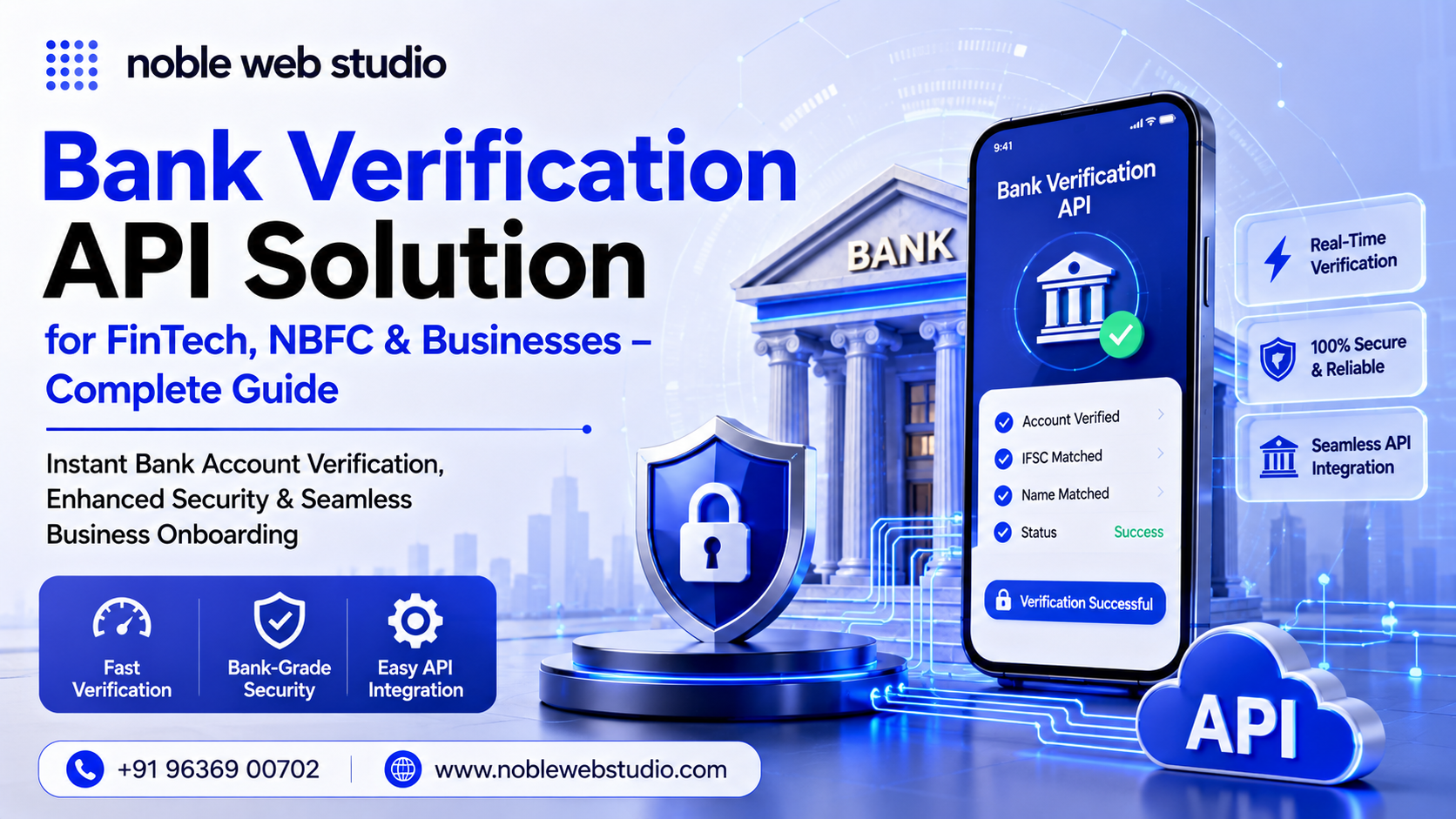
In today’s digital economy, businesses need to verify bank account details quickly, securely, and accurately before processing payments, onboarding customers, or completing financial transactions. This is where a Bank Verification API Solution becomes essential. It helps businesses verify bank account information in real time, reducing manual work, preventing payment failures, and improving customer trust.
A Bank Verification API is a smart technology that allows businesses to instantly validate bank account details through a secure Bank Verification API connection. Instead of manually checking account information, companies can automate the verification process within seconds. This saves time, improves operational efficiency, and minimizes the risk of incorrect or fraudulent bank account details.
A Bank Verification API instantly validates and cross-checks account ownership, account status, and routing details (like IFSC codes) against official banking records. It typically uses penny-drop technology (depositing and reversing ₹1) or Open Banking connections to verify account legitimacy in real-time, preventing transaction failures and fraud.
A best Bank Verification API Solution is widely used by fintech companies, banks, NBFCs, payment gateways, lending platforms, insurance companies, payroll providers, e-commerce businesses, and digital service providers. It supports secure customer onboarding, vendor verification, merchant registration, refund processing, salary disbursement, and business payment verification.
One of the biggest advantages of using a Bank Account Verification API is real-time verification. Businesses can instantly confirm whether the account details are valid before initiating a transaction. This helps reduce failed payments, improve transaction success rates, strengthen compliance, and provide a smoother customer experience.
An advanced Bank Verification API Solution also offers secure Bank Verification API integration, fast response times, encrypted data transfer, high availability, and seamless scalability. These features make it suitable for businesses of all sizes, from startups to large enterprises handling thousands of financial transactions every day.
A modern Bank Account Verification API is designed for quick integration, secure data processing, and reliable performance. It helps businesses automate verification workflows, improve transaction success rates, and deliver a seamless customer experience. Real-time account verification also increases trust by ensuring payments are sent to valid bank accounts.
Noble Web Studio offers advanced Bank Verification API Solutions that are secure, scalable, and easy to integrate with websites, mobile apps, fintech platforms, and enterprise systems. With fast response times, robust security, and dedicated technical support, businesses can simplify bank account verification and build a more efficient digital payment ecosystem.
In this guide, you’ll learn what a Bank Verification API Solution is, how it works, its key features, business benefits, integration process, and why it has become an essential tool for modern businesses across India.
What is a Bank Verification API Solution?
A Bank Verification API Solution is a digital tool that allows businesses to instantly authenticate and verify a user’s bank account details in real-time. By acting as a secure bridge between your software and the banking network, it ensures the provided name, account number, and routing details (like an IFSC code) are accurate and active.
Noble Web Studio is one of India's most trusted Bank Verification API providers offering instant verification, 99% success rate, easy integration, and pricing starting from just ₹3 per verification.
In simple words: Imagine you are about to pay a vendor ₹50,000. But what if the account number they gave you is wrong, closed, or fake? Your money could be lost or sent to the wrong person.
A Bank Verification API Solution stops this from happening. With one click, it tells you:
- Is this bank account real?
- Is it active or closed?
- Does the name match the account holder?
- Is the IFSC code correct?
All in less than 3 seconds.
Who built this technology? Companies like Noble Web Studio build Bank Verification API solutions in line with NPCI, RBI, and UIDAI guidelines, ensuring that every check is secure, legal, and reliable.
How Does a Bank Verification API Solution Work? (Step-by-Step)
A Bank Verification API solution securely validates an individual’s or business’s bank account information in real-time. It functions as a digital bridge between your business and banking networks, instantly cross-checking submitted data against official banking records to confirm account status and ownership.
How It Works: Step-by-Step
- User Input: The customer or vendor enters their basic banking details (such as account number, routing/IFSC code, and legal name) on your platform or app.
- API Call & Encryption: Your system transmits this data securely (usually via REST Bank Verification API) to the Noble web studio servers.
- Data Validation: The Bank Verification API system connects to the target financial institution or a secure inter-bank consortium network to check if the account number corresponds to a real bank branch.
4. Verification Checks:
- Active Status: The Bank Verification API checks if the account is active, frozen, or closed.
- Name Matching: The Bank Verification API runs advanced (fuzzy) name-matching algorithms to compare the submitted name against the bank’s official records.
- Penny Drop: Bank Verification API automatically deposit a micro-amount (e.g., ₹1 or a few cents) into the bank account. If the deposit succeeds, it proves the account is active and captures the exact registered beneficiary name.
5. Response & Action: The Bank Verification API returns a response to your system (e.g., verified, invalid, or name mismatch). Based on this response, your platform either approves the transaction, halts for manual review, or prompts the user to correct the information.
- Total time: Less than 3 seconds.
- Result: Zero failed transactions, zero fraud, 100% trust.
Types of Bank Verification API
Bank Verification API are essential digital tools used by businesses to instantly validate a customer’s bank account details, confirm account ownership, and prevent fraudulent transactions.
These Bank Verification API are categorized into several primary types based on how they process the validation:
1. Penny Drop / Micro-Deposit Verification
The most common type in regions like India, this Bank Verification API deposits a very small, random amount (e.g., ₹1) into the user’s bank account.
- How it works: The bank instantly returns the actual beneficiary name registered with that account number. The business then cross-checks this name with the user’s provided Bank Verification API onboarding details.
2. Reverse Penny Drop
Instead of the business sending money to the user, the user is prompted to initiate a tiny transfer to a designated virtual payment address (VPA) or corporate account.
- How it works: The successful incoming transaction acts as proof of account ownership, and the system automatically refunds the small amount back to the user.
3. Penny-less (or Zero-Balance) Verification
A modern, frictionless solution that authenticates an account without the need to actually transfer any funds.
- How it works: The Bank Verification API communicates directly with the banking or payments network (such as NPCI in India) to validate if the combination of the account number and IFSC/routing code is active and matches the user’s name.
4. Instant Account Verification (IAV) / Open Banking
Often associated with Open Banking frameworks (like Noble web studio in the Account Aggregators in India).
- How it works: The user securely logs into their online banking portal directly through a widget or secure bridge. This allows the Bank Verification API to pull real-time account status, transaction history, and account holder details in milliseconds.
5. Document-Based Verification
Useful when digital/Bank Verification API communication with the bank isn’t feasible or for international verifications (like Noble web studio).
- How it works: The customer uploads a bank statement, a voided check, or a passbook photo. The Bank Verification API uses Optical Character Recognition (OCR) and AI to scrape the data, verify the document’s authenticity, and confirm the account details.
6. IBAN / SWIFT Validation
Predominantly used for international and cross-border transactions.
- How it works: Validates international bank routing, SWIFT/BIC codes, and IBAN formats to ensure an overseas payment is directed to an active, properly structured foreign account.
Who Needs a Bank Verification API Solution?
Bank Verification APIs automate and secure fund transfers by instantly validating account details and the associated user’s name. They reduce payment failures, prevent fraud, and ensure compliance with anti-money laundering (AML) protocols.
If your business sends money, collects payments, or Bank Verification API onboard customers/vendors, you need it. Here’s a list of businesses that use Bank Verification API Solutions every day:
The primary industries relying on this technology include:
- Fintechs & Payment Gateways: To verify user identities during onboarding, facilitate seamless digital wallet activations, and process safe payouts.
- Banks & NBFCs: For loan disbursal & customer verification
- Lending & Credit Platforms: To validate a borrower’s bank details and ensure account ownership before disbursing loans, preventing transfer failures or fraud.
- E-Commerce & Marketplaces: Retailers validate vendor and customer bank accounts to ensure seamless payouts, accurate refunds, and to prevent transaction fraud.
- Recharge & DMT Portals: For wallet payouts to retailers
- Gig Economy & Payroll: Companies automatically verify the bank accounts of freelancers and employees before bulk payouts, preventing payment errors and delays.
- EdTech Companies: For refunds & scholarship payouts
- Insurance & Investment: These Bank Verification API platforms instantly authenticate user accounts during onboarding and before processing premium payments or claim disbursals.
- Real Estate (PropTech): Used to securely manage and automate RERA-compliant escrow accounts and split payments between developers and financial institutions.
- Government & DBT Schemes: For subsidy & pension distribution
- SaaS & Subscription: Subscription services use verification to prevent failed transactions for recurring billing.
- Lending Apps: For borrower verification
- HR & Payroll Systems: To validate employee salary accounts, minimizing transfer failures and payroll processing errors.
Noble web studio must operate in compliance with financial and data regulations (such as the RBI KYC norms or the DPDP Act in India), ensuring the proper handling of user data and audit trails.

Documents Required for Bank Verification API
A Bank Verification API requires three primary data points from the user: the Bank Account Number, the IFSC Code, and the Account Holder’s Name. Physical documents are not transmitted directly to the Bank Verification API, but are instead used by the user to establish the digital information.
Required Data Elements
To execute a verification (often using a “penny drop” method), the following inputs must be passed into the Bank Verification API request payload:
- Account Number: The target bank account to be verified.
- IFSC Code: The unique branch identifier for the bank.
- Account Holder Name: The exact name associated with the bank account for validation and matching.
Physical Documents (For Digital Retrieval)
For workflows that automate the extraction of these details (such as eKYC or Digital Locker integrations), the underlying system relies on the user’s Officially Valid Documents (OVDs):
- Identity Proof: PAN Card (mandatory for most financial transactions), Aadhaar Card, Passport, or Voter ID.
- Bank Proof: Cancelled cheque, bank statement, or passbook to verify the account number and IFSC.
Requirements of Bank Verification API
A Bank Verification API authenticates bank account details in real-time. It requires three primary inputs: Account Number, Bank IFSC, and Account Holder Name. The Bank Verification API system validates the account’s existence and executes a “penny drop” to verify ownership and calculate a name-match percentage.
1. Mandatory Data Inputs
To initiate a verification request, you must submit the following parameters:
- Account Number: The recipient’s bank account number.
- IFSC: The 11-character alphanumeric code for the bank branch.
- Name: The account holder’s name for ownership verification.
2. How the Verification Works
- Penny Drop Method: The API credits a nominal amount (e.g., ₹1) into the provided account to verify if it is active and accepting transactions.
- Name Match Logic: The Best Bank Verification API Solution returns the exact account holder name registered with the bank. It calculates a match percentage against the submitted name to prevent fraud or typos.
3. Technical Requirements
- Secure Communication: All Secure Bank Verification API Solution calls must be made over HTTPS (TLS 1.2 or higher).
- Authentication: Requests require secure authentication using an Online Bank Verification API Key, OAuth2, or JWT tokens.
- Input Sanitization: Client-side inputs must be sanitized to prevent injection attacks before reaching the endpoint.
4. Compliance & Security Best Practices
- User Consent: You must obtain explicit user consent before verifying their details and log the timestamp to comply with data privacy laws (like the DPDP Act in India).
- Data Encryption: All Personally Identifiable Information (PII) must be securely encrypted both in transit and at rest.
- Logging and Auditing: Every Instant Bank Verification API attempt should be logged securely, masking sensitive numbers for fraud pattern analysis and auditing.
Why Use Bank Verification API
A Bank Account Verification API is a tool that authenticates the validity and ownership of a bank account in real time. Businesses rely on it to instantly cross-check details like account numbers and routing/IFSC codes against bank records, ensuring payouts and disbursements reach the intended beneficiary.
Key reasons to use a bank verification API include:
- Instant Fraud Prevention: It deters synthetic identity theft and unauthorized transactions by verifying that the account is active, open, and legally belongs to the intended user.
- Elimination of Payment Failures: By pre-verifying account parameters, businesses prevent failed transactions, penalties, and costly reversals caused by manual data entry errors.
- Automated Compliance: Bank Verification API Solution Services seamlessly generate digital audit trails to meet strict KYC (Know Your Customer) and AML (Anti-Money Laundering) regulatory requirements.
- Operational Efficiency: It reduces the dependency on slow, manual document checks or micro-deposit waiting periods (like penny drops), leading to faster customer onboarding and streamlined disbursements.
- Massive Cost Savings: Automating these checks reduces operational and manual reconciliation costs by accelerating processing times.

Top Use Cases of Bank Verification API
A Bank Verification API instantly validates account authenticity and ownership. It matches user details with bank records, ensuring funds transfer correctly and preventing fraud.
Top Use Cases
- Secure Loan Disbursal: Lenders and NBFCs verify a borrower’s banking details to release funds safely, preventing misdirected transfers.
- Vendor & Partner Payouts: Businesses validate vendor accounts before processing transfers to guarantee accuracy and reduce transaction reversals.
- Salary & Gig Payroll: HR platforms and gig-economy apps instantly onboard workers and verify accounts for on-time payroll delivery.
- Customer Refunds & Withdrawals: E-commerce stores and investment apps secure financial payouts by matching registered account holders, eliminating failed transfers.
- Compliance & KYC: Organizations automatically comply with Anti-Money Laundering (AML) mandates and perform digital name-matching, creating audit-ready transaction logs.
Real-World Use Cases & Industries
Here are real examples of how Bank Verification API Solutions are used:
| Industry | Use Case |
|---|---|
| Lending | Verify borrower account before loan disbursal |
| E-commerce | Verify seller account before payouts |
| Insurance | Verify customer account before claim settlement |
| HR & Payroll | Verify employee salary accounts during onboarding |
| Gig Economy | Verify driver/delivery partner accounts for daily payouts |
| Government | Verify beneficiary accounts for DBT, pensions, MNREGA |
| Fintech Apps | Verify user account during signup/KYC |
| B2B Marketplaces | Verify vendor account before placing orders |
| Wealth Management | Verify investor accounts for mutual funds, broking |
| Recharge Portals | Verify retailer account for commission settlement |
Key Aspects of Bank Verification API
A Bank Account Verification API is a digital interface that instantly validates bank account details (such as account numbers and IFSC/routing codes) to confirm account ownership and authenticity. It replaces manual checks with real-time, automated screening to prevent fraudulent transactions and failed payouts.
Core Functionality & Features
- Name & IFSC Matching: Cross-references the account holder’s name and IFSC/routing code against banking databases to ensure the recipient is the intended party.
- Penny Drop Verification: Temporarily deposits a nominal amount (e.g., ₹1) to confirm the account is active, valid, and able to receive funds.
- Real-Time Status Checks: Instantly checks if an account is frozen, closed, or restricted before any transaction is executed.
Primary Use Cases
- Customer Onboarding: Seamlessly validates user bank details during registration to reduce drop-offs and data entry errors.
- Vendor & Payout Management: Protects against payout failures and ensures funds are correctly routed to legitimate businesses or individuals.
- Lending & Underwriting: Assists lending bank account validation API platforms in verifying borrower details and establishing financial trust prior to loan disbursements.
Compliance & Security
- KYC & AML: Automatically enforces Know Your Customer (KYC) and Anti-Money Laundering (AML) mandates, protecting businesses from legal liabilities.
- Data Privacy: Ensures sensitive financial information is handled securely and in compliance with data privacy regulations.
- Audit Trails: Generates transaction and verification logs to satisfy regulatory and internal audits.
Why Bank Account Verification APIs Matter
A Bank Account Verification API automatically validates bank account details (such as account number and IFSC) in real-time. It securely cross-checks information against financial institutions to confirm account ownership and status.
This technology matters for several critical reasons:
Key Benefits at a Glance
- Instant Fraud Prevention: Reduces payment fraud by verifying that a recipient’s account is active, open, and belongs to the correct beneficiary before transferring funds.
- Elimination of Transaction Failures: Drastically cuts down on failed payments, bounce-backs, and chargebacks caused by mistyped account numbers or IFSCs.
- Regulatory Compliance: Automates audit trails required for KYC (Know Your Customer) and AML (Anti-Money Laundering) mandates, ensuring adherence to financial regulations.
- Frictionless Onboarding: Prevents user drop-offs by dropping the need for manual, days-long document reviews in favor of seamless, real-time validation (often using a “penny drop” method).
Core Use Cases
- Vendor & Payroll Payouts: Ensures salaries and vendor invoices are routed directly to the intended, verified bank account.
- Digital Wallets & Fintech: Allows users to link their bank accounts securely and instantly without manual data entry.
- Loan Disbursal: Confirms the borrower’s identity and account legitimacy instantly before approving financial disbursements.

What Can You Verify With Bank Account Verification APIs
A Bank Account Verification API verifies the authenticity, ownership, and status of a bank account in real-time. Using a minor transaction (like a “penny drop”) or open banking integration, it instantly cross-checks details with banking systems to prevent fraud and failed transactions.
You can verify and retrieve the following details:
1. Account Authenticity & Ownership
- Account Validity: Confirms if the provided account number and IFSC Code actually exist and are active.
- Account Holder Name: Retrieves the exact name registered with the bank for the account.
- Name Match Status: Compares the name you collected against the bank’s official records to return a match status (Exact, Partial, or Mismatch).
2. Banking Infrastructure Details
- Bank & Branch Name: Identifies the full name of the associated bank and the exact branch location attached to the IFSC code.
- Supported Transfer Modes: Confirms the payment rails the bank supports (e.g., IMPS, NEFT, RTGS).
3. Risk & Compliance Verification
- AML & Fraud Prevention: Ensures funds are not sent to “mule” or fraudulent accounts, which is critical for Anti-Money Laundering (AML) compliance.
- KYC Adherence: Fulfills core Know Your Customer (KYC) requirements by establishing actual account ownership before payouts or onboarding.
- Audit Trails: Generates verifiable timestamps and match records to prove compliance with data privacy regulations like the DPDP Act.
How Many Banks Are Supported By Bank Verification API
The number of banks supported by a real time bank verification API depends entirely on the Noble web studio you are using. Because there is no single universal API, coverage varies:
- In India: Bank Verification API support 600+ banks, covering nationalized, private, rural, and cooperative banks.
- Global/North America: Noble web studio integrate with over 12,000 financial institutions across the U.S. and Canada.
- Europe: Noble web studio like Enable Banking support around 2,700+ banks across 30 European countries.
Real-Time Bank Account Verification Process
Real time bank account verification is an automated, secure process that validates a user’s banking details such as account number and routing/IFSC code in seconds. It replaces manual document reviews with Real Time Bank Account Verification for Lenders technology, eliminating data-entry errors and reducing fraud.
There are three primary methods used for instant bank account validation:
1. API-Based Micro-Deposits (“Penny Drop”)
This method is highly common in regions like India (using UPI networks or IMPS) and globally for direct debits.
- The Process: The user enters their Account Number and IFSC/Routing Number on your Bank Verification API Solution Platform.
- Validation: The system instantly transfers a small nominal amount (e.g., ₹1 or $0.01) to the account.
- Confirmation: The bank Account Validation API cross-references the official account holder’s name stored at the bank and returns a match status (Exact/Partial/Failed) and confidence score.
2. Open Banking & OAuth Log-in (Credential-Based)
Often considered the fastest and most secure method, popular services like Noble web studio allow users to securely link their bank accounts without exposing passwords.
- The Process: The user grants consent to connect their bank and is securely routed to their bank’s portal (via OAuth).
- Verification: Once the user logs in, the Bank Details Verification API platform retrieves real-time account data, balance, and transaction history using secure token authentication.
- Completion: The Penny Drop Verification API system verifies account ownership and balance instantly, passing this data securely to the requesting entity.
3. Database & Name Matching
This happens instantly in the background and is strictly used to check that an account exists.
- The Process: The user provides their account details and name.
- Validation: The bank Account Validation API queries the central banking database to see if the branch and account combination is real.
- Matching: An algorithm uses fuzzy-matching to see if the name provided matches the legal name on file at the institution.
The Growing Digital Payments Landscape with Bank Verification API
The digital payments landscape has scaled exponentially, with Unified Payments Interface (UPI) handling billions of monthly transactions. To combat rising transaction frauds and payout failures, businesses utilize a top Bank Account Verification API to instantly validate beneficiary names and account details.
As digital transaction values have surged reaching over ₹29.53 lakh crore in a single month across 691 live banks on UPI the risk of fund transfers to unverified accounts has correspondingly grown. Consequently, regulatory bodies mandate strict compliance and authentication prior to releasing funds.
Core Benefits of Bank Verification APIs
- Instant Ownership Confirmation: Securely validates if the provided name matches the bank records before initiating bulk disbursements or refunds.
- Fraud Prevention: Replaces traditional manual validation (such as penny-drop delays) to dramatically reduce payout failures, chargebacks, and anti-money laundering (AML) risks.
- Compliance & Security: Ensures real-time adherence to KYC Master Directions and DPDP Act requirements, maintaining secure audit trails of verification activities.
- Failed Transaction Elimination: By verifying details before a transaction is pushed, these APIs drastically improve successful payout rates often bumping standard rates up to 98-99%.
- Operational Efficiency: Saves up to 70% on labor costs by automating Know Your Customer (KYC) and Know Your Business (KYB) checks, driving Bank Account Verification API onboarding completion from days to under one second.
- Boosted User Confidence: As digital transactions continue to scale across, automated and instant confirmations foster critical trust between consumers, banks, and fintechs.
The Developer and Business Stack
Platforms and fintechs looking to embed financial identity verification into their products usually lean on specialized Bank Verification API Solution Services. Integrating these services creates a frictionless end-user experience while mitigating risks for platforms and banks alike.
How the Ecosystem Operates
- The Process: A business submits the account number and IFSC to the API. The API instantly pings the destination bank or NPCI database and returns the official registered name of the account holder.
- Key Use Cases: These Instant Bank Verification API Solution are heavily utilized for quick digital lending decisions, B2B vendor payouts, e-commerce onboarding, and P2P transfers.

Choosing the Right Bank Account Verification API
A Bank Account Verification API verifies account ownership, validity, and status in real-time. It prevents fraudulent payouts and misdirected funds. The right Bank Verification API streamlines Bank Verification API onboarding while meeting compliance mandates like KYC, AML, and data protection regulations (e.g., DPDP).
Choosing the Noble web studio requires evaluating core features to ensure Bank Verification API Solution India system reliability and security.
Key Factors to Consider
- Verification Methods: Choose Bank Details Verification API that support multiple methods tailored to your user experience. Common methods include penny drop (crediting ₹1 to establish an account exists and is active), penny-less verification, or reverse penny drop (RPD).
- Coverage and Uptime: Ensure the Noble web studio offers high availability (e.g., ≥ 99.9% uptime) and supports seamless verification across a wide range of regional and national banks.
- Security and Compliance: Prioritize robust encryption and automatic compliance with local data protection laws. In regions like India, built-in adherence to RBI guidelines is essential.
- Speed and Response Time: Look for API for Bank Account Verification that deliver validated data in milliseconds to avoid user drop-offs during onboarding or checkout flows.
Why Is Bank Account Verification Api Important for Businesses?
A Bank Verification API Solution for Businesses is a crucial automation tool that instantly validates if a bank account number and branch code belong to the intended recipient. It protects companies from financial loss by preventing payment failures, eliminating manual data-entry errors, and stopping fraud before funds leave the system.
Integrating Bank Verification API Solution for Businesses delivers several core operational advantages:
1. Fraud Prevention
- Identifies Illegitimate Accounts: Instantly flags frozen, closed, or fake bank accounts to prevent money laundering and internal embezzlement.
- Reversal and Scam Protection: Blocks malicious actors from using unauthorized or compromised identities to reroute payouts or refunds.
2. Elimination of Failed Transactions
- Validates Destination: Confirms that the account status allows for direct credits or debits prior to processing.
- Stops Misdirected Funds: Prevents expensive errors like sending employee salaries, vendor payouts, or customer refunds to the wrong account.
3. Streamlined Operations & Customer Onboarding
- Real-Time Authentication: Replaces slow, manual document reviews with automated API checks that verify data in seconds.
- Cost Savings: Lowers operational processing expenses by reducing the administrative time needed to track down bounced payments.
4. Regulatory Compliance
- AML & KYC Adherence: Automates essential Anti-Money Laundering (AML) and Know Your Customer (KYC) checks to easily meet banking and government regulations.
- Audit-Ready: Automatically generates digital trails required for compliance reporting.
Benefits of Bank Account Verification API Solution
A (BAV) Bank Account Verification API instantly authenticates the ownership, validity, and active status of bank accounts. It significantly reduces transaction failures, prevents fraudulent disbursements, and automates compliance with KYC/AML mandates by checking details directly against financial institution databases.
Integrating Bank Account Verification API solution provides several critical operational and security advantages:
Fraud and Risk Mitigation
- Prevents Misdirected Payments: Verifies that account numbers, names, and IFSC codes match before money is transferred, eliminating human error.
- Blocks Scams: Identifies compromised or synthetic identities instantly, protecting the business from account takeovers and financial loss.
- Reduces Failed Transactions: Ensures that the receiving account is active and can process funds, preventing penalties from failed ACH or banking transfers.
Cost and Operational Efficiency
- Automates Manual Checks: Slashing time-consuming, error-prone manual verifications cuts administrative and operational costs.
- Boosts Payout Success: Increases first-time payout success rates (often jumping to 98–99%) by validating account details preemptively.
- Speeds Up Onboarding: Enables real-time verification during user sign-ups or loan applications, reducing turnaround times from days to mere seconds.
Regulatory Compliance
- Streamlined KYC & AML: Automatically generates verifiable audit trails for KYC (Know Your Customer) and AML (Anti-Money Laundering) requirements.
- Regulatory Alignment: Keeps businesses compliant with evolving mandates from central banking authorities (such as the RBI in India or Nacha in the US).
Enhanced User Experience
- Frictionless Onboarding: Eliminates the need for users to upload canceled checks or physical bank statements, streamlining the registration or checkout process.
- Builds Trust: Provides secure and transparent transaction environments, which fosters long-term customer retention and loyalty.
Features of Bank Account Verification API Solution
A Bank Account Verification API securely validates recipient banking details in real-time before transactions are processed. It prevents failed payments, halts payout fraud, and guarantees compliance with financial regulations like KYC and AML.
Key features and capabilities of these solutions include:
Core Validation Features
- Name Matching & Verification: Cross-references the account holder’s name against official bank databases (often utilizing NPCI networks in India) and returns an AI-powered match score (e.g., Exact, Partial, or Mismatch).
- Penny Drop & Penny-less Methods: Uses instant ₹1 (or micro-deposit) transfers to confirm account activity, or secure “penny-less” database queries to instantly verify information without moving funds.
- IFSC & Branch Validation: Automatically validates IFSC codes, corrects branch details, and ensures standard routing.
- Account Status Check: Confirms if the destination bank account is active, dormant, frozen, closed, or restricted.
Risk & Security Capabilities
- Fraud Prevention: Blocks transfers to fraudulent actors or “mule accounts” by verifying true account ownership.
- Bulk Verification: Allows batch processing to verify thousands of merchant or vendor accounts simultaneously.
- Real-time Webhooks & Dashboards: Triggers instant notifications upon verification completion and provides visual monitoring dashboards for easy reconciliation.
Compliance & Data Privacy
- Regulatory Alignment: Aids regulated businesses in satisfying Reserve Bank of India (RBI) KYC guidelines, AML frameworks, and digital consent tracking.
- Data Security: Employs enterprise-grade data protection (e.g., HTTPS, AES-256 encryption at rest) and token-based authentication (OAuth 2.0 / JWT).
- Masked Logging: Prevents exposure of sensitive personal information by masking PII (Personally Identifiable Information) in audit logs.

Bank Account Verification API Integration
Integrating Bank Account Verification API often utilizing “penny drop” transactions or database lookups allows your application to instantly validate routing/account numbers and confirm the account holder’s legal name to prevent fraud and failed payouts.
Follow these concrete steps to implement the integration:
- Select a Provider: Noble web studio handle major banks through penny drop verification, while global options like Noble web studio provide direct account number and routing validations.
- Obtain API Credentials: Sign up on the Noble web studio provide platform and generate your Bank Account Verification API keys and Sandbox credentials for testing.
- Secure User Consent: Ensure compliance with data protection laws (like the DPDP Act in India). Present a consent screen to the user and log their permission before initiating the check.
- Build the Frontend UI: Create a form on your website or app requesting the user’s Full Name, Bank Account Number, and IFSC code (or routing number).
- Configure the Backend Endpoint: Set up an endpoint (e.g.,
/verify-account) in your backend to handle the request. Encrypt the payload and authenticate using OAuth2 or JWT tokens. - Test in Sandbox: Submit test credentials and mock user data in the Noble web studio sandbox environment to verify how the Bank Account Verification API responds (e.g., success, name mismatch, or timeout).
- Map API Responses: Program your backend to interpret the Bank Account Verification API output. If using a penny drop Bank Account Verification API, the bank will transfer a nominal amount (like ₹1) and return the exact Account Holder Name on file, which your system should cross-reference with the user-provided name using a fuzzy-matching algorithm.
- Implement Error Handling: Program fallback workflows for edge cases. If the Bank Account Verification API times out or the name does not match, trigger a manual verification process, such as asking the user to upload a cancelled check or bank statement.
- Go Live: Push your code to production using your live Bank Account Verification API keys.
Step-by-Step Bank Account Verification Process
Bank account verification secures funds, prevents fraud, and confirms account ownership. The process involves the user submitting basic details, the verifying party querying the institution, cross-referencing records, and receiving a validation outcome.
Depending on your region and the platform, the step-by-step process follows one of these common methods:
1. Open Banking / Instant Verification (Recommended)
This method connects directly to your financial institution for instant, secure authentication.
- Select Your Bank: Choose Noble web studio.
- Authenticate: You will be securely redirected to your bank’s login portal (or an OAuth-supported module).
- Grant Permission: Log in to your bank account and provide consent to securely share your account details.
- Confirmation: The system verifies your account and routing numbers, along with your name, instantly.
2. Micro-Deposit Verification
Typically used when open banking isn’t available, this manual process verifies account ownership by sending funds.
- Enter Details: Manually input your account number and routing/IFSC code into the verifying platform.
- Wait for Deposits: The name match API bank system will send two very small, random deposits (e.g., $0.05 and $0.12) to your bank account.
- Confirm Amounts: Check your bank statement and enter the exact amounts back into the bank verification platform to prove you have access to the account.
3. Penny Drop Verification (Common in India)
Frequently used in India, this method validates account holder names and codes without waiting days.
- Submit Information: Provide your account holder name, account number, and bank IFSC code.
- Transfer & Validate: The bank account validation platform deposits a single nominal amount (e.g., Re 1) to verify that the account is active.
- Name Match: The name match API bank system automatically cross-references the name on your bank records with the name provided during cheapest bank verification API onboarding.
4. Document-Based Verification
A traditional method for high-value accounts or manual reviews.
- Submit Documents: Upload a physical or digital copy of a bank statement, voided check, or a bank-issued verification letter.
- Manual Review: An agent reviews the document to ensure the account number, routing number, and your legal name match the registration details provided.
📞 Need Help? Our team is one call away.

Bank Verification API Cost and Price Structure
Bank Account verification API pricing and cost typically falls between ₹2.00 to ₹3.00 per successful transaction for standard pay-as-you-go models. Bank verification API cost scale depending on your chosen verification method, total transaction volume, and any upfront bank verification API setup fees.
1. Verification Methods & Costs
The exact pricing is highly dependent on the specific type of verification technology used:
- Penny Drop Verification: The most common method, where the Penny Drop Verification API deposits ₹1 into the user’s bank account to verify its active status and extract the account holder’s registered name. Costs range from ₹2.04 to ₹3.00 per successful transaction.
- Pennyless / Name Match: Validates the bank account, IFSC code, and the account holder’s name against banking databases without transferring funds. This method usually costs around ₹2.04 per transaction.
- Bank Search by IFSC: Standard lookup validation to confirm routing details before transactions, often costing around ₹0.18 per request.
2. Pricing Models
Noble Web Studio structure their services based on your business’s scale and frequency of use:
- Pay-As-You-Go (Prepaid/Postpaid): Best for unpredictable transaction volumes. Noble web studio often bundle this with Verify Bank Account API for PAN or Aadhaar verification.
- Annual/Bulk Contracts: Standard packages for bulk verification cost between ₹5,000 to ₹10,000 per year or per block of transactions.
3. Additional Fees & Setup Costs
- One-Time Setup: Noble Web Studio charge upfront integration or activation fees ranging from ₹3,000 to ₹5,000.
- Wallet / Testing: Noble Web Studio offer small testing balances (e.g., ₹100 in credits) to test integrations before Bank Account Verification API live deployment.
Noble Web Studio Pricing (Most Affordable in India):
- Per verification: Starting at ₹3
- Setup fee: ₹5,000 – ₹15,000 (depending on plan)
- Free sandbox testing
- Volume discounts for 10,000+ verifications/month
💡 Smart Tip: For high-volume businesses, the monthly subscription model is much cheaper than pay-per-use.
Here is a complete pricing snapshot for Bank Verification API Solutions in India:
| Cost Component | Price Range |
|---|---|
| Per Verification (Penny Drop) | ₹2 – ₹5 |
| Per Verification (UPI/IFSC) | ₹0.50 – ₹2 |
| One-Time Setup Fee | ₹4,000 – ₹20,000 |
| Monthly Subscription | ₹499 – ₹5,000 |
| Bulk Plans (10,000+ verifications) | Special discounts |
| Sandbox / Free Trial | ₹0 (Free) |
Bank Verification API Commission Structure
Bank Account Verification API typically follow a Pay-Per-Lookup model rather than a commission structure, costing between ₹0.18 to ₹3+ per Bank Account Validation API call. Costs vary based on volume and the verification method used (e.g., penny drop vs. penniless/instant lookups).
Typical API Cost Breakdown (Pay-Per-Use)
For businesses integrating Bank Verification API(e.g., for KYC, payouts, or loan disbursals), Bank Account Verification API costs are structured on volume tiers:
- Penny Drop Verification: A micro-transaction (usually ₹1) is deposited into the user’s account to authenticate the bank details and fetch their official name. Noble web studio charge between ₹1.5 to ₹3.00 per transaction (plus the cost of the ₹1 and gateway/bank charges).
- Bulk Verification: If you validate thousands of user or vendor accounts at once, bulk Bank Verification API rates usually drop as low as ₹0.18 to ₹0.50 per lookup.
- Instant Account Verification (IAV): Utilizes token-based OAuth connections to log directly into the bank to verify account ownership instantly. Because it relies on direct banking integrations, it is often priced higher (up to $1.50+ or ₹125+ globally, though Indian domestic rates vary based on Noble web studio packaging).
2. Available Provider Pricing Models
- Pay-Per-Use: Deducts a fixed amount from a prepaid wallet balance with every successful verification API call.
- Tiered Volume Pricing: Costs decrease as your monthly Bank Verification API call volume scales (e.g., higher volume packages cost ₹0.6 to ₹1.2 per call instead of ₹2.5).
3. Related Commissions (AePS & Payouts)
If you are looking for Bank Verification API commission structures in banking, it often refers to Aadhaar Enabled Payment Systems (AePS) rather than verification. In these models, businesses and retailers earn a commission instead of paying for a service:
- AePS Withdrawals: Retailers generally earn between ₹2.00 to ₹15.00+ per transaction depending on the withdrawal amount.
Pro Tips to Improve Your Bank Verification Success Rate
Improving your bank verification success rate involves balancing robust fraud prevention with a frictionless user experience. Best practices include implementing instant bank verification API to cut processing time, keeping forms simple, and offering alternative verification methods like micro-deposits or document uploads to reduce drop-offs.
Whether you are looking to optimize a digital Bank Verification API onboarding flow, protect corporate payments, or minimize user friction, the following strategies categorize the best methods for achieving success.
1. Optimize the User Experience (UX)
Improving the digital flow reduces abandonment and accelerates customer onboarding.
- Pre-fill Data: Auto-populate fields where possible (e.g., using information pulled from linked accounts or previously submitted identity documents).
- Provide Actionable Errors: Instead of generic “Invalid Account” notices, provide specific feedback (e.g., “The name on your bank statement does not match the name you provided”).
- Use Progress Bars: Break down verification into smaller, manageable steps.
- Display Security Badges: Reassure users by clearly communicating your data privacy policies and encryption standards.
2. Implement Instant API Verification
Transitioning from manual or document-based checks to real time bank verification APIs reduces processing times from days to seconds.
- Open Banking & Data Aggregation: Securely connect to the customer’s bank with their permission to instantly confirm account activity and ownership.
- Real-Time Validation: Use Online Bank Verification API to validate bank routing/IFSC numbers and confirm that the account is active and matches the user’s registered name before processing transactions.
- Reduce Manual Checks: Minimize the need for human review of voided checks or bank statements.
3. Establish Multi-Method Fallback Paths
Even the most advanced instant verification API systems encounter technical snags or edge cases where a user’s bank doesn’t support the Bank Account Verification API India.
- Micro-deposits: Send small, temporary test deposits (e.g., $0.75) and ask the user to verify the exact amounts to prove account access.
- Document Uploads: Allow users to upload a voided check, canceled check, or a recent bank statement.
- Manual Review: Provide an agent-assisted review or manual option for complex cases so users do not get entirely stuck in the funnel.
4. Track and Analyze Verification Metrics
You cannot improve what you do not measure. Use analytics to pinpoint where your users are abandoning the process.
- Monitor Drop-Off Rates: Track which fields or steps cause the highest abandonment or error rates.
- Time-to-Verify: Measure how long it takes a user to successfully complete the verification journey.
- Technical Analytics: Track technical failures, such as server timeout issues or browser-specific rendering bugs, to ensure system uptime.
How Bank Verification API Helps Prevent Fraud
A Bank Account Verification API prevents fraud by instantly validating the ownership, active status, and legitimacy of account details against trusted banking or clearinghouse records. It halts bad actors by executing these critical automated checks in milliseconds:
- Name Matching: Cross-references the account holder’s name with the bank’s registered data to ensure the recipient is the intended party.
- Active Status Verification: Confirms the account is open and active to prevent the use of frozen, dormant, or fake accounts.
- Account Validity Check: Validates combinations of routing numbers, account numbers, and SWIFT/IFSC codes to catch typos and synthetic fraud attempts.
The technology stops fraud across several specific use cases:
- Prevents Fake Disbursements: In digital lending or insurance payouts, it confirms account ownership before releasing funds, avoiding misdirected payments or “money mule” schemes.
- Stops Chargebacks & Bounced Payments: Validating an account upfront minimizes unauthorized transactions and subsequent chargebacks.
- Ensures Regulatory Compliance: It automates KYC (Know Your Customer) and AML (Anti-Money Laundering) checks to guarantee legal Bank Account Validation API onboarding of individuals and businesses.
- Protects Sensitive Data: By querying the bank directly, businesses avoid storing or mishandling sensitive financial data themselves.
Security, Data Encryption, and Compliance Standards Bank Account Verification API
A secure Bank Account Verification API validates account authenticity in real-time to prevent fraud and transaction failures. It relies on strict encryption protocols, token-based authorization, and regional regulatory compliance frameworks to protect Personally Identifiable Information (PII) throughout the verification process.
Core Security Measures
- Data in Transit: All communications must use HTTPS with TLS 1.2 or 1.3 to prevent eavesdropping and Man-in-the-Middle (MITM) attacks.
- Data at Rest: Sensitive financial data and PII stored on servers must be encrypted using strong cryptographic standards such as AES-256.
- Access Control: Endpoints are protected via token-based authentication like OAuth 2.0 or JWT (JSON Web Tokens) and Bank Details Verification API keys.
- Threat Mitigation: Infrastructure limits abuse through IP whitelisting, strict rate limiting, and routine penetration testing.
Data Encryption & Privacy
- PII Masking: Personally Identifiable Information (such as full account numbers and names) is masked in system logs and reports.
- Consent Framework: Trusted Bank Verification API workflows require explicit, logged user consent before validating or accessing bank details, per strict privacy guidelines.
- Penny Drop Validations: Bank Verification API Systems often execute Penny Drop Verification API to securely verify the account holder’s name and active status without storing sensitive credentials.
Global & Regional Compliance
- Regulatory Adherence: APIs align with financial mandates like KYC (Know Your Customer) and AML (Anti-Money Laundering).
- Data Localization & Privacy: Systems operating across regions must adhere to local privacy laws (e.g., GDPR in Europe, CCPA in California) and reserve processing within sovereign borders when mandated by financial regulators like the RBI.
- Payment Security: Bank Verification API Systems dealing with payments must comply with PCI DSS (Payment Card Industry Data Security Standard) requirements.

Common Issues With Bank Verification API
Integrating Bank Account Verification API often runs into common data-mismatch and technical errors during Bank Account Verification API onboarding, refunds, or salary disbursals.
Common issues generally fall into the following distinct categories:
1. Data Mismatch & User Errors
- Name Mismatch: The legal name provided by the user does not match the beneficiary name registered in the bank’s records. For instance, abbreviations (e.g., “Robert J. Smith” vs. “Robert John Smith”) frequently cause failed automated name-match checks.
- Typographical Errors: Transposed digits in account numbers or incorrect IFSC/routing codes.
- Mismatched Account Type: Passing a Savings account for an API expecting checking/current account information.
2. Banking Infrastructure & API Errors
- Account Status/Validity Issues: The account exists and is validly formatted, but the account itself is frozen, on legal hold, or closed.
- System Downtime: The destination bank’s internal servers are offline or undergoing maintenance, causing timeouts in Instant Bank Verification API requests.
- Legacy System Limitations: Connecting to older core banking systems can result in delayed responses or asynchronous data updates.
3. Fraud & Security Constraints
- Mule Accounts: Repeated failed name-matching verification often points to potential fraudulent or “mule” accounts.
- Rate-Limiting & Bot Attacks: Professional Bank Verification API often block excessive consecutive verification attempts to prevent brute-force or bot attacks, resulting in locked requests.
4. Integration & Format Technicalities
- Invalid Payload Parameters: Missing required fields (such as omitting the IBAN for international transfers or the account holder’s name for name verification) will result in bad request responses (e.g.,
400or422HTTP status codes). - Authorization Failures: Incorrect Bank Account Validation API keys or attempting to call the Bank Account Validation API from an unwhitelisted server IP can immediately halt the request.
What Problems Does Bank Verification API Solve?
A Bank Verification API solves critical digital payment and onboarding challenges by instantly cross-checking account details against official bank records. It prevents misdirected payments, blocks fraudulent vendor or beneficiary accounts, and reduces costly manual verification workflows.
Key Problems Solved
- Payment Failures & Reversals: Eliminates bouncing payments and payout errors caused by typos or incorrect routing (e.g., IFSC/SWIFT codes).
- Financial Fraud & Identity Theft: Blocks fake vendor accounts and prevents unauthorized disbursements by confirming the exact name match and account legitimacy.
- Regulatory Non-Compliance: Automates the extraction of audit trails to meet strict KYC (Know Your Customer) and AML (Anti-Money Laundering) requirements without manual spreadsheet tracking.
- Slow Onboarding: Removes the need for users to upload voided checks or wait days for micro-deposits to settle, creating a frictionless user experience.
- High Verification Costs: Slashes manual data entry and document review expenses, automating a process that would otherwise take hours of staff time.
How Developers & Businesses Use It
Businesses integrate these tools into their payout, lending, and onboarding flows to:
- Validate Account Existence: Confirm if the provided account is active and operational.
- Verify Account Ownership: Ensure the account truly belongs to the individual or entity making or receiving the payment.
How to Choose the Best Bank Verification API Provider
Noble web studio one of the best Bank Verification API Provider involves balancing bank coverage, accuracy, security protocols, and integration ease. Evaluating these core factors helps streamline customer onboarding, reduce transaction failures, and protect against financial fraud.
Review these key elements when making your decision:
1. Bank Coverage and Accuracy
- Extensive Network: Ensure the Noble web studio covers a vast network of banks, including public, private, rural, and cooperative banks (especially critical for India’s diverse financial ecosystem).
- Match Precision: Look for right Name Match Verification API that offer precise real-time name matching (exact vs. partial) alongside Account Number and IFSC validation to drastically cut down on failed transactions.
2. Security and Regulatory Compliance
- Data Privacy: Verify that the Noble web studio complies with local data protection and banking standards.
- Encryption & Architecture: Check for robust security practices such as encrypted payloads, tokenization, OAuth 2.0 authentication, and OWASP-aligned development.
3. Integration Capabilities & Developer Support
- Tech Stack Compatibility: The Bank Account Verification API should integrate seamlessly with your existing infrastructure using REST architecture and offer well-structured documentation or SDKs in your preferred programming language.
- Testing Environments: Evaluate if they provide reliable sandbox/testing environments that allow your development team to test Bank Verification API response times and failure rates prior to production.
4. Performance and Scalability
- Uptime Reliability: High uptime (e.g., 99.9%) is non-negotiable to handle peak traffic without bottlenecks during payday or festive seasons.
- Scalability: The Bank Details Verification API must be capable of processing high transaction volumes effortlessly as your platform grows.
5. Pricing Models and Support
- Cost Efficiency: Choose billing structures that fit your scale, whether through pay-per-use, subscription models, or tiered plans.
- Customer Support: Ensure the Noble web studio offers solid, real-time technical support or solution architecture guidance so they act as an extension of your team.
Why Noble Web Studio Is India’s #1 Bank Verification API Provider
Noble Web Studio is widely recognized as a top bank verification API provider in India due to its high accuracy, real-time transaction speed, and cost-effectiveness. The bank verification AP platform enables businesses to instantly validate beneficiary accounts, prevent fraud, and automate digital Verify Bank Account API onboarding.
Noble Web Studio has helped 500+ businesses across India launch secure, scalable Bank Verification systems. Here’s why we stand out:
Key reasons to choose a Noble web studio include:
- Trusted by 500+ Businesses: Fintechs, NBFCs, e-commerce, and more
- Fraud Prevention & Accuracy: Bank Verification API instantly confirm if a beneficiary name matches bank records and utilize features like “penny drop” (micro-deposits) to verify that an account is active and genuine, heavily reducing the risk of unauthorized transfers.
- Regulatory Compliance: Noble web studio automate required checks for KYC (Know Your Customer) and AML (Anti-Money Laundering), maintaining audit trails that help businesses stay compliant and avoid financial penalties.
- High Volume Ready: Process thousands of requests per second
- 140+ Banks Supported: Public, private, regional, and co-operative banks
- Bank-Grade Security: End-to-end encryption + RBI compliance
- Real-Time Account Verification: Instantly authenticates customer names and verifies bank account status, preventing failed transactions and reducing fraud.
- Cost-Effective API Calls: Offers highly competitive per-lookup pricing, reducing operational costs for high-volume processors.
- Most Affordable Pricing: Starting at just ₹3 per verification
- Fastest Response Time: Results in under 2 seconds
- All-in-One: Penny Drop + UPI + Name Match + IFSC in one Bank Account Verification API
- Bulk Verification Support: Allows Bank Verification API platform to process multiple bank and UPI IDs simultaneously, which is highly beneficial for large-scale payroll processing and bulk refunds.
- Reduced Payment Failures: By verifying bank details (e.g., account number and IFSC code) prior to processing transactions, businesses cut down on bounced or reversed payments.
- Streamlined Customer Onboarding: Eliminating manual data entry accelerates the registration and loan disbursement process, resulting in a frictionless user experience and fewer application drop-offs.
- Free Sandbox: Test before you pay
- Developer-Friendly Integration: Provides seamless integration capabilities, Bank Verification API software development kits (SDKs), and thorough Bank Verification API documentation for quick deployment.
- Scalability & Integrations: Noble web studio offer Bank Verification API that connect with hundreds of banks, handle bulk verifications, and provide 99.9% uptime to support peak traffic periods like paydays.
- 24/7 Support: Real human help via call, chat, WhatsApp

Conclusion
A Bank Verification API Solution is an essential tool for businesses that want to verify bank account details quickly, securely, and accurately. Whether you run a fintech company, payment gateway, NBFC, lending platform, insurance business, or e-commerce website, a reliable Bank Verification API helps automate account verification, reduce payment failures, prevent fraud, and improve customer trust.
With real-time verification, secure Bank Verification API integration, high accuracy, and fast response times, businesses can simplify customer best Bank Verification API onboarding and create a better digital experience. Automated bank account verification also reduces manual work, saves time, lowers operational costs, and helps ensure that every transaction is processed with confidence.
A Bank Verification API instantly authenticates account ownership, validates IFSC/routing codes, and cross-checks the user’s name via methods like “penny drop” (depositing ₹1). It is vital for KYC/AML compliance, preventing fraudulent payouts, and eliminating failed transactions during customer and vendor onboarding.
One of the biggest advantages of using a modern Bank Verification API Solution is automation. Instead of manually checking bank account information, businesses can verify account details through secure Bank Verification API integration in just a few seconds. This saves valuable time, minimizes errors, and supports faster business growth.
Noble web studio is a professional Bank Verification API Provider should offer real-time verification, high Bank Verification API uptime, fast response times, strong data security, simple integration, accurate verification results, and dedicated technical support. These features help businesses build trust while maintaining compliance with industry standards.
Noble Web Studio provides a secure and scalable Bank Verification API Solution designed for businesses of all sizes. Our Bank Verification API solution supports fast bank account verification, seamless Bank Verification API integration, reliable performance, enterprise-grade security, and easy implementation. Whether you are building a fintech platform, payment application, lending solution, or business verification system, our API helps simplify your verification process.
If you are looking for a trusted Bank Verification API Provider in India, Noble Web Studio offers the technology and support you need to streamline verification, improve operational efficiency, and grow your business with confidence.
Get in touch with Noble Web Studio today to integrate a secure Bank Verification API Solution and simplify your business verification process.
Ready to Stop Fraud & Speed Up Payments?
👉 Book a FREE Demo with Noble Web Studio Today
📧 contact@noblewebstudio.com | 🌐 www.noblewebstudio.com
Frequently Asked Questions (FAQs) – Bank Verification API Solution
A Bank Verification API Solution is a secure API that helps businesses verify bank account details in real time. It checks information such as the account number, IFSC code, and account holder details to reduce payment failures, prevent fraud, and improve transaction accuracy.
A Bank Verification API connects your application with banking verification systems. When a customer enters their bank account details, the API securely verifies the information and returns the verification result within seconds. This makes the verification process fast, accurate, and automated.
A Bank Verification API helps businesses verify customer bank accounts before making payments or onboarding users. It reduces fraud, prevents incorrect transfers, improves compliance, and builds customer trust.
Businesses use a Bank Verification API Solution to:
Verify bank accounts in real time
Reduce failed transactions
Prevent payment fraud
Improve customer onboarding
Save time with automated verification
Increase payment accuracy
Enhance customer trust
A Bank Account Verification API is suitable for:
Fintech companies
Payment gateways
NBFCs and lending platforms
Insurance companies
eCommerce businesses
Payroll management companies
Investment platforms
Financial service providers
It helps businesses verify customer bank accounts quickly and securely.
A reliable Bank Verification API Solution can verify important bank account details, including:
Bank account number
IFSC code
Account holder name (where supported)
Bank branch information
Account validation status
The available verification data depends on the integration and banking network.
The main benefits include:
Real-Time Bank Account Verification
Faster Customer Onboarding
Reduced Payment Failures
Fraud Prevention
Improved Data Accuracy
Secure Digital Verification
Better Customer Experience
A high-quality Bank Verification API should include:
Real-time verification
High verification accuracy
Fast API response
Secure data encryption
Easy API integration
Detailed verification reports
Reliable technical support
Yes. A professional Bank Verification API uses secure encryption, authenticated API requests, and industry-standard security practices to protect sensitive banking information during the verification process.
Costs range from ₹2 to ₹5 per verification, with setup fees of ₹4,000 to ₹20,000. Noble Web Studio offers verification starting at ₹3 per transaction.
Yes. Noble web studio offer developer friendly Bank Verification API with complete documentation, SDKs, and technical support. This makes integration with websites, mobile apps, fintech platforms, CRM systems, and payment applications simple and efficient.
Yes. By verifying bank account details before initiating a transaction, businesses can significantly reduce failed transfers, incorrect payments, and refund-related issues.
Most modern Bank Verification API designed for quick integration and include developer-friendly documentation, allowing businesses to connect their applications with minimal development effort.
Yes. A real time Bank Verification API verifies bank account details within seconds, helping businesses automate their verification process.
By validating bank account details before processing transactions, the API helps businesses detect incorrect or invalid banking information, reducing financial risks and improving payment accuracy.
As digital payments, online banking, and fintech services continue to grow, Bank Verification API are becoming essential for secure customer onboarding, automated verification, and faster financial transactions across India.
Yes. Startups, fintech companies, payment aggregators, and enterprises can easily integrate a Bank Verification API Solution into their websites, mobile apps, ERP systems, or payment platforms.
All major Indian banks — including SBI, HDFC, ICICI, Axis, Kotak, PNB, BoB, plus 140+ regional and co-operative banks.
Penny Drop is a verification method where a tiny amount (₹1) is sent to the bank account to confirm it’s real and to fetch the registered holder’s name.
While not legally mandatory for every business, it’s strongly recommended for any company that handles payments, payouts, KYC, or vendor onboarding — to stay safe and compliant.
Yes. It works for all types of bank accounts — savings, current, salary, NRI, and joint accounts.
Yes. Noble Web Studio supports bulk verification via Excel/CSV upload or API you can verify thousands of accounts in one request.
Most Bank Verification APIs complete verification in just a few seconds. Real-time verification helps businesses process payments faster, reduce delays, and improve the customer experience.
Before selecting a Noble web studio, consider the following factors:
Real-time verification speed
API uptime and reliability
Data security and encryption
Easy API integration
Comprehensive documentation
Scalability for business growth
Transparent pricing
Dedicated technical support
Choosing a Noble web studio ensures smooth verification, fewer transaction errors, and a better experience for both your business and your customers.
Yes. We provide a free sandbox environment so you can test the API completely free before going live.
NobleWebStudio provides secure, scalable, and easy-to-integrate Bank Verification API Solutions for businesses across India. Our APIs offer fast verification, high uptime, advanced security, reliable performance, comprehensive documentation, and dedicated technical support to help businesses automate bank account verification with confidence.