
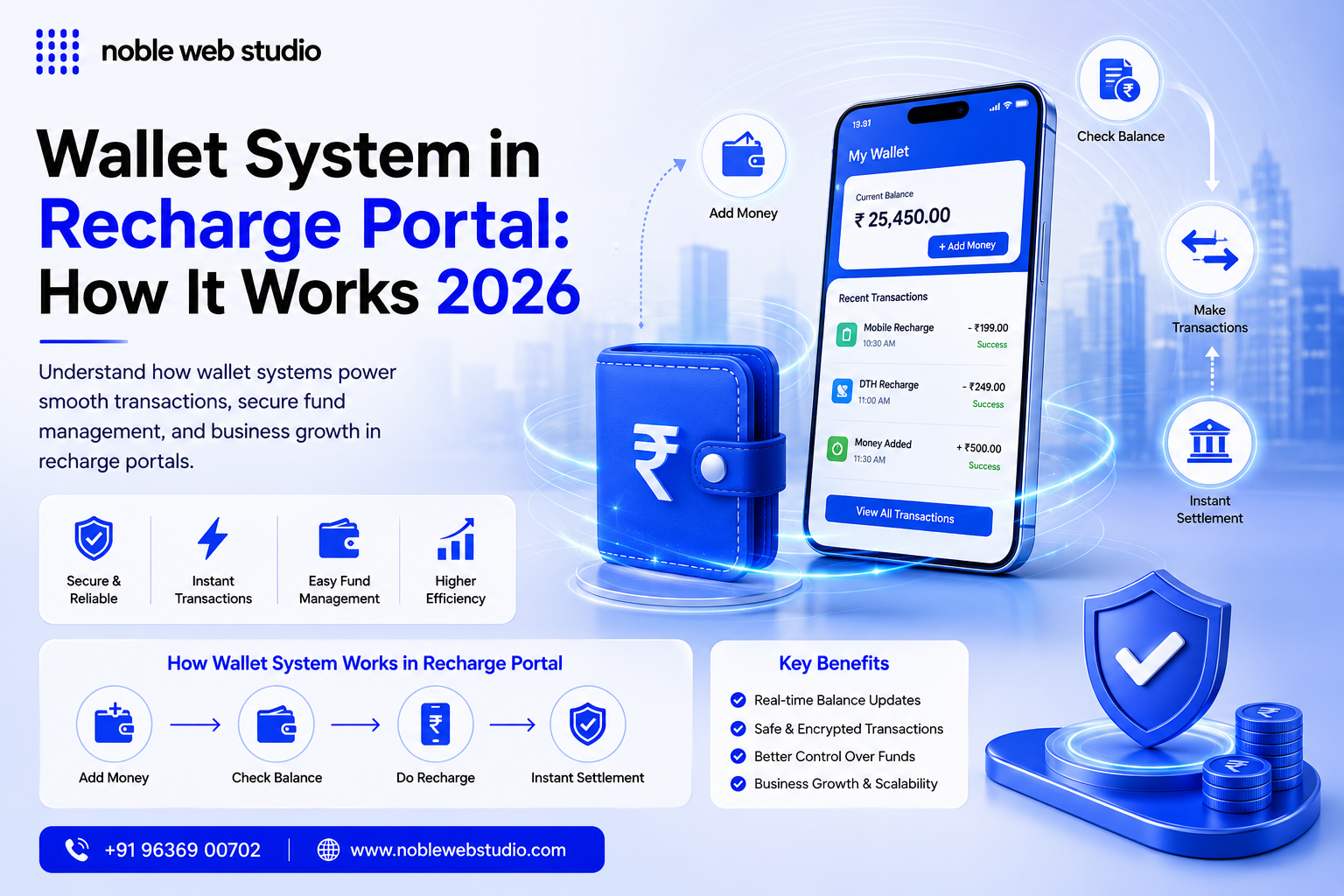
A wallet system is one of the most important components of any recharge portal. Whether you operate a B2B recharge platform, white-label recharge software, AEPS portal, BBPS platform, or multi-service fintech application, the wallet manages every financial transaction within the system. It allows distributors, retailers, and administrators to maintain balances, perform transactions, receive commissions, and track funds in real time.
Unlike traditional banking, a recharge portal wallet is designed for high-speed digital transactions. Every recharge request, bill payment, commission credit, refund, and settlement is processed through the wallet engine. A well-designed wallet system improves transaction accuracy, reduces manual work, and provides users with complete transparency.
Modern recharge software also includes multiple wallet levels such as Admin Wallet, Master Distributor Wallet, Distributor Wallet, and Retailer Wallet. These wallets work together to ensure smooth balance management across the entire distribution network.
In this guide, you will learn how a wallet system works, its architecture, transaction flow, major features, security measures, benefits, and why it is an essential part of every recharge portal.
What is a Wallet System in a Recharge Portal?
A wallet system in a recharge portal is a pre-paid digital account that stores funds, allowing users to execute one-click mobile/DTH recharges or bill payments without entering bank details for every transaction. It serves as the financial backbone of the platform, instantly managing debits, credits, commission tracking, and agent payouts.
Every transaction automatically updates the wallet balance. The software records each debit and credit entry, allowing users to track their financial activities with complete transparency.
A wallet system is commonly used in B2B recharge portals where multiple user levels operate together. Administrators can allocate funds to distributors, distributors can transfer balances to retailers, and retailers can use those balances to serve customers.
Read Blog :Best Mobile Recharge Software in India – Complete Recharge Business Platform (2026)
How Does a Wallet System Work? (Step-by-Step Process)
A digital wallet (or e-wallet) works by securely storing your payment information (like credit card or bank details) on your phone or computer. When you make a purchase, the system encrypts your data or creates a temporary, one-time code to authorize the transaction safely without revealing your actual card details to the merchant.
Here is the complete life cycle of money inside a recharge portal wallet:
| Step | Process | Description |
|---|---|---|
| Step 1 | Money Added to Wallet (Top-Up) | The retailer or distributor adds money through UPI, IMPS, Net Banking, Payment Gateway, or by requesting balance from the level above them. After payment verification, the portal credits the wallet, usually within a few seconds for online payment methods. |
| Step 2 | Real-Time Balance Update | As soon as the wallet is credited, the available balance is updated instantly on the dashboard. Most advanced recharge portals also send an SMS, email, or mobile app notification for every wallet credit to maintain complete transparency. |
| Step 3 | Recharge Transaction (Debit) | When a retailer initiates a recharge (for example, ₹239), the system first verifies whether the wallet has sufficient balance and checks for duplicate requests. After successful validation, the amount is deducted and forwarded to the recharge API. |
| Step 4 | Operator Processing | The recharge API submits the transaction to the respective telecom operator. Within a few seconds, the operator returns one of three responses: SUCCESS, FAILED, or PENDING. |
| Step 5 | Status Update & Auto Refund | If the recharge is successful, the transaction is marked as completed. If it fails, the deducted amount is automatically returned to the wallet through an auto-reversal process. For pending transactions, the amount remains on hold until the operator provides the final confirmation. |
| Step 6 | Instant Commission Credit | After every successful recharge, the system automatically calculates the commission according to the user’s commission slab. The retailer receives their commission, the distributor earns the network margin, and the admin retains the platform margin through a fully automated settlement process. |
Read Blog : Fast Recharge API: Complete Guide for Retailers and Startups
Who Uses Recharge Wallet Systems?
Recharge wallet solutions are widely used by:
- Recharge portal owners
- B2B retailers and distributors
- White-label recharge providers
- Fintech companies
- Digital payment platforms
- Multi-service utility payment businesses
Why a Wallet System is Important
Without a wallet system, every transaction would require manual payment processing, resulting in slower service and increased chances of errors.
A wallet system offers several important advantages:
- Instant balance deduction
- Faster recharge processing
- Automated commission calculation
- Secure transaction records
- Easy balance transfers
- Real-time wallet updates
- Transparent financial management
- Reduced operational workload
For fintech businesses handling thousands of daily transactions, a wallet system ensures smooth financial operations and better user experience.
Types of Wallets in a Recharge Portal
A professional recharge portal does not have just one wallet. It has a multi-level wallet structure, where each user role gets its own wallet:
| Wallet Type | Who Uses It | Main Purpose |
|---|---|---|
| Admin Wallet | Portal Owner | Acts as the master wallet of the recharge portal. It stores the platform’s total funds, manages fund distribution to distributors, and receives platform margins from transactions. |
| Distributor Wallet | Distributors / Master Distributors | Receives funds from the admin wallet, transfers balance to retailer wallets, and earns commissions from the distributor network. |
| Retailer Wallet | Retailers, Shop Owners & Agents | Used for daily mobile recharges, bill payments, AEPS services, DTH recharges, and other customer transactions while earning per-transaction commissions. |
| Commission Wallet (Optional) | Admin, Distributors & Retailers | Maintains earned commissions separately from the working balance to improve accounting, reporting, and financial transparency. |
Fund flow always moves in a chain: Admin → Distributor → Retailer. This structure keeps accounting clean and lets every level track its own balance and earnings separately.
Wallet Transaction Flow
A recharge portal follows a structured transaction flow to maintain financial accuracy.
Typical wallet flow:
- User adds money.
- Wallet balance is updated.
- User initiates recharge.
- Balance verification begins.
- Recharge amount is deducted.
- API receives the recharge request.
- Operator processes the recharge.
- Success or failure response is received.
- Commission is calculated.
- Wallet ledger is updated.
- Final transaction status is displayed.
This automated workflow helps maintain consistency even during high transaction volumes.
Wallet Flow – Real Example
Let us see this with a full example of one day at a retailer’s shop:
| Activity | Debit | Credit | Wallet Balance |
|---|---|---|---|
| Morning top-up via UPI | — | ₹5,000 | ₹5,000 |
| Jio recharge ₹239 (2% commission) | ₹239 | ₹4.78 | ₹4,765.78 |
| Airtel recharge ₹299 — FAILED | ₹299 | ₹299 (auto-refund) | ₹4,765.78 |
| Tata Play DTH ₹400 (3% commission) | ₹400 | ₹12.00 | ₹4,377.78 |
| Electricity bill ₹1,200 (₹5 flat) | ₹1,200 | ₹5.00 | ₹3,182.78 |
Example: Wallet Flow for a ₹5,000 Wallet Balance
| Step | Action | Wallet Balance |
|---|---|---|
| 1 | Retailer adds money to wallet | ₹5,000 |
| 2 | Customer requests a ₹399 Jio recharge | ₹5,000 |
| 3 | System deducts ₹399 instantly | ₹4,601 |
| 4 | Recharge API processes the request | ₹4,601 |
| 5 | Recharge is successful | ₹4,601 |
| 6 | ₹8 commission is credited | ₹4,609 |
| 7 | Transaction is saved in wallet ledger | ₹4,609 |
Wallet Flow in Case of a Failed Recharge
| Step | Action | Wallet Balance |
|---|---|---|
| 1 | Wallet Balance | ₹5,000 |
| 2 | ₹399 Recharge Initiated | ₹5,000 |
| 3 | Wallet Deducted | ₹4,601 |
| 4 | Operator/API Failure | ₹4,601 |
| 5 | Auto Refund Process Started | ₹4,601 |
| 6 | ₹399 Credited Back to Wallet | ₹5,000 |
| 7 | Status Updated as Refunded | ₹5,000 |
Real-Life Wallet Scenario
Suppose a retailer starts the day with a ₹10,000 wallet balance.
| Transaction Details | Value |
|---|---|
| Opening Wallet Balance | ₹10,000 |
| Airtel Recharge | ₹299 |
| Wallet Balance After Deduction | ₹9,701 |
| Recharge Successful | Recharge Successful |
| Commission Earned | ₹6 |
| Updated Wallet Balance | ₹9,707 |
| DTH Recharge | ₹450 |
| Wallet Balance | ₹9,257 |
| Recharge Failed | Recharge Failed |
| Auto Refund | ₹450 |
| Final Wallet Balance | ₹9,707 |
Notice the failed Airtel recharge the amount came back automatically, and the balance stayed exactly correct. This is what a properly built wallet system does: not a single rupee is lost or unaccounted.
Types of Wallet Transactions
| Transaction Type | What It Means | Example |
|---|---|---|
| Credit | Money added to wallet | Top-up, commission, refund |
| Debit | Money deducted from wallet | Recharge, bill payment, fund transfer to retailer |
| Reversal | Failed transaction refunded automatically | Failed recharge amount credited back |
| Hold | Amount blocked till final status | Pending recharge under operator processing |
| Settlement | Wallet money moved to bank account | Commission withdrawal to bank |
Recharge Wallet System Architecture
A modern recharge wallet typically consists of the following components:
- Wallet database for storing balances and transaction records
- Transaction processing engine
- Recharge API integration layer
- Security and authentication module
- Reporting and analytics dashboard
- Notification service for transaction alerts
Read Blog: Recharge Platform Development Guide 2026
Common Types of Wallet Transactions
| Entry Type | Description |
|---|---|
| Debit Entry | Occurs when money is deducted from the wallet for services such as mobile recharge, DTH recharge, utility bill payments, or money transfers. |
| Credit Entry | Generated when funds are added to the wallet through deposits, commissions, cashback rewards, or transaction refunds. |
| Reversal Entry | Created when a failed or cancelled transaction is reversed, and the deducted amount is automatically credited back to the wallet balance. |
Commission Distribution
Recharge portals automatically calculate commissions based on predefined commission slabs.
When a successful transaction is completed:
- The retailer receives the retailer commission.
- The distributor receives the distributor commission.
- The master distributor receives their commission.
- The admin retains the remaining margin.
Automatic commission distribution reduces manual calculations and ensures timely earnings for all users.
Wallet Reports
A professional recharge portal provides comprehensive reporting tools that help businesses monitor financial performance.
Some of the most useful reports include:
| Report Type | Description |
|---|---|
| Wallet Summary Report | Displays the current wallet balance, total credits, total debits, and available balance to help users monitor their financial transactions in real time. |
| Recharge Report | Provides a complete list of all recharge transactions, including mobile operator details, recharge amount, commission earned, transaction ID, and current transaction status. |
| Commission Report | Shows commissions earned from services such as Mobile Recharge, Bill Payment, AEPS, Domestic Money Transfer (DMT), PAN Services, and other fintech transactions. |
| Settlement Report | Displays settlement records between Admin, Master Distributor, Distributor, and Retailer, ensuring complete transparency in wallet settlements. |
| Refund Report | Lists failed recharge refunds, refund processing status, reversal transactions, and successfully credited refund history. |
| User Activity Report | Tracks user login history, wallet activity, account usage, device access, IP logs, and important account actions for enhanced security. |
These reports simplify auditing and improve financial transparency.
Wallet Limits and Controls
Recharge portals often allow administrators to configure wallet usage limits.
Examples include:
- Minimum wallet balance
- Maximum wallet balance
- Daily transaction limit
- Maximum recharge amount
- Daily recharge count
- Distributor funding limit
- Retailer funding limit
These controls help businesses reduce financial risk while maintaining smooth operations.
Wallet Notifications
Real-time notifications improve communication between the portal and its users.
Notifications may include:
- Successful recharge
- Failed recharge
- Wallet credited
- Wallet debited
- Commission credited
- Refund completed
- Low wallet balance
- Settlement completed
- Security alerts
Notifications can be delivered through SMS, email, WhatsApp, or in-app alerts.
Wallet Security: How Your Money Stays Safe
Since the wallet holds real money, security is not optional. A trusted recharge portal protects the wallet with multiple layers:
| Security Feature | Description |
|---|---|
| 🔐 Login Security (Password + OTP Verification) | Password and OTP verification ensure that only authorized users can access the wallet, preventing unauthorized login attempts. |
| 🔑 Transaction PIN Protection | A separate transaction PIN is required for every debit transaction, providing an extra layer of security even if login credentials are compromised. |
| 🛡 SSL Encrypted Transactions | All wallet transactions are processed through secure SSL-encrypted servers to protect sensitive financial and user data. |
| ⚡ Duplicate Transaction Protection | The system automatically detects and blocks duplicate recharge or payment requests submitted accidentally. |
| 📱 IP & Device Verification | Login attempts from unknown devices or suspicious IP addresses require additional verification before access is granted. |
| 📋 Complete Audit Trail | Every wallet credit and debit transaction is recorded with the date, time, transaction ID, and activity logs for quick verification and dispute resolution. |
Wallet Settlement Management
Settlement management refers to the process of reconciling wallet balances between different user levels.
Settlement ensures that every debit, credit, commission, and refund is properly accounted for.
Recharge software may support different settlement models such as:
- Instant settlement
- Daily settlement
- Manual settlement
- Scheduled settlement
- Automatic settlement
Settlement reports help administrators verify that all financial transactions have been processed accurately.
Pending Transaction Management
Sometimes recharge operators do not return an immediate response. In such situations, transactions remain in a pending state until the final status is received.
Pending transactions are monitored continuously by the system.
Possible outcomes include:
- Success
- Failed
- Reversed
- Timeout
If the final response is unavailable within the configured period, the portal checks the operator status through API validation before deciding whether to process a refund.
Common Wallet Problems and Their Solutions
| Problem | Why It Happens | Recommended Solution |
|---|---|---|
| Balance Deducted but Recharge Failed | Operator delay in sending the failure status or transaction confirmation. | Wait a few minutes for the automatic refund. Do not retry immediately—always check the transaction status first. |
| Wallet Balance Mismatch | Missed reversal entry, duplicate debit, or synchronization issue. | Verify your wallet transaction history using the transaction ID and contact support if the issue continues. |
| Pending Transactions Stuck | Operator servers are slow or overloaded during peak usage hours. | The amount usually remains on hold until the final status is received through a callback or manual status check. |
| Top-up Not Credited | Delay from the bank or payment gateway while processing the payment. | Share the UTR (Unique Transaction Reference) number with the support team so the payment can be verified and credited. |
| Duplicate Recharge | The same recharge request was submitted more than once. | Professional recharge portals prevent duplicate requests using unique transaction IDs. Avoid submitting the same recharge repeatedly. |
Wallet Deduction Process
Wallet deduction is performed instantly once a recharge request enters the processing stage.
The software verifies:
- User status
- Wallet balance
- Recharge amount
- Service availability
- API connectivity
Only after successful validation is the wallet balance deducted.
If the request cannot proceed due to insufficient balance or system validation failure, the recharge request is rejected immediately.
This process helps maintain accurate wallet balances across all users.
Wallet Refund and Reversal Process
Recharge failures may occur because of operator downtime, network interruptions, API errors, or timeout responses.
To maintain transparency, recharge software automatically processes wallet reversals whenever applicable.
The refund process generally follows these steps:
- Recharge request fails.
- Failure response is received.
- Wallet engine validates transaction status.
- Deducted balance is credited back.
- Wallet ledger is updated.
- User receives notification.
Automatic refund systems reduce customer complaints and eliminate manual balance adjustments.
Wallet Security Features
Wallet systems must ensure Wallet Security Features:
- OTP Verification
- Device Binding
- Token Authentication
- SSL Encryption
- IP Restriction
- Role-Based Access
- Fraud Detection
- Login Logs
- Activity Logs
- API Encryption
Benefits of a Wallet System
A digital wallet offers several operational advantages:
- Faster transaction processing
- Simplified balance management
- Automatic commission distribution
- Better financial transparency
- Easy fund transfers
- Reduced manual effort
- Improved scalability for growing businesses.
Best Practices for Wallet Management
To ensure smooth operations, recharge businesses should:
- Maintain accurate transaction records
- Enable instant wallet synchronization
- Implement automatic retry mechanisms
- Perform regular financial reconciliation
- Use secure and trusted API integrations
- Monitor wallet activity continuously
- Schedule routine database backups
What Makes a Good Wallet System (Checklist)
- Real-time balance updates with SMS/app alerts on every transaction.
- Instant auto-refund on failed transactions — no manual follow-up needed.
- Multi-level wallet support for admin, distributor and retailer panels.
- Instant commission credit with clear slab-wise reports.
- Low balance alerts so you never say no to a customer.
- Downloadable statements for accounting, TDS and reconciliation.
- Bank-grade security with OTP, PIN and encrypted servers.
Wallet System in Noble Web Studio’s Recharge Software
At Noble Web Studio, the wallet system is the core of our recharge software and white-label portal solutions. Our platform gives you:
| Feature | Description |
|---|---|
| Multi-Level Wallet Architecture | Separate Admin, Distributor, and Retailer wallets with a secure and well-structured fund flow system for smooth financial management. |
| Instant Commission & Auto Refund Engine | Automatically credits commissions after every successful transaction and instantly processes refunds for failed transactions without manual intervention. |
| Comprehensive Reports | Access complete transaction history, commission reports, wallet summaries, settlement statements, and downloadable business reports anytime. |
| Advanced Security | Protect your platform with OTP login, Transaction PIN, encrypted operations, role-based access, and duplicate transaction prevention. |
| Complete Fintech Ecosystem | Expand your business by integrating Mobile Recharge, DTH Recharge, BBPS, AEPS, Money Transfer, and Payout APIs into a single wallet platform. |
If you are planning your own recharge portal, the wallet engine is the one part you should never compromise on and it is the part we have built strongest.
Future of Recharge Wallet Systems
Recharge wallet technology continues to evolve with innovations such as:
- Deeper UPI integration
- AI-powered fraud detection
- Instant settlement mechanisms
- Smart commission automation
- Advanced analytics dashboards
- Predictive financial reporting
- Cloud-based wallet infrastructure
Conclusion
A wallet system is the financial backbone of any recharge portal. It manages every debit, credit, commission, refund, and settlement while ensuring that transactions are processed quickly and accurately.
Whether you operate a small recharge business or a large B2B fintech platform, an efficient wallet system improves operational efficiency, enhances financial transparency, and delivers a better experience for distributors, retailers, and customers.
Businesses looking to build a secure and scalable recharge platform should invest in a wallet solution that supports real-time balance updates, automated reconciliation, advanced security, comprehensive reporting, and seamless API integration. A modern wallet system not only simplifies daily operations but also creates a strong foundation for long-term business growth.
Planning to launch your own recharge portal or upgrade your current software? Noble Web Studio builds white-label recharge software with a secure, multi-level wallet system trusted by retailers and distributors across India. Visit https://www.noblewebstudio.com/ for a free demo.
Ready to Launch Your Own Recharge Portal with an Advanced Wallet System?
Build a secure, commission-ready recharge platform with a powerful wallet management system, automated settlements, real-time transactions, and complete B2B control. Get a personalized cost estimate or connect with our experts today.
 Get My Estimate
 WhatsApp Support
FAQs – Wallet System in Recharge Portal
It is a prepaid digital balance inside the portal. You add money once and use it for recharges and bill payments, while commissions and refunds are credited back to the same wallet.
The balance is updated automatically whenever money is added, a recharge is completed, a refund is processed, or a commission is credited.
Yes, if the portal follows proper security OTP login, transaction PIN, encrypted servers and full transaction logs. Always choose a trusted software provider and never share your login or PIN.
Yes. Most B2B recharge portals provide separate wallets for Admins, Master Distributors, Distributors, and Retailers.
The amount is automatically reversed (refunded) to your wallet, usually within a few minutes once the operator confirms the failure. Never retry a pending transaction immediately.
No. In a genuine B2B recharge portal, your wallet balance never expires. It stays until you use it or settle it.
The deducted amount is usually refunded automatically after the system confirms the failed transaction.
A wallet ledger records every debit and credit transaction, making it easier to track balances, perform audits, and resolve disputes.
Most recharge portals provide wallet summary reports, recharge reports, commission reports, settlement reports, refund reports, and user activity reports.
Yes. Most portals offer settlement of wallet balance (especially earned commission) to your registered bank account, with daily or instant settlement options.
The software calculates commissions automatically based on predefined commission slabs configured by the administrator.
It simplifies fund management, speeds up transaction processing, automates commission distribution, improves transparency, and helps businesses manage financial operations efficiently.
A bank account holds your money with a bank; a portal wallet is a prepaid balance inside the recharge software meant only for transactions on that platform. The wallet gives instant, 24×7 transactions without per-transaction bank approval.
Noble Web Studio Editorial Team
This article is written by the Noble Web Studio editorial team. We specialize in developing secure, scalable, and innovative fintech software solutions for startups, enterprises, retailers, and distributors across India. Our expertise includes White Label Recharge Software, Multi Recharge Solutions, AEPS API Integration, BBPS Software, Payout API, Payment Gateway Solutions, and complete B2B Fintech Software Development. Our goal is to deliver practical, accurate, and up-to-date content that helps businesses build and grow successful digital payment platforms.