
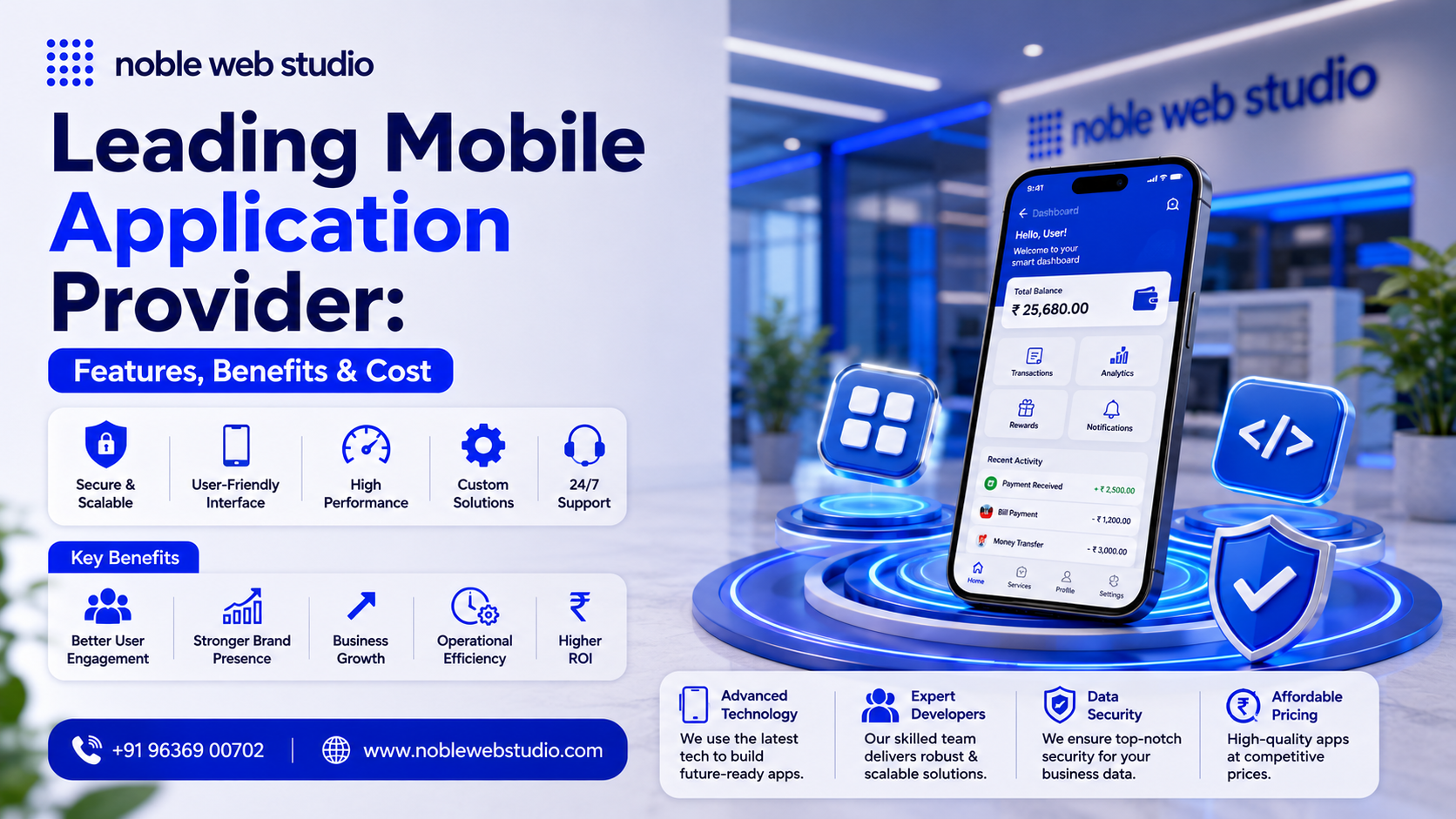
In today’s digital-first world, every business needs a strong mobile presence to connect with customers and stay competitive. Choosing the right mobile application provider is one of the most important decisions for any brand that wants to build a successful app. A reliable provider ensures not only smooth app development but also long-term support, security, and innovation. With so many options available, businesses often search for trusted names that deliver quality and value.
A reliable mobile app provider offers features such as robust security (encryption, MFA, secure APIs), excellent customer support, a well-designed user experience (UI/UX), scalability, and a proven development process, including clear communication and an agile methodology. Other key aspects are fast loading times, strong data protection, adherence to compliance standards, and the ability to provide customized solutions.
This is where Noble Web Studio, a leading mobile application provider in India, comes into the picture. Known for creating custom, user-friendly, and scalable mobile apps, Noble Web Studio helps startups, enterprises, and digital retailers bring their ideas to life. Whether it’s Android, iOS, or cross-platform development, the right provider offers features like responsive design, advanced security, seamless integrations, and post-launch maintenance.
In this blog, we will share the top features to look for in a mobile application provider so you can make a smart and confident decision for your next project.
What is Mobile Application Development
Mobile application development is the process of building software applications for mobile devices like smartphones and tablets, a process that involves designing, coding, testing, and deploying apps that can run on operating systems such as Android and iOS. It often leverages device-specific hardware, such as cameras and sensors, and uses specialized programming languages like Swift, Java, or Kotlin. Key steps include strategy, planning, design, development (including frontend and backend), testing, and release, with the goal of meeting user needs and business objectives.
Key Aspects of Mobile App Development
- Purpose: To create software for mobile devices to facilitate transactions, access information, or provide entertainment, enhancing user experiences and enabling business growth.
- Platforms: The two most dominant platforms are Apple’s iOS and Google’s Android, each requiring specific development approaches.
- Device Integration: Apps are often designed to take advantage of unique mobile device features like GPS, accelerometers, cameras, and sensors, allowing for rich, integrated experiences.
Development Approaches:
- Native Development: Builds apps specifically for one platform (e.g., Swift for iOS, Java for Android), providing optimal performance and full access to device capabilities.
- Cross-Platform Development: Uses a single codebase to build apps for multiple platforms, reducing development time and costs but potentially sacrificing some platform-specific features.
The Development Lifecycle
- Strategy: Defining the app’s purpose, target users, and measuring success metrics.
- Planning: Analyzing the market, outlining core features, and planning the development team and resources.
- UX/UI Design: Creating user interfaces and user experiences that are intuitive and appealing.
- Development: Writing the code for both the user-facing part (frontend) and the server-side components (backend).
- Testing: Conducting functional testing on target devices to ensure reliability and identify bugs.
- Deployment: Releasing the app to app stores or other distribution channels.
- Post-Launch: Monitoring the app’s performance, gathering user feedback, and providing updates and maintenance.
Why It Matters
Organizations across all industries rely on mobile applications to meet evolving customer expectations. By creating effective mobile apps, businesses can improve customer engagement, streamline operations, and stay competitive in a digital-first world.

Understanding the Role of a Mobile Application Provider
Noble web studio is the top Mobile Application Provider role is to manage the entire lifecycle of a mobile app, from initial concept to ongoing support, including development, design, testing, deployment, and maintenance to ensure a high-quality, user-friendly, and successful app for its users. They are responsible for technical expertise, understanding user needs, and leveraging various tools and platforms to create functional and engaging applications that meet business goals.
Key Aspects of a Mobile Application Provider’s Role
- Conceptualization & Design: They collaborate with Noble web studio to transform app ideas into tangible designs, creating user interfaces (UI) and ensuring a smooth user experience (UX).
- Development & Coding: They write clean, efficient code in various languages and frameworks (like Flutter or React Native) to build the app’s features and functionality.
- Testing:Rigorous testing is crucial to ensure the app is stable, secure, and free of bugs, which involves both developer-led testing and user feedback analysis.
- Deployment: Noble web studio manage the process of releasing the app onto mobile platforms like the Apple App Store or Google Play Store.
- Maintenance & Support: This involves monitoring app performance, gathering and responding to user feedback, and releasing regular updates and enhancements to keep the app competitive and functional.
- Collaboration: They work closely with designers, product managers, and other developers to ensure the app’s technical and functional requirements are met.
- Platform Expertise: Noble web studio stay updated on various development platforms and tools, such as low-code/no-code platforms or cloud-based services, to efficiently build and scale applications.
- Strategic Vision: They help businesses align mobile app development with their overall objectives, ensuring that the app contributes to customer engagement, operational efficiency, and market advantage.
Custom Mobile App Development for Business Needs
Custom mobile app development builds unique mobile applications to address specific business needs and objectives, offering tailored features, enhanced user experiences, and greater control than off-the-shelf solutions. This process involves phases of discovery, design, development, and testing, resulting in apps that can improve operational efficiency, boost customer engagement, and provide a competitive edge through unique functionalities and seamless integration with existing systems.
What it is
Custom mobile app development is the creation of a mobile application designed from the ground up to meet a particular business’s distinct goals, workflows, and challenges.
Why it’s beneficial for businesses
- Unique Functionality: Develops apps with specific features that off-the-shelf solutions can’t provide, giving a competitive advantage.
- Enhanced User Experience: Creates an intuitive and seamless experience perfectly aligned with the brand and target audience.
- Improved Operational Efficiency: Streamlines internal business processes, such as task management or inventory tracking.
- Better Customer Engagement: Provides a direct channel to connect with and engage customers, fostering loyalty.
- Scalability & Flexibility: Allows for easy future updates and adaptations as business needs evolve.
- System Integration: Can be designed to integrate with existing business systems and processes for a cohesive workflow.
The Development Process
- Discovery & Planning: Defining project scope and understanding unique business requirements.
- Design & Prototyping: Creating user-friendly and visually appealing user interfaces (UI/UX).
- Development: Building the robust application using appropriate technologies.
- Testing & Quality Assurance (QA): Rigorously testing to ensure a bug-free and seamless performance across devices.
- Deployment & Maintenance: Launching the app and providing ongoing support, updates, and maintenance.
Considerations
- Strategic Alignment: A successful custom app requires careful planning to ensure every feature and function supports the business’s objectives.
- Cost & Time: Custom development typically involves higher upfront costs and a longer development timeline compared to standard solutions.
Hire Best Mobile App Developers
To hire mobile app developers, define your project needs and budget, then find candidates on through specialized hiring services and custom mobile app development company such as Noble web studio. Look for expertise in specific technologies like Swift, Flutter, or React Native, and consider flexible hiring models, including hourly, part-time, or full-time options, depending on your project’s scope.
1. Define Your Project Needs
- Clearly outline your project goals: Understand what you want to build, including features, platforms (iOS, Android, cross-platform), and target audience.
- Determine your budget: Costs can vary significantly based on the developer’s experience, location, and the complexity of the project.
- Choose your technology stack: Decide if you need native developers for iOS (Swift, Objective-C) or Android (Kotlin, Java), or cross-platform developers (Flutter, React Native).
2. Find Developers
- Freelance Platforms: Websites like Noble web studio allow you to find and hire developers based on their skills, experience, and hourly rates.
- Specialized Hiring Services: Companies like Noble web studio specialize in connecting businesses with pre-vetted mobile app developers.
- Custom Development Companies: For more complex or long-term projects, consider partnering with mobile app development companies like Noble web studio.
3. Vet Candidates
- Review profiles: Examine developers’ detailed profiles to understand their technical expertise, past projects, and the tools and technologies they’ve used.
- Conduct interviews: Ask specific questions about their experience with the technologies relevant to your project and their approach to problem-solving.
- Check portfolios: Look at examples of their previous work to assess their quality and ability to meet your project’s requirements.
4. Choose a Hiring Model
- Part-Time Model: Ideal for short-term projects or when you need flexibility, allowing you to pay only for the hours worked.
- Full-Time Model: Provides dedicated expertise for a fixed monthly cost, suitable for projects requiring consistent support.
- Hourly-Time Model: Offers maximum adaptability for projects with fluid requirements, allowing you to adjust team size as needed.

Hire Mobile App Development Company
To find the best mobile app development company, look for Noble web studio with proven client satisfaction on platforms like Noble web studio, deep expertise in your required technologies (iOS, Android, React Native, Flutter), and a portfolio of successful, user-friendly apps for businesses like yours. Leading companies often provide dedicated teams, offer flexible delivery models, and emphasize excellent project management and client communication to deliver innovative, scalable, and secure mobile solutions.
Key factors to consider when selecting a company
- Client satisfaction and reputation: Check client reviews and testimonials like Noble web studio for verifiable feedback on project management and client communication.
- Technology expertise: Ensure the Noble web studio has experience in the platforms and frameworks relevant to your project, whether it’s native iOS/Android (Swift, Kotlin) or cross-platform (Flutter, React Native).
- Portfolio and past work: Review Noble web studio portfolio for successful projects that demonstrate their ability to translate complex ideas into functional, innovative, and user-friendly applications.
- Project management: Look for Noble web studio with strong, adaptable project management skills and transparent communication processes to ensure your project is delivered on time and to your satisfaction.
- Scalability and security: The Noble web studio should have experience building scalable, secure, and future-proof applications that align with your business goals and future needs.
How to find and evaluate companies
1. Use industry-specific platforms: Websites like Noble web studio rank top app development agency based on client reviews and project experience.
2. Check company websites: Noble web studio websites for details on their technologies, services, case studies, and client testimonials.
3. Evaluate based on your project needs: Share your project requirements and ask companies about their approach to your specific needs, ensuring they can offer the required expertise, resources, and flexibility.
4. Consider the costs and experience: Be aware of potential cost structures, which can vary from hiring individual developers to engaging an entire agency, and ensure the team has the experience level to handle your project.
Key Features of Mobile Application Provider
Key features for a successful mobile application include user-friendly interfaces with easy navigation, push notifications, personalization, social media integration, and robust security. Essential functionalities often involve biometric authentication, offline capabilities, voice search, and location tracking, while also considering cross-platform compatibility, performance optimization, and data privacy to enhance user experience and engagement.
Core User Experience & Interface Features
- Intuitive UI/UX: A simple, easy-to-navigate user interface is crucial for user satisfaction and engagement.
- Personalization: Tailoring the app experience to individual user preferences and usage patterns increases engagement.
- Push Notifications: Provide real-time updates, alerts, and messages to users, keeping them informed and connected.
- Social Media Integration: Allows users to easily share content and connect with others on social media platforms, increasing reach and engagement.
- Dark/Light Theme Support: Offers users the flexibility to choose between different visual themes for a more comfortable viewing experience.
Security & Authentication
- Biometric Authentication: Features like fingerprint or facial recognition provide a secure and convenient way for users to log in and authenticate without manual credentials.
- Data Privacy: Protecting user data and ensuring compliance with privacy regulations is a fundamental aspect of building trust.
Functionality & Connectivity
- Offline Functionality: Allows users to access certain features and content even without an active internet connection, providing flexibility.
- Voice Recognition/Search: Enables users to interact with the app using their voice, making it more convenient for various tasks.
- Location Tracking: Helps apps provide location-relevant services and personalize content based on the user’s current location.
- Easy Payment Gateways: For e-commerce or service-based apps, a seamless and secure payment process is essential.
Performance & Compatibility
- Cross-Platform Compatibility: Ensures the app works across different mobile operating systems (like iOS and Android) and devices.
- Performance Optimization: Focus on features like less response time and battery saving to ensure the app runs smoothly and efficiently on the user’s device.
Benefits of Mobile Application Provider
A mobile application’s benefits include increased customer convenience, engagement, and loyalty through personalized features, push notifications, and direct communication. Businesses can also enhance their brand image, improve operational efficiency, generate new revenue streams, and gain valuable customer feedback through apps. For users, apps offer improved performance, offline access, and a more streamlined user experience compared to mobile websites.
Benefits for Businesses
- Enhanced Customer Engagement & Loyalty: Apps foster deeper loyalty by providing a dedicated, personalized experience with features like loyalty programs and tailored content.
- Increased Reach & Brand Visibility: An app in an app store can boost a brand’s image, signifying it is serious about user experience.
- Direct Communication: Apps offer powerful push notification capabilities to share promotions, updates, and reminders directly with customers.
- Higher Conversion Rates: Apps can create more efficient pathways to purchase, leading to higher add-to-cart rates and overall sales.
- Personalization: Apps allow for detailed personalization, offering customized content and recommendations based on user behavior and preferences.
- Improved Customer Experience: Apps provide faster performance, better user interfaces, and offline access, creating a superior experience to mobile websites.
- New Revenue Streams: Businesses can monetize apps through in-app purchases, paid subscriptions, or premium content.
- Access to Hardware Features: Apps can seamlessly access device features like the camera, GPS, and Bluetooth, enabling richer functionality.
- Data and Feedback: Apps facilitate real-time data collection and direct customer feedback, helping businesses understand user needs.
Benefits for Users
- Convenience: Access information and services instantly from anywhere, anytime, directly from their mobile device.
- Personalization: Receive customized content, recommendations, and updates tailored to their interests and location.
- Offline Functionality: Some app features may work without an internet connection, providing access to information when offline.
- Improved User Experience: Apps offer faster performance, intuitive interfaces, and more streamlined navigation compared to mobile websites.
- Direct Engagement: Receive timely notifications and engage with a brand more deeply through a dedicated mobile platform.
- Simplified Tasks: Streamline tasks, from shopping and payments to fitness tracking, making them more efficient.

Affordable Mobile Application Development Cost
Affordable mobile app development costs can range from a few thousand dollars for simple apps or using no-code platforms to tens of thousands for more complex applications, with costs heavily dependent on features, complexity, design, and platform. Choosing to develop in regions like India, where hourly rates for developers can be significantly lower, is a common strategy for affordability. Using low-code platforms and starting with a Minimum Viable Product (MVP) can also reduce initial costs.
Factors Influencing Cost
- App Complexity: A simple app with basic features (login, forms) is significantly cheaper than an app with real-time updates, AI, or AR/VR capabilities.
- Features & Functionality: More features, such as payment gateways, third-party integrations, and custom dashboards, increase development time and cost.
- Platform (iOS, Android, Cross-Platform): Developing for a single platform is generally less expensive than a cross-platform solution.
- Design (UI/UX): A complex and highly polished user interface requires more design and coding effort, increasing costs.
- Development Team Location: Developers in regions like India offer highly competitive rates compared to Western countries, making it a cost-effective choice.
- Infrastructure & APIs: Relying on third-party services and robust web-based APIs adds to the overall development budget.
Strategies for Affordable Development
- Choose a Simpler Tech Stack: A less complex tech stack can reduce development time and costs.
- Start with an MVP: Focus on developing only the core features of your app and then build upon it iteratively.
- Consider No-Code/Low-Code Platforms: These platforms offer drag-and-drop interfaces, significantly reducing development time and cost by simplifying the process.
- Hire Developers in Cost-Effective Regions: Look for Noble web studio provide skilled developers in countries like India, where rates are much lower.
- Use Templates: For very basic apps, using pre-built templates can be a quick and affordable way to launch.
Secure and Reliable Mobile Application Development
Secure and reliable mobile app development integrates security throughout the entire Software Development Lifecycle (SDLC), focusing on secure coding practices, robust authentication, data encryption, regular testing, and compliance with app store guidelines. Key strategies include using HTTPS for data transfer, implementing multi-factor authentication, encrypting sensitive data stored on the device, using secure APIs, and conducting thorough security testing to protect user data and build trust.
Key Principles & Practices
- Secure Coding: Adopt secure coding practices from the start, following guidelines from organizations like the NCSC and OWASP to prevent common vulnerabilities.
- Authentication & Authorization: Implement strong user authentication, potentially using multi-factor authentication (MFA) for sensitive operations. Enforce the principle of least privilege to ensure apps only have necessary access rights.
Data Security:
- Encryption: Encrypt all sensitive data in transit (e.g., using HTTPS) and at rest on the device. Use platform-specific secure storage mechanisms like the Android KeyStore.
- Data Storage: Store private data in internal storage, use internal storage for sensitive information, and only store non-sensitive data in cache files.
- Secure APIs: Use secure, authenticated APIs to prevent unauthorized data access and manipulation.
- Session Management: Handle user sessions carefully to prevent hijacking.
- Testing & Maintenance: Conduct thorough security testing, including penetration testing and threat modeling, at every stage of the SDLC. Plan for and implement security patches and updates.
- Backend Security: Secure the backend infrastructure that your mobile app connects to.
- Obfuscation: Use code obfuscation techniques to make it harder for attackers to reverse-engineer your application.
Platform-Specific Considerations
- Android: Use internal storage for sensitive details, encrypt data with hardware-backed keys where possible, and utilize the Android KeyStore. Compile in release mode with debug information stripped and apply code shrinking and optimization.
- iOS: Use strong authentication, obfuscate your code, and ensure data is encrypted during transit.
User & Developer Best Practices
- Dependencies: Keep all third-party libraries and app dependencies updated to their latest, most secure versions.
- User Awareness: Inform users about the data an app accesses and for what purpose.
- App Store Guidelines: Adhere to the security and privacy guidelines set by the Google Play Store and Apple App Store to ensure a compliant and secure app.
Cross-Platform App Development (Android & iOS)
Android and iOS cross platform app development allows creating applications for both operating systems from a single codebase using frameworks like Flutter, React Native, or Ionic. This approach accelerates development, reduces costs, and streamlines maintenance. While offering efficiency, cross-platform solutions may introduce limitations in native hardware access and performance compared to native development, which involves separate, platform-specific codebases written in languages like Swift/Kotlin for iOS/Android.
How Cross-Platform Development Works
- Single Codebase: Developers write code once, and it is adapted to run on both Android and iOS.
- Abstraction Layers: Cross-platform frameworks provide an abstraction layer, allowing the code to interact with device features and platform-specific elements through a unified interface.
- Pre-built Components: Frameworks like Flutter offer their own rendering engines and pre-built widgets to create visually appealing and custom UIs that function consistently across platforms.
Cross-Platform Frameworks
These tools provide an abstraction layer over native APIs, allowing a single codebase to interact with both Android and iOS devices.
- Flutter: Developed by Google, Flutter uses its own rendering engine and a single codebase in Dart to build high-quality apps for various platforms, including iOS and Android.
- React Native: This framework, created by Facebook, uses JavaScript to build native-like apps by allowing developers to write code once and deploy it to both iOS and Android platforms.
- Ionic: An open-source framework that uses web technologies (HTML, CSS, JavaScript) to create cross-platform mobile and web apps from a single codebase.
Key Considerations
- Development Efficiency: A unified codebase significantly reduces the time and resources needed to build apps for multiple platforms.
- Maintenance and Consistency: Managing a single codebase for two platforms simplifies updates and ensures a consistent user experience.
- Performance and Hardware Access: Cross-platform apps may have slightly slower performance and limited access to specific device hardware compared to native apps.
- Cost-Effectiveness: Developing with one codebase is generally more cost-effective than maintaining two separate native applications.
Native Development Alternative
For the best performance and full access to platform-specific features, you can develop native apps.
- Android: Uses programming languages like Java or Kotlin.
- iOS: Uses programming languages like Swift or Objective-C.
This approach, however, requires developing and maintaining two distinct codebases.
Pros and Cons
Pros:
- Reduced Costs & Time: A single codebase significantly cuts down on development time and resources.
- Increased Consistency: A shared codebase ensures greater consistency in features and user experience.
- Faster Development Cycles: Features like Flutter’s hot reload enable rapid development, testing, and delivery.
Cons:
- Potential Performance Issues: Cross-platform apps may exhibit slightly lower performance compared to native apps, though it’s often unnoticeable to users.
- Limited Hardware Access: There can be limitations in accessing certain device-specific hardware features compared to native solutions.
- Framework Dependency: Dependence on the framework’s development team for updates, particularly concerning underlying OS changes.
When to Choose Cross-Platform Development
- Data-Driven Apps: Suitable for apps focused on fetching, processing, and displaying data.
- Cost-Sensitive Projects: Ideal for startups or projects with budget limitations.
- Broad Audience Reach: To quickly reach a wide user base on both Android and iOS platforms.

Importance of Choosing a Mobile Application Provider
Choosing the right mobile application provider is important because a poor choice can damage your brand, waste resources, and hinder your project’s success, while a good provider ensures a high-quality, user-friendly app that attracts customers and meets business goals. Key factors to consider include the Noble web studio expertise and experience in your industry, their technical proficiency with relevant technologies, their commitment to quality assurance and rigorous testing, and their ability to provide post-launch support and maintenance to ensure long-term success and scalability.
Here’s a breakdown of the importance:
- Post-Launch Support: Noble web studio offers ongoing maintenance, bug fixes, and updates to keep your app compatible with new devices and evolving user needs, ensuring its continued relevance and success.
- Quality and User Experience: Noble web studio uses advanced technologies and a user-centered design approach, resulting in a functional, reliable, and engaging app that pleases users and enhances your brand.
- Expertise and Advanced Technologies: Noble web studio have access to talented professionals and stay updated on the latest tools and frameworks, ensuring your app is built with modern, efficient, and effective methods.
- Cost-Efficiency and Resource Management: Outsourcing allows you to focus on your core business while experts handle the technical complexities, preventing wasted time and resources that come with a poorly executed project.
- Scalability and Future-Proofing: Noble web studio build mobile apps with future growth in mind, ensuring your application can scale to handle increasing users and seamlessly integrate new features or adaptations to market changes.
- Accelerated Time-to-Market: Experienced development partners streamline the entire process, reducing development time and accelerating your app’s launch, giving you a competitive edge.
How Noble Web Studio Delivers Reliable Mobile App Development Solutions
Reliable mobile app development solutions are delivered through a structured process including requirement analysis, UI/UX design, native or cross-platform development using modern technologies like Flutter or React Native, rigorous quality assurance and testing, secure cloud backend integration, and post-launch support, all managed within an agile framework to ensure a high-quality, user-friendly, and maintainable application.
1. Strategic Requirement Analysis
- Understand the Vision: Start by thoroughly analyzing the business needs and the specific goals for the mobile app.
- Define Scope: Clearly define the app’s features, functionalities, and target platforms to ensure a focused development process.
2. User-Centric Design
- UX/UI Design: Develop intuitive and engaging user interfaces (UI) and user experiences (UX) that prioritize user satisfaction and ease of use.
- Prototyping & Wireframing: Create wireframes and prototypes to visualize the app’s layout and functionality before development begins.
3. Robust Development
- Native vs. Cross-Platform: Choose the appropriate development approach: native for platform-specific optimization or cross-platform (using tools like Flutter or React Native) for broader reach with a single codebase.
- Modern Technology Stack: Utilize cutting-edge languages and frameworks, such as Swift for iOS and Kotlin for Android, to ensure high performance and scalability.
- Secure Backend Integration: Integrate robust backends and cloud services (like those provided by AWS) to handle scalability, security, and data management efficiently.
4. Quality Assurance & Testing
- Comprehensive Testing: Conduct rigorous testing, including functional, usability, performance, and security testing, to identify and resolve bugs.
- Bug-Free Deployment: Ensure that only error-free versions of the app are released to the app stores.
5. Deployment & Post-Launch Support
- App Store Deployment: Manage the deployment process to the Google Play Store and Apple App Store.
- Ongoing Maintenance: Provide continuous support and maintenance to ensure the app’s long-term performance, updates, and security.
6. Agile Methodology
Iterative Development: Employ agile frameworks to foster continuous collaboration, prioritize individuals and interactions, and allow for flexibility and adaptation throughout the project.
Why Noble Web Studio is a Reliable Mobile Application Provider
Noble web studio is the best reliable mobile application provider is crucial because they deliver secure, high-performance, user-friendly apps that are tailored to business needs, ensuring a consistent and positive user experience and helping businesses achieve their goals. Reliability in a provider means they possess expertise in current technologies, follow a systematic development process, meet quality standards, offer customized solutions, and provide ongoing support.
Key benefits of a reliable provider:
- Expertise and Experience: They bring in-depth knowledge of platforms like iOS and Android, as well as modern technologies such as AI, cloud computing, and blockchain, leading to high-quality, robust applications.
- User Experience (UX) and User Interface (UI): A reliable mobile app provider focuses on creating intuitive and engaging apps with a great UI, which enhances customer engagement and positive brand perception.
- Security and Performance: They incorporate essential security features and optimize performance across devices, ensuring data protection and a smooth user experience.
- Timely & Efficient Delivery: They follow a structured development approach and have dedicated teams, which ensures the project is delivered on time and meets the project’s quality standards.
- Cost-Effectiveness: By utilizing their expertise and potentially cross platform development techniques, they can offer efficient solutions that provide good value for the investment.
- Customized Solutions: They understand that each business has unique needs and can provide tailored solutions that align with specific business goals.
- Ongoing Support: A reliable app provider will offer essential support and maintenance, ensuring the application continues to function optimally after launch.
- Wider Audience Reach: By developing optimized apps, they help businesses attract and engage a larger customer base across different devices and platforms.
Future Trends in Mobile Application Development
Future trends in mobile application development are significantly influenced by advancements in technology and evolving user expectations. Key trends shaping the future of mobile apps include:
Mobile Wallets and Contactless Payments: The expansion of mobile payment solutions and digital wallets continues to drive the integration of secure and convenient payment functionalities within mobile applications.
Artificial Intelligence (AI) and Machine Learning (ML) Integration: AI and ML are becoming integral to mobile apps, enabling features like personalized experiences, predictive analytics, voice assistants, image and speech recognition, and intelligent automation. This leads to more intuitive and adaptive applications.
Augmented Reality (AR) and Virtual Reality (VR): AR and VR are moving beyond gaming, finding applications in diverse fields like education, healthcare, retail, and remote assistance. Mobile apps are increasingly incorporating AR/VR capabilities to offer immersive and interactive experiences.
5G Technology and Beyond: The widespread adoption of 5G, and the emergence of 6G, provide significantly faster speeds and lower latency, enabling the development of more complex and data-intensive applications, including real-time streaming, advanced gaming, and IoT integrations.
Internet of Things (IoT) Integration: Mobile apps are serving as central control hubs for a growing array of IoT devices, from smart home appliances to industrial sensors. This trend emphasizes seamless connectivity and remote management capabilities.
Low-Code/No-Code Development: Platforms enabling low-code or no-code development are empowering a broader range of individuals and businesses to create mobile applications without extensive coding knowledge, accelerating development cycles.
Cross-Platform Development: Frameworks like Flutter and React Native are increasingly popular, allowing developers to build applications for multiple operating systems (iOS and Android) from a single codebase, streamlining development and reducing costs.
Enhanced Security and Privacy: With growing concerns about data breaches, mobile app development is placing a heightened emphasis on robust security measures, including advanced encryption, multi-factor authentication, and privacy-by-design principles.
Foldable Devices and Adaptive UI: The rise of foldable smartphones necessitates adaptive user interfaces that can seamlessly adjust to different screen orientations and sizes, creating a more flexible user experience.

Conclusion
Choosing the right mobile application provider is one of the most important decisions for any business. A reliable provider should offer custom mobile app development, user-friendly design, strong security features, scalability, and ongoing support. They must understand your business needs and deliver apps that are not only functional but also innovative and future-ready.
A reliable mobile app provider emphasizes features like strong security, a user-friendly and high-performing interface, cross-platform compatibility, offline functionality, and robust customer support. Additionally, they deliver timely updates and maintenance, integrate advanced technologies for enhanced user experience, and offer useful features like push notifications and social integration to keep users engaged and informed.
At Noble Web Studio, we focus on creating high-quality mobile application that help businesses grow and connect better with their customers. By working with an experienced and trusted team, you can ensure your mobile app is built with the latest technology, smooth performance, and long-term success in mind.
If you are looking for a reliable mobile application development company, make sure to choose a partner like Noble web studio who values quality, transparency, and customer satisfaction just like we do at Noble Web Studio.
FAQ – Top Features to Look for in a Reliable Mobile Application Provider
A mobile application provider is a company or service that develops, designs, and manages mobile apps for businesses and individuals. They ensure your app runs smoothly on Android, iOS, or both, and provide features like design, coding, testing, and maintenance.
A reliable provider ensures your app is secure, user-friendly, and scalable. They also provide ongoing support, timely updates, and help your business grow with digital innovation.
The most important features include custom app development, responsive design, cross-platform support, high-level security, seamless integration, scalability, and post-launch maintenance services.
Noble Web Studio stands out for its client-focused approach, advanced technology stack, affordable pricing, and proven track record in delivering high-quality mobile apps for businesses across different industries.
Yes, a reliable provider should offer cross-platform app development. This means your app can run on both Android and iOS platforms without separate coding, saving cost and time.
App security protects user data, payment details, and business information. A trusted provider ensures strong encryption, secure APIs, and regular updates to safeguard your app against cyber threats.
The cost depends on factors like app complexity, features, design, and platform. Noble Web Studio offers flexible and affordable packages that fit small businesses, startups, and enterprises.
A reliable provider should offer end-to-end support, including app updates, bug fixing, performance monitoring, and feature enhancements even after launch.
Check their portfolio, client reviews, experience, technology expertise, and customer support. Noble Web Studio ticks all these boxes, making it a trusted choice for businesses.
The future will see more use of AI, AR/VR, IoT, and blockchain in apps. Reliable providers like Noble Web Studio are already preparing businesses for these technologies to stay ahead in the digital market.