
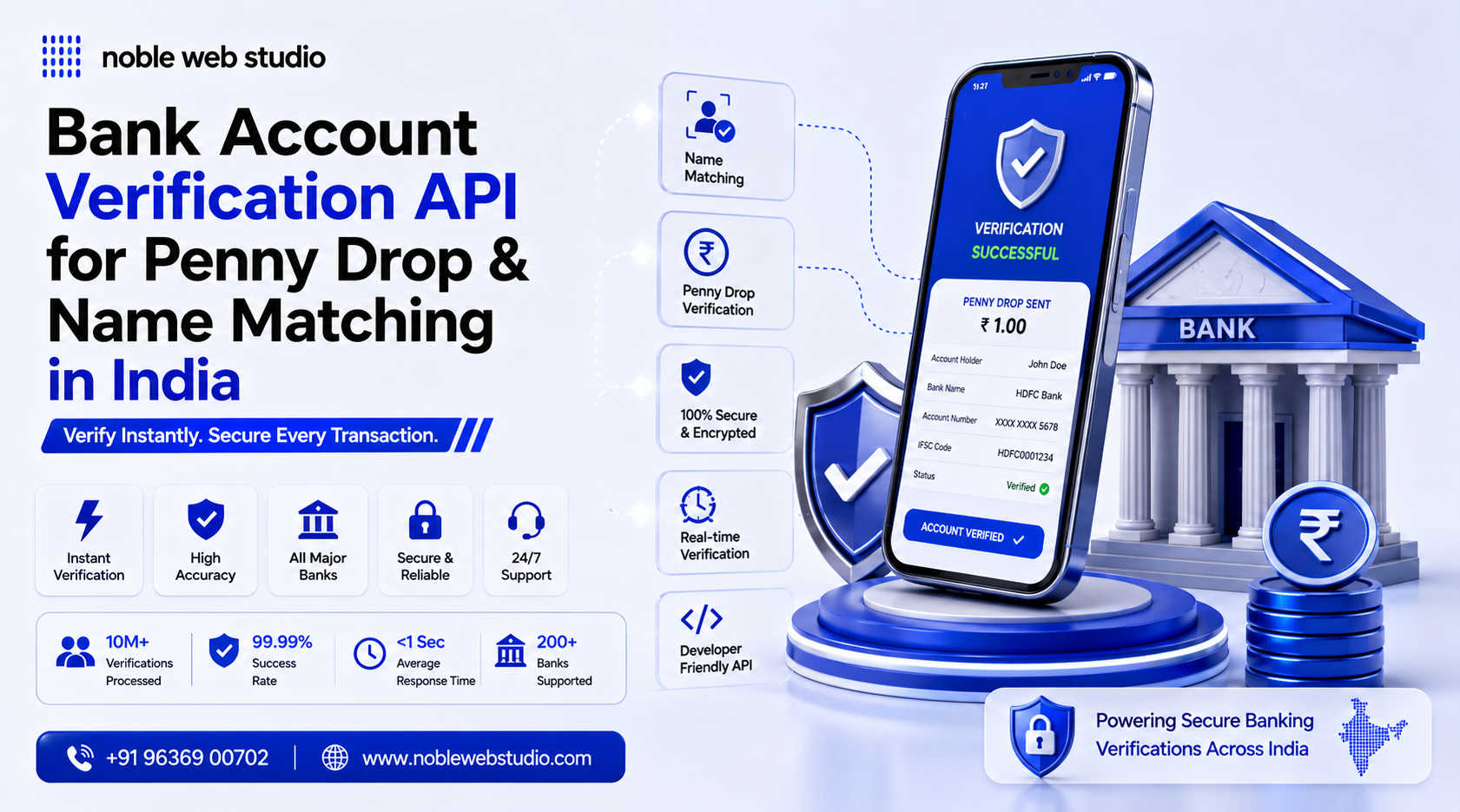
Are you looking for a reliable Bank Account Verification API to verify customer bank account details instantly and securely? In today’s digital business world, accurate bank account verification is essential for fintech companies, payment gateways, lending platforms, insurance providers, and online businesses. A powerful Bank Account Verification API helps businesses validate account details in real time, reduce transaction failures, prevent fraud, and improve customer onboarding processes.
With advanced verification technology, businesses can automate account validation without manual checks, saving both time and operational costs. A secure Bank Account Verification API ensures that payments are sent to the correct account while enhancing customer trust and compliance standards.
A Bank Account Verification API validates an account number and IFSC/routing code in real-time, instantly returning the registered account holder’s name and account status (e.g., active, blocked). Businesses use these APIs to prevent fraudulent payouts, ensure regulatory compliance, and stop failed transactions.
Whether you run a fintech company, payment gateway, lending platform, insurance business, NBFC, e-commerce platform, or financial service company, a secure Bank Account Verification API Solution can help you validate account information quickly and accurately. This improves operational efficiency and enhances customer trust.
One of the biggest advantages of using an Instant Bank Account Verification API is the ability to verify account details within seconds. This helps reduce failed transactions, eliminate incorrect account information, and protect businesses from financial fraud.
The best Bank Account Verification API Provider in India should offer real-time verification, high accuracy, secure API integration, fast response times, developer-friendly documentation, and dedicated technical support. These features help businesses streamline operations and scale confidently.
Noble Web Studio provides a robust and secure Bank Account Verification API Solution designed for fintech companies, startups, payment service providers, and enterprises. With seamless integration, reliable verification systems, advanced security, and expert support, businesses can automate account verification and strengthen their financial processes.
If you want to improve transaction accuracy, reduce risks, and build customer confidence, investing in a trusted Bank Account Verification API is the right choice for long-term business growth and success.
In this blog, you’ll discover What is Bank Account Verification API, how a Bank Account Verification API works, its key features, benefits, integration process, and why it has become an essential tool for modern digital businesses.
What is Bank Account Verification
A Bank Account Verification API is a programming interface that allows businesses to instantly authenticate and verify the ownership, validity, and active status of a bank account in real-time. It cross-checks information like the account number, routing/IFSC code, and account holder’s name against banking and clearinghouse databases.

Bank Account Verification Work
A Bank Account Verification API is a secure, real-time technology solution that connects a business’s digital application directly to financial systems to confirm the validity and ownership of a bank account. It eliminates manual documentation and safeguards platforms against failed transactions, human input errors, and financial fraud.
How the API Workflow Works
The end-to-end operational flow of a verification API takes less than two to five seconds through the following steps:
- Data Input & Consent Collection: The user inputs their banking details (such as account number and routing code/IFSC) during an onboarding or payout setup. Under strict financial regulations like the India DPDP Act, collecting explicit user consent at this stage is legally mandatory.
- Encrypted Request Transmission: The hosting business’s platform forwards this raw data securely via an API request to a verification partner or central payment gateway.
- Financial Network Ping: The API queries national banking grids (like NPCI in India) or global banking databases to match the records.
- Algorithmic Validation: Systems automatically compare the registered name at the bank against the client identity records already on file. Advanced name-matching AI engines compute a “confidence score” to handle minor spelling discrepancies.
- Structured Response Output: The API sends back an immediate, machine-readable JSON object containing explicit parameters like
ACTIVE,INVALID,BLOCKED, orCLOSED, allowing the system to approve or reject the request automatically.
Who Can Use Bank Account Verification API?
A Bank Account Verification API can be used by businesses and developers to instantly authenticate bank account details, prevent fraud, and ensure payouts reach the intended recipient.
Who Uses Instant Bank Verification:
- Fintech & Lending Platforms: To verify borrower banking details and determine creditworthiness or prevent loan disbursal to fraudulent accounts.
- E-Commerce & Marketplaces: To secure online transactions, safely onboard vendors, and authorize secure payout methods.
- HR & Recruitment Agencies: To validate employee bank accounts and match names to ensure faster onboarding and prevent salary transfer failures.
- Gig Economy Platforms: For paying contractors and freelancers quickly and accurately.
- Payroll Services & Employers: To ensure direct deposits go to the correct employee accounts.
- Subscription & SaaS Businesses: To set up recurring billing and instantly confirm customer account ownership through micro-deposits.
- Insurance Companies: For premium collection and claims disbursement.
- Cryptocurrency Exchanges & Investment Platforms: For verifying user accounts for fiat currency deposits/withdrawals.
- Government Agencies: For disbursing benefits or tax refunds.
- Online Gaming/Gambling Sites: To verify player financial details for real-money transactions.
Key Benefits:
- For Businesses: Reduced fraud, lower operational costs, faster onboarding, better customer experience, and real-time data access.
- For Consumers: Quick account access, seamless onboarding, and secure connection to financial services without sharing sensitive login info directly.
Service Offer Bank Account Verification API
A Bank Account Verification (BAV) API instantly authenticates account ownership, validates routing details, and checks account status. Using real-time bank records or “penny drop” transfers, it reduces fraud, lowers failed transactions, and accelerates customer onboarding.
Primary Verification Methods
- Penny Drop: Transfers a nominal amount (e.g., ₹1) and often instantly reverses it to verify active status and fetch the registered account holder’s name.
- Open Banking / OAuth: Allows users to securely log into their bank via an API to instantly verify ownership and share balances.
- Name Matching: Compares the name provided by the user against the bank’s official records to prevent unauthorized payouts.
Types of Bank Account Verification API
Bank Account Verification APIs are developer tools that instantly validate bank account details to confirm ownership, prevent fraud, and ensure regulatory compliance. They eliminate manual statement uploads and failed payouts by returning real-time data, such as account holder names and match accuracy scores.
Common Types of Bank Account Verification APIs
1. Penny Drop (Micro-Deposit) APIs
- How it works: Transfers a nominal amount (e.g., ₹1 in India, $0.01 in the US) to the user’s bank account. The API verifies if the account exists, is active, and returns the exact account holder name registered with the bank.
- Best used for: Payouts, vendor onboarding, and KYC compliance.
2. Open Banking / Instant Aggregator APIs
- How it works: Requires the user to log into their bank portal securely via OAuth. The API instantly retrieves the account details, ownership status, and transactional history.
- Best used for: Loan underwriting, subscription billing, and income verification.
3. Basic Account Validation APIs (Format Check)
- How it works: Instantly validates formatting criteria like the Bank Routing Number, IFSC code, or IBAN against a global/regional database.
- Best used for: Front-end checkout or data-entry forms to prevent user typos before proceeding.
4. UPI/VPA Verification APIs
- How it works: Validates a Virtual Payment Address (VPA) or UPI ID linked to a mobile number. It confirms the actual name of the user tied to that specific handle.
- Best used for: Peer-to-peer (P2P) transfers and immediate merchant settlements.
5. Reverse Penny Drop (RPD) APIs
- How it works: The user initiates a small transfer to a designated company account to register a payment method. The API then captures the incoming sender’s name and details for future debits.
- Best used for: E-commerce setups and recurring billing.
Key Data Returned by Verification APIs
Most APIs return a structured JSON response containing:
- Account Holder Name: The official name associated with the bank.
- Match Score: A percentage/AI confidence score indicating how closely the provided name matches the bank’s records (e.g., Exact, Partial, or Mismatch).
- Account Status: Indicates if the account is Active, Dormant, or Closed.
Use Cases of Bank Account Verification API
A Bank Account Verification API automatically validates bank details (like account numbers, routing/IFSC codes, and account holder names) to ensure accounts are active and owned by the correct individual. It prevents failed transactions, eliminates payout errors, and serves as a critical tool for fraud prevention and compliance.
Key Use Cases:
- Fintech & Digital Lending: Platforms verify borrower details in real-time before disbursing loan amounts to ensure funds reach the verified applicant, mitigating fraud and data entry errors.
- E-Commerce & Marketplaces: Retailers and platforms use Account Ownership Verification APIs to validate customer bank accounts before initiating refunds or vendor payouts, drastically reducing failed transactions and chargebacks.
- Corporate Payroll & Gig Economy: Businesses and Bank Account Verification APIs confirm employee and contractor account information to avoid failed salary transfers and delays.
- KYC/KYB Compliance: During onboarding, financial institutions and digital wallets cross-reference bank data with legal entity names to satisfy Know Your Customer (KYC) and Anti-Money Laundering (AML) regulations.
- Government Direct Benefit Transfers (DBT): State agencies and municipal governments use APIs to bulk-verify beneficiary accounts, stopping fund leakage and ensuring benefits reach intended citizens.
- Insurance Claim Settlement: Insurers use account checks to authenticate a claimant’s identity before disbursing settlement payouts, minimizing identity theft and fraudulent claims.
Common Verification Methods
- Penny Drop: Transfers a nominal amount (e.g., ₹1 in India) to the user’s account to fetch the exact registered name and account status.
- Reverse Pull: Pulls information via secure Open Banking rails to verify account ownership without requiring manual micro-deposits.
- Name Match Engine: Cross-references the user’s provided name against the exact name registered at the bank.
Key Aspects of Bank Account Verification API
A Bank Account Verification API securely and instantly authenticates the legitimacy and ownership of a bank account by directly querying financial institutions. It eliminates manual errors, prevents fraudulent transactions, and streamlines user onboarding or payouts.
Key Aspects and Features
- Real-Time Authentication: Validates the account status (active, inactive, closed) and returns responses in seconds, removing the 2-to-3-day wait associated with traditional micro-deposits.
- Penny Drop Verification: Deposits a nominal amount (e.g., ₹1) to confirm the account’s active status and captures the exact beneficiary name registered with the bank.
- AI-Powered Name Matching: Uses advanced algorithms to match the name provided by the user with the bank’s official records, successfully handling abbreviations, spelling errors, and name reversals.
- Bulk Processing: Allows businesses to verify large lists of vendors, employees, or customers simultaneously to ensure seamless mass payouts.
Fraud Prevention & Compliance
- AML & KYC Compliance: Acts as a vital tool to meet Know Your Customer (KYC) and Anti-Money Laundering (AML) mandates by verifying true account ownership.
- Mule Account Detection: Flags repeated failed name matches or suspect activities, preventing money laundering and illegal “mule” accounts.
- Consent & Data Security: Enforces strict consent-based collection, ensuring sensitive Personally Identifiable Information (PII) remains encrypted at rest and in transit per regional privacy frameworks like India’s DPDP Act.

Why Bank Account Verification API Used
Bank account verification confirms a bank account is real and belongs to the claimed owner, preventing fraud, ensuring accurate payments (like payroll, loans, refunds), meeting KYC/AML compliance, and streamlining digital onboarding for businesses, lenders, and platforms by validating details like account number and name in real-time. It’s essential for secure online transactions, reducing failed payments and protecting against money laundering and identity theft.
Key Reasons for Instant Verification:
- Fraud Prevention: Instantly confirms the account belongs to the stated person/entity, stopping fake accounts, identity theft, and fraudulent payouts.
- Accuracy & Efficiency: Eliminates errors from manual entry (wrong digits/names) and failed transactions, ensuring funds reach the right place instantly.
- Faster Onboarding: Replaces slow methods like micro-deposits (which take days) with instant confirmation, improving user experience and conversion rates.
- Regulatory Compliance: It helps financial institutions and businesses adhere to strict rules like Know Your Customer (KYC) and Anti-Money Laundering (AML) laws, avoiding hefty fines and legal trouble.
- Cost Savings: Prevents costly failed payments, chargebacks, and operational headaches associated with incorrect details.
- Enhanced Customer Experience: Reduces friction and abandonment during onboarding by offering a fast, seamless process instead of waiting days for micro-deposits.
- Streamlined Operations: Automated verification streamlines processes like payroll, loan applications, and direct debits, reducing manual checks and operational friction.
- Builds Trust: Customers feel more secure knowing their money is handled safely, strengthening relationships with Noble Web Studio.
- Reduces Risk: It protects businesses from financial losses and reputational damage that can arise from fraudulent activities or major payment errors.
Standard Verification Methods Supported by Bank Account Verification API
Bank Account Verification APIs use standardized methods to confirm account validity, ownership, and active status to prevent fraud and ensure seamless fund routing. Standard methods include:
- Penny Drop (Micro-deposits): A small nominal amount (usually ₹1) is transferred to the user’s account and immediately reversed. The API checks for successful receipt, confirms the account is active, and retrieves the registered beneficiary name.
- Instant Account Verification (IAV): Uses secure Open Banking rails or APIs (like OAuth) where users log into their banking app directly to authorize data sharing and verify account ownership.
- IFSC & Routing Validation: Validates the combination of the bank account number and the bank branch’s IFSC (or routing/clearing code) against centralized banking databases to ensure correct payment routing.
- Name Match & Confidence Scoring: The API compares the account holder’s name provided in your application with the official name registered at the bank, returning an exact/partial match status and a confidence score.
- Document-based/OCR Verification: Extracts and verifies data by securely uploading or scanning a voided check, canceled check, or official bank statement.
Bank Account Verification API Documentation
A Bank Account Verification (BAV) API allows businesses to instantly authenticate bank account ownership, validity, and active status by cross-checking details against bank or inter-bank databases. It is widely used to prevent fraud, eliminate failed payouts, and ensure compliance with KYC and AML regulations.
Standard Integration Flow
- User Input: The user enters their Bank Account Number, IFSC code, and registered name on your platform.
- API Request: Your backend transmits these details to the BAV API endpoint using secure authentication (typically OAuth2 or Signed JWT).
- Verification: The API pings the issuing bank’s system or networks like the NPCI (using a “penny drop” method).
- Response: The API returns a match status and the actual account holder’s name as registered in the bank’s records.
Compliance Considerations
When integrating a BAV API in India, you must adhere to several regulatory frameworks:
- DPDP Act (2023): Always obtain explicit user consent before processing their financial data and maintain clear logging systems.
- RBI Guidelines: Use the API as an integral part of your Customer Due Diligence (CDD) and AML processes.
Visit Here : Complete Bank Account Verification API Documentation
Bank Account Verification API Workflow
A Bank Account Verification API validates customer or vendor banking details in real-time. It confirms if an account number and routing/IFSC code are active and identifies the account holder to prevent fraud, payment failures, and regulatory non-compliance.
The workflow operates in four sequential steps:
1. Data Collection
- Input: The user enters their Bank Account Number and Routing/IFSC Code during onboarding, checkout, or payout setup.
- Collection: The Bank Account Verification API system may also collect the Account Holder’s Name for cross-referencing purposes.
2. Request Payload
- Format: Your backend system securely packages this information into a JSON payload and sends it as an encrypted Bank Account Verification API request to the Noble web studio.
- Authentication: The request includes your Bank Account Verification API keys or Bearer Tokens to authorize the transaction.
3. Verification & Processing
- Bank Ping: The Bank Account Verification API queries the destination bank’s database or clearing network (such as Noble web studio).
Validation:
- Basic Check: The Bank Account Verification API verifies if the account format is valid and the branch exists.
- Penny Drop (Optional): For deep validation, the Bank Account Verification API securely deposits a nominal amount (e.g., ₹1 or $0.01) into the account and prompts the bank for a real-time beneficiary name match.
4. Response & Next Steps
- Response Payload: The Bank Account Verification API returns a structured JSON response to your application.
- Data Returned: This typically includes a status (e.g.,
success,invalid,inactive), the registered account holder name, and a name-match confidence score (Exact, Partial, or Failed). - Action: Your system evaluates the response. If it passes, the transaction or onboarding continues. If it fails or shows a poor name match, the system prompts the user to re-enter their details.
Bank Account Verification API Supported Banks
Bank Account Verification APIs support all major Indian banks, including all public sector, private sector, and over 100+ cooperative and rural banks. Coverage spans the National Payments Corporation of India (NPCI) network, though some limitations apply to specific APIs (e.g., Paytm Payments Bank and Deutsche Bank may not be supported by certain vendors).
Supported Banks & Institutions
Verifications are available for accounts across the following types of financial institutions:
- Public Sector Banks: SBI, PNB, Bank of Baroda, Canara Bank, Union Bank, etc.
- Private Sector Banks: HDFC, ICICI, Axis, Kotak Mahindra, Yes Bank, RBL, IndusInd, etc.
- Small Finance & Payment Banks: AU Small Finance, Airtel Payments Bank, NSDL Payments Bank, etc.
- Cooperative & Regional Rural Banks: Supported widely, though coverage depth varies by the Noble web studio.
Verify Bank Account Using API
Verifying a bank account via API confirms the legitimacy of an account number, routing/IFSC code, and the account holder’s name. This is typically done in one of two ways: the Penny Drop method (common in India) or via Instant Aggregators (common in the US/Europe).
1. The “Penny Drop” Method (India / Global)
This API sends a micro-transaction (usually ₹1 or the local equivalent) to the user’s bank account.
- How it works: You send the user’s name, account number, and IFSC/routing code to the API. The API checks the banking network (like IMPS or UPI) and returns the verified name registered with the bank, plus a match status.
2. Open Banking / Instant Aggregators (US / EU / Global)
This method connects directly to the user’s bank portal to read and verify account details instantly without needing manual uploads.
- How it works: The user is securely redirected to their bank login via a UI widget. The API returns an authorization token and the verified routing and account numbers.
Bank Account Verification API for Fintech
A Bank Account Verification (BAV) API instantly validates a user’s bank details and ownership. Fintechs use it during user onboarding, loan disbursements, and refunds. It typically works via “penny drop” (transferring a nominal sum to verify the account) or direct bank-database querying, returning the account holder’s name match status and account validity in seconds.
Core Capabilities & Match Logic
A BAV API evaluates multiple data points to reduce fraud and transaction failures:
- Name Match Scoring: Uses AI-driven fuzzy matching to verify if the provided name matches the bank’s registered account holder.
- Penny Drop/Verification: Transfers and reverses ₹1 (or equivalent nominal amount) to definitively prove account existence and active status.
- Account Status Check: Validates whether the account is active, frozen, dormant, or closed.
- IFSC/Routing Validation: Ensures correct branch details and routing numbers before initiating bulk or high-value transfers.
Key Compliance Requirements
When building with BAV APIs in regions like India (under RBI and DPDP regulations), you must ensure:
- Explicit User Consent: Capture and log user consent before processing financial data.
- Data Privacy: Ensure sensitive data is encrypted at rest and in transit, logging only the verification outcome.
- Auditability: Maintain timestamped API logs to pass recurring regulatory and security audits.
Why Businesses Use Bank Account Verification API
Businesses use Bank Account Verification APIs to instantly validate account ownership, prevent fraudulent transactions, eliminate failed payouts, and ensure regulatory compliance. By automating name-matching and validation, these tools reduce manual processing, lower operational costs, and ensure seamless, audit-ready operations.
A breakdown of core business benefits and use cases includes:
- Fraud Mitigation & Security: APIs use AI-based name matching to verify that the beneficiary’s name matches the registered account holder. This prevents impersonation, deters money laundering, and closes compliance loopholes.
- Elimination of Payout Failures: By validating account numbers, IFSC codes, and IBANs in real time before sending funds, businesses drastically reduce transaction errors, failed transfers, and costly manual reversal fees.
- Regulatory Compliance: Verifying accounts ensures adherence to strict KYC (Know Your Customer) and AML (Anti-Money Laundering) mandates set by financial authorities. It also builds timestamped digital logs for successful audits.
- Streamlined Onboarding: Eliminating manual uploads or tedious micro-deposits makes onboarding faster and builds trust with gig workers, vendors, and customers.
Features Bank Account Verification API
A Bank Account Verification API securely and instantly validates beneficiary details by cross-referencing account numbers and IFSC codes with bank or central payment databases. It prevents payout failures, minimizes financial fraud, and automates compliance checks like KYC and AML.
Essential features of a robust Bank Account Verification API include:
- Penny Drop Verification: Automatically deposits and instantly reverses a small amount (e.g., ₹1) to confirm the bank account is active, valid, and belongs to the intended recipient.
- Name Matching & Validation: Cross-checks the provided name against the official bank records, returning a match status (e.g., Exact, Partial, or Mismatch) and AI-powered confidence scores.
- IFSC/Branch Validation: Instantly validates IFSC codes, branch addresses, and MICR details to ensure routing accuracy before transferring funds.
- Compliance & Consent: Ensures adherence to strict privacy regulations (such as the DPDP Act or GDPR) by automatically capturing and logging user consent.
- Bulk/Batch Processing: Allows businesses to process thousands of beneficiary, vendor, or employee accounts simultaneously, often via API triggers or Excel/CSV uploads.
- Account Status Checks: Queries bank databases to determine if an account is active, dormant, frozen, or closed prior to transactions.
- Fraud Detection: Utilizes machine learning models and anomaly detection to flag suspicious, repeated mismatches, or mule accounts.
- Real-Time API Responses: Delivers verification results in under a second for seamless customer onboarding and immediate payout processing.
Benefits Bank Account Verification Api
A Bank Account Verification API automatically cross-checks routing and account numbers against secure banking networks in real-time. It instantly confirms account existence, ownership, and active status. This prevents fraudulent transactions, eliminates manual data entry errors, and ensures seamless customer onboarding.
Adopting this technology provides several key operational and financial advantages:
Key Benefits
- Instant Fraud Prevention: It instantly flags inconsistencies in name matches, blocks stolen identities, and stops the use of compromised accounts before transactions are processed.
- Reduces Failed Transactions: Eliminates human error (typos) by pre-verifying account validity, saving time and reversal fees.
- Automates KYC & Compliance: Ensures adherence to regulatory guidelines (such as AML) by verifying user data in real-time.
- Significant Cost Savings: By replacing slow, manual document inspections with automated validation, businesses save on administrative overhead and reduce expensive payout failures.
- Regulatory Compliance: APIs ensure that your business automatically aligns with global and local KYC (Know Your Customer) and AML (Anti-Money Laundering) requirements, maintaining strict audit logs.
- Streamlined Onboarding: Customers experience a friction-free registration and payment setup process, which significantly reduces drop-off and cart abandonment rates.

Integrate Bank Account Verification API
Integrating Bank Account Verification API involves signing up with a Noble Web Studio provide platform, getting API keys, implementing secure calls in your app (sending account/IFSC details), handling responses (success/fail), and crucially, getting explicit user consent for verification, often via OTP or a bank login, ensuring compliance and security throughout the process.
Step-by-Step Integration Process
Sign Up & Get Credentials:
- Choose a Bank Account Verification API provider like Noble web studio.
- Create an account and obtain API keys/tokens for authentication.
Implement Authentication
- Securely use your Bank Account Verification API keys (often one-time-use tokens or via Basic Auth) in your requests to authenticate with the Noble Web Studio.
Get User Consent
- Before any verification, get explicit user consent via a checkbox or digital form, as required by regulations.
Integrate API Calls
- Collect Data: Get user’s bank account number, IFSC code, and optionally, name and phone number.
- Send Request: Make an API call with this data.
- Verification Methods: APIs use methods like Reverse Penny Drop (small deposit/withdrawal), OTP verification (user logs into bank), or simply IFSC/Name matching.
Handle API Responses
- Process the real-time response (e.g., success, account holder name matched, account active/inactive) to confirm authenticity.
Monitor & Maintain
- Use dashboards to monitor verification status and ensure your system stays updated with API changes.
Key Considerations
- Security: Use secure tokens, encryption, and comply with KYC/AML standards.
- Methods: APIs offer options like pennyless, penny drop, and OCR for flexibility.
- Support: Leverage Noble Web Studio SDKs and 24/7 support for easier integration.
Read Blog : Bank Account Verification API? Complete Guide 2026
Bank Account Verification API Price
Bank account verification API costs typically range from ₹2.00 to ₹4.00 per successful transaction for pay-as-you-go models in India. The pricing is primarily structured around the verification method used (e.g., penny drop vs. instant match), the transaction volume, and any setup or maintenance fees.
Typical Pricing Models & Examples (India-Focused)
- One-Time Setup/Activation: Around ₹2,000 – ₹10,000+ for getting started with a Noble Web Studio.
- Per Piece/Activation: Costs can range from ₹1,999 to ₹40,000 or more for a single verification or activation.
- Volume-Based: Noble Web Studio offer tiered pricing; the more you verify, the lower the per-Bank account verification API call cost.
- Enterprise: Custom pricing for high volumes, advanced features (e.g., Noble web studio).
Core Cost Structures
- Pay-As-You-Go (Per-Txn): Standard models where you only pay for what you use. Basic IFSC or active/inactive checks can cost ₹0.20 to ₹0.50, while standard ownership verifications cost around ₹2.00 to ₹3.50.
- Prepaid Wallets / Credits: Buying bulk Bank account verification API requests in advance (e.g., packages of 5,000 to 50,000 requests) brings the per-transaction cost down significantly.
- Annual Licensing / Setup Fees: Noble web studio charge a flat setup fee or annual platform access charge ranging from ₹10,000 to ₹50,000, in addition to per-hit charges.
- Failed Transaction Fees: Bank account verification API charge a nominal fee (e.g., ₹0.50 to ₹1.00) for “failed” or “mismatched” verifications to cover banking server overhead.
Common Verification Methods
- Penny Drop Verification: The Bank account verification API deposits a small amount (e.g., ₹1) into the user’s bank account and fetches the exact registered beneficiary name. This typically costs ₹2.00 to ₹3.50 per transaction.
- Pennyless (Instant Match) Verification: Matches details via the bank’s database instantly without transferring funds. This is sometimes more expensive, running around ₹2.00 to ₹4.00 depending on the gateway.
- Bank Statement Analysis (BSA): For underwriting, Noble web studio may charge per uploaded statement or per sheet. These can cost ₹15 to ₹50+ depending on the depth of the analysis.
Hidden Costs to Watch For
- Failed Verification Fees: Bank account verification APIs charge a reduced fee or regular fee even if the transaction fails (e.g., mismatched name, inactive account).
- Refund Failure Expenses: Failing to verify accounts before payouts often leads to bounce fees or support costs.
Factors Influencing Price
- Provider: Established players like Noble web studio often have higher costs than local players.
- Features: Basic validation (account number/name match) vs. real-time balance checks, Aadhaar integration, UPI checks.
- Coverage: India-only vs. global reach.
- Support & SLA: Premium support and uptime guarantees add to the cost.
Bank Account Verification API Commission
Bank Account Verification API pricing is typically structured as a per-query commission (pay-per-lookup) rather than a revenue share model. The cost depends on the integration method, volume tiers, and the specific database pinged.
Typical Cost & Commission Structure
- Penny Drop Method: The API transfers a small amount (e.g., ₹1) to verify the account is active and retrieve the beneficiary’s official name.
- Cost: Typically ₹0.15 to ₹0.30 per API call in India for high-volume users, scaling up to ₹1.00 for smaller volumes.
Direct Database Query: Instantly querying central databases (like Noble web studio).
- Cost: Usually ₹0.50 to ₹2.00 per lookup in Western markets, or ₹0.25 to ₹0.50 in India based on the Noble web studio.
- Volume Tiers: Most Bank Account Verification B2B APIs offer tiered pricing. The higher the number of verifications your platform processes per month, the lower the per-request commission rate.
Common Pricing Models
- Prepaid / Pay-As-You-Go: You purchase a wallet balance or Bank Account Verification API credits upfront. Costs remain flat regardless of the end-user outcome.
- Postpaid / Monthly Billing: You are invoiced at the end of the month based on the exact number of successful or attempted verifications.
- Reseller Commission: If you are building an platform, you purchase Bank account verification API credits at wholesale rates (e.g., ₹0.20/lookup) and set your own margin, charging your merchants a retail rate (e.g., ₹0.50/lookup).
Bank Account Verification API Authentication
Bank Account Verification (BAV) API authentication involves securing the connection between your application and the banking institution or aggregator to confirm a user’s account details. Standard authorization relies on OAuth 2.0 and JSON Web Tokens (JWT) to ensure strict, financial-grade security.
1. Standard Authentication Methods
- OAuth 2.0: The industry standard. Your server exchanges your Bank Account Verification API credentials (Client ID and Client Secret) for a short-lived
access_token. This token is then passed in theAuthorizationheader of subsequent verification requests. - Signed JWT (JSON Web Tokens): Used to ensure data integrity. Your application signs requests containing the account details (e.g., Account Number, IFSC/Routing Number) with a private key, and the Noble web studio verifies it using your public key.
- API Keys: For basic or sandbox environments, a static, hashed Bank Account Verification API key is usually passed in the header (e.g.,
x-api-key).
2. Best Practices for BAV Security
- HTTPS/TLS: All Bank Account Verification API communications must occur over encrypted channels using HTTPS (TLS 1.2 or higher).
- IP Whitelisting: Restrict the servers that can call the Bank Account Verification API in Noble web studio provide dashboard to prevent unauthorized usage.
- Encryption at Rest: Ensure that any account logs or sensitive response data are encrypted both in transit and in storage to maintain DPDP and KYC compliance.
3. Implementation Flow
- Token Generation: Send your credentials to the Noble web studio
oauth/tokenendpoint to receive an access token. - Payload Construction: Securely bundle the user’s details (Name, Account Number, IFSC) and the required consent logs.
- API Request: Make an authenticated call (e.g., passing
Bearer {access_token}) to the Noble web studio/verifyendpoint. - Verification Response: The Bank Account Verification API connects with the issuing bank, validates the account (often using a micro-deposit or “penny drop”), and returns the account status and confirmed holder name.
Security and Accuracy in Bank Account Verification API
A Bank Account Verification (BAV) API validates account existence, active status, and ownership in real time. By cross-referencing bank records and executing automated security checks, it prevents payout failures, ensures compliance with KYC/AML regulations, and thwarts financial fraud like identity theft and money laundering.
Core Security Mechanisms
- Penny Drop Method: The Bank Account Verification API deposits a nominal amount (e.g., ₹1) into the target account. A successful transfer validates the account’s active status and immediately returns the exact registered account holder’s name.
- Encrypted Data Transmission: End-to-end encryption (TLS/SSL) protects financial payloads against interception.
- Consent Management: Built for compliance with privacy mandates like the DPDP Act, Bank Account Verification API facilitate user-consented data gathering.
- Multi-Level Fraud Detection: Protects against mule accounts and fake credentials by checking IFSC, UPI VPA, and account status (e.g., dormant, frozen).
Ensuring High Accuracy
- Direct Bank/NPCI Fetching: Data is pulled directly from the source (such as the National Payments Corporation of India), rather than relying on stale databases.
- Name Matching Algorithms: Returns an algorithmic match score (e.g., 90% match) comparing the input name against the actual bank-held name, drastically reducing manual entry errors.
- Instant Reversal Logic: Facilitates immediate or automated refunds of the verification penny to balance operational costs and account reconciliation.
Bank Account Verification API Compliance standards
Bank Account Verification APIs must adhere to strict security, data privacy, and anti-fraud regulations. Key standards include mandatory user consent, end-to-end encryption (like TLS), and strict data localization and PII masking. These ensure secure real-time validations and fraud prevention.
Essential Compliance Standards
- Data Privacy Laws: Bank Account Verification API must enforce data minimization and obtain explicit user consent prior to verifying accounts. In India, this aligns with the Digital Personal Data Protection (DPDP) Act, while Europe mandates GDPR.
- KYC / AML Norms: Verification must ensure the account belongs to the intended customer. It must align with the Reserve Bank of India (RBI) KYC guidelines and the Prevention of Money Laundering Act (PMLA) to deter mule accounts.
- Auditability & Traceability: Bank Account Verification API Systems must maintain immutable audit trails. API logs should track timestamps, account match statuses (masked), and response times to pass regulatory audits.
- Strong Customer Authentication (SCA) & Security: Connections must utilize tokenization and ISO 27001-certified infrastructure to protect personal data in transit and at rest.
Implementation & Utility
- Data Minimization: Verifications should rely on proxy data (e.g., name-matching percentages) rather than retaining the user’s plain-text banking credentials.
- Infrastructure: Modern enterprise Bank Account Verification APIs handle regulatory updates centrally to significantly reduce the cost of compliance overheads.
- Transaction Reliability: You can implement cross-border services that utilize built-in validation before processing transactions by referencing Bank Account Verification API specifications like the Mastercard Account Validation API.
Bank Account Verification API Error codes and failure reasons reference table
Bank account verification API failures generally stem from data entry mistakes, downstream banking network issues, or authentication timeouts.
Below is a consolidated reference table mapping standard HTTP status codes, specific Bank Account Verification API/Bank error codes, detailed failure reasons, and recommended troubleshooting actions based on major open-banking protocols (Noble web studio).
Bank Account Verification Error Reference Table
| HTTP Status | Common Error Code / Standard ID | Failure Reason | Recommended Action / Resolution |
|---|---|---|---|
| 400 | INVALID_ACCOUNT_FORMAT / R04 | Account or routing number contains invalid digits/characters. | Validate length and format before sending. Prompt user to re-enter. |
| 400 | COUNTRY_NOT_SUPPORTED | Country code of the account is outside the API network. | Restrict frontend inputs to supported countries only. |
| 401 | UNAUTHORIZED / AUTH_FAILED | Invalid API keys, or user credentials failed institution OAuth. | Check server API header credentials. Route user to re-authenticate with bank. |
| 403 | FORBIDDEN / ACCESS_NOT_GRANTED | User opted out or did not grant read permissions during OAuth. | Ask the user to re-initiate flow and accept permissions. |
| 404 | ACCOUNT_NOT_FOUND / R03 | Account number is validly formatted but does not exist. | Prompt user to check for transposed account digits. |
| 422 | ACCOUNT_CLOSED / R02 | The target bank account is closed by the holder or bank. | Request an alternative, active bank account from the user. |
| 422 | ACCOUNT_BLOCKED_FROZEN / M3 | Account is frozen due to legal holds, fraud, or restrictions. | Inform user to contact their bank’s support desk. |
| 422 | NAME_MISMATCH | Provided legal name does not match the bank record. | Cross-verify business/individual KYC documentation. |
| 422 | VERIFICATION_TIMEOUT | Micro-deposit validation window expired before completion. | Re-initiate the micro-deposit or verification flow. |
| 422 | MAX_ATTEMPTS_EXCEEDED | Incorrect verification codes entered too many times. | Lock account selection. Fall back to manual document verification. |
| 429 | RATE_LIMIT_EXCEEDED | Too many verification calls hit the API or bank gateway. | Implement exponential backoff handling on the server side. |
| 500 / 502 | BANK_DOWN / PROVIDER_ERROR | Beneficiary bank core services or networks are down. | Log the failure. Automatically retry the request later. |
| 503 | VOP_REQUEST_FAILED | Downstream automated Verification of Payee network timeout. | Queue request for asynchronous verification attempt. |

Bank Account Verification API Rate Limits
Bank Account Verification (BAV) API rate limits are rules that restrict how many requests you can make to a bank or payment gateway’s verification endpoint (e.g., penny drop) within a set time frame.
These limits are strictly enforced to protect bank infrastructure from overloads and prevent automated fraud.
Why Limits Exist
- Server Stability: Core banking systems have limited CPU and memory; limits prevent crashes during high-traffic periods.
- Fraud Prevention: They block bots, credential stuffing, and brute-force attempts aimed at guessing account details.
- Cost & Compliance: They prevent excessive charges and help enforce regulatory requirements like explicit user consent.
Common Types of Limits
- Requests Per Minute/Second (RPS): Caps high-speed, instant verifications for real-time onboarding.
- Daily Quotas: Restricts the total volume of calls allowed in a 24-hour period (e.g., throttling).
- End-User/Account Limits: Specific rules restricting the number of times a single bank account can be queried per day.
Best Practices for API Consumers
- Implement Exponential Backoff: If you hit a 429 error, pause, then stagger your next requests to avoid continuous blocking.
- Monitor with Headers: Track your Bank Account Verification API usage by watching the
X-RateLimit-Remainingheader in API responses to predict when you will hit the cap. - Validate Before Calling: Use client-side checks to verify the formatting of IFSC codes and account numbers before sending them to the Bank Account Verification API to save your requests.
What Happens When You Hit the Limit?
If you exceed your allowed quota, the Bank Account Verification API will reject the call and return an HTTP 429 Too Many Requests error. The error response typically includes a Retry-After header indicating exactly how long to wait before trying again.
Bank Account Verification API Sandbox
A Bank Account Verification API Sandbox allows developers to simulate real-time account validation, “penny drop” (or micro-deposit) tests, and name matching before going into production. It helps ensure seamless Bank Account Verification API integration while avoiding actual financial transactions or exposing sensitive data.
Key Sandbox Features & Capabilities
- Simulated Responses: Bank Account Verification API typically allow you to trigger specific scenarios (e.g., successful validation, name mismatch, or insufficient funds) by passing dedicated test account numbers or routing numbers.
- No Actual Fund Transfer: You can safely test your transaction workflows without dropping real money into beneficiary accounts.
- Real-time Callbacks: Test webhook notifications to verify that your system successfully registers status updates (e.g., success, failed).
Bank Account Verification API Webhooks
Bank Account Verification (BAV) webhooks are automated, server-to-server HTTP POST requests sent by Noble web studio server to notify your application the exact moment a bank account validation such as a penny-drop or micro-deposit completes.
Why Use Webhooks?
Instead of polling the Bank Account Verification API repeatedly to see if a bank has verified an account, webhooks provide real-time event-based notifications, preventing unnecessary server load and processing delays.
Standard BAV Webhook Events
Noble web studio typically trigger specific event notifications based on the verification result:
- Verification Success (
VERIFIED/SUCCESS): The account is validated. The webhook payload will include the official account holder name, match score (exact/partial), and bank details. - Verification Failure (
FAILED): The validation process failed (e.g., incorrect IFSC, invalid account number, or name mismatch). - Verification Pending (
PENDING/IN_PROGRESS): The bank is still processing the micro-deposit or asynchronous network check.
Key Payload Data
When a webhook hits your endpoint, the JSON payload generally contains:
event: The type of state change (e.g.,fund_account.validation.success).entity_id: Unique identifier for the fund account or contact.status: The result of the verification check.details: Bank Response details (including account holder name and match percentage).
Best Practices for Implementation
To build a robust integration, ensure you implement the following:
- Idempotency: Handle duplicate webhook deliveries by storing the
event_idand ensuring you don’t process the same event twice. - Signature Verification: Always verify the cryptographic signature provided in the webhook headers (e.g.,
X-Razorpay-Signature) to ensure the request genuinely came from Noble Web Studio. - Acknowledge with 200 OK: Respond immediately with an HTTP 200 or 204 status code so the Noble Web Studio knows you received the payload.
- HTTPS: Ensure your endpoint URL is secure (
https://) to protect sensitive financial data in transit.
Bank Account Verification API for AI Fraud Detection
Bank Account Verification APIs for AI fraud detection instantly validate account ownership, check account status (e.g., active, frozen, closed), and return name-match scores. By integrating these Bank Account Verification API, systems identify money mules, synthetic identities, and forged documents in milliseconds before completing fund transfers or onboarding.
Penny Less Verification API Guide
Penny Less Verification APIs validate a user’s bank account status and registered name in real-time without initiating a traditional fund transfer. This data-only handshake replaces the “pending” waiting state, prevents transaction gateway fees, and ensures a seamless digital onboarding experience.
How the API Flow Works
Unlike traditional “penny drop” methods that deposit ₹1, the penny-less Bank Account Verification API performs a direct host-to-host system query.
- User Input: The user submits their Bank Account Number and IFSC code during your onboarding or payout setup.
- API Call: Your backend sends an encrypted payload to the verification provider’s endpoint.
- Database Check: The Bank Account Verification API system securely queries centralized banking or NPCI networks.
- Instant Result: You receive a structured JSON response (typically in milliseconds) confirming if the account is active and returning the officially registered name.
Expected API Response
Upon a successful query, the JSON response will typically return:
status_code:200(or similar success indicator).account_status: Indicates if the account is active, frozen, or closed.account_holder_name: The exact name registered in the bank’s database.match_score: If a name was passed in the request, a percentage score (e.g.,85.5%) measuring how closely the user’s provided name matches the bank records.
Common Data Request Payload
When integrating penny less verification API (such as with Noble web studio), the POST request to the verification endpoint generally expects the following parameters:
beneficiary_account_no: The customer’s target bank account number.beneficiary_ifsc: The IFSC code corresponding to the bank branch.beneficiary_name: (Optional) The name provided by the user, which allows the API to return a fuzzy-match score.unique_request_id: A unique ID you generate to track the request and for later reconciliation.
Integration Advantages
- Zero Transaction Cost: Eliminates the ₹1 deposit cost and payment gateway reconciliation overheads.
- No Cluttered Bank Statements: Leaves no trace of micro-deposits on the user’s official bank statement.
- Sub-Second Speed: Keeps users engaged by verifying details instantly before they close the app.
- Robust Security: Ensures you strictly capture matching beneficiary names to block fraud and “money mule” accounts.
Penny Drop Verification API Guide
Penny Drop Verification API authenticate bank account ownership by instantly crediting a small amount (typically ₹1) into a user’s account. The bank validates the transaction and returns the exact account holder’s name and verification status, preventing fraud during user onboarding and payouts.
The Verification Workflow
- Data Collection: The user submits their Bank Account Number and IFSC Code on your platform.
- API Initiation: Your backend sends an Penny Drop Verification API request with these details to a Noble web studio.
- Transaction: The Noble web studio initiates an IMPS/NEFT transaction to transfer ₹1 to the user’s account.
- Validation: The destination bank confirms the account status and returns the registered account holder’s name.
- Confirmation: Your system receives a success or failure callback confirming validity or flagging discrepancies.
Common Response Statuses
- SUCCESS: Account is active, and the transaction was deposited. The response will return the exact name registered with the bank.
- FAILURE / REVERSED: The transaction failed, usually due to an incorrect account number, invalid IFSC, or frozen bank account.
- PENDING / PROCESSING: The transaction is awaiting bank clearing. You can use a callback URL or Fetch Status API to retrieve the final result.
Core Request Payload Parameters
When constructing your API calls, the payload typically requires:
beneficiary_account_no: The user’s bank account number.beneficiary_ifsc: The bank’s standard IFSC code.beneficiary_name(Optional): The user’s name, used to calculate a fuzzy-match score against the bank’s official records.unique_request_id: A unique alphanumeric string for traceability and reconciliation.
Noble Web Studio- Best Bank Account Verification Service Provider
Noble web studio one of the best Bank Account Verification API requires balancing speed, security, and integration flexibility. To select the Noble web studio for your business, prioritize these six core factors:
1. Data Accuracy & Success Rates
- Name Match Accuracy: The Bank Account Verification API should instantly confirm that the beneficiary’s name on your system perfectly matches the name registered with their bank account.
- Penny-Drop Verification: Ensure the Noble web studio supports real-time, micro-transaction validation (like instant ₹1 transfers) to verify active accounts and capture exact account holder names.
2. Security & Compliance
- Regulatory Adherence: The Noble web studio must comply with data localization and financial regulations (e.g., RBI guidelines in India).
- Data Protection: Look for end-to-end encryption, PCI-DSS alignment, and tokenized payloads to prevent sensitive banking details from being stored in plain text.
3. Bank Coverage & Uptime
- Wide Network: Check that the Bank Account Verification API covers a comprehensive list of public, private, and regional rural banks.
- Uptime SLAs: Since payment flows run around the clock, target Noble web studio offering at least 99.9% uptime to avoid transaction failures during peak hours.
4. Integration & Developer Experience
- Ease of Implementation: The Bank Account Verification API should offer well-structured REST endpoints, comprehensive documentation, and pre-built SDKs for your specific tech stack.
- Testing Environments: A sandbox environment is essential for your developers to test responses, handle edge cases, and simulate errors safely before going Bank Account Verification API live.
5. Scalability & Response Time
- Low Latency: Ensure the Bank Account Verification API returns validation responses in milliseconds to minimize user drop-offs during checkout or onboarding.
- Scalable Architecture: The infrastructure must be capable of handling high transaction volumes (e.g., payday spikes or festive seasons) without degrading performance.
6. Pricing & Support
- Transparent Models: Best costs based on your expected volume. Choose between tiered subscriptions or pay-per-use models.
- Dedicated Support: Look for Noble web studio that offer round-the-clock technical support and solution architecture guidance so you have a direct line of communication during outages.
Why Choose Noble Web Studio for Bank Account Verification API Solution
Noble Web Studio one of the bank account verification provider for speed (real-time results), security (fraud prevention), compliance (KYC/AML), and better customer experience, avoiding slow methods like micro-deposits for quicker onboarding, fewer failed payments, reduced operational costs, and building trust with instant, accurate validation of account details. Key benefits include preventing fraud, ensuring correct payment routing, automating manual processes, and scalability for high transaction volumes.
Key Reasons to Choose a Noble Web Studio
- Speed & Efficiency: Get instant validation (seconds vs. days) for real-time decisions in lending, onboarding, and payments.
- Fraud Prevention: Mitigate risks from fake accounts, account takeovers, and misdirected payments by confirming account legitimacy and ownership.
- Enhanced Security: Secure, encrypted connections protect sensitive data, meeting high security standards.
- Improved Customer Experience: Noble web studio offer a seamless, hassle-free onboarding and payment process without long waits, boosting satisfaction.
- Regulatory Compliance: Helps meet Know Your Customer (KYC) and Anti-Money Laundering (AML) requirements.
- Reduced Costs: Lower labor costs by automating manual reviews, and decrease expenses from failed payments or returns.
- Accuracy & Reliability: AI/ML reduces manual errors, ensuring correct account details for smoother digital transactions.
- Scalability: Handles massive transaction volumes effortlessly, ideal for growing businesses.
Future Trends Bank Account Verification
Future bank account verification trends focus on AI, biometrics, and digital identity for faster, seamless, and more secure processes, moving beyond passwords to real-time behavioral analysis, portable digital IDs, and integrated Bank Account Verification API for instant KYC/AML, tackling synthetic fraud, and enhancing user experience through continuous, frictionless authentication.
Key Future Trends
AI & Machine Learning:
- Behavioral Biometrics: AI analyzes typing speed, mouse movements, and navigation patterns for continuous, real-time user verification, detecting anomalies instantly.
- Intelligent Fraud Detection: Real-time analysis of transaction patterns to spot fraud, moving beyond simple rules.
- Automated KYC: AI-powered suites offer unified scoring for identity checks (PAN, Aadhaar, face match).
Biometrics Evolution:
- Widespread Adoption: Fingerprints, facial recognition, and iris scans are becoming standard.
- Neurotechnology: Brainwave-based authentication is emerging for advanced security.
Digital Identity & APIs:
- Digital ID Wallets: Banks will offer portable, verified digital IDs for use across various services, reducing reliance on single credentials.
- Plug-and-Play APIs: No-code interfaces allow non-developers to integrate sophisticated verification into onboarding.
- Webhook Monitoring: Real-time alerts for mismatches or fraud triggers.
Enhanced Security & Compliance:
- Advanced MFA: AI triggers extra authentication steps when unusual behavior is detected.
- PSD3 Compliance: Stricter requirements for secure APIs and multi-factor authentication.
- Synthetic Fraud Defense: Advanced methods to combat fake identities created from mixed real/stolen data.
Seamless User Experience:
- Instant Verification: Faster onboarding and transaction approvals.
- Frictionless Access: Stronger security that doesn’t disrupt the user flow.

Conclusion
A powerful Bank Account Verification API is no longer just an optional tool for businesses—it has become a necessity in today’s fast-moving digital payment and fintech ecosystem. As online transactions continue to grow, businesses need a secure and reliable way to verify customer bank account details, reduce payment failures, and prevent fraud.
By implementing a trusted Bank Account Verification API Solution, businesses can instantly validate account information before processing payments or onboarding customers. This helps improve transaction accuracy, enhance customer trust, and reduce operational risks. Whether you are a fintech company, payment gateway provider, NBFC, lending platform, insurance company, or e-commerce business, real-time bank account verification can significantly improve your workflow and customer experience.
One of the biggest benefits of using an Instant Bank Account Verification API is automation. Instead of manually checking account details, businesses can complete verification in seconds, saving time and increasing efficiency. This not only reduces costs but also improves the overall success rate of financial transactions.
The best Bank Account Verification API Provider should offer high verification accuracy, secure API integration, real-time response, advanced fraud protection, easy implementation, and dedicated technical support. These features help businesses scale faster while maintaining security and compliance standards.
Noble Web Studio offers advanced Bank Account Verification API solutions designed to meet the needs of modern digital businesses. With secure infrastructure, easy integration, high verification accuracy, and dedicated technical support, businesses can confidently manage account verification and payment validation processes.
As the demand for secure digital financial services continues to increase, investing in a trusted Bank Account Verification API provider can help businesses stay ahead of the competition, improve security, and support long-term growth.
Contact Noble Web Studio today to integrate a secure and reliable Bank Account Verification API and simplify your verification process with confidence.
FAQs on Instant Bank Account Verification
Instant Bank Account Verification is a fast and secure method to check whether a customer’s bank account details are correct. It helps businesses verify account numbers, IFSC codes, and account status in real time without delays.
Noble Web Studio offers a trusted Bank Account Verification API that instantly checks customer bank details directly from the banking network. It gives quick, accurate, and real-time verification results for all business needs.
It helps prevent fraud, reduces payment failures, improves onboarding speed, and builds trust. Businesses using instant verification offer smoother user experiences and more secure digital transactions.
Fintech companies, digital lenders, NBFCs, payment apps, AEPS agents, travel platforms, e-commerce sites, and any business that needs fast and accurate bank verification can use it.
Yes. Noble Web Studio uses strong encryption, secure banking channels, and industry-standard protocols to ensure all bank data is protected during verification.
The verification happens instantly. Most results appear within 1–2 seconds, making it ideal for high-volume onboarding and payment processes.
Yes. By validating account details before any transfer, the API helps reduce wrong payments, failed transactions, and payout issues.
Noble Web Studio’s Instant Bank Account Verification API supports almost all major banks in India, offering broad coverage for seamless verification.
The Bank Account Verification API is simple to integrate with any website, app, CRM, or backend system. Developers get full documentation and support for quick setup.
Noble Web Studio offers fast speed, high accuracy, secure verification, wide bank coverage, and smooth Bank Account Verification API integration, Noble Web Studio one of the best Instant Bank Account Verification service providers in India.
Yes. By validating real account ownership, it reduces fake entries, fraud risks, and identity mismatch issues.
Absolutely. Startups and small businesses can easily use the Bank Account Verification API API onboarding, payouts, settlements, and customer verification.
Pricing varies based on usage, volume, and business needs. Noble Web Studio provides affordable and flexible plans for all companies.
Yes. Noble Web Studio provides complete technical support, integration help, and ongoing API maintenance for smooth operations.
You can contact Noble Web Studio directly to get the API, choose your plan, and start using the Instant Bank Account Verification service immediately.