
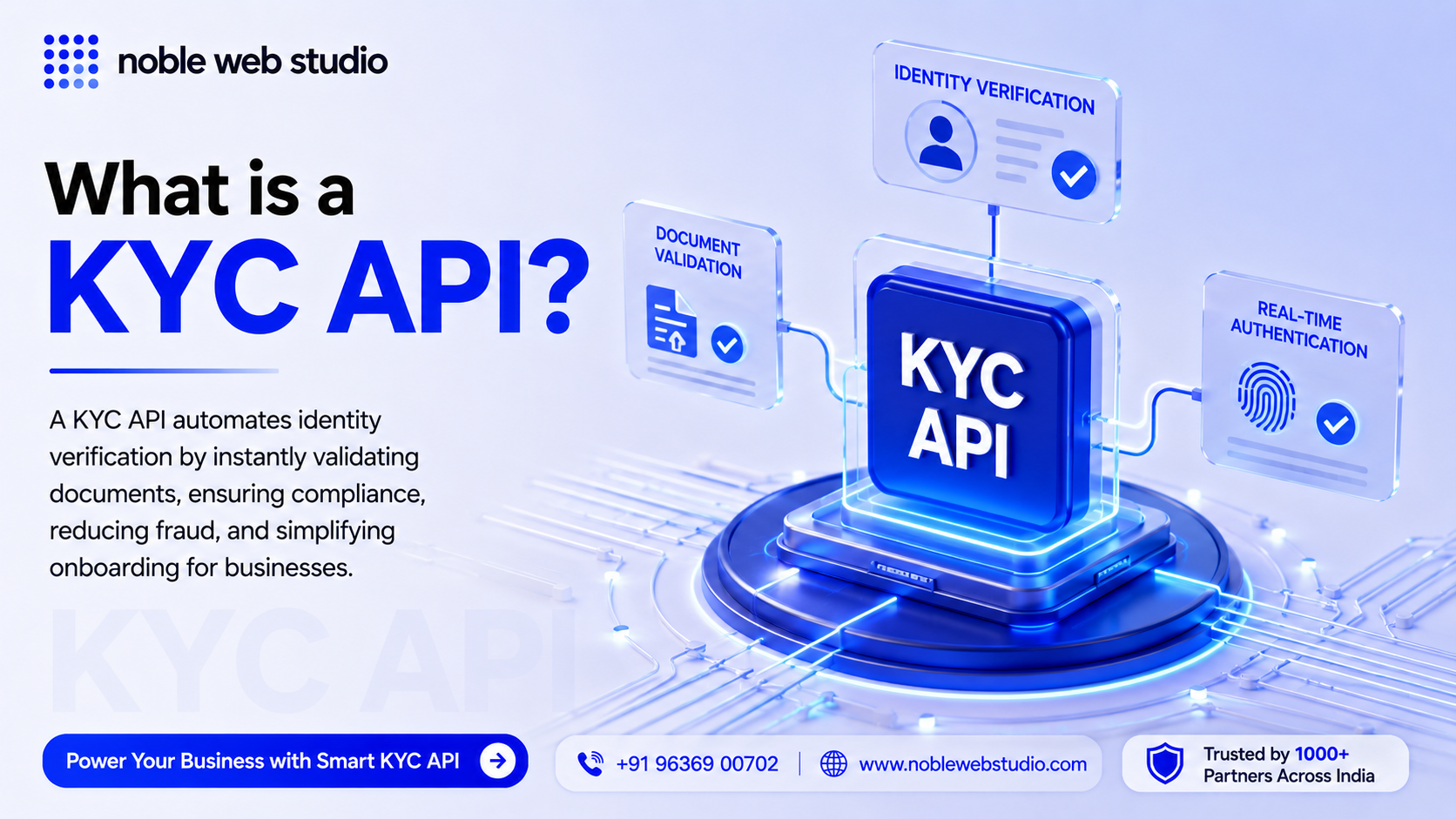
Are you looking for a KYC API to verify customer identity quickly, securely, and automatically? If yes, you’re in the right place. In today’s digital world, every fintech company, bank, NBFC, payment gateway, lending platform, insurance company, cryptocurrency platform, and online business needs a reliable Know Your Customer (KYC) API to verify users before providing financial or digital services.
A KYC API (Know Your Customer API) is a secure verification solution that helps businesses verify customer identity in real time using official documents such as Aadhaar Card, PAN Card, Voter ID, Driving Licence, Passport, and other government-approved records. Instead of manually checking customer documents, businesses can automate the entire KYC process through a fast and secure API, reducing verification time from hours to just a few seconds.
A KYC (Know Your Customer) API is a digital bridge that lets apps instantly verify user identities. Like a digital bouncer, it automatically checks a customer’s documents, government records, and background. This allows businesses to approve or block users in seconds.
Today, banks, fintech companies, NBFCs, payment gateways, insurance providers, lending platforms, investment firms, crypto exchanges, e-commerce businesses, and digital service providers use KYC Verification APIs to simplify customer onboarding while maintaining compliance with regulatory requirements. Automated KYC verification not only saves time but also helps businesses prevent identity fraud, fake registrations, duplicate accounts, and financial risks.
A modern KYC API Solution supports real-time identity verification using official customer information and can be integrated into websites, mobile applications, CRM systems, and enterprise platforms. Many businesses also combine KYC APIs with Aadhaar Verification API, PAN Verification API, Bank Account Verification API, GST Verification API, Voter ID Verification API, Driving Licence Verification API, and CKYC solutions to create a complete digital verification workflow.
Noble Web Studio offers a powerful KYC API Solution built for modern businesses that need speed, accuracy, and security. Our APIs are easy to integrate, highly scalable, and designed for fintech platforms, banking applications, payment gateways, lending companies, insurance providers, stock brokers, e-commerce businesses, and enterprises that require real-time identity verification.
In this complete guide, you’ll learn what is a KYC API is, how it works, why businesses use it, its key benefits, common use cases, API integration process, and how choosing the right KYC API provider can improve security, compliance, and customer onboarding for your business.
What Does KYC Mean, and Why Does It Need an API
KYC stands for Know Your Customer. It is a mandatory verification process used by financial institutions, fintech apps, and businesses to confirm the identity of their users and assess potential risks. The process typically requires collecting and verifying official identifying information, such as an individual’s name, date of birth, address, and government-issued ID number.
A KYC API (Application Programming Interface) bridges your application with external verification and compliance databases to automate this process in real-time. Instead of manually reviewing documents or coding complex verification systems from scratch, businesses use a KYC API to securely send customer data and instantly receive verification verdicts (Pass, Fail, or Manual Review).
KYC API Work?
A KYC (Know Your Customer) API works by acting as a secure, real-time bridge that connects your application’s signup page to external verification databases and risk screening services. Instead of requiring a human compliance officer to manually look at files, it programmatically approves or denies users in seconds.
- Data Submission: The customer uploads their details (name, date of birth, address) and photos of official ID (passport, driver’s license) via your mobile app or website.
- API Request: Your server bundles this input into a structured payload (usually JSON) and sends a secure HTTPS request to the KYC provider’s endpoint.
- Automated Verification: The KYC API processes the input through engines that run OCR (text extraction), biometric checks, and cross-reference government registries.
- Instant Response: The API instantly sends back a structured response payload detailing match scores, fraud indicators, and an onboarding verdict:
PASS,FAIL, orRETRY.
Industries That Use KYC API
KYC APIs power digital onboarding by instantly verifying customer identities, conducting biometric checks, and screening against financial watchlists. They reduce onboarding times from days to seconds and are critical for preventing fraud and ensuring regulatory compliance.
The primary industries relying on KYC APIs include:
- Banking & Financial Services (BFSI): Banks use APIs for instant account opening, loan processing, and to satisfy regulatory Anti-Money Laundering (AML) requirements.
- Fintech & Digital Lending: Digital wallets and loan apps use APIs for instant validation of documents (like PAN and Aadhaar in India), bank accounts, and liveness detection.
- Insurance: Providers use KYC APIs to verify a policyholder’s identity instantly, significantly reducing manual document verification times during claim processing or premium payments.
- Telecommunications: Telecom operators utilize Video KYC and document verification to instantly authenticate users who are purchasing new SIM cards or mobile connections.
- Cryptocurrency & Web3: Exchanges leverage APIs for identity verification and wallet screening to comply with strict global crypto-asset regulations.
- Real Estate & Property Tech: Platforms verify the identities of buyers, sellers, and tenants (tenant screening) to build trust and ensure security in high-value transactions.
Types and Capabilities of KYC API Services
KYC APIs provide multiple verification capabilities through specialized API services, with each API type designed to verify a different aspect of customer identity and regulatory compliance. Businesses can use a single verification service or combine multiple APIs to build a complete identity verification workflow.
| API Type | Primary Function | Key Technologies | Typical Use Cases | Integration Complexity |
|---|---|---|---|---|
| Document Verification | Authenticate official documents and extract data | OCR, machine learning, template matching | Account opening, loan applications | Medium |
| Biometric Authentication | Verify identity through biological characteristics | Facial recognition, liveness detection, fingerprint analysis | High-security transactions, mobile onboarding | High |
| AML Screening | Check against sanctions and watchlists | Database matching, fuzzy logic, real-time updates | Regulatory compliance, transaction monitoring | Low |
| Address/Phone Verification | Validate contact information accuracy | Telecom databases, postal services, carrier lookup | Customer data quality, fraud prevention | Low |
| Government Database Integration | Access official records and registries | Direct API connections, secure data channels | Identity confirmation, background checks | High |
- Document Verification APIs utilize OCR and machine learning to verify identity documents, passports, and driver’s licenses while extracting important information automatically. These APIs can identify document tampering, validate security features, and confirm document authenticity.
- Biometric Authentication APIs enable identity verification through facial recognition with built-in liveness detection, helping prevent spoofing attempts. Advanced solutions also support fingerprint analysis and voice recognition for stronger multi-factor authentication.
- AML Screening APIs automatically compare customer information with global sanctions lists, politically exposed persons (PEP) databases, and adverse media sources. Since these databases receive continuous updates, organizations can perform real-time compliance checks whenever new entries are added.
- Address and phone verification APIs verify customer contact details through telecom databases and postal service records. This helps improve customer data accuracy while reducing fraud risks.
- Government Database Integration APIs provide secure access to official government records for identity confirmation and background verification. Because these services interact with sensitive data, they require advanced security protocols and strict regulatory compliance.
Why Is KYC Verification Important?
KYC (Know Your Customer) is a mandatory verification process that businesses and financial institutions use to confirm a customer’s identity and assess risks. It is crucial for preventing fraud, combating money laundering, and ensuring overall financial security.
KYC is critical for several key reasons:
- Prevents Financial Crimes: By verifying identities, KYC serves as the first line of defense against money laundering, terrorist financing, and fraud.
- Reduces Identity Theft: Thorough checks—using authorized documents like a passport, driver’s license, or Aadhaar ensure that scammers cannot open fake accounts or secure loans using someone else’s stolen identity.
- Ensures Legal Compliance: Financial regulators mandate KYC to maintain the integrity of the global banking system. Failing to comply can result in massive penalties for institutions.
- Builds Trust: By keeping illicit funds out of the system, KYC protects legitimate customers and preserves institutional credibility.
How KYC APIs Function in Digital Identity Verification
A KYC API acts as the core technology behind automated customer identity verification by replacing manual verification with a streamlined digital workflow. The process generally follows three main stages: data submission, automated verification, and instant response delivery.
The workflow is completed in the following sequence:
- Data Submission: Customer information and documents are collected through web or mobile applications and securely sent to the API endpoint.
- Automated Verification: The system validates the submitted information by using multiple verification methods and cross-checking it against external databases.
- Instant Response: Verification results are generated in real time, along with compliance reports and detailed risk assessments.
The primary components of KYC APIs include identity verification engines that validate personal information, document validation systems that authenticate official documents, and risk assessment modules that identify possible fraud indicators. These components work together by connecting with external data sources such as government databases, credit bureaus, and global watchlists.
Secure API communication protocols protect information using industry-standard encryption techniques. The platform processes requests through RESTful API calls and returns structured JSON responses containing verification status, confidence scores, and comprehensive analysis results. This automated workflow removes the lengthy manual review process that has traditionally been required for customer onboarding and ongoing compliance monitoring.
Why Businesses Need a KYC API
Businesses need a KYC (Know Your Customer) API to automate identity verification, eliminate manual paperwork, and prevent fraud in real-time. . Instead of building complex compliance systems from scratch, companies use APIs to instantly validate customer details, verify documents and biometrics, and ensure strict adherence to regulatory standards.
A KYC API seamlessly serves several critical business functions:
- Real-Time Onboarding: Validates information such as verifying a PAN, Aadhaar, or Driving License in seconds, allowing users to start using a platform immediately.
- Fraud Prevention: Conducts automated background checks, including AML (Anti-Money Laundering) and PEP (Politically Exposed Person) screening, to block bad actors before they create accounts.
- Regulatory Compliance: Automatically meets evolving GDPR, KYC, and AML laws, minimizing human error and avoiding hefty penalties for non-compliance.
- Operational Efficiency: Reduces reliance on manual document checking and physical paperwork, drastically lowering operational costs while scaling securely.
KYC API vs Manual KYC
A KYC API automates customer identity verification using AI, biometrics, and database cross-referencing to provide instant, real-time onboarding approvals. In contrast, Manual KYC relies on physical document submission and human review, which is resource-intensive, prone to human error, and causes significant onboarding delays.
The digital transformation of identity verification has changed how businesses onboard users. While both methods serve to prevent fraud and maintain compliance, they operate on fundamentally different principles.
Key Differences
| Feature | KYC API (Automated) | Manual KYC |
|---|---|---|
| Speed | Instant (seconds) | Slow (hours or days) |
| Scalability | Easily handles millions of concurrent users | Hard to scale; requires hiring more human reviewers |
| Cost | Low to medium per check (highly scalable) | High (salaries, training, facility overhead) |
| Fraud Detection | High (biometrics, liveness detection, pixel-level forgery checks) | Variable (depends on human fatigue and expertise) |
| User Experience | Seamless; done from a mobile phone or web browser | Cumbersome; requires visiting an office or mailing paperwork |
| Audit Trails | Digital, immutable, and fully automated | Paper files or scanned documents requiring manual filing |
Crucial Features to Look for in a Premium KYC API Provider
Do not just choose the lowest-cost integration. Verify that your core tech layer includes these options:
- Multi-Server Routing Setup: Seamless automated switching between multiple banking nodes and server lines to keep your platform online >99.99% of the time.
- Robust Native SDK Wrappers: Pre-packaged, modular code modules built for quick deployment on Android, iOS, and modern web frameworks.
- Informative Sandbox and Testing Infrastructure: Comprehensive error codes and transaction tracking tools that help developers debug quickly.
- Completely Transparent Cost Slabs: Clear, volume-based pricing structures with no hidden maintenance fees or surprise charges.
Key Features to Look For in a KYC API
A KYC (Know Your Customer) API automates identity verification, enabling businesses to instantly validate user identities, authenticate documents, and perform compliance checks. It acts as a programmatic bridge between your application and global or regional identity databases.
Essential features of a modern KYC API include:
- Direct integration with official databases (UIDAI, NSDL/UTI, GSTN) rather than a cached or third-party copy of the data.
- Response time — verification should complete in seconds, not minutes.
- High uptime, especially during peak onboarding hours.
- Clear, well-documented API with sandbox access so your developers can test before going live.
- Support for the specific checks you need Aadhaar, PAN, GST, Video KYC, bank verification, or a combination.
- Data security — encryption in transit and at rest, and compliance with India’s data protection requirements.
- Responsive technical support when something breaks during a live integration.
KYC API Cost Structure
KYC API costs in India are typically structured on a pay-per-use model with per-transaction rates. Pricing is tiered by volume and largely depends on the type of data or verification required. Typical commercial API costs break down as follows:
- Basic Identity (PAN Verification): ₹2 to ₹5 per API call.
- Aadhaar Offline XML/QR: ₹3 to ₹8 per API call.
- Aadhaar OKYC (OTP-based): ₹5 to ₹25 per verification.
- Biometric / Liveness Checks: ₹3 to ₹4 per instance .
For end-to-end customer onboarding (which bundles API document extraction, liveness checks, and database screenings), businesses generally spend between ₹100 to ₹200 per customer, though bulk or high-volume enterprise rates can drastically reduce per-call costs.
Hidden and Additional Costs
- Integration Overhead: Upfront investments in engineering time to integrate with various vendor APIs.
- Auxiliary Checks: AML, PEP (Politically Exposed Person) screening, and ongoing monitoring add extra per-check charges.
Noble web studio offer transparent pay-per-call pricing for small to medium scale needs. For complex workflows, you can use Sandbox API to estimate total monthly/annual operational costs based on specific verification volumes and features.
Is a KYC API Safe and RBI-Compliant
Yes, a KYC API is inherently safe and RBI-compliant, provided you partner with authorized, secure vendors. . The Reserve Bank of India (RBI) actively regulates and encourages digital verification methods like Video KYC (V-CIP), e-KYC, and automated document checks, making APIs the standard for compliant financial onboarding.
How KYC APIs Ensure RBI Compliance
To be considered RBI-compliant, KYC APIs must implement strict structural and regulatory guidelines:
- Digital Personal Data Protection (DPDP) Act: APIs are built to capture explicit, auditable consent from the customer before pulling or verifying any data.
- Data Sovereignty: Compliant APIs process and store customer data including Video KYC recordings and identity documents—on servers located within India.
- Database Verification: Authorized APIs query central, trusted government databases directly (such as UIDAI, the Income Tax department for PAN, and DigiLocker) rather than relying on unverified user-uploaded files.
- Liveness Detection & Audits: Video KYC APIs simulate a live face-to-face interaction, capture live location data, and record encrypted sessions with verifiable timestamps for mandatory RBI audits.
Security Standards
Reputable KYC APIs protect sensitive financial data using multiple robust safeguards:
- Encryption & Tokenization: Data in transit and at rest is secured using bank-grade TLS (Transport Layer Security) and encryption to prevent leaks.
- Data Minimization: Many APIs use automated Aadhaar masking to black out the first 8 digits of an Aadhaar number, ensuring you only store the minimum required data to reduce your risk exposure.
- Anti-Spoofing & Liveness Checks: APIs utilize advanced AI and liveness detection (often iBeta certified) to ensure the person holding the ID is physically present and not using a photograph or a deepfake.
Business Impact and Operational Advantages
KYC APIs deliver major operational, compliance, and customer experience benefits compared to traditional manual verification methods. By automating identity verification, businesses can improve efficiency, lower operational costs, and provide a faster onboarding experience. Organizations adopting KYC APIs often experience immediate workflow improvements along with long-term savings.
The comparison below highlights the business impact of using automated KYC API solutions:
| Business Metric | Manual Process | KYC API Process | Improvement Factor | Business Impact |
|---|---|---|---|---|
| Customer Onboarding Time | 3–7 days | 2–5 minutes | 95% reduction | Higher conversion rates and better customer satisfaction |
| Processing Costs | $25–50 per verification | $2–8 per verification | 70–85% reduction | Lower operational expenses and improved efficiency |
| Error Rate | 5–15% human error | <1% automated error | 90%+ improvement | Better compliance and fewer manual corrections |
| Compliance Coverage | Periodic manual checks | Real-time continuous monitoring | 24/7 monitoring | Stronger regulatory compliance and proactive risk management |
| Scalability | Linear staff increases | Unlimited API capacity | Exponential scaling | Business growth without proportional operational costs |
One of the biggest advantages of KYC APIs is faster customer onboarding. Verification that previously required several days can now be completed within minutes, helping businesses reduce customer drop-offs and improve the overall onboarding experience.
Another key benefit is stronger regulatory compliance. With automated AML screening, Customer Identification Program (CIP) requirements, and Customer Due Diligence (CDD) procedures, organizations can maintain continuous monitoring instead of relying on periodic manual verification.
Businesses also benefit from reduced operational costs because automation minimizes manual review efforts while lowering human error. Many organizations achieve 70–85% savings in verification costs without compromising accuracy.
Improved security is another important advantage of KYC API solutions. Features such as real-time fraud detection, advanced encryption technologies, and continuous monitoring provide stronger protection while maintaining detailed audit trails for compliance requirements.
In addition, scalability allows businesses to process growing verification volumes without increasing staff or infrastructure at the same rate. Modern API-based systems can efficiently manage thousands of simultaneous verifications while maintaining consistent performance.
How to Integrate a KYC API
Integrating a KYC (Know Your Customer) API typically takes 5–7 days using a provider’s Sandbox. The standard process involves generating KYC API keys, building a secure server-side session endpoint, initializing a client-side SDK for document or biometric capture, and setting up webhooks to receive the final verification status.
Follow these concrete steps to integrate the API into your product:
- Pick the specific checks you need Aadhaar, PAN, GST, bank verification, or Video KYC.
- Get KYC API documentation and sandbox/test credentials from the provider.
- Have your developer integrate KYC API into your signup or onboarding flow.
- Test with sample data in the sandbox environment before going live.
- Go live, and monitor success rates and response times in the first few weeks to catch any integration issues early.
How to Choose the Right KYC API Provider
- Accuracy and success rate — ask for a real number, not just a marketing claim
- Which ID types are supported — Aadhaar, PAN, passport, driving licence, voter ID
- Speed — how long a single verification actually takes end to end
- Integration ease — a clean REST KYC API with clear documentation and SDKs saves weeks of development time
- Compliance — confirm the Noble web studio is aligned with RBI and UIDAI requirements, not just “compliant” in general terms
- Transparent pricing — a per-verification cost you can actually calculate, with no hidden minimum volume charges
- Support — someone to call when a verification fails and you need to know why
Why Choose Noble Web Studio for KYC & Bank Verification API
Noble web studio one of the specialized provider for KYC (Know Your Customer) and Bank Verification APIs drastically reduces onboarding times from days to seconds. These integrations replace manual document reviews and risky “penny drop” delays with real-time, automated database checks.
Key reasons to use a specialized API provider include:
- Real-time verification against official records, not cached or outdated data.
- Simple, well-documented API that most developers can integrate within days.
- Users enjoy a seamless, frictionless onboarding process with fewer drop-offs.
- Covers Aadhaar, PAN, and Bank Account Verification from a single platform.
- High uptime and fast response times, even during peak transaction hours.
- 24/7 technical support for integration and live issues.
- Noble Web Studio already verifying customers through our platform replace with your real number.
Final Thoughts
A KYC API has become an essential part of modern digital business because it helps verify customer identities quickly, securely, and accurately. Instead of relying on manual document verification, businesses can use a KYC Verification API to automate identity checks, reduce onboarding time, improve customer experience, and maintain regulatory compliance.
Whether you operate a fintech company, bank, NBFC, lending platform, payment gateway, insurance business, investment platform, e-commerce marketplace, or digital wallet, a reliable KYC API Solution helps protect your business from identity fraud, fake accounts, and compliance risks. Real-time verification also reduces operational costs and allows businesses to onboard genuine customers much faster.
KYC APIs have transformed identity verification by replacing manual processes with automated, real-time verification. This shift enables organizations to shorten customer onboarding from days to minutes while improving accuracy, strengthening security, and simplifying compliance requirements.
When evaluating KYC API solutions, businesses should carefully review the technology behind the platform. Providers with extensive expertise in computer vision, machine learning, and advanced document verification can deliver reliable data extraction capabilities that support modern identity verification requirements. Organizations should also look for providers with proven experience in delivering scalable and enterprise-ready identity verification solutions.
Beyond reducing operational costs, KYC APIs enhance customer experience, strengthen compliance, improve security, and provide the flexibility needed to scale verification processes as business requirements grow. These advantages make KYC APIs an essential component for organizations operating in regulated industries and businesses managing high-volume customer onboarding.
Choosing the right technology partner is equally important. A trusted provider ensures reliable uptime, strong security standards, easy integration, responsive technical support, and APIs that can scale as your business grows. This enables organizations to deliver secure digital services while improving operational efficiency and customer satisfaction.
Noble Web Studio offers a secure and scalable KYC API Solution built for modern businesses. With fast API integration, real-time verification, enterprise-grade security, and dedicated technical support, businesses can simplify customer onboarding, strengthen compliance, and build greater trust with their users.
Contact Noble Web Studio today to integrate a secure KYC API Solution and streamline your customer verification process with fast, accurate, and reliable identity verification.
🚀 Ready to Launch Your KYC API Business?
Power your business with Secure, Fast & Reliable KYC API Solutions. Verify Aadhaar, PAN, Bank Account, GST, Driving License, Voter ID, Passport, and more with lightning-fast API responses and enterprise-grade security.
⚡ Schedule Free Demo →