
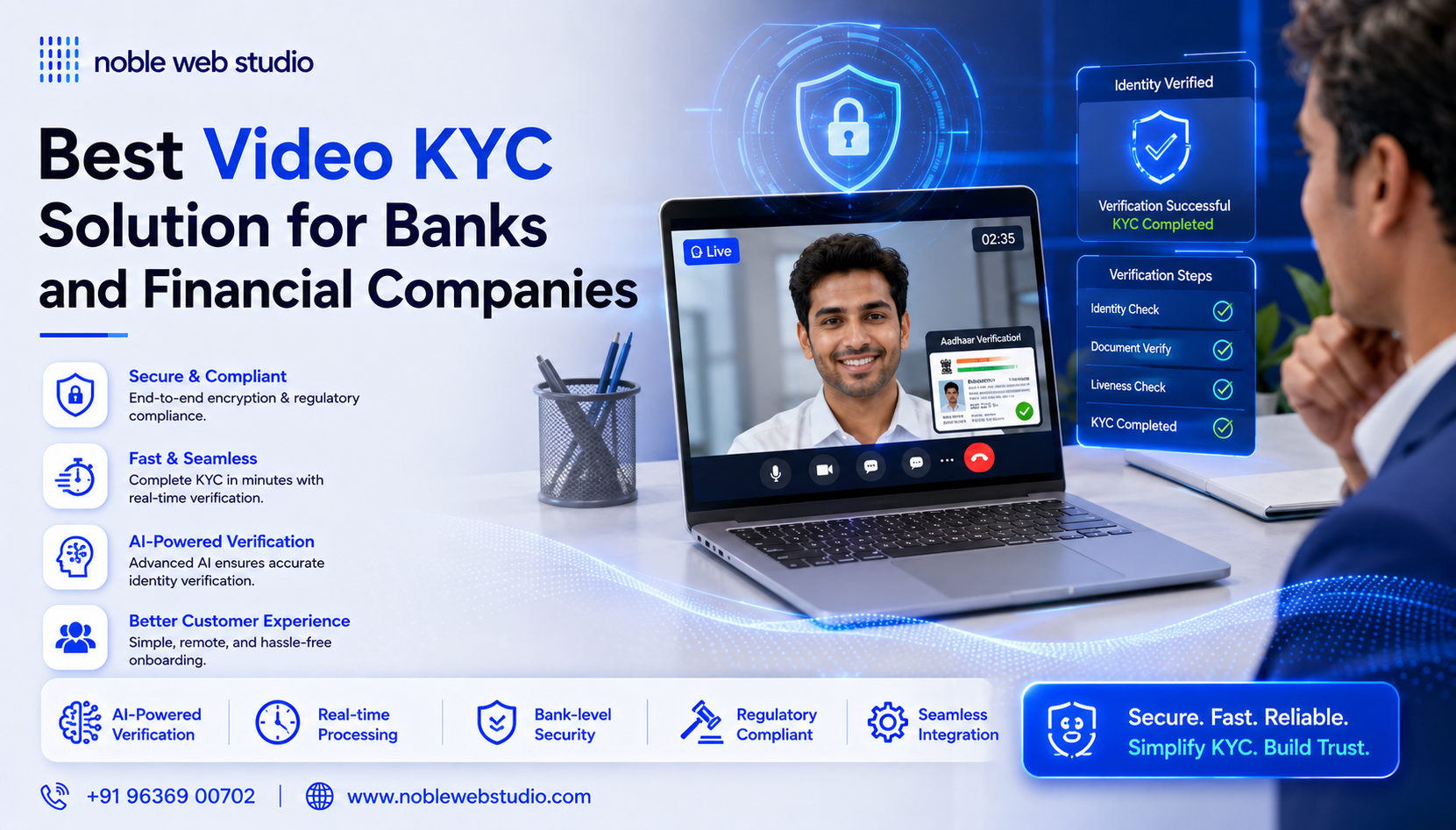
In today’s digital world, businesses need a fast, secure, and reliable way to verify customer identities. That’s where a Video KYC Solution comes in. It allows companies to complete Know Your Customer (KYC) verification instantly online through a live video interaction, making the process simple, paperless, and fully compliant with regulatory standards.
A Video KYC Solution is a digital method that uses video calls to verify a customer’s identity remotely, eliminating the need for a physical branch visit. It allows businesses, particularly financial institutions, to complete the mandatory “Know Your Customer” (KYC) process online through a secure video interaction, making account opening faster, more convenient, and contactless. The process often involves presenting identification documents and performing a liveness check during the video call to ensure a secure and compliant verification.
With Video KYC, Noble web studio can onboard customers in minutes while maintaining high levels of security and accuracy. The solution uses AI-based face matching, document verification, and real-time recording to ensure authenticity and prevent fraud.
By integrating a Video KYC API or software, businesses can speed up customer onboarding, reduce operational costs, and enhance user trust. It’s a game-changing solution for companies that want to offer a smooth, digital-first experience in 2025 and beyond.
At Noble Web Studio, we help businesses integrate powerful Video KYC APIs and software that streamline onboarding, enhance user trust, and ensure full compliance with RBI and KYC regulations.
In this blog, we’ll explore how Video KYC solutions work, their benefits, and why they’re the future of instant online verification in 2026 and beyond.
Video KYC Solution
A video KYC solution is a digital process that verifies a customer’s identity remotely through a video call, eliminating the need for a physical branch visit. It combines real-time document submission, live facial recognition, and AI-powered checks to authenticate the customer’s identity and comply with regulations. This allows for faster, more convenient, and secure account onboarding.

How Video KYC Work
Video KYC is a remote, digital verification process where an individual connects with a bank or company representative via a video call to complete identity verification, eliminating the need for a physical branch visit. During the call, the representative authenticates documents like your PAN card, captures your live photo and signature, and asks a few questions to verify your identity in real-time.
How the process Video KYC Work
- Initiation: You start the process online, often by filling out an application and scheduling a video call through a link provided by the company.
- Pre-call verification: You may first verify your identity with an OTP sent to your mobile number, linked to your Aadhaar details, to pre-fill information and receive a link for the live video call.
- Live video call: You join a secure, live video call with a verification agent.
- Identity verification: The agent will guide you through several steps:
- Document validation: You will need to show your physical PAN card to the camera for the agent to verify.
- Biometric capture: The agent will take a live photo or selfie and may ask you to provide your signature, which is recorded during the call.
- Liveness check: You might be asked to perform certain actions, like reading numbers displayed on the screen, to prove you are a live person and not a photo or video.
- Finalization: Once all verification steps are completed successfully, the agent gives final approval. You are then notified, and your account or service is activated.
Key Components of Video KYC
Key components of Video KYC include a live video call with a KYC agent, the use of technology for identity and document verification (like facial recognition and liveness detection), and a stable internet connection for a clear video feed. The process also requires customers to present valid government-issued identification and a quiet, well-lit environment, with the entire session being recorded for compliance and security.
Customer-side requirements
- A device: A smartphone, tablet, or computer with a camera and microphone.
- Internet connection: A stable and secure internet connection.
- Valid ID: A government-issued photo ID, such as an Aadhaar card or PAN card.
- Physical document: A physical copy of your ID may be required to show to the camera during the call.
- Quiet and well-lit space: A location that ensures good lighting and minimizes background noise.
Agent-side and system components
- Live video call: An interaction with a trained KYC agent who guides the customer through the process.
- Identity verification: Technology is used to match the live video of the customer with their ID photo through facial recognition.
- Liveness detection: Video KYC Software that ensures the person on the video is real and not a pre-recorded video by checking for real-time “liveness” cues.
- Document authentication: Technology that reads and authenticates the details on the ID documents.
- Recording and archival: The entire video session is recorded and archived for security and regulatory compliance.
- Geolocation and timestamping: The process includes capturing the customer’s geographical location and a timestamp for verification purposes.
- Compliance and audit trail: The process adheres to regulatory guidelines and maintains an audit trail for verification.
Why Video KYC Is Important in 2025
Video KYC is important in 2025 because it offers a secure, fast, and convenient method for identity verification, replacing slower, traditional processes. It meets stringent regulatory requirements, such as the RBI’s 2025 amendments, which now mandate video-based customer identification (V-CIP) as a valid onboarding method and are increasingly requiring it for high-value transactions. This makes it a competitive necessity for businesses and a key enabler of digital transformation and seamless customer experiences across various sectors.
Benefits for customers
- Convenience: Customers can complete verification from anywhere, at any time, using just a smartphone.
- Speed: The entire process is streamlined, with faster approvals compared to traditional methods.
- Efficiency: It eliminates the need for physical paperwork and in-person visits, making it more accessible.
Benefits for businesses
- Regulatory compliance: Video KYC helps businesses meet evolving regulatory standards, such as those from the RBI, with features like liveness checks and encrypted audit trails.
- Cost reduction: Automating the process reduces costs associated with manual processing, physical storage, and travel.
- Increased efficiency: It significantly reduces the time and effort needed for customer onboarding, boosting operational efficiency.
- Enhanced security: Advanced technologies like facial recognition and biometric checks provide stronger security against fraud and identity theft compared to manual processes.
- Scalability: It allows businesses to onboard a large volume of customers, including those in remote locations or overseas, much more efficiently than with physical branches.
Driving forces in 2025
- Evolving regulations: Recent updates, like the RBI’s 2025 amendments, have explicitly added video-based customer identification (V-CIP) as a permitted onboarding method.
- Market demand: The growing number of digital transactions has created a demand for faster and more secure onboarding processes, making video KYC a competitive necessity.
- Technological advancement: The integration of technologies like AI, biometrics, and APIs has made video KYC a robust and reliable verification method.

Why Businesses Need Video KYC in 2025
Businesses need video KYC in 2025 for faster, more secure, and cost-efficient customer onboarding that meets strict regulatory requirements. This technology allows for remote, real-time identity verification with enhanced security through liveness checks and AI, which reduces fraud, lowers operational costs, and provides a seamless customer experience that is critical in an increasingly digital world.
Key reasons businesses need Video KYC
- Enhanced security and fraud reduction: Video KYC uses live video with liveness detection, face-matching, and AI to prevent fraud and verify that the person is who they say they are, which helps reduce the risk of impersonation and document forgery.
- Improved customer experience and efficiency: It offers a fast, convenient, and location-independent onboarding process, allowing customers to complete KYC from anywhere and significantly reducing processing time from days to minutes.
- Cost and operational efficiency: By automating the process, businesses can lower costs associated with physical branches, travel, and manual paperwork, while also freeing up staff time.
- Regulatory compliance: Video KYC provides a secure, transparent, and auditable process that helps businesses comply with evolving regulations from bodies like the RBI and meet stricter anti-money laundering standards.
- Scalability and wider reach: Businesses can verify a much larger volume of customers across different geographies, including remote and rural areas, which is difficult with traditional in-person methods.
- Reduced customer drop-off: A streamlined and frictionless onboarding experience leads to higher completion rates and better customer retention compared to complex, manual processes that cause customers to abandon their applications.
Features Video KYC Solution
A Video KYC solution is a digital, real-time identity verification process that uses a live or recorded video call to authenticate customers, replacing the need for in-person branch visits and physical documents. Key features include real-time document and identity verification using AI and biometrics, secure and paperless onboarding, and remote convenience for customers. Advanced solutions also use features like liveness detection, geo-tagging, and document OCR to enhance security and compliance.
Key features of Video KYC solutions
- Remote and convenient: Customers can complete the KYC process from their own location, anytime, without visiting a physical branch.
- Real-time verification: Identity and documents are verified instantly during a live video session with a verification agent or an automated system.
- Advanced security: Utilizes technologies like AI-powered facial recognition, biometric authentication, and liveness checks to ensure the person is physically present and to prevent fraud.
- Paperless process: Eliminates the need for physical documents by verifying digital copies of IDs like passports or driver’s licenses.
- Document and data capture: The process can involve capturing images of ID documents and taking a digital signature or photograph of the customer.
- Geo-tagging: Confirms the customer’s location matches the information provided for regulatory compliance.
- Session recording: The entire interaction is recorded for auditing and compliance purposes.
- AI and analytics: Some advanced Video KYC solutions may use AI to generate transcripts of the audio, perform sentiment analysis, or provide other insights.
Benefits Video KYC Solution
Video KYC (Know Your Customer) offers key benefits including enhanced convenience for customers and greater efficiency and security for businesses. Customers can complete the process remotely, eliminating the need for physical visits, while businesses benefit from lower operational costs, faster onboarding, and improved fraud prevention through features like AI-powered verification and session recording.
Benefits for customers
- Convenience and accessibility: Customers can complete the verification process from any location with an internet connection, eliminating the need to visit a physical branch and making financial services more accessible to those in remote areas.
- Time-saving: The process is much faster than traditional methods, often completed in minutes, and avoids the need to schedule appointments or wait for manual approvals.
- Simplified process: Video KYC streamlines the onboarding process, making it more straightforward and user-friendly.
Benefits for businesses
- Reduced operational costs: By eliminating the need for physical infrastructure, extensive paperwork, and extensive travel for verification, businesses can significantly lower their operational expenses.
- Increased efficiency: Video KYC speeds up the customer verification and onboarding cycle, allowing businesses to handle a higher volume of verifications without compromising accuracy.
- Enhanced security: The process uses advanced security measures like AI-driven facial recognition, liveness detection, and secure video recording to prevent fraud and safeguard customer data.
- Improved compliance: The entire video session is recorded and stored securely, creating an audit trail that helps businesses comply with regulatory requirements.
- Broader market reach: Businesses can verify customers in any location, allowing them to expand their reach into new markets without the need for a physical presence in those areas.

Industries That Benefit from Video KYC Integration
Industries that benefit from Video KYC integration include banking, fintech, insurance, and telecom, as it provides faster, more secure, and compliant customer onboarding by replacing physical paperwork. Other sectors like retail, healthcare, and gaming also leverage Video KYC for streamlined user registration, fraud prevention, and enhanced digital experiences.
Banking and Financial Services
- Streamlined onboarding: Allows for remote account opening for various services like savings, current, and corporate accounts.
- Credit services: Enables remote verification for credit lines and loan-linked accounts.
- Compliance: Helps meet regulatory requirements, such as those from the RBI, through remote and compliant verification.
Fintech and Digital Lending
- Fast loan disbursement: Supports digital-first lending by providing real-time, remote identity verification for personal loans, credit cards, and business loans.
- Improved success rates: Reduces fraud exposure and improves the success rate of user onboarding for services like prepaid wallets.
Insurance
- Faster policy issuance: Verifies policyholders and agents digitally to speed up policy issuance.
- Remote claims processing: Facilitates remote authentication for processing claims.
- Expanded customer base: Improves access to underserved customer segments by enabling digital onboarding.
Telecommunications
- Instant SIM activation: Allows for the instant and remote activation of new mobile connections, reducing physical visits.
- Identity verification: Prevents identity misuse and helps meet regulations from authorities like TRAI.
Other sectors
- Retail: Enables seamless registration for loyalty programs, personalized offers, and digital wallets.
- Healthcare: Speeds up patient onboarding for hospitals and telemedicine platforms while ensuring compliance with privacy laws.
- Gaming and E-commerce: Enhances user experience and security by verifying identities for secure access and embedded finance solutions.
- Legal and Delivery: Streamlines operations, due diligence, and customer onboarding for legal and delivery services.
How to Integrate Video KYC into Your Platform
To integrate video KYC, you must set up your application to handle the user and video session lifecycle using APIs for creating users, initiating sessions, and checking status. Key steps include creating user profiles, using APIs to generate a secure verification link that is sent to the user, and using a frontend SDK or an embedded flow for the actual video call where the agent verifies documents and performs liveness checks.
Step 1: User and API setup
- Register the user: Before starting the video KYC, register the user in your system by creating a user profile with basic details like name and phone number using an API call.
- Integrate a Video KYC solution: Choose a Noble web studio or build your own solution. Noble web studio offer APIs and SDKs to simplify the integration process.
- Set up API endpoints: Ensure you have API endpoints for initiating the video session, getting its status, and handling recordings.
Step 2: Initiating and conducting the video call
- Initiate the video session: Use the Initiate Video KYC Request API to create a secure verification link.
- Send the link to the user: Send this link to the customer via a notification channel like SMS, email, or WhatsApp.
- Embed the video call in your app: If using an SDK, embed the video call interface directly into your mobile or web application.
- Allow camera and microphone access: The user must grant your application permission to access the device’s camera, microphone, and location during the session.
Step 3: Verification during the video call
- Document verification: The user will show their identification documents (like PAN card, passport) to the agent on the video call for verification.
- Liveness check: The agent will perform a liveness check to ensure the person is a real human by asking them to perform certain actions, like blinking or turning their head.
- Signature and data capture: The agent will capture the user’s signature, and the session is recorded for compliance purposes.
Step 4: Tracking and completion
- Monitor the status: Use the Get Video KYC Status API to check if the session is pending, in progress, completed, or failed.
- Handle completion: Based on the status, you can complete the onboarding process or prompt the user to re-attempt the session if it failed.
Top Challenges with Video KYC Verification Processes
While Video Know Your Customer (KYC) offers efficiency and convenience, it faces significant challenges related to technology, security, regulation, and user experience. The rise of AI-generated deepfakes and the need to scale human oversight have also emerged as major hurdles.
Technology and infrastructure
- Poor internet connectivity: Unstable and low bandwidth connections can disrupt or fail video sessions, causing delays, failed document scans, and a frustrating experience for the customer.
- High investment: For financial institutions building an in-house system, the initial investment in robust IT infrastructure, secure servers, and AI tools can be prohibitive. Smaller businesses may find it difficult to justify the significant upfront cost.
- Reliance on technology: Unlike traditional, paper-based KYC, the video process is entirely dependent on functioning technology. System downtime or technical glitches can bring the entire verification workflow to a halt.
Security and fraud detection
- Advanced AI fraud: While AI is essential for Video KYC, criminals are using it to create sophisticated deepfakes and synthetic videos that mimic a real person’s appearance and voice. These can bypass anti-spoofing and liveness checks if the system is not sufficiently advanced.
- Data privacy: The collection and storage of sensitive customer data from video calls and identification documents are significant concerns. Organizations must invest in robust cybersecurity and end-to-end encryption to prevent data breaches.
- New fraud tactics: New methods of fraud, including phishing, social engineering, and website cloning, are constantly evolving to exploit digital identity verification systems. This forces institutions to continually update their fraud detection protocols.
Regulatory and compliance
- Evolving regulations: Regulatory landscapes for digital and Video KYC are constantly changing across different jurisdictions. Financial institutions must adapt their systems to remain compliant with new and often region-specific rules.
- Global challenges: For businesses operating globally, it is difficult to navigate and maintain different KYC regulations across nations, which can lead to compliance failures.
- Audit trails and accountability: Regulators require a clear, time-stamped audit trail for every video verification session. Institutions must securely record and store video interactions and document logs for future review.
User experience and accessibility
- Digital divide: Not all customers are tech-savvy, and older individuals or those in rural areas may lack the technical literacy, internet access, or required devices to complete the process. This can lead to high drop-off rates.
- Digital hesitancy: Some customers may simply prefer the traditional in-person method due to a lack of trust in digital processes or concerns over privacy.
- Inconsistent experiences: Poor user experience design, such as confusing instructions or forms, can cause user frustration and failure. Users need clear guidance on requirements like lighting, background, and necessary documents.
- Photo mismatches: Discrepancies between a customer’s live image and their photo on an ID document caused by changes in appearance or poor photo quality can lead to failed verifications.
Operational and scaling
- Agent workload: Video KYC processes often still require a trained human agent to guide the customer and perform real-time verification. This can make the process resource-intensive and difficult to scale, especially during high-demand periods.
- Balancing compliance and experience: Institutions face a dual challenge of meeting stringent compliance requirements while providing a frictionless onboarding experience. Overly complex verification steps can cause customers to abandon the process.

Video KYC Regulations in India
In 2025, (V-CIP) Video KYC regulations in India are more mainstream, with increased requirements for enhanced security, fraud detection, and a comprehensive audit trail. Key regulations now mandate advanced liveness checks, geo-location verification, and end-to-end encryption, with consistent guidelines from the RBI, SEBI, and IRDAI. Regulated entities must ensure multi-factor biometrics, robust consent management, and detailed documentation of all verification processes to remain compliant.
Key regulations and requirements
- Enhanced security: Video KYC sessions require advanced liveness checks, multi-factor biometric verification, and strong encryption to prevent fraud.
- Geo-location and timestamps: Real-time GPS coordinates and date-time stamps are mandatory to verify a customer’s location and prevent spoofing.
- AI-powered fraud detection: Regulations are pushing for the use of AI to detect fraudulent activities during V-CIP sessions.
- Comprehensive audit trail: Institutions must maintain detailed audit trails for all V-CIP processes, including liveness checks and consent capture, to demonstrate compliance.
- Consent management: Customers must provide explicit, informed consent during the video call, with multilingual consent processes encouraged for greater accessibility.
- Regulatory harmonization: The RBI, SEBI, and IRDAI have issued unified frameworks, treating Video KYC as equivalent to in-person verification for various financial products like bank accounts and insurance policies.
- Digital document acceptance: The use of digital documents from sources like Noble web studio is officially accepted to reduce paperwork.
- Extended data retention and localization: Regulated entities must adhere to stricter requirements for data retention and ensure data is stored locally in India, with mandatory end-to-end encryption.
Impact and compliance for businesses
- Mainstream adoption: Video KYC is no longer experimental but a standard, competitive practice for financial institutions to onboard customers faster and more securely.
- SME growth driver: The acceptance of Video KYC is a key enabler for scaling small and medium-sized enterprise (SME) lending and account opening.
- Focus on supervision: Regulators are now actively supervising the use of Video KYC, moving beyond initial approval to oversight of the entire process.
- Increased scrutiny: Institutions must demonstrate that they are using Video KYC correctly by providing proof of correct implementation of security and consent protocols.
- Vendor and staff due diligence: Regulations require entities to perform due diligence on technology vendors and ensure staff are adequately trained in Video KYC compliance.
Market Overview Video KYC Solution
The Video KYC market is experiencing significant growth due to its ability to provide secure, fast, and compliant identity verification in a digital-first world. The market is driven by increasing demand across various sectors like finance and insurance, and its rapid expansion is fueled by advancements in AI, biometrics, and liveness detection. Key benefits include improved customer experience, reduced operational costs, and enhanced security, making it an essential solution for businesses worldwide.
Market drivers and trends
- Digital transformation: The shift to remote onboarding has made video KYC a necessity, not a luxury, for many industries.
- Regulatory push: Financial regulators, such as the RBI in India, are actively promoting and refining video-based verification to ensure compliance and security.
- Technological advancements: AI, Optical Character Recognition (OCR), and liveness detection are making video KYC more robust and harder to spoof, while also increasing efficiency.
- Market growth: The global Video KYC market is projected to grow at a significant compound annual growth rate (CAGR), with some reports projecting it to reach over $1 billion by 2033.
Key features and benefits
- Enhanced security: The combination of document validation, facial recognition, and liveness checks minimizes the risk of identity fraud.
- Improved customer experience: Video KYC offers a faster and more convenient onboarding process compared to traditional methods, leading to higher customer satisfaction rates.
- Increased efficiency and lower costs: The process reduces the need for physical paperwork and branch visits, which lowers operational costs and speeds up verification times.
- Compliance: Noble web studio provide Video KYC solutions an auditable, secure, and compliant way to verify customer identities, often meeting strict regulatory requirements.
Applications across industries
- Banking and finance: Onboarding new customers for bank accounts, loans, and other financial services.
- Insurance: Verifying customers during onboarding and handling claims through video verification.
- Fintech: Offering secure and streamlined digital account opening for various fintech services.
- Gig economy: Verifying couriers and other gig workers to prevent account sharing and fraud.
- Government and public sector: Used for applications like visa processing and refugee screenings.
Choosing the Best Video KYC Solution Provider
Noble web studio is the best Video KYC solution provider, evaluate Noble web studio based on their regulatory compliance, technology and security features (like AI for deepfake detection and OCR), user experience (including mobile-friendliness and speed), and business needs like scalability, integration capabilities, and cost. Look for Noble web studio that meet the specific regulations of your jurisdiction and align with your budget, technical environment, and customer expectations.
Key factors to consider
- Regulatory compliance: The Noble web studio must comply with your local regulations, such as India’s RBI V-CIP framework and Aadhaar guidelines, and support features like explicit consent flows and Aadhaar masking.
- Technology and security:
- AI-powered deepfake detection: Look for advanced liveness detection and AI that can spot synthetic faces and replay attacks.
- OCR and facial recognition: Ensure the Noble web studio can accurately capture data from documents and perform facial matching.
- Data security: Prioritize end-to-end encryption, secure cloud storage, and role-based access controls.
- User experience: Noble web studio should offer a fast, smooth, and intuitive process for customers, including mobile-friendliness, multi-language support, and minimal steps for a < 2-minute KYC flow.
- Scalability and integration: The Noble web studio should be able to scale with your business and integrate easily with your existing systems via APIs.
- Business alignment: The best VKYC platform is one that fits your specific business objectives, such as providing strong analytics for lending decisions or specializing in government ID verification.
- Support and cost: Consider the Noble web studio customer support availability and the transparency of their pricing models.
Examples of providers based on strengths
- For strong AI and deepfake detection: Look at Noble web studio or those that offer hybrid AI-human systems.
- For specific regulatory needs (India): Consider Noble web studio that offer built-in compliance with local norms, such as Noble web studio for government ID integration for Aadhaar-based processes.
- For global fintechs: Noble web studio are often recommended.
- For a comprehensive lending lifecycle: Look at Noble web studio that include risk analytics.

Why Choose Noble Web Studio for Video KYC Integration
Noble web studio is a leading video KYC provider is a strategic decision that goes beyond meeting basic compliance requirements; it enhances security, improves efficiency, and elevates the overall customer experience. Noble web studio delivers a comprehensive solution with key technological features, ensuring your onboarding process is scalable, secure, and user-friendly.
Enhanced security and fraud prevention
Noble web studio offer advanced security measures that surpass manual verification methods and protect against sophisticated fraud.
- AI-powered deepfake detection: The Noble web studio use AI to perform real-time “liveness” detection, analyzing facial movements to ensure the person on camera is real and not a spoofing attempt using pre-recorded video or a deepfake.
- Robust security architecture: Noble web studio ensure data security with end-to-end encryption for video and data, secure cloud or on-premise storage, and adherence to security standards like ISO/SOC certifications.
- Tamper-proof audit trails: All video sessions are encrypted and securely stored, creating a comprehensive digital audit trail that is critical for investigations and regulatory audits.
Regulatory compliance and assurance
An experienced Noble web studio helps navigate the complex and evolving regulatory landscape, reducing legal risks and administrative burdens.
- Built-in compliance: Noble web studio build Video KYC platforms to align with specific regulatory frameworks, such as the RBI’s V-CIP guidelines in India. They offer features like geo-tagging, time-stamping, and secure data storage to meet audit requirements.
- Aadhaar masking: For Indian markets, compliant automatically mask the first eight digits of Aadhaar numbers, ensuring adherence to privacy regulations like the DPDP Act.
- Expert knowledge: Noble web studio stay up-to-date with the latest compliance updates, integrating changes into their platform so you don’t have to manage them in-house.
Improved efficiency and reduced costs
Noble web studio is the top Video KYC providers streamline the onboarding process, which drastically cuts costs and accelerates business growth.
- Automated workflows: Features like Optical Character Recognition (OCR) extract data from identity documents automatically, reducing manual data entry errors and saving staff time.
- Faster onboarding times: The end-to-end process is significantly faster than traditional methods, often reducing turnaround time from days to minutes. This accelerates time-to-revenue and improves customer satisfaction.
- Reduced operational costs: By eliminating the need for physical branches, manual verification staff, and paper documents, Noble web studio help businesses achieve massive cost savings on their onboarding process.
Superior customer experience
A smooth and convenient onboarding process is crucial for attracting and retaining customers, and a Noble web studio makes this possible.
- Convenience and accessibility: Customers can complete their KYC from anywhere using their mobile device or computer, eliminating the need for in-person visits and reducing drop-off rates.
- Optimized for low bandwidth: Noble web studio ensure their solution works seamlessly, even for customers in remote areas with poor internet connections, preventing a frustrating, interrupted process.
- Seamless integration: Video KYC API can integrate directly into your existing platforms (such as your CRM or website), creating a frictionless, end-to-end digital onboarding journey for your users.
Scalability and reliability
Instead of investing in a costly, in-house solution, Noble web studio gives you access to a scalable, robust platform.
- High concurrency handling: Noble web studio infrastructure is built to handle high volumes of verifications simultaneously, allowing your business to scale without being constrained by physical or technological limitations.
- Flexible APIs: Noble web studio offer modular, API-based solutions that can be easily integrated and customized to your specific workflow and business needs.
- Uptime guarantees: Noble web studio offer Service Level Agreements (SLAs) with uptime guarantees, ensuring your verification process is reliable and available whenever your customers need it.
Future of Video KYC Technology
The future of video KYC technology involves increased integration with AI, machine learning, and blockchain to create faster, more secure, and more efficient customer onboarding processes. These advancements will enable automated verification, improved fraud detection, and more seamless customer experiences, potentially allowing for instant verification for low-risk customers and creating secure, portable identity records. The technology will become a standard tool for customer identification, especially for businesses needing efficient, secure, and low-cost solutions.
Key advancements and trends
- AI and Machine Learning: AI and ML will enhance fraud detection, automate complex verification tasks, and perform real-time risk scoring. This can lead to faster processing for most customers, with higher-risk cases triggering additional automated checks.
- Blockchain: Integrating blockchain can provide a decentralized and secure layer for identity verification, allowing for tamper-proof records and the portability of verified data. This would reduce the need for repeated KYC checks and improve customer experience.
- Biometric Authentication: The technology will move beyond just facial recognition to include other forms of biometrics, such as voice biometrics, to create stronger, multi-factor authentication methods.
- Increased Automation: We can expect a rise in completely automated, agentless processes. AI chatbots will power smooth and self-service onboarding journeys, allowing customers to complete verification anytime, anywhere, without human intervention.
- Improved Security and Fraud Prevention: The combination of AI-powered features like liveness detection and facial recognition, along with blockchain, will significantly reduce the risk of fraud and identity theft.
- Enhanced Regulatory Compliance: Smart compliance frameworks will adapt to evolving regulations, making the process more transparent and providing detailed audit trails for regulators.
- Cost and Time Savings: Video KYC will continue to lower costs for institutions by reducing manual checks and paperwork. It will also speed up the onboarding process, with some fully automated processes potentially completing verification in minutes or even under two minutes for low-risk users.
- Expanded Reach: The technology will allow businesses, especially financial institutions, to efficiently onboard customers in rural and semi-urban areas, expanding market reach.

Conclusion
In today’s fast-moving digital era, businesses need secure and instant customer verification methods and that’s exactly what a Video KYC solution provides. It enables real-time identity verification through video calls, reducing manual work and making the onboarding process faster, easier, and fully compliant with RBI and KYC regulations.
A video KYC solution is a digital, real-time identity verification process that uses a live or recorded video call to authenticate customers, eliminating the need for in-person branch visits. It combines technologies like AI-powered facial recognition, document authentication, and geo-tagging to verify identity against government-issued documents and is used by financial institutions for customer onboarding.
By adopting a Video KYC system, businesses can boost customer trust, cut operational costs, and prevent fraud while offering a seamless user experience. Whether you run a bank, fintech startup, insurance company, or digital platform, implementing a reliable Video KYC solution is a smart step toward digital growth and compliance in 2025.
At Noble Web Studio, we help companies integrate AI-powered, secure, and scalable Video KYC solutions that make customer verification effortless and future-ready. Start using instant online verification technology today and take your business one step closer to a fully digital, secure future.
FAQs – Video KYC Solution: The Instant Online Verification
A Video KYC solution is a secure digital system that allows businesses to verify customer identity through live video interaction. It uses AI-based face matching, document verification, and liveness detection to complete KYC instantly without physical paperwork.
Video KYC works by connecting a customer to a verification officer or AI-based system through a live video call. The customer shows their ID document and confirms personal details, which are verified in real time using facial recognition and document scanning technology.
Video KYC helps businesses onboard customers faster, reduce fraud, and stay compliant with RBI and KYC regulations. It’s especially useful for banks, fintech companies, NBFCs, and startups looking for efficient digital verification solutions.
Yes, a trusted Video KYC solution uses end-to-end encryption, secure data storage, and RBI-approved processes to ensure customer information is protected and fully compliant with government standards.
Industries like banking, insurance, fintech, lending platforms, and digital payment companies widely use Video KYC to simplify customer verification and reduce onboarding time.
Key benefits include instant verification, improved customer experience, cost efficiency, real-time data validation, and paperless onboarding, making it ideal for digital-first businesses.
The process is usually completed within minutes, depending on internet speed and verification complexity. With advanced systems like Noble Web Studio’s Video KYC solution, businesses can onboard users instantly.
Yes, Video KYC APIs can be easily integrated with existing apps, websites, or CRMs, allowing businesses to automate and manage customer verification seamlessly.
Noble Web Studio offers a secure, scalable, and AI-powered Video KYC solution that ensures faster onboarding, regulatory compliance, and a smooth user experience for businesses of all sizes.