
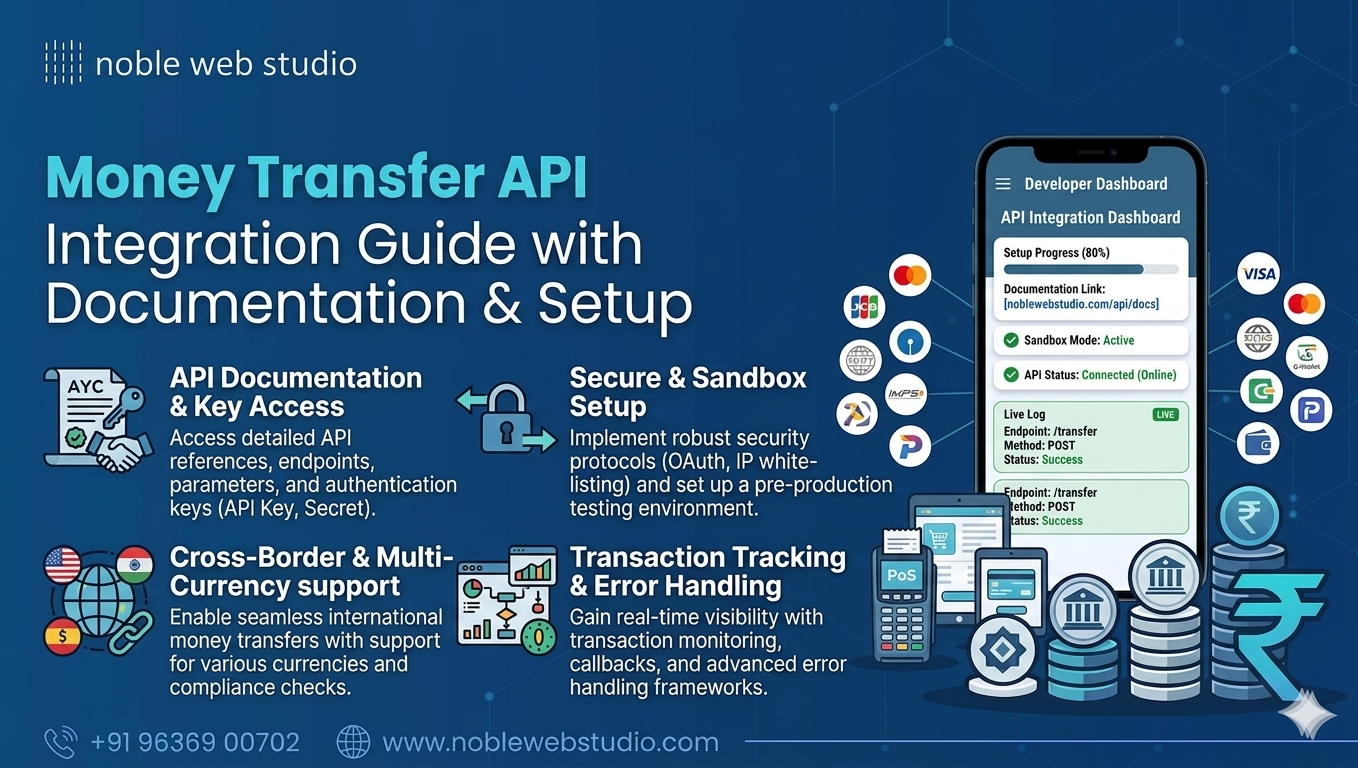
If you want to start a fintech or digital payment business, then Money Transfer API integration in India is one of the most powerful solutions available today. A money transfer API allows you to add instant fund transfer services to your website or mobile app, helping you serve customers quickly and efficiently.
A Money Transfer API allows you to connect your website, mobile money transfer app, or money transfer software platform with banking networks to enable online money transfer services like domestic remittance, wallet transfer, and bank-to-bank transactions. With this integration, users can send money anytime, anywhere with just a few clicks.
Money Transfer API integration enables money transfer platform to securely process instant, automated fund transfers (IMPS/NEFT/UPI) between bank accounts or digital wallets without manual intervention. It is widely used to embed payment functionality into websites, money transfer app and ecommerce platforms for features like bulk payouts, bank account validation, and 24/7 financial services.
With the help of a reliable money transfer API provider like Noble web studio, businesses can enable secure online money transfer, domestic remittance, and real-time payment services. This creates a strong earning opportunity where you can generate commission on every transaction, making it a profitable and scalable business model.
A reliable money transfer API in India enables businesses to send money between bank accounts in real-time with high security and accuracy. Customers can easily transfer funds anytime, making it a highly demanded service in both urban and rural areas.
Choosing the right money transfer platform is important for long-term growth. A robust money transfer api solution ensures high-speed transactions, strong security, easy integration, and scalable infrastructure that supports business expansion. Whether you are a retailer, distributor, or fintech company, integrating a money transfer API in India can help you enter the fast-growing digital payments market and build a profitable business with minimal investment.
Noble Web Studio provides a trusted and high performance money transfer API solution in India designed for easy integration and smooth operation. With features like fast transactions, secure money transfer API connection, high success rate, and user-friendly money transfer api dashboard, it helps businesses manage payments effectively and grow faster.
As the demand for online money transfer services in India continues to rise, integrating a powerful money transfer API can help you build a successful fintech platform. Choosing a reliable partner like Noble Web Studio gives you the advantage to create a secure, profitable and future-ready digital payment business.
In this blog, you will learn What is money transfer API integration, how money transfer API integration works, its benefits, setup process, and how you can earn money step by step. This guide will help you choose the right solution and grow your business successfully.
What is Money Transfer API Integration?
Money transfer API integration is the process of embedding secure, real-time, bank-to-bank, or wallet-to-wallet fund transfer capabilities directly into websites, mobile money transfer apps, or enterprise best money transfer software. It connects money transfer platform to payment rails like IMPS, NEFT, or SWIFT for instant transactions, often used for automated payroll, money transfer services, and fintech applications. Synonyms include Fund Transfer API, Payout API, (DMT) Domestic Money Transfer API, or Digital Payment Gateway Integration.
| Daily DMT transfers India Crores Every business day across India | Max transfer per sender/day ₹25,000 Basic KYC — higher with full KYC | Transfer success speed Seconds IMPS — available 24/7/365 |

Money Transfer API Integration Work
Money Transfer API integration connects a website, app, or best money transfer software to banking networks (e.g., IMPS, NEFT, SWIFT) to facilitate secure, real-time fund transfers, automated payments, and beneficiary management. This integration eliminates manual processing, allowing instant transaction initiation, automated KYC/compliance checks, and real-time status tracking.
How Money Transfer API Integration Works
- Initiate Transfer: A user inputs recipient details (account number, IFSC/SWIFT code) and the transfer amount within your application.
- Secure Request: The application sends a secured money transfer API request containing authentication keys and transaction details to the Noble web studio.
- Compliance Checks: The Noble web studio validates user data and performs automated compliance checks, such as Know Your Customer (KYC) or Anti-Money Laundering (AML) checks.
- Bank Connectivity: The best money transfer API routes the payment request through the appropriate banking infrastructure (e.g., IMPS for instant transfers, SEPA/SWIFT for international).
- Processing & Confirmation: The bank processes the transfer and returns a real-time status update (success, failure, or pending) to the user’s application.
What happens when a transfer fails?
If a transfer fails because of an incorrect account number, a bank server timeout, or insufficient balance top Money Transfer API sends an error response with a specific error code explaining what went wrong. The transfer amount is automatically refunded to your wallet within minutes. Your best money transfer platform displays a clear failure message to the user. No money is lost, and no manual intervention is required from your side.
Types of Money Transfer API
High commission Money transfer API enable high performance money transfer software application to initiate, manage, and automate fund transfers through various rails like banking networks (ACH, SWIFT, SEPA, IMPS, UPI), digital wallets, or crypto, offering secure and instantaneous transactions. Types include Domestic Transfer (DMT), International/Cross-border, UPI, ACH/Bank Transfer, and Digital Wallet/P2P money tranfer API designed for specific payment methods and geographical scopes.
Types of Money Transfer APIs
- Domestic Money Transfer (DMT) APIs: Specialized for instant, 24/7, within-country transfers. In India, these often leverage IMPS or NEFT for immediate beneficiary credit.
- UPI Money Transfer API: Specifically Money Transfer API designed in India to automate real-time bank-to-bank transfers via Virtual Payment Address (VPA).
- International/Cross-border Payment APIs: These smooth Money Transfer API handle foreign currency exchange and cross-border remittances, often utilizing the SWIFT network or local payment networks in different countries.
- ACH/Bank Transfer APIs: Facilitate direct, secure bank-to-bank transfers, commonly used for automated payroll or ACH (Automated Clearing House) transfers in the US, or SEPA in Europe.
- Digital Wallet/P2P APIs: Allow instant peer-to-peer (P2P) transfers, enabling payments through popular digital wallets.
- Payout APIs: Used by businesses to send funds directly to vendors, partners, or users, often supporting bulk transfers and multi-currency payouts.
- Crypto Payment APIs: Enable businesses to accept and process payments via various cryptocurrencies, often offering instant conversion to fiat currencies.
| API Type | Speed | Availability | Best For | Limit |
|---|---|---|---|---|
| IMPS | Seconds | 24/7/365 | Retail DMT, urgent transfers | Up to ₹5 lakh |
| NEFT | 30 min batches | Banking hours | Vendor, payroll, scheduled | No upper limit |
| RTGS | Real-time | Banking hours | Large business transfers | Min ₹2 lakh |
| UPI | Seconds | 24/7/365 | Mobile-first consumer apps | Up to ₹1 lakh/txn |
| DMT | Seconds (IMPS) | 24/7/365 | Retail agents, kirana stores | ₹25,000/day basic KYC |
Required Documents for Money Transfer API Setup
Setting up a money transfer API setup requires mandatory KYC documents, including a PAN card, Aadhaar card, business registration proof (GST/Shop Certificate), and a cancelled cheque for settlement. For business/corporate entities, additional documents like MOA/AOA, Board Resolution, and partnership deeds are required to meet regulatory standards.
Core Documentation Requirements
- Proof of Identity (POI): PAN Card (mandatory for financial transactions).
- Proof of Address (POA): Aadhaar Card, Voter ID, Passport, or Driving License.
- Business Proof: GST Registration Certificate, Shop & Establishment License, or Certificate of Incorporation.
- Banking Details: Cancelled cheque, bank statement, or passbook for settlement accounts.
- Personal/Entity Information: Active mobile number and email ID, passport-size photographs.
Entity-Specific Requirements
- Proprietorship: PAN card of proprietor, address proof of proprietor, and bank account proof.
- Partnership/Company: Partnership deed, Certificate of Incorporation (MOA/AOA), and Board Resolution authorizing the best money transfer API setup.

Who Can Start Money Transfer API
Money transfer API can be implemented by fintech companies, startups, financial institutions, retail businesses, and e-commerce platforms to enable secure, real-time domestic or international payments. These entities, along with individual developers and agents, use low cost Money transfer API to facilitate services like IMPS/NEFT transfers, P2P payments, and digital wallet transactions.
Key Entities Who Can Start a Money Transfer API:
- Fintech Companies & Startups: Used to build digital wallets, payment apps, and peer-to-peer (P2P) platforms.
- Businesses & Retailers: Small to medium enterprises (SMEs) and retailers can turn their shops into “mini-banks” to offer cash-to-bank deposit services to customers.
- E-commerce Platforms: Websites use high volume money transfer API to securely process payments and manage transaction payouts directly.
- Banks & Financial Institutions: Utilized to expand banking services to external applications, allowing fund transfers and instant, 24×7 transactions.
- Payroll Providers: Used to automate employee salaries, vendor payments, and instant refunds.
- Individual Developers: Use highest commission money transfer API to create custom financial applications or payment solutions.
Requirements and Considerations:
- Technical Integration: Businesses connect to Noble web studio to integrate money transfer services.
- Compliance: Services must comply with regulations (e.g., RBI guidelines in India), which can be managed by partnering with established Noble web studio.
- Secure Infrastructure: Money transfer API calls are typically secured using tokens and encryption.
Why Use Money Transfer API
Higher commission Money transfer API enable businesses to securely and instantly move funds, automate payouts, and facilitate global transactions by integrating banking functionality directly into money transfer application. They significantly reduce manual effort, lower operational costs, and ensure compliance with KYC/AML regulations. These seamless money transfer API are used for real-time payments, mass payouts, and improved user experiences.
Key Reasons to Use a Money Transfer API:
- Speed and Efficiency: Enables real-time or near-real-time, 24/7, and instant money transfers.
- Enhanced Security and Compliance: Built-in encryption, tokenization, and adherence to KYC/AML regulations and the Bank Secrecy Act (BSA) ensure secure transactions.
- Cost Reduction and Automation: Minimizes manual intervention for payroll, refunds, and vendor payments, leading to lower transaction fees and operational costs.
- Seamless Integration: Allows easy embedding of financial services into existing platforms (e.g., e-commerce sites, websites, and mobile apps).
- Global Reach & Scalability: Supports international transfers with multiple currencies and handles large transaction volumes to facilitate business scaling.
- Improved User Experience: Provides user-friendly, fast, and secure payment methods.
Key Use Cases:
- Automated Payments: Streamline payroll, vendor payments, and bulk disbursements.
- Fintech & Banking: Power peer-to-peer (P2P) apps, digital wallets, and neobanks.
- Retail/Agent Banking: Enable cash-deposit and cash-withdrawal services.
- E-commerce: Facilitate fast, secure online checkout.
Read Blog :Buy Money Transfer API in India – Best DMT API Provider (2026 Guide)
Top Use Cases of Money Transfer API
Fast Money transfer API enable secure, real-time financial transactions, automating workflows like peer-to-peer (P2P) transfers, instant customer refunds, and automated payroll. These most money transfer API power digital wallets, e-commerce, and gig economy payouts, while connecting businesses to banking rails for instant loan disbursements and B2B vendor payments, often supporting UPI, IMPS, and NEFT.
Top Use Cases of Money Transfer API
- Peer-to-Peer (P2P) & Mobile Wallets: Fintech apps and digital wallets use instant money transfer API to facilitate instant, 24/7 transfers between users and bank-to-wallet top-ups.
- E-commerce Refunds & Rewards: Retailers and marketplaces use real time money transfer API to process customer refunds immediately and distribute cashback or loyalty rewards.
- Payroll and Vendor Payouts: Businesses, especially in the gig economy, use affordable money transfer API for automated, high-volume payroll, vendor, and contractor payments.
- Instant Loan & Insurance Payouts: NBFCs and insurance companies use cloud based money transfer API to instantly disburse loan amounts and settle claims directly into borrower bank accounts.
- Cash-to-Bank Services (Financial Inclusion): Retailers use high profit money transfer API to turn physical shops into mini-banks, allowing unbanked customers to perform cash deposits and withdrawals.
- Cross-Border Payments: International transfers are streamlined using money transfer API networks like SWIFT or SEPA, allowing for faster and cheaper cross-border transactions.
- Automated Bill Payments & Subscriptions: white label Money transfer API enable recurring payments for utilities, SaaS platforms, and digital subscriptions.
- Real Estate & Escrow Accounts: Real estate platforms use money transfer API to manage RERA-compliant escrow accounts and handle high-value transactions.

Key Aspects of Money Transfer API
Digital Money transfer API act as secure, digital bridges between financial systems, enabling automated, near real-time, and cross-border fund transfers. Key aspects include high security (encryption, KYC/AML), support for multiple payment rails (ACH, SWIFT, SEPA, UPI), and easy integration into apps to automate payouts and transaction tracking.
Key Aspects of a Money Transfer API
- Speed and Real-time Processing: Modern money transfer API facilitate instant or near-real-time transactions, utilizing protocols like IMPS or instant bank transfers, eliminating manual delays.
- Security and Compliance: Crucial for building trust, they incorporate advanced security features such as encryption, tokenization, and strict compliance with KYC (Know Your Customer) and AML (Anti-Money Laundering) regulations.
- Multiple Payment Methods/Rails: They support various methods, including bank transfers (SEPA, SWIFT, ACH), UPI, digital wallets, and credit/debit cards, providing versatile payout options.
- Seamless Integration & Automation: Money transfer API Design for easy integration into existing web or mobile apps, they offer SDKs and developer-friendly documentation to automate payroll, bulk payouts, and reconciliation.
- Global Reach & Currency Conversion: These online Money transfer API allow for international transactions by navigating different currency conversion rates and local regulations across various markets.
- Transaction Tracking & Transparency: They provide real-time updates and notifications on the status of funds, ensuring transparency for both the business and the end customer.
Core Components of Money Transfer APIs
- API Gateway & Access Control: Secures requests, authenticates callers, and manages rate limits.
- Banking Integrations: Connects to bank-to-bank clearing houses and card networks.
- Digital Ledger: Ensures accurate recording of debits, credits, and adjustments.
How Retailers & Agents Earn Money Using Money Transfer API
Retailers and agents earn money using money transfer API by charging transaction commissions, service fees for cash-based transactions (deposits/withdrawals), and offering value-added services like Mini-Statements. They earn ~₹5–₹25+ per transaction using AEPS (Aadhaar Enabled Payment System) or DMD (Domestic Money Transfer) APIs, with higher money transfer commissions for amounts over ₹3,000.
Key Revenue Streams:
- Cash Withdrawal Commission: Agents receive a commission, typically
2 to
15+ per withdrawal, especially when facilitating Cash-out at their shop.
- Deposit Service Charges: Retailers charge customers a service fee for depositing money into their bank accounts.
- Mini-Statement & Balance Inquiry: Small fees (₹1–₹5) are charged for instant balance checks and mini-statement services.
- Aadhaar Pay Payments: Using best Aadhaar Pay for high-value transactions (above ₹10,000) allows agents to earn higher fees while acting as a merchant POS.
- Wallet Loading/Reloading: Agents can charge a commission to load money into pre-paid digital wallets.
Earning Structure:
- Tiered Commission: Money transfer Commissions are generally higher on larger transactions (₹3,000–₹10,000).
- High-Volume Income: Retailers with high traffic can earn substantial monthly income (up to ₹30,000+).
- Instant Settlement: Agents often benefit from
𝑇
+0 (instant) settlements, allowing them to keep cash flowing without high liquidity constraints.
Retailers usually partner with Noble web studio to integrate these services, transforming their outlets into a digital banking point.
Read Blog :Affordable Money Transfer API in India (2026) – Fast & Secure API Solution
Why Businesses Need Money Transfer API Integration
Businesses need money transfer API integration to automate financial workflows, significantly reducing manual errors and processing times for payroll, supplier payments, and customer payouts. These money transfer API offer real-time transactions, enhanced security (KYC/AML compliance), and reduced operational costs by enabling seamless, instant, and secure money movement directly within existing applications and websites.
Key Reasons for Money Transfer API Integration
- Automation and Efficiency: Replaces manual bank processes with automated, instant, or near-real-time fund transfers, reducing administrative overhead.
- Enhanced Security and Compliance: Built-in security measures like encryption, tokenization, and automated AML/KYC screenings help prevent fraud and ensure compliance with regulatory standards.
- Cost Reduction: Lowers operational expenses by minimizing manual errors, reducing staff hours, and avoiding the need for expensive in-house infrastructure development.
- Improved User Experience: Provides instant transactions and immediate, transparent notifications, increasing customer satisfaction and trust.
- Scalability and Global Reach: Facilitates high-volume transactions and supports international payments with currency conversion, allowing businesses to scale efficiently.
- Real-time Cash Visibility: Allows businesses to monitor financial transactions instantly, facilitating better cash flow management and decision-making.
Integrating money transfer API is essential for businesses seeking to streamline operations, enhance security, and scale effectively in the digital economy.

Benefits Money Transfer API Integration
Money transfer API integration enables businesses to automate, secure, and accelerate financial transactions, providing real-time processing and global, multi-currency support. Key benefits include reduced operational costs, enhanced security through advanced encryption, improved user experience with instant notifications, and seamless scalability to handle high volumes of transactions.
Key Benefits of Money Transfer API Integration:
- Revenue Generation: Enables agents or businesses to earn commissions on every cash deposit, withdrawal, or transaction.
- Speed and Efficiency: Enables real-time or near-real-time transactions, significantly reducing processing times compared to manual methods.
- Reduced Operational Costs: Minimizes manual intervention, reducing the need for extensive in-house development and lowering transaction fees.
- Enhanced Security and Compliance: Incorporates robust security measures like encryption and tokenization while ensuring compliance with financial regulations like KYC/AML.
- Improved User Experience: By allowing for smoother checkout flows and direct payments, APIs create a more convenient experience for customers.
- Real-Time Tracking and Transparency: Users receive instant notifications for transaction status, ensuring better financial management and improved customer satisfaction.
- Global and Local Reach: Facilitates international transfers with currency conversion and connects with local payment networks, expanding market reach.
- Seamless Integration and Scalability: Money transfer API services can be easily integrated into existing applications and scaled up or down to handle changing business needs.
- Automation and Reliability: Automates workflows such as vendor payments, payroll, and refunds.
- Scalability: API-based systems are designed to handle high transaction volumes, allowing businesses to scale efficiently.
Features Money Transfer API Integration
A Money Transfer API integration enables businesses to embed secure, real-time financial transactions directly into apps or websites, featuring instant bank transfers (IMPS, NEFT, UPI), 24/7 availability, high security (encryption, KYC), and multi-currency support. These Money Transfer API solutions turn platforms into mini-banks, allowing automated payouts, wallet management, and high-volume processing with high success rates.
Key Features of Money Transfer API Integration
- Real-Time Processing: Enables instant fund transfers 24/7 through various networks such as IMPS, NEFT, RTGS, and ACH.
- Multiple Payment Rails: Supports diverse payment methods, including Immediate Payment Service (IMPS), National Electronic Funds Transfer (NEFT), Real-Time Gross Settlement (RTGS), and Unified Payments Interface (UPI).
- 850+ banks supported: Transfers to every IMPS/NEFT-connected bank in India private, nationalised, cooperative, and regional rural banks.
- Real-time bank account verification: Validate recipient account before transfer using penny drop verification eliminating wrong account transfers completely.
- Secure & Compliant: Utilizes robust security protocols like AES-256 encryption, asymmetric cryptography, and automated KYB/AML checks.
- Instant T+0 settlement: Your commission and disbursed amounts settle back to your account the same day keeping your working capital healthy.
- 24/7 Availability: Enables transactions at any time, including weekends and public holidays, without relying on physical banks.
- Global/Domestic Reach: Supports both domestic bank transfers and international cross-border payments.
- Easy Integration & Customization: Provides developer-friendly documentation for seamless incorporation into existing platforms (apps, websites, money transfer software).
- Developer-Friendly Tools: Provides comprehensive documentation, SDKs, and sandbox environments for quick, easy integration.
- Complete admin dashboard: Monitor every transaction, commission, and settlement in real time through your business dashboard.
- REST API JSON format: Developer-friendly REST money transfer API with complete documentation, sample code in multiple languages, and a dedicated technical support team.
- All-in-one platform: Combine money transfer API with AEPS api, BBPS api, and recharge api all from the same Noble Web Studio account and dashboard.
- Webhook callbacks: Real-time push notifications sent to your server for every transaction status change success, pending, or failed.
- Full KYC and AML compliance: Built-in sender KYC, beneficiary verification, and AML monitoring fully compliant with RBI and PMLA guidelines.
- Bulk Payouts & Automation: Enables automated, scheduled, and bulk transfers for payroll, vendor payments, or agent commissions.
- Intelligent Routing: Automatically selects the best payment route to minimize costs and maximize success rates.
- Comprehensive Reporting: Provides real-time transaction updates, webhooks, and detailed logs for tracking.
- White Labeling & Customization: Offers customized interfaces to match brand identity.
- Transaction Monitoring & Reporting: Includes real-time tracking, detailed reporting, and analytical dashboards for tracking earnings and transaction history.
Read Blog :Best Money Transfer API Integration for Website and Mobile App in India
Step-by-Step Process of Money Transfer API Integration
Money transfer API integrate enables secure, automated financial transactions within an application. Key steps include selecting a Noble web studio, signing up for Money transfer API keys, setting up a sandbox environment, implementing endpoints, testing, and going live. This process allows for P2P payments, payroll, and banking functionality.
1. Pre-Integration Requirements
- Provider Selection: Choose a Noble web studio offering necessary rails (SEPA, SWIFT, IMPS, UPI).
- Documentation & API Keys: Secure money transfer API documentation, test mode, and live mode credentials (API keys, secret keys).
- Compliance (KYC/AML): Ensure your business adheres to local financial regulations, including Know Your Customer (KYC), Anti-Money Laundering (AML), and PCI DSS for card handling.
- Merchant Account: Set up a merchant/developer account to enable transaction processing.
2. Technical Implementation Requirements
- Environment Setup: Configure the money transfer software development environment with sandbox endpoints to simulate transactions without moving real money.
- Authentication & Security: Use secure authentication protocols such as OAuth 2.0 or best money transfer API keys. Implement encryption for data at rest and in transit.
- API Standards: Utilize RESTful principles and JSON format for requests and responses.
- Data Handling: Implement tokenization to prevent storing sensitive card information on your servers.
3. Key Functional Modules to Implement
- Beneficiary Management: Add, verify, and manage bank account details (IFSC/IBAN).
- Transaction Initiation: Create money transfer API calls for initiating fund transfers, ensuring Amount, Currency, and Reference IDs are accurate.
- Webhooks for Real-Time Updates: Configure webhooks to receive real-time notifications for transaction success, failure, or reversals.
- Transaction Status Check: Build mechanisms to poll or query transaction status from the money transfer API.
4. Testing and Go-Live
- Sandbox Testing: Test various scenarios: successful transactions, declined cards, insufficient funds, and network timeouts.
- Reconciliation: Develop backend logic to reconcile transactions, mapping Noble web studio specific responses to your internal system.
- Go-Live: Switch to production money transfer API keys and conduct final end-to-end testing with small, real-money transactions.
Typical API Requirements Checklist
| Requirement | Description |
|---|---|
| API Keys | Unique credentials for authentication. |
| Endpoint URL | Sandbox and Production URLs. |
| Data Format | JSON (usually). |
| Webhook URL | Endpoint to receive asynchronous status updates. |
| Error Handling | Handling specific HTTP error codes (e.g., 400, 401, 404, 500). |
| Compliance | PCI DSS, GDPR, KYC. |
Core API Functionalities
- Beneficiary APIs: Adding, removing, or finding beneficiaries.
- Payouts API: Managing transfers and checking transfer history.
- Bank API: Interacting directly with bank systems.
Common use cases include Peer-to-peer (P2P) payments, international remittances, and B2B transactions.

Requirements for Money Transfer API Integration
Money Transfer API integration requires obtaining Money Transfer API credentials (keys), setting up a secure sandbox environment, implementing webhook listeners for real-time status updates, and complying with KYC/KYB and PCI-DSS regulations. Essential steps include integrating endpoints for user authentication, beneficiary management, quote generation, and transaction initiation.
Key Requirements for API Integration:
- API Credentials & Documentation: Obtain top money transfer API keys (test and live) from the Noble web studio and thoroughly review documentation for endpoints, parameters, and rate limits.
- Secure Environment: Utilize a sandbox environment for testing to simulate transactions before going live.
- Authentication: Implement secure tokenization or authorization protocols (like OAuth) to secure the API requests.
- Compliance (KYC/KYB/AML): Ensure adherence to regulations by collecting and submitting necessary identity documents for KYC (Know Your Customer) or KYB (Know Your Business) checks to prevent money laundering.
- Data Handling (PCI-DSS): If processing cards, ensure the system is PCI-DSS compliant. Securely store and transmit sensitive data using encryption.
- Webhook Implementation: Configure webhooks to receive real-time notifications about payment status changes (e.g., successful transfer, pending, failed).
- Technical Stack: Ensure support for JSON data formats.
Essential API Functionality:
- Beneficiary Management: Money transfer API must allow adding and managing recipients’ bank details, UPI IDs, or wallets.
- Quote/Validation Endpoints: Use endpoints to check currency conversion rates, transfer fees, and validate recipient details.
- Transfer Initiation: Implement endpoints to initiate money transfer transactions.
- Transaction Status Query: Real-time tracking of transactions through dedicated status endpoints.
- Transaction Reporting: Access dashboards for analytics and reports.
Cost of Money Transfer API
Money Transfer API cost typically include a mix of one-time setup fees (₹0 – ₹50,000+), per-transaction fees (₹2–₹15 or 0.5%–1% of the amount), and annual maintenance charges. Pricing models vary, often featuring tiered rates based on transaction volume, with competitive options offering lower costs for higher usage.
Core API Cost Structure Components
- One-time Setup/Integration Fees: Often range from ₹0 to ₹50,000 depending on the Noble web studio and complexity (white-label vs. custom).
- Transaction Fees:
- Flat Fee: A fixed fee per transfer, commonly ₹2–₹15.
- Percentage-Based: Usually 0.5% – 1% of the transaction amount, often with a cap.
- Slab-based: Fixed fees based on transaction slabs (e.g., higher fee for higher amounts).
- Recurring/Maintenance Fees: Annual maintenance charges (AMC) often range from ₹9,999 to ₹40,000.
- Optional Costs: White label money transfer software setups can exceed ₹1 lakh, while specific AEPS API integration generally costs ₹12,000–₹35,000.
Common Pricing Models
- Pay-per-use: Charged for each money trandfer API call (e.g., AWS, OpenAI).
- Tiered/Volume Pricing: Costs depend on transaction volume (e.g., Tier 1: 0–1000 trans/mo, Tier 2: 1000+ trans/mo).
- Package Pricing: Pre-paid bundles of transactions.
Specific API Examples (India Focus)
- Domestic Money Transfer (DMT) API: Generally involves flat fees or small percentages.
- AEPS API (Aadhaar Enabled Payment System): Costs include integration (₹12k–₹35k), with per-transaction agent commissions of ₹2–₹15.
- UPI Transactions: Often zero Merchant Discount Rate (MDR), though money transfer platform fees (around 2%) may apply.
- Indo-Nepal API: Costs typically range from ₹135 to ₹155 per transaction based on amount slabs.
Costs may be negotiable based on the volume of transactions. Noble web studio offer free demos.
Read Blog :Money Transfer API: A Complete Guide for Businesses
Commission Structure & Profit in Money Transfer Services
Money transfer commission structures for agents and retailers (DMT/AePS) generally operate on a slab-based model, offering commissions or margins between 0.04% to 0.50% of the transaction value, typically ranging from ₹2 to ₹16 per transaction, often capped at ₹100. Earnings are often enhanced by monthly incentives for high-volume transactions.
Typical Retailer Commission Slabs (Example)
- 1 – 1000: Low fee/commission
- 1001 – 2000: Moderate fee/commission
- 2001 – 3000: Higher commission rate
- 3001 – 4000: Increased margin
- 4001 – 5000+: Top tier commission
Commission rate table — amount wise
| Transfer Amount | Commission Rate | Example Earning | Service Fee to Customer |
|---|---|---|---|
| Up to ₹1,000 | ₹2 – ₹5 fixed | ₹2 – ₹5 per transfer | ₹5 – ₹10 |
| ₹1,001 – ₹5,000 | 0.25% – 0.40% | ₹2.50 – ₹20 per transfer | ₹10 – ₹20 |
| ₹5,001 – ₹10,000 | 0.40% – 0.55% | ₹20 – ₹55 per transfer | ₹20 – ₹30 |
| ₹10,001 – ₹25,000 | 0.55% – 0.65% | ₹55 – ₹162 per transfer | ₹25 – ₹50 |
| Above ₹25,000 (full KYC) | Up to 1% | Up to ₹250+ per transfer | Varies |
Real monthly income example for businesses using Noble Web Studio’s DMT API
Example — Retailer or fintech app processing 40 DMT transfers per day at average ₹5,000 per transfer
40 transfers/day × ₹5,000 × 0.5% commission = ₹1,000/day × 30 days = ₹30,000/month from DMT API commission alone. Add customer service fee of ₹15 per transfer on 40 daily transfers = ₹600/day extra = ₹18,000/month additional. Total: ₹48,000/month from money transfer alone — before Best AEPS API, Best BBPS Api, and recharge commissions.
Key Commission Structures for Agents/Retailers
- Slab-Based Commission: Commonly used where higher transaction volumes yield higher commissions (e.g., ₹1000–₹2000 vs. ₹4000–₹5000).
- Percentage-Based: Ranging from
0.04
%
−0.15
% for deposits and
0.07
% for cash-outs.
- Flat Commission: A fixed fee per transaction, often used for specific services.
- Monthly Incentives: Fixed bonuses for reaching specific monthly transaction counts (e.g., ₹3,000 per month for meeting high-volume targets).
Specific Service Commission Examples
- Domestic Money Transfer (DMT): Retailer margins often range from ₹1 to ₹10 for smaller amounts, with higher margins for larger amounts (e.g., up to ₹10.35 for higher slabs).
- AePS (Aadhaar Enabled Payment System): Typically offers higher earnings on cash withdrawals, with some platforms offering ₹2 to ₹13 per transaction depending on the slab.
- Bank BC/CSP Commissions:
- Cash Deposits/Withdrawals: 0.25% to 0.40% (₹2 to ₹16).
- Money Transfers: 0.25% to 0.50% (₹5 to ₹10).
- Account Opening: Up to ₹20.
Factors Affecting Commission
- Transaction Volume: Higher transaction volumes usually lead to higher commission rates or incentives.
- Service Type: Cash withdrawals and deposits often have different, more profitable rates than simple transfers.
- Service Provider:Noble web studio offer slightly different rates.
- Compliance/Regulations: Changes in SEBI/AMFI or regulatory guidelines can impact commission structures.

How to Earn Money with Money Transfer API
Earning money with a money transfer API involves integrating banking capabilities into top money transfer apps or retail stores to charge transaction fees, commissions, or subscription fees. Key methods include earning commissions on domestic transfers, providing cash deposit/withdrawal services (AEPS), and facilitating business payouts, with typical revenue models based on per-transaction charges.
Top Strategies to Earn Money with Money Transfer APIs:
- Commission on Domestic Transfers (DMT): Retailers and businesses can use best DMT API to transfer money directly into bank accounts for customers and charge a fee or commission for each transaction.
- Aadhaar Enabled Payment System (AEPS): Turn any retail shop into a mini-bank by using top AEPS API to provide cash withdrawals, cash deposits, and balance inquiries. Retailers earn commission on every transaction, often over ₹15 for larger withdrawals.
- White Labeling/Agent Networks: Develop white label money transfer platform using Noble web studio to recruit a network of agents, earning revenue on every transaction processed by your agents.
- E-commerce and Payout Services: Integrated money transfer API to facilitate automatic payouts for, gig workers, vendors, or to issue instant refunds for e-commerce websites.
- Transaction Fees: If building a money transfer app or money transfer b2b platform, monetize it by charging users a fee per transfer, subscription fees for premium features, or capturing foreign exchange margins on international transfers.
Tips to Increase Income with Money Transfer API
To increase income using a Money Transfer API, focus on integrating high-commission services like Aadhaar Enabled Payment System (AEPS) for cash withdrawals and Domestic Money Transfer API(DMT), enabling revenue of ₹10,000–₹30,000+ monthly. Maximize earnings by targeting 3,000–10,000 INR transactions for maximum commission slabs, providing 24/7 service, and offering complementary financial services like bill payments.
Key Strategies to Increase Income with Money Transfer APIs:
- Maximize AEPS & DMT Commissions: Integration money transfer API that offers competitive commissions (0.25%–1% for remittances). Focus on AEPS cash withdrawals of ₹3,000–₹10,000 to secure higher commission slabs (up to ₹15–₹20+).
- Diversify Service Offerings: Do not rely solely on transfers. Add services like [Aadhaar Pay] for high-value transactions, mini-statements, balance inquiries, and utility bill payments (electricity, water, gas).
- Target High-Volume Times: Boost earnings by offering services during early-month salary days, pension days, or when government subsidies are credited.
- Use Reliable Technology & Local Marketing: Ensure 24/7 service with a secure, L1-certified biometric device. Use high-speed internet to prevent transaction failures and install clear, visible banners to attract customers.
- Create a Network: Act as a master agent or distributor, allowing you to earn commissions (up to 25%) on the total investment and transactions of your sub-agents.
- Enable Automated Reconciliation: Utilize best modern money transfer API to reduce reconciliation errors and staffing hours spent on manual processing, boosting efficiency and profitability.
Key Revenue Streams:
- Cash Withdrawals: Earn up to ₹15–₹20+ per transaction using AEPS.
- Remittances: Earn 0.25% to 1% of the total amount for DMT.
- Value-Added Services: Earn ₹1–₹5 for mini-statements and balance inquiries.
- Aadhaar Pay: Earn roughly 1% commission on transactions up to ₹50,000.
Read Blog :Everything You Need to Know About Money Transfer API Integration
Security & Compliance in Money Transfer API (KYC, RBI Guidelines)
Money Transfer API security relies on end-to-end encryption (TLS 1.2/1.3, AES-256), tokenization, and strict multi-factor authentication (MFA) to protect data. Compliance requires adhering to PCI DSS 4.0 for card data, KYC/AML for user verification, and GDPR/CCPA for data privacy, monitored via real-time AI fraud detection.
Key Security Components
- Encryption & Data Protection: Data must be encrypted in transit (TLS 1.2/1.3) and at rest (AES-256). Tokenization replaces sensitive card/bank details with unique identifiers, reducing data exposure risk.
- Authentication & Authorization: APIs should implement OAuth 2.0, API keys, and Role-Based Access Control (RBAC) to ensure only authorized users can initiate transactions.
- Fraud Detection & Monitoring: AI-powered, real-time monitoring identifies anomalous patterns and potential threats, providing alerts via webhooks.
- Input Validation: To prevent injection attacks and cross-site scripting (XSS), APIs must validate and sanitize all incoming data, such as ensuring numeric fields contain only numbers.
Regulatory Compliance Standards
- PCI DSS 4.0: Focuses on securing credit card transactions, with new requirements emphasizing API security and testing.
- KYC (Know Your Customer) & AML (Anti-Money Laundering): Mandatory protocols to verify identity and detect suspicious transaction patterns, often tailored to the risk profile of the customer.
- Data Protection (GDPR/CCPA): Strict adherence to international and local data privacy laws.
- Secure Payment Infrastructure: Utilizing robust, regulated payment gateways and APIs ensures compliance with financial regulations and protects user trust.
Best Practices
- Automated Testing: Implement SAST (Static Application Security Testing) and DAST (Dynamic Application Security Testing) to catch vulnerabilities during development and production.
- API Management: Keep money transfer API documentation updated, monitor money transfer API dashboard and apply security patches immediately.
- Rate Limiting: Implement throttling to prevent Implement money transfer API abuse and DDoS attacks.
- Log Masking: Ensure sensitive data is not exposed in logs or money transfer API responses.

RBI rules for money transfer API in India 2026
Effective April 1, 2026, the RBI mandates strict Two-Factor Authentication (2FA) for all digital payments, including API-based money transfers, moving beyond OTP-only systems to enhance security. Key rules include mandatory 2FA, potential 1-hour delays for high-value transactions (>₹10,000), and added authentication for transfers over ₹50,000 to reduce fraud.
Key RBI Digital Payment/API Rules 2026
- Mandatory 2FA/AFA: Stricter two-factor authentication (e.g., biometric check + device binding) applies to all digital transactions.
- High-Value Transfer Delays: A 1-hour “cooling-off” period is proposed for first-time or high-value transfers exceeding ₹10,000.
- API Security Standards: Money transfer API integration must support device fingerprinting, behavioral analytics, and in-app encrypted notifications instead of just SMS OTPs.
- Risk-Based Authentication: Instead of uniform authentication, systems must detect risk, triggering extra verification only when necessary.
- International Transfer Tax (LRS): While Money transfer API transfer limits remain, new taxation rules (TCS) apply to Liberalised Remittance Scheme (LRS) transfers.
Operational Changes (NPCI/API limitations)
- Balance Checks: Capped at 50 per day, per app.
- Transaction Status: Limited to 3 status checks per pending transaction, with a 90-second gap.
- Auto-Debits: Recurring payments are scheduled for non-peak hours (before 10 AM or after 9:30 PM).
These rules, aimed at improving transaction security, require fintechs and banks to upgrade their payment API to ensure seamless, secure data flow and compliance with 2FA mandates.
How to Choose Best Money Transfer API Provider
Noble web studio is the best money transfer API provider requires evaluating security (PCI DSS, KYC/AML compliance), money transfer API reliability (99.9% uptime, <2s latency), bank coverage, and transparent, competitive pricing. Key factors include real-time settlement capability, robust developer documentation, and scalability to handle growing transaction volumes.
Here are the key factors to evaluate when choosing a money transfer API provider:
1. Security and Regulatory Compliance
- Compliance Standards: Ensure the Noble web studio adheres to crucial regulations like PCI DSS for card data, and GDPR for data privacy.
- KYC/AML: Verify if the Noble web studio has built-in Know Your Customer (KYC) and Anti-Money Laundering (AML) checks to ensure legal compliance.
- Data Protection: Look for end-to-end encryption and multi-factor authentication (MFA) to safeguard user data.
2. Reliability, Speed, and Performance
- High Uptime: Noble web studio with high uptime (e.g.,
99.9
%
+) to ensure 24/7 availability for financial operations.
- Transaction Speed: Choose Noble web studio that offer real-time processing (e.g., IMPS, UPI) rather than just batch processing.
- Transaction Success Rate: A high success rate is critical, aiming for over 98% to minimize failed transfers.
3. Cost and Transparency
- Transparent Pricing: Look for a clear fee structure (per-transaction or subscription) and beware of hidden fees.
- Competitive Rates: Compare fees for ACH, bank transfers, and international, if applicable.
- Currency Conversion Rates: If international, check the fairness of their exchange rates.
4. Technical Factors and Integration
- Documentation: Comprehensive best money transfer API documentation is essential for rapid, easy developer integration.
- Ease of Use: Ensure the money transfer API is flexible, easy to maintain, and supports modern protocols.
- Real-time Reporting: Look for robust money transfer api dashboard that allow for immediate tracking, reconciliation, and reporting.
5. Coverage and Scalability
- Network Coverage: Check if the Noble web studio supports all necessary local, national, or international bank networks.
- Scalability: The money transfer API must be able to handle increasing transaction volumes as your business grows.
6. Support and Reputation
- Technical Support: Evaluate the Noble web studio ability to offer 24/7 technical support for troubleshooting.
- Reputation: Research the Noble web studio track record and read user feedback regarding their stability and service.
Read Blog :Best Money Transfer API Provider in India : A Retailer’s Guide
Why Choose Noble Web Studio for Money Transfer API Integration
Noble web studio is a professional money transfer API provider enables businesses to securely automate, scale, and accelerate digital payments through real-time processing (IMPS/NEFT/SWIFT). Key advantages include reduced operational costs, robust fraud security (KYC/AML), 24/7 reliability, and seamless integration into existing platforms.
Why Choose a Professional Money Transfer API Provider
- Improved Revenue Streams: Through competitive commission structures on transactions, businesses can generate new income streams.
- Speed and Operational Efficiency: Money Transfer API integration enables real-time, 24/7, or near-instant domestic and cross-border money transfers, reducing reliance on manual processes.
- Enhanced Security and Compliance: Noble web studio ensure secure transactions using encryption and tokenization, while managing complex regulatory requirements like KYC (Know Your Customer) and AML (Anti-Money Laundering).
- Improved User Experience: Embedding payment capabilities directly into a mobile app or website offers a 24/7 convenient, seamless, and user-friendly experience.
- Automation and Speed: Money Transfer API automate complex financial workflows like payroll, vendor payouts, and user transfers enabling instant or real-time transactions.
- Reduced Cost and High Scalability: Automating vendor payments, payroll, and refunds lowers transaction costs, while robust infrastructure handles high transaction volumes to support business growth.
- Simplified Integration: Pre-built, well-documented Money Transfer API allow developers to quickly embed functionality into existing apps or websites, reducing development time.
- Seamless Integration and Better User Experience: Easy, well-documented integration allows businesses to embed banking capabilities directly into apps/websites, increasing customer satisfaction and loyalty.
- Expanded Service Offerings: Businesses can add value-added services like best BBPS service (utility bills), best AEPS service and balance inquiries, transforming platforms into comprehensive fintech hubs.
- Scalability: These Noble web studio are best money transfer api design to handle large transaction volumes, allowing businesses to scale payment services as they grow.
- Global/Multi-Currency Support: Money transfer API facilitate cross-border transactions, supporting multiple currencies and currency conversion for expanded market reach.
- Real-time Tracking and Reporting: Money transfer API integration provide instant access to transaction status, detailed logs, and automated reporting.
- Enhanced Security and Compliance: Noble web studio generally offer robust security protocols (tokenization, encryption) and ensure compliance with regulatory standards like KYC/AML.
For businesses looking to integrate, utilizing specialized, well-documented money transfer API from trusted Noble Web Studio offers secure, instant, and scalable money transfer API solution for global and local transfers.
Future Trends Money Transfer API Integration
Future money transfer API integration is rapidly evolving toward real-time, AI-driven, and blockchain-enabled systems, with a strong focus on embedded finance, enhanced security, and open banking. Key trends include 24/7 instant cross-border transfers, Money transfer API-driven AI for fraud prevention, and the integration of Central Bank Digital Currencies (CBDCs). The market is also heavily embracing voice-activated payments and the expansion of Banking-as-a-Service (BaaS).
Key Future Trends in Money Transfer API Integration:
- Real-Time & Instant Payments: Real time Money transfer API are becoming the backbone of instant payment systems like UPI, facilitating 24/7, instantaneous fund transfers and reducing processing times to milliseconds.
- Embedded Finance: Non-financial platforms (e-commerce, logistics) are increasingly using Money transfer API to embed financial services directly into their apps, creating seamless, all-in-one user experiences.
- AI-Driven Security & Fraud Management: Advanced AI and machine learning (ML) are being integrated to enhance fraud detection, risk management, and automated compliance checking in real-time.
- Blockchain and CBDC Integration: High earning Money transfer API are beginning to support blockchain technology and digital currencies to enhance security and significantly lower costs in cross-border transfers.
- Open Banking & Standardization: Increased adoption of open banking standards is enabling improved interoperability between traditional banks and fintech firms.
- Cross-Border Efficiency: Top volume Money transfer API are transforming international transfers by reducing the need for intermediaries, making cross-border payments faster, cheaper, and more transparent.
- Biometric & Voice Authentication: Best commission Money transfer API will utilize biometric data (fingerprints, facial recognition) and voice-enabled technology to enhance security and provide a frictionless experience.
- Biometric Authentication: Future Money transfer API banking will prioritize security by integrating biometric data such as fingerprints or facial recognition directly into payment authorization workflows.
- API-Driven Analytics: Businesses are using Money transfer payment API to gain real-time insights into transaction patterns and user behavior, enabling data-driven decision-making.
Emerging Areas & Applications:
- IoT Payments: Trusted Money transfer API integration for automatic payments through smart devices and IoT systems.
- Data-Driven Insights: Money transfer API will offer enhanced reporting to help businesses understand user behavior and cash flow.
- Cross-Industry Partnerships: Highest volume Money transfer API will bridge traditional banks with sectors like healthcare for integrated expense management.

Conclusion
Integrating a Money Transfer API is one of the smartest steps for businesses looking to enter the fast-growing digital payment and remittance industry in India. With increasing demand for instant money transfer services, customers expect fast, secure, and reliable transactions, and this is exactly what a powerful money transfer API integration delivers.
A powerful Money Transfer API integration allows your website or mobile app to provide services like domestic money transfer (DMT), bank-to-bank transfer, IMPS, NEFT, and UPI payments in a simple and user-friendly way. This not only improves customer experience but also helps businesses generate commission on every transaction, creating a strong and scalable income source.
Money Transfer API integration enables businesses to embed secure, real-time fund transfers, disbursements, and payments directly into websites or mobile apps. These money transfer API provided by Noble web studio facilitate Instant payments (IMPS), UPI transfers, and international remittances, reducing reliance on manual banking processes. Key benefits include automated payouts, high security, and improved user experience.
A well-designed money transfer API solution allows businesses to automate fund transfers, reduce manual work, and provide real-time transactions through their website, mobile app, or money transfer software platform. This improves customer experience and helps build a strong and scalable digital financial service business.
One of the biggest advantages of using a money transfer API in India is the opportunity to earn commission on every transaction, creating a steady and scalable revenue model. As your customer base grows, your earnings increase, making it a highly profitable business.
By choosing a trusted provider like Noble Web Studio, businesses get access to a secure and high-performance money transfer API with easy integration, high success rates, and strong technical support. This makes it simple to launch your online money transfer platform and start serving customers efficiently.
Noble Web Studio provides a trusted and advanced Money Transfer API solution, designed for fast integration, high success rate, secure transactions, and multi-bank support. With easy setup and full technical assistance, businesses can start their money transfer services quickly and efficiently.
If you want to succeed in the fintech industry, choosing a trusted money transfer API integration with Noble Web Studio is a smart step to create a profitable, future-ready, and high-growth business in India.
Ready to start your money transfer business? Contact Noble Web Studio today and get your API integration setup with expert support. Call us now and grow your digital income!
FAQ – Money Transfer API Integration with Noble Web Studio
Money Transfer API integration is the process of connecting your website or mobile app with a secure system that allows you to offer online fund transfer services like sending money instantly between bank accounts.
DMT API (Domestic Money Transfer API) allows users to send money from one bank account to another instantly using secure digital channels.
The money transfer API system connects your platform with banking networks. When a user initiates a transfer, the API processes the request in real time and completes the transaction securely.
Anyone can start, including:
Retail shop owners
Agents and distributors
Entrepreneurs
Small business owners
With a Noble web studio can offer:
Domestic money transfer (DMT)
Bank-to-bank transfer
Instant fund transfer
Account-based payment services
Basic documents include:
Aadhaar card
PAN card
Bank account details
Mobile number
You need:
Website or mobile app
Best Money transfer API credentials
Internet connection
Basic technical or developer support
You can grow by:
Providing fast and reliable service
Building customer trust
Promoting your services locally
Adding more digital payment services
Fast and real-time transactions
Secure digital payment system
Easy integration for apps and websites
Commission earning on every transaction
Scalable fintech business growth
You can increase income by:
Increasing daily transactions
Offering fast services
Choosing high commission Noble web studio
Yes, a trusted money transfer API solution in India uses secure encryption, money transfer banking API, and real-time authentication to ensure safe and reliable transactions.
You can register with Noble Web Studio, complete KYC verification, get money transfer API credentials, and integrated money transfer API into your website or mobile app with technical support.
Yes, the money transfer API business in India is highly profitable due to increasing demand for instant digital payment and fund transfer services.
Commission ranges from ₹2 to ₹5 for small transfers (up to ₹1,000) and up to 0.65% of the transfer amount for larger transactions (₹10,000 to ₹25,000). You also earn an additional customer service fee that you set yourself. At 40 transfers per day of ₹5,000 average, monthly earnings cross ₹30,000 from commission alone.
The Money Transfer API cost depends on the Noble web studio. Noble web studio offer low setup cost with commission-based earning model.
Yes, you can easily run this business from home or shop using internet and a basic device.
Yes, the demand for digital money transfer services in India is growing rapidly, making it a profitable business opportunity.
With the Noble web studio, API integration can be completed quickly, and you can start your services in a short time.
Yes. Best DMT API allows customers to hand cash to an authorised retailer and transfer it to any bank account in India even without the sender having their own bank account. The customer only needs their mobile number for basic KYC registration, which is a one-time process per sender.
Customers with basic mobile OTP KYC can transfer up to ₹25,000 per day through the top DMT API. Customers who complete full Aadhaar + PAN KYC can transfer up to ₹1 lakh per day. These limits are set by RBI guidelines and are automatically enforced by Noble Web Studio’s platform.
If a transfer fails after the amount is debited from your wallet, money transfer system automatically refunds the full amount to your wallet within minutes. No manual refund request is needed. Noble Web Studio also provides 24/7 support to resolve any transaction issue immediately if the automated refund does not process within the expected timeframe.
Yes. all-in-one platform lets you offer IMPS/NEFT money transfer, AEPS cash withdrawal, BBPS bill payments, best mobile recharge api, FASTag, and DTH recharges all from one login, one wallet, and one integration. This means one customer can generate commission from multiple services in a single visit.
money transfer API supports IMPS (instant 24/7 transfers), NEFT (batch transfers), RTGS (large value transfers), and UPI all from one integration. For most retail DMT businesses, IMPS is the primary payment rail used for every customer transfer.
The investment is low. You need a mobile or computer, internet connection, and access to a Noble web studio.
You can start by registering with Noble Web Studio, get money transfer API access, integrate it into money transfer platform, and launch money transfer services to earn regular income.
Choose a Noble web studio that offers:
High transaction success rate
Fast processing
Secure money transfer API system
Good commission
Strong customer support
Noble Web Studio provides:
Secure and reliable money transfer API
Easy integration process
Fast transactions
High commission structure
24/7 technical support
The future is very strong as digital payments and online transactions are increasing across India every day.