
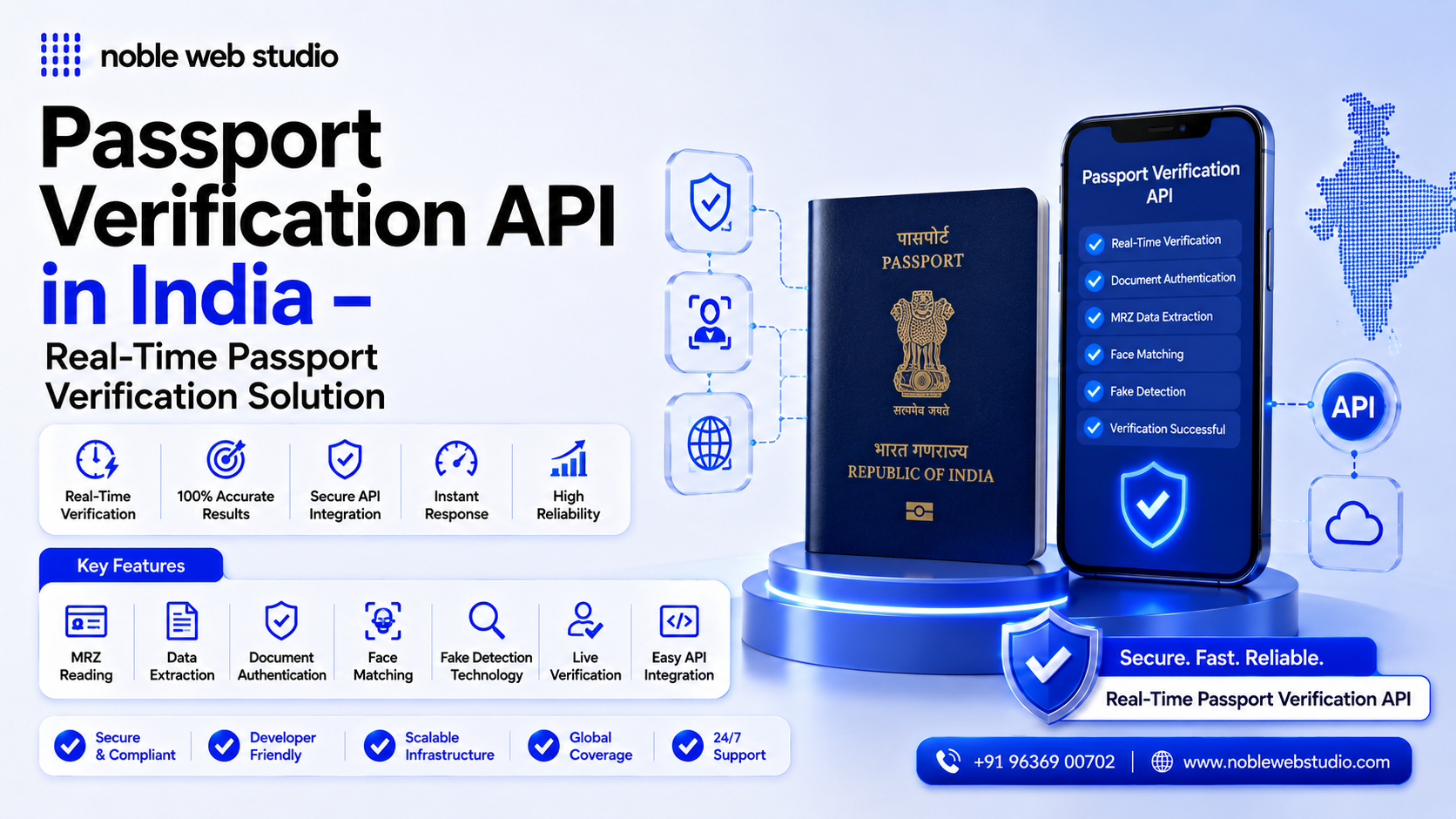
Are you looking for a secure and reliable Passport ID Verification API in India for your business in 2026? In today’s fast-growing digital ecosystem, businesses need fast, accurate, and automated identity verification solutions to onboard customers safely and reduce fraud risks.
A Passport Verification API is a powerful digital tool that helps companies verify customer identity using passport details in real time. It is widely used in KYC verification, fintech platforms, banking services, NBFCs, travel companies, insurance services and online service businesses to ensure secure customer onboarding.
A Passport Verification API is an automated software interface that authenticates an individual’s passport details in real-time. By cross-referencing user input with official government records, it instantly confirms if the passport is genuine and pulls verified profile data to streamline KYC and AML compliance.
With the increasing demand for digital KYC verification in India, businesses are shifting from manual verification processes to automated API-based solutions. A Passport ID Verification API helps reduce manual errors, speed up verification, and improve customer experience by delivering instant and accurate results.
The need for a trusted Identity Verification API provider in India like Noble web studio is growing rapidly as companies focus on fraud prevention, compliance, and secure digital operations. A strong verification system ensures that only genuine users are onboarded, protecting businesses from financial and identity-related risks.
The best Passport Verification API solution should offer features like real-time verification, secure API integration, high accuracy, fraud detection, compliance support, and easy scalability. These features help businesses build a strong and secure digital onboarding system.
A professional Passport Verification API provider like Noble Web Studio offers advanced and secure Passport ID Verification API solutions designed for fast integration and high performance. With developer-friendly APIs, strong security layers, and real-time verification capability, businesses can easily integrate passport verification into their existing platforms.
Noble Web Studio provides a powerful and secure Passport ID Verification API solution in India designed for startups, fintech companies, and enterprises. With fast API integration, real-time verification, high security standards, and dedicated technical support, businesses can streamline their digital KYC process and improve operational efficiency.
In this blog, you will learn everything about the Passport ID Verification API, its features, benefits, integration process, and how businesses in India can use it for secure digital verification systems.
What is a Passport ID Verification API?
A Passport ID Verification API is a digital tool that instantly authenticates a passport and verifies the holder’s details against official government records. It replaces slow, error-prone manual document checks by securely cross-referencing information in real-time.
| 5 sec Average passport verification time via API | 99.2% Accuracy rate of top passport OCR APIs India | 300+ Countries & document types supported | 60% Reduction in KYC ops cost after API integration |

How Does Passport ID Verification API Work? (Step by Step)
A Passport ID Verification API automates identity authentication by extracting data from a physical passport and cross-referencing it with official databases in real time. This system replaces manual reviews, allowing businesses to complete secure Know Your Customer (KYC) and Anti-Money Laundering (AML) checks in seconds.
Data Capture and Extraction
- OCR Scanning: The user uploads a photo of their bio-data page. Optical Character Recognition (OCR) extracts key text fields like full name, date of birth, expiry, and nationality.
- MRZ Parsing: The API reads the Machine-Readable Zone (the rows of text and arrows at the bottom of the passport) to ensure structural format validity.
Verification Request Execution
- Secure Payload: The system generates an encrypted payload containing the vital metrics (such as the passport file number and date of birth).
- Government Cross-Referencing: The request is transmitted over an encrypted network directly to authorized or official government databases to confirm the passport is active and legitimate.
Response Interpretation
- Status Codes: The API issues a structured response (typically a JSON object) with clear indicators for match status.
- Workflow Actions: If the result returns a clean validation, the customer moves instantly to the next stage of digital onboarding. If fields mismatch, the system flags the profile for manual compliance oversight.
Service Offer Passport ID Verification API
A Passport ID Verification API provides automated, real-time identity authentication by extracting data from a user’s passport and validating it against official databases. It serves as a core component for modern Know Your Customer (KYC) and Anti-Money Laundering (AML) workflows.
Key Capabilities & Technology
- Data Extraction: AI-powered Optical Character Recognition (OCR) pulls text directly from the passport image.
- MRZ Parsing: The system decodes the Machine Readable Zone (MRZ) at the bottom of the booklet to cross-check structural information.
- Database Cross-Referencing: It validates fields like name, date of birth, expiration, and passport file number against official government systems.
- Biometric Matching: Advanced platforms offer facial matching between the user’s selfie and the passport photo.
Primary Benefits
- Instant Processing: Verifications execute in 1 to 30 seconds, eliminating slow manual review queues.
- Fraud Prevention: Detects tamper marks, expired documents, and synthetic identities immediately.
- Global Compliance: Helps businesses comply with international regulations like GDPR and local guidelines.
- Reduced Abandonment: Speeds up user onboarding to improve completion rates on digital platforms.
Types of Passport ID Verification API
Passport ID Verification APIs streamline Know Your Customer (KYC), AML (Anti-Money Laundering), and international onboarding by authenticating user identity. Depending on your security and compliance needs, these APIs are divided into several core types:
Optical Character Recognition (OCR) API
- How it works: Extracts text and data directly from an uploaded passport photo or scan (e.g., full name, DOB, issue date, and expiry).
- Key Use Case: Quick, frictionless data entry for app sign-ups without manual typing.
Machine Readable Zone (MRZ) API
- How it works: Reads and validates the cryptographic machine-readable zone at the bottom of the passport (typically two lines of text at the bottom containing document numbers and checksums).
- Key Use Case: Verifying that the document’s physical data matches the encoded machine strings.
Database / Government API Match
- How it works: Sends the inputted passport details (like Passport Number and Date of Birth) to secure, official government or issuing-authority databases to confirm the passport exists and is valid.
- Key Use Case: Highly secure authentication for banking, fintech, and visa processing.
Liveness Detection & Facial Recognition API
- How it works: Compares the photograph in the passport to a live selfie or video scan of the user.
- Key Use Case: Ensuring the person holding the passport is the actual owner of the document (prevents identity theft and spoofing).
NFC Chip Reading (ePassport) API
- How it works: Reads the encrypted biometric data embedded within the passport’s physical RFID chip (using NFC technology on a user’s phone).
- Key Use Case: The highest level of anti-fraud verification; it prevents the use of forged or altered physical booklets.

Documents Required for Passport Verification Process
To get your passport successfully verified, you need to bring all your original documents along with one set of self-attested photocopies to the Passport Seva Kendra (PSK) and subsequent Police Verification.
Proof of Address (POA)
You only need to submit proof of your current address, regardless of how long you’ve lived there:
- Primary: Aadhaar card / e-Aadhaar
- Alternatives: Voter ID, Utility Bills (Electricity, Water, Gas), or Landline/Postpaid Mobile bill
- Additional Options: Active Bank Account passbook/statement, or a registered Rent Agreement
Proof of Date of Birth (DOB)
- For individuals born on or after Oct 1, 2023: A birth certificate issued by the Municipal Corporation or authorized Registrar is mandatory.
- For individuals born before Oct 1, 2023: You can provide a Birth Certificate, School Leaving/Matriculation Certificate, PAN card, Driving Licence, or Policy Bond from a public life insurance company.
Proof of Photo Identity (POI)
- Primary: Aadhaar Card
- Alternatives: PAN Card, Voter ID, or Driving Licence
Additional Mandatory Items
- Photographs: Two recent passport-sized color photographs with a white background.
- Application Printout/ARN: A printed copy of your Application Reference Number (ARN) or the Application Form.
Case-Specific Documents
- For Passport Renewal/Reissue: Your old passport.
- For Married Applicants: Marriage Certificate or a Joint Photo Declaration (Annexure J).
- For Minors (under 18): Parents’ passports, current address proof in parents’ name, and student ID or birth certificate.
- For Tatkal Applications: Tatkal requires at least three specific documents from the official list (e.g., Aadhaar, PAN, and Voter ID).
Who Needs a Passport ID Verification API?
A Passport ID Verification API is essential for any business that needs to instantly verify a customer’s identity, prevent fraud, or comply with global regulations. It automatically cross-checks passport details against official government databases or document-verification systems to authenticate the user.
Industries that heavily rely on these APIs include:
- Fintech & Banking: Financial institutions, banks, and digital lenders use these APIs to adhere to strict Know Your Customer (KYC) and Anti-Money Laundering (AML) laws. It ensures that users opening accounts or securing loans are legitimate.
- Travel & Hospitality: Airlines, booking platforms, hotels, and visa agencies utilize these to automate the guest journey, authenticate passport data during booking, and ensure smooth international travel processes.
- Visa & Immigration Services: Agencies and embassies use them to automate document processing and quickly validate traveler information.
- Gig Economy & Marketplaces: Platforms that rely on user trust (such as ride-sharing apps, home-sharing services, and online dating apps) use APIs to ensure hosts, drivers, and users are who they claim to be.
- Government & Immigration: Used by border control and immigration departments to quickly process international arrivals and verify citizenship documentation.
- Corporate HR & Background Check Firms: Companies conducting global background checks or verifying right-to-work documents use these APIs to validate candidate credentials.
Why Use Passport ID Verification API
A Passport ID Verification API instantly authenticates identity documents by securely cross-referencing passport details like name, date of birth, and passport number with official government or issuing authority databases. It replaces slow, error-prone manual reviews with real-time accuracy.
Key reasons businesses integrate passport verification APIs:
- Instant Customer Onboarding: Eliminates manual data entry and back-office wait times. By utilizing Optical Character Recognition (OCR) to scan the Machine-Readable Zone (MRZ), the API extracts and validates data in 1 to 5 seconds.
- Robust Fraud Prevention: Protects against document forgery, synthetic identity theft, and modified passports. It verifies the document’s authenticity at the start of any transaction.
- Rapid Customer Onboarding: Cuts down verification time to just a few seconds, replacing tedious manual data entry and back-office review queues with automated AI/OCR checks.
- Global Reach & Scalability: Passports are universally recognized. APIs allow businesses to seamlessly verify domestic and international clients, digital nomads, and expats without struggling with cross-border document delays.
- Regulatory Compliance: Essential for meeting global Anti-Money Laundering (AML) and Know Your Customer (KYC) requirements, avoiding legal penalties for highly regulated sectors like banking, fintech, and travel.
- Secure Data Management: Streamlines visitor management, remote hiring, and high-value transactions by building a dependable, secure digital audit trail.
- Elimination of Human Error: Standardizes the verification process across all business operations, ensuring consistent checks and accurate data extraction.

Top Use Cases of Passport ID Verification API
A Passport ID Verification API instantly authenticates identity documents by extracting data (OCR) and securely cross-checking it with official databases or biometric matching. It is essential for streamlined digital onboarding and robust compliance.
Top industry use cases include:
- Financial Services & Banking: Secures customer onboarding, accelerates loan approvals, and fulfills regulatory requirements like KYC (Know Your Customer) and AML (Anti-Money Laundering).
- Travel & Hospitality: Validates traveler citizenship status and passport authenticity for hotels, airlines, and visa processing platforms, drastically reducing manual document checks.
- Gig Economy & Remote Hiring: Confirms identity and work eligibility for distributed workforces and digital nomad platforms. Biometric binding prevents “candidate bait-and-switch” fraud.
- E-commerce & Marketplaces: Authenticates sellers and high-risk buyers, building platform trust and preventing fraudulent transactions or account takeovers.
- Healthcare & Government: Verifies patient identities for accurate medical records, insurance claims, or the distribution of official government and immigration services.
Key Aspects of Passport ID Verification API
A Passport ID Verification API is an automated solution that authenticates a user’s identity by securely checking their passport details against official government or database records in real-time.
Core Capabilities
- Instant Data Extraction: Utilizes Optical Character Recognition (OCR) to automatically pull text and data from the passport’s bio-data page.
- Database Cross-Referencing: Verifies document legitimacy by matching extracted details (e.g., name, DOB, passport number) against official sources to ensure the passport is authentic and active.
- MRZ Validation: Extracts and verifies the Machine Readable Zone (MRZ) codes, checking checksum algorithms to spot font irregularities or tampering.
- Biometric Face Matching: Compares the passport’s photo with a live user selfie to confirm the document belongs to the presenter.
- Liveness Detection: Employs AI to ensure the person taking the selfie is physically present, preventing the use of static photos or digital screens.
What does a Passport Verification API do?
A Passport Verification API instantly authenticates identity by cross-referencing a user’s passport details (such as the passport number, file number, and date of birth) with official government or issuing authority databases. It automates KYC (Know Your Customer) compliance and flags fake, altered, or expired documents in real time.
How it Works
- Data Input: The user enters their passport details or uploads an image, from which Optical Character Recognition (OCR) extracts the required information.
- Verification Request: The system sends an encrypted request to the API, which securely queries official records.
- Instant Match: The API returns a pass/fail response, along with exact passport holder details to confirm a match.
Why Passport Verification is Important in India in 2026
Passport verification is vital in India to safeguard national security, prevent identity fraud, and ensure only genuine citizens receive this highly valuable travel document. With India’s transition to biometric e-passports and the growth of global travel, securing your identity prevents international misuse and helps maintain the global strength of the Indian passport.
Key reasons why passport verification remains critical:
- National Security: Scrutinizing the applicant’s background helps authorities identify potential threats and prevents individuals with criminal records or dubious intentions from illegally traveling abroad.
- Preventing Identity Theft: It authenticates your residential address and personal credentials against official records (like Aadhaar), ensuring that duplicate or fraudulent passports cannot be created.
- Maintaining Global Trust: Passports are a major international identity proof. Thorough verification preserves India’s international relations and ensures foreign nations accept Indian travellers without security concerns.
- Access to e-Passports: With India rolling out chip-embedded e-Passports, rigorous verification is needed to securely encode your biometrics (fingerprints and iris scans) into the microprocessor to allow for faster automated e-gates at airports.
How to do Passport Verification Online?
Verifying a passport online depends on whether you are verifying your identity for a service/app, checking your application status, or completing police verification.
1. Verifying Identity for an App or Business
To verify your identity for banking, travel, or digital services:
- Image Upload: Take a clear photograph of your passport’s data page and upload it to the platform.
- NFC Scanning: If you have an ePassport with a biometric chip, hold the passport against the back of your NFC-enabled phone when prompted.
- Liveness Check: The app will likely require you to blink, smile, or scan your face to match it with your passport photo.
2. Checking Passport Application Status
If you are applying for a new or renewed passport, you can track your verification and processing status online:
- Visit the official Passport Seva Portal.
- Go to the Track Application Status page.
- Enter your File Number and Date of Birth to get real-time updates.
3. Police Verification Process
If you recently applied for a passport, the Indian government has streamlined the police verification process:
- Online Intimation: Police verification is initiated by the Regional Passport Office and handled via the mPassport Police App used by local officers.
- Process: The assigned police officer will visit your address or verify your details digitally using a tablet.
- Track: You can track the police verification status on the Passport Seva system.

Passport Verification API from India’s fastest-growing verification platform
A Passport Verification API is a digital tool that instantly validates a passport’s authenticity by cross-checking submitted details directly with official government databases. It replaces slow manual document checks with real-time, automated verification, helping businesses prevent identity fraud and streamline onboarding.
Key Benefits for Businesses
- Frictionless Onboarding: Reduces drop-offs during customer sign-ups by removing the need for manual document scanning and long back-office approvals.
- Fraud Prevention: Caters to upfront fraud detection by verifying that the passport genuinely exists and has not been forged.
- Compliance & Security: Ensures your business adheres to KYC (Know Your Customer) and AML (Anti-Money Laundering) regulations seamlessly.
Why Passport Verification is Important for Businesses
Passport verification is crucial for businesses to prevent identity fraud, ensure regulatory compliance (such as KYC/AML), and mitigate legal risks in global operations. Because passports are highly secure, government-issued documents, they serve as a universally trusted method to authenticate both customers and employees.
Key Reasons It Matters for Businesses
- Fraud Prevention: Passports feature stringent biometric data, digital signatures, and machine-readable zones (MRZ). Verifying these features blocks fraudulent account creations, prevents fake credentials, and protects companies against hiring the wrong individuals.
- Regulatory Compliance: For banking, fintech, and legal sectors, proper identity checks satisfy Know Your Customer (KYC) and Anti-Money Laundering (AML) mandates. Failing to verify documents properly can lead to massive financial and operational penalties.
- Streamlined Global Hiring: When expanding internationally, remote worker and executive background checks rely on a globally recognized document to swiftly confirm a candidate’s identity, citizenship, and legal right to work.
- Travel & Hospitality: It helps organizations such as airlines, hotels, and vehicle rentals authenticate travelers seamlessly, preventing illegal entries and ensuring compliance with local visa policies.
How Businesses Verify Passports
- Automated APIs: Many businesses use automated verification services to instantly extract and validate document data.
- Document Liveness Checks: Users often upload a photo of their passport alongside a real-time selfie to prove ownership.
- Database Cross-Referencing: Verifying the data against trusted third-party databases.
Passport Verification API for Banking & Financial Services
A Passport Verification API enables banks and financial services to instantly authenticate a customer’s passport. By cross-referencing inputted details (like File Number, Passport Number, and Date of Birth) directly with official government databases, it ensures the document is genuine, active, and belongs to the user.
This technology significantly enhances Know Your Customer (KYC) and Anti-Money Laundering (AML) compliance while protecting institutions against identity theft and fraud.
Key Features for Financial Services
- Real-Time Database Checks: Instantly validates passport details against official government and regulatory data sources.
- OCR Integration: Automatically extracts text and data from physical or digital passports, ensuring seamless, error-free onboarding.
- Fraud Prevention: Matches user photos, signatures, and document MRZ (Machine Readable Zone) lines to prevent forged or tampered documents.
- Cross-Border/NRI Onboarding: Simplifies the verification process for expatriates and Non-Resident Indians (NRIs) who use passports as their primary KYC document.
Regulatory & Security Benefits
- Compliance: Helps institutions adhere to stringent financial regulations (e.g., RBI guidelines in India or USPVS in the US) without manual friction.
- Fraud Mitigation: Protects against identity theft, forged passports, and document tampering.
- Audit Trails: Provides time-stamped, unalterable digital records of identity verification for audit purposes.
Passport Verification API for Travel & Immigration Platforms
A Passport Verification API is a digital tool that instantly authenticates passport details and checks for document fraud by cross-referencing information against official government databases and international directories. It drastically streamlines Know Your Customer (KYC) and Anti-Money Laundering (AML) onboarding.
Core Functionalities
Travel and immigration platforms rely on these APIs for several automated functions:
- Real-Time Database Checks: Validates if the passport is legitimate, active, and belongs to the specified user by matching the Name, Date of Birth (DOB), and Passport Number against official issuing authorities.
- OCR & MRZ Extraction: Automatically scans passport images or PDFs, extracting and verifying data from the Machine Readable Zone (MRZ) with over 99% accuracy.
- Document Liveness & Tamper Detection: Detects if the document has been physically or digitally altered, scanned from a screen, or faked.
- Cross-Border Global Watchlists: Screens travelers against global Interpol, OFAC, and sanctions lists for enhanced security.

Role of Passport Verification in Digital Identity Verification
Passport verification is the cornerstone of digital identity verification. Because passports are government-issued and universally recognized, they provide the highest standard of security for confirming a user’s name, date of birth, and nationality. This prevents fraud and ensures regulatory compliance.
Why Passports are the Gold Standard
- Global Acceptance: Passports are accepted worldwide, making them the ideal document for cross-border transactions, remote onboarding, and international business.
- Tamper-Proof Features: Modern passports contain advanced security elements like biometric chips (e-passports), watermarks, and microprinting, which make counterfeiting extremely difficult.
How Digital Passport Verification Works
- Data Extraction (OCR): Optical Character Recognition (OCR) technology instantly reads the Machine Readable Zone (MRZ) and data page of the passport, auto-filling necessary application fields without manual typing.
- Document Authentication: Systems scan for security features and verify the document’s validity against government databases or cryptographic data stored in the electronic chip.
- Biometric Matching (Liveness Test): The user takes a live selfie, and AI-driven facial recognition matches it against the passport photo to prove the document belongs to the person holding it.
The Ecosystem in India
- DigiLocker Integration: Citizens can securely fetch and share their official Passport Verification Records (PVR) and other documents directly through the Digital India DigiLocker platform, reducing reliance on physical copies.
- E-Passport Infrastructure: The government’s transition to chip-based e-passports improves security and speeds up immigration and digital identity checks at both domestic and international airports.
How Noble Web Studio Integrates Passport ID Verification API
Noble web studio integrates a Passport ID Verification API by implementing an automated workflow that captures a user’s passport data, securely transmits it to a third-party verification platform, and parses the response to validate authenticity. This end-to-end integration typically follows a standard RESTful API or SDK architecture.
Here is a step-by-step breakdown of how the integration works in a production environment:
1. Document & Data Capture
The Noble web studio frontend application collects the passport data using one of two common implementation methods:
- OCR Scanning: The user takes a live photograph or uploads an image of their passport page. An AI-powered Optical Character Recognition (OCR) system instantly reads the Machine Readable Zone (MRZ) and visual data fields.
- Manual Entry: Alternatively, the application provides form fields where the user types their critical identifiers, such as their Passport File Number and Date of Birth (DOB).
2. Request Structuring & Security
The backend software packages the extracted information into an encrypted payload, typically structured as a JSON body.
- Endpoint Communication: The application sends a secure HTTPS POST request to the identity Noble web studio endpoint (e.g., using services from platforms like Noble web studio.
- Authentication: The request includes secure credentials, such as an
API Key,Bearer Token, or an asymmetric cryptographic token passed in the request header.
3. Verification & Database Cross-Referencing
The verification engine processes the payload to ensure the passport is legitimate and active:
- Data Matching: The service securely routes the query to cross-reference the data points against official government databases, credit bureaus, or authorized global registries.
- Fraud Detection: Advanced algorithms analyze the uploaded image to flag document tampering, digital alterations, or pixel-level inconsistencies.
- Biometric Step (Optional): Noble web studio integrate a face-match API alongside this process, checking a user’s live selfie against the extracted passport photo using liveness detection to prevent deepfake exploitation.
4. Response Interpretation & Workflow Logic
Because cross-referencing government records can take a few seconds, applications use Webhooks or asynchronous execution to handle the server’s response code without freezing the user interface.
The system receives a JSON response indicating the verification status:
- Success Status: If the records perfectly align, the system receives a success code (e.g.,
VERIFIED) along with confirmed metadata like the full name and expiration date. The backend automatically moves the user to the next stage of onboarding. - Failure/Mismatch Status: If data points clash or show signs of document manipulation, the API returns a clear error code. The system handles this programmatically by either prompting the user to re-upload a clear document or routing the file to a compliance team for manual review.
Features Passport ID Verification API
A Passport ID Verification API automates identity checks by scanning, extracting, and cross-referencing passport data with trusted databases. It enables businesses to achieve secure, instantaneous Know Your Customer (KYC) and Anti-Money Laundering (AML) compliance without manual data entry.
The core features include:
Core Data Extraction & Validation
- Optical Character Recognition (OCR): Automatically extracts information from the document’s bio-data page, such as the holder’s name, passport number, nationality, date of birth, and date of expiry.
- Machine Readable Zone (MRZ) Parsing: Reads the complex, standardized block of text at the bottom of the passport to confirm document integrity and formatting.
- Government Database Cross-Referencing: Validates the passport’s status and details in real-time against official government datasets.
Fraud Detection & Security
- Biometric Facial Matching: Captures a live selfie and matches it against the photo on the passport to ensure the user is the rightful document owner.
- Liveness Detection: Uses motion or depth-sensing to confirm that the user taking the selfie is physically present and to prevent spoofing with photos or masks.
- Tamper & Forgery Detection: Scans for signs of digital alteration, font inconsistencies, or fake security features.
Operational Features
- Real-Time Processing: Verifications are completed in just seconds, which significantly reduces onboarding drop-offs and customer abandonment.
- Global Coverage: Most top-tier APIs allow seamless verification for passports spanning over 180 countries.
- Secure Data Handling: Employs end-to-end encryption (TLS) during data transit and minimizes or eliminates local data storage to ensure regional privacy compliance.
Benefits Passport ID Verification API
Integrating a Passport ID Verification API allows businesses to cross-verify passport details directly against authoritative government databases in real-time. This automated process instantly validates the document holder’s identity while eliminating time-consuming manual document reviews.
Implementing an automated passport verification solution offers several measurable improvements in security, speed, and regulatory compliance.
Core Benefits
- Accelerated Customer Onboarding: Replaces slow, manual data entry with sub-30-second automated checks to reduce sign-up abandonment rates.
- Robust Fraud Prevention: Utilizes AI algorithms to identify tampered documents, digital alterations, and forged credentials that fool human eyes.
- Guaranteed Regulatory Compliance: Automates mandatory Know Your Customer (KYC) and Anti-Money Laundering (AML) checks across diverse legal boundaries.
- Elimination of Human Error: Employs Optical Character Recognition (OCR) to accurately pull text from the data page, avoiding manual typing mistakes.
- Global Operational Scalability: Standardizes identity validation for over 140 countries using international passport data formats.
- Reduced Overhead Expenditures: Eliminates back-end processing operational costs associated with manual paperwork review and error fixing.

Passport API Integration Process
The Passport API integration process connects your application to verification databases or OCR engines to validate identity data in real time. Depending on your business needs, the integration typically handles Data Capture, Authentication/Cross-checking, and Response Interpretation.
The exact workflow steps, architectural requirements, and developer considerations are outlined below.
Step-by-Step Integration Workflow
Setup and Vendor Onboarding
- Choose a Vendor: Select a Noble web studio.
- Account Creation: Register your organization on the Noble web studio developer portal.
- KYC Compliance: Submit corporate entity verification documents to obtain production access.
- Credentials Generation: Retrieve your unique API Keys, Client Secret, or Bearer Tokens.
Data Capture & OCR Initialization
- Input Interface: Build a user interface enabling front-end uploads of passport photos or manual field forms.
- OCR Scanning: Stream the captured image to the API’s endpoint.
- Data Extraction: AI engines parse text and Machine-Readable Zone (MRZ) patterns.
- Field Generation: The API automatically isolates names, passport file numbers, dates of birth, and expiration dates.
Database Authentication & Validation
- Endpoint Request: Send a
POSTrequest to the Noble web studio validation database. - Government Verification: The API proxies the request to governmental sources securely without permanently saving raw data.
- Fraud Analytics: System algorithms flags forged configurations, tampered signatures, or expired dates.
Response Interpretation
- JSON Evaluation: Parse the returning payload response containing boolean flags and status fields.
- Success Paths: A
SUCCESSstatus approves the user step, storing key metadata fields locally. - Failure Paths: Handle standard HTTP errors or application specific errors like
NOT_FOUND.
Passport Verification API Cost and Pricing Factors
Passport Verification API costs in India generally follow a Pay-Per-Use or Prepaid Wallet model, ranging from $0.19 (₹15) to ₹5 per successful request. Aggregators and B2B software agencies also offer flat one-time integration setups ranging from ₹2,000 to ₹10,000 for enterprise licenses.
The pricing structure is divided into two main categories:
1. Database Validation (KYC API)
These APIs connect to government-backed servers or authorized repositories to confirm if a passport is valid and matches the user’s name.
- Cost per call: Typically between ₹4 to ₹8 + GST for low-volume users.
- Volume Pricing: Enterprise users can negotiate rates as low as ₹1.5 to ₹3 per call by purchasing bulk credit packages (e.g., 10,000 to 100,000 calls).
- Billing Logic: You are generally only billed for conclusive, successful hits. Failed lookups due to downtime or incorrect formatting are usually free.
2. OCR & Data Extraction (Text Parsing)
This extracts text from a scanned or photographed passport. It reads data like MRZ (Machine Readable Zone) lines and photo pages but does not authenticate validity with a database.
- Cost per call: Usually ranges from ₹1.5 to ₹4 per document.
- Free Tiers: Noble web studio offer free tiers allowing up to 500-1,000 scans per month.
3. Bulk Setup & Platform Fees
For a complete, white-labeled KYC dashboard (without building the backend yourself), Noble web studio in Mansarovar/Jaipur quote flat rates spanning ₹1,999 to ₹10,000 for bundled access and API keys.
4. Additional KYC Add-Ons (Optional)
To create a robust fraud-prevention workflow, passport checks are often bundled with other KYC components:
- Face Match (Selfie to Passport Photo): ~₹2.00 to ₹2.50 per attempt.
- Face Liveness Detection: ~₹3.50 to ₹4.00 per scan.
Notable Vendors in India
- Direct Fintech APIs: Noble web studio dominate the B2B space and strictly adhere to Indian KYC compliance requirements.
Passport OCR and Data Extraction Technology
Passport Optical Character Recognition (OCR) and Data Extraction is an AI-powered technology that instantly converts physical or digital passport images into structured, machine-readable data. By eliminating manual data entry, it automates identity verification, border control, and KYC (Know Your Customer) workflows.
How the Technology Works
The pipeline for converting a passport photo or scan into actionable data involves three main steps:
- Image Preprocessing: The software automatically corrects lighting, adjusts contrast, and straightens skewed or blurred images to ensure the text is legible.
- Text Recognition (OCR): Advanced algorithms scan the document and convert visual characters into editable, digital text.
- Data Structuring: The AI categorizes the recognized text into structured formats like JSON or CSV, organizing fields such as Name, Nationality, Date of Birth, Passport Number, and Expiry Date.
Key Extraction Zones
Systems pull data from two primary areas on a passport:
- Visual Inspection Zone (VIZ): Extracts the human-readable text on the main data page (such as the holder’s photograph, exact name formatting, and date of issue).
- Machine-Readable Zone (MRZ): Decodes the two or three lines of text, numbers, and chevron symbols at the bottom of the page. This zone is designed for rapid parsing and uses checksum algorithms to ensure data integrity.
Enhanced Security & Validation
Leading APIs go beyond basic text extraction to prevent fraud and authenticate documents:
- Cross-Verification: The system compares the data in the VIZ with the data in the MRZ to ensure they match perfectly.
- NFC Reading: Advanced systems connect via smartphones to read the passport’s built-in RFID chip. This provides cryptographically secured data and retrieves the biometric photo stored inside.
- Liveness Checks: Paired with a live selfie, the technology verifies that the person presenting the passport is its actual owner.
Typical Use Cases
- Travel & Hospitality: Streamlining hotel check-ins and airport border crossings.
- Banking & Finance: Fulfilling compliance requirements by verifying customer identities in seconds.
- Human Resources: Automating onboarding and travel compliance for international employees.

Passport Verification API and Fraud Prevention
A Passport Verification API is a digital solution that authenticates a user’s passport details in real time by securely cross-referencing provided information with trusted government records. It prevents identity theft, document forgery, and fraudulent transactions during customer onboarding or background checks.
How the Verification Process Works
- Data Extraction: Users upload an image of their passport, and the API uses Optical Character Recognition (OCR) to extract text and details from the Machine Readable Zone (MRZ).
- Database Matching: The API compares the extracted fields (e.g., Name, Date of Birth, Passport Number, Issue/Expiry Date) against official database records.
- Instant Verification: If the data matches official records, the API returns a verified status, bypassing the need for manual review.
Core Fraud Prevention Mechanisms
- MRZ and Tamper Check: The API validates the extracted MRZ against ICAO algorithms to detect any physical manipulation of personal information.
- Database Verification: Checking the passport number directly against official government authorities ensures the document is genuine and not counterfeit.
- Liveness & Biometric Matching: Combined with facial recognition, the API checks if the person submitting the documents matches the photo on the passport to prevent impersonation and identity theft.
- NFC Chip Reading: Advanced solutions read the encrypted biometric data embedded directly within the e-Passport’s NFC chip for absolute authentication.
Benefits for Businesses
- Faster Onboarding: Verification takes seconds, eliminating manual data entry and back-office delays.
- Regulatory Compliance: Streamlines mandatory Know Your Customer (KYC) and Anti-Money Laundering (AML) checks across banking, fintech, and travel.
- Risk Reduction: Protects high-value transactions and remote onboarding in the gig economy from fraudulent activities.
Passport ID Verification API vs Manual Verification — Full Comparison
Automated Passport APIs offer near-instant verification and higher scalability by using OCR and biometric matching. While manual verification handles edge cases better, APIs are highly recommended for modern digital onboarding due to their speed, cost-effectiveness, and built-in security features.
| Factor | Manual Verification | Passport ID Verification API Recommended |
|---|---|---|
| Verification Speed | 1–2 business days | 3–5 seconds |
| Accuracy | 85–90% (human error) | 99%+ (AI-powered) |
| Cost per Verification | ₹50–₹200 (staff cost) | ₹2–₹15 per API call |
| Fraud Detection | Inconsistent, misses tampered docs | 100% AI fraud detection |
| Scalability | Needs more staff for more users | Handles millions/day with zero extra cost |
| Compliance | Dependent on human knowledge | Always updated with latest RBI/DPDP rules |
| User Experience | Long wait = high drop-off | Instant = higher conversion |
| Audit Trail | Paper-based, incomplete | Full digital audit log, every verification |
Key Differences
- Speed & Onboarding: APIs verify passports in seconds, creating a frictionless user experience ideal for fintech, travel platforms, and gig-economy apps. Manual verification slows down the process, often leading to high user drop-off rates.
- Security & Fraud Prevention: Passport APIs typically perform MRZ (Machine Readable Zone) data extraction, cross-check databases, and utilize biometric liveness checks (e.g., matching a selfie to the passport photo) to prevent spoofing. Manual verification requires staff to physically inspect security watermarks and holograms, which requires specialized training.
- Compliance: Both methods satisfy Know Your Customer (KYC) and Anti-Money Laundering (AML) requirements. However, APIs log digital audit trails automatically, reducing the risk of human compliance errors.
- Handling Exceptions: Manual verification excels at reviewing damaged passports, blurred photos, or expired documents with official extensions, whereas automated APIs might outright reject these exceptions.
Which Should You Choose?
- Choose a Passport Verification API if: You need to onboard users at scale, operate globally, want to reduce per-check costs, and need to integrate seamlessly into a mobile app or website.
- Choose Manual Verification if: Your business deals with a very low volume of high-risk users, frequently encounters heavily damaged documents, or requires complex legal exceptions that algorithms cannot evaluate.
How Passport Number Verification API Helps Businesses Cater to Clients
A Passport Number Verification API automates identity checks by securely cross-referencing passport details against official government databases. It helps businesses cater to clients by enabling instant, frictionless onboarding, preventing fraud, and ensuring strict compliance, all while maintaining a premium customer experience.
Using this technology allows companies to elevate their client services in several core areas:
1. Instant Client Onboarding
- Zero Friction: Instead of forcing clients to fill out lengthy manual forms or wait days for document reviews, the API instantly reads and validates passport data.
- Fewer Errors: By using OCR (Optical Character Recognition) to extract data directly from the passport, it eliminates typos and ensures accurate client profiles from the very first interaction.
2. High-Trust Environment for Travel and Hospitality
- Seamless Bookings: Travel agencies, airlines, and luxury hospitality providers rely on APIs to automatically verify traveler details, making bookings and hotel check-ins faster and error-free.
- High-Value Protection: It secures transactions for high-value bookings (e.g., luxury villas or exotic car rentals) by verifying that the person booking is the legitimate passport holder.
3. Frictionless Cross-Border Transactions
- Global Reach: For clients sending international payments or engaging with fintech platforms, the API securely validates the client’s identity regardless of their country of origin.
- Regulatory Compliance: It automates necessary KYC (Know Your Customer) and AML (Anti-Money Laundering) checks, allowing businesses to operate globally without heavy manual operational burdens.
4. Secure Remote Client Management
- Digital Nomads & Remote Work: HR departments and freelance platforms can securely onboard clients or remote workers they may never meet in person.
- Biometric Matching: When integrated with biometric checks (like selfie-matching), the API ensures that the person submitting the documents is the actual passport holder, eliminating “candidate bait-and-switch” fraud.
5. Data Privacy and Security
- Encrypted Processing: Client data stays heavily encrypted (e.g., via TLS 1.2 or higher) during transmission, protecting their sensitive personally identifiable information (PII).
- Zero-Data Retention: To minimize the risk of data breaches, systems can be configured to purge sensitive documents immediately after verification, storing only a digital token that verifies the client’s identity has been confirmed.
Understanding the Problem Passport Verification API
A Passport Verification API delivers real-time identity authentication by cross-referencing passport data directly with official government databases. It transforms manual document checks into an automated, instant digital workflow to prevent fraud and fast-track user onboarding.
The core solution relies on a combination of automated steps and robust features to ensure secure, seamless identity verification:
Core Capabilities & Features
- Real-Time Database Validation: Connects directly with official government or issuing authority databases to instantly confirm if a passport is genuine, active, and matches official records.
- Field Matching: Validates all major passport fields in seconds—including full name, date of birth, passport number, and date of issue/expiry—and immediately flags any inconsistencies.
- Document Data Extraction: Utilizes AI-powered Optical Character Recognition (OCR) to pull textual data straight from uploaded passport images without requiring manual typing.
- MRZ Parsing: Decodes the Machine-Readable Zone (MRZ) at the bottom of the passport booklet to cross-check structural data and catch tampering or forgery.
- Facial Biometrics: Matches a live user selfie against the passport photo to ensure the person presenting the document is the rightful owner.
Key Business Benefits
- Faster Onboarding: Reduces wait times from days to seconds, removing the need for manual review queues.
- Fraud Prevention: Drastically lowers risks of identity theft and document forgery by relying on authoritative sources rather than just visual checks.
- Regulatory Compliance: Automates critical KYC (Know Your Customer) and AML (Anti-Money Laundering) requirements to ensure businesses operate safely within legal frameworks.
- Seamless Integration: Plugs smoothly into existing websites, CRMs, and mobile apps to enable automated data flow and eliminate human entry errors.
Passport Verification API for Fast Digital KYC
A Passport Verification API enables instant, automated KYC and AML compliance by cross-referencing passport details with secure government databases. It extracts data, instantly checks document authenticity, and flags inconsistencies, significantly reducing fraud and onboarding time.
Core Functionality
- Real-Time Database Checks: The API instantly matches parameters like Passport Number, Date of Birth, and File Number with government records.
- OCR & Liveness Checks: Often paired with an OCR (Optical Character Recognition) API, it scans physical passports or photos to extract information, preventing fraudulent alterations.
- Instant Verification: Replaces slow, error-prone manual document reviews with a secure, automated validation process that takes only a few seconds.
Key Benefits
- Frictionless Onboarding: Eliminates manual data entry and document scanning delays, resulting in higher user sign-up and conversion rates.
- Fraud Protection: Instantly flags mismatched information, fake documents, or expired passports at the start of the customer journey.
- Regulatory Compliance: Satisfies strict Know Your Customer (KYC) and Anti-Money Laundering (AML) standards across various sectors, including banking, travel, and fintech.

Passport Verification API Security and Compliance Standards
A Passport Verification API authenticates traveler and customer identities by cross-referencing document details (e.g., MRZ codes, passport numbers) against official government databases. Implementing these APIs requires strict adherence to global security protocols and data privacy mandates.
1. Core API Security Standards
- Encryption: All data in transit must be protected using TLS 1.2 or 1.3 protocols. Data at rest (especially if storing PII or scanned documents) must use robust algorithms like AES-256.
- Authentication & Access Control: Endpoints must be secured using modern frameworks like OAuth 2.0/2.1 and OpenID Connect (OIDC). APIs should utilize stateless JSON Web Tokens (JWTs) or API keys rotated at regular intervals.
- Rate Limiting & Threat Protection: APIs employ Web Application Firewalls (WAFs), IP whitelisting, and rate-limiting to prevent DDoS attacks, credential stuffing, and brute-force attempts on sensitive endpoints.
2. Global Compliance Frameworks
- KYC and AML Compliance: The verification flow aids heavily in meeting mandated Know Your Customer (KYC) and Anti-Money Laundering (AML) checks required by financial and banking institutions.
- Data Residency & Privacy (GDPR, CCPA, DPDP): To comply with regional laws like Europe’s GDPR, California’s CCPA, or India’s Digital Personal Data Protection Act (DPDP), APIs must support data minimization (verifying without retaining raw images/data) or secure tokenization.
- Industry Certifications: Noble web studio handling high-risk personal data usually undergo independent audits to maintain certifications such as ISO 27001:2013 (Information Security Management) and PCI-DSS.
3. Key Verification Technologies
- ICAO Compliance: APIs validate the Machine Readable Zone (MRZ) using standard international algorithms defined by the International Civil Aviation Organization (ICAO).
- AI-Based OCR: Secure systems employ AI-driven Optical Character Recognition (OCR) to quickly extract data from passport images while ensuring PII logs are masked or purged immediately after the session.
Real-Time Passport Verification API Process Explained
A Real-Time Passport Verification API automates identity checks by securely extracting and cross-referencing document data with official government or trusted databases in seconds. This process strengthens KYC (Know Your Customer) compliance, prevents document fraud, and accelerates user onboarding.
The verification process typically follows four core steps:
1. Document Capture & OCR
The user uploads a photo, a scanned copy of their passport, or provides it via a live streaming video. The system uses Optical Character Recognition (OCR) to scan the Machine Readable Zone (MRZ) and visual data page, instantly converting the physical data into structured digital text.
2. Payload Submission
Once the data is extracted (e.g., passport number, full name, date of birth, and expiration date), the system bundles it into a secure, encrypted payload. This payload is sent to the official database via a secure API request (like a POST request).
3. Database Validation
The API cross-checks the submitted passport data against trusted records or government databases to confirm the following:
- Authenticity: Verifies that the document was issued by a legitimate authority.
- Validity: Checks that the passport is active and has not expired or been reported lost/stolen.
- Data Matching: Ensures the name and date of birth match the official records linked to the passport number.
4. Response Interpretation
The API sends a response code indicating a success, failure, or data mismatch. If successful, the user’s onboarding proceeds immediately. If there is a mismatch (e.g., the name doesn’t match the passport number), the system will flag the user for manual review or prompt them to re-upload.
Advanced Features: Biometrics & NFC
Many modern APIs also include advanced security measures:
- Liveness Detection: Requires the user to take a live selfie, ensuring they are physically present and preventing the use of spoofed photos.
- Facial Matching (1:1): Compares the extracted passport photo against the live selfie to guarantee the user is the rightful owner of the passport.
- NFC Chip Reading: Reads the encrypted, tamper-proof data stored on the e-Passport chip for ultimate security.
Passport Verification API Response, Accuracy & Verification Status Explained
A Passport Verification API instantly authenticates identity details by securely cross-referencing user-submitted data (e.g., passport number, name, and date of birth) with official government and issuing authority databases. It delivers a conclusive response in 1–5 seconds to streamline KYC/AML compliance and prevent document fraud.
1. Typical API Response Payload
When you query the API, it returns a structured JSON response containing the following key data points:
- Holder Details: Full name, date of birth, and gender extracted directly from official records.
- Document Details: Passport number, date of issue, and date of expiry.
- Application Metadata: File number, date of application, and application type (e.g., fresh or reissue).
- Verification Status: A boolean or string indicating whether the passport matches authoritative sources.
2. Accuracy & Matching Logic
The API calculates accuracy based on field-by-field comparisons rather than a simple “pass/fail”:
- Exact Match: All user-provided data perfectly matches the government database (highest confidence score).
- Partial/Fuzzy Match: Minor discrepancies like spelling variations (e.g., Smith vs. Smyth) or date format differences are flagged for manual review.
- MRZ & OCR Integration: High-quality APIs utilize Optical Character Recognition (OCR) to read the Machine-Readable Zone (MRZ) on a scanned passport, achieving up to 99.7% accuracy, especially when combined with e-passport NFC chip reading.
3. Verification Statuses Explained
The API will typically return one of the following verification states:
- Success / Verified: The passport is genuine, active, and belongs to the individual. All key fields (name, date of birth, passport number) correspond exactly with the official database.
- Mismatch / Failed: At least one of the submitted fields does not align with authoritative records. This could indicate user typos, outdated information, or a potentially fraudulent document.
- Pending / Processing: The API cannot instantly verify the data. This usually happens if the government servers are undergoing maintenance or if the passport is newly issued and hasn’t fully updated in the central registry.
- No Record Found: The combination of passport number and user details queried does not exist in the issuing authority’s database.
Passport Verification API for KYC and Customer Onboarding
A Passport Verification API instantly validates a customer’s identity during onboarding by securely cross-referencing passport details against official government databases. It drastically reduces fraud, accelerates KYC (Know Your Customer) and AML (Anti-Money Laundering) compliance, and approves genuine users in under three seconds.
How the Verification Workflow Works
- Data Input: The user submits their passport number, file number, and date of birth. Alternatively, they upload a scanned image or photo of the passport page.
- Data Extraction: If an image is used, a built-in OCR API extracts alphanumeric text and parses the Machine Readable Zone (MRZ).
- Database Cross-Check: The API securely pings official government data sources to verify authenticity and active status.
- Instant Response: The system returns a matched/mismatched status for fields like Name, Date of Birth, Issue Date, and Expiry Date.
Core Benefits for Customer Onboarding
- Enhanced Security: Protects against fake, forged, or tampered documents by verifying directly with the issuer.
- Frictionless UX: Eliminates the need for tedious manual data entry and back-office reviews, resulting in higher onboarding conversion rates.
- Global Reach: Validates both domestic and international passports, ideal for businesses onboarding global users, expats, or NRIs.
- Regulatory Compliance: Satisfies strict global data protection guidelines (like GDPR) and local KYC mandates.
How the Passport Verification API Caters to Clients
A Passport Verification API caters to clients by automating and instantly authenticating identity details through trusted government or regulatory databases. It ensures real-time verification, eliminates manual processing delays, and bolsters fraud prevention, making it ideal for banking, travel, and hospitality.
The API caters to clients (both businesses and end-users) by delivering the following core advantages:
- Instant Customer Onboarding: Clients bypass the need to submit physical scanned copies or wait for days-long back-office manual approvals. The API automatically extracts fields (like full name, date of birth, passport number, and expiry date) in seconds.
- Robust Fraud Prevention: Fake or modified passports are flagged instantly. By cross-referencing information with official sources, it verifies that the document is active and genuine.
- Regulatory Compliance: It helps businesses seamlessly meet global KYC (Know Your Customer) and AML (Anti-Money Laundering) requirements without slowing down their operations.
- Global Client Support: Streamlines the onboarding of international clients, Non-Resident Indians (NRIs), and expatriates, enabling companies to confidently scale into multiple markets.
- Seamless System Integration: The API easily integrates into existing mobile apps, CRM systems, and onboarding portals, ensuring a smooth, white-labeled experience for the end-user.

White Label Passport Verification API Solutions
White-label passport verification APIs are fully brandable, end-to-end identity verification (KYC/AML) solutions. They enable businesses to instantly extract, authenticate, and cross-reference passport data against official government or database sources, all while displaying your own company’s logo and UI.
Core Capabilities
White-label APIs combine several automated steps into a single, cohesive onboarding flow:
- Document Parsing (OCR & MRZ): Automatically extracts critical text (name, DOB, nationality, passport number) from the Machine Readable Zone (MRZ) or via document scanning.
- Database Cross-Check: Instantly matches the submitted passport number, file number, and Date of Birth (DOB) against official issuer registries to verify authenticity.
- NFC/Chip Reading: Cryptographically validates e-passports via Near Field Communication for maximum security.
- Biometric Liveness & Face Match: Compares real-time user selfies against the passport photo using AI to prevent deepfakes and spoofing.
Passport Verification API Solution
A Passport Verification API validates identity and document authenticity in real-time. By submitting key credentials like passport number and date of birth, businesses securely cross-reference official government databases. This prevents fraud and streamlines global KYC and AML compliance.
Core Capabilities
- Instant Authentication: Verifies if the passport is genuine and active within a few seconds.
- Field Verification: Validates primary fields including the full name, passport number, and date of expiry.
- Document Fraud Protection: Blocks forged documents by flagging discrepancies between the user’s input and official records.
How to Choose Best Passport Verification API Provider in India
Noble web studio one of the best passport verification API provider requires balancing data accuracy, processing speed, security compliance, and integration flexibility to ensure seamless customer onboarding.
Key factors to evaluate include:
1. Accuracy and AI Capabilities
- Data Extraction: Ensure the Noble web studio uses AI-based Optical Character Recognition (OCR) rather than traditional template-based OCR to flawlessly read various global document layouts, fonts, andMRZ (Machine Readable Zones).
- Real-time Authentication: Verify that the API directly cross-references passport details with authoritative government databases or central issuing authorities (e.g., in India, integrating with platforms like Noble web studio).
2. Security and Compliance
- Data Privacy: Noble web studio must enforce end-to-end encryption and comply with regional regulations like the Digital Personal Data Protection (DPDP) Act in India and global standards like GDPR.
- Certifications: Look for recognized security certifications like ISO 27001, SOC 2, and PCI-DSS.
- Data Minimization: Choose systems that validate verification requests without holding raw passport images or PII (Personally Identifiable Information) on their servers longer than necessary.
3. Global Coverage & Document Types
- If your business operates globally or serves expats, ensure the API supports a vast array of international passport templates and can detect common fraud markers across various document types.
4. Speed and User Experience
- Latency: Opt for APIs that return millisecond-level response times. Delays will cause friction and drop-offs during customer onboarding.
- Liveness Checks: Select a Noble web studio that couples OCR data extraction with biometric liveness checks (like face-matching or video KYC) to ensure the person holding the passport is the actual owner.
5. Integration and Support
- Developer Friendliness: Look for APIs that offer clear RESTful architecture, well-documented SDKs, and easy plug-ins to your existing CRM, ERP, or HR platforms.
- Technical Support: Noble web studio offering robust developer resources and 24/7 technical assistance to prevent downtime.
6. Pricing Models
- Compare scalable pricing structures like “pay-per-scan” or monthly subscription tiers. Evaluate the overall Cost vs. Build-vs-Buy dilemma before committing to an enterprise plan.
Why Choose Noble Web Studio for Passport Verification API Solutions
Noble web studio is the right Passport Verification API solution depends on balancing data security, verification speed, and global coverage against your budget. For Indian businesses, local compliance with the Digital Personal Data Protection (DPDP) Act is also critical.
(Top Passport Verification API providers for the Indian and global markets include Noble web studio).
Key factors to evaluate when choosing a Noble web studio include:
1. Accuracy and Fraud Detection
- Database Connections: Check if the API pulls data directly from official issuing authorities (like the Ministry of External Affairs in India) rather than just reading images.
- OCR & MRZ Parsing: Ensure the system accurately reads the Machine Readable Zone (MRZ) and handles varying image qualities or glares.
- Liveness Checks: If using biometric matching (matching a selfie to the passport photo), look for advanced liveness detection to prevent spoofing.
2. Compliance and Data Privacy
- Local Laws: Ensure the Noble web studio adheres to the Digital Personal Data Protection (DPDP) Act in India and global standards like GDPR if your users are international.
- Data Minimization: Opt for Noble web studio that do not store raw passport images on their servers longer than necessary to complete the verification.
3. Speed and Integration
- Response Times: Fast real-time APIs (under 3–5 seconds) are crucial for seamless customer onboarding in fintech, travel, and hospitality.
- Developer Tools: Check for well-documented RESTful APIs, SDKs for mobile apps, and sandbox environments to test implementation friction.
4. Coverage and Scalability
- Document Types: Ensure the API can handle different types of passports (e.g., standard, diplomatic) and passports from various countries if you have a global user base.
- Scalability: The infrastructure should be able to handle sudden spikes in verification volume without performance degradation.
5. Pricing Structure
- Pay-per-verification: Most vendors charge roughly
$
2
to
$
5 (approx. ₹165 to ₹410) per check. Evaluate if you are paying only for successful verifications and check for hidden setup or maintenance fees.
Future Trends Passport Verification API
Passport verification APIs are evolving from simple text-extraction tools into automated, AI-driven identity hubs. To stay competitive, modern systems leverage real-time database querying, biometric cross-referencing, and mobile-first document parsing to authenticate travelers instantly while preventing fraud.
Key future trends driving Passport Verification APIs include:
1. Direct Government Database Integration
Instead of relying solely on uploaded images, APIs are increasingly cross-referencing user data (like passport number, date of birth, and file number) directly with official issuing authorities.
- Action: This validates that the document is actively issued and genuine, closing the gap left by visual-only forgeries.
- Example: Noble web studio offer real-time national passport authority checks to verify authenticity in seconds.
2. NFC & ePassport Reading (Chip Technology)
Modern ePassports contain embedded RFID/NFC chips that secure biometric data. APIs are adapting to read these microchips directly from mobile devices to combat document tampering.
- Why it matters: It reads encrypted digital signatures directly from the government certificate, making it virtually impossible to spoof the document’s biographical data.
3. Biometric Liveness & Face Matching
Verification APIs are combining document data with biometric liveness checks to ensure the person presenting the passport is the rightful owner.
- Process: The API uses Optical Character Recognition (OCR) to read the Machine Readable Zone (MRZ), extracts the photo, and compares it with a live selfie or video.
- Security: Advanced liveness detection algorithms prevent spoofing by requiring the user to blink or move in real-time.
4. Global Interoperability & Identity Networks
Navigating fragmented local and regional eID standards is resource-intensive. The industry is shifting toward global digital identity layers that aggregate over 100+ national ID schemes.
- Future Trend: Identity networks are beginning to act like international payment systems (e.g., Visa), bridging different government systems into a single standardized API request.
5. Mobile-First Edge Processing
- Travelers expect seamless, digital-first experiences from their smartphones. APIs are moving towards edge computing to improve image preprocessing, glare reduction, and automatic document detection right from the user’s camera.
6. Compliance & “Zero Trust” Data Minimization
With tightening global regulations—such as India’s DPDP Act and Europe’s eIDAS 2.0—APIs are adopting strict compliance protocols.
- Data Minimization: APIs are configured to process data and return a simple “Yes/No match” status rather than storing massive repositories of sensitive passport data.
- Noble web studio Focus: Noble web studio emphasize these strict KYC/AML compliance architectures to ensure data privacy without sacrificing speed.

Conclusion
A Passport ID Verification API in India has become an essential solution for businesses that need fast, secure, and accurate identity verification. In today’s digital-first environment, companies cannot rely on manual KYC processes, as they are slow, time-consuming, and prone to errors. This is where an advanced Passport Verification API plays a key role in simplifying customer onboarding and reducing fraud risks.
With the help of a reliable identity verification API, businesses such as fintech platforms, banking services, NBFCs, travel companies, insurance services, and online marketplaces can instantly verify passport details in real time. This improves customer trust, speeds up onboarding, and ensures compliance with regulatory requirements.
A Passport ID Verification API is a software service that allows platforms to cross-verify passport details against authorized government databases or extract data securely using automated AI workflows. This technology automates Know Your Customer (KYC) procedures, allowing businesses to confirm a user’s identity and background in seconds.
The biggest advantage of a passport ID verification system is its ability to deliver real-time results with high accuracy. This improves customer experience, reduces manual verification effort, and helps businesses build trust and transparency in their services.
Noble web studio is a professional identity verification API provider should offer features like secure API integration, real-time verification, high accuracy, fraud detection, compliance support, and easy scalability. These features ensure smooth business operations and strong data security.
A trusted technology partner like Noble Web Studio provides advanced and scalable verification API solutions designed for modern businesses in India. With smooth integration, secure architecture, fast response time, and dedicated technical support, businesses can easily implement passport verification into their platforms without technical complexity.
Noble Web Studio provides a secure and advanced Passport ID Verification API solution in India designed for fintech companies, startups, and enterprises. With easy integration, fast verification, strong security layers, and reliable technical support, businesses can streamline their KYC verification process and improve onboarding efficiency.
If you are looking for a reliable Passport Verification API in India, investing in a robust and scalable verification solution can help your business improve compliance, strengthen security, and accelerate digital growth in the years ahead.
Start your secure verification journey with Noble Web Studio and integrate a powerful Passport ID Verification API for fast, reliable, and scalable identity verification solutions in India.
FAQ – Passport ID Verification API: Complete Guide, Features & Integration in India
A Passport ID Verification API is a digital solution that allows businesses to verify a customer’s passport details online in real time. It helps confirm identity, reduce fraud, and complete secure KYC verification for users in India.
Passport Verification API is important because it helps fintech companies, banks, NBFCs, travel agencies, and online platforms verify user identity quickly, improve security, and meet compliance requirements.
The API works by connecting your system with a secure verification database. When a user submits passport details, the API checks and verifies the information instantly and returns accurate results.
It is used by:
Fintech Companies
Banks and NBFCs
Insurance Providers
Travel Agencies
E-commerce Platforms
Recruitment and HR Platforms
Digital Onboarding Businesses
Key features include:
Real-time identity verification
High accuracy data matching
Secure encrypted processing
Fast API response time
Easy integration
Fraud detection support
Scalable system for businesses
Benefits include:
Faster customer onboarding
Reduced fraud risk
Improved compliance
Automated verification process
Better user experience
Cost-effective identity verification
It is widely used in:
Banking and fintech apps
Travel booking systems
Recruitment platforms
Online marketplaces
Digital onboarding systems
Yes, it is highly secure. It uses encryption, secure data transfer, and compliance-based systems to protect user information and prevent unauthorized access or fraud.
It automates the KYC process by verifying passport details instantly, reducing manual errors, speeding up onboarding, and improving compliance for businesses.
NobleWebStudio provides reliable Passport Verification API solutions with secure architecture, fast integration, real-time processing, strong uptime, and dedicated technical support for businesses.
The future is very strong as digital KYC, fintech growth, and online identity verification continue to expand. More businesses will adopt API-based verification to ensure secure and seamless customer onboarding.
Yes, it can be easily integrated into mobile applications, websites, and fintech platforms using API documentation.
It helps businesses complete digital KYC verification by validating passport details instantly, reducing manual checks and improving onboarding speed.
Integration time depends on system requirements, but with proper API documentation it can be completed quickly and efficiently.
Noble Web Studio provides reliable and secure API solutions for passport verification with fast integration, high accuracy, and scalable infrastructure.
Yes, basic development knowledge is required, but Noble web studio offer documentation and support for easy integration.
Yes, it helps detect fake or invalid identity documents and reduces the risk of fraud in digital onboarding.
Yes, it is widely used in KYC (Know Your Customer) processes for verifying customer identity securely.
Pricing depends on usage volume, features, and integration requirements. Noble Web Studio offer flexible pricing models for startups and enterprises.
Yes, it is very important for fintech companies to ensure secure onboarding and compliance with KYC regulations.
Yes, it helps detect fake identities and reduces fraud in customer onboarding processes.
Yes. Most top passport verification APIs support 180+ countries. The API can verify Indian passports, US passports, UK passports, UAE passports, and all other ICAO-standard passports. MRZ parsing and OCR extraction work for all international passport formats.
MRZ stands for Machine Readable Zonee the two lines of text at the bottom of every passport. MRZ parsing decodes this text to extract name, passport number, nationality, DOB, expiry date, and checksum digits. MRZ validation is the most reliable way to detect forged or tampered passports because any alteration breaks the checksum.
Yes. Noble Web Studio integrates passport verification APIs with biometric face match — comparing the passport photo with a live selfie from the user. This combination of document verification + face match is the gold standard for eKYC in India’s fintech, banking, and HR industries.
Noble Web Studio offer simple documentation and support for easy integration.
Yes, it helps businesses save cost, improve efficiency, and increase customer trust, making it highly valuable.
You can integrate it by using Passport Verification Api keys, developer documentation, and secure backend integration provided by the Noble web studio.
Yes, most advanced APIs provide real-time verification results within seconds.
Businesses can integrate it using API keys and developer documentation provided by the Noble web studio. It allows easy integration into websites, apps, or fintech platforms.
Noble web studio ensures:
Real-time verification
High accuracy results
Easy API integration
Secure data processing
Dedicated technical support
Noble Web Studio provides secure and scalable Passport ID Verification API integration, KYC solutions, and custom identity verification systems designed for fintech companies, enterprises, and startups looking for fast and reliable onboarding solutions.
Noble Web Studio provides:
Secure API integration
Fast verification services
High uptime and reliability
Developer-friendly documentation
Technical support for businesses
The future is fully digital. AI-based and API-driven identity verification systems will continue to grow, making onboarding faster, safer, and more efficient for all industries.