
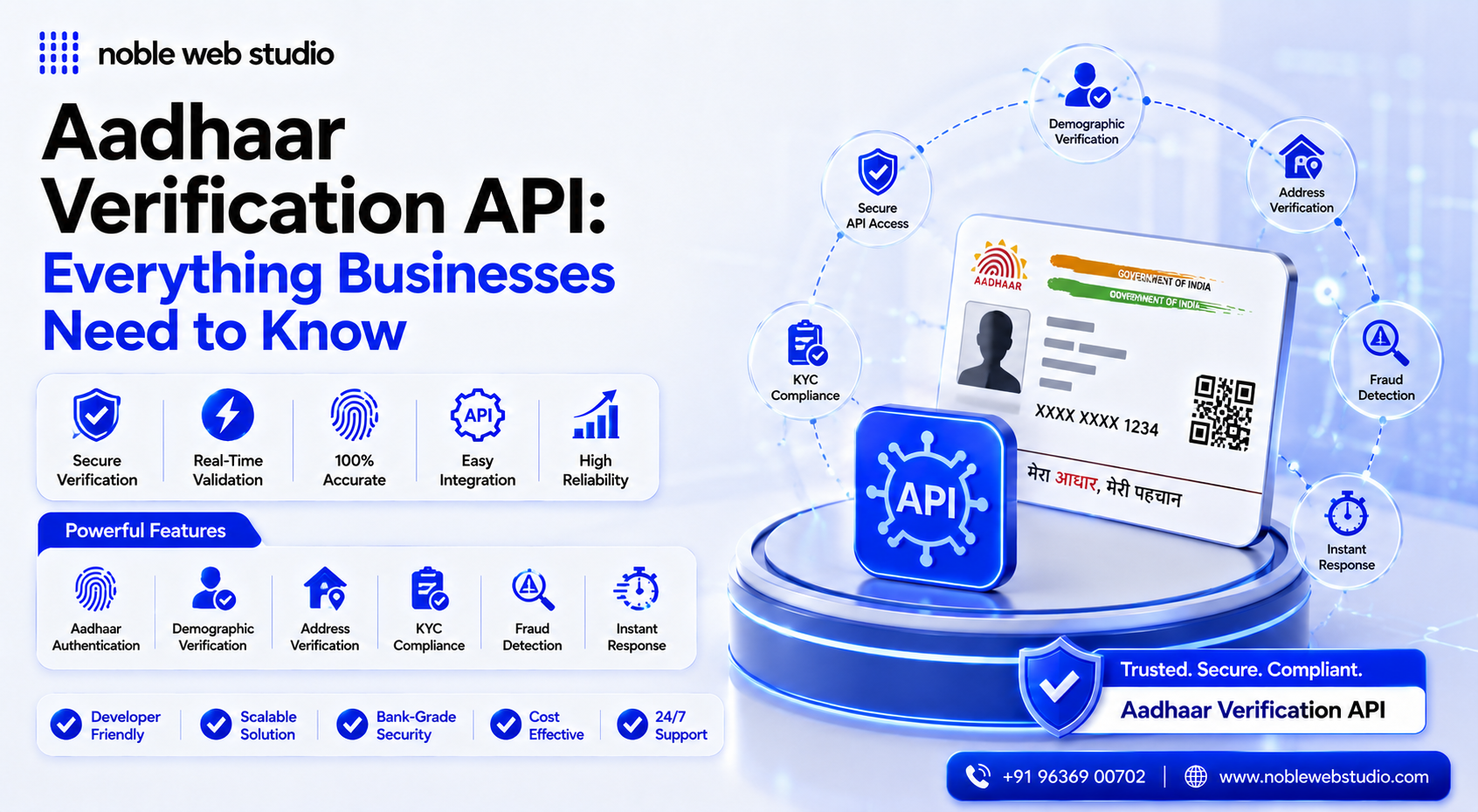
An Aadhaar Verification API helps businesses add digital Aadhaar-based identity verification to their website, mobile app, fintech platform, or online onboarding system. Instead of handling every verification step manually, businesses can integrate an Aadhaar Verification API into their existing workflow and make identity verification faster, simpler, and more organized.
For businesses that need reliable Aadhaar verification online, choosing the right API solution is important. A good Aadhaar Verification API should provide a smooth verification process, secure data handling, clear API documentation, reliable responses, easy integration, and support for applicable KYC and eKYC requirements. The exact verification method and information available depend on the authorized service and applicable UIDAI rules.
An Aadhaar Verification API is a secure digital tool that lets businesses confirm a person’s identity in real time using India’s Aadhaar database.
With Noble Web Studio, businesses can explore an Aadhaar Verification API Solution for integrating Aadhaar-based verification into their digital platforms. The solution can be considered for customer onboarding, identity verification, KYC workflows, fintech applications, and other business processes where authorized Aadhaar verification is required.
A strong Aadhaar API integration is not only about checking an Aadhaar number. Businesses also need to consider user consent, authentication method, data privacy, security, verification response handling, API reliability, scalability, and regulatory requirements. These factors can directly affect the quality of the overall verification experience.
If you are searching for Aadhaar Verification API, Aadhaar API, Aadhaar Verification API Provider, Aadhaar Verification API Integration, Aadhaar KYC API, Aadhaar eKYC API, Aadhaar Authentication API, or Aadhaar Verification Solution, this guide focuses specifically on the information you need to evaluate and implement an Aadhaar verification solution.
In this guide, you will learn what an Aadhaar Verification API is, how Aadhaar API integration works, how the Aadhaar verification process works, available verification approaches, important API features, security and compliance considerations, business use cases, pricing factors, and how to choose the right Aadhaar Verification API provider in India.
What Is Aadhaar Verification API
An Aadhaar Verification API is a digital tool that lets businesses and government systems check a person’s identity in real time using their 12-digit Indian Aadhaar number.

Aadhaar Verification API Work
How the Aadhaar Verification API Works
The API functions through a secure, cloud-based data loop that validates user identity in seconds. The standard step-by-step workflow includes:
[ User Inputs Aadhaar + Consent ]
               │
               ▼
[ API Encrypts & Transmits Request ] ──> [ UIDAI Central Database ]
                                                   │
               ▼                                   ▼
[ System Processes Action (Onboard/Flag) ] <── [ Returns Match Result (Yes/No) ]
- User Consent & Input: The user provides their 12-digit Aadhaar number (or Virtual ID) along with explicit, legally required consent to use their data.
- Secure Transmission: The API encrypts the request bundle to ensure high data security and transmits it to the UIDAI’s Central Identities Data Repository (CIDR).
- Authentication: The UIDAI backend runs checks on the data based on the chosen verification method (e.g., matching a submitted OTP or demographic detail).
- Result Delivery: The API returns an instant verification result (usually in structured formats like JSON or XML) back to the enterprise client. Following a “zero-storage” privacy policy, provider APIs generally pass through the confirmation without permanently storing sensitive biometric or personal info.
- System Action: Based on the “Yes” (match) or “No” (discrepancy) result, the client system automatically completes customer onboarding or flags the profile for manual review.
Verify with Aadhaar
QR Code
Based Verification
Aadhaar Verification API Service Offered
An Aadhaar Verification API is a secure, real-time digital service that allows businesses to validate a user’s identity by cross-referencing their Aadhaar details directly with the Unique Identification Authority of India (UIDAI) database. It is an essential component for digital onboarding, customer acquisition, and regulatory compliance (KYC/eKYC) across sectors like banking, fintech, telecom, and e-commerce.
Key Verification Methods Offered
Aadhaar verification APIs generally support multiple modes of authentication depending on the business use case and security requirements:
- OTP-Based Verification (OKYC): The most common consent-based method. The API triggers a One-Time Password to the user’s Aadhaar-linked mobile number to pull verified data.
- Demographic Verification: Validates basic parameters like Name, Date of Birth (DoB), Gender, and Address using just the 12-digit Aadhaar number, without requiring biometrics or OTPs.
- Biometric Authentication: Uses fingerprint or iris scans via compatible scanner hardware for high-security, physical verification.
- Face Authentication: Matches a live face scan of the individual against the photo stored in the official UIDAI records using AI-driven liveness detection.
- Offline XML / QR Code Verification: Decodes and verifies the digitally signed QR code or XML file downloaded from the UIDAI portal, ensuring a data privacy-compliant workflow.
Types of Aadhaar Verification API
Aadhaar Verification APIs enable businesses to validate user identities in real time using the Unique Identification Authority of India (UIDAI) ecosystem. These APIs are essential for digital onboarding, fraud prevention, and regulatory compliance across banking, fintech, and e-commerce.
The different types of Aadhaar Verification APIs can be classified into Online/Live Authentication APIs, Privacy & Offline Verification APIs, and Value-Added APIs.
1. Online & Live Authentication APIs
These APIs interact directly and securely with the centralized UIDAI database to verify identity in real time.
- Aadhaar OTP Verification API: Sends a One-Time Password to the user’s registered mobile number. The user inputs this OTP to instantly confirm their identity remotely.
- Aadhaar Biometric Authentication API: Captures fingerprints or iris scans using specialized hardware devices. It matches this data against UIDAI database records for high-security, in-person checks.
- Face Authentication API: Uses AI-powered facial recognition with liveness detection to match a live selfie with the photo stored in the Aadhaar registry. It offers touchless, highly secure remote verification.
- Demographic Verification API: Validates text-based details such as the user’s name, date of birth, gender, and address against the records held by UIDAI.
2. Privacy & Offline Verification APIs
These methods prioritize user privacy or work seamlessly in low-connectivity situations by eliminating the need for a live connection to the central database.
- Offline eKYC (XML/Zip-Based) API: Downloads a secure, digitally signed XML or Zip file from UIDAI with user consent. It securely extracts user information and photographs without sharing the actual Aadhaar card.
- Aadhaar QR Code Verification API: Extracts data by scanning the secure, tamper-proof QR code printed on the physical or digital Aadhaar card. It verifies demographic data and photographs completely offline.
- Virtual ID (VID) Verification API: Protects sensitive personal data by using a temporary, system-generated 16-digit Virtual ID instead of the actual 12-digit Aadhaar number.
3. Extended Value-Added APIs
These specialized variations build upon basic Aadhaar infrastructure to handle documents, signatures, and government database links.
- Aadhaar-based eSign API: Combines digital signature services with OTP or biometric verification to allow users to sign legal and financial contracts remotely.
- DigiLocker Integration API: Fetches government-issued, verified Aadhaar documents directly from a user’s secure DigiLocker wallet via an OTP consent flow.
- Optical Character Recognition (OCR) API: Uses computer vision to scan images of physical Aadhaar cards, extracting text and numbers automatically to skip manual data entry.
- Bank Seeding Status API: Checks which bank account is actively linked to the customer’s Aadhaar profile, a critical feature for processing Direct Benefit Transfers (DBT).
API Comparison Summary
| API Type | Security Level | Best Use Case | Infrastructure Needed |
|---|---|---|---|
| OTP API | Medium | Remote onboarding, fast sign-ups | Standard smartphone / PC |
| Biometric API | High | Branch banking, high-value security | Biometric scanner hardware |
| Face Auth API | High | Secure remote KYC, elderly onboarding | Camera with RD Service support |
| Offline XML / QR | Medium-High | Privacy-sensitive KYC, offline areas | Smartphone camera or reader |
Types of Aadhaar Verification APIs
Aadhaar Verification API Authentication Methods
Aadhaar Verification APIs utilize seven primary authentication methods to validate identities against the Unique Identification Authority of India (UIDAI) central infrastructure. These methods are categorized into online (real-time) and offline (privacy-focused) frameworks, serving different business use cases from remote onboarding to physical branch security.
1. Online Authentication Methods (Real-Time)
- OTP-Based Authentication: Sends a One-Time Password to the user’s Aadhaar-linked mobile number or email. Best for remote, friction-free digital onboarding on fintech or digital banking apps.
- Biometric Authentication: Matches live fingerprint or iris scans using standard biometric devices against UIDAI records. Best for high-security, in-person identity verification at bank branches or insurance firms.
- Face Authentication: Captures a live facial image with liveness detection and matches it against the photo stored in the UIDAI database. Best for contactless access and elderly users who struggle with fingerprint matching.
- Demographic Verification: Compares submitted text details—such as full name, gender, date of birth, and address—directly against the UIDAI registry without retrieving data. Best as a basic checklist for low-risk identity validation.
2. Offline & Privacy-Preserving Methods
- Paperless Offline eKYC (XML-Based): Parses a digitally signed, encrypted XML file downloaded by the user from the UIDAI portal. Best for NBFCs and telecom compliance without requiring live UIDAI server connectivity.
- Secure QR Code Verification: Scans the tamper-proof QR code printed on physical Aadhaar cards or e-Aadhaar letters to instantly extract identity information. Best for instant retail checkouts, security gates, and counter workflows.
- Virtual ID (VID) Verification: Substitutes the actual 16-digit Aadhaar number with a temporary, revocable 16-digit VID generated by the user. Best for privacy-centric ecosystems like e-commerce and digital lending.
Who Can Use Aadhaar Verification API
Aadhaar Verification APIs can be used by authorized businesses, financial institutions, and government bodies registered under UIDAI regulations to perform real-time identity verification and digital KYC.
Who Can Use the API?
- Financial Institutions: Banks, Non-Banking Financial Companies (NBFCs), and fintech platforms use it for instant paperless KYC, account opening, and loan processing.
- Telecom Providers: Companies use it for immediate customer onboarding and mobile SIM card activation.
- Insurance Companies: Providers use it for policyholder verification, fraud detection, and claims processing.
- E-commerce & Marketplaces: Platforms use it to verify merchants, gig workers (such as delivery partners), and high-value buyers.
- Government & Public Sector: Agencies use it to distribute subsidies, welfare benefits, and manage public services.
- Human Resources & Background Verification (BGV): Employers use it for candidate, employee, and vendor identity verification.
- Healthcare Providers: Platforms use it for patient identity verification and secure telemedicine services.
Why USE Aadhaar Verification API
An Aadhaar Verification API allows businesses and organizations to instantly verify an individual’s identity in real time by connecting securely to the central Unique Identification Authority of India (UIDAI) database.
Unlike physical document checks, which are easily forged, validating details directly against the government registry ensures that the person matches their official records.
Key Benefits
Real-Time Onboarding
- Instant Verification: Validates user identities in seconds.
- Paperless Flow: Eliminates heavy manual documentation and reduces customer drop-out rates during sign-ups.
- Automated Workflows: Removes human errors by handling validation automatically via code.
Enhanced Security & Fraud Prevention
- Auth Sources: Uses One-Time Passwords (OTP), biometrics (fingerprint/iris), or secure QR codes to confirm the holder is genuinely present.
- Anti-Forgery: Confirms identity records through authoritative government registry data rather than easily manipulated physical paper.
Regulatory Compliance
- KYC Mandates: Helps entities like banks, NBFCs, and telecom operators adhere to Reserve Bank of India (RBI) and government Know Your Customer (KYC) norms.
- Consent-Based Architecture: Pulls details only after explicit user authorization, respecting legal privacy standards.
Aadhaar Verification API Use Cases
The Aadhaar Verification API has transformed how organizations handle identity verification by establishing a secure, real-time connection with the Unique Identification Authority of India (UIDAI) database. It allows private enterprises and government entities to eliminate paperwork, mitigate fraud, and maintain stringent regulatory compliance.
Key Use Cases by Industry
Financial Services & Fintech
- Instant Digital eKYC: Banks and NBFCs use OTP-based Aadhaar verification to onboard customers remotely for savings accounts, credit cards, and investment portfolios.
- Loan Disbursal: Fintech platforms instantly verify customer demographic profiles to run quick credit and fraud assessments.
- Regulatory Compliance: Financial companies meet strict Anti-Money Laundering (AML) mandates, leveraging UIDAI data to prevent massive annual identity frauds.
Telecom & Utilities
- SIM Card Activation: Service providers utilize instant identity checks to activate new mobile connections on the spot, lowering the risk of spoofed identities.
- Utility Connections: Simplifies verification for setting up new gas, electricity, or water accounts.
HR, Employment & Gig Economy
- Employee Background Checks: HR departments validate candidate details during hiring to cross-verify names, addresses, and dates of birth directly from official records.
- Gig Worker Onboarding: On-demand delivery and ride-hailing services verify contract workers to maintain platform safety and trust.
Government & Public Services
- Direct Benefit Transfers (DBT): Ensures that social welfare schemes, farming subsidies, and public aid reach intended individuals directly without leakage or duplication.
- E-Governance: Powers digital applications for certificates, driving licenses, and public welfare platforms.
E-Commerce & Digital Marketplaces
- Vendor & Seller Verification: High-value online marketplaces verify sellers before letting them open digital storefronts to prevent counterfeit goods.
- High-Value Buyer Fraud Prevention: Flags fake accounts and filters fraudulent transactions for premium delivery services.
Real Estate & Shared Economy
- Tenant & Guest Onboarding: Property owners and hotel chains cross-verify tenants and guests to fulfill local safety compliance and identity proofing.
- Aadhaar eSign: Facilitates legally binding digital signatures for lease agreements and purchase contracts without requiring physical paperwork.
Verification Methods Supported by the API
The integration method depends entirely on the security level and user experience flow an application requires:
| Verification Type | How it Works | Primary Feature |
|---|---|---|
| OTP-Based OKYC | A One-Time Password is sent to the user’s UIDAI-linked mobile phone. | Fast, consent-based, paperless fintech onboarding. |
| Biometric Verification | Uses fingerprint or iris scanners to authenticate identity. | Foolproof security for high-risk corporate and physical banking transactions. |
| Offline XML/QR Check | Scans a physical card QR code or validates a digitally signed XML file. | Processes records locally via cryptographic validation without calling live databases. |
| Face Authentication | Matches the live user’s face to their Aadhaar card photo using AI-driven liveness detection. | Prevents deepfakes, screen replays, and photo fraud. |
What Details Can Be Verified Through Aadhaar API?
An Aadhaar Verification API confirms an individual’s identity and retrieves authorized demographic details directly through the Unique Identification Authority of India database.
Verifiable Details
- Full Name: Matches the name registered on the Aadhaar card.
- Date of Birth / Age: Confirms the exact date or year of birth.
- Gender: Verifies the gender marker on record.
- Address: Retrieves complete address data including state, district, PIN code, and locality.
- Photograph: Provides a base64-encoded profile photo of the cardholder (via e-KYC).
- Contact Info: Returns masked or hashed mobile numbers and email addresses linked to the account.
- Card Status: Validates whether a 12-digit Aadhaar number or Virtual ID is active and genuine.
Verification Methods
- OTP Authentication: Sends a One-Time Password to the mobile number linked to the Aadhaar to fetch e-KYC data.
- Biometric Authentication: Uses fingerprint or iris scanners for secure, physical verification.
- Demographic Match: Cross-checks input names and addresses against official records.
- QR Code / XML Scan: Reads digitally signed offline XML files or card QR codes.
Aadhaar Verification API for KYC and eKYC
An Aadhaar Verification API is a digital tool that lets businesses instantly confirm a person’s identity and fetch their official details using India’s Aadhaar database.
What is KYC vs. eKYC?
- KYC (Know Your Customer): A general process where companies verify who you are using ID documents.
- eKYC (Electronic KYC): A paperless, digital method where UIDAI shares encrypted, digitally signed user details directly after an online check.
Aadhaar Verification API for Online Identity Verification
An Aadhaar Verification API is a secure, real-time tool that allows businesses to validate a customer’s identity instantly against the official government database managed by the Unique Identification Authority of India (UIDAI).
Integrating this API helps entities automate digital onboarding, comply with regulatory mandates (like KYC), and prevent identity theft or fraud.
Common Verification Methods
Depending on your security requirements and user experience workflow, you can implement several validation methods:
- OTP-based e-KYC (OKYC): The system triggers a One-Time Password to the user’s Aadhaar-linked mobile number. Once entered, it decrypts a digitally signed XML file containing verified details like name, photo, date of birth, and address.
- Demographic Verification: Validates basic typed-in text parameters (e.g., matching a submitted name, gender, or date of birth against the database) without pulling private data.
- Aadhaar XML / QR Code Upload: Extracts secure, pre-verified demographic info from a downloaded e-Aadhaar file or physical QR code. This functions completely offline without contacting UIDAI servers in real time.
- Biometric Authentication: Uses facial recognition, iris scans, or fingerprints for high-security, in-person onboarding workflows.
Aadhaar Verification API for Customer Onboarding
An Aadhaar Verification API lets businesses instantly confirm a customer’s identity and address using their 12-digit Aadhaar number during digital onboarding.
Key Verification Methods
- OTP-based e-KYC: Paperless verification that fetches official demographic data via a registered mobile number.
- DigiLocker Integration: Secure document fetching approved by the government.
- OCR and QR Scanning: Scanning physical cards or QR codes to extract and check details.
Aadhaar Verification API
Simplify Aadhaar verification for digital onboarding, KYC, financial services, recruitment, travel and other customer verification workflows.
NBFC & Digital Lending
Verify customer identity during digital loan onboarding and KYC.
Recruitment Agencies
Verify applicant identity and simplify employee onboarding.
Insurance
Support customer verification and secure policy onboarding.
Aadhaar
Verification API
Travel & Hospitality
Enable reliable guest verification for travel and hospitality services.
Fintech & Payments
Strengthen KYC and identity verification across fintech platforms.
Gig Economy Platforms
Verify delivery partners, drivers and gig workers during onboarding.
Aadhaar Verification API for Fintech and Digital Platforms
An Aadhaar Verification API allows fintech and digital platforms to instantly authenticate customer identities, automate digital KYC, and prevent fraud through UIDAI-backed systems or secure offline mechanisms.
Major Benefits for Fintech
- Instant Onboarding: Reduces customer acquisition time from days to mere seconds.
- Fraud Reduction: Detects tampered, fake, or synthetic identity cards in real time.
- Regulatory Compliance: Adheres to UIDAI security guidelines and maintains audit-ready logs.
Aadhaar Verification API for Secure Identity Verification
An Aadhaar Verification API is a digital tool that allows businesses to instantly validate the identity of individuals in real-time by securely connecting to the Unique Identification Authority of India (UIDAI) central database. It enables organizations to confirm whether an Aadhaar number is genuine, extract matching demographic details, and prevent identity fraud during customer onboarding.
Core Technical & Compliance Features
- Zero-Storage Policy: Top providers strictly adhere to UIDAI guidelines, meaning no biometric data or raw Aadhaar numbers are stored by the API gateway.
- Masked Aadhaar & VID Support: Supports Virtual IDs (VIDs) and returns masked formats to protect user privacy.
- Regulatory Compliance: Fully satisfies Know Your Customer (KYC) guidelines dictated by major Indian regulators including the RBI, SEBI, IRDAI, and UIDAI.
- Real-Time Performance: Transactions complete in roughly 2 to 3 seconds with an average success rate exceeding 99%.
Why Businesses Need Aadhaar Verification API
An Aadhaar Verification API lets businesses instantly confirm a customer’s or employee’s identity and address using the official Unique Identification Authority of India (UIDAI) database.
Why Businesses Need It
- Instant Onboarding: Verify user details in seconds without any paper forms or manual work.
- Fraud Prevention: Stop fake IDs and identity theft by checking credentials directly against government records.
- Regulatory Compliance: Meet Know Your Customer (KYC) and Anti-Money Laundering (AML) rules required by authorities like the RBI.
- Lower Costs: Cut down on the staff time and operational costs needed for physical document checks.
- Better User Experience: Keep customers happy with fast, zero-contact digital sign-ups and fewer drop-offs.
Selection Matrix for Businesses
| Business Goal | Recommended Authentication Method | Key Advantage |
|---|---|---|
| Remote Fintech Onboarding | OTP-Based / VID Verification | 2-3 second completion time |
| High-Risk Financial Services | Biometric / Face Recognition | Minimizes identity fraud |
| Privacy & Masked Compliance | Offline XML / VID Verification | Zero storage of actual Aadhaar numbers |
| Retail Counter / In-Store KYC | QR Code Scanning / Biometrics | Eliminates manual typing errors |

Aadhaar Verification API Workflow: Step-by-Step Process
Choosing the Right PAN Verification API for Your Business
Need Fast
Verification?
Real-Time PAN
Validation,
Instant Results.
Remote
Onboarding?
PAN Verification,
Digital KYC,
API Integration.
Business
PAN Checks?
Company PAN,
Business Validation,
PAN Status.
Secure
Verification?
Encrypted Data,
Secure API,
Compliance-Focused.
Need Easy
Integration?
Simple API,
Developer-Friendly,
Scalable Solution.
Benefits Aadhaar Verification API
An Aadhaar Verification API provides instant, paperless identity confirmation by securely connecting applications to official database records.
Key Benefits
- Instant Verification: Cuts down customer onboarding and verification times from days or weeks to mere seconds.
- Fraud Prevention: Directly connects to official databases to stop identity theft, fake documentation, and duplicate accounts.
- Cost Efficiency: Automates data checks to remove manual paperwork and lower operational overhead.
- Regulatory Compliance: Meets mandatory KYC (Know Your Customer) and AML (Anti-Money Laundering) guidelines for financial and telecom sectors.
- High Scalability: Handles millions of daily automated verification requests smoothly for growing enterprises.
- Better User Experience: Uses simple OTP or digital consent flows to build customer trust without physical document hassles.
Features Aadhaar Verification API
An Aadhaar Verification API provides real-time, secure identity validation by connecting directly to the Unique Identification Authority of India (UIDAI) central database.
Core Features
- Real-Time Validation: Instantly checks if an Aadhaar number is active and valid within seconds.
- Multiple Verification Modes: Supports OTP-based verification, biometric scans (fingerprint and iris), and demographic checks.
- Demographic Cross-Checking: Validates name, date of birth, gender, and address against official records.
- Offline e-KYC (XML/QR): Uses digitally signed XML files or secure QR codes for paperless verification without live database dependency.
- Consent-Based Flow: Requires explicit user authorization, typically via a registered mobile OTP, before sharing any personal data.
- Zero Data Storage: Complies with UIDAI privacy standards by not storing sensitive biometric or Aadhaar number data on external servers.
- Standardized JSON/XML Output: Returns clear, structured response formats for smooth integration into existing software workflows.
Aadhaar Verification API Integration for Websites and Apps
The process of Aadhaar Verification API integration involves several key steps to enable seamless and secure identity verification within an application or system.
Registration and Credentials:
- Register with an authorized Noble web studio provide platform, such as a licensed Aadhaar Authentication User Agency (AUA) or KYC User Agency (KUA), or directly with UIDAI if eligible.
- Obtain necessary Aadhaar Verification API credentials, including Client ID, API Key, and License Key, which are essential for authenticating your requests.
Choosing the Aadhaar Service:
- Determine the specific Aadhaar service required for Aeps application, such as Aadhaar Authentication (OTP or biometric), e-KYC, or Offline KYC.
Setting up the API Environment:
- Utilize the sandbox (testing) environment provided by UIDAI or Noble web studio to test the integration thoroughly before deploying to a live production environment.
API Integration:
- Integrate Aadhaar Verification API into Aeps software or website. This typically involves making secure HTTPS requests to the API endpoints.
- Include required inputs in fast Aeps API calls, such as the Aadhaar number, OTP or biometric data, and encrypted license keys.
Data Security and Encryption:
- Adhere to UIDAI’s guidelines for data security and encryption, which often involve using public key infrastructure and specific data block formats (e.g., PID block) to protect sensitive Aadhaar information.
Handling API Responses:
- Process the Aadhaar Verification API responses to determine the verification status (success or failure) and retrieve relevant details, such as demographic information in the case of e-KYC or demographic API calls.
- Implement logic to handle different response scenarios, including displaying user details or appropriate error messages.
Compliance and Auditing:
- Ensure strict compliance with the Aadhaar Act, UIDAI guidelines, and relevant data privacy regulations throughout the integration and usage of the API.
- Maintain detailed audit trails of all Aadhaar interactions and obtain explicit user consent before initiating any Aadhaar-related verification processes.
Going Live:
- Once testing is complete and compliance requirements are met, transition your integration to the live production environment using your production credentials.

Cost Aadhaar Verification API
Aadhaar verification API costs in India generally range from ₹0.60 to ₹15 per successful verification, depending on your monthly transaction volume and the type of check required.
Pricing Models
- Pay-Per-Use (Per Transaction): Most providers charge a flat rate per successful verification, ranging from ₹1 to ₹5 for basic OTP/e-KYC, and up to ₹10–₹15 for photo-based or advanced biometric matching.
- Volume Tiers: High-volume users (over 100,000 requests per month) get discounted rates, often dropping basic validation to around ₹0.60 to ₹0.80 per call.
- Setup or Implementation Fees: Some B2B vendors charge a one-time integration or portal development fee ranging from ₹3,000 to ₹25,000, though many modern cloud API providers offer zero setup fees with free sandbox testing credits.
Typical Cost Breakdown
- Basic Aadhaar / Offline Verification: ₹1 to ₹5 per check (lower for bulk/high volume).
- Aadhaar Advanced / OKYC (OTP-based): ₹1 to ₹5 per request.
- Photo-based / Face Match Verification: ₹10 to ₹20 per check due to higher processing complexity.
- Aadhaar-based E-Sign: ₹4 to ₹28 per document signed depending on volume.
Real-Time Aadhaar Verification API
A Real-Time Aadhaar Verification API is a digital tool that lets businesses instantly check and authenticate a user’s 12-digit Aadhaar number against the official Unique Identification Authority of India (UIDAI) database.
Key Verification Methods
- OTP Authentication: Validates the user via their registered mobile number.
- Demographic Check: Confirms name, gender, address, and date of birth.
- XML / eKYC Processing: Decrypts securely signed offline paperless eKYC XML files.
- Biometric Authentication: Uses physical fingerprint or iris scanners for high-security verification.
Aadhaar Verification API Request and Response Fields Explained
An Aadhaar verification API request sends identity data like a 12-digit ID or an OTP to a secure server, and the response returns a success status, validity check, or basic user details. You can visit the official UIDAI Website to learn more about how Aadhaar services work.
Common Request Fields
uid/aadhaar_number: The 12-digit unique ID number of the user.otp: The One-Time Password sent to the mobile phone linked to the Aadhaar.consent: A boolean value (trueorfalse) showing the user allowed the check.txn_id/reference_id: A unique code to track one specific API call.api_key: Your private authorization key to access the gateway.
Common Response Fields
status/success: Shows if the API request worked (trueorfalse).valid: Confirms if the ID number is real and active.message/error_code: Explains why a request failed or succeeded.data: An object containing user details (like name, gender, or state) when eKYC is approved.
Aadhaar Number Verification API and Verification Status
An Aadhaar Number Verification API is a digital tool that allows businesses and organizations to instantly validate the authenticity of a 12-digit Aadhaar number against the official server database. It is a foundation for digital onboarding, Know Your Customer (KYC) workflows, and fraud prevention.
Understanding the “Verification Status”
When checking an Aadhaar number, you will encounter specific status outputs. Here is what they translate to in practical business logic:
| Status Code / Output | Meaning | Action Required |
|---|---|---|
VALID / TRUE | The Aadhaar number exists in the database and is actively registered. | Proceed to the next step of onboarding. |
INVALID / FALSE | The 12-digit number is malformed, structurally incorrect, or does not exist. | Stop the flow; prompt the user to re-enter their ID. |
SUSPENDED / DEACTIVATED | The ID was once valid but has been frozen or deactivated by the government due to anomalies. | Flag for manual fraud review. |
PENDING / IN_PROGRESS | Typically seen in update loops when a user has updated their demographic profile online. | Query the status endpoint again via webhooks. |
If you are an individual wanting to check your own current registration or update status manually without using code, you can use the official web-based UIDAI Portal Tracker by entering your Enrolment ID (EID) or Service Request Number (SRN).
Aadhaar Verification API Security and Data Protection
Aadhaar Verification APIs require a multi-layered security ecosystem to protect sensitive Personally Identifiable Information (PII) and comply with strict UIDAI regulations. Because these APIs interface directly with the Central Identities Data Repository (CIDR), implementing entities must enforce robust data protection protocols at every stage of transmission and storage.
Core Security Architecture
- Transport Layer Security (TLS): All data packets moving between the client application, the API gateway, and the UIDAI servers must use TLS 1.3 encryption to eliminate man-in-the-middle attacks.
- Hardware Security Modules (HSM): Cryptographic keys used for data signing and decryption must reside in intrusion-resistant, FIPS 140-2 Level 3 certified HSMs.
- Aadhaar Data Vault (ADV): If an organization must store Aadhaar data, it cannot sit in normal databases. It must live inside a highly encrypted, isolated Aadhaar Data Vault.
- Tokenization: Actual 12-digit Aadhaar numbers must be replaced with a secure reference key or token within your primary business applications.
Regulatory & Data Protection Mandates
[User Consent Granted] ➔ [Data Masking Applied] ➔ [Encrypted API Request] ➔ [UIDAI Match (Yes/No)]
- Explicit Consent Verification: You must obtain and document explicit, informed consent from the user before executing an API call.
- Aadhaar Number Masking: Systems displaying or logging data must redact the first 8 digits of the Aadhaar number, showing only the final 4 digits.
- DPDP Act Compliance: The API workflows must adhere to India’s Digital Personal Data Protection (DPDP) Act, ensuring strict purpose limitation and data minimization.
- No Retention of Raw Biometrics: Entities using biometric APIs (fingerprint/iris) are strictly prohibited from capturing, storing, or caching raw biometric templates.
Aadhaar Verification API Accuracy, Reliability and Response Time
The Aadhaar Verification API is highly accurate and reliable because it cross-references user data directly with the central database of the Unique Identification Authority of India (UIDAI). This direct link enables businesses to achieve up to 99.99% accuracy depending on the specific authentication method, with response times ranging from instantaneous to under 60 seconds.
Accuracy and Performance Metrics
The accuracy of an Aadhaar API varies based on the verification framework chosen:
| Verification Method | Accuracy Rate | Average Response Time |
|---|---|---|
| Biometric Verification (Fingerprint/Iris) | 99.99% | 20–30 seconds |
| OTP-Based Authentication | 99.9% | 2–3 seconds (up to 60s with latency) |
| Face Matching (with Liveness Detection) | 98%+ | 10–20 seconds |
| QR Code / XML Scanning (Offline e-KYC) | 100% Validated Data | Instantaneous |
System Reliability & Uptime
- Zero-Storage Policy: Noble web studio maintain a strict zero-storage infrastructure to meet UIDAI regulations, meaning data is encrypted end-to-end and never stored locally.
- Uptime Dependency: Because the API relies on government infrastructure, overall availability is bound to UIDAI server health. Noble web studio usually guarantee a 99.9% Service Level Agreement (SLA).
- Error Handling: When UIDAI experience server lags, advanced APIs route requests via fail-safe mechanisms providing real-time status updates and automated retry handling.
Response Time Drivers
- Network Latency: Direct UIDAI-compliant eKYC APIs process data formats in JSON or XML format to optimize server handshake speeds.
- User Input Delay: For OTP methods, the processing time is mostly governed by how quickly the telecom provider delivers the SMS and how fast the user inputs it.
- Fallbacks: QR Code scanning (via the encrypted QR printed on physical cards) avoids live internet checks entirely, making it the most resilient option against network outages.
Aadhaar Verification API Error Handling and Verification Failures
Robust error handling for the Aadhaar Verification API is critical to maintaining high onboarding conversion rates in fintech and digital applications. Relying on a single-source validation stream without catching backend exceptions creates operational compliance risks and ruins user experience.
Implementing a clean taxonomy ensures technical glitches are isolated from user input mistakes.
Core Architecture for Aadhaar API Error Handling
Fintechs and verification systems must implement a layered error architecture rather than mapping all failures to generic errors:
[ User Action / API Request ]
             │
             ▼
┌──────────────────────────┐
│ Lightweight Frontend     │ ──► [Format Fails] ──► Block submission instantly
│ Regex Validation         │                        (Save backend API costs)
└──────────────────────────┘
             │
             ▼ [Format Passes]
┌──────────────────────────┐
│ Network & Protocol Layer │ ──► [HTTP 503 / Timeout] ──► Trigger Exponential Backoff
│ (HTTP Status Checks)     │                              Queue async fallback logs
└──────────────────────────┘
             │
             ▼ [HTTP 200 OK]
┌──────────────────────────┐
│ UIDAI Response Codes     │ ──► [Match Fails / Suspended] ──► Display Actionable UX Message
│ (JSON/XML Parsing)       │                                   Route to DigiLocker / Video KYC
└──────────────────────────┘
Categorized UIDAI Error Code Taxonomy
The Unique Identification Authority of India (UIDAI) structures its response payloads using specific numeric code blocks:
| Error Code Range | Error Category | System Action / Resolution |
|---|---|---|
0–99 | Success & Match Status | Proceed to downstream onboarding steps. |
100–199 | Request Validation / Input Errors | Check application formatting or structural data payloads. |
200–299 | Protocol / Format Handling | Inspect network layer encoding, header values, or encryption layers. |
730–739 | Capture Flow Errors | Re-initialize local hardware SDK or camera modules. |
800–899 | Application Policy / Missing Attributes | Ensure mandatory elements (like bt or bs) are included. |
900–909 | Runtime / Input Scheme Failures | Fix badly formatted demographic items like invalid dob formatting. |
930–939 | Internal Authentication Server Issues | Treat as temporary downtime; route request through retry queue. |
9700–9999 | Device SDK / Biometric Capture Failures | Request user check lighting or clean sensor surface. |
Crucial Identity Failure Codes & Resolution Log
When processing live verification payloads, handle these exact critical flags seamlessly:
998(Invalid Aadhaar Number): Explicitly fail the application onboarding pathway. Tell the user to re-verify their physical document entry. Do not auto-retry.995,996,997(Aadhaar Blocked/Suspended/Cancelled): The identity instrument is non-authenticatable. Halt automated verification workflows. Flag the profile for manual compliance oversight.950/951(OTP Store or Biometric Lockout): The security parameters on the user’s account are locked. Prompt the user to clear their bio-lock status inside the official mAadhaar application.
Aadhaar Verification API Sandbox and Testing
To test Aadhaar authentication before going live, you must use an Aadhaar Verification API Sandbox. The UIDAI Developer Section provides an official, free testing environment. Alternatively, commercial compliance hubs such as the Noble web studio offer managed API wrappers for easier developer integration.
Quick Summary: Official vs. Commercial Sandbox
| Feature | Official UIDAI Sandbox | Third-Party API Sandboxes |
|---|---|---|
| Provider | UIDAI (Government) | FinTech aggregators (e.g., Sandbox.co.in, Surepass, Perfios) |
| Access Speed | Delayed (Requires review/onboarding for formal access) | Instant (Sign up and get tokens in minutes) |
| Complexity | High (Requires handling XML, PID encryption, and SDKs) | Low (Simplified RESTful HTTP JSON endpoints) |
| Cost | Free | Free tier/Sandbox testing, then volume-based pricing |
Accessing the Official UIDAI Developer Sandbox
UIDAI organizes sandbox access into a phased onboarding funnel to risk-manage live data applications:
Open Access (Proof of Concept Mode):
- Target: Individual developers, startups, or students.
- Requirement: No registered company or prior licenses needed.
- How it works: You use a public AUA (Authentication User Agency) code and test license key directly from the developer portal.
- Capability: Download the SDK and hit staging endpoints using dummy Aadhaar numbers to test end-to-end OTP, authentication, and offline eKYC flows.
Staging Access (Pre-Production Mode):
- Target: Companies that have formally applied for an AUA or KUA license.
- Requirement: Formal application submission and payment of fees.
- Capability: UIDAI provides a dedicated corporate Sandbox ID to prepare for your mandatory Self-Certification audit tests before going live.
Using a Commercial REST API Sandbox (e.g., Sandbox.co.in)
If you want to bypass complex government SDK integration, commercial aggregators wrap the UIDAI framework into clean, developer-friendly REST endpoints.
The 4-Step Testing Workflow
- Authentication: Fetch your test Bearer Token from your provider’s dashboard. All API calls require HTTPS.
- Generate OTP: Send a
POSTrequest containing a test Aadhaar number, specific user consent flags, and a reason string. - Simulate Callback: Instead of an actual phone receiving text, your sandbox responds with a mock
reference_id. - Verify & Fetch: Submit the mock OTP (e.g., using predefined success strings like
success@upior generic numbers like123456) alongside thereference_idto receive dummy eKYC JSON objects.
Expected Sandbox JSON Response Data
When a mock test passes, the sandbox API responds within seconds to simulate production output. The returned mockup object contains:
- Full name
- Date of Birth (DOB)
- Gender
- Masked Aadhaar number / Virtual ID (VID)
- Pre-filled address string
- Dummy base64 profile picture string
Aadhaar Verification API Compliance and Verification Requirements
Aadhaar Verification APIs allow businesses to authenticate user identities securely through the Unique Identification Authority of India (UIDAI) ecosystem while following strict data compliance rules.
Key Compliance Requirements
- AUA/KUA Licensing: Direct live authentication requires an Authentication User Agency (AUA) or KYC User Agency (KUA) license, though most firms use sub-AUA models via authorized API vendors.
- User Consent: Businesses must capture explicit, informed user consent before launching any verification or pulling data.
- Data Masking & Vaults: Storing raw 12-digit Aadhaar numbers is prohibited; platforms must use masked numbers, Virtual IDs (VID), or set up a secure Aadhaar Data Vault.
- Regulatory Alignment: Workflows must adhere to guidelines set by UIDAI, RBI, SEBI, and the Aadhaar Act.
Main Verification Methods
- OTP-Based eKYC: Sends a one-time password to the mobile number linked to the Aadhaar to fetch verified demographic details.
- Offline XML / DigiLocker: Uses digitally signed XML files or the DigiLocker platform to share verified identity attributes safely.
- Demographic Match: Compares submitted names, dates of birth, or addresses against official records without full biometric pulls.
Aadhaar OTP vs Aadhaar eKYC API
Aadhaar OTP verification confirms an individual’s identity by validating a passcode sent to their registered mobile number, whereas the Aadhaar eKYC API retrieves a full profile of verified demographic and identity data directly from UIDAI upon successful authentication.
Comparison Table
| Feature | Aadhaar OTP Verification API | Aadhaar eKYC API |
|---|---|---|
| Primary Purpose | Validates if the person possesses the Aadhaar-linked mobile number. | Authenticates and downloads full electronic Know Your Customer data. |
| Input Required | Aadhaar Number + 6-digit OTP. | Aadhaar Number + OTP (or Biometric/Face). |
| Data Returned | Basic confirmation of validity and match status. | Full demographic details (Name, Address, DOB, Gender, Photo). |
| Hardware Needed | None (Software-based/API integration only). | None for OTP-based eKYC; certified scanners needed for biometric eKYC. |
| User Presence | Remote / Fully online. | Remote (via OTP) or In-person (via Biometric). |
| Risk / Use Case | Low-to-medium risk onboarding (fintech, digital wallets). | Higher compliance and regulatory onboarding needs. |
Aadhaar Verification API vs Manual Aadhaar Verification
An Aadhaar Verification API provides instant, automated identity checks through the UIDAI database, whereas manual verification relies on human inspection of physical or scanned card copies.
Comparison: Aadhaar Verification API vs. Manual Verification
| Feature | Aadhaar Verification API | Manual Aadhaar Verification |
|---|---|---|
| Speed | Real-time (takes 30 to 60 seconds). | Slow (takes hours or days). |
| Accuracy | Extremely high (99.9% direct database match). | Low to medium (prone to human typos or oversight). |
| Fraud Risk | Minimal; flags altered or fake cards instantly. | High; vulnerable to forged physical documents or photoshopped PDFs. |
| Cost & Scale | Highly cost-effective and scalable for high volumes. | Labor-intensive, expensive, and difficult to scale. |
| User Experience | Seamless digital onboarding via OTP or QR scan. | Friction-heavy; requires uploading and reviewing document scans. |
| Compliance & Audit | Generates automated, encrypted, audit-ready logs. | Relies on manual record-keeping, complicating compliance audits. |
White label Aadhaar verification API
A white-label Aadhaar verification API lets businesses rebrand an identity check and electronic Know Your Customer (e-KYC) platform with their own company name, logo, and domain.
Key Features
- OTP Authentication: Confirms identity by sending a One-Time Password to the mobile number linked to the Aadhaar card.
- Demographic Checking: Validates names, dates of birth, genders, and addresses against the official UIDAI database.
- Biometric Scanning: Uses fingerprint or iris scanners for high-security verification.
- Custom Branding: Applies your own user interface, brand colors, and administrative panels.

How to Choose the Best Aadhaar Verification API Provider in India
Noble web studio one of the best Aadhaar Verification API provider, you must prioritize regulatory compliance (UIDAI licensing), data directness, and anti-fraud capabilities over basic cost metrics. A weak provider relies only on basic Optical Character Recognition (OCR), while a premium provider integrates directly into the government database using official licenses.
1. Regulatory Status & Licensing
- UIDAI Authorized: Must be an authorized Noble web studio .
- Beyond OCR: Avoid Noble web studio doing simple text extraction from card photos. True eKYC requires official UIDAI integration.
- Compliance Standards: Ensure compliance with NPCI and RBI standards for secure data handling.
2. Supported Verification Methods
- OTP Authentication: Fast, hardware-independent remote onboarding via user mobile numbers.
- Biometric Support: Fingerprint or iris scans using certified Registered Device (RD) services for physical branches.
- Face Auth & Liveness: Live face capture matched with UIDAI records to prevent spoofing fraud.
- Offline XML/QR: Digitally signed XML handling that supports secure Aadhaar masking for user privacy.
3. API Performance & Infrastructure
- Uptime SLA: Look for Noble web studio guaranteeing 99%+ uptime to prevent onboarding drops.
- Response Velocity: Data extraction and verification should take only a few seconds.
- Scalable Architecture: Capable of managing spikes in concurrent traffic during high-volume periods.
4. Security & Risk Intelligence
- Data Encryption: End-to-end data encryption for all in-transit identity data.
- Fraud Detection: Capability to detect tampered, photocopied, or blurry Aadhaar uploads.
- Signal Layering: Ability to cross-reference data with device intelligence and cross-signal checks.
5. Developer Experience & Integration Cost
- Sandbox Environment: Seamless testing setup with clear API documentation and sample code.
- Pricing Model: Transparent transactional pricing without hidden software maintenance fees.
- Workflow Bundling: Ease of grouping Aadhaar checks with PAN, GST, or bank account validation.
Why Choose Noble Web Studio for Aadhaar Verification API Solution?
Noble web studio is an Aadhaar Verification API provider that holds official UIDAI authorization or AUA/KUA licensing to ensure legal compliance and direct database access instead of basic OCR.
Key Factors to Evaluate
- Regulatory Compliance & Licensing: Ensure the Noble web studio follows UIDAI rules and relevant data privacy laws. Certified platforms prevent major legal and operational risks.
- Data Source Directness: Opt for live, direct integration with government databases rather than cached data or weak OCR-only checks
- Uptime and Reliability: Look for a high uptime service SLA (99.9%+) to prevent transaction and onboarding failures during peak hours.
- Security Protocols: Verify that the system uses end-to-end encryption and supports secure methods like OTP, biometric, or face authentication.
- Integration & Documentation: Choose developer-friendly APIs with clear documentation, sandbox environments for testing, and active technical support.
- Pricing & Scalability: Compare per-transaction costs, volume discounts, and the platform’s ability to handle growing verification demands without slowing down.
Future Trends Aadhaar Verification API
The future of the Aadhaar Verification API is defined by AI-driven fraud detection, stricter data compliance, and the widespread adoption of multi-modal, contactless authentication. Driven by shifting regulatory frameworks and technological advancements, the landscape is moving away from basic data checks toward highly secure, privacy-first identity infrastructures.
Key Future Trends
1. AI-Powered Liveness Detection and OCR
- Smart Verification: Integration of machine learning to analyze user behavior and block sophisticated hacking attempts in real-time.
- Hyper-Automation: Advanced AI-driven Optical Character Recognition (OCR) for instant, automated, and multilingual text extraction from e-Aadhaar documents.
- Anti-Spoofing: Implementation of automated liveness checks to prevent presentation attacks using photos or pre-recorded videos.
2. Mass Adoption of Face Authentication
- Contactless KYC: Rising reliance on Face Authentication APIs that match a live face scan against the UIDAI database, eliminating the need for fingerprint scanners.
- Speed Records: Deployment of rapid systems capable of activating services like telecom SIM cards in under 50 seconds through secure face matching.
- Accessibility: Enhanced onboarding capabilities for remote areas and senior citizens who often face fingerprint issues.
3. Transition to L1-Certified Biometric Devices
- Hardware Mandates: Shift toward strict compliance roadmaps requiring STQC-certified L1 biometric readers for all network transactions.
- Hardware-Level Encryption: Cryptographic processing executed directly on the biometric device to block intercept attacks.
- Mandatory Audits: Periodic, automated device audits to ensure integrity and prevent grey-market scanner usage.
4. Heightened Privacy and Data Compliance
- Regulatory Oversight: Tighter scrutiny by MeitY and UIDAI over private sector access paths, forcing a shift to structured, alternative verification flows.
- DPDP Act Alignment: Core architectural updates to ensure APIs adhere perfectly to India’s Digital Personal Data Protection (DPDP) standards.
- Masked Identities: Increased reliance on Virtual ID (VID) APIs and paperless offline XML codes to hide actual 12-digit Aadhaar numbers.
5. Cross-Ecosystem Financial Synergy
- Unified Rails: Deeper structural binding between Aadhaar e-KYC, the Account Aggregator framework, and Bank Account Verification APIs.
- Risk Reduction: Joint operational setups that slash real-time fintech payment fraud by up to 70%.
- Instant Payouts: Automated identity loops facilitating instant, verified transfers for high-volume gig and digital lending platforms.

Get Aadhaar Verification API Solution with Noble Web Studio
A reliable Aadhaar Verification API can make digital identity verification faster, simpler, and easier to integrate into modern business applications. Whether the requirement is customer onboarding, KYC verification, identity authentication, or a digital verification workflow, businesses need an API solution that is secure, dependable, developer-friendly, and aligned with applicable requirements.
With Noble Web Studio, businesses can explore an Aadhaar Verification API Solution for integrating Aadhaar-based verification into their website, mobile application, fintech platform, or online onboarding system. The right integration can help reduce manual verification work and create a smoother verification experience for users.
An Aadhaar Verification API is a secure software tool that lets businesses check a person’s identity in real time using their 12-digit Aadhaar number issued by the UIDAI.
However, selecting an Aadhaar Verification API Provider should not be based only on price. Businesses should also evaluate API reliability, integration process, documentation, response handling, security, consent requirements, data privacy, scalability, technical support, and applicable UIDAI compliance requirements. UIDAI provides official developer resources and authentication/e-KYC testing information, making regulatory and technical requirements an important part of any Aadhaar API implementation.
The key is to choose an Aadhaar Verification API that fits your actual business workflow and supports a secure, scalable, and user-friendly verification experience. With the right API approach, businesses can build a more efficient digital identity verification process while keeping security, consent, privacy, and applicable regulatory requirements at the center.
If you are searching for an Aadhaar Verification API, Aadhaar API, Aadhaar KYC API, Aadhaar eKYC API, Aadhaar Authentication API, Aadhaar Verification API Integration, or Aadhaar Verification API Provider in India, Noble Web Studio can be considered as a technology partner for your verification requirements.
Frequently Asked Questions (FAQ) – Aadhaar Verification API
An Aadhaar Verification API is an API-based solution that allows an authorized business or platform to integrate Aadhaar-based identity verification into its website, mobile app, or digital onboarding process. The exact verification method and data returned depend on the authorized service and applicable UIDAI requirements.
The Aadhaar verification process depends on the available authentication method. Generally, the user provides the required information and completes the applicable authentication or consent step. The API then processes the verification request and returns the verification status and permitted response data to the business system.
Aadhaar API integration means connecting an Aadhaar verification service with your website, mobile application, fintech platform, or other digital system. It allows the verification workflow to become part of your existing customer onboarding or KYC process.
Yes, Aadhaar-based verification services can be used by eligible businesses through authorized service providers and applicable authentication channels. Businesses should select a solution according to their use case, authorization, consent requirements, and current UIDAI rules.
An OTP can be part of certain Aadhaar verification or eKYC workflows, but the available method depends on the specific authorized service and current UIDAI framework. Businesses should not assume that every Aadhaar Verification API uses the same authentication method.
Not necessarily. Some Aadhaar authentication methods can involve biometrics, while other authorized verification workflows may use different methods. The method available to a business depends on the service, use case, authorization, and applicable UIDAI requirements.
The response depends on the verification method and applicable permissions. Depending on the authorized service, the response may include verification status and permitted identity information such as name, date of birth, gender, address, or masked Aadhaar details. Businesses should collect and retain only the information they are legally permitted to use.
Security depends on the API provider, integration architecture, authentication process, consent mechanism, and how the business handles the returned data. A suitable Aadhaar Verification API Solution should use secure data transmission, access controls, proper authentication, and responsible data handling.
Yes, an authorized Aadhaar-based verification service can be used as part of certain KYC or eKYC workflows, subject to the business’s eligibility, applicable regulations, consent requirements, and the specific verification method supported by the provider.
The terms are often used interchangeably in the market, but they can refer to different technical or regulatory workflows. Aadhaar authentication generally refers to an authorized authentication process, while Aadhaar verification is commonly used more broadly for checking identity information through an API or verification service.
Yes. An Aadhaar Verification API can be integrated into a mobile application when the business is eligible to use the applicable verification service. The integration can be designed to fit into customer registration, onboarding, KYC, or identity verification workflows.
Answer: If your Aadhaar card is lost or stolen, immediately lock your Aadhaar number using the UIDAI portal, report the loss, and request a reprint or update to protect your personal information from misuse.
Integration time depends on the API documentation, authentication flow, testing requirements, development resources, and business use case. A developer-friendly API with clear documentation, testing support, and standard integration methods can make implementation easier.
Businesses should check API reliability, supported verification methods, security, documentation, integration support, response handling, scalability, pricing, data privacy, consent requirements, and compliance with applicable UIDAI rules before selecting an Aadhaar Verification API provider.
There is no single price for every Aadhaar Verification API. Pricing can depend on the verification method, transaction volume, API provider, successful verification model, and business requirements. Businesses should compare the complete pricing structure rather than selecting a provider only on the lowest per-transaction cost.improving customer trust. Noble Web Studio helps businesses integrate Aadhaar verification seamlessly for better efficiency and compliance.
Noble Web Studio can help businesses explore API-based technology solutions for integrating Aadhaar verification into their digital platforms. The appropriate integration depends on the required verification workflow, business use case, authorization, and currently available Aadhaar verification services.
It can be useful for eligible fintech platforms, digital onboarding systems, and businesses that require identity verification, provided the selected verification service is appropriate for the business and used according to applicable requirements.
Businesses should not assume that a complete Aadhaar number will be returned or can be stored. The information available and permitted data handling depend on the applicable Aadhaar framework, verification method, authorization, and provider. Where applicable, businesses should use masked or otherwise permitted information and follow UIDAI requirements.
Noble Web Studio focuses on API-based solutions that can help businesses build structured digital verification workflows. When evaluating an Aadhaar Verification API, the focus should be on reliable integration, secure processing, clear documentation, scalability, appropriate verification methods, and compliance—not simply on the lowest API price.