
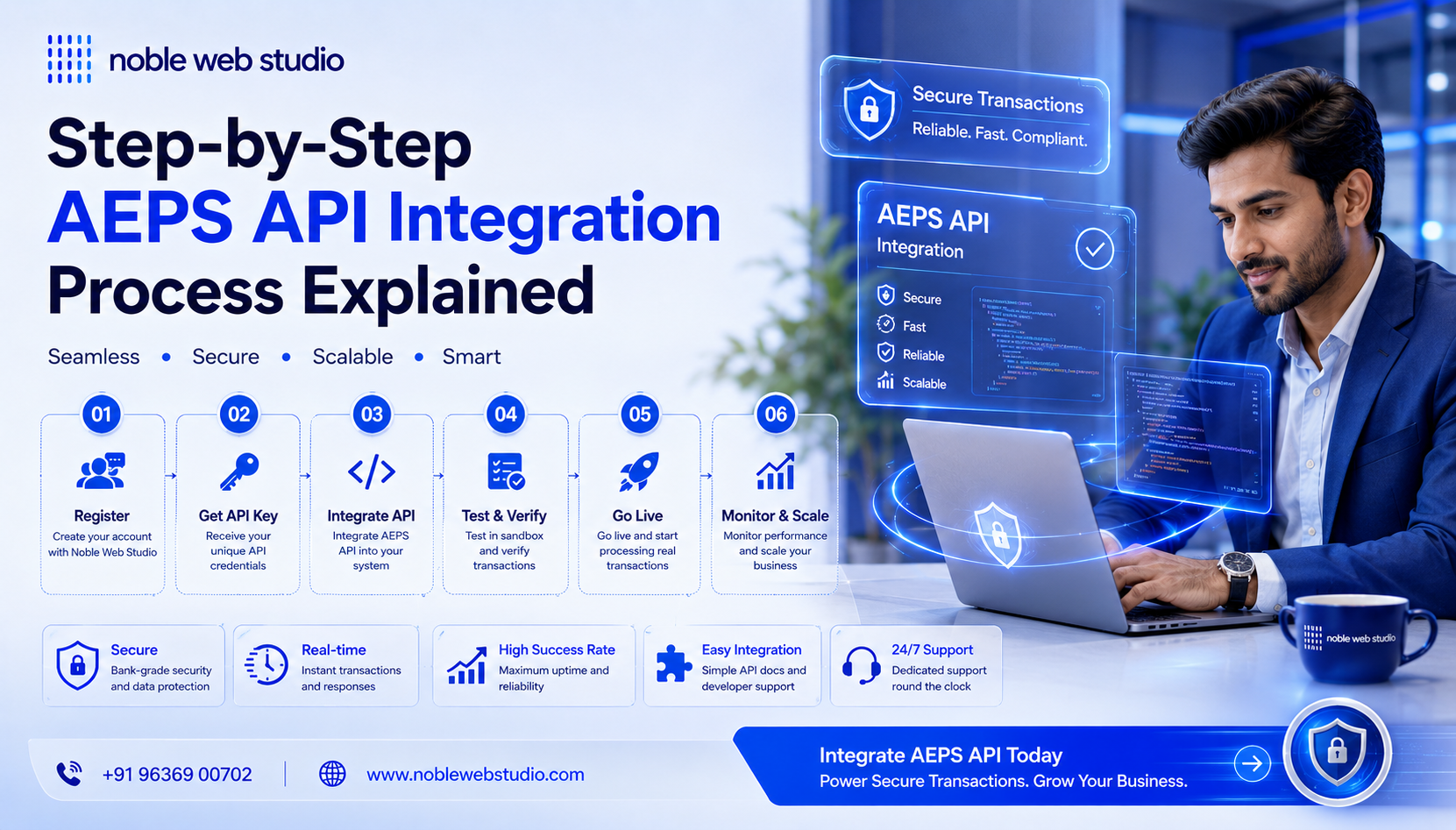
In today’s digital banking ecosystem, AEPS API integration in India has become one of the most powerful solutions for businesses that want to offer secure and fast Aadhaar-based banking services. AEPS (Aadhaar Enabled Payment System) allows users to perform essential banking transactions like cash withdrawal, balance enquiry, mini statement, and fund transfer using their Aadhaar number and biometric verification.
Aadhaar Enabled Payment System (AePS) API integration enables secure, biometric-based banking services—such as cash withdrawals, deposits, and balance inquiries on your platform using Aadhaar authentication. Integration involves partnering with an NPCI-certified Noble web studio, completing KYC, purchasing L1-certified biometric devices, and implementing SDKs, typically costing ₹12,000–₹35,000 for setup.
With the rapid growth of digital payment services in India, retailers, fintech startups, and service providers are adopting AEPS API integration to automate their business operations and provide real-time banking services to customers, especially in rural and semi-urban areas.
Noble Web Studio provides a secure and high-performance AEPS API integration solution in India designed for smooth connectivity, fast transactions, and easy implementation. It comes with features like real-time processing, high success rate, biometric authentication support, and secure API architecture, making it ideal for scalable fintech businesses.
A reliable AEPS API integration provider helps businesses reduce manual work, increase transaction speed, and earn commission on every successful banking service. It is one of the best ways to build a strong and profitable digital banking platform in India.
If you want to grow in the fintech industry, choosing a trusted AEPS API integration like Noble Web Studio can help you build a secure, scalable, and high-income business in the digital payment sector.
In this blog by Noble Web Studio, we’ll walk you through a step-by-step guide on AEPS API integration, its key benefits, features, and how it can help your business grow in 2026 with secure and seamless financial transactions.
AEPS API Integration
AEPS API integration connects a business’s website or app to the Aadhaar Enabled Payment System, enabling secure, cardless banking transactions (cash withdrawal, balance inquiry) via Aadhaar and fingerprint authentication. It turns merchant devices into micro-ATMs, allowing real-time transactions while earning commissions on services.

AEPS API Integration Work
AEPS (Aadhaar Enabled Payment System) API integration enables secure, biometric-based banking services—cash withdrawals, balance inquiries, and mini-statements—directly into apps or websites. It works by connecting a certified biometric device (fingerprint/iris) with NPCI and bank servers for real-time authentication. This allows merchants to turn smartphones into micro-ATMs.
How AEPS API Integration Works (Process Flow)
- Initiation: The agent/merchant selects a service (e.g., Cash Withdrawal) on their integrated app.
- Authentication: The customer enters their 12-digit Aadhaar number and provides biometric input (fingerprint/iris scan) via a certified device.
- Encrypted Request: The app sends encrypted biometric and transaction data through the API provider to the NPCI and Aadhaar database.
- Verification & Settlement: NPCI sends the request to the customer’s bank. Upon successful verification, the bank debits the customer, and the agent’s wallet is credited in real-time.
Read Blog : Affordable AEPS API Providers in India for Startups
Services You Can Offer Using Aeps API Integration
AePS (Aadhaar Enabled Payment System) API integration allows businesses to offer secure, biometric-based banking services, turning retail shops into mini-ATMs. Key services include cash withdrawals, balance inquiries, mini-statements, Aadhaar-to-Aadhaar fund transfers, and Aadhaar Pay merchant payments, supporting high-volume, real-time, cardless transactions.
Key Services Offered via AePS API Integration:
- Cash Withdrawal: Customers can withdraw money from their Aadhaar-linked bank account using only their fingerprint or iris scan at a retail outlet.
- Balance Enquiry: Provides instant, real-time access to the available balance in a customer’s bank account.
- Mini Statement: Generates a summary of the last 5–10 transactions, allowing customers to track account activity.
- Aadhaar Pay (Merchant Payments): Enables merchants to accept digital payments directly from a customer’s bank account via biometric authentication, which can support higher transaction limits than standard withdrawals.
- Cash Deposit: Allows customers to deposit cash directly into their Aadhaar-linked bank account through retail partners.
- Aadhaar-to-Aadhaar Fund Transfer: Facilitates immediate money transfers between two bank accounts that are linked to Aadhaar numbers.
Key Function of AEPS API Integration
AEPS API integration enables businesses to offer secure, cardless, and PIN-less banking services such as cash withdrawals, balance inquiries, and mini-statements using Aadhaar-based biometric authentication. It turns retail outlets into mini-ATMs, driving financial inclusion and facilitating real-time transactions.
Key Functions of AEPS API Integration:
- Cash Withdrawal: Allows customers to withdraw cash from their Aadhaar-linked bank accounts at any authorized retail point.
- Balance Enquiry: Provides instant, real-time access to account balances through a biometric fingerprint or iris scan.
- Mini-Statement: Generates a mini-statement of the last 5–10 transactions.
- Cash Deposit: Enables secure, immediate cash deposits into Aadhaar-linked accounts.
- Aadhaar Pay: Enables merchants to accept instant digital payments directly from a customer’s bank account using biometrics.
- Aadhaar-to-Aadhaar Fund Transfer: Facilitates direct money transfers between bank accounts.
- eKYC Services: Enables secure, instantaneous, paperless identification verification.
- Interoperability: Allows customers to access services from any bank, regardless of where they are transacting.
Who Can Use AEPS API Integration
AEPS (Aadhaar Enabled Payment System) API integration is primarily used by fintech startups, banks, NBFCs, and retail businesses to enable secure biometric banking services like cash withdrawals and balance inquiries. It is designed for entities seeking to operate as business correspondents (BCs) or transform physical stores into “micro-ATMs”.
Key Entities Authorized to Use AEPS API Integration
- Fintech & Technology Firms: To build or enhance banking apps, software, and platforms with Aadhaar-based payments.
- Business Correspondents (BCs) & Agents: Authorized bank agents operating in rural or unbanked areas.
- Retail Businesses & Merchants: Kirana shops, pharmacies, and Kirana merchants.
- Common Service Centers (CSCs) & E-Mitra Centers: Government-to-citizen service centers.
- Microfinance Institutions (MFIs): For secure loan collection and disbursement.
Prerequisites to Use AEPS API Integration
To integrate, entities must meet specific requirements:
- Partner: Must work with an NPCI/RBI-authorized AEPS provider (direct NPCI integration is not possible).
- Registration & KYC: Requires a registered business (firm/company) with PAN, GST, and Aadhaar-linked banking details.
- Hardware: STQC-certified L1 biometric devices (fingerprint/iris scanner) are required.
- Compliance: Adherence to “One Operator, One Bank” policy.
Why Use AEPS API Integration
AEPS (Aadhaar Enabled Payment System) API integration enables businesses to provide secure, cardless, and PIN-less banking services—such as cash withdrawals, balance inquiries, and mini-statements—using Aadhaar-linked biometric authentication. It turns retail shops into mini-ATMs, increasing footfall, offering high transaction commissions (₹12-₹15+), and providing instant (T+0) settlement.
Key Reasons to Use AEPS API Integration:
- Financial Inclusion & Reach: It brings banking services to rural and underserved areas, allowing, for example, beneficiaries to access government subsidies without visiting a distant bank.
- High Security & Compliance: Transactions are secured by Aadhaar-linked fingerprint or iris scans and are 100% NPCI/RBI-compliant, significantly reducing the risk of fraud compared to traditional card-based methods.
- Increased Revenue & Footfall: Retailers can operate as micro-ATMs, earning commissions per transaction and attracting more customers to their businesses.
- Customer Convenience: Eliminates the need for physical debit cards, PINs, or smartphones, making banking accessible to everyone.
- Instant Settlements (T+0): Ensures same-day settlement of funds to the agent’s or merchant’s bank account, maintaining cash flow.
- Easy & Scalable Integration: Provides seamless integration into existing Android apps, websites, or POS systems, with reliable API providers ensuring 99.9% uptime.
- Versatile Services: Beyond cash withdrawals, it supports balance inquiries, fund transfers, and mini-statements.
Common applications include Micro-ATMs, mobile banking apps, and E-commerce payments in low-card-penetration regions.
Top Use Cases of AEPS API Integration
AEPS API integration enables secure, biometric-based banking (cash withdrawal, deposit, balance inquiry, mini-statement) using Aadhaar verification, allowing businesses to turn retail shops into “Mini ATMs”. Key use cases include banking for rural financial inclusion, instant cash management for merchants, and [Aadhaar Pay] (cardless merchant payments).
Top Use Cases of AEPS API Integration
- Mini ATMs at Retail Stores: Retailers and Kirana stores can act as banking correspondents, allowing customers to deposit or withdraw cash using their Aadhaar number and fingerprint, significantly expanding access in rural areas.
- Balance Inquiry & Mini Statement: Customers can access real-time bank balance details and view their last 5-10 transactions instantly, eliminating the need to visit a bank branch or ATM.
- Aadhaar Pay (Merchant Payments): Enables merchants to accept payments from customers via biometric authentication. This is crucial for high-value transactions (up to ₹50,000) that require no cards or PINs.
- Direct Benefit Transfer (DBT) Payouts: Facilitates the immediate disbursement of government subsidies, pensions, and scholarships, allowing beneficiaries to withdraw funds locally.
- Aadhaar-to-Aadhaar Fund Transfers: Facilitates secure, real-time money transfers between bank accounts that are linked to Aadhaar.
- eKYC and Customer Onboarding: Financial institutions and fintech startups can use AEPS API for instant, paperless customer identity verification.
- Micro-ATM Services: Small devices used by banking agents are powered by this API to provide mobile banking services to remote areas.
Key Aspects of AEPS API Integration
AEPS (Aadhaar Enabled Payment System) API integration enables secure, biometric-based banking services (withdrawals, balance inquiries) directly into mobile apps or websites. Key aspects include high security (NPCI/RBI compliance), 99.9% uptime for 24/7 transactions, real-time transaction processing, L1-certified device support, and instant wallet settlements (T+0).
Key Aspects of AEPS API Integration
- Security & Regulatory Compliance: Adherence to NPCI, RBI, and UIDAI guidelines is mandatory, with biometric data encrypted in transit.
- Mandatory L1 Devices: As of January 1, 2026, integration requires L1-certified registered biometric devices (fingerprint/iris scanner) for enhanced fraud prevention.
- High Reliability & Uptime: Top API providers offer over 98% success rates and 99.9% uptime, ensuring minimal transaction failures and high user trust.
- Instant Settlement (T+0): Enables immediate (T+0) or same-day (T+1) settlement of funds to agent wallets, crucial for business cash flow.
- Interoperability: Allows consumers to transact with any bank account using any enabled agent, promoting wide adoption.
- Core Functionalities: Includes CASH withdrawal, balance inquiry, mini-statements, and Aadhaar Pay for higher transaction limits.
- Onboarding & KYC: Requires strict merchant/agent onboarding using e-KYC (OTP/biometric), with mandatory re-KYC after 3 months of inactivity.
- “One Operator, One Bank” Rule: New guidelines restrict agents to using one bank for AEPS services.
Functionalities for AEPS API Integration
AEPS API integration offers a range of functionalities to enable Aadhaar-based banking services within an application or system. These functionalities typically include:
Core Banking Services:
- Cash Withdrawal: Facilitates the withdrawal of cash from Aadhaar-linked bank accounts using biometric authentication.
- Balance Inquiry: Allows users to check their current bank account balance instantly.
- Cash Deposit: Enables users to deposit cash directly into their Aadhaar-linked accounts.
- Fund Transfer: Supports secure money transfers between Aadhaar-linked bank accounts, even across different banks.
- Mini Statement: Provides a summary of recent account transactions for quick review.
Security and Authentication:
- Biometric Authentication: Utilizes fingerprint or iris scans for secure and reliable user verification, replacing the need for PINs or passwords.
- Aadhaar Verification: Integrates with the Aadhaar system for authenticating the user’s identity.
- Secure Data Encryption: Ensures the protection of sensitive transaction data during transmission and storage.
Operational Features:
- Real-time Transaction Processing: Enables instant authentication and settlement of transactions.
- Multi-Bank Support: Allows transactions to be processed across various banks that are part of the AEPS network.
- Aadhaar Pay: Facilitates merchant payments directly from customers using their Aadhaar number and biometrics.
- Direct Benefit Transfers (DBT): Supports the disbursement of government benefits directly into Aadhaar-linked accounts.
- Transaction History and Reports: Provides access to transaction logs and reports for tracking and analysis.
- Seamless Integration: Designed for easy integration into existing platforms and applications.
Requirements for AEPS API Integration
AEPS (Aadhaar Enabled Payment System) API integration requires a registered business entity, NPCI/bank partnership, and mandatory agent KYC (Aadhaar/PAN). Technical prerequisites include STQC-certified L1 biometric devices, secure Android/Windows systems, and “One Operator, One Bank” settlement compliance. Integration involves sandbox testing, HTTPS/TLS 1.2+ protocols, and secure PID block handling.
Core Requirements for AEPS API Integration (2026)
Business Entity & Documentation (KYC):
- Entity Registration: Company, firm, or individual retailer registration.
- KYC Docs: PAN Card (mandatory), Aadhaar card linked to mobile number, and business proof (Udyam, GST, or shop license).
- Settlement Bank: Active bank account (cancelled cheque/passbook) linked to Aadhaar.
- 2026 Compliance: Strict “One Operator, One Bank” policy is enforced.
Technical Hardware & Software:
- Biometric Device: Mandatory STQC/UIDAI-certified L1 biometric fingerprint or iris scanner (e.g., Mantra, Morpho).
- Device Driver: Registered Device (RD) service driver installed to ensure encrypted biometric data (PID block) transmission.
- Operating System: Android smartphone/tablet or Windows PC/laptop with stable, secure internet.
- Protocol: API integration using secure HTTPS/TLS 1.2+ protocols.
Integration & Operational Requirements:
- Partnership: Partner with an authorized banking correspondent (BC) or fintech partner (e.g., TrinityPay, Eko).
- Sandbox Testing: Use sandbox APIs (e.g., JSON/XML formats) to test balance inquiry, withdrawal, and Mini Statement.
- Callback Mechanism: Secure HTTPS callback URL for real-time transaction updates.
- Data Security: Strictly no storage of sensitive biometric data or raw PID blocks.
- Inactivity Policy: Re-KYC is mandatory if the agent account is inactive for 3 months.

Why Business Need AEPS API Integration
AEPS API integration enables businesses to offer secure, cardless banking services (cash withdrawals, balance inquiries, mini-statements) using Aadhaar-based biometric authentication. It turns retail shops into mini-ATMs, boosts customer footfall, generates high commissions (up to ₹15+ per transaction), and facilitates instant T+0 settlements.
Key Reasons Businesses Need AEPS API Integration:
- New Revenue Stream: Retailers earn substantial commissions on every transaction, often ranging from ₹12 to ₹15+ for cash withdrawals and, with high volumes, these commissions provide a steady, passive income stream.
- Increased Customer Footfall: By transforming a regular shop or business into a mini-ATM, it attracts more customers, particularly in rural or semi-urban areas lacking bank branches.
- High Security & Compliance: As a system compliant with NPCI and RBI guidelines, it uses encrypted biometric (fingerprint/iris) authentication, drastically reducing the risk of fraud compared to card-based systems.
- Instant Settlement (T+0): Modern AEPS platforms provide instant or same-day settlements, which significantly helps in managing cash flow and maintaining working capital.
- Financial Inclusion & Reach: It allows businesses to serve the vast, underserved population that relies on Aadhaar-based banking, including recipients of government direct benefit transfers (DBT).
- Low Cost & Easy Integration: Requires minimal infrastructure only a smartphone/computer and a biometric device making it easy to integrate into existing apps or websites.
Benefits AEPS API Integration
Integrating AEPS API enables businesses to provide basic, secure, and accessible banking services. The best AEPS platform, developed by the National Payments Corporation of India (NPCI), uses Aadhaar-based biometric authentication for transactions, promoting financial inclusion, increasing revenue, and enhancing customer convenience.
Benefits for businesses
- Generate new revenue streams: By facilitating AEPS transactions like cash withdrawals and deposits, businesses especially retailers acting as micro-ATMs can earn commissions on every service they provide.
- Financial Inclusion: Enables businesses to extend basic banking services to unbanked and underbanked populations, particularly in rural and remote areas, fostering financial inclusion.
- Increase customer footfall: Offering banking services attracts new customers, who may also make additional purchases, thereby boosting a business’s overall sales.
- Easy integration: AEPS API designed for seamless integration into existing platforms, such as mobile apps and Point-of-Sale PoS devices.
- Expand market reach: This Aeps integration allows businesses to serve unbanked and underbanked populations, especially in rural and remote areas where traditional banking is scarce.
- Enhance customer trust and loyalty: Providing convenient and reliable financial services builds trust with the local community, encouraging repeat business.
- Enable cost-effective expansion: The AEPS API is a budget-friendly way to offer financial services compared to the high costs associated with setting up physical bank branches or ATMs.
- Diversify service offerings: AEPS integrated with other services like bill payments and mobile recharges, making a business a comprehensive financial service point.
- Boost operational efficiency: The system supports real-time, paperless transactions, which streamlines financial operations and reduces manual errors.
- Competitive Advantage: Enhances a business’s service offerings, providing a competitive edge by delivering secure and inclusive financial solutions through their existing platforms.
- Supports government initiatives: Align with national goals for financial inclusion and the digital economy by helping with the secure and direct distribution of government benefits.
- Access to analytics and reporting: Get detailed transaction histories and performance reports to gain valuable business insights.
Benefits for Customers:
- Convenience and Accessibility: Provides easy access to essential banking services like cash withdrawal, balance inquiry, and fund transfers without the need for debit cards or PINs, using only their Aadhaar number and biometric authentication.
- Enhanced Security: Offers a secure transaction method through biometric authentication, minimizing the risk of fraud compared to card-based transactions.
- Reduced Dependency on Physical Branches/ATMs: Enables access to banking services even in areas with limited or no traditional banking infrastructure.
- Access to government benefits: Easily receive and withdraw government subsidies, pensions, and welfare payments directly through their Aadhaar-linked accounts.
- Simplified Transactions: Streamlines basic banking transactions, making them faster and more user-friendly.
- Interoperability: Transact at any AEPS-enabled outlet regardless of which bank holds their account, as long as the bank is part of the AEPS network.
Read Blog : Key Features to Look for in an AEPS API
Features AEPS API Integration
AEPS API integration allows businesses to offer Aadhaar-based banking services to their customers through their own digital platforms. This integration enables various features, primarily focused on financial inclusion and secure transactions.
Key Features of AEPS API Integration:
- Aadhaar-Based Biometric Authentication: This is a core security feature, using fingerprint or iris scans linked to the customer’s Aadhaar number to verify their identity for transactions.
- Core Banking Services: Facilitates essential banking functions such as:
- Cash Withdrawal: Allows customers to withdraw cash from their Aadhaar-linked bank accounts.
- Cash Deposit: Enables customers to deposit cash into their Aadhaar-linked accounts.
- Balance Inquiry: Provides real-time information on the customer’s account balance.
- Mini Statement: Offers a summary of recent transactions.
- Fund Transfers: Enables transfers between Aadhaar-linked accounts.
- Real-Time Processing: Transactions are processed and settled instantly, ensuring immediate updates to account balances and quick service delivery.
- Interoperability: Supports transactions across different banks, allowing customers to access services regardless of their bank, as long as it’s linked to their Aadhaar.
- Enhanced Security Measures: Includes features like data encryption, multi-factor authentication, and fraud detection mechanisms to protect user data and prevent unauthorized access.
- Seamless Integration: Designed for straightforward integration into existing platforms, with developer-friendly documentation and support resources.
- Financial Inclusion: Extends banking services to remote and underserved areas, providing a convenient and accessible way for individuals to manage their finances without needing physical bank branches or ATMs.
- Direct Government Benefit Disbursal: Can be used for the efficient and secure disbursal of government benefits directly to beneficiaries’ Aadhaar-linked accounts.

Step-by-Step Guide to AEPS API Integration
Integrating an AEPS API involves several key steps to enable Aadhaar-based financial transactions within an application or platform:
- Select a Certified AEPS API Provider: Choose a Noble web studio registered with the National Payments Corporation of India (NPCI) and known for reliability, security, and comprehensive support. Consider factors like Aeps API documentation, sandbox environment availability, and technical assistance.
- Registration and KYC: Register with the Noble web studio and complete the Know Your Customer (KYC) verification process. This typically involves submitting documents like Aadhaar card, PAN card, bank account details, and business verification if applicable.
- Acquire Biometric Device: Obtain an RD-service compliant biometric device (e.g., fingerprint scanner) required for capturing customer biometrics during authentication. Ensure device compatibility with the chosen Noble web studio provided Aeps platform.
- Obtain API Key and Documentation: Receive the Aeps API key and comprehensive integration documentation from the Noble web studio. This documentation will detail the API endpoints, request/response formats, and authentication mechanisms.
Integrate the API:
- Frontend Development: Develop Aeps Software for user interface within your application or web portal to capture customer details (Aadhaar number, bank selection, transaction type, amount) and initiate the biometric authentication process.
- Backend Integration: Use the provided Aeps API key and documentation to integrate AEPS functionalities into your backend system. This involves making Aeps API calls for tasks such as initiating transactions, verifying biometrics, and processing transactions.
- Biometric Device Integration: Integrate the biometric device with your system to securely capture and transmit biometric data for authentication against the UIDAI database.
- Testing in a Sandbox Environment: Thoroughly test the integrated system in a sandbox or staging environment provided by the Noble web studio. This ensures all functionalities work correctly and transactions are processed as expected without affecting live data.
- Go Live: After successful testing and validation, deploy the integrated AEPS solution to the live environment to start offering AEPS services to customers.
- Monitoring and Support: Continuously monitor the AEPS integration for performance and security. Leverage the Noble web studio technical support for any issues or queries.
- Start Offering AEPS Services: Once live, you can begin offering AEPS services such as cash withdrawals, balance inquiries, and deposits to customers using their Aadhaar number and biometric authentication.
Read Blog :
Technical Requirements for Successful AEPS API Integration
Successful (Aadhaar Enabled Payment System) AEPS API integration requires adherence to specific technical requirements:
1. AEPS API Access and Documentation:
- Obtain access to the AEPS API from a Noble web studio.
- Acquire the necessary AEPS API Software keys and comprehensive integration documentation.
2. Development Environment:
- Utilize a secure sandbox or testing environment provided by the Noble web studio for Aeps development and thorough testing of the integration before deployment to a live environment.
3. Secure and Scalable Infrastructure:
- Ensure a robust and scalable infrastructure capable of handling potentially high transaction volumes and ensuring reliable operation.
- Implement robust fraud detection systems and security measures.
4. Compatible Hardware:
- Ensure compatibility with UIDAI-certified biometric devices (e.g., fingerprint scanners, iris scanners) required for customer authentication.
5. System Integration:
- Integrate AEPS API seamlessly into your existing platform, which may include mobile applications, websites, or Point-of-Sale (POS) systems.
6. Admin Panel (Optional but Recommended):
- Consider a robust Aeps admin panel for managing agents, tracking transactions, handling commissions, and generating reports.
7. Security and Compliance:
- Implement strong security protocols and data encryption for all transactions and data handling.
- Adhere to all regulatory and compliance requirements related to AEPS, including KYC (Know Your Customer) guidelines.
8. Testing and Deployment:
- Conduct comprehensive testing in the sandbox environment, including all transaction types (cash withdrawal, balance inquiry, etc.), security, and reliability.
- After successful testing, deploy the integrated Aeps solution to the live production environment.
Read Blog : How Much Does AEPS API Cost in India? A Complete Guide
Cost of AEPS API Integration
The cost AEPS API integration varies, but you can expect a one-time Aeps setup fee ranging from approximately ₹12,000 to ₹35,000. Ongoing costs include Aadhaar Enabled Payment System Software fees, which can be a one-time purchase of ₹25,000 to ₹60,000 or monthly/annual charges, and transaction fees of about 0.5% to 1% per transaction. Noble web studio also offer white label Aeps Api solutions with a broader price range, from around ₹25,000 to ₹1.2 Lakhs.
One-time costs
- AEPS API Integration/Setup: This usually falls between ₹12,000 and ₹35,000, but can be higher for more complex, non-white label Aeps Api solutions.
- AEPS Software Cost: You may need to pay for additional AEPS B2B software to manage your AEPS services, including Aeps admin portal, which can range from ₹25,000 to ₹60,000.
- White-label solutions: These are often more expensive upfront, with typical Aeps setup fees for a white label Aeps solution ranging from ₹22,000 to ₹30,000, and more for a standard integration.
Ongoing costs
- Monthly/Annual Fees: Varies by provider, with annual costs for Aeps B2B software around ₹40,000
- Transaction Fees: Typically a commission of 0.5% to 1% per transaction
Factors that influence the price
- Integration complexity: A simpler integration will cost less than a more complex one.
- Solution type: White label Aeps solution are typically more expensive than standard integrations.
- Included features: The total Aeps cost will vary depending on the specific services and features included, such as a bundled AEPS device.
- Provider and vendor: Noble web studio provide have best pricing models and best service offerings.
Additional considerations
- Biometric Device: You will need to purchase an RD-service compliant biometric device to capture customer biometrics for authentication.
- Hidden Costs: It’s important to understand all costs upfront to avoid hidden charges, such as the cost of integration support or specific transaction features.
- Provider-Specific Pricing: Noble Web Studio provides the best AEPS services at best prices, offering flexible plans and feature-rich solutions tailored to your business needs.

Choosing the Best AEPS API Provider in India
Noble web studio is the best AEPS API provider, prioritize security and compliance (NPCI certification, data encryption), reliability and performance (high success rates, low downtime, fast settlements), and cost-effectiveness (transparent pricing, competitive commission). Also, consider factors like ease of integration with existing systems, a user-friendly interface, robust technical support, and the Noble web studio ability to scale with your business.
Key factors to evaluate
Security and compliance
- NPCI and RBI certification: Ensure the Noble web studio is authorized by the National Payments Corporation of India (NPCI) and follows Reserve Bank of India (RBI) guidelines.
- Data security: Verify they use strong encryption, secure authentication, and other measures to protect sensitive financial and user data.
Reliability and performance
- Transaction success rate: Look for a Noble web studio with a high transaction success rate (ideally 98%+) and minimal downtime.
- Performance: Assess transaction speed and real-time processing for a smooth user experience.
- Settlement: Check for fast settlement times to ensure quick access to earnings.
Integration and functionality
- Seamless integration: The Affordable Aeps API should be well-documented and easy to integrate into your existing systems like mobile apps or POS terminals.
- User-friendly interface: The Aeps software or Aeps portal should be intuitive for both agents and customers.
- Multi-bank support: A wide network of supported banks provides more flexibility for customers.
- Additional services: Consider Noble web studio that offer extra services like bill payments or mobile recharges.
Cost and commission
- Transparent pricing: Understand the complete cost, including any licensing fees, and compare commission structures to ensure profitability.
- Real-time commissions: Noble web studio offer instant commission credits after each transaction, which can be a significant advantage.
Support and reputation
- 24/7 customer support: Responsive and reliable technical and customer support is crucial for resolving issues promptly.
- Provider reputation: Research user reviews and testimonials to gauge the Noble web studio service quality and customer satisfaction.
- Scalability: The Aeps platform design to handle increased transaction volumes and users as your business grows.
Read Blog : Why Choosing the Right AEPS API Provider is Crucial for Your Business Success
Why Choose Noble Web Studio for AEPS API Integration
Noble web studio is the top AEPS API provider is crucial for enhanced security, reliable and efficient transactions, and business growth. Noble web studio offers seamless integration, strong security features to build customer trust, and a scalable Aeps platform to handle high transaction volumes. This allows businesses to generate income through commissions, attract new customers, and provide essential financial services, thereby promoting financial inclusion and gaining a competitive edge.
Key benefits of choosing a good provider
- Security and compliance: A Noble web studio implements strong security measures, like data encryption and biometric authentication, to protect transactions and ensure compliance with regulations. This builds customer trust and loyalty.
- Reliability and performance: A reliable Aeps API ensures high transaction success rates and minimal downtime, leading to a better user experience and operational stability.
- Seamless integration: Noble web studio with clear documentation and a user-friendly interface allows for easy integration into your existing applications.
- Scalability: The Aeps API design to handle large volumes of transactions and grow with your business needs.
- Financial inclusion: By enabling basic Banking services in remote areas, a Noble web studio helps you reach new customers and contribute to financial inclusion goals.
- Business growth and revenue: Offering AEPS services can turn your business into a local banking hub, increasing footfall and providing a steady income stream through transaction commissions.
- Cost-effectiveness: AEPS requires less infrastructure than traditional banking, making it a cost-effective way to offer financial services.
- Comprehensive services: Noble web studio also offer other services like bill payments and money transfers, allowing you to provide a one-stop shop for your customers.
- Technical and customer support: Noble web studio offer excellent and responsive customer support to assist with integration and any issues that arise.
Read Blog : What is AEPS API and How Does It Work? A Complete Guide
Future of AEPS API Integration
The future of AEPS API integration involves enhanced security through AI and biometrics, deeper integration with digital wallets and other platforms like UPI, expanded services beyond basic banking to include micro-loans and utilities, and the use of blockchain for improved transparency. The technology will continue to focus on expanding financial inclusion, especially in rural areas, through mobile-first, user-friendly interfaces and support for offline transactions.
Key future trends in AEPS API integration
- Enhanced Security: Advanced AI and machine learning will be used for fraud detection, while more sophisticated biometric and eKYC methods (including voice and facial recognition) will improve verification speed and security.
- Deeper Integration: AEPS will be more deeply integrated with other digital platforms like digital wallets and UPI to create a unified financial ecosystem.
- Expanded Services: The scope of services will move beyond basic banking to include utility bill payments, mobile recharges, micro-loans, and insurance.
- Blockchain Adoption: Blockchain technology will be adopted to increase the transparency, security, and trustworthiness of transactions.
- Improved User Experience: There will be a greater focus on real-time settlements and on AEPS software development company creating more intuitive, user-friendly interfaces for both AEPS Software for Agents and end-users.
- Increased Accessibility: Efforts will continue to broaden the reach of AEPS, particularly in rural and semi-urban areas, through mobile-first solutions and offline functionalities.
- Embedded Finance: AEPS integrate into non-financial applications, allowing users to access financial services directly within other apps and services.

Conclusion
Integrating an AEPS API in India is one of the most effective ways to build a strong and profitable digital banking business. With AEPS API integration, businesses can easily offer services like cash withdrawal, balance enquiry, and mini statement using Aadhaar authentication, making banking simple and accessible for everyone.
AEPS API Integration is the technical process of connecting a business’s app, website, or software to the National Payments Corporation of India’s (NPCI) AEPS system. This enables businesses to use Aadhaar-linked biometric authentication for banking services like cash withdrawals, balance inquiries, and mini-statements directly at their outlet, turning it into a mini-ATM.
A smooth and secure AEPS API integration helps retailers, agents, and fintech companies automate transactions, reduce manual work, and improve service speed. It also ensures high accuracy and real-time processing, which increases customer trust and satisfaction.
By choosing a trusted AEPS API provider, you can expand your financial services, increase daily earnings through commission, and build a long-term sustainable business model. It is especially useful for businesses targeting rural and semi-urban areas where AEPS services are in high demand.
Noble Web Studio provides a reliable and advanced AEPS API integration solution designed for seamless performance and easy setup. With features like secure biometric authentication, real-time transaction processing, high success rate, fast settlement, and easy API connectivity, it helps businesses scale quickly in the digital payment industry.
If you want to grow in the fintech sector, adopting a powerful AEPS API integration like Noble Web Studio is the right step toward building a secure, scalable, and high-profit digital business in India.
Frequently Asked Questions (FAQs)
AEPS API integration allows businesses to connect their platform with the Aadhaar Enabled Payment System, enabling secure and instant financial transactions using Aadhaar authentication.
In 2025, digital payments and financial inclusion are growing rapidly. Aeps api service provider helps businesses offer secure cash withdrawals, balance inquiries, and fund transfers to customers, boosting trust and service reach.
AEPS API works by linking a user’s Aadhaar number, fingerprint, and bank account to process real-time transactions through NPCI. Businesses integrate Aeps API into their best Aeps software or Aeps admin portal to enable these services.
Instant and secure transactions
New income through commission-based services
Wider customer reach in rural and urban areas
24/7 financial service availability
Yes. AEPS APIs follow RBI and NPCI security guidelines with advanced encryption and authentication to keep customer data safe and prevent fraud.
Startups and retailers can partner with trusted providers like Noble Web Studio to get ready-to-integrate AEPS API solutions that come with full technical support and documentation.
The cost depends on the API provider, service features, and transaction volume. Noble Web Studio offers best price AEPS API integration packages for businesses of all sizes.
Noble Web Studio provides secure, fast, and customizable AEPS API solutions, helping businesses earn commissions, manage operations easily, and grow their digital payment services in 2026.