
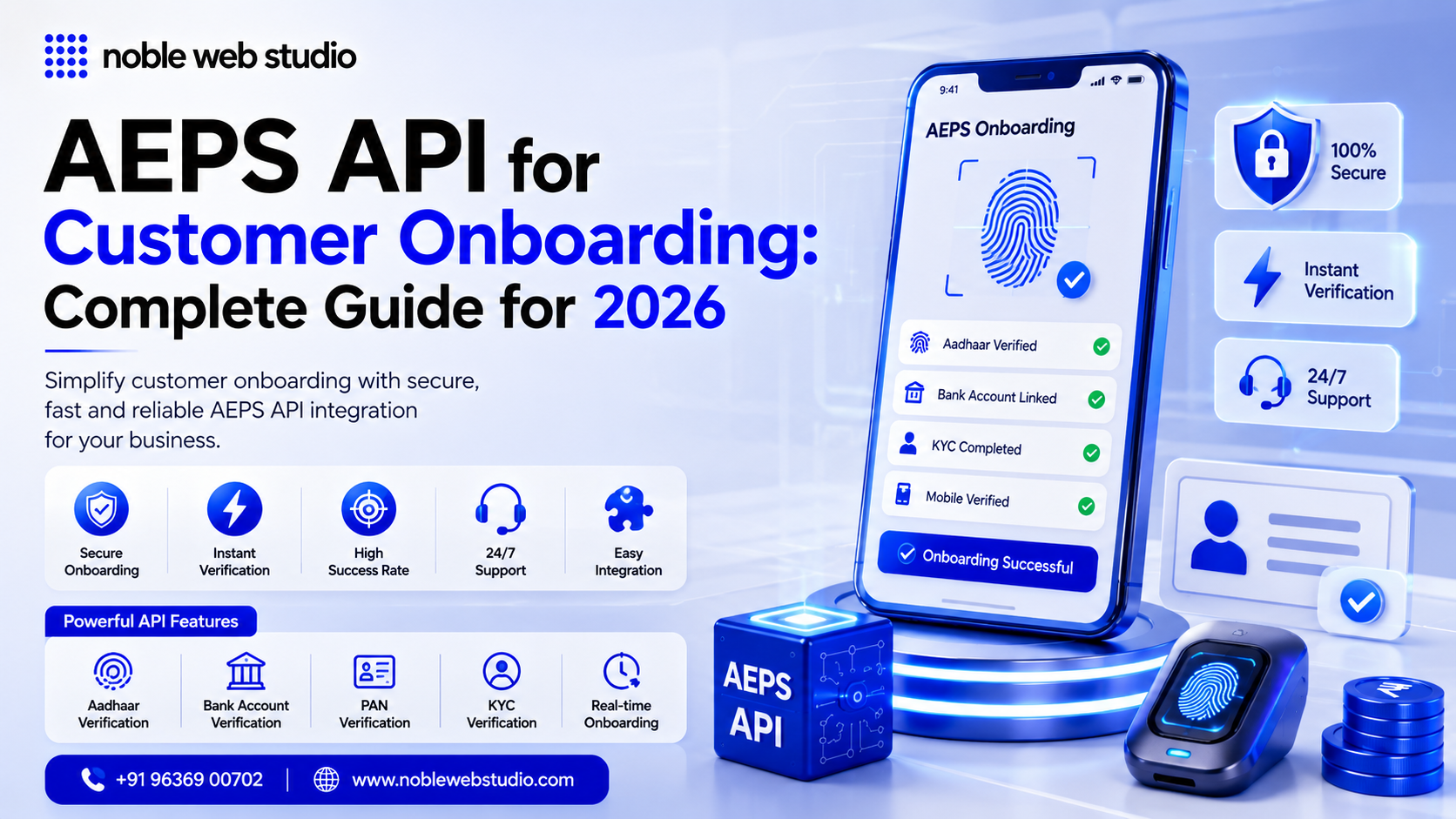
Customer onboarding is the first step in building a trusted digital banking and fintech business. With a secure AEPS API for Customer Onboarding, businesses can simplify the onboarding process while offering Aadhaar-based banking services through a reliable and scalable platform. Whether you are a fintech company, B2B service provider, retailer network, distributor, or digital banking startup, integrating an AEPS API helps create a faster, more efficient customer onboarding experience.
A modern AEPS API supports secure integration with your Aeps software or Aeps portal, allowing you to connect banking services with your customer onboarding workflow. Businesses can manage customer records, retailers, distributors, transactions, and service activation from a centralized platform while improving operational efficiency and user experience.
An AePS API allows businesses to integrate cardless, PIN-free banking like cash withdrawals, balance inquiries, and mini-statements into their Aeps apps or websites using only a customer’s Aadhaar number and biometric fingerprint. It connects directly to the NPCI switch for real-time transaction processing.
Choosing the right AEPS API provider is essential for long-term business success. Businesses should look for features such as high Aeps API uptime, secure encryption, fast response time, easy integration, detailed Aeps API documentation, scalable infrastructure, white label Aeps support, and dedicated technical assistance. These capabilities help ensure smooth Aeps onboarding and reliable business operations as transaction volumes grow.
Noble Web Studio provides secure and scalable AEPS API solutions that simplify customer Aeps onboarding for startups, fintech companies, retailers, distributors, and enterprises across India. Our Aeps platform designed for easy integration, strong security, high transaction reliability, and long-term scalability, helping businesses launch Aadhaar-enabled financial services with confidence.
In this complete guide, you will learn what AEPS API for customer onboarding is, how it works step by step, which documents are required, the new RBI and NPCI guidelines for 2026, the integration process, cost, commission, and why Noble Web Studio is trusted as one of the best AEPS API providers in India.
What Is an AEPS API?
An Aadhaar Enabled Payment System API is a programming interface that lets businesses integrate secure, cardless, and PIN-free banking services directly into their apps, websites, or Point-of-Sale (PoS) systems. Customers authorize transactions using only their 12-digit Aadhaar number and their fingerprint.
What Is Customer Onboarding in AEPS API?
Customer onboarding in an AePS API refers to registering a merchant or retailer as a Business Correspondent (BC) on the Aeps payment platform. It involves digital KYC (Aadhaar/PAN) and biometric verification so the agent can legally process banking transactions for consumers.
AEPS API for customer onboarding means using this best Aeps API to register and verify new customers, agents, or retailers digitally. Instead of filling long forms and waiting for days, the customer is verified instantly through Aadhaar eKYC, and their account or agent ID becomes active within minutes. This is why fast AEPS onboarding is called instant, paperless, and 100% secure onboarding.
In simple words: AEPS API turns a long, manual registration process into a quick digital journey fingerprint, verify, done.
AEPS API Customer Onboarding Work
The AEPS customer onboarding process in 2026 is simple and fully digital. Here is the step-by-step flow:
- Registration request: The customer or agent starts onboarding on your app, website, or portal powered by the top AEPS API.
- Aadhaar and PAN details: Basic details like Aadhaar number, PAN card, and mobile number (linked to Aadhaar) are entered.
- Biometric authentication: The customer places their finger on an STQC-certified L1 biometric device. The fingerprint is encrypted instantly and sent for UIDAI verification.
- eKYC verification: The AEPS eKYC API matches the biometric data with UIDAI records in real time and confirms the identity.
- Bank account linking: The customer’s Aadhaar-linked bank account is verified for settlements and transactions.
- Activation: Once KYC is approved, the Merchant ID (MID) or customer profile is activated, and services like cash withdrawal, balance enquiry, and mini statement go live.
With secure AEPS API, this entire onboarding journey is completed with a 98%+ success rate and real-time status updates through webhooks and callbacks.
Documents Required for AEPS Customer Onboarding in 2026
To integrated AePS API, you must complete strict Know Your Customer (KYC) and Business Correspondent (BC) verifications. Onboarded customers themselves do not need to register separately; they only need their Aadhaar linked to their bank account and a registered mobile number.
Under the 2026 RBI guidelines, full KYC is mandatory. Partial or OTP-only registration is no longer accepted. Keep these documents ready:
| Document | Purpose |
| Aadhaar Card (linked to mobile) | eKYC identity verification via UIDAI |
| PAN Card | Financial and tax compliance (mandatory) |
| Bank Account / Cancelled Cheque | Settlement account verification |
| Passport-Size Photo | Profile verification and records |
| Business Proof (Udyam / Shop Certificate / GST) | Required for agents, retailers, and distributors |
| Active Mobile Number & Email | OTP verification and communication |
| STQC-Certified L1 Biometric Device | Mandatory for biometric authentication (Mantra, Morpho, etc.) |
Key Aspects of AEPS API Onboarding
Integrating AEPS API requires strict adherence to NPCI and UIDAI guidelines to ensure security and legal compliance. Key aspects include mandatory agent KYC, hardware compliance, network security, and transaction parameters.
1. Mandatory KYC & Compliance
- Agent/Merchant KYC: All Business Correspondents (BCs) and merchants must complete full KYC verification including Aadhaar and PAN card validation before transacting.
- “One Operator, One Bank” Rule: Operators can only be mapped to a single acquiring bank for transaction settlements.
- Inactivity Rule: Agents who remain inactive for 3 consecutive months must undergo mandatory re-KYC.
2. Hardware and Device Specifications
- L1 Certified Registered Devices (RD): Aeps Biometric devices (like fingerprint or iris scanners) must be STQC-certified and L1 compliant.
- Biometric Liveness Detection: Aeps API integration must support liveness checks to prevent spoofing and ensure a real person is physically present.
3. Data Privacy and Security
- Zero Biometric Storage: UIDAI guidelines strictly forbid storing raw biometric data or Aadhaar numbers on your application or server.
- Encrypted Transmission: All PID (Personal Identity Data) blocks must be securely encrypted (e.g., using RSA encryption) before being transmitted to the partner bank and NPCI.
4. Transaction Limits and Architecture
- Standard Limits: Cash withdrawals and Aadhaar Pay are generally subject to caps (e.g., typically ₹10,000 per transaction and ₹50,000 daily).
- Core Financial Services: The powerful Aeps API should support primary transactions such as Cash Withdrawals, Balance Inquiries, and Mini Statements.
- Settlement & Commissions: Ensure your Aeps platform architecture includes multi-tier wallet management to track margins, commission structures, and daily transaction settlements.
New RBI & NPCI Guidelines for AEPS Onboarding in 2026
The new RBI and NPCI guidelines for the Aadhaar Enabled Payment System (AePS) introduce strict security measures to curb fraud. Key mandates include the “one-operator-one-bank” rule, mandatory fresh KYC for operators inactive for 90 days, and step-up authentication (OTP + biometrics) for transactions over ₹5,000.
From 1 January 2026, the RBI and NPCI have introduced stricter rules to make AEPS safer for everyone. Every business using an reliable Aeps API must follow these rules:
- Stringent Due Diligence: Acquiring banks must conduct full Customer Due Diligence (CDD) in line with the RBI Master Direction – Know Your Customer before onboarding any AePS Touchpoint Operator (ATO).
- Full KYC for all agents: Every AEPS agent (ATO) must complete full KYC with Aadhaar, PAN, bank details, and photograph before activation.
- One-Operator-One-Bank Limit: To increase accountability, an ATO can now only be Aeps onboarded by a single acquiring bank.
- Mandatory Re-KYC: If an operator remains completely inactive for three consecutive months, they must undergo fresh KYC verification before they are permitted to process further transactions.
- Step-Up Authentication: For transactions over ₹5,000 (Cash Withdrawals and BHIM Aadhaar Pay), acquiring banks must capture and transmit an OTP along with the customer’s biometric data.
- Real-Time Monitoring: Banks must continuously assess transactions against risk factors like volume, frequency, and location to block suspicious activities instantly.
- 3-month inactivity re-KYC: Agents with no transactions for three continuous months must complete fresh KYC before restarting.
- Biometric Locks: Customers can secure their Aadhaar-linked accounts by activating the biometric-lock functionality via the UIDAI Resident Portal to completely block unauthorized AePS withdrawals.
- No data storage: Customer biometric data and Aadhaar numbers must never be stored on local devices or servers.
- 2FA for agent login: Two-factor authentication is compulsory for agent portal access.
- Transaction limits: Typically ₹10,000 per transaction, with daily limits around ₹50,000, as set by NPCI.
- Good news: When you secure Aeps onboard with Noble Web Studio, all these compliance requirements OAOB mapping, re-KYC reminders, device certification checks, and encrypted data handling are managed automatically. You focus on business; we handle compliance.
Identity Verification and eKYC in AEPS Onboarding
Identity Verification and eKYC in Aadhaar Enabled Payment System onboarding involve using UIDAI’s database to securely and instantly verify a merchant’s or customer’s identity. This process eliminates paper-based delays and is completed using Aadhaar-linked OTP, biometric (fingerprint/iris) scans, or face authentication.
Core Identity Verification Methods
- Aadhaar OTP: A One-Time Password is sent to the user’s Aadhaar-registered mobile number for quick, remote verification.
- Biometric Authentication: Requires a UIDAI/STQC-certified L1 Aeps biometric device to capture fingerprint or iris scans.
- Face Authentication: Uses the built-in camera of a smartphone or tablet to capture a live facial image and match it instantly with UIDAI records.
- Offline e-KYC (XML/QR): Leverages a digitally signed, encrypted XML file or QR code downloaded from the mAadhaar app to verify identity without needing live UIDAI connectivity.
Key Documents Required for Agent/Merchant Onboarding
To legally process AePS transactions, an agent’s onboarding requires the following specific verifications:
- Identity & Tax Proof: PAN Card is mandatory.
- Bank Account Proof: A canceled check, passbook, or bank statement for secure settlement.
- Business/Address Proof: A Shop Act license, Udyam registration, or a local utility bill (e.g., electricity or water).
Industries That Can Use AEPS Customer Onboarding API
An AEPS Customer Onboarding API allows businesses to register agents and merchants to facilitate cardless, biometric banking (withdrawals, balance inquiries, and mini-statements). It is primarily used by industries driving financial inclusion, rural banking, and digital payment services.
Key industries that can integrate and benefit from an AEPS Customer Onboarding API include:
1. Fintech & Digital Wallet Startups
- Use Case: Fintech companies and mobile wallet providers integration AEPS API into their best Aeps apps to offer secure, cardless digital banking services.
- Value: Allows users without debit cards to access banking services, expanding the fintech’s total addressable market in rural and semi-urban areas.
2. Retailers & Kirana Stores (Micro-ATMs)
- Use Case: Local shopkeepers, pharmacies, and grocery merchants use the b2b Aeps API to turn their stores into active “Micro-ATMs”.
- Value: Customers can walk into a local store and withdraw cash or check balances using only their fingerprint. Merchants earn a fixed commission per transaction, increasing both footfall and revenue.
3. Business Correspondents (BCs) & Banking Agents
- Use Case: Authorized banking agents and business correspondents act as intermediaries to bring banking directly to unbanked, remote regions.
- Value: The branded Aeps API enables agents to provide basic, real-time Aeps banking API services in areas lacking physical bank branches or ATMs.
4. Microfinance Institutions (MFIs)
- Use Case: Organizations providing small loans to low-income individuals and groups utilize biometric authentication for transactions.
- Value: The Fast Aeps API allows for completely secure and cashless loan disbursements as well as digital EMI collections, even in remote locations.
5. Common Service Centers (CSCs) & E-Mitra Centers
- Use Case: Operators running digital citizen service hubs use the AEPS infrastructure to offer various utilities to rural citizens.
- Value: Citizens can access government welfare payments (DBTs) and pensions right at their local service center using biometric authentication.
6. Insurance and Pension Agencies
- Use Case: Organizations and agencies responsible for dispensing government benefits or insurance payouts use secured AEPS API.
- Value: Ensures direct and efficient fund disbursement directly into the beneficiaries’ Aadhaar-linked bank accounts.
Why AEPS Customer Onboarding Matters in 2026
Effective AePS customer onboarding is critical in 2026 to ensure last-mile financial inclusion, enforce strict RBI security mandates, and build trust. With digital transactions crossing new volume milestones, seamless and secure Aeps onboarding is the frontline defense against identity theft and fraud.
Customer onboarding is the first impression of your fintech business. If onboarding is slow or complicated, customers leave. If it is fast and simple, your business grows. Here is why AEPS-based onboarding is so important in 2026:
1. Combating Fraud via Stricter Compliance
To combat instances of identity theft and fingerprint cloning, the Reserve Bank of India (RBI) enforces strict due diligence directives for AePS Touchpoint Operators (ATOs). Smooth Aeps onboard requiring physical Aadhaar, PAN verification, and biometric checks ensures only authorized and legitimate agents operate micro ATM software.
2. Mandatory Regulatory Deadlines
Strict operational policies govern the best AePS ecosystem to safeguard user funds:
- The “One Operator, One Bank” Rule: Agents are limited to operating with only one acquiring bank.
- Inactivity Policy: If an agent is inactive for 3 consecutive months, full re-verification is required before they can resume transactions.
- L1-Certified Devices: Mandatory use of STQC-certified Level 1 biometric devices is strictly required during customer and agent authentication.
3. Fostering Trust in Rural Banking
For millions of citizens, senior citizens, and migrant workers, AePS provides doorstep banking without the need for physical debit cards or complex PINs. A secure and straightforward Aeps onboarding process ensures that rural populations can safely access Direct Benefit Transfers (DBTs), pensions, and wage withdrawals.
4. Supporting the Digital Ecosystem
Retailers, fintech startups, and banking correspondents (BCs) rely on reliable Aeps platform to boost customer footfall and earn lucrative transaction commissions. Seamless integration Aeps API allows these local merchants to act as mini-banks while maintaining instant settlement and efficient cash management.
AEPS API for Fintech Companies & CSPs
Professional AEPS API empower fintech companies and Customer Service Points (CSPs) to offer interoperable, cardless banking. By utilizing just an Aadhaar number and biometric verification, agents can facilitate instant cash withdrawals, balance inquiries, mini-statements, and Aadhaar Pay software.
Core Features Offered
- Cash Withdrawal: Customers can withdraw money from their Aadhaar-linked bank accounts through local retail and agent networks.
- Balance Enquiry: Agents can check and display account balances in real-time.
- Mini Statements: Retrieve the last few transactions for any linked account.
- Aadhaar Pay: Enables cashless, digital merchant payments using fingerprint or iris scans.
Technical and Security Requirements
Integrating AEPS into an best Aeps app or web portal requires strict compliance with NPCI (National Payments Corporation of India) and UIDAI guidelines. Key requirements for developers include:
- RD (Registered Device) Service Integration: Aeps service API must support STQC-certified biometric devices (fingerprint or iris scanners) to capture and encrypt data safely without saving raw data locally.
- Liveness Detection: Secure authentication incorporates AI-driven liveness checks to prevent spoofing and fraud.
- Real-Time Settlement: Instant confirmation and wallet credit/debit for retailers and agents.
Why Customer Onboarding Is Important for AEPS Businesses
Customer onboarding is critical for AEPS businesses because it ensures regulatory compliance, prevents financial fraud, and builds trust with unbanked populations. A branded Aeps onboarding process minimizes agent drop-offs and drives best Aeps platform adoption, accelerating revenue generation.
Key reasons why customer and Aeps agent onboarding is essential for AEPS businesses include:
- Regulatory Compliance & Security: Proper Aeps onboarding, including rigorous KYC (Know Your Customer) and AML (Anti-Money Laundering) checks, is mandatory under Reserve Bank of India (RBI) and NPCI guidelines. It prevents identity theft and secures transactions.
- Trust and Confidence: Top AEPS involves biometric authentication (fingerprint/iris). Effective onboarding educates agents and customers on how to use biometric devices correctly, reducing transaction failures and building faith in the system.
- Reduced Churn & Increased Adoption: Because branded AEPS requires handling cash and digital transactions, a clunky Aeps setup can scare users away. Smooth Aeps onboarding service shortens the time-to-value, helping agents process transactions faster and more frequently.
- Lower Support Costs: Well-guided integrate Aeps onboarding resources (like video tutorials and FAQs) empower users to troubleshoot basic issues independently, significantly easing the burden on your customer support team.
- Business Growth & Revenue: Successful Aeps onboarding maximizes agent retention. Active, well-trained agents process more transactions, which leads to higher commission-based revenue for both the agent and the AEPS service provider.
Benefits AEPS API For Customer Onboarding
Integrating Aadhaar Enabled Payment System API for customer Aeps onboarding streamlines the process by replacing lengthy paperwork with instant, paperless eKYC. Customers are verified in seconds using their Aadhaar number and a biometric (fingerprint or iris) scan, drastically reducing drop-offs, preventing fraud, and enabling immediate access to banking services.
Core Benefits for Customer Onboarding
| Benefit | Description |
|---|---|
| Instant, Paperless eKYC | Eliminate manual document verification. The API allows your platform to instantly fetch and verify customer identity directly from the government database, reducing the onboarding time from days to mere seconds. |
| Zero Barrier to Entry | Customers do not need physical documents, debit cards, or passwords to start using your services. The system only requires their Aadhaar number and a biometric scan, which is ideal for financially underserved or semi-urban users. |
| Lower Operational Costs | By automating identity verification and removing the need for physical branches or card-issuing infrastructure, your business saves significantly on administrative overhead. |
| Highest Security & Fraud Prevention | Biometric authentication provides a much higher level of security than traditional passwords or PINs, virtually eliminating identity theft and card skimming. |
| High Transaction Conversions | Because onboarding and authentication are frictionless, users are much more likely to complete their transactions. High-uptime platforms provide direct bank connections for a near-perfect success rate. |
| Interoperable & Convenient | Customers can link and verify accounts from multiple different banks seamlessly through your platform, making it highly convenient for the end-user. |
Benefits of AEPS API Onboarding for Retailers, Distributors & Fintech Startups
| Who Can Benefit? | Benefits |
|---|---|
| For Retailers | Turn your shop into a mini-ATM, increase footfall, and earn daily commission on every transaction. |
| For Distributors | Onboard and manage a network of retailers with sub-user creation, customisable commission slabs, and real-time wallet management. |
| For Fintech Startups | Launch a complete digital banking platform quickly with white label AEPS software and ready made Aeps onboarding flows. |
| For Customers | Simple, safe banking with just Aadhaar and fingerprint no card, no PIN, no long forms. |
Features AEPS API For Customer Onboarding
An Trusted AePS API is an interoperable banking tool that lets businesses integrate cardless, biometric transactions (fingerprint or iris scans) into their trusted Aeps platform. It transforms a standard retail outlet or fintech best Aeps software into an active digital banking touchpoint.
Essential features AePS API for customer Aeps onboard and service delivery include:
| Feature | Description |
|---|---|
| Paperless e-KYC | Verifies customer identity in real-time using Aadhaar-linked biometrics for secure and instant onboarding. |
| Biometric Authentication | Supports STQC-certified fingerprint or iris scanners (e.g., Morpho, Mantra) for secure authorization. |
| Liveness Detection | Incorporates anti-spoofing and liveness checks during the biometric scan to prevent fraud. |
| Aadhaar Pay | Enables merchants to accept digital payments via Aadhaar authentication directly from a customer’s primary bank account. |
| Aadhaar-to-Aadhaar Transfers | Facilitates instant fund transfers between two Aadhaar-linked accounts. |
| Direct Benefit Transfer (DBT) | Assists in the processing of government subsidies and welfare funds. |
| RESTful Architecture | Uses developer friendly Aeps API with standard JSON request and response formats. |
| Admin Dashboard | Provides centralized control for managing agents, viewing live transaction success ratios, and tracking commissions. |
| Automated Settlements | Allows instant or T+0 to T+1 settlements directly to the merchant’s or agent’s settlement bank account. |
| End-to-End Encryption (RSA/AES) | Customer data stays fully secure at every step. |
| Multi-Level Admin Panel | Manage distributors, retailers, wallets, and commissions easily. |
| 24/7 Dedicated Technical Support | Expert help during integration and after go-live. |
AEPS API Integration Process
AEPS API integrate allows businesses to embed secure, cardless banking services (cash withdrawals, balance inquiries, mini-statements) via Aadhaar and biometrics. The best Aeps setup involves partnering with an Noble web studio, acquiring biometric hardware, completing technical implementation and whitelisting your server.
Here is the step-by-step integration process:
1. Provider Selection and Onboarding
Choose a Noble web studio that offers high volume AEPS API. You will need to sign a Merchant Agreement and complete Know Your Customer (KYC) compliance by submitting your business PAN, GSTIN, and corporate bank details.
2. Acquire Biometric Hardware
You must purchase a UIDAI-certified Aeps biometric device (such as Mantra). The Aeps device must be registered using the manufacturer’s Registered Device (RD) Service software to securely capture and encrypt biometric data.
3. Obtain API Credentials
Once your KYC is approved, Noble web studio will issue your technical Aeps API documentation, a Merchant ID (MID), and your developer Aeps API keys or tokens.
4. Technical Integration
Your Aeps software development team will implement both frontend and backend requirements:
- Frontend: Create a UI to capture the user’s Aadhaar number, bank code (IIN), and transaction type. Integrate the RD Service SDK to securely capture the customer’s fingerprint.
- Backend & Security: Send the encrypted biometric payload (PidData) securely to Aeps API endpoint. Ensure you set up a secure HTTPS callback URL to receive real-time transaction updates.
5. Sandbox Testing
Before going Aeps API live, test every transaction type including cash withdrawals, balance checks, and failed attempts (e.g., invalid biometrics) in a secure staging environment using provided test credentials.
6. Go-Live and IP Whitelisting
Once testing is successful, Noble web studio will whitelist your server’s static IP address, allowing you to launch the service in the live production environment.
A basic, well documented AEPS API integration is usually completed within 1 to 3 weeks. White-label or fully customised Aeps API solution may take a little longer depending on your requirements.
Step-by-Step AEPS Customer Onboarding Process
There is no separate registration needed for customers to use the high volume AEPS. Customers only need to ensure their 12-digit Aadhaar is linked to their bank account. The trusted Aeps onboarding and transaction process relies entirely on biometric authentication for identity verification.
The step-by-step transaction process for an AEPS customer includes:
- Visit a Business Correspondent: The customer visits an authorized Banking Correspondent or micro-ATM retailer.
- Provide Details: The customer provides their 12-digit Aadhaar number and specifies their bank’s name to the retailer.
- Select Transaction Type: The customer states the required service, such as a cash withdrawal, balance inquiry, or mini-statement.
- Biometric Authentication: The customer scans their finger or provides an iris scan on a certified biometric device.
- Bank Verification: The encrypted details are routed through the National Payments Corporation of India (NPCI) servers to the customer’s bank for real-time validation.
- Completion: Upon successful authentication, the transaction is processed (e.g., cash is dispensed by the agent) and a digital or paper receipt is generated.
AEPS Onboarding Cost & Commission in 2026
Starting AEPS service is highly affordable in 2026. Retailer Aeps onboarding cost range from ₹0 to ₹3,000, with agents earning High Aeps commission of ₹2 to ₹16+ per successful cash withdrawal, peaking on transaction slabs of ₹3,000 to ₹10,000.
Costs vary by business model. Here is a simple 2026 price overview:
| Item | Approximate Cost (2026) |
| Retailer / Agent ID | ₹0 – ₹3,000 (often free or low cost) |
| Biometric Device (L1, STQC-certified) | ₹1,500 – ₹3,000 |
| AEPS API Integration (one-time) | ₹12,000 – ₹35,000 |
| White-Label AEPS Software | ₹15,000 – ₹1.2 Lakh+ |
| Annual Maintenance | ₹10,000 – ₹40,000 |
| Agent Commission per Transaction | ₹5 – ₹15+ depending on volume and slab |
AEPS Commission Structure (2026)
Highest Aeps Commission are structured on a slab-based model; agents generally earn higher payouts for larger withdrawal amounts.
| Transaction Slab (₹) | Approximate Retailer Commission |
|---|---|
| ₹100 – ₹999 | ₹1.00 – ₹2.00 |
| ₹1,000 – ₹1,499 | ₹3.00 |
| ₹1,500 – ₹1,999 | ₹4.00 – ₹4.50 |
| ₹2,000 – ₹2,499 | ₹5.00 – ₹5.50 |
| ₹2,500 – ₹2,999 | ₹5.00 – ₹7.00 |
| ₹3,000 – ₹10,000 | ₹13.00 – ₹16.00+ |
Additional Earnings & Add-ons
- Balance Inquiry & Mini-Statements: Yields a smaller, consistent income of ₹0.50 to ₹3.00 per request.
- Aadhaar Pay: For monthly transaction requirements exceeding ₹10,000, Aadhaar Pay software allows up to ₹50,000 in transactions with percentage-based margins.
Most retailers recover their Aeps setup cost within the first few weeks because High commission AEPS are earned on every cash withdrawal, balance enquiry, and mini statement transaction.
AEPS eKYC API – Instant Paperless Customer Verification
An best AePS eKYC API enables businesses to instantly verify customer identities using their Aadhaar number and biometric or OTP authentication. This paperless process replaces physical paperwork, allowing you to authenticate users, prevent fraud, and comply with KYC regulations in real-time.
The heart of modern Aeps customer onboarding is the Aeps eKYC Verification API. It uses UIDAI-compliant biometric matching to verify a customer’s identity in seconds. Here is what it enables:
- Instant, paperless identity verification for new customers, agents, and retailers
- Faster account opening, wallet activation, SIM activation, and loan verification
- Encrypted PID block transmission — biometric data is never sent in raw format
- Best Finger Detection (BFD) support to reduce authentication failures
- Liveness detection to block fake or cloned fingerprints
With Aeps eKYC API onboarding, verification that once took days is completed in under two minutes with far higher accuracy and zero paperwork.
Security Features and Compliance Standards Aeps API
Fast AePS API integration require strict, multi-layered security and compliance to protect sensitive financial and biometric data. Developers and businesses must adhere to guidelines enforced by the RBI (Reserve Bank of India) and NPCI (National Payments Corporation of India).
| Security Requirement | Description |
|---|---|
| L1 Registered Device (RD) Compliance | All biometric fingerprint and iris scanners used for customer authentication must be STQC-certified and L1 RD compliant. This helps ensure liveness detection and reduces the risk of biometric spoofing. |
| Encrypted Data Transmission | Sensitive information, including the PID (Personal Identity Data) block, should be encrypted using secure standards such as RSA or AES-256 during data transmission. |
| Zero Biometric Storage | Best Aeps API provider, merchants, and retailers must not store, cache, or log raw biometric data or Aadhaar numbers after authentication. |
| Secure API Protocols | All AEPS API integrations should use HTTPS, IP Whitelisting, and secure authentication methods such as OAuth 2.0 or Mutual TLS (mTLS) to protect server-to-server communication. |
| Two-Factor Authentication (2FA) | Retailers and agents should complete Two-Factor Authentication (2FA) before performing customer transactions through the AEPS Portal. |
| Agent KYC Verification | Every agent must complete Aadhaar, PAN, and bank account verification before gaining access to best AEPS services. |
| One Operator, One Bank Policy | Each operator ID should be linked with one primary acquiring bank for transaction settlement and operational compliance. |
| Agent Inactivity Policy | If an agent account remains inactive for 90 days, re-KYC is generally required before AEPS services can be reactivated. |
| Audit Trail & Transaction Logs | Maintain complete logs of device IDs, transaction requests, response status, timestamps, and system activities to support auditing and dispute resolution requirements. |
How AEPS API Speeds Up Customer Onboarding
An AEPS admin API accelerates Aeps customer onboard by replacing traditional, paper-heavy documentation with instant, paperless identity verification. Customers can verify their identity and link their accounts in seconds using just their 12-digit Aadhaar number and a biometric scan.
Integrating AEPS API speed up the process in several ways:
- Instant eKYC: Replaces physical documents by fetching customer identity details digitally through UIDAI servers, reducing Aeps onboarding time from days to mere seconds.
- Cardless & PIN-less Activation: Eliminates the need for debit cards, passwords, or PINs, making it highly accessible for first-time or rural users.
- Real-Time Authentication: Biometric matching connects directly with NPCI to authenticate and authorize the customer in under 3 seconds.
- Interoperable Verification: Allows users from any participating bank to be verified on a single platform without creating separate profiles for different institutions.
- Higher Conversion Rates: Decreases drop-off rates during registration by removing complex sign-up steps, drastically improving the user experience.
Operational Advantages
- Plug-and-Play Integration: Developers can easily embed the AEPS b2b API into Android Aeps application or websites to create “Aadhaar ATMs”.
- Lower Operational Costs: Removes the need to maintain physical branches or ATM hardware, allowing AEPS Platform Provider like Noble web studio to rapidly deploy banking correspondents.
- High Success Rates: High sucess Aeps API maintain a transaction success rate of over 98% and instant settlements, building immediate consumer trust.
Biometric Authentication in AEPS Customer Onboarding
Biometric authentication in the reliable AePS allows customers to securely onboard and authorize financial transactions (such as cash withdrawals, deposits, and balance inquiries) using only their 12-digit Aadhaar number and a fingerprint or iris scan, verified in real time against the UIDAI database.
The AePS Customer Onboarding & Verification Process
- Initiation: The customer visits a Business Correspondent (BC) or agent outlet with their Aadhaar number and the name of their linked bank.
- Consent & Input: The agent enters the Aadhaar details and transaction type into an NPCI-certified Aeps banking software.
- Biometric Scan: The customer places their finger on a certified Aeps biometric scanner or provides an iris/facial scan.
- Real-time Verification: The encrypted biometric data is securely routed to the UIDAI repository for a 1:1 match.
- Settlement: Once validated, the transaction is approved, funds are deducted or credited instantly, and a receipt is generated.
Core Authentication Technologies
- Fingerprint Scanning: The most widely used method, requiring UIDAI-approved L1/L2 biometric devices.
- Face Authentication: Utilizes a live facial scan matched against your Aadhaar profile. It is especially useful for customers with worn fingerprints and offers enhanced security against spoofing.
- Iris Recognition: Uses high-resolution camera scans of the eye for highly accurate identification.
Real-Time Customer Verification Using AEPS API
Real-time customer verification using an best Aadhaar Enabled Payment System API allows businesses to authenticate users instantly for banking and financial services. By using a customer’s Aadhaar number and a biometric scan (fingerprint or iris), the Aeps API securely routes encrypted data through the NPCI and UIDAI to verify identity.
How the AEPS Verification & Transaction Flow Works
- Initiation: The merchant or agent enters the customer’s 12-digit Aadhaar number, selects the bank, and specifies the transaction type (e.g., balance inquiry or cash withdrawal) on their trusted Aeps software.
- Biometric Capture: The customer provides their fingerprint or iris scan using a certified, registered biometric device.
- Encrypted Transmission: The high performance AEPS API securely encrypts the customer’s data into a PID (Personal Identity Data) block and transmits it to the National Payments Corporation of India (NPCI).
- UIDAI & Bank Verification: NPCI validates the biometric and demographic data against the UIDAI centralized database and the customer’s issuing bank.
- Real-Time Settlement: Once authenticated, the bank processes the request in real-time (usually taking 2 to 3 seconds) and instantly updates the agent’s or merchant’s business wallet.
Common Challenges During AEPS Customer Onboarding
Customer onboarding in the AEPS faces friction primarily due to strict compliance checks, network unreliability, and hardware limitations. Common bottlenecks include biometric authentication failures (especially for older or manual laborers), server downtime at the issuer bank, and delayed dispute resolutions.
Understanding and overcoming these hurdles is vital to maintaining customer trust and operational efficiency.
| Challenge | Noble Web Studio Solution |
| Biometric authentication failures | Best Finger Detection (BFD) API + L1 device support for higher success rates |
| Complex 2026 compliance rules | Automatic OAOB mapping, full-KYC workflow, and re-KYC reminders before deadlines |
| Slow manual verification | Instant Aadhaar eKYC with real-time UIDAI matching |
| Transaction failures & downtime | 99.9% uptime infrastructure with 98%+ success rate |
| Difficult integration | Clear JSON documentation, sandbox environment, and dedicated tech support |
| Fraud & ghost accounts | Liveness detection, encrypted PID blocks, and real-time fraud monitoring |
Best Practices for Secure and Fast Customer Aeps Onboarding
For a secure and fast Aadhaar Enabled Payment System onboarding, automate e-KYC using Aadhaar and PAN, mandate L1-certified biometric devices, and enforce strict “One Operator, One Bank” mapping. Balancing speed with security minimizes drop-off rates while strictly adhering to Reserve Bank of India (RBI) and National Payments Corporation of India (NPCI) fraud risk regulations.
Adopting these core pillars balances a frictionless retail experience with strict compliance:
1. Frictionless Customer/Agent Onboarding (Speed)
- Paperless e-KYC: Digitize the process by immediately verifying the agent’s or merchant’s identity using Aadhaar and PAN card details. This drops onboarding times from days to 24–48 hours.
- Facial Recognition/Liveness Checks: Supplement basic fingerprint verification with AI-based liveness detection during setup to eliminate fake registrations.
- Pre-Integration Testing: Give agents a dedicated sandbox environment to test their biometric devices and simulate transactions before going live.
2. Regulatory and Risk Compliance (Security)
- L1-Certified Biometric Devices: Ensure the use of STQC-certified L1 biometric devices (fingerprint or iris scanners). This guarantees encrypted biometric data capture at the hardware level, actively preventing spoofing.
- “One Operator, One Bank” Mandate: Prevent multi-bank agent registrations to improve accountability and reduce fraud, as mandated by NPCI and RBI guidelines.
- Continuous Monitoring & Re-KYC: Set up real-time transaction monitoring to flag anomalies based on location and transaction volume. Additionally, mandate automated re-KYC for accounts inactive for 3 months.
3. Backend and Technical Architecture (Reliability)
- Zero Biometric Data Storage: Strictly adhere to UIDAI guidelines by ensuring biometric data is securely passed directly to UIDAI servers and never stored locally.
- IP Whitelisting & Two-Factor Authentication (2FA): Secure your online Aeps API endpoints and Master Aeps Admin panel by allowing access only from authorized IP addresses and implementing strong 2FA for backend adjustments.
- Instant Settlements (T+0): Ensure your low cost Aeps API supports instantaneous or same-day fund settlements to the agent’s wallet so they maintain healthy working capital.
White Label AEPS API for Customer Onboarding
A White Label AePS API provide a ready-to-deploy, customize Aeps portal and best Aeps admin panel that allows your business to offer Aadhaar-based banking services (cash withdrawals, balance inquiries, mini-statements) under your own brand. It typically costs between ₹15,000 to ₹1.2 Lakhs+ to set up and requires compliant biometric devices.
Noble Web Studio – India Best AEPS API Provider for Customer Onboarding
Noble web studio one of the top AEPS API provider for customer onboarding, prioritize companies with NPCI certification, robust security compliance, and developer-friendly sandbox testing. Look for high transaction success rates (over 99%), fast settlement cycles (T+0), and clear e-KYC integration to ensure a seamless experience for your retail agents or end-users.
Selecting the Noble web studio involves evaluating specific technical and business factors:
- Security & Compliance: Noble web studio is fully compliant with RBI and NPCI guidelines for Aadhaar data safety. Strong encryption and device (RD Service) compatibility are non-negotiable.
- Success Rate & Uptime: High transaction failure rates damage customer trust. Look for Noble web studio that offer at least 99% uptime and real-time transaction reconciliation.
- Onboarding Simplicity: Noble web studio offer paperless e-KYC for quick Aeps merchant onboarding. The faster your agents can be verified, the quicker they can start transacting.
- API Integration & Support: Noble web studio will have clear documentation, launch Aeps API, and a sandbox environment so your developers can test the workflow before going live. Responsive technical support is vital for resolving integration issues.
- Commission & Settlement: Highest Aeps commission structure and payout cycles. Instant (T+0) settlement features ensure working capital is never blocked.
- Multi-Bank Support: Strong banking infrastructure guarantees wider coverage, meaning fewer “server down” errors for varying customer accounts.
Why Choose Noble Web Studio for AEPS API Integration
Noble web studio is a reliable AEPS API provider enables your business to process secure, cardless, and PIN-less banking transactions (like cash withdrawals and balance inquiries) using biometric authentication. It instantly transforms retail shops into “mini-ATMs,” boosts foot traffic, and creates new commission-based revenue streams.
Noble Web Studio is a trusted fintech software company in India offering secure, NPCI-compliant AEPS API solutions along with white-label recharge software, Payout API, and complete B2B fintech platforms. Here is why businesses across India choose us:
Selecting the Noble web studio ensures your business runs smoothly, securely, and profitably:
- Security & Compliance: Noble web studio offer NPCI-certified and UIDAI-compliant top Aeps platform, ensuring end-to-end encryption for biometric (fingerprint/iris) scans to prevent fraud.
- High Success Rates: Noble web studio minimizes downtime and ensures a high transaction success rate (ideally >98%). This builds essential trust with end-customers and agents in rural or underserved areas.
- Fast onboarding: Most agents go live within 2 to 4 working days
- Real-Time Settlements: Instant (T+0) or same-day (T+1) fund settlements ensure your agents maintain healthy cash flow and liquidity.
- Lucrative Commissions: Noble web studio offers a High Aeps commission structure (e.g., ₹2 to ₹15+ per transaction) directly boosting your revenue.
- Developer-Friendly Integration: Well-documented, affordable Aeps API and SDKs enable seamless integration into your existing Android Aeps apps, web portals, or Aeps B2B dashboard.
- Complete API stack: AEPS, eKYC, Aadhaar Pay API, Payout, and recharge API on one Aeps admin platform.
- White-Label Solutions: Noble web studio allow you to branded Aeps platform, create custom agent networks, and manage your own commission slabs.
- 24/7 Technical Support: Dedicated round-the-clock technical assistance helps instantly resolve transaction failures or biometric device mismatches.
Whether you are a retailer starting AEPS business, a distributor building a network, or a fintech startup launching Aeps platform Noble Web Studio gives you the technology, compliance, and support to grow with confidence.
Conclusion
AEPS API for Customer Onboarding is helping businesses simplify digital customer registration while making Aadhaar-enabled banking services faster, more secure, and more accessible. For fintech companies, banks, NBFCs, CSPs, payment service providers, and Aeps B2B businesses, integrating reliable AEPS API can improve customer onboarding, reduce manual verification, speed up activation, and enhance the overall user experience.
A professional AEPS API Solution should offer secure Aeps API integration, fast Aeps onboard workflows, real-time verification support, high system reliability, scalable infrastructure, and strong technical assistance. These features enable businesses to Aeps onboard customers efficiently while maintaining a smooth and secure digital banking process.
An top Aadhaar Enabled Payment System API empowers your fintech, banking, or retail application to process secure, cardless, and PIN-free transactions by verifying customers via their Aadhaar number and biometric data. It allows merchants to offer cash withdrawals, balance inquiries, and mini-statements directly from a best micro ATM software or point-of-sale terminal.
Noble Web Studio provides advanced AEPS API for Customer Onboarding solutions designed to help businesses launch and manage Aadhaar-enabled banking services with confidence. With easy Aeps API integration, enterprise-grade security, user-friendly technology, and dedicated support, businesses can streamline seamless Aeps onboarding and expand their digital financial services.
As digital banking and financial inclusion continue to grow in India, investing in a trusted AEPS API for Customer Onboarding can help businesses improve operational efficiency, enhance customer satisfaction, and build a future-ready fintech platform.
Contact Noble Web Studio today to integrate a secure AEPS API for Customer Onboarding and accelerate your digital banking business with a reliable, scalable, and high performance Aeps API solution.
Ready to Launch Your AEPS API Customer Onboarding Platform?
Looking for a secure, scalable, and white-label AEPS API for Customer Onboarding? Get a customized solution with complete onboarding, API integration, admin panel, retailer management, and dedicated technical support. Connect with our experts today and receive the best solution for your fintech business.
 Get My Estimate
 WhatsApp Support
FAQs on AEPS API for Customer Onboarding
An AEPS API for Customer Onboarding is a secure API solution that helps businesses register and verify customers for Aadhaar Enabled Payment System (AEPS) services. It automates the onboarding process by enabling fast customer verification, secure authentication, and easy integration with digital payment platforms.
The AEPS Customer Onboarding API securely collects customer information, verifies the required details, and completes the onboarding process through best Aeps API integration. Once verification is successful, eligible customers can access AEPS services such as cash withdrawal, balance enquiry, and mini statements, subject to the applicable banking and service provider requirements.
An AEPS API is suitable for:
Fintech companies
Banking Correspondents (BCs)
Retailers
Distributors
B2B digital payment platforms
White label fintech businesses
Financial service providers
It helps these businesses onboard customers quickly and efficiently.
Key benefits include:
Faster customer onboarding
Automated verification process
Reduced manual work
Improved customer experience
Secure Aadhaar-based authentication
Easy Aeps API integrate
Better operational efficiency
Scalable onboarding for growing businesses
Yes. Noble web studio uses encrypted communication, secure authentication methods, access controls, and industry-standard security practices to protect customer information during the onboarding process.
Yes. Noble web studio a offer developer friendly Aeps API, detailed documentation, SDKs, and technical support, making it easy to integrate customer onboarding into existing Aeps fintech platform, recharge software, payment applications, and digital banking systems.
A reliable solution should provide:
Real-time onboarding
Secure API integration
Fast response time
High API uptime
Easy documentation
White label support
Scalable infrastructure
Technical support
Transaction monitoring
Secure customer verification
With a modern AEPS Customer Onboarding API, the verification and onboarding process is typically completed within a few minutes, depending on successful verification, document validation, and the workflow followed by the Noble web studio.
Aadhaar card (linked to mobile), PAN card, bank account proof, photo, business proof for agents, and an STQC-certified L1 biometric device.
Full KYC for all agents, One Operator One Bank rule, re-KYC after 3 months of inactivity, L1 certified devices only, no biometric data storage, and 2FA for agent login.
One-time integration typically costs ₹12,000 to ₹35,000, while white label AEPS software ranges from ₹15,000 to over ₹1.2 lakh depending on features.
Yes. Agents earn ₹5 to ₹15+ per transaction on cash withdrawals and other services, with higher slabs for higher volumes.
Yes. Biometric data is encrypted end to end, never stored locally, and every transaction follows strict NPCI, RBI, and UIDAI security standards.
Because it offers NPCI-compliant APIs, 98%+ success rates, instant T+0 settlement, automatic compliance handling, easy integration, and 24/7 dedicated support.