
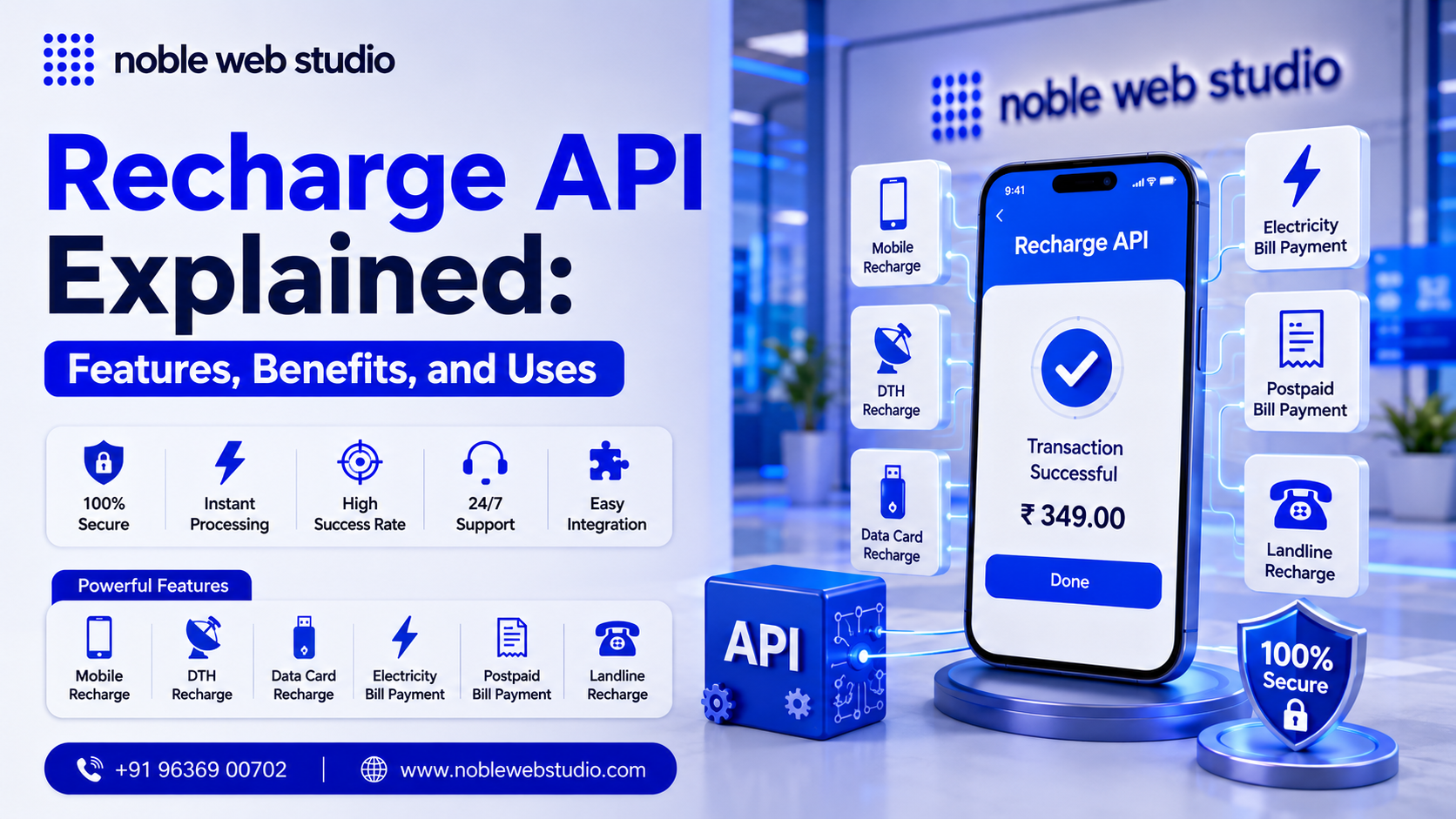
Are you looking for a reliable Recharge API to add mobile recharge, DTH recharge, data card recharge, or bill payment services to your website, mobile app, or recharge software? A Recharge API provides the connection between your business platform and the recharge service infrastructure, helping you automate recharge requests, transaction processing, status checks, and other supported services through API integration.
For businesses starting an online recharge business, building a B2B recharge portal, launching a recharge app, or expanding an existing fintech platform, choosing the right Recharge API Provider in India is an important decision. Instead of managing separate integrations for every service, an appropriate API solution can bring supported recharge services into a centralized platform and simplify day-to-day operations.
A Recharge API is a software bridge that lets your app or website process mobile top-ups, DTH satellite TV recharges, and utility bill payments automatically. Instead of setting up separate contracts with every telecom operator, your system connects to a single API provider to execute real-time transactions.
Noble Web Studio provides Recharge API solutions for businesses that want to integrate recharge services into their own websites, applications, portals, and software. Depending on the selected solution, businesses can integrate services such as Mobile Recharge, DTH Recharge, Data Card Recharge, and utility bill payments, along with transaction status and reporting capabilities.
A professional Mobile Recharge API Integration should be evaluated for API documentation, supported operators and services, request and response handling, transaction-status management, security, scalability, integration support, and the ability to work with your existing B2B Mobile Recharge Software or Recharge Admin Panel. These factors are important for maintaining a smooth experience as transaction volume and users grow.
Whether you want to buy a Recharge API, integrate a Mobile Recharge API, develop an online recharge platform, or launch B2B Recharge Software, Noble Web Studio can help you choose an API-based solution according to your business and technical requirements.
In this complete guide, you will learn what a Recharge API is, how Recharge API Integration works, its key features and benefits, supported services, integration process, pricing factors, and how to choose the right Recharge API Provider for your business.
What is Recharge API?
A recharge API (Application Programming Interface) is a software bridge that allows a website or mobile app to offer instant mobile, DTH, data card, and utility bill top-ups. Instead of connecting to every telecom operator individually, a business integrates one unified API to automate transactions, verify numbers, and process payments securely in real time.

Recharge API Work
A Recharge API (Application Programming Interface) functions by enabling communication between different software systems to facilitate recharge services, such as mobile top-ups, DTH recharges, and bill payments. It acts as a bridge, allowing businesses to integrate these functionalities directly into their own platforms, like websites or mobile apps.This allows users to perform recharges or manage subscriptions directly through that platform.
Here’s a breakdown of how it works:
Request Initiation:
- A user initiates a recharge or subscription action through a host application (e.g., a website, mobile app, or e-commerce platform).
- The host application sends a request to the Recharge API, containing relevant details such as the service type (mobile, DTH, etc.), recipient details (mobile number, DTH ID), amount, and authentication information (e.g., API key, token ID).
API Processing and Validation:
- The Recharge API receives the request and performs validation checks. This typically involves verifying the authenticity of the request (e.g., checking the provided token ID or API key) and ensuring the data integrity (e.g., valid mobile number, correct amount format).
- For mobile recharges, the recharge API might then communicate with the respective telecom operator’s system. For subscription services like those offered by Recharge Payments, the recharge API interacts with their billing and subscription management platform.
Transaction Execution:
- If the validation is successful, the recharge API proceeds with the transaction. This could involve processing the payment, initiating the mobile top-up with the telecom operator, or updating the subscription status within the platform.
Response and Confirmation:
- After the transaction is complete, the Recharge API sends a response back to the host application.
- This response indicates the success or failure of the transaction and may include details like a transaction ID, status code, and any relevant error messages.
- The host application then displays the transaction status to the user.
User Notification:
- The business’s recharge platform receives the response and updates the user on the status of their recharge or payment, often with a confirmation message or an error notification.
Services You Can Offer with a Recharge API
A modern multi-service recharge API allows you to offer automated digital top-ups, utility payments, and financial settlement features. By integrating a single endpoint system, you can instantly process transactions across telecom, entertainment, and municipal sectors.
Telecom and TV Services
- Mobile Prepaid: Instant talk-time and data pack top-ups for major networks like Jio, Airtel, Vi, and BSNL.
- Mobile Postpaid: Bill payments for cellular numbers across national providers.
- DTH Recharge: Monthly or annual plan renewals for TV operators like Tata Play, Dish TV, and Airtel Digital TV.
- Data Card: High-speed internet dongle and portable router balance recharges.
Utility and Municipal Bills
- Electricity: Automated bill fetching and payments for state and private boards like UPPCL, BSES, and TPDDL.
- Gas & Water: Piped natural gas (PNG), LPG cylinder bookings, and municipal water bill payments.
- Broadband & Landline: Fixed-line telephone and fiber internet bill clearances.
Travel and Transit Solutions
- FASTag: Instant highway toll tag balance top-ups using vehicle registration numbers.
- Metro Card: Digital smart card top-ups for active urban metro transit networks.
Financial and Value-Added Services
- Insurance Premiums: Recurring policy payments for major providers like LIC, HDFC, and ICICI.
- Digital Gift Cards: Instant voucher code generation for platforms like Google Play.
- Municipal Challans: Direct payment gateways for state traffic fine collections.
Read Blog : How Recharge API Works: Step-by-Step Guide
Documents Required for Recharge API
To start a recharge API service in India, you must complete standard KYC (Know Your Customer) and business verification. Required documents are divided into two main categories:
1. Business & Entity Registration
Depending on your business type, you will need to provide one of the following:
- For Sole Proprietorships: Udyam Registration Certificate or Shop & Establishment License.
- For Companies/LLPs: Certificate of Incorporation, MOA, and AOA.
- For Partnerships: Partnership Deed.
- Taxation: Business PAN Card and GST Certificate (if applicable for financial services).
2. KYC, Financials, and Technicals
- Identity & Address Proof: Aadhaar Card, Passport, Voter ID, or Driver’s License of the authorized signatory, proprietor, or directors.
- Banking: A cancelled cheque or bank statement from your dedicated current business bank account to set up fund settlements and commission payouts.
- Technical Details: Proof of domain ownership (website URL) and a signed API Service Agreement with Noble web studio.
Requirements of Recharge API
A Recharge API requires business documentation, server infrastructure, and developer credentials. You need a verified PAN card, Aadhaar, a business bank account, and a minimum wallet deposit. For technical integration, your server needs a static IP, an SSL certificate, and a framework like PHP or Python to process JSON/RESTful responses.
1. Business & Legal Requirements
To legally partner with a B2B recharge service provider in India, you must register your business.
- For Sole Proprietorships: PAN card, Aadhaar card, and personalized or current bank account details.
- For Private Limited/LLPs: Certificate of Incorporation, company PAN card, board resolution, and GST registration.
- Minimum Deposit/Wallet Balance: Providers typically require an initial wallet top-up to start hitting the API (e.g., minimum deposits range from ₹5,000 to ₹25,000).
2. Technical Infrastructure
Your platform needs specific backend resources to securely connect to the provider’s endpoint.
- Server Setup: A dedicated web server (Apache or Nginx) running on a static IP address.
- SSL Certificate: HTTPS encryption is mandatory to secure customer data and API transaction requests.
- Development Stack: Support for secure server-side execution, typically using PHP (cURL extension), Python, or Node.js to trigger HTTP GET/POST methods.
3. API Integration Features
When choosing an API provider, ensure they support the following core technical capabilities:
- Multi-Operator Support: Must cover all major telecom operators (Jio, Airtel, Vi, BSNL) and DTH services.
- Authentication: Secure API keys or OAuth tokens granted by the provider.
- Callbacks/Webhooks: The provider should be able to instantly notify your server (URL) with real-time success or failure statuses.
- Plan API: Tools to dynamically fetch and display current active prepaid and postpaid plans.
- Auto-Refunds: Mechanism to instantly reverse funds to the user wallet for failed or dropped transactions.
Who Can Use Recharge API
A Recharge API can be used by fintech platforms, e-commerce retailers, and businesses to automate prepaid mobile, DTH, data card, and utility bill payments directly into their own applications. It allows companies to integrate a single bridge instead of building individual connections with telecom operators.
The following specific groups and entities typically use a Recharge API:
- Fintech Startups & Wallets: Companies integrating digital payment ecosystems or mobile wallets use APIs to let users instantly top-up accounts or pay bills.
- Retailers & White-Label Providers: Individual shop owners, local vendors, and B2B aggregators use multi-recharge platforms to run branded recharge applications and generate commissions on services.
- E-commerce Platforms & Websites: Retailers integrate storefront-specific APIs (such as the Recharge REST API) to manage recurring billing, subscription boxes, and customer profiles.
- Telecom Agents: Regional distributors and multi-service agents automate operator requests and transaction status routing.
Why Use Recharge API
A Recharge API automates and processes mobile, DTH, and utility top-ups directly through your website or app. Businesses use it to save thousands in development costs, eliminate manual errors, scale instantly for high traffic, and earn steady revenue through commissions on every successful transaction.
A Recharge API provides several core benefits:
- Unified Connectivity: Connect to multiple major telecom and utility operators through a single integration.
- Real-Time Processing: Delivers instant automated recharges and callbacks to your customers.
- Cost Efficiency: Avoid building and maintaining expensive, complex infrastructure for every individual service provider.
- Deep Analytics: Track your transaction history and earnings with real-time reporting.
- Automated Support: Automatically fetches network circles and operators, preventing user error.
Why Choose Recharge API
Businesses choose a recharge API to automate processes, improve customer experience with faster, more convenient services, and drive revenue growth by expanding service offerings and earning commissions. Key benefits include increased operational efficiency, real-time transaction processing, enhanced security, multi-operator support, and scalability to handle high volumes, ultimately leading to higher customer satisfaction and increased profitability.
Benefits for Businesses
- Increased Revenue: Businesses can earn commissions on transactions, create new revenue streams, and attract more customers by offering a wider range of services.
- Enhanced Operational Efficiency: A recharge API automates manual processes, reducing errors and freeing up staff to focus on other critical business tasks.
- Scalability: The recharge API is designed to handle high transaction volumes, allowing businesses to grow their operations without major infrastructure overhauls.
- Expanded Service Offerings: Businesses can integrate a variety of recharge services, such as mobile and DTH recharges and utility bill payments, directly into their own platforms.
- Real-Time Insights: Businesses gain access to real-time transaction status updates and detailed reports, improving monitoring and analysis.
Benefits for Customers
- Convenience: Customers can recharge their connections or pay bills at any time, from anywhere, through the business’s website or app.
- Speed and Efficiency: The recharge API ensures instant and seamless transactions, reducing customer wait times and improving satisfaction.
- Multi-Operator Support: Customers have access to a wide range of telecom and DTH operators and plans from a single, unified platform.
Technical Advantages
- Automation: The recharge API automates the entire recharge process, from initiation to completion.
- Multi-Operator Support: It allows integration with various telecom and DTH providers, enabling businesses to offer diverse services.
- Security: Noble web studio use secure protocols and encryption to protect sensitive customer data during transactions.
- Real-Time Processing: Transactions are processed instantly, providing immediate feedback and updates.
Top Uses of Recharge API
A Recharge API is used to integrate and automate various payment and subscription services, allowing businesses to offer mobile, DTH, and data card top-ups, utility bill payments, and subscription management directly through their own websites and applications. Businesses use it to create their own custom recharge portals, white label recharge solutions, and to add advanced billing functionality to their e-commerce platforms. The recharge API acts as a bridge, connecting a business’s platform to service providers and payment aggregators for seamless, secure, and automated transaction processing.
Key Uses of a Recharge API
- Mobile & Data Card Recharge: Businesses can allow customers to top up their prepaid mobile numbers and data cards directly through the business’s platform.
- DTH Recharge: Recharging satellite television subscriptions is another common application for recharge APIs.
- Utility Bill Payments: The recharge API can be used to process payments for various utilities, including electricity, water, and gas bills.
- Postpaid Recharges: In addition to prepaid services, some recharge APIs support postpaid recharges and bill payments.
- Subscription Management: For e-commerce platforms, the recharge API allows businesses to add subscription options, manage recurring payments, and enable customers to handle their subscriptions.
- Custom Portals: Developers can use the recharge API to build custom customer portals or integrate subscription features into existing customer portals.
- Loyalty Programs: Developers can integrate features for loyalty programs, such as rewarding customers for recharges, through the recharge API.
- White-label Solutions: A Recharge API can be used to create white label recharge solutions, allowing other businesses to offer recharge services under their own brand.
- E-commerce Integration: The recharge API facilitates seamless integration with existing e-commerce platforms for managing subscription products and processing orders.
- Payment Processing:The recharge API handles secure payment transactions, often integrating with various payment gateways to process payments like net banking and UPI.
- Automated Confirmations: Using related services like SMS or email recharge APIs, businesses can send automated transaction confirmations and notifications to customers.
Key Aspects of a Recharge API
A Recharge API is a software tool that connects an app or website to telecom and utility systems. It lets users add mobile balance, pay bills, or buy TV packages instantly.
Core Functionality
- Multi-Operator Support: Works with major phone and DTH companies through one single system.
- Real-Time Processing: Completes top-ups and sends money in a few seconds.
- Auto-Validation: Checks phone numbers and account details before sending funds.
Security and Data
- API Key Protection: Uses secret keys and secure tokens to block bad users.
- SSL Encryption: Protects private user data during transfer.
- JSON Responses: Sends clear, simple data back and forth in standard formats.
Management and Tracking
- Live Status Reports: Shows if a payment worked, failed, or stayed pending.
- Wallet Tracking: Lets you view your current balance and track earned commissions.
- Webhooks/Callbacks: Sends automatic alerts to your server when a payment status changes.
Why Businesses Need Recharge API
Businesses need a Recharge API to streamline operations, enhance customer experience, and drive business growth by offering services like mobile, DTH, and utility recharges through their own recharge platforms. Recharge APIs automate the entire recharge process, support multiple operators, enable real-time transactions, and provide a secure, reliable, and scalable solution that expands service offerings, increases revenue through commissions, and reduces operational costs.
Here’s a breakdown of why businesses need a Recharge API:
For Business Operations & Efficiency
- Automation: Recharge API automate manual tasks in the recharge process, freeing up staff to focus on other core business activities.
- Buying recharge API access costs a fraction of building operator connections yourself.
- Streamlined Processes: By integrating with telecom providers and other services, businesses can manage recharges and payments more efficiently.
- Cost Reduction: Outsourcing the complex task of building and maintaining recharge infrastructure to an API provider is more cost-effective than developing a custom solution.
For Customer Experience
- Convenience & Speed: Customers benefit from fast, real-time transactions and the convenience of recharging multiple services (mobile, DTH, bills) in one place.
- Enhanced Satisfaction: Reduced wait times and a seamless online recharge experience lead to greater customer satisfaction and loyalty.
For Business Growth & Revenue
- The same API scales from 100 to 1,00,000+ transactions a day without changing your setup.
- Expanded Services: Integrating Recharge API allows businesses to offer a wider range of essential services, attracting more customers.
- New Revenue Streams: Businesses can generate additional revenue through commissions or convenience fees from the services they offer.
- A wider service menu (mobile + DTH + bills) attracts more customers and more footfall, which lifts sales of your core products too.
- Scalability: Mobile recharge API designed to handle high volumes of transactions, allowing businesses to scale their operations without compromising performance.
Security & Reliability
- Enhanced Security: Reputable Recharge API incorporate robust security protocols like encryption to protect sensitive customer data and financial transactions.
- High Reliability: A reliable Recharge API ensures consistent performance and minimal downtime, which is crucial for financial services.
Read Blog : How Mobile Recharge API Integration Works for Retailers
Key Features to Look for in a Recharge API
A recharge API provides automated, real-time integration for services like mobile, DTH, and bill payments within an existing recharge application or website. Key features include multi-operator and multi-channel support, secure payment gateway integration, detailed reporting and analytics, high transaction success rates, and options for customization and branding to enhance the user experience and streamline operations.
Core Functionality
- Automated Recharges: Streamlines the process of recharging prepaid numbers, data cards, and DTH services.
- Real-Time Processing: Ensures instant completion of transactions, providing immediate value and a smooth user experience.
- Integration: Allows developers to seamlessly embed recharge capabilities into their existing websites, apps, and platforms.
Key Features
- Multi-Operator & Multi-Channel Support: Connects with numerous mobile, DTH, and data card providers, offering a wide array of services.
- Payment Gateway Integration: Facilitates secure online payments through various methods like credit/debit cards, UPI, and digital wallets.
- Security: Implements robust security measures, encryption, and fraud detection to protect sensitive financial data.
- Reporting and Analytics: Provides detailed insights into transaction history, success rates, and customer behavior for business analysis.
- Customization: Enables businesses to tailor the recharge interface and user experience to their specific branding and needs.
- Reliability: Designed for high uptime and consistent performance, minimizing service interruptions and ensuring high success rates.
- Support and Documentation: Offers developer resources and documentation to simplify the integration process.
Benefits for Businesses
- Increased Revenue: Provides a new service offering to expand business opportunities.
- Enhanced User Experience: Offers convenience and instant top-ups, improving customer satisfaction.
- Operational Efficiency: Automates processes, reduces manual effort, and minimizes errors.
- Data-Driven Insights: Analytics help in understanding customer behavior and optimizing services.
Benefits of Recharge API
A Recharge API (Application Programming Interface) provides a set of defined rules and specifications that allow different recharge software applications to communicate with each other, specifically for facilitating digital recharge services. The benefits of integrating mobile Recharge API into a business platform are numerous and impact various aspects of operations and customer experience.
Key Benefits of a Recharge API:
- Expanded Service Offerings: Businesses can seamlessly integrate and offer a wide range of recharge services, including mobile top-ups, DTH recharges, data pack purchases, and utility bill payments, all through a single platform. This increases the value proposition for customers and can lead to increased engagement.
- Increased Revenue Streams: Offering recharge services can generate new revenue streams through commissions on each successful transaction. High commission mobile recharge API can further maximize profit potential.
- Improved Customer Experience: Customers benefit from the convenience of recharging directly within a familiar platform, eliminating the need to visit Noble web studio. This leads to faster, more convenient, and often more secure transactions.
- Operational Efficiency through Automation: Recharge APIs automate the entire recharge process, from initiating the transaction to processing payments and providing real-time status updates. This reduces manual effort, minimizes errors, and streamlines operations.
- Real-time Processing and Updates: Transactions are typically processed instantly, and customers receive immediate confirmation or status updates, enhancing transparency and satisfaction.
- Multi-Operator Support: A good Recharge API allows access to a wide network of telecom operators and service providers, enabling businesses to cater to a broader customer base.
- Scalability: Mobile recharge API designed to handle varying transaction volumes, allowing businesses to scale their services as demand grows without significant infrastructure changes.
- Enhanced Security: Reputable Recharge API providers like Noble web studio prioritize security, employing measures like secure payment gateway integration and data encryption to protect sensitive customer information.
- Cost-Effectiveness: Integrate mobile recharge API can be a more cost-effective solution than building and maintaining a proprietary recharge system from scratch, especially for businesses with limited resources.
Technical Requirements for Recharge API Integration
Integrating a Recharge API requires a robust technical architecture to handle instant, secure data exchanges between your platform, the aggregator, and telecom telecom networks.
A comprehensive breakdown details the fundamental technical requirements for a successful production-grade integration.
1. Network & Infrastructure Setup
- Secure Web Server: Modern architecture requires Apache or Nginx running with valid, production-grade SSL/TLS certificates (HTTPS only).
- Static IP Address: Most aggregators require your production server’s Static IP for whitelisting before granting access to production endpoints.
- Environment Isolation: Maintain a clean separation between your local development/sandbox environment and live production instances.
2. Authentication & Data Security
- Header-Based Authentication: Requests must be authenticated using Bearer Tokens or unique API Keys sent securely via HTTP headers.
- IP Whitelisting: The provider’s gateway will drop any network traffic that does not originate from your registered server IPs.
- Payload Hashing: To avoid interception or tampering, request signatures should be dynamically generated using cryptographic algorithms like HMAC-SHA256 or MD5 hashes.
3. Architecture & Protocol Requirements
- RESTful JSON Over HTTPS: Standard communications are handled via stateless HTTP POST methods for initiating actions and HTTP GET for lookups, utilizing JSON formatted payloads.
- Real-time Plan Fetching: Integration of a secondary Operator Plan Fetch API to display valid plans in real-time based on the mobile number’s current network operator and circle.
- Asynchronous Webhook Receivers: Set up listener endpoints to capture asynchronous HTTP POST callback updates when a transaction status transitions.
4. Core Core API Request Requirements
Every core transaction payload (POST /recharge) requires specific, immutable data blocks:
| Parameter Key | Data Type | Description |
|---|---|---|
reference_id | Alphanumeric String | A strictly unique client transaction ID generated by your system to enforce server-side idempotency. |
operator_code | Pre-defined Key | Unique provider code representing the specific carrier network (e.g., JIO, AIRTEL). |
target_identifier | Numerical String | The destination entity ID, such as a Mobile Number or DTH Subscriber ID. |
amount | Float / Integer | Precise numerical currency value corresponding exactly to an authorized recharge package. |
5. High-Reliability Fault Tolerance
- Idempotency Safeguards: Enforce strict unique keys to ensure that a network hiccup or repetitive client-side double click does not drain your digital business wallet.
- Three-State Processing Logic: Your ledger system must acknowledge three distinct API response states:
- Success: Balance is deducted, transaction completes.
- Failed: Instant rejection; funds are kept safe.
- Pending: Wallet funds must be escrowed/locked until settled via a status polling loop or webhook response.
- Auto-Retry & Polling Strategies: Build structured back-off polling logic (e.g., checking status at intervals of 5, 15, and 30 seconds) rather than aggressively spamming the status endpoint during operator delays.
6. Logging, Error Mapping & Compliance
- Unified Audit Trails: Store complete raw text blocks of inbound and outbound HTTP headers and JSON bodies with millisecond-precise timestamps for auditing.
- User-Friendly Exception Handling: Implement a translation middleware layer that seamlessly maps provider specific error codes (e.g.,
ERR_402_OP_DOWN) into plain customer-facing status labels. - PCI DSS & Local Compliance: Ensure that your local infrastructure layer respects regulatory guidelines (like RBI guidelines or PCI DSS frameworks if managing integrated payment methods natively).
How to Integrate a Recharge API in India (Step-by-Step)
Noble web studio with go live within 2–7 working days when documents and a developer are ready.
Integrating Recharge API involves connecting your platform with Recharge’s system to manage subscriptions, recurring billing, and related functionalities. This process generally includes the following steps:
Obtain API Credentials:
- Log in to your Recharge admin portal.
- Navigate to “Tools & apps” and then “API tokens.”
- Create a new API token, providing a name, contact email, and setting appropriate scope permissions (No access, Read access, or Read and Write access) based on your integration needs.
- Save the token and securely store the generated API key.
Understand the API Documentation:
- Familiarize yourself with the Recharge API documentation, which outlines available endpoints, request formats, authentication methods, and data structures for various resources (e.g., Addresses, Charges, Customers, Orders, Subscriptions).
- Pay attention to any platform-specific compatibility limitations or regional restrictions mentioned in the documentation.
Develop Your Integration:
- Choose a method: Decide whether to use Recharge’s hosted solutions, integrate with an existing e-commerce platform (like Shopify), or build a custom recharge api integration.
- Integrate the API: Use your chosen programming language and tools to send requests to Recharge API endpoints and process the responses. This involves:
- Authentication: Include your API token in the request headers for authentication.
- Request Construction: Format your requests according to the mobile recharge API documentation, including necessary parameters and data.
- Response Handling: Parse the API responses to extract relevant information and handle success or error scenarios.
Implement functionality
Develop the specific features you require, such as:
- Adding and managing subscriptions.
- Handling recurring payments and charges.
- Optimizing your storefront for subscription purchases.
- Creating a custom checkout experience if needed.
Testing and Deployment:
- Thoroughly test your integration in a development or staging environment to ensure all functionalities work as expected and handle various scenarios (e.g., successful transactions, failed payments, customer updates).
- Once testing is complete and satisfactory, deploy your integration to your live environment.
Monitoring and Maintenance:
- Continuously monitor your integration for performance, errors, and potential issues.
- Stay updated with Recharge API changes and updates to ensure ongoing compatibility and leverage new features.
Recharge API Integration Example
Recharge API Integration Logic
Technical Request-Response Cycle for Automated Recharges
Recharge API Documentation
Recharge API Cost
Recharge API costs can vary significantly, with a typical range for the API itself from ₹4,999 to ₹5,000 or more, though Noble web studio offer recharge software solutions starting around ₹2,000-₹5,000 for mobile recharge software with integration. Additional costs include mobile recharge API integration, payment gateway setup, maintenance and support fees, and potential charges for custom features or increased transaction volumes.
| What You Buy | Typical Price Range (2026) | Best For |
| Recharge API access only | ₹2,000 – ₹5,000 (one-time) | Businesses with their own developers and platform |
| White label recharge software + API | ₹25,000 – ₹80,000 | Launching a branded portal fast, no coding needed |
| Custom recharge portal + mobile app | ₹1,00,000+ | Companies building a large B2B/B2C network |
| Annual maintenance (optional) | ₹10,000 – ₹30,000 / year | Ongoing updates and technical support |
| Wallet balance (working capital) | ₹10,000 – ₹20,000 minimum recommended | Prepaid balance from which recharges are processed |
Extra costs to plan for: payment gateway charges if you accept online payments from your customers, and higher wallet top-ups as your daily volume grows. There is no per-request fee on a good recharge API — you earn commission instead of paying transaction charges.
Noble Web Studio pricing: recharge API access starts at [₹9,999], and complete white label recharge software with API integration starts at [₹24,999]. Request a live demo for an exact quote for your business model.
Typical Costs
- API Purchase/License: Noble web studio offer access to the recharge API for a one-time fee or as part of a recharge software package. For example, Noble web studio lists options like ₹4,999 for a best Mobile Recharge API or ₹5,000 for a Multi Recharge API.
- Software & Integration: For a complete mobile recharge software solution, including a user interface and integration mobile recharge API, the cost can range from ₹25,000 to over ₹80,000.
- Custom Solutions: Solutions with custom websites or apps can cost upwards of ₹100,000 or more.
Additional Costs to Consider
- API Integration: Integration recharge API with your own mobile recharge platform or mobile recharge software can incur additional costs, depending on the complexity.
- Payment Gateway: To process payments securely, you’ll need to integrate payment gateway, which often involves setup fees and transaction charges.
- Maintenance & Support: Noble web studio charge ongoing fees for maintenance and technical support to keep the system running smoothly.
- KYC & Registration: You may need to register with a mobile recharge portal and complete KYC (Know Your Customer) procedures, which can involve costs.
- Scalability: As your business grows, you may need to upgrade recharge API plan or purchase more API units, leading to higher recurring costs.
Factors Influencing Cost
- Features: More advanced features, such as multi recharge capabilities (mobile, DTH, bills), or customizable recharge platforms, increase the price.
- API Provider Reputation: More established and reliable recharge API providers like Noble web studio might charge more for their services.
- Volume of Transactions: Noble web studio may have tiered pricing based on the number of transactions your business handles.

Recharge API Commission and Margin Structure
Recharge API commission rates in India typically range from 1.5% to 7% per transaction, varying heavily by telecom operator, service category (prepaid mobile, DTH, or utility bills), and monthly transaction volume. BSNL and certain DTH providers offer the highest margins, while major operators like Airtel and Jio offer lower rates.
Typical Commission Slabs by Operator
- BSNL: 4.50% – 6.70% (Highest margin)
- Vodafone Idea (Vi): 3.50% – 4.30%
- Jio: 2.80% – 4.40%
- Airtel: 1.80% – 3.60% (Lowest margin due to carrier policies)
Commission Ranges by Service Type
- Prepaid Mobile (Jio, Airtel): 1.0% to 3.5% commission.
- Prepaid Mobile (BSDN/Vi): 2.5% to 6.0% commission (state-backed or alternative operators often yield higher margins).
- DTH Recharge (Tata Play, Dish TV): 2.0% to 7.0% commission.
- BBPS Utility Bills (Electricity, Gas): Flat fee of ₹5 to ₹20 per bill or 0.5% to 2.5%.
- Financial Services (AePS / DMR): ₹5 to ₹15 flat per transaction or 0.4% to 1%.
Volume-Based Slabs (Example Tiers)
- ₹0 – ₹1 Lakh/month: 3.8% – 4.5% base margin.
- ₹1 Lakh – ₹10 Lakhs/month: 4.2% – 5.2% margin.
- ₹10 Lakhs – ₹50 Lakhs/month: 4.8% – 6.0% margin.
- ₹2+ Crores/month: 6.2% – 7.5% enterprise tier.
Margin Distribution Models
- Direct Reseller Spread: If you white-label or resell API connectivity via Noble Web Studio, your profit is the spread (typically 0.1% to 0.5%) between the upstream provider’s cost and your sub-retailer’s payout.
- Instant Wallet Credit: Commissions and margins are credited instantly to your operational API wallet upon successful transaction validation.
Important Things to Know
- Volume Tiers: Noble web studio offer higher commission slabs if your monthly transaction volume scales past ₹10 lakhs or ₹50 lakhs.
- Beware of Fraud/Unrealistic Claims: Be cautious of providers advertising unusually high flat rates (like 5% to 8% across all operators including Airtel/Jio); these often carry hidden gateway fees, setup traps, or suffer from poor transaction success ratios. Check provider reliability and uptime (ideally >99.9%) over raw commission promises.
Read Blog : Best All-in-One Recharge API Provider in India
Recharge API vs Recharge Software: Which One Should You Choose?
A recharge API is a code link that lets your existing app process mobile or DTH top-ups through an outside provider. Recharge software is a complete, ready-made business platform that includes user wallets, admin panels, and agent networks. Choose an API if you are a developer adding features to an app; choose software if you want to run a standalone recharge business.
Recharge API
- Best for: Developers, software companies, and custom app builders.
- How it works: Plugs code into your current website or mobile application.
- Control: Gives you total design and user-interface freedom.
- Needs: Requires technical coding skills to set up and maintain.
Recharge Software
- Best for: Shop owners, startup owners, and B2B distributors.
- How it works: Provides a complete ready-to-use portal, admin panel, and mobile app.
- Control: Uses the provider’s layout or a white-label version of your brand.
- Needs: Requires no coding knowledge; ready to use on day one.
Recharge API Failure, Refund and Dispute Process
In a Recharge API system, failed transactions typically trigger an automatic refund to the platform wallet. Pending requests require a status check rather than a retry, while successful and delivered recharges are final. Disputed or misreported transactions must be manually raised using the transaction reference ID (refid) for operator verification.
Transaction Status Handling
- SUCCESS: The operator accepted the request and generated an operator reference ID; funds are captured and non-refundable.
- PENDING: The request is queued or processing at the telecom operator; use the Status Check API to poll the final state instead of resending.
- FAILED: The system or upstream vendor rejected the request; funds are reversed or credited back to the retailer wallet automatically.
Refund Workflow
- Automatic Reversals: System-detected failures return the balance to your source wallet immediately or within a short processing window (typically instant up to 24 hours).
- Non-Refundable Scenarios: Successful recharges, incorrect mobile/operator numbers entered by the user, or delays caused by third-party operator outages after acceptance are ineligible for automated refunds.
Dispute Process
- Raise a Dispute: Submit a ticket or call the Dispute API using the unique transaction reference ID (
refid) if a recharge shows successful in logs but the end-user claims non-receipt. - Verification: The provider reconciles logs with the upstream telecom operator.
- Resolution: Valid claims result in a manual wallet credit adjustment, while invalid claims tied to operator-confirmed success require the end-user to coordinate directly with the telecom provider.
Recharge API Security Best Practices
To secure a Recharge API (whether for subscription billing platforms like Recharge Payments or mobile/fintech top-up integrations), you must protect financial workflows, user wallets, and private telecom/customer data.
Authentication & Access Control
- Token Isolation: Assign exactly one unique token per application to track access precisely.
- Environment Variables: Store your keys safely in server environments rather than hard-coding them into your source code.
- OAuth Framework: Use strong OAuth authorization protocols to manage external and partner app permissions securely.
- Least Privilege: Apply strict scoping to limit token capabilities to only the minimum required database actions.
Transaction & Financial Integrity
- Idempotency Keys: Use server-side idempotency keys to prevent double-charging wallets during network timeouts.
- Status Polling: Confirm actual delivery statuses via webhooks rather than trusting a basic HTTP 200 response.
- Log Scrubbing: Ensure sensitive data like ClientSecrets and customer passwords are never written to plaintext server logs.
- Strict Validation: Screen and sanitize data ranges to stop injection attacks and incorrect billing entries.
Network & Infrastructure Defense
- Enforced TLS: Route all API communication through TLS 1.2 or higher to prevent payload interception.
- Gateway Throttling: Deploy an API gateway to enforce rate limiting and block malicious denial-of-service attempts.
- Anomaly Auditing: Continuously monitor transaction volumes to spot and alert on sudden token leakage or activity spikes.
Failed Recharge, Refund and Dispute Handling
If a mobile recharge fails or goes to the wrong number, do not try to pay again right away. Check your payment app or bank statement for the Transaction ID, date, and status. Failed recharges typically refund automatically to your bank within 3 to 7 working days. For wrong numbers or disputes, you must act fast.
Steps for a Failed Recharge (Money Deducted)
- Check status: Open your payment app or telecom app and look at the Transaction History to see if it shows as failed.
- Wait for auto-refund: Most systems clear failed charges in 3–7 business days via automated bank settlements.
- Contact support: If the money does not return after 7 days, share your Transaction ID with your payment platform or provider’s helpdesk.
Steps for a Wrong Recharge Mistake
- Use self-service cancel: If you use platforms like the MyJio App, check for a direct plan cancellation or recharge reversal option within 2 to 3 hours.
- Call customer care: Contact your operator’s support line immediately with the incorrect mobile number and payment proof.
Dispute and Escalation Handling
- Raise a chargeback: If the merchant or operator refuses to help, file a formal dispute or chargeback with your bank or card issuer.
- Lodge a grievance: Submit a ticket on official consumer forums like the National Consumer Helpline if digital wallet support fails to respond.
Recharge API Sample Request & Response (Developer Example)
A standard Mobile/DTH Recharge API allows third-party applications to process instant top-ups by sending structured HTTP POST or GET requests to a telecom aggregator platform.
The technical blueprint below demonstrates a standard RESTful JSON implementation for triggering a mobile recharge and processing its synchronous response.
Sample API Request
Recharge requests are typically initiated via a POST method to a secure endpoint, passing authorization tokens and transaction payloads within a JSON body.
HTTP Method:POSTEndpoint URL:https://yourrechargeprovider.comHeaders:
Content-Type: application/jsonAuthorization: Bearer YOUR_API_ACCESS_TOKEN
{
  "api_key": "rc_live_9f83a21b4c5e6d7e",
  "client_tx_id": "TXN2026081499521",
  "account_number": "+15550199",
  "operator_code": "VODAFONE_PREPAID",
  "circle_code": "NY",
  "amount": 25.00,
  "recharge_type": "TopUp"
}
Request Parameter Breakdown
api_key: The unique identifier provided by the vendor to authenticate your system.client_tx_id: A unique transaction reference generated by your system to prevent duplicate executions.account_number: The destination target phone or DTH account identification number.operator_code: Unique string identifier mapped to a specific telecommunications carrier or service provider.circle_code: Geolocation or regional network identifier code required by some telecom networks.amount: The financial value of the targeted top-up plan.
Sample API Responses
1. Success Response (HTTP 200 OK)
Returned when the validation succeeds and the upstream carrier processes the network credit injection successfully.
{
  "status": "success",
  "error_code": 0,
  "message": "Recharge completed successfully.",
  "data": {
    "client_tx_id": "TXN2026081499521",
    "operator_ref_id": "OP8873210495",
    "gateway_tx_id": "RECH_99482110",
    "account_number": "+15550199",
    "amount": 25.00,
    "opening_balance": 1542.50,
    "closing_balance": 1517.50,
    "timestamp": "2026-08-14T18:44:00Z"
  }
}
2. Pending Response (HTTP 200 OK or 202 Accepted)
Returned when the aggregator accepts the request but the downstream provider experiences queue delays. Implementations must poll a status checking endpoint for final resolution.
{
  "status": "pending",
  "error_code": 1,
  "message": "Transaction is pending upstream provider confirmation.",
  "data": {
    "client_tx_id": "TXN2026081499521",
    "gateway_tx_id": "RECH_99482110",
    "account_number": "+15550199",
    "amount": 25.00,
    "timestamp": "2026-08-14T18:44:02Z"
  }
}
3. Failure Response (HTTP 422 Unprocessable Entity)
Returned when data validation checks fail, or the business wallet contains insufficient funds.
{
  "status": "failure",
  "error_code": 402,
  "message": "Insufficient wallet balance to process this recharge amount.",
  "data": {
    "client_tx_id": "TXN2026081499521",
    "current_balance": 4.20,
    "requested_amount": 25.00
  }
}
How to Choose the Best Recharge API Provider
Noble web studio one of the best recharge API provider, prioritize a high transaction success rate (99%+), low response times (under 500ms), automated refunds for failed requests, wide operator coverage (mobile, DTH, utilities), and a transparent commission structure.
Core Performance Factors
- Success Rate: Look for Noble web studio guaranteeing 99% or higher success to minimize user friction and complaints.
- Speed & Uptime: Opt for sub-second response times (ideally under 300ms) and 99.9% server uptime.
- Auto-Refund System: Ensure the API instantly reverses funds to your wallet for dropped or failed transactions.
Service & Operator Coverage
- Multi-Operator Support: Check if they cover major telecom and utility providers like Jio, Airtel, Vi, BSNL, DTH operators, and FASTag.
- Expanded Utilities: Verify support for BBPS, electricity, gas, and broadband bills if you plan to scale your platform.
Financial & Technical Usability
- Commission Margins: Compare profit margins and commission rates after confirming technical stability.
- Developer Documentation: Clear, well-structured documentation, sandbox/testing environments, and reliable webhooks make integration seamless.
- Customer Support: 24/7 technical assistance is crucial when dealing with real-time payment failures.
Read Blog : Best Recharge API Providers with 24×7 Support
Why Choose Noble Web Studio for Recharge API?
Noble web studio one of the Recharge API provider based on high success rates (99%+), low latency (<300ms), 99.9% uptime, robust operator coverage (Jio, Airtel, Vi, BSNL, DTH), automated webhook callbacks, and transparent commission structures. Prioritize secure, well-documented endpoints with active 24/7 technical support over margins alone.
Key Performance Factors
- Success & Uptime: Look for a minimum of 99% transaction success rates and 99.9% server uptime with auto-retry mechanisms.
- Speed (Latency): Fast response times under 300 milliseconds prevent user drop-offs and double charges.
- Operator Coverage: Ensure support for all major mobile networks, DTH, Fastag, and utility payments under a single wallet.
Technical Integration Factors
- Webhooks & Callbacks: Automated asynchronous status updates eliminate the need for slow polling.
- Documentation & Sandbox: Clear guides and a risk-free testing environment speed up developer integration.
- Security: Bank-grade encryption (TLS/SSL) and IP whitelisting protect wallet data and credentials.
Business & Commercial Factors
- Commission Margins: Compare volume-based margins, but never let commission rates overrule platform reliability.
- Auto-Refund System: Instant wallet reversals for failed or dropped requests reduce customer friction.
- Support Quality: 24/7 technical help desks are vital for fixing sudden operator-side outages.
Read Blog : Mobile Recharge Portal Providers with API Integration & Admin Control
Future of Recharge API in India
The future of recharge API in India points to integration with digital wallets and banking apps, deeper financial inclusion through expansion into rural areas, increased security via AI and blockchain, and the offering of a wider range of digital services beyond just mobile recharges. This evolution will result in faster, more secure, and accessible platforms that serve as comprehensive digital and financial hubs, driving the digital economy and providing greater convenience for users across various channels, including IoT devices.
Key Trends and Developments
- Unified Financial Ecosystem: Recharge API integrate more deeply with digital wallets, banking apps, and systems like Aadhaar Enabled Payment System (AEPS) and Bharat Bill Payment System (BBPS), creating a seamless experience for users to manage multiple financial services.
- AI and Blockchain for Security and Personalization: Artificial intelligence will enhance predictive analytics and user experience, while blockchain technology will improve security and enable more personalized services and fraud prevention mechanisms.
- Expansion of Services: The scope will extend beyond mobile and DTH recharges to encompass a broader array of digital services, making recharge platforms more like comprehensive financial and service hubs.
- Rural Market Growth: A major focus will be on rural areas to foster financial inclusion, bringing faster, more secure, and accessible digital services to a larger, expanding user base.
- Multi-Channel Availability: Businesses will leverage recharge APIs to offer services across a wider array of platforms, including mobile apps, websites, and potentially even Internet of Things (IoT) devices.
- Enhanced Security and Scalability: Mobile recharge API provide secure communication channels with advanced encryption, and platforms will be developed to be highly scalable and resilient to manage increasing transaction volumes.
Impact on the Digital Economy
- Driving Financial Inclusion: By expanding access to digital services in rural areas, recharge APIs will play a crucial role in bringing more people into India’s digital economy.
- Creating New Opportunities: These recharge software development will create new income opportunities for businesses and entrepreneurs by enabling them to offer a wider range of services.
- Streamlined and Efficient Services: The recharge api integration of these technologies will lead to faster, more efficient, and user friendly recharge platform, improving the overall customer experience.

Conclusion
A reliable Recharge API can help businesses add mobile recharge, DTH recharge, data card recharge, FASTag and supported bill payment services to their website, mobile app, B2B portal or existing software through a single integration. Instead of building separate connections for every service, businesses can use a unified API approach to automate recharge processing, transaction status updates, wallet operations and reporting.
For startups, fintech companies, B2B recharge businesses, retailers, distributors and software companies, choosing the right Recharge API Provider in India is important. Before purchasing, check operator and service coverage, API documentation, transaction-status handling, security, scalability, commission structure, reporting, technical support and integration requirements.
A Recharge API (Application Programming Interface) is a software bridge that allows a website or mobile app to connect directly with telecom, DTH, and utility providers. It lets businesses automate prepaid top-downs, bill payments, and data recharges inside their own software without building separate carrier connections.
Noble Web Studio provides Recharge API solutions for businesses that want to develop or expand their digital recharge platform. Depending on your requirements, you can integrate Mobile Recharge API, DTH Recharge API, White Label Recharge API, B2B Recharge API and other supported digital payment services into your business platform.
Whether you want to buy a ready-made Recharge API, develop a custom recharge platform, or integrate Recharge API with your existing software, Noble Web Studio can help you evaluate the required technology and business workflow before implementation.
Ready to launch your recharge business? Contact Noble Web Studio to discuss your Recharge API requirements, integration, software development needs, and request a live demo.
Frequently Asked Questions (FAQs)
A Recharge API is a software interface that allows businesses and retailers to offer mobile, DTH, and utility recharges directly on their platform. It connects your system to multiple operators in real time, enabling instant transactions.
Recharge API works by integrating with your website, app, or software. When a customer enters their number and operator details, the API processes the recharge with the operator and confirms the payment instantly.
Recharge API access typically costs ₹2,000–₹5,000, while complete white label recharge software with API integration ranges from ₹25,000 to ₹80,000+. Custom portals with mobile apps can cross ₹1,00,000. Ongoing costs are wallet top-ups (prepaid balance) and optional annual maintenance.
Using a Recharge API, you can offer:
Mobile prepaid and postpaid recharges
DTH recharges
Data card recharges
Utility bill payments
Retailers, distributors, fintech startups, and online platforms can use a Recharge API to expand services, earn commission, and provide fast, secure recharge solutions to customers.
Instant transactions and real-time updates
Secure and reliable integration
Multi-operator support on a single platform
Increased revenue through commissions
Easy integration with websites, apps, or software
Basic integration takes a developer 2–4 hours to a couple of days with good documentation. The full process KYC approval, IP whitelisting, sandbox testing and go-live — usually takes 2–7 working days.
No special license is required to resell mobile and DTH recharges through an API — you operate on your provider’s aggregation setup. You only need standard business KYC: PAN, Aadhaar, bank proof, and GST/Udyam if applicable.
Noble Web Studio offers a robust Recharge API with secure integration, multi-operator support, real-time transaction updates, and high uptime. Retailers and businesses can easily scale their digital services while earning commissions.
Roughly 1–4% on mobile recharges, 1.5–4% on DTH, and flat ₹1–₹5 per utility bill, depending on operator and volume. A retailer doing 100 recharges a day at ₹200 average can earn ₹10,000–₹20,000+ per month across services.
Simply partner with a provider like Noble Web Studio, get API credentials, and follow the developer-friendly documentation to integrate it into your website, app, or software. Integration is fast and seamless.
Yes. Recharge API uses secure protocols and encryption to protect customer data and transaction information, ensuring safe and reliable recharges.
The API is the connection layer developers integrate into their own platform. Recharge software (white label portal) is a ready-made platform admin, retailer and distributor panels plus app with the API already built in. Have developers? Buy the API. Want to launch fast? Buy the software.
A reliable recharge API automatically refunds failed transactions to your API wallet, usually instantly or within a few hours. Confirm auto-refund and a dispute API exist before you integrate.
Noble web studio give free sandbox credentials so you can test every operator, success case and failure case before going live. Avoid providers who only allow live testing with real money.
A complete recharge API covers Airtel, Jio, Vi and BSNL for mobile; Tata Play, Dish TV, d2h, Airtel Digital TV and Sun Direct for DTH; plus electricity, gas, water and FASTag billers via BBPS.
Yes. With a B2B setup you can create unlimited distributors and retailers under your own brand, set your own commission slab at each level, and keep the margin difference — the standard white label recharge business model in India.
Yes — recharges are a repeat, daily-need purchase. Profit depends on three things: your commission slab, your transaction success rate, and how many services you run from one platform (mobile + DTH + BBPS + AEPS). The provider you choose decides all three.