
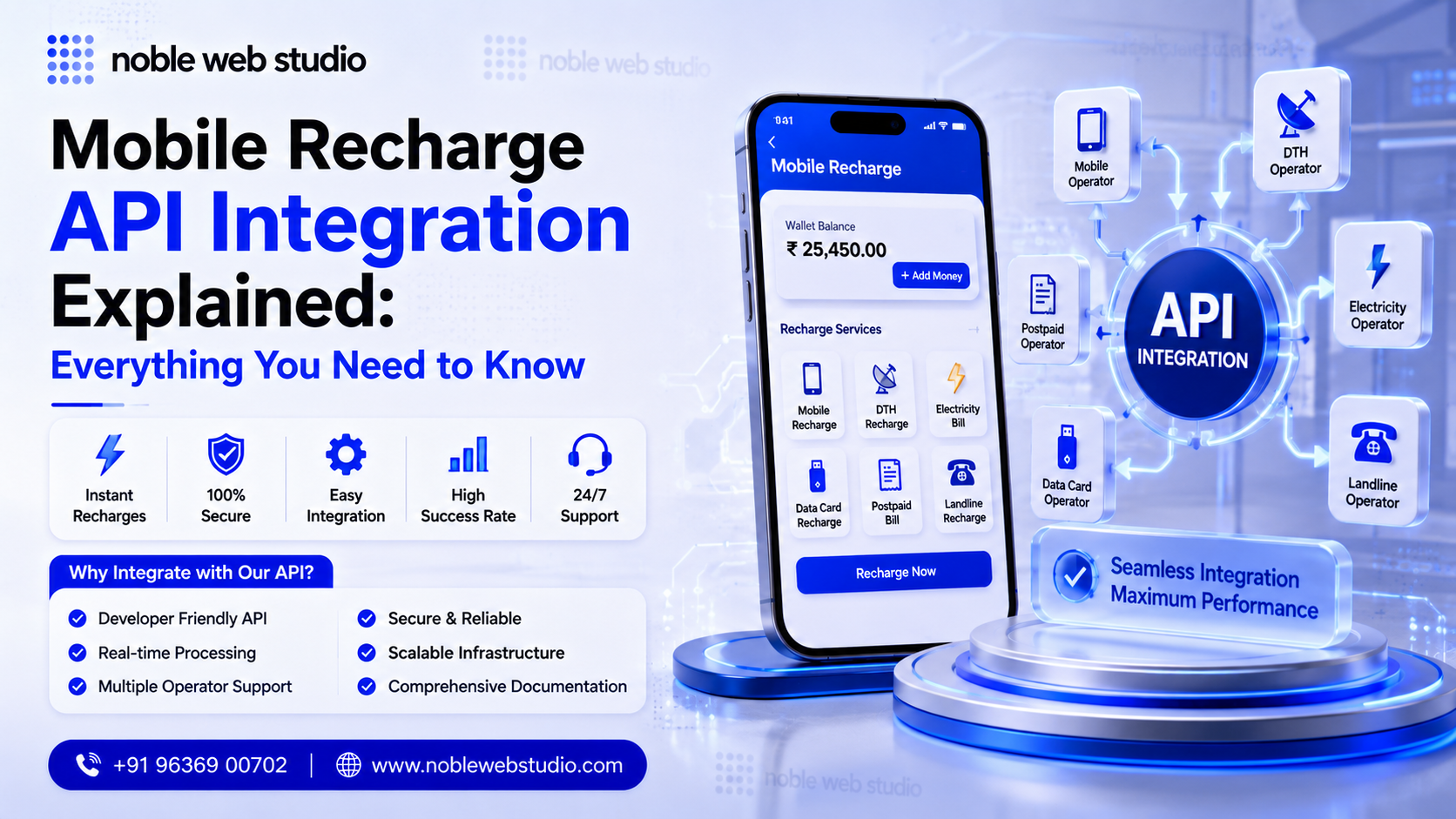
The demand for Mobile Recharge API Integration is increasing rapidly as digital payments and online recharge services continue to grow across India. Businesses, fintech startups, retailers, distributors, aggregators, and entrepreneurs are looking for secure and scalable Mobile Recharge API solutions that can automate recharge services and deliver a fast, reliable experience to customers. If you are planning to launch a recharge platform or upgrade your existing system, understanding Mobile Recharge API Integration is the first step toward building a successful digital recharge business.
A Mobile Recharge API connects your website, mobile app, or software with telecom operators through a secure API. This allows your platform to process prepaid mobile recharge, postpaid bill payments, DTH recharge, data card recharge, and utility bill payments in real time. Instead of processing requests manually, the API automatically verifies the transaction, communicates with the operator, and returns an instant response, making the entire recharge process quick and efficient.
Mobile recharge API integration is the process of connecting a business’s application or website to a mobile recharge service through an Application Programming Interface (API), enabling automated, real-time recharges for customers. By integrating, Noble web studio can offer mobile, DTH, and bill payment services without building the entire system from scratch, which provides convenience for users and operational efficiency for the business.
A Mobile Recharge API Integration by Noble Web Studio, a leading mobile recharge software development company, connects your platform directly with multiple telecom operators allowing instant prepaid, postpaid, DTH, and data card recharges through a single system. It saves time, reduces errors, and ensures faster transaction processing, all within just a few clicks.
Modern Recharge API Integration offers much more than basic recharge services. A complete solution includes multi-operator support, real-time transaction processing, secure wallet management, commission management, retailer and distributor management, transaction reports, API analytics, automated settlements, and high transaction success rates. These features help businesses improve customer satisfaction while simplifying day-to-day operations.
Partnering with Noble Web Studio, a leading Mobile Recharge API provider in India, helps you set up a secure, high-performance recharge platform that supports multi-operator services, real-time commission tracking, and complete recharge admin control. Their customize mobile recharge API solutions are built to scale your business effortlessly and meet the growing digital demand of 2026.
Noble Web Studio provides a secure and scalable Mobile Recharge API Integration Solution designed for startups, enterprises, retailers, distributors, and fintech companies. With fast API integration, developer-friendly documentation, high uptime, real-time processing, customizable recharge software, white-label solutions, and dedicated technical support, businesses can launch and scale their recharge platform with confidence.
If you’re planning to start or expand your digital recharge business, this complete guide will help you understand everything about Mobile Recharge API Integration in 2026, its benefits, features, and how it can boost your revenue with the right technology partner like Noble Web Studio.
| 🚀 Quick Highlights | |
|---|---|
| ✔ | Multi-Operator Recharge API |
| ✔ | Prepaid & Postpaid Mobile Recharge |
| ✔ | DTH & Data Card Recharge |
| ✔ | Real-Time Transaction Processing |
| ✔ | Secure API Integration |
| ✔ | Commission Management |
| ✔ | White Label Recharge Software |
| ✔ | B2B Retailer & Distributor Support |
What Is Mobile Recharge API Integration?
Mobile recharge API integration involves connecting a business’s platform to a third-party API to automate and offer mobile and DTH recharges to customers directly through the business’s app or website. The integration process typically includes registering with an recharge API provider, obtaining recharge API credentials, and using the Noble web studio documentation to implement recharge API calls within your own recharge software requests, manage transactions, and process payments within your own software. This integration provides benefits such as creating new revenue streams, increasing customer convenience, and streamlining operations by automating the entire recharge process. This integration provides benefits such as creating new revenue streams, increasing customer convenience, and streamlining operations by automating the entire recharge process.
How Does Mobile Recharge API Integration Work?
Mobile Recharge API integration functions as a bridge, enabling a host platform (like a website or app) to offer mobile recharge services by connecting to a Noble web studio system. The process involves several key steps:
- Initiation of Recharge Request: A user on the host platform initiates a mobile recharge, providing details such as the mobile number, operator, and recharge amount.
- API Request to Vendor: The host platform sends an mobile recharge API request to the Noble web studio server. This request includes the transaction details and authentication credentials (e.g., API key, token ID) to verify the host platform’s legitimacy.
- Authentication and Validation: The Noble web studio server receives the online recharge API request and performs authentication on the host platform’s credentials. It then validates the provided transaction details, such as the mobile number and recharge amount.
- Transaction Processing: If all details are authenticated and validated, the Noble web studio server processes the recharge transaction by interacting with the respective telecom operator’s system.
- Response from Telecom Operator: The telecom operator processes the recharge and sends a response back to the Noble web studio server, indicating the success or failure of the transaction.
- API Response to Host Platform: The Noble web studio server relays this response back to the host platform via the recharge API providing details about the transaction status.
- Confirmation and Notification: The host platform receives the secure mobile recharge API response and updates the user on the transaction status (e.g., “Recharge Successful” or “Transaction Failed”), often with a confirmation message or an error notification.
Mobile Recharge API Integration Architecture
Mobile Recharge API Transaction Flow
Customer
The customer initiates a mobile recharge request.
Website / Mobile App
The recharge request is submitted through the website or Android application.
Mobile Recharge API
The request is securely sent to the Recharge API for processing.
API Provider
The API provider validates and forwards the transaction to the selected telecom operator.
Telecom Operator
The operator processes the recharge request in real time.
Transaction Response
The telecom operator sends the transaction status back to the API provider.
Success / Failure
The final recharge status is displayed instantly to the customer.
This entire process allows for automated, real-time mobile recharge services without the host platform needing to manage direct integrations with individual telecom operators.Without the host platform needing to manage direct integrations with individual telecom operators.
Read Blog : Mobile Recharge API Integration: Step-by-Step Guide for Businesses
Types of Mobile Recharge API Available
The main types of mobile recharge API are multi recharge API, which handle mobile, DTH, and data card recharges, and specialized recharge APIs such as B2B (Business-to-Business), prepaid, postpaid, and Bill Payment API. These APIs allow businesses to integrate a variety of recharge services into their own platforms for their customers.
Types of mobile recharge APIs
- Multi-Recharge API: A comprehensive mobile recharge API that consolidates various recharge services into a single recharge platform, including prepaid and postpaid mobile, DTH, and data card recharges.
- Prepaid Mobile Recharge API: Allows users to top up prepaid mobile numbers with talk time, data packs, or combo plans from different telecom operators.
- Postpaid Mobile Bill Payment API: Enables the payment of postpaid mobile bills for various operators.
- Bill Payment API: Extends beyond mobile and DTH to include utility bill payments and other services.
- B2B Recharge API: Designed specifically for businesses that need to process high volumes of transactions for their customers, partners, or retailers.
- BBPS API: An API that facilitates payments through the Bharat Bill Payment System, integrating various bill payment services.
- Custom Recharge API Solutions: These are custom-built or modified recharge API designed to meet the specific needs of a business, offering more flexibility in features and integrations.
Other related APIs
- PAN API: An pan verification API used for services related to Permanent Account Number (PAN) applications, sometimes offered alongside other financial APIs.
Mobile Recharge API Supported Operators & Services
Mobile Recharge API provide a unified interface for businesses to process talk-time, data, and bill payments across all major cellular networks and utility services. Integrating a single multi operator recharge API removes the need to build individual partnerships with separate telecom providers, granting immediate access to nationwide digital transaction channels.
Supported Mobile Operators
A standard multi recharge API covers all major pan-India cellular networks:
- Reliance Jio: High-volume 4G/5G prepaid plans, data top-ups, and postpaid bills.
- Bharti Airtel: Core prepaid talk-time, specialized roaming vouchers, and postpaid payments.
- Vodafone Idea (Vi): National voice and data packages, validity extensions, and corporate billing.
- BSNL (Bharat Sanchar Nigam Limited): Regional and national prepaid top-ups, specialized SMS cards, and landline routing.
- MTNL: Specialized metropolitan circle recharges for Delhi and Mumbai.
Key Services Offered
Multi recharge API structure from aggregators like Noble Web Studio generally sort digital transactions into distinct operational service types:
1. Mobile & Data Connectivity
- Prepaid Top-ups: Instant credit for standard talk-time, rate cutters, and localized network validity bundles.
- Data Pack Activation: 4G/5G standalone data add-ons and legacy internet dongle/data card renewals.
- Postpaid Bill Submissions: Secure monthly payment execution across primary cellular and regional landline connections.
2. DTH (Direct-to-Home) Television
Instant satellite TV renewals paired with automated subscriber information checks to verify customer names before processing payment:
3. Integrated Utility & Financial Channels (BBPS)
Many modern recharge API feature Bharat Bill Payment System (BBPS) modules to process daily micro-transactions:
- FASTag Toll Payments: Prepaid highway wallet loads mapped to exact vehicle registration numbers.
- Domestic Energy & Utilities: Secure bill payments routed to municipal state electricity boards, piped gas systems (PNG/LPG), and water connections.
- Fixed Broadband: Internet account renewals across private ISPs such as JioFiber, Airtel Xstream, and ACT Fibernet.
- Digital Vouchers: Real-time generation of Google Play redeem codes, OTT media subscriptions, and institutional tuition fees.
Who Can Use Mobile Recharge API
Top Mobile Recharge API are used by a wide range of businesses and individuals to integrate mobile top-up, DTH, data card, and utility bill payment services into their existing platforms, attracting customers and generating additional revenue.
Primary Users of Mobile Recharge APIs
Various entities utilize branded mobile recharge API to enhance their service offerings and revenue streams. These include:
- E-commerce and Retail Platforms: Integrate recharge functions to add services and increase loyalty.
- Banking and Payment Wallets: Offer a wide range of payment services, including recharges, within their apps.
- B2B Platforms and Distributors: Manage networks of retailers to provide recharge services and earn commissions.
- Small and Medium Enterprises (SMEs): Attract customers and increase revenue with value-added services.
- Digital Entrepreneurs and Startups: Launch branded recharge platform without building infrastructure from scratch.
- Content and Service Providers: Create a comprehensive service experience for customers by offering complementary services.
- Software and App Developers: Embed recharge features into applications for direct user access.
Essentially, any business or individual aiming to provide convenient digital payment and top-up services can utilize a best Mobile Recharge API to expand their offerings and improve efficiency.
Top Industries Using Mobile Recharge API
A Trusted Mobile Recharge API allows apps to talk directly to telecom networks. It automates instant prepaid top-ups, postpaid bills, and DTH payments. Think of it like a digital messenger. It connects your app to networks like Jio or Airtel. This lets users buy services instantly.
Key industries utilizing Mobile Recharge APIs include:
- Fintech & Digital Wallets: Integrating mobile recharge API allows for “super apps” that manage recharges and bill payments alongside other financial services.
- Retail Networks & Kiosks: Used to provide convenient, on-the-spot top-ups to customers at physical store locations.
- E-commerce & Travel: Enhances user engagement by enabling top-ups and loyalty point redemption directly within the app.
- Rewards & Loyalty Platforms: Facilitates instant redemption of corporate rewards or points for mobile talk time.
- White Label Solutions: Allows entrepreneurs to quickly launch recharge businesses via reseller networks.
Mobile Recharge API for Different Business Types
Mobile recharge APIs are tailored to different business models, primarily categorized into B2B Reseller APIs, White-Label solutions, and Multi-Utility/B2C direct integrations. Choosing the right configuration depends on whether you run a retail shop network, an e-commerce platform, or a standalone digital wallet.
Business Models and API Types
- B2B / Master Reseller API: Built for companies managing a downstream network of agents, distributors, or local shopkeepers. It includes commission management, multi-tier wallet distribution, and instant credit tracking.
- White-Label Recharge API: Designed for businesses wanting to launch a fully branded mobile app or website without building backend telecom connections. The provider manages operator routing behind the scenes.
- Multi-Service / B2C API: Ideal for consumer-facing apps, fintech platforms, or e-commerce websites wanting to add immediate value by offering automated prepaid mobile, DTH, FASTag, and utility bill payments.
Core Technical and Operational Factors
- Uptime and Speed: Look for high-availability connections with sub-300ms response times and high transaction success rates.
- Single vs. Multiple Wallets: Multi-recharge options consolidate operators (Jio, Airtel, Vi, BSNL) into one unified API pool, removing the need to manage individual operator floats.
- Documentation and Support: Robust RESTful architecture, JSON-encoded payloads, and webhook callbacks for pending or failed transactions are essential for clean development.
Best Recharge API for Every Business: Startups, Retailers, Fintechs & Developers
The Noble web studio is the overall best recharge API provider, delivering up to 7.5% volume-based commissions, sub-300ms response times, a free sandbox environment, and full webhook support.
The categorized breakdown below highlights the top recharge API solutions matched precisely to your specific business requirements, developer needs, and technical criteria.
Best Recharge API by Business Type
- For Startups. It offers a low entry barrier, 24/7 technical support, and extensive documentation to launch quickly without heavy infrastructure costs.
- For Retailers: These platforms offer a single wallet system for all mobile, DTH, and utility operators, eliminating the need to maintain separate stock or high capital investments.
- For Fintech Companies:They offer seamless Bharat Bill Payment System (BBPS) compliance, multi-service utility aggregation, and robust digital wallet ecosystem integrations.
- For High-Volume Businesses: It is built explicitly for massive concurrent transaction loads, featuring specialized rate-limiting handling and efficient batch-processing architectures.
Best Recharge API by Technical Capabilities
- For Developers: This Noble web studio stands out by offering a choice between standard REST and modern GraphQL architectures, optimized specifically for developer flexibility and custom app environments.
- With Fast Response Time: It clocks an industry-leading average latency of under 300ms (averaging around 280ms), followed closely by at 350ms.
- With Webhook Support: Provides automated, real-time HTTP webhooks to deliver immediate payment or top-up status updates directly to your core system.
- With Sandbox Environment: These Noble web studio offer entirely free sandbox/staging environments to safely simulate and test successful or failed top-up flows.
Best Recharge API for Revenue & Branding
- With High Commission: We offers the highest tier margins ranging from 4.0% to 7.5% depending on your monthly transaction volume. E2E Networks is the runner-up with 3.8% to 6.8% commissions.
- With White Label: They allow businesses to entirely rebrand the platform, manage multi-level downstream distributor or retailer networks, and use custom domains while hiding the underlying provider.
Quick Comparison Metrics
| Business / Requirement | Best Recharge API Choice |
|---|---|
| Startups | Low setup cost + Sandbox |
| Retailers | High commission + Easy integration |
| Fintech Companies | Scalability + Security + Webhooks |
| High-Volume Businesses | High uptime + Fast response |
| Developers | Documentation + SDKs + Sandbox |
| High Commission | Better commission slabs |
| Fast Response | Low-latency API |
| Webhook | Real-time transaction updates |
| Sandbox | Testing environment |
| White Label | Custom branding + domain |
Why Mobile Recharge API is Important for Business
A latest mobile recharge API is important for businesses because it boosts revenue through new income streams and commissions, improves customer experience by enabling instant, convenient recharges, and increases operational efficiency through automation. It also allows for scalability to handle high transaction volumes, reduces costs by avoiding in-house recharge API development, and provides a secure, reliable recharge platform for transactions.
Benefits for businesses:
- Increased revenue: Earn recharge commissions from each successful transaction, creating new income streams and attracting more customers by offering a value-added service.
- Enhanced customer experience: Provide customers with instant, convenient, and reliable recharge options directly within your app or website, which improves satisfaction and loyalty.
- Improved operational efficiency: Automate the recharge process to reduce manual effort, minimize errors, save time, and free up staff to focus on other critical business areas.
- Scalability: Easily handle a growing number of transactions as your business expands, without needing to build or manage complex infrastructure from scratch.
- Cost-effectiveness: Avoid the high costs and time associated with developing and maintaining your own custom recharge system.
- Expanded service offerings: Integrate multiple services, such as DTH and utility bill payments, into a single platform, creating a more comprehensive service for your customers.
- Security: Ensure transactions are secure and encrypted through a robust mobile recharge api design to handle financial transactions reliably.
- Flexibility and customization: Tailor the recharge experience to your specific business needs, with options to customize services and integrate with your existing systems.
Why Businesses Integrate Mobile Recharge API Instead of Building Their Own Recharge System
Businesses integrate a Mobile Recharge API instead of building an in-house system because it saves time, lowers costs, and avoids complex telecom connections. Key advantages include single-point operator integration, instant transaction automation, and built-in system scalability.
Operational & Financial Benefits
- Lower Development Costs: Eliminates the heavy expenses of building and maintaining custom infrastructure or hardware.
- Fast Market Entry: Connects apps or websites to telecom networks in days instead of spending months on engineering.
- Reduced Overhead: Automates processing to remove manual tracking work and lower staffing needs.
Technical & Integration Advantages
- Unified Access: Connects a platform to multiple mobile and DTH operators through one single interface.
- Smart Failover: Automatically reroutes failed requests to secondary channels to keep success rates high.
- Real-Time Sync: Delivers instant updates on plan tariffs, commission earnings, and delivery statuses.
Features Mobile Recharge API Integration
Mobile recharge API integration features include multi-operator and real-time processing, secure payment gateways for various methods, and automation of the recharge process. Other key features are customization for branding, comprehensive reporting and analytics, and the ability to integrate with existing applications and websites to offer seamless services to customers.
Core features
- Multi-operator support: Allows for recharges across various telecom and DTH providers, including major operators like Airtel, Jio, and Vodafone.
- Real-time processing: Ensures transactions are completed instantly, providing a fast and smooth user experience.
- Secure payment integration: Connects with secure payment gateways to support multiple payment methods, such as credit/debit cards, UPI, net banking, and digital wallets, while protecting user data.
- Automation: Streamlines the entire recharge process, reducing manual effort and potential errors by automating requests and status updates.
Advanced features
- Customization: Offers options for businesses to customize the look and feel of the recharge service to match their brand.
- Reporting and analytics: Provides detailed reports and analytics to help businesses track transactions and performance.
- High success rates: Ensures high reliability with a high success rate for transactions.
- Integration support: Designed for easy integration into various platforms, including websites, mobile apps, and chatbots, often through REST recharge API and comprehensive documentation.
- Scalability: The API can handle a high volume of transactions and scales with the business’s growth.
- Other services: Noble web studio extend mobile recharge API integration to include other services like utility bill payments and bulk SMS services.
Benefits Mobile Recharge API Integration
Mobile recharge API integration offers benefits like increased revenue streams, enhanced customer experience through instant and automated recharges, and improved operational efficiency via automation and scalability. It also provides cost savings by eliminating the need to build a system from scratch and allows businesses to expand their service offerings by adding new features like DTH and utility bill payments.
Benefits for businesses
- Increased revenue: Integrate recharge services into your mobile recharge platform to create a new revenue stream and attract more customers.
- Operational efficiency: Automate the recharge process to reduce manual effort, save time, and lower operational costs.
- Cost-effectiveness: Avoid the high costs and time required to develop and maintain a custom recharge software.
- Scalability: Handle a growing volume of transactions without needing to build a custom infrastructure, making it suitable for businesses of all sizes.
- Expanded service offering: Integrate mobile, DTH, and utility bill recharges to provide more value to your customers and offer a more comprehensive service.
Benefits for customers
- Enhanced user experience: Customers benefit from a convenient and seamless way to recharge services directly through your platform.
- Real-time processing: Recharges are processed instantly, providing a fast and efficient experience.
- Multi-operator support: Access a wide range of mobile and DTH operators through a single integration, making it easier for customers to find the service they need.
- Security: Secure transactions protect sensitive customer information.
Mobile Recharge API vs Direct Operator Integration
When deploying a telecom top-up service, businesses must choose between a professional Mobile Recharge API (via a Noble web studio) or Direct Operator Integration. The primary difference lies in operational complexity: a advanced Mobile Recharge API offers a single point of integration for hundreds of telecom carriers with minimal upfront effort, while Direct Operator Integration provides maximum profit margins and raw transaction speeds but demands massive engineering resources, legal compliance, and separate financial deposits for every individual carrier.
| Feature | Mobile Recharge API (Aggregator) | Direct Operator Integration |
|---|---|---|
| Time to Market | Extremely fast (usually 2 to 4 hours) | Slow (weeks or months per carrier) |
| Development Cost | Very low; single REST mobile recharge API to maintain | Very high upfront and ongoing maintenance |
| Capital Requirements | Single wallet balances all transactions | High advance deposits required for each carrier |
| Profit Margin | Lower (split with the middleware provider) | Maximum possible direct commission rates |
| System Uptime | High via automated failover/backup routing | Dependent on your own redundant server infrastructure |
| Product Breadth | Includes DTH, data cards, and utility bill payments | Limited strictly to that specific carrier’s services |
Secure and Fast Reseller Recharge API
A secure and fast reseller recharge API allows businesses to integrate mobile, DTH, and utility bill payment services into their platforms, offering customers a seamless experience while earning recharge commissions. Key features for such an fast mobile recharge API include high reliability, robust security measures, and real-time transaction processing.
Key Features of Secure & Fast Reseller Recharge APIs
- Security: Noble web studio use security protocols such as HTTPS encryption, token-based authentication, SSL protection, and strict input validation to safeguard sensitive data and prevent fraud.
- Speed: Fast response times and real-time transaction processing ensure instant recharges, which is crucial for customer satisfaction.
- Reliability & Uptime: High uptime (often 99.9%) minimizes service disruptions, ensuring a consistent and reliable platform for transactions.
- Multi-Operator Support: A single recharge API integrate typically provides access to a wide network of telecom operators and DTH service providers, simplifying service management for the reseller.
- Ease of Integration: Noble web studio offer detailed documentation, sample code, and robust developer support to facilitate smooth and quick integration into existing websites or apps.
- Commission Tracking: Built-in tools allow resellers to monitor and manage commissions transparently, providing a clear revenue stream.
- Scalability: Recharge API design to handle varying and high transaction volumes, allowing businesses to grow their customer base without performance issues.
- Comprehensive Reporting: Features for tracking transaction history, success rates, and customer behavior offer valuable insights for business optimization.
Mobile Recharge API Integration Requirements
To integrate Mobile Recharge API successfully, your system must meet specific technical, functional, and security parameters. The process involves bridging your platform (website or mobile app) with an aggregator’s server to process real-time telecom transactions.
Before starting Mobile Recharge API integration, businesses should prepare the technical and operational requirements needed to connect their platform securely with the Noble web studio.
API Credentials
Businesses generally need authorized recharge API credentials, such as an mobile recharge API key, access token, or other authentication details provided after successful recharge API onboarding.
API Documentation
Developers should review the available mobile recharge API documentation to understand endpoints, request parameters, response formats, transaction status codes, and error handling.
Secure Server Environment
The website or application should operate through a secure server environment suitable for handling transaction requests and responses.
HTTPS/SSL
Secure HTTPS communication helps protect information transmitted between the business recharge platform and recharge API infrastructure.
IP Whitelisting
If required by the Noble web studio, authorized production server IP addresses should be configured before live recharge API requests are processed.
Callback or Webhook URL
Businesses may need to configure a callback or webhook URL to receive transaction status updates.
Developer Resources
A developer familiar with REST recharge API, JSON responses, server-side development, and error handling can help complete the integration correctly.
The exact technical requirements depend on the Noble web studio and integration architecture.
Steps to Integrate Mobile Recharge API
To integrate mobile recharge API, first choose a Noble web studio and obtain your B2b mobile recharge API credentials. Next, set up your mobile recharge software development environment and consult the Noble web studio documentation to understand the recharge API structure and endpoints. Then, integrate mobile recharge API into your best recharge application, manage transactions, and conduct thorough testing before going live.
1. Choose a provider and get credentials
- Select a provider: Choose a Noble web studio based on reliability, security, and support.
- Sign up and get credentials: Create an account with the Noble web studio to get your online mobile recharge API key or access token.
2. Understand the API
- Review the documentation: Access the recharge API documentation to learn about the request and response structures, including available endpoints for operations like mobile recharge, balance checks, and transaction management.
- Configure permissions: Set up any necessary access permissions for your top recharge software within the best Recharge system.
3. Integrate the API
- Set up your environment: Prepare your recharge api development environment to start the integration process.
- Implement the API: Write the code to integrateed recharge API into your system, using the documentation as a guide.
- Implement payment gateway: Integrate payment gateway to securely process transactions, accept different payment methods, and get instant confirmations.
4. Test and go live
- Test the integration: Thoroughly test the integration to ensure it functions correctly and securely across various scenarios and operators.
- Go live: Deploy the integrated mobile recharge api feature to your live environment and begin offering the mobile recharge service to your users.
- Monitor performance: Continuously monitor the service for successful and failed transactions.
Mobile Recharge API Integration Timeline
A standard Mobile Recharge API integration typically takes 1 to 2 weeks from kickoff to live deployment.
The exact duration depends heavily on documentation quality, developer experience, and system testing.
Key Factors That Speed Up the Timeline
- Postman Collections: Pre-configured request collections can cut development time by 2 days.
- Webhook Support: Instant status callbacks remove the need to build complex polling loops.
- Active Support: Access to responsive provider support shortens troubleshooting delays.
How Mobile Recharge APIs Handle Failed Transactions
Mobile recharge APIs handle failed transactions using automatic failover routing, real-time error mapping, and instant wallet refunds. They rely on status webhooks and unique transaction reference IDs to prevent duplicate debits.
Core Failure Handling Mechanisms
- Automatic Failover Routing: The system switches to a backup operator route if the primary telecom connection drops.
- Status Polling and Webhooks: Asynchronous callbacks confirm final delivery instead of relying on a single HTTP response.
- Unique Transaction IDs (UUIDs): Each request carries a distinct reference tag to block accidental duplicate processing during timeouts.
- Automated Ledger Refunds: Funds are instantly returned to the client or reseller wallet if an explicit failure code arrives from the telecom provider.
- Error Code Mapping: Raw system errors are converted into simple, user-friendly notices (e.g., invalid number or low balance).
Real-Time Recharge Status, Callback API & Auto Refund System
A real-time recharge, callback, and auto-refund system uses server-to-server communication to instantly process transactions, update order statuses, and reverse failed payments without manual work. It ensures your app or website shows live details while keeping your digital wallet perfectly balanced.
1. Real-Time Recharge Status
When a user sends a recharge request, your system queries the recharge b2b API to check if the transaction is pending, successful, or failed.
- Analogy: Think of it as a package tracking number that instantly tells you where the item is.
- Process: Your server sends a request to the operator, and the best b2b mobile recharge API returns a response containing the exact transaction ID and current status.
2. Callback API (Webhooks)
Instead of forcing your website to constantly ask, “Is the recharge done yet?” the Callback API (Webhook) acts as a digital messenger.
- Analogy: It is like the doorbell ringing the exact moment your food delivery arrives.
- Process: Once the telecom operator successfully processes the mobile or DTH recharge, the server pushes an instant JSON response directly to your app’s pre-configured webhook URL. This updates your user interface immediately.
3. Automatic Refund System
If a transaction fails or gets stuck in network delays, the auto-refund system steps in to protect your customer’s funds.
- Analogy: It is like a vending machine returning your coins instantly if it fails to drop your drink.
- Process: If the high speed recharge API flags a failure status, your system’s logic automatically triggers a reverse payout. The deducted amount is instantly credited back to the user’s digital wallet, preventing disputes and reducing support tickets.
Typical API Flow Breakdown
To see how these three pieces fit together in real-time processing:
- Step 1: The user initiates a recharge of ₹299 on your platform.
- Step 2: The amount is deducted from your master wallet.
- Step 3: The telecom operator attempts to send the recharge but fails.
- Step 4: The operator sends a
STATUS: FAILEDcallback to your recharge API. - Step 5: Your auto-refund engine receives the callback, credits ₹299 back to your customer’s app wallet, and notifies them via a push notification.
Required Documents for Recharge API Activation
The required documents for Recharge API activation can vary by Noble web studio and the nature of your business. However, common requirements often include:
For Individuals/Sole Proprietors:
- Identity Proof: A government-issued ID such as Aadhar Card, Passport, Driver’s License, or Voter ID.
- Address Proof: Utility bills (electricity, water, gas), bank statements, or rental agreements.
- PAN Card (India specific): For tax purposes.
- Bank Account Details: For settlement of funds and commission payouts.
For Businesses/Companies:
- Business Registration Documents: Certificate of Incorporation, Partnership Deed, or Shop & Establishment License.
- PAN Card of the Business: For tax purposes.
- GST Certificate (India specific): If applicable for your business.
- Bank Account Details: Business bank account for transactions and settlements.
- Authorized Signatory Details: Identity and address proof of the authorized person.
- Company Letterhead: May be required for formal communications.
General Requirements:
- API Integration Details: Information about best mobile recharge platform or recharge b2b application where the recharge API will be integrated.
- Website/App URL: If you have an online presence.
- Contact Information: Valid email address and mobile number.
- Agreement/Terms & Conditions: You will likely need to agree to the Noble web studio terms and conditions.
Important Considerations:
- Specific Provider Requirements: Chosen Noble web studio for their exact documentation requirements, as these can differ significantly.
- KYC (Know Your Customer) Compliance: Noble web studio are often subject to KYC regulations, which necessitate the collection of these documents for verification.
- Security and Fraud Prevention: The mobile recharge API documentation helps ensure the legitimacy of the user and reduce the risk of fraudulent activities.
Mobile Recharge API Documentation Explained
A mobile recharge API documentation typically details RESTful endpoints, authentication methods, and request parameters like operator codes, mobile numbers, and amounts. Essential components include authentication guidelines, core request/response structures, and error handling codes.
Core Integration Endpoints
- Recharge Request API: Submits top-up orders using parameters such as
mobile number,operator code,amount, and uniqueorderidvia GET/POST methods. - Plan Fetching API: Retrieves active prepaid recharge plans, R-offer details, or custom plans based on the user’s
circleandoperator. - Number Info API: Auto-detects the telecom operator and circle region linked to a specific phone number before processing.
- Status Check API: Queries live transaction statuses (success, pending, or failed) using the transaction or order ID.
Authentication and Request Parameters
- Credentials: Requires secure parameters like
username,password, or an API token/key in the request header or query string. - Data Formats: Exchanges data using JSON-encoded bodies and responses, though XML or CSV formats are supported by select traditional gateways.
- Response Codes: Returns standard HTTP response codes alongside custom application codes (e.g.,
200for success,300for pending, or specific error strings for invalid operator codes).
Recharge API Documentation: What Developers Get
| Feature | Noble Web Studio |
|---|---|
| Authentication | API Key |
| Recharge Endpoint | Available |
| Balance API | Available |
| Status API | Available |
| Operator API | Available |
| Callback/Webhook | Available |
| JSON Response | Available |
| XML Response | Available |
| PHP Example | Available |
| Python Example | Available |
| Node.js Example | Available |
| cURL Example | Available |
| Sandbox | Available |
| Error Codes | Available |
| Postman Collection | Available |
Mobile Recharge API Integration Cost in India
Mobile recharge API integration costs vary widely, from around ₹10,000 to over ₹30,000 for a single recharge API integration and complexity. Overall mobile recharge api cost are influenced by the need for mobile recharge software development (ranging from under ₹50,000 for basic white label recharge solutions to more for custom platforms), integration with Noble web studio, and potential ongoing fees for maintenance, payment gateways, and support.
Cost breakdown
API Integration:
- Single API integration: Can range from approximately ₹10,000 to ₹20,000.
- One-time integration charges: Noble web studio provide one-time fees between ₹20,000 and ₹30,000.
Software and platform development:
- Basic software/portal: A simple mobile recharge portal can cost around ₹35,000 to ₹50,000.
- White-label solutions: Basic white label recharge solutions start under ₹50,000.
- Advanced/Custom platforms: Feature-rich systems or custom-built apps can cost ₹70,000 to ₹1,50,000 or more.
Other potential costs:
- Payment gateway integration: An additional cost for connecting to secure payment gateways.
- Maintenance and support: Ongoing fees may apply for system maintenance and support.
- Multiple integrations: Integrating with (e.g., multiple mobile or DTH operators) will increase the total cost.
- Operator surcharges: Noble web studio have surcharges that add to the cost.
Mobile Recharge API Commission & Earning Opportunities
Mobile Recharge API commission range from 1% to 6%+ depending on the operator, your monthly volume, and the Noble web studio. Highest recharge Commissions are paid as a percentage of the transaction amount and are instantly credited to your digital wallet upon a successful transaction.
Commission Breakdown
Commissions vary significantly based on the specific telecom or utility service being used.
- Prepaid Mobile: Margins usually range from 2% to 4%. Operators like BSNL and Jio generally offer higher percentages (up to 3.5%–5%), while Airtel and Vi sit around 1.5%–3%.
- DTH Recharge: These offer the highest margins, typically between 3% and 7%.
- Utility Bills & Postpaid: These transactions usually pay a flat fee (e.g., ₹5 to ₹20 per bill) rather than a percentage, or lower margins of 1% to 3%.
Multi-Level B2B Architecture
Multi service Recharge API use a hierarchical structure. Noble web studio receive the highest cuts directly from telecom operators (e.g., 4%–6%). They then pass down smaller, overriding percentages to distributors and retailers.
- Master Distributor: 3.5% to 5.0%
- Distributor: 2.5% to 3.5%
- Retailer: 1.5% to 3.0%
Slab-Based Volume
Noble web studio tier their commission rates based on how much transaction volume you generate monthly.
- ₹0 – 1 Lakh/month: Lowest base commission
- ₹10 – 50 Lakhs/month: Medium tier commission
- ₹2+ Crores/month: Highest slab rate
Earning Opportunities & Business Models
You can scale your earnings by taking on different roles in the recharge ecosystem:
- Retailer/Agent: You add funds to a distributor’s recharge commission app to recharge walk-in customers and earn a direct retail margin.
- Distributor/Master Distributor: You recruit a network of smaller retailers. When they perform recharges, you get a higher commission override (e.g., earning 3.5% while passing 3% to your retailers).
- API Reseller / White-Label Partner: You use a white label Recharge API Integration to create a custom brand. You can resell mobile recharge API to other businesses and collect ongoing maintenance fees and commission splits.
How to Maximize Your Profits
- Diversify Services: Never rely strictly on mobile SIM top-ups. Combine recharges with Electricity, Water, FASTag, and Insurance bills to double your monthly turnover.
- Maintain High Success Rates: Choose a Noble web studio with at least a 99.9% recharge API uptime to prevent transaction failures.
- Leverage Tiers: Use the mobile recharge commission App or full-scale recharge admin platform to scale your volume, as higher transaction volumes lead to higher recharge commission tiers.
How Mobile Recharge API Helps Retailers Earn More Commission
A Strong mobile recharge API helps retailers earn more recharge commission by generating revenue through a commission on each transaction, increasing customer traffic through the convenience of a one-stop-shop for multiple services, and enabling cross-selling of other products and services to a wider customer base. The recharge service API also offers operational efficiency through automation, which allows them to process a higher volume of transactions and earn more in a shorter amount of time.
Earning commission
- Direct commission: Retailers earn a commission on every successful mobile recharge and bill payment processed through the low cost recharge API.
- Multi-service commission: By fast integrating mobile recharge API, retailers can offer more services beyond mobile top-ups, such as DTH, data card recharges, and utility bill payments, all of which generate their own commissions.
- Tiered network commission: Some business models allow retailers to build a tiered network of users, like master distributors and distributors, and earn commissions on the activity within that network.
Increasing volume and reach
- Increased foot traffic: Noble web studio offering convenient recharge services attracts more customers to the physical store.
- Cross-selling opportunities: Customers who come in for a recharge are more likely to purchase other products or services offered by the retailer.
- Automated processes: The top performance recharge API automates the entire process, allowing retailers to handle a much higher volume of transactions faster and more efficiently than manual methods, leading to higher earnings.
Expanding service offerings
- One-stop-shop: Retailers can become a single location for multiple digital services, making them a convenient and attractive option for customers.
- Scalability: The scalable recharge API allows businesses to scale up their services to meet high demand without needing to build out a large in-house infrastructure, ensuring they don’t lose potential revenue.
Mobile Recharge API Case Study
A mobile recharge API case study outlines how a business integrates automated prepaid top-ups, multi-operator support, and real-time processing into an app. Key components include system architecture, transaction workflow, and business outcomes.
System Architecture & Tech Stack
- Protocol: RESTful endpoints using secure JSON-encoded HTTP requests (
GET/POST). - Authentication: API keys or OAuth 2.0 tokens for encrypted requests.
- Core Modules: User management, wallet balance ledger, operator routing engine, and callback webhook handler.
Transaction Workflow
- Request Initiation: The user inputs their phone number, selects an operator (e.g., Airtel, Jio, Vi), and chooses a recharge plan on the client app.
- API Call Execution: The host server fires a secure HTTP request with the parameters and API key to the recharge gateway.
- Validation & Routing: The gateway checks the merchant’s deposit/wallet balance and pushes the request directly to the telecom operator’s server.
- Response & Callback: The telecom network returns a real-time success or failure code, triggering an instant UI confirmation and receipt on the user app.
Key Business Results
- High Uptime: Achieved 99.9% service reliability with automated fallback and retry logic on failed requests.
- Operational Efficiency: Eliminated manual processing errors and reduced transaction times to under 3 seconds.
- Revenue Growth: Enabled commission-based earnings per successful top-up and boosted customer retention through an all-in-one payment suite.
Mobile Recharge API Response Codes Explained
A Mobile Recharge API Response Code is a status code sent by a recharge gateway to tell your system whether a transaction succeeded, failed, or is still processing.
Standard Categories
Response codes generally fall into four distinct categories based on their initial digits:
- 1xx / 2xx (Success Codes): Transaction completed. Account credited.
- 3xx (Pending / Processing): Transaction initiated. Awaiting operator confirmation.
- 4xx (Client-Side Errors): Invalid input data. Action required by you.
- 5xx (Server / Operator Errors): System or provider issues. Retry usually required.
Common API Response Codes
| Code | Status | Meaning | Action Required |
|---|---|---|---|
| 200 / SUCCESS | Success | Recharge completed successfully | Update user wallet; print receipt. |
| SUCCESS_PENDING | Pending | Request accepted; awaiting operator | Do not refund yet; poll status API. |
| ERR_INVALID_NUMBER | Failure | Mobile number is invalid or wrong length | Prompt user to correct the number. |
| ERR_INVALID_OPERATOR | Failure | Selected operator does not match number | Validate circle/operator via MNP lookup. |
| ERR_INVALID_AMOUNT | Failure | Amount does not match operator plans | Verify current plans before submitting. |
| ERR_LOW_BALANCE | Failure | Your API wallet has insufficient funds | Maintain a higher API wallet balance. |
| ERR_DUPLICATE_REQ | Failure | Same transaction sent twice too quickly | Block duplicate hits; use unique Request IDs. |
| ERR_AUTH_FAILED | Failure | Invalid API key, IP address, or token | Check API credentials and IP whitelisting. |
| 503 / SYSTEM_DOWN | Failure | Operator or gateway utility down | Retry after a delay; alert support if persistent. |
Best Practices for Handling Responses
- User Alerts: Translate technical codes (e.g.,
ERR_LOW_BALANCE) into friendly messages for customers. - Always Poll Pendings: Never assume a pending transaction failed. Check status every 5 to 10 seconds.
- Idempotency Keys: Use unique
request_idparameters to prevent accidental double-charging.
Mobile Recharge API Performance Optimization
Optimizing a Mobile Recharge API requires reducing latency, ensuring transactional consistency, and handling high concurrent traffic.
⏱️ Latency & Caching
- Cache Operator Plans: Store static plan data in Redis.
- Set TTLs: Expire plan caches every 24 hours.
- Pre-fetch Balances: Cache API aggregator balances to avoid real-time checks.
- Asynchronous Fetching: Pull user profile data in parallel with API validation.
🔀 Concurrency & Queue Management
- Message Queues: Use RabbitMQ or Kafka to decouple requests.
- Worker Pools: Process recharge executions using dedicated background workers.
- Rate Limiting: Implement token bucket algorithms per user token.
- Throttling: Limit downstream operator requests to prevent 429 errors.
🛡️ Network & Connection Pooling
- Keep-Alive: Enable HTTP Keep-Alive to reuse TCP connections.
- Connection Pools: Maintain active connection pools to downstream aggregators.
- DNS Caching: Cache downstream operator IP addresses locally.
- Payload Compression: Use Gzip or Brotli for plan list payloads.
💳 Transactional Integrity & Idempotency
- Idempotency Keys: Require unique
X-Idempotency-Keyheaders for every transaction. - Two-Phase Commits: Separate wallet deductions from vendor execution steps.
- Automatic Rollbacks: Refund wallet balances instantly if downstream operators fail.
- Dead Letter Queues: Route timed-out transactions to a DLQ for manual review.
📉 Error Handling & Resiliency
- Circuit Breakers: Disconnect failing operator routes automatically via resilience libraries.
- Failover Routing: Switch traffic to backup recharge aggregators instantly.
- Exponential Backoff: Retry transient network errors with randomized jitter.
- Timeouts: Set strict connect (2s) and read (15s) timeout limits.
Mobile Recharge API Business Model
A Mobile Recharge API Business Model allows developers to embed automated telecom top-ups into their apps. The business earns money through volume-based margins or commissions (typically 2% to 7%), or by reselling this software to local retailers.
AEPS Business Hierarchy
1. How It Makes Money (The Core Mechanic)
- Telecom Margins: Telecom operators (like Airtel or Jio) sell bulk airtime to Noble web studio at a discount. When an app user buys a recharge, the Noble web studio keeps a fraction of the full price as profit.
- Commission Sharing: The Noble web studio passes a portion of this discount to your business. For example, if a user recharges for $10, the telco might give a $0.50 (or 5%) commission, which is split between you and Noble web studio.
The Three Common Business Models
- B2C (Business-to-Consumer): You integrate the API into your own consumer wallet or shopping app. Every time a user recharges, you get a small commission.
- B2B (Business-to-Business) / Distributor: You buy recharge API access and resell it to smaller shopkeepers or sub-agents. You build a network and earn a tiny cut (e.g., 0.5%) on every recharge made by the agents under you.
- White-Label: You pay a Noble web studio a flat monthly fee to use their ready made recharge software. You then brand recharge platform as your own and sell the service to users or agents.
3. Real-World Example
Think of it like buying a box of candy at wholesale price (90 cents) and selling it for the retail price ($1.00). The Noble web studio is the wholesaler who connects directly to the candy factory. You are the store owner who sells it to the customer.
4. Technical and Financial Requirements
- Integration: Your developers connect the recharge admin API to your branded recharge platform. This usually takes a few hours using a format like REST/JSON.
- Prepaid Wallet: You must keep a running deposit (working capital) with Noble web studio. When a customer recharges, the cost is deducted from your wallet instantly.
- Popular Providers: Platforms vary by country. In India, popular multi service mobile recharge API include Noble web studio provide instant callbacks, automated refunds, and high success rates.
Mobile Recharge API Dashboard & Transaction Management
A Mobile Recharge API Dashboard is your control center. It connects your app to telecom operators. You use it to instantly process recharges and manage utility bills. It shows live transaction logs, success rates, and user funds in one place.
Key Dashboard Features
- Transaction Management: Track every recharge instantly. View status logs, process refunds, and fix disputes.
- User & Role Management: Build a sales team. Create tiers like Super Distributor, Distributor, and Retailer.
- Commission Settings: Set specific profit margins per mobile operator (e.g., Jio, Airtel, Vi) for each user tier.
- Wallet & Finance: Manage digital funds. Handle automated debits, credits, and gateway payments.
- Multi-Service Support: Go beyond phones. Manage DTH, electricity, gas, and FASTag right from the panel.
Understanding the Transaction Workflow
Imagine your system is a store clerk and the API is a phone line to the warehouse.
- The Request: A user pays you and asks for a $10 recharge. Best recharge commission app uses an low budget recharge API command (like a structured HTTP request) to send the phone number and operator to the API provider.
- The Processing: The Noble web studio takes the $10 from your account balance. They send the recharge to the telecom company.
- The Response: The telecom company activates the phone. The highest volume recharge API sends a callback (a message confirming Success or Failed) back to your best mobile recharge commission app.
- The Update: Your mobile recharge Api dashboard logs this status update and credits your commission to your wallet.
Common Mobile Recharge API Errors & Solutions
Common mobile recharge API errors usually stem from authentication issues, connectivity timeouts, or incorrect request parameters. Resolving these quickly requires understanding HTTP status codes and implementing automated safeguards like idempotency (making sure the exact same transaction request doesn’t double-charge wallets).
Review this guide to understand the most common mobile recharge API errors and how to fix them.
| Error | Possible Reason | Recommended Action |
| Invalid Mobile Number | Incorrect number entered | Verify customer details |
| Invalid Operator | Wrong operator selected | Confirm operator details |
| Insufficient Wallet Balance | Available API wallet balance is low | Check and fund the wallet if required |
| Operator Unavailable | Temporary operator issue | Check status before retrying |
| Transaction Pending | Final response not received | Wait for final status or callback |
| Recharge Failed | Transaction could not be completed | Review the returned error/status |
| Duplicate Transaction | Same request submitted again | Verify original transaction status |
| API Timeout | Response delayed | Check transaction status before resubmitting |
Businesses should follow their Noble web studio official error-handling and reconciliation process.
Mobile Recharge API Request Flow (Step-by-Step)
User enters number & amount in App
App sends encrypted request to Server
Checks Wallet Balance & API Key
Request sent to Telecom Operator (Jio/Airtel)
Success/Failure message sent to User
Mobile Recharge API Security & Server Performance
To secured Mobile Recharge API and optimize server performance, enforce IP whitelisting, AES-256 encryption, and TLS 1.3. To boost server speeds, implement auto-scaling servers (adding computing power dynamically as traffic spikes) and intelligent transaction routing to prevent operator downtime.
API Security Best Practices
Securing your high volume recharge platform means protecting sensitive customer data and preventing financial fraud.
- IP Whitelisting: Only allow trusted recharge API requests originating from your predefined, static server IP addresses.
- Token Authentication: Use JWT (JSON Web Tokens) or OAuth 2.0 instead of static passwords to authenticate user sessions securely.
- Data Encryption: Apply AES-256 (Advanced Encryption Standard) to encrypt payload data such as mobile numbers and transaction amounts.
- HTTPS/TLS: Enforce TLS 1.3 (Transport Layer Security) to encrypt all data in transit between your app and the API provider.
- HMAC Signatures: Use HMAC (Hash-based Message Authentication Code) to verify that the request payload was not altered during transmission.
Server Performance Optimization
High traffic volumes during peak hours (like morning mobile data renewals) require optimized, responsive architecture.
- Intelligent Auto-Retry: Noble web studio that supports auto-retry logic to route failed requests through alternative upstream nodes.
- Webhook Listeners: Avoid making customers wait for a response. Use HTTP callbacks (webhooks) to receive real-time success or failure statuses in under 300ms.
- Rate Limiting: Implement rate limiting to prevent malicious bots or users from spamming your mobile recharge API endpoints and overloading your servers.
- Caching: Store static data (like telecom operator circles and data plans) in an in-memory database like Redis to reduce database read times.
- Load Balancing: Distribute incoming recharge requests across multiple backend server instances using a load balancer (e.g., NGINX) to ensure 99.99% uptime.
Mobile Recharge API Best Practices
Integrating Mobile Recharge API requires balancing payment security, transaction speed, and failure handling to maintain a smooth retailer experience. To prevent double-charging and minimize failed transactions, developers must adhere to strict idempotency mechanisms, multi-route failover logic, and token-based security.
Here are the industry best practices for a scalable mobile recharge API integration.
Transaction Fault Tolerance & Idempotency
- Use Idempotency Keys: Generate a unique server-side token for each transaction to avoid double-charging during network dropouts.
- Implement Webhooks: Use event-driven webhooks instead of constant data polling to update transaction status instantly.
- Auto-Retry Failures: Set up automatic retries for temporary network timeouts without alerting the user.
- Asynchronous Processing: Run recharge API tasks in the background to prevent user interface freezing.
- Handle Smart Failover: Build automated routing to switch telecom gateways if a specific operator path fails.
Bank-Grade Security
- Enforce IP Whitelisting: Restrict recharge API traffic to designated server IP addresses to block unauthorized external requests.
- Use Token Authentication: Replace static recharge API keys with rotating, token-based authentication like OAuth 2.0.
- Never Hardcode Keys: Store high-volume credentials exclusively in secure server-side environment variables.
- Mandate TLS 1.3 Encryption: Route all requests through HTTPS using modern TLS encryption layers.
- Audit Active Logging: Keep a thorough transaction trail tracking request payloads, timestamps, and origin IPs.
UI & Plan Verification
- Validate Number Portability: Check Mobile Number Portability (MNP) data prior to final submission to confirm the active operator.
- Verify Tariffs Dynamically: Pull live plan catalogs directly from operator systems to display accurate customer pricing.
- Incorporate Auto-Refunds: Ensure your code reverses the localized payment state within a defined timeout window if a top-up fails.
- Bundle Multi-Service Options: Group mobile recharges with services like the Bharat Bill Payment System (BBPS) or Aadhaar Enabled Payment System (AEPS) for faster merchant navigation.
Evaluation Framework
When selecting a Noble web studio benchmark them across these production metrics:
| Metric | Target Standard | Purpose |
|---|---|---|
| Server Latency | Sub-200ms processing | Stops user drop-offs and redundant clicks |
| API Success Rate | 99% or higher threshold | Reduces reliance on refunds and customer support |
| Platform Uptime | 99.9% to 99.99% SLA | Ensures consistent 24/7 service viability |
| Wallet Management | Automated balance monitoring | Prevents failed requests due to low virtual balances |
How We Tested Recharge APIs
To evaluate a mobile recharge API effectively, run a structured 14-day test across two geographic regions using 500 mixed carrier requests. Measure response times via automated scripts, track successful callbacks versus total hits, and log documentation clarity and support ticket turnaround times to score overall reliability.
Testing Parameters & Framework
- Test Period: Run evaluations continuously for 14 to 30 days to capture peak and off-peak network behaviors.
- Test Location: Execute tests from at least two distinct geographic nodes (e.g., Tier-1 and Tier-3 Indian telecom circles) to check geo-routing latency.
- API Response Measurement: Track round-trip time (RTT) from request dispatch to webhook/JSON response confirmation using tools like Postman or JMeter.
- Sample Size: Process a minimum of 500 live or sandbox test transactions distributed across major operators (Jio, Airtel, Vi, BSNL).
- Uptime Calculation: Track total operational minutes minus downtime, formulated as:
- Uptime%=TotalUptimeMinutes−DowntimeMinutesTotalUptimeMinutes×100
- Transaction Success Calculation: Measure completed top-ups over submitted requests:
SuccessRate%=SuccessfulRechargesTotalAttemptedRequests×100
- Commission Source: Verify margin payouts, slab updates, and hidden gateway fees against the provider’s commercial agreement.
- Documentation Evaluation: Assess clarity of endpoint schemas, error codes, authentication setups, and sample code availability.
- Support Response Test: Raise three test support tickets (technical, billing, and failure callback) and measure issue resolution time in hours.
Noble Web Studio – Best Mobile Recharge API Provider
Noble web studio one of the best mobile recharge API provider, prioritize reliability, security, and service coverage first. Then, evaluate the Noble web studio on factors like transaction speed, pricing and recharge commission structures, support, scalability, and ease of integration to ensure it meets your business needs and budget.
Key factors to evaluate
1. Reliability and security
- High uptime: Choose a Noble web studio with a proven track record of high availability to ensure your service is always accessible.
- Robust security: Look for strong security measures like data encryption and secure payment protocols to protect customer data and transactions.
- Scalability: Select an best recharge API that can handle increasing transaction volumes as your business grows.
2. Service and operations
- Operator and service coverage: Ensure the all in one recharge API supports all the operators and services you plan to offer, including mobile, DTH, data cards, and bill payments.
- Transaction speed: Noble web studio offers fast and real-time transaction processing.
- Automatic refunds: Noble web studio automatically refund failed transactions within a specified period, which is a beneficial feature.
3. Business and support
- Pricing and commission: Best recharge commission rates and payout models to ensure they align with your financial goals.
- Documentation and support: Look for comprehensive, easy-to-understand documentation and responsive, reliable customer support for smooth integration and troubleshooting.
- Reporting and analytics: Noble web studio offers detailed reporting to track business performance and reconcile transactions effectively.
- White-labeling: If you plan to rebrand the service as your own, confirm the Noble web studio offers white-labeling capabilities.
4. Reputation
- Company reputation: Noble web studio best reputation within the industry and top reviews or testimonials to gauge their reliability.
- Payment verification: Always pay only to the Noble web studio registered company account after verifying the account details.
Mobile Recharge API Provider Comparison Checklist
Before selecting a Noble web studio , compare the features that directly affect your daily business operations.
| Factor | What to Check |
| Transaction Reliability | How transaction statuses and failures are handled |
| Service Availability | Provider’s documented availability commitments |
| Operator Coverage | Required prepaid, postpaid and DTH services |
| Security | Authentication and secure communication |
| API Documentation | Clear endpoints and integration instructions |
| Technical Support | Availability of integration assistance |
| Pricing | Transparent setup and recurring charges |
| Commission | Clear and current commercial structure |
| White Label | Branding and customization options |
| Reporting | Transaction and commission reports |
| Scalability | Ability to support business growth |
NobleWeb — The Most Complete & Developer-Friendly Recharge API Platform
| Feature | NobleWeb | Factor | A1Topup | KwikAPI | BANKIT | ZuelPay |
|---|---|---|---|---|---|---|
| Mobile Recharge | ⭐ ✓ | ✓ | ✓ | ✓ | ✓ | ✓ |
| DTH | ⭐ ✓ | ✓ | ✓ | ✓ | ✓ | ✓ |
| BBPS | ⭐ ✓ | ✓ | ✓ | ✓ | ✓ | ? |
| Webhook | ⭐ ✓ | ✓ | ✓ | ? | ? | ? |
| Sandbox | ⭐ ✓ | ✓ | ? | ? | ? | ? |
| API Docs | ⭐ ✓ | ✓ | ✓ | ✓ | ✓ | ? |
| PHP | ⭐ ✓ | ✓ | ? | ? | ? | ? |
| Node.js | ⭐ ✓ | ✓ | ? | ? | ? | ? |
| Python | ⭐ ✓ | ✓ | ? | ? | ? | ? |
| XML | ⭐ ✓ | ✓ | ✓ | ✓ | ? | ? |
| JSON | ⭐ ✓ | ✓ | ✓ | ✓ | ✓ | ? |
| Support | ⭐ 24/7 | 24/7 | 24/7 | ? | ? | ? |
| Overall | 🏆 BEST / Most Complete | Strong | Average | Limited | Limited | Least Complete |
Choose a Noble web studio based on your actual business and technical requirements rather than relying only on advertising claims.
How Noble Web Studio Supports Mobile Recharge API Development
Noble web studio supports mobile recharge API development by acting as a secure, unified digital bridge between developers and telecom networks. Instead of requiring you to build individual vendor partnerships with every mobile operator, Noble web studio offers a single integration point to manage all transactions programmatically.
Noble web studio assists throughout the development lifecycle in the following ways:
1. Developer Onboarding and Integration Tools
- Comprehensive Documentation: Noble web studio deliver detailed technical documentation mapping out REST or RPC endpoints.
- Format Flexibility: They structure payloads in universal formats like JSON or XML to fit your tech stack.
- Sandbox Environment: Noble web studio offer a secure testing sandbox with dummy recharge API keys to simulate live transactions before deployment.
- Sample Code: Noble web studio share ready-made integration code snippets for languages like PHP, Python, ASP.NET, and Node.js.
Core Network & Transaction Infrastructure
- Unified Aggregation: Noble web studio package connectivity for major telecom networks (e.g., Jio, Airtel, Vi) into one single mobile recharge API.
- Automated Operator Discovery: The recharge API run an internal look-up system to instantly detect the user’s carrier and geographical circle based on the phone number.
- Dynamic Plan Fetching: Noble web studio provide data streams to fetch live, up-to-date prepaid talktime, data add-ons, and local roaming plans.
- Intelligent Failover Routing: If a primary operator server experiences lag or a node drops, the Recharge Api system automatically redirects traffic to a backup carrier route to maintain high success rates.
Financial and Security Guardrails
- Bank-Grade Security: They safeguard endpoints using TLS/SSL encryption, IP whitelisting, and token-based authentication.
- Automated Webhooks: Noble web studio use fast webhooks to push instant transaction status callbacks (success/failure) to your top recharge application in under 300-500 milliseconds.
- Wallet Management: Noble web studio build unified digital recharge wallet API that automatically debit the transaction amount and credit direct commission percentages instantly.
- Automated Reversals: If a telecom operator drops a transaction midway, an automatic refund system instantly reverses funds back into your trusted recharge application digital balance.
4. Scalability and Ecosystem Expansion
- White-Label Solutions: Noble web studio allow you to wrap their infrastructure into your own custom-branded recharge software to resell recharge API access to sub-retailer networks.
- Multi-Service Extension: Providers often support easy functional expansion into utility bill payments (BBPS), FASTag, DTH, and money transfer services through the same core setup.
Why Choose Noble Web Studio for Mobile Recharge API Integration
Noble web studio is one of the best mobile recharge api provider for fast Recharge API integration offers numerous benefits for businesses looking to offer mobile, DTH, and utility bill payment services. The key reasons to choose a Noble web studio for this integration include:
- Enhanced Customer Experience: A reliable Recharge API ensures instant and seamless transactions, allowing customers to recharge or pay bills conveniently from various platforms at any time. This speed and efficiency improve customer satisfaction and loyalty.
- Increased Revenue Potential: Integrating Recharge API creates new revenue streams by enabling businesses to offer diverse recharge and bill payment services. Noble web studio often offer attractive commission structures, allowing businesses to earn more on each transaction.
- Improved Operational Efficiency: Mobile recharge API automate the entire recharge process, significantly reducing manual effort, saving time, and minimizing errors associated with manual data entry and processing. This automation leads to greater operational efficiency.
- Reliability and Security: Noble web studio prioritize security, utilizing secure protocols and encryption to protect sensitive customer data and ensure safe transactions. This builds trust and safeguards both the business and its users.
- Scalability and Flexibility: Noble web studio offers a scalable mobile recharge api solution that can handle increasing transaction volumes as the business grows. Furthermore, the top recharge API should be flexible enough to integrate with mobile recharge platforms and allow for customization based on specific business needs.
- Wide Service Coverage: Noble web studio offers access to a broad range of mobile operators, DTH providers, and utility bill payment services through a single integration, simplifying management and expanding service offerings.
- Reduced Development Costs and Time: Instead of building and maintaining a custom recharge system from scratch, integrating a pre-built recharge API saves significant development time and costs.
- Dedicated Support and Documentation: Noble web studio offer comprehensive documentation and responsive customer support, which are crucial for smooth integration, troubleshooting, and ongoing operational assistance.
Read Blog : Multi Recharge Admin Portal Development
Future Trends of Mobile Recharge API Integration
Future trends for mobile recharge API integration include leveraging AI for personalization and fraud detection, enhancing security with blockchain and biometrics, and expanding services to include IoT and other financial products. The technology will enable more seamless, automatic, and secure transactions, with 5G facilitating near-instantaneous payments and edge computing allowing for offline processing.
Technology and security
- AI and Machine Learning: Expect AI to drive features like personalized plan recommendations, predictive analytics, and advanced fraud detection.
- Personalized services: AI will analyze user data to offer tailored recharge plans and recommendations.
- Blockchain: This technology will increasingly be used to provide more secure and transparent transactions.
- Biometric Authentication: To improve security and user convenience, biometric data like fingerprints or facial recognition will be more frequently integrated for transactions.
- Advanced fraud detection: AI-powered analytics will improve real-time fraud prevention.
- Customer support: Chatbots and voice assistants will provide automated customer support and allow for voice-enabled recharges.
User experience and accessibility
- Localized interfaces: Mobile recharge Software will increasingly support regional languages and voice commands to cater to a wider audience, especially in rural areas.
- Multi-platform and multi-operator support: Multi Mobile recharge API will continue to be integrated into more best recharge earning platform and support a broader range of telecom operators, allowing for more comprehensive service offerings.
Expanded services and integration
- IoT integration: Most Mobile recharge API will power automatic recharges directly from connected devices, such as smart appliances.
- Unified financial platforms: High Mobile recharge API will evolve into comprehensive financial hubs offering a wider range of services like utility bill payments, insurance, and microloans.
- Digital wallet and payment gateway integration: Integration with digital wallets and other payment systems will become more seamless.
Performance and infrastructure
- 5G technology: The high speed and low latency of 5G will make transactions nearly instantaneous.
- Edge computing: This will enable transactions to be processed offline at local kiosks and then synced with the central system once a connection is restored.
- Real-time processing: Instantaneous processing will remain a crucial standard for immediate recharge and reporting.
Service expansion
- Integration with other fintech services: The trend is towards a “super app” model, where mobile recharge APIs will support other services like utility bill payments and even insurance and micro-loans through a single platform.
- Government program partnerships: Best Recharge Commission Platform will align with government schemes, integrating services related to subsidies or digital education.
Conclusion
In 2026, Mobile Recharge API Integration continues to be a powerful tool for digital entrepreneurs, retailers, and fintech startups aiming to expand their business in the online recharge industry. With a strong and reliable mobile recharge API, you can connect multiple operators, automate transactions, and offer customers a smooth recharge experience without manual effort.
Mobile recharge API integration is the process of connecting a business’s application or website to a mobile recharge service system via an API, allowing for the automation of mobile, DTH, and bill payments directly within the mobile recharge business platform. This integration enables businesses to offer seamless, real-time recharges to customers, automating transactions, connecting with multiple operators, and creating a more efficient and enhanced user experience.
Noble web studio is the right technology partner is the key to success. As a trusted mobile recharge API provider like Noble Web Studio delivers high-performance, secure, and scalable mobile recharge API solutions designed to support both small and large businesses. Their user-friendly recharge admin panel, 24/7 technical support, and flexible white label options make integration simple and profitable.
Whether you’re starting a new mobile recharge portal or upgrading your existing system, integrating a robust recharge API ensures faster transactions, better uptime, and higher customer satisfaction. Partner with Noble Web Studio today to empower your business with the best Mobile Recharge API Integration for 2026 and stay ahead in India’s growing digital payment ecosystem.
If you’re planning to start or upgrade your recharge business in 2026, partnering with Noble Web Studio will help you achieve your goals faster with a robust mobile recharge API system, advanced mobile recharge admin control, and customizable white label recharge solutions. Now is the best time to take your digital recharge business to the next level with the power of mobile recharge API integration.
Ready to Integrate Mobile Recharge API Into Your Business?
If you are planning to start a new recharge platform or integrate recharge services into your existing website or application, evaluate your required operators, services, transaction volume, technical requirements, pricing, and support before selecting a solution.
Businesses looking for customized Mobile Recharge API integration or recharge software development can contact Noble Web Studio to discuss their specific project requirements, available integration options, and current pricing.
Ready to Integrate a Mobile Recharge API Into Your Business?
Launch a reliable recharge platform with modern API integration, multi-service support, and an easy onboarding process. Connect with our team to discuss your project requirements and receive the right solution for your business.
Frequently Asked Questions (FAQs)
Mobile Recharge API Integration connects your website or app with multiple telecom operators, allowing you to provide instant prepaid and postpaid recharge services through a single secure platform.
The API acts as a bridge between your application and telecom servers. When a customer initiates a recharge, the API processes the request instantly and completes the transaction securely through the connected operator network.
In 2026, more businesses are going digital. Mobile Recharge API integration allows retailers and startups to offer fast, secure, and error-free recharge services while earning attractive commissions.
Instant recharge services for all operators
High commission on transactions
Real-time reports and transaction tracking
Secure and reliable payment processing
Yes. Noble Web Studio offers a white label recharge software solution where you can launch your own branded recharge portal with API integration, your logo, and full mobile recharge admin portal access.
The integration process is completely secure. Noble Web Studio uses advanced encryption, SSL protection, and verified APIs to ensure safe and error-free online transactions.
Recharge APIs are developed using secure web technologies like JSON, REST APIs, PHP, and MySQL to ensure speed, accuracy, and easy integration with portals or apps.
Noble Web Studio is trusted for its reliable APIs, real-time support, multi-operator coverage, user-friendly mobile recharge admin panel, and fully customizable recharge software designed for retailers and startups.
Yes. Noble Web Studio provides a white label mobile recharge software that allows you to launch your own brand recharge portal with your logo, domain, and complete control over mobile recharge admin and commission settings.
Absolutely. Noble Web Studio uses advanced encryption and secure payment gateways to ensure that every transaction is safe, transparent, and fully verified.
Integration usually takes a few hours to a couple of days, depending on your platform requirements and customization level. Noble Web Studio ensures a quick and smooth integration process.