Ankit
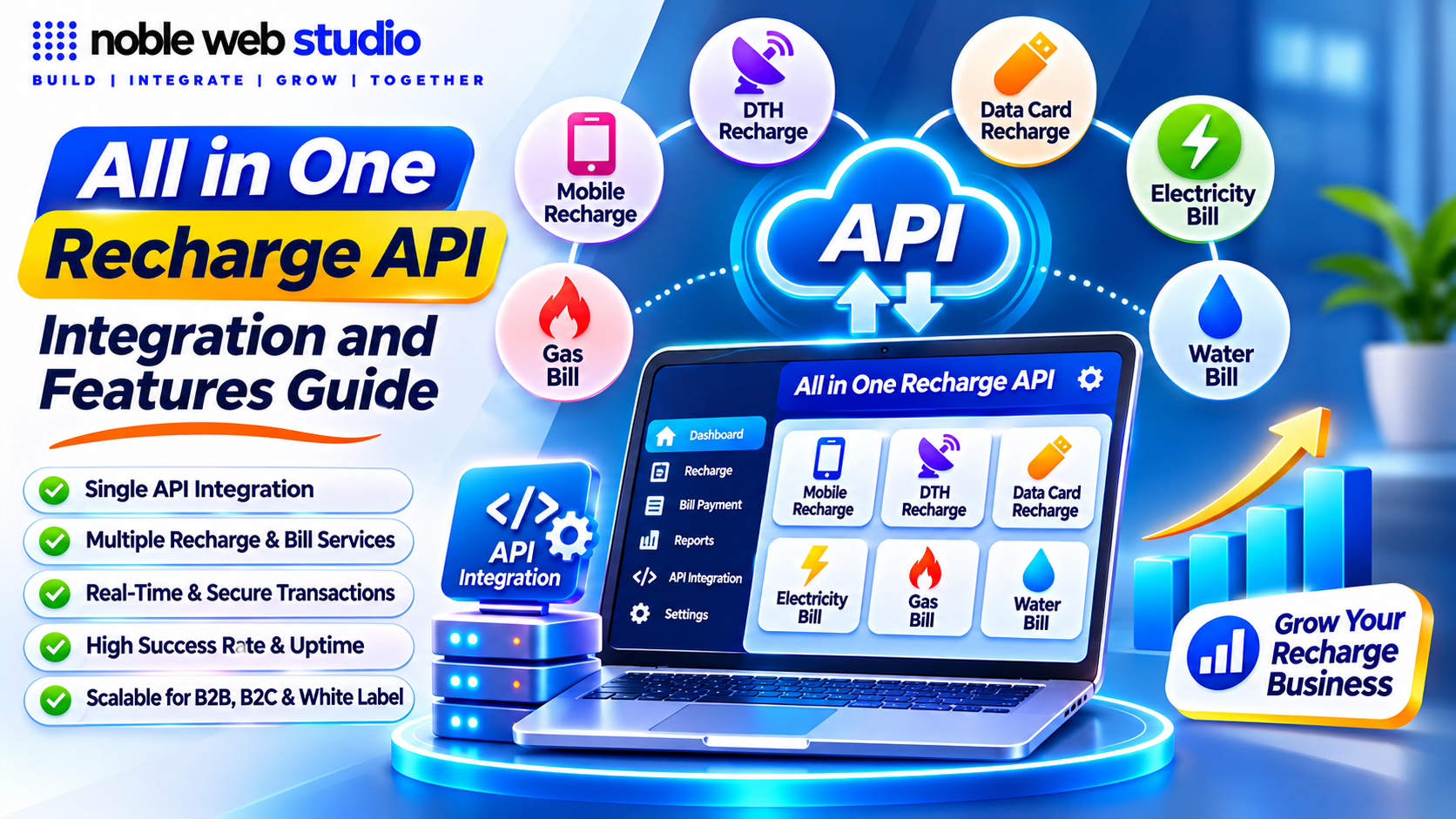
Are you looking for a reliable All in One Recharge API to start your own recharge business, develop a mobile recharge application, or integrate multiple digital payment services into your existing website? An All in One Recharge API is a powerful solution that enables businesses to connect multiple recharge and bill payment services through a unified All in One Recharge API integration.
An All-in-One Recharge API is a single integration interface that lets software applications, mobile apps, or websites connect to multiple telecom operators, DTH providers, and utility billers through one unified platform.
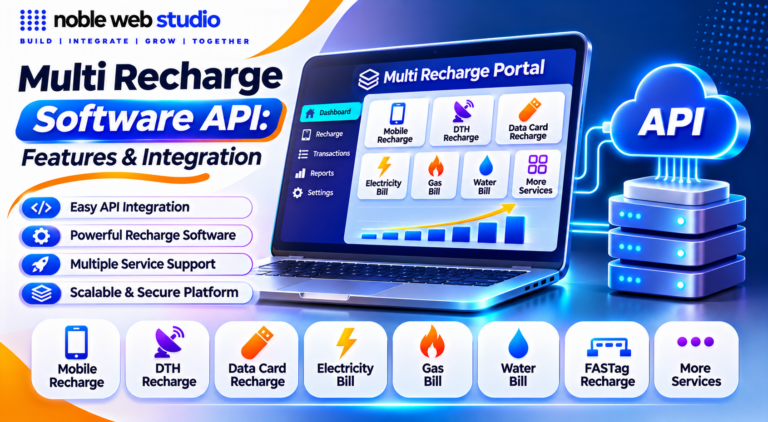
Noble Web Studio provides recharge API solutions designed to help businesses build and manage digital recharge platform. With an integrated recharge API, businesses can offer services such as prepaid mobile recharge, postpaid bill payments, DTH recharge, data card recharge and supported utility bill payments from a centralized platform.
Instead of managing separate integrations for every service, businesses can use a unified All in One Recharge API structure to simplify transaction processing, manage service requests and maintain transaction records. This makes an All in One Recharge API a useful technology for entrepreneurs, fintech startups, recharge software developers, retailers, distributors and companies planning to enter the digital payment industry.
Whether you want to launch B2B recharge portal, a B2C mobile recharge website, a white label recharge application or a multi recharge software platform, choosing the right recharge API integration is an important step towards building a scalable business.
With Noble Web Studio, businesses can explore recharge API integration possibilities according to their project requirements, service coverage and business model.
In this comprehensive guide, we will explain what an All in One Recharge API is, how it works, its essential features, supported recharge services, integration process, business benefits, pricing considerations and how to select the right recharge API provider for your business.
What Is an All in One Recharge API?
An all-in-one recharge API is a unified programming interface that lets businesses connect to multiple telecom, DTH, and utility service providers through a single integration point instead of building separate contracts and codebases for each vendor.
How Does an All in One Recharge API Work?
An All-in-One Recharge API works as a single technical bridge that connects your website or mobile recharge commission app to multiple telecom operators, DTH providers, and utility billers at once. Instead of building separate integrations with every individual services like Airtel, Jio, Tata Play, or local electricity boards, you integrate one unified interface to offer all these services.
Step-by-Step Working Flow
- Prefunded Wallet Setup. Before processing live transactions, you load funds into a master digital wallet provided by your API partner. Every successful customer recharge deducts the transaction amount from this balance, minus your earned commission.
- Customer Request and Validation. A user enters their mobile number, DTH subscriber ID, or utility consumer number on your platform. Optional helper All in One Recharge API can automatically detect the operator and telecom circle or fetch active plans and pending bill amounts before payment.
- API Request Trigger. Your system sends an encrypted HTTP POST request in JSON or XML format to the endpoint. This payload includes your authentication credentials, the customer number, operator code, amount, and a unique transaction ID.
- Operator Routing and Execution. The Noble web studio verifies your wallet balance, validates your IP address, and routes the request to the relevant telecom network or billing infrastructure such as BBPS. The operator processes the top-up or bill settlement in real time.
- Response and Webhook Callback. The All in One Recharge API immediately returns a transaction status typically Success, Failed, or Pending along with an operator reference ID. If a transaction is marked pending, the Noble web studio server sends an automated webhook update or lets you query a status endpoint until final settlement.
Why Is an All in One Recharge API Important for Digital Businesses in India?
An all-in-one recharge API is a unified integration layer that connects a website, mobile app, or business portal to multiple telecom operators, DTH providers, and utility services simultaneously.
Why It Is Important for Digital Businesses in India
- Single Integration Simplicity: Instead of building and maintaining separate technical workflows or contracts with every operator (Airtel, Jio, BSNL, Vodafone Idea, etc.), a business connects once to access 100+ operators. This reduces integration time by up to 90% and cuts development costs significantly.
- Real-Time Transaction Processing: Modern All in One Recharge API process recharges live against operator networks in sub-seconds, providing instant confirmation, automated status updates (success, pending, or failed), and eliminating manual queues.
- Multi-Service & Operator Coverage: Beyond standard mobile prepaid and postpaid top-ups, a single API often bundles DTH recharges, data packs, utility bill payments, and insurance services. Auto-detection features can also automatically identify the correct operator and circle for a given mobile number.
- Cost Efficiency & Reduced Manual Effort: Automating the recharge pipeline removes the need for manual intervention, driving down operational costs by up to 40% and accelerating transaction speeds by up to 60% compared to traditional or manual methods.
- Scalability & New Revenue Streams: It allows small retailers, startups, B2B recharge platform, and fintech entrepreneurs to easily add digital recharge services as a high-margin value-add or secondary revenue stream.
- Financial Inclusion & Digital Adoption: By embedding fast top-up tools into local and remote digital touchpoints, businesses help bridge the digital divide in semi-urban and rural India, where prepaid mobile services remain a daily necessity.
Services Supported by an All in One Recharge API
An all-in-one recharge API provides a unified integration interface to access multiple telecom, utility, financial, and digital services through a single backend connection.
Core Services Supported
Mobile & Telecom Services
- Mobile Prepaid Recharge: Instant talk-time, data packs, and SMS top-ups for major operators like Jio, Airtel, Vi, and BSNL.
- Mobile Postpaid Bills: Monthly bill payments for postpaid mobile connections.
- Data Card & Broadband: Recharge and bill payments for portable data cards, high-speed broadband, and landline connections.
DTH (Direct-to-Home) Services
- TV Subscriptions: Plan renewals and account balance/info checks for operators such as Tata Play, Dish TV, Airtel Digital TV, Sun Direct, and D2H.
Utility & BBPS (Bharat Bill Payment System) Payments
- Electricity Bills: High-voltage and low-voltage board bill fetch and payments (e.g., BSES, local state boards).
- Gas & Water Bills: Piped natural gas, LPG, and municipal water bill processing.
- FASTag Recharge: Highway toll prepaid tag recharges linked to vehicle numbers.
Financial & Banking Services
- Domestic Money Transfer (DMT): IMPS/NEFT fund transfers to bank accounts.
- AEPS (Aadhaar Enabled Payment System): Cash withdrawals and balance inquiries via biometric authentication.
- Loan Repayment & Insurance: EMI collections, LIC premiums, and recurring insurance policy payments.
Value-Added & Ancillary Services
- PAN Card & Travel Bookings: Identity verification, PAN application services, and travel/bus/hotel ticketing.
- Digital Gift Cards & Vouchers: E-fulfillment for brand gift cards and digital vouchers.
- Operator Detection & Plan Finder APIs: Real-time lookup tools to detect mobile operator/circle and fetch live recharge plans.
Features All in One Recharge API
An All-in-One Recharge API is a unified integration interface that lets a software platform, recharge commission app, or website process multiple digital top-up and utility payment services through a single connection.
Core Features
- Multi-Operator & Multi-Service Support: Covers prepaid and postpaid mobile recharges, data packs, DTH providers (Airtel Digital TV, Tata Play, Dish TV, Sun Direct), and data cards.
- Operator & Circle Detection: Automatically identifies the telecom operator and telecom circle/region from a mobile phone number before processing.
- Real-Time Transaction Processing: Executes live requests against operator networks with instant confirmations and sub-second to fast response times.
- Utility Bill Payments (BBPS): Integrate BBPS for electricity, gas, water, broadband, landline, and insurance bill payments.
- Bill Fetch & Plan Finder APIs: Fetches exact live bill amounts before payment and queries active mobile/DTH operator plans by circle.
- Domestic Money Transfer (DMT): Supports IMPS/NEFT fund transfers to bank accounts, plus additional services like FASTag recharges.
- Wallet, Balance & Status Tracking: Provides endpoints to check real-time wallet balances, verify transaction status via transaction IDs, and pull historical ledgers.
- Auto-Refund & Complaint Management: Built-in logic for automatic refunds on failed or dropped transactions and automated dispute/complaint raising.
- Developer-Friendly Integration: Noble web studio offers standard REST/JSON APIs, multi-language code samples (Node.js, PHP, Python), Postman collections, and a sandbox/testing environment.
- Security & Authentication: Uses encrypted protocols (TLS 1.3), unique recharge API keys, IP whitelisting, and request signing.
- Commission & Margin Management: Tracks operator-wise or plan-wise commissions, slabs, and distributor/retailer margins.
- White-Label Branding Options: Allows businesses to brand recharge portal, recharge admin panel, and retailer/distributor mobile apps under their own name.
Benefits All in One Recharge API
An All-in-One Recharge API is a unified software interface that lets businesses integrate mobile recharges, DTH, utility bill payments, and financial services into their website or app through a single connection.
Key Benefits
- Single Integration & Lower Costs: Reduces All in One Recharge API development time by up to 90% and cuts All in One Recharge API integration costs by roughly 70% compared to connecting with each operator individually.
- Single E-Wallet System: Uses one central wallet for all mobile and DTH operators, eliminating the need to maintain separate stock, pre-funded accounts, or physical recharge coupons for Noble web studio.
- Wide Multi-Operator Support: Connects users to 100+ telecom, DTH, and utility service providers via a uniform JSON/REST framework.
- Automated & Real-Time Processing: Provides instant recharges, live balance checks, automatic status tracking, and instant auto-refunds for failed transactions without manual intervention.
- New Revenue & Commission Streams: Allows businesses, shops, and apps to earn commission margins or service fees on every recharge and bill payment processed.
- High Security & Encryption: Features IP-based whitelisting, encrypted transactions, and fraud detection layers to protect user data and financial logs.
- Enhanced Customer Retention: Keeps users coming back to mobile recharge platform by offering a one-stop-shop experience for daily digital payments.
Who Can Use an All in One Recharge API?
An all-in-one recharge API can be used by any business, developer, or b2b recharge platform that wants to offer digital top-ups, bill payments, or value-added services to their customers without integrating directly with each individual operator.
Who Can Use an All-in-One Recharge API?
- Digital Wallets and Fintech Applications: Best Recharge commission App looking to provide instant mobile recharges, DTH top-ups, and utility payments right inside their user dashboard.
- E-Commerce Platforms: Online stores wanting to increase customer retention and engagement by letting users pay bills or recharge phones during checkout.
- Retail Businesses (B2C & B2B): Local shops, multi-service centers, or distributor networks offering assisted recharge and bill payment services to walk-in customers.
- Travel and Booking Websites: Bus, train, flight, or hotel booking portals that add mobile and DTH recharges as a convenience service for travelers.
- Custom Recharge Portals (White-Label Solutions): Entrepreneurs and startups launching their own branded multi-recharge or B2B/B2C payment website.
- Utility Bill & Service Providers: Recharge admin Platform expanding beyond a single service to handle electricity, gas, water, and broadband bills through one unified backend.
- Transportation and Logistics Companies: Fleet or commuter apps integrating FASTag recharges and transport pass renewals.
- Employer Benefits and Loyalty Programs: Companies managing corporate rewards, employee wallets, or points redemption programs that convert points into mobile or DTH recharges.
All in One Recharge API for B2B and B2C Recharge Businesses
An all-in-one recharge API lets B2B and B2C businesses integrate mobile, DTH, utility, and financial services into their own high commission recharge app or websites through a single connection instead of managing multiple vendor contracts individually.
Key Features for B2B & B2C Platforms
- Dual-Mode Operation: Manage individual end-users (B2C) alongside a hierarchy of resellers, distributors, and master distributors (B2B) with custom commission structures.
- White-Label Solutions: Noble web studio offer ready-made branded recharge portal and Android recharge apps if you prefer not to build the interface from scratch.
- Automated Endpoints: Real-time balance checks, operator/circle detection APIs, live plan lookups, and instant transaction status webhooks.
All in One Recharge API Integration: Step-by-Step Process
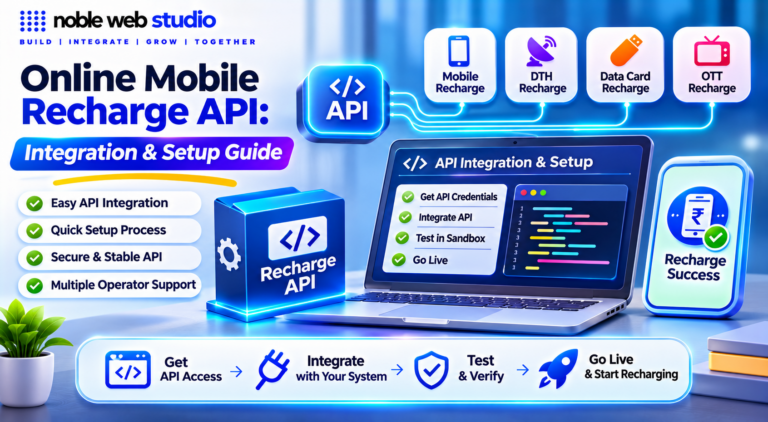
Integrating an All-in-One Recharge API (covering prepaid mobile, DTH, FASTag, and BBPS utility bills) connects your website or mobile app to telecom operators and billers through a single unified backend.
Following a structured implementation flow ensures reliable transaction processing, accurate wallet deductions, and automated status updates.
1. Noble web studio and Onboarding
- Choose a Reliable Aggregator. Noble web studio based on supported operators, commission structures, uptime, and technical documentation.
- Complete KYC and Whitelisting. Submit your business documents to activate your merchant account. Provide your production server IP address to the Noble web studio so they can whitelist it for secure API access.
- Obtain API Credentials. Collect your recharge API key, secret token, user ID, and base URLs for both the sandbox (testing) and live environments.
2. Backend Architecture Setup
- Build a Service Integration Layer. Noble web studio-specific logic inside your backend rather than exposing mobile recharge API keys in your mobile app or frontend. Store credentials securely using environment variables.
- Configure Master Data Endpoints. Set up initial recharge service API calls to fetch and cache operator codes, telecom circles, biller categories, and active browse plans.
- Add Operator Auto-Detection. Integrate the operator-and-circle lookup endpoint so highest commission recharge app automatically identifies the telecom services when a user enters a 10-digit mobile number.
3. Core Transaction Execution Flow
When a user initiates a recharge or bill payment, execute these steps sequentially on your server:
- Validate Input and Service Rules. Verify the mobile number format, subscriber ID, or biller account details. For utility bills, call the bill-fetch or validation endpoint before accepting payment.
- Generate a Unique Order ID. Create a distinct transaction reference ID in your database to ensure idempotency and prevent duplicate recharges.
- Debit the User Wallet. Deduct the recharge amount from the user’s internal wallet or confirm payment gateway capture before triggering the operator recharge API.
- Trigger the Recharge Request. Send a POST/GET request to the Noble web studio server transaction endpoint containing the operator code, circle code, customer number, amount, and your unique order ID.
4. Status Handling and Webhooks
- Process Synchronous Responses. Read the immediate recharge API response, which typically returns one of three states: Success, Pending, or Failed.
- Configure Callback Webhooks. Provide a public webhook URL to Noble web studio. Telecom operators frequently put transactions in a Pending state and send the final status asynchronously to your callback endpoint.
- Implement a Status Check Cron Job. Set up a scheduled background task to query the recharge Transaction Status API for any orders stuck in
Pendingbeyond a set timeout. - Automate Wallet Refunds. Immediately credit the amount back to the user’s wallet if a transaction returns a
Failedstatus either synchronously or via webhook.
5. Testing and Production Deployment
- Run Sandbox Scenarios. Use test numbers and mock operator codes provided in the sandbox environment to verify success, failure, timeout, and duplicate-order handling.
- Verify Reconciliation Logs. Cross-check your internal wallet ledger against the Noble web studio server transaction reports and operator reference numbers.
- Switch to Live Credentials. Replace sandbox URLs and keys with production credentials, fund your master recharge API wallet with the Noble web studio, and monitor initial live transactions.
Technical Architecture of an All in One Recharge API
An all-in-one recharge API technical architecture decouples the customer-facing application from multiple third-party telecom, DTH, and utility vendor networks using a layered, event-driven, and highly resilient backend design.
Core Architectural Layers
1. Edge & API Gateway Layer
- DNS & CDN: Routes user traffic globally with low latency.
- API Gateway (e.g., Kong, Envoy, or AWS API Gateway): Manages rate limiting, JWT/API-key authentication, IP whitelisting, and TLS 1.3 encryption.
- Idempotency Check: Intercepts incoming transaction requests with an
Idempotency-Keyheader to prevent duplicate recharges during network retries.
2. Business Logic & Orchestration Layer
- Common Integration Layer: Translates unified internal data models into Noble web studio-specific payloads (e.g., mapping generic mobile/DTH fields to distinct operator specifications).
- Operator & Circle Detection Engine: Automatically identifies the telecom operator and telecom circle from the input mobile number prefix (HLR/MNP lookup table).
- Validation & Bill-Fetch Service: For utility bills, triggers a mandatory pre-payment fetch/validation step (
/api/v1/bill/...) before debiting user funds.
3. Wallet, Ledger & Payment Engine
- Prepaid/Wallet Ledger: Manages user or B2B partner wallet balances atomically in ACID-compliant databases (PostgreSQL/MySQL).
- Payment Gateway Integration: Handles decoupled payment flows via UPI, net banking, or cards (treating payment and recharge as separate distributed transactions).
4. Asynchronous Message Queues & Workers
- Event Queues (e.g., RabbitMQ, Kafka, or Redis Streams): Offloads synchronous bottlenecks by pushing recharge requests to background workers.
- Worker Pools: Manages persistent socket connections, all in one recharge API tunnels, and retry policies to operator gateways without blocking main thread responses.
5. Provider Integration & Upstream Connectivity
- Multi-Operator Connectors: Interfaces with telecom carrier APIs, Bharat Bill Payment System (BBPS) switches, or aggregator APIs (Airtel, Tata Play, electricity boards) via private MPLS/VPN or hardened HTTPS endpoints.
- Reconciliation Cron & Webhook Handlers: Listens for async operator callback webhooks and runs automated reconciliation jobs to fix dropped, pending, or timeout transactions.
All in One Recharge API Commission Structure and Earning Opportunities
An All-in-One Recharge API allows software applications, websites, and B2B mobile recharge portal to process prepaid mobile, postpaid, DTH, and utility bill payments through a single unified interface.
Typical Commission Structure
Commissions vary by telecom operator, DTH provider, service category, and your position in the hierarchy (Admin, Master Distributor, Distributor, Retailer, or recharge API User).
Approximate industry commission ranges (sample breakdown based on Noble web studio rate cards):
Prepaid Mobile Recharge:
- BSNL: ~3.5% to 6.5%
- Vodafone Idea (Vi): ~3.8%
- Jio: ~0.7% to 3.5%
- Airtel: ~2.0% to 2.5%
DTH Recharge:
- Airtel Digital TV: ~4.2%
- Tata Play / Videocon d2h: ~4.1%
- Sun Direct / Dish TV: ~4.0%
Other Services & Utility Bills:
- FASTag / PAN Card / Money Transfer (IMPS): ~0.75% to 8.0% (varies by Noble web studio)
- Electricity, Gas, and Insurance Bills: Often 0.0% or flat utility processing fees (though customer convenience fees may apply).
Earning Opportunities & Business Models
Direct Commission & Margin Slabs
- Earn a percentage or fixed margin on every successful transaction processed through your wallet/API.
- High-volume operators like BSNL or select DTH providers offer higher percentage returns, whereas core mass-market telcos (Airtel/Jio) operate on tighter margins (0.7%–2%).
API Reselling & Spread Income
- If you act as an aggregator or platform owner, you can issue sub-APIs or white label recharge software solution to other local businesses or developers.
- Spread Model: You earn the difference (spread) between the higher commission/lower cost credited to you by the Noble web studio and the lower commission you pass down to your All in One Recharge API clients (typically a 0.1% to 0.5% margin per transaction). Processing thousands of daily hits across multiple clients builds steady passive volume income.
Multi-Tier Network Distribution (B2B Hierarchy)
- Build a chain of Master Distributors, Distributors, and Retailers.
- You earn an override or differential margin whenever anyone in your downline network performs a recharge.
- Noble web studio allow you to track real-time ledgers, webhook callbacks, and automated reconciliations.
Value-Added Service (VAS) Cross-Selling
- Combine basic mobile/DTH recharges with high-margin digital financial services like Aadhaar enabled Payment System (AePS), Domestic Money Transfer (DMT), PAN card applications, and FASTag recharges to boost per-shop profitability and customer retention.
All in One Recharge API Pricing: Setup Cost, Integration Charges and Other Fees
An All-in-One Recharge API setup involves several distinct cost components ranging from one-time onboarding fees to ongoing wallet balances and hidden maintenance charges.
1. Setup and Integration Costs
API Plans / One-Time Setup Fees:
- Basic or starter All-in-One Recharge API access plans generally range from ₹1,000 to ₹7,500 (one-time) depending on the Noble web studio.
- Multi recharge API, reseller, or white label recharge software packages (which include an mobile recharge admin panel, website, and Android app) range from ₹15,500 to ₹25,000+.
- Specialized verification, AEPS, or Bharat Bill Payment System (BBPS) / DMT API families may incur separate setup fees (e.g., ₹6,000–₹20,000 per family with Noble web studio).
Custom Software / Integration Work:
- If you are building a custom-coded platform or connecting multiple microservices, third-party or custom REST recharge API development can range from ₹40,000 to over ₹1,50,000.
2. Ongoing & Recurring Fees
- Platform & Monthly Charges: Noble web studio do not charge a monthly subscription or monthly minimum fee; instead, you operate on a prepaid wallet model.
- Annual Maintenance Contracts (AMC) / Renewals: White label recharge software setup or custom recharge commission app often carry yearly server, domain renewal, or AMC charges (ask providers upfront to avoid surprises).
- Play Store / App Updates: Maintaining a branded Android or iOS recharge app involves occasional costs for developer accounts, store compliance updates, or bug fixes.
3. Working Capital (Wallet Balance)
- Unlike standard software where you pay a license fee and walk away, a best recharge API requires you to maintain a pre-funded virtual wallet with the Noble web studio to process transactions:
- Solo/Small Setup: ₹10,000 to ₹25,000 initial wallet load.
- Reseller/Multi-Client Network: ₹50,000 to ₹1,00,000+ initial wallet load.
4. Commission Structure & Margins (How You Earn)
- Rather than charging a flat fee per call, Noble web studio operate on an operator-wise commission model credited back to your wallet per successful transaction:
- Mobile & DTH Operators: Typically yield a percentage or fixed commission per recharge (e.g., roughly 4% to 4.2% on DTH like Airtel Digital TV or Tata Play, or tiered per-plan cuts like ~6% on select operator recharges).
- Utility Bills & Postpaid (BBPS): Usually yield 0% commission or involve small customer convenience fees rather than backend margins.
- Hierarchy Split: If you use a multi-tier white label recharge API setup, margins are split across Master Distributors, Distributors, and Retailers.
All in One Recharge API Plan the Service Catalogue Before Integration
Planning your service catalogue before integrating an All-in-One Recharge API ensures you map out the exact operator codes, plan fetching flows, and wallet structures your platform needs. A structured catalogue prevents failed transactions, reduces All in One Recharge API development rework, and lets you configure accurate commission margins from day one.
1. Core Service Categories
Decide which verticals your application will support at launch versus future phases. Most Indian recharge API organize services into distinct categories:
- Prepaid Mobile. Covers major telecom operators like Jio, Airtel, Vi, and BSNL across specific telecom circles.
- DTH Recharge. Supports direct-to-home providers such as Tata Play, Airtel Digital TV, Dish TV, Sun Direct, and Videocon d2h.
- BBPS Utility Bills. Expands your catalogue to postpaid mobile, broadband, electricity, water, gas, and FASTag payments via Bharat Bill Payment System integration.
- Gift Cards and Vouchers. Adds digital brand vouchers, OTT subscriptions, and Google Play recharge codes for higher margin potential.
2. Operator & Circle Mapping
Noble web studio uses specific internal codes to route requests to the right telecom or utility network.
- Master Operator List. Obtain the Noble web studio exact Operator IDs and Service Codes for every biller you plan to offer.
- Circle Routing. Map state and regional telecom circles (e.g., Rajasthan, Delhi NCR, Maharashtra) so prepaid plans and tariffs load accurately for each user’s number.
- Auto-Detection Support. Check if the high speed recharge API includes an operator and circle lookup endpoint to auto-fill details when a user enters their mobile number.
3. Plan Fetching & Validation Flows
Modern recharge commission app require dynamic plan browsing rather than manual amount entry.
- Plan Browse API. Noble web studio offers live tariff endpoints categorized by Unlimited, Data, Talktime, Roaming, and Special Offers (R-Offer).
- Customer Info Fetch. Ensure the top recharge API supports DTH customer info checks (fetching subscriber name, current balance, and next recharge date) and BBPS bill fetch before payment.
- Input Parameter Rules. Document the exact validation rules for each category, such as 10-digit mobile numbers, 10-to-12-digit DTH Subscriber IDs, or electricity consumer numbers.
4. Commission & Pricing Structure
Define how your platform will monetize each service category in the catalogue.
- Margin Slabs. Noble web studio commission rates per operator, as prepaid telecom margins typically range from 1% to 5% while DTH and utilities vary.
- B2B vs. B2C Models. Decide whether you will pass cashback to end users (B2C) or configure multi-tier commission slabs for retailers and distributors (B2B).
- Convenience Fees. Identify which zero-margin utility categories require a customer convenience fee to cover payment gateway costs.
5. Transaction Lifecycle & Exception Handling
Map out how your system will handle every possible recharge API response state.
- Status Responses. Build logic for three core states:
Success,Failed, andPending. - Webhooks and Callbacks. Configure callback URLs so the Noble web studio can push instant status updates for pending transactions without constant polling.
- Auto-Refund Rules. Confirm how failed transactions trigger automatic wallet reversals for your users and reconcile against your master recharge API balance.
All in One Recharge API Design a Common Integration Layer
Designing a Common Integration Layer (often called an API Gateway or Adapter Layer) for an All-in-One Recharge API decouples your core business logic from external telecom, DTH, and utility (BBPS) providers. This architecture allows you to switch vendors, add new services, and implement smart routing without modifying your customer-facing higher commission recharge app.
1. High-Level System Architecture
The request flows through a standardized pipeline that isolates external quirks from your internal ledger.
[Client App / Web]
       │  (Standardized Internal JSON)
       ▼
[Core Business Backend] ──► (Auth, Wallet Debit, Commission, Duplicate Check)
       │
       ▼
┌──────────────────────────────────────────────────────────┐
│                COMMON INTEGRATION LAYER                  │
│  1. Router & Failover Engine (Selects best vendor)       │
│  2. Adapter Interface (Normalizes Request/Response)      │
│  3. Webhook & Polling Manager (Async status updates)     │
└──────┬─────────────────────┬─────────────────────┬───────┘
       │ (REST/JSON)         │ (XML/Form)          │ (BBPS Spec)
       ▼                     ▼                     ▼
  [Provider A]          [Provider B]          [Provider C]
2. Core Components of the Integration Layer
- Unified Request & Response Schema. Define a single internal payload format (e.g.,
transaction_id,service_type,operator_code,subscriber_number,amount). Your backend only ever speaks this canonical language, regardless of whether the upstream vendor uses JSON, XML, or URL-encoded query strings. - Provider Adapters (Strategy Pattern). Build an isolated adapter class for each Noble web studio. Each adapter handles vendor-specific authentication (recharge API key, IP whitelisting, HMAC signatures), maps your internal operator codes to vendor codes, and translates vendor error codes into standardized internal statuses (
SUCCESS,PENDING,FAILED). - Smart Routing & Failover Engine. Route traffic dynamically based on operator, circle, margin, or real-time success rates. Noble web studio A times out or returns a gateway error for a specific operator, the router automatically retries the transaction via Provider B.
- Asynchronous Callback & Polling Engine. Recharge transactions frequently return a
PENDINGstate. Expose a single webhook listener that routes Noble web studio callbacks to the right adapter for signature verification and payload parsing. Pair this with a background cron/worker to poll status recharge API for transactions stuck inPENDINGbeyond a set threshold.
3. Essential Guardrails & Financial Safety
- Idempotency & Duplicate Locks. Enforce a unique client_reference_id at the entry point and use distributed locks (e.g., Redis) per subscriber-amount pair for a short window (e.g., 60 seconds) to prevent accidental double recharges.
- Two-Phase Ledger Management. Debit the user’s wallet and lock the funds before calling the integration layer. Only finalize the ledger (or trigger an instant wallet refund) once the integration layer emits a terminal SUCCESS or FAILED event.
- Immutable Audit Logging. Store raw request payloads, raw Noble web studio responses, HTTP status codes, and latency metrics in a dedicated log table. Keeping raw logs alongside normalized records is critical for dispute resolution and vendor reconciliation.
4. Standardized Internal Contract Example
To keep your integration layer clean, enforce a strict contract between your business backend and the adapter interface, following mobile recharge API integration best practices:
| Field | Direction | Purpose |
|---|---|---|
txn_id | Request | Unique internal UUID generated by your backend. |
operator_id | Request | Internal standardized code (e.g., JIO_PRE, TATA_DTH). |
account_no | Request | Mobile number, DTH subscriber ID, or BBPS consumer number. |
status | Response | Normalized state: SUCCESS, PENDING, or FAILED. |
operator_ref | Response | Telco/BBPS live confirmation number (required for customer receipts). |
raw_code | Response | Original vendor response code for debugging and routing rules. |
All in One Recharge API Handle Different Service Rules Correctly
To handle different service rules correctly in an All-in-One Recharge API, your backend must enforce service-specific validation, input schemas, and workflows before routing a request to a single unified endpoint. While a unified reliable recharge API simplifies integration, bypassing the underlying rules of individual operators or utility billers causes failed transactions.
1. Service-Specific Validation Rules
Each service category requires distinct input parameters, formatting checks, and pre-transaction steps:
| Service Category | Key Identifiers | Pre-Transaction Rules & Validation |
|---|---|---|
| Mobile Recharge | Mobile number, Operator code, Circle | Validate 10-digit number format and use an Operator Detection API (accounting for MNP) to confirm the carrier and telecom circle. Match the amount against active plans from a Plan Fetch API. |
| DTH Recharge | Subscriber ID / Viewing Card number, Operator code | Verify the exact subscriber ID length and prefix rules per provider (such as Tata Play, Airtel Digital TV, or Dish TV). Validate minimum and maximum recharge limits. |
| Utility Bills (BBPS) | Consumer/Account number, Biller ID, Optional subdivisions | Call a Bill Fetch API first to retrieve the exact due amount, customer name, and due date. Enforce whether the biller allows partial payments, overpayments, or late-fee additions. |
| FASTag & Other Services | Vehicle registration number, Issuer bank / Service code | Validate vehicle number formatting and verify wallet limits or minimum top-up rules set by the issuing bank. |
2. Backend Architecture Best Practices
To manage varying rules cleanly across multiple services without hardcoding messy conditionals, implement these core patterns:
- Dynamic Schema Validation. Maintain a configuration table or JSON schema per operator and biller that defines regex patterns, required fields, and min/max amount limits. Validate user inputs against this schema on your server before calling the Noble web studio.
- Pre-Payment Discovery & Fetch. Always run lookup steps such as operator detection, plan fetching, or BBPS bill fetching before debiting a user’s wallet. Pass the resulting fetch reference ID into the final payment payload when required by the biller.
- Idempotency & Reference Tracking. Generate a unique transaction reference ID for every request. Passing this ID prevents duplicate recharges if a network timeout forces a retry.
- Normalized Error & Status Handling. Noble web studio-specific error codes into standardized internal statuses (
SUCCESS,PENDING,FAILED,REVERSED) and user-friendly messages. Use webhooks or status polling APIs to resolve pending utility and telecom transactions safely. - Sandbox Multi-Operator Testing. Test edge cases across every supported category in a staging environment before going live. Confirm Noble web studio behaves on invalid account numbers, expired plans, and bill-fetch mismatches.
All in One Recharge API Use a Consistent Transaction Reference System
Using a consistent transaction reference system across an all-in-one recharge API ensures that every mobile, DTH, FASTag, and utility bill payment can be tracked, reconciled, and verified without duplicate charges or lost records. Because a single platform routes requests to many different telecom operators and billing boards, standardized tracking prevents data mismatches when services behave differently.
Core Identifier Layers
To maintain full visibility from the moment a user clicks “pay” until the operator confirms completion, your system should map three distinct reference layers together:
- Client Order Reference. Generate a unique internal ID (such as
ORD-20261116-001) on your platform before sending the API request. Pass this ID as an idempotency key so retries never trigger double deductions. - API Provider Transaction ID. Store the gateway reference returned by the Noble web studio. You will use this ID to query status endpoints or match incoming webhook callbacks.
- Operator Reference ID (Live ID). Capture the final confirmation number issued by the telecom operator or utility board (such as Airtel, Jio, or BBPS). Displaying this Live ID on user receipts provides definitive proof of payment.
All in One Recharge API Manage Pending Transactions Without Creating Duplicates
To safely manage pending transactions in an All-in-One Recharge API without creating duplicates, you must implement idempotency keys, atomic database locking, and a polling/webhook reconciliation flow.
In recharge aggregators, a PENDING status occurs when the telecom operator or upstream Noble web studio delays confirmation due to network congestion. Retrying a transaction during this window without strict safeguards is the primary cause of double deductions.
1. Client-Side & API Safeguards (Idempotency)
Every recharge request must be uniquely identifiable before it leaves your system or hits the Noble web studio.
- Generate a Unique Client Reference ID: Create a globally unique
client_txn_id(such as a UUIDv4 or a timestamped order ID) in your database before calling the upstream recharge API. - Enforce Database Uniqueness: Apply a UNIQUE database constraint on
client_txn_idin your transactions table. This guarantees that even if a user double-clicks “Pay” or a network retry triggers twice, your database will reject the second insert. - Pass the Reference ID Upstream: Send your
client_txn_idin the payload to the All-in-One Recharge API. Noble web studio use this field to block duplicate requests on their end within a specific time window.
2. Handling PENDING States Safely
When an API call times out or explicitly returns a PENDING or PROCESSING status, never treat it as a failure and never automatically re-trigger a new recharge.
| Transaction State | Recommended System Action | Wallet / Ledger Action |
|---|---|---|
SUCCESS | Mark transaction complete and notify the user. | Keep user balance deducted. |
PENDING / Timeout | Lock the transaction and queue it for status verification. | Hold the deducted amount (do not refund yet). |
FAILED | Mark transaction failed and log the operator error code. | Refund the held amount back to the user’s wallet. |
- Implement Pessimistic Locking: When processing a status update or webhook, use row-level locking (
SELECT ... FOR UPDATEin SQL) on the transaction record. This prevents race conditions if a webhook arrives at the exact same millisecond a background cron job checks the status. - Strict State Machine Transitions: Only allow transitions from
PENDING→SUCCESSorPENDING→FAILED. Block any code path that attempts to modify a transaction already markedSUCCESSorFAILED.
3. Status Reconciliation (Webhooks + Polling)
Rely on a dual-verification approach to resolve pending transactions accurately.
- Primary (Webhooks / Callbacks): Configure a callback URL with Noble web studio to receive instant push notifications when a pending transaction settles. Always verify the webhook’s IP whitelist or HMAC signature before updating your database.
- Secondary (Exponential Backoff Polling): If a webhook is missed, run a background worker to call the Check Status API using your original
client_txn_id. Space out your checks (e.g., after 30 seconds, 2 minutes, 10 minutes, and 1 hour) to avoid hitting API rate limits. - Verify Upstream Transaction IDs: When a status check returns
SUCCESS, record the operator’sop_id(Operator Reference Number). If an operator ID is present, the recharge was definitively processed.
4. Recommended Database Ledger Pattern
Instead of directly subtracting from a user’s balance and adding it back later, use a three-column wallet balance or a double-entry ledger:
available_balance: Funds the user can currently spend.locked_balance: Funds tied up inPENDINGrecharges.- Workflow: When a recharge starts, move the amount from
available_balancetolocked_balance. If it succeeds, clearlocked_balance. If it fails, move it back toavailable_balance. This prevents users from spending the same money twice while a recharge is stuck in pending.
Choose Between a Noble web studio and All in One Recharge API
Noble web studio is an all-in-one recharge API provider requires evaluating service coverage, uptime reliability, commission/margin structures, and integration ease.
Key Factors to Evaluate
- Service Coverage: Noble web studio supports all major prepaid and postpaid mobile operators (Jio, Airtel, Vi, BSNL), DTH operators (Tata Play, Dish TV, Airtel Digital TV, Sun Direct), BBPS/utility bills (electricity, gas, water), and FASTag under a single dashboard.
- Uptime & Direct Connectivity: Noble web studio offering direct operator connectivity to minimize transaction dropouts, delayed confirmations, and failed callback responses.
- Commission & Pricing Structure: Compare transparent operator-wise margins and wallet-loading charges before committing.
- White-Label & Ready Portals: If you lack heavy development resources, check if the Noble web studio offers a white label mobile recharge commission app and web portal.
All in One Recharge API Security Across Multiple Service Integrations
Securing an All-in-One Recharge API across multiple service integrations such as mobile top-ups, DTH, BBPS utility bills, FASTag, and domestic money transfers requires a defense-in-depth architecture. Because a single gateway handles financial transactions across dozens of downstream telecom and banking providers, a vulnerability in one integration can expose your entire wallet balance and user database.
1. Authentication & Network Perimeter
- IP Whitelisting. Restrict Recharge API access so transactions are only accepted from your verified production server IP addresses. Even if credentials leak, unauthorized servers cannot initiate recharges.
- Scoped API Keys and Secrets. Use separate
X-API-KeyandX-API-Secretcredentials for sandbox testing versus live production. Implement role-based access control (RBAC) so distinct modules (e.g., utility bill fetch vs. money transfer) only have permissions for their required endpoints. - Mutual TLS (mTLS). Enforce HTTPS with TLS 1.3 for all data in transit, and use mTLS when connecting to high-risk financial endpoints like AePS or money transfers to verify both client and server certificates.
2. Payload Integrity & Replay Protection
- HMAC Request Signing. Sign every outgoing fast mobile recharge API payload using a cryptographic hash (such as HMAC-SHA256) generated from the request parameters, a timestamp, and your secret key. This prevents attackers from tampering with mobile numbers, amounts, or operator codes mid-transit.
- Nonce and Timestamp Validation. Include a unique request identifier (nonce) and a strict UTC timestamp window (e.g., 30 to 60 seconds) in every header. Reject expired or duplicate nonces to block replay attacks.
- Webhook Signature Verification. When receiving asynchronous status callbacks from Noble web studio, verify the incoming HMAC signature before updating user wallet balances or marking pending transactions as failed.
3. Transaction & Wallet Safeguards
- Idempotency Keys. Require a unique client-generated transaction reference ID (
txn_id) for every recharge attempt. If a network timeout causes your system to retry a request, the gateway will recognize the duplicate ID and prevent double-charging your wallet. - Velocity Limits and Anomaly Detection. Configure automated circuit breakers that flag or block unusual spikes, such as repeated recharges to the same mobile number within a short window or sudden high-value transfers.
- Wallet Segregation. Maintain separate float pools or daily spend caps for high-velocity, low-margin services (like prepaid mobile) versus high-value services (like domestic money transfers or electricity bills) to limit financial exposure during a breach.
4. Multi-Provider Routing & Data Compliance
- Unified Security Abstraction Layer. If you use Multi mobile recharge API Routing to switch between backup providers during downtime, build an internal middleware layer. This ensures your core application uses one consistent encryption and logging standard rather than exposing different vendor credentials across your codebase.
- PII Encryption and Tokenization. Encrypt sensitive customer data at rest (such as Aadhaar numbers for AePS, PAN details, or bank account numbers) using AES-256. Mask sensitive fields in application logs so developers and support staff cannot view raw customer credentials.
- Regulatory Adherence. Ensure your integration complies with local financial frameworks, such as NPCI / BBPS guidelines for bill payments and RBI data localization and KYC norms when handling wallet balances and money transfers.
All in One Recharge API Reporting and Reconciliation Across Services
An all-in-one recharge API consolidates mobile, DTH, utility, and bill-payment services into a single interface, making reporting and reconciliation critical to track money flow, commissions, and operator statuses.
Core Reporting Features Across Services
A unified reporting system should track and filter data across multiple dimensions:
- Multi-Service Filters: Filter transactions by date, service type (Prepaid Mobile, DTH, Electricity, Gas, FASTag, BBPS), operator/biller, user/retailer, amount, and status (Success, Pending, Failed, Refunded).
- Noble web studio Reference Tracking: Preserve original upstream Noble web studio server or operator transaction IDs so customer support can audit failures directly at the source.
- Real-Time Status & Webhooks: Use asynchronous webhook callbacks rather than manual polling to update transaction states the moment an operator or BBPS switch confirms or rejects a request.
- Commission & Margin Reports: Track per-transaction commissions, tiered distributor/retailer margins, and wallet balances across various operators and plans.
Reconciliation Workflow
Reconciliation compares internal database and wallet ledgers against external operator statements, payment gateway settlements, and bank logs.
- Stage Separation: Distinguish clearly between recharge/service completion (operator side), payment status (UPI, wallet, or card gateway), and wallet settlement. A recharge can succeed while a payment gateway webhook is delayed, or vice versa.
- Automated Daily Matching: Run automated scripts to match internal transaction logs with Noble web studio ledger exports to flag discrepancies.
Discrepancy Categories to Flag:
- Pending/Awaiting Confirmation: Transactions stuck in limbo where the debit happened but the operator hasn’t returned a final callback.
- Confirmed Failures vs. Debited Wallets: Cases where an operator rejected a top-up but the user’s wallet wasn’t auto-refunded immediately.
- Duplicate/Conflicting Status Updates: Multiple or looping webhooks for the same
txn_id. - Provider Statement Gaps: Mismatches in total settlement payout versus net commission-adjusted wallet debits.
Testing an All in One Recharge API
Testing an All-in-One Recharge API requires validating the complete transaction lifecycle across every supported service (mobile, DTH, FASTag, and utility bills), rather than just checking for a basic 200 OK response.
Before moving to production, run your sandbox integration through these core testing phases.
1. Environment & Authentication Setup
- Sandbox Credentials. Obtain your test recharge API keys, client secrets, and sandbox base URLs fromNoble web studio.
- IP Whitelisting. Ensure your local testing IP or staging server IP is whitelisted in the Noble web studio developer dashboard to avoid authorization errors.
- Postman / Browser Tools. Import the Noble web studio Postman collection or use an online tester to manually inspect raw request headers and JSON payloads before writing application code.
2. Core Functional Flow
- Operator & Circle Detection. Pass test mobile numbers to verify that the best mobile recharge API accurately returns the telecom operator and circle.
- Plan & Bill Fetching. Query live plans for prepaid/DTH and test bill-fetch endpoints (electricity, gas, water) to confirm accurate amounts, due dates, and customer names before payment.
- Wallet Balance Check. Verify your pre-funded sandbox wallet balance updates accurately before and after every test transaction.
3. Transaction States & Edge Cases
Most sandbox environments provide specific dummy numbers or test amounts to simulate different telecom operator responses. Test all four states:
- Confirmed Success. Verify the response returns a valid internal transaction ID alongside an operator reference ID.
- Confirmed Failure & Auto-Refund. Trigger a simulated failure to ensure the deducted wallet amount is automatically refunded and your system logs the failure reason properly.
- Pending & Timeouts. Simulate a delayed operator response to confirm your top recharge commission app places the transaction in a
Pendingstate instead of assuming failure. - Input Validation. Send malformed 10-digit numbers, unsupported operator codes, missing parameters, and zero/negative amounts to ensure clean error handling.
4. Webhooks, Retries & Reconciliation
- Webhook Callbacks. Use a tunneling tool (like ngrok) to expose your local webhook URL. Test valid, duplicate, and out-of-order callbacks to ensure your database updates transaction statuses reliably without double-crediting.
- Idempotency & Retries. Submit the exact same unique
reference_idtwice to verify the API blocks duplicate recharges if a network drop forces your system to retry. - Status Polling. For transactions stuck in
Pending, test theGET /statusendpoint to confirm your background cron jobs can fetch final resolution. - Ledger Reconciliation. Compare your internal transaction logs against the Noble web studio sandbox settlement report to verify that commissions, deductions, and refunds match to the exact decimal.
White Label All in One Recharge API: Launch Your Own Recharge Brand
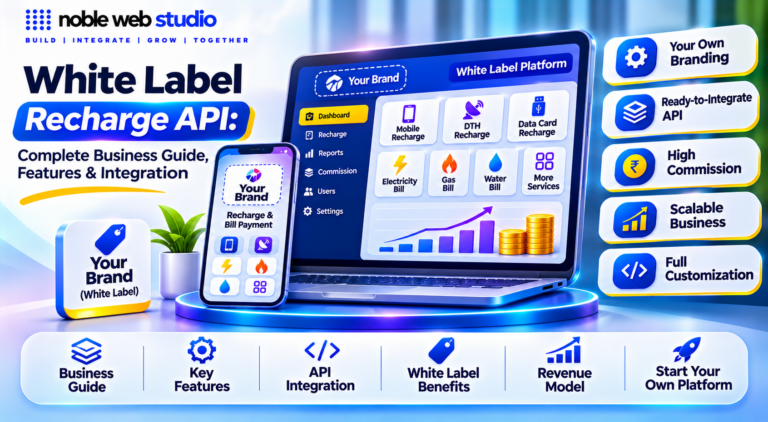
A White Label All-in-One Recharge API and Software solution allows you to launch your own branded B2B/B2C mobile recharge, DTH, and utility payment business without building the infrastructure from scratch.
Key Features of White-Label Recharge Platforms
- Your Own Brand Identity: Custom domain name, company logo, color themes, web portal, and branded Android/iOS mobile apps for your sub-dealers and retailers.
- Multi-Service Integration: Access to mobile/DTH recharges, Bharat Bill Payment System (BBPS) utility bills (electricity, water, gas, broadband), money transfer (DMT), AEPS, FASTag, and PAN card services through Noble web studio.
- Admin & Commission Control: Multi-tier wallet systems where you can manage master distributors, distributors, and retailers while setting customized commission structures and profit margins.
- API Redundancy & Uptime: Built-in automatic operator switching across Noble web studio to ensure high success rates and 99.9% uptime.
- Fast Deployment: Turnkey recharge platform can typically be deployed and customized within 2 to 72 hours depending on the Noble web studio.
Single Recharge API vs Multiple Recharge APIs: Which Is Better?
A single (unified) recharge API is better for startups and small businesses seeking fast recharge Api setup, while multiple mobile recharge API with smart routing are better for high volume recharge platform that require maximum uptime and the highest commission margins.
Choosing between the two depends on your daily transaction volume, engineering capacity, and tolerance for operator downtime.
Side-by-Side Comparison
| Feature | Single Recharge API | Multiple Recharge APIs |
|---|---|---|
| Setup & Maintenance | Fast integration using one endpoint and one authentication flow. | Longer setup requiring separate integrations and ongoing maintenance for each vendor. |
| Uptime & Reliability | Vulnerable to single-vendor outages or slow peak hours. | High reliability through Multi-API Routing and automatic failover. |
| Commission Margins | Fixed wholesale rates set by your single aggregator. | Higher profits by routing each telecom operator to whichever Noble web studio offers the best rate. |
| Wallet & Settlement | Easy management with a single pooled wallet balance. | Complex reconciliation requiring split funds across multiple vendor wallets. |
| Best For | MVPs, new apps, and businesses with moderate daily volume. | Established fintech apps, B2B distributors, and high-volume platforms. |
When to Choose a Single Recharge API
A single multi recharge API bundles mobile prepaid, DTH, and utility bill payments (BBPS) into one connection.
- Faster time to market. You only need to write code once to connect to one dashboard, avoiding the weeks of extra development required to map multiple vendor schemas.
- Simpler cash flow. You maintain a single prefunded wallet for all transactions instead of tying up working capital across three or four different providers.
- Lower engineering overhead. Noble web studio handle backend operator changes, meaning your developers spend less time fixing broken endpoints.
When to Choose Multiple Recharge APIs
Connecting multiple APIs allows your software to use trusted recharge API switching, which automatically routes transactions to the best-performing vendor in real time.
- Protection against peak-hour slowdowns. Noble web studio, if one route slows down for a specific operator like Jio during busy evening hours, your system can instantly switch only that operator to a backup API.
- Margin optimization. Noble web studio offer varying commission slabs per telecom circle or operator. Multiple All in One Recharge API let you route each recharge to the vendor paying the highest recharge commission.
- Reduced dependency. You avoid vendor lock-in and protect your business if a Noble web studio changes its terms, experiences server downtime, or runs out of operator stock.
Noble Web Studio One of The Best All in One Recharge API Provider in India
Noble web studio one of the best all in one recharge API provider requires evaluating technical performance, operator coverage, and business terms rather than focusing solely on commission rates.
1. Transaction Success Rate & Reliability
- Target Success Rate: Look for a Noble web studio boasting a 99% to 99.9% success rate.
- Automatic Fallback: Ensure they use direct operator routing and automated fallback switches to reroute failed requests immediately through secondary pipes.
- Low Latency: Recharge API response times should ideally be under 200ms to 5 seconds to prevent user drop-offs and duplicate payment submissions.
2. Multi-Operator & Multi-Service Coverage
- All-in-One Range: Verify that the single recharge API supports all major telecom operators (Airtel, Jio, Vi, BSNL), DTH providers (Tata Play, Dish TV, etc.), FASTag, data cards, and utility bill payments (BBPS).
- Dynamic Plan Verification: Prepaid plans and tariffs change frequently; real-time plan fetching ensures your users see accurate, up-to-date pricing.
3. Asynchronous Webhooks & Callbacks
- Real-Time Status Updates: The smooth mobile recharge API must support automated webhook callbacks so your system gets instant, accurate final transaction statuses (Success, Pending, or Failed) without needing manual refreshes.
4. Transparent Commission & Fee Structure
- Operator-Wise Breakdown: Do not just look at the highest headline commission percentage. Review the complete, operator-by-operator commission chart.
- Hidden Charges: Check for setup fees, annual maintenance charges (AMC), or wallet-loading charges.
5. Developer Tools & Documentation
- Sandbox & Documentation: Look for clean, well-documented recharge API with sandbox/testing environments so recharge API developer can safely test live-like recharges before going into production.
- Live Small-Batch Testing: Always test a Noble web studio with a small live transaction volume before committing to a heavy integration or large wallet load.
6. Support & Uptime
- 24/7 Technical Support: Recharge failures happen outside standard business hours; round-the-clock technical and customer support is vital to resolve stuck or pending balances quickly.
Why Choose Noble Web Studio for All in One Recharge API Services?
Noble web studio one of the all-in-one recharge API provider lets you integrate mobile, DTH, utility bills, and financial services through a single technical connection rather than managing dozens of individual operator agreements.
Key Reasons to Choose an All-in-One Recharge API Provider
- Single Integration & Faster Time-to-Market: Instead of building separate integrations for Jio, Airtel, Vi, BSNL, and various DTH or utility billers, a single mobile recharge API cuts development time and costs significantly.
- Extensive Service Portfolio: Noble web studio bundles multiple services such as prepaid/postpaid mobile recharges, DTH (Tata Play, Dish TV, etc.), electricity, gas, water bills, BBPS, and domestic money transfer (DMT) under one roof.
- High Transaction Success Rates & Smart Routing: Noble web studio feature direct operator pipes and automatic fallback switches to minimize transaction drops and ensure near-instant processing.
- Low Latency & Real-Time Plan Verification: Sub-200ms response times prevent user drop-offs, while dynamic plan lookup tools ensure end-users always see up-to-date telecom and DTH pricing.
- Automated Webhooks & Error Handling: Real-time asynchronous alerts and built-in refund management eliminate the need for server-loop polling to check transaction statuses.
- White-Label & Admin Dashboard Support: Noble web studio offer ready-to-use best recharge admin panel or white-label web/mobile recharge portals so businesses can monitor transactions, manage retailer/distributor networks, and track operator-wise commissions without heavy coding.
Conclusion
Choosing the right All in One Recharge API is an important decision for businesses that want to enter the digital recharge industry, expand their existing services, or build a scalable online payment platform. A reliable mobile recharge API can simplify multiple service integrations, automate transaction processing, improve operational efficiency, and provide customers with a convenient recharge and bill payment experience.
An All-in-One Recharge API is a unified recharge software interface that lets high recharge commission apps, websites, or billing systems connect once to process multiple digital services such as mobile recharges, DTH top-ups, utility bill payments, and money transfers across various operators through a single integration.
With Noble Web Studio, businesses can explore an integrated recharge API solution for mobile recharge, DTH recharge, data card recharge, and supported utility bill payment services through a centralized mobile recharge API integrate. Whether you are a startup, retailer, distributor, fintech company, recharge software developer, or established business, the right recharge API infrastructure can help you develop recharge platform according to your business requirements.
Before selecting an All in One Recharge API provider, always evaluate mobile recharge API documentation, supported operators, transaction success and failure handling, wallet management, security, commission structure, integration costs, and technical support. These factors play an important role in building a dependable recharge business and maintaining customer trust.
If you are planning to launch your own B2B recharge portal, B2C recharge website, white label recharge application, or custom mobile recharge software, Noble Web Studio can help you explore the right recharge API integration for your business goals.
Ready to Start Your Recharge Business?
Contact Noble Web Studio to discuss your All in One Recharge API requirements, explore integration possibilities, and take the next step towards building your own digital recharge platform.
Choose a smarter way to manage recharge services with an All in One Recharge API by Noble Web Studio!
All in One Recharge API with Noble Web Studio
Looking for a reliable All in One Recharge API for your business? Noble Web Studio provides recharge API solutions to help businesses integrate mobile recharge, DTH recharge, data card and other digital services through a single platform. Contact our team to discuss API integration, service coverage, features, pricing and setup options for your recharge business.
Frequently Asked Questions About All in One Recharge API
An All in One Recharge API is a technology solution that connects multiple recharge and digital payment services with a single business application. It enables websites, mobile applications and recharge portals to communicate with supported service providers through API integration. Businesses can manage different recharge services, process transactions and monitor their status through a centralized system. The exact functionality depends on the Noble web studio and available integrations.
An All in One Recharge API can support multiple digital services, depending on the service coverage. Common integrations include:
Prepaid mobile recharge
Postpaid mobile bill payments
DTH recharge
Data card recharge
Electricity bill payments
Water bill payments
Gas bill payments
Other supported utility payment services
Before choosing an API, businesses should verify the available operators, billers and service categories.
Yes. An All in One Recharge API can provide the technical connectivity required to build your own online recharge business. You can integrate supported services into a website, mobile application, retailer portal or distributor recharge platform. Depending on your business model, you may also need customer management, wallet functionality, transaction reports and administrative controls. Commercial agreements and applicable regulatory requirements should also be considered.
Noble Web Studio can help businesses explore recharge API integrating according to their technical and business requirements. A suitable integration can bring multiple supported services into one mobile recharge admin platform, simplify transaction management and provide a centralized way to handle recharge operations. Before proceeding, discuss available services, recharge API documentation, integration scope, pricing and technical support with the Noble Web Studio team.
Yes. Depending on the recharge API integrated network, one live recharge API connection may support multiple mobile operators. Your application can use the relevant operator identifiers and service-specific request parameters to submit recharge requests. Always verify the current operator list, supported circles, transaction limits and applicable service conditions before going live.
All in One Recharge API integration generally involves obtaining authorized recharge API credentials, reviewing technical documentation, configuring backend connectivity, mapping request and response parameters, and implementing transaction-status management. All in One Recharge API Developers should also test successful, failed and pending transactions before production deployment. Noble Web Studio can discuss the integration requirements and suitable implementation approach for your project.
Yes. An All in One Recharge API can be used in both B2B and B2C business models. B2B mobile recharge platform generally focus on distributors, retailers, agents and business account management. B2C recharge platform focus on providing recharge and bill payment facilities directly to customers. The required dashboard, user permissions, wallet features and reporting system will depend on the selected business model.
Recharge transactions may receive successful, failed or pending responses. A properly designed integration should maintain transaction references and provide a method to verify uncertain requests through the Noble web studio supported status-checking mechanism. Confirmed failures should follow the applicable refund or balance-restoration process. A new request should not automatically be submitted when the original transaction’s final status is unknown, as this could result in duplicate processing.
Before selecting a recharge API, evaluate the features that directly affect your business operations, including:
Multiple service and operator support
Secure API authentication
Transaction status checking
Wallet and ledger management, if required
Admin and retailer management
Commission configuration, if supported
Transaction history and reporting
Error handling and duplicate prevention
Recharge API documentation and testing facilities
Technical support and maintenance
Selecting features according to your actual requirements can help you avoid unnecessary development costs.
The cost of an All in One Recharge API depends on the Noble web studio, integration complexity, number of services, customization requirements and commercial agreement. Noble web studio may charge an initial recharge API setup fee, while additional costs can include development, hosting, maintenance and service usage. Contact Noble Web Studio for project-specific pricing and confirm all applicable charges before purchasing.
Yes, branding customization may be available depending on the recharge software package and development agreement. Businesses can explore options such as their own logo, website interface, domain, retailer dashboard and mobile application branding. Confirm which customization options, source-code rights and administrative controls are included before finalizing your project.
Choosing the Noble web studio requires evaluating service coverage, integration quality, transaction handling, best recharge API documentation, security, technical assistance and overall commercial terms. Check whether the Noble web studio offers the services your customers need and whether its integration can handle pending transactions, transaction enquiries and reconciliation. You should also request a demonstration or testing environment wherever available. Noble Web Studio can help you discuss your project requirements and explore an appropriate recharge API integration solution.