Ankit
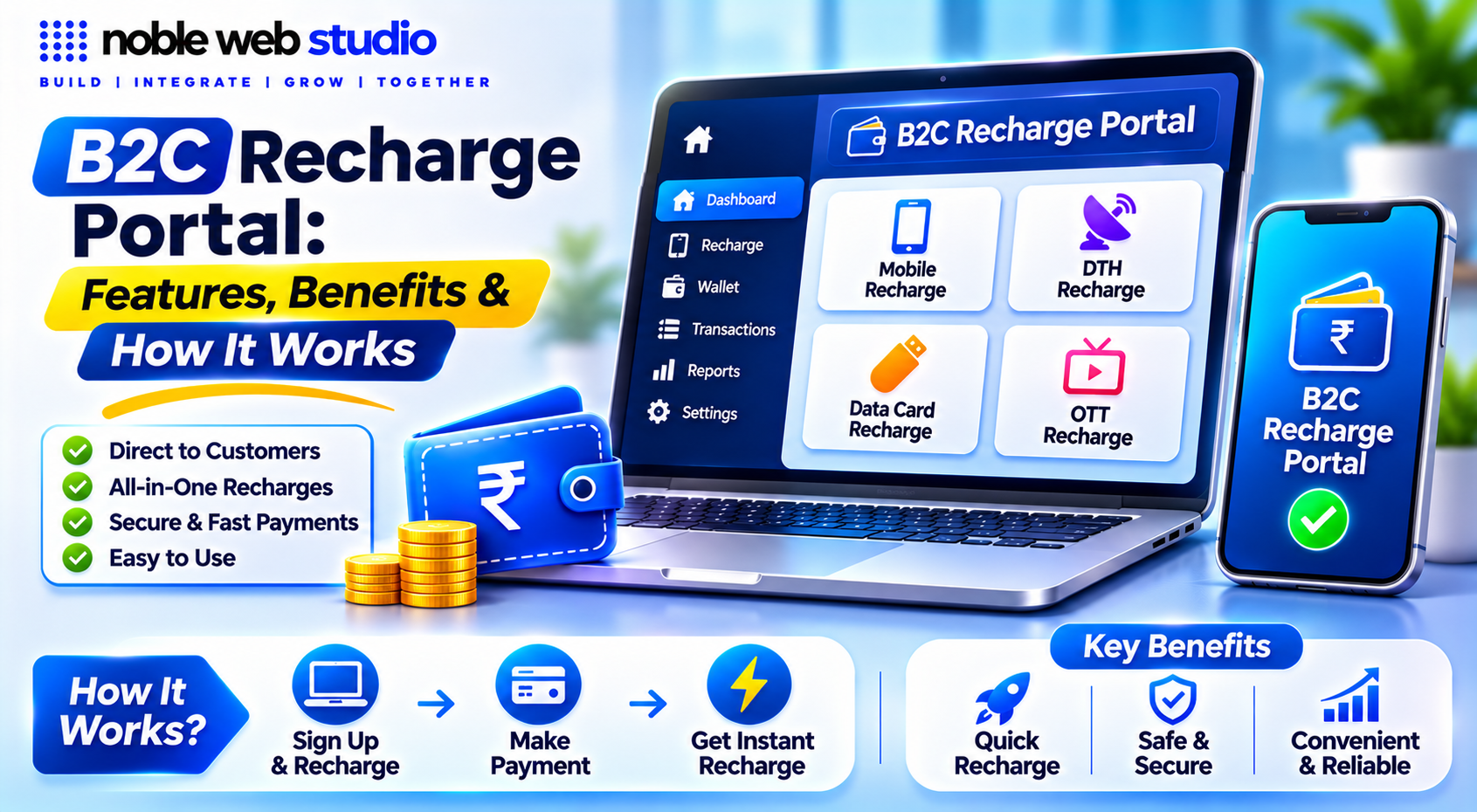
The increasing demand for digital payments and online mobile recharges has created new business opportunities for entrepreneurs, startups, and fintech companies. A B2C Mobile Recharge Portal allows businesses to offer mobile recharge services directly to individual customers through a website or mobile application. Customers can enter their mobile number, select an operator, choose an available recharge plan, make an online payment, and check their transaction status without visiting a physical retail store.
For businesses planning to enter the online recharge industry, having a dedicated B2C recharge platform provides greater control over customer accounts, recharge services, payment processing, and daily operations. A well-developed portal can support prepaid mobile recharges, DTH services, postpaid bill payments, transaction history, digital receipts, customer notifications, and administrative reporting, depending on the available service integrations. Features such as a mobile-friendly interface, secure payment gateway, real-time transaction updates, and easy recharge management can help create a convenient experience for customers.
A B2C (Business-to-Consumer) Mobile Recharge Portal is an online platform or mobile application that lets individual customers recharge their mobile numbers, pay DTH bills, and settle utility services directly without visiting a physical store or retailer.
Noble Web Studio provides fintech software development and recharge API integration solutions for businesses looking to establish their own online recharge platform. Whether you want to launch a branded B2C Mobile Recharge Portal, develop a customer-facing recharge website, build mobile recharge application, or integrate multiple recharge operators through APIs, the recharge platform can be planned according to your business requirements. From customer registration and recharge processing to payment integration and transaction management, the right software infrastructure helps organize essential business operations.
In this guide, we will explore how a B2C Mobile Recharge Portal works, its essential features, recharge API integration, payment gateway requirements, customer management, development process, software cost, and important factors to consider before choosing a recharge portal development company in India.
What is a B2C Mobile Recharge Portal?
A B2C (Business-to-Consumer) mobile recharge portal is an online website or mobile application where individual customers can directly top up their own or someone else’s mobile number without going through a local retailer or shopkeeper.
Types of Recharge Services Supported by a B2C Recharge Portal
A B2C (Business-to-Consumer) recharge portal allows individual customers to directly manage and pay for telecom, entertainment, and utility services through a website or mobile application.
Core Recharge & Top-Up Services
- Prepaid Mobile Recharges: Instant talktime, data packs, and special validity plans across all major telecom operators (e.g., Jio, Airtel, Vi).
- Postpaid Mobile Bill Payments: Monthly bill settlement for postpaid mobile connections.
- DTH (Direct-to-Home) Recharges: Top-ups and channel pack renewals for DTH television providers like Tata Play, Airtel Digital TV, Dish TV, and Sun Direct.
- Data Card Recharges: Internet data plan recharges for portable or plug-in broadband data cards.
Utility & Bill Payments (via BBPS)
Through integrated platforms like the Bharat Bill Payment System (BBPS), B2C portals support:
- Electricity Bills: Monthly power utility payments for state and private discoms.
- Water & Gas Bills: Municipal water bills and piped/cylinder gas utility payments.
- Broadband & Landline Bills: Fixed-line telephone and high-speed fiber internet bills.
- Insurance & Loan EMIs: Policy premium payments (such as LIC) and select financial obligations.
Transport & Financial Services
- FASTag Recharge: Instant toll-tag balance top-ups for highway travel.
- AEPS & Money Transfers: Aadhaar-enabled payment services or peer-to-peer wallet transfers (depending on specific platform licensing and features).
- In-App Wallets & Digital Payments: Stored-value user wallets topped up via UPI, credit/debit cards, or net banking, often paired with cashback and referral engines.
Essential Features of a B2C Mobile Recharge Portal
A B2C mobile recharge portal allows customers to directly top up prepaid numbers, pay postpaid bills, and manage digital utility services through a website or mobile application.
Core Features of a B2C Mobile Recharge Portal
- Multi-Operator Support: Instant compatibility with major telecom providers for prepaid mobile recharges, postpaid bills, DTH connections, and data packs.
- Plan Discovery & Browsing: Interactive catalog allowing users to view operator plans, validation periods, and data benefits before selecting.
- Integrated Payment Gateways: Support for checkout via UPI, net banking, credit/debit cards, and digital wallets.
- Real-Time Processing & Status: Sub-second operator routing with clear transaction tracking (pending, successful, failed, or refunded) and instant digital receipts.
- Customer Accounts & Wallets: Built-in user profiles to save favorite numbers, view order history, repeat past recharges, and manage internal wallet balances.
- Promotions & Notifications: Automated push, SMS, or email alerts paired with coupon codes, cashback offers, and festive banners.
- Admin & Support Dashboard: Tools for business owners to monitor transactions, manage support tickets, configure best recharge API and track customer engagement.
B2C Mobile Recharge Portal Development Process: Step by Step
Developing a B2C (Business-to-Consumer) mobile recharge portal involves a structured, step-by-step technical and business workflow.
Step 1: Planning and Business Registration
- Define Scope & Services: Decide if the portal will handle only prepaid/postpaid mobile recharges and DTH, or expand into utility bills (electricity, water, gas) and Bharat Connect (BBPS).
- Business Registration & Compliance: Register your company (Proprietorship, Partnership, or Private Limited) and open a current bank account.
- Documentation & Legal Agreements: Gather KYC/KYB documents, PAN, GST details, and sign technical/commercial agreements with Noble web studio.
Step 2: UI/UX Design and Branding
- Wireframes & User Flows: Design clean, conversion-focused customer journeys for selecting operators, browsing plans, and entering phone numbers.
- Responsive Web & App Layout: Build intuitive designs for web browsers as well as optional Android/iOS recharge apps.
Step 3: Recharge & Utility API Integration
- API Selection: Partner with Noble web studio that route transactions to major operators.
- API Switching & Failover: Implement multi recharge API routing so that if one telecom/utility gateway fails, the system automatically shifts to a Noble web studio.
- Payment Gateway Integration: Integrate payment options such as UPI, debit/credit cards, net banking, and digital wallets for customer checkouts.
Step 4: Core Back-End & Admin Dashboard Development
- Server-Side Logic & Database: Build secure databases to track user profiles, transaction logs, live recharge statuses, and wallet balances.
- Admin Dashboard: Create an operational panel to monitor daily transactions, manage refund requests, view success/failure reports, and track customer support tickets.
- Security & Encryption: Implement SSL encryption, multi-factor authentication, and data privacy safeguards.
Step 5: Quality Assurance and Testing
- Sandbox & Live Testing: Test operator fetch responses, payment gateway callbacks, webhook triggers, and edge cases (e.g., dropped connections or payment timeouts).
- Load & Performance Testing: Ensure the server handles concurrent high-volume traffic smoothly during peak hours.
Step 6: Deployment and Launch
- Cloud Hosting: Deploy the web portal on a scalable cloud server.
- Go-Live & SEO: Publish SEO-optimized landing pages, setup customer helpdesk scripts, and initiate go-to-market (GTM) strategies.
- Post-Launch Maintenance: Monitor live transaction analytics, push regular recharge software updates, and fix bugs promptly.
B2C Mobile Recharge Portal Business Model Explained
A B2C (Business-to-Consumer) Mobile Recharge Portal is a direct digital recharge platform (website or mobile recharge commission app) where individual end-users perform mobile recharges, DTH top-ups, and utility bill payments for themselves or family members.
How the B2C Recharge Model Works
- Single-Tier Structure: Unlike B2B or multi-tier network models (which use distributors and local retailers), B2C operates on a direct link between b2b recharge platform and the end consumer.
- User Flow: A customer visits your web portal or recharge commission app, enters their mobile number or account details, selects a telecom/utility plan, and pays online via UPI, debit/credit cards, or a built-in wallet.
- Backend Integration: Once payment clears, recharge commission platform communicates via a reliable Recharge API (Application Programming Interface) with telecom operators or aggregator gateway partners to fulfill the recharge almost instantly.
Core Components & Tech Stack
To run a B2C recharge portal, you need:
- Customer-Facing Interface: A responsive website and an Android/iOS mobile application.
- Recharge & Bill Payment APIs: Reliable telecom/aggregate APIs with failover switching (routing through Noble web studio server if one top recharge API fails).
- Payment Gateway & Wallet System: Integrated UPI, cards, net banking, and an internal digital wallet for quick one-tap checkouts.
- Admin & Reporting Panel: Real-time transaction status tracking (success, pending, failed), automated reconciliation, and customer support ticket management.
How Does a B2C Recharge Portal Generate Revenue?
A B2C (Business-to-Consumer) recharge portal generates revenue through a mix of operator commissions, convenience fees, cross-selling financial or utility services, and digital advertising.
Primary Revenue Streams
- Operator Commissions & Margins: The branded recharge portal earns a small percentage commission or fixed margin from telecom operators, DTH (Direct-to-Home) service providers, and utility billers for every successful transaction processed through the platform.
- Convenience or Gateway Fees: Some B2C recharge platforms charge end-users a small nominal "convenience fee" or "handling charge" per online transaction, especially for utility bill payments or credit card-based recharges to cover payment gateway costs.
- Value-Added Services (VAS) & Fintech Integration: Modern B2C recharge portals expand beyond basic mobile recharges to offer high-margin services such as:
- BBPS (Bharat Bill Payment System) utility bill payments
- AEPS (Aadhaar Enabled Payment System) and money transfers (DMT)
- PAN card assistance, insurance policies, and travel/gift card sales
- In-App Advertising & Promotions: Portals with high daily active user traffic monetize banner space, featured brand offers, or sponsored digital products targeted at consumers.
B2C vs B2B Mobile Recharge Portal: Key Differences
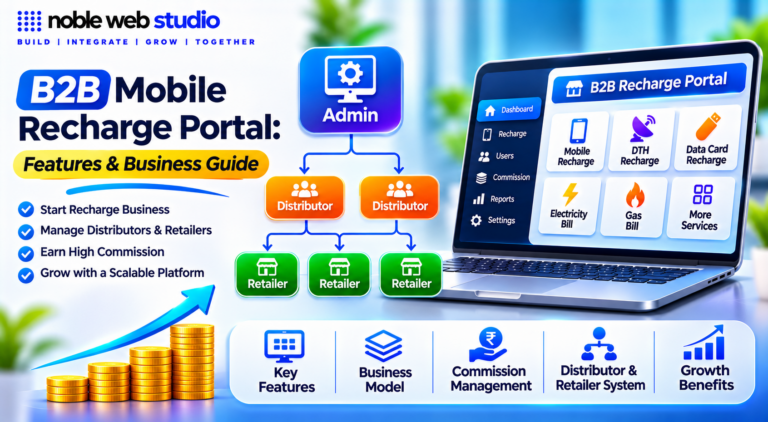
A B2C (Business-to-Consumer) mobile recharge portal serves individual end-users directly, whereas a B2B (Business-to-Business) mobile recharge portal serves a multi-tier network of distributors, retailers, and local agents who process recharges on behalf of customers.
Key Differences
| Factor | B2C Recharge Portal | B2B Recharge Portal |
|---|---|---|
| Target User | Individual end-consumers (general public) | Distributors, master distributors, and local retailers |
| Business Structure | Single-tier (Platform directly to the customer) | Multi-tier (Admin → Master Distributor → Distributor → Retailer) |
| Transaction Flow | The customer logs in and recharges their own phone or pays their own bill | The retailer logs in and initiates the recharge/bill payment for a walk-in customer |
| Revenue Model | Earns a tiny margin/convenience fee across high-volume individual transactions | Commissions are shared/spread across multiple hierarchy levels in the network |
| Customer Acquisition | High marketing and branding costs to compete with apps. | Lower direct marketing cost; grows by onboarding channel partners and local shopkeepers |
| Initial Investment | Higher (custom app development, payment gateway integration, heavy user acquisition) | Lower entry barrier (often run via white-label SaaS subscriptions starting around ₹1,499/month) |
Which Model Should You Choose?
- Choose B2C if you have deep capital reserves, strong brand-building capabilities, and want to capture direct consumer traffic through a self-serve app or website.
- Choose B2B if you want a faster path to steady transaction volume by empowering a ground network of local kirana stores, e-seva centers, and regional agents.
Why Choose a White Label B2C Mobile Recharge Portal?
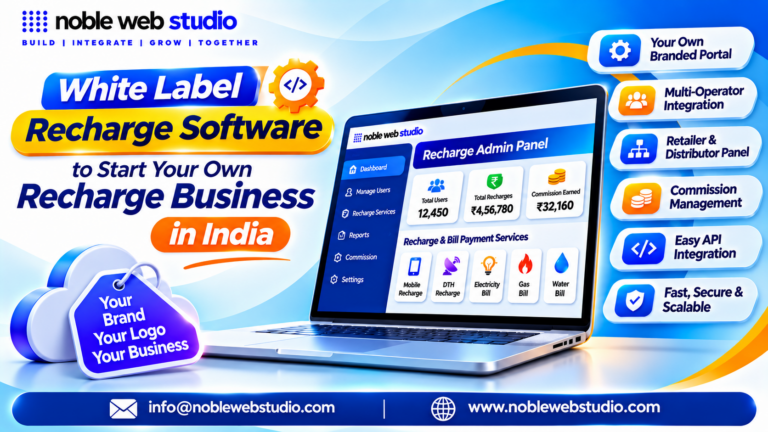
Choosing a White Label B2C Mobile Recharge Portal allows you to launch a branded digital recharge and utility business quickly and cost-effectively without building complex infrastructure from scratch.
Key Reasons to Choose a White Label B2C Recharge Portal
- Instant Brand Identity: The platform runs entirely under your own company name, logo, custom domain, and branded Android/iOS apps. Your customers and downline network never see the third-party developer's brand.
- Low Startup Cost & Fast Time-to-Market: Instead of spending months and heavy capital on custom recharge software development, server architecture, and operator mobile recharge API integration, you get a ready-to-use solution immediately.
- Hands-Off Backend & Maintenance: The Noble web studio handles server hosting, security updates, and backend real time recharge API connections with telecom and utility operators, leaving you free to focus on marketing and customer acquisition.
- High Recurring Demand & Multiple Revenue Streams: Prepaid mobile recharges, DTH renewals, FASTag updates, and BBPS (Bharat Bill Payment System) utility bills drive frequent, repeat monthly traffic. You earn automated commissions or margin splits on every transaction.
- Full Admin Control & Hierarchy Management: You get complete command over the recharge admin panel to set custom commission slabs, manage wallets, monitor live transaction reports, and optionally build your own network of distributors and retailers.
- Integrated Fintech & Value-Add Services: Most white label recharge b2c portal allow you to scale beyond simple recharges by adding domestic money transfers (DMT), BBPS bills, and QR-scan wallet transfers.
B2C Recharge Admin Panel and Transaction Management
A B2C Recharge Admin Panel is the central web-based backend control system that lets business owners manage direct-to-consumer mobile, DTH, broadband, and utility bill payments.
Core Features of a B2C Recharge Admin Panel
- Direct Consumer Management: Handle self-registration, user profile verification, KYC checks, and individual consumer wallet balances.
- Real-Time Transaction Monitoring: Track live recharge orders across Noble web studio server, complete with search filters for transaction IDs, dates, and statuses (Success, Pending, Failed).
- Automated Failure Handling & Retries: Run background retry logic on transient operator errors and issue instant refunds or manual status updates for stuck transactions.
- Payment Gateway & Wallet Reconciliation: Reconcile incoming payment gateway settlements against outgoing API operator calls to prevent ledger mismatches.
- Promotions & Banner Management: Create and schedule promotional campaigns, cashback offers, discount coupons, and push-notification banners for retail users.
- Comprehensive Analytics & Reports: Generate daily, weekly, and monthly activity reports covering gross transaction volume, revenue margins, and active user retention.
Mobile Recharge API Integration for B2C Portals
To build or scale a mobile recharge and utility payment system, you can connect your application using developer guides like Recharge API Documentation & Integration Guide to process prepaid, postpaid, DTH, and bill transactions.
Core Architecture of a B2C Recharge Portal
- User Interface & App: A responsive web or mobile dashboard where B2C customers enter phone numbers, pick plans via a Mobile & DTH Plan Finder and pay.
- Payment Gateway Layer: Secure integration handling credit/debit cards, UPI, net banking, or digital wallets before triggering the backend API.
- Recharge API Engine: Connects to Noble web studio via REST/JSON endpoints using unique order IDs.
- Wallet & Ledger System: A central prepaid corporate balance or single-wallet setup that tracks deductions, auto-refunds on failed/timed-out hits, and operator-wise commission margins.
4-Step Integration Workflow
- Credentials & KYC: Sign up with an Noble web studio to complete KYC and receive your API username, password, and secret keys.
- IP Whitelisting & Callbacks: Whitelist your server's static IP address and register your webhook/callback URL in the top recharge admin panel for asynchronous status updates.
- Sandbox / Micro-Testing: Run small test recharges (e.g., ₹10), parse the JSON payload (
status,opid,orderid), and implement dedicated status-enquiry and balance-check endpoints. - Go-Live & Switch Logic: Fund your master wallet, deploy auto-switching across backup recharge API to prevent operator downtimes, and activate real-time commission credit splits.
B2C Recharge Portal Customer Registration, Login and Recharge Process
A B2C Recharge Portal is a digital platform where individual users can top up mobile numbers, DTH, FASTag, or pay utility bills directly.
1. Customer Registration Process
- Sign-Up Option: Users visit the web portal or mobile app and click Register or Sign Up.
- Credentials: Enter basic details such as full name, email address, and mobile number.
- Verification (OTP): An One-Time Password (OTP) is sent via SMS or email to verify the mobile number.
- Account Creation: Once verified, the profile is active, allowing users to save favorite numbers, payment methods, and check transaction history.
2. Customer Login Process
- Access Points: Log in via the web browser portal or Android/iOS app.
- Authentication Methods:
- Mobile Number + OTP: Enter the registered mobile number and verify via a quick OTP.
- Password / MPIN: Alternatively, log in using a custom password or a 4-digit PIN.
- Dashboard Access: Redirects to the user dashboard showing wallet balance, quick-recharge options, and active offers.
3. Recharge & Transaction Process
- Service Selection: Choose the service category (e.g., Mobile Prepaid/Postpaid, DTH, FASTag, or Data Card).
Number & Operator Input:
- Type in the target mobile number or Customer ID.
- The system auto-detects the telecom operator (Airtel, Jio, Vi, BSNL) and circle/region, though it can be changed manually.
- Plan Discovery: Browse or search available recharge plans filtered by talktime, data quota, validity, or special packs.
Payment Checkout:
- Select a payment method: UPI, debit/credit card, net banking, or internal portal wallet.
- Complete the payment authorization.
API Routing & Confirmation:
- The b2c recharge portal triggers the smooth recharge API to the operator for sub-second processing.
- The screen displays an instant success, pending, or failure status.
- Confirmation alerts are dispatched via SMS, email, or push notification, and logged into the user's transaction history.
B2C recharge Portal Commission Structure, Revenue Model and Profit Calculation
A B2C recharge portal operates on a margin-sharing (commission-based) revenue model. You connect to a Noble web studio, receive a base commission percentage or flat fee from them, and distribute a portion of it down your network tiers (Portal Owner → Master Distributor → Distributor → Retailer/Customer).
1. Commission Structure (Tiered Example)
Commission rates typically range from 1% to 4%+ on mobile/DTH recharges, while utility bills (BBPS) may use flat rupee-per-transaction fees rather than percentages.
A standard 3-level distribution structure on a ₹1,000 mobile recharge (assuming a 3% gross API margin) looks like this:
| Tier / Level | Share (% of Recharge Value) | Earnings on a ₹1,000 Recharge | Role / Function |
|---|---|---|---|
| API Provider / Base | 3.0% (Total received) | ₹30.00 | Provides raw telecom/DTH connectivity |
| Retailer | 2.0% | ₹20.00 | Does the actual customer recharge |
| Distributor | 0.4% | ₹4.00 | Manages and supports a group of retailers |
| Master Distributor | 0.3% | ₹3.00 | Oversees multiple distributors |
| Portal Owner (You) | 0.3% (Net Gap) | ₹3.00 | Retained platform margin |
Note: The gap between what the reliable mobile recharge API gives you (e.g., 3%) and what you distribute down the chain (2.7%) is your gross portal profit per transaction (0.3% or ₹3).
2. Revenue Model
- Core Transaction Margin: Earning a percentage spread or flat commission per mobile, DTH, Fastag, or data-pack recharge.
- High-Margin Services Mix: Pure mobile recharges have thin margins (1%–2%). True B2C mobile recharge portal profitability relies on expanding the service mix to include higher-margin utility bills (BBPS), Domestic Money Transfer (DMT), Aadhaar Enabled Payment System (AePS), and PAN/insurance services.
- White-Label & API Reselling: Licensing your white label recharge software or reselling your aggregated recharge API to smaller sub-portals.
- SaaS / Subscription Fees: Charging monthly or setup recharge software fees if operating a B2B2C white label recharge network.
3. Profit Calculation Formula
A. Daily & Monthly Gross Profit Formula
Daily Gross Profit = ∑ (Transaction Volume × Net Retained Commission %)
Monthly Gross Profit = (Daily Recharge Value × Average Net Margin %) × Working Days
B. Net Profit Calculation
To find your actual take-home profit, you must subtract operational and compliance overhead from your gross retained earnings.
Net Profit = Total Retained Gross Commission − Operating Expenses
Common Operating Expenses to Factor In:
- Recharge portal / software hosting & server maintenance
- White-label software subscription or recharge api wallet maintenance fees
- SMS gateway charges (for OTPs and transaction alerts)
- Customer support and payment gateway/virtual account loading charges
- Statutory Deductions (TDS): Under Section 194H / tax rules in India, 2% TDS may apply if commission payouts cross threshold limits (e.g., ₹20,000/year)—consult a chartered accountant for exact compliance.
B2C recharge Portal Security Features and Customer Data Protection
A B2C recharge portal requires multi-layered technical security and strict data privacy practices to safeguard transactions, build user trust, and comply with financial regulations.
Core Security Features
- Encryption in Transit & Rest: Use HTTPS (TLS) to encrypt all data transmitted between the customer's browser/app and the server, alongside database encryption for stored records.
- Secure Authentication & Session Management: Implement strong password hashing, multi-factor authentication (MFA) for administrative accounts, and strict session timeouts.
- OTP & Two-Factor Verification: Use One-Time Passwords (OTPs) or biometric/PIN checks for transaction authorization to prevent unauthorized recharges.
- PCI-DSS Compliant Payment Gateways: Offload sensitive card processing to authorized, PCI-DSS compliant third-party gateways (such as UPI, net banking, or tokenized cards) rather than storing raw card details locally.
- Fraud Detection & Monitoring: Deploy real-time anomaly detection, rate-limiting on recharge requests, and automated background retry/monitoring mechanisms to spot suspicious patterns.
- Server-Side Input Validation: Validate and sanitize all user-submitted forms, phone numbers, and recharge amounts on the server side to block injection attacks or tampering.
Customer Data Protection
- Data Minimization: Collect only the personal information strictly necessary to process the recharge (e.g., mobile number, operator, transaction ID, and basic account details).
- Access Control & Least Privilege: Restrict internal access to customer profiles and transaction logs strictly to authorized support or admin staff, logging all data access events.
- No Unnecessary Storage of Credentials: Avoid saving sensitive payment credentials (CVVs, full card numbers, or banking passwords) on local company servers.
- Retention & Incident Policies: Define clear timelines for how long transaction records are kept, how data is purged, and how security incidents or breaches are investigated.
B2C Mobile Recharge Portal Development Cost in India
The development cost of a B2C mobile recharge portal in India typically ranges from ₹35,000 to ₹1,50,000+ for ready-made or white label recharge software solution and ₹2,00,000 to ₹10,00,000+ if custom-built from scratch with an Android/iOS app.
Cost Breakdown by Solution Type
| Solution Approach | Estimated Cost Range | What It Includes |
|---|---|---|
| Basic B2C Web Portal | ₹35,000 – ₹50,000 | Simple responsive website, customer login, basic recharge flow, single payment gateway. |
| Multi-Service Portal | ₹50,000 – ₹80,000 | Web panel, mobile & DTH recharge, utility bill payments, user management, and reporting. |
| White-Label Mobile App | ₹70,000 – ₹1,50,000 | Branded Android app (Play Store), wallet system, live recharge API callback integration, and admin dashboard. |
| Custom-Built MVP / App | ₹2,00,000 – ₹10,00,000+ | Custom UI/UX, scalable backend architecture, multi-API failover routing, and high-load capacity. |
Core Components Driving the Cost
- API Integrations: Connecting third party mobile recharge API for mobile, DTH, FASTag, and utility bills generally costs ₹10,000 to ₹20,000 per API, plus optional plan/operator-finder APIs.
- Payment Gateway Setup: Integration with Noble web studio for customers to load money or pay directly; note that gateways charge a per-transaction MDR (Merchant Discount Rate) fee.
- Android / iOS App Development: Building and publishing a branded app requires ongoing updates for new OS versions, security patches, and app store compliance.
- API Failover Routing: Recharge Software Developer to automatically switch to a backup mobile recharge API if the primary operator mobile recharge API lags or fails costs more upfront but prevents failed transaction drop-offs.
- Hosting & Infrastructure: Basic portals run on shared/VPS hosting, while high-volume B2C recharge platforms require dedicated cloud servers, automated backups, and uptime monitoring.
Recurring & Ongoing Costs
- Server & Domain/SSL: ₹5,000 to ₹15,000+ per year.
- API Wallet Float/Recharge Balance: Working capital required to maintain liquidity with Noble web studio.
- Maintenance & Support: Annual maintenance contracts (AMC) or bug fixes (often free for the first 6–12 months with Noble web studio, then roughly 15–20% of the build cost annually).
How to Choose the Best B2C Mobile Recharge Portal Development Company?
Noble web studio is the right B2C Mobile Recharge Portal Development Company is critical to ensure high transaction success rates, customer trust, and long-term recharge platform stability.
Key Factors to Consider
- Multi-API Integration & Redundancy: Look for a Noble web studio that supports multi recharge API integration with automatic operator-switching. If your primary recharge or bill-fetching API goes down or slows down, a backup route keeps transactions flowing without dropping user requests.
- White-Label & Customization Capabilities: Noble web studio offers a true white label mobile recharge software solution where the web portal and Android/iOS apps carry your brand, logo, and domain. Ideally, you should own or have direct control over your own Play Store/App Store developer account.
- Comprehensive Service Portfolio: A great B2C platform shouldn’t just stop at mobile top-ups. Check if the company integrates DTH recharges, BBPS (Bharat Bill Payment System), utility bills (electricity, water, gas), FASTag, and money transfer/AEPS modules.
- Real-Time Plan & Operator Detection: The best recharge software must include live operator-and-circle detection and real-time plan fetching APIs so customers see accurate tariff details before making a payment.
- Payment Gateway & Wallet Management: Look for smooth integration with secure payment gateways, internal customer wallets, automated refund handling for failed transactions, and clear transaction tracking.
- Admin Control & Reporting Dashboard: A robust B2C recharge platform needs an intuitive best recharge admin panel to track live transactions, manage user coupons, view commission/margin logs, and generate settlement reports.
- Technical Support & SLA: Recharge platforms operate 24/7. Verify the Noble web studio commitment to around-the-clock technical support, response times, and clear written agreements regarding post-launch maintenance or recharge API failures.
- Pricing & Transparency: Avoid hidden fees for source code, yearly renewals, or add-on modules. Request a live demonstration with a small real-world transaction (e.g., ₹10 recharge) before making a financial commitment.
Why Choose Noble Web Studio for B2C Mobile Recharge Portal Development?
Choosing a Noble web studio for B2C mobile recharge portal development gives your business a ready-made, scalable foundation rather than building a complex telecom network from scratch.
Key Reasons to Choose a Noble web studio
- Instant Multi-Operator & Utility Access: Noble web studio server connects your portal directly to major telecom operators, DTH service providers, and utility bill channels via integrated recharge API, enabling instant, real-time transaction processing.
- White-Label & Custom Branding: Noble web studio offer white label mobile recharge software solutions that let you launch recharge platform under your own brand name, logo, and custom domain rather than promoting the b2b mobile recharge software vendor's brand.
- Seamless Payment Gateway Integration: Built-in support for UPI, credit/debit cards, and digital wallets ensures end customers can fund their recharges and complete checkouts smoothly.
- Automated Transaction Tracking & Refunds: Modern B2C recharge portals feature automated status tracking (success, pending, or failed), background auto-retry mechanisms for transient operator failures, and automated refund tools for failed drops.
- Admin Control Panel & Reporting: Gain complete backend oversight to manage user wallets, monitor live transaction logs, generate financial reports, and handle customer support tickets.
- Cross-Platform Availability: Noble web studio deliver both a responsive web-based portal and an Android mobile application so customers can recharge on the go.
How to Get Started with Your B2C Mobile Recharge Portal?
Starting a B2C (Business-to-Consumer) mobile recharge portal involves choosing a reliable technical foundation, integrating payment and recharge API services, and setting up core features for your users.
Step-by-Step Guide to Getting Started
Choose Your Development Approach:
- White-Label Solutions: Use ready-made, branded recharge software from Noble web studio to launch quickly under your own domain name and logo.
- Custom Build: Develop a tailored website and best mobile recharge commission app (Android/iOS) from scratch if you require unique workflows or deeply integrated fintech modules.
Integrate a Recharge API:
- Connect your b2c recharge portal to authorized all in one recharge API that handle operator-level communication for prepaid mobile, DTH, data cards, and utility bills.
- Look for multi mobile recharge API switching features so transactions can automatically reroute through a Noble web studio if one fails.
Incorporate a Payment Gateway:
- Integrate a secure payment gateway (supporting UPI, net banking, debit/credit cards, and wallets) so customers can fund and complete instant recharges.
Build Essential Customer Features:
- Simple Interface: An easy-to-use form to pick the operator, enter the mobile number, select a browse plan, and pay.
- Transaction Tracking: Real-time status updates (success, pending, or failed) with automated logs and digital receipts.
- Customer Support Flow: A dedicated helpdesk or support ticket system to resolve failed recharges or stuck payments quickly.
Address Legal and Compliance:
- Consult with a Noble web studio to understand statutory compliance, local business registration, and tax requirements for digital payment and top-up services.
Expand Services for Growth:
- Core mobile recharges have thin margins. Scale your B2C portal over time by adding Bill Payments (BBPS), DTH recharges, and money transfer or AePS services.
Future Trends B2C Mobile Recharge Portal
Future B2C mobile recharge portals are shifting toward AI-driven automation, 5G integration, and embedded financial services to elevate speed and user experience.
Key Future Trends
- AI-Powered Voice Assistants: Customers can complete recharges or check plans using natural voice commands through integrated virtual assistants.
- Biometric Authentication: Higher security during checkouts and wallet access using fingerprint or facial recognition rather than standard passwords.
- 5G-Accelerated Performance: Sub-second operator routing and ultra-fast transaction processing enabled by low-latency 5G networks.
- Value-Added Financial Services (VAS): Expanding recharge b2b platform to include microloans, savings plans, utility bill routing, and FASTag top-ups inside the same B2C app.
- IoT & Automated Recharges: Connected Internet of Things (IoT) devices and smart meters triggering automatic balance reloads when thresholds run low.
- QR-Driven Wallet Transfers: Peer-to-peer wallet balance sharing or QR scan features built directly into consumer recharge applications.
Conclusion: Launch Your B2C Mobile Recharge Portal with Noble Web Studio
A B2C Mobile Recharge Portal provides businesses with an opportunity to offer direct online recharge services to customers through a website or mobile application. From mobile number verification and operator selection to recharge plan selection, online payments, and transaction tracking, a well-developed recharge platform brings essential recharge activities together in one convenient system. It also allows business owners to manage customer accounts, recharge services, payment records, and daily operations through a centralised administration panel.
For businesses planning to launch their own online recharge platform, choosing the right mobile recharge software infrastructure is an important decision. Features such as mobile-friendly design, multiple operator integration, secure payment gateway connectivity, real-time transaction status updates, customer notifications, recharge history, and reporting tools can help create a smoother customer experience. Businesses should also evaluate recharge API reliability, transaction handling, scalability, technical support, and customisation options before selecting a development solution.
A B2C (Business-to-Consumer) Mobile Recharge Portal is an online website or mobile application that allows individual customers to directly top up their own or someone else's mobile phone, DTH, or utility services without going through a physical retailer or distributor.
Noble Web Studio provides fintech software development and recharge API integrated solutions for businesses looking to build their own B2C Mobile Recharge Portal. Whether you want to launch a branded recharge website, develop a customer-facing mobile application, integrate multiple mobile operators, or establish an online recharge platform with centralised transaction management, Noble Web Studio can help plan a solution around your business requirements.
If you are planning to enter the online recharge industry or expand your existing digital services, explore B2C Mobile Recharge Portal development solutions from Noble Web Studio. Choose a platform that matches your customer requirements, supports your operational needs, and provides the flexibility to expand your recharge business.
B2C Mobile Recharge Portal with Noble Web Studio
Want to start your own online mobile recharge business? Noble Web Studio offers B2C Mobile Recharge Portal solutions to help businesses provide online mobile recharge services to customers. Discuss portal features, mobile-friendly design, payment integration, admin management, branding options and software pricing with our team. Contact us to explore a suitable solution for your business.