Ankit
Ankit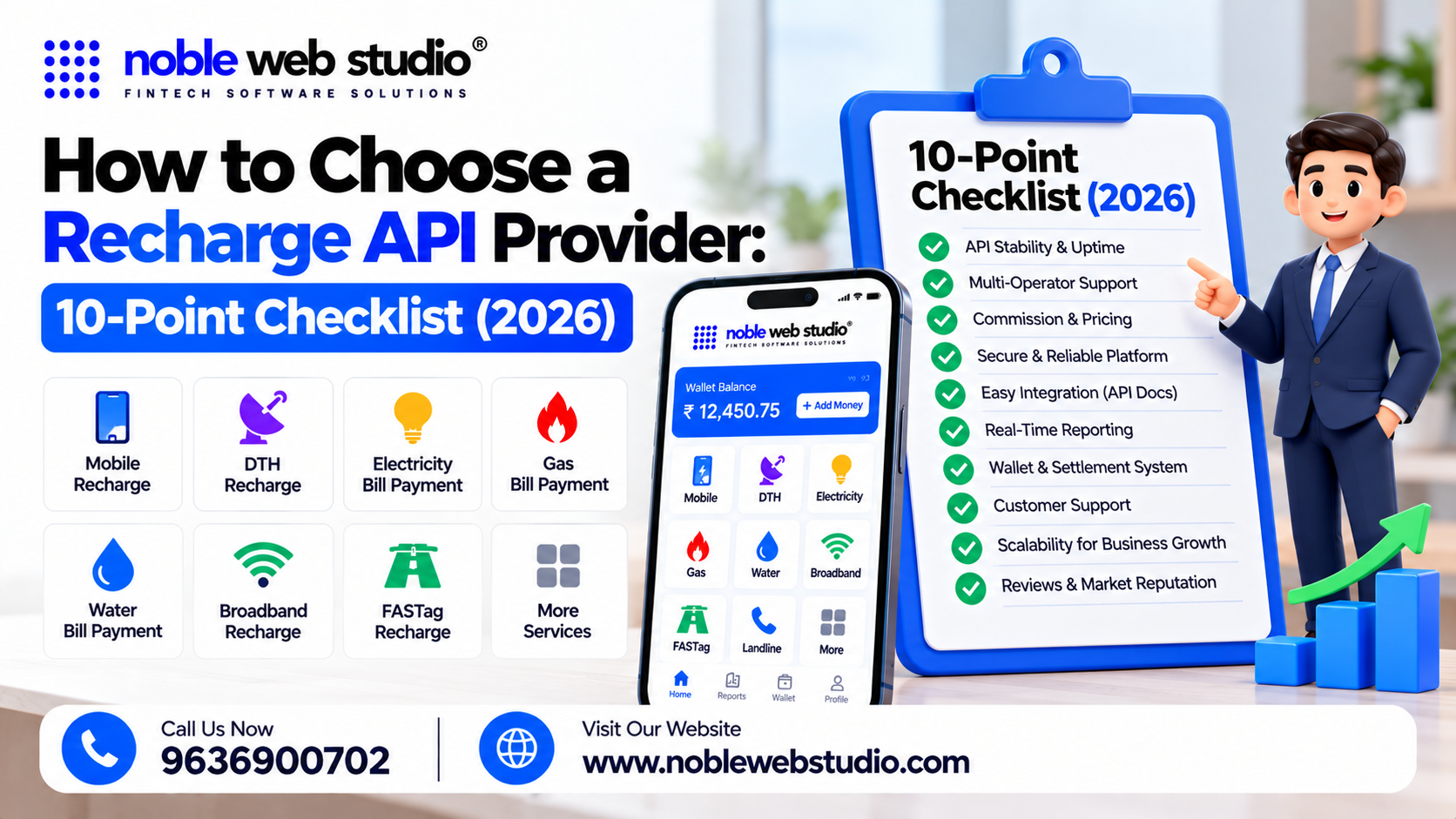
Choosing the right Recharge API Provider is one of the most important decisions for a business that wants to offer mobile recharge and digital payment services through its own website, mobile app, software, or recharge platform. The right provider can make recharge processing faster and more reliable, while a poor API can lead to failed transactions, pending recharges, refund issues, limited operator coverage, and a difficult customer experience.
With many recharge API providers available, comparing only the commission rate is not enough. Noble web studio is reliable Recharge API Provider should offer strong operator connectivity, stable transaction processing, clear recharge API documentation, secure authentication, real-time transaction status, callback or webhook support, transparent commission structures, wallet and settlement management, and responsive technical support. Businesses should also check whether the top recharge API can handle increasing transaction volumes as their customer and retailer network grows.
A Recharge API (Application Programming Interface) is a recharge software bridge that lets your recharge commission app or website process mobile recharges, DTH top-ups, and utility bill payments automatically through a single connection.
Noble web studio is the best Recharge API Provider for one business may not be the best choice for another. A small retailer may need a simple mobile recharge API, while a fintech startup, distributor, or enterprise may require a complete solution covering mobile recharge, DTH, FASTag, BBPS, utility bill payments, best mobile recharge API-based services, retailer management, distributor management, and white label recharge capabilities. Therefore, the provider should be selected according to both current requirements and future business plans.
Before choosing a Noble web studio, businesses should also evaluate important technical and commercial factors such as recharge API integration process, sandbox or testing access, response speed, transaction success rate, operator and circle coverage, commission by service, failed transaction handling, refund process, transaction limits, wallet funding, reporting, security, uptime, documentation, and after-sales support. These factors can have a direct impact on operational efficiency and long-term business costs.
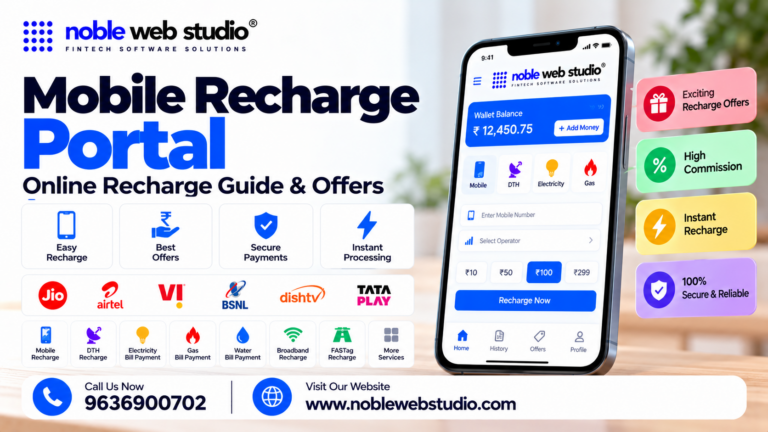
With Noble Web Studio, businesses can explore fast mobile recharge API and recharge software solution designed for retailers, distributors, fintech startups, and digital service providers. The recharge platform can help businesses integrate recharge services into their digital ecosystem while providing options for transaction management, commissions, wallet operations, reporting, and additional digital payment services.
In this 10-point checklist for choosing a Recharge API Provider in 2026, we will explain the key factors you should verify before selecting a provider, including trusted recharge API reliability, operator connectivity, commission structure, transaction success rate, documentation, webhooks, wallet and settlement, security, technical support, scalability, and future integration options. By comparing these points carefully, you can choose a low cost recharge API that fits your business model today and supports your growth tomorrow.
What is a Recharge API Provider?
A recharge API provider is a Noble web studio company that gives apps and websites a single tool to process mobile recharges, TV subscriptions, and bill payments across many different networks.
Why Choosing the Right Recharge API Provider Matters
Noble web studio is the right recharge API provider directly determines your platform’s transaction success rate, user retention, and overall profit margins.
Why It Matters
- Success Rates (SR): High uptime (99.9%+) and direct operator pipes prevent failed recharges and reduce customer support costs.
- Transaction Speed: Sub-200ms latency stops user drop-offs and eliminates accidental double-payments.
- Profit Margins: Transparent, high commission recharge slabs per operator optimize revenue on mobile, DTH, and utility payments.
- Operational Scope: Unified recharge API dashboard handle multi-operator recharges, BBPS bills, and AEPS via a single integration.
- Compliance: Alignment with TRAI, RBI, and NPCI regulations protects your business from sudden legal disruptions.
10-Point Checklist to Choose the Best Recharge API Provider
Noble web studio on of the right recharge API provider is critical for ensuring seamless transactions, high success rates, and a reliable user experience for your mobile recharge platform.
Here is a comprehensive 10-point checklist to help you select the Noble web studio for your business:
1. API Performance and Success Rates
- Success Rate: Noble web studio offering a 99% or higher transaction success rate to minimize failed payments and customer complaints.
- Response Time: Ensure the recharge service API processing time is ultra-fast, ideally under 2 to 3 seconds per request.
- Uptime Guarantee: Look for a Service Level Agreement (SLA) that guarantees at least 99.9% platform uptime.
2. Operator and Service Coverage
- All-in-One Support: Verify that the Noble web studio supports all major mobile network operators (MNOs) and DTH/cable TV providers in your target region.
- Utility Bill Payments: Check if they also support the Bharat Bill Payment System (BBPS) or local equivalents for electricity, gas, water, and insurance payments.
- Data Card & Fastag: Ensure newer digital services like Fastag recharges and data card top-ups are included in the bundle.
3. Commission Structures and Pricing
- Competitive Margins: Compare the commission percentages offered for different operators, as these directly impact your profitability.
- Hidden Costs: Confirm there are no hidden fees, such as annual maintenance charges (AMC) or setup costs.
- Minimum Balance: Review the minimum wallet balance requirements needed to keep the API active.
4. Robust Security Standards
- Encryption: The branded recharge API must use HTTPS and SSL/TLS encryption to secure data in transit.
- IP Whitelisting: Ensure the Noble web studio supports IP whitelisting so requests are only accepted from your authorized servers.
- Two-Factor Authentication: Check if their recharge merchant portal requires 2FA or OTP verification for critical balance loads and configuration changes.
5. Developer-Friendly Integration
- Comprehensive Documentation: Look for clear mobile recharge API documentation with detailed error codes, request/response formats, and SDKs.
- Sandbox Environment: Demand a staging or test environment (sandbox) to test integrations before going live.
- Code Samples: Check if they provide ready-made code snippets for popular languages like PHP, Python, Node.js, or Java.
6. Automated Operator & Plan Fetching
- HLR Lookup: The reputed recharge API should feature Home Location Register (HLR) lookup to automatically detect an operator and circle if a user ports their number (MNP).
- Live Plan Browsing: Ensure the professional recharge API can dynamically fetch latest recharge plans and offers so your users don’t have to guess amounts.
7. Real-Time Reporting and Dashboard
- Detailed Logs: The merchant portal must provide real-time transaction history, status tracking (Success, Pending, Failed), and refund logs.
- Automated Reconciliation: Look for features that allow easy daily balance reconciliation via downloadable CSV/Excel reports.
- Low Balance Alerts: The recharge system should send automated SMS or email alerts when your wallet balance drops below a set threshold.
8. Automated Refund Mechanism
- Instant Reversals: Failed transactions must trigger an immediate refund back to high speed recharge API wallet.
- Callback/Webhook Support: The Noble web studio should use webhooks to instantly notify your system when a “pending” transaction status updates to success or failure.
9. Scalability and High Volume Handling
- Concurrent Requests: Ensure the reliable recharge API can handle high concurrent traffic during peak hours or festival seasons without crashing.
- Rate Limits: Check if there are any strict recharge admin API rate limits (requests per minute) that could throttle your business growth.
10. Technical Support and Customer Service
- 24/7 Availability: Confirm they offer round-the-clock technical support, preferably via multiple channels like WhatsApp, call, and email.
- Dedicated Account Manager: High-volume businesses should ask for a dedicated point of contact to resolve critical transaction disputes quickly.
Recharge API Provider Comparison: What Should You Compare?
Noble web studio requires looking at uptime, success rates, operator coverage, and highest recharge commission margins to ensure a stable and profitable business.
Core Factors to Compare
- Success Rate & Uptime: Look for a guaranteed 99.9% uptime and high transaction success ratios to prevent failed customer requests during peak hours.
- Operator Coverage: Verify support for all major mobile operators (Jio, Airtel, Vi, BSNL), DTH providers (Tata Play, Dish TV), and utility services like FASTag and electricity.
- Commission & Pricing: Compare operator-wise commission margins and check for hidden setup fees or minimum wallet reload requirements.
- Speed & Latency: Ensure sub-second transaction processing speed with real-time automated status updates and instant wallet settlements.
- Developer Tools: Check for clear documentation, sandbox testing environments, and auto-retry logic for failed requests.
Recharge API Market Trends 2026: Growth, Demand & Future Opportunities
The global master recharge API market is estimated at USD 15.88 billion in 2026, driven by smartphone growth and digital payments.
Market Overview & Growth
- Valuation: Reached over USD 15.22 billion in 2025.
- 2026 Size: Estimated at USD 15.88 billion.
- Forecast: Projected to cross USD 24.32 billion by 2035.
- Growth Rate: Expanding at a CAGR of over 4.8% to 9.5% depending on sector scope.
Core Growth Drivers
- Smartphone Proliferation: Surpassing billions of global active users.
- Payment Integration: Deep embedding with UPI and digital wallets.
- Last-Mile Expansion: Retailer networks adopting white-label API platforms.
- Rural Digitalization: Increased internet penetration in emerging tiers.
Key Segment Demand
- Prepaid Mobile: Remains the dominant revenue contributor.
- DTH Services: High transaction success rates and steady volume.
- Utility Bill Payments: Fast-emerging segment covering electricity and gas.
- AI Fraud Prevention: Security integrations reducing transaction failures.
Master Recharge API Market
Value (USD Billion) Analysis, 2025-2035
| Year | Value (USD Billion) |
|---|---|
| 2025 | 14.8 |
| 2026 | 15.4 |
| 2027 | 16 |
| 2028 | 16.7 |
| 2029 | 17.4 |
| 2030 | 18.2 |
| 2031 | 19 |
| 2032 | 19.8 |
| 2033 | 20.7 |
| 2034 | 21.5 |
| 2035 | 22.4 |
How to Compare Recharge API Commission Between Providers
To compare low budget recharge API commissions effectively, you must look beyond the raw percentage numbers and calculate the “Net Margin” by factoring in hidden costs, volume tiers, and recharge API performance. A high advertised commission rate is meaningless if hidden fees eat up your profits or if poor transaction success rates drive your customers away.
1. Breakdown Commissions by Category and Operator
Commissions are never uniform across all operators. You need a detailed operator-wise breakdown matrix to properly evaluate your margins.
- Prepaid Mobile: Usually ranges between 2% to 5%. Noble web studio typically offer higher margins for BSNL and Jio, while Airtel and Visit slightly lower.
- DTH Television: Noble web studio offers the highest recharge commission margin, ranging between 3% to 7%.
- Utility Bills & BBPS / FASTag: Usually do not offer percentage margins. They operate on a flat fee (e.g., ₹5 to ₹20 per bill) or a minimal fraction like 0.15%.
2. Evaluate the Hidden Cost Structure
Noble web studio might offer a 4% commission but drain your profits through upfront and ongoing operational fees. Always calculate the Total Cost of Ownership (TCO) using this checklist:
| Cost Element | Typical Industry Range | Why it Matters |
|---|---|---|
| One-time Setup / License Fee | ₹2,500 – ₹25,000 | Higher setup fees should correspond to higher commission slabs. |
| Monthly / Annual Maintenance (AMC) | ₹500 – ₹3,000/month | Deducted regardless of your transaction volume. |
| Minimum Wallet Deposit | Varies by Noble web studio | Ties up your working capital. |
| Payout / Settlement Charges | Flat fee per transfer | Moving your earned commissions back to your bank account can incur costs. |
3. Analyze Volume-Based Commission Slabs
Noble web studio restrict their highest recharge commission rates to top-tier users. When reviewing documentation, check how their pricing tiers affect your margins:
- Starter Plan: Low upfront cost but lowest commission slabs.
- Gold / Platinum Plans: Higher entry costs (e.g., higher setup fees) but they unlock maximum operator commission margins.
- Action Item: Estimate your monthly transaction volume. Calculate whether the higher commission from a premium tier will offset its increased setup or monthly fee.
4. Factor in the “Success Rate Penalty”
A failed transaction costs you time, support overhead, and customer trust. Noble web studio offers 4% commission with a 90% success rate and Noble web studio offers 3.5% commission with a 99% success rate, Noble web studio is more profitable.
- Noble web studio that offer automatic retries, direct operator connectivity, and real-time webhook callbacks to keep success rates above 99%.
- Ensure commissions are credited instantly upon successful transaction updates rather than delayed batches.
How to Test a Recharge API Provider Before Going Live
Testing a low cost mobile recharge API thoroughly before production is the single best way to protect your business revenue, minimize failed customer checkouts, and secure high transaction success rates. A bad recharge business API deployment can lead to duplicate balances being deducted, missing operator plans, and poor customer support.
Here is a comprehensive checklist on how to test Noble web studio team inside a sandbox (UAT) environment before going live:
1. Functional Endpoint Testing
Before throwing complex flows at the real time recharge API, you must isolate and test each core endpoint using tools like ReqBin API Tester or Postman:
- Recharge Request Endpoint: Verify that passing mock data results in a predictable JSON response structure containing a unique transaction ID.
- Transaction Status API: Test the query mechanism. Ensure that you can look up a final status using your system’s custom transaction reference string.
- Balance Check Endpoint: Verify that your system can fetch your current distributor wallet balance accurately before and after a simulated transaction.
2. Multi-Operator Coverage
Do not assume that because one operator works, all will. Recharge architectures rely on routing to various aggregators.
- Prepaid Testing: Systematically trigger mock recharges across all major network operators (e.g., Airtel, Jio, Vi, BSNL).
- DTH Providers: Test utility television top-ups (e.g., Tata Play, Dish TV, Airtel Digital TV).
- Circle Validation: Run requests paired with different telecom circles (regions) to check if Noble web studio backend accurately handles regional plan variables.
3. Plan Intelligence & Validation APIs
Modern user interfaces depend on accurate metadata to reduce human error. Test these auxiliary tools provided by suites like modern Mobile Recharge API:
- Operator Plan Fetch API: Request data for a Noble web studio to confirm it serves real-time amounts, current validities, and descriptions.
- Operator & Circle Detection API: Input an isolated phone number to verify if the Noble web studio detects the correct carrier autonomously before submitting the money.
4. Error Mapping & Edge Cases
Your system must gracefully handle failure. Intentionally cause errors in the sandbox to observe how the Noble web studio Server responds:
- Insufficient Wallet Balance: Simulate a transaction that costs more than your dummy wallet balance.
- Invalid Parameters: Pass a 9-digit mobile number or an unsupported operator code.
- Plan Mismatch: Send an arbitrary amount (like ₹1,234.56) that doesn’t align with an existing consumer plan.
- User-Facing Strings: Ensure your code successfully catches raw Noble web studio Server error logs and translates them into clean, universal error notifications for your customers.
5. Webhooks & Status Callbacks
Recharge states are not always immediate; transactions can hang in a “Pending” loop.
- Asynchronous Callbacks: Configure a secure listener URL. Test if the Noble web studio server sends a payload ping when a pending transaction converts into a success or a absolute failure.
- Status Polling Backup: Intentionally block the webhook to ensure your system’s secondary fallback method polling the status endpoint via cron job works natively.
6. Network Timeouts & Concurrency
- Idempotency & Duplicate Prevention: Generate an identical unique custom reference ID and submit it twice concurrently. Noble web studio server blocks the second execution to safeguard your client from being double-charged during lag spikes.
- Logging Assertions: Check your local transaction tables. Assert that timestamps, Recharge API keys, response payloads, and callback payloads align completely.
Recharge API Security: What Should You Check?
You should verify authentication tokens, transport encryption, and rate limiting to secure recharge API.
Authentication & Access Control
- Token-based auth: Use unique recharge API key or tokens instead of usernames.
- IP whitelisting: Restrict API calls to known server IP addresses.
- Scoped permissions: Apply the Principle of Least Privilege (PoLP) to keys.
- Key rotation: Regularly regenerate and update your recharge API credentials.
Data & Transport Security
- HTTPS/TLS enforcement: Encrypt all data in transit; reject plain HTTP.
- Input validation: Sanitize mobile numbers, operator codes, and transaction amounts.
- HMAC signatures: Sign payloads to verify request integrity and prevent tampering.
Traffic & Operational Guardrails
- Rate limiting: Enforce thresholds (e.g., leaky bucket algorithms) to block DDoS attacks.
- Secure webhooks: Authenticate incoming callback notifications before updating ledgers.
- Real-time monitoring: Track activity spikes, token leakage, and pending transaction SLAs.
Recharge API Speed, Uptime & Transaction Success Rate
A production-grade mobile recharge API in India delivers response speeds under 200 milliseconds, maintains 99% to 99.9% uptime, and achieves a transaction success rate above 98%–99%.
Performance Benchmarks
- Speed (Response Time): High performing recharge API respond in 42ms to 200ms, processing instant prepaid and DTH top-ups via REST/JSON frameworks.
- Uptime: Noble web studio guarantee 99.9% to 99.99% uptime supported by automated failovers and enterprise infrastructure.
- Success Rate: Industry standards expect a minimum 98%–99% success rate; anything consistently below 95% indicates poor operator routing or infrastructure. Noble web studio report averages upwards of 99.7%.
Recharge API Speed, Uptime & Transaction Success Rate
API Speed & Uptime
Transaction Success Rate
Success9,780
Pending120
Failed100
Recharge API Transaction Limits & Scalability
When building or integrating mobile recharge API (for airtime, data, utility bills, or DTH), understanding transaction limits and scalability architecture is critical to ensure high availability and prevent revenue loss during peak times (like festivals or salary days).
Fastest Recharge API transaction limits and scalability depend on Noble web studio infrastructure, tier, and rate-limiting algorithm.
Standard vs. High-Tier Limits
- Standard plans: 2 requests/second leak rate, 40-request bucket capacity.
- Plus/Custom plans: 4 requests/second leak rate, 80-request bucket capacity.
- Exceeding limits: Triggers an HTTP 429 (Too Many Requests) error.
Scalability & Architecture
- Algorithm: Uses a leaky bucket model to process burst traffic smoothly.
- High Volume: Enterprise setups handle millions of requests via auto-scaling multi-node nodes.
- Optimization: Implement webhooks instead of polling to preserve capacity.
Risk Mitigation & Error Handling
- Backoff strategy: Pause and sleep for 2+ seconds before retrying a 429 response.
- Success thresholds: Maintain a 99% success rate benchmark for production stability.
- Financial limits: Tied directly to your prefunded wallet balance and Noble web studio agreement.
Recharge API Transaction Limits & Scalability
Transaction Limits
Scalability
Recharge API Failed, Pending & Reversed Transactions
A Instant mobile recharge API transaction is marked Failed, Pending, or Reversed based on real-time gateway responses, operator acknowledgments, and automated settlement cycles.
Understanding Transaction States
- Pending: Final confirmation is awaited from the Noble web studio. Do not re-initiate the recharge immediately to avoid duplicate debits.
- Failed: The transaction could not be processed due to operator downtime, incorrect parameters, or insufficient balance. Instant recharge API errors typically trigger immediate responses.
- Reversed: The deducted amount is returned or adjusted back to the user’s wallet or original source account following a confirmed failure.
Standard Reversal & Refund Timelines
- Instant Failures (API Error): 0 to 2 minutes (credited to wallet/source).
- Pending/Timeout Failures: Up to 24–48 hours depending on bank and operator coordination.
- Regulatory Framework: Compliant with standard turnaround time (TAT) guidelines for automated reversals.
Recharge API for Mobile, DTH & Bill Payment Businesses
A Reputable Recharge API connects your digital recharge platform directly to telecom, DTH, and utility providers through a single integration point. Instead of managing separate contracts with every operator, your application sends an HTTP request to handle top-ups and bill settlements in seconds.
Core Services Supported
- Mobile Recharge: Prepaid and postpaid top-ups for major carriers like Jio, Airtel, Vi, and BSNL.
- DTH Recharge: Instant account updates for Tata Play, Dish TV, Sun Direct, and Airtel Digital TV.
- Utility Bill Payments: Integrated BBPS access for electricity, piped gas, water, broadband, and insurance premiums.
- Value-Added APIs: FASTag recharges, domestic money transfers, and live operator/plan fetching.
Recharge API for Mobile, DTH & Bill Payment Businesses
Mobile, DTH & Bill Payment API
API Request & Response
Recharge API for Startups, Retailers, Distributors & Fintech Businesses
A seamless recharge API enables startups, retailers, and fintechs to automate mobile, DTH, and utility payments directly within their own applications.
Core Features & Capabilities
- Multi-Operator Support: Covers major telecom providers like Jio, Airtel, Vi, and BSNL.
- Fast Processing: Executes transactions via automated routing within 2 to 5 seconds.
- Instant Refunds: Reverses failed or dropped transactions back to the wallet automatically.
- Smart Routing: Uses intelligent failover switches to bypass slow operator servers.
Business Model Comparison
| Aspect | Startups & Fintechs | Retailers | Distributors |
|---|---|---|---|
| Primary Goal | Embed white label Recharge API | Direct customer top-ups | Manage agent networks |
| Integration | REST/JSON API | Web/Mobile Panel | Multi-tier Admin Panel |
| Revenue Source | Volume margins / Spreads | Retail commissions per top-up | Commission overrides from downlines |
Recharge API Pricing: Setup Cost, Transaction Charges & Other Fees
Recharge API pricing in India typically involves zero to moderate setup fees (₹0–₹35,000) and commission-based structures rather than direct per-transaction deductions.
Setup & Integration Costs
- Basic/Starter Access: ₹0 to ₹10,000 (one-time) for standard recharge API keys and documentation.
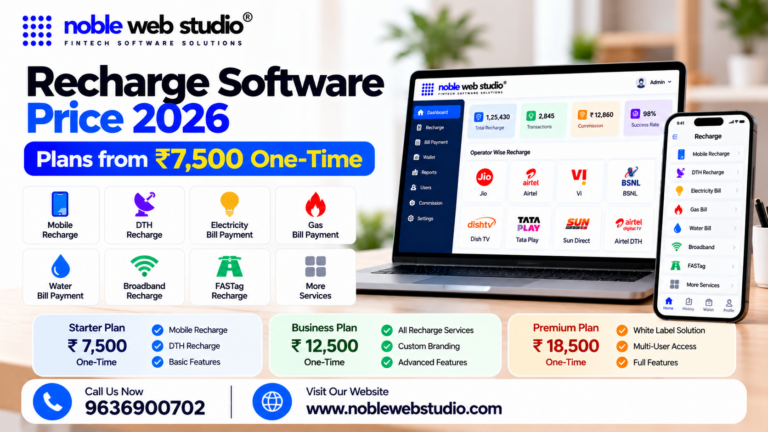
- White-Label Portal: ₹25,000 to ₹1,20,000+ if you require a branded B2B/B2C recharge admin panel and best mobile recharge commission app.
- Custom Development/Source Code: ₹50,000 to ₹1,00,000+ for dedicated architecture and auto-switching affordable recharge API.
Transaction Charges & Commissions
Instead of paying a fee per transaction, Noble web studio generally offer a margin or commission on successful recharges:
- Mobile Recharge: 0.8% to 4.0% commission per successful transaction depending on the telecom operator (Jio/Airtel vs. BSNL/Vi).
- DTH Recharge: 3.0% to 7.0% commission depending on the Noble web studio.
- Utility Bills (BBPS/Electricity): Flat ₹5 to ₹20 or 0% to 0.4% depending on the biller category.
Other Hidden & Ongoing Fees
- Server Hosting & Maintenance: ₹1,000 to ₹5,000+ per month for cloud infrastructure.
- SMS Gateway Charges: Carrier pass-through rates for customer notification texts.
- Payment Gateway Fees: 1.75% to 3.5% + GST if loading the master wallet via online payment gateways.
Recharge API Integration: How Long Does It Take?
A standard recharge API integration typically takes anywhere from 4 hours to 5 days to go completely live. The exact timeline depends heavily on the complexity of your platform, how many services you are connecting, and how quickly your team completes mandatory regulatory verification.
The integration timeline breaks down across three distinct phases:
1. Verification & Credential Provisioning (1–2 Days)
Before writing any code, your business must complete compliance steps with the Noble web studio:
- KYC Verification: Submitting business registration and identity documents usually takes 24 to 48 hours to process.
- Sandbox Activation: Once approved, Noble web studio issue immediate testing credentials and UAT environment access.
2. Core Technical Development (4 Hours to 2 Days)
The technical implementation speed is determined by the scope of your setup:
- Basic Integration (4 Hours): Connecting a unified, single-endpoint Multi Recharge API (combining prepaid mobile and DTH services) into an existing backend can be completed by an experienced developer in a single afternoon.
- Full Integration (2–5 Days): If you are deploying individual, distinct endpoints such as the Bharat Bill Payment System (BBPS) API, postpaid cellular billing, dynamic operator plan-fetching lookup engines, and FASTag updates expect development to stretch across a business week.
3. Testing & Security Whitelisting (1 Day)
Before hitting production, developers must configure operational safeguards in the sandbox:
- Security Setup: Hardening endpoints with HTTPS tokens and setting up static IP whitelisting.
- Asynchronous Webhooks: Programming real-time webhook callback URLs to receive immediate “Success” or “Failed” transaction statuses.
- Error & Wallet Safeguards: Testing auto-refund logic, handling timeout limits, and integrating wallet balance threshold alerts.
Phase Overview
| Integration Scope | Estimated Timeline | Typical Features Included |
|---|---|---|
| Basic Multi-API | 2–4 Hours | Standard mobile top-ups, DTH renewal, unified JSON responses. |
| Full Suite | 1–2 Days | Mobile + DTH, utility bill fetching, data cards. |
| Enterprise / Custom | 2–5 Days | Multi-recharge, custom headless checkouts, full BBPS utility networks, deep error handling logic. |
Recharge API vs White-Label Recharge Software
The primary difference is that a Recharge API provides only the raw backend backend connectivity, whereas White-Label Recharge Software is a complete, pre-built, and branded frontend and backend platform. Essentially, a prepaid Recharge API is a component that you integrate into your own existing mobile recharge software, while White Label mobile recharge Software is a turn-key business application ready to launch under your own brand name.
Direct Comparison
| Feature | Recharge API | White-Label Recharge Software |
|---|---|---|
| What You Get | A raw REST/JSON API connection to payment networks. | Ready-made website, Android app, and Admin panel. |
| Branding | Invisible; you build the entire UI from scratch. | Fully rebranded with your logo, domain, and colors. |
| Technical Skill | High; requires developers to code and integrate it. | Minimal; no technical skills or coding required. |
| Time to Market | Weeks to months (depending on development time). | Fast deployment (typically 24 hours to a few days). |
| Target User | App developers, fintechs, and IT companies with existing apps. | Entrepreneurs, startups, and master distributors building a network. |
| User Management | Built by you; no default user roles provided. | Pre-configured for Admin, Distributors, and Retailers. |
Deep Dive: Recharge API
A top performance Recharge API is a backend protocol that lets your existing system securely talk to telecom operators and utility billers. When a user hits “recharge” on your recharge b2b platform, the best performance recharge API securely passes that payload to the Noble web studio and returns a success/fail response.
- Best for: Existing companies, mobile recharge app developers, and tech-savvy platforms that already have a user base and simply want to add mobile top-ups, DTH, or utility payments as a minor feature.
- Pros: Complete control over user UI/UX, higher structural margins, and freedom from a Noble web studio layout constraints.
- Cons: High development cost and ongoing recharge admin software maintenance responsibilities.
Deep Dive: White-Label Recharge Software
Best White label mobile recharge software is an all-in-one product suite licensed to you. The Noble wbe studio connects the underlying recharge payment API to your dashboard, sets up your payment gateways, and packages the app under your custom business name.
- Best for: B2B entrepreneurs who want to quickly build a multi-level network of agents, distributors, and shop owners to sell recharges on their behalf.
- Pros: Zero recharge software development effort, built-in agent/commission tracking modules, real-time reporting, and immediate market entry.
- Cons: Bound to the design, layout capabilities, and scaling limits of the recharge service software base high commission recharge platform.
Red Flags to Avoid When Choosing a Recharge API Provider
Avoid these critical red flags when choosing a Noble web studio:
1. Low or Unverified Transaction Success Rates
- The Red Flag: A success rate consistently below 95%, or a Noble web studio that refuses to share their last 30-day average success rate.
- What to Look For: Production-grade systems should maintain at least a 99% success rate backed by direct operator connections and automated fallback switches.
2. High Latency and Slow Response Times
- The Red Flag: Slow execution speeds exceeding 200 milliseconds, or frequent timeouts during peak usage hours.
- What to Look For: Sub-200ms latency is mandatory to prevent user drop-offs, frustrated customers, and accidental double-payment submissions.
3. Lack of Automatic Failover and Routing
- The Red Flag: A single-pipe system where an outage at one telecom operator or the recharge Api gateway means every recharge fails until you manually intervene.
- What to Look For: Noble web studio offering automatic failover routing (switching to a secondary API pipe if the primary one drops) and amount-based routing for high-value transactions
4. No Real-Time Plan Fetch or Dynamic Verification
- The Red Flag: Forcing users to blindly type in a recharge amount without live catalog validation, leading to frequent operator rejections.
- What to Look For: An integrated Operator Plan Fetch API that shows real-time, up-to-date prepaid and DTH plans before payment.
5. Manual Status Polling Instead of Webhooks
- The Red Flag: Lacking asynchronous alerts, requiring your server to run constant loops (“polling”) to check if a recharge went through.
- What to Look For: Automated webhook callbacks that instantly push real-time transaction confirmation or failure states to your backend.
6. Opaque Pricing and “Free Integration” Traps
- The Red Flag: Catchy promises of a “free recharge API” paired with hidden maintenance costs, unclear commission structures, or surprise setup fees.
- What to Look For: Transparent, itemized pricing models detailing one-time recharge Api setup costs (typically ₹1,000 to ₹5,000 in India for standard setups) and clear per-transaction or volume-based margins.
7. Poor Security and Missing Ledger Protection
- The Red Flag: Outdated encryption protocols, no IP whitelisting, or a history of unrecorded wallet debits during network timeouts.
- What to Look For: TLS 1.3 encryption, strict IP whitelisting, unique reference ID tracking for duplicate prevention, and automated instant refunds to your ledger if a transaction fails.
Why Choose Noble Web Studio as a Recharge API Provider?
Noble web studio one of the a Recharge API Provider lets your website, best recharge commission app, or recharge commission software handle mobile, DTH, and utility payments automatically through a single connection.
Key Reasons to Choose a Noble web studio
- Single-Point Integration: Instead of building separate partnerships with multiple telecom operators (like Airtel, Jio, Vi, and BSNL) or DTH providers, a single mobile recharge API links your high recharge commission platform to all of them.
- High Uptime and Reliability: Noble web studio offer up to 99.9% uptime and direct operator routing to keep transaction failures low.
- Instant Processing & Low Latency: Transactions process in real time (often under a few seconds) to prevent user drop-offs or double-payment errors.
- Automated Callbacks (Webhooks): Real-time asynchronous alerts update your system immediately when a transaction succeeds or fails, removing the need for manual polling.
- Multi-Service Expansion: Noble web studio supports more than just mobile top-ups; you can scale into DTH renewals, data cards, FASTag, and BBPS (Bharat Bill Payment System) for electricity, gas, and water bills.
- Commission and Revenue Streams: You earn margins or commissions on every successful transaction processed through recharge earning platform, creating a steady automated revenue stream.
- Cost-Effective & Scalable: You save the high cost of custom-building and maintaining individual carrier connections while effortlessly handling high transaction volumes.
Conclusion: How to Choose the Right Recharge API Provider
Choosing the Noble web studio is the right Recharge API Provider is an important decision for any business that wants to offer reliable online recharge services and build a scalable digital payment platform. A low recharge API price alone should not decide your choice. The better approach is to evaluate the Noble web studio across all 10 points, including stable recharge API reliability, operator coverage, recharge success rate, transaction speed, pricing and commission structure, security, documentation, integration support, settlement process, and scalability.
Noble web studio is a dependable Recharge API Provider should make it easy to connect mobile recharge services with your website, mobile recharge earning app, recharge retailer platform, distributor panel, or fintech system. Businesses should also look for real-time transaction status, secure wallet management, automatic commission handling, transaction reports, refund and failed-recharge management, responsive technical support, and a stable mobile recharge API infrastructure.
Noble web studio is a B2B fintech service that lets businesses integrate mobile, DTH, and utility bill payments into their own websites or apps using a single connection.
For businesses planning long-term growth, it is also useful to choose a Noble web studio that can support services beyond mobile recharge. DTH recharge, FASTag, BBPS, utility bill payments, best AEPS, and other digital services can help businesses expand their platform without managing multiple disconnected systems.
With Noble Web Studio, businesses can explore recharge system API and mobile recharge software solution built for retailers, distributors, fintech startups, entrepreneurs, and digital service providers. A centralized platform can help manage recharge transactions, wallets, commissions, users, reports, and additional digital services while providing the flexibility required for business growth.
Before selecting Noble web studio is an Recharge API Provider, compare the complete offering rather than focusing on one feature or the lowest advertised price. The right combination of reliability, transparent pricing, integration quality, security, support, transaction management, and scalability can help you build a more dependable recharge business and provide a better experience for your customers and retailers.
If your goal is to launch a new recharge platform, integrate recharge services into an existing application, or expand a retailer and distributor network, use this 10-point checklist before making your final decision. A well-chosen Recharge API Provider can become the technical foundation for a reliable, scalable, and profitable digital recharge business.
Integrate a recharge API for your business
- Mobile Recharge API Integration
- Top Recharge API Provider
- Top 10 Mobile Recharge API Service Provider Company
- Mobile Recharge API Services Help Retailers Earn More
Recharge API Provider with Noble Web Studio
Looking for a reliable Recharge API Provider for your business? Noble Web Studio provides a professional recharge API solution designed to help businesses integrate mobile recharge and digital recharge services smoothly. Connect with our team to discuss your requirements, pricing, integration and business needs.
Talk to Noble Web Studio for your Recharge API Provider requirements, integration support and business-focused recharge solutions.
Frequently Asked Questions About Choosing a Recharge API Provider
A Recharge API Provider supplies recharge API that allow businesses to add mobile recharge and related payment services to their own website, high commission mobile recharge app or mobile recharge admin software. The Noble web studio typically manages the underlying service connectivity while the business integrated recharge API into its platform.
Compare operator coverage, transaction reliability, commission, mobile recharge API documentation, sandbox access, transaction-status handling, security, pricing, support and scalability. The Noble web studio should match your actual business requirements rather than simply offering the lowest price.
Check supported operators, recharge success performance, best recharge API documentation, authentication, callbacks, failed-transaction handling, wallet and settlement process, pricing, support and integration requirements. Testing recharge API before going live is also highly recommended.
Transaction reliability is extremely important because failed or pending recharges directly affect customer experience and support workload. Noble web studio how it measures success and, where possible, test real transaction flows before production.
A sandbox allows recharge Api developer to test authentication, requests, responses, error handling and transaction-status flows before connecting the production environment. If sandbox access is available, it can significantly reduce integration and testing risks.
Good documentation should explain authentication, mobile recharge API endpoints, request parameters, response formats, status codes, error codes, examples and callback or webhook handling. Clear documentation helps developers integrate and troubleshoot the trusted mobile recharge API more efficiently.
Webhooks or callbacks can help your application receive transaction-status updates automatically. They are especially useful for handling successful, failed and pending recharge transactions without repeatedly checking the successful recharge API manually.
Compare commission operator by operator and service by service rather than relying on one advertised percentage. Also check transaction charges, settlement fees and other applicable costs because a higher commission does not always mean a higher net margin.
Depending on your business, look for mobile prepaid, postpaid, DTH and utility bill-payment support. If you plan to expand later, check whether the Noble web studio also offers additional recharge API such as bill payment, FASTag or other relevant services.
The Noble web studio should have a defined mechanism for transaction status checking, reversal, refund and reconciliation. Before integration, understand what happens when a transaction is pending, fails after wallet deduction or requires a reversal.
Wallet functionality generally allows businesses to maintain an recharge API balance and monitor transaction deductions. Settlement features determine how funds, commissions or eligible balances are reconciled and transferred according to the Noble web studio commercial terms.
Recharge API pricing varies by Noble web studio and business requirements. Costs can include setup, transaction fees, monthly charges, recharge API usage, customization, settlement, maintenance or support, so always request the complete pricing structure.
Not necessarily. A lower price may not compensate for poor transaction reliability, limited documentation, weak support, restricted recharge API or difficult reconciliation, so compare total business value instead of price alone.
Start with sandbox credentials if available, then test authentication, recharge requests, successful responses, failed transactions, pending transactions, callbacks, status checks and reversal/refund handling. Also test the Noble web studio technical support before production deployment.
Yes. Businesses should evaluate recharge API authentication, encrypted connections, access controls, mobile recharge API key protection, wallet security, transaction controls and data-protection practices. Security requirements should be reviewed before connecting the live recharge API to a live recharge application.
It depends on the Noble web studio infrastructure, recharge API limits and commercial plan. Before selecting a Noble web studio for a growing business, ask about rate limits, concurrent requests, daily transaction capacity, uptime and scalability options.
A Branded mobile recharge API is generally suitable when you already have a website, highest recharge earning app or high recharge earning software and need recharge functionality. White label recharge admin software can be more suitable when you want a ready-made recharge business platform with features such as an admin panel, retailer management and branding.
Ask about current operator support, commission, pricing, mobile recharge API limits, sandbox, documentation, callbacks, failed transactions, refunds, settlement, security, support and additional mobile recharge API. Also ask whether the commercial terms can change with transaction volume.
Noble Web Studio offers recharge technology and recharge API related solutions for businesses, subject to the specific services and integrations currently available. Before choosing a Noble web studio, confirm the latest recharge API features, supported services, pricing, documentation and support directly with Noble Web Studio.
Noble Web Studio can be evaluated based on its recharge API capabilities, integration requirements, supported services, software options and business support. Businesses should compare the actual current features and commercial terms with their requirements before selecting a solution.