Ankit
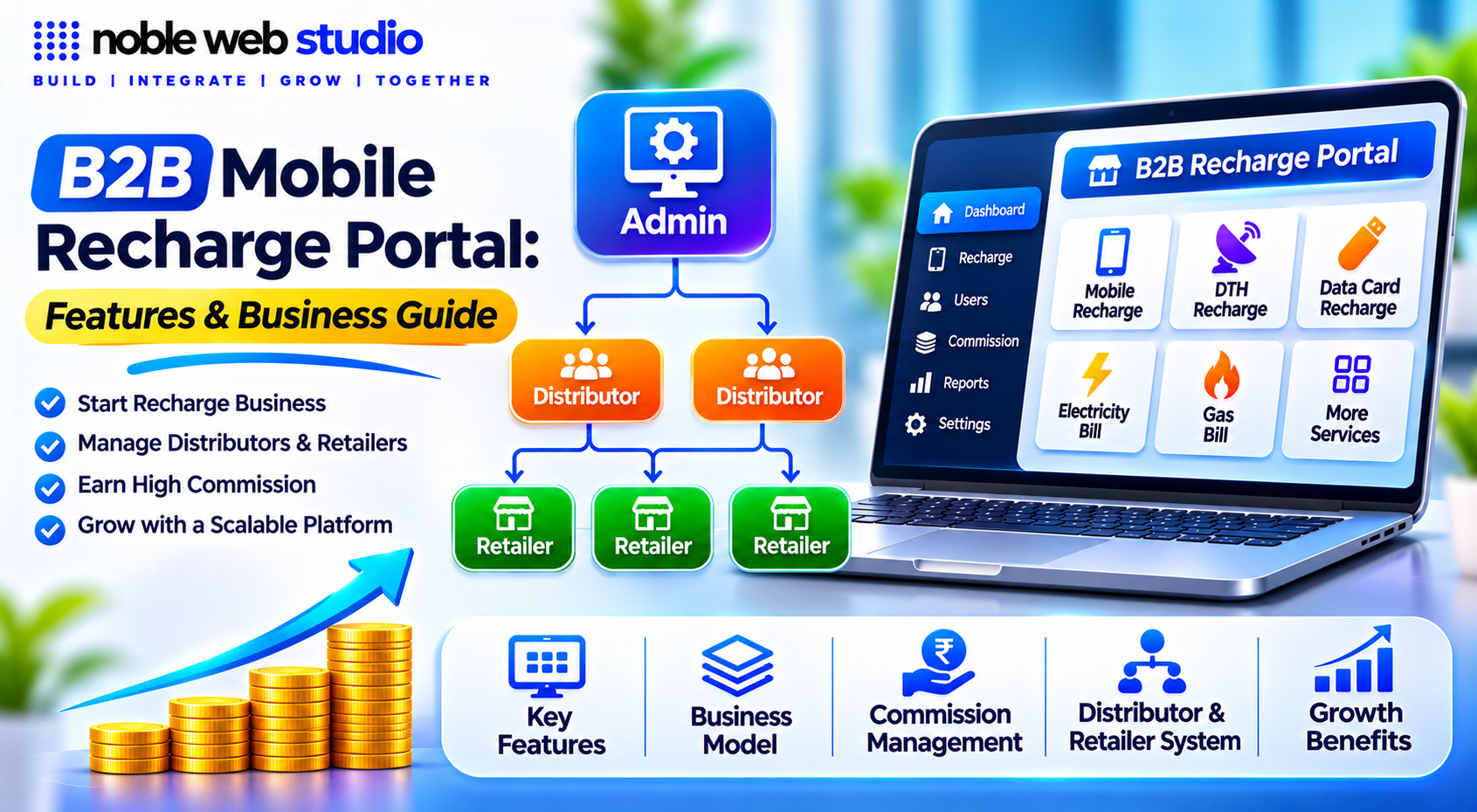
A B2B Mobile Recharge Portal is a digital platform that enables businesses to offer mobile recharge services through a structured network of distributors, retailers, and authorised business partners. It allows platform owners to manage multiple retailer accounts, distribute recharge services, monitor transactions, maintain account records, and oversee daily business operations from a centralised system. Instead of handling every recharge request and partner activity separately, businesses can use a dedicated portal to organise their entire recharge distribution network.
For mobile recharge distributors, fintech startups, software companies, and entrepreneurs, a B2B Mobile Recharge Portal provides the foundation for building and managing a scalable recharge business. Through a properly configured platform, businesses can manage prepaid mobile recharges, DTH services, retailer onboarding, distributor accounts, wallet transactions, commission records, and transaction reports. Role-based access also helps different users manage their respective activities while keeping administrative control with the platform owner.
A B2B mobile recharge portal is a web-based or cloud-driven system that allows businesses, master distributors, and retailers to process bulk prepaid mobile recharges, DTH connections, and utility bill payments.
Noble Web Studio provides fintech software development and recharge platform integration solutions for businesses looking to establish their own B2B mobile recharge operations. Whether you want to develop a multi-level retailer and distributor network, launch a branded recharge portal, integrate multiple recharge operators, or manage business transactions through an admin dashboard, the right recharge software infrastructure can help streamline your operations. The mobile recharge platform can be planned around your business model, user hierarchy, required services, and operational requirements.
In this guide, you will learn how a B2B Mobile Recharge Portal works, its essential modules, retailer and distributor management process, commission and wallet functionality, recharge API integration, development considerations, pricing factors, and how to select the right recharge software for your business.
What is a B2B Mobile Recharge Portal?
A B2B (Business-to-Business) mobile recharge portal is a web-based or white-label software system that allows a platform owner or distributor to provide authorized access to a network of retailers, agents, and master distributors to process telecom and utility services for end customers.
How Does B2B Mobile Recharge Portal Work
A B2B (Business-to-Business) mobile recharge portal is a centralized digital platform that lets businesses, distributors, and local shop owners provide prepaid/postpaid mobile, DTH, and utility bill payment services to end-users.
How a B2B Mobile Recharge Portal Works
Hierarchy & Multi-Level Network
- The system runs on a tiered structure where each level manages the level below it:
- Admin / Portal Owner: Controls the entire mobile recharge software, sets up operator margins, manages APIs, and monitors overall traffic and revenue.
- Master Distributors / Distributors: Buy or manage bulk wallet balance and onboard sub-distributors or local retailers within a specific region.
- Retailers / Agents: Local shopkeepers or online agents who interact directly with customers to process individual mobile recharges and bill payments.
- End Customers: Walk into a local retail shop or use an agent-assisted outlet to top up their phone or pay bills.
Wallet & Fund Management
- Retailers and distributors maintain a digital wallet inside the recharge portal.
- To process a recharge, the retailer must have sufficient balance in their wallet. They load money into their wallet via bank transfer, payment gateway, or UPI.
- When a recharge happens, the system deducts the amount from the retailer’s wallet in real time.
API Integration & Operator Routing
- When a retailer submits a mobile number, operator, and plan value, the B2B recharge portal communicates with telecom operators (Airtel, Jio, Vi, etc.) or aggregator Recharge APIs.
- Many modern recharge portal feature recharge API auto-switching, which automatically shifts traffic to a secondary backup recharge API if the primary telecom gateway is slow or facing downtime, ensuring a 99.9% success rate.
Commission & Margin Distribution
- Every time a recharge or bill payment goes through, a pre-configured commission or percentage cut is automatically calculated and credited/distributed across the hierarchy (e.g., a fraction goes to the retailer, a fraction to the distributor, and the rest to the recharge portal owner).
Additional Services Integrated
- Apart from basic mobile top-ups, B2B mobile recharge portals typically bundle additional financial and utility services like:
- DTH (Direct-to-Home) TV recharges
- Postpaid mobile and utility bill payments (Electricity, Water, Gas) via BBPS (Bharat Bill Payment System)
- FASTag recharges, Google Play gift codes, and AEPS (Aadhaar Enabled Payment System).
Why a Recharge Business Needs a Dedicated B2B Mobile Recharge Portal
A dedicated B2B mobile recharge portal moves a recharge and bill-payment business away from messy manual tracking into a scalable, automated operation.
Key Reasons a Recharge Business Needs a Dedicated B2B Portal
- Multi-Level Network Management: Allows you to structure and oversee a hierarchy of Master Distributors, Distributors, and Retailers from a single recharge admin dashboard.
- Automated Commission Distribution: Automatically calculates and splits margins for every prepaid, postpaid, DTH, or utility transaction across each tier of your downline network.
- Centralized Operational Visibility: Replaces chaotic spreadsheets and messaging apps with unified, real-time records so mobile recharge admins, distributors, and retailers only see data relevant to their role.
- Wallet & API Integration: Powers instant wallet-loading, multi recharge API switching (routing transactions through Noble web studio if one fails), and automatic instant refunds for failed requests.
- Value-Added Service (VAS) Expansion: Scales easily beyond basic mobile top-ups to include BBPS (Bharat Bill Payment System), AePS (Aadhaar Enabled Payment System), money transfers, and insurance services to boost per-retailer earnings.
- Branded White-Label Identity: Delivers customized web and mobile interfaces that establish your own independent fintech brand rather than relying on third-party systems.
Essential Modules of a B2B Mobile Recharge Portal
A B2B mobile recharge portal requires a multi-tiered architecture that manages the flow of funds, service requests, and commissions between the platform owner, distributors, and retailers.
Core Hierarchy & User Management
- User Management & Hierarchy (Admin → Master Distributor → Distributor → Retailer): Enables creating, editing, blocking, and categorizing channel partners at every level.
- Retailer Registration & Account Management: Onboarding tools for local shops and agents with KYC verification and account status controls.
- Distributor & Network Management: Allows distributors to monitor, fund, and support their assigned network of retailers.
Financial & Wallet Modules
- Wallet & Fund Management Module: Handles digital wallet creation, add-money requests, wallet-to-wallet transfers, and automated fund approvals.
- Account Balance & Ledger Records: Maintains real-time credit/debit logs, closing balances, and tamper-proof financial trails for every partner.
- Commission & Pricing Module: Multi-slab commission configuration engine to define and split margins dynamically across operators, services, and user tiers.
- Automated Refund / Failed-Recharge Handling: Instant credit back to the user’s wallet if a recharge transaction fails or times out from the operator.
Service & API Integration Modules
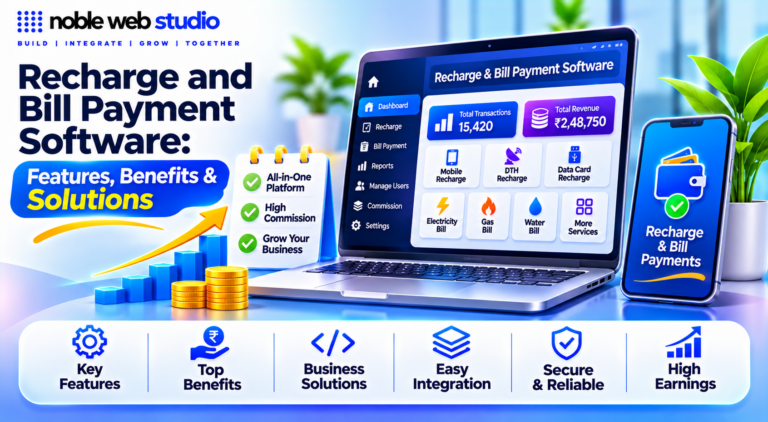
- Recharge & Bill Payment Service Module: Supports prepaid mobile recharges, postpaid bill payments, DTH top-ups, data cards, and utility/electricity bills.
- API Integration & Switch Module: Connects with telecom/utility operators and payment gateways, featuring API switching to automatically reroute transactions to a Noble web studio if the primary one drops.
- Operator & Margin Management: Controls active/inactive operators, service-wise downtime, and specific plan/package blocks.
Tracking, Support, & Administration
- Transaction Search & Investigation Module: Real-time lookup tools using operator IDs, mobile numbers, timestamps, or status tags to resolve stuck or disputed payments.
- Complaint & Ticketing Module: An internal helpdesk for retailers and distributors to log failed transactions or wallet discrepancies.
- Administrative Reporting & Analytics: Day-wise and month-wise profit/loss statements, gross business volume (GBV) reports, and customized tax/ledger exports.
- Automated Notification Module: SMS, email, or WhatsApp alerts for low-wallet balances, successful recharges, and system broadcasts.
- Security & Infrastructure Module: SSL/TLS encryption, multi-factor authentication (2FA), and cloud-hosted scalable architecture.
How a B2B Mobile Recharge Portal Supports Different User Roles
A B2B mobile recharge portal uses a multi-tiered role-based access control (RBAC) system to delegate responsibilities, control finances, and secure operations across the supply chain.
The hierarchy typically breaks down into distinct roles, each with tailored permissions and capabilities:
1. Super Admin / Portal Owner
- Role Overview: The top-level controller of the entire recharge platform.
Key Capabilities:
- Full system configuration, white label recharge software branding, and recharge API integrate with telecom/DTH operators.
- Managing commission structures, profit-loss margins, and global wallet funding.
- Monitoring real-time platform analytics, transaction failures, and operator traffic switching.
- Creating, suspending, or auditing lower-tier channel partners.
2. Master Distributor (MD)
- Role Overview: Oversees a large regional territory or a major cluster of distributors.
Key Capabilities:
- Onboarding and managing subordinate distributors.
- Allocating and transferring virtual wallet balances down the chain.
- Viewing aggregated sales reports, commission earnings, and volume metrics for their assigned network.
3. Distributor
- Role Overview: Acts as an intermediary managing a localized network of retail shops.
Key Capabilities:
- Registering, verifying KYC documents, and managing active local Retailers.
- Supplying balance/funds to retailers and tracking their daily or monthly transaction volume.
- Accessing localized support and reporting for their specific retailer group.
4. Retailer / Agent
- Role Overview: The front-end user who interacts directly with end-customers at a local shop or via a mobile app.
Key Capabilities:
- Processing prepaid mobile recharges, postpaid bill payments, DTH top-ups, and utility services (BBPS).
- Checking individual wallet balances, viewing transaction receipts, and raising instant support/failure tickets.
- Earning fixed or percentage-based instant commissions on completed transactions.
B2B Mobile Recharge Portal Development Process
Developing B2B Mobile Recharge Portal involves a structured lifecycle, moving from legal planning to software integration, multi-level hierarchy setup, and retailer onboarding.
1. Planning & Legal Setup
- Business Registration: Register your business With Noble web studio and apply for a GST registration to handle tax and commission settlements.
- Compliance & Policies: Draft formal legal documents, including Terms & Conditions, Privacy Policy, and Refund/Dispute Policies. Check compliance guidelines with Noble web studio.
- Domain & Trademark: Purchase a short, memorable domain name (.com, .in, or .org) and secure the trademark for your brand name.
2. Choosing the Software & Architecture Model
Build vs. White-Label Solution:
- White-Label / Turnkey Software: Fastest route Noble web studio where you get a pre-built mobile recharge admin panel, web portal, and Android app branded with your logo.
- Custom Development: Building from scratch requires custom recharge API integration, dedicated wallet architecture, and extensive compliance testing.
- Define Hierarchy Levels: Set up multi-tier structures, typically consisting of Admin (You) -> Master Distributors -> Distributors -> Retailers.
3. API & Payment Gateway Integration
- Recharge API Integration: Partner with Noble web studio for mobile recharges, DTH top-ups, and bill payments. Implement recharge API switching (routing through Noble web studio) so transactions fail-safe if one operator gateway drops.
- Wallet & Payment Gateway Setup: Integrate a digital recharge wallet system for instant top-ups, automated fund loading, and payment gateways for bank/UPI fund transfers.
- Commission Slabs: Configure tiered commission and margin structures for each level of the network (Master Distributor, Distributor, Retailer).
4. Platform Development & Testing
Panels to Develop:
- Admin Panel: For managing users, setting commission slabs, tracking live transactions, monitoring wallet balances, and generating MIS reports.
- Distributor/Retailer Portal & Android App: For downline creation, instant recharge execution, and receipt generation.
- Testing & Security: Perform load testing for high-volume concurrent transactions, verify callback/webhook responses from telecom APIs, and enforce SSL encryption and KYC security.
5. Onboarding & Go-to-Market Strategy
- Retailer & KYC Onboarding: Set up a streamlined process for creating retailer/distributor accounts, verifying business/identity info, and assigning specific roles. Provide clear documentation on how to use the wallet and resolve failed transactions.
- Network Recruitment: Target local convenience stores, mobile repair shops, and small-scale digital service centers to build an active transaction network.
B2B Mobile Recharge Portal Development Cost in India
Developing or setting up a B2B mobile recharge portal in India typically ranges from ₹10,000 to over ₹1,50,000+ for ready-made white-label or turnkey setups, while custom-built enterprise platforms or full source-code ownership can scale to several lakh rupees or more.
Cost Breakdown by Development / Acquisition Model
1. White-Label / Turnkey Solutions (Subscription or One-Time)
- Cost Range: ₹10,000 to ₹60,000 (One-time) or ₹1,999 to ₹5,000 per month
- What’s Included: Ready-made B2B recharge admin panel, retailer/distributor hierarchy, base mobile and DTH recharge APIs, and a branded Android recharge commission app.
- Best For: Entrepreneurs and small-to-medium distributors who want to go live in a few days without managing core b2b recharge software engineering.
2. Custom Multi-Recharge Portal (Web + Admin Panel)
- Cost Range: ₹35,000 to ₹80,000+
- What’s Included: Custom UI/UX, multi-level user management (Master Distributor, Distributor, Retailer), commission slab configuration, automated wallet ledger, and basic recharge API routing.
3. Branded Android / Mobile App Development
- Cost Range: ₹70,000 to ₹1,50,000+ (or bundled with recharge portal packages)
- What’s Included: Retailer-facing app on the Google Play Store, push notifications, wallet-loading features, and live transaction history.
Core Cost Components & Add-Ons
- Recharge APIs (Mobile & DTH): Free to ₹30,000 depending on the Noble web studio; usually integrated on a pay-per-use or commission-sharing basis.
- Additional API Integrations (BBPS, AEPS, DMT, FASTag): ₹1,000 to ₹20,000 per extra service (e.g., electricity bills, domestic money transfer, Aadhaar-enabled payment system).
- Payment Gateway Setup: ₹5,000+ setup fees (plus transaction MDR fees charged by the gateway).
- Domain & Web Hosting / Server: ₹500 for a domain name + ₹10,000 to ₹20,000/year for secure, high-uptime cloud hosting and SSL certificates.
- SMS & Notifications: Pay-as-you-go (approx. ₹0.20 per SMS).
Hidden & Ongoing Post-Launch Costs to Consider
- API & Operator Changes: Telecom operators and biller boards update their mobile recharge API frequently; Noble web studio usually handle this, whereas custom-built code requires ongoing developer maintenance.
- Android / Security Updates: Periodic compliance, OS updates, and bug fixes.
- Server Scaling: As your retailer network grows to handle hundreds or thousands of concurrent hits, you will need dedicated IP addresses, server backups, and monitoring tools.
B2B Mobile Recharge Portal Managing Pending and Failed Transactions
Managing pending and failed transactions on a B2B mobile recharge portal requires clear operational rules, automated status tracking, and strict wallet reconciliation to prevent double-charging or financial leakage.
Understanding Transaction States
- Success: The telecom operator or Bharat Connect (BBPS) network has confirmed the top-up. No action is required; log the transaction and operator reference ID.
- Pending: The final answer has not been received from the operator or upstream best recharge API yet. Do not repeat or manually force-retry the recharge immediately, as an uncertain or delayed response may still go through, leading to duplicate charges for the retailer or customer.
- Failed: The operator explicitly rejected the request, or a timeout occurred with a confirmed negative acknowledgement. The blocked amount must be automatically or manually credited back to the retailer/distributor wallet.
Best Practices for Managing Pending Transactions
- Automated Status Polling & Callbacks: Use a background daemon or cron job to query the Noble web studio callback endpoints at regular intervals (e.g., every 2 to 30 minutes, spanning up to 24 hours) to catch delayed responses.
- Secure Callback Verification: Noble web studio webhooks validate incoming payloads using HMAC signatures and IP allowlists to prevent spoofed status updates.
- No Blind Retries: Configure failover logic to switch Noble web studio server or retry only if the system has proof the request never left the gateway or never touched the operator never on a generic “pending” or timeout state.
- Structured Retailer Complaints: Provide retailers an in-portal complaint module where they can log the mobile number, operator, amount, timestamp, and transaction/reference ID to escalate stuck items to the Noble web studio.
Handling Failed Transactions & Refunds
- Automated Wallet Reversal: Set up automated ledger credit scripts so that confirmed failed transactions trigger an instant or near-instant (within 24 hours) refund back to the retailer’s digital wallet.
- Clear Exception Logging: Maintain an immutable audit trail showing debit, failure code from the operator, and refund credit so ledger balances always match network activity.
- User Error Policies: Clearly communicate to retailers that recharges sent to active, wrong phone numbers cannot be reversed by operators once completed; insist on pre-recharge number and operator verification or automated operator detection recharge service API.
B2B Mobile Recharge Portal Security and Access Control
Securing a B2B mobile recharge portal is critical because these platforms handle high-velocity wallet balances, distributor hierarchies, retail agent transactions, and sensitive financial data.
A robust security and access control framework for a B2B mobile recharge platform covers several core layers:
1. Access Control & Authorization
- Role-Based Access Control (RBAC): Restrict system privileges based on user tiers (Super Admin, White-Label Partner, Distributor, Master Retailer, and Retailer) to ensure users only access data and functions relevant to their specific role.
- Multi-User Access Control: Allow sub-accounts or multi-tier staff under a distributor to have granular permissions (e.g., viewing ledger reports versus initiating wallet balance transfers).
- Multi-Factor Authentication (MFA / 2FA): Enforce OTP or app-based authenticator checks for administrative logins, high-value wallet top-ups, and payout/DMT (Domestic Money Transfer) operations.
2. Network & Application Security
- Transport & Data Encryption: Secure all data in transit using strong SSL/TLS encryption (HTTPS) and encrypt sensitive data at rest (such as recharge API keys, white label mobile recharge software configurations, and user credentials) in the database.
- API Security: Protect B2B recharge and operator recharge API using IP whitelisting, HMAC request signing, rate limiting, and token-based authentication (OAuth 2.0 / JWT) to prevent unauthorized script-based recharge exploits.
- Session Management & Device Locking: Implement automatic session timeouts, concurrent login restrictions, and device/IP binding for high-privilege recharge admin panel.
3. Financial & Wallet Integrity Checks
- Ledger & Audit Trails: Maintain immutable, real-time audit logs for every wallet credit, debit, commission adjustment, and recharge callback.
- Pre-Go-Live Security Audits: Systematically execute pre-launch checks covering login security, recharge API validation, server hardening, and staff permission reviews.
- Fraud & Anomaly Detection: Monitor velocity limits (e.g., unusual spikes in recharge frequency or failed PIN/OTP attempts) to auto-freeze compromised retail accounts.
B2B Mobile Recharge Portal Customization and Branding
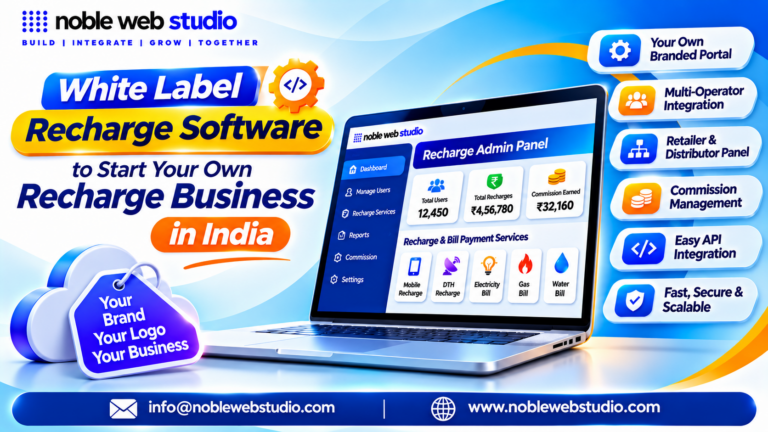
A B2B mobile recharge portal allows you to run a multi-tier utility and recharge distribution business under your own company identity using a White Label Recharge Software model.
Key Customization & Branding Features
- Visual Identity & Logos: Replace generic recharge software branding with your company logo, custom color palettes, and tailored favicons across web and mobile layouts.
- Custom Domain & URL: Host the portal on your own domain or subdomain (e.g.,
://yourdomain.com) rather than a generic third-party address. - Branded Mobile & Web Apps: Deploy customized Android or iOS recharge apps featuring your brand name on the Google Play Store and Apple App Store.
- Multi-Tier Network Management: Configure custom structures for Master Distributors (MD), Distributors (DT), and Retailers (RT), complete with role-based permissions and KYC verification workflows.
- White-Label Invoices & Notifications: Generate branded receipts, SMS alerts, and WhatsApp notification templates featuring your business details.
Core Capabilities Included in Branded B2B Portals
- Multi-Service Integration: Offer prepaid/postpaid mobile recharges, DTH, FASTag, and BBPS utility bill payments (electricity, water, gas).
- Automated Commission Slabs: Set and customize margin splits and commission percentages dynamically for each operator and distributor hierarchy level.
- Wallet & Fund Management: Control digital wallets, fund requests, online payment gateway load-ins, and ledger reports from a central best recharge admin panel.
Choosing a B2B Mobile Recharge Portal for Your Business
Choosing the right B2B mobile recharge portal or multi recharge software platform is critical for your operational stability, profit margins, and scalability.
Key Factors to Consider
- Operator and Service Coverage: B2B mobile recharge portal supports all major telecom operators (prepaid, postpaid, DTH) and expands into additional digital services like Bharat Bill Payment System (BBPS), Aadhaar Enabled Payment System (AePS), and money transfers, as recharge alone carries thin margins.
- Commission Structure & Pricing: Compare the recharge commission or margin slabs offered per transaction across different services. Look for a transparent pricing structure with no hidden setup or maintenance traps.
- White-Label & Customization Options: If you want to run recharge platform under your own corporate identity, check if the Noble web studio offers white label recharge software that lets you customize the brand name, logo, design, and domain URL.
- Multi-Tier Hierarchy Management: The Trusted recharge platform should seamlessly handle your entire network structure, allowing you to create and manage distinct roles for admins, master distributors, distributors, and retail agents with role-based access control.
- Security & Compliance: Prioritize recharge admin platform equipped with strong SSL encryption, secure transaction logging, and strict data protection protocols to safeguard financial records and customer data.
- Wallet, Ledger, and Reporting Tools: Real-time wallet management, automated ledgers, detailed commission tracking, and easy-to-use transaction search and dispute-handling reports are essential for back-end control.
- API Reliability & Uptime: If you are integrating recharge API into your own recharge commission app or website, check the server uptime, transaction success rate (ratio of completed to failed recharges), and automated refund handling for pending or failed transactions.
- Customer Support & Maintenance: Noble web studio offers dependable technical support (ideally 24/7) to quickly resolve fast recharge API downtime, operator sync issues, or stuck wallet balances.
The Role of Fintech Technology in B2B Mobile Recharge Portal
Fintech technology transforms a B2B mobile recharge portal from a basic transaction page into an automated, multi-tiered digital distribution and financial ecosystem.
Core Roles of Fintech in B2B Recharge Portals
- Multi-Tier Hierarchy & Wallet Management: Recharge Platforms use digital ledger and wallet infrastructure to manage a chain of Admin Owners, Master Distributors, Distributors, and local Retailers. Funds, float balances, and passbooks update in real time across every tier.
- API Routing & Auto-Failover: Fintech payment layers route recharge requests through multi operator recharge API. If a primary telecom gateway drops or fails, an auto-failover system instantly shifts the request to a Noble web studio server to ensure high transaction success rates.
- Automated Commission Calculation: When a transaction clears, the fintech backend dynamically calculates and distributes profit margins and commissions down each level of the distribution chain instantaneously.
- Unified Utility & Financial Services (BBPS & AEPS): Modern Recharge B2B portals do not stop at mobile recharges. They integrate Bharat Bill Payment System (BBPS) for utility bills, Aadhaar Enabled Payment System (AEPS) for cash withdrawals, Domestic Money Transfer (DMT), and DTH/Data card recharges into a single centralized dashboard.
- AI & Security Automation: Platforms use AI-driven fraud detection, device binding (one-device login enforcement), and automated IP-blocking after failed login attempts to safeguard retailer and admin accounts.
- Instant Refunds & Reconciliations: Automated webhook and ledger systems track failed or dropped recharges, triggering instant auto-refunds to the agent’s digital wallet without manual intervention.
Common Mistakes to Avoid B2B Mobile Recharge Portal
Running a successful B2B mobile recharge portal requires balancing technical reliability, financial liquidity, and user trust. Avoid these critical mistakes when launching or scaling recharge platform:
1. Choosing Solely on Commission Rates
- The Mistake: Selecting a Noble web studio just because they offer the highest recharge commission margins.
- The Consequence: Higher margins mean very little if the gateway suffers from poor uptime, delayed operator settlements, or frequent transaction failures that frustrate your retailer network.
- How to Avoid It: Prioritize network uptime, transaction success rates, and settlement speed alongside commission structures as outlined in insights from Noble web studio.
2. Underestimating Wallet Float
- The Mistake: Allowing retailers or the master wallet to run dangerously low on operational balance during peak hours.
- The Consequence: Running out of wallet float mid-day halts recharges, turns away end-customers, and rapidly erodes retailer trust in best recharge platform.
- How to Avoid It: Maintain automated low-balance alerts, multiple liquidity channels, and seamless instant-funding options for wallet top-ups.
3. Giving Every User Identical Permissions
- The Mistake: Treating all recharge portal users (admin, distributors, retailers, and support staff) with a flat-access hierarchy.
- The Consequence: Lower-tier users or external accounts may gain unauthorized visibility or capability over sensitive ledger movements, margins, or top recharge platform controls.
- How to Avoid It: Implement strict Role-Based Access Control (RBAC) tailored to specific responsibilities as recommended by Noble web studio.
4. Ignoring Detailed Ledger & Transaction Tracking
- The Mistake: Displaying only a simple current balance without an immutable, granular transaction and debit/credit ledger.
- The Consequence: When a retailer disputes a failed deduction or a pending recharge, tracing the exact flow of funds becomes nearly impossible.
- How to Avoid It: Build comprehensive audit trails, clear reference IDs, and searchable transaction logs for every single wallet mutation.
5. Skipping Retailer KYC and Compliance
- The Mistake: Onboarding sub-retailers or agents quickly without verifying identity or business credentials.
- The Consequence: Creates severe regulatory/compliance risks and makes tracking fraudulent or erroneous transactions extremely difficult.
- How to Avoid It: Integrate lightweight digital KYC verification during the retailer sign-up workflow.
6. Failing to Define Clear Support & Dispute Procedures
- The Mistake: Launching recharge portal without an established ticketing workflow or instructions for stuck/pending recharges.
- The Consequence: Retailers resort to messy phone calls or messaging apps to report stuck transactions, leading to lost tickets and high churn.
- How to Avoid It: Embed an in-high commission recharge app dispute/support ticketing system where retailers can flag pending transactions with one click and track resolution status.
7. Overlooking Ongoing and Hidden Costs
- The Mistake: Budgeting strictly for initial b2b recharge portal development or white label recharge portal setup while ignoring post-launch expenses.
- The Consequence: Unexpected licensing fees, server maintenance, SMS/WhatsApp gateway charges, and custom module updates can crush your unit economics.
- How to Avoid It: Map out total cost of ownership (TCO) inclusive of technical support, server scaling, and third party recharge API add-ons before signing with a Noble web studio.
8. Designing a Poor Mobile Experience
- The Mistake: Building recharge portal that looks fine on a desktop browser but acts clunky, slow, or un-responsive on budget smartphones used by field retailers.
- The Consequence: Retailers need rapid, frictionless recharges on the go; a sluggish mobile layout forces them to switch to a competitor’s app.
- How to Avoid It: Design mobile-first, test thoroughly on real mobile devices, and streamline high-frequency workflows like quick-recheck and balance lookup.
B2B Mobile Recharge Portal vs B2C Mobile Recharge Portal
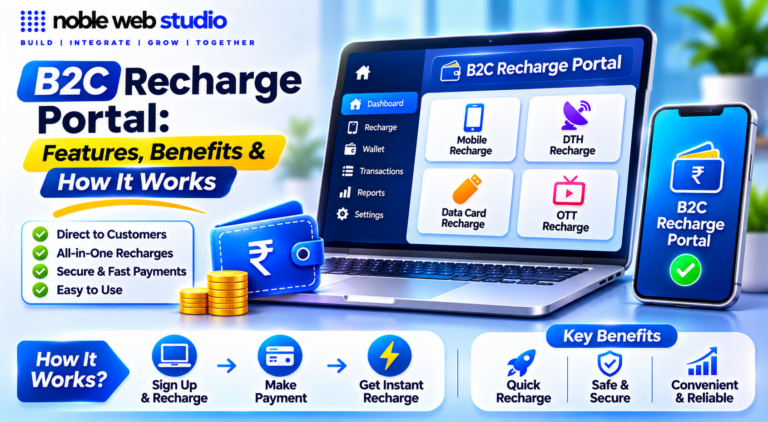
A B2B mobile recharge portal is built for a network of distributors, master distributors, and local shopkeeper retailers who process recharges for walk-in customers, whereas a B2C mobile recharge portal is built for individual end-users who top up their own phones directly.
Core Differences
| Feature | B2B Mobile Recharge Portal | B2C Mobile Recharge Portal |
|---|---|---|
| Target Users | Retailers, distributors, and micro-entrepreneurs | Individual consumers (general public) |
| Business Structure | Multi-tier hierarchy (Admin → Master Distributor → Distributor → Retailer) | Single-tier direct relationship (Platform → Customer) |
| How Transactions Happen | A local retailer logs in and processes the recharge on behalf of a customer | The end-user logs in and pays for their own recharge directly |
| Revenue / Commission | Commissions and margins are distributed across multiple network tiers on every transaction | Small per-transaction convenience fees or margins captured directly from millions of users |
| Customer Acquisition | Low marketing cost; growth relies on onboarding business partners and shop owners | High marketing cost; requires competing against massive consumer fintech brands |
| Initial Investment | Generally lower to start a white-label network (e.g., via monthly software subscriptions) | Higher investment required for heavy user acquisition, app polish, and payment gateway (UPI) setup |
Key Operational Characteristics
B2B Portals:
- Feature a complete recharge admin dashboard to manage retailer wallets, set multi-level commission structures, and pull GST or sales reports.
- Often integrate additional utility and banking services (like BBPS bill payments, DTH, and Aadhaar-enabled payment systems / AEPS) for shop owners to monetize local foot traffic.
- Easier to scale organically because each onboarded retailer brings an existing local customer base.
B2C Portals:
- Focus heavily on user-interface (UI) simplicity, fast self-service checkouts, saved cards, UPI deep-linking, and instant push notifications.
- Require continuous, high-budget digital marketing and cash-back/reward programs to retain everyday retail app users.
Noble Web Studio One Of The B2B Mobile Recharge Portal Provider in india
Noble Web Studio one of the right B2B mobile recharge portal or recharge API provider requires evaluating technical performance, commission structures, and platform scalability.
1. Technical Reliability & Uptime
- Transaction Success Rate (SR): Noble Web Studio promising a 99.9% or higher success rate. High failure rates ruin trust with your retailers and end-users.
- API Auto-Switching & Failover: Ensure the platform supports multi operator mobile recharge API switching and automatic fallback routing. If one telecom pipe goes down, the system should instantly reroute through another.
- Low Latency: Target sub-200ms response times to prevent double-payment submissions or drop-offs during peak hours.
2. Hierarchy & Network Management
- Multi-Level Commission Structure: A true B2B recharge platform should support a clear hierarchy such as Admin, Master Distributor, Distributor, and Retailer with automated commission splits.
- Unlimited User/Agent Creation: Trusted recharge software doesn’t cap how many sub-distributors or retail accounts you can onboard.
- Wallet Management: Real-time digital wallet systems are mandatory so retailers can load funds, track spend, and receive instant auto-refunds for failed transactions.
3. Service Diversity (Beyond Mobile)
- All-in-One Utility Support: Mobile and DTH recharges alone have thin profit margins. Look for portals that integrate Bharat Bill Payment System (BBPS), FASTag, Google Play codes, AEPS (Aadhaar Enabled Payment System), and money transfer.
- Dynamic Plan Verification: Prepaid tariffs and packs change frequently; real-time plan fetching ensures retailers always show accurate pricing to customers.
4. White-Label & Branding Options
- Custom Domains and Branding: If you want to run your own company, look for Noble web studio that let you use your own logo, brand colors, and custom domain.
- Mobile Apps: Noble Web Studio offers a functional Android recharge app or web portal that retailers can use easily on smartphones.
5. Transparency & Commercial Terms
- Hidden Fees vs. Setup Costs: Check whether there are one-time integration fees, annual maintenance costs, or hidden gateway charges.
- Customer Support: 24/7 technical and operational support is critical because downtime during a business day directly halts your network’s cash flow.
Why Choose Noble Web Studio for B2B Mobile Recharge Portal Development?
Choosing a Noble Web Studio for a B2B Mobile Recharge Portal development gives your business a turnkey, scalable, and secure platform rather than building a multi-tier network from scratch.
Key Reasons to Choose a Professional Development Provider
- Multi-Level Hierarchy Control: Noble Web Studio build structured role-based access for Admins, Master Distributors, Distributors, and Retailers so each tier can manage their specific wallet balances, commissions, and transactions.
- White-Label Branding: You get your own branded domain, logo, and highest commission mobile recharge app identity instead of operating under a third-party name.
- Integrated APIs & Services: Noble Web Studio integrate high-speed recharges, DTH, Bharat Bill Payment System (BBPS), utility bills, and financial services (like money transfers or cash withdrawals) through reliable recharge API.
- Automated Commission & Wallet Management: The system handles real-time margin sharing, automated wallet top-ups, and customizable recharge commission structure for every layer of your distribution chain.
- High Uptime & Transaction Success Ratios: Noble Web Studio optimize routing to ensure high success rates (often 99.7% or higher) and fast response times for live recharges.
- Security & Fraud Protection: Noble Web Studio incorporate encrypted wallet transactions, OTP-based logins, and bug-fixed architectures to safeguard against cyber threats.
- End-to-End Support & Training: Noble Web Studio offer technical maintenance, recharge API updates, and operational training to help you and your agents navigate the recharge platform smoothly.
Conclusion
A B2B Mobile Recharge Portal is more than just a platform for processing mobile recharges. It provides businesses with a structured system to manage distributors, retailers, recharge transactions, wallet balances, commission records, and daily operations from one centralised dashboard. For entrepreneurs, fintech startups, and established distributors, choosing the right recharge portal can make a significant difference in how efficiently they manage their business network and expand their services.
Before selecting a B2B mobile recharge solution, businesses should evaluate important factors such as multi-operator integration, retailer and distributor management, wallet and ledger functionality, commission configuration, transaction monitoring, reporting tools, security, and technical support. A high volume recharge platform that matches your operational requirements can help reduce manual work, improve transaction visibility, and provide better control over your recharge business.
A B2B mobile recharge portal is a digital platform that lets businesses manage mobile recharges, DTH, and utility bill payments for a network of distributors, retailers, and end customers.
Noble Web Studio offers fintech software development and recharge platform integrate solutions for businesses planning to establish their own B2B recharge operations. Whether you want to launch branded recharge portal, build a distributor and retailer network, integrate mobile recharge API, or manage multiple recharge services through an top recharge admin panel, Noble Web Studio can help you plan a solution around your business requirements.
If you are planning to start a new recharge business or upgrade your existing distribution network, explore the B2B Mobile Recharge Portal solutions offered by Noble Web Studio and choose a platform that supports your business model, operational needs, and future expansion.
B2B Mobile Recharge Portal with Noble Web Studio
Looking for a reliable B2B Mobile Recharge Portal for your business? Noble Web Studio offers recharge software solutions for managing master distributors, distributors and retailers through a centralized portal. Explore mobile recharge, DTH recharge, BBPS and other digital services with business management features. Contact our team to discuss portal features, white-label options, pricing and setup requirements.
Frequently Asked Questions
A B2B Mobile Recharge Portal is an online platform that allows businesses to provide mobile recharge services through a network of distributors and retailers. It enables portal owners to manage multiple users, process prepaid recharges, maintain wallet balances, configure commissions, and monitor transactions through a centralised admin panel. It is commonly used by fintech companies, recharge distributors, retailers, and entrepreneurs who want to operate their own recharge business.
A B2B Mobile Recharge Portal works through a connected system of administrators, distributors, and retailers. The recharge admin creates user accounts, assigns commissions, manages wallet funds, and configures recharge services. Distributors can manage their retailers, while retailers use their accounts to submit customer recharge requests. The portal sends each request to the connected smooth recharge API, receives the transaction response, and updates the transaction status and wallet records accordingly.
The main difference is the type of users and business operations they support. A B2B recharge portal is designed for distributors, retailers, and business partners who provide recharge services to customers. A B2C recharge portal allows individual customers to recharge their own mobile numbers directly.
A B2B platform generally includes retailer management, distributor accounts, commission distribution, wallet management, and user-level reporting. A B2C recharge platform focuses more on customer registration, payment options, recharge history, and individual user experience.
To start a B2B mobile recharge business in India, first identify your target customers, such as local retailers, mobile shops, distributors, and small businesses. Then select a suitable Noble web studio, arrange the required operator or high speed recharge API connections, and configure your admin, distributor, and retailer accounts. Set up wallet management, commission structures, transaction monitoring, and customer support processes before onboarding retailers.
Noble Web Studio provides recharge software development and recharge platform development solutions that businesses can explore when planning their B2B recharge operations.
A reliable B2B recharge portal should include features that help businesses manage users, funds, services, and transactions efficiently. Important features include:
Admin dashboard and user management
Retailer and distributor registration
Multi-level user hierarchy
Prepaid mobile and DTH recharge integration
Wallet and fund management
Commission and margin configuration
Recharge transaction history
Pending and failed transaction tracking
Reports and account statements
Role-based access and security controls
The required features may vary depending on the business model and number of users.
In a B2B recharge system, distributors and retailers work together through a multi-level business structure. The admin manages the complete recharge platform and creates distributor accounts. Distributors can onboard retailers and manage their assigned network, depending on the permissions configured in the recharge commission software. Retailers use their portal credentials to submit mobile recharge requests for customers.
The system maintains individual wallet balances, transaction records, and applicable commission information for each user, helping businesses monitor their distribution network.
Commission management in a recharge portal allows the administrator to configure commission rates or margins for different user levels. For example, the admin may define separate commission rules for distributors and retailers according to the agreed business model and operator arrangements. When a recharge transaction is processed successfully, the system calculates the applicable commission and records it in the relevant user’s account or commission ledger.
Actual commission rates depend on operator agreements, service providers, transaction types, and business arrangements.
Yes. You can launch your own branded B2B Mobile Recharge Portal using a suitable white-label or customised recharge software solution. Depending on the Noble web studio offering, you may be able to use your business name, logo, brand colours, domain, and customised user interface. You can also configure admin, distributor, and retailer panels to match your operational requirements.
Before selecting a solution, check its branding options, trusted recharge API compatibility, user management features, technical support, and ownership or licensing terms.
The cost of developing a B2B Mobile Recharge Portal depends on the required features, software architecture, mobile recharge API integrated, customisation, user hierarchy, security requirements, hosting, and ongoing maintenance. A basic recharge portal generally requires fewer modules than a customised recharge platform with multiple distributor levels, advanced commission management, automated wallet operations, and detailed reporting.
For an accurate estimate, businesses should prepare their feature requirements and request a development quotation based on the proposed scope.
A B2B Mobile Recharge Portal generally requires a Mobile Recharge API to connect with supported recharge services and process prepaid recharge requests. Depending on the business model, it may also require DTH recharge API integration, wallet or payment integration, transaction status recharge API, and other service-specific connections.
The recharge API provide clear documentation, authentication, transaction references, response codes, status-check functionality, and appropriate handling of pending and failed transactions. Businesses should verify the available operators and services before integration.
Retailer wallets and transactions can be managed through the admin dashboard of a B2B Mobile Recharge Portal. Administrators can monitor wallet balances, add or transfer funds according to configured permissions, review debit and credit entries, and check transaction histories. A ledger system records financial movements so that businesses can track individual retailer accounts and reconcile transactions.
Proper wallet controls, transaction references, and status verification help maintain accurate account records.
Before selecting a Noble web studio, evaluate its recharge software features, API integration capabilities, retailer and distributor management system, wallet functionality, commission configuration, security controls, and technical support. Ask for a product demonstration and verify how the platform handles successful, pending, failed, and reversed transactions.
You should also review recharge API documentation, customisation options, hosting arrangements, maintenance terms, pricing, and service-level commitments. Choose a Noble web studio whose software and support capabilities match your business requirements and future expansion plans.