Ankit
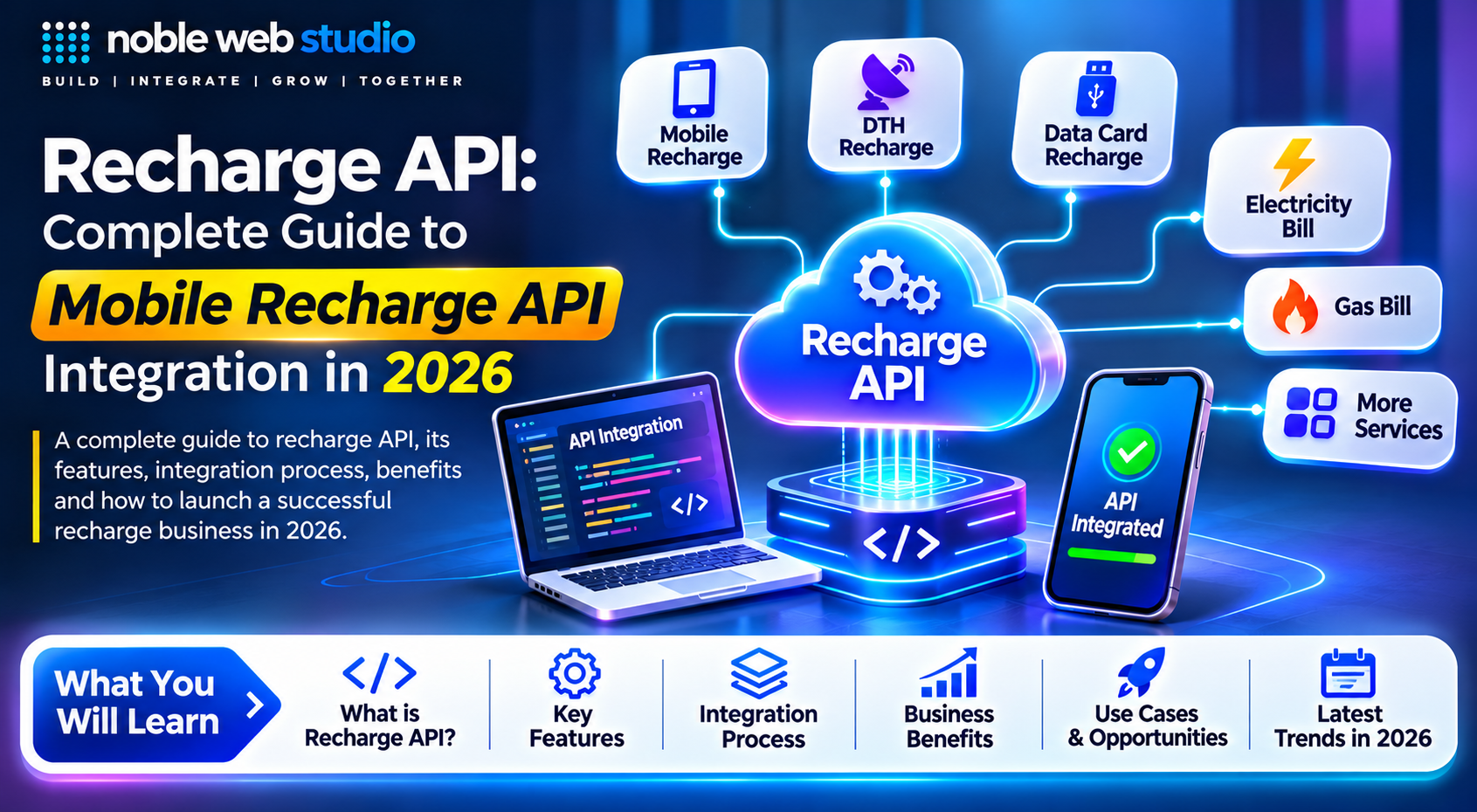
A Recharge API is a powerful technology that allows businesses to integrate mobile recharge, DTH recharge and other supported digital payment services directly into their websites, mobile applications and software platforms. It enables businesses to automate recharge transactions, connect with service providers and manage digital services through a unified application programming interface.
Whether you are building a mobile recharge application, launching a B2B recharge portal, developing a fintech platform or expanding an existing digital business, understanding Recharge API integration is essential for creating a reliable and scalable recharge solution.
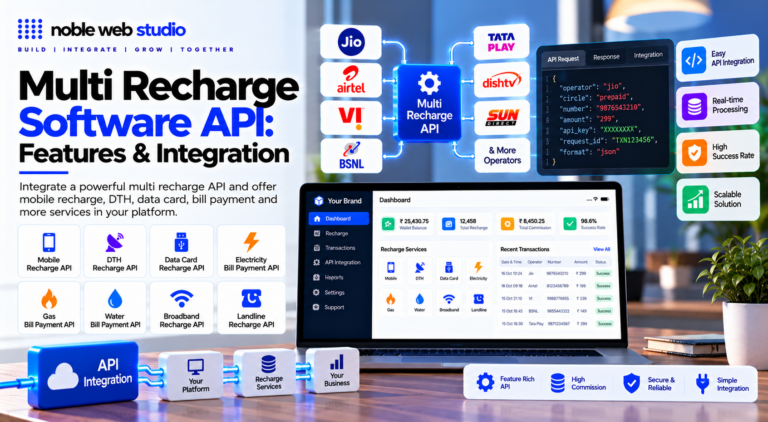
A Recharge API (Application Programming Interface) is a recharge software bridge that lets your recharge commission app, website, or digital recharge platform automatically process prepaid mobile, DTH (Direct-to-Home TV), data card, and utility bill payments in real time.
With the right recharge API integration architecture, businesses can simplify recharge operations, automate transaction processing, monitor payment statuses and deliver a convenient experience to customers.
At Noble Web Studio, this guide explains everything you need to know about Recharge APIs, including how they work, important features, integration methods, technical requirements, security considerations, business applications and how to choose the right recharge API solution for your project.
What Is a Recharge API?
Recharge API (Application Programming Interface) is a software bridge that lets a website, mobile app, or digital platform programmatically process mobile recharges, DTH top-ups, utility bill payments, and financial services (such as FASTag or electricity) through a single unified connection.
How Does a Recharge API Work?
A Recharge API functions as a digital bridge connecting recharge software application directly to various telecom networks, DTH providers, and utility companies. It automates the transaction cycle, eliminating manual intervention so top-ups happen instantly in real time.
The Step-by-Step Transaction Workflow
When a customer hits “Submit” on an app, the mobile recharge API executes a multi-step sequence within fractions of a second:
- Step 1: Request Initiation: Recharge platform (website or app) captures user inputs such as the mobile number, operator code, circle/region code, and amount.
- Step 2: Transmission: Your server wraps this information into an encrypted payload (usually JSON) containing your secure authentication token and a unique order ID, passing it to the recharge API gateway.
- Step 3: Verification & Network Routing: The Noble web studio verifies your credentials and wallet balance. It instantly detects or confirms the operator network and forwards the payload to the respective telecom grid.
- Step 4: Upstream Processing: The telecom operator or utility company acts on the request, deducting money from the business’s centralized wallet and provisioning the user’s specific account.
- Step 5: Status Response: The Noble web studio sends back a response containing a Transaction ID and an explicit final status code to update your backend database.
Types of Recharge API
Recharge API are classified into several types based on the specific digital services and utility payments they facilitate through a single unified mobile recharge platform.
Common Types of Recharge APIs
- Mobile Prepaid Recharge API: Facilitates instant talk-time, SMS, and internet data pack top-ups for prepaid mobile numbers across major telecom operators like Jio, Airtel, Vi, and BSNL.
- Mobile Postpaid Bill Payment API: Enables monthly bill payments for postpaid mobile connections.
- DTH (Direct-to-Home) Recharge API: Handles television subscription renewals and plan extensions for satellite TV providers like Tata Play, Dish TV, and Airtel Digital TV.
- Data Card & Dongle Recharge API: Supports topping up prepaid mobile broadband and portable internet data cards.
- FASTag Recharge API: Allows instant reloading of highway electronic toll collection prepaid cards using vehicle and account numbers.
- Utility Bill Payment & BBPS API: Integrates with the Bharat Bill Payment System (BBPS) to process payments for essential services like electricity, gas, water, landline phones, and insurance premiums.
- Multi-Recharge API: A comprehensive, single-wallet solution that bundles mobile, DTH, data card, and utility bill services into one unified integration recharge platform.
Who Can Use a Recharge API?
A Recharge API can be used by a wide range of businesses, developers, and digital recharge platform depending on how they want to integrate recurring billing or instant top-up services:
- Fintech Companies & Digital Service Platforms: Add mobile prepaid/postpaid recharges, DTH renewals, FASTag payments, and utility bill options inside existing recharge commission app or super-apps.
- E-Commerce Brands & Retailers: Enable subscription-based recurring orders and automated checkouts (such as via Recharge API) on best recharge platform like Noble web studio server.
- Startups & Entrepreneurs: Build a brand-new digital wallet, payment portal, or mobile application without needing to independently build and maintain custom direct connections with dozens of telecom and utility operators.
- Software Development Agencies: Integrate multi-recharge and bill-payment features into client websites, ERP systems, or custom recharge software solutions.
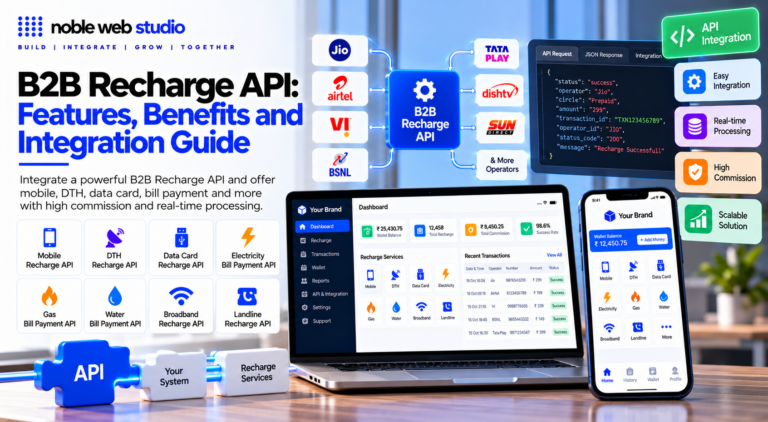
- Distributors & Multi-Level Retail Networks: Use white label recharge portal or B2B recharge API to manage retailer wallets, track commissions, and process local customer recharges from a single dashboard.
Recharge API Integration with Different Technologies
Recharge API integration serves as the automated bridge between consumer-facing client applications and backend telecom or utility processing networks. This core infrastructure operates via structured HTTP REST requests (typically transmitting data payloads in JSON or XML format), allowing systems to execute and confirm transactions within fractions of a second.
The technical architecture and language-specific tools used to execute recharge API implementation depend heavily on the underlying technology stack.
Comparison of Tech Stacks for Recharge API Integration
| Technology Stack | Primary HTTP Client | Payload Parsing | Best Suited For | Key Advantages |
|---|---|---|---|---|
| Node.js | Axios, Fetch API | Built-in JSON | High-throughput web & mobile apps | Non-blocking I/O; highly scalable for simultaneous requests |
| Python | requests, httpx | response.json() | Data-heavy portals, internal tooling | Readable syntax; fast prototyping and testing |
| PHP | cURL, Guzzle | json_decode() | Legacy web forms, WordPress modules | Native compatibility across standard web servers |
| Java | HttpClient, OkHttp | Jackson, Gson | Enterprise B2B, banking portals | Rigid type safety; robust multi-threading and security |
Implementation across Technologies
1. Node.js (JavaScript / TypeScript)
Node.js processes asynchronous operations efficiently, making it optimal for high-volume consumer fintech apps handling hundreds of concurrent top-ups.
const axios = require('axios');

async function processRecharge() {
    const payload = {
        api_key: 'YOUR_API_KEY',
        operator_code: 'JIO',
        mobile_number: '9876543210',
        amount: 499,
        reference_id: 'TXN1029384'
    };

    try {
        const response = await axios.post('https://provider.com', payload);
        if (response.data.status === 'SUCCESS') {
            console.log(`Recharge Completed! TxnID: ${response.data.txnid}`);
        }
    } catch (error) {
        console.error('Transaction Failed:', error.response ? error.response.data : error.message);
    }
}
2. Python
Python offers a clean development pattern ideal for backend processing networks, internal admin dashboards, and retailer network management systems.
import requests

def execute_recharge():
    url = "https://provider.com"
    payload = {
        "api_key": "YOUR_API_KEY",
        "operator_code": "AIRTEL",
        "mobile_number": "9876543211",
        "amount": 299,
        "reference_id": "TXN556473"
    }

    try:
        response = requests.post(url, json=payload, timeout=10)
        data = response.json()

        if data.get("status") == "SUCCESS":
            print(f"Success! Operator Ref: {data.get('operator_ref')}")
        else:
            print(f"Failed: {data.get('message')}")
    except requests.exceptions.RequestException as e:
        print(f"Network error encountered: {e}")
3. PHP
PHP remains heavily deployed across digital wallet modules, B2B distributor panels, and traditional e-commerce web applications.
<?php
$url = "https://provider.com";
$payload = json_encode([
    "api_key" => "YOUR_API_KEY",
    "operator_code" => "VI",
    "mobile_number" => "9876543212",
    "amount" => 199,
    "reference_id" => "TXN998877"
]);

$ch = curl_init($url);
curl_setopt($ch, CURLOPT_RETURNTRANSFER, true);
curl_setopt($ch, CURLOPT_POST, true);
curl_setopt($ch, CURLOPT_POSTFIELDS, $payload);
curl_setopt($ch, CURLOPT_HTTPHEADER, ['Content-Type: application/json']);

$response = curl_exec($ch);
if (curl_errno($ch)) {
    echo 'Error: ' . curl_error($ch);
} else {
    $result = json_decode($response, true);
    echo "Status: " . $result['status'];
}
curl_close($ch);
?>
4. Java
Enterprise portals, banking integrations, and dedicated Android recharge platform utilize Java or Kotlin to ensure strict type definition and end-to-end memory isolation.
import java.net.URI;
import java.net.http.HttpClient;
import java.net.http.HttpRequest;
import java.net.http.HttpResponse;

public class RechargeClient {
    public static void main(String[] args) throws Exception {
        HttpClient client = HttpClient.newHttpClient();
        String jsonPayload = "{\"api_key\":\"YOUR_API_KEY\",\"operator_code\":\"BSNL\",\"mobile_number\":\"9876543213\",\"amount\":150,\"reference_id\":\"TXN112233\"}";

        HttpRequest request = HttpRequest.newBuilder()
                .uri(URI.create("https://provider.com"))
                .header("Content-Type", "application/json")
                .POST(HttpRequest.BodyPublishers.ofString(jsonPayload))
                .build();

        HttpResponse<String> response = client.send(request, HttpResponse.BodyHandlers.ofString());
        System.out.println("Response body: " + response.body());
    }
}
Critical Integration Best Practices
- Implement Webhooks (Callback URLs): Recharge processing can occasionally enter a pending state with the telecom switch. Relying entirely on the initial HTTP response can result in missed confirmations. Configure an exposed webhook listener to receive async status updates.
- Idempotency Safeguards: Always assign unique transaction identifiers (
reference_id) generated on your platform. This prevents duplicate charges if network timeouts prompt a system retry. - IP Whitelisting & Secure Protocols: Protect recharge API keys strictly on server-side environments (never expose keys inside customer-facing web apps or mobile bundles). Whitelist production server IPs within mobile recharge portal to block malicious external requests.
Recharge API for Different Business Models
A Recharge APIconnects your software platform to telecom, DTH, and utility operators (or aggregator switches) so you can process instant recharges and bill payments programmatically.
The way you use and monetize a Recharge API depends heavily on your business model:
1. B2C (Business-to-Consumer) Model
- How it works: Best mobile recharge commission app or website lets end-users log in, enter their mobile number/DTH ID, and pay for personal recharges or utility bills directly.
- API Role: Your backend sends a REST/JSON request to the Noble web studio. The Noble web studio executes the operator transaction and returns a real-time status (success/failure) in seconds.
- Revenue Source: Markup margins, convenience fees, or cashback/reward structures on each transaction.
- Key Requirement: High uptime, fast response times (< 10 seconds), and a smooth consumer-facing UI.
2. B2B / White-Label Portal Model
- How it works: You run a master recharge portal where you create distributor and retailer accounts. Retailers use your web panel or Android recharge b2b app to serve walk-in customers for recharges and utility payments.
- API Role: Your platform sits between the Noble web studio and your internal wallet/ledger system, debiting retailer wallets as they process customer requests.
- Revenue Source: Tiered commission splits (you earn a higher commission from the Noble web studio and pass a smaller margin down to distributors/retailers).
- Key Requirement: A robust multi-tier wallet, role-based access control (RBAC), and automated credit/debit ledger management.
3. API Reselling / Multi-Level B2B Model
- How it works: You act as a sub-aggregator. You consume a master recharge API and expose/resell your own API endpoints to external businesses or software developers who want recharge capabilities in their own apps.
- API Role: Your servers proxy requests from external recharge API clients, authenticate their keys, track their volume/quotas, and hit the upstream master recharge API.
- Revenue Source: Per-transaction overrides or flat recharge API subscription/setup fees charged to downstream business clients.
- Key Requirement: Developer documentation, recharge API key generation/management, IP whitelisting, and webhook/callback handling for asynchronous failure refunds.
4. E-Commerce / Subscription Model (e.g., Shopify / BigCommerce)
- How it works: Online stores selling physical goods (like coffee, supplements, or cosmetics) offer automated recurring/subscription box reorders.
- API Role: Platforms like the Recharge API Documentation manage recurring billing, tokenized payment methods, customer portals, and scheduled subscription orders synced with your store cart.
- Revenue Source: Recurring product sales and reduced customer churn.
- Key Requirement: PCI-compliant checkout flows, webhook event listeners for subscription lifecycle changes (skipped, paused, canceled), and ERP/inventory sync.
Why Businesses Need Recharge API Integration
Businesses integrate Recharge APIs (Application Programming Interfaces) to connect their best recharge earning app, websites, or retailer portals directly to telecom, DTH, and utility processing networks.
Key Reasons Businesses Need Recharge API Integration
- Real-Time Processing: Delivers instant recharges and immediate transaction status updates without manual intervention.
- Operational Automation: Replaces slow manual processing with automated workflows, lowering human error and cutting operational costs by up to 40%.
- Faster Transactions: Accelerates processing speeds significantly (up to 60% faster than manual methods).
- New Revenue Streams: Lets fintech apps, digital wallets, retail stores, and general websites offer prepaid mobile, DTH, data card, bill payments, and money transfers to earn commissions.
- Brand Consistency: Keeps customers inside your own Android, iOS, or web interface rather than redirecting them to third-party sites.
- Scalability: Easily handles high transaction volumes and supports multiple mobile operators or service providers through a single integration.
- Enhanced Customer Experience: Provides a one-stop, convenient self-service portal with up-to-date plans, tariffs, and instant feedback.
Key Features of a Recharge API
A Recharge API (Application Programming Interface) is a developer tool that connects an highest recharge commission app or website directly to telecom, DTH, data card, and utility bill operators.
Key Features of a Recharge API
- Single Unified Interface: Integrates multiple services (prepaid/postpaid mobile, DTH, broadband, and utility bills) through one connection instead of building separate systems for each operator.
- Automated Operator & Circle Detection: Automatically identifies the telecom operator and geographical service circle based on the entered phone number.
- Real-Time Transaction Processing: Delivers instant status updates (success or failure) and transaction IDs, typically within a few seconds.
- Wide Operator Coverage: Supports major national and regional telecom, DTH (e.g., Tata Play, Dish TV, Airtel Digital TV), and utility providers.
- Built-In Wallet & Commission System: Features a pre-funded or agent wallet model to manage balances, track earnings/commissions, and log transaction history.
- Developer-Friendly Documentation & Responses: Uses standard JSON-encoded HTTP requests and responses with clear endpoints, authentication scopes, and error codes (similar to structures found in recharge commission platform references like Recharge API Reference).
- High Security & Encryption: Protects sensitive data and financial transactions using end-to-end encryption and automated fraud detection.
- Scalability & 24/7 Uptime: Built on cloud infrastructure to handle high volumes of concurrent transactions around the clock.
Recharge API Integration: Step-by-Step Guide
Integrating a Mobile & Utility Recharge API involves connecting your application backend to a Noble web studio to instantly process telecom, DTH, and utility bills.
The core implementation lifecycle spans 6 essential steps:
1. Account Setup and Authentication
- Register with the Provider: Create a merchant account on the top recharge portal and fulfill local legal requirements (e.g., KYC compliance).
- Acquire Credentials: Secure your system’s unique recharge API tokens, production
username, andpassword. - IP Whitelisting: Log into Noble web studio dashboard to authorize the specific server IP addresses that will transmit requests.
2. Payload Preparation & Client Input
- Capture Customer Details: Collect the target mobile or customer account number, operator code, circle code, and transaction value.
- Generate Unique Order IDs: Create a persistent
orderidor reference sequence in your system to avoid duplicate processing. - Validate locally: Check inputs on the client side before triggering backend network traffic.
3. Server-to-Server Backend Integration
- Isolate API Keys: Never embed recharge API credentials inside client-facing mobile or web code; run requests exclusively through your server.
- Execute REST Call: Initiate a standard secure POST/GET request over TLS 1.3 to the recharge API endpoint.
- Standard Input Properties:
{
  "username": "YOUR_USERNAME",
  "pwd": "YOUR_PASSWORD",
  "number": "9800000000",
  "operatorcode": "A",
  "amount": "10",
  "orderid": "485668",
  "format": "json"
}
4. Response Parsing and Status Routing
- Read JSON Structure: Capture HTTP codes and structured responses from the provider network.
- Handle Responses: Map responses to one of three statuses:
- Success: Instantly debit user wallet/payment method and display confirmation.
- Failed: Revert payments locally and trigger validation checks.
- Pending: Put the order in a holding loop for operator networks to verify processing status.
5. Asynchronous Webhooks & Status Checkers
- Configure Callback URL: Register an active endpoint listener on your merchant panel to process real-time status changes pushed by the Noble web studio.
- Implement Status API Polling: Set up a fallback background cron job to query the recharge API order status endpoint if a live webhook fails or network timeouts occur.
6. Sandbox Testing to Live Deployment
- Send Small Transactions: Run test micro-transactions (e.g., ₹10 / $1) within a sandbox loop to confirm endpoint connections.
- Fund the Gateway Wallet: Add credits to your global merchant wallet balance on the recharge service platform.
- Go Live: Transition base URLs from test staging environments to production lines.
Recharge API Pricing in india
The cost structure for a Recharge API depends on whether you mean a Telecom/Utility Recharge API (mobile, DTH, bill payments popular in India) or the Recharge Payments SaaS platform for subscription e-commerce.
1. Telecom, DTH & Utility Recharge APIs (India)
Used by apps and best mobile recharge portal to process mobile, DTH, and utility bill recharges, these are typically structured around setup fees, wallet loading, and operator commissions.
One-Time Setup / License Fees:
- Range from ₹3,000 to ₹15,000+ for basic recharge API access or standard white label recharge portal (e.g., providers like Noble web studio charge one-time setup fees around ₹3,000 to ₹10,000).
- Custom multi recharge software, High commission recharge app, or full source-code ownership can range from ₹25,000 to over ₹1,00,000.
Per-Transaction / Usage Cost:
- Noble web studio do not charge a per-request API fee. Instead, you maintain a prepaid float/wallet balance and pay face value for the recharges.
Commissions & Margins:
- Rather than paying a cost per call, you typically earn a commission (a small percentage or flat slab) credited to your wallet for each successful mobile, DTH, or BBPS utility transaction.
Recurring & Hidden Costs to Watch For:
- Annual Maintenance Contracts (AMC) or yearly renewal fees (₹1,000 to ₹25,000+/year).
- Server hosting, domain registration, and payment gateway integration fees (extra ₹5,000 to ₹50,000 if building a full web/app ecosystem).
2. Recharge Payments (E-Commerce Subscription SaaS)
If you are referring to Recharge, the recurring-billing and subscription platform for Shopify merchants, it uses a fixed monthly subscription plus per-transaction model (the REST recharge API is included with paid plans at no extra per-call charge):
- Starter Plan: $149 per month + 1.50% + 20¢ per transaction (plus a 60-day free trial).
- Scale Plan: $499 per month + 1.25% + 20¢ per transaction for growing subscription programs.
- Custom Plan: Tailored pricing for high-volume enterprise merchants.
Recharge API Commission Structure
A Recharge API commission structure defines how profit margins on mobile, DTH, and utility recharges are calculated and shared between telecom/utility operators, the Noble web studio, top recharge platform owners, distributors, and retail agents.
Average Commission Rates by Category
Industry commission rates in India typically fall within these standard ranges:
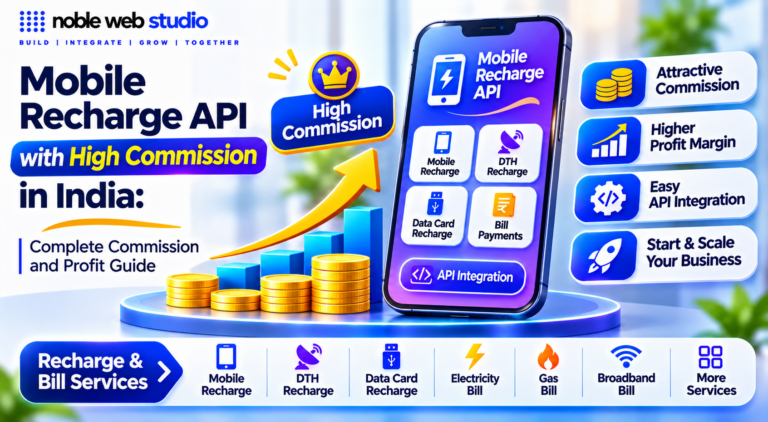
- Prepaid Mobile Recharge:1.0% to 6.5%
- BSNL: ~6.50%
- Vodafone Idea (Vi): ~3.80%
- Jio: ~3.50%
- Airtel: ~2.0%
- DTH Recharge: 2.0% to 3.0% (Airtel Digital TV, Tata Play, Dish TV, Sun Direct)
- BBPS / Utility Bill Payments (Electricity, Gas, Water): 0.5% to 2.0% (or flat/fee-based structures)
Common Commission Models
1. Percentage-Based (Slab) Model
The recharge commission is calculated as a percentage of the total transaction value. For example, a ₹500 recharge at a 3% commission yields ₹15 credited to your wallet. Rates often vary heavily depending on the specific telecom operator and whether it is a regular top-down plan or a special tariff voucher (STV).
2. Multi-Level / B2B2C “Spread” Model
If you run a white label or multi mobile recharge software platform, the commission flows down a hierarchy:
- Upstream API Provider → gives a base margin to recharge Platform Admin
- Platform Admin → retains a “spread” margin and passes a lower percentage down to Master Distributors / Distributors
- Distributor → passes the final retail commission down to Retail Agents / Shops
3. Flat Fee / Slab-Per-Transaction
Instead of a percentage, some utility or money-transfer layers operate on fixed per-transaction payouts or flat service slabs.
Key Factors to Evaluate Before Choosing an API
- Hidden Costs & Wallet Loading Fees: Check if the charges gateway/wallet loading fees or monthly maintenance charges. Many reliable recharge API work on a zero-monthly-fee/one-time setup fee model (ranging from ₹3,000 to ₹5,500) where you only top up your working e-wallet.
- Success & Failure Ratios: Look for high uptime recharge API (ideally ≥ 99.9%) with automated, instant refund cycles for failed or dropped transactions.
- Operator-Wise and Circle-Wise Live Data: Noble web studio supports real-time operator/circle detection and live plan fetching recharge APIs so your users pick accurate plans without transaction mismatches.
Recharge API Request and Response Examples
When integrating a mobile, DTH, or utility billing system, developers typically use RESTful JSON-based APIs to transmit payload details securely.
The structural blueprint below highlights standard, clean implementations for a Recharge API Request alongside its three possible response states: Success, Pending, and Failure.
1. Recharge API Request
This POST payload is sent from your backend server to the Noble web studio. It includes authentication headers and essential parameters such as the consumer’s mobile number, operator code, amount, and a unique tracking reference.
Endpoint:POST https://www.noblewebstudio.com/
Headers:
Content-Type: application/json
Authorization: Bearer your_api_secret_token_here
JSON Body:
{
  "mobile": "9828543210",
  "operator_code": "JIO",
  "circle_code": "MH",
  "amount": 199.00,
  "type": "prepaid",
  "client_reference_id": "TXN_20261105_88492"
}
2. Recharge API Responses
A. Success Response (HTTP 200 OK)
Returned when the operator successfully processes the top-up and provides a live transaction ID.
{
  "status": "success",
  "status_code": 1,
  "message": "Recharge completed successfully.",
  "data": {
    "client_reference_id": "TXN_20261105_88492",
    "operator_transaction_id": "OP88392019482X",
    "api_transaction_id": "REQ_7739104",
    "mobile": "9828543210",
    "amount": 199.00,
    "current_wallet_balance": 4820.50,
    "timestamp": "2026-11-05T15:13:22Z"
  }
}
B. Pending Response (HTTP 200 OK or HTTP 202 Accepted)
Returned when the telecom network is slow or processing heavily. You should never automatically retry a pending status. Instead, listen for the final outcome via your webhook/callback URL or ping the status check endpoint.
{
  "status": "pending",
  "status_code": 4,
  "message": "Transaction is awaiting operator confirmation.",
  "data": {
    "client_reference_id": "TXN_20261105_88492",
    "api_transaction_id": "REQ_7739104",
    "mobile": "9828543210",
    "amount": 199.00,
    "timestamp": "2026-11-05T15:13:24Z"
  }
}
C. Failure Response (HTTP 400 Bad Request or HTTP 422 Unprocessable Entity)
Returned when the transaction is immediately rejected due to bad inputs, insufficient recharge API wallet balance, or network refusal.
{
  "status": "failed",
  "status_code": 2,
  "error": {
    "code": "INSUFFICIENT_FUNDS",
    "message": "Recharge failed. Your API wallet balance is too low to complete this operation."
  },
  "data": {
    "client_reference_id": "TXN_20261105_88492",
    "mobile": "9828543210",
    "amount": 199.00,
    "timestamp": "2026-11-05T15:13:25Z"
  }
}
Core Integration Rules
- Unique Order IDs: Always pass an entirely unique
client_reference_idfor every distinct request to avoid accidental double-debits. - Handle ‘Pending’ Gracefully: Keep the order open on your frontend if a pending status returns. Wait for the asynchronous webhook execution before updating your client’s UI or modifying your ledger balance.
Recharge API Security and Authentication
To implement a highly secure Recharge API integration (whether you are using e-commerce subscription platforms like Recharge Payments or B2B telecom top-up gateways), you must enforce rigid security standards. Because a recharge API directly interacts with financial wallets or saved credit cards, a credential leak can result in immediate monetary loss.
1. Authentication Mechanisms
Recharge APIs typically rely on token-based protocols rather than weak, legacy username/password combinations.
- API Tokens / Access Keys: Requests are validated by passing a private token in the HTTP header (e.g.,
X-Recharge-Access-Token: your_api_token). - OAuth 2.0 Framework: For partner integrations or third-party applications, OAuth authorization is strongly encouraged. This generates dynamic access tokens that limit broad credential exposure.
- Principle of Least Privilege (PoLP): Never generate an omnipotent mobile recharge API key. Restrict token scopes at the dashboard level to only the exact actions required (e.g.,
Read-Onlyfor fetching data, or restricting write access to specific endpoints like/addressesor/customers).
2. Transport & Infrastructure Security
Authentication tokens are only as safe as the pipeline they travel through.
- Enforced TLS 1.3 Encryption: All mobile recharge API calls must occur over HTTPS. Plain HTTP requests must be automatically rejected to prevent man-in-the-middle (MITM) snooping.
- IP Whitelisting: Restrict mobile recharge API key execution to the specific outbound IP addresses of your production servers, staging instances, or cron boxes. If a key is stolen, it remains useless to an attacker unless the request originates from your whitelisted infrastructure.
3. Preventing Token Leakage
Most security failures stem from developer oversights during implementation. Protect your tokens by avoiding these common pitfalls:
- Server-Side Execution Only: Never place mobile recharge API keys in client-side code (JavaScript, mobile front-ends, or public web pages). Front-end code is entirely visible to the browser; all recharge actions must be brokered securely through your backend server.
- Environment Variable Discipline: Store keys in secure
.envfiles and add them to your.gitignore. Never commit raw keys to public Git repositories, and avoid sharing raw.envcontents across unencrypted chat platforms (like Slack or WhatsApp).
4. Transaction Integrity & Idempotency
Telecom and subscription recharge systems are highly vulnerable to race conditions and duplicate payment triggers.
- Idempotency & Unique Order IDs: Map every transaction to a unique, single-use transaction or order ID. If a network timeout occurs, re-submitting the same order ID ensures the gateway identifies it as a duplicate rather than charging the customer twice.
- Callback (Webhook) Verification: When a transaction processes asynchronously, the Noble web studio sends a webhook to your callback URL. Never trust a callback blindly. Cryptographically verify the payload signature using your webhook secret to ensure it hasn’t been spoofed by an external actor.
- Leaky Bucket Rate Limiting: Modern recharge Platform use rate-limiting algorithms to curb brute-force discovery or denial-of-service attempts. Ensure your application gracefully handles standard limits (e.g., 2 to 4 calls per second depending on trusted recharge platform tier) to prevent server-side dropped requests.
Recharge API Transaction Management
Securing a Recharge API integration is critical because these endpoints directly manage wallet balances, payment distributions, and financial transactions. Insecure implementations can lead to unauthorized wallet draining or duplicate transaction processing.
Implement the following core protocols and architectural practices to fully protect your Recharge API integration.
1. Authentication & Authorization Models
Depending on the specific provider you use (e.g., standard subscription recharge APIs like Recharge Payments or telecom/utility gateways like PayU and PayPrime), authentication follows one of three modern paradigms:
- API Key & Access Tokens: Most REST-based recharge platforms utilize unique server-generated keys passed via custom headers. For example, the Recharge Payments API Reference requires the
X-Recharge-Access-Tokenheader. - Token Generation Endpoint (OAuth 2.0 / JWT): Higher-security utility gateways use a multi-step handshake. You pass a
Client IDandClient Secretto aGet Tokenendpoint, which issues a short-lived JSON Web Token (JWT) or Bearer token for subsequent requests. - Principle of Least Privilege (PoLP): Restrict your recharge API keys at the scoping level. If your application only needs to trigger recharges, disable scopes that allow reading user profiles, changing wallet settings, or exporting transaction histories.
2. Transport Layer Security (TLS)
- Strict HTTPS Enforcement: All data must be encrypted in transit using TLS 1.3. API gateways reject plain text
http://calls immediately to prevent man-in-the-middle (MITM) credential sniffing. - IP Whitelisting (Firewalling): Restrict recharge API call execution exclusively to the static IP addresses of your production servers. Even if an attacker compromises recharge API key, they cannot execute transactions from an unauthorized machine.
3. Application-Level Security Defenses
| Security Threat | Prevention Mechanism | Implementation Strategy |
|---|---|---|
| Credential Leakage | Zero Frontend Exposure | Never place an API token or secret inside client-side code (Android/iOS apps or Vue/React frontends). Route all requests through your secure backend proxy. |
| Replay Attacks | Request Signing (HMAC) | Generate a unique cryptographic signature for each request payload using an HMAC-SHA256 hash combined with a secret key and a timestamp. |
| Double Spending | Server-Side Idempotency | Always generate and attach a single, strictly unique Transaction Reference ID per recharge attempt. Prevent your system from generating a new ID if a timeout occurs. |
| API Abuse & DoS | Leaky Bucket Rate Limiting | Enforce strict request limits (e.g., standard 2–4 requests per second) to block brute-force automation or loops caused by recursive programming errors. |
4. Securing Callback & Webhook Endpoints
Recharge architectures routinely leverage asynchronous callbacks to report if a pending transaction succeeded or failed. Protect your callback listeners using these three layers:
- Validate Webhook Signatures: The provider signs the webhook body using a shared secret. Compute the HMAC hash on your receiving server and verify it matches the incoming signature header before processing the update.
- Verify Order State: Only trust a callback if it references an existing, pending Order ID generated inside your own database. Never provision credit or update status for an unknown transaction identifier.
- Fallback to Status Polling: If a callback is dropped or fails verification, use a secure
Get Payment Statusor transaction polling endpoint to query the Noble web studio directly via backchannel rather than opening up lenient firewall rules.
Benefits of Recharge API
Integrating recharge API whether for mobile top-ups, DTH, utility bill payments, or subscription e-commerce like Noble web studio offers significant operational and financial advantages:
1. Speed and Real-Time Processing
- Sub-second responses: Automated top-ups and status checks complete almost instantly, eliminating manual processing delays for users.
- Live plan updates: Integrated recharge API automatically sync latest operator tariffs, preventing outdated pricing.
2. Automation and Reduced Overhead
- Zero manual intervention: The system handles requests, validations, and confirmations programmatically.
- Automated refunds: Failed or dropped transactions trigger automated instant or same-day wallet/bank refunds.
- Single e-wallet management: Instead of maintaining separate dealer balances for every telecom operator or DTH provider, businesses run transactions through a single unified pool.
3. Revenue Growth and Commissions
- Additional monetization streams: Businesses (such as retail outlets, mobile wallets, or e-commerce apps) earn commissions or margins on every successful recharge or bill payment API.
- Value-added services (VAS): Retains customers within your app or store by providing a complete suite of utility and telecom recharge services API.
4. Enhanced User Experience & Retention
- Pan-India/Global operator coverage: Supports major prepaid and postpaid operators across all circles with high uptime (typically 99.9%).
- Boosted brand loyalty: Giving users a fast, reliable, all in one recharge platform for mobile recharges and bill payments increases daily app engagement and repeat usage smooth recharge API.
5. Security and Scalability
- Encrypted transactions: Uses IP whitelisting, secure token authentication, and HTTPS protocols to protect financial data.
- High volume handling: Easily scales to process thousands of concurrent recharge API requests as your user base grows recharge API.
Recharge API Testing and Sandbox Environment
A Recharge API Sandbox Environment is a separate, simulated testing environment provided by fintech platforms, subscription software vendors, and telecom operators. It allows developers to test mobile top-ups, DTH updates, subscription billing, and utility bill payments without moving real money, incurring costs, or affecting live data.
Core Mechanics of a Recharge Sandbox
Depending on whether you are integrating a Subscription Billing API or a B2B Fintech/Telecom Top-Up API (like Mobile Recharge/BBPS providers), the sandbox operates through specific mechanisms:
1. B2B Telecom & Bill Payment APIs (e.g., Pay2All, A1Topup, APIExpress)
- Unified Environment Switches: Noble web studio allow developers to toggle between testing and live modes via a simple request parameter (e.g.,
"mode": "UAT"vs"mode": "LIVE") or by hitting a dedicated base URL endpoint. - Mock Wallet Balance: Real transactions settle against an e-wallet funded with actual capital. In the UAT/Sandbox environment, the system provides a virtual or deterministic balance so zero financial liability is incurred.
- Deterministic Test Payloads: Passing specific mock inputs (such as pre-defined test mobile numbers) forces the sandbox to return specific success, failure, or timeout responses to evaluate edge cases.
2. Subscription E-commerce APIs (e.g., Recharge Checkout Integration)
- Developer Accounts: Branded recharge Platform-centric setups (like the Recharge Support Portal) require you to establish a designated recharge API developer account.
- Automatic Test Provisioning: Recharge software Development stores utilizing free plans on platforms like Shopify or BigCommerce automatically configure connected apps as test stores.
- Simulated Gateways: Transactions are forced through test payment modules, such as a Bogus Gateway or a processor configured strictly in developer mode.
- Automatic Live Triggers: Testing pipelines instantly convert to live billing environments if the underlying merchant store upgrades to a paid commerce plan or if real, non-test orders are detected.
Essential API Testing Checklist
Before moving from your sandbox environment to production, verify your integration using these five essential functional and performance tests:
| Test Category | What to Verify in Sandbox | Target Outcome |
|---|---|---|
| Authentication & Authorization | Pass both valid and intentionally altered unique API keys, signatures, and TLS 1.3 whitelists. | Rejects invalid requests with distinct HTTP error codes (401 Unauthorized / 403 Forbidden). |
| Operator Auto-Detection | Submit varying test telephone prefixes to simulate different mobile circles and DTH providers. | The endpoint successfully auto-resolves the exact network operator and regional circle. |
| Status Synchronization | Simulate delayed or pending transactions, testing callback/webhook handling and periodic transaction status queries. | Avoids prematurely marking a recharge as successful until definitive confirmation payloads arrive. |
| Idempotency Verification | Fire duplicate requests with identical transaction identifiers back-to-back. | The server processes the request only once, preventing accidental double-deductions from the customer wallet. |
| Error Handling Architecture | Force systematic failures by triggering mock out-of-balance parameters, invalid operator plans, or server time-outs. | Front-end UI seamlessly catches backend JSON errors and translates them into localized, actionable text for users. |
Common Recharge API Integration Errors and Solutions
Recharge API integrated errors usually stem from invalid parameters, authentication gaps, network latency, or specific downstreams from telecom/utility operators. When building a mobile, DTH, or recurring billing recharge system, handling these errors correctly prevents duplicate charges and lost revenue.
Here is a breakdown of the most common Recharge API errors, their root causes, and how to solve them.
1. The “Pending” Black Hole (Status Unknown)
- The Issue: The API response returns a
Pendingstatus instead of a clearSuccessorFailed. This happens when the third-party provider or the telecom operator accepts the request but hasn’t finalized the top-up. - The Risk: Blindly retrying the transaction will result in the customer being charged twice.
The Solution:
- Never auto-retry a pending transaction.
- Hold the transaction in a localized “Pending” state.
- Set up a Webhook Callback URL so the Noble web studio can push the final
Success/Failedstatus once confirmed. - Implement a fallback polling mechanism using the provider’s Status Check API every few minutes if the webhook fails.
2. Idempotency & Duplicate Request Errors (HTTP 429 / Custom Errors)
- The Issue: If a network interruption occurs right after sending a request, your server might not receive the response. If you retry the exact same payload, the operator might process a duplicate recharge or throw a conflict error.
The Solution:
- Implement Idempotency Keys (e.g., passing a unique
Idempotency-Keyor uniqueorder_idin the header/body). - Noble web studio caches response payloads against this key so that subsequent identical retries simply return the original receipt rather than executing a new transaction.
3. Validation & Parameter Mismatches (HTTP 400)
- The Issue: The request fails because of incorrect formatting, such as missing fields, invalid circle codes, or mobile numbers that don’t match the selected operator.
The Solution:
- Integrate an Operator & Circle Detection API to automatically verify the provider before submitting the recharge request.
- Sanitize inputs on the frontend/client side (e.g., stripping country codes like “+1” or “+91” if the API strictly requires a 10-digit number).
- Cross-reference your requests with the provider’s Live Plan API to ensure the exact denomination amount is active.
4. Authentication and IP Whitelisting Failures (HTTP 401 / 403)
- The Issue: The API returns
Access DeniedorUnauthorized. This is typically caused by expired access tokens, poorly formatted signature hashes, or requests originating from an unwhitelisted server IP.
The Solution:
- Ensure your production server’s static IP is whitelisted inside recharge API merchant dashboard.
- Verify token expiration intervals and build an automated token-refresh loop if the provider utilizes OAuth or rotating bearer tokens.
5. Rate Limiting (HTTP 429 Too Many Requests)
- The Issue: Recharge admin platform is sending too many concurrent volume requests, exceeding the provider’s allowed per-minute or per-second thresholds.
The Solution:
- Respect the
Retry-Afterheader provided in the HTTP 429 response. - Implement an Exponential Backoff algorithm with jitter (e.g., delaying retries by 1s, 2s, 4s, 8s plus a random fraction of time) to spread out traffic spikes.
Quick Reference Error-Handling Matrix
| HTTP Status / Error | Nature of Failure | Immediate Action Required |
|---|---|---|
Pending / Timeout | Ambiguous | Do not retry. Await webhook callback or hit the Status API. |
400 Bad Request | Permanent | Do not retry. Fix invalid inputs (wrong phone number, invalid plan amount). |
401 / 403 Forbidden | Permanent | Check API keys, signatures, and dashboard IP whitelisting. |
429 Too Many Requests | Temporary | Slow down request cadence using exponential backoff. |
503 Service Unavailable | Temporary | Network/Operator down. Log the error and retry manually or after a safe delay. |
Noble Web Studio One of The Best Recharge API Provider
Noble web studio only one of the right recharge API provider is a critical decision that directly impacts user trust, customer retention, and your business’s overall profitability. While many businesses make the mistake of choosing a Noble web studio solely based on the highest commission rates, technical reliability and operational stability are what truly dictate your actual income.
A breakdown of the core factors to evaluate when selecting a Noble web studio is detailed below.
1. Technical Reliability & Speed
- Transaction Success Rate (SR): Noble web studio that guarantees a 99.9% success rate. They should utilize direct operator pipes and feature automatic fallback switches to minimize failed transactions.
- Low Latency Responses: Execution speed is vital for the user experience. The recharge API response time should ideally be under 200ms to 5 seconds to prevent double-payment submissions and user drop-offs.
- Automated Webhook Callbacks: Noble web studio delivers real-time asynchronous status updates via webhooks rather than forcing your system to constantly run server loops (“polling”) to check transaction statuses.
2. Service Breadth & Advanced API Capabilities
- Multi-Recharge Support: A singular recharge API connection should ideally support prepaid mobile recharges across all major telecom operators, DTH services, data cards, and utility bill payments.
- BBPS Integration: In India, Noble web studio integrates with the Bharat Bill Payment System (BBPS), allowing you to seamlessly process electricity, water, gas, broadband, and FASTag payments through the exact same API.
- Operator & Plan Detection APIs: Look for value-added modules like Live Plan Verification (to show real-time accurate pricing to users) and Automatic Operator Detection (which reduces human error by finding the telecom operator from the phone number).
3. Operational Efficiency & Financial Health
- Automated and Fast Refunds: Systems inevitably experience “pending” states or temporary operator glitches. Evaluate how quickly the provider handles disputes, resolves stuck transactions, and processes automatic refunds.
- Robust Ledger and Wallets: Modern mobile recharge platform should feature an advanced, secure ledger system with clear reporting tools so you can seamlessly track your wallet balances, earnings, commissions, and transaction logs.
4. Security & Compliance
- Data Protection: The reputed recharge API must use modern encryption, such as TLS 1.3, to protect transaction packets.
- Access Control: The infrastructure should support security measures like IP whitelisting and API key rotation to protect your digital funds from unauthorized access.
- Corporate Credibility: Partner with an Noble web studio company. Verify their GST registration, corporate credentials, and business longevity before loading funds into their wallet.
5. Support and Scalability
- Accessible Customer Support: Test their communication before committing. Ensure they provide dedicated, rapid human support via phone, email, or messaging channels during peak business hours.
- White-Label & Upgrade Paths: If your long-term goal involves building out a network of downstream distributors or retailers, Noble web studio offer pre-integrated white label recharge software solution so you avoid expensive migration down the line.
Why Choose Noble Web Studio for Recharge API Solutions?
Noble web studio one of the right Recharge API provider helps your business automate mobile, DTH, and utility top-ups while growing revenue and user trust.
Key Reasons to Choose a Recharge API Provider
- Faster Development & Integration: Instead of building separate, complex connections for every telecom operator or DTH service, you plug into a single, well-documented recharge API.
- Revenue & Commission Growth: Earn margins or competitive commissions on every transaction while offering high-demand value-added services to attract more customers.
- High Success Rates & Speed: Noble web studio offer direct operator connections, automated fallback switches (yielding high transaction success rates), and sub-200ms response times to prevent user drop-offs.
- Real-Time Automation: Automated workflows, instant confirmations, and real-time webhook callbacks eliminate manual tracking and server polling.
- Dynamic Plan Verification: Automated updates ensure your customers always see accurate, live prepaid plans and pricing.
- Centralized Management: Track all recharges, ledger balances, transaction records, and support logs from one unified dashboard.
- Cost Efficiency: Lower operational overhead, cut manual intervention errors, and scale your platform effortlessly as transaction volumes grow.
Conclusion
A reliable Recharge API is the foundation of a successful digital recharge platform. Whether you want to launch a mobile recharge website, develop an Android or iOS recharge application, build a B2B recharge portal or integrate mobile and DTH recharge services into your existing business, choosing the right recharge API integration solution is essential for long-term growth.
From secure recharge API authentication and seamless transaction processing to real-time status verification, automated callbacks, wallet management and transaction tracking, every component plays an important role in delivering a smooth and dependable recharge experience.
A Recharge API (Application Programming Interface) is a recharge commission software bridge that allows a website, mobile recharge earning app, or business system to automatically process real-time digital top-ups and bill payments without manual work.
With Noble Web Studio, businesses can explore professional Recharge API integration solutions designed around their technical requirements and business objectives. Our focus is on helping businesses understand API integration, develop scalable digital platforms and create user-friendly recharge experiences.
Unlike a basic recharge integration, a well-planned Recharge API solution should prioritize transaction accuracy, data security, system performance, reliable status management and future scalability.
If you are looking for a Mobile Recharge API, DTH Recharge API, B2B Recharge API or complete Recharge API integration, Noble Web Studio is ready to help you explore the right technology approach for your business.
Build your digital recharge platform with Noble Web Studio. Explore Recharge API integration possibilities and take your recharge business to the next level.
Contact Noble Web Studio today to discuss your Recharge API requirements and start planning your next digital recharge solution.
Recharge API with Noble Web Studio
Looking for a reliable Recharge API for your business? Connect with Noble Web Studio to discuss mobile recharge API integration, DTH and utility bill payment services, API documentation, transaction management and custom recharge software solutions. Contact our team to explore suitable integration options and pricing for your business requirements.