Ankit
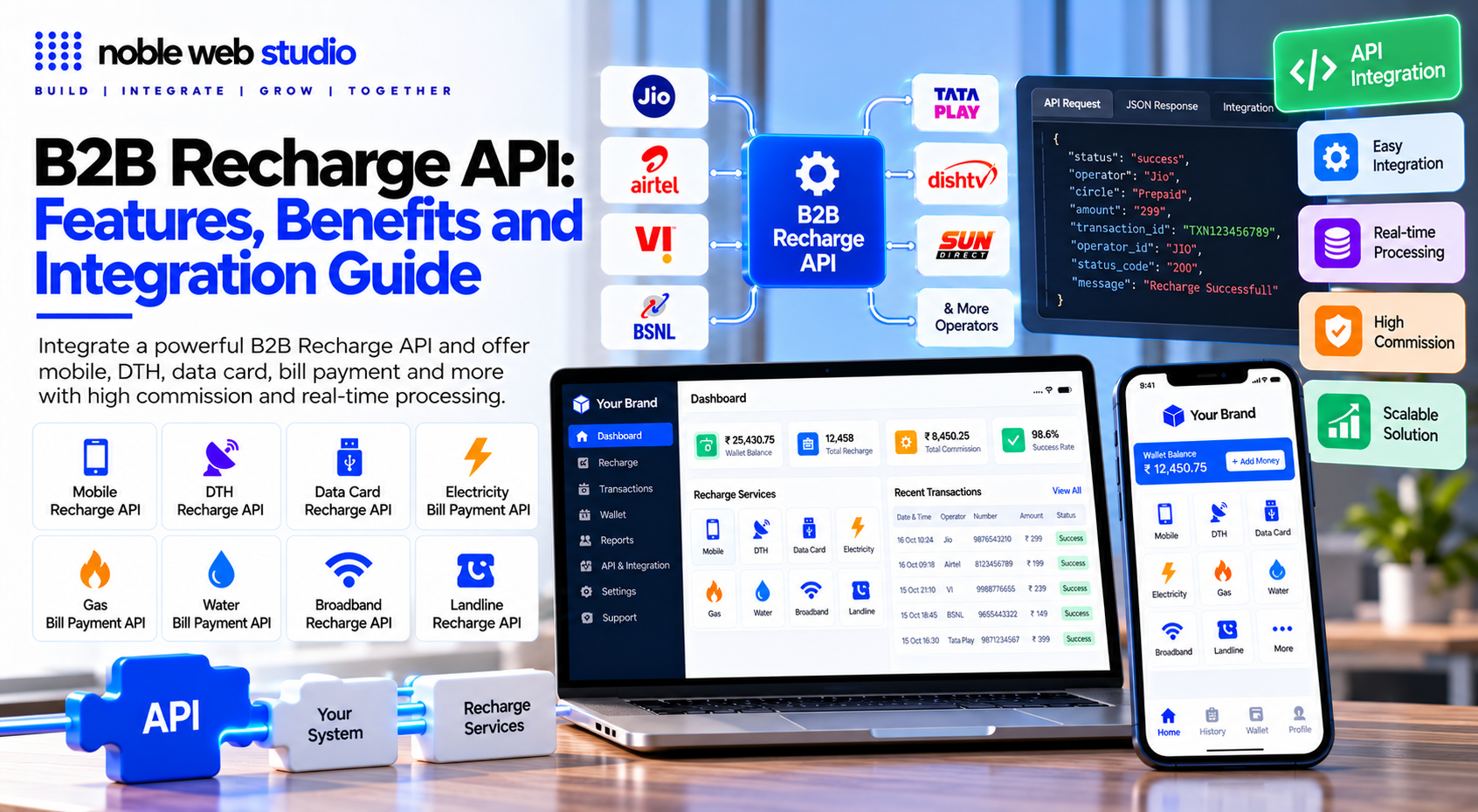
A B2B Recharge API helps businesses connect mobile recharge services with their own websites, applications, retailer portals, and distributor networks. It allows businesses to send recharge requests, receive transaction responses, check recharge statuses, and manage transaction records through an integrated software platform. For entrepreneurs, fintech startups, distributors, and digital service providers, the right B2B recharge API can provide the technical foundation to launch or expand a recharge business.
However, choosing a B2B Recharge API is not just about connecting to mobile operators. You also need a system that can manage multiple retailers, distributor accounts, commission structures, wallet balances, transaction reports, and pending or failed recharge requests. Before selecting an Noble web studio, it is important to understand the supported operators, B2B Recharge API documentation, integration process, transaction verification methods, security controls, pricing, and technical support.
Noble Web Studio develops and sells ready-made B2B Mobile Recharge Software for businesses that want to operate their own recharge platform. Depending on the selected version and available integrations, the software can provide recharge Admin, Master Distributor, Distributor, and Retailer management, commission configuration, wallet management, transaction monitoring, and business reporting. Recharge API connectivity can help connect the recharge platform with supported recharge services, Selected Noble web studio and integration requirements.
Whether you want to start a new B2B recharge business, provide recharge facilities to retailers, expand your distributor network, or launch a branded recharge portal, it is important to select mobile recharge software and mobile recharge API connectivity that match your business model. A properly planned setup can help organise daily operations, monitor transactions, manage commission distribution, and support business expansion.
In this guide, you will learn what a B2B Recharge API is, how it works, which features to check before choosing an Noble web studio, how API integration works, how retailers and distributors can be managed, and what to consider when planning your recharge business with Noble Web Studio.
What is a B2B Recharge API
A B2B Recharge API (Business-to-Business Application Programming Interface) is a digital bridge that lets a business plug instant recharge and bill payment services directly into its own website, app, or retailer network.
How Does a B2B Recharge API Work?
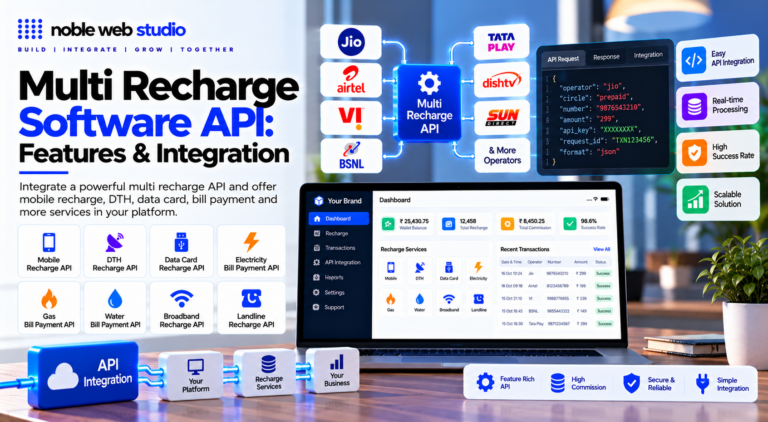
A B2B Recharge API works by acting as a secure digital bridge between a business application (like a retail app or website) and telecom/utility operators to process instant mobile, DTH, and utility top-ups. It automates the transmission of request data, handles immediate fund updates from a single unified wallet, and returns automated transaction responses in real time.
How a B2B Recharge API Works (Step-by-Step)
[Retailer / Customer] ---> (Your B2B Platform) ---> [Recharge API Provider] ---> [Telecom Operator (e.g., Jio, Airtel)]

                                 |                            |
                       Checks Unified Wallet        Deducts Balance & Adds
                       & Deducts Amount             B2B Commission Margin
- Initiation: A customer or local retailer enters the customer’s mobile number, operator, circle, and desired plan amount into a recharge B2B platform or application.
- API Request Transmission: The application converts this data into a secure HTTP REST request (usually via standard JSON) and transmits it directly to the Noble web studio server.
- Wallet Balance Check & Authentication: The Recharge API gateway validates the authentication keys and verifies that the B2B recharge portal has a sufficient balance in its unified e-wallet to cover the transaction.
- Operator Routing: The Noble web studio instantly routes the request to the specific telecom or utility network (such as Jio, Airtel, or BBPS) for fulfillment.
- Real-time Status Response: The operator processes the top-up and sends a success or failure token back. The b2b mobile recharge API then instantly returns this status to the B2B mobile recharge portal, updating both the customer’s device and the recharge software ledger in seconds.
- Instant Margin Settlement: The business logic tracks the predetermined distributor/retailer commission percentages. It credits the B2B client’s margin automatically on every successful transaction.
B2B Recharge API Business Model for Retailers and Distributors
A B2B Recharge API business model operates as a multi-tiered digital distribution network. It connects telecom and utility operators to a Noble web studio, which then routes services down through master distributors, distributors, and local retail touchpoints.
Core Hierarchy (The Distribution Chain)
- Admin / Recharge API: Owns the primary technical infrastructure, maintains direct or Noble web studio-level connections with telecom operators and Bharat Bill Payment System (BBPS), and manages core ledger balances.
- Master Distributor / Distributor: Purchases or manages floating wallet balances in bulk, onboard sub-distributors and local merchants, assigns commission structures, and provides regional support.
- Retailer / Agent: The end-of-chain physical or digital touchpoint (kirana stores, mobile repair shops, local service kiosks) that accepts cash or digital payments from customers to process prepaid mobile, DTH, FASTag, and utility recharges.
Prepaid, Postpaid and DTH Recharge API Services
A Recharge API lets your website, mobile recharge commission app, or best recharge software process prepaid mobile, postpaid mobile, and DTH recharges through a single unified system and wallet balance.
Core Services Covered
- Prepaid & Postpaid Mobile: Support for major operators including Jio, Airtel, Vi (Vodafone Idea), BSNL, and MTNL.
- DTH Recharge: Instant automated top-ups for Tata Play, Dish TV, Airtel Digital TV, Sun Direct, and Videocon d2h.
- Extended Utilities (Optional): Noble web studio bundle BBPS, electricity, gas, water bills, FASTag, and money transfer APIs into the same integration.
- Financial & Value-Added Services (FASTag, AEPS, DMT, data cards).
Why B2B Businesses Need a Recharge API Provider
B2B businesses need a recharge API provider such Noble web studio to integrate multi-operator mobile, DTH, and utility recharges directly into their platforms without building separate, complex connections for each service.
Key Reasons B2B Businesses Need a Noble web studio
- Single-Point Multi-Operator Integration: Connects your system to multiple telecom, DTH, and bill payment operators (such as Airtel, Jio, Vodafone Idea, and Tata Play) through one single API instead of managing individual tie-ups.
- Automated Operations & Real-Time Responses: Automates transaction requests, status tracking, and callbacks so that success or failure updates happen in under a second with minimal manual intervention.
- Expand Service Portfolios: Allows fintech platforms, digital payment apps, and retail networks to quickly add prepaid recharges, DTH, FASTag, and utility bill payments.
- Network & Multi-Tier Management: Enables B2B recharge platform, master distributors, and channel admins to manage retailer hierarchies, assign commission structures, and track live transaction volumes from a centralized dashboard.
- Cost and Time Efficiency: Saves the heavy development and server infrastructure costs required to build and maintain direct carrier connections from scratch.
Features Recharge API for B2B Businesses
A B2B Recharge API connects a business platform directly to telecom, DTH, and utility operators to automate digital top-ups.
Core Features of a B2B Recharge API
- Multi-Operator & Multi-Service Support: Connects to major mobile network operators (such as Airtel, Jio, Vodafone Idea), DTH providers (such as Tata Play), and utility bill payment systems (BBPS, electricity, gas, FASTag) through a single integration.
- Real-Time Transaction Status: Delivers immediate confirmation, failure, or pending alerts (via webhook callbacks or status lookup endpoints) to update user interfaces instantly.
- API Routing & Auto-Failover: Automatically reroutes failed or delayed traffic through backup operator gateways to maintain a high transaction success rate.
- Real-Time Wallet & Ledger Management: Automatically debits and credits internal digital wallets while tracking live balances across multi-tier networks.
- Automated Commission & Margin Payouts: Dynamically calculates and distributes profit margins down multi-level B2B distribution hierarchies (Admin → Master Distributor → Distributor → Retailer) upon transaction completion.
- Duplicate Transaction Protection: Uses request identifiers and idempotency mechanisms to prevent accidental double-billing or duplicate recharges.
- Secure Authentication & Access Controls: Implements token-based or IP-whitelisted security, encrypted communications, and role-based credential management.
- Flexible Data Formats: Supports standard recharge API payloads like JSON, XML, or CSV for seamless integration with custom web apps, mobile apps, or B2B kiosks.
Benefits of B2B Recharge API Integration
B2B Recharge API integration offers companies a plug-and-play solution to automate high-volume digital transactions, opening up new revenue streams while cutting operational overhead. By serving as the secure technical bridge between a business and multiple network operators, a reliable recharge API eliminates the need to build individual carrier connections from scratch.
Integrating a B2B Recharge API provides several operational and strategic advantages:
1. New Revenue Streams & Commission Management
- Instant Profitability: Businesses earn a direct commission on every mobile, DTH, and utility bill payment processed through the system.
- Tiered Networks: Distributors can seamlessly set up automated multi-tier commission structures for their entire network of sub-distributors and retailers.
2. Operational Automation & Error Reduction
- Hands-off Processing: The fast recharge API fully automates the transaction cycle, eliminating manual human data entry and drastically reducing transaction errors.
- Real-time Status Tracking: The system instantly relays transaction success, pending states, or failures directly back to the business portal.
3. Multi-Service Aggregation
- Single Interface, Universal Access: One integration provides access to prepaid/postpaid mobile networks, DTH providers, data cards, and utility billers (such as electricity, water, and FASTag).
- Operator Agility: It eliminates the technical nightmare of negotiating and maintaining separate custom protocols for dozens of different telecom operators.
4. Seamless Scalability
- High Volume Handling: Built on robust infrastructure, these b2b mobile recharge APIs are engineered to process thousands of concurrent requests without performance degradation or system downtime as the partner network grows.
- Infrastructure Cost Savings: Avoids the heavy upfront capital and engineering expenses required to build and maintain an in-house transaction routing engine from scratch.
5. Enhanced Security & Analytics
- Bank-Grade Safety: Transactions are protected using SSL encryption, multi-factor protocols, and secure API keys to safeguard financial data and prevent fraud.
- Real-Time Reporting: The system populates a centralized admin panel tracking daily metrics, wallet balance thresholds, and business profitability analytics.
Types of B2B Businesses That Can Use Recharge APIs
Various types of B2B (business-to-business) enterprises can integrate recharge API into their best mobile recharge software, portals, or operations to automate mobile, DTH, and utility top-ups:
- Fintech Companies: Digital financial platforms and mobile wallets can embed recharge services to expand their existing product suite for end-users.
- Payment Service Businesses (PSBs): Noble web studio that provide merchant payment gateways or white-label payment solutions can add multi-recharge functionalities as an extra service category.
- Retailer and Distributor Networks: Multi-level distributor networks can integrate recharge tools into centralized management dashboards, master-distributor systems, and local retail store portals.
- Software Development & White-Label Agencies: Tech firms that build customized enterprise applications, utility portals, or SaaS products for corporate clients can package recharge service API into custom deliverables.
- Digital Service Aggregators: Platforms that bundle multiple public or consumer services (such as bill payments, travel booking, and money transfers) can unify recharges into a single interface.
- Telecom and Value-Added Resellers (VARs): Enterprises that resell airtime, data packs, or specialized value-added telecom services to sub-dealers or corporate fleets can automate top-ups via API.
Who Can Benefit From a B2B Recharge API?
A B2B Recharge API connects software systems directly to telecom, DTH, and utility providers, allowing businesses to embed instant top-up and bill-payment features into their own platforms.
The primary entities and businesses that benefit from a B2B Recharge API include:
- Fintech Companies & Digital Payment Platforms: Add mobile recharges, data packs, DTH top-ups, and utility bill payments directly into existing wallet or financial apps.
- Retailer & Distributor Networks: Integrate centralized recharge systems so master distributors, regional managers, and local shops can process walk-in customer top-ups and manage multi-level commission structures.
- Software Development & White-Label Agencies: Build customized multi recharge portal, mobile apps, or branded B2B recharge platform for enterprise clients.
- Digital Service Aggregators: Combine multiple digital and financial services (such as mobile top-ups, FASTag, AEPS, and bill payments) into a single unified dashboard.
- Village Level Entrepreneurs (VLEs) & CSC Operators: Bridge the digital and financial inclusion gap by offering essential telecom and utility services in rural or underserved areas.
B2B Recharge API Admin Panel and Dashboard
A B2B Recharge API Admin Panel and Dashboard acts as the central nerve center for businesses providing mobile, DTH, utility, and financial transaction services. It gives the mobile recharge platform owner full administrative control, multi-tier agent management, and the ability to route traffic across Noble web studio developers dynamically to ensure a near-100% transaction success rate.
Essential Admin Panel Modules & Features
1. API Integration & Smart Switching
- Multi-API Connectivity: Admin panels allow you to integrate multiple recharge API (e.g., direct operators or aggregators) into a single wallet ecosystem.
- Dynamic API Switching: Noble web studio network goes down, the panel can automatically reroute the transaction to a backup operator recharge API to maintain high uptime.
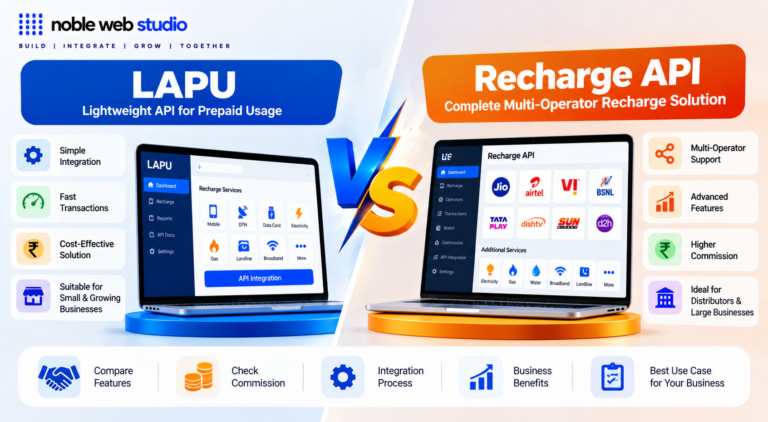
- Lapu System Integration: Ability to connect physical LAPU SIM cards/devices directly to the software for local SIM-based commission optimization.
2. User & Agent Management
- KYC & Registration: Modules to review, approve, or suspend Master Distributors, Distributors, and Retailers.
- Permission Controls: Fine-grained access management defining what services (e.g., Mobile, DTH, BBPS, AEPS, PAN card) each user tier can access.
3. Financial & Wallet Control
- Single Wallet Architecture: Agents maintain one digital fund pool that works universally across all services ( prepaid, postpaid, electricity, FASTag, etc.).
- Automated Commission Engine: Setup flat or percentage-based instant commissions for specific operators and push them automatically through the distribution chain.
- Credit/Debit Adjustments: Tools to manually adjust user balances, approve bank fund requests, or set credit limits.
4. Real-time Dashboard Analytics
- Instant Support Inversion: Real-time logging of failed transactions with automated balance rollbacks for immediate customer dispute resolution.
- Live Status Tracking: Visual tickers showing live transaction volume, success percentages, and recharge API response latencies.
- Daily Earnings Calculations: Automated daily profit/loss reports exportable to Excel or CSV format.
B2B Recharge API Pricing and Commission Structure
B2B recharge API pricing models in India typically fall into one-time setup fees, recharge software subscription plans, or zero-cost setup with wallet funding requirements:
- One-Time Setup / Integration Fees: Ranges from ₹1,000 to ₹5,500 depending on the Noble web studio and plan tier (e.g., Noble web studio plans range from ₹1,000 to ₹5,500).
- Monthly Software Subscriptions: Starting around ₹1,499 to ₹3,000+ per month if you are using a ready-made B2B/B2B2C white label recharge panel or best recharge portal software.
- Per-Transaction / Maintenance Fees: Recharge API charge no recurring monthly or transaction fees, requiring you only to maintain an active prepaid float/wallet balance.
Commission Structure & Margins
Commissions are percentage-based or flat rates credited directly to your wallet upon a successful transaction, varying by operator and service category:
1. Prepaid Mobile Recharge Margins
- Jio: ~1.7% to 3.2%
- Airtel: ~2.0% to 3.3%
- Vodafone Idea (Vi): ~3.5% to 4.1%
- BSNL: ~4.0% to 6.5%
- General range: 2% to 4.5%
2. DTH Recharge Margins
- Tata Play, Airtel Digital TV, Dish TV, Sun Direct, Videocon D2H: 1% to 4.5%
3. BBPS & Utility Bill Payments (Flat / Percentage)
- Electricity Bills: ₹3 to ₹10 per bill (or ~0.30% to 0.5%)
- Water & Piped Gas Bills: ₹2 to ₹5 per bill (or up to 4.5% depending on category)
- Postpaid Mobile Bills: ₹2 to ₹4 per bill
- FASTag Recharge: ~0.15% to 0.20%
- Loan EMI & Insurance Premiums: ₹3 to ₹8 per payment (or up to 3%)
B2B2C Margin Spread Model
If you operate a B2B2C network (passing down a sub-panel to distributors or retailers):
- Your Gross Margin: What the upstream Recharge API pays you (e.g., 3.5% on BSNL or 3% on Airtel).
- Retailer Payout: What you pass down to your agents/retailers (e.g., 2% to 2.5%).
- Your Spread (Net Profit): The difference (e.g., 0.5% to 1.0%) minus hosting, SMS, and server costs.
B2B Recharge API Wallet, Fund Transfer and Commission Management
A B2B Recharge API platform allows businesses to automate mobile recharges, DTH, and utility bill payments through a multi-tier network (Admin, Master Distributor, Distributor, Retailer).
Core Modules of a B2B Recharge System
Wallet Management:
- Single or multi-wallet architecture to manage real-time debits and credits.
- Instant ledger tracking for Recharge API requests, refunds, and failed transactions.
Fund Transfer Hierarchy:
- Top-down fund allocation from Admin → Master Distributor → Distributor → Retailer.
- Manual or automated wallet loading with approval workflows and payment gateway/UPI hooks.
Commission Management:
- Tiered, operator-wise, and circle-wise commission structures (e.g., margins for Airtel, Jio, VI, BSNL, and DTH providers).
- Automated slab-based margin distribution down the network hierarchy upon successful transaction callbacks.
API & Multi-Operator Switching:
- Real-time routing across multiple operator gateways to maintain a 99.9% uptime and high success rate.
- Webhook and JSON/XML Recharge API endpoints for submitting recharge payloads and fetching live statuses.
B2B Recharge API vs. a Basic Recharge API
The primary difference between a B2B Recharge API and a Basic Recharge API lies in their business architecture and system capabilities: a B2B Recharge API includes a multi-level user management and commission routing framework built directly into its system architecture, whereas a Basic Recharge API is a simple, single-tier transactional pipeline designed exclusively for a business to fulfill its own individual recharge requests.
While a basic API only handles execution (“send request, get success/fail status”), a B2B API provides the underlying database structure required to run a full multi-tier reseller network.
Core Comparison Matrix
| Feature | Basic Recharge API | B2B Recharge API |
|---|---|---|
| Primary Target User | Solo apps, startups, or standalone portals serving end-consumers. | Fintech startups, large aggregators, and multi-tier network operators. |
| User Hierarchy Support | None. Single application-to-provider interface. | Multi-level (Admin → Master Distributor → Distributor → Retailer). |
| Commission Routing | Flat commission directly applied to a single master wallet. | Dynamic, split-commissions routed instantly across up to 10 network levels. |
| Wallet Management | Single wallet system managed by the platform developer. | Built-in individual virtual wallets and ledgers for every single reseller down the line. |
| Failover Infrastructure | Usually single-gateway or basic endpoint retries. | Advanced smart routing with automated, multi-gateway failover to prevent downtime. |
| Scope of Services | Often restricted strictly to prepaid mobile and DTH. | Bundled with broader fintech services (BBPS, AEPS, DMT, travel booking). |
Common Challenges in B2B Recharge API Operations
Running a B2B mobile or utility recharge API operation involves coordinating multiple telecom operators, multi-tier distribution networks (admin, distributor, retailer), and real-time financial ledgers.
Common Challenges in B2B Recharge API Operations
- Diverse and Changing API Formats: Different telecom and service providers use unique authentication methods, request fields, operator codes, and response structures. Furthermore, Noble web studio frequently update their specifications or endpoints without advance notice.
- Delayed Responses and Timeout Handling: Network glitches or slow upstream telecom gateways can leave a recharge request hanging in an uncertain state. Without a robust status-check process and pending-state architecture, transactions risk double-charging or failing silently.
- Transaction Inconsistencies and Reconciliation: Internal ledgers and external systems can temporarily drift out of sync, making manual reconciliation overwhelming for finance teams.
- Retailer Network Activation & Engagement: Signing up retailers on a B2B Mobile Recharge platform is only the first step. Ensuring active usage, genuine customer demand, and proper platform adoption across tiers requires ongoing support.
- Multi-Tier Wallet & Commission Payouts: Managing real-time debit/credit flows across complex hierarchies (Admin Owner, Master Distributors, Distributors, Retailers) while calculating dynamic profit margins requires ultra-low latency and error-free ledgers.
- Failover and Uptime Reliability: Single-gateway dependence leads to downtime when a telecom operator faces an outage, necessitating automated recharge API routing and failover systems.
- Security and Authentication Gaps: Protecting wallet balances, recharge API keys, and partner data against unauthorized access, man-in-the-middle issues, or data breaches demands strict encryption and access controls.
Noble Web Studio One Of The the Best Recharge API Provider for B2B Businesses
Noble web studio only one of the right Recharge API Provider is a foundational decision for B2B businesses offering mobile recharges, DTH, and utility bill payment services. While many businesses make the mistake of choosing a Noble web studio based on the highest commission rates, a poor API leads to failed transactions, stuck capital, and frustrated retail networks.
For a B2B mobile recharge commission platform to remain profitable and reliable, several critical technical, financial, and operational factors must be evaluated.
1. Transaction Reliability & Success Rates
- 99%+ Core Success Rate: A high transaction success rate and rapid recharge API response times (ideally under 5 seconds) are non-negotiable. A cheaper provider with a 95% success rate costs more in customer support and lost retail clients than a reliable alternative.
- Direct Operator Connectivity: Verify Noble web studio server connects to primary telecom circles (like Jio, Airtel, Vi, and BSNL). More middle hops between your B2B server and the operator introduce more latency and single points of failure. Direct or near-direct operator routing guarantees fewer pending cases.
2. Technical Infrastructure & Webhook Support
- Callback (Webhook) Support: In B2B networks, some recharges inherently face delayed network responses. Webhook support automatically posts the final status back to your server once updated, eliminating manual status-checking or premature refunds.
- Developer-Friendly Documentation & Sandbox: The Noble web studio should offer clean REST Recharge API documentation with transparent error codes, JSON/XML payload structures, and a robust sandbox testing environment. Noble web studio development team cannot build a stable proof-of-concept quickly, onboarding will stall.
3. Financial Transparency & Wallet Management
- Operator-Wise Commission Margins: Payout margins should be explicitly detailed operator by operator upfront, rather than advertised as a singular flat rate.
- Real-Time Settlement & Reconciliation: B2B administrators must track distributor balances, Permitted Net Work structures, and exact ledger margins. Evaluate wallet top-up speeds and ensure failed transactions instantly credit money back to the respective sub-wallet without manual intervention.
4. Service Breadth & Scalability
- Multi-Service Architecture: To scale effectively, prioritize “Multi Recharge API that bundle prepaid, postpaid, DTH, and Bharat Bill Payment System (BBPS) utilities (electricity, water, gas, broadband) under a single dashboard. Noble web studio streamline infrastructure by keeping multiple services under a single integration.
- White-Label Solutions: If you intend to sell the recharge platform downstream to regional super-distributors, ensure the Noble web studio supports customizable white-label dashboards and flexible business-rule configurations.
Why Explore Noble Web Studio for Fintech Software Development?
Exploring a Noble web studio for Fintech Software Development offers distinct technical, financial, and operational advantages over building an in-house team or using generic IT agencies.
Key Reasons to Partner with a Fintech Software Development Provider
- Deep Domain Expertise: Noble web studio understand complex financial regulations, open banking protocols, payment gateways, and risk management systems far better than general-purpose software shops.
- Regulatory Compliance & Security: Financial apps must adhere to strict standards such as PCI DSS, GDPR, AML/KYC, and regional banking laws. Noble web studio build these safety and audit frameworks natively from day one.
- Faster Time-to-Market: Pre-vetted engineering teams, pre-built financial modules, and ready-to-use API integrations (such as identity verification or core banking connectors) help launch products in weeks or months rather than years.
- Cost Efficiency: Outsourcing or partnering eliminates the high overhead of recruiting, training, and retaining a full in-house fintech engineering, compliance, and QA department.
- Scalability & Modern Tech Stack: Noble web studio use cloud-native architecture, microservices, and containerization to ensure platforms scale smoothly during high-volume transaction spikes.
- Access to Cutting-Edge Innovation: Noble web studio integrate advanced capabilities like AI/ML for fraud detection and robo-advisors, or blockchain for cross-border and smart-contract transactions.
B2B Recharge API Integration Solutions with Noble Web Studio
Noble web studio one of the the right B2B Recharge API provider requires evaluating technical performance, financial terms, and long-term business scalability rather than just looking at commission rates.
1. Technical Reliability & Performance
- Transaction Success Rate (SR): Noble web studio offering 99.9% uptime and success rates backed by direct operator connections and automatic fallback routing to prevent failed recharges.
- Latency & Speed: Aim for sub-200ms or fast response times to prevent customer drop-offs and double-debit errors.
- Automated Webhooks: Ensure the API supports real-time asynchronous callbacks so your server does not waste resources constantly polling for transaction statuses.
- Dynamic Plan & Operator Detection: A good API should offer a live recharge plan API and an automatic mobile-number-to-operator detection API to eliminate wrong recharges.
2. Commercials & Commissions
- Transparent Pricing: Check for hidden setup fees, wallet maintenance charges, or minimum deposit requirements.
- Commission Margins & Settlement: Evaluate operator-wise margins (prepaid, DTH, FASTag, utility bills) and confirm whether commissions are credited instantly to your wallet or settled periodically.
- Failed Transaction Reversals: Clarify the exact automated process and timeline for refunding money on failed or stuck transactions.
3. Service Coverage & Multi-Service Expansion
- Breadth of Operators: Verify direct connectivity across all major telecom, DTH, electricity, gas, water, and FASTag service providers.
- Future-Proofing: Plan for expansion today you might need mobile recharge, but tomorrow you may need DTH or bill payments.
4. Documentation & Integration Support
- Developer-Friendly Docs: Clear, well-structured documentation covering endpoints, request/response formats, authentication (TLS 1.3, IP whitelisting), and sandbox/testing environments.
- Technical Support: Test their live support lines (phone and WhatsApp) during business hours before committing.
5. Business Credibility & Scalability
- Company Track Record: Verify GST registration, corporate background, and how many years they have operated in the digital payment/recharge space.
- White-Label & Network Support: If you plan to scale a multi-tier network of distributors and retailers, check if the Noble web studio offers an integrated white-label software solution alongside the raw API. You can explore structured evaluation criteria further on Noble web studio.
Best Practices for B2B Recharge API Integration
Integrating a B2B Recharge API requires architectural discipline because it functions as a live payment gateway. A single compromised credential or unhandled response loop can exhaust wallet balances or trigger costly customer disputes.
Implementing robust transactional state machines, strict security frameworks, and resilient failover routing is essential to ensure long-term stability and high system availability.
1. Robust Transaction State Management
Recharge transactions often suffer from network latencies where a request is neither an immediate success nor a definitive failure.
- Idempotency Keys: Generate and enforce a unique transaction reference ID on your system before pushing the payload to the Noble web studio. This prevents duplicate billing if the request is resent due to network drops.
- Handle the “Pending” State: Never treat a delayed or unacknowledged response as a failure. Keep the transaction marked as
PENDINGinternally to prevent triggering immediate consumer refunds while the downstream Noble web studio might still execute the top-up. - Webhooks over Polling: Implement webhook endpoints to process real-time transaction updates from Noble web studio. Use status polling APIs exclusively as a fallback mechanism if a webhook delivery fails or times out.
2. Multi-API Routing & High Availability
Relying on a single vendor leaves your platform vulnerable to operator downtimes, API performance degradation, or sudden wallet depletion.
- Dynamic Failover Routing: Integrate multiple recharge Noble web studio. Noble web studio A returns an internal server error or encounters a timeout, dynamically route the retry payload through Noble web studio.
- Operator Performance Mapping: Different upstream aggregators maintain varying success rates across distinct cellular networks (e.g., Airtel vs. Jio). Route traffic dynamically based on historical operator performance per Noble web studio.
- Smart Circuit Breakers: Automatically stop routing transactions to a Noble web studio if its error rate crosses a set threshold (e.g., 5 consecutive drops), shifting the capacity to healthy endpoints.
3. Bulletproof Wallet & Balance Management
Because B2B recharge operations depend heavily on advance wallet deductions from your sub-merchants and distributors, rigorous ledger logic is mandatory.
- Two-Phase Commit Balance Locking: When a sub-merchant initiates a recharge request, immediately place a hold or lock on the transaction amount within their wallet. Do not complete the final deduction until a success payload is returned, and do not release the hold until a final state (
SUCCESSorFAILED) is determined. - Low-Balance Alerts: Implement active monitoring protocols to Noble web studio wallet dips below a defined threshold, ensuring continuous processing capital.
4. API Security Checklist
Recharge endpoints represent a direct financial liability; treat them with standard banking-grade security protocols.
- IP Whitelisting: Strictly enforce IP address pinning so Noble web studio only accepts transaction requests initiated from your designated production server addresses.
- Payload Hashing / Digital Signatures: Secure transaction integrity by signing each outbound request payload using standard HMAC algorithms (e.g., SHA-256) paired with a private secret key.
- Token Rotation: Authenticate API calls through dynamic token generation systems (like OAuth 2.0 or JWTs) rather than hardcoding static credentials inside your application environments.
5. Standard Architectural Integration Comparison
| Feature Capability | Best Practice Approach | Anti-Pattern to Avoid |
|---|---|---|
| Response Delays | Hold transaction in PENDING, log timestamps, and await webhooks. | Instantly display a failed state or trigger automated refunds. |
| Error Handling | Parse Noble web studio team error codes to display friendly, actionable messages to retailers. | Expose raw JSON errors or system stack traces to end-users. |
| Data Reconciliation | Automate daily cron jobs to reconcile internal database logs with Noble web studio CSV dumps. | Manually adjust wallet differences only when retailers file complaints. |
| Vendor Redundancy | Maintain Noble web studio failover configurations natively at the router level. | Hardcode the code architecture to a single API vendor endpoint. |
Conclusion
Choosing the right B2B Recharge API is an important step for businesses that want to offer mobile recharge services through their own website, application, retailer portal, or distributor network. A suitable API integration can help automate recharge requests, connect supported operators, retrieve transaction statuses, and maintain records from a central system. However, a successful B2B recharge business depends on more than API connectivity. You also need transparent commission arrangements, secure integration, reliable transaction tracking, proper reconciliation, and software that can manage your growing business network.
Noble Web Studio develops and sells ready-made B2B Mobile Recharge Software for entrepreneurs, fintech startups, distributors, and businesses planning to establish their own recharge platform. Depending on the selected software version and available integrations, the platform can support Admin, Master Distributor, Distributor, and Retailer management, commission configuration, wallet management, transaction monitoring, recharge reports, and API connectivity. These features can help you organise business operations and manage your retailer network through a centralised system.
Before selecting a B2B Recharge API, check the supported mobile and DTH operators, API documentation, authentication process, response handling, pending transaction procedures, refund and reversal policies, commission structure, and technical support. Also confirm whether the API can work with your existing application or selected B2B recharge software. Testing successful, failed, pending, and duplicate transaction scenarios before going live can help reduce avoidable operational problems.
If you are planning to start a B2B recharge business or expand your existing digital services, connect with Noble Web Studio to discuss ready-made B2B Mobile Recharge Software, API integration requirements, retailer and distributor management, and available platform options. Select a solution according to your business model, expected transaction volume, and commercial requirements.
Build your B2B recharge platform with the right software, suitable API connectivity, and a clear business plan with Noble Web Studio.
B2B Recharge API with Noble Web Studio
Looking for a reliable B2B Recharge API for your business? Connect with Noble Web Studio to discuss API integration, multi-operator recharge services, commission management and a scalable recharge platform for your business requirements.