Ankit
Looking for a Recharge API with High Margin to start your own recharge business or increase the earning potential of your existing platform? Choosing the right recharge API is not just about finding the highest advertised commission. You also need to consider operator-wise rates, transaction success, service availability, settlement terms, retailer payouts, and operating expenses. A suitable API integration can help you manage recharge services efficiently while building a sustainable business model.
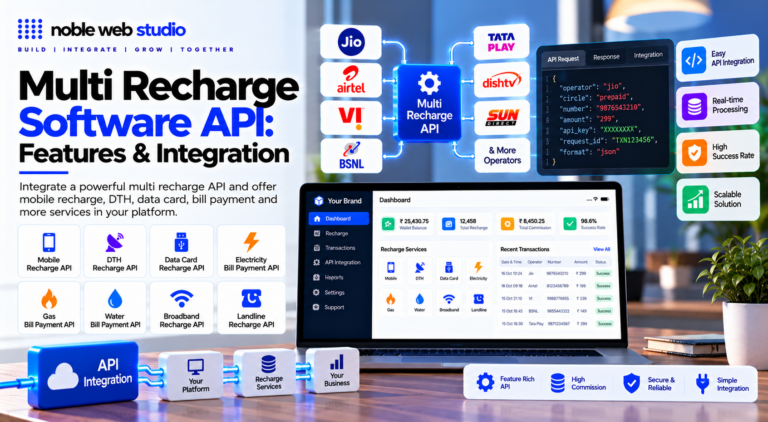
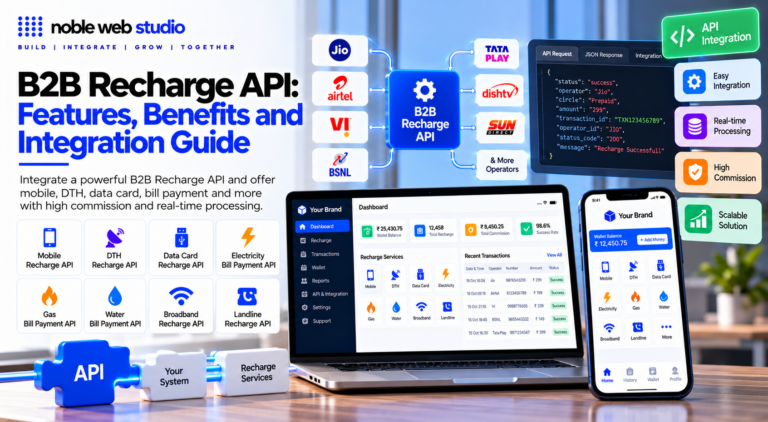
A recharge API connects your website, mobile application, or retailer portal with supported recharge services. Depending on the provider and commercial agreement, it can support prepaid and postpaid mobile recharge, DTH recharge, and other available digital services. Businesses can use these integrations to operate B2B recharge portals, customer-facing platforms, retailer networks, or API-based services. Important features include secure API authentication, real-time transaction status, commission reports, balance management, and transaction reconciliation.
A high-commission recharge API connects your fintech app, digital wallet, or retail platform directly to telecom, DTH, and utility networks, allowing you to earn a percentage or a fixed margin on every transaction. In the Indian market, major providers structure their plans to offer competitive commissions that scale based on your transaction volumes.
Noble Web Studio develops ready-made B2B Mobile Recharge Software for startups, entrepreneurs, retailers, distributors, and businesses planning to establish or expand their recharge operations. The software can provide a business platform for managing recharge transactions, retailer and distributor accounts, commission settings, and reports. If you are planning to integrate a recharge API, discuss your required services, provider connectivity, API availability, and commercial terms with Noble Web Studio before selecting your setup.
To evaluate a Recharge API with High Margin, compare the actual commission offered for each operator and service instead of relying on a single advertised percentage. For example, calculate your expected gross commission, subtract retailer and distributor payouts, API charges, hosting expenses, and other operating costs, and then estimate the amount your business may retain. Also check how pending, failed, and reversed transactions affect commission eligibility.
In this guide, you will learn how high-commission recharge APIs work, which factors influence recharge margins, how to compare API providers, and how to calculate potential business earnings. You will also understand the importance of transaction reliability, transparent commission structures, and the right software platform when building a recharge business with Noble Web Studio.
What Is a Recharge API with High Commission?
A recharge API with high commission is a software interface provided by a B2B fintech or telecom aggregator that allows your website, mobile app, or retail panel to process prepaid mobile, DTH, data card, and utility bill payments while offering elevated percentage-based or fixed cash-back/commission margins on each successful transaction.
How Does a High-Commission Recharge API Work?
A High-Commission Recharge API acts as a digital bridge between your business platform (website, Android/iOS app, or retail portal) and major telecom, DTH, and utility network operators. It automates mobile top-ups while paying you or your agent network a percentage-based commission for every transaction processed.
How the API Workflow Works
[Customer Request] ➔ [Your Platform] ➔ [Recharge API Provider] ➔ [Operator Network (Jio/Airtel/etc.)]

       |                                                                            |
[Wallet Debited] 🡠🡠🡠🡠🡠🡠🡠🡠🡠🡠🡠🡠🡠 [Commission Disbursed] 🡠🡠🡠🡠🡠🡠🡠🡠 [Success Response]
- Initiation: A customer or retail merchant inputs the mobile number, detects the operator circle, and selects a recharge plan.
- Authentication & Validation: Your system transmits a secure JSON/REST request to the API provider to verify the details and check your available wallet balance.
- Execution: The provider processes the tokenized transaction directly through B2B operator channels within 200ms to 500ms.
- Instant Settlement: Upon a successful operator callback, the final transaction ID is generated. The exact transaction cost is debited from your pre-funded virtual wallet, and the high-margin commission is instantly credited back into your account.
How the Recharge API Commission Model Works
A Recharge API commission model is the set of rules that decides how the profit margin on a mobile, DTH, or utility recharge is shared between the telecom operator, the API provider, platform owners, distributors, and retailers.
How the Flow Works
- Operator Margin: Telecom or utility operators (like Jio, Airtel, Vodafone Idea, or BSNL) give a small percentage margin to the upstream API provider or aggregator on every successful transaction.
- Platform Distribution: The API provider or platform owner keeps a share and passes the rest down through a hierarchical chain:
- Master Distributor / Distributor: Takes a small cut or override commission for managing sub-agents.
- Retailer / End Agent: Receives the largest slice of the commission because they handle the actual customer interaction.
- Wallet Credit: As soon as a transaction receives a successful confirmation response from the operator, the calculated commission is automatically credited to each tier’s digital wallet in real time.
What Does Recharge API with High Margin Mean?
A recharge API with a high margin is a software interface that connects your website or mobile app to telecom and utility providers, promising a larger-than-average commission or revenue share for every transaction processed.
What It Means in Practice
- Commission Sharing: When a customer completes a mobile, DTH, or utility bill recharge, the API provider gives your business a percentage or flat-rate commission. A “high margin” claim means this percentage is marketed as higher than standard industry rates.
- The “Spread” (Admin / Distributor Level): If you run a B2B2C model where you pass a portion of the commission down to sub-dealers or retailers, your margin is the “spread”the difference between what the upstream API provider gives you and what you share with your network.
- Actual Net Earnings: A headline percentage does not automatically mean high net profit. You must factor in hidden costs, gateway or wallet loading fees, failed transaction ratios, and operator-wise commission variations (e.g., mobile recharge margins typically range from 1% to 4%, DTH from 2% to 3%, and BBPS bill payments from 0.5% to 2%).
Mobile Recharge API Commission Structure by Operator
Mobile recharge API commission structures in India vary by telecom operator, plan type, and the specific API service provider or reseller tier you partner with.
Average Commission Rates by Operator
Standard prepaid mobile recharge commission percentages generally range across major providers:
- BSNL (Top-up / STV / Validity): ~5.0% to 6.50%
- Vodafone Idea (Vi / Idea): ~3.50% to 4.10%
- Jio: ~2.80% to 4.00% (varying by base margin and active promotional or slab offers)
- Airtel: ~2.00% to 3.30% (depending on circle-wise and gold/basic plan slabs)
DTH Recharge Commission Rates
- Airtel Digital TV: ~4.1% to 4.2%
- Tata Play (Tata Sky): ~4.1%
- Sun Direct: ~4.0% to 4.1%
- Dish TV / Videocon d2h: ~4.0% to 4.1%
Key Factors That Change Your Margins
- Plan Tiers: Noble web studio offer higher slabs (such as Gold or Platinum packages with a one-time setup fee) that unlock higher commission percentages compared to basic free or entry-level APIs.
- Hierarchy Role: Commissions split across layers. Master distributors, distributors, and retailers each take a cut from the primary margin provided by the telecom operator.
- Postpaid & Utility Bills: Postpaid mobile, electricity, gas, and water bills typically yield 0% commission or require convenience fees rather than earning percentage-based margins.
Factors That Influence Recharge API Commission
The recharge API commission structure operates on a tiered, multi-layered model where telecom operators pass margins down to software providers, master distributors, distributors, and finally, retail agents.
Several critical factors dictate the specific commission rates you receive from a Noble web studio:
1. Telecom Operator and Circle
Commission margins are not uniform across the board. Each telecom operator (e.g., Jio, Airtel, Vi, BSNL) sets its own margin distributions based on market share, internal policies, and operational costs.
- State-owned or smaller operators (like BSNL) often offer significantly higher commission slabs (sometimes up to 5%–6.5%) to incentivize agents.
- Market-leading operators (like Jio and Airtel) command high user volume and consequently provide much tighter, thinner margins (frequently under 1.5%–3%).
- Geographic Circles: Rates can sometimes fluctuate depending on the regional telecom circle the consumer belongs to.
2. Service Category
The type of digital service being funded plays a massive role in the final payout structure:
- Prepaid Mobile Recharges: High volume but narrow, aggressive margins.
- DTH (Satellite TV) Recharges: Generally yields a higher margin percentage compared to mainstream mobile prepaid plans.
- BBPS Utility Bills & Postpaid Plans: These often offer flat, negligible, or even 0% commission structures, Noble web studio usually apply a fixed convenience surcharge instead of a percentage-based payout.
3. Monthly Transaction Volume (Tiered Slabs)
Noble web studio incentivize scalability. High-volume bulk businesses or platforms with consistent daily traffic typically qualify for superior custom commercial terms. Noble web studio often split their rates into “Starter/Basic” and “Gold/Premium” subscription tiers, locking higher commission rates behind specific membership levels or transaction thresholds.
4. Partner Hierarchy Role
Where you sit in the software ecosystem determines your baseline margin. A B2B platform admin who owns the core white-label software retains the highest absolute upstream margin from the API. They then distribute a portion down the chain:
- Master Distributors take a small cut.
- Distributors take the next sliver.
- Retailers receive the final piece of the commission spread.
5. API Cost Structures and Hidden Fees
Your real margin is your gross commission minus the administrative costs of running the API. Noble web studio offering an attractive commission percentage might offset it through alternate pricing mechanics:
- Upfront Setup Fees or Subscriptions: Monthly fees can eat into profits during slower business months.
- Per-Transaction Surcharges: Small flat charges per API hit that quickly accumulate at high volumes.
- Hidden Operating Gaps: Slow support or poor transaction success rates result in stuck balances, forcing manual refunds and administrative loss.
How to Calculate High-Commission Recharge API Earnings
To calculate your earnings from a high-commission recharge API, you need to determine your gross commission using Noble web studio rate model, subtract any operating costs or partner payouts, and factor in your daily transaction volume.
Core Formulas for Gross Commission
– Percentage-Based Commission:
Gross Commission=100Eligible Transaction Amount×Commission Rate (%)
Example: For a ₹500 recharge at a 3% commission rate,
100500×3=₹15
– Fixed Commission Per Transaction:
Gross Commission=Fixed Amount per Successful Transaction
- (Some utility or bill payment categories pay a flat rate, such as ₹15 per transaction.)
Tier-Based / Volume-Based Rates:
- If your API offers higher percentages only when you cross a specific monthly or daily volume threshold, apply the specific tier percentage that matches your active volume.
2. Calculating Monthly Net Earnings
To know what actually stays in your pocket rather than just the gross commission on the screen, use this formula:
Net Earnings = (Daily Recharge Value × Average Commission % × Working Days)
Where Operating Costs can include:
- API integration or monthly software subscription fees (e.g., ₹1,499+/month).
- Gateway, SMS, or server maintenance charges.
- Payout shares if you run a distributor/retailer chain (sharing a margin with your sub-retailers).
- Deductions or adjustments from failed, pending, or reversed transactions.
3. Step-by-Step Calculation Example
- Daily Volume: You process ₹50,000 worth of total recharges and bill payments a day.
- Average Commission: You average a blended commission rate of 2.5% across operators (Prepaid, DTH, BBPS).
- Daily Gross Commission: ₹50,000 × 2.5% = ₹1,250 per day.
- Monthly Gross (30 Days): ₹1,250 × 30 = ₹37,500.
- Deduct Monthly Costs: Subtract ₹2,500 for portal/software/server overhead.
- Net Monthly Profit: ₹37,500 − ₹2,500 = ₹35,000.
Which Recharge Services Should You Evaluate?
When evaluating mobile recharge services and plans in India, you should assess several key factors to ensure you get the best value and performance:
Key Criteria to Evaluate
- Operator Support & Network Coverage: Check which telecom operator provides the strongest 4G or 5G coverage and reliable call connectivity in your daily routine. (e.g., Jio, Airtel, Vodafone Idea/Vi, and BSNL).
- Usage & Budget Needs: Estimate your average monthly data, calling, and SMS requirements by reviewing your past history so you don’t overpay for unused benefits.
- Prepaid vs. Postpaid: Choose prepaid if you want strict spending control and no surprise bills, or postpaid if you need high data limits, international roaming, or family add-on connections.
- Plan Validity & Cost-per-Day: Compare short-term, quarterly, and annual options using a tool like Plan Compare to see the real daily cost rather than just the upfront recharge amount.
- Bundled OTT & Value-Add Services: Look at extra perks included in the plan, such as free 5G data, OTT subscriptions (like JioHotstar, SonyLIV, or Amazon Prime), or cloud storage.
- Platform Reliability: If you are recharging through a third-party app or working as a retailer, evaluate platform features, transaction confirmation speeds, and dispute resolution for failed recharges.
High Commission Recharge API Integration Process: Step by Step
Integrating a High-Commission Recharge API into your website or B2B/B2C application allows your users to process prepaid mobile, DTH, and utility bill payments while earning you an automated margin or commission on every successful transaction.
The step-by-step developer integration process consists of six key stages:
Phase 1: Onboarding and Configuration
- Choose a Noble web studio: Select an Noble web studio with high transaction success rates (minimum 99%), low response latency, and a strong commission framework.
- Complete KYC & Retrieve Credentials: Complete your commercial onboarding and regulatory KYC to receive your live API Username, Secret Key, and Base Authentication Token.
- Configure Environment Variables: Secure your credentials on your backend web server (e.g., Apache/Nginx using
.envfiles) rather than hardcoding them into scripts. - IP Whitelisting & Callback Setup: Share your system’s production server IP address with the Noble web studio for security whitelisting, and register your secure web hook listener Callback URL (
https://yourdomain.com).
Phase 2: Core Development & Endpoint Integration
The backend architecture relies on structural RESTful API endpoints, typically utilizing JSON arrays over HTTPS basic or token-based authentication.
Step 1: Operator & Circle Discovery (Optional but Recommended):
- Action: When a user types in their mobile number, trigger a POST lookup endpoint.
- Purpose: Automatically returns the telecom carrier (e.g., Jio, Airtel) and geographical circle (e.g., Karnataka) to minimize human error.
Step 2: Fetch Dynamic Plans:
- Action: Query the
/plans/{operator}/{circle}endpoint. - Purpose: Dynamically populate available prepaid vouchers, data add-ons, or talktime configurations in your UI.
Step 3: Execute Transaction Initiation:
- Action: When the customer confirms, compile and execute a secure
POSTrequest payload to the process endpoint (e.g.,/recharge/process). - Payload Schema: Pass critical keys including
mobile_number,operator_id,amount, and a universally uniqueclient_reference_id(Idempotency Key) generated from your database to prevent duplicate debits.
Phase 3: Status Handling & Commission Recording
A robust recharge integration must cleanly bifurcate its processing flow based on response codes returned by the Noble web studio:
| Status Code | System Action Required | Commission Treatment |
|---|---|---|
| SUCCESS | Instantly update client UI, deduct main user wallet, issue notification. | Credit / Calculate Commission: Calculate net margin slabs and record to accounting table. |
| PENDING | Do Not Re-submit. Route transaction to a cron queue or wait for callback hooks. | Hold: Freeze commission calculation until final status resolves. |
| FAILURE | Immediately roll back internal customer funds and display error. | Void: No commission generated. |
- Implementing Status Polling: Set up an internal worker script that systematically queries
GET /transaction/status/{id}for any transaction stuck in a “Pending” window for more than 60 seconds.
Phase 4: Sandbox Testing & Going Live
- Mock Testing: Use the Noble web studio sandbox/test environment to trigger mock responses for valid inputs, invalid numbers, timeouts, and network outages.
- Small Volume Live Test: Switch configurations to production, fund your virtual wallet with a nominal value (e.g., ₹10), and initiate real transactions to verify live tracking.
- Monitor Live Dashboard: Ensure that commission variables are reflecting accurately alongside your net wallet deduction.
Features to Look for in a High-Commission Recharge API
A High Commission Recharge API allows businesses, fintech platforms, and retailers to integrate automated mobile, DTH, and utility payment services into their existing systems while maximizing profit margins. Instead of dealing with individual telecom networks, this single interface routes transactions instantly and offers competitive earnings per transaction.
Core Technical Features
- Multi-Operator Support: Connects to all major telecom operators (e.g., Jio, Airtel, Vi, BSNL) and DTH services (e.g., Tata Play, Dish TV) through a single unified endpoint.
- Real-Time Processing: Completes transactions in milliseconds with instant server responses and automated generation of unique transaction IDs.
- Automatic Operator & Circle Detection: Identifies the operator and regional telecom circle automatically when a phone number is entered, preventing user input errors.
- Dynamic Plan Fetching: Fetches live, up-to-date prepaid plans, talk-time options, and data add-ons directly from operators.
- Robust Security: Utilizes secure REST endpoints (JSON/XML data exchange) encrypted with HTTPS/SSL protocols and protected by recharge API keys or OAuth authentication.
- Webhooks and Callback URLs: Sends real-time, automated updates regarding transaction success, failure, or pending status back to your server application.
- Automated Refund System: Reverses failed transactions immediately, updating client wallets without requiring manual intervention.
Business & Commission Management Features
- Tiered Commission Management: Allows recharge platform owners to set up multi-level structures (Distributors, Sub-Distributors, Retailers) and distribute distinct commission percentages automatically.
- Instant Margin Settlement: Credits earnings (ranging typically from 1% to over 7% depending on the operator and contract) immediately to the agent’s wallet upon transaction success.
- Auto-Wallet Update: Integrates central digital wallets that auto-deduct the cost price of the recharge while simultaneously locking in the commission payout.
- Detailed Analytics & Reporting: Provides comprehensive transaction histories, successful vs. failed logs, volume reports, and transparent revenue tracking panels.
- White-Label Capabilities: Enables businesses to rebrand the interface or recharge software portal under their own company name and logo while using the Noble web studio backend infrastructure.
Strategies to Negotiate Better Recharge API Commission
To negotiate a better Recharge API commission, use your actual transaction volume, compare net margins instead of raw percentages, and evaluate technical reliability alongside pricing.
1. Prepare and Leverage Volume Data
- Present Verified Transaction Logs: Compile historical data showing your daily, weekly, and monthly transaction counts, operator-wise split (Jio, Airtel, Vi, BSNL), and gross turnover.
- Request Volume-Based Slabs: Ask for tiered or slab-based commission models where higher monthly transaction volumes unlock higher percentage margins.
- Show Growth Trajectory: If you are scaling or onboarding sub-distributors and retailers, present your projected growth to justify a better starting or stepped tier.
2. Shift the Conversation to Net Margin (Not Just Gross Commission)
- Factor in Failure Rates: A higher commission rate means nothing if the recharge API has a low success rate (SR). Failed recharges cost you customer trust, support overhead, and lost transactions. Push for higher margins tied to a 99.9% uptime and success rate SLA (Service Level Agreement).
- Audit Hidden Costs: Look past the headline commission figure. Check for setup fees, annual maintenance charges (AMC), wallet loading/moving fees, or recharge API access charges that erode your actual profit.
- Operator-Specific Optimization: Telecom operators pay varying margins (e.g., mobile prepaid vs. DTH vs. data cards). Avoid blanket single-rate demands; instead, negotiate operator-wise or category-wise customized rate cards.
3. Use Competitive Leverage
- Compare Complete Commercial Offers: Do not just say “the Noble web studio charges less.” Present a side-by-side cost-and-margin sheet from Noble web studio.
- Leverage Multi-Vendor Routing: Inform your provider that you have a secondary/fallback mobile recharge API integrated. Knowing you can dynamically shift traffic to a backup pipe if margins or latencies degrade gives you strong leverage.
4. Lock Terms Down in Writing
- Obtain an Official Rate Card: Get the operator-wise and service-wise commission breakdown documented in writing.
- Clarify Reversals & Failed Transactions: Ensure the agreement explicitly details how commission adjustments, pending status resolutions, and instant refunds are credited back to your wallet.
- Negotiate Renewal Price Caps: Prevent sudden margin squeezes down the line by adding renewal or hike caps into the commercial agreement.
Recharge API Wallet, Settlement and Payout Management
A Recharge API connects your application to telecom operators, DTH providers, and utility systems to process automated, real-time digital top-ups and bill payments.
Core Components
1. Wallet Management
- Pre-funded main wallet: You must keep a floating cash balance with Noble web studio server to process live transactions.
- Auto-debit & low-balance alerts: The system deducts transaction amounts (minus commission) in real time and triggers webhooks or dashboard warnings when your balance drops below a set threshold.
- Sub-wallet / Multi-tier hierarchy: B2B or white-label platforms use sub-wallets to split capital among distributors, retailers, and end-users.
2. Settlement
- Operator settlement: When a recharge request hits the server, the provider settles the amount directly with the telecom or utility switch, then returns a status response (Success, Pending, or Failed).
- Reversal and refund handling: If a transaction shows “Pending” or “Failed” due to operator timeouts, the provider automatically credits the deducted amount back to your recharge API wallet.
- Commission tracking: Commissions or margins (percentage- or flat-rate per operator like Jio, Airtel, Vi, or BSNL) credit either instantly upon transaction completion or via a periodic settlement ledger.
3. Payout Management
- Bulk & instant payouts: Integrates PayOut APIs to disburse funds, earnings, or cashbacks out to bank accounts, UPI handles, or digital wallets.
- Customizable settlement logic: Configure automated payout schedules, routing channels (IMPS, NEFT, RTGS, UPI), and rules based on transaction volume or merchant tier.
- Ledger reconciliation: Real-time transaction reports and exportable logs match debit entries, operator confirmations, and payout disbursements to prevent cash-flow drift.
High Margin Recharge API Pricing in india
A high-margin recharge API cost structure involves a balance between upfront setup or software licensing fees, operational wallet/routing charges, and operator-wise commission earnings distributed across your retailer or B2B network.
1. Upfront & Setup Costs
- API License / One-Time Fee: Typically ranges from ₹1,000 to ₹30,000+ depending on whether you purchase a basic plug-and-play recharge API or a multi-operator switching module (e.g., Noble web studio charge one-time plan fees between ₹3,000 and ₹5,500).
- White-Label / Software Setup: If you need a full web portal or app interface alongside the recharge API, costs range from ₹15,000 to ₹80,000+ for standard packages, or ₹1,00,000 to ₹3,00,000+ for custom multi-tier white-label platforms.
- Monthly / Yearly Subscriptions: Noble web studio opt for recurring software maintenance or server hosting fees, ranging from ₹1,000 to ₹2,500 per month (or around ₹25,000/year).
2. Transaction & Operational Costs
- Per-Transaction / Routing Fees: Depending on the Noble web studio, small per-hit routing or gateway fees may apply (roughly ₹3 to ₹5 per transaction or internal routing splits).
- Wallet Loading & Payment Gateway Costs: Funding your master recharge API wallet via payment gateways or net banking can incur gateway merchant discount rates (MDR) or setup fees (approx. ₹5,000+).
- Failed/Pending Transaction Buffer: A key hidden cost in recharge APIs is handling stuck, timeout, or failed transactions where manual or automated refund reconciliation is required.
3. Commission Margins (What You Earn)
Commissions vary heavily by telecom operator, service category (Prepaid, Postpaid, DTH, or BBPS utility bills), and whether the transaction is Non-GST (P2A) or GST (P2P):
- Jio / Airtel: Typically 0.7% to 1.4%
- Vi (Vodafone Idea): Typically 3.3% to 3.8%
- BSNL (TopUp / Special): Typically 3.0% to 4.0%
- DTH Operators (Tata Play, Airtel DTH, Dish TV): Typically 3.5% to 4.2%
4. Profitability Formula
Your net retention depends on cutting out downstream payouts to your agent/retailer network:
Amount Retained = Gross Commission – Partner/Retailer Payouts – Operating & Routing Expenses [0.6.1]
Building a Recharge Business Around API Integration
Building a digital recharge business around recharge API integration allows you to launch a high-volume fintech platform with low upfront technical infrastructure. Instead of negotiating individual contracts and building custom integrations for dozens of telecom networks, DTH companies, and utility providers, you connect to a Noble web studio. This Noble web studio these networks into a unified endpoint and a single wallet balance.
Core Business Models
Before writing code or partnering with an Noble web studio, you must establish how your business will generate revenue:
- B2C Platform (Direct-to-Consumer): You build your own consumer-facing mobile app or website. Users pay retail rates for mobile top-ups, utility payments, and DTH renewals. You pocket the full operator commission minus your payment gateway fees.
- B2B Distributor Network: You provide a white-label portal or software backend to local retail shops. The merchants process recharges for walk-in customers. You split the operator commission with the retailer, earning smaller margins but at a much higher aggregate volume.
- API Reseller (B2B Infrastructure): You sell API access directly to other fintech startups, app developers, or eCommerce platforms that want to embed utilities into their own software ecosystems.
High Margin Recharge API Commission and Profit Calculation
A high-margin recharge API business model relies on the spread (difference) between the gross commission you get from Noble web studio and what you pass down to your distributors and retailers.
Industry Commission Benchmarks (India)
Typical base market commission rates across digital service categories:
- Prepaid Mobile Recharge:
1% – 4%per transaction (varies by operator like Jio, Airtel, Vi, BSNL) - DTH Recharge:
2% – 3%per transaction - BBPS Utility Bill Payments:
0.5% – 2%per transaction - Domestic Money Transfer (DMT):
0.4% – 1%per transaction - AEPS (Aadhaar ATM):
₹5 – ₹15flat per transaction
The Profit Calculation Formula
The net profit retained by a platform owner or admin is governed by this formula:
Net Profit = Gross Commission Earned – Partner/Retailer Payouts – Operating & Gateway Costs
Step-by-Step Breakdown:
Gross Commission:
- Total Recharge Volume × Upstream API Commission Rate
Partner Payouts (Distributor/Retailer Share):
- Total Recharge Volume × Downstream Commission Rate Payout
Your Spread (Net Margin %):
- Upstream Rate − Retailer Rate
Deduct Fixed/Variable Overhead:
- White-label software subscription / recharge API panel fees
- Server hosting & maintenance
- Wallet loading/payment gateway charges (if any)
- Customer support and transaction adjustments
Failed Recharge, Refund and Commission Reconciliation
Managing a high-margin recharge API system requires strict tracking to handle failed transactions, instant or delayed refunds, and commission reversals without leaking wallet balance or margin.
1. Core Lifecycle of a High-Margin Recharge Transaction
- Request Initiation: The user or retailer triggers a recharge; the platform debits the wallet (or holds the net payable amount after upfront commission or post-credited commission) and generates a Unique Reference ID (TXN ID).
- Upstream Processing: The request hits the operator/provider pipe. Status returns as
Success,Failed, orPending/Timeout. - High-Margin Trap: High-margin recharge APIs often involve multi-tier distribution (Admin → Master Distributor → Distributor → Retailer). If a transaction fails after or during split-commission settlement, reversing the commission across all tiers becomes complex.
2. Handling Failed Recharges & Status Inquiry
- No Blind Retries: Never auto-retry a
Pendingor timed-out transaction without first querying the API provider’s status endpoint using the original Unique Reference ID. Blind retries risk duplicate successful recharges and double-debit losses.
Synchronous vs. Asynchronous Callbacks:
- Rely on verified Callback URLs pushed by the Noble web studio rather than aggressive manual polling.
- Secure callback endpoints using IP whitelisting or cryptographic signature verification to prevent forged “success” or “failed” spoofing.
3. Refund Mechanics
- Instant vs. Manual Refunds:
- If the recharge API returns an immediate
Failedstatus, execute an automated instant wallet credit for the deducted principal amount. - For stuck
Pendingtransactions that eventually time out or fail at the operator end, run scheduled cron reconciliation jobs to force-expire and refund.
- If the recharge API returns an immediate
- Partial/Disputed Success: In rare edge cases where an operator deducts money or delays a top-up indefinitely, hold the wallet balance in an escrow/suspense ledger until a final status callback clears.
4. Commission Reconciliation & Reversals
When Commissions are Credited:
- Post-Success Crediting (Recommended): Commission is credited to the retailer/distributor wallet only after an explicit
Successstatus callback is received. This completely eliminates commission clawback issues on failed recharges. - Upfront Crediting (High-Risk): If commissions are credited at the moment of request initiation, a failed transaction must trigger an atomic database transaction that simultaneously:
- Refunds the base recharge amount to the wallet.
- Claw back/debit the exact commission credited to the retailer.
- Reverse any distributor or admin share from the upline ledger.
Daily Ledger Reconciliation:
- Match your internal transaction logs line-by-line against the provider’s settlement/statement API or CSV export at the end of each day.
- Audit discrepancies in: Total Requests vs.
Operator Success Countvs. Wallet Debits/Credits vs. Net Commission Payouts.
High Commission vs. Overall Business Profit
A high advertised commission rate from a recharge API does not automatically translate to higher overall business profit. While attractive percentage payouts look great on paper, true profitability depends on the net balance after factoring in transaction failures, hidden fees, and operational costs.
Gross Commission vs. Net Profit
- Gross Commission: The raw percentage or fixed reward offered on the face value of a mobile, DTH, or utility bill payment (typically ranging from 1% to 4% for mobile recharges and 0.5%–2% for utility bills via BBPS).
- Net Profit: The actual money left in your business after subtracting recharge API subscription fees, gateway charges, failed transaction reversals, server/app maintenance, and customer support overhead.
Why High-Commission APIs Can Be Deceptive
- Low Transaction Success Rates (SR): Some high-commission recharge APIs route transactions through unstable or secondary operator pipes. Frequent failures mean lower completed volumes and high customer churn.
- Hidden Surcharges & Payout Conditions: Noble web studio offering unrealistically high commissions often claw back earnings through activation fees, minimum commitment penalties, or delayed wallet settlements.
- Operator Mix Matters: Commissions vary heavily by telecom operator, DTH provider, and service type. An recharge API that pays high margins on a niche operator might fail on high-demand mainstream operators like Jio, Airtel, or Vi.
What Actually Drives Long-Term Business Profit
- High Uptime & Speed: Recharge APIs with 99.9%+ uptime and sub-200ms latency prevent failed transactions and reduce customer service overhead.
- Service Diversification: Sticking only to low-margin prepaid mobile recharges limits growth. Bundling DTH, electricity, gas, and FASTag (BBPS) brings customers back more frequently and boosts overall basket size.
- Network Building (Distributor Model): Operating as a distributor or platform owner allows you to earn a commission spread across an active network of retailers rather than relying solely on individual point-of-sale recharges.
Common Mistakes That Reduce Recharge API Margins
Common mistakes that eat into recharge API profit margins come down to hidden costs, poor technical handling, and loose network splits.
1. Pricing and Structure Mistakes
- Treating Gross Commission as Net Profit: Base commissions from mobile operators (typically 1% to 4%) look appealing, but they are not pure profit once upstream and operational expenses are factored in.
- Ignoring Hidden Provider Fees: Failing to audit recharge API usage fees, infrastructure charges, or payment gateway/loading fees used to top up B2B service wallets.
- Over-Splitting with Retailers/Distributors: Noble web studio offering high downstream commissions to attract retail partners without calculating whether the remaining spread covers your own business overhead.
2. Technical and Operational Failures
- Ignoring Reversals and Disputed Transactions: Failing to track or reconcile failed, stuck, or disputed recharges leads to unrecovered funds and lost commission.
- Blind Retries and Duplicate Transactions: Retrying a timed-out recharge without checking status or passing unique reference IDs can trigger double debits and penalty costs.
- Neglecting Status Polling and Webhooks: Relying purely on an initial HTTP 200 response rather than implementing webhooks or status polling leaves you blind to whether the operator actually delivered the recharge.
- Skipping Operator Auto-Detection and Plan Fetch: Manually entering details or lacking a real-time Plan Fetch API results in failed recharges, customer frustration, and wasted support time.
3. Business Mix & Maintenance Oversight
- Relying Solely on Low-Margin Mobile Recharges: Sticking strictly to basic mobile recharges yields thin margins; failing to expand into higher-value services like DTH, BBPS bill payments, or money transfers limits overall profitability.
- Neglecting Daily Reconciliation: Ignoring the gap between your internal ledger, the provider’s report, and bank statements leads to silent leakage over time.
- Ignoring Maintenance and Support Costs: Customer support calls, software fixes, and server maintenance for failed or pending transactions silently drain net earnings.
How to Choose a Recharge API for Your Business Model
Choosing the right recharge API depends on your business model (such as B2C app, B2B multi-tier reseller network, or e-commerce subscription) and matching your technical and operational requirements.
1. Match the API to Your Business Model
- B2C Consumer App or Website: You need a high-speed, reliable API that handles instant mobile, DTH, and utility recharges in under a second, featuring automated webhooks for real-time status updates.
- B2B Multi-Tier Network (Distributors/Retailers): You need software that supports sub-user wallet controls, commission structures, tiered distributor permissions, and transaction ledgers.
- E-Commerce / Subscription Model: If you sell physical goods on a recurring basis (e.g., using Recharge API Documentation), choose an API architecture designed to manage automated recurring billing and customer portals.
2. Key Factors to Evaluate Before Choosing
- Operator Coverage & Uptime: Noble web studio supports all major telecom operators (Jio, Airtel, Vi), DTH providers, FASTag, and utility/BBPS bills with high uptime and low failure rates.
- Documentation & Sandbox Environment: Look for clear, well-structured documentation containing sample requests, response payloads, error codes, and a free sandbox/testing environment. If a developer cannot test and understand it quickly, integration costs will spiral.
- Wallet Management & Settlement: Check how fast your pre-loaded wallet updates after a payment, whether you can export complete ledgers for reconciliation, and how failed or “pending” recharges are refunded.
- Operator Detection & Plan APIs: A built-in operator detection API (which identifies the telecom circle/operator from a phone number) and a live plan API drastically reduce user entry errors and failed transactions.
- Commission and Pricing Structure: Evaluate one-time setup fees, wallet load charges, and the margin/commission per transaction across different operators.
3. Step-by-Step Selection Process
- Define Scope: List the exact services you need today (e.g., mobile + DTH) versus what you will scale into later (e.g., FASTag, electricity bills).
- Complete KYC and Compliance: Prepare standard Indian B2B/fintech compliance documents, including your PAN card, Aadhaar card of the director/proprietor, business bank account, and GST registration (strongly recommended for B2B operations).
- Test the Sandbox: Request sandbox credentials from Noble web studio and run test scripts before signing any paid contract.
Recharge API Integration Solutions with Noble Web Studio
Noble web studio only one of the right provider for Recharge API Integration Solutions directly dictates your platform’s transaction reliability, user retention, and profit margins. Partnering with a Noble web studio offers several key advantages:
Core Benefits of a Quality Provider
- High Transaction Success Rates (SR): Noble web studio with direct operator connections and automatic fallback switches achieve 99.9%+ uptime, preventing failed recharges and cutting down on customer support tickets.
- Low Latency Processing: Sub-200ms transaction speeds stop user drop-offs at checkout and eliminate accidental double-payments.
- Multi-Operator & Multi-Service Support: Connects your platform to all major prepaid mobile networks, DTH providers, data cards, and utility bill payments (BBPS) under a single unified integration.
- Unified Service Portfolio: A single integration can handle multi-operator mobile recharges, DTH, postpaid bill payments, BBPS (Bharat Bill Payment System), and AEPS/DMT services.
- Admin & Commission Control Panel: Includes a full-featured admin dashboard to manage users, monitor real-time transaction logs, and set flexible/instant commission slabs for retailers and distributors.
- Real-Time Plan Verification & Webhooks: Automated lookups ensure customers see live, accurate prepaid plans, while asynchronous webhook callbacks eliminate the need for heavy server polling.
- Regulatory Compliance & Security: Built-in encryption (such as TLS 1.3), IP whitelisting, and alignment with statutory frameworks (like TRAI, RBI, and NPCI) protect your platform from legal and financial disruptions.
- Technical Support: Provides 24/7 technical assistance to help with setup, API integration, and troubleshooting.
Conclusion
Choosing a Recharge API with High Margin is not just about finding a provider that advertises the highest commission. It is about selecting an API solution that offers transparent commission terms, reliable transaction processing, suitable service coverage, clear settlement conditions, and the flexibility to grow your recharge business. Before making a decision, compare operator-wise commission rates, API charges, transaction success and reversal policies, support availability, and the actual amount you can retain after paying your business expenses.
A well-planned recharge business also needs the right software to manage daily operations. Noble Web Studio develops and sells ready-made B2B Mobile Recharge Software for businesses looking to operate through an organised retailer and distributor network. Depending on the selected version and available integrations, the software can help manage retailer accounts, distributor accounts, recharge transactions, commission distribution, wallet records, and business reports from a central platform. This can make it easier to monitor transactions, manage your network, and understand your business performance.
A High Commission Recharge API allows fintech startups, B2B portals, and retail platforms to connect directly with telecom, DTH, and utility networks to earn competitive, percentage-based margins on transactions. Depending on the operator (Jio, Airtel, Vi, BSNL) and tier, top-tier B2B providers offer commissions ranging from 1.80% up to 7.20%.
Whether you are starting a new recharge business, expanding an existing retailer network, or planning to launch a B2B or white-label recharge platform, evaluate the Noble web studio and software setup according to your actual business requirements. Check the commercial terms carefully, test the integration, and calculate your expected net margin instead of relying only on promotional commission figures.
Contact Noble Web Studio to discuss your requirements for B2B Mobile Recharge Software, API integration, retailer and distributor management, and platform options. Choose a setup that supports transparent operations, practical commission management, and sustainable business growth. The right combination of a suitable recharge API and reliable software can help you build a more organised and scalable recharge business.
High Commission Recharge API with Noble Web Studio
Looking for a High Commission Recharge API for your business? Connect with Noble Web Studio to discuss API integration, recharge commission opportunities, automated transactions, and a reliable recharge platform for your business needs.