Ankit
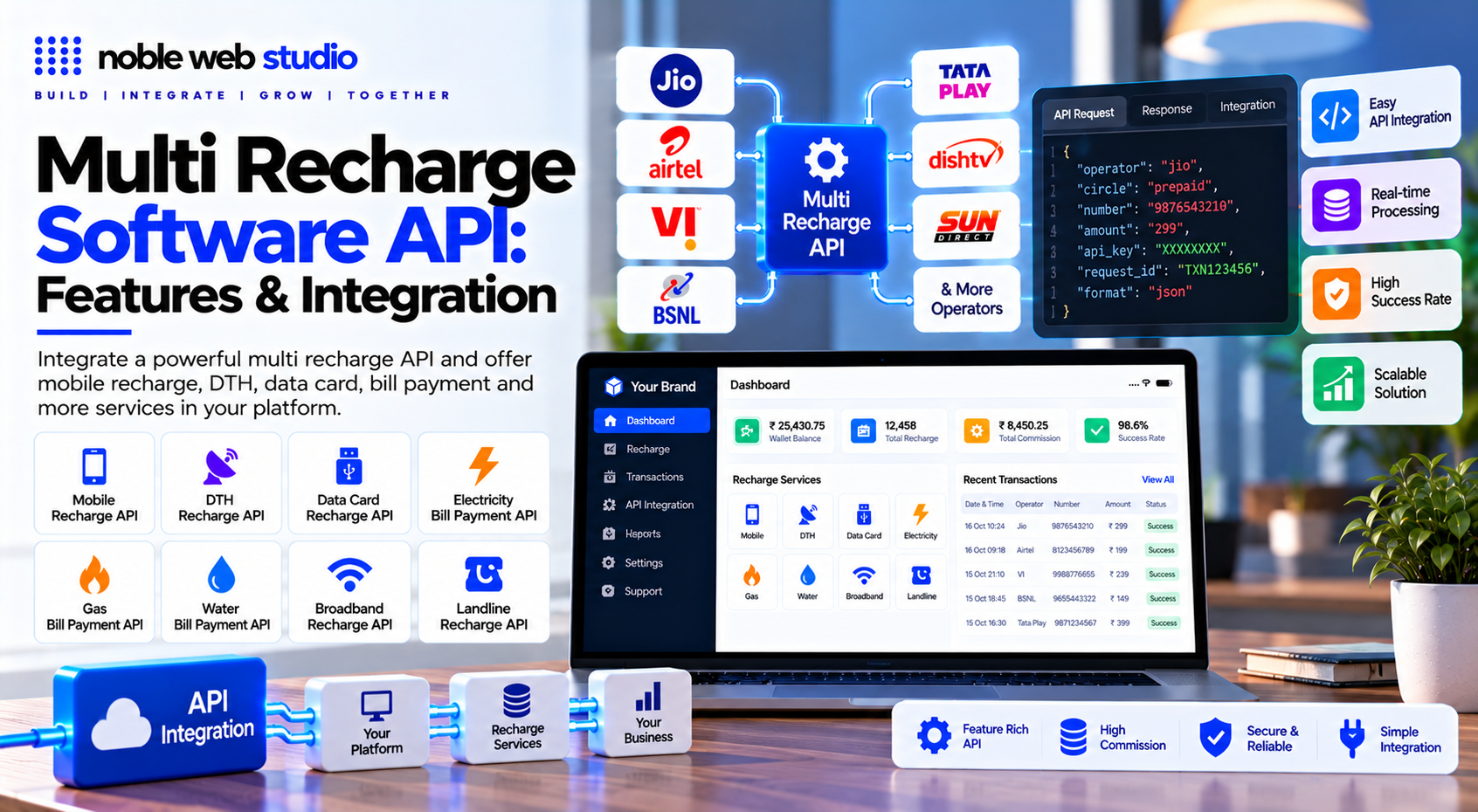
A Multi Recharge Software API helps businesses connect multiple recharge services to their own website, mobile application, or B2B recharge portal. It provides a way for software platforms to communicate with supported service providers, submit recharge requests, receive transaction responses, and maintain recharge records. Entrepreneurs, fintech startups, mobile recharge distributors, and digital service providers can use this type of integration to build recharge platform where retailers and customers can access available recharge services through one system.
However, starting a multi-recharge business requires more than connecting an API. You need software that can manage retailer and distributor accounts, configure commissions, control wallet balances, monitor transactions, and generate business reports. It is also important to understand how the system handles successful, pending, and failed transactions, because accurate status updates and reconciliation are essential for daily operations.
A Multi Recharge Software API is an interface that consolidates multiple mobile, DTH, data card, and utility bill payment services into a single unified wallet and code integration. It allows fintech platforms, distributors, and retail networks to handle high-volume electronic top-ups across multiple telecom operators simultaneously without managing separate individual server pipelines.
Noble Web Studio develops and sells ready-made B2B Mobile Recharge Software for businesses planning to launch or expand their own recharge platforms. Depending on the selected version and available integrations, the software can include Admin, Master Distributor, Distributor, and Retailer panels, commission management, wallet controls, transaction reports, and recharge API integration. Supported services may include mobile recharge, DTH, FASTag, and other digital services, subject to the selected package and provider connectivity.
Whether you want to launch a new recharge portal, provide recharge facilities to retailers, create a distributor network, or establish a branded B2B recharge business, selecting the right Multi Recharge Software API and software platform is an important step. Before choosing a solution, compare recharge API documentation, supported operators, integration requirements, security measures, transaction-status handling, commercial terms, and technical support.
In this guide, you will understand how a Multi Recharge Software API works, which features matter when selecting an recharge API solution, how software integration supports recharge operations, and how Noble Web Studio’s ready-made B2B Mobile Recharge Software can help you plan your recharge business.
What Is a Multi Recharge Software API?
A multi recharge software API (Application Programming Interface) is a digital bridge that connects a business’s website, app, or portal to multiple telecom operators, DTH service providers, and utility bill systems through a single integration point.
How Does Multi Recharge Software API Work?
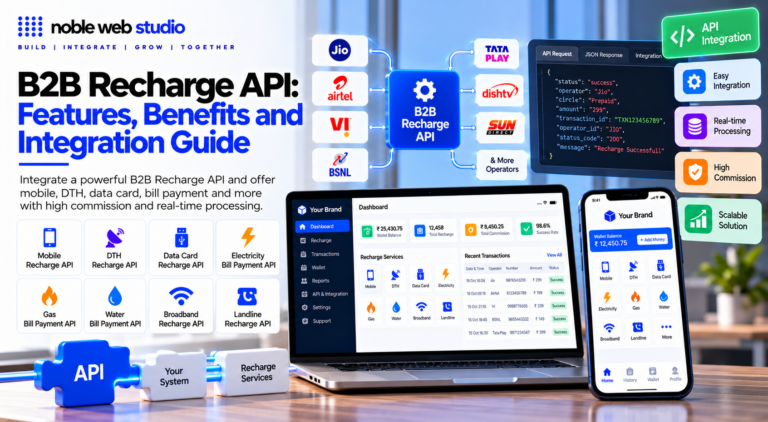
A Multi Recharge Software API acts as a centralized bridge that connects a digital wallet or application to multiple telecom, DTH, and utility networks. Instead of integrating separate pipelines for every individual telecom operator, a developer integrates a single unified API to handle all transactions.
How the Multi Recharge API Workflow Works
[Retailer App / Website] ➡️ [Your Recharge Software] ➡️ [Multi-Recharge API Platform] ➡️ [Telecom Operator/LAPU]
- Initiation: A user or retailer selects an operator (e.g., Jio, Airtel), inputs a mobile number, chooses an amount, and hits submit on your platform.
- Authentication & Validation: The request passes via secure JSON/XML strings to the integrated multi-recharge gateway. The software instantly checks your software’s central wallet balance.
- Smart Routing (API Switching): If your recharge software uses multiple recharge APIs, it checks the live success rates. If Operator A’s channel is down, the system switches the traffic to Operator B to maximize fulfillment.
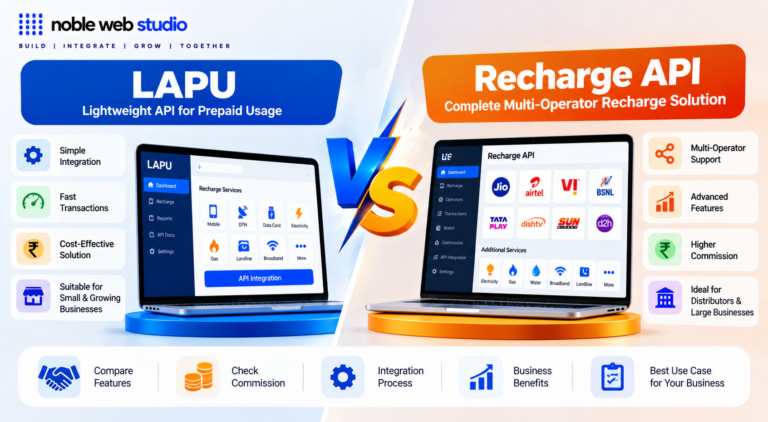
- Execution: The Multi-Recharge Software API transmits the digital command to the telecom operator’s core network or a physical LAPU SIM automation server.
- Real-time Status Delivery: Within 1 to 3 seconds, the network returns an status code (Success, Failed, or Pending) along with an Operator Transaction ID.
- Auto-Reversal: If the transaction fails, the software triggers an automated reversal script, crediting the customer’s wallet balance instantly.
Key Features of a Multi Recharge Software API
A Multi-Recharge Software API is a unified B2B recharge platform that integrates services from multiple telecom, television, and utility operators into a single application programming interface. Instead of developing dozens of separate connections for individual service providers, a business uses this single endpoint to process digital transactions instantly.
The core features driving modern multi recharge API platform are categorized below:
1. Multi-Operator & All-in-One Service Core
- Unified Single Integration: Connects your recharge business platform to over 100+ operators through a single JSON-response API.
- Mobile Recharges: Processes both prepaid and postpaid top-ups for major networks.
- DTH & Cable TV: Supports digital television service updates with dynamic subscriber ID and plan verification.
- Utility Bill Payments (BBPS): Incorporates the Bharat Bill Payment System (BBPS) to clear electricity, gas, water, landline, and insurance bills.
- Value-Added FinTech Add-ons: Frequently bundles micro-ATM, Domestic Money Transfer (DMT via IMPS/NEFT), and Aadhaar Enabled Payment Systems (AePS).
2. Intelligent Routing & Transaction Resilience
- Multi-API Routing Engines: Automatically redirects transaction traffic based on operator, circle location, transaction amount, and real-time network stability.
- Automated API Failover: Instantly switches to alternative priority paths if a primary gateway experiences downtime, lowering transaction drop rates.
- Auto-Operator & Circle Detection: Identifies the network carrier and regional circle from a simple mobile number string before pushing the transaction.
- Live Plan Fetching: Pulls live data packs, talk-time top-ups, and active DTH operator offers directly to the retail application.
3. Multi-Tier Ledger & Commission Architecture
- Hierarchical E-Wallet Systems: Manages distinct digital wallets across tiered user flows: Admin → Master Distributor → Distributor → Retailer.
- Dynamic Commission Slab Management: Customizes exact margin/discount percentages per provider, transaction type, or specific user category.
- Automated Fund Adjustments: Deducts balances immediately upon successful recharges and triggers automated, instantaneous fund reversals for failed requests.
4. Admin, Reporting & Security Infrastructure
- White-Label Customization: Deploys web panels and native Android/iOS commission applications using your company’s own logo, branding, and custom domain.
- Enterprise Security Standards: Utilizes IP whitelisting, recharge API key validation, secure transaction locking, and protection against common web vulnerabilities like XSS, CSRF, and SQL injections.
- Data-Driven Logging: Compiles granular histories of commissions, settlements, network response times, wallet ledgers, and download-ready transaction sheets (Excel, CSV, PDF).
Multi Recharge Software API for Retailers and Distributors
Multi Recharge Software APIs enable entrepreneurs, businesses, and fintech companies to build a branded B2B recharge platform where a hierarchical network of retailers and distributors can process mobile recharges, DTH top-ups, data cards, and utility bills from a single wallet system. By integrating a single payment backbone, businesses eliminate the need to manage multiple logins or separate direct ties with individual telecom providers.
Core Features & Architecture
An all-in-one multi-recharge solution typically incorporates a structured recharge platform layout built on top of high-speed payment gateways:
- Multi-Tier Hierarchy Management: An administrative control panel handles account creation across multiple downstream roles, including Admin Owners, Master Distributors, Distributors, and Retailers. Each level can transfer wallet balance downward and manage sub-agent networks.
- Automated Commission Slabs: The system tracks, calculates, and distributes profit margins instantly down the entire chain as soon as a transaction succeeds, removing the need for manual reconciliation.
- Centralized Wallet System: Operates on a single ledger concept where digital wallets credit and debit instantly, featuring auto-refill triggers such as UPI AutoPay or online payment gateways.
- Failover Optimization: Advanced systems leverage multi operator recharge API routing. If a primary telecom gateway drops or lags, an auto-failover mechanism instantly switches traffic to a backup API to maximize transaction success rates.
- Extended Fintech Integrations: Modern systems frequently bundle recharges alongside the Bharat Bill Payment System (BBPS) for utility bills, Aadhaar Enabled Payment System (AEPS), and Domestic Money Transfers (DMT).
Mobile Recharge API Integration for Multiple Operators
A Multi-Recharge Software API is an all-in-one digital backbone that allows businesses, entrepreneurs, master distributors, and retailers to process mobile, DTH, and utility bill payments from a single interface. By aggregating multiple telecom networks and services into a unified framework, it removes the need to maintain separate wallets, logins, or balances for different operators.
Core Architecture & Channel Hierarchy
The software operates on a multi-tier distribution network designed to manage down-line agents and systematically divide profits:
- Admin / Platform Owner: Owns the primary recharge software license, controls mobile recharge API routing, sets global commission margins, and monitors system performance.
- Master Distributors: Purchase bulk wallet balances from the recharge admin and onboard distributors.
- Distributors: Manage local clusters of retail networks, handle cash-to-wallet loading, and earn a margin on every sub-agent transaction.
- Retailers (Shop Owners): The front-end touchpoints who interact with the end customer, execute the transactions, and earn flat or percentage-based instant commissions.
Multi Recharge Software API Security and Performance
Multi-Recharge Software API Security and Performancedictate the scalability, user trust, and financial stability of modern B2B recharge fintech portals. Processing instant payments across dozens of telecom, DTH, and utility operators requires architecture optimized for split-second latency and bulletproof defense mechanisms.
Core Security Architecture
Operating a high-volume financial transaction layer requires rigorous encryption, strict access controls, and compliance with fintech frameworks like the Reserve Bank of India (RBI) guidelines.
- Transport and Request Security: Implement mandatory SSL/TLS 1.3 encryption for all endpoints. Force strict IP Whitelisting so that API requests are accepted exclusively from the trusted servers of registered distributors or merchants.
- Authentication & Integrity: Abandon static recharge API keys in favor of dynamic OAuth 2.0 / JWT (JSON Web Tokens) containing short expiration windows. Enqueue HMAC-SHA256 digital signatures in the request headers calculated from the payload data and a shared secret to prevent data tampering.
- Database and Payload Hardening: Protect user wallets and transactional logs using Parameterization / Prepared Statements to eliminate SQL injection vectors. Encrypt sensitive persistent data (like vendor credentials or transaction tokens) utilizing AES-256 at rest.
- Fraud Mitigation: Enforce explicit Duplicate Request Filtration. By hashing the transaction payload (e.g.,
Mobile Number + Amount + Client Reference ID) and storing it in an in-memory cache for 30–60 seconds, the recharge admin software automatically drops identical concurrent requests to prevent double-debiting.
Performance Optimization & Concurrency
When thousands of agents push mobile top-ups simultaneously, the integration layer must resolve transactions smoothly while avoiding server crashes.
- Asynchronous Processing & Callbacks: Avoid blocking the client thread while waiting for slow operator networks. Rely on Webhooks and Automated Callback Handlers. The best recharge API acknowledges a request instantly with a
PENDINGstatus, processes it asynchronously, and fires a POST callback to the client system once the operator transaction ID is generated. - Caching & Ledger Synchronization: Utilize in-memory data structures like Redis for operator balance lookups, real-time commission structures, and session tokens. This ensures real-time ledger synchronization without choking the primary relational database (like MySQL).
- Smart API Routing & Switching: Maintain automated Failover Routing. If a primary operator mobile recharge API slows down or fails, the top recharge software shifts subsequent requests to an alternative backup gateway provider automatically to ensure near-zero downtime.
- Rate Limiting & Throttling: Implement Token Bucket or Leaky Bucket algorithms at the recharge API gateway layer. This shields your backend infrastructure from brute-force scripts, runaway loops, or distributed denial-of-service (DDoS) attempts from corrupted client endpoints.
Multi Recharge Software API Pricing and Integration Cost
The total cost of multi-recharge software, recharge API setup, and integration in India typically ranges from ₹10,000 to ₹3,00,000+ for pre-built white-label solutions, and ₹75,000 to ₹25,00,000+ for custom-developed multi-tier platforms.
Cost Breakdown Structure
1. Recharge API Pricing Models
- One-Time Setup Fee: Noble web studio charge a single setup fee ranging from ₹3,000 to ₹5,500 (e.g., basic multi-operator plans).
- Per-Transaction / Commission Model: Noble web studio do not charge heavy monthly fees; instead, they operate on a wallet-load basis where you earn a fixed operator-wise commission on every successful mobile, DTH, or utility/BBPS transaction.
- Third-Party API Integration Cost: Connecting external telecom or bill payment APIs into your software generally costs ₹10,000 to ₹20,000 per API.
2. Software & White-Label Platform Pricing
Pre-Built / White-Label Software:₹10,000 to ₹3,00,000+
- Includes a central recharge admin panel, white label recharge branding (your own logo and domain), Android/iOS commission app, virtual wallet system, and multi-tier hierarchy (Admin → Master Distributor → Distributor → Retailer).
Custom Portal & App Development:₹75,000 to ₹25,00,000+
- Varies based on whether you build a basic MVP or a large-scale distributor-retailer network with automated ledgers, high-volume failover handlers, and custom reporting.
- Basic Web Portal (Non-White-Label): ₹35,000 to ₹80,000
- Mobile App Development (Dedicated): ₹70,000 to ₹1,50,000+
3. Ancillary & Ongoing Costs
- Payment Gateway Setup: ₹5,000 (plus gateway transaction rates)
- Payment Gateway + API Integration Work: ₹30,000 to ₹50,000
- Domain Name & Cloud VPS / Hosting: ₹500 (domain) + ₹10,000 to ₹20,000 per year (hosting/VPS)
- SMS / WhatsApp Notification Gateway: Varies by usage volume.
Key Components to Verify Before Purchasing
- BBPS Integration: Best mobile recharge software/fast mobile recharge API connects directly to the Bharat Bill Payment System (BBPS) to handle electricity, water, gas, and insurance bills alongside telecom recharges.
- Commission Slabs: Check how multi-tier margins are split across retailers and distributors automatically in real-time.
- Wallet & Ledger System: Confirm automated balance deductions, instant status updates, and failed-transaction refund handlers.
How to Select the Right Multi Recharge API Integration
To select the right multi-recharge API integration, you must balance technical reliability with commercial viability. A low commission rate or cheap setup fee means very little if your transactions constantly fail, or if your engineering team spends weeks trying to parse poorly documented endpoints.
The critical technical and operational parameters to evaluate before signing an agreement include the following:
1. Technical Performance and Architecture
- Transaction Success Rate & Latency: Ensure the Noble web studio maintains a success rate above 99% with response times under 2–3 seconds. Delayed responses result in double-debited wallets and poor user experiences.
- Multi-API Routing & Automatic Failover: The Noble web studio should feature dynamic, intelligent routing. If a specific telecom operator’s channel goes down on Route A, the system must automatically switch to Route B at the operator level without dropping the entire platform.
- Webhooks vs. Manual Polling: Noble web studio that require manual status polling. The platform must support real-time callbacks (webhooks) to immediately push transaction status changes (success/failure) to your server.
2. Comprehensive Service & Supplemental APIs
- Full Service Coverage: Do not isolate your business to mobile top-ups. Choose an aggregator that bundles Mobile (prepaid/postpaid), DTH, FASTag, and utility bills under a single wallet ledger via the Bharat Bill Payment System (BBPS).
- Operator & Plan Fetch Lookup APIs: Look for supplementary endpoints like the Operator Detection API (which identifies the operator/circle from the mobile number to prevent user errors) and the Live Plan Fetch API (which pulls real-time, compliant tariff plans).
3. Developer Experience & Integration Speed
- Sandbox Environments & Clean Documentation: Request access to a staging/sandbox environment before purchasing. The documentation should clearly define standard REST endpoints, JSON payloads, headers, and explicit error codes. If a developer cannot map the integration flow within an hour, pass on the Noble web studio.
- Security Infrastructure: The trusted recharge API must support robust security protocols, including IP whitelisting, secure recharge API keys, and cryptographic request signing to protect your wallet balance.
4. Financial Operations & Transparency
- Automated Wallet Settlements: Evaluate how quickly your digital wallet balances are updated after a payment gateway settlement. The system must offer clear, downloadable ledger trails for debits, credits, and instant reversals on failed recharges.
- Clear Commission Disclosures: Avoid “free integration” traps that bundle hidden transactional margins. Noble web studio details fixed or percentage-based payouts operator-by-operator up front.
Common Problems and How to Prevent Them
Common Problems & How to Prevent Them
Duplicate Recharge Requests
- Problem: Users click the recharge button twice or retry a transaction after a slow server response.
- Prevention: Implement server-side idempotency controls and unique transaction references. Always query the status of the original transaction before triggering a retry.
Incorrect Service & Operator Mapping
- Problem: Wrong operator codes or circle identifiers lead to rejected requests or misrouted funds.
- Prevention: Maintain a strictly verified, auto-updated mapping table between your application’s service options and the exact identifiers provided by the Noble web studio.
Unresolved Pending Transactions
- Problem: A request stays stuck in a pending state when the telecom provider fails to return a final success or failure confirmation.
- Prevention: Build an automated background inquiry process to poll transaction statuses, log investigations clearly, and update the user interface without auto-submitting duplicate recharges.
Inconsistent Wallet & Commission Records
- Problem: Mismatches occur between internal wallet balances, commission slabs, and actual API provider settlements.
- Prevention: Record every financial movement with an immutable timestamp and unique reference ID. Run automated daily reconciliation scripts rather than manually editing user balances.
Slow Routes & Peak-Hour Failures
- Problem: A specific telecom operator or top mobile recharge API route slows down or fails during heavy evening hours, stalling retailer networks.
- Prevention: Set up multi-recharge API routing to switch traffic automatically or manually from a lagging route to a backup route on an operator-by-operator basis. Keep a positive minimum balance on all backup routes.
Outdated Prepaid Plans & Offers
- Problem: Telecom operators frequently update tariff plans and regional offers, causing plan mismatch errors and customer complaints.
- Prevention: Integrate a live Plan API or Bill Fetch API to sync plan details dynamically with your backend database in real time.
Exposed API Credentials & Security Loopholes
- Problem: Unauthorized parties steal mobile recharge API keys or wallet credentials due to front-end storage or unencrypted traffic.
- Prevention: Store all recharge service API secrets strictly on the backend, enforce HTTPS communication, implement role-based access control (RBAC), and validate all inputs server-side. Use resources like the Noble web studio Integration Security Checklist to audit your code before going live.
Planning for Future Business Growth
Planning future business growth with a multi recharge software API requires scaling your technology, managing provider connections, and structuring your agent and wallet hierarchies.
1. Core Architectural & Scaling Priorities
- Modular Codebase: Separate application modules so new services (such as FASTag, DTH, or utility bill fetch APIs) can plug in without breaking core operations.
- Traffic Spikes: Build for high concurrency such as month-end rushes or festival top-up spikes using scalable backend stacks (e.g., Node.js/Python with Redis for caching and MySQL/PostgreSQL for ledgers).
- Redundant API Providers: Integrate secondary or backup recharge/BBPS APIs to route traffic automatically if a primary telecom operator or recharge API slows down or fails. Never blindly resubmit unresolved or pending transactions without checking status endpoints first.
2. Expanding Service Offerings
Diversify beyond basic prepaid mobile recharges to increase wallet share and transaction frequency:
- Bharat Bill Payment System (BBPS): Integrate electricity, water, gas, and broadband bill payments.
- Financial & Transit Services: Add Domestic Money Transfer (DMT), Aadhaar Enabled Payment System (AePS), and FASTag top-ups.
- Plan & Operator Detection APIs: Use live operator/circle detection and real-time plan fetch APIs to reduce user transaction errors.
3. Managing Hierarchy & Commissions
- Multi-Level Network: Scale your B2B model cleanly across an Admin → Master Distributor → Distributor → Retailer chain.
- Dynamic Commission Slabs: Configure tiered, operator-wise, and plan-wise commission structures directly from your admin dashboard.
- Real-Time Wallet & Ledger Reconciliation: Automate real-time debit/credit tracking, wallet-to-wallet transfers, and daily automated settlement logs to prevent cash-flow discrepancies.
4. Operational & Compliance Checklist
- KYC & KYB Compliance: Ensure strict verification for all onboarding distributors and retailers in compliance with regional fintech and telecom guidelines.
- Transaction Status Handling: Enforce strict callback and webhook handling for pending or disputed recharges to minimize customer support overhead.
- Total Cost of Ownership (TCO): Separate one-time white-label/custom development expenses (ranging from ₹10,000 for basic setups to ₹25,00,000+ for custom multi-tier ecosystems) from recurring recharge API and recharge API server maintenance costs.
Noble Web Studio india Best Reliable Multi Recharge Software API Provider
Noble Web Studio only one of the reliable multi-recharge software API provider requires evaluating key technical, operational, and business factors beyond just commission rates.
Core Factors to Consider
- Operator & Service Coverage: Ensure the Noble Web Studio supports all major prepaid and postpaid mobile operators, DTH services, data cards, and utility payment systems through the Bharat Bill Payment System (BBPS) (such as electricity, water, gas, and broadband), plus additional services like FASTag.
- Uptime & Success Rates: High transaction success rates and system stability especially during peak periods like month-end bill cycles are critical to preventing failed or pending recharges. Look for Noble Web Studio offering multi recharge API routing or automatic failover/fallback to switch dead or slow operator routes seamlessly.
- API Documentation & Technical Ease: Noble Web Studio offers clean, well-documented recharge API, real-time transaction status callbacks, and webhook support to integrate smoothly into your web or mobile app.
- Transparent Commission & Pricing Structure: Clear, operator-wise commission slabs and payout structures help you calculate exact margins upfront rather than dealing with hidden deductions later.
- Wallet & Settlement Management: An integrated virtual wallet system avoids maintaining separate stocks or paper coupons for each operator, allowing fast settlements and smooth B2B/B2C ledger tracking.
- White-Label & Scalability Options: If you plan to scale your network, check whether the provider offers white-label software, multi-tier reseller or distributor panels, and support for growing transaction volumes.
- Company Credibility & Compliance: Verify the business registration, GST details, and operational track record in the industry.
- Customer Support Availability: Test their support response times via phone or WhatsApp during business hours to see how they handle dispute resolution and failed transaction complaints.
Multi Recharge Software API Integration with Noble Web Studio
Noble web studio one of the right provider for Multi Recharge Software API Integration is essential to ensure high transaction success rates, low latency, and smooth business scaling.
Key Reasons to Choose a Quality Provider
- Single Unified Interface: Instead of building and maintaining separate tie-ups with multiple telecom operators (like Airtel, Jio, VI), DTH companies, and utility billers, a single recharge API connects you to all of them at once.
- High Success Rate & Low Latency: Noble web studio delivers fast transaction processing and high real-time success rates, preventing failed recharges and unhappy end-users.
- Auto-Switching & API Fallback: Top providers offer intelligent routing that automatically switches traffic to a backup operator if a primary route fails or experiences downtime.
- Multi-Service Expansion: Beyond mobile and DTH recharges, providers often bundle utilities (electricity, gas, broadband), FASTag, AEPS, and money transfer APIs to grow your revenue streams.
- Cost and Time Efficiency: Integrating recharge API or white label recharge portal is vastly more affordable and faster than developing a proprietary system from the ground up.
- Commission Management & Wallets: Noble web studio offer built-in multi-tier commission engines, automated wallet systems, and live tracking for distributors, master distributors, and retailers.
- Sandbox Testing and Support: Access to a sandbox environment lets your developer test recharges safely before going live, backed by technical support to resolve callback or webhook issues.
Final Thoughts
Choosing the right Multi Recharge Software API is an important decision when you want to build, manage, or expand your own online recharge business. A suitable mobile recharge API integration connects your recharge platform with supported Noble web studio and helps process recharge requests through a structured system. But a successful recharge business requires more than multiple operator connections. You also need easy user management, transparent commission settings, secure mobile recharge API communication, accurate transaction records, and a reliable process for handling pending, failed, and successful transactions.
Noble Web Studio develops and sells ready-made B2B Mobile Recharge Software for entrepreneurs, retailers, distributors, fintech startups, and businesses planning to launch recharge platform. Depending on the selected version and available integrations, the branded recharge software can include Admin, Master Distributor, Distributor, and Recharge Retailer panel, wallet management, commission configuration, transaction monitoring, recharge reports, and recharge API connectivity. These features can help you manage different business levels and monitor daily recharge operations from a centralised platform.
A Multi Recharge Software API is a software interface that lets a website, best mobile recharge commission app, or B2B portal connect to multiple telecom, DTH, and utility providers through a single integration.
Before selecting a Multi Recharge Software API, check the supported mobile and DTH services, API documentation, authentication process, transaction-status verification, integration requirements, commercial terms, and technical support. Make sure the system can identify pending transactions correctly, maintain transaction references, and provide suitable reporting for reconciliation. You should also confirm which services and modules are included in your selected software package rather than assuming every feature is available by default.
Whether you want to start a new recharge portal, build a retailer and distributor network, launch a branded recharge platform, or expand your existing digital services business, choosing the right recharge software setup can make daily operations easier to organise. Discuss your business model, required services, expected transaction volume, and integration needs before finalising the solution.
Contact Noble Web Studio to explore ready made B2B Mobile Recharge Software and discuss your Multi Recharge Software API integration requirements. Build a recharge platform with the right combination of software, service connectivity, transaction management, and business controls to support your long-term growth.
Multi Recharge Software API with Noble Web Studio
Looking for a reliable Multi Recharge Software API for your business? Connect with Noble Web Studio to discuss API integration, mobile recharge, DTH recharge, BBPS services, API features and software development options for your recharge business.