Ankit
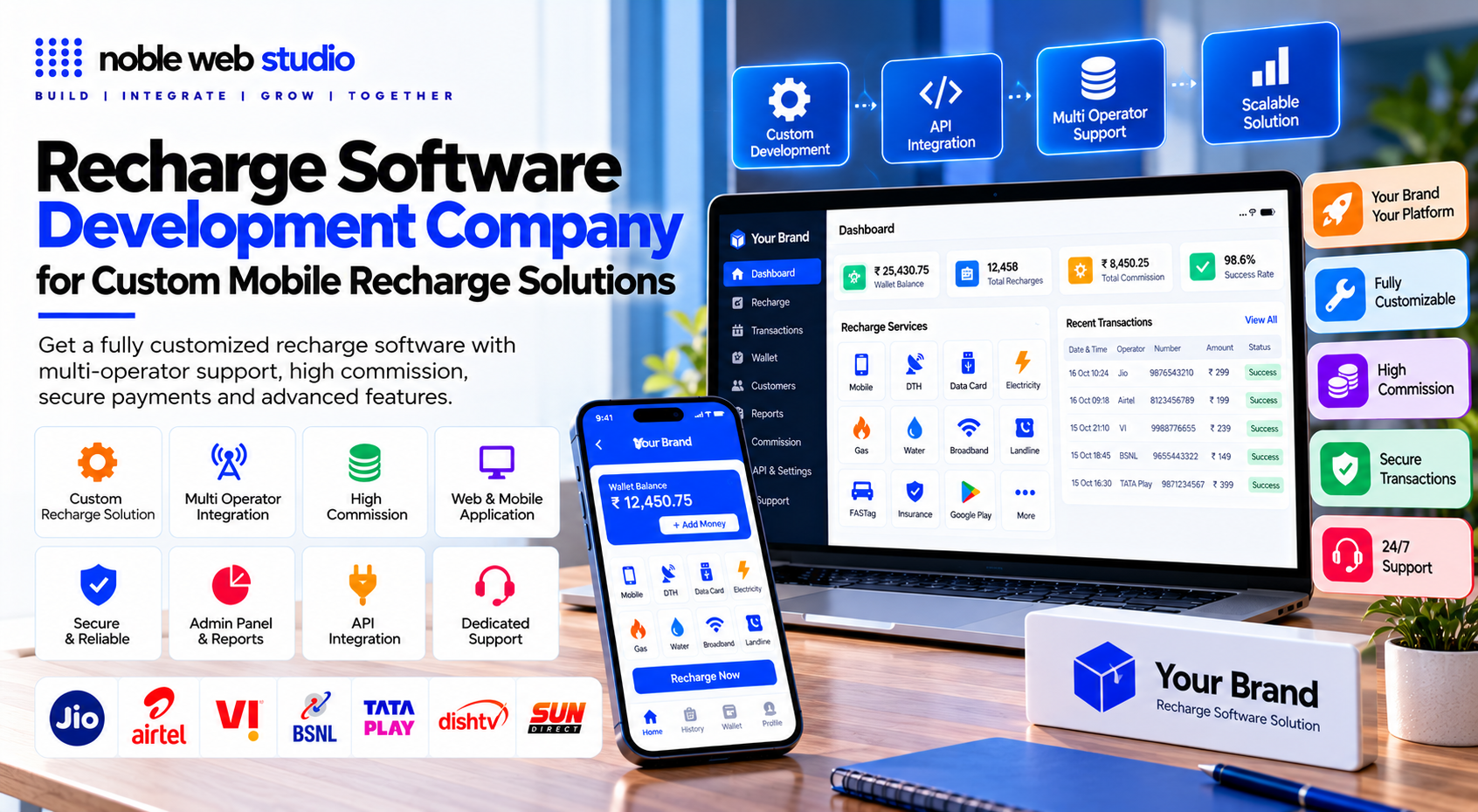
Looking for a reliable Recharge Software Development Company to start your own online recharge business or expand an existing digital service platform? Choosing the right recharge software is essential for managing transactions, connecting with service providers, supporting retailers and distributors, and handling daily business operations efficiently. A well-planned recharge platform can bring multiple supported services together, simplify business management, and help you build a solution that can grow with your customer base.
Recharge software can include a web-based recharge portal, recharge admin dashboard, retailer and distributor panels, commission management, wallet controls, transaction reports, and recharge API integration with service providers. Depending on your business model, you may need a B2B recharge platform for managing retailer networks, a B2C recharge platform for serving customers directly, or a white-label recharge solution with your own branding. Before selecting a mobile recharge platform, compare its features, integration options, security, scalability, technical support, and overall setup cost.
A recharge software development company builds digital recharge platform that let businesses process mobile recharges, DTH top-ups, utility bill payments, and fintech services like AEPS (Aadhaar Enabled Payment System) and money transfers.
Noble Web Studio develops ready made B2B Mobile Recharge Software for startups, entrepreneurs, retailers, distributors, and businesses planning to enter or expand the digital recharge market. Depending on the selected software version and available integrations, the solution can support mobile recharge, DTH recharge, FASTag, and other digital services. You can discuss your business requirements with Noble Web Studio to understand the available features, user roles, branding options, customization possibilities, and integration requirements.
In this guide, you will learn how recharge software development works, which features matter for a successful recharge platform, how B2B and B2C recharge systems differ, and what to check before choosing a Noble web studio. Whether you are launching a new recharge business or upgrading an existing best recharge platform, this information will help you evaluate your options and make a more informed decision.
What Is a Recharge Software Development Company?
A recharge software development company builds digital platforms and applications that process mobile recharges, Direct-to-Home (DTH) TV packs, data card top-ups, and utility bill payments (such as electricity, gas, and water).
What Does Recharge Software Development Include?
Recharge software development covers the design, programming, integration, and maintenance of digital platforms that process mobile recharges, DTH top-ups, and utility payments.
Core Components & Features
- Frontend & User Portals: Custom web portals and Android/iOS apps for end-users, retailers, and distributors.
- Admin Control Panel: Centralized recharge software dashboard for managing users, tracking commission slabs, generating reports, and monitoring wallet balances.
- Recharge API Integration: Connectivity with telecom operators (such as Airtel, Jio, and Vi) and utility aggregators for real-time transaction processing.
- Wallet & Ledger Management: Digital wallets that handle fund additions, deductions, commission payouts, and automatic ledger reconciliation.
- Multi-Service Support: Expanding beyond basic mobile recharges to include DTH, FASTag, Bharat Connect (BBPS), and Aadhaar Enabled Payment Systems (AEPS).
- Notifications & Support Tools: Automated SMS, email, or push notifications for transaction statuses alongside customer support modules.
Types of Recharge Software for Different Business Models
Recharge software is a digital platform that connects transaction requests with mobile, DTH, data card, and utility service providers. The type of recharge software needed depends on your target audience and operational setup.
1. B2B (Business-to-Business) Recharge Software
- Target Audience: Retailers, agents, distributors, and local shop owners.
- How It Works: Designed for a multi-tiered hierarchy where an recharge admin or master distributor creates accounts for local agents. Agents use a web portal, recharge commission app, or SMS to process recharges for walk-in customers.
- Key Features: Wallet and commission management, agent-level ledgers, bulk operations, and multi-operator switching.
- Best For: Wholesale recharge networks and distributor networks.
2. B2C (Business-to-Consumer) Recharge Software
- Target Audience: Individual end-users.
- How It Works: Built as a direct-to-consumer mobile recharge commission app or website (similar to consumer apps) where users log in, link a payment method, and top up their own phones or DTH connections.
- Key Features: Self-service UPI/payment gateway integration, cashback/promo modules, automated receipts, and account history.
- Best For: Consumer-facing fintech startups and digital wallets.
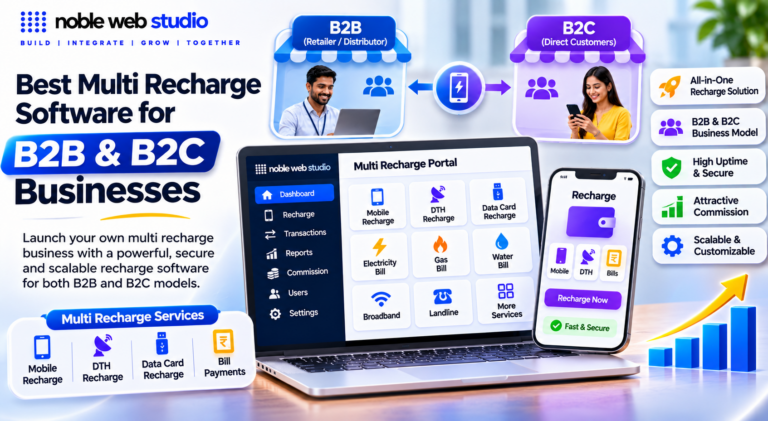
3. Multi-Recharge Software
- Target Audience: Businesses wanting an all-in-one utility portal.
- How It Works: Integrates multiple service categories such as mobile, DTH, broadband, electricity, gas, and water bills into a single unified dashboard.
- Key Features: Single-wallet system across all utilities, high speed recharge API routing, and automated failover if one operator’s server is down.
- Services Guide: You can explore development frameworks via Multi Recharge Software.
- Best For: Multi-service retail kiosks, common service centers (CSCs), and local payment stores.
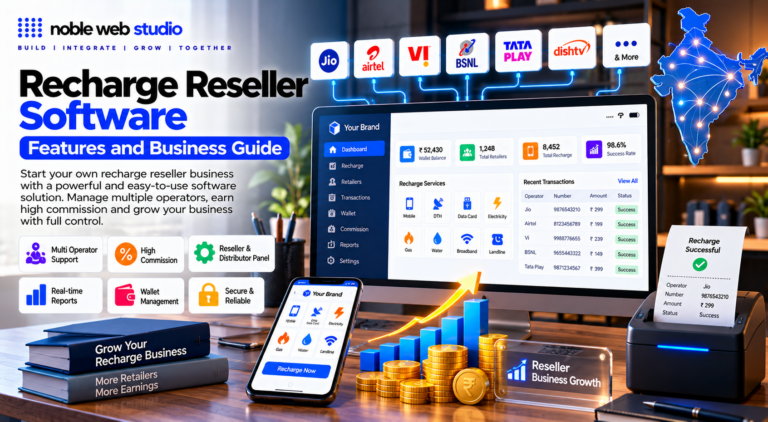
4. White-Label Recharge Software
- Target Audience: Entrepreneurs and businesses wanting to launch a brand without building code from scratch.
- How It Works: A ready-made, rebrandable mobile recharge platform where you can swap out the logo, color scheme, and domain name to make it your own.
- Key Features: Custom branding, modular add-ons, and full mobile recharge admin control over commissions and user data.
- Best For: Companies looking to launch branded recharge service quickly.
5. API-Based Recharge Integration
- Target Audience: Existing best recharge commission app, websites, or ERP systems (e.g., travel portals, grocery apps) adding recharge capabilities.
- How It Works: Instead of a standalone mobile recharge portal, the business embeds a recharge Application Programming Interface (API) into their current digital product.
- Key Features: Lightweight integration, real-time response callbacks, and automated wallet deduction.
- Platform Insights: Read more on evaluation criteria through Noble web studio.
- Best For: Established digital mobile recharge platform expanding their service catalog.
Essential Features of Recharge Software Development
Essential features for recharge software development span user-facing capabilities, operator integrations, administrative controls, and strong security architecture.
Core User & Retailer Features
- Multi-Service & Operator Support: Integration with major telecom providers (such as Airtel, Jio, Vodafone Idea, and BSNL) as well as DTH and utility services (electricity, water, gas, FASTag, and broadband).
- Real-Time Transaction Processing: Instant request execution and immediate status confirmations (success, pending, or failed) to prevent user friction.
- Plan Browsing & Selection: In-app catalogs allowing users or retailers to browse current operator recharge plans, validity packs, and special data/talktime offers.
- Multiple Payment Gateway Integration: Support for digital payment methods including UPI, credit/debit cards, net banking, and digital wallets.
Admin & Distributor Control Panels
- Centralized Administration Dashboard: A single command center for managing users, configuring profit margins, and monitoring recharge admin platform settings.
- Commission & Wallet Management: Automated commission distribution structures for multi-tier B2B networks, retailers, and distributors.
- Comprehensive Transaction Reports: Detailed audit logs tracking reference numbers, timestamps, operator responses, and ledger balances via solutions like Noble web studio.
- API Connectivity & Integration: Reliable third-party mobile recharge API module with request validation, automated error handling, and auto-sync capabilities.
Security & Technical Specifications
- Data Encryption & Fraud Protection: End-to-end encryption for financial payloads alongside MAC and IP-address restriction controls.
- Multi-Factor Authentication (MFA / OTP): Verification steps for high-value operations, admin logins, and critical wallet adjustments.
- Cloud Infrastructure & Backups: Scalable cloud hosting backed by automated database snapshots to ensure high availability and disaster recovery.
Recharge Software Development Process: From Planning to Launch
1. Planning & Requirement Analysis
- Define Business Model: Choose whether you are building a B2C (customer-facing portal), B2B (retailer/distributor network), or White Label recharge platform.
- Compliance & Legal Documentation: Gather required KYC/KYB documents, business registration (proprietorship, partnership, or private limited), and banking details.
- Feature & Tech Scope: Map out core modules (prepaid/postpaid mobile recharges, DTH, BBPS utility bills, AEPS) and decide between custom build vs. ready-made/configurable software.
2. System Architecture & UI/UX Design
- Tech Stack Selection:
- Frontend: React Native, Flutter, or Ionic for cross-platform apps and responsive web.
- Backend: Node.js, Python, or Ruby on Rails.
- Database: MongoDB, MySQL, or PostgreSQL.
- Wireframing & Interface Design: Design fast, low-latency UI/UX flows for operator selection, plan browsing, and wallet checkouts.
3. Backend & API Integration
- Recharge & Operator APIs: Integrate multi-operator and multi-circle telecom/DTH APIs (Jio, Airtel, Vi, BSNL) or partner with a Noble web studio.
- Payment Gateway & Wallet Setup: Integrate payment gateways and fund the master/retailer wallet architecture.
- Automated Dispute & Refund Logic: Build real-time status tracking and automated instant-refund mechanisms for failed or pending transactions.
4. Testing & Security Audit
- Load & Performance Testing: Simulate high concurrent traffic to ensure rapid recharge execution without server lag.
- Security Hardening: Implement data encryption, two-factor authentication (2FA), and fraud detection protocols.
- Workflow & Sandbox Testing: Run end-to-end sandbox test transactions across all connected operator recharge b2b API and utility bill boards.
5. Deployment & Launch
- Platform Publication: Deploy web admin panels to cloud infrastructure and publish mobile apps to the Google Play Store and Apple App Store.
- Distributor & Retailer Onboarding: Initialize wallet balances, assign commission slabs, and onboard your first network of distributors/retailers.
- Monitoring & Maintenance: Track live transaction logs, monitor recharge API uptime, and utilize resources like Noble Web Studio for post-launch scaling and updates.
B2B and B2C Recharge Software Development
Mobile recharge software development builds automated digital recharge admin platform that route transactions between end-users or retailers and telecom/utility APIs. These systems power prepaid/postpaid mobile recharges, DTH connections, and utility bill payments (electricity, gas, water, FASTag).
Core Differences: B2B vs. B2C Software
| Factor | B2C Recharge Software | B2B Recharge Software |
|---|---|---|
| Target User | End consumers directly (general public) | Distributors, master distributors, and retail shop owners |
| Business Structure | Single-tier (Direct-to-Consumer) | Multi-tier commission hierarchy (Admin → Master Distributor → Distributor → Retailer) |
| Revenue Model | Micro-margins per transaction across high user volume | Commission spread distributed across a multi-tier network |
| Acquisition & Cost | High marketing and user acquisition costs (competing with giants like Paytm and PhonePe) | Low marketing cost; focused on onboarding local retail and distributor networks |
| Investment Level | Higher upfront cost (custom app development, payment gateways, heavy branding/ads) | Lower barrier to entry (subscriptions often start around ₹1,499/month via Noble web studio) |
Recharge Admin Panel and Dashboard Development
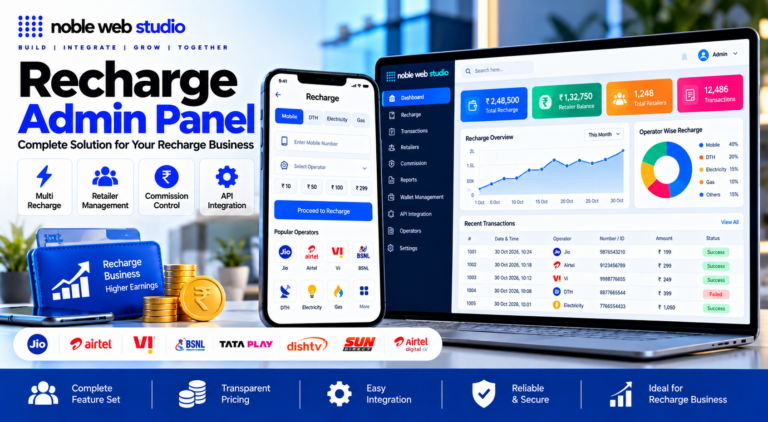
A Recharge Admin Panel and Dashboard is the central backend control system used to manage, monitor, and scale digital top-up, DTH, and utility payment platforms.
Core Features of a Recharge Admin Panel
- Real-Time Dashboard: Displays live transaction volumes, success/failure ratios, revenue trends, and service-wise performance metrics through visual graphs.
- Multi-Level User Hierarchy: Manages roles and permissions for Admins, Master Distributors, Distributors, Retailers, and end Customers.
- Commission & Margin Management: Configures custom commission structures and automated payouts based on operator types, transaction volumes, or user tiers.
- Transaction & Ledger Tracking: Monitors live status updates, processes refunds, and maintains detailed audit logs for every recharge or bill payment.
- API & Operator Integration: Connects with telecom operators, Bharat Bill Payment System (BBPS), and payment gateways for automated, instant processing.
- Security & Access Control: Enforces role-based permissions, multi-factor authentication (MFA), IP whitelisting, and data encryption.
Key Modules in Development
- Super Admin & Operator Module: Add/edit telecom/DTH operators, manage service uptime, and configure backup routes.
- Wallet & Fund Management: Handle online/offline wallet loads, credit/debit adjustments, and ledger reconciliations.
- Reports & Analytics: Exportable CSV/PDF reports for GST compliance, sales performance, and distributor earnings.
- Notification & Automation: Automated alerts via SMS, email, or WhatsApp for low balances and transaction failures.
Recharge Software Wallet, Commission and Transaction Management
A complete Recharge Software platform powers multi-tier B2B and B2C digital service networks (such as mobile, DTH, and Bharat BillPay utility payments) by integrating real-time wallet accounting, automated margin distribution, and transaction routing.
Explore white label recharge software package via Price or review industry setups on Noble web studio.
Core Components of Recharge Software
1. Wallet & Virtual Balance Management
- Real-Time Ledger Updates: Replaces batch/end-of-day calculations with instant virtual balance updates when funds move.
- Hierarchy & Float Flow: Supports multi-tier structures—Admin → Master Distributor → Distributor → Retailer—allowing upper tiers to push virtual float down the chain.
- Fund Requests & Top-Ups: Retailers and distributors can request or load wallet balance via UPI, bank transfers, or payment gateways.
- Reconciliation: Weekly and daily ledger tracking cross-checks wallet credits, debits, reversals, and bank statements to flag discrepancies.
2. Commission Management Engine
- Operator-Wise Slabs: Configure distinct margins and percentage/flat slabs for different operators (Jio, Airtel, BSNL, Vi), DTH providers, and utility billers.
- Multi-Level Payouts: Automatically splits and credits commissions across the administrator, distributor, and retailer per completed transaction.
- Net Earnings Tracking: Calculates gross margins minus partner payouts and operating overhead. Read more on commission structures via Noble web studio.
3. Transaction Management & API Routing
- Multi-API Failover: Connects to multiple recharge and bill payment APIs with priority rules and automatic switching if a primary provider fails.
- Automated Refunds: Failed or dropped recharge/bill requests automatically trigger instant refunds back to the user’s wallet.
- Complete Audit Trails: Connects every transaction reference number with status logs, operator info, and assigned commission entries.
Ready-Made Software vs. Custom Recharge Software Development
Ready-made recharge software is a pre-built, subscription-based platform designed for rapid deployment, whereas custom recharge software development builds a tailored application from scratch based on your exact business workflows.
Side-by-Side Comparison
| Parameter | Ready-Made Recharge Software | Custom Recharge Software Development |
|---|---|---|
| Time to Launch | Days (immediate or within a week) | 3 to 12 months (planning, design, build, and testing) |
| Initial Cost | Low / Subscription-based (e.g., ~₹1,500 to ₹2,000/month) | High / Upfront (typically ₹1,50,000+ or significantly higher depending on scope) |
| Customization | Limited to features and integrations provided by the vendor; you adapt to the tool | Completely tailored; the software adapts to your unique workflows and rules |
| Maintenance & Updates | Handled completely by the software provider (bug fixes, regulatory/API changes) | Your responsibility (or requires a separate yearly/monthly retainer with your dev team) |
| Code & Data Ownership | You rent access or license the platform (vendor lock-in risks apply) | You own the source code, intellectual property, and data (subject to contract) |
| Channel / Scale Hierarchy | Pre-set structures (e.g., 4-level or 5-level distributor/retailer models) | Custom number of tiers, commission trees, and multi-tenant logic |
When to Choose Ready-Made Software
- You are launching a startup or testing a B2B mobile recharge business in India with limited initial capital.
- Standard channel hierarchies (Admin → Master Distributor → Distributor → Retailer) fit your operational model.
- Speed to market is critical, and you want to start operations in days rather than months.
- Vendor-managed maintenance is preferred so you don’t have to hire an in-house technical team.
- Example: Subscription packages like those from Noble web studio offer tiered monthly plans.
When to Choose Custom Development
- Your workflow is highly specialized and cannot be mapped onto standard multi-level recharge software without awkward workarounds.
- You need deep, proprietary integrations with custom banking, fintech, or legacy enterprise systems.
- Intellectual property and complete code ownership are mandatory for your long-term business valuation or security compliance.
- You have the budget and patience to weather a 3-to-12-month development and testing cycle.
How Much Does Recharge Software Development Cost?
The cost structure for developing or launching a mobile and B2B recharge software depends on whether you choose a ready-made white label recharge software solution, a monthly subscription, or custom enterprise software development.
1. Ready-Made / White-Label Solutions (One-Time License)
Best for launching a branded B2B multi recharge platform quickly with pre-integrated operators and wallets.
- Starter / Basic Packages: ₹3,999 to ₹15,000 (single operator or limited top mobile recharge API support, branded website, and basic recharge admin panel).
- Standard / Gold Packages: ₹15,500 to ₹50,000 (multi mobile recharge API, mobile/Android app, wallet system, BBPS, and multi-level hierarchy like Master Distributor, Distributor, Retailer).
- Platinum / Enterprise Packages: ₹75,000 to ₹2,000,000+ (unlimited APIs, custom domain, payment gateways, and reseller rights).
- View ready-made pricing options and tier inclusions on Noble web studio.
2. Subscription-Based Models (SaaS)
Best for lower upfront capital investment where you pay a recurring software fee.
- Basic B2B Version (R1): ~₹1,499 per month.
- Advanced B2B Version (R2): ~₹1,999 per month.
- Note: API setup, SMS gateways, and payment gateway integration may have separate one-time or per-transaction costs.
3. Custom-Built / Enterprise Software Development
Best if you want a unique architecture built from scratch rather than a white label mobile recharge template.
- Indian Market Custom Solutions: ₹1,00,000 to ₹5,00,000+ depending on custom recharge commission apps (Android/iOS), backend ledger reconciliation, and multi-operator routing.
- Global / Full-Scale MVPs: $25,000 to $60,000 for an MVP, scaling up to $200,000–$1,000,000+ for full enterprise compliance, security, and direct operator connectivity.
- Explore market cost breakdowns on Noble Web Studio Pricing Insights.
Key Cost Components in the Structure
- Core Product Stack: Website, Android/iOS App, Mobile recharge Admin Panel, User/Distributor E-Wallet, and Database (MySQL/PostgreSQL with Redis for high-concurrency traffic).
- API & Third-Party Integrations: Trusted Recharge API (₹1,000 to ₹5,000 setup), BBPS (Bharat Bill Payment System), UPI/Payment Gateways, and SMS/WhatsApp notification APIs.
- Ongoing / Recurring Expenses: Server hosting, SSL security, annual maintenance (typically budgeted at 15–20% of initial build cost yearly), and Recharge API balance/commission margins.
Technology, Scalability and Recharge Software Maintenance
Recharge software platform (handling mobile, DTH, and utility recharges) require a tight balance between technology stack selection, scalability, and ongoing maintenance to handle high-frequency, real-time transaction volumes without dropping requests.
1. Technology Foundations
- Real-Time Processing: Built using asynchronous event-driven architectures (such as Node.js, Go, or Java Spring Boot) to handle thousands of concurrent Mobile Recharge API requests with telecom operators and payment gateways.
- Database & Caching Layer: Uses high-throughput relational databases (PostgreSQL/MySQL) paired with in-memory caches (Redis) to store wallet balances, Recharge API tokens, and operator mapping data with low latency.
- Idempotency & Retry Mechanisms: Ensures that if a network timeout occurs during a recharge callback, duplicate debits or missed recharges are automatically reconciled.
2. Scalability
- Horizontal vs. Vertical Scaling: As transaction counts grow from thousands to millions per day, systems scale out by adding stateless microservice instances behind a load balancer rather than just upgrading a single server.
- Queue Management: Uses message brokers (RabbitMQ, Apache Kafka) to queue high-volume bulk recharge requests, preventing downstream telecom APIs from rate-limiting or crashing the system.
- Database Sharding/Partitioning: Splits massive transaction and ledger logs across multiple database nodes to maintain fast query and write times.
3. Software Maintenance Types & Best Practices
- Corrective Maintenance: Fixing bugs, Mobile Recharge API integrated breaks from operator end-point updates, or payment gateway handshake failures immediately to protect user trust.
- Adaptive Maintenance: Updating the trusted mobile recharge software when telecom regulatory rules change, or migrating cloud infrastructure (AWS, Azure, GCP) for better cost efficiency.
- Perfective Maintenance: Adding new features like UPI AutoPay, cashbacks, or new biller categories (Fastag, electricity).
- Preventive Maintenance: Running automated security audits, code refactoring, and database index cleanups before performance degrades.
How to Evaluate a Recharge Software Development Company
Evaluating a recharge software development company requires looking past basic price quotes and focusing on architecture, compliance, Recharge API reliability, and long-term support.
1. Platform Architecture & Scalability
- Transaction Load Handling: Ask how the system handles high concurrent traffic without downtime or delayed callbacks. Look for architecture details like database optimization, caching, and load management.
- Uptime Track Record: Request average Recharge platform uptime statistics over the last 6 months.
- Codebase & Technical Debt: Check how often the recharge commission platform receives major updates and whether the codebase is actively maintained rather than running on legacy, stale scripts.
2. Business Model & Solution Type Match
- White-Label vs. Custom Development:
- White Label Solutions: Faster and cheaper (ranging from ₹50,000 to ₹3,00,000 in India), but check branding restrictions, recurring fees, and customization limits.
- Custom/MVP Software: Better for unique workflows or complex hierarchies (ranging from ₹5 lakhs to ₹15 lakhs+).
- Hierarchy & Role Controls: Ensure the recharge commission software natively supports your operational model, whether that includes B2C customer apps, B2B recharge panel, or multi-tier distributor/master-distributor chains.
3. API Integrations & Automation
- Core & Utility APIs: Confirm built-in or seamless integration with mobile prepaid/postpaid operators, DTH providers, FASTag, and utility bill payments.
- Smart Feature APIs: Look for value-add tools such as operator detection APIs (to automatically detect the correct operator from a phone number and reduce wrong recharges) and live plan APIs.
- AEPS & Additional Services: If you plan to expand later into Aadhaar Enabled Payment System (AEPS) or money transfer, check if the Noble web studio has a clear upgrade path.
4. Company Credibility & Client Verification
- Business Registration: Verify the company’s registration documents, incorporation history, and GST details. Companies with a proven track record (e.g., operating since 2016 or earlier) carry lower default risk.
- Client Retention: Ask for the average client retention period. A platform where clients stay active for 3+ years is a strong proxy for reliability.
- Reference Checks: Speak directly with existing clients of the recharge software development company or inspect independent reviews.
5. Support & Dispute Resolution
- Communication Channels: Test their support responsiveness via phone and WhatsApp during real business hours before signing a contract.
- Dispute Handling: Clarify how transaction failures, operator timeout issues, and refund/dispute cycles are managed inside the best recharge admin panel.
Planning Your Recharge Software Project
Planning a mobile recharge software project requires balancing core business goals, legal compliance, and technical architecture. Whether you are targeting B2C end-users, B2B retail agents, or a white-label reseller model, a structured approach is essential from day one.
1. Define the Business Model & Scope
- Model Selection: Choose whether your top recharge platform will operate as a B2C direct-to-consumer app/portal, a B2B multi-level retailer/distributor network, or a White-Label franchise system.
- Service Offerings: Decide which services to support upfront: prepaid/postpaid mobile recharges, DTH top-ups, data cards, and utility bill payments (electricity, gas, water, FASTag).
- Phased Rollout: Launch with essential core features first, monitor real-world usage and failure rates, then introduce advanced modules.
2. Essential System Architecture & Features
- Frontend Layer: Responsive web portal and Android/iOS mobile applications.
- Backend & Ledger Management: Core engine handling business rules, balance deductions, real-time transaction logs, and e-wallet management.
- Admin & Commission Control Panel: Interface to add/manage operators, configure commission slabs for distributors/retailers, and block/unblock accounts.
- API & Payment Gateway Integrations: Telecommunication operator APIs (for instant top-ups) and payment gateways supporting UPI, net banking, and debit/credit cards.
3. Documentation & Legal Prerequisites
Before writing code or going live, compile the required verification and agreement files:
- Personal KYC: Identity and address proof for promoters/founders.
- Business Verification (KYB): Company registration, GST, and legal entity proofs.
- Banking & Financial Documents: Current account details, settlement mechanism agreements, and security deposits for trusted mobile recharge API pools.
- Technical Agreements: Service-level agreements (SLAs) with Noble web studio and payment gateway aggregators.
4. Development Costs & Timelines (India Market)
- Basic White-Label Solution: ₹50,000 to ₹3,00,000 (pre-built, rebranded, fast deployment with limited customization).
- Custom MVP (Minimum Viable Product): ₹5,00,000 to ₹15,00,000 (custom UI/UX, core recharge API integrating, and basic multi-level controls).
- Advanced Scalable Platform: ₹15,00,000 to ₹50,00,000+ (complex backend architecture, high concurrency, AI-driven analytics, and extensive automation).
Noble Web Studio One Of The Right Recharge Software Development Company
Noble Web Studio one of the right recharge software development company requires evaluating technical strength, business model fit, and long-term support rather than just looking at the lowest upfront cost.
Key Factors to Evaluate
- API Reliability & Uptime: High transaction success rates and dependable uptime are vital; frequent downtime or delayed commission settlements hurt your business reputation and customer trust. Read the Smooth Recharge API Checklist for evaluation tips on operator and plan APIs.
- Business Model Support (B2B, B2C, or White-Label): Ensure the Noble Web Studio can build the specific architecture you need whether it’s a direct consumer counter (B2C), a multi-level distributor network (B2B/B2B2C), or a branded white-label admin panel that lets you run recharge platform under your own domain.
- Multi-Service Integration: Look for multi service recharge platform that can expand beyond basic mobile recharge into Bharat Bill Payment System (BBPS), AePS, DTH, FASTag, and DMT under a single login.
- Security & Encryption: The modern recharge software must feature strong data encryption, secure payment gateway integrations, and strict anti-fraud controls to protect user data and financial transactions.
- Core Technical Team & Experience: Avoid vendors who lack an in-house development team or outsource critical tasks. Noble Web Studio track record, company registration, and industry tenure.
- Total Cost of Ownership (TCO): Compare itemized quotes that cover discovery, custom UI roles, testing, hosting, and post-launch maintenance. Review guidelines on Noble web studio regarding custom vs. ready-made options.
- Post-Launch Support & Maintenance: Clarify who handles bug fixes, security patches, backups, and customer support escalation (phone/WhatsApp availability) after the software goes live.
Why Choose Provider for Recharge Software Development Solution
Noble web studio one of the right provider for a Recharge Software Development Solution is essential for building a fast, secure, and error-free digital payment or B2B reseller business.
Key Reasons to Choose a Dedicated Provider
- Centralized Multi-Service Platform: Noble web studio combines mobile prepaid, postpaid, DTH, data cards, and utility (BBPS) payments into a single dashboard or admin panel, eliminating the need to manage multiple vendor accounts.
- High Transaction Success & Smart Routing: Noble web studio build systems with high real-time success rates, fast final status updates, and smart recharge API routing with automated failovers to prevent downtime.
- White-Label & Ready-to-Use Solutions: If you lack an in-house engineering team, Noble web studio deliver a pre-built web portal and high mobile recharge commission app customized with your brand logo, domain, and automated commission slabs.
- Automated Admin Dashboards & Commission Engine: Manage live transactions, configure multi-tier commission slabs, switch recharge API operators, and generate detailed financial reports.
- Hierarchy & Distributor Network Management: Noble web studio offer tiered user structures (admin, master distributor, distributor, and retailer) with real-time wallet tracking and automated payouts.
- Security & Compliance: Noble web studio integrate SSL encryption, 2FA, IP restrictions, and KYC-ready retailer onboarding to protect financial transactions.
- Scalability & Cost-Efficiency: Automated workflows lower operational overhead and allow your business to scale its service offerings as transaction volumes grow.
- Technical Support: Benefit from ongoing technical assistance and training options for recharge b2b platform.
Conclusion
Choosing the right Recharge Software Development Company is an important step when you want to launch a new recharge business or expand your existing digital services. The right recharge software should make it easier to manage recharge operations, serve retailers and distributors, monitor transactions, and organize your business from one b2b mobile recharge platform. Before making an investment, evaluate the branded mobile recharge software features, fast recharge API integration options, security, scalability, user management, technical support, and overall cost.
A recharge software development company builds and maintains digital recharge service platform that let users and businesses process instant prepaid mobile, DTH (Direct-to-Home), data card, and utility bill payments (like electricity, gas, and water).
Noble Web Studio develops ready-made B2B Mobile Recharge Software for entrepreneurs, startups, retailers, distributors, and businesses planning to establish or grow their recharge operations. Depending on the selected mobile recharge software version and available integrations, the fast recharge platform can support mobile recharge, DTH recharge, FASTag, and other digital services. Businesses can discuss their requirements for admin controls, retailer and distributor panels, commission management, transaction reports, web access, and Android app availability.
When comparing a Recharge Software Development Company, do not make your decision based only on the initial price or the number of advertised features. Check how the software handles successful, failed, and pending transactions, whether the required recharge service API are supported, how user accounts are managed, and what assistance is available after launch. Also confirm which features are included in the selected mobile recharge software package and which require separate integration or customization.
Whether you are starting a B2B recharge business, building a retailer network, or upgrading your existing best mobile recharge platform, choose a solution that matches your actual business requirements and future plans. Noble Web Studio can help you explore its ready made Mobile Recharge Software and discuss the available options for your project.
Ready to start your recharge software business? Contact Noble Web Studio to discuss your requirements, available features, and pricing.
Recharge Software Development Company with Noble Web Studio
Looking for a reliable Recharge Software Development Company? Noble Web Studio develops ready-made recharge software solutions for retailers, distributors and entrepreneurs. Contact our team to discuss B2B recharge software, white-label platforms, API integration and your business requirements.