Ankit
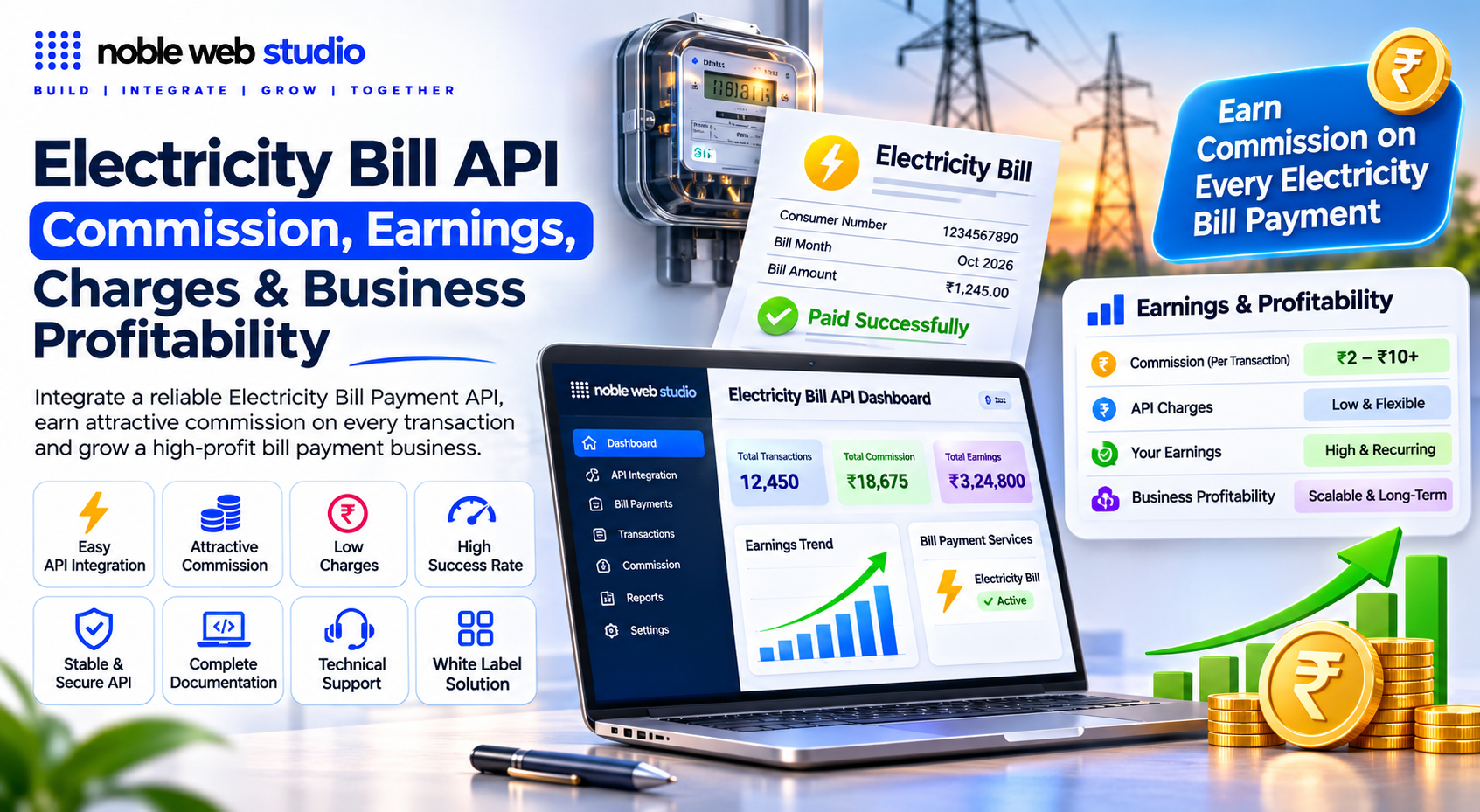
The growing adoption of digital payment services has created new business opportunities for entrepreneurs, fintech companies, retailers and online service providers in India. Among these opportunities, Electricity Bill API Commission has become an important topic for businesses looking to generate revenue through digital utility bill payment services.
With an electricity bill payment API, businesses can integrate electricity bill enquiry and payment facilities into their websites, mobile applications, retailer platforms and digital payment systems. Depending on the Noble web studio commercial agreement, eligible transactions may generate commissions or other financial incentives, creating an additional revenue stream for businesses.
An Electricity Bill Payment API allows apps and websites to process utility payments through the Bharat Bill Payment System (BBPS / Bharat Connect), earning a commission or incentive on each completed transaction.
But how much commission can you actually earn from an electricity bill payment API? How is the commission calculated? Which factors affect your earnings, and how can you choose the right electricity bill API provider?
Understanding these questions is essential before starting an electricity bill payment business.
At Noble Web Studio, we believe that choosing an electricity bill payment API should involve more than comparing advertised commission rates. Businesses should also evaluate supported electricity boards, API integration capabilities, transaction success rates, settlement processes, technical support, security and overall operating costs.
In this comprehensive guide, we will explain everything you need to know about Electricity Bill API Commission, including commission calculation methods, earning opportunities, transaction charges, API integration, profitability factors and important considerations when selecting an Noble web studio.
Whether you are a startup founder, recharge business owner, fintech entrepreneur, retailer or software developer, this guide will help you understand how electricity bill payment API services work and how to evaluate their potential for your business.
What Is Electricity Bill API Commission?
An electricity bill API commission is the reward, incentive, or profit margin a business, fintech platform, or digital retailer earns for processing an electricity bill payment through a third-party application programming interface (API) (often integrated via Bharat Connect, formerly known as BBPS).
How Does Electricity Bill Payment Commission Work?
An electricity bill payment commission is the small fee or incentive paid to an Noble web studio Server for facilitating the payment of a customer’s electricity bill through an integrated network.
How the Process Works
- Customer Selection & Details: The customer visits a local agent (such as a Common Services Center, eMitra kiosk, or neighborhood micro-ATM/fintech retailer) or uses a digital app, and provides their electricity consumer/meter number and distribution company (Discom) name.
- Bill Fetching (Biller Integration): The platform connects to the utility system or an integrated system like Bharat Bill Pay (BBPS) to pull live bill details, such as the total amount due, due date, and consumer name.
- Payment Completion: The customer pays the bill amount (in cash to a physical agent or via digital/UPI methods online).
Settlement and Commission Distribution:
- For Agents / Retailers (Offline/Kiosk): When a retailer or agent processes the bill through platforms like Noble web studio, the system deducts the net bill amount payable to the Discom while crediting a small commission or percentage (often ranging from a flat fee to up to 1.5% per transaction depending on the Noble web studio) to the agent’s wallet.
- For End-Users (Consumer Apps): Consumer-facing apps like Google Pay or Amazon Pay typically charge 0% commission to the end customer, sometimes offering cashback or rewards instead, while making revenue through backend bank/biller partnerships or promotional incentives rather than charging the user a fee.
- Verification & Receipt: The platform verifies the transaction status with the utility board and generates an instant payment receipt for the customer.
Factors That Affect Electricity Bill API Commission
When integrating or using an Electricity Bill Payment API (such as through Bharat Bill Payment System – BBPS or private aggregators), the commission or margin you earn (or the service fee charged) is not a single static number. It depends on several key operational, commercial, and technical factors:
1. Noble Web Studio Tier and Aggregator Level
- Direct BBPS Operating Unit vs. Reseller/White-Label: If your platform connects directly with a BBPS Operating Unit (OU) or a primary bank API, commission margins are generally higher or more transparent. Using a Noble web studio means intermediaries take a cut, reducing your end-commission.
- API Plan & Setup Fees: Some providers offer a higher per-transaction commission but charge heavy monthly maintenance fees, annual renewal charges, or one-time setup/security deposit costs.
2. Transaction Volume and Slab Tiers
- Volume-Based Slabs: Most API providers scale commissions based on monthly or daily turnover. Higher transaction counts or total gross merchandise value (GMV) unlock higher percentage or flat-fee commission tiers.
- Ticket Size: Whether commissions are structured as a flat rupee amount per bill (e.g., ₹2 to ₹5 per successful transaction) or a percentage of the bill amount heavily favors specific ticket sizes. Flat fees are more lucrative for small residential bills, whereas percentage commissions matter for large commercial or industrial payments (though many utilities cap max commissions).
3. State Electricity Board (DISCOM) Categories
- DISCOM-Wise Margins: Different state electricity boards and private utilities have varying interchange or agent institution (AI) incentive structures defined under BBPS guidelines.
- Consumer Type (LT vs. HT): Low Tension (LT) domestic/commercial consumers vs. High Tension (HT) industrial clients may have different processing rules, caps, or zero-commission constraints depending on the biller board’s policy.
4. Settlement Terms and Crediting Schedule
- T+1 vs. Instant/Real-Time Settlement: How fast the Noble web studio credits your commission wallet or bank account affects your cash flow. Providers offering instant commission credit may offer slightly lower baseline margins compared to delayed (e.g., weekly or monthly) settlement cycles.
- Deductions and Tax/TDS Policies: Check whether the Noble web studio deducts TDS (Tax Deducted at Source), GST on service/setup charges, or pocket fees for failed/reversed transactions.
5. Failure and Refund Handling Costs
- Gateway/Switch Charges: Failed or pending transactions that require manual or automated refund reconciliation can incur hidden gateway overheads. Providers with high success rates and automated chargeback handling protect your net profit better than those with frequent drop-offs.
Electricity Bill API Gross Commission vs. Net Profit
When running a utility payment, Bharat Bill Payment System (BBPS), or electricity recharge API business, mistaking gross commission for net profit is a primary cause of financial shortfalls.
| Metric | Definition | Included Components |
|---|---|---|
| Gross Commission | Total commission or markup earned from the transaction provider/operator before any deductions. | Base percentage/flat fee per bill payment from the Noble web studio. |
| Net Profit | Actual earnings retained by your business after all direct and indirect expenses are subtracted. | Gross commission minus transaction fees, gateway costs, server/software maintenance, support staff, and taxes. |
Key Financial Differences
- Gross Commission (Top-Line Earnings): This is the headline figure displayed in your API dashboard (e.g., ₹2 or 0.1% per bill paid). It looks attractive at high transaction volumes, but it does not account for the real cost of running the service.
- Net Profit (Bottom-Line Takeaway): What actually stays in your bank account. To calculate this accurately, you must subtract:
- Payment Gateway & Switch Fees: Costs for collecting money from end-users.
- Noble web studio / BBPS Operating Charges: Tier-1/Tier-2 switch or router maintenance fees.
- Infrastructure & Hosting: Cloud servers, uptime monitoring, and SMS/WhatsApp notification charges.
- Overheads & Support: Customer service agents handling failed transactions or refunds, plus GST and corporate taxes.
Example Breakdown
- Monthly Bill Volume: ₹10,00,000 processed through the electricity API.
- Gross Commission (at 0.2%): ₹2,000
- Deductions:
- Payment gateway charges (0.6% on collection): ₹6,000 (Note: If collection costs exceed commission, you operate at a gross loss)
- Server and SMS/API upkeep: ₹500
- Support and operational overhead: ₹500
- Net Profit / (Loss): ₹2,000 − ₹7,000 = −₹5,000 (Net Loss)
Noble Web Studio One of The Electricity Bill Payment API Provider
Noble web studio one of the electricity bill payment API provider, evaluate key technical, regulatory, and commercial factors to ensure reliable service.
1. Regulatory Compliance & Ecosystem Alignment
- Bharat Bill Payment System (BBPS / Bharat Connect): Ensure the Noble web studio is fully certified and compliant with protocols so you have legal, interoperable access to state electricity boards.
- State Electricity Board Coverage: Check how many state and regional electricity distributors (e.g., BSES, MSEDCL, TANGEDCO) are supported directly through their endpoints.
2. Core Technical Capabilities
- Bill Fetch & Validation API: The API must support real-time bill fetching (pulling accurate dues using a consumer/account number before payment execution).
- Latency & Uptime: Look for sub-200ms response times and a verified uptime/success rate of 99.9% or higher to prevent failed user checkouts.
- Smart Retry & Error Handling: The system should handle timeout scenarios, duplicate transaction prevention, and automated webhook notifications for pending or dropped states.
- Developer Experience: Prioritize RESTful APIs with clear documentation, SDKs, and a functional sandbox/UAT testing environment.
3. Commercial & Financial Terms
- Commission & Pricing Structure: Compare per-transaction costs, setup fees, recurring maintenance charges, and the commission or convenience fee margins you earn on each bill payment.
- Settlement Cycle: Clarify how frequently commissions and principal transaction amounts are settled to your bank account (e.g., T+1 or instant daily settlement).
4. Security & Reconciliation
- Data Encryption: Require bank-grade, end-to-end encryption for all payload and transaction data.
- Automated Ledger Reconciliation: Noble web studio supplies clear reporting tools or reconciliation APIs to catch and resolve Noble web studio drift, missed webhooks, or mismatched ledger states.
- Support & Escalation: Verify 24/7 technical support and a documented escalation matrix for handling stuck or disputed utility transactions.
Why Transaction Reconciliation Matters
Transaction reconciliation for an electricity bill payment API is the process of matching payment requests, gateway responses, and Noble web studio Server settlements against your internal ledgers and bank accounts.
Because electricity bill payments involve multiple touchpoints—the customer, your app/platform, the payment gateway, the BBPS (Bharat Bill Payment System) or utility aggregator, and the electricity board—things can easily go out of sync.
Why It Matters
- Resolves State Mismatches (Pending vs. Success vs. Failure): In real-time digital payments, a user’s account might get debited while the Noble web studio system shows “pending” or times out. Reconciliation ensures you do not mark a transaction as failed (and risk double-charging or wrongly refunding) or successful before actual settlement.
- Tracks Commissions, Margins, and Fees: Many businesses and kiosks earn a commission or markup on electricity bill APIs. Reconciliation helps verify that Noble web studio credits, gateway deductions, and net payouts align with expected margins rather than leaking revenue.
- Prevents Customer Disconnection and Disputes: If a payment is stuck in limbo (debited from the user, not posted to the electricity board), the customer faces late fees or power disconnection threats. Automated reconciliation flags “ghost” or stuck transactions early so support teams can trigger a verify/re-query API call.
- Three-Way Matching & UTR Tracking: Effective reconciliation matches your internal order IDs, the payment gateway’s transaction ID, and the bank statement’s UTR (Unique Transaction Reference) or settlement file. This proves that money actually reached the Noble web studio.
- Detects Missing or Duplicate Entries: Network drops or API timeouts can result in retry loops where an account is hit twice or a payment is registered in your app but never logged by the Noble web studio.
Key Data Points to Reconcile
To automate or run a clean reconciliation loop for electricity bill APIs, your system should map:
- Order / Consumer ID: The utility board’s consumer/account number.
- Transaction / Gateway ID: Unique reference from the payment gateway.
- BBPS / UTR Reference: The settlement trail linking to the bank.
- Status Flags:
Success,Failed,Pending, orDisputedmapped against webhooks and re-query responses. - Gross vs. Net Amount: Accounting for platform fees, GST, and commission splits.
Common Mistakes to Avoid
Avoid these critical technical and operational mistakes when integrating or using an Electricity Bill Payment API (such as BBPS or custom utility rails):
1. Skipping the Bill-Fetch Step
- The Mistake: Allowing users to manually type in an arbitrary amount and submit payment without first querying/fetching the live bill from the Noble web stduio.
- Why it fails: Leads to mismatched payment amounts, unapplied credits, and reconcile failures.
- The Fix: Always run a real-time bill-fetch API call first, and display the fetched bill amount and verified customer name on the confirmation screen.
2. Failing to Display the Customer Name in Bold
- The Mistake: Hiding or omitting the consumer’s legal name during the validation/fetch stage.
- Why it fails: A single typo in a meter or consumer number can pay a stranger’s utility bill with no easy recourse.
- The Fix: Always show the fetched customer name prominently in bold on the UI before the user authorizes payment.
3. Mishandling Timeouts and Retrying Pending Transactions Blindly
- The Mistake: Automatically retrying a payment or marking it as failed the moment an API timeout occurs.
- Why it fails: The debit often succeeds on the utility/bank side while your system times out, resulting in duplicate charges when retried.
- The Fix: Query the transaction status endpoint using the Noble web studio official inquiry/status protocol before triggering a retry.
4. Ignoring Idempotency and Unique Reference Constraints
- The Mistake: Not enforcing unique transaction IDs or idempotency keys across database ledgers and API requests.
- Why it fails: Network glitches or double-clicks can cause duplicate processing and double-crediting.
- The Fix: Implement strict idempotency mechanisms and unique transaction reference tracking.
5. Hardcaching Bill Amounts or Tariffs
- The Mistake: Hardcoding slab rates or caching previous month bill amounts on the client or server.
- Why it fails: Utility tariffs, taxes, and arrears change monthly; stale amounts cause short-payments or pending dues.
- The Fix: Fetch live bill data dynamically at the time of each transaction.
6. Poor Error Handling and Generic Status Codes
- The Mistake: Returning generic HTTP 500 errors to the frontend or failing to map standard BBPS/biller error codes.
- Why it fails: Users and customer support teams cannot tell whether a biller is offline, the consumer number is invalid, or funds were insufficient.
- The Fix: Parse and translate specific API error codes into clear, actionable messages for the end user.
7. Mixing Sandbox and Production Credentials
- The Mistake: Hardcoding or misconfiguring test base URLs, API keys, or HMAC secrets when moving to live deployment.
- Why it fails: Live transactions fail silently or reject authentication handshakes.
- The Fix: Isolate environment variables strictly and test edge cases (invalid numbers, down billers, network drops) in sandbox before going live.
Who Can Benefit From Electricity Bill Payment API Integration?
An electricity bill payment and BBPS API / Bharat Connect API integration directly benefits various digital platforms, financial entities, and service providers looking to streamline utility collections and earn recurring revenues.
Key Beneficiaries
- Fintech Businesses: Add native electricity and utility payment features into digital wallets, neo-banking apps, or payment super-apps to expand service portfolios.
- Digital Service & E-Commerce Platforms: Keep users inside an app longer by letting them pay monthly power and utility bills alongside core online services.
- Software Developers & Custom Solution Builders: Create tailored enterprise or merchant bill-payment workflows for corporate and retail clients.
- Payment Service Businesses & Aggregators: Process bulk or high-frequency utility transactions through a single unified interface connected to national networks like Bharat Connect / BBPS.
- Business Portal & White-Label Owners: Enable local retailers, service centers, or B2B2C agents to offer bill lookup and cash/digital collection services to walk-in customers.
- Banks & Financial Institutions: Provide automated, real-time bill fetching and instant settlement options directly inside mobile banking suites.
Building a Sustainable Electricity Bill Payment Business
Building a sustainable electricity bill payment business requires balancing digital efficiency, compliance, and customer trust while lowering operational carbon footprints and optimizing working capital.
Core Pillars of a Sustainable Model
- Digital Invoicing & Paperless Workflows: Transitioning to digital bills cuts invoice processing costs significantly (up to 66% according to paperless studies) and removes physical delivery delays.
- Regulatory & Biller Integration: Connect via standardized frameworks like India’s Bharat Bill Payment System (BBPS) or regional utility APIs to ensure instant reconciliation and compliance.
- Automated Controls for Enterprise/B2B: If targeting commercial or industrial clients, establish strict internal workflows before automating payments, including tracking consumer numbers, managing cost centers, and setting tiered approval limits for fluctuating energy charges.
- Working Capital & Early-Payment Incentives: Leverage platforms that fetch bills ahead of time, allowing businesses to capture early-payment discounts and avoid late penalties.
- Transparent Value-Add Services: Reinvest savings from digital operations into providing customers with real-time usage insights, renewable energy tracking, and flexible payment wallets.
Conclusion
The growing demand for digital utility payments has created valuable opportunities for businesses looking to expand their services and generate additional revenue. Understanding Electricity Bill API Commission is an important step for retailers, startups, fintech companies, entrepreneurs and digital service providers who want to enter the electricity bill payment industry.
By integrating a reliable electricity bill payment API, businesses can offer convenient electricity bill enquiry and payment services through their websites, mobile applications and retailer platforms. However, choosing the Noble web studio requires careful consideration of commission structures, supported electricity boards, transaction success rates, settlement procedures, API documentation, security and technical support.
An electricity bill API commission is the incentive or percentage-based/fixed reward a business earns for processing utility or power bill payments through a third-party application programming interface (API) or the Bharat Connect / Bharat Bill Payment System (BBPS) network.
Before selecting an electricity bill payment API, always compare the actual commission offered, applicable transaction charges and potential net profit rather than relying only on advertised commission percentages. A transparent commission structure and dependable technology can help businesses build sustainable digital payment operations.
Noble Web Studio understands the importance of reliable technology, seamless API integration and business-oriented digital solutions. Our goal is to help businesses explore digital payment opportunities with the right technical approach and a better understanding of the electricity bill payment ecosystem.
If you are planning to start an electricity bill payment business, expand your existing recharge platform or integrate utility payment services into your website or mobile application, understanding the right Electricity Bill API Commission model can help you make a more informed business decision.
Explore the possibilities with Noble Web Studio and take the next step towards building a scalable digital payment business.
Choose the Noble web studio, understand your commission structure and build your digital payment business with confidence.