Ankit
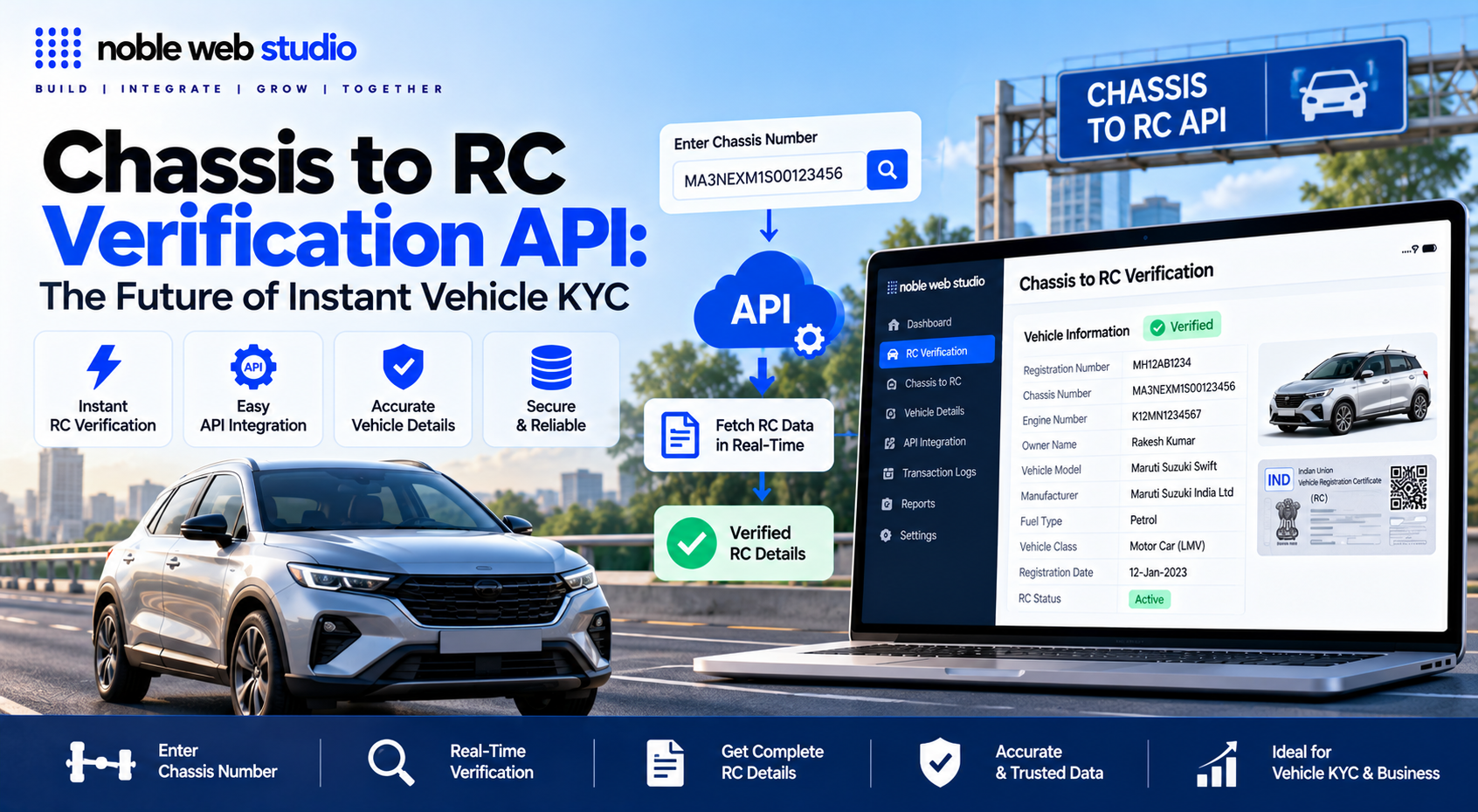
A Chassis to RC Verification API helps businesses look up available vehicle registration details using a vehicle’s chassis number through an integrated software system. It can simplify vehicle verification workflows for used-car dealers, vehicle financing companies, insurance businesses, fleet operators, and fintech platforms that need to check vehicle information within their applications.
With a chassis-to-RC lookup, businesses can submit a chassis number and retrieve the registration details supported by their chosen Noble web studio. The exact information returned depends on data availability, Noble web studio coverage, and authorised access. Before integrating an API, businesses should check its supported fields, response format, documentation, security requirements, pricing, and handling of unmatched or invalid chassis numbers.
The Chassis to RC Verification API is a specialized RESTful service that enables businesses to instantly retrieve a vehicle’s official Registration Certificate (RC) details using only its Chassis Number (Vehicle Identification Number or VIN). Unlike standard vehicle APIs that require a registration number (license plate), this API allows platforms to perform instant KYC, fraud checks, and asset valuation when the plate number is missing, obscured, or altered.
Noble Web Studio helps businesses explore API integration and custom software development according to their project requirements. Whether you want to add chassis-based vehicle lookup to an existing application or build a vehicle verification portal, defining the required data fields and verification workflow is an important first step.
In this guide, you will learn how a Chassis to RC Verification API works, which vehicle details may be available, how integration is carried out, what common lookup errors mean, and how to evaluate an Noble web studio for your business. This will help you make a more informed decision before adding vehicle verification functionality to your software.
What Is Chassis Number to RC API
A Chassis Number to RC API is a digital programming interface that lets software applications retrieve official Vehicle Registration Certificate (RC) details by inputting a vehicle’s unique 17-character chassis number (or VIN).
How the Chassis Number to RC Verification API Works
A Chassis Number to RC (Registration Certificate) Verification API acts as a bridge that allows businesses to query official government transport records (such as India’s VAHAN database) using a vehicle’s unique 17-character vehicle identification number (VIN) or chassis number.
Instead of searching by the license plate number, this API maps the physical hardware ID of the vehicle to its legally registered profile.
How the API Works (Step-by-Step)
[ Client App ] --(Chassis Number/VIN)--> [ API Gateway ]
                                             │
                                     (Queries VAHAN/RTO)
                                             ▼
[ JSON Response ] <--(Vehicle & Owner Data)-- [ Govt Registry ]
- Input Collection: The client system takes a 17-character Chassis Number (VIN) as input, often gathered via OCR scanning or manual data entry during customer onboarding.
- API Request Initiation: The API encrypts the payload and routes the query securely to the middleware infrastructure connected to central transport databases (like MoRTH / VAHAN).
- Registry Querying: The API queries the central database using the hardware string as the unique key.
- Data Aggregation & Fraud Analysis: The system verifies the chassis number against existing records. If the number is linked to multiple active registrations or flagged as blacklisted, fraud alerts are generated.
- JSON Payload Delivery: The API cleans, structures, and returns a comprehensive data package to the client in milliseconds.
What Vehicle Details Can You Retrieve Using a Chassis Number?
Using a chassis number (or Vehicle Identification Number – VIN), you can retrieve comprehensive data from official portals like the Ministry of Road Transport and Highways Vahan Portal or verification services like Noble web studio provide Chassis to RC API:
- Manufacturer and Model Details: Brand, maker name, exact model, and vehicle class (e.g., two-wheeler, car, truck).
- Registration and Ownership Info: The vehicle’s unique registration number, registration date, RTO of registration, and current owner details.
- Engine and Hardware Specs: The matching engine number, fuel type, and emission norms.
- Compliance and Validity Dates: Fitness certificate validity, Pollution Under Control Certificate (PUCC) status, and road tax details.
- Insurance and Legal Status: Active insurance policy details, active challans (penalties), and theft or fraud flags.
- Vehicle History: Past transaction records, service history, recall notices, and accident or ownership transfer reports.
Chassis Number vs RC Number: Key Differences
The primary difference between a Chassis Number and a Registration Certificate (RC) Number is that the Chassis Number identifies the physical vehicle itself, while the RC Number identifies the legal registration of that vehicle with the government.
Here is a direct comparison of the key differences:
| Feature | Chassis Number (VIN) | RC Number (Registration / Plate Number) |
|---|---|---|
| What it Represents | The unique physical identity of the vehicle’s frame. | The legal registration identity of the vehicle. |
| Assigned By | The vehicle manufacturer. | The government transport authority (e.g., RTO). |
| When it is Created | At the time of manufacturing. | After purchase, when registering the vehicle. |
| Can it Change? | No. It is permanently stamped onto the chassis and remains the same for the lifespan of the vehicle. | Yes. It can change if the vehicle is transferred to a different state or jurisdiction. |
| Format | Usually a 17-character alphanumeric code (Vehicle Identification Number). | A combination of state codes, district codes, and unique series numbers (e.g., DL 01 CA 1234). |
| Primary Purpose | To track vehicle manufacturing history, safety recalls, and prevent theft/cloning. | To verify legal ownership, pay road taxes, and enforce traffic laws. |
When Do Businesses Need a Chassis to RC Verification API?
Businesses need a Chassis to RC Verification API to instantly fetch official Registration Certificate (RC) and ownership records directly from government transport databases using just a vehicle’s chassis number (VIN).
Key Use Cases & Industries
- Insurance Companies: Use it at policy issuance to verify vehicle specifications, check for active coverage, and spot lapsed policies before approving claims.
- Fintech & Lending Platforms: Use it during vehicle-backed loans and asset-financing workflows to confirm the physical asset exists, check financier/hypothecation status, and prevent duplicate or fraudulent collateral claims.
- Logistics & Fleet Management: Use it when onboarding new drivers or acquiring transport fleets to verify real-time ownership, road permits, and fitness/PUCC status.
- Used-Car Marketplaces & Dealerships: Use it to authenticate vehicle listings, match stamped hardware numbers against official RTO records, and detect swapped number plates or altered papers.
- Law Enforcement & Verification Services: Use it for instant roadside or field checks to cross-reference identity, blacklist status, and vehicle history.
Data Returned by the RC Verification API
An RC (Registration Certificate) Verification API connects directly to authoritative government transport databases in India (such as VAHAN or Regional Transport Offices) to instantly validate vehicle and ownership details.
The comprehensive structured data returned in a standard API JSON response payload is categorized below:
1. Ownership & Identity Information
- ownerName: Full name of the registered vehicle owner.
- fatherName / husbandName: Father’s or husband’s name of the owner.
- presentAddress: The current address of the registered owner.
- permanentAddress: The permanent address listed on the official document.
2. Vehicle Registration & Core Meta
- registrationNumber: The vehicle license plate number (e.g., HR26DA8398).
- registrationDate: The date the vehicle was officially registered.
- rcStatus: Operational status of the registration (e.g.,
Active,Suspended). - registeredAt / registrationAuthority: The specific RTO code and location issuing the certificate.
- fitnessUpto: Validity expiration date for the vehicle’s fitness certificate.
3. Technical Specifications & Identifiers
- chassisNumber: The unique Vehicle Identification Number (VIN) stamped on the chassis.
- engineNumber: The unique serial identifier stamped on the vehicle’s engine block.
- makerDescription / makerModel: Brand manufacturer, specific model name, and variant details.
- vehicleClassDescription / vehicleCategory: Vehicle type classification (e.g., Motor Car, Two-Wheeler, Commercial).
- fuelDescription: Power source type (e.g., Petrol, Diesel, CNG, Electric).
- cubicCapacity: Engine displacement capacity represented in CC.
- seatingCapacity: Maximum passenger seating limit allowed by law.
- manufacturedMonthYear: The exact manufacturing timeline of the asset.
- color: The officially registered body color of the vehicle.
4. Compliance, Finance & Legal Status
- insuranceCompany: Name of the active third-party or comprehensive motor insurance provider.
- insurancePolicyNumber: The active insurance contract policy identifier.
- insuranceUpto: The expiration date of the current insurance coverage.
- financier / hypothecation: The bank or NBFC funding the vehicle loan, indicating if a lien exists.
- blackListStatus: Flags indicating if the vehicle is blacklisted due to unpaid traffic challans, theft, or legal disputes.
Why Vehicle KYC Is More Important Than Ever
Vehicle KYC (Know Your Customer) and KYV (Know Your Vehicle) have become critical requirements due to stricter toll regulations, digital lending controls, and fraud prevention measures.
Key Reasons Vehicle KYC/KYV Matters More Than Ever
- One Vehicle, One FASTag Mandate: The National Highways Authority of India (NHAI) and IHMCL enforce the “one vehicle, one FASTag” policy to stop drivers from using a single FASTag across multiple vehicles or misusing tags at tolls.
- Real-Time Vahan Database Integration: APIs connect directly with the national MoRTH Vahan database to pull live Registration Certificate (RC) details, chassis numbers, and ownership statuses instantly.
- Fraud and Theft Prevention: Automated verification flags fake, altered, or blacklisted chassis numbers and scrambled vehicle identities before completing sales, transfers, or commercial fleet onboardings.
- Smoother Auto Loans and Insurance: Lenders, NBFCs, and motor insurers rely on digital KYC to confirm real ownership, prevent synthetic identity or impersonation fraud, and speed up policy or loan approvals.
- Avoiding Toll Penalties: Keeping your vehicle records updated and properly linked via platforms like IHMCL prevents wallet blacklisting, tag deactivation, or double toll fees on highways.
Use Cases for Chassis Number to RC Verification API
A Chassis Number to RC (Registration Certificate) Verification APIbridges a critical gap when a vehicle’s registration number is missing, faded, or unavailable. Because a 17-digit chassis number (or VIN) is permanently stamped onto a vehicle’s frame, it serves as an unalterable physical identifier. By hitting official centralized repositories like India’s VAHAN database, the API reverses this number to fetch complete ownership, vehicle specifications, and history.
The primary commercial and operational use cases across key industries include:
1. Vehicle Lending, Banks, & NBFCs (Asset Validation)
- Collateral Verification: Before approving a used car or commercial vehicle loan, lenders use the chassis number captured directly from a physical inspection or dealer invoice to ensure the asset exists and matches the loan application.
- Hypothecation & Title Verification: Verifies if the vehicle already has active liens or loans against it, preventing double-collateralization scams.
- Pre-Disbursal Guardrails: Authenticates the borrower by ensuring the owner name on the official RC matches the loan applicant.
2. Auto Insurance Underwriting & Claims (Fraud Prevention)
- New Policy Underwriting: Verifies the precise make, model, cubic capacity, and manufacturing date directly from the chassis number to calculate exact risk premiums, cutting out manual data entry errors.
- Claims Processing & Anti-Substitution: When an accident or theft claim is filed, the API matches the physically recovered chassis number against the policy database. This prevents fraudsters from substituting a totaled vehicle’s paper identity onto a different car.
3. Used Vehicle Marketplaces & Dealerships
- Direct Inventory Sourcing: Used car platforms can onboard inventory instantly without needing physical paperwork on hand. Scanning the chassis plate pulls the entire digital history.
- Trust & Title Clearance: Ensures that a seller is the legal owner and flags if a vehicle has been blacklisted by regional transport offices (RTOs), scrapped, or marked stolen.
- Interstate Transfer Tracking: When a vehicle moves between states, its registration number changes, but its chassis number stays identical. The API maps the vehicle’s history across state lines seamlessly.
4. Fleet Management & Ride-Hailing Onboarding
- Rapid Driver & Asset Onboarding: Logistics providers, delivery networks, and ride-hailing applications use it to instantly audit a vehicle’s active fitness certificate, emission compliance (PUCC), and national permits.
- Regulatory Compliance Audits: Automated scripts can ping the fleet’s chassis database to proactively alert management before tax or fitness expirations lapse.
Direct Industrial Comparison: RC vs. Chassis Lookup
| Feature / Objective | Vehicle RC Number Lookup | Chassis Number Lookup (Reverse Search) |
|---|---|---|
| Primary Identifier | Licensing plate / Digital document | Engraved physical asset frame |
| Tamper Vulnerability | Plates can be easily swapped or cloned. | Extremely difficult to forge or alter illegally. |
| Primary Advantage | Simplest for rapid consumer checks. | Works when the RC is lost, damaged, or changed. |
| Best Used For | Everyday traffic, tolling, and swift KYC. | Deep asset audits, underwriting, and loan fraud detection. |
No RC Verification Number? Here’s Why That’s Not a Dead End
Not having a Registration Certificate (RC) number or hitting a “Record Not Found” loop during verification can feel like a dead end, but it is actually a common administrative hurdle with multiple workaround paths. Whether you are dealing with a misplaced physical smart card, an older pre-digitized vehicle, or a pending transfer, you can bypass the missing RC number constraint using alternative indicators.
1. The Chassis Number Workaround
When the RC number is completely missing or unavailable, the 17-digit chassis number permanently stamped on the vehicle’s frame acts as your primary legal fallback.
- API Alternatives: If you are an enterprise onboarding customers, specialized tools like the Chassis Number to RC API pull official registration data directly from central VAHAN records by querying only the chassis number.
- DigiLocker & mParivahan: For individual owners, you can often fetch a digital copy of your RC via the mParivahan App or DigiLocker by pairing your chassis and engine numbers, which bypasses the need for the physical document number.
2. Digital Retrieval via RTO Receipts
If your vehicle was recently registered and you have not received your physical smart card, you can extract your vehicle data online:
- Navigate to the official Parivahan Sewa Portal.
- Select Vehicle Related Services and choose your state.
- Instead of searching by registration number, select your specific Registering Authority (RTO).
- Go to
Status > Reprint Receipt/Formand choose the Receipt-wise lookup option. - Enter the transactional Receipt Number received via SMS during purchase to view your tax records, application numbers, and newly generated registration details.
3. Resolving Pre-Digitization Erasures
If your vehicle was registered before 2010, its information may not have migrated to the contemporary VAHAN 4 database. This frequently causes pollution testing centers or insurance systems to display a “No Record Found” error. To resolve this:
- Visit your local Regional Transport Office (RTO) with your original physical paper booklet, proof of identity, and address details.
- Request the Motor Licensing Officer (MLO) to manually back-enter and digitize your legacy record onto the live web database.
Key Benefits of Chassis to RC Verification API
A Chassis to RC Verification API allows businesses to look up and verify a vehicle’s official Registration Certificate (RC) details directly from government RTO (Regional Transport Office) databases using a unique 17-character chassis number (VIN).
Key Benefits
- Fraud Detection and Prevention: Catches fake RC documents, cloned or duplicated vehicles (where a single chassis number is tied to multiple registrations), and mismatched vehicle specifications.
- Instant Ownership & KYC Authentication: Retrieves verified owner names, father’s names, current/permanent addresses, and identity details in seconds.
- Automated Risk & Compliance Checks: Validates active insurance status, policy numbers, expiration dates, commercial permits, and pending traffic challans.
- Faster Digital Onboarding: Cuts down manual verification times (which traditionally take hours or days) to mere seconds for used-car marketplaces, banks, NBFCs, and logistics fleets.
- High-Volume Scalability: Supports automated batch or real-time API lookups across all Indian states and RTO jurisdictions with high uptime.
Features of the Chassis Number to RC Verification API
A Chassis Number to RC Verification API fetches official vehicle registration certificate (RC) and ownership data directly using a 17-digit chassis number (VIN) instead of needing the physical registration number.
Core Features
- Direct Database Fetching: Connects with official transport and VAHAN/RTO databases across India to pull live records.
- No-RC-Number Lookup: Retrieves vehicle and owner data even when the physical RC card is lost, damaged, pending, or not on hand.
- Comprehensive RC Dataset: Returns owner details (name, father’s name, address), registration dates, validity, and vehicle class.
- Technical Specifications: Provides make, model, fuel type, engine number, body dimensions, and manufacturing date.
- Insurance & Financer Status: Pulls active insurance policy provider details, expiration dates, and financier/hypothecation info.
- Compliance & Fraud Detection: Identifies chassis-to-document mismatches, blacklist status, challan pendency, and PUCC (Pollution Under Control) validity.
- Consent & Regulatory Compliance: Built-in mechanisms to comply with data privacy standards such as the DPDP Act 2023 (requiring user consent).
- Developer & Integration Specs: RESTful API architecture, JSON responses, low-latency execution (5–10 seconds), and sandbox environments for testing.
How to Integrate a Chassis to RC Verification API
Integrating a Chassis to RC Verification API with solutions from Noble Web Studio enables businesses to streamline vehicle verification by retrieving Registration Certificate (RC) details using a vehicle’s unique Chassis Number, also known as the Vehicle Identification Number (VIN). This integration helps simplify vehicle verification workflows for automotive businesses, fintech platforms, and other service providers.
Here is the step-by-step process to complete this integration successfully.
Step 1: Choose an Noble web studio & Sandbox Signup
Select a Noble web studio that offers real-time connection to government databases.
- Create a Developer Account: Noble web studio developer dashboard to receive access keys (
client_id,client_secret, or anapi_key). - Acquire Sandbox Credentials: Set up a test account using their staging environment to run test requests without consuming real credits.
Step 2: Implement User Consent Framework
Under strict compliance frameworks like the DPDP Act 2023, obtaining explicit user consent before querying official vehicle parameters is mandatory.
- Ensure your user interface (UI) contains a mandatory checkbox or explicit consent statement before the API payload is triggered.
Step 3: API Authentication & Token Management
Most modern RESTful vehicle APIs use token-based authentication (OAuth 2.0 or secure header signatures).
- Generate Bearer Token: Set up an initial POST request to the Noble web studio auth endpoint using your API keys.
- Handle Token Expiry: Implement a caching mechanism in your backend logic to store and reuse tokens until they expire, minimizing repetitive auth requests.
Step 4: Construct the API Request Payload
The API relies on a direct POST method. The structural endpoint usually maps to a path like /api/v1/vahan/chassis-no.
Sample Header configuration:
Content-Type: application/json
Authorization: Bearer YOUR_ACCESS_TOKEN
Sample Request JSON Payload:
{
  "chassis_number": "MA1M1A2B3C4XXXXXX",
  "consent": "Y"
}
Step 5: Handle the API Response & Parse Parameters
The server will return a structured JSON response containing the registration records tied to the hardware identifier. Map these fields directly into your application’s databases or UI fields:
- Identity Check: Extract
owner_name,father_name, and completeaddress. - Technical Details: Extract
registration_number,engine_number,maker_model, andfuel_type. - Compliance & Risks: Check
blacklist_status(stolen/accidental history),insurance_validity, andhypothecation/financier_details.
Step 6: Code Error Handling & Resiliency
Ensure your application addresses common edge cases gracefully:
- HTTP 404 (Not Found): Returned if the chassis number is typed incorrectly or not logged in the transport authority’s system.
- HTTP 429 (Rate Limit): Occurs if your account breaches your current API plan volume.
- HTTP 502/503 (Upstream Timeout): Happens during periodic maintenance windows of the centralized Vahan server. Implement a retry strategy (e.g., exponential backoff) for structural reliability.
Step 7: Transition to Production (Go-Live)
- Switch the API base URL from the Noble web studio sandbox server to their live production environment.
- Secure your production credentials using environment variables (
ENV), strictly forbidding them from being hardcoded in your app files.
Chassis to RC Verification API Pricing
Chassis to RC Verification API pricing in India typically starts at ₹1.50 to ₹3.00 per verification depending on the Noble web studio, with most platforms using a prepaid wallet model rather than a monthly subscription.
Standard Cost Structure
- Per-Verification Pricing: Base rates range from ₹1.50 per call to ₹3.00+ per call (excl. GST) depending on the breadth of data and the Noble web studio.
- Prepaid Wallets: You purchase credits or top-up a balance in advance. Credits are deducted per request.
- No Monthly Commitment: Noble web studio do not charge fixed monthly subscription fees, charging strictly on a pay-as-you-go or tier volume basis.
- Failed / Missing Lookups: Noble web studio do not charge your balance if a vehicle or chassis number returns no record, fails to find a match, or encounters a system error.
- Volume Tiers: Enterprise or high-volume tiers (thousands to millions of lookups per month) feature graduated slab discounts where the cost per hit drops.
- Sandbox & Testing: Noble web studio generally offer a free sandbox environment or complimentary test credits to validate payload structures and JSON responses before moving to production keys.
Chassis to RC Verification API Request and Response
A Chassis to RC (Registration Certificate) Verification APIallows businesses to fetch real-time, official vehicle registration details from India’s national VAHAN registry using only the vehicle’s unique chassis number (VIN).
Below is a standard production-grade layout for the API Request and Response payloads based on standard fintech ecosystem specifications.
API Request Payload
- Method:
POST - Content-Type:
application/json - Headers:
Authorization: Bearer <YOUR_API_KEY>
{
  "reference_id": "TXN_987654321",
  "chassis_no": "MA3EEXXXXXXXXX123",
  "consent": true,
  "purpose": "To retrieve vehicle registration certificate details for user onboarding"
}
Request Parameters
- reference_id (String, Required): A unique client-side transaction ID to track the query.
- chassis_no (String, Required): The complete 17-character vehicle chassis number.
consent(Boolean, Required): Explicit confirmation that user consent was obtained, in compliance with India’s DPDP Act.purpose(String, Required): A brief string descriptive of why the user data is being requested.
API Response Payload (200 Success)
{
  "status": "SUCCESS",
  "response_code": "200",
  "Noble web studio_txn_id": "DEMO123456789",
  "message": "Vehicle details retrieved successfully.",
  "data": {
    "registration_details": {
      "rc_number": "DEMO-XX-1234",
      "registration_date": "2024-01-10",
      "fitness_valid_upto": "2039-01-09",
      "rto_name": "DEMO RTO",
      "status": "ACTIVE"
    },
    "owner_details": {
      "owner_name": "DEMO USER",
      "father_name": "DEMO FATHER",
      "present_address": "Demo Address, New Delhi",
      "masked_mobile_number": "XXXXXX0000"
    },
    "vehicle_specifications": {
      "chassis_number": "DEMOCHASSIS123",
      "engine_number": "DEMOENGINE123",
      "manufacturer": "DEMO MOTORS",
      "model": "DEMO MODEL VXI",
      "fuel_type": "PETROL",
      "vehicle_class": "LIGHT MOTOR VEHICLE",
      "manufacturing_date": "2024-01"
    },
    "insurance_details": {
      "company_name": "DEMO GENERAL INSURANCE",
      "policy_number": "DEMO-POLICY-123",
      "valid_upto": "2027-12-31"
    },
    "compliance_details": {
      "pucc_number": "DEMO-PUCC-123",
      "pucc_valid_upto": "2027-12-31",
      "blacklist_status": "CLEAN",
      "hypothecation_details": "NONE"
    }
  }
}
Response Parameters Breakdown
Noble web studio_txn_id/txn_id: The gateway’s unique transaction footprint identifier.registration_details: Contains the freshly matched license plate number (rc_number), registration lifecycle, and regional RTO office markers.owner_details: Official legal registry ownership structure metadata.vehicle_specifications: Strict physical identification metrics (useful for checking if the digital parameters match the physical hardware).insurance_details: Underwriting coverage window metadata to flag lapsed policies instantly.compliance_details: Crucial risk indicators including hypothecation (loan status), active blacklists, and emission compliance timelines.
What Happens If a Chassis Number Does Not Return an RC Record?
When a vehicle’s chassis number, also known as the Vehicle Identification Number (VIN), fails to return a Registration Certificate (RC) record on portals like VAHAN Parivahan or other verification tools, it may indicate data mismatches, incomplete registration records, or administrative issues. Noble Web Studio can help businesses integrate vehicle verification solutions to streamline chassis-to-RC verification workflows.
The exact real-world impact and meaning depend heavily on the context of the search:
1. Data Entry or Typographical Errors
Because a modern chassis number is a complex, 17-character alphanumeric string, typing errors are the single most common reason a search returns empty.
- The Glitch: Common mistakes include swapping the number
0for the letterO, or mistaking8forB. - The Result: Even a single incorrect digit will cause the database file query to fail completely.
2. Administrative Processing Delays
If you are querying a brand-new vehicle, the digital database simply might not have caught up with physical reality.
- The Glitch: It frequently takes two to four weeks (and sometimes up to a month) after vehicle delivery for the Regional Transport Office (RTO) to fully digitize and upload the complete chassis and engine records onto central servers.
- The Result: The physical vehicle exists, but its digital twin does not, triggering a “No Record Found” error.
3. Legacy (Non-Digitized) Regional Records
If the vehicle is older typically registered before the mid-2010s—the record might only exist in physical ledgers.
- The Glitch: Many local RTOs have not fully “back-filled” or digitized historical archives.
- The Result: The vehicle is legally registered at its local office, but a centralized nationwide chassis-level search will come back entirely empty.
4. Vehicle Scrapping or Permanent Deregistration
If a vehicle has lived out its lifecycle or was legally retired, the record is deliberately pulled.
- The Glitch: When an owner surrenders an RC to an authorized scrapping facility, the physical chassis number is cut out and destroyed, and the RTO officially cancels the registration.
- The Result: The database status changes, meaning active operational searches will no longer return a valid, clean RC record.
5. Cloned Vehicles or Fake Documents (High Risk)
In the worst-case scenario, an empty or mismatched search result is a red flag for legal fraud.
- The Glitch: Vehicle cloners will take a stolen car, slap a fake number plate on it, and hand a buyer convincing, photocopied documents that seem legitimate.
- The Result: While a casual lookup of the license plate might pass, checking the actual physical chassis number stamped onto the car’s metal body will pull up an empty record or map to a completely different make, model, and color.
Critical Consequences: Why This Matters Immediately
If you proceed with a vehicle transaction when the chassis number doesn’t map to a valid record, you face major roadblocks:
- Blocked Ownership Transfer: The RTO will instantly reject transfer applications if the chassis details do not match or exist in their system.
- Insurance Claim Denials: Insurers cross-verify the vehicle’s VIN during claims. If the database is missing the record or shows a mismatch, they will deny insurance payouts, leaving you entirely liable for accident costs.
- Legal Liability: Driving a car without a verifiable record can lead to the vehicle being impounded by law enforcement under suspicion of theft or forgery.
Security and Data Protection Requirements
Implementing a Chassis-to-RC (Registration Certificate) Verification API in India requires strict adherence to enterprise security protocols and legal frameworks, particularly because it processes highly sensitive Personally Identifiable Information (PII) mapped against the Ministry of Road Transport and Highways (MoRTH) VAHAN database.
The core security, data protection, and regulatory requirements necessary to deploy this API safely are outlined below:
1. Regulatory & Compliance Frameworks
- DPDP Act (Digital Personal Data Protection Act, 2023): The API architecture must strictly conform to DPDP guidelines. For businesses operating under newer iterations like the DPDP V3 framework, implementing a consent-driven processing model is mandatory. You must obtain explicit, informed, and verifiable consent from the data principal (the vehicle owner) before looking up, displaying, or storing their RC data.
- MoRTH Data Sharing Policy: Interfacing with the National Transport Repository (NTR) requires formal onboarding compliance. API parameters are strictly monitored, and end-users must provide a validated business case (e.g., banking, insurance, or vehicle onboarding) to access unmasked fields.
- Security Audits: The API and its underlying infrastructure must undergo regular CERT-In (Computer Emergency Response Team – India) security audits to identify and patch system vulnerabilities.
2. Data Encryption & Transmission Security
- Transport Layer Security (TLS): All data in transit between the client system, the API gateway, and government transport databases must be encrypted using TLS 1.3.
- Data at Rest: If any registration parameters (such as chassis number logs or engine numbers) are briefly cached or stored, they must be encrypted using enterprise-grade algorithms like AES-256.
- Sensitive Field Tokenization: Masking or tokenizing highly sensitive PII fields (e.g., father’s name, permanent address) prevents exposure in logs or to unauthorized application components.
3. Identity and Access Management (IAM)
- API Key Management: Access to production infrastructure must be controlled using cryptographically secure API keys passed via request headers. Revocation capabilities are required in the event of an internal leak.
- IP Whitelisting & Rate Limiting: Enforce rigid IP whitelisting for backend communication. Rate limiting (Throttling) must be active to prevent DDoS attacks, massive database scraping, or automated brute-force attempts on sequential chassis numbers.
- Multi-Factor Authentication (MFA): Access to admin consoles, developer tools, and API usage dashboards should require MFA (e.g., SMS/authenticator tokens).
4. Auditing, Logging, and Data Retention
- Immutable Access Logs: Every incoming API call must generate an immutable log capturing the timestamp, requesting IP, API key identifier, input chassis number, and the consent token status.
- Smart Caching Controls: While vehicle registrations rarely change, insurance and blacklist metrics fluctuate. Caching schedules must balance performance with legal constraints; long-term archival of unmasked PII data without continuous authorization violates standard DPDP data minimization principles.
Chassis to RC Verification API vs Vehicle RC Verification API
The Chassis to RC Verification API and the Vehicle RC Verification API both query official Indian transport databases (like Vahan), but they differ primarily in the input parameter they use to start the lookup and the fraud-detection use case they target.
Core Differences
| Feature | Chassis to RC Verification API | Vehicle RC Verification API |
|---|---|---|
| Primary Input | Chassis Number (VIN / Vehicle Identification Number) | Vehicle Registration Number (License Plate Number) |
| Primary Output | Full RC details linked to that chassis (owner, model, RC status) | Full RC details linked to that registration plate (owner, model, RC status) |
| Tamper Resistance | High: Chassis numbers are stamped on the metal body and cannot be easily swapped. | Lower: Number plates can be swapped or cloned. |
| Key Use Cases | Unregistered or new vehicles, deep asset inspection, detecting forged/altered chassis numbers, inventory audits. | Day-to-day driver onboarding, toll/parking checks, standard motor insurance renewals, general fleet tracking. |
What Verification Challenges Does the Chassis Number to RC Verification API Solve?
The Chassis Number to RC Verification API (which performs a reverse lookup using a vehicle’s chassis number/VIN instead of the registration plate) solves several critical operational and fraud-prevention challenges:
Main Verification Challenges Solved
- Swapped Plates and Falsified Identities: Identifies cases where license plates are moved to a different vehicle or do not match the physical frame, preventing identity and asset mismatches during sales, loans, or insurance underwriting.
- Stolen and Non-Existent Vehicles: Cross-checks the physical chassis number stamped on the vehicle frame against official government databases (such as Vahan / MoRTH) to confirm the vehicle is legally registered and not reported as stolen or blacklisted.
- Missing or Damaged Paperwork: Resolves scenarios where physical registration documents (RC), number plates, or owner details are missing, destroyed, or disputed commonly required by insurers during total-loss/theft claims or by salvage/auction yards.
- Manual Data Transcription Errors: Eliminates human typos, misread characters, or altered/forged paper RC documents by pulling live, un-cached data straight from official RTO records in under a second.
- Slow and Costly Onboarding Bottlenecks: Replaces manual field visits, physical inspections, and multi-day paper verification cycles with an automated REST API call that scales across thousands of checks.
Noble Web Studio One of The Right Chassis to RC Verification API Provider
Noble Web Studio one of the right Chassis to RC Verification API provider requires evaluating key technical, operational, and data-source criteria to ensure security and speed.
Key Factors to Evaluate
- Data Source and Authenticity: Noble Web Studio connects directly to official government databases like the national VAHAN database and MoRTH (Ministry of Road Transport and Highways) rather than scraped or cached third-party lists.
- Response Time and Latency: Look for real-time response speeds under 100 milliseconds to maintain smooth workflows for loan origination, insurance issuance, or field inspections.
- Breadth of Data Returned: Verify that the API returns comprehensive details including owner name, engine number, make/model, manufacturing date, insurance status, tax/fitness expiration, and blacklist or hypothecation status.
- Fraud Detection and Matching Capabilities: Noble Web Studio that actively flags fake, altered, or mismatched chassis numbers and vehicle identification numbers (VINs) in real time to prevent asset-backed lending fraud.
- Pan-India Coverage: Confirm that the Noble Web Studio supports all Regional Transport Offices (RTOs) across every Indian state and union territory.
- Integration and Scaling Support: Check for developer-friendly documentation, plug-and-play REST architecture, sandbox environments for testing, and support for both single real-time checks and bulk mass operations.
- Pricing Model: Compare per-hit or subscription structures (typically starting around ₹1.5+ per successful search depending on the Noble Web Studio) to match your expected transaction volume.
How Noble Web Studio Is Solving Real-World Challenges Does the Chassis to RC Verification API
Noble Web Studio provides a Chassis to RC Verification API that helps businesses retrieve vehicle Registration Certificate (RC) details using a vehicle’s unique chassis number or VIN. The API can integrate with authorized vehicle-data sources, such as India’s Vahan system, to support automotive, fintech, and verification workflows with fast and reliable responses.
Real-World Challenges & How the API Solves Them
Preventing Asset-Backed Lending & Auto Loan Fraud:
- Challenge: Non-Banking Financial Companies (NBFCs) and banks risk financing ghost vehicles, duplicate entries, or falsified collateral.
- Solution: The API flags fake, altered, or mismatched chassis numbers in real time before loan disbursal.
Detecting Cloned and Duplicated Vehicles:
- Challenge: Criminals sometimes stamp the same chassis number onto multiple illegal or stolen vehicles.
- Solution: The API surfaces alerts if a single chassis number is tied to multiple active registrations across different states.
Streamlining Used-Car Marketplaces:
- Challenge: Buyers and platforms often misrepresent or misremember a car’s age, specs, or ownership history during manual inspections.
- Solution: Entering or scanning the chassis number instantly pulls verified owner names, maker models, manufacturing years, fuel types, and active/expired RC statuses.
Automating Fleet Logistics and Insurance:
- Challenge: Fleet operators and insurance providers waste hours or days manually cross-checking physical RC booklets and renewal dates.
- Solution: Automated bulk- or real-time API lookups verify insurance validity, fitness certificates, pollution (PUC) status, and blacklist flags instantly.
Assisting Law Enforcement and Recovery Firms:
- Challenge: Tracing vehicle ownership during roadside checks, accidents, or asset recovery is slow.
- Solution: Law enforcement can validate vehicle identity on the spot directly from authoritative RTO records.
Why Choose Noble Web Studio?
Noble Web Studio is a reliable provider for a Chassis to RC Verification API (Vehicle Registration Certificate lookup via chassis/VIN number) helps businesses automate KYC, stop vehicle fraud, and confirm asset ownership in seconds.
Key Reasons to Choose a Noble web studio
- Direct Government Source Integration: Noble Web Studio pull data straight from authorized national and state transport databases (like VAHAN) to ensure high accuracy (often 99.8% or higher).
- Real-Time Fraud Prevention: The API catches swapped plates, altered papers, cloned chassis numbers, and non-existent vehicles by cross-referencing physical vehicle hardware IDs against official records.
- Comprehensive Data Retrieval: Noble Web Studio returns more than just basic registration status, offering:
- Owner name and address details
- Vehicle make, model, fuel type, and manufacturing year
- Insurance provider, policy number, and validity dates
- Financier/hypothecation details (crucial for loan and used car platforms)
- Blacklist status and pending traffic challans
- Speed and Low Latency: Verifications complete in just a few seconds (typically under 1 to 10 seconds), enabling seamless in-app or on-field inspections.
- DPDP Act Compliance: Noble Web Studio incorporate mandatory user-consent workflows to comply with modern data privacy regulations (such as India’s DPDP Act 2023).
- Scalability for High Volume: Whether your platform handles 10 lookups a day or 10,000 automated checks, enterprise-grade infrastructure ensures high uptime and bulk-processing capacity.
Final Thoughts:
A Chassis to RC Verification API helps businesses retrieve available vehicle registration details using a chassis number, making vehicle verification easier to integrate into digital workflows. It can be useful for vehicle dealerships, used-car platforms, insurance businesses, financing companies, and other organisations that need vehicle information within their applications.
Before selecting an API, evaluate the available vehicle data fields, source reliability, response format, integration requirements, security measures, pricing, and support. It is equally important to understand how the system handles invalid chassis numbers, unmatched records, and unavailable data. The information returned depends on the Noble web studio server data source and authorised access, so verify the available fields before implementation.
The Chassis to RC Verification API (also known as the VIN to RC API) is a RESTful programmatic interface that enables businesses to retrieve official Vehicle Registration Certificate (RC) details instantly using only a vehicle’s 17-character chassis number (Vehicle Identification Number or VIN).
Noble Web Studio helps businesses explore API integration and custom software development based on their project requirements. Whether you want to integrate chassis-based vehicle lookup into an existing application or develop a dedicated verification platform, a clearly defined workflow can help establish the right technical approach.
If your business is planning vehicle verification software, contact Noble Web Studio to discuss your requirements, integration options, and development scope. Choose a Chassis to RC Verification API that fits your business process and supports reliable, secure, and efficient vehicle-data verification.
Chassis to RC Verification API with Noble Web Studio
Looking for a Chassis to RC Verification API for your business? Connect with Noble Web Studio to discuss vehicle registration verification, API integration, and the right solution for your application or digital platform.
Frequently Asked Questions About Chassis to RC Verification API
A Chassis to RC Verification API allows a business application to submit a vehicle chassis number and retrieve matching registration details available through the Noble web studio. It helps integrate vehicle lookup into websites, mobile applications, and verification platforms without requiring users to handle every lookup manually.
The application sends a chassis number to the API using the required request format and authentication method. The Noble web studio processes the request against its available data source and returns a response containing matching vehicle details, if available. The application then validates and displays the response according to its workflow.
A chassis-to-RC lookup API may return the associated registration number when a matching record is available and the Noble web studio supports this lookup. Results are not guaranteed for every vehicle. Data coverage, the accuracy of the submitted chassis number, and authorised access can affect the response.
Depending on the Noble web studio and its data source, the response may include the vehicle registration number, make, model, vehicle class, fuel type, registration date, or registration status. Not every API returns all these fields, so confirm the supported response parameters before integrating the service.
A chassis number is a vehicle identification number associated with the vehicle itself, while an RC number generally refers to the vehicle’s registration number issued by the relevant registration authority. A chassis-to-RC API uses the chassis number as the lookup input to retrieve associated registration details when supported.
A Chassis to RC Verification API uses a chassis number to look up associated vehicle registration information. A Vehicle RC Verification API commonly uses the registration number to retrieve or verify vehicle details. The appropriate option depends on the identifier available in your business workflow and the lookup capabilities supported by the Noble web studio.
Businesses can integrate chassis-based vehicle lookup into used-car marketplaces, dealerships, vehicle financing workflows, insurance applications, fleet-management systems, and vehicle verification portals. The integration can help retrieve available registration information during a digital workflow, subject to the Noble web studio coverage and permitted use.
First, confirm the RC Verification API documentation, access requirements, supported fields, and authentication method. Then configure the API connection, submit the chassis number in the required format, validate the response, and handle errors or unmatched records. Test the integration before deploying it to production.
The primary lookup input is generally the chassis number, along with any other parameters required by the API. Depending on the Noble web studio, the request may also require authentication credentials or a client reference. Always follow the actual API documentation instead of assuming that Noble web studio uses the same request format.
Check that the chassis number has been entered correctly and follows the required format. If the input is correct, the record may be unavailable in the Noble web studio data source, the vehicle may not be covered, or the service may have encountered a temporary error. Review the response code and follow the Noble web studio troubleshooting procedure.
It can support vehicle financing workflows by helping retrieve available registration information for further verification. However, a chassis-to-RC lookup alone should not be treated as complete proof of ownership, loan eligibility, or legal status. Financing businesses should apply their required checks and follow relevant verification policies.
The cost depends on the pricing model, number of requests, data coverage, access terms, and integration requirements. Custom development may add costs for application changes, testing, maintenance, and support. Request a detailed quotation that separates API usage charges from software development and ongoing service costs.
Evaluate data-source reliability, supported vehicle fields, response format, API documentation, authentication, error handling, pricing, technical support, and permitted use. Also check how the Noble web studio handles unmatched records and temporary service failures. Choose based on documented capabilities rather than Noble web studio offer the same data.
Not necessarily. Data accuracy and freshness depend on the source, update frequency, coverage, and Noble web studio access arrangements. Confirm the Noble web studio data-update practices and verify important information through appropriate authorised sources when required.
Security depends on the Noble web studio and the way the integration is implemented. Use secure communication, protect credentials, restrict access to authorised users, and avoid exposing sensitive information in logs. Follow the Noble web studio security documentation and applicable data-protection requirements.
Yes, if the API supports the required lookup and the existing portal can accommodate the integration. Development may include a chassis-number input field, response display, error handling, and verification history. The exact implementation depends on your software architecture and the RC Verification API capabilities.
Noble Web Studio can discuss API integration and custom software development requirements for a vehicle verification project. Share your intended use case, required vehicle data fields, expected request volume, and existing platform details to establish the project scope. Confirm API availability, third-party access, costs, and deliverables before proceeding.
Start by identifying whether you need to add chassis-based lookup to an existing application or develop a new verification platform. List the vehicle fields you need, expected request volume, and error-handling requirements. Then contact Noble Web Studio to discuss the integration approach, API access requirements, estimated cost, and development scope.