Ankit
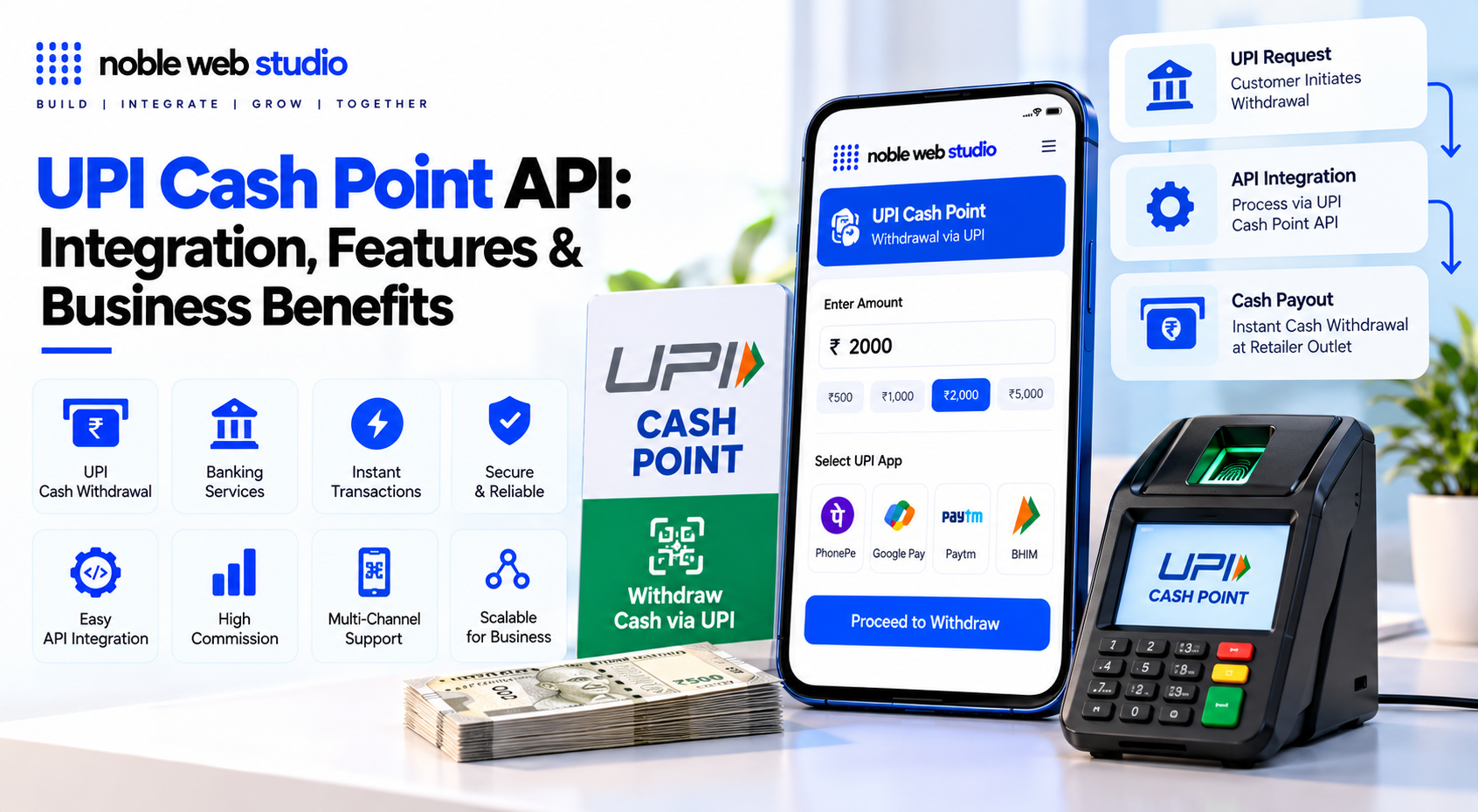
UPI Cash Point API integration helps businesses connect supported UPI-based cash withdrawal services with their applications, merchant platforms, or fintech software. For fintech startups, software developers, payment service businesses, and retailers, understanding how a UPI Cash Point API works is essential before choosing an integration partner. The right solution should support the required transaction workflow, provide clear UPI Cash Point API documentation, and help businesses manage transaction status and payment records efficiently.
A UPI Cash Point API is an application programming interface that enables compatible software to communicate with a supported UPI Cash Point service. Noble web studio capabilities the integration may support dynamic QR generation, transaction initiation, payment confirmation, transaction-status enquiry, webhook notifications, and transaction record management. The exact functions available depend on the API Noble web studio and the payment infrastructure being used.
The UPI Cash Point API is an NPCI-backed developer tool that lets local retail shops, Kirana stores, and Business Correspondents (BCs) act as cardless cash-withdrawal points. Customers scan a dynamic QR code using any UPI app, enter their UPI PIN, and receive physical cash from the merchant.
Unlike a general UPI payment integration, a cash point solution must account for the complete cash withdrawal workflow. The merchant should follow the supported transaction process, verify the appropriate confirmation, and provide cash only when the transaction has been successfully confirmed. Clear handling of pending, failed, and successful transactions is also important for accurate reconciliation and customer support.
Businesses can explore UPI Cash Point API integration to develop a compatible application, extend an existing fintech platform, or manage supported merchant services through a centralized system. Before implementation, developers should assess UPI Cash Point API authentication, request and response formats, error codes, callback or webhook handling, security controls, reporting requirements, and the process for reconciling transactions.
Choosing an integration partner also requires checking service availability, commercial terms, technical documentation, onboarding requirements, support arrangements, and the relevant authorizations. These checks help businesses understand whether the proposed integration fits their operational needs rather than selecting a Noble web studio based on feature lists alone.
Noble Web Studio helps businesses explore software development and UPI Cash Point API integration requirements for fintech projects. If you are planning a UPI Cash Point application or adding cash point functionality to an existing platform, discuss your required transaction flow, merchant management needs, reporting features, integration scope, and expected business scale before finalizing your project.
In this guide, we cover how UPI Cash Point API integration works, its key features, transaction processing, technical requirements, business applications, and the factors to consider when choosing an Noble web studio. The goal is to help you make an informed decision and plan a suitable integration for your business.
What is a UPI Cash Point API?
A UPI Cash Point API is an NPCI-backed developer tool that lets software platforms, fintechs, and Business Correspondents (BCs) turn local retail shops and Kirana stores into cardless cash-out counters. Customers scan a dynamic QR code using any UPI app, enter their PIN, and receive physical cash.
UPI Cash Point API Work?
A UPI Cash Point API allows fintech platforms, banks, and business correspondents to turn local shops into cardless micro-ATMs. Customers scan a dynamic QR code, authorize payment via their UPI app, and receive physical cash from the merchant while digital funds settle in real time.
How the Workflow Functions
- Request Cash: A customer visits a local merchant or Business Correspondent (BC) and asks to withdraw physical cash.
- Initiate API Call: The merchant types the amount into the software, triggering a
POSTrequest to generate a transaction. - Dynamic QR Generation: The UPI Cashpoint API generates a unique, single-use dynamic QR code tied to that exact sum.
- Scan & Authorize: The customer scans the QR code using any UPI app and enters their UPI PIN.
- NPCI Validation: The NPCI switch routes and verifies the payment between the customer’s bank and the merchant’s account.
- Webhook & Payout: A real-time webhook callback confirms success to the terminal, and the merchant hands over the physical cash.
Types of APIs Required for UPI Cash Point Integration
UPI Cash Point integration (cardless cash withdrawal at Business Correspondent or BC locations via NPCI guidelines) requires three core structural UPI Cash Point API layers: Cashpoint Dynamic QR / Intent Generation APIs to trigger the cash-out request, Transaction Status Enquiry APIs to verify live states, and Webhook / Callback Management APIs for asynchronous settlement.
Core API Types
Dynamic QR & Intent Generation API
- Generates time-bound, order-specific UPI QR codes or deep-link Intent payloads containing the exact cash-out amount and BC terminal identifier.
VPA / Payee Verification API
- Validates the customer’s Virtual Payment Address (VPA) and mobile number in real time before initiating the withdrawal to prevent routing errors.
Transaction Status Enquiry API
- Allows the BC terminal or merchant app to poll the bank or NPCI switch manually when a response is delayed or pending.
Webhook / Callback API
- Pushes real-time, event-driven transaction notifications (Success, Failed, or Timeout) from the bank or NPCI infrastructure back to the BC server.
Reconciliation & Payout / Commission API
- Handles end-of-day settlement tracking, ledger reconciliation, and automated calculation of Business Correspondent (BC) cash-out commissions.
UPI Cash Point API Requirements for Businesses
To integrate a UPI Cash Point API, businesses must partner with an authorized Noble web studio complete KYC and business verification, set up dynamic QR generation and webhook endpoints, and comply with NPCI cash-out limits (typically ₹5,000 per transaction).
Core Technical & API Requirements
- Dynamic QR Generation API: Systems must generate a one-time-use, transaction-specific dynamic QR code (valid for 60 to 120 seconds) rather than a static store QR.
- Intent & Payment Processing APIs: Handles app-to-app redirection or scanning so customers can authorize withdrawals via their preferred UPI app using their UPI PIN.
- Real-Time Status Enquiry & Webhooks: Must integrate endpoints to verify transaction states (success, pending, or failed) in real time before physical cash is handed over.
- Staging & Production Access: Requires completing a testing round in a staging environment (such as through the Noble web studio) before receiving production UPI Cash Point API keys and webhook configurations from Noble web studio.
Business & Regulatory Prerequisites
- KYC & Entity Verification: Submission of PAN card, Aadhaar card, business registration proof, GST certificate, or shop establishment license for the authorized signatory.
- Banking Setup: An active current or savings bank account (linked for liquidity, commission payouts, and automated settlements) plus a cancelled cheque or bank statement.
- Merchant Category & Rules: Must operate under designated guidelines (such as MCC 6013) with mandatory Two-Factor Authentication (UPI PIN). UPI LITE and credit-type accounts are excluded from cash-out services.
- Branding Compliance: Compliance with official NPCI UPI Cash Point Brand Guidelines for displaying wordmarks and logos at physical counter touchpoints.
- Hardware: A basic Android smartphone, tablet, or POS terminal running the UPI Cash Point app; no physical debit card swipe machine or biometric AEPS scanner is required.
UPI Cash Point API for Different Business Model
The UPI Cash Point API (backed by NPCI guidelines) enables local merchants, Kirana stores, and digital platforms to turn physical counters into cardless cash-dispensing micro-ATMs via dynamic QR or intent requests. Different business models adapt this UPI Cash Point API structure to fit their operational and revenue workflows.
1. Retail & Kirana Store Model (Counter-Top Micro-ATM)
- How it works: Shopkeepers use a mobile app or POS device to enter a requested cash amount, generating a dynamic QR code that the customer scans via apps like Google Pay, PhonePe, or Paytm.
- API Role: Uses dynamic QR generation endpoints and real-time webhook callbacks to verify customer UPI PIN authorization before handing over physical cash.
- Monetization: Earns per-transaction micro-commissions (typically ₹2 to ₹14) paid by the Noble web studio.
2. B2B Fintech & White-Label Distributor Model
- How it works: A fintech aggregator or master distributor builds a proprietary network of sub-agents and neighborhood retail outlets.
- API Role: Integrates a centralized multi-tenant UPI Cash Point API with tiered admin dashboards, automated distributor commissions, and real-time status enquiry endpoints.
- Monetization: Operates on revenue-sharing splits across the distributor hierarchy or SaaS/white-label platform licensing fees (ranging from ₹15,000 to ₹1,20,000+).
3. E-Commerce & Hybrid Retail Model (Cash-at-POS)
- How it works: Integrated directly into established retail chains or delivery partner networks where customers can pick up goods and pull out extra cash simultaneously.
- API Role: Combines standard payment/payout APIs with cash-dispensing logic, tracking store-level cash drawer liquidity in real time.
- Monetization: Drives store foot traffic and cross-sell opportunities while offsetting cash-management and deposit run costs.
4. Enterprise / Neobank Financial Inclusion Model
- How it works: Noble web studio deploy micro-ATM infrastructure in Tier-2/Tier-3 cities and rural villages where physical bank branches are sparse.
- API Role: Utilizes sandbox-tested NPCI-compliant Cashpoint APIs (Cashpoint Dynamic QR Generation, Transaction Status Enquiry, and Webhooks) for high-reliability auditing and automated reconciliation.
- Monetization: Focused on customer acquisition, deposit mobilization, and government/institutional financial inclusion subsidies.
Who Can Use UPI Cash Point API
The UPI Cash Point API can be used by fintech platforms, B2B software providers, authorized Business Correspondents (BCs), Bank Mitras, and local retail merchants (such as Kirana stores, pharmacies, and general shops) to turn physical counters into cardless cash-dispensing Noble web studio.
Eligible Entities & Users
- Fintechs & B2B Software Providers: Noble web studio that white-label or integrate cash-out capabilities into their own agent networks and dashboards.
- Business Correspondents (BCs) & Bank Mitras: Authorized banking agents who distribute cash without needing bulky card-swipe machines or biometric scanners.
- Kirana & General Stores: Neighborhood daily-needs shops that act as local cash points to earn transaction commissions.
- Medical & Pharmacy Outlets: Chemist shops offering cash withdrawals alongside regular retail sales.
- Mobile & Electronics Shops: Retail stores providing digital-to-cash services to footfall customers.
- Common Service Centers (CSC): Rural and semi-urban digital kiosks filling local cash-access gaps.
Why Use UPI Cash Point API
A UPI Cash Point API turns local retail shops, Kirana stores, and Business Correspondent (BC) outlets into cardless micro-ATMs. Customers scan a dynamic QR code using any UPI app (like Google Pay, PhonePe, or BHIM), authorize the transfer with their UPI PIN, and receive physical cash from the merchant.
Key Benefits for Users and Customers
- No Physical Card Needed: Withdraw cash using only a smartphone and a UPI-enabled banking app.
- Enhanced Security: Eliminates debit card skimming, cloning, and physical theft risks by using a private mobile UPI PIN and dynamic single-use QR codes.
- Better Local Accessibility: Access cash easily in rural, semi-urban, or neighborhood areas where traditional ATMs are broken or far away.
- Real-Time Speed: Transactions complete in seconds with instant notification updates to both the user and merchant.
Key Benefits for Retailers, BCs, and Fintechs
- Extra Commission Income: Shop owners and micro-agents earn per-transaction commissions (typically ranging from ₹2 to ₹14).
- Increased Footfall: Acting as a local cash point brings more walk-in customers into the retail shop.
- Zero Heavy Hardware Costs: Operates on standard Android smartphones or existing partner apps without requiring expensive POS machines or traditional ATM hardware.
- Better Cash Flow Management: Helps retailers circulate physical store cash cleanly through digital NPCI UPI settlements.
UPI Cash Point API Requirements in India
Integrating the UPI Cash Point API in India requires partnering with an RBI-licensed Noble web studio. Core requirements include generating real-time dynamic QR codes, handling intent/collect requests, enforcing OAuth2 and webhook security, and capping withdrawals at ₹5,000 per transaction.
Key Integration Requirements
- Business & Legal: Requires registration as an official business or Bank Mitra/BC with mandatory KYC verification (PAN, Aadhaar, location mapping) and a tie-up with an RBI-licensed sponsor bank.
- Core Technical APIs: Utilizes Dynamic QR Generation for time-bound cash-out amounts, Intent/Collect UPI Cash Point API for UPI app prompts, Transaction Status UPI Cash Point API for tracking, and Webhook Handlers for payment confirmations.
- Security & Infrastructure: Enforces OAuth2 access, idempotency via unique transaction IDs (
merchant_txn_id), SSL/TLS network encryption, IP whitelisting, and customer 2FA (UPI PIN) authorization without biometrics or cards. - Transaction Limits & Rules: Capped at ₹5,000 per transaction, ₹10,000 daily, and ₹50,000 monthly, restricted to savings/current accounts using MCC
6013, Purpose Code00, and Initiation Mode15.
UPI Cash Point API for Fintech Businesses
A UPI Cash Point API (such as Noble web studio) lets fintech businesses and B2B platforms turn local retail stores and Business Correspondents (BCs) into cardless cash-out stations. Customers scan a dynamic QR code or use a UPI intent flow on their phone to pay the merchant, and the merchant hands over physical cash in return.
Key Benefits for Fintechs
- Cardless & Skimming-Free: No physical debit cards or ATM hardware are required just a smartphone and a UPI app.
- Expanded Network Reach: Any onboarded kirana store, micro-ATM agent, or retail outlet can act as a cash point, boosting rural and semi-urban financial inclusion.
- New Revenue Streams: Fintech platforms and retailers earn commission incentives on every cash-out transaction processed through the network.
- Simplified Integration: Core UPI Cash Point API handle merchant/terminal ID mapping, webhook callbacks, automated reconciliation, and multi-tier distributor/retailer management.
UPI Cash Point API for Fintech Businesses
Why Business Need UPI Cash Point API
A UPI Cash Point API turns local retail stores, Kirana shops, and business networks into cardless micro-ATMs. It lets customers withdraw physical cash by scanning a dynamic QR code with any UPI app, bridging physical cash gaps without heavy ATM or biometric hardware.
Key Reasons Businesses Need the UPI Cash Point API
- New Revenue Streams: Merchants and Business Correspondents (BCs) earn direct per-transaction commissions (ranging from ₹2 to ₹14 depending on volume) for dispensing cash.
- Higher Store Footfall: Offering cash-out services draws more people into the shop, increasing the likelihood of cross-selling retail goods.
- Cardless and Biometric-Free: Requires no physical debit cards, card swipe machines, or AePS fingerprint scanners just a smartphone or integrated POS system.
- Real-Time Settlement & Reconciliation: Automated webhooks and instant status UPI Cash Point API ensure transparency, tracking every cash-out against drawer balances without manual paperwork.
- Interoperability: Backed by the National Payments Corporation of India (NPCI), customers from any participating bank can withdraw cash using apps.
- No Heavy Hardware Costs: Unlike traditional Micro ATM or micro ATM devices, businesses scale the service purely through software integration
Features UPI Cash Point API
The UPI Cash Point API is an NPCI-backed infrastructure service that lets local retailers, Kirana shops, and Business Correspondents (BCs) act as cardless micro-ATMs. Customers scan a dynamic QR code using any UPI app, enter their UPI PIN, and receive physical cash while the funds transfer digitally.
Key Features of UPI Cash Point API
- Dynamic QR Generation: Creates single-use, time-bound QR codes locked to specific withdrawal amounts and terminal IDs.
- UPI PIN Authorization: Secures user transactions directly inside apps like Google Pay, PhonePe, or BHIM without sharing card data.
- Real-Time Webhooks: Delivers instant push notifications and status updates to backend servers when a payout clears.
- Transaction Status Enquiry API: Polls or verifies transaction states (success, pending, or failed) before cash is handed over.
- Auto-Reconciliation Engine: Matches transaction IDs, Retrieval Reference Numbers (RRN), and UTRs to balance merchant ledgers.
- Commission & Agent Management: Calculates retailer/agent margins, tracks partner incentives, and manages working-capital credit lines.
- Zero Hardware Dependency: Requires no physical debit cards, POS machines, or biometric scanners—only a smartphone or integrated partner app.
Benefits UPI Cash Point API
The UPI Cash Point API enables local Kirana stores, retail shops, and Business Correspondents (BCs) to operate as cardless, human-run micro-ATMs. Customers scan a dynamic QR code using any UPI app, enter their PIN, and receive physical cash while merchants earn transaction commissions.
For Customers & Users
- Card-Free Access: Withdraw physical cash using only a smartphone and a UPI app without needing a physical debit card or ATM.
- High Security: Eliminates card-skimming, cloning, and physical theft risks. Each transaction uses a time-bound, single-use dynamic QR code authorized privately via your UPI PIN.
- Better Reach: Get cash easily at neighborhood Kirana stores and local trade points in semi-urban and rural areas where traditional ATMs are sparse.
- Multi-Account Flexibility: Easily switch between different bank accounts linked inside your UPI app during a cash-out.
For Retailers & Business Correspondents
- Extra Commission Income: Earn a direct commission or partner incentive on every cash-out transaction processed.
- Increased Footfall: Attract new walk-in customers who need emergency cash services into your store.
- Zero Hardware Costs: Runs on a standard Android smartphone or existing B2B app no card swipe machines, Micro ATM hardware, or Aadhaar fingerprint scanners required.
- Better Cash Flow Management: Helps balance physical cash-in-hand through digital NPCI/bank settlements.
For Fintechs & Platform Providers
- Plug-and-Play Integration: Easily embed REST/JSON UPI Cash Point API, webhooks, and push notifications into existing B2B panels or retailer apps.
- Interoperability: Backed by NPCI infrastructure, allowing users from any participating bank to withdraw funds seamlessly.
- Real-Time Status Tracking: Instant transaction verification (success, pending, or failed) protects both the agent and customer before cash changes hands.
UPI Cash Point API Integration Workflow
Integrating UPI Cash Point API involves partnering with an authorized Noble web studio completing business KYC, and deploying backend endpoints for dynamic QR generation, PIN authorization, and real-time webhook status notifications.
Onboarding & Authentication
- Noble web studio Registration: Visit an authorized Noble web studio.
- Business KYC: Submit corporate registration documents, PAN, and GST details for merchant verification.
- Credentials: Obtain production/sandbox UPI Cash Point API keys, Merchant ID (MID), and Terminal ID (TID) from the partner developer dashboard.
- OAuth Setup: Authenticate UPI Cash Point API requests using a bearer-token or OAuth2 client-credentials flow.
Core Integration Workflow
- Withdrawal Request: The merchant app captures the customer’s requested cash amount and mobile number, sending a request to your server.
- Dynamic QR Generation: Your backend calls the POST /dynamic-qr or cashpoint generation endpoint to create a unique, single-use QR payload tied to that specific transaction.
- Customer Scan & App Intent: The customer opens any UPI-enabled app to scan the dynamic QR code or trigger the UPI Intent flow.
- UPI PIN Authorization: The customer selects their bank account and enters their private UPI PIN to authorize the cash-out.
- Network Verification & Webhook: The NPCI switch processes the debit/credit, and an instant webhook (/webhook/status) notifies your server of the successful transaction.
- Cash Handover: Once the backend verifies the status update, the merchant hands over the physical cash.
Testing & Verification
- Sandbox Environment: Execute end-to-end test flows using staging UPI Cash Point API to validate QR creation, mock scans, status enquiries, and webhooks.
- Fallback & Reconciliation: Implement a polling/status inquiry UPI Cash Point API fallback to handle network drops or delayed webhook callbacks.
UPI Cash Point API Cost in India
The cost structure for a UPI Cash Point API involves setup fees ranging from ₹0 to ₹50,000, platform or routing fees of 0.20% to 2% (or a flat ~₹8 per withdrawal), and retailer/agent commissions of ₹2 to ₹14 per cash-out transaction.
Setup and Integration Costs
- Onboarding & Setup Fees: ₹0 to ₹50,000 (one-time) depending on whether you use an open-market micro enterprise UPI Cash Point API or an enterprise-grade banking correspondent (BC) framework.
- Software / White-Label Customization: ₹15,000 to ₹1,20,000+ for customized admin dashboards, branding, and licensing.
- Annual Maintenance Charges (AMC): ₹10,000 to ₹40,000 per year covering server hosting, security patches, and switch uptime.
Platform & Transaction Fees
- Routing & Aggregator Fees: 0.20% to 2% of the transaction amount, or a fixed platform charge of around ₹8 per withdrawal.
- Standard UPI Transfer MDR: Standard bank-account-to-bank-account UPI transfers have a regulatory MDR of 0% for standard flows, though specific P2M transactions above ₹2,000 carry a 0.4% MDR framework.
UPI Cash Point API Commission Structure
A UPI Cash Point API commission structure typically pays retailers or agents ₹2 to ₹14 per successful cash withdrawal. Lower slabs (₹100–₹3,000) use a percentage model (0.36% to 0.50%), while higher slabs (₹3,001–₹5,000) offer flat payouts around ₹10 to ₹11+ per transaction.
Typical Commission Slabs
- ₹500 – ₹999: ₹1 flat commission
- ₹1,000 – ₹1,999: ₹2 flat commission
- ₹2,000 – ₹2,999: ₹4 flat commission
- ₹3,000 – ₹3,500: ₹7 flat commission
- ₹3,001 – ₹5,000 (Higher Slabs): ₹10 to ₹14+ per transaction (depending on volume tiers and aggregator schemes)
Transaction Limits & Rules
- Limits: Capped at ₹5,000 per transaction, ₹10,000 daily per user, and ₹50,000 monthly per user, with a 30-minute cooling period between repeat transactions.
API & Software Integration Costs
- Setup and AMC: Standard platform setup ranges from ₹0 to ₹12,000, white-label B2B setups cost ₹15,000 to ₹1,20,000+, direct bank integrations range from ₹2.5 Lakhs to ₹4.5 Lakhs+, and annual maintenance charges run ₹10,000 to ₹40,000.
UPI Cash Point API Documentation
The UPI Cashpoint API (aligned with the latest NPCI directive) allows fintech platforms, Business Correspondents (BCs), and Micro-ATMs to provide cardless cash-out services. Instead of using a physical debit card, customers scan a dynamically generated QR code via any UPI application to withdraw physical cash from an authorized merchant.
Core System & Compliance Specifications
To invoke these APIs in production, your system configuration must comply with the strict routing rules designated by NPCI:
- Merchant Category Code (MCC): Must be set to 6013 (Cash-out / ATM Services).
- Purpose Code: Must be set to 00.
- Initiation Mode: Must be set to 15.
- Eligible Accounts: Restricted to standard Savings and Current bank accounts; UPI LITE and credit-linked lines are strictly excluded from cash-out transactions.
⚙️ Core Technical Workflow
A typical implementation requires integrating three primary phases: Dynamic QR Generation, Status Polling, and an Asynchronous Webhook Callback Handler.
 [Retailer App] ----(1. POST /create-request)----> [Fintech Gateway]
       ^                                                 │
       │                                       (2. Generates QR / Intent)
       └------------(3. Returns QR_URL)------------------┴> Customer Scans
                                                                 │
                                                      (4. Customer UPI PIN Auth)
                                                                 │
 [Retailer App] <---(5. Instant Payout/Webhook)----------- [NPCI Switch]
1. Dynamic QR Generation API
This endpoint initiates the cash withdrawal request. It captures the withdrawal amount, maps the transaction to the specific physical retail outlet, and returns a unique, single-use QR string or payment URL.
- Endpoint Protocol:
POST /api/v1/cashpoint/create-request - Header Authentication: Requires standard
Bearer Tokenor customHMAC Request Signature, alongside pre-configured IP Whitelisting.
Sample Request Payload:
{
  "merchantId": "BC_OUTLET_MUM991",
  "retailerMobile": "9876543210",
  "transactionAmount": 2000.00,
  "currency": "INR",
  "mcc": "6013",
  "initiationMode": "15",
  "purposeCode": "00",
  "clientReferenceId": "TXN202610210089A"
}
Sample Response Payload:
{
  "status": "SUCCESS",
  "responseCode": "200",
  "message": "Dynamic Cashpoint QR Generated successfully.",
  "data": {
    "clientReferenceId": "TXN202610210089A",
    "npciTransactionId": "NPCI40921098412",
    "qrCodeUrl": "upi://pay?pa=merchant@sponsorbank&pn=MerchantName&am=2000.00&mam=2000.00&cu=INR&mc=6013&mode=15&purpose=00&tr=TXN202610210089A",
    "expiresAt": "2026-10-21T10:52:00Z"
  }
}
2. Transaction Status Enquiry API
If network latency delays the automated webhook delivery, your application must call this polling endpoint to confirm whether the funds have safely moved out of the customer’s account before the merchant dispenses physical currency.
- Endpoint Protocol:
GET /api/v1/cashpoint/status?clientReferenceId=TXN202610210089A
Sample Response Payload:
{
  "status": "SUCCESS",
  "data": {
    "clientReferenceId": "TXN202610210089A",
    "npciTransactionId": "NPCI40921098412",
    "transactionStatus": "SUCCESSFUL",
    "remitterName": "John Doe",
    "settlementWalletBalance": 14500.50,
    "commissionEarned": 5.00
  }
}
3. Webhook Callback Event
Upon a successful debit at the NPCI switch, the UPI Cash Point API gateway sends an asynchronous POST alert to your system’s listener URL. This represents the definitive trigger to safely hand over physical cash to the customer.
Sample Webhook Payload:
{
  "event": "transaction.cashout.success",
  "timestamp": "2026-10-21T10:48:15Z",
  "payload": {
    "clientReferenceId": "TXN202610210089A",
    "npciTransactionId": "NPCI40921098412",
    "amount": 2000.00,
    "status": "SUCCESS",
    "statusCode": "00"
  }
}
Transaction Limits & Constraints
| Metric | Regulatory Cap |
|---|---|
| Minimum Amount | ₹100 per transaction |
| Maximum Amount | ₹5,000 per transaction (Some platforms permit up to ₹10,000 depending on sponsor bank routes) |
| Daily Cumulative Limit | ₹10,000 per customer profile |
| Monthly Cumulative Limit | ₹50,000 per customer profile |
| Frequency Rules | Maximum of 2 transactions per day |
| Safety Intermission | Mandatory 30-minute cooling-off period between consecutive attempts |
Visual & Branding Compliance Guidelines
Any integration must strictly adhere to the official NPCI UPI Cash Point Brand Guidelines before moving out of the staging environment:
- Typography: The “UPI Cash Point” wordmark must utilize the Helvetica typeface exclusively.
- Digital Interfaces: The logo asset must be rendered at a minimum width of 40px.
- Print Formats: Counter signages or banners require a minimum size of 15% of the total layout width or 30mm.
- Co-Branding Alignment: Partner logos must sit directly before the UPI Cash Point emblem and match it at a strict 1:1 height proportion.
- Powered By Label: The official “Powered by UPI” asset must be positioned at the bottom-center of the app interface where the dynamic UPI Cash Point API interactions occur.
UPI Cash Point API Transaction Limits
UPI Cash Point (Business Correspondent / MicroATM touch points) and UPI-ATM cash withdrawal limits are governed by NPCI guidelines:
- Per-Transaction Limit: ₹5,000 for retail UPI Cash Points / MicroATMs (and up to ₹10,000 for interoperable UPI-ATMs).
- Daily Limit: ₹10,000 per day for retail cash points (UPI-ATMs fall under standard daily UPI caps up to ₹1,00,000).
- Monthly Limit: ₹50,000 per month for retail touch points.
- Frequency & Cooling Period: Maximum of 2 transactions per day with a 30-minute cooling period between repeat transactions.
- Authentication: Mandatory Two-Factor Authentication (2FA) via UPI PIN on the user’s mobile app.
- Account Types: Limited to savings and current accounts; UPI LITE and credit-type accounts are excluded.
- Technical Parameters: Routed using Merchant Category Code (MCC) 6013, Purpose Code 00, and Initiation Mode 15 via dynamic QR codes.
Transaction Limits Comparison
| Type of Touch Point | Per-Transaction Limit | Daily Limit | Monthly Limit |
|---|---|---|---|
| UPI Cash Point / MicroATM | ₹5,000 | ₹10,000 | ₹50,000 |
| UPI-ATM (ICCW) | ₹10,000 | Up to ₹1,00,000 (Bank specific) | Subject to bank/UPI caps |
UPI Cash Point API Request, Response and Status Handling
The UPI Cash Point API manages cash-out withdrawals at local merchant agents through three core pillars: dynamic QR generation requests, real-time transaction responses, and asynchronous status handling via webhooks or polling.
1. Request Structure (Dynamic QR Generation)
The agent or merchant system sends a POST request to generate a single-use withdrawal QR code tied to a specific client reference.
- Endpoint:
POST /v1/cashpoint/dynamic-qr - Sample Request Body:
{
  "clientRefId": "CR202610219876543",
  "amount": 500,
  "payeeVPA": "merchant.cash@icici",
  "platform": "MOBILE",
  "transaction_note": "Cash withdrawal at store"
}
2. Response Structure
Upon a successful UPI Cash Point API request, the system returns base64-encoded QR data or payment states that the agent displays to the customer.
- Sample Response Body (
200 OK):
{
  "status": "SUCCESS",
  "statusCode": "00",
  "statusDesc": "QR generated successfully",
  "clientRefId": "CR202610219876543",
  "txnId": "UPI987654321098",
  "amount": 500,
  "payeeVPA": "merchant.cash@icici",
  "qrData": "iVBORw0KGgoAAAANSUhEUgAAAP..."
}
3. Status Handling & Webhooks
Because UPI transactions can briefly enter a pending state due to bank or NPCI routing delays, systems track completion using Webhooks and Status Enquiry APIs.
- Webhook Payload (
POSTto Merchant Endpoint):
{
  "txnId": "UPI987654321098",
  "txnAmt": "500",
  "status": "SUCCESS",
  "statusCode": "00",
  "statusDesc": "Transaction Successful",
  "payer_vpa": "customer@okaxis",
  "payee_vpa": "merchant.cash@icici",
  "transaction_date": "2026-10-21T10:52:00Z"
}
- Fallback Strategy: If a webhook callback is missed or times out, the client must trigger a server-side Status Enquiry API (polling) using the
txnIdorclientRefIdbefore handing over physical cash.
UPI Cash Point API Authentication and Security
UPI Cash Point APIs rely on two-factor authentication (2FA via UPI PIN and device binding), end-to-end TLS encryption, single-use dynamic QR codes, and server-side webhook validation to ensure secure, cardless cash-out transactions through the NPCI network.
Core Authentication Layers
- Bearer / JWT Tokens: UPI Cash Point retailer applications authenticate UPI Cash Point API requests to the aggregator using standard protocols like JWT, OAuth 2.0, or signed API keys.
- IP Whitelisting: Server-to-server calls restrict origin access by registering static outbound IP addresses with the payment gateway.
- Device Binding: The customer’s UPI app is cryptographically tied to their physical mobile device hardware to block remote app spoofing.
- UPI PIN Authorization: End-users authorize the cash withdrawal locally on their smartphone using their confidential UPI PIN.
Security & Risk Measures
- Dynamic QR Codes: The system generates a single-use, time-bound QR code for each cash point session to prevent replay attacks and duplicate processing.
- Server-Side Validation: Integration backends must verify transaction status directly via server-to-server callbacks (webhooks) rather than trusting client-side app screens or screenshot confirmations.
- Tokenization & Masking: Actual bank account numbers and sensitive card credentials are never exposed or stored in plain text across the cash point software.
- Transaction Limits & Monitoring: Cash point withdrawals enforce strict per-transaction caps (typically up to ₹5,000 at retail shops or ₹10,000 at UPI ATMs) alongside real-time AI fraud detection.
- Auto-Reversals: In the event of a cash dispensing failure or network timeout, the core banking system automatically reverses the debited funds within defined NPCI timelines.
UPI Cash Point API Transaction Status and Error Handling
The UPI Cash Point API handles cardless cash withdrawals via NPCI infrastructure using a Dynamic QR Generation API, Transaction Status Enquiry API, and Webhook Integration to poll, track, and lock cash-dispensing states in real time.
Core Transaction Status Flow
- Initiation: The merchant generates a dynamic QR code mapped to the withdrawal amount using the Dynamic QR Generation API.
- Polling & Enquiry: Systems call the Transaction Status Enquiry API to verify if a payment is SUCCESS, PENDING, or FAILED before releasing cash.
- Webhooks: Automated server-to-server push notifications update the merchant backend instantly upon settlement to prevent double-dispensing.
- Idempotency: Every request uses a unique transaction ID (txnId or clientRefId) to block duplicate debits if network timeouts trigger a retry.
Common Status Codes & Error Handling
| Code / State | Status | Description | Recommended Action |
|---|---|---|---|
00 | SUCCESS | Transaction completed and cleared | Dispense physical cash to customer |
01 | PENDING | Awaiting response from bank network | Hold cash release; poll status enquiry or wait for webhook |
RB | DEEMED | Beneficiary bank system unresponsive | Do not dispense cash; retry or trigger status check |
ZA | DECLINED | Transaction declined by bank/user | Abort cash release; prompt user to retry or check balance |
U69 | EXPIRED | Collect or QR intent expired | Regenerate dynamic QR code |
YG | FAILURE | Validation error (amount/TID mismatch) | Check payload formatting and re-initiate |
Failure & Reversal Protocols
- Pre-Debit Failure: If the payment fails before account debit, no money moves and a failure prompt appears immediately.
- Debited but Un-dispensed: If an account is debited but cash is not handed over due to a glitch, the system triggers an automated reversal (UPI-REV).
- Timelines: Under RBI rules, automated reversals process within T+1 to T+5 business days, with delayed reversals subject to customer compensation rules.
UPI Cash Point API Settlement and Reconciliation
The UPI Cash Point API enables cardless cash withdrawals at merchant or Business Correspondent (BC) outlets via dynamic QR and UPI app auth. Settlement and reconciliation sync funds across customer bank accounts, the NPCI Switch, acquirer/issuer banks, and merchant/retailer ledgers.
Core Settlement & Clearing Cycle
- Authorization & Payout: The customer scans a dynamic QR code for a specific cash-out amount, enters their UPI PIN, and the issuer bank debits the user’s account while the merchant hands over physical cash.
- NPCI Net Settlement: Transactions are batched and settled across participating banks through the RBI/NPCI clearing mechanism, segregated under current NPCI auth and dispute cycle norms (such as standard Auth cycles 1–10 and dedicated dispute cycles).
- T+0 / T+1 Payout to Merchant/BC: Acquirer banks or platform fintechs credit the merchant or BC settlement account minus applicable interchange or tier-based commission margins.
Reconciliation & API Workflows
- Real-Time Webhooks: The API fires automated push notifications upon transaction completion to update local point-of-sale (POS) or backend servers instantly.
- Status Enquiry APIs: Systems use Transaction Status Enquiry endpoints to poll or verify pending, timed-out, or ambiguous states before releasing cash or closing ledgers.
- Three-Way Ledger Matching: Automated reconciliation matches records across:
- Core Banking System (CBS) / Bank Statements
- NPCI Raw / Switch Settlement Files
- Merchant / Fintech Ledger & Webhook Logs
- Dispute & Chargeback Handling: Mismatches (such as customer account debited but cash not dispensed or timeout states) trigger automated adjustment requests, chargebacks, or manual exception queues via the settlement dashboard.
UPI Cash Point API SLA, Uptime and Support
The UPI Cash Point API delivers a standard 99.9% platform uptime, supports cardless cash withdrawals via NPCI-backed dynamic QR codes, and includes 24×7 technical support for integration, transaction tracking, and real-time webhook reconciliation.
Service Level Agreement (SLA) & Uptime Specs
- Platform Uptime: Typically committed at 99.9% availability by leading aggregator and switch providers.
- Allowable Downtime: Roughly 43 minutes of unscheduled infrastructure maintenance or system gaps per month.
- Exclusions: SLAs usually exclude network failures, bank switch outages, or downtime originating directly on NPCI/core banking rails.
- Transaction Limits & Flow: Caps are generally set at ₹5,000 per transaction, ₹10,000 per day, and a 30-minute cooling period between repetitive pulls.
Technical Architecture & APIs
- Core Endpoints: Dynamic QR Generation API, Transaction Status Enquiry API, and real-time Webhook notifications.
- Testing Environment: Staging and sandbox environments are provided for single-round end-to-end integration checks (Intent API, QR generation, and webhook validation) prior to production rollouts.
- Settlement Models: Supports instant or scheduled (T+0 / T+1) reconciliations linked via transaction IDs or virtual UPI IDs.
Support & Incident Management
- Support Availability: Round-the-clock (24×7) technical and operational assistance for API handshakes, error handling, and dispute management.
- Issue Escalation: Real-time dashboard reporting tracks failed or pending states, and automated status enquiry APIs mitigate hanging/stuck debit states.
UPI Cash Point API Sandbox and Testing
A UPI Cash Point API sandbox provides a simulated environment to test cash-in and cash-out withdrawals, dynamic QR generation, intent/collect flows, and webhook callbacks using test VPAs before going live with Noble web studio.
Core Sandbox Features
- Dynamic QR Generation: Create test payment and withdrawal requests.
- Intent & Collect APIs: Simulate user app authorization Noble web studio.
- Webhook & Callbacks: Test real-time status updates and reconciliation payloads.
- Status Enquiry APIs: Poll and confirm transaction states (success, pending, or failed).
Standard Testing Checklist
- Authentication: Validate sandbox-only UPI Cash Point API keys, tokens, and IP whitelisting.
- Idempotency: Send duplicate transaction payloads to confirm single-charge protection.
- Error Handling: Simulate network timeouts, declined transactions, and invalid VPA errors.
- Transaction Limits: Verify built-in per-transaction caps and cooling-off timers.
UPI Cash Point API Provider: Features to Compare
Noble web studio is a UPI Cash Point API provider lets businesses turn retail stores into cardless cash-out counters using NPCI’s UPI infrastructure. When Noble web studio evaluate dynamic QR/Intent support, real-time webhooks, settlement speed (T+0/T+1), agent/merchant management, and compliance/KYC readiness.
Core Features to Compare
1. Transaction & Payment Flow
- Dynamic QR & Intent APIs: Look for single-use, time-bound QR code generation and app-to-app UPI intent redirect flows.
- Multi-App Interoperability: Ensure support for all major consumer apps.
- Cardless & Hardware-Free: Confirm whether transactions run purely on Android apps or require extra hardware like micro-ATM/AEPS biometric scanners.
2. Settlement & Financial Operations
- Settlement Speed: Compare T+0 instant wallet/bank settlements versus standard T+1 end-of-day cycles.
- Liquidity & Float Management: Check tools for tracking merchant cash floats, credit/working capital extensions, and daily balance reconciliation.
- Commission Structure: Review per-transaction margins, slab-based incentives, and partner payout transparency.
3. Developer & Integration Support
- Webhook & Push Notifications: Verify real-time callback reliability with idempotency and auto-retry logic for pending/failed states.
- Status Enquiry APIs: Ensure instant UTR/RRN tracking and lookup endpoints to verify status before handing over physical cash.
- Sandbox Environment: Test staging UPI Cash Point API, mock flows, and developer documentation quality prior to going live.
4. Administration & Compliance
- Merchant/Agent Hierarchy: Look for multi-tier management (Admin -> Distributor -> Retailer/Business Correspondent).
- Regulatory & KYC Compliance: Check onboarded bank tie-ups, NPCI/RBI guideline adherence, and automated business KYC workflows.
Common UPI Cash Point API Integration Problems
Common UPI Cash Point and Payment API integration problems include delayed or pending transaction states, unverified or missed webhook callbacks, bank server downtime, and reconciliation mismatches between dynamic QR triggers and cash dispenser logs.
Core Technical Challenges
- Pending & Timeout States: Transactions can remain stuck in an intermediate state before final settlement. Fulfilling cash dispenses or orders before a verified terminal state risks financial loss.
- Webhook Unreliability: Missing, duplicated, or unverified server-to-server notifications lead to out-of-sync backend ledgers.
- Bank & PSP Downtime: Multi-bank routing issues across the NPCI network cause dropped intents or slow QR generations.
- Authentication & Payload Errors: Invalid signature headers, wrong API keys, or malformed JSON payloads break communication with Noble Web Studio endpoints.
- Rate Limiting: High-frequency calls for status enquiries or balance checks risk throttling or suspension under NPCI guidelines.
Operational & Compliance Issues
- Reconciliation Gaps: Mismatches between cash point terminal logs, merchant aggregator reports, and bank settlement files.
- Client-Side Validation Flaws: Trusting app screens or client callbacks instead of server-side status verification.
- KYC & Terminal Mappings: Incorrect binding of merchant IDs (MIDs) and terminal IDs (TIDs) causing rejected cash withdrawal or deposit requests.
UPI Cash Point API vs AEPS API vs Micro ATM
UPI Cash Point API, AEPS API, and Micro ATMs are all digital cash-dispensing systems for retail shops in India, differing primarily by technology and authentication. UPI Cash Point uses cardless QR/intent mobile scans, AEPS API uses Aadhaar biometric fingerprint scans, and Micro ATMs use physical debit cards with PINs.
Core Differences
| Feature | UPI Cash Point API | AEPS API | Micro ATM |
|---|---|---|---|
| Authentication | UPI app scan / Dynamic QR / Intent | Aadhaar number + Biometric (Fingerprint/Iris) | Debit Card + 4-digit PIN |
| Hardware Required | Smartphone / Software API integration | Smartphone + Biometric scanner (RD Device) | Portable Micro ATM card terminal |
| Customer Requirement | UPI-enabled smartphone app | 12-digit Aadhaar + Linked bank account | Physical bank debit card |
| Primary Use Case | Cardless cash withdrawal via merchant network | Rural banking, balance check, and cardless service | Traditional card-based cash withdrawal & inquiry |
Detailed Breakdown
UPI Cash Point API
- How it works: Software interface integrated into a business app or website that generates dynamic QR codes or payment intents for cash-out.
- User experience: The customer scans the QR code using any UPI app, authenticates with their UPI PIN, and the merchant hands over cash.
- Best for: Tech-savvy urban or semi-urban retail stores wanting to offer cash-out services without extra hardware.
AEPS API (Aadhaar Enabled Payment System)
- How it works: A backend bridge connecting merchant software to the NPCI via Aadhaar and biometric data.
- User experience: The customer provides their bank name, 12-digit Aadhaar number, and presses their finger on a certified biometric scanner.
- Best for: Rural inclusion, unbanked citizens, and seniors who do not carry smartphones or debit cards.
Micro ATM
- How it works: A standalone or paired physical handheld hardware terminal (POS-like device) with a card slot and keypad.
- User experience: The customer inserts or swipes a physical bank debit card and enters their secret PIN.
- Best for: Business correspondents (BCs) and shopkeepers handling traditional debit card holders or customers with failing biometric fingerprints.
Noble Web Studio One of The UPI Cash Point API Provider in india
Noble Web Studio one of the right UPI Cash Point API provider requires evaluating key technical, financial, and regulatory factors to ensure reliable cardless cash-out services for your retail or fintech network.
Core Technical & Integration Factors
- Dynamic QR Support: Ensure the API natively generates real-time, one-time-use dynamic QR codes (valid for 60 to 120 seconds) instead of static store codes.
- No-Biometric Frictionless Flow: Confirm that transactions run smoothly via standard UPI PIN or dynamic QR app authorization without needing extra hardware like fingerprint scanners.
- High Uptime & Success Rate: Look for infrastructure with 99%+ uptime, fast processing times, and low failure or pending-state rates.
- Webhook & Reconciliation Tools: Require real-time transaction-status webhooks, automated ledgers, and exportable logs to match physical cash drawers with digital inflows.
- White-Label & Multi-Tier Panels: If you manage distributor or retailer networks, check for white-label options and multi-tier admin control panels.
Financial & Commission Factors
- Commission Margins: Compare the exact per-transaction payout or profit margins earned per cash withdrawal.
- SaaS & Setup Fees: Factor in any monthly software maintenance fees, platform setup costs, or hidden charges.
- Settlement Speed: Verify whether the Noble Web Studio supports instant (T+0) or end-of-day (T+1) automated wallet and bank account settlements.
Compliance & Support
- NPCI Guidelines Compliance: Ensure the Noble Web Studio strictly aligns with NPCI UPI Cashpoint frameworks and brand display rules.
- Developer Support & Sandbox: Look for clear UPI Cash Point API documentation, active technical helpdesks, and an interactive sandbox for testing.
Why Choose Noble Web Studio for UPI Cash Point API Integration?
Noble Web Studio is a reliable provider for UPI Cash Point API integration turns local retail shops and business outlets into cardless mini-ATMs. Noble Web Studio lets customers withdraw cash by scanning a dynamic QR code with any UPI app while offering merchants real-time tracking, low hardware overhead, and extra commission income.
Key Benefits of Choosing a Noble web studio
- Cardless & Biometric-Free: Eliminates physical debit/credit cards, ATM visits, and external fingerprint scanners; users only need a smartphone and a UPI app.
- NPCI-Backed Interoperability: Works across all participating banks and UPI apps (such as Google Pay, PhonePe, and BHIM), ensuring broad customer reach.
- Dynamic QR & Intent APIs: Automatically generates transaction-specific QR codes and handles app-to-app redirection for instant PIN authorization.
- Real-Time Webhooks & Status Enquiry: Delivers instant transaction status updates (success, pending, or failed) to prevent manual verification errors or cash hand-over disputes.
- Retailer Commission & Growth: Generates guaranteed per-transaction commission for shop owners while boosting daily store footfall.
- Easy Onboarding & B2B Management: Provides admin dashboards for master distributors and fintech partners to manage downline retailers, liquidity, and settlement metrics.
Conclusion
Choosing the right UPI Cash Point API is an important step for businesses that want to develop or expand digital payment and cash withdrawal services. A suitable UPI Cash Point API integration can connect your application with the supported UPI Cash Point transaction process and help your business manage payment requests, transaction verification, status updates, and transaction records more efficiently.
Noble web studio is a UPI Cash Point API provider, evaluate the complete integration process, UPI Cash Point API documentation, dynamic QR generation, transaction-status enquiry, webhook support, security controls, error handling, reconciliation features, and technical assistance. These capabilities help developers build a more reliable workflow and make it easier for businesses to investigate pending or failed transactions. Actual functionality depends on the Noble web studio, the available integration, and the applicable authorization requirements.
The UPI Cash Point API is a developer tool built on National Payments Corporation of India (NPCI) guidelines. It lets fintech platforms, apps, and local merchants turn Kirana stores or Business Correspondent (BC) outlets into cardless cash withdrawal spots. Customers scan a dynamic QR code, enter their UPI PIN, and get physical cash from the shop owner while the money transfers digitally.
Noble Web Studio can help businesses explore UPI Cash Point software development and UPI Cash Point API integration requirements for their fintech projects. Whether you are planning a new UPI Cash Point application, extending an existing UPI Cash Point platform, or developing UPI Cash Point software for retailers and business partners, define your required features, expected transaction volume, reporting needs, and operational workflow before starting development.
If you are looking for a UPI Cash Point API with Noble Web Studio, discuss your project requirements with the team to understand the suitable UPI Cash Point API development approach, integration scope, estimated cost, and implementation timeline. Ensure that the selected service and transaction flow are supported by the relevant authorized payment partners before launching.
Ready to discuss your UPI Cash Point API project? Contact Noble Web Studio to explore your requirements and plan the next steps toward building your fintech solution.
Frequently Asked Questions About UPI Cash Point API
A UPI Cash Point API enables eligible fintech platforms and software applications to integrate UPI-based cash withdrawal services through an authorised service arrangement. Depending on the integration, it may support QR generation, transaction status verification, notifications, and transaction record management.
The process generally starts when a retailer initiates a cash withdrawal request. The system generates a QR code, the customer scans it using a supported UPI app and authorises the transaction, and the system verifies the payment status. Cash should be handed over only after the transaction is confirmed successful through the authorised Noble Web Studio process.
Compare API documentation, supported functions, security controls, transaction status handling, testing facilities, technical support, pricing terms, and the Noble Web Studio authorised service arrangements. Confirm that the Noble Web Studio can support your intended business model before starting integration.
Depending on the service arrangement, useful capabilities may include dynamic QR generation, transaction status enquiry, secure callbacks or webhooks, unique transaction references, transaction reports, error handling, and reconciliation support. Confirm which features are actually available before choosing an API.
Start by confirming eligibility and the required Noble web studio arrangement. Review the API documentation, configure authentication, implement the required endpoints, handle responses and callbacks, test successful and failed transactions, and validate transaction reconciliation before moving to production.
Some UPI Cash Point integrations support dynamic QR generation for transaction-specific payment requests. Availability and implementation depend on the authorised Noble web studio. Verify the QR format, expiry behaviour, supported transaction flow, and status-verification method in the documentation.
A transaction status API allows an integrated application to check the current status of a transaction using the supported reference details. It is particularly useful when an initial request times out or a callback is delayed. The application should follow the Noble web studio status-handling rules before treating a transaction as successful.
Webhooks can notify an integrated application when a transaction event or status update occurs. Developers should validate incoming notifications, handle duplicate callbacks safely, and use status enquiry when an expected notification does not arrive.
A pending transaction needs further verification through the authorised Noble Web Studio status-enquiry or reconciliation process. Retailers should not assume that a pending transaction has succeeded. The system should record the reference ID, check for status updates, and follow the applicable dispute or reversal procedure.
Security depends on the implementation and the authorised service arrangement. Good practices include encrypted communication, protected API credentials, access controls, request validation, verified callbacks, and secure transaction logs. Businesses should follow the security requirements specified by their Noble Web Studio.
Requirements vary by Noble web studio, business model, and authorised Noble Web Studio arrangement. Businesses may need registration details, identity and business verification documents, banking information, and retailer or business correspondent onboarding records. Confirm the exact checklist with the relevant Noble web studio before applying.
The cost depends on the pricing, integration complexity, software customisation, testing, hosting, maintenance, and ongoing support. Ask for a written quotation that clearly separates setup charges, recurring fees, transaction-based charges, and optional development costs.
It may be possible if the existing application can meet the API’s technical, security, and operational requirements. Developers should review the supported endpoints, authentication method, transaction workflow, callback handling, and production eligibility before estimating the integration work.
UPI Cash Point and AEPS are different service models. UPI Cash Point uses a UPI-based transaction flow, commonly involving QR scanning and customer authorisation. AEPS uses an Aadhaar-based banking transaction flow with the authentication method required by the relevant service. Availability, eligibility, and operating requirements differ.
Use the testing environment and credentials provided by the authorised Noble Web Studio, where available. Test QR generation, valid and invalid requests, successful and failed transactions, pending statuses, callback delivery, duplicate notifications, and reconciliation. Confirm production approval before processing live transactions.
Check the Noble web studio authorised service arrangement, available API functions, technical documentation, security requirements, transaction-status handling, testing process, support commitments, pricing, and production onboarding process. Ask for a demonstration and verify important claims before making a commitment.
Noble Web Studio can be approached to discuss software development and API integration requirements for a fintech project. Ask the team to confirm the specific UPI Cash Point capabilities available, authorised Noble Web Studio arrangements, technical documentation, onboarding requirements, and commercial terms before proceeding.
Prepare your business model, expected transaction flow, required software features, and technical requirements. Contact Noble Web Studio to discuss the project and request confirmation of API availability, integration scope, onboarding requirements, testing support, and pricing.