Ankit
Ankit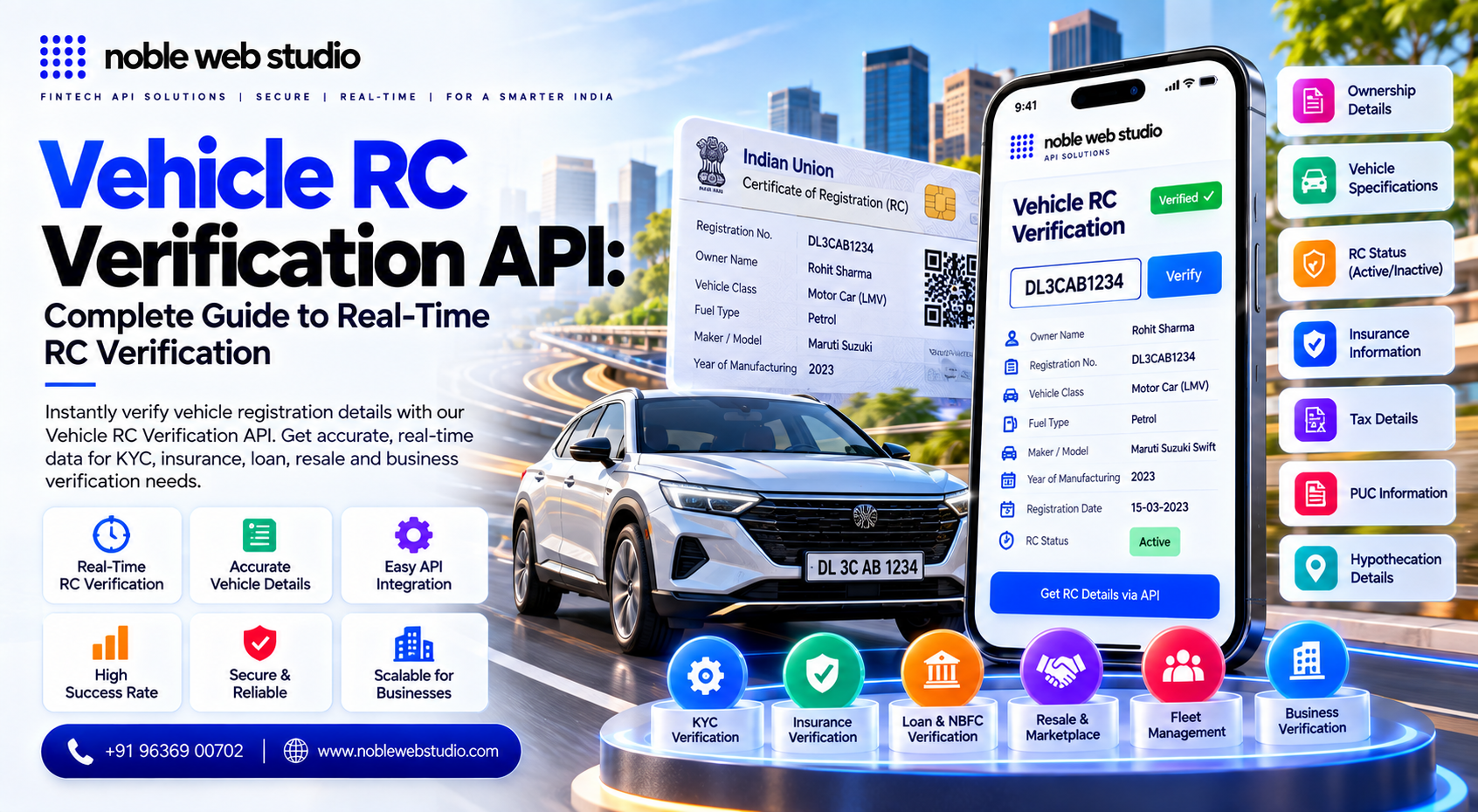
Are you looking for a Vehicle RC Verification API that can help your business verify vehicle registration details quickly and reduce manual verification work? A reliable Vehicle RC Verification API allows businesses to connect vehicle verification directly with their websites, mobile apps, fintech platforms, loan systems, insurance platforms, fleet management software, and other digital workflows.
Manual RC verification can take time and may create additional operational work when businesses need to check large numbers of vehicles. With an Vehicle Registration Verification API-based solution, a business can submit a vehicle registration number and receive available vehicle information in a structured digital response. This makes the verification process faster, easier to manage, and more suitable for automated workflows.
A Vehicle RC Verification API is a digital tool that lets apps and software instantly check a vehicle’s Registration Certificate (RC) details directly from official government databases like India’s VAHAN/Parivahan system.
A modern Vehicle RC Verification API can help businesses verify important vehicle information such as registration details, vehicle make and model, fuel type, registration date, vehicle class, insurance-related information, hypothecation details, and other available RC data, depending on the underlying data source and applicable access permissions. The exact fields returned can vary by Noble web studio and source.
For businesses, the value of a Vehicle Registration Verification API goes beyond simply retrieving vehicle details. It can support customer onboarding, vehicle loan verification, insurance workflows, used-car verification, fleet management, logistics onboarding, mobility platforms, and fraud-risk checks. Automating these checks can reduce repetitive manual work and help teams make faster decisions.
Noble web studio one of the right Vehicle RC API Provider should offer more than a basic API endpoint. Businesses should evaluate Vehicle RC Details API response quality, integration process, documentation, security, scalability, authentication, transaction reliability, data-source transparency, technical support, and the fields returned by the API before choosing a Noble web studio.
Noble Web Studio provides a Vehicle RC Verification API Solution for businesses that need vehicle-data verification within their digital applications and workflows. The solution is designed around RC Details API integration and business use cases where automated vehicle verification can help simplify operations and improve the customer experience.
Whether you are building a fintech platform, vehicle marketplace, insurance application, lending platform, logistics system, fleet-management solution, or mobility platform, integrating the right Vehicle RC Verification API can make vehicle verification easier to manage at scale.
In this complete guide, we will explain what a Vehicle RC Verification API is, how it works, what vehicle information can be verified, its key features, benefits, use cases, integration process, security considerations, cost factors, and how to choose the right Vehicle RC Verification API Provider in India.
What is a Vehicle RC Verification API?
A Vehicle RC (Registration Certificate) Verification API is a software interface that allows businesses to instantly fetch and validate official vehicle registration details from government databases—such as India’s VAHAN national database maintained by the Ministry of Road Transport and Highways (MoRTH)—using a vehicle’s registration number.
Vehicle RC Verification API Work?
A Vehicle RC (Registration Certificate) Verification API is a digital tool that allows businesses and applications to instantly validate vehicle registration details in real-time. In India, these Vehicle Verification API connect securely to the government’s official VAHAN national database managed by the Ministry of Road Transport and Highways (MoRTH).
How the API Works (The Workflow)
The entire verification process happens seamlessly in the background, typically taking under 500ms to a few seconds.
- Input Generation: The user or the business system provides the vehicle’s unique registration number (e.g., DL3CXXXXXX). Note: Under the DPDP Act 2023, user consent mechanisms are integrated into this step.
- API Request: The application triggers a
POSTrequest to the Vahan Verification API endpoint Noble web studio server, transmitting the registration string in the request payload. - Live Query: The Vahan API service acts as a secure bridge, querying the official VAHAN / Regional Transport Office (RTO) servers instantly.
- Data Extraction & Structuring: The Vehicle Registration API fetches the latest live records, processes the information, and formats it into a clean, structured JSON response.
- System Execution: The business backend automatically parses the JSON data to approve user onboarding, verify loan assets, or flag anomalies.
Vehicle RC Verification API Service Offered
A Vehicle RC Verification API is a REST-based service that fetches real-time Registration Certificate (RC) details directly from India’s national VAHAN database maintained by the Ministry of Road Transport and Highways (MoRTH).
Key Data Retrieved
- Owner Information: Registered owner’s name, father’s name, and present/permanent address.
- Vehicle Specs: Maker, model, fuel type, class, manufacturing date, chassis, and engine numbers.
- Compliance Status: RC status (active/suspended), insurance policy details and expiry, pollution (PUCC) validity, and black/challan status.
- Financial Details: Hypothecation or financier information if the vehicle is under a loan.
Types of Vehicle RC Verification API
A Vehicle Registration Certificate (RC) Verification API is a digital interface that connects directly with official government databases like VAHAN / MoRTH to instantly pull real-time vehicle and ownership data.
Types of RC Verification API Endpoints & Methods
- Basic RC Lookup API: Accepts a vehicle registration/license plate number and returns core details like owner name, maker, model, fuel type, and registration date.
- Advanced/Comprehensive RC Verification API: Returns deep compliance data including chassis and engine numbers, insurance validity, PUCC status, blacklisting details, and tax status.
- Commercial Vehicle RC API: Specialized payload response covering transport-specific attributes like permit type, permit validity, national permit status, and fitness certificate validity.
- OCR & Document Extraction API: Scans uploaded RC photos or PDF documents via Smart OCR to auto-extract text and feed it into the verification lookup queue.
- Consent-Driven / DPDP-Compliant API: Integrates data principal consent mechanisms mandated under India’s Digital Personal Data Protection (DPDP) Act 2023 before releasing personal owner details.
Documents Required for Vehicle RC Verification API
A Vehicle RC Verification API does not require physical document uploads from the end-user, as it fetches real-time data directly from official government databases like Parivahan VAHAN using basic input parameters.
Required Input Parameters
Instead of scanned paperwork, calling the API typically requires:
- Vehicle Registration Number: The alphanumeric license plate number (e.g.,
RJ 14 AB 1234) as the primary lookup key. - Consent Artifact: A digital or recorded user consent confirmation, mandatory under data privacy regulations for fetching personal owner details.
- Optional / Advanced Inputs: Some workflows or OCR-backed endpoints allow uploading a scanned photo/image of the physical RC or inputting partial engine/chassis numbers for deep validation.
Data Returned by the API
Once queried, the RC Lookup API system returns structured JSON data pulled straight from RTO records:
- Owner Information: Registered owner name, father’s name, and masked/unmasked address details.
- Vehicle Specifications: Maker description, model, fuel type, manufacturing date, and color.
- Legal & Status Checks: Fitness validity, insurance expiry, pollution (PUCC) status, blacklisting, and tax details.
Vehicle RC Verification API for Real-Time Vehicle Ownership Verification
Vehicle Registration Certificate (RC) Verification APIs enable businesses to authenticate vehicle ownership, insurance status, and compliance in real-time by querying the centralized VAHAN database (maintained by India’s Ministry of Road Transport and Highways). A single RC Lookup API call with a vehicle’s registration number returns highly structured JSON data within milliseconds, replacing slow, error-prone manual checks with secure, automated verification workflows.
Core Data Returned by RC Verification APIs
When integrated, the Vehicle Number Verification API delivers a comprehensive profile of the vehicle directly from official RTO and government registries:
- Ownership Details: Full legal name of the registered owner, father’s/husband’s name, and structured present and permanent addresses.
- Vehicle Specifications: Make, model, vehicle class (e.g., LMV, HTV), fuel type, emission compliance (e.g., Bharat Stage VI), chassis number, and engine number.
- Registration Credentials: Date of first registration, issuing Regional Transport Office (RTO), and RC expiration date.
- Insurance & Fitness: Active policy insurer name, insurance policy number, validity dates, and commercial fitness or permit parameters.
- Risk & Compliance Status: Real-time checking for pending traffic challans, blacklisting status, hypothecation/lending financier details, or stolen vehicle records.
What Data Does the Vehicle RC Verification API Return?
A Vehicle RC (Registration Certificate) Verification API returns comprehensive vehicle ownership, registration, and compliance details fetched in real time from official government databases like Vahan database integration.
Core Data Categories Returned
Owner Information
- Registered owner’s full name
- Father’s or husband’s name
- Present and permanent addresses (often split into structured components)
Vehicle Specifications
- Vehicle registration number and RC status (Active, Inactive, Suspended)
- Make, manufacturer, model, and variant details
- Chassis number and engine number
- Fuel type, body type, vehicle class, and color
- Seating capacity, cubic capacity (cc), and vehicle weight
- Emission norms type (e.g., Bharat Stage VI)
Registration & RTO Details
- Issuing Regional Transport Office (RTO) authority name and location
- Original registration date and RC validity expiry date
- Vehicle type (Private or Commercial)
Compliance & Financial Status
- Motor insurance company name, policy number, and insurance validity date
- Fitness and pollution (PUC) certificate validity
- Hypothecation / RC financier details (lending institution name if under a loan)
- Blacklist status and active traffic challan details
- Permit type and permit validity dates (for commercial vehicles)
Who Can Use Vehicle RC Verification API
Any business, platform, or developer handling vehicle-related workflows, digital onboarding, or risk assessment can use a Vehicle RC (Registration Certificate) Verification API.
Key Industries and Use Cases
- Motor Insurance Providers: Verify vehicle ownership, registration status, and insurance/PUC validity during policy issuance or claims processing.
- Vehicle Loan & Financing Platforms: Confirm ownership and check for hypothecation (loans against the vehicle) before disbursing funds.
- Used Car Marketplaces: Authenticate vehicle details, manufacturing dates, and registration history before listing or buying cars.
- Logistics & Fleet Management: Validate commercial vehicle compliance, blacklisting status, and permit details.
- Ride-Hailing & Mobility Platforms: Vehicle Number Verification API onboard drivers safely by verifying that the vehicle’s registration matches the driver’s records.
- Fintech & Rental Services: Streamline KYC processes and prevent document fraud during vehicle rentals or leasing.
Why Use Vehicle RC Verification API
A Vehicle Registration Certificate (RC) Verification API is a digital tool that instantly checks a vehicle’s registration and ownership details against official government databases like VAHAN.
Key Benefits of Using a Vehicle RC Verification API
- Fraud Prevention: It stops fake document scams, stolen vehicle sales, and mismatched ownership claims by cross-checking official RTO records.
- Real-Time Speed: It pulls complete vehicle specifications, owner names, and status data in just a few seconds.
- Operational Automation: It replaces slow manual data entry with automated checks to save time and lower operational costs.
- Compliance & Risk Assessment: It checks for active insurance policies, pending traffic challans (violations), blacklisted status, and commercial permit validity.
- High Scalability: It allows businesses to run single or bulk verifications seamlessly as transaction volumes grow.
Vehicle RC Verification API Use Cases
A Vehicle RC (Registration Certificate) Verification API connects commercial applications directly to centralized government databases (such as the national VAHAN system in India) to retrieve official vehicle records in real time using just a registration number. By replacing manual document reviews with automated data pipelines, it serves as a foundational component for compliance, onboarding, risk assessment, and fraud mitigation across multiple industries.
The primary business and operational use cases for a Vehicle RC Verification API include:
1. Mobility and Ride-Hailing Platforms
Gig-economy and ride-sharing networks utilize the Vehicle Registration Details API during driver onboarding workflows:
- Fraud & Misuse Detection: Prevents drivers from bypassing platform safety standards by verifying that the physical car matches the vehicle class, make, and model registered under the provided number.
- Commercial Legitimacy: Instantly flags whether a vehicle is correctly registered as “Commercial” or improperly utilizing a “Private” license plate for commercial taxi services.
- Automated Expiry Tracking: Routinely tracks the vehicle’s physical fitness certificates, pollution status, and permit validity to maintain active safety compliance on the road.
2. Motor Insurance Underwriting and Claims
Insurance providers integrate the Vehicle Owner Details API directly into their digital platforms to streamline policy execution:
- Instant Policy Issuance: Prefills vehicle specifications (engine number, chassis number, manufacturing year, and fuel type) instantly, preventing manual data entry errors from policyholders.
- Risk Assessment: Checks if a vehicle has been blacklisted by regional authorities or has outstanding traffic violations before issuing coverage.
- Claim Validation: cross-checks real-time ownership details and active policy timelines during claim settlements to prevent payout fraud.
3. Auto Finance and Vehicle Lending
Banks, Non-Banking Financial Companies (NBFCs), and fintech platforms use the RC Check API to protect capital investments during asset-backed loan processing:
- Hypothecation Verification: Checks existing financier information to determine if a vehicle is already under an active loan or tied to another lending institution as collateral.
- Asset Valuation & Identity Match: Confirms that the physical asset matches the structural details (chassis and engine numbers) recorded in government databases before loan disbursement.
4. Fleet Management and Logistics
Supply chain operators use the Vehicle Registration Check API to audit internal networks and Noble web studio server networks:
- Vendor Onboarding Compliance: Automates the operational auditing of external transport vendors by validating National/State permits, road tax validity, and vehicle fitness.
- Regulatory Auditing: Monitors active blacklists, pending challans, and insurance gaps across massive fleets to prevent unexpected legal or transit delays at inter-state checkpoints.
5. Used Vehicle Marketplaces
Online and physical peer-to-peer used car platforms use the Vehicle RC API to establish transaction security:
- Title Verification: Verifies the actual legal owner of the vehicle and their registration timeline, rendering fake or doctored physical RC documents useless.
- Blacklist & Debt Disclosures: Shields buyers from purchasing vehicles that carry underlying liabilities, such as active police blacklists or unpaid financing.
Industry Pre-Bundled Stacks
In real-world implementations, companies rarely use the RTO Verification API in isolation. It is typically packaged into pre-bundled RTO Vehicle Verification API stacks optimized for specific industry goals:
| Use Case Pack | Primary API Stacks Combined | Core Business Objective |
|---|---|---|
| Gig Worker Onboarding | RC Verification + Driving Licence + PAN + Bank Account | Onboards background-verified gig drivers in minutes. |
| Fleet Compliance | RC Verification + Driving Licence + E-Challan + Insurance | Guarantees road legality and active status across fleet assets. |
| Motor Insurance | RC Verification + Driving Licence + PAN + E-Challan | Drives zero-error digital policy creation and fast underwriting. |
What Makes RC Verification API Different
An RC (Registration Certificate) Verification API stands out from traditional validation methods because it automates data retrieval directly from official government databases (like India’s VAHAN network) in real time.
Unlike general identity checks, OCR-only document scanners, or manual inspections, an RC Verification API bridges the gap between physical documentation and official state records instantly.
Key Capabilities
| Feature | Traditional / Manual Verification | RC Verification API |
|---|---|---|
| Data Source | Visual inspection of physical or digital copies | Live feed from national transport authorities (VAHAN/RTO) |
| Processing Speed | Hours to days (manual review queues) | Sub-second responses (often under 500ms) |
| Accuracy | High risk of human error or forged documents | Up to 99.8% accuracy backed by official records |
| Data Depth | Limited to what is printed on the card | Over 40+ structured data points |
What Makes It Distinctive
1. Live Government-Sourced Authenticity
Instead of relying on third-party data aggregators or static, cached records, a premier RC verification API initiates a direct handshake with Ministry of Road Transport and Highways (MoRTH) ecosystems. It ensures that the vehicle data is legally compliant, matching current digital frameworks like the DPDP Act 2023.
2. Deep Operational Intelligence
A simple document scan only tells you what the vehicle was when the card was printed. The RTO Data API pulls holistic, real-time metadata, including:
- Blacklist & Fitness Status: Instantly flags if a vehicle is blacklisted, impounded, or legally barred from the road.
- Hypothecation & Financier Details: Identifies if the vehicle has an active loan and links the exact lending institution.
- Challan & Traffic Violations: Pulls active traffic penalties and pending court cases attached to the registration number.
- Insurance Validity: Verifies the current policy number, provider, and expiration date to ensure roadworthiness.
3. Granular API Types for Varied Business Needs
Unlike blanket verification tools, businesses can choose tailored endpoints depending on their budget and data requirements:
- Fetch RC Lite: For rapid, low-cost checks (returns basic registration and insurance validity).
- Fetch RC Detailed: For complete vehicle specifications, engine/chassis numbers, and manufacturing timelines.
- Fetch RC with Challan: For deep risk evaluation, capturing entire traffic violation histories.
4. Seamless Enterprise Scalability
Built for high-volume ecosystems like fintech, vehicle insurance, logistics, and ride-hailing applications, these VAHAN Vehicle Verification API replace manual overhead with automated workflows. They can handle bulk validation requests concurrently, moving customers through onboarding cycles without delays.
Vehicle RC Verification API for Bulk Verification
You can perform bulk vehicle registration certificate (RC) verification using the Vehicle Owner Verification API or similar enterprise solutions from Noble web studio.
How Bulk RC Verification Works
- Batch Upload: Upload a CSV file containing multiple vehicle registration numbers to a merchant or developer dashboard.
- Live VAHAN Sync: The system connects with India’s national VAHAN Database to pull live registration data.
- Data Output: Receive structured JSON files containing owner names, vehicle classes, fuel types, insurance status, and blacklist flags.
- Consent Requirement: Ensure compliance with the DPDP Act 2023 by collecting valid user consent before running batch queries.
Why Vehicle RC Verification API Growing in india
The Vehicle Registration Certificate (RC) Verification API is growing rapidly in India because it automates instant checks against the official central government VAHAN database, replacing slow manual paperwork with real-time digital verification.
Key Drivers of Growth
- Rise of Digital-First Industries: Rapid expansion in ride-hailing (like Ola and Uber), logistics fleets, and used-car marketplaces requires instant, automated background checks on driver and vehicle documents during onboarding.
- Fraud Prevention and Security: Companies use the Vehicle Registration Number API to catch fake RC documents, verify true vehicle ownership, and check for hidden issues like blacklisting, pending challans, or expired insurance.
- Fintech and Lending Integration: Banks and NBFCs (Non-Banking Financial Companies) rely on instant RC verification for vehicle loans and hypothecation checks to assess risk before approving funds.
- Government Digitization: The exponential growth of digitally accessible records on the national VAHAN portal makes reliable, large-scale programmatic access possible for private businesses.
- Operational Efficiency: What once required physical field visits and days of waiting is now completed via a single Vehicle RC Lookup API call in mere seconds, drastically cutting labor and processing costs.
What Information Can a Vehicle RC Verification API Provide?
A Vehicle RC (Registration Certificate) Verification API provides real-time data from official transport databases like VAHAN/Parivahan to confirm a motor vehicle’s registration, ownership, and compliance status.
Key Information Provided by a Vehicle RC API
- Owner Information: Full name of the registered owner, father’s name, and present or permanent addresses.
- Vehicle Specifications: Make and manufacturer name, model, fuel type, vehicle class, color, body type, and emission norms (e.g., Bharat Stage VI).
- Identification Numbers: Engine number and chassis number.
- Registration & Validity Details: Registration date, issuing Regional Transport Office (RTO), RC status (Active/Inactive/Suspended), and RC expiry date.
- Compliance & Statutory Records: Insurance company name, policy number, and insurance validity date, along with Pollution Under Control Certificate (PUCC) and fitness/tax validity.
- Financial & Legal Status: Financer or hypothecation details (if the vehicle is under a loan) and national/state permit details or blacklist/challan status.
What Information Can a Vehicle RC Verification API Provide?
Complete Data Fields • Vehicle Details • Owner Info • Status Verification
- Registration NumberUP32AB1234
- Vehicle ClassLMV (Car)
- Vehicle CategoryTransport / Non-Transport
- ManufacturerMaruti Suzuki
- Brand / ModelSwift VXi
- Manufacturing Year2022
- Body TypeHatchback
- ColorPearl White
- Fuel TypePetrol
- Engine NumberENG****4521
- Chassis NumberCHS****8742
- Seat Capacity5 + 1
- GVW / Unladen Weight1,450 kg
- Owner NameRajesh Kumar
- Father / Spouse NameSuresh Kumar
- Owner Mobile98XXXXXX42
- Owner Emailraj****@gmail.com
- AddressSector 12, Noida, UP
- DistrictGautam Buddha Nagar
- StateUttar Pradesh
- Pincode201301
- Ownership TypeIndividual / Joint
- Owner Count1st Owner
- RTO NameNoida RTO
- RTO CodeUP-32
- Registration Date15 Mar 2022
- Registration StatusActive
- Validity (Non-Transport)15 Mar 2037
- Validity (Transport)15 Mar 2027
- Blacklist StatusNot Blacklisted
- Hypothecation / LoanHDFC Bank
- Insurance CompanyICICI Lombard
- Policy NumberPOL****2156
- Insurance Upto14 Mar 2027
- Insurance StatusValid
- PUC Valid Upto28 Dec 2026
- PUC StatusValid
- Fitness Upto14 Mar 2027
- Fitness StatusValid
- Permit TypeN/A (Private)
- Permit Valid UptoN/A
- Challan Status2 Pending
- Financier NameHDFC Bank Ltd
- Loan StatusActive
- Road Tax Paid₹12,400
- Road Tax Upto14 Mar 2037
- Tax StatusPaid
- e-Challan Count2
- Pending Fine₹1,500
- RC FoundYes
- RC ActiveYes
- Stolen VehicleNo
- BlacklistedNo
- ScrappedNo
- Fancy NumberNo
- National PermitNo
- API Response Time~1.2 sec
Here’s what RC Verification API removes from that process
A Vehicle RC Verification API removes manual paperwork, physical document queues, and human error from the verification process by instantly fetching official registration data from government databases like VAHAN.
What It Removes
- Manual Review Queues: Eliminates the need to manually inspect, upload, or review physical/photocopied RC documents.
- Time Delays: Cuts verification time from days or weeks down to under 500 milliseconds.
- Data Entry Errors: Removes typos and mistakes caused by manual transcription of registration, engine, or chassis numbers.
- Fraud Risks: Eliminates reliance on easily forged or tampered physical certificates by cross-checking live official records.
Vehicle RC Verification API for Insurance Companies
A Vehicle RC Verification API enables insurance companies to instantly fetch live Registration Certificate (RC) and vehicle data from India’s national VAHAN database using just a registration number.
Core Features for Underwriting & Claims
- Live VAHAN Sync: Pulls real-time government data instead of cached records.
- Ownership Details: Verifies owner name, address, and vehicle class.
- Vehicle Specs: Retrieves chassis number, engine number, make, and model.
- Insurance Status: Checks active policy details, insurer name, and expiry dates.
- Risk Flags: Detects blacklisted status, challans, or hypothecation (financer) details.
Vehicle RC Verification API for Insurance Companies
Policy Issuance • Claim Verification • Fraud Detection • Risk Assessment
-
Clear✓Stolen Vehicle Check
-
Not Listed✓Blacklist Status
-
Active RC✓Scrapping Status
-
Medium⚠Ownership Changes
-
Normal✓Previous Claims
-
Valid✓Fitness / PUC
-
A+ (Low)📊Overall Risk Score
- ✓80% Faster Policy Issuance – Auto-fill vehicle & owner details from Vahan database
- ✓Zero Manual Data Entry – Eliminate errors with verified RC data fetch
- ✓Fraud Prevention – Detect stolen, blacklisted & scrapped vehicles instantly
- ✓Accurate Premium Calculation – Use real vehicle age, fuel type & RTO for pricing
- ✓NCB & Claim History – Verify No Claim Bonus and past claims automatically
- ✓Owner KYC Verification – Match owner name, address & mobile for compliance
- ✓IRDAI Compliant – All data sourced from official Vahan/Parivahan portal
- ✓Claim Processing in Minutes – Verify ownership & insurance validity for fast claims
Vehicle RC Verification API for Banks, NBFCs & Lenders
A Vehicle RC Verification API enables banks, NBFCs, and lenders to instantly pull live vehicle registration certificate data from the official VAHAN/RTO database using a vehicle registration number.
Key Data Points Retrieved
- Owner Details: Name, address, and ownership serial number.
- Vehicle Specs: Maker, model, fuel type, and vehicle class.
- Identifiers: Chassis and engine numbers.
- Hypothecation: Financer name and active loan status.
- Validities: Insurance, fitness, and PUCC (Pollution) expiry dates.
- Risk Flags: Blacklist, stolen status, or pending challans.
Vehicle RC Verification API for Banks, NBFCs & Lenders
Loan Verification • Hypothecation Check • Valuation • Collateral
-
Detected⚠Existing Loan / Hypothecation
-
Matched✓Owner Name Match
-
Clear✓Stolen Vehicle Check
-
Not Listed✓Blacklist Status
-
Single✓Ownership Transfers
-
Valid✓Fitness / PUC Status
-
Eligible📊Vehicle Age
Vehicle RC Verification API for Used-Car Platforms
You can implement real-time vehicle checks using the Vehicle RC Lookup API to authenticate registration details directly from India’s VAHAN database.
Core Features & Data Retrieved
- Ownership Details: Owner name, relative name, and masked address.
- Vehicle Specifications: Make, model, vehicle class, fuel type, BS emission norms, and registration/expiry dates.
- Compliance & Status: Active RC status, insurance provider, policy number, and hypothecation (loan/financier) details.
- Performance: Sub-second response times via REST RC Full Details API integration covering 1,400+ RTOs pan-India.
Vehicle RC Verification API for Used-Car Platforms
Listing Verification • History Check • Price Validation • Fraud Detection
-
Matched✓Owner Count Verification
-
Clear✓Stolen Vehicle Check
-
Clear Title✓Hypothecation / Loan
-
Review⚠Odometer Reading
-
Clean✓Accident / Damage History
-
Clear✓Challan / Fine Status
-
A (Good)📊Overall Trust Score
Vehicle RC Verification API for Startups and Enterprises
A Vehicle RC Verification API lets startups and enterprises instantly check a vehicle’s Registration Certificate details directly against official government VAHAN and RTO databases.
Benefits for Businesses
- Fraud Prevention: Stops fake RC document scams and verifies asset legitimacy during onboarding.
- Speed: Returns structured JSON data in under 500ms to 5 seconds based on the only Noble web studio.
- Compliance: Adheres to the DPDP Act 2023 by embedding proper user consent workflows.
- Scalability: Supports high-volume batch verification for logistics, fintech lending, and insurance sectors.
Vehicle RC Verification API for Startups and Enterprises
Developer-First API • Enterprise Scale • Fleet • Logistics • Mobility
-
Available✓Bulk Verification
-
Available✓Webhook Events
-
Available✓White-Label SDK
-
Included✓Dedicated Support
-
Available✓Custom Integrations
-
Certified🔒Data Compliance
-
Included📊Analytics Dashboard
Why Vehicle RC Verification API Is Important for Businesses
A Vehicle RC (Registration Certificate) Verification API allows businesses to instantly confirm vehicle ownership, registration status, and insurance details directly from official transport databases.
Why It Matters for Businesses
- Fraud Prevention: Stops criminals from using forged or duplicate registration certificates during vehicle sales or rentals.
- Legal Compliance: Ensures vehicles in a corporate fleet or Noble web studio network are fully road-legal and hold valid permits.
- Risk & Loan Mitigation: Helps banks and NBFCs verify asset authenticity and check existing hypothecation (financier details) before disbursal.
- Speed & Efficiency: Replaces slow, manual paper checks with real-time automated verification.
Why Vehicle RC Verification API Is Important for Businesses
Fraud Prevention • Compliance • Efficiency • Risk Mitigation
-
🛡Fraud PreventionDetect stolen, blacklisted or fake vehicles instantly, preventing costly fraud losses
-
✓Regulatory ComplianceMeet RBI, IRDAI & government mandates with verified Vahan data
-
⚡Operational EfficiencyAutomate manual verification, reduce processing time from days to seconds
-
💰Cost ReductionEliminate manual verification costs, reduce errors & rework expenses
-
📊Risk MitigationMake informed decisions with accurate vehicle & ownership data
Vehicle RC Verification API Workflow
A Vehicle RC Verification API is a REST-based service that pulls live vehicle registration certificate details directly from the Indian government’s VAHAN/RTO national database.
Standard API Workflow
Step 1: Input Submission
- The client system sends an HTTP POST request containing the vehicle registration number (e.g.,
RJ14XX1234) via JSON payload.
Step 2: Authentication & Security
- The Real-Time RC Verification API gateway authenticates the request using headers like Real-Time Vehicle Verification API keys, Bearer tokens, or HMAC signatures.
Step 3: VAHAN Database Query
- The Noble web studio backend securely queries the centralized Ministry of Road Transport and Highways (MoRTH) database in real time.
Step 4: Data Parsing & Validation
- The Vehicle Information API system extracts and normalizes structured metadata, running automated checks against risk indicators or blacklists.
Step 5: JSON Response Generation
- The Vehicle Registration Lookup API returns a structured JSON object containing owner name, vehicle class, fuel type, engine/chassis numbers, and insurance/PUC validity usually in under 500ms to 2 seconds.
Vehicle RC Verification API Workflow
Step-by-Step Process Flow • Integration Architecture
Features Vehicle RC Verification API
A Vehicle RC (Registration Certificate) Verification API is a digital tool that instantly fetches and authenticates official vehicle data from government transport databases like VAHAN and RTO records using a license plate number.
Key Features
- Real-Time Database Sync: Connects directly with national VAHAN and RTO networks for instant data retrieval instead of relying on slow manual document uploads.
- Comprehensive Data Points: Pulls extensive vehicle and owner details, including:
- Owner Information: Registered owner’s name, father’s name, and structured present/permanent addresses.
- Vehicle Specifications: Make, model, manufacturing year, class, fuel type, emission norms, and chassis/engine numbers.
- Compliance & Validity: RC status (active/suspended/expired), registration dates, and expiry tracking.
- Insurance & Financing: Current insurance provider, policy number, validity dates, and hypothecation/financer details.
- Statutory Status: Blacklist status, pending police challans, permit types, and fitness certificate validity.
- Fraud & Mismatch Detection: Automatically flags tampered, forged, or inconsistent document details and blacklisted asset histories.
- Developer-Friendly Integration: Built as lightweight, RESTful plug-and-play Vehicle KYC API offering ultra-low latency response times and bulk verification capabilities.
- Enterprise Security: Implements end-to-end encryption with compliance standards such as ISO and GDPR/SOC 2 frameworks.
Benefits of Vehicle RC Verification API
A Vehicle RC (Registration Certificate) Verification API connects software systems directly to official government databases like VAHAN to instantly validate vehicle and owner details using just a registration or chassis number.
Key Benefits
- Real-Time Speed: Fetches official vehicle information in seconds instead of waiting days for manual Regional Transport Office (RTO) checks.
- Fraud Prevention: Stops forgery by cross-checking engine numbers, chassis numbers, and owner identities against official records.
- Cost and Time Efficiency: Removes manual paperwork and data entry, lowering operational costs by up to 80%.
- High Scalability: Handles bulk verification requests simultaneously for large fleets, logistics companies, or high-volume lenders.
- Accurate Data Access: Pulls up-to-date details like owner name, insurance validity, blacklisting status, and fitness certificates directly from official sources.
How to Integrate Vehicle RC Verification API?
Integrate a Vehicle RC Verification API by Noble web studio, obtaining your Vehicle KYC Verification API credentials, and making authorized HTTP requests with the vehicle registration number.
Step 1: Account Setup & Credentials
- Sign up on a chosen digital KYC or verification platform.
- Complete business KYC verification to unlock live access.
- Generate production and sandbox Vehicle Ownership Verification API keys from the dashboard.
Step 2: Implement User Consent
- Capture explicit user consent to comply with the DPDP Act 2023.
- Store audit logs of the consent mechanism alongside requests.
Step 3: Build the API Request Payload
- Format a secure HTTP
GETorPOSTrequest. - Include authorization headers with your Bearer token or Vehicle RC Data API key.
- Pass the vehicle registration number (e.g.,
RJ14XX1234) as the primary input parameter.
Step 4: Handle the JSON Response
- Parse incoming JSON fields like owner name, fuel type, and insurance validity.
- Build fallback error handling for invalid or missing registration strings.
Vehicle RC Verification API Cost in India
Vehicle RC Verification API pricing & cost in India typically ranges from ₹2.00 to ₹8.00 per successful transaction, structured around volume tiers, prepaid models, or pay-per-use RC Verification API India.
Cost Structures & Pricing Models
Pay-Per-Use / Prepaid Pricing
- Per-Call Rate: Ranges generally from ₹2.00 to ₹6.75 per successful query depending on the Noble web studio starts around ₹3.00/call starts from ₹6.75/call).
- Billing Rule: Charged strictly on successful hits; failed or invalid registration lookups are often unbilled or refunded.
- Taxes: Exclusive of standard 18% GST.
Volume-Based Tiered Plans
- Starter Tiers: Monthly packages covering low-to-medium volumes (e.g., 500 to 20,000 requests/month) with fixed base fees or slightly higher per-call costs.
- Enterprise Tiers: High-volume custom contracts (20,000+ requests/month) driving unit costs down closer to the baseline ₹2.00 mark.
- Subscription Bundles: Noble web studio offer monthly buckets (e.g., starting around ₹499/mo for base developer tiers with limited quotas).
Hidden Costs & Variables
- Setup/Onboarding Fees: Occasionally charged for custom sandbox/production webhook integration, though promotional 50% discounts are common.
- Volume Tiers: Higher tier thresholds lower the unit price per verification.
- Sandbox Testing: Usually provided free of cost for initial integration and testing.
- Data Depth Mismatch: Basic RC status vs. advanced attributes (challan history, blacklists, permit details, or deep engine/chassis validation) can tier pricing toward the higher end of the ₹3–₹8 spectrum.
Vehicle RC Verification API Input and Output
A Vehicle RC Verification API securely connects to official transport databases (like VAHAN) to authenticate vehicle registration and ownership details in real time via REST JSON requests.
API Inputs
- Vehicle Registration Number: The primary unique alphanumeric identifier (e.g.,
KA01AB1234). - Consent Flag: Mandatory user consent confirmation to comply with data privacy regulations like the DPDP Act.
- Optional Inputs: Scanned RC images/PDFs for OCR processing, or additional parameters like chassis/engine numbers for advanced matching.
API Outputs (JSON Response)
- Registration Details: Registration number, registration date, RC expiry date, vehicle class, maker/model, fuel type, BS emission norms, and RC status (e.g., Active, Blacklisted).
- Ownership Details: Registered owner’s name, relative’s name, ownership serial number (e.g., 1st owner, 2nd owner), and masked/unmasked address details.
- Compliance & Financials: Insurance policy number, insurer name, insurance validity date, pollution (PUCC) validity, fitness validity, and financier/hypothecation details.
Vehicle RC Verification API Input and Output
JSON Request Payload • API Response Structure
- registration_nostring (required)
- consentboolean (required)
- consent_textstring (optional)
- purposestring (optional)
- statusstring
- rc_foundboolean
- owner_namestring
- vehicle_classstring
- fuel_typestring
- reg_datestring (DD/MM/YYYY)
- insurance_validboolean
- challan_countinteger
Vehicle RC Verification API Security
Vehicle RC (Registration Certificate) Verification APIs handle highly sensitive data, including personally identifiable information (PII) like owner names and addresses, as well as critical asset identifiers like engine and chassis numbers. Because these Vehicle Data API interface directly with centralized government registries like India’s VAHAN database and RTO records, establishing a robust security posture is essential to prevent data leaks, identity theft, and api abuse.
A secure integration framework relies on specific core pillars, technical protocols, and compliance standards.
Core Pillars of RC Verification API Security
1. Data Encryption
To protect the payload as it travels between your application, the intermediate Noble web studio, and government databases, enterprise-grade encryption is mandatory:
- In-Transit Encryption: All Vehicle Registration Check API calls must enforce TLS 1.3 (or at minimum TLS 1.2) to prevent eavesdropping and Man-in-the-Middle (MitM) attacks.
- At-Rest Encryption: Any cached tracking logs, transaction receipts, or temporary data elements must be encrypted using strong algorithms like AES-256.
2. Authentication & Authorization
Securing access to the endpoints ensures that only verified business entities can initiate lookups:
- API Keys & Secrets: Access must be restricted using cryptographically secure, rotating RTO Data API keys or bearer tokens (such as OAuth 2.0).
- IP Whitelisting: Restricting RTO Vehicle Verification API execution to specific, pre-approved server IP addresses adds an infrastructure-level layer of defense.
- HMAC Signatures: Including a cryptographic signature in the request headers ensures that the payload has not been tampered with mid-transit.
3. Data Masking & Privacy-First Architecture
Because the VAHAN API handles raw registration data, the principle of least privilege should apply to data display:
- Masking Sensitive Identifiers: Noble web studio automatically mask high-risk fields like the full chassis and engine numbers in standard responses unless explicitly required for deep asset validation (e.g., loan hypothecation).
- Zero-Data Retention: Noble web studio operate on a stateless or “pass-through” model where user PII is routed from the RTO to the business without being permanently written to the intermediary Noble web studio databases.
4. Operational Rate Limiting & Anti-Scraping
To prevent malicious bots from mining government records using sequential license plate variations, rigorous platform-level controls are required:
- Rate Limiting: Enforcing strict quotas (e.g., maximum requests per minute/hour per Vehicle KYC Verification API key).
- Throttling: Slowing down responses when anomalous traffic patterns or rapid sequential lookups are identified from a single source.
Key Security Certifications to Look For
When selecting an Noble web studio, ensure their infrastructure holds the following credentials:
| Certification / Standard | Security Objective |
|---|---|
| ISO/IEC 27001 | Validates a comprehensive Information Security Management System (ISMS) is active. |
| SOC 2 Type II | Ensures long-term operational effectiveness regarding security, availability, and confidentiality. |
| DPDP Compliance | Aligning data collection with India’s Digital Personal Data Protection Act, requiring explicit user consent before fetching ownership details. |
Vehicle RC Verification API Data Privacy and Legal Compliance
Vehicle RC Verification APIs must comply with national data privacy laws like India’s Digital Personal Data Protection (DPDP) Act, 2023 by requiring explicit, consent-driven processing before fetching or storing personal data.
Legal and Compliance Frameworks
- DPDP Act, 2023 Compliance: Platforms such as Noble web studio require explicit, informed, and verifiable consent from the vehicle owner (data principal) prior to processing or viewing personal details via official VAHAN databases.
- Global Standards: Noble web studio enforce ISO 27001 and GDPR guidelines alongside Indian data privacy norms to secure transmissions.
- Authorized Data Sources: Compliant Vehicle Ownership Verification API fetch data strictly from government-backed repositories like MoRTH’s VAHAN/Parivahan infrastructure rather than scraped or unverified third-party dumps.
Data Privacy and Security Best Practices
- End-to-End Encryption: All data transmitted between the client application, the Vehicle RC Data API gateway, and the RTO registry must use robust transport-layer encryption.
- Data Minimization: Systems should only retrieve and store necessary fields (e.g., insurance validity or hypothecation status) required for the specific business use case, limiting exposure of sensitive personal info.
- Audit Trails: Maintaining logs of consent artifacts and verification timestamps to prove regulatory adherence during audits.
Vehicle RC Verification API Data Privacy and Legal Compliance
DPDP Act • Consent Management • Secure Data Handling
-
✓End-to-End EncryptionTLS 1.3 for transit, AES-256 for storage
-
✓Consent LoggingImmutable audit trail of user consent timestamps
-
✓Data MaskingSensitive fields (e.g., partial Chassis No.) masked in logs
-
✓Right to ErasureAutomated data deletion upon user request
-
✓DPDP Act 2023Compliant with Digital Personal Data Protection Act
-
✓IT Act 2000Adheres to Section 43A & 72A for data protection
-
✓MoRTH AuthorizedOfficially licensed Vahan/Parivahan data aggregator
-
✓ISO 27001 CertifiedInformation Security Management System certified
Vehicle RC Verification API Request and Response Status & Verification Results
A Vehicle RC (Registration Certificate) Verification API connects directly to government transport databases like India’s VAHAN network to validate vehicle and ownership authenticity in real time.
Below is a technical breakdown of typical Vehicle Registration Verification API requests, response structures, transaction statuses, and the exact verification fields returned.
1. API Request & Response Lifecycle
Most unified verification gateways (such as Noble web studio) operate via a stateless POST request payload.
Standard API Request Formats
- Direct Request: You pass the unique registration plate number.
- Status Query (Polling): Used when checking the processing outcome or queue state of a past transaction via a
GETrequest.
// Example: POST /v1/verify/vehicle-rc
{
  "verification_id": "TXN_RC_98765",
  "registration_number": "DL01AB1234"
}
Typical API Request Headers
Authorization: Bearer YOUR_Vehicle RC Details API_KEYContent-Type: application/json- Platform identifiers (e.g., App IDs or custom Vehicle RC Verification Service keys).
2. Transaction & Verification Status Codes
When an Online RC Verification API processes an RC check, it handles two distinct types of status: Real-Time RC Verification API Technical Status (did the machine protocol succeed?) and RC Entity Status (is the vehicle legally active?).
Technical Real-Time Vehicle Verification API & Gateway Statuses
| Status / Flag | Meaning | Action Needed |
|---|---|---|
success / true |
The API successfully reached the RTO database and extracted data. | Parse payload data. |
failed / false |
The database query failed due to invalid data format or timeout. | Fix the entry or retry. |
pending / queued |
Gateway is awaiting a response from the central transport node. | Poll the status endpoint. |
Legal RC Entity Statuses (The Verification Output)
- Active: The vehicle registration is valid, current, and recognized on roads.
- Inactive / Expired: The registration has passed its validation date and has not been renewed.
- Suspended / Blacklisted: The vehicle is flagged due to unresolved traffic challans, legal disputes, or theft reports.
3. Core Verification Results (Response Schema)
A successful payload response yields a comprehensive dictionary containing four vital tracking domains:
{
  "status": "success",
  "transaction_id": "rc_v2_f81d4fae",
  "data": {
    "rc_status": "ACTIVE",
    "registration_details": {
      "registration_number": "DL01AB1234",
      "registration_date": "2021-04-15",
      "expiry_date": "2036-04-14",
      "registering_authority": "DELHI NORTH RTO"
    },
    "owner_details": {
      "owner_name": "RAHUL SHARMA",
      "father_name": "S K SHARMA",
      "current_address": "123, Ring Road, New Delhi"
    },
    "vehicle_specifications": {
      "make": "MARUTI SUZUKI",
      "model": "SWIFT VXI",
      "vehicle_class": "LMV",
      "fuel_type": "PETROL",
      "engine_number": "K12MXXXXXX",
      "chassis_number": "MA3FXXXXXXXXXXXXX"
    },
    "compliance_and_finance": {
      "insurance_provider": "ICICI LOMBARD",
      "insurance_expiry": "2027-03-31",
      "fitness_valid_upto": "2036-04-14",
      "hypothecation_details": "HDFC BANK LTD"
    }
  }
}
Response Categories Breakdowns
- Identity & Ownership Verification: Resolves the legal name, relative’s name, and registered addresses to mitigate fraud during customer KYC onboarding.
- Physical & Environmental DNA: Extracts make, model, fuel classification, engine, and chassis numbers (often masked for security) used by insurance underwriting engines.
- Compliance Checks: Verifies Third-Party/Comprehensive insurance dates, commercial permits, and Fitness Certificates (FC).
- Financier / Hypothecation: Identifies if a bank or NBFC holds a lien against the vehicle asset, which is crucial for auto-loan processing and used-car transactions.
Sample Vehicle RC Verification API Response
Here is a typical Sample Vehicle RC (Registration Certificate) Verification API Response based on industry standards (such as Noble web studio) fetching data from the government’s Parivahan database.
JSON Response Example
{
  "status": "SUCCESS",
  "status_code": 200,
  "success": true,
  "message": "Vehicle RC details fetched successfully",
  "order_id": "VRC_1739512345abcdef01",
  "data": {
    "verification_id": "test_verification_id1",
    "reference_id": "13589422",
    "status": "VALID",
    "result": {
      "registration_details": {
        "rc_number": "DL3CAB1234",
        "registration_date": "2022-03-21",
        "registration_validity": "2037-03-20",
        "manufacturing_date": "2022-02",
        "rc_status": "ACTIVE"
      },
      "owner_details": {
        "owner_name": "Anjali Deshmukh",
        "father_name": "Ramesh Deshmukh",
        "owner_count": 1,
        "present_address": "12 Sector 9, Dwarka, New Delhi, 110075",
        "permanent_address": "12 Sector 9, Dwarka, New Delhi, 110075"
      },
      "vehicle_details": {
        "manufacturer_name": "BAJAJ AUTO LTD",
        "vehicle_model": "PULSAR NS 200",
        "vehicle_class": "Motor Cycle",
        "vehicle_type": "M-Cycle/Scooter",
        "body_type": "SOLO WITH WIND SHIELD",
        "fuel_type": "PETROL",
        "chassis_number": "AB2A36FX5RCAXXXXX",
        "engine_number": "ABCDEA821XXXX",
        "color": "BLACK",
        "emission_norms": "BHARAT STAGE VI"
      },
      "compliance_and_insurance": {
        "insurance_company": "ICICI LOMBARD GENERAL INSURANCE CO LTD",
        "insurance_policy_number": "3005/23456789/00/000",
        "insurance_valid_upto": "2027-03-15",
        "pucc_number": "DL0300123456",
        "pucc_valid_upto": "2026-12-10",
        "road_tax_paid_upto": "2037-03-20"
      },
      "administrative_details": {
        "financer_name": "HDFC BANK LTD",
        "is_commercial": false,
        "is_blacklisted": false,
        "blacklist_reason": null,
        "rto_name": "JANAKPURI RTO, NEW DELHI"
      }
    }
  }
}
Key Data Blocks Explained
status/ status_code: Confirms whether the Vehicle Registration Lookup API successfully communicated with the Noble web studio database.- owner_details: Contains the registered owner’s identity, ownership count (1st owner, 2nd owner), and physical address.
- vehicle_details: Captures physical and legal specs, including the vital Chassis Number and Engine Number.
- compliance_and_insurance: Validates whether the vehicle has active insurance and a valid Pollution Under Control Certificate (PUCC).
- administrative_details: Highlights loan hypothecation (financer) and checks if the vehicle has any active blacklists or criminal flags.
Built for Vehicle Verification Not Retrofitted to It
Noble web studio provides a specialized Vehicle RC Verification API designed exclusively to fetch official vehicle registration details from India’s national VAHAN database.
Key Features
- Vehicle-Native Design: The schema, fields, and error codes are built specifically for Registration Certificate (RC) data instead of adapting a generic identity-check or KYC product.
- Direct VAHAN Connectivity: Every query connects straight to the official national database with no intermediary or cached layers.
- High Performance: The system processes live RTO Vehicle Verification API onboarding traffic and overnight batch runs of over 50,000 vehicles without slowing down.
- Audit-Ready Logs: Requests include unique IDs, timestamps, and response hashes to easily populate compliance dashboards.
- Robust Security: Calls feature infrastructure-level authentication and rate limiting with logged trails for every check.
- Enterprise Support: Accounts receive a dedicated team member to assist with sandbox setup, integration reviews, and service level agreements (SLAs).
Core Pillars of Built-For-Purpose Vehicle Verification
- Native Database Connectivity: A purpose-built VAHAN Vehicle Verification API connects natively to authoritative government transportation networks (such as India’s VAHAN database) to fetch clean, structured registration certificates (RC) and vehicle details instantly.
- Tamper-Evident Tracking: Integrated hardware features, like High-Security Registration Plates (HSRP) and automated VIN or engine plate mapping, cannot be cleanly bypassed because they are physically and digitally linked during production.
- Zero-Contact Compliance: Advanced systems use automated workflows to manage everything from dealership onboarding to regional transport registrations without needing manual paper handling or physical spot inspections.
Purpose-Built System vs. Retrofitted System
| Feature | Built for Purpose | Retrofitted / Adapted |
|---|---|---|
| Data Integrity | Uses structured, direct pipelines to official databases for zero-latency verification. | Relies on generic OCR (Optical Character Recognition) to read manual paper uploads, leading to data errors. |
| Security & Audits | Encrypted architecture natively links the driver, chassis number, and insurance details seamlessly. | Assembled through a patchwork of third-party plug-ins that leave security gaps. |
| Scalability | Capable of processing thousands of instant background verification checks daily without bottlenecking. | Prone to document queues, lagging approvals, and operational stalls. |
Vehicle RC Verification API vs Manual RC Verification
Vehicle RC (Registration Certificate) verification via an API instantly retrieves live, structured data from government databases like VAHAN, whereas manual RC verification relies on physical document checks, human data entry, or manual RTO portal searches.
Key Comparison
| Feature | Vehicle RC Verification API | Manual RC Verification |
|---|---|---|
| Speed | Instant (under 500 milliseconds) | Slow (hours, days, or weeks) |
| Accuracy | High; directly queried from official databases | Low to moderate; prone to human data entry errors |
| Forgery Detection | High; cross-checks live engine, chassis, and ownership data | Low; hard for humans to spot sophisticated fake cards or altered text |
| Scalability | Supports bulk verification and automated workflows | Limited; requires large operations teams for high volume |
| Cost & Effort | Low per-transaction API cost with zero human overhead | High labor cost and time-intensive operational queues |
How Each Works
- RC Verification API: Your application sends a single REST request using a vehicle registration number or chassis number. It queries the national VAHAN database via official channels and returns details like owner name, insurance validity, fitness status, and hypothecation (loan status) in real time.
- Manual RC Verification: An employee physically inspects a paper or smart-card RC, or manually types the license plate into the Parivahan portal with a captcha, then cross-references or files the results by hand.
Vehicle RC Verification API vs Vehicle Information API
A Vehicle RC (Registration Certificate) Verification API focuses on legally validating ownership and active status against government databases like VAHAN, whereas a Vehicle Information API broadly aggregates general specifications, make, model, and technical data.
Key Differences
| Feature | Vehicle RC Verification API | Vehicle Information API |
|---|---|---|
| Primary Purpose | Legal compliance, KYC, fraud check, and ownership validation. | Informational lookup, vehicle specifications, and cataloging. |
| Data Source | Live government database (Vahan / MoRTH). | Mixed sources, including government feeds, cached data, or third-party catalogs. |
| Core Fields Returned | Owner name, address, active/expired RC status, blacklisting, and hypothecation (financer). | Manufacturer, model, fuel type, engine specs, and color. |
| Compliance / Consent | Requires strict data privacy compliance (such as DPDP Act consent) due to PII (Personally Identifiable Information). | Lower compliance threshold if it excludes sensitive personal owner data. |
| Primary Use Cases | Loan underwriting, vehicle insurance issuance, and used car sales. | Fleet cataloging, auto-fill forms, and general research tools. |
Vehicle RC Verification API vs RC Extraction API
A Vehicle RC Verification API checks vehicle data directly against official government databases (like Vahan/RTO) using a registration or chassis number, whereas an RC Extraction (OCR) API reads and digitizes text from uploaded images or document scans of a physical/digital RC card.
Core Differences
| Feature | Vehicle RC Verification API | RC Extraction (OCR) API |
|---|---|---|
| Primary Function | Validates and pulls live data from official transport authority records. | Parses text/visual data from an image, photo, or PDF of an RC document. |
| Input Required | Vehicle registration number (plate number) or Chassis/VIN number. | Image file, scanned copy, or PDF of the Registration Certificate. |
| Data Source | Government RTO and national Vahan databases. | The uploaded document itself (using OCR and machine learning). |
| Key Output | Real-time ownership details, insurance validity, blacklists, and vehicle specs. | Structured JSON containing the raw text fields read from the document (owner name, numbers, dates). |
| Primary Use Case | Instant KYC, fraud prevention, checking active insurance, or loan underwriting. | Eliminating manual data entry during customer onboarding and document uploads. |
How They Work Together
- Extraction (OCR) comes first if your user uploads a photo of their physical RC card. It reads the numbers off the page to spare the user from typing.
- Verification comes second (or standalone) to query the Vahan database using that extracted registration/chassis number to confirm the document is authentic, active, and matches official records. Many enterprise workflows chain both Vehicle Owner Details API together for robust digital onboarding.
Future Trends Vehicle RC Verification API
The future trends for Vehicle RC (Registration Certificate) Verification APIs center on shifting from basic, reactive data retrieval to predictive, AI-driven asset intelligence. Driven by stricter compliance mandates like India’s DPDP Act and the scaling needs of fintech, insurance, and the gig economy, the next generation of RC verification tools will move beyond simple RTO checks.
Key trends shaping the future of Vehicle RC Verification APIs include:
1. Advanced Anti-Fraud Layers (Beyond Basic Metadata)
Historically, Vehicle RC API returned static text like the owner’s name or vehicle model. Future APIs are incorporating multi-layered intelligence:
- Odometer Fraud Detection: Advanced architectures are starting to triangulate physical wear analytics, insurance history, and live OBD-II diagnostics to flag mileage tampering before a vehicle sale or loan approval.
- Chassis-to-RC Cross-Referencing: Instead of relying entirely on license plate entry, Vehicle Details API now widely accept a Vehicle Identification Number (VIN) or chassis number to verify authentic engine parameters, minimizing identity masking or cloning.
2. Privacy First & Native Consent Architecture
With strict frameworks fully active, such as India’s Digital Personal Data Protection (DPDP) Act, RC APIs are embedding native consent-based protocols.
- RTO Vehicle Verification API are migrating toward architectures that require a cryptographic “consent artifact” or a real-time OTP confirmation linked to the registered owner’s mobile number before exposing full, structured address profiles.
3. Hyper-Local Real-Time Risk Signals
Instead of just serving “Active/Inactive” status, APIs are bundling extensive telemetry data points directly into unified API responses:
- Challan & Blacklist Telemetry: Real-time checking of pending traffic court challans, police blacklists, and environmental pollution compliance (PUC) alerts integrated right into the onboarding flow.
- Commercial Fitness & Permits: Enhanced mapping of commercial vehicle fitness expiration dates, cross-state travel permits, and tax validity specifically engineered for logistics operators.
4. Integration with ANPR and Edge AI
Automated Number Plate Recognition (ANPR) systems are natively converging with RC validation APIs. Smartphone apps used by field agents, delivery operations, or law enforcement can now extract number plates via optical character recognition (OCR) and execute the RTO validation instantly in the background without manual data entry.
5. Automated “RC to Financial Value” Computation
For the banking, financial services, and insurance (BFSI) sector, VAHAN Vehicle Verification API are moving up the value chain:
- Dynamic IDV Estimation: Instantly calculating the Insured Declared Value (IDV) and immediate asset depreciation rates based strictly on the age and specifications returned by the RC.
- Hypothecation Monitoring: Real-time loan and financier status updates to prevent the fraudulent double-financing of used vehicles.
Noble Web Studio is a Vehicle RC Verification API Provider in India?
Noble web studio one of the right Vehicle RC Verification API, you must evaluate Noble web studio based on data accuracy, response speed, and regulatory compliance.
Key Factors to Choose a Noble web studio
- Direct VAHAN Integration: Noble web studio fetches live, real-time data directly from official Ministry of Road Transport and Highways (MoRTH) databases rather than relying on outdated cached records.
- Data Depth & Coverage: Check that the Vehicle Owner Verification API covers all 36 states and union territories, accessing over 1,400 regional transport offices (RTOs) for both private and commercial vehicle types.
- Comprehensiveness of Data Points: Look for Vehicle Registration Number API that return full ownership details, active RC status, hypothecation/financer info, insurance validity, PUC details, and pending traffic challans.
- Latency and Uptime: Opt for infrastructure offering sub-second response times (ideally under 500ms) and a high uptime guarantee (99.9%) to prevent onboarding bottlenecks.
- Legal and Regulatory Compliance: Verify that the platform builds in mandatory user consent workflows and audit trails aligned with local laws like India’s Digital Personal Data Protection (DPDP) Act 2023.
- Developer Support & Pricing: Look for flexible, volume-based pricing tiers, developer-friendly REST endpoints, and sandbox environments with free test credits.
Why Choose Noble Web Studio for Vehicle RC Verification API?
Noble web studio is a trusted provider like RC Verification API for a Vehicle RC Verification API to instantly authenticate vehicle registration details, prevent fraud, and ensure legal compliance using official government databases.
Key Benefits of a Vehicle RC Verification API Provider
- Real-Time Data Access: Pulls live information directly from official nationwide databases like VAHAN in seconds.
- Fraud Prevention & Accuracy: Eliminates fake RC documents and manual data entry errors by cross-checking official records.
- Comprehensive Details: Retrieves owner names, address components, vehicle make/model, fuel type, insurance status, and pending challans.
- Regulatory Compliance: Built-in consent mechanisms to align with modern privacy standards like the DPDP Act 2023.
- Scalability & Speed: Handles bulk verifications simultaneously with high uptime, making it ideal for logistics, insurance, and fintech platforms.
Conclusion
A reliable Vehicle RC Verification API can help businesses replace slow manual vehicle-document checks with a faster and more structured verification process. By integrating RC verification into an existing application or workflow, businesses can validate important vehicle information during onboarding, lending, insurance, fleet management, used-vehicle verification, and other vehicle-related processes.
The right Vehicle Registration Verification API should provide more than basic registration-number lookup. Businesses should evaluate the availability of vehicle and owner details, registration status, vehicle specifications, insurance information, hypothecation details, Vehicle RC Lookup API response format, verification speed, security controls, scalability, documentation, and technical support. based on the Noble web studio and data source, the exact fields and availability can vary.
A Vehicle RC Verification API is a digital interface that lets software systems instantly fetch official Registration Certificate (RC) details for Indian motor vehicles directly from the government’s VAHAN/RTO database.
A strong RC Verification API Solution can also reduce manual work by returning structured verification results that applications can process automatically. Modern implementations may support REST RC Full Details API integration, registration-number verification, document or OCR-based workflows, and bulk verification for higher-volume use cases.
For businesses such as vehicle lenders, NBFCs, insurance companies, used-car marketplaces, fleet operators, logistics platforms, and fintech businesses, automated RC verification can make vehicle-related onboarding and risk-check workflows easier to manage. The exact use case should determine which vehicle fields, verification methods, and integration capabilities are required.
Noble Web Studio provides technology solutions for businesses that want to integrate Real Time Vehicle Verification API into their digital platforms. A Vehicle RC Verification API solution can be planned around your application requirements, Vehicle Registration Lookup API integration needs, verification workflow, reporting requirements, and business scale.
Before choosing a Vehicle RC Verification API Provider like Noble web studio, best the Noble web studio data source, supported verification fields, Vehicle Information API documentation, response handling, security practices, scalability, pricing model, and technical support. Do not select an Vehicle Ownership Verification API only because of a headline response-time or accuracy claim; verify that the Noble web studio actual coverage and returned data meet your specific business requirements.
If you are planning to automate Vehicle RC Verification, integrating the right Vehicle RC Verification API can create a smoother verification workflow, reduce repetitive manual checks, and help your team process vehicle-related information more efficiently. With a properly designed Vehicle RC Verification API Solution from Noble Web Studio, businesses can build a scalable verification workflow around their specific operational requirements.
Vehicle RC Verification API
Verify vehicle registration details quickly and efficiently with a reliable Vehicle RC Verification API designed for businesses, developers, fintech platforms, and digital service providers. Integrate vehicle RC verification into your website or application to streamline registration and verification workflows.
Looking for a Vehicle RC Verification API integration for your business? Connect with our team to discuss your requirements, integration process, and estimated development cost.
Frequently Asked Questions About Vehicle RC Verification API
A Vehicle RC Verification API is a digital API that helps businesses verify vehicle registration details using a vehicle registration number. It can return available vehicle, registration, ownership, insurance, and related information in a structured format.
The Vehicle RC Verification API receives a vehicle registration number, processes the verification request through its authorised data source, and returns the available vehicle and RC details in a structured API response.
Based on the Noble web studio and available records, it may provide registration number, vehicle make and model, fuel type, registration date, RC status, owner-related information, RTO details, insurance information, and other available vehicle details.
Yes. A Vehicle RC Verification API can use the vehicle registration number as the primary input to retrieve and verify the available RC and vehicle information.
Yes. Where ownership information is available and permitted for the RC Details API response, the Vehicle Details API can help businesses verify the ownership details associated with a vehicle registration record.
Yes. The Vehicle Registration Details API can return the available RC status and related registration information for the submitted vehicle number.
Based on the Noble web studio and available data, the Vehicle Registration Details API may return available insurance-related information associated with the vehicle record.
Some Vehicle RC Verification APIs may use VAHAN or other authorised vehicle-data sources. The actual data source based on the Noble web studio and its authorised access arrangements.
The primary input is generally the vehicle registration number. Additional authentication parameters, headers, or other required fields may based on the Noble web studio.
The Vehicle Registration Verification API generally returns a structured response containing the verification result and available vehicle registration details, such as vehicle information, RC status, RTO details, ownership-related information, and other supported fields.
You can integrate Vehicle Number Verification API by obtaining API credentials, reviewing the documentation, sending the required request parameters, processing the Vehicle Number Verification API response, and displaying the required verification result within your website or application.
A Vehicle RC Verification API should use secure communication, authentication, access controls, and appropriate data-protection practices. Businesses should also follow the Noble web studio security and privacy requirements when handling vehicle-related information.
If a vehicle record cannot be found, the Vehicle Owner Details API may return a record-not-found, unavailable, or similar response. Your application should handle this response and display an appropriate message to the user.
The cost based on the Noble web studio, verification volume, features, support, and pricing model. Providers may offer pay-per-verification, volume-based, monthly, or customised enterprise plans.
Consider data coverage, Vehicle Owner Details API documentation, response quality, security, scalability, pricing, reliability, integration support, technical assistance, and the Noble web studio authorised access to the required vehicle data.
An RC Verification API focuses on verifying registration and related RC information, while a Vehicle Information API may provide broader vehicle-related information. The exact capabilities based on the Noble web studio and available data.
RC Verification checks available vehicle or registration information against a data source. RC Extraction generally refers to extracting information from an RC document, often using document processing or OCR technology. They serve different purposes.
Yes, businesses can use bulk verification where the Noble web studio supports batch or high-volume processing. This can be useful for fleets, insurance companies, finance businesses, marketplaces, and other organisations handling multiple vehicles.
Yes. Insurance companies, lenders, NBFCs, vehicle marketplaces, fleet businesses, and other organisations can use RC verification as part of vehicle onboarding, verification, underwriting, claims, or risk-management workflows, subject to applicable requirements.
To get started, contact Noble Web Studio to discuss your verification requirements, RTO Verification API integration needs, expected transaction volume, supported features, pricing, and technical requirements. You can then obtain the required Vehicle Ownership Verification API access and integrate it into your application.