Ankit
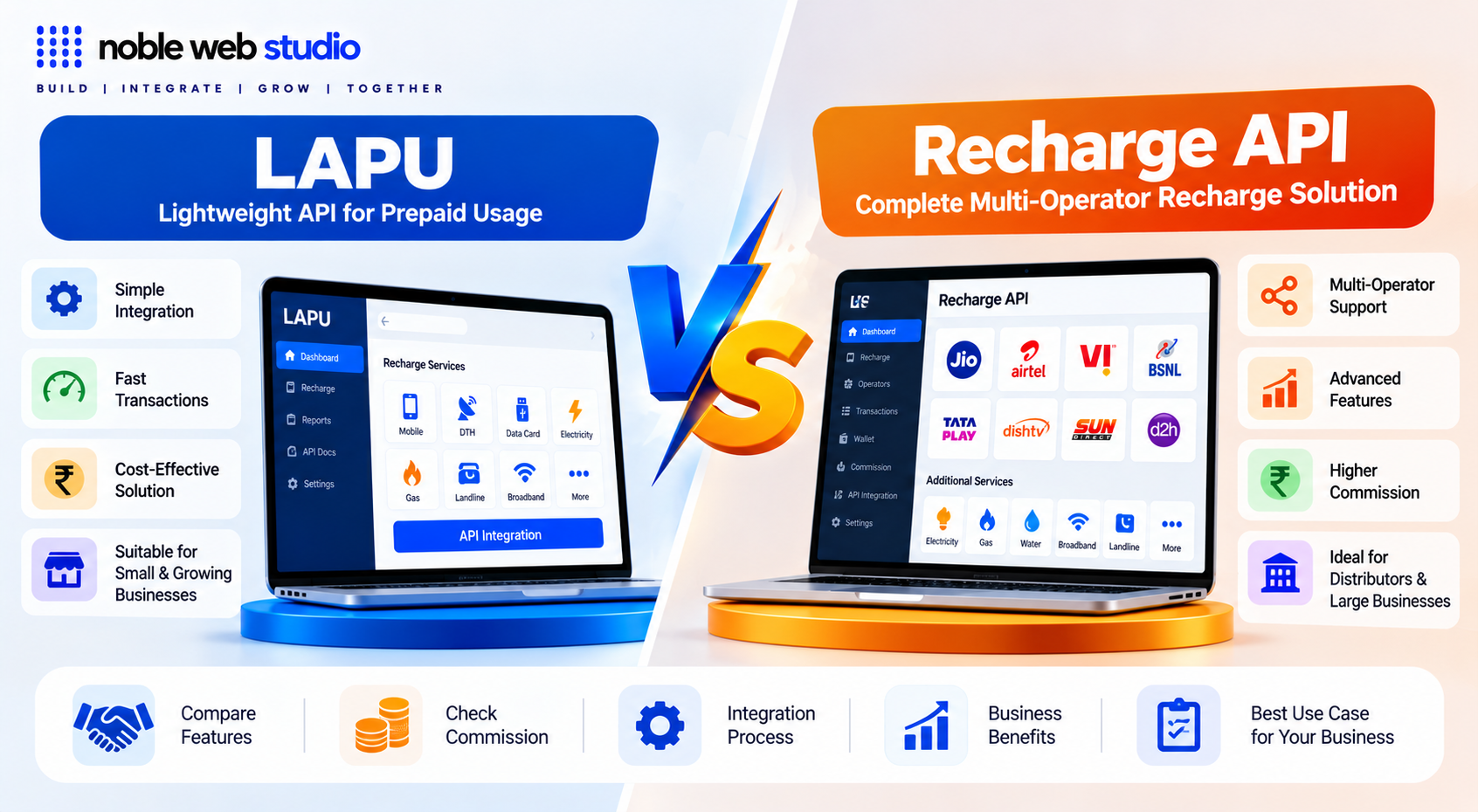
LAPU vs Recharge API is an important comparison for retailers, distributors, startups, and fintech businesses planning to offer mobile recharge services in India. Both approaches can support recharge operations, but they differ in how businesses access services, integrate technology, manage transactions, and build their own recharge platforms. Understanding these differences can help you choose a solution that matches your business model and growth plans.
LAPU may be suitable for businesses working through a specific telecom or distributor-based arrangement, depending on the operator’s terms. A Recharge API, on the other hand, allows businesses to connect recharge services with their own website, mobile application, retailer portal, or existing recharge software. Depending on the Noble web studio and integration, features may include multi-operator recharge, automated transaction processing, commission management, transaction status checks, and reporting.
LAPU (Local Area Pre-Paid Unit) and a Recharge API are two different methods for processing mobile and DTH recharges in India, differing primarily in hardware dependency, operator coverage, and scalability.
Before choosing between LAPU and a Recharge API, compare the setup requirements, operator coverage, commission structure, transaction reliability, technical support, and long-term flexibility. The right choice depends on whether you want to operate within an existing distribution system or develop recharge platform around your own business requirements.
Noble Web Studio provides recharge software development and mobile recharge API integration services for businesses exploring digital payment and recharge solutions.
In this guide, we explain the key differences between LAPU and Recharge API, their business applications, important selection factors, and what to consider before building or expanding a recharge business.
What Is LAPU Recharge?
LAPU recharge refers to a mobile and DTH top-up system that uses a specialized Local Area Pre-Paid Unit (LAPU) SIM card issued by telecom operators to retail shopkeepers and distributors.
What is a Recharge API?
A Recharge API (Application Programming Interface) is a b2b recharge software bridge that allows your website, mobile app, or digital platform to process automated top-ups and bill payments in real time.
LAPU vs Recharge API: What Is the Difference?
A LAPU (Local Area Pre-Paid Unit) is a physical or eSIM card issued by a single telecom operator to an authorized retailer for manual or SIM-based mobile recharges, while a Recharge API is a mobile recharge software connection that lets an recharge commission app, website, or recharge portal process multi-operator mobile, DTH, and utility recharges automatically from a single digital wallet.
Side-by-Side Comparison
| Feature | LAPU (Local Area Pre-Paid Unit) | Recharge API |
|---|---|---|
| Underlying Mechanism | Physical SIM card tied to one specific telecom operator. | Server-to-server digital HTTP/software connection. |
| Operator Coverage | Limited to the single operator of that specific SIM card. | All major telecom operators, DTH, and billers from one place. |
| Balance Management | Requires a separate balance loaded onto each operator’s SIM. | Uses a single centralized pre-paid e-wallet for everything. |
| Services Supported | Mainly mobile recharges for that specific network. | Mobile recharges, DTH, utility bills, FASTag, and more. |
| Automation | Traditionally manual or phone/SMS-based (unless hosted via cloud/robotic SIM boxes). | Fully automated with real-time status callbacks and receipts. |
| Hardware & Scaling | Requires managing multiple phones, SIMs, or hardware SIM boxes. | No hardware needed; scales easily for web/mobile software users. |
| Best Suited For | Small, single-operator local shops or niche direct-margin setups. | Apps, online portals, B2B re-sellers, and growing networks. |
LAPU vs Recharge API: Commission and Profit Comparison
LAPU (Local Area Pre-Paid Unit) and Recharge service API use different operational models, commission structures, and profit drivers for mobile and utility recharges.
Core Structural Differences
LAPU (Local Area Pre-Paid Unit):
- Model: A special SIM card issued by a telecom operator’s distributor directly to a ground-level retailer.
- Scope: Single-operator per SIM (you need separate physical SIMs or phones for Airtel, Jio, Vi, and BSNL).
- Balance: Requires maintaining a separate prepaid balance float loaded on each individual operator SIM.
- Execution: Manual or phone/USSD-based transactions dependent on SIM signal health and hardware.
Recharge API:
- Model: A software-to-operator or aggregator HTTP connection integrated into a website, higher recharge earning app, or mobile recharge portal.
- Scope: All major telecom operators, DTH providers, FASTag, and bill payments handled from a single central wallet.
- Balance: Single consolidated e-wallet for all services.
- Execution: Automated real-time HTTP calls with instant status callbacks and automatic refund processing on failures.
Commission & Profit Comparison
| Feature / Metric | LAPU Model | Recharge API Model |
|---|---|---|
| Mobile Recharge Commission | Higher direct margins on specific operator SIMs (often 1% to 4% depending on direct distributor terms) | Slightly lower or competitive aggregation margins (typically 0.8% to 4.0% depending on the operator like Jio/Airtel vs. BSNL/Vi) |
| DTH Commission | Limited or separate setup | 3.0% to 7.0% depending on the Noble web studio |
| Utility & Bill Payments | Usually limited or unsupported directly via basic SIM | Flat ₹5 to ₹20 or 0% to 2.5% via BBPS integration |
| Hardware & Setup Cost | Low entry cost (requires mobile phones or multi-port GSM devices/SIM boxes) | Software subscription or platform setup fee (ranging from ~₹7,500 to ₹24,500+ one-time/tier-based) |
| Working Capital | Fragmented float locked across multiple operator SIMs | Consolidated single-wallet float easy to rotate |
| Failure & Downtime Loss | High risk of hidden losses due to SIM throttling, signal drops, or stuck recharges requiring manual dispute resolution | Higher success rates via direct monitored carrier/aggregator routing with auto-refunds |
| Scaling Potential | Hard to scale; requires managing dozens of physical SIMs, cards, and devices | High scalability; supports unlimited multi-tier network hierarchies (retailers, distributors) from one portal |
LAPU vs Recharge API: Which Is Better for Retailers?
Recharge API is generally better than LAPU (Local Area Pre-Paid Unit / Last Agent Per Unit) for modern retailers and scaling businesses, though LAPU still suits very small, single-operator setups.
Core Differences
| Feature | LAPU (SIM-Based) | Recharge API (Software-Based) |
|---|---|---|
| Operators Supported | One operator per dedicated SIM card (e.g., separate SIMs for Airtel, Jio, VI) | All major telecom operators, DTH, and utility bills from a single wallet |
| Wallet & Balance | Requires separate balance loading on each operator SIM | Single centralized e-wallet for all services |
| Automation & Speed | Manual or phone/SMS-based; prone to delays and signal issues | Fully automated with real-time status callbacks and high success rates |
| Hardware & Setup | Requires physical phones, multiple SIM cards, or GSM modem pools | No special hardware; connects via web portals, apps, or software |
| Scalability | Hard to scale; more volume means managing more phones and SIM limits | Easily scales to thousands of transactions and multi-level agent networks |
Why Recharge API is Better for Retailers
- All-in-One Convenience: Retailers do not need to juggle 3 to 4 different phones or physical SIM cards to recharge different operators. One best mobile recharge portal or mobile recharge commission app handles everything.
- Higher Success Rates & Speed: Fast Recharge API connect directly to operator and Noble web studio servers, yielding real-time confirmation and automated refunds for failed pings. LAPU frequently fails due to SIM health, poor mobile network coverage, or operator anti-spam throttling.
- Broader Service Portfolio: Beyond basic mobile prepaid recharges, a standard recharge API allows retailers to offer DTH, FASTag, BBPS, and utility bill payments.
- Lower Operational Hassle: There is no need to manually maintain separate balances across multiple operator SIM wallets or worry about a SIM card running out of battery or network signal.
Which Is Better for Distributors and Master Distributors?
Neither role is universally “better” instead, master distributors and regular distributors serve different scales, risk profiles, and business models in the supply chain.
Regular Distributors
- Role: Buy goods from a manufacturer or master distributor and sell directly to local retailers, businesses, or end customers.
- Best for: Companies or individuals with strong local market knowledge, smaller capital, and a focus on direct customer relationships.
Advantages:
- Lower inventory risk and smaller minimum order requirements.
- Simpler logistics and less operational overhead.
- Closer ties to local buyers and faster direct feedback loops.
- Disadvantages: Higher per-unit purchasing costs because you buy further down the pricing ladder.
Master Distributors
- Role: Sit at the top of the distribution chain, buying massive volume directly from manufacturers and supplying regional or sub-distributors.
- Best for: Experienced distribution businesses with deep financial capacity, nationwide or multi-region footprints, and large-scale warehousing.
Advantages:
- Deepest price discounts and lower cost of goods.
- Earning override commissions or margins from an entire downline network of sub-distributors and retailers.
- Direct relationships with primary brand owners and broader product catalogs.
Disadvantages:
- Massive capital requirements to fund large inventory and credit terms.
- Heavy operational burden managing downline disputes, onboarding, and logistics.
- Stricter contractual performance metrics and minimum purchase commitments from manufacturers.
LAPU vs Recharge API Business Opportunity: Why the Choice Matters
Choosing between a LAPU (Local Area Pre-Paid Unit) system and a smooth Recharge API is a pivotal decision for a digital or retail recharge business in India. The right choice impacts your margins, scaling potential, and daily operational workload.
Core Definitions
- LAPU (Local Area Pre-Paid Unit): A specialized SIM card provided by a telecom operator to an authorized retailer or distributor. You load a physical balance onto that specific SIM and process recharges manually or via basic local routing for that single operator.
- Recharge API (Application Programming Interface): A cloud-based software connection. From a single centralized e-wallet, your application, website, or B2B recharge panel can process recharges for all major telecom operators, DTH services, and utility bills automatically.
Side-by-Side Comparison
| Feature | LAPU System | Recharge API |
|---|---|---|
| Operator Coverage | Restricted to one operator per SIM card (requires multiple phones/SIMs for all networks) | All major operators accessible from a single unified wallet |
| Balance Management | Requires maintaining separate, individual balances across multiple operator SIMs | Single centralized digital e-wallet for everything |
| Services Supported | Mainly mobile recharges (operator-specific) | Mobile recharge, DTH, FASTag, BBPS, and utility bills |
| Automation & Speed | Often manual, phone-based, or dependent on hardware/robotic setups | Fully automated with real-time status callbacks and webhooks |
| Scalability | Hard to scale; requires managing more physical phones, SIM cards, and manual balance refills | High scalability; easily handles thousands of retailer requests on a cloud panel |
| Best Suited For | Small, single-operator local shops or niche high-margin operator-specific rules | Apps, multi-tier B2B mobile recharge portals, white-label networks, and growing businesses |
Why the Choice Matters for Your Business
1. Working Capital & Hardware Overhead
- LAPU: Demands locking up physical cash across multiple operator SIM balances. If a particular operator’s SIM runs out of balance mid-day, transactions halt until you refill that specific SIM.
- API: Eliminates physical hardware and multi-SIM clutter. Your only ongoing costs are recharge admin software subscription/platform fees and a single central working capital wallet.
2. Margins vs. Reliability at Scale
- LAPU Margins: Can sometimes offer attractive or direct operator commission structures for specific denominations.
- The Scale Trap: While LAPU may look cheaper or more lucrative at very low volumes, it often incurs hidden losses as volume grows due to failed transactions, manual reconciliation overhead, and SIM downtime.
- API Reliability: Reduces human intervention and automates fund reversals, status tracking, and multi-operator switching (using smart recharge API-switching features).
3. Business Model & Multi-Tier Distribution
- If you plan to run a White Label recharge B2B, or multi-level distribution network (Admin → Distributor → Retailer), a raw LAPU-only setup struggles to synchronize inventory and roles.
- Noble web studio offering integrated recharge platform layers often combine standard multi operator recharge API with hybrid LAPU-integrated gateways so businesses can capture specific operator margins without losing automated scale.
LAPU vs Recharge API for High-Volume Recharge Businesses
For high-volume recharge businesses, Recharge API is superior to traditional LAPU (Local Area Pre-Paid Unit or Last Agent Per Unit) SIM-based setups due to automation, scalability, and higher success rates.
Core Comparison
| Feature | LAPU (SIM / Modem Pool) | Recharge API (Server-to-Server) |
|---|---|---|
| Operator Coverage | Limited to one specific operator per SIM card | All major operators, DTH, utilities, and FASTag from one wallet |
| Balance Management | Fragmented; separate physical/virtual balance on each SIM | Single centralized e-wallet for all services |
| Automation & Speed | Manual or GSM modem-dependent; prone to delays | Fully automated with real-time status callbacks |
| Success Rate & Reliability | Lower; prone to SIM blockages, signal drops, and operator anti-spam throttling | Higher; direct connection to operator or aggregator servers |
| Scalability | Hard to scale; requires managing hundreds of physical phones or GSM modems and changing balances manually | High scalability; handles thousands of retailer transactions effortlessly |
| Best Suited For | Small, single-operator local recharge shops | High volume B2B recharge portal, apps, and multi-tier distribution networks |
Why High-Volume Businesses Choose Recharge API
- Direct Server Connectivity: Top Recharge API connections bypass physical hardware limitations (such as GSM modem failure, poor network signal, or SIM card damage).
- Anti-Spam Throttling Protection: Telecom operators frequently block or throttle high-frequency LAPU SIM cards due to automated transaction limits, whereas authorized best mobile recharge API handle massive concurrent throughput smoothly.
- Multi-Operator Routing & Switching: B2B recharge platform using reliable recharge API support smart-switching if one operator or recharge API gateway goes down, the system instantly reroutes the transaction to a backup Noble web studio without human intervention.
- Unified Financials and Commissions: Instead of tracking cash and float across dozens of physical operator SIMs, a best recharge API paired with a B2B recharge admin panel automates tiered commissions (Admin → Distributor → Retailer) and real-time ledger updates.
How Much Can You Earn With Each Method?
Earnings with LAPU (Local Area Punch-Up / SIM-based) vs. Recharge API depend on percentage commission margins typically 0.6% to 3% for Jio/Airtel, 2.5% to 5% for BSNL/Vi, and 2% to 7% for DTH where LAPU offers direct operator margins (sometimes higher for specific carriers), while Recharge APIs offer volume scalability, automated single-wallet management, and zero physical SIM/hardware overhead.
Commission Earnings Breakdown by Method
1. LAPU (SIM-Based Recharge)
- How it works: Uses physical SIM cards, eSIMs, or hosted SIM-box hardware tied directly to specific telecom operators. You maintain separate operator balances (load) for each network.
Earning Potential / Margins:
- Direct distributor/retailer margins can be slightly higher for select telecom operators because you bypass Noble web studio server.
- Mobile recharges generally yield 0.6% to 3% (higher like 2.5% to 5% on BSNL and Vi depending on active operator plans).
Hidden Costs & Limits:
- Requires blocking working capital across multiple separate operator SIM balances.
- Hardware, phone/SIM box upkeep, and manual reconciliation reduce net efficiency.
- Slower throughput and risk of SIM congestion or operator blocks.
2. Recharge API (Server-to-Server)
- How it works: Uses automated HTTP software-to-operator routing via a centralized cloud wallet.
Earning Potential / Margins:
- Noble web studio offers the same core commission slabs (0.6% to 3% for Jio/Airtel; 2.5% to 5% for BSNL/Vi; 2% to 7% for DTH), plus additional revenue streams from utility bills (BBPS), FASTag, and money transfers (DMT).
Volume & Net Profit Advantages:
- Single Wallet Efficiency: One consolidated float covers every operator and service, preventing idle money from being trapped in separate SIM balances.
- Higher Volume Capacity: Near-instant processing allows shopkeepers or white label recharge portal owners to handle thousands of transactions daily without manual typing errors.
- Reselling Capability: You can resell recharge API panels or sub-distributor tiers to other agents to stack commission tiers.
Key Comparison
| Feature | LAPU Method | Recharge API Method |
|---|---|---|
| Working Capital | Split across multiple operator SIM balances | Unified single wallet for all operators |
| Transaction Speed | Slower (SIM-menu / manual typing) | Near-instant (automated HTTP) |
| Commission Margins | Sometimes higher direct operator margins | Standard market margins + cross-sell (DTH, BBPS, DMT) |
| Setup & Maintenance | Needs separate SIMs/phones/hardware | No physical hardware; software/platform fee |
| Scaling Limit | Capped by physical SIM limits & manual tracking | High volume via automated ledger and switch-API tools |
LAPU vs Recharge API Investment Required
Choosing between a LAPU (Last Agent Per Unit, SIM-based) setup and a Recharge API platform involves different upfront costs, working capital management, and infrastructure requirements.
LAPU (SIM-Based) Investment
- Hardware & SIMs: Requires a separate dedicated SIM card, often a separate mobile phone, GSM/SIM box, or a PC-based port device for each telecom operator (Airtel, Vi, Jio, BSNL).
- Upfront / Setup Cost: Low to moderate for a single-operator counter, though scaling up hardware ports or SIM boxes can increase initial outlays if managing multiple devices.
- Working Capital (Float): Fragmented. You must maintain separate balance/load wallets for every single operator SIM. If one operator’s SIM runs out of balance, you cannot process recharges for that network until you top up that specific SIM.
- Service Scope: Restricted mostly to prepaid mobile top-ups for specific operators; it does not inherently support unified DTH, BBPS utility bills, or multi-service wallets without specialized software bridging.
Recharge API Investment
- Software / Platform Cost: No physical SIM-box or multi-phone hardware needed. Costs depend on whether you use a ready-made white label recharge panel/best commission recharge app (typically ranging from ₹1,499 to ₹2,100+/month for hosted B2B plans like Noble web studio, or ₹7,500 to ₹25,000+ for a one-time custom recharge portal build) or build a direct custom recharge API from scratch (which involves higher mobile recharge software developer and certification overhead).
- Working Capital (Float): Centralized. A single e-wallet or main balance covers all operators, DTH, and utility bill payments simultaneously.
- Service Scope: Multi-operator, DTH, utility bills (BBPS), and additional financial/digital services (like AePS or DMT) integrated into a single dashboard or highest recharge commission app.
- Speed & Error Reduction: Automated responses with transaction IDs reduce manual typing errors compared to USSD/SIM-menu punching.
Can LAPU and Recharge API Work Together?
Yes, LAPU and Recharge APIs can work together perfectly within a single B2B mobile recharge platform. Modern, enterprise-grade best recharge software allows you to integrate both methods simultaneously, giving you the ability to route traffic dynamically between them.
How They Work Together
Instead of choosing one over the other, you can use a hybrid system via a central admin panel:
- Primary and Backup Routing: You can set a standard Mobile Recharge API as your main source for high-volume transactions because it is faster and connects directly over HTTP. If that recharge API server goes down or fails, recharge service software can instantly switch the routing to your LAPU system (or vice versa) to maintain a near-100% success rate.
- Margin Optimization: LAPU (which uses operator SIM cards) often yields higher profit margins for specific networks or local promotional denominations. You can program your top recharge software to automatically route those specific requests through your LAPU modem/gateway while routing all other multi-operator traffic through a standard third party Recharge API.
- Unified Wallet: Your retailers and distributors do not need to know which backend is being used. They deduct funds from a single, unified digital wallet inside high commission recharge app or portal, while standard recharge software handles the backend split.
LAPU vs Recharge API: Integration and Software Requirements
When setting up a digital multi-operator recharge business, understanding the distinction between LAPU (Local Area Payment Unit) and a Recharge API is essential. While both systems ultimately deliver airtime to customers, their technological architectures, hardware requirements, and integration methods are fundamentally different.
Here is a comprehensive breakdown of the differences, integration pipelines, and recharge b2b software requirements for both systems.
Direct Technical Comparison
| Feature | LAPU (SIM-Based Hardware / Automation) | B2B Recharge API (Aggregator Model) |
|---|---|---|
| Core Mechanism | Transactions route through physical or hosted telecom-issued SIM cards. | Transactions route through web servers (HTTP GET/POST) directly to an Noble web studio. |
| Capital Allocation | Fragmented: Separate balances must be maintained on each operator’s SIM. | Unified: A single wallet balance handles all operators and services. |
| Hardware Required | GSM Modems/SIM Boxes (for automation) or mobile phones. | None: Relies entirely on cloud hosting or existing servers. |
| Failure Points | SIM health, network reception, operator anti-spam throttling. | Noble web studio server downtime or timeout drops. |
| Service Diversity | Limited strictly to mobile/DTH top-ups supported by that operator SIM. | Broad: Mobile, DTH, BBPS (Electricity, Water, Gas), Fastag, and DMT. |
1. LAPU Software & Integration Requirements
Traditional LAPU involves manual dialing (USSD/STK), but scaling a business requires Robotic LAPU or SIM-hosting software that automates the hardware.
Hardware Infrastructure
- GSM Modem Pools / SIM Boxes: Multi-port hardware units (supporting 4 to 240+ channels) connected to a central computer via USB or LAN.
- Dedicated Servers: A local or cloud server connected to the physical hardware to execute continuous scripts.
- Operator SIMs: Authorized commercial E-recharge SIM cards directly from telecom distributors (e.g., Airtel, Jio, Vi, BSNL).
Software Architecture
- AT Command Engine / Driver Layer: Low-level trusted recharge software that sends standard AT commands or communicates with STK (SIM Tool Kit) menus to automate the USSD dialing process without human intervention.
- Robotic Auto-Retry Daemon: Background services that monitor SIM signals, transaction logs, and automatically retry failed transactions through alternative ports if a SIM gets throttled.
- Virtual Mobile Number (VMN) Parser: High Volume Recharge Software component that decodes incoming SMS confirmations from operators to match transaction statuses.
Features Recharge API and LAPU Recharge
Recharge API and LAPU (Local Area Pre-Paid Unit or Last Agent Per Unit) are two distinct methods used to power mobile, DTH, and utility recharges in India’s digital payments ecosystem.
Recharge API Features
- Multi-Operator Coverage: Connects a single wallet or recharge service platform to all major telecom and DTH operators simultaneously.
- High Automation & Speed: Operates via direct server-to-server json/REST recharge API with real-time status callbacks (webhooks) and high uptime (often 99%+).
- Single Wallet System: Uses a centralized digital recharge wallet for all transactions, eliminating the need to track individual operator balances.
- Extended Services: Supports prepaid/postpaid mobile, DTH, utility bill payments (BBPS), FASTag, AePS, and money transfer (DMT).
- Built-in Tools: Features automatic retry engines for pending transactions, R-offer/tariff plan finders, and white-label Android recharge commission app.
LAPU Recharge & Robotic LAPU Features
- SIM-Based Distribution: Traditionally relies on a dedicated operator-issued SIM card (LAPU SIM) given to a retailer to process top-ups for a specific network.
- Robotic Cloud Hosting: Modern Robotic LAPU APIs host physical LAPU SIMs or GSM modem pools on cloud servers, allowing automated hits from an app or website without manual phone typing.
- Higher Margins: Noble web studio provides attractive fixed or special commissions/margins set by local distributors for specific operator plans.
- Segmented Balances: Traditional LAPU requires maintaining separate physical balances tied to individual operator SIM cards (though robotic wrappers unify them into branded recharge software).
- R-Offer Support: Direct integration with operator-specific special recharges (R-offers).
Common Problems With LAPU and Recharge API
LAPU (Local Area Payment Unit / Last Agent Per Unit) and Recharge APIs come with distinct operational, technical, and financial challenges.
Common Problems with LAPU (Local Area Payment Unit)
- Fragmented Balances: Requires a separate SIM card, a dedicated phone or device, and a separate working capital balance for every single telecom operator.
- Hardware & SIM Vulnerabilities: Relies heavily on physical SIM health, mobile signal strength, and handset stability.
- Anti-Spam Throttling & Restrictions: Telecom operators frequently trigger automated blocks, speed limits, or anti-spam restrictions on high-volume LAPU SIM cards.
- Manual Entry Errors: Retailers typically type recharges manually into USSD menus or app interfaces, increasing the risk of wrong numbers or incorrect amounts.
- Limited Service Scope: Cannot process DTH, utility bill payments, or multiple multi-service categories from a single SIM.
Common Problems with Recharge API
- API Downtime & Route Failures: Service can stall or fail completely if the aggregator/operator server goes offline or experiences upstream routing issues.
- Stuck & Pending Transactions: Requests may hang in an ambiguous state where the money is deducted from the wallet, but the operator confirmation is delayed or dropped.
- Wallet & Reconciliation Discrepancies: Mismatches can happen between local database transaction logs and the actual balance deducted from the Noble web studio central wallet.
- Invalid Inputs & Circle Mismatches: Errors occur if the system fails to auto-detect the correct telecom circle or network operator (e.g., ported numbers).
- Security & Credential Leaks: Exposing Recharge API keys, tokens, or webhook endpoints insecurely can lead to unauthorized access, wallet draining, or abuse.
- Technical Dependency: Requires developer setup, webhook handling, and error-retry logic rather than a plug-and-play manual device.
How to Choose Between LAPU and Recharge API
Choosing between LAPU (Local Area Payment Unit) and a Recharge API depends entirely on your business scale, budget, and how many telecom operators you intend to serve. While LAPU relies on dedicated physical or hosted SIM cards tied to specific telecom distributors, a Recharge API uses a digital gateway to connect high commission recharge platform directly to Noble web studio networks or operator servers for instantaneous processing.
For a single-operator local shop, LAPU is standard; however, for a scaling business that wants to handle multiple networks through a single wallet, a Recharge API is the industry-standard choice.
Direct Comparison
The table below breaks down the key operational differences to guide your selection:
| Feature | LAPU (SIM-Based) | Recharge API |
|---|---|---|
| Capital Management | Split balances across multiple SIMs per operator. | Single wallet balance covers all operators. |
| Service Scope | Typically restricted to mobile/DTH top-ups. | Supports DTH, BBPS (Electricity, Water), and Bill Payments. |
| Transaction Success | Subject to SIM cellular network stability and manual speed. | Higher success rates due to server-to-server connections. |
| Operations | Manual entry or specialized local automation software. | Fully automated with real-time digital transaction logs. |
| Compliance | Bound tightly to local distributor terms and regional SIM rules. | Governed by commercial platform SLA agreements. |
When to Choose LAPU
You should opt for a traditional LAPU setup if you operate a highly localized business or targeted distribution counter:
- Single Operator Dominance: If you primarily sell services for just one telecom operator in a specific territory with direct distributor connections.
- Higher Regional Margin Control: When your local telecom distributor offers aggressive direct margins that outpace third-party aggregator pricing.
- Low Initial Tech Needs: If you prefer simple operations without writing software code or hiring developers.
When to Choose a Recharge API
You should integrate Recharge API if you are building a modern, scalable digital platform:
- Capital Efficiency: You want your working capital pooled into one central wallet rather than locking money down into five separate SIM card balances.
- All-in-One Utility Hub: You want to offer value-added capabilities like utility bills, Bharat Bill Payment System (BBPS), and diverse data plans alongside mobile recharges.
- Platform Scalability: You run a multi-tier network (e.g., Admin → Distributor → Retailer) requiring auto-plan fetching, instant digital receipts, and real-time transaction tracking.
LAPU vs Recharge API: How Noble Web Studio Can Help
A Recharge API connects your recharge commission platform to all telecom and DTH operators through a single digital wallet, whereas a LAPU (Local Area Pre-Paid Unit) requires a physical SIM card dedicated to just one specific operator.
LAPU vs. Recharge API: Core Comparison
- Operator Coverage: A LAPU SIM only handles one specific operator (e.g., Airtel or Jio), requiring multiple physical SIMs or hardware setups for multi-operator support. A High Speed Recharge API covers all major mobile networks, DTH providers, and utility bill payments from a single unified wallet.
- Hardware & Setup: Traditional LAPU needs physical SIM-boxes or mobile phones, while hardware-free/robotic LAPU solutions or Recharge admin API eliminate bulky hardware.
- Success Rate & Speed: API connections route directly to operator servers with automated real-time status reports (typically under 2–3 seconds) and higher success rates (~99%). LAPU depends on SIM signal strength, device health, and operator anti-spam limits.
- Scalability: Trusted Mobile Recharge API scale easily for B2B retailer networks, white label mobile recharge portal and high transaction volumes without managing physical SIM inventories.
When LAPU Recharge API still makes sense
A LAPU (Last Agent Per Unit) recharge setup where physical or hosted SIM cards are used for distribution still makes strategic and economic sense in specific scenarios despite the growth of direct multi operator mobile recharge API:
- High-Margin Single-Operator or Local Dominance: When a business or local distributor focuses heavily on a single dominant telecom operator in a specific Tier-2, Tier-3, or rural market where local SIM margins or distributor incentives are structured better than powerful mobile recharge API.
- Secondary / Backup Routing Layer: For existing recharge API resellers and master distributors who want to plug LAPU in as a fallback or secondary routable channel to ensure uptime if a primary direct API faces operator-side latency or downtime.
- Low-Volume Single-Counter Shops: For a small local retailer or single-operator counter where investing in a full multi-recharge white label mobile recharge platform or complex recharge API integrated adds unnecessary overhead.
- High-Margin Control on Specific Packs: When local trade schemes offer special retailer trade benefits, talk-time bonuses, or commission margins tied directly to physical/SIM-based distribution that Noble web studio cannot replicate.
When to Move from LAPU to a Recharge API
- Working Capital Fragmentation: LAPU requires maintaining separate SIM balances (and often separate phones or ports) for each telecom operator, locking up cash across multiple pockets instead of a single unified e-wallet.
- Service Expansion: LAPU cannot natively handle DTH, electricity bills, BBPS, or fast-growing utility services from the exact same channel without complex multi-system switching.
- Error Reduction & Speed: Recharge API system automate operator detection and provide instant on-screen transaction IDs, drastically cutting down manual typing or menu-code errors common to SIM-based USSD/SMS flows.
Why most growing businesses move to an recharge API
Growing businesses move to a recharge API (Application Programming Interface) to replace outdated, manual systems like LAPU (Local Area Prepaid Unit SIM cards) with an automated, scalable digital infrastructure.
Key Reasons for the Shift
- Single Wallet Management: Instead of splitting working capital across separate SIM cards, physical balance accounts, and phones for each telecom operator, a single recharge API wallet covers every operator and utility service.
- All-in-One Service Suite: Unlike basic operator-specific SIMs that only handle single mobile recharges, APIs let businesses bundle mobile top-ups, DTH (Direct-to-Home) recharges, FASTag, and utility bill payments (electricity, gas, water) from one reliable mobile recharge platform.
- Automation and Speed: Transactions process in real time with instant on-screen confirmation and unique transaction IDs, removing the need for shopkeepers to manually type shortcodes or USSD menus.
- Fewer Manual Errors: Automated operator detection and digital amount entry significantly lower typing mistakes and wrong recharges.
- Recurring Commissions & New Revenue: Integrated recharge system automatically track commissions per transaction and allow businesses to add retail or agent networks under their own brand name.
- Better Customer Retention: Turning an high commission mobile recharge app or website into a “one-stop shop” for micro-payments increases user engagement and cross-selling opportunities for other services.
Do You Need a Recharge API Developer?
You need a best recharge API developer only if you are building or maintaining a custom recharge commission app, website, or POS system that connects to an external telecom or subscription top-up network.
When You Need a Developer
- Custom Software: You already operate an higher recharge commission app, payment portal, or billing system and want to embed real-time mobile, DTH, FASTag, or utility bill recharges into it.
- API Integration: Noble web studio Recharge API developer team takes 2 to 5 days to write the code, connect the endpoints (such as recharge request, plan fetch, and status check), and set up sandbox testing.
When You Do Not Need a Developer
- White-Label / Ready-Made Software: If you do not have a technical team, you can skip hiring recharge software developer and use a ready-to-use white label mobile recharge portal or B2B mobile recharge software package that comes with the mobile recharge API integrated.
Recharge API Cost Comparison
Recharge API cost in India typically range from ₹0 to ₹50,000+, depending on whether you choose a one-time setup model, a reputable recharge software subscription, or a commission-based structure.
Cost Structures Comparison
- One-Time Setup / API Plans (e.g., Noble web studio):
- Noble Web Studio: Noble web studio offers one time recharge API plans priced at ₹3,000 (Starter), ₹4,500 (Gold), and ₹5,500 (Platinum) with no monthly fees. Full recharge commission software bundles range from ₹7,500 to ₹24,500.
Software License & White-Label Integration (e.g., Noble Web Studio):
- License Fees: ₹5,000 to ₹25,000.
- Integration Fees: ₹10,000 to ₹50,000.
- White-label Solutions: ₹25,000 to ₹1,20,000+.
- Ongoing/Subscriptions: ₹10,000 to ₹20,000 per year or ₹45,000+ per month for enterprise builds.
Commission vs. Margin Model:
- Most recharge API do not charge per-call or per-transaction service fees; instead, you pre-load a working capital wallet.
- You earn an operator-wise commission on every successful transaction:
- Mobile Prepaid: Generally 2% to 4% (e.g., Vodafone 3.3%–3.5%, BSNL 3.0%–3.2%, with lower margins on Jio and Airtel).
- DTH: 2% to 7%.
- Data Card: 3% to 5%.
- Utility & BBPS Bills: Fixed per-transaction structures (e.g., ₹0.72 to ₹9.60 per txn depending on the utility type like electricity, water, or gas).
Recharge API Speed and customer experience
High performing mobile recharge API process transactions in 42 to 200 milliseconds, maintaining 99.0% to 99.9% uptime and a 98% to 99% transaction success rate.
Speed & Technical Benchmarks
- Response Time: Standard REST/JSON recharge API complete mobile, DTH, and utility top-ups within 200ms to 500ms under normal network conditions.
- Automation: Automated operator and circle detection eliminates manual entry errors and delays.
- Plan Discovery: Real-time plan-fetch smooth mobile recharge API prevent invalid denominations and plan mismatches before a transaction is submitted.
- Failover & Refunds: Automated routing switches between telecom gateways during outages, and failed transactions trigger instant or near-instant wallet reversals.
Impact on Customer Experience
- Instant Gratification: Real-time top-ups eliminate waiting periods, long retail queues, or manual intervention.
- Higher Retention: Seamless, zero-drop payment flows build customer trust and drive repeat usage across digital wallets, banking apps, and e-commerce platforms.
- Unified Convenience: Customers can manage mobile, DTH, FASTag, and utility bills from a single application interface.
Common Mistakes Distributors Make
Distributors managing mobile recharges often run into costly operational mistakes when balancing LAPU (Local Area Pre-Paid Unit) physical/cloud SIM setups against multi operator Recharge API.
Common Mistakes Distributors Make
- Sticking with LAPU purely for cost savings: Relying on LAPU as volume grows often leads to losing more money in failed, stuck, or unmanaged transactions than the cost of proper recharge API infrastructure.
- Ignoring automatic failover and routing: Choosing a Noble web studio or setup that lacks a fallback mechanism means a single operator or route failure breaks service for all downstream retailers.
- Overlooking API call caps: Failing to ask Noble web studio whether recharge API access is limited or unlimited can result in silent volume throttling as your retailer network expands.
- Skipping regular reconciliation: Assuming all transactions succeeded based on a quick glance instead of weekly and monthly ledger matching leads to undetected balance gaps and financial leakage.
- Failing to train retailers on failure states: Not teaching shopkeepers how to identify true failure alerts versus pending or duplicate requests causes repeat hits, angry customers, and endless disputes.
- Mismatched operator codes and order IDs: Entering wrong telecom operator prefixes (such as confusing Jio/Airtel/Vi short codes) or reusing identical recharge system API order IDs causes immediate, silent transaction drops.
- Relying on a single-method ceiling: Locking a business permanently into either pure LAPU or a single mobile recharge API without multi-channel flexibility limits growth and margins.
Moving from LAPU to an Recharge API
Moving from a LAPU (Local Area Pre-Paid Unit a single-operator retailer SIM card) to a Recharge API (a recharge software connection that handles all operators, DTH, and bills from one central wallet) upgrades your business from manual SIM-and-handset management to automated software routing.
Key Differences: LAPU vs. Recharge API
- Operator Coverage: LAPU covers only one specific telecom operator per SIM; an high quality recharge API covers all major telecom operators, DTH, and utility bills from a single balance.
- Transaction Vehicle: LAPU uses physical SIM cards or eSIMs where value is drawn directly from the SIM’s local balance; an high performance recharge API uses HTTP/REST recharge software requests (GET/POST) connected to an Noble web studio or direct telecom gateway.
- Volume & Speed: LAPU is prone to delays, network drops, or manual tracking needs, working best under ~50 transactions a day; instant recharge API process high volumes in real time with automatic status reports and instant callbacks.
Conclusion
The choice between LAPU vs Recharge API depends on your business model, recharge volume, integration requirements, and plans for growth. LAPU may suit businesses operating through a particular telecom retailer or distributor arrangement, while a top performance Recharge API can be a better fit for businesses that want to integrate mobile recharge services into their own website, application, retailer recharge portal, or software platform.
With a Multi Recharge API, businesses can explore options such as multi-operator recharge integration, automated transaction processing, commission management, transaction status checks, and a scalable recharge platform. The exact features depend on the Noble web studio, commercial terms, and available integrations. Before choosing a Noble web studio, compare the setup cost, operator coverage, commission structure, technical support, settlement process, and failed-transaction handling.
LAPU (Local Area Pre-Paid Unit) and Recharge API are two distinct methods for processing mobile and DTH recharges in India, differing primarily in how transactions are routed and scaled.
Noble Web Studio helps businesses explore fintech mobile recharge software development and mobile recharge API integration solutions suited to their project requirements. If your goal is to build or expand a recharge business with your own mobile recharge commission platform, discuss your requirements with Noble Web Studio to identify a suitable integration approach.
Ultimately, understanding the difference between LAPU and a Recharge API helps you choose a Noble web studio that fits your current operations and future growth plans. Review the features, costs, and integration requirements carefully before making your decision.
LAPU vs Recharge API with Noble Web Studio
Comparing LAPU and Recharge API solutions for your business? Connect with Noble Web Studio to discuss recharge software, API integration, business requirements, and suitable setup options.
FAQs About LAPU vs Recharge API
LAPU recharge typically uses a telecom operator’s agent-based recharge facility, while a Recharge API connects recharge software service to a recharge service through a defined mobile recharge API interface. LAPU may suit businesses using a particular operator’s agent arrangement, whereas a Recharge API can help businesses integrate recharge services into their own website, highest mobile recharge commission app, or recharge retailer software. The right choice depends on operator access, commission terms, integration needs, and business volume.
A Recharge API may be more suitable if you want to build a branded recharge platform, automate transactions, connect multiple operators, and manage transactions through recharge earning software. LAPU may be useful when your business has access to an appropriate operator-based arrangement and its commercial terms suit your needs. Compare the actual commission rates, operating requirements, transaction reporting, and support before choosing.
It depends on the retailer’s business model. LAPU can be useful for operator-specific recharge operations, while an recharge business API-based mobile recharge service platform can provide recharge software-driven workflow for supported operators and services. Retailers should compare availability, ease of use, commission, wallet requirements, transaction status tracking, and the support offered by their Noble web studio.
Yes. A business can use a high response Recharge API to connect recharge services to its website, application, mobile recharge retailer portal, or other compatible recharge software. Before launching, confirm the recharge API onboarding requirements, Recharge API documentation, operator coverage, wallet or prepaid balance rules, commission structure, and technical support.
They may be used together if the reliable recharge software supports both integrations and the relevant operator or service arrangements permit it. A combined fast recharge platform can give a business more flexibility in how transactions are processed. Ask the recharge software developer whether both connections are supported, how routing is configured, and how transaction status and reconciliation are managed.
There is no universal winner. Commission depends on the operator, recharge amount, business agreement, rate card, and other commercial conditions. Compare the actual net margin per transaction rather than relying on advertised maximum commission figures. Also check settlement terms, wallet charges, and any integration or maintenance fees.
Yes. A suitable Recharge API can support distributor-focused high earning recharge software when the platform includes the required user hierarchy, wallet or ledger management, commission configuration, transaction reports, and access controls. The exact features depend on the Noble web studio. Confirm that the proposed solution supports your intended retailer and distributor structure before recharge app development.
Yes. A compatible Recharge API can be integrated into a custom website or b2b mobile recharge application so customers or retailers can initiate supported recharge transactions through your platform. You may also need an recharge admin panel, user management, transaction history, wallet accounting, and support workflows. These components must be developed or supplied separately unless included in the chosen solution.
Review these essential points before making a decision:
Supported mobile operators and recharge services
Mobile Recharge API documentation and integration assistance
Authentication and credential security
Transaction status enquiry and callback support, where available
Pending, failed, and reversed transaction handling
Commission and wallet ledger reports
Testing environment and technical support
Pricing, maintenance costs, and commercial terms
Choose a Noble web studio based on verified capabilities and documented terms rather than marketing claims alone.
Not in every situation. Fast response Recharge API-based recharge can support automated server-to-server processing, but actual response time depends on the Noble web studio infrastructure, operator connectivity, network conditions, and transaction processing. LAPU performance also depends on its particular implementation and operator conditions. Ask for real transaction data and test the service before relying on speed claims.
A pending transaction means the final outcome has not yet been confirmed. The highest speed recharge software should check the transaction status through the Noble web studio supported status mechanism or callback process, if available. Avoid submitting the same recharge again before checking its status, as doing so may result in a duplicate transaction. Follow the Noble web studio documented process for failures, reversals, and refunds.
The cost varies according to the Noble web studio commercial terms and the scope of your project. A basic integration may require less development than a complete recharge platform with a branded website, Android mobile recharge commission app, Mobile recharge admin panel, retailer and distributor accounts, wallet management, and custom reporting. Request a detailed quotation that separates recharge API charges, software development, Recharge API setup, maintenance, and ongoing support.
Noble Web Studio can discuss your top recharge software development and Mobile recharge API integrate requirements. The proposed scope may include a custom website or application, an branded recharge admin panel, retailer or distributor workflows, and transaction reporting, depending on your project needs. Contact Noble Web Studio to confirm the required integrations, available development options, estimated cost, and delivery scope before starting.
Explain whether you need a recharge website, mobile application, Recharge B2B retailer platform, Recharge distributor panel, Mobile Recharge API integrating, or a combination of these. Ask for a written scope covering supported branded mobile recharge API, operator coverage, commission configuration, transaction status handling, security, testing, deployment, maintenance, and project cost. Also clarify which services are included and which require third-party agreements.
A business may be able to transition to an recharge API solution, but the process depends on the existing multi recharge software, operator arrangements, customer accounts, and data requirements. Before switching, plan the integration, test transactions, verify wallet reconciliation, and communicate any operational changes to retailers. If you want to retain LAPU as an additional route, confirm that the new recharge platform can support it.
It can be, provided the startup chooses a Noble web studio that matches its budget and immediate requirements. Compare the total cost of integration, fast recharge software, wallet funding, support, and ongoing maintenance. Starting with a clearly defined scope and adding features as the business grows may help control initial recharge software development cost.
A Brand Recharge API is the technical interface used to send recharge requests and receive responses from a supported service. Highest earning Recharge software is the best recharge application through which administrators, retailers, distributors, or customers use those services. Highest Commission Recharge Software may connect to one or more reputed recharge API and include features such as user accounts, wallet records, commission settings, and reports.
Start by identifying your target customers, expected transaction volume, required operators, and distribution model. Then compare commission terms, integration flexibility, transaction monitoring, support, security, operating costs, and scalability. Choose the option that meets your current needs without creating unnecessary technical or commercial restrictions as your business expands.
Custom software can help a business organize its recharge workflow around its own users, operational rules, reporting requirements, and branding. Depending on the agreed scope, it may include best mobile recharge API integration, retailer management, High recharge commission configuration, transaction tracking, and administrative controls. The benefits depend on implementation quality and the capabilities of the connected Noble web studio.
Start by sharing your business model, required operators, preferred Highest volume Mobile Recharge platform, estimated transaction volume, and whether you need LAPU, Recharge API, or both. Noble Web Studio can discuss the proposed highest volume recharge software and integration scope, including the required Mobile Recharge panels, reporting, testing, and support. Confirm Mobile recharge API access, third-party charges, project deliverables, and timelines before approving the project.