Ankit
Ankit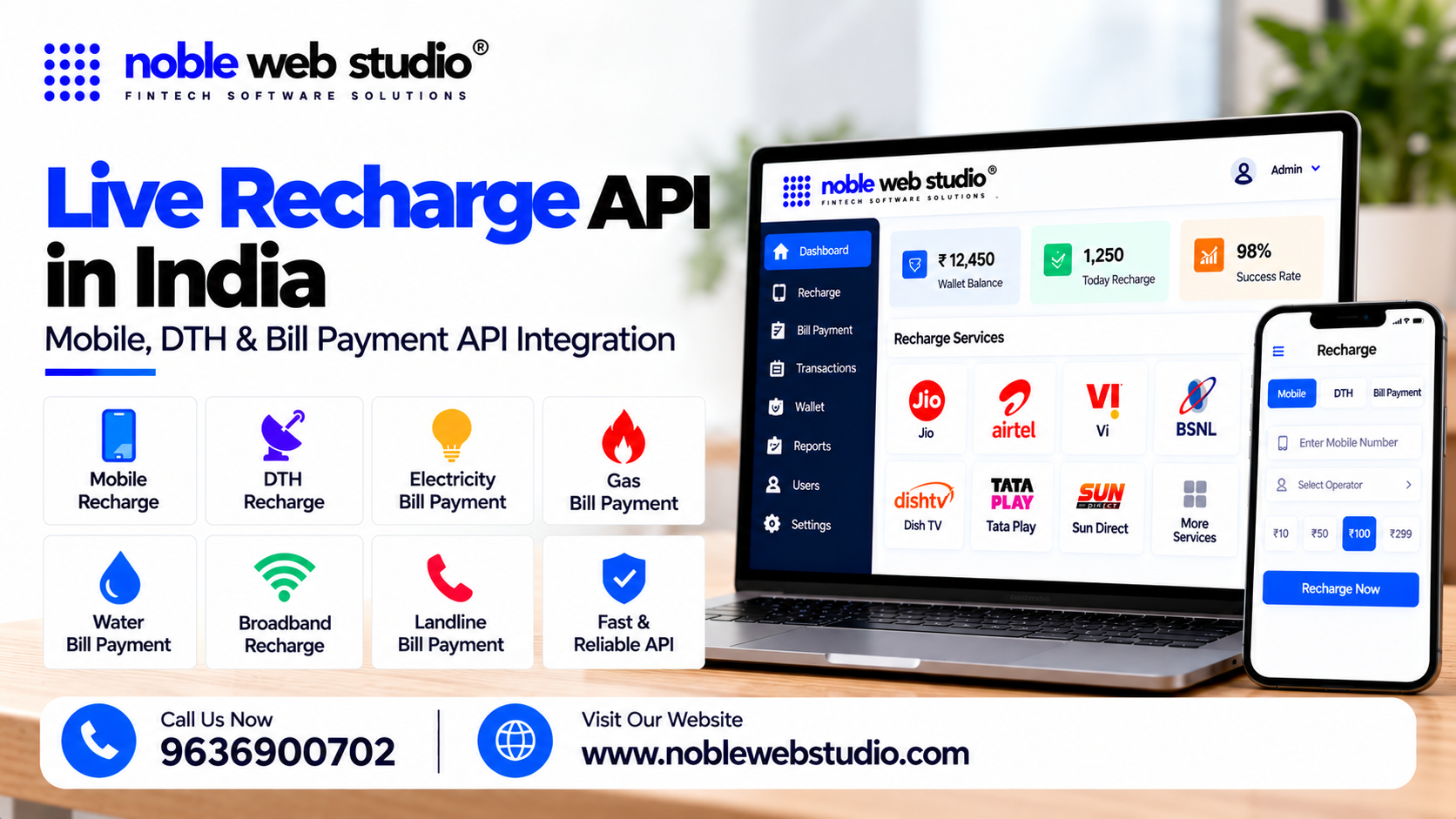
A Live Recharge API enables businesses to integrate real-time mobile recharge services into a website, mobile application, brand recharge portal, or recharge fintech platform. With a suitable Live Recharge API in India, businesses can offer customers a convenient way to recharge prepaid mobile numbers and access supported DTH and utility bill payment services through a connected system. Noble Web Studio provides recharge software solutions for businesses looking to build, launch, or expand their online recharge operations.
Whether you are a fintech startup, mobile recharge retailer, distributor, recharge software reseller, or entrepreneur, integrating a Live Mobile Recharge API can help automate recharge requests, connect supported operators, and manage transaction responses through your own live recharge platform. Depending on the fast recharge API and service coverage, additional services may include DTH recharge, postpaid bill payments, electricity bills, FASTag, and other utility payments. The exact services available depend on the selected Noble web studio and its integrations.
A Live Recharge API is a software interface that lets developers integrate real-time mobile, DTH, data card, and utility bill recharges directly into their own recharge commission app, websites, or recharge B2B platforms.
When choosing a Live Recharge API Provider such Noble web studio, it is important to check operator coverage, recharge API documentation, transaction-status updates, callback support, failed-recharge handling, refund procedures, security, commission terms, and technical assistance. A clear integration process and reliable transaction tracking can help reduce manual work and make it easier to manage customer queries. Before going live, test successful, pending, and failed transactions carefully so recharge platform can handle different responses correctly.
Noble Web Studio offers ready-made B2B mobile recharge software and recharge business solutions that can help businesses manage retailer and distributor operations. Depending on your selected recharge API package and integration requirements, you can explore features such as an admin panel, user management, commission configuration, transaction reports, and mobile recharge services. If you want to build a branded recharge platform, connect an existing application, or establish a multi-level recharge business, choosing the right recharge software and recharge API setup is essential.
Looking to launch or expand your recharge business? Contact Noble Web Studio to discuss your mobile recharge software and recharge API integration requirements.
In this guide, you will learn how a Live Recharge API works, which features matter when comparing providers, how mobile recharge API integration supports automated transactions, what to check before selecting a best recharge API, and how to choose a solution that fits your business goals. Understanding these factors can help you make a more informed decision and prepare your fast recharge platform for future growth.
What is a Live Recharge API?
A Live Recharge API (Application Programming Interface) is a set of digital protocols and code endpoints that lets a website, mobile recharge commission app, or fintech platform connect directly to telecom, DTH (Direct-to-Home), and utility service providers to process instant, real-time top-ups and bill payments.
How Does a Live Recharge API Work?
A Live Recharge API is a software interface that connects a business website, application, or POS terminal directly to telecommunications operators, DTH platforms, and utility billers. Instead of integrating separately with individual carriers like Jio, Airtel, Vi, and BSNL, businesses use a single unified mobile recharge API to process instant automated transactions.
How a Live Recharge API Works (Step-by-Step)
The background communication between the customer-facing system and the underlying operator takes 3 to 10 seconds and involves several validation steps:
[ Customer App/Web ] ──(1. Request)──> [ Your Server ] ──(2. API Call)──> [ API Gateway ] ──(3. Process)──> [ Operator System ]
[ Customer App/Web ] <──(6. Success)── [ Your Server ] <──(5. Callback)── [ API Gateway ] <──(4. Response)─ [ Operator System ]
- Request Initiation: A user enters their mobile or account number, selects an operator, inputs the amount, and authorizes payment on recharge b2b portal.
- API Call & Validation: Recharge software system captures these details and sends a secured HTTPS request containing parameters like mobile_number,
operator,amount, and a uniquetransaction_idalong with an encrypted recharge API token. - Gateway Verification: The Noble web studio checks your single wallet balance to confirm you have enough funds to cover the request, running up to 10+ validation checks.
- Operator Fulfillment: The Noble web studio forwards the query to the specific telecom network operator or utility hub in real time.
- Real-time Response: The operator processes the credit, sends back a confirmation payload, and the Noble web studio immediately returns a success or failure webhook status code to best recharge commission app.
Live Recharge API Services Available for Businesses
Live recharge API services allow businesses to add automated mobile, DTH, utility, and digital payment features directly into their websites or apps using a single integration.
Core Services Available
- Mobile Prepaid & Postpaid: Instant top-ups, data packs, and special tariff vouchers for Jio, Airtel, Vi (Vodafone Idea), BSNL, and MTNL.
- DTH Recharge: Subscriptions and plan renewals for Tata Play, Dish TV, Sun Direct, Airtel Digital TV, and d2h.
- Utility & Bill Fetch APIs: Electricity, gas, water, and landline bill payments via the Bharat Bill Payment System (BBPS).
- FASTag & Money Transfer: Highway toll tag recharges and domestic money transfers (DMT) via IMPS/UPI.
- Helper APIs: Operator-circle detection, live plan fetching, and pre-payment bill amount checking.
Documents Required for Live Recharge API
To get a live Recharge API (for mobile, DTH, and utility services) from a Noble web studio in India, you must complete the KYC (Know Your Customer) and recharge API onboarding process.
Personal & Identity Documents (For Individuals / Proprietors)
- PAN Card: Mandatory for tax identification, financial settlements, and commission payouts.
- Aadhaar Card: Required for address and identity verification.
- Alternative ID Proof: Voter ID, Passport, or Driving License (if Aadhaar or PAN requires supplementary proof).
- Passport-Size Photograph: For account verification.
Business & Company Documents (For Registered Entities / Pvt Ltd / Partnership)
- Company PAN Card: Corporate or firm tax ID.
- Business Registration Proof: Certificate of Incorporation, MSME/Udyam certificate, or Shop & Establishment License.
- GST Registration Certificate: Required if you handle B2B transactions or exceed the legal turnover threshold.
- Authorized Signatory ID & Address Proof: Documents for the designated owner or person managing the account.
Banking & Financial Details
- Cancelled Cheque or Bank Passbook: To link your wallet/payout bank account.
- Recent Bank Statement: Sometimes requested by the Noble web studio for high-volume or enterprise recharge service API accounts.
Technical & Integration Information
- Website or App URL: The recharge digital platform where the best mobile recharge API will be embedded.
- Static IP Address: (If required by the Noble web studio for IP-whitelisting and security).
- Signed Service Agreement / Terms of Use: A signed contract or digital consent form provided by the Noble web studio.
Who Can Use Live Recharge API
A live recharge API can be used by any business, developer, or organization looking to integrate automated mobile, DTH, and utility bill payments into their digital recharge platform or branded recharge software.
Key User Categories
- Retailers & Small Businesses (SMEs): Local shops and kiosks use trusted recharge API to offer direct top-ups to customers and earn transaction commissions.
- Fintech & Payment Wallet Companies: Digital recharge wallets and neobanks integrate recharge API to turn their platforms into all-in-one utility payment apps.
- E-Commerce & Digital Platforms: Online stores provide mobile recharges as a value-added feature or a way for users to redeem loyalty rewards.
- Banks & Financial Institutions: Traditional and digital banks embed direct recharge and bill-pay options straight into their high mobile recharge commission app and web portals.
- App & Software Developers: Creators build white label recharge software or custom B2B and B2C mobile recharge software solutions for external clients.
- Startups & Entrepreneurs: Noble web studio launch dedicated digital utility, fintech, or recharge payment platform using unified b2b mobile recharge API.
- Distributors & B2B Networks: Noble web studio manage multi-tier networks of sub-distributors and local merchant chains.
Why Use Live Recharge API
Using a Live Recharge API connects your website, high commission mobile recharge app, or recharge admin software directly to Noble web studio to automate services in real time.
Key Benefits of Using a Live Recharge API
- Instant Real-Time Processing: Completes mobile prepaid, DTH, data card, and utility rejections/top-ups in under a second (usually under 500 milliseconds).
- Single Unified Integration: Combines multiple operators (Airtel, Jio, Vi, BSNL) and DTH services (Tata Play, Dish TV, Sun Direct) into one interface instead of building separate integrations for each.
- Live Plan Fetching: Pulls real-time plans, pricing, talktime, and validity data on demand so standard recharge platform never displays stale or outdated tariffs.
- Automated Operator & Circle Detection: Identifies the user’s telecom operator and regional circle automatically upon entering a mobile number.
- New Revenue Streams & Commissions: Earns fractional or fixed commission margins on every transaction processed through recharge earning platform.
- High Daily User Engagement: Drives recurring, frequent higher earning recharge app visits since mobile top-ups and bill payments are regular customer needs.
- Scalability Beyond Telecom: Expands easily to support DTH, electricity, water, gas bills, and FASTag toll payments from a single dashboard.
- Built-in Status Tracking & Security: Noble web studio offers real-time callback URLs, transaction status reporting, automated complaint/refund handling, and encrypted data protection.
Key Aspects of Live Recharge API
A Live Recharge API is a recharge software interface that connects high volume recharge platform directly to Noble web studio to automate mobile, DTH, and bill payments in real time.
Key Aspects of a Live Recharge API
- Real-Time Processing: Completes mobile and DTH top-ups instantly, usually in under 200 to 500 milliseconds.
- Multi-Operator & Multi-Service Support: Connects a single interface to multiple telecom operators (Jio, Airtel, Vi, BSNL), DTH providers (Tata Play, Dish TV, etc.), and utility/BBPS bills.
- Auto-Operator & Plan Discovery: Automatically detects the Noble web studio server circle code, and active live recharge plans/packs to prevent transaction errors.
- Wallet & Commission Management: Features a built-in pre-funded recharge wallet system that tracks margins, dealer commissions, and payouts automatically.
- High Uptime & Reliability: Maintains around 99.9% service uptime with automated status checks and self-healing error or refund protocols.
- Security & Authentication: Uses bank-grade standards such as HTTPS/TLS encryption, 256-bit SSL, IP whitelisting, and mobile recharge API token restrictions.
- Sandbox & Developer Tools: Provides test environments (sandbox) alongside clean RESTful documentation with code samples in PHP, Python, Node.js, and Java.
Live Recharge API for Websites, Apps and Recharge Portals
Live Recharge APIs serve as a critical digital bridge that connects websites, mobile recharge application, and B2B/B2C portals directly to telecommunications networks and utility systems. A single, unified integration allows recharge platforms to process instant, real-time recharges using a centralized wallet system.
Core Features of a Live Recharge API
- Unified Multi-Operator Gateway: Process prepaid top-ups, postpaid bills, and DTH recharges across major telecom operators (such as Jio, Airtel, Vi, and BSNL) from one integration endpoint.
- Operator & Circle Detection: Automatically detects the circle location using just the 10-digit mobile number, reducing user selection error.
- Live Plan Fetch API: Dynamically pulls up-to-date regional talktime packs, data plans, and roaming bundles so users always see current offers.
- Real-Time Status & Webhooks: Utilizes automated HTTP POST webhooks to push instant transaction status callbacks (Success, Pending, Failed) back to your app.
- Centralized Wallet & Commission Engine: Operates on a pre-funded mobile recharge B2B wallet, automatically deducting costs and calculating percentage-based commissions (typically ranging from 2% to 5%) in real time.
Live Recharge API for Retailers, Distributors and B2B Businesses
A Live Recharge API lets B2B businesses, distributors, and retailers connect directly to telecom and utility providers to process instant digital recharges and bill payments.
Core Features for B2B & Distribution Networks
- Multi-Level Hierarchy: Supports recharge Admin Owners, Master Distributors, Distributors, and local Retailers with isolated wallet and commission controls.
- All-Operator Coverage: Handles mobile (Jio, Airtel, Vi, BSNL), DTH (Tata Play, Dish TV, Airtel Digital TV, Sun Direct, D2H), and FASTag issuers.
- Real-Time Plan Discovery: Fetches active operator plans per telecom circle before transaction execution to prevent failures.
- High-Speed Processing: Completes most transactions within 200ms to 500ms with auto-failover to backup gateways if a primary line drops.
- Automated Commission Payouts: Dynamically splits and credits profit margins down each tier of the distribution chain upon a confirmed transaction.
- White-Label Solutions: Allows businesses to launch a branded recharge portal, mobile recharge admin panel, and Android recharge b2b app.
What Is the Difference Between a Live Recharge API and a Mobile Recharge API?
A Mobile Recharge API is a general programming interface that lets a software application process top-ups (prepaid mobile, postpaid bills, and DTH) through telecom operators. A Live Plan Fetch API or live lookup feature is a specific sub-function or an upgraded live-data capability within a recharge system that pulls real-time tariff plans, special offers (Roffers), and operator/circle detection directly from the carrier at that exact moment.
Core Differences
| Feature / Concept | Mobile Recharge API (General / Core) | Live Plan / Live Lookup API (Dynamic Layer) |
|---|---|---|
| Primary Purpose | Processes the actual financial/recharge transaction to credit a mobile number or DTH account. | Fetches real-time plans, browse-plans data, and operator/circle identification prior to payment. |
| Data Type | Transaction-focused (sends amount, mobile number, operator code; receives success/failure status). | Informational/Query-focused (queries current tariffs, active user offers, and validation). |
| Role in Workflow | Executes the final debit and top-up step. | Helps the user choose what plan to buy before hitting recharge. |
| Failure Prevention | Relies on user-inputted plan details (risk of wrong plan/amount entered). | Auto-detects operator/circle and pulls live plans to prevent operator mismatches and failed transactions. |
Key Components Explained
1. Mobile Recharge API
- What it does: Acts as a bridge between higher commission recharge app/website and the Noble web studio.
- Capabilities: Handles prepaid mobile recharges (Airtel, Jio, Vi, BSNL), DTH top-ups (Tata Play, Dish TV), and sometimes utility or bill payments via a single wallet balance.
- Integration: Uses REST endpoints, JSON payloads, recharge API keys, and callback URLs to confirm if a transaction went through.
2. Live Plan / Operator-Circle Detection API
- What it does: A specialized live query module often bundled with Noble web studio.
- Capabilities:
- Operator & Circle Detection: Automatically identifies which telecom circle or carrier a mobile number belongs to (crucial in markets like India where mobile numbers are ported across operators).
- Live Plan Fetch: Pulls up-to-the-minute data packs, validity details, and special promotional offers (Roffers) tailored to a specific phone number.
- Why it matters: It stops users from picking expired plans or entering the wrong operator, drastically cutting down on failed transactions and support tickets.
Features Live Recharge API
A Live Recharge API is a software interface that connects your website, b2b mobile recharge app, or digital high earning recharge platform directly to telecom, DTH, and utility operators to process instant, automated transactions through a single unified balance.
Key Features of a Live Recharge API
- Single Unified Interface: Process mobile top-ups, data packs, DTH subscriptions, and utility bills across multiple operators (such as Jio, Airtel, Vi, and BSNL) using one code integration.
- Automated Operator & Circle Detection: Instantly auto-fetches the telecom operator and service circle when a user enters a mobile number (
Operator Detect API). - Live Plan & Roffer Fetching: Pulls real-time tariff plans, special packs, validity details, and subscriber-specific special offers (
Plan Fetch APIandRoffer Fetch API) directly from operators. - Real-Time Transaction Status: Delivers instant success, pending, or failure status responses in milliseconds alongside webhook/callback notifications.
- Shared Wallet & Auto-Topup: Operates on a centralized prepaid wallet model with support for instant auto-debits and digital wallet top-ups (UPI, NetBanking).
- Auto-Complaints & Auto-Refunds: Automatically raises complaint tickets for stuck or failed transactions and triggers instant wallet refunds.
- Developer-Friendly Formats: Uses standard RESTful endpoints returning JSON or XML data, complete with SDK samples (PHP, Node.js, Python, Java) and sandbox/testing environments.
- Security Controls: Employs TLS/HTTPS encryption, IP whitelisting, and server-side mobile recharge API key protection to secure financial ledgers.
Benefits Live Recharge API
A Mobile Recharge API (Application Programming Interface) is a software bridge that lets websites, highest commission mobile recharge app, or B2B recharge platform automatically process prepaid mobile, postpaid, DTH, and utility bill recharges directly through telecom operators.
Key Benefits
- Instant Processing: Completes transactions in under a second (usually under 500 milliseconds) with near-zero downtime.
- Single Integration: Combines multiple operators (Airtel, Jio, Vi, BSNL, Tata Play, Dish TV, etc.) into one unified interface instead of managing separate accounts.
- Automated Refunds: Failed or stuck transactions trigger automatic wallet refunds or status reversals without needing manual support tickets.
- New Revenue Streams: Earn commission margins or fixed cashbacks on every mobile, DTH, data card, or utility bill processed through your platform.
- Developer-Friendly: Returns standard JSON or XML payloads with built-in sandbox environments for testing before going live.
- Expanded Services: Scales beyond simple top-ups to support the Bharat Bill Payment System (BBPS), electricity, gas, broadband, and money transfer services.
How to Integrate a Live Recharge API Step by Step
Integrating a live Mobile Recharge API allows your website or app to instantly process prepaid top-ups, postpaid bills, and DTH payments. It acts as a middleman, connecting your software directly to major telecom providers like Jio, Airtel, and Vodafone Idea.
Here is a comprehensive, step-by-step developer guide to integrating a live recharge API into best recharge earning platform.
1. Choose a Noble web studio and Complete KYC
- Select a Noble web studio: Noble web studio that supports major operators like Jio, Airtel, Vi, BSNL, and DTH services.
- KYC & Documentation: Submit your business proof, PAN card, Aadhaar card, and bank account details to get your account and wallet approved.
- Fund Your Wallet: Load an initial deposit balance into Noble web studio e-wallet so best recharge system has funds to process top-ups.
2. Set Up the Sandbox Environment
- Obtain Credentials: Generate your test/sandbox best recharge API Key, Secret, or Token from the recharge software developer dashboard.
- Test Endpoints: Use mock phone numbers, test operator codes, and local circle codes in a staging environment to avoid affecting live money or real accounts.
3. Build Front-End and Back-End Logic
- Operator & Circle Detection: Implement an input form where the user enters their mobile number. Optionally use an operator-lookup endpoint to auto-detect the telecom circle and carrier (e.g., Airtel, Jio).
- Fetch Plans: Call the Noble web studio server plan-fetching endpoint (
/plans/{operator}/{circle}) to display live recharge packs to your users. - Process Recharge Request: Send an HTTP
POSTrequest from your server to the recharge API live or sandbox processing endpoint.- Required Payload Parameters typically include:
mobile/number,amount,operator code,circle code, and a uniqueorder_id/ reference ID.
- Required Payload Parameters typically include:
4. Handle Responses, Webhooks, and Status Polling
- Parse JSON Responses: Handle immediate responses (
status,txid,opid) returned by the API. - Webhooks / Callbacks: Configure a callback URL on your server so the Noble web studio can push real-time transaction updates (Success, Failed, or Pending) back to your database.
- Status Query: Build a fallback background job or manual status-check endpoint (
GET /transaction/status/{id}) in case a callback is delayed.
5. Go Live and Monitor
- Switch Base URLs: Replace the sandbox top recharge API base URL with the production base URL (e.g., switching from staging to live production endpoints).
- Security Best Practices: Store high speed recharge API secrets safely in server-side environment variables, enforce HTTPS, and whitelist your server IP if required by the Noble web studio.
Live Recharge API Pricing, Setup Fees in India
The cost structure for a live recharge API in India typically includes setup/license fees, ongoing subscriptions, recharge software development/integration costs, and operator recharge commission margins.
1. Setup & Software License Costs (One-Time)
- Basic / Starter API Plans: ₹5,000 – ₹7,500 (covers basic mobile and DTH recharge APIs)
- Mid-Range / Gold Plans: ₹15,000 – ₹25,000 (adds BBPS utility payments and multi-level distribution)
- White-Label & Enterprise Solutions: ₹25,000 – ₹1,20,000+ (includes a fully branded mobile recharge portal, higher commission mobile recharge app, and trusted mobile recharge admin panel)
- Entry-Level Basic Setup (e.g., KwikAPI): Starts around ₹4,999 one-time.
2. Ongoing & Subscription Fees
- Monthly Software / Maintenance Plans: ₹1,499 – ₹1,999/month for standard B2B multi-level distribution recharge software, or up to ₹45,000+/month for heavy enterprise-grade fast recharge platforms.
- Annual Renewals / Subscriptions: ₹10,000 – ₹20,000/year depending on the Noble web studio.
- Per-Call / Volume-Based Plans: Custom recharge API-only integrations are often priced based on expected transaction volume rather than a flat monthly fee.
- Add-ons: SMS or WhatsApp OTP notifications are usually billed separately at carrier pass-through rates.
3. Custom Development & Integration Costs
- API Integration Services: ₹1,000 – ₹5,000 per smooth recharge API or ₹20,000 – ₹30,000 for general third party recharge API hooking.
- Payment Gateway Setup: ₹5,000+ (plus standard transaction gateway fees).
- Custom Website & App Development: ₹50,000 – ₹1,00,000+ depending on UI/UX complexity.
- Domain & Hosting: ₹500 (domain) + ₹10,000 – ₹20,000/year (web hosting).
Live Recharge API Maintenance Cost in India
The live recharge API maintenance and ongoing cost structure consists of recurring technical fees, server overhead, and wallet or transaction dependencies.
Recurring Maintenance & Support Costs
- Annual Maintenance Contracts (AMC): Ranges from ₹500 to ₹25,000 per month (or billed annually) depending on the Noble web studio, covering system patches, bug fixes, and technical support.
- Server and Hosting Fees: Ranges from ₹2,000 to ₹20,000+ per month to handle high-concurrency reliable recharge API request, database updates, and uptime reliability.
- Developer / Tech Support: If you manage a custom-built wrapper or white-label portal, internal or external engineering hours are required for recharge API version updates (when operators like Airtel, Jio, Vi, or BSNL change their callback or billing endpoints).
Recurring Maintenance & Support Costs
- Annual Maintenance Contracts (AMC): Ranges from ₹500 to ₹25,000 per month (or billed annually) depending on the Noble web studio, covering system patches, bug fixes, and technical support.
- Server and Hosting Fees: Ranges from ₹2,000 to ₹20,000+ per month to handle high-concurrency recharge API request, database updates, and uptime reliability.
- Developer / Tech Support: If you manage a custom-built wrapper or white-label portal, internal or external engineering hours are required for mobile recharge API version updates (when operators like Airtel, Jio, Vi, or BSNL change their callback or billing endpoints).
Infrastructure & Operational Costs
- Pre-funded Wallet Requirement: You must maintain a working capital or float balance (typically ₹50,000 to ₹5,00,000+ depending on scale) locked inside the recharge wallet to execute live recharges.
- Payment Gateway Fees (if applicable): If end-users top-rule professional recharge platform directly via online payment, expect gateway charges of 1.75% to 3.5% + fixed per-transaction fees.
- Domain, SSL, and Security: Annual renewal of SSL certificates, domain registration (₹500/year), and security/compliance updates (₹0 to ₹20,000).
Commission & Margin Dynamics (Offsetting Costs)
Your net cost is heavily influenced by the spread or commission structure provided by the Noble web studio:
- Mobile Operators: High recharge Commission usually range from 0.8% to 2.0% for Airtel/Jio and 3.0% to 6.5% for BSNL/Vi.
- DTH & Utility (BBPS): DTH commissions range from 3.0% to 7.0%, while BBPS/bill payments often operate on flat fees (₹5 to ₹20 per transaction).
Recharge API Commission Structure and Business Profitability
Recharge API commission structure in India typically vary by service category, operator, and the Noble web studio tiered subscription plan (such as Starter, Gold, or Platinum).
Average Commission Rates by Category
- Prepaid Mobile Recharge: Ranges from 0.8% to 5.0% depending on the telecom operator and plan tier.
- Jio & Airtel: 0.8% – 2.0%
- Vodafone Idea (Vi) & BSNL: 3.0% – 6.5%
- DTH Recharge: Ranges from 3.0% to 7.0%.
- Tata Play, Dish TV, Airtel Digital TV, Sun Direct, & Videocon: 3.5% – 4.5%
- Google Play / Gift Cards: Ranges from 1.5% to 2.5% (available on higher-tier plans).
- Utility Bills, Postpaid, & BBPS (Electricity, Gas, Water): Usually 0.0% to 1.5%, or handled via a flat fee (e.g., ₹5 to ₹20 per transaction) rather than a percentage margin.
- FASTag & LIC: Typically 0.15% to 0.40% or flat commission structures.
Sample Tiered Plan Structure (Example)
Noble web studio often structure commissions using tiered startup or monthly subscription packages.
| Service / Operator | Starter Plan | Gold Plan | Platinum Plan |
|---|---|---|---|
| Vodafone Idea (Vi) | 3.30% | 3.40% | 3.50% |
| BSNL | 3.00% | 3.10% | 3.20% |
| Airtel / Jio | 0.80% | 0.90% | 1.00% |
| Tata Play DTH | 3.50% | 3.60% | 3.70% |
| Airtel Digital TV / Videocon | 4.00% | 4.10% | 4.20% |
| Google Play | — | 2.00% | 2.50% |
Hidden Costs & Evaluation Factors
When choosing a brand recharge API, high commission percentages can be offset by hidden operational fees:
- Setup / License Fees: Generally range from ₹2,500 to ₹25,000 (or higher for custom white label recharge software solutions).
- Maintenance / AMC: Can run between ₹500 and ₹3,000 per month.
- Success Rate vs. Commission: Noble web studio offering 3.5% commission with a 99%+ success rate is often more profitable than one offering 4% commission with frequent transaction failures and support overhead.
Live Recharge API Request and Response Example
A live mobile recharge API request and response uses a standard POST method with a JSON payload, authenticated via an fast recharge API key or bearer token.
API Request Example
Send a POST request to the Noble web studio server endpoint with your authentication headers and JSON body containing the client reference ID/operator ID, mobile number, and amount.
POST https://pay2all.in/api/v1/recharge HTTP/1.1
Host: pay2all.in
Authorization: Bearer YOUR_API_KEY
Content-Type: application/json
Accept: application/json

{
  "client_id": "TXN-1001",
  "provider_id": 2,
  "number": "9876543210",
  "amount": 239,
  "type": "MOBILE"
}
The server processes the transaction live against the telecom operator and returns a structured JSON response with the transaction status, unique transaction ID, operator details, and message.
{
  "status": "success",
  "status_code": 200,
  "message": "Recharge successful",
  "data": {
    "transaction_id": "P2A88492011",
    "client_id": "TXN-1001",
    "number": "9876543210",
    "operator": "Jio",
    "circle": "Rajasthan",
    "amount": 239,
    "commission": 9.56,
    "operator_ref_id": "JIO9988776655",
    "timestamp": "2026-10-15T12:00:00Z"
  }
}
Real-Time Webhook Callback (Asynchronous Status)
If the operator network delays confirmation, the gateway pushes the final status to your configured callback URL (POST request):
{
  "event": "transaction.completed",
  "transaction_id": "P2A88492011",
  "client_id": "TXN-1001",
  "service": "mobile_recharge",
  "mobile": "9876543210",
  "operator": "jio",
  "amount": 239,
  "status": "success",
  "timestamp": "2026-10-15T12:00:05Z"
}
Live Recharge API Documentation: Endpoints, Parameters and Error Codes
For the Reputed Recharge API Reference, integration relies on REST/RPC endpoints over HTTPS with JSON-encoded payloads.
Base URL & Authentication
- Base URL: https://www.noblewebstudio.com/
- Authentication Header:
X-Recharge-Access-Token: store_api_token - Versioning Header:
X-Recharge-Version(defaults to store settings; supports versions like2021-11and2021-01)
Core Endpoints & Resources
- Addresses:
/2021-01/addresses(GET,POST,PUT,DELETE, validation, count) - Charges:
/2021-01/charges(GET,POST,PUT) - Checkouts:
/2021-01/checkouts(GET,POST) - Customers:
/2021-01/customers(GET,POST,PUT, payment sources) - Subscriptions:
/2021-01/subscriptions(GET,POST,PUT,DELETE) - Orders & Onetimes:
/2021-01/orders,/2021-01/onetimes - Webhooks: Managed via dashboard events or recharge API configuration
Parameters
- Pagination: Cursor-based or page-based pagination (
limitdefault 50, max 250 vialimit,next_cursor,previous_cursor). - Sorting: Controlled via
sort_byquery parameters. - Data Extension: Use
includeorincluded_objectsquery parameters to embed related entities (e.g., customer, metafields).
Error Codes & Status Responses
- 2xx (Success): Standard HTTP
200,201indicating successful execution. - 4xx (Client Errors):
400 Bad Request: Invalid payload or missing required parameters.401 Unauthorized: Missing or invalidX-Recharge-Access-Token.403 Forbidden: Insufficient permission scopes on the API token.404 Not Found: Target resource does not exist.429 Too Many Requests: Rate limit exceeded (Standard rate limit is 2 calls/second leak, 40-call bucket; Plus/Custom plans allow 4 calls/second leak, 80-call bucket).
5xx (Server Errors):
500 Internal Server Error: Unexpected server-side failure.503 Service Unavailable: Temporary downtime or maintenance.
Real-Time Recharge API Status: Success, Failed and Pending Transactions
Here are standard JSON and response snippets for Success, Failed, and Pending transaction statuses in mobile and subscription recharge API.
1. Success Transaction Snippet
Indicates that the recharge or payment has been completely processed by the telecom operator or payment gateway.
{
  "status": "SUCCESS",
  "statusCode": "200",
  "message": "Transaction successful",
  "clientTransactionId": "TXN_987654321",
  "operatorRefId": "OP_REF_55443322",
  "data": {
    "number": "9876543210",
    "amount": 299,
    "operator_name": "Airtel",
    "debit_amount": "294.50",
    "opening_bal": "5000.00",
    "closing_bal": "4705.50",
    "commission_amount": "4.50"
  }
}
2. Failed Transaction Snippet
Indicates that the request could not be completed (e.g., due to insufficient balance, invalid parameters, or operator rejection), and the wallet amount is typically refunded.
{
  "status": "FAILED",
  "statusCode": "402",
  "errorCode": "INSUFFICIENT_BALANCE",
  "errorMessage": "Your wallet balance is insufficient to complete this transaction.",
  "clientTransactionId": "TXN_987654321",
  "operatorRefId": null,
  "data": {
    "number": "9876543210",
    "amount": 299,
    "operator_name": "Airtel",
    "opening_bal": "50.00",
    "closing_bal": "50.00"
  }
}
3. Pending Transaction Snippet
Indicates that the transaction is held in a processing queue (waiting for operator response, 3D Secure verification, or SEPA/bank confirmation). Do not refund or re-trigger the request immediately to avoid double-charging.
{
  "status": "PENDING",
  "statusCode": "202",
  "message": "Transaction is still in processing. Await callback or check via status query.",
  "clientTransactionId": "TXN_987654321",
  "operatorRefId": null,
  "data": {
    "number": "9876543210",
    "amount": 299,
    "operator_name": "Airtel",
    "opening_bal": "5000.00",
    "closing_bal": "4705.50"
  }
}
Recharge API Automatic Refunds, Failed Recharges and Transaction Dispute Handling
Integrating a Mobile, DTH, or Bill Payment Recharge API requires a highly defensive engineering approach. In a standard multi-recharge architecture, your software communicates with an Noble web studio team via a RESTful JSON interface. Because transactions involve three separate nodes Your Application → Upstream API Provider → Telecom Operator Grid—handling edge cases like dropouts, network timeouts, and delayed operator acknowledgments is critical.
1. Failed Recharges & Status Matrix
Multi Recharge API classify transactions into three foundational states:
| Transaction Status | Operational Definition | System/Operator Action Required |
|---|---|---|
| SUCCESS | The telecom operator has acknowledged and provisioned the plan. A permanent Operator Ref ID is issued. | Final State. Deduct funds from user; credit margins. No cancellation allowed. |
| FAILED | The transaction dropped due to an immediate validation error or network refusal. | Final State. Trigger immediate automated wallet reversal. |
| PENDING | The upstream gateway or operator has accepted the payload but hasn’t confirmed execution. | Transient State. Freeze wallet balance. Do not re-attempt. Await callback or poll. |
The Core Integration Rules
- Implement Idempotency Keys: Always generate a unique
client_ref_idinside your application before firing the API payload. If a network timeout occurs mid-request, re-sending the exact same key prevents the operator from charging the target mobile number twice. - The “Double Recharge” Trap: Retailers must be programmatically blocked from clicking “Recharge” again on a number if the initial request sits in a
PENDINGstate. If a transaction is pending, the downstream user must be shown a “Processing” screen until finality is reached.
2. Automated Refund Architecture
When a transaction hits a structural FAILED state, the upstream core engine uses an automated ledger correction loop to clear the balance.
[Your App Request] ──> [Upstream API Provider] ──> [Telecom Operator Grid]
                                                           │ (Fails Validation)
[Wallet Reversal]  <── [Auto-Refund Trigger]  <─── [Return FAILED Response]
- Wallet Reversals vs. Bank Gateways: In B2B utility API structures “refunds” do not mean returning funds to a customer’s Visa/Mastercard account. Instead, the exact face value of the failed transaction is instantly rolled back to your B2B virtual wallet balance.
- Immediate vs. Asynchronous Rollbacks:
- Instant Failures: If an operator returns an immediate error (e.g., “Invalid Number” or “Plan Mismatch”), the recharge API response reflects the failure in real-time, and the wallet ledger is corrected within 0 to 2 minutes.
- Timeout Reversals: If a transaction is marked
PENDINGdue to a downstream bank or operator timeout, the top recharge software locks the balance. The trusted recharge platform run asynchronous cron jobs or relies on webhook triggers to continuously verify the transaction status. If the status flips to FAILED after verification, the system initiates an auto-reversal to the wallet, which can take anywhere from 4 to 24 hours.
3. Transaction Dispute & Complaint Handling
A major operational bottleneck occurs when a transaction is marked SUCCESS by the multi mobile recharge API, but the end customer claims they never received the talktime, data pack, or DTH activation.
Dispute Resolution Flow
- Isolate the Operator Ref ID: Locate the specific live Operator Reference ID returned in the success payload. Without this ID, telecom networks will not investigate a claim.
- Programmatic Escalation via Dispute API: Instead of manual email tickets, modern systems leverage a dedicated Dispute Raise API. Your application sends a structured POST request containing the
transaction_idand theref_iddirectly to the complaints ledger. - Operator Verification Loop: The Noble web studio passes this complaint to the target network operator (e.g., Jio, Airtel, Vi).
- If the operator proves the system provisioned the balance, the dispute is closed, and you can generate a Transaction Proof Statement to show the customer.
- If the operator admits a systemic issue occurred during the success broadcast, the transaction is retroactively marked as failed, and a manual or semi-automated credit reversal is sent to your wallet within 5 to 15 business days.
Engineering Integration Checklist
To safeguard your system from double debits and un-reconciled ledger loops, verify recharge earning software satisfies this core functional checklist:
- Plan Validation: Integrate an Operator Plan Fetch API to check live packs before allowing a customer to submit an amount. This eliminates “Plan Mismatch” structural failures entirely.
- Idempotent Retries: Configure a strictly monitored timeout value (e.g., 15–30 seconds) on your HTTP client. If a request times out, check the transaction status via a polling endpoint using your
client_ref_idbefore attempting a retry. - Callback Webhook Endpoint: Expose a secure, publicly accessible HTTPS webhook URL in your system configuration. This allows the upstream recharge API server to push real-time status updates (e.g., pushing a final
SUCCESSorFAILEDupdate for a previouslyPENDINGitem) instead of forcing your top recharge application to continuously poll their endpoints.
Recharge API Wallet Balance, Fund Management and Transaction Reports
A multi recharge API system manages your balance, funds, and reporting through a centralized digital wallet architecture.
Wallet Balance & Real-Time Tracking
- Single Wallet Pool: All operator requests (Jio, Airtel, Vi, BSNL, DTH, and utility bills) draw from a unified pre-funded wallet balance rather than separate operator accounts.
- Balance Check Endpoints: Retrieve your live balance programmatically using dedicated endpoints like
GET /api/v1/balance. - Auto-Debit & Low-Balance Alerts: Trusted Mobile recharge software automatically deduct transaction amounts and commission credits in real time, triggering notifications or webhooks when thresholds drop.
Fund Management
- Fund Load & Requests: Mobile recharge Admins and channel partners handle manual or online fund load requests, top-ups, and balance transfers across master distributor, distributor, and retailer tiers.
- Commission & Margin Slabs: Earnings are credited automatically per transaction based on configured operator-wise slabs (e.g., mobile, DTH, electricity, FASTag).
- Reconciliation: Ledger tracking matches incoming payment gateway settlements against outgoing recharge executions to prevent discrepancies.
Transaction Reports & Analytics
- Real-Time Status & Logs: Track every request (success, failure, or pending) with unique transaction IDs (
GET /api/v1/status?txn_id=...). - Exportable Data: Generate daily transaction logs, revenue statements, GST summaries, and custom date-range exports via the trusted recharge admin panel or recharge API callback/webhooks.
- Auto-Refunds: Failed or timed-out transactions trigger an automated instant refund back into the mobile recharge API wallet.
Recharge API Wallet Balance, Fund Management and Transaction Reports
Recharge API Response Time, Availability and Recharge Success Rate: What to Check
When choosing or auditing a mobile and utility recharge API, evaluating response time, availability, and the success rate is critical to preventing failed transactions and poor user experiences.
Here is what you need to check across these three key performance metrics:
1. Recharge Success Rate (SR)
The success rate directly impacts your customer retention and operational costs.
- The baseline benchmark: A production-grade low cost recharge API must maintain a minimum 99% transaction success rate. Rates between 95% and 98% point to faulty routing infrastructure, and anything below 95% is a major red flag.
- Intelligent transaction routing: Check if the Noble web studio uses a “smart routing” system connected to multiple operator gateways. If one telecom route experiences downtime, the recharge b2b software should automatically dynamically switch to a backup path.
- Auto-retry mechanism: The online recharge API should feature built-in auto-retries (ideally 2 to 3 attempts) for transient timeouts before pushing back a hard failure response to your interface.
- Historical logs: Ask for a transparent 30-day average success rate and review sample transaction logs rather than relying on marketing numbers.
2. API Response Time (Latency)
Slow recharge APIs lock up your user interface, leading to “double-spend” attempts by frustrated customers.
- Processing time targets: Top tier recharge API process requests with an average response time of under 500 milliseconds (<0.5s). The absolute upper limit for the complete processing loop should be under 2 to 3 seconds.
- Asynchronous Webhooks vs. Polling: Check if the Noble web studio supports secure, real-time webhook callbacks. Waiting for a delayed response synchronously blocks threads; a high performance recharge software immediately sends an initial status acknowledgements and passes final confirmation later via webhooks.
- Status Polling API backup: Ensure there is a low-latency “Transaction Status API” to check the outcome of a transaction manually if a webhook drops.
3. API Availability & System Health
Availability guarantees the service is functional 24/7 without sudden system drops.
- Uptime SLAs: Look for a Service Level Agreement (SLA) that strictly guarantees at least 99.9% to 99.99% real time recharge platform uptime.
- Rate limits and queuing algorithms: Check the Noble web studio rate limits to see how it handles high concurrent volumes. High speed recharge platforms use algorithms like the “leaky bucket” to queue requests evenly rather than dropping traffic bluntly with
429 Too Many Requestserrors during peak hours. - Graceful degradation and balances: Confirm that the Noble web studio has automated balance threshold alerts and auto-reversals within an SLA window if a transaction gets stuck in a pending loop.
Recharge API Response Time, Availability and Recharge Success Rate
Security Measures for Live Recharge API
Securing a live recharge API requires multi-layered protection across data transmission, authentication, infrastructure, and transaction monitoring.
Encryption & Data Transmission
- Transport Layer Security (TLS): Enforce strict HTTPS/TLS (minimum TLS 1.3 or TLS 1.2) for all API requests and responses to prevent man-in-the-middle (MitM) interception.
- Data-at-Rest Encryption: Encrypt sensitive customer databases, mobile numbers, and transaction logs using robust standards (such as AES-256).
Authentication & Access Control
- API Key & Token Management: Use token-based authentication (such as OAuth 2.0 or scoped API tokens) rather than hardcoding static secrets into client apps.
- IP Whitelisting: Restrict recharge API calls strictly to known, fixed server IP addresses owned by the merchant or integrator.
- Least Privilege Principle: Limit recharge service API token permissions so individual keys can only access required endpoints (e.g., separating admin/payout permissions from basic recharge request endpoints).
- Key Rotation: Periodically regenerate real time mobile recharge API keys and immediately delete unused or legacy tokens.
Rate Limiting & Input Validation
- Rate Limiting: Implement strict rate limits on authentication and transaction endpoints to block brute-force attacks, carding, or DDoS attempts.
- Input Sanitization & Validation: Validate and sanitize all incoming payloads (operator IDs, phone numbers, recharge amounts) on the server side to prevent injection attacks and malformed requests.
Fraud Prevention & Transaction Integrity
- Idempotency Keys: Use unique transaction or idempotency keys for every recharge request to prevent accidental or malicious duplicate recharges.
- Real-Time Status & Auto-Reversal: Track transaction states via webhooks or status check recharge API, and enforce automated refund/reversal SLAs if a transaction hangs or fails at the operator level.
- Regulatory Compliance: Align transaction routing and data storage with local financial and telecom guidelines (such as RBI and NPCI frameworks in India).
Monitoring & Auditing
- Activity Logging: Maintain immutable audit logs for all recharge API access, authentication failures, and high-value transactions.
- Alerting: Set up automated real-time alerts for spike anomalies, repeated failed auth attempts, or sudden error rate increases.
Live Recharge API Integration Checklist
To successfully implement a live mobile and DTH recharge API integration into your website or mobile application, follow this comprehensive technical and operational checklist to ensure zero down-time, automated refunds, and seamless transaction processing:
1. Account & Environment Migration Checklist
- Switch Production Endpoints: Remove the
"test"prefix from your base URL strings and route all multiple mobile recharge API calls to the mobile recharge API live production servers. - Swap API Credentials: Generate and replace your sandbox credentials with live production recharge API keys and secrets.
- Secure Token Management: Keep your live production secrets isolated from source control by loading them through server-side environment variables (
.envfiles). - IP Allowlist Configurations: Submit your production server’s static outbound IP addresses to recharge API security panel to grant access.
- Verify Live Gateway Credentials: If your system handles upfront payment collections from users, switch your active payment gateway dashboard from test to live mode.
2. Core API Endpoint Integrations
- Operator & Circle Detection (HLR/MNP): Connect the mobile number lookup master recharge API to automatically identify the telecom operator and regional circle, accounting for Mobile Number Portability (MNP).
- Dynamic Plan Lookup: Implement the live recharge plan browsing endpoint so users select valid, current tariff amounts rather than typing random figures.
- Wallet Balance Checker: Configure an active lookup call to your recharge software wallet balance (
/account/balance) before initiating any user recharge request. - Unique Transaction IDs: Inject a unique client_reference_id or order_id into every payload to prevent duplicate charging on rapid retries.
3. Payment Lifecycles & Async Status Handling
- Webhook / Callback URLs: Register explicit, HTTPS-secured webhook callback URLs to receive immediate status adjustments for transactions initially flagged as
PENDING. - Fallback Status Polling: Set up a cron job or background worker queue to actively query the transaction status check endpoint for any PENDING orders that miss webhooks.
- Automated Instantly Reversible Refunds: Map out backend triggers that instantly credit user wallets internally if the upstream logs an absolute transaction failure.
- Smart Auto-Retry Architecture: Configure limited automatic transaction retries specifically tailored for network timeouts, whilst blocking automatic retries for distinct user validation errors.
4. Logging, Analytics, and Security
- Complete Database Auditing: Log every outgoing raw request and incoming payload response, complete with precise timestamps, HTTP status codes, and tracking parameters.
- Enforced HTTPS Protocols: Require encrypted SSL connections for all backend-to-backend communication profiles to safeguard transactional payloads.
- Customized Error Interceptors: Translate error codes (e.g., “Invalid Circle”, “Low Balance”) into friendly, actionable client messages.
- Low Balance Automated Triggers: Establish an automated system trigger that emails or texts your finance desk when best mobile recharge API wallet drops beneath your minimum threshold cushion.
- Automated Reconciliation Workflows: Implement data ingestion scripts that cross-examine your domestic daily ledger logs against downloadable CSV statement exports from the Noble web studio.
White Label Live Recharge API for Your Own Brand
A White Label Live Recharge API is a pre-built platform and backend infrastructure that lets you run your own branded mobile, DTH, and utility bill payment business under your custom logo, domain, and colors.
Key Features Included
- Multi-Recharge Support: Prepaid/postpaid mobile, DTH, and data cards.
- Utility & Financial Services: Electricity, gas, water bills, FASTag recharge, Domestic Money Transfer (DMT), best AEPS, and PAN card verification (offered by Noble web studio).
- Automated Tools: Live operator and circle detection, real-time plan fetch APIs, and automated wallet balance systems.
Noble Web Studio is the Best Live Recharge API Provider in India
Noble web studio one of the best live recharge API provider requires evaluating technical reliability, operator connectivity, and business terms rather than focusing on price alone.
Key Factors to Evaluate
- Direct Operator Connectivity: Check how the Noble web studio connects to major telecom carriers like Jio, Airtel, Vi, and BSNL. Direct or near-direct pipes reduce intermediary hops, speed up execution, and lower the rate of pending or failed transactions.
- Uptime & Transaction Success Rate (SR): Look for a proven reliability rate of 99.9% or higher. High success rates prevent customer drop-offs and minimize the manual support burden of stuck recharges.
- Latency & Speed: Aim for sub-200ms mobile recharge API response times. Fast execution prevents user frustration and accidental double-payment submissions.
- Multi-Service & Operator Coverage: Ensure the best recharge admin API supports all prepaid/postpaid mobile operators, DTH services (e.g., Tata Play, Dish TV), data cards, FASTag, and BBPS (Bharat Bill Payment System) for utility bills under a single integration.
- Dynamic Plan Verification & Auto-Detection: The Noble web studio should supply real-time mobile/DTH plan fetch recharge API and automatic operator-circle detection from phone numbers so users always see accurate pricing.
- Automated Webhooks: Real-time asynchronous webhook callbacks eliminate the need for heavy server-side polling to check whether a transaction succeeded or failed.
- Commission & Pricing Transparency: Compare margins (typically ranging across competitive B2B tiers) only after confirming system stability. Watch out for hidden gateway or wallet-loading fees.
- Developer Tools & Sandbox Testing: Look for clear documentation (JSON/XML/CSV support) and a functional sandbox environment to test flows safely before going live.
- Security & Ledger Management: Verify bank-grade encryption (TLS 1.3), IP whitelisting, and a transparent wallet ledger for tracking balances and refunds.
- Customer Support & SLA: Test their support response times before signing up or loading a live wallet balance.
Why Choose Noble Web Studio for Live Recharge API Integration?
Noble web studio one of the right recharge API provider for a live recharge API integration is crucial because it directly impacts mobile recharge admin platform reliability, user trust, and profit margins.
Key Reasons to Choose a Noble web studio
- High Transaction Success Rates & Speed: Noble web studio ensures sub-second processing (often under 500 milliseconds) and high real success ratios (99% or higher), preventing failed transactions and frustrated customers.
- Single Wallet & Multi-Operator Support: Instead of negotiating and maintaining separate direct tie-ups with multiple telecom operators (like Airtel, Jio, Vi, and BSNL) or DTH providers, a single API routes all requests through a unified balance.
- All-in-One Utility Suite: Modern mobile recharge API scale beyond mobile top-ups to support DTH, data cards, FASTag, and best BBPS utility bills (electricity, water, gas).
- New Commission Revenue Streams: Integrating recharge API allows your business to earn percentage-based or fixed commissions (typically ranging from 2% to 7.5% depending on the Noble web studio) on every transaction.
- Automated Error & Status Handling: Noble web studio offer HLR lookups (automatic operator and circle detection), dynamic plan-fetching in JSON/XML, webhook callbacks for pending/delayed orders, and automated refund/complaint handling for failed requests.
- Bank-Grade Security: Transactions are protected via 256-bit SSL/TLS encryption, token-based authentication, and top recharge API key restrictions.
- Scalability for Apps & Platforms: Whether you run a local retail outlet, a fintech startup, or a high-volume e-commerce super-app, the infrastructure scales automatically as your user base grows.
Conclusion: Live Recharge API for Your Business with Noble Web Studio
Choosing the right Live Recharge API can help your business automate recharge transactions, connect Noble web studio, and build a convenient digital recharge business platform. Whether you are a fintech startup, retailer, distributor, or entrepreneur, a stable recharge API can help you integrate mobile recharge services into your website, branded recharge application, or branded mobile recharge software while making transaction management more organized.
A reliable Live Recharge API Provider like Noble web studio should offer clear recharge API documentation, supported operator coverage, transaction-status updates, pending and failed transaction handling, refund procedures, transparent commission terms, and technical support. Before integration, check which services are available, including prepaid mobile recharge, DTH recharge, FASTag, and utility bill payments. Service availability depends on the mobile recharge API integrated and commercial terms.
A Live Recharge API is a software interface that lets apps, websites, or billing portals process real-time prepaid mobile, DTH, data card, and utility bill recharges directly through telecom operators or aggregators.
Noble Web Studio offers ready made B2B mobile recharge software for businesses planning to launch or expand their recharge operations. Depending on the selected configuration, businesses can explore features such as retailer and distributor management, an admin panel, commission settings, transaction reports, and supported recharge services. Combining suitable recharge software with a well-documented Live Recharge API can help you manage daily operations and build a platform around your business requirements.
Before going live, test successful, pending, and failed transactions, verify callback responses, and establish a clear process for resolving customer complaints. Also consider integration costs, expected transaction volume, scalability, security, and ongoing maintenance so your chosen solution remains suitable as your business grows.
If you want to launch recharge portal, integrate recharge services into an existing application, or establish a B2B recharge business, Noble Web Studio can help you explore Multi mobile recharge software options and discuss your integration requirements.
Ready to get started with a Live Recharge API? Contact Noble Web Studio to discuss your business goals and find a suitable best recharge software solution.
Live Recharge API – Get Started Today
Looking for a Live Recharge API for your business? Contact Noble Web Studio to discuss API integration, recharge services, and a solution that fits your business requirements. Connect with our team for pricing and support.
FAQs About Live Recharge API?
A Live Recharge API is an application programming interface that allows a website, mobile application, or high speed recharge platform to connect with a Noble web studio and submit recharge requests. It can help businesses offer supported mobile recharge and other recharge services without developing separate integrations for every operator.
A Live Recharge API works by connecting a recharge business application to a recharge system. The application sends a recharge request with the required details, such as the mobile number, operator code, and recharge amount. The recharge business API returns a response indicating the request status. Depending on the integration, businesses can also check transaction status through a separate recharge API or callback.
To get a Live Recharge API in India, identify a provider that supports your required operators and recharge services. Review its mobile recharge API documentation, pricing, authentication process, transaction-status handling, and support arrangements. Complete the instant recharge API registration and verification process, obtain Recharge API credential, test the integration, and move to production after the required approvals.
Depending on the provider’s coverage, a Live Recharge API may support prepaid mobile recharge, DTH recharge, postpaid bill payments, and selected utility bill payment services. Available services and operators vary by Noble web studio, so confirm the supported service list before integration.
A reputable mobile recharge API specifically enables mobile recharge functionality. A Live Recharge API generally emphasizes processing recharge requests through an active integration. In practice, Noble web studio may use these terms interchangeably, so compare actual features, operator coverage, transaction processing, and status updates rather than relying on the product name.
Yes. A Live Recharge API can be integrated into a website, mobile application, retailer portal, or other business platform if the Noble web studio supplies compatible recharge system API and the application meets its technical requirements. The integration typically includes authentication, operator selection, recharge requests, response handling, and transaction-status checks.
Noble web studio support multiple mobile operators and recharge services through a single integration. The available operators, service categories, and recharge options depend on the multi service mobile recharge Api network and commercial arrangements. Request an up-to-date operator list before choosing an best mobile recharge Api.
The typical integration process includes reviewing the high quality recharge API documentation, obtaining credentials, configuring authentication, mapping operator codes, implementing recharge requests, handling FAST mobile recharge API responses, and adding transaction-status checks. Recharge API Developer should test successful, failed, and pending transactions in the available testing environment before production deployment.
A recharge API response is the data returned by the Noble web studio after receiving a request. It may contain a transaction identifier, status, reference number, error code, or message. The exact fields depend on the reputed mobile recharge API documentation. Your application should interpret these fields correctly rather than assuming every accepted request represents a completed recharge.
Use the recharge api documented transaction-status recharge API or callback mechanism, if available. Check the transaction using the appropriate reference identifier and follow the mobile recharge Api retry and reconciliation rules. Avoid submitting repeated recharge requests without checking the original transaction’s final status, as this may result in duplicate transactions.
Noble web studio offer automated managed refunds for eligible failed transactions. Refund eligibility, processing time, and the procedure for pending transactions vary. Before integration, confirm how the provider handles failed recharges, delayed responses, duplicate requests, and disputed transactions.
The cost of a Live Recharge API depends on the Noble web studio, integration requirements, service coverage, transaction volume, and commercial agreement. Charges may include setup fees, mobile recharge software development, maintenance, wallet funding requirements, or transaction-based fees. Ask for a written quotation that clearly identifies all applicable charges.
Businesses may generate revenue through retailer or distributor commissions, service margins, or a recharge platform’s agreed commercial model. Actual earnings depend on transaction volume, operator-specific rates, operating costs, customer demand, and the Noble web studio terms. Review the applicable commission schedule before estimating profitability.
Yes. A suitable API can help you build a recharge website, mobile application, retailer recharge platform, or B2B recharge business under your own brand. You will also need to plan customer support, wallet or payment management, transaction reconciliation, security, and the applicable business and service requirements.
A white-label recharge solution allows a business to offer recharge services under its own branding, depending on the Noble web studio offering. It may include a branded portal or application, administrative tools, and prepaid mobile recharge API connectivity. Confirm which branding and customization features are included and whether they involve additional charges.
A Live Recharge API can be suitable for B2B businesses that need to provide recharge services to retailers, distributors, or business customers. Depending on the solution, useful features may include account management, transaction reports, role-based access, commission configuration, balance tracking, and reconciliation tools.
Evaluate secure authentication, HTTPS, appropriate credential storage, access restrictions, input validation, transaction logging, and controls against duplicate requests. Sensitive mobile recharge API credentials should remain on the server rather than being exposed in browser-based or mobile application code. The implementation should follow the Noble web studio security guidance.
A timeout means the application did not receive a response within the expected period; it does not necessarily mean the recharge failed. Check the transaction status using the mobile recharge Api documented process before retrying. Proper timeout handling, unique transaction references, and reconciliation help reduce duplicate requests and incorrect status displays.
Noble web studio on operator coverage, service availability, trusted recharge API documentation, integration complexity, transaction-status accuracy, failure handling, pricing, reporting, security, and technical support. Request a demonstration, review the commercial terms, and test the important workflows before committing to a Noble web studio.
When evaluating Noble Web Studio, ask about its Live Recharge API or integration services, supported operators, smooth recharge API documentation, onboarding requirements, transaction-status features, pricing, and technical support. Choose the Noble web studio based on verified capabilities and whether they match your business requirements.
Yes, if the existing recharge service portal can support the recharge API requirements. Integration may involve updating the backend, configuring authentication, mapping operators, connecting transaction-status checks, and modifying reporting or wallet workflows. The exact recharge commission app development effort depends on the fast mobile recharge portal architecture and the highest volume recharge API documentation.
Contact Noble Web Studio through its official website to discuss your integration requirements. Share your intended platform, required operators, expected transaction volume, branding needs, and reporting requirements. Request the current API documentation, pricing, supported-service list, and implementation process before starting.