Ankit
Ankit
Mobile Recharge Business Profit is a common search for retailers, shop owners, entrepreneurs, distributors, and digital service providers who want to know how much they can earn by starting a mobile recharge business in India. With customers regularly recharging prepaid mobile connections, a recharge business can create recurring transaction opportunities. However, actual profit depends on factors such as recharge volume, commission rates, customer demand, operating costs, and the services included in your business model.
The most important question is not simply “How much can you earn from mobile recharge?” but “How is Mobile Recharge Business Profit calculated?” Your potential income depends on the number of successful recharges you process, the average commission earned on each transaction, the number of working days, and additional revenue generated from related digital services. A business with higher transaction volume can have a very different profit potential from a small retailer with limited customer activity.
The profit margin for a mobile recharge business typically ranges from 1% to 4% per transaction for retailers and agents.
A successful recharge business can also go beyond prepaid mobile recharge. Depending on the recharge platform, retailers and distributors can provide services such as DTH recharge, FASTag, BBPS, utility bill payments, AEPS, DMT, and other digital services. Offering multiple services can increase customer convenience, improve repeat visits, and create additional revenue opportunities instead of depending on mobile recharge commission alone.
Technology is another major factor when calculating Mobile Recharge Business Profit. A reliable recharge platform should provide fast transaction processing, wallet management, automatic commission calculation, transaction history, real-time status updates, reports, retailer and distributor management, and secure recharge API connectivity. These features can help reduce manual work and make it easier to manage a growing recharge business.
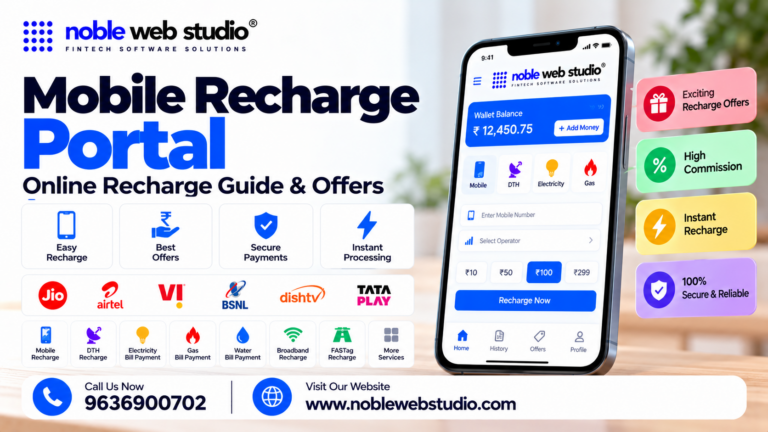
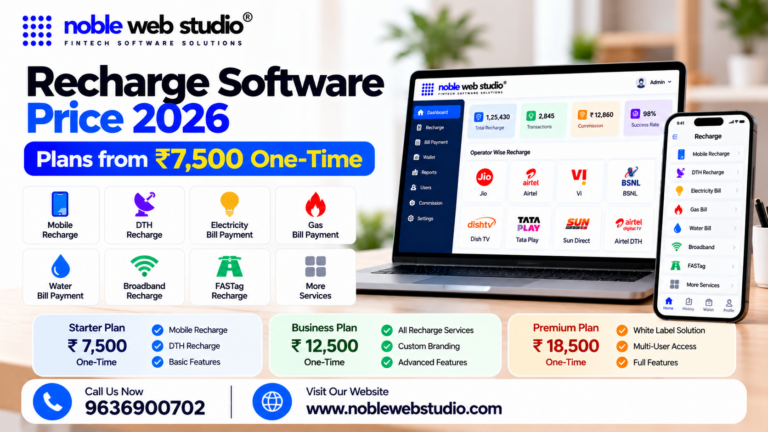
With Noble Web Studio, businesses can explore mobile recharge software and recharge API solutions designed for retailers, distributors, fintech startups, entrepreneurs, Kirana shops, and digital service company. The platform can help businesses manage recharge transactions, wallets, commissions, users, reports, and additional digital services through a centralized system.
In this complete guide to Mobile Recharge Business Profit, we will explain how mobile recharge income works, how to calculate daily and monthly profit, recharge commission, investment and operating costs, factors that affect earnings, the role of best Mobile Recharge API and recharge software, additional services that can increase revenue, and practical considerations for starting and scaling a profitable recharge business.
If you are planning to start new recharge business or expand an existing digital service operation, understanding these factors before investing can help you build a realistic and sustainable Mobile Recharge Business Profit model
Is Mobile Recharge Business Profitable in 2026?
Yes, a mobile recharge business is profitable in 2026, though it works best as a high-volume, supplementary revenue stream or when expanded into broader utility and financial services rather than a standalone venture.
Profit Margins & Earnings Breakdown
- Prepaid Mobile Recharges: Yields 1% to 5% per transaction, depending on the telecom operator:
- BSNL: 4.0% – 5.5%
- Vodafone Idea (Vi): 3.0% – 4.0%
- Jio: 2.5% – 3.5% (plus occasional promotional margin offers)
- Airtel: 1.5% – 2.2%
- DTH Top-Ups: Yields 2% to 4.5% for services like Tata Play or Dish TV.
- Utility Bills (BBPS): Ranges from 0.5% to 3% or small flat fees for electricity, water, gas, and FASTag.
- Retailer Monthly Income: An active shop processing 80–120 daily transactions typically earns ₹3,000 to ₹8,000 per month purely from basic recharges.
- Distributor Monthly Income: Managing a network of 20–30 active local shop retailers scales earnings to ₹15,000 to ₹40,000 per month.
Mobile Recharge Business ROI & Profitability Calculation
A mobile recharge business operates on low upfront capital, high velocity, and recurring transaction commissions. Rather than buying and reselling physical inventory, you maintain a working balance in a digital wallet to process instant consumer recharges.
Profitability & ROI Variables
The standard financial framework is driven by your operational structure:
| Metric / Variable | Retailer Tier | Distributor Tier | Platform Admin Tier |
|---|---|---|---|
| Initial Capital Investment | Minimal (₹1,000 – ₹5,000) | Moderate (₹20,000 – ₹50,000) | High (₹1,000,000+) |
| Prepaid Mobile Margin | 1% – 4% per transaction | 0.5% – 1% (network volume override) | 3% – 7% (API sourcing level) |
| DTH / TV Margin | 2% – 4% per transaction | 0.3% – 0.5% network spread | Full API margin control |
| Utility Bills (BBPS) | Flat ₹1 – ₹15 or 0.5% – 2% | Network override metrics | Surcharges & service splits |
| Typical Monthly Income | ₹3,000 – ₹8,000 | ₹15,000 – ₹40,000 | ₹100,000+ |
Core Financial Formulas
1. Monthly Net Profit
Net Income = (Daily Volume × Avg. Commission % × Days) − Operating Costs
2. Simple Return on Investment (ROI)
ROI (%) = (Net Income (Annual) ÷ Cost of Investment) × 100
Note: In the retail setup, your “Cost of Investment” includes initial software registration or hardware (smartphone/biometric scanner), while your wallet funds are active working capital, not fixed capital sunk costs.
Simulated Profitability Example (Retailer Tier)
Below is a realistic scenario mapping an active local retail agent who complements mobile recharges with broader financial/utility bill offerings.
Assumptions:
- Initial Fixed Investment: ₹5,000 (Registration fee, marketing board, and accessories).
- Daily Wallet Turnover (Working Capital): ₹10,000 (Rotated constantly through a unified wallet).
- Operating Days: 30 days a month.
- Service Mix: Balanced across high-margin recharges and standard utility billing.
Annualized Performance & ROI Summary
- Total Monthly Net Margin: ₹6,600
- Annual Net Margin: ₹6,600 × 12 = ₹79,200
- Annual Operating Costs (SMS/Software maintenance): ₹4,200
- Annual Net Profit: ₹75,000
Annualized ROI = (₹75,000 ÷ ₹5,000) × 100 = 1,500%
Mobile Recharge Business Profit Based on Daily Transaction Volume
Retailers in a mobile recharge business earn a profit margin of 1% to 4% per prepaid mobile transaction, scaling from ₹3,000 to ₹8,000+ per month for standard standalone recharges and higher when bundled with DTH and BBPS utility bills.
Estimated Earnings by Daily Volume Tier
| Volume Tier | Daily Transaction Value | Avg. Commission | Daily Profit | Estimated Monthly Profit (30 Days) |
|---|---|---|---|---|
| Low Volume (Small shop / 40–50 txns) | ₹5,000 – ₹10,000 | 2.0% | ₹100 – ₹200 | ₹3,000 – ₹6,000 |
| Moderate Volume (Active local shop / 80–120 txns) | ₹15,000 – ₹25,000 | 2.5% | ₹375 – ₹625 | ₹11,250 – ₹18,750 |
| High Volume (Busy commercial center / 250+ txns) | ₹40,000 – ₹90,000 | 3.0% | ₹1,200 – ₹2,700 | ₹36,000 – ₹81,000 |
Mobile Recharge Business Investment and Startup Cost
Starting mobile recharge business in India requires a low initial capital investment, ranging from ₹1,499 per month for software subscriptions to ₹3,00,000+ for custom white label recharge platform, alongside working capital for your operational wallet.
1. Investment and Startup Cost Breakdown
The costs depend heavily on the scale and business model you choose:
Retailer Level (Small / Shop or Home-Based):
- Software / Portal Setup: Many basic recharge commission app or distributor recharge retailer panel are free or low-cost (often starting with zero to minimal setup fees).
- Initial Wallet Funding: ₹5,000 to ₹20,000 (working capital to process daily customer recharges).
B2B / Multi-Recharge Software & Network Level:
- Software Subscription: Starts around ₹1,499 to ₹1,999 per month via recharge platforms like Noble web studio for multi-level networks (4-to-5 levels with white label mobile recharge branding).
- API Integration: ₹1,000 to ₹5,000 per API (one-time cost) if integrating multi-operator or utility APIs.
- Custom / White-Label Software Development: Ranging from ₹10,000 for basic standalone systems to ₹3,00,000+ for custom-built, feature-rich multi recharge platform.
Franchise / Physical Setup (e.g., Easy My Recharge or similar brands):
- Workspace Requirement: A small shop or office space of 150–250 sq. ft..
- Payback Period: Typically recovers initial investment within 6 to 8 months depending on transaction volume.
2. Potential Earnings and Margins
- Retailer Earnings: An active retailer processing 80–120 transactions daily can earn approximately ₹3,000 to ₹8,000 per month from recharges and bill payments, scaling higher if adding BBPS (Bharat Bill Payment System), AEPS (Aadhaar Enabled Payment System), or domestic money transfer (DMR).
- Commissions: Typically range from 1% to 6% depending on the operator (e.g., Jio up to 3%, Airtel up to 5%, DTH up to 4.5%).
- Distributor Earnings: Managing a network of 20–30 active retailers yields roughly ₹15,000 to ₹40,000 per month from commission spreads.
- API Reseller Earnings: Reselling recharge API access to downstream clients can generate passive spreads (e.g., ₹0.50 per transaction across hundreds of daily hits).
Mobile Recharge Business Expenses That Reduce Profit
Running a mobile recharge and utility payment business involves low profit margins (typically 1% to 5% on mobile recharges and 0.5% to 3% on utility bills). Several key operating, setup, and hidden expenses directly eat into these small commissions.
1. Setup & Software Costs
- Software or Portal Fees: B2B mobile recharge commission app or best recharge software subscriptions cost anywhere from free to ₹1,500 per month. White label recharge portal models can require heavy one-time or annual fees ranging from ₹30,000 to ₹1,500,000.
- API Integration Fees: If you use custom multi-recharge or utility APIs, integration can cost ₹1,000 to ₹5,000 per best recharge API.
- Hardware Expenses: While basic setups run on a standard Android smartphone, expanding or operating a white-label/distributor setup requires a PC, internet router, and thermal printer.
2. Operational & Running Expenses
- Internet & Data Connectivity: Uninterrupted high-speed mobile data or broadband is mandatory. Disconnections mean lost transactions and frustrated walk-in customers.
- Electricity & Shop Rent: If you operate from a physical brick-and-mortar shop (like a Kirana, pharmacy, or dedicated telecom kiosk), a portion of your monthly rent and electricity bill reduces net earnings.
- Working Capital Lock-in: Maintaining a pre-funded float or wallet balance (typically ₹5,000 to ₹25,000+) ties up your liquid cash, meaning cash flow is constantly tied to the platform.
3. Transactional & Risk-Related Losses
- Failed or Stuck Transactions: If a server times out or glitches, delayed refunds or stuck balances can temporarily freeze your working capital (though Noble web studio use auto-fallback mechanisms).
- Customer Chargebacks or Human Error: Accidental wrong-number entries or operator mix-ups can sometimes lead to unrecoverable amounts if the carrier does not reverse the recharge.
- Low Commission Slabs: Because individual commissions are small (e.g., 1% to 4%), high transaction volume is required just to break even against basic overhead.
Gross Commission vs Net Mobile Recharge Business Profit
Gross commission in a mobile recharge business is the raw percentage or fixed reward earned on the face value of a recharge transaction, while net profit is what actually stays in your pocket after subtracting all operating expenses, mobile recharge platform/API fees, and overhead costs.
Gross Commission vs. Net Profit Breakdown
Gross Commission (Top-Line Earnings):
- Typically ranges from 1% to 4% on mobile recharges depending on the operator (such as Jio, Airtel, Vi, or BSNL) and your tier in the distribution hierarchy.
- For example, on a ₹1000 total recharge volume at a 3% gross commission rate, your gross commission is ₹30.
- Promotional or base structures (like Jio's base + introductory margins) can temporarily push gross rates higher.
Net Profit (Bottom-Line Earnings):
- Calculated by taking your gross commission and deducting recurring business expenses.
- Deductions include: Noble web studio subscription fees, best recharge commission app/recharge portal charges, shop rent, electricity, internet, GST/tax obligations, and any commission shared down the chain if you operate as a distributor or master distributor.
- If your overhead and operational costs for that ₹30 gross earning come out to ₹12, your net profit is ₹18 (a 1.8% net margin on the transaction volume).
Gross Commission vs. Net Profit Breakdown
| Feature | Gross Commission | Net Profit |
|---|---|---|
| Definition | Total percentage or cash reward paid by the operator/aggregator per recharge. | Real earnings left after all expenses and overhead are paid. |
| Typical Rate | 1% to 4% of transaction value. | Often 0.5% to 2% (or lower) for pure recharges once costs are factored in. |
| Impact of Scale | Increases linearly with more recharges processed. | Improves only if fixed overhead costs do not scale at the same pace. |
| Value-Add Effect | Pure mobile recharge yields thin margins. | Adding DTH, BBPS bill payments, and money transfers (DMT) boosts overall net profitability. |
Key Factors That Turn Gross Commission Into Net Profit
- Base Commission Slabs: Mobile operators (Jio, Airtel, Vi, BSNL) offer base margins around 1% to 4%, sometimes with promotional boosts (e.g., Jio offering an additional 2% introductory/special structure).
- Distributor & Retailer Splits: If you operate as a master distributor or recharge platform admin, you share a portion of the gross commission with downstream retailers to keep them active. Your net margin is only the spread (the difference between what you extract from the upstream Noble web studio and what you pay the retailer).
Hidden Costs & Deductions:
- API/Software Costs: Monthly subscription fees for white label recharge panel or top recharge API gateway charges.
- Payment Loading Charges: Gateway fees when adding money to your recharge B2B wallet (though many recharge service platforms try to eliminate these).
- Overhead Expenses: Shop rent, electricity, internet, or staff if running a physical storefront.
- Service Mix Value-Add: Pure mobile recharge margins are slim (often 0.2% to 3% net for aggregators). Adding high-margin utility services like BBPS (Bharat Bill Payment System), DTH, AePS, or DMT boosts overall net profitability significantly.
Mobile Recharge Business Profit for Retailers vs Distributors
Retailers earn a direct per-transaction commission (typically 1% to 4% for mobile recharges) from walk-in customer sales, while distributors earn through a commission spread (the difference between the recharge admin/recharge API rate and the lower rate passed to retailers) scaled across an active network of 20–30+ retailers yielding roughly ₹15,000 to ₹40,000 per month.
Retailer vs. Distributor Comparison
| Feature | Retailer | Distributor |
|---|---|---|
| Target Customer | End-consumers / walk-in shop visitors | Downline retail shop owners |
| How Profit is Earned | Direct commission percentage on each customer's mobile, DTH, or utility recharge | Commission "spread" or override margin on every transaction processed by connected retailers |
| Mobile Recharge Margin | 1% to 4% (e.g., JioPOS Lite offers up to 4% total margin) | A fractional cut per transaction (e.g., 0.1% to 0.5% override spread depending on configuration) |
| DTH / Bill Payment Margins | DTH: 2%–3%; BBPS: 0.5%–2% | Spread margin over retailer slab across all network utility/DTH volumes |
| Average Monthly Earnings | Tied to footfall and daily transaction count (varies widely by shop location) | ₹15,000 – ₹40,000+ per month (managing 20–30 active retailers) |
| Operational Focus | Customer service, physical/local store trust, multi-service upsell (AePS, DMT) | Retailer acquisition, onboarding, activation, and network retention |
| Investment & Setup | Low budget; smartphone or PC with digital wallet balance | Moderate budget; software panel/app management for the downline |
Detailed Breakdown
1. Retailer Profit Model
- Direct Interaction: Retailers deal directly with local customers who drop by to recharge prepaid numbers, pay DTH, or clear utility bills via Bharat Bill Payment System (BBPS).
Income Drivers:
- Mobile recharges give roughly 1% to 4%.
- DTH recharges yield 2% to 3%.
- Utility and bill payments (BBPS) yield 0.5% to 2%.
- Value-Add Services: Adding Domestic Money Transfer (DMT) or Aadhaar Enabled Payment System (AePS) sharply increases a retailer's daily income compared to mobile recharge alone.
2. Distributor Profit Model
- Network Leverage: Instead of serving end-consumers, distributors build and manage a chain of local retail shops.
- The Commission Spread: When a retailer processes a recharge, the recharge earning platform splits or passes a tiered margin. The distributor keeps the "spread" the gap between the wholesale recharge API/recharge admin rate and what is shared with the retailer.
Volume Scaling:
- If a distributor supports 20 to 30 active retailers, earnings typically scale between ₹15,000 and ₹40,000 per month, depending on how active those shops are.
- Adding higher tiers like a Master Distributor allows earnings across multiple sub-distributors and larger networks.
How to Increase Mobile Recharge Business Profit
To increase profit in a mobile recharge business, you need to expand your service catalog, optimize your commission tiers, and cut best mobile recharge platform overhead.
1. Diversify Beyond Basic Recharges
- Add BBPS Utility Bills: Process electricity, water, gas, and broadband bills through the Bharat Bill Payment System to bring customers back monthly (commissions typically range from 0.5% to 2%).
- Offer DTH & Data Card Recharges: Support Tata Play, Airtel DTH, and Dish TV alongside telecom recharges.
- Incorporate Financial & Travel Services: Integrate Aadhaar Enabled Payment System (AePS) cash withdrawals, money transfers (DMT), PAN card assistance, FASTag recharges, or train/bus/flight ticket booking to turn your shop into a neighborhood digital service hub.
2. Upgrade Your Business Model
- Move to a Distributor Network: If you already manage a steady flow of local walk-ins, transition from a basic retailer to a Distributor Model by onboarding sub-agents or local shops under your network to earn a percentage of their transaction volume.
- Switch to High-Margin Platforms: Noble web studio to secure better tiered recharge commission structures (mobile margins typically range from 1% to 4%). For instance, apps or multi-service SaaS dashboards offer base margins plus active promotional margins.
3. Cut Hidden Costs and Capital Lock-In
- Avoid Pre-Locked Wallet Fees: Use zero recharge platform-fee or direct-UPI apps that let you pay via UPI at the exact moment of transaction instead of unnecessarily freezing large amounts of working capital in pre-loaded wallets.
- Ensure High Uptime: Use congestion-free, reliable multi mobile recharge API (aiming for 99.9% server uptime) to prevent failed recharges, customer drop-offs, or stuck wallet balances.
4. Drive Local Footfall
- Promote Cross-Selling: Bundle mobile recharges with physical retail items or display clear outdoor branding for best BBPS and digital cash points so passersby know you offer financial services.
- Manage Credit Smartly: Use a digital ledger (Digital Khata) to track regular customer credit and automate payment reminders without risking your cash flow.
Increase Profit With DTH & Utility Bill Payments
Expanding a mobile recharge business with DTH top-ups and Bharat Bill Payment System (BBPS) utility services transforms a single-service counter into an all-in-one digital kiosk, driving repeat foot traffic and stacking high recharge commission streams.
Typical Commission Slabs & Earning Margins
- Mobile Recharge: 1% to 5% per transaction (depending on operators like Jio, Airtel, Vi, and BSNL).
- DTH Top-Ups: 2% to 4% for Tata Play, Dish TV, Sun Direct, and Airtel Digital TV.
- Utility Bills (Electricity, Gas, Water): 0.5% to 3% or flat fees via BBPS Integration.
- FASTag & Insurance / LIC Premiums: 1% to 2% margins per renewal.
Realized Monthly Earning Potential
- Retailer Level: Process 80–120 daily transactions to earn ₹3,000 to ₹8,000 monthly from basic recharges and utility splits.
- Expanded Service Counter (AEPS, DMT, Bills): Scaling up multi-service volume pushes monthly net returns to ₹15,000 to ₹40,000+.
- Distributor Level: Recharge API Onboarding and managing 20–30 active local shop retailers yields ₹15,000 to ₹40,000 monthly through network spreads.
Key Steps to Maximize Profitability
- Adopt an All-in-One B2B Portal: Partner with multi service recharge platform like Noble Web Studio to manage mobile, DTH, and BBPS utilities from a single wallet.
- Complete KYC Verification: Keep your PAN card and Aadhaar card ready for instant merchant onboarding and open a dedicated business bank account.
- Cross-Sell at the Counter: Customers coming in for a monthly electricity or DTH bill are prime candidates for mobile top-ups, FASTag recharges, or cash withdrawals via best AEPS.
- Build a Local Retailer Network: Transition from a pure retailer to a distributor model to earn passive percentage cuts on sub-agents' daily transactions.
- Watch Out for Hidden Costs: Track gateway convenience fees, SMS notification charges, and branded mobile recharge software renewal costs to protect your net spread.
Mobile Recharge Business Profit Calculator
A mobile recharge business in India typically yields a commission of 1% to 4% per transaction or a flat rate of ₹3 to ₹6 per transaction depending on the Noble web studio used.
How to Calculate Your Profit
Formula: Daily Transactions × Commission per Transaction × Working Days = Monthly Profit
Percentage-Based Formula: Total Recharge Volume × Commission Rate (%) = Monthly Profit
Example Scenarios
1. Flat Commission Model (e.g., ₹3 per recharge)
- Daily Transactions: 50 recharges
- Commission per Recharge: ₹3
- Working Days: 30 days
- Calculation: 50 × ₹3 × 30 = ₹4,500 per month
2. Percentage Commission Model (e.g., 2% on ₹50,000 monthly volume)
- Monthly Recharge Volume: ₹50,000
- Commission Rate: 2%
- Calculation: ₹50,000 × 2% = ₹1,000 per month
Key Factors That Affect Your Profit
- Volume vs. Margin: Prepaid recharges have a lower percentage margin (1%–4%) compared to financial or utility services, so high daily footfall is required to scale.
- Cross-Selling Services: Adding DTH recharges, BBPS bill payments (electricity, gas, broadband), or AEPS/Money Transfer increases customer visits and monthly income per user.
- Distributor Network: If you operate as a distributor or admin managing active retailer recharge panel, you earn an additional commission spread of 0.5% to 1.5% over your network's volume.
Mobile Recharge Business Profit Calculator
Calculate your daily, monthly and yearly profit from mobile recharge commission.
Enter Your Details
Please enter a valid sale amount and commission.
Your Profit
How to Track Mobile Recharge Business Profit Every Day
To track your mobile recharge business profit every day, you need to monitor three core metrics at the close of business: total recharge value, total commission earned, and closing wallet balance.
Step-by-Step Daily Tracking Method
- Record the 3 Daily Numbers: Write down or export the following from smooth recharge platform every evening:
- Total Recharge Volume: The aggregate sum of all customer recharges processed (e.g., Jio, Airtel, Vi, BSNL).
- Total Commission Earned: The instant margin or percentage credit added to your account per transaction (typically ranging from 1% to 4% for mobile recharges).
- Wallet Balance: Your remaining digital float/wallet balance at the end of the day.
- Reconcile Your Cash vs. Wallet: Compare the cash or UPI payments collected physically from customers against the amount deducted from your digital recharge wallet. Ensure there is zero mismatch.
- Use Built-in App Reports: Trusted Mobile recharge platform or multi recharge service portal have automated Earning Dashboards and transaction history reports that calculate daily and monthly commissions for you.
- Maintain a Daily Ledger: If you use multiple recharge earning app or accept udhar (credit) from regular neighborhood customers, keep a simple physical or digital ledger to track pending customer payments alongside your wallet reloads.
- Analyze by Operator: Review which operator or service (mobile top-up vs. DTH vs. BBPS bill payments) drives your highest daily volume so you can keep peak-hour wallet balances funded accordingly.
Track Mobile Recharge Business Profit Every Day
Common Mistakes That Reduce Mobile Recharge Business Profit
Running mobile recharge business comes with thin commission margins (typically 1% to 6% per transaction), meaning small operational errors can quickly wipe out your earnings.
Common Mistakes That Reduce Profit
- Low Wallet Balance at Peak Times: Running out of working capital in your digital wallet during rush hours means you cannot process recharges immediately, causing customers to walk away to competitors.
- Relying Solely on Mobile Recharges: Sticking strictly to basic mobile airtime limits your income. Expanding into DTH (Direct-to-Home), BBPS (Bharat Bill Payment System), AEPS (Aadhaar Enabled Payment System), and DMT (Domestic Money Transfer) unlocks steady extra commissions from the same foot traffic.
- Repeating Pending Recharges Too Quickly: Re-initiating a recharge before confirming the final status of a stuck or delayed transaction can result in your wallet being debited twice for a single customer request.
- Using Unreliable APIs or Poor Software: Choosing fast recharge platform with frequent transaction failures, slow processing times, or a lack of distributor management tools drives away both customers and retail agents.
- Ignoring Customer Complaints: In a high-competition market, a single unhappy customer or unresolved issue drives loyal foot traffic straight to rival shops.
- Failing to Track Sales and Records: Neglecting to log every transaction (especially for manual or paper-based recharges) leads to stock, balance, or customer disputes that cost you money out of pocket.
- Poor Margin Planning (for Distributors/API Resellers): Setting commission slabs too high for retailers without leaving an adequate spread for yourself or failing to monitor active network performance destroys overall profitability.
- Falling for Unverified/Fake Platforms: Using unaccredited or fraudulent websites to buy airtime or print recharge cards can result in stolen working capital.
How Long Does It Take to Build a Stable Recharge Business?
It takes 3 to 12 months to launch and stabilize a basic mobile recharge or retail utility business, and 1 to 3 years to build a self-sustaining B2B multi recharge platform or distributor network.
Timeline Breakdown by Business Model
1. Local Retail / Shop-in-Shop Model (3 to 6 months to stability)
- Launch time: 1 day to 1 week (downloading an high commission recharge app or registering with a recharge B2B platform).
- Time to break even: 1 to 2 months (since overhead is near zero if you already run a grocery or repair shop).
- Time to stability (consistent daily walk-ins & repeat customers): 3 to 6 months of building local trust and expanding into utility bill payments (BBPS) and DTH.
2. Distributor / Master Distributor Network (6 to 18 months to stability)
- Launch time: 1 to 3 weeks to tie up with a Noble web studio and complete KYC.
- Time to scale network: Managing 20 to 30 active retailers takes 6 to 12 months of continuous field onboarding and service reliability.
- Time to stability: 12 to 18 months, once your commission spreads generate a predictable monthly flow (typically ₹15,000 to ₹40,000+ for a small active network).
3. Branded Multi-Recharge Platform / Admin Panel Owner (1 to 3 years to stability)
- Launch time: 3 to 7 days to deploy white-label software, mobile apps, and single/multi recharge API integration.
- Time to stability: 1 to 3 years. While the recharge commission software goes live in days, building trust with Noble web studio, preventing transaction drop-offs/failures, and scaling a downline of master distributors requires heavy technical oversight and customer retention.
Key Factors That Speed Up or Slow Down Stability
- Initial Wallet Capital: Recharge requires rolling pre-funded wallet balances; running out of liquidity during peak hours breaks customer trust immediately.
- Transaction Success Rates: Low recharge API uptime or high "pending/failed" rates will bleed customers to competitors within the first month.
- Service Multiplicity: Adding DTH, BBPS bill payments, Aadhaar-enabled payment systems (AePS), and money transfers accelerates repeat usage much faster than mobile-only recharges.
Mobile Recharge Business Profit With Recharge Software
A mobile recharge and utility business typically yields a 2% to 4% commission margin on transaction volume, translating to steady small profits that scale with daily customer traffic and multi-service offerings.
Profit Breakdown & Example
- Commission Rate: Generally ranges from 2% to 4% depending on the telecom operator (e.g., Jio, Airtel, VI, BSNL) and whether you earn promotional or base margins.
Worked Example (Retailer Level):
- Daily Recharge Value: ₹10,000
- Average Commission (2%): ₹200 per day
- Monthly Earnings (26 working days): ₹5,200 per month
Distributor & Admin Scaling:
- Distributors earn an overriding commission percentage on all transactions processed by the retailers under their network.
- Platform Admins/Owners running a B2B multi recharge white label recharge system can earn ₹50,000 to ₹2,00,000+ per month based on total active user count and transaction volume.
How Recharge Software Increases Profit
Using dedicated multi-recharge or white label recharge software improves your profit margins through several channels:
- Single-Wallet Convenience: Manage all operators (Prepaid, Postpaid, DTH) from one central dashboard without maintaining separate physical SIM cards or balances.
- Added Utility Services: Expand beyond mobile top-ups to include BBPS utility bills (electricity, water, gas), FASTag, DTH recharges, and money transfers, which bring customers back more frequently.
- White-Label & Network Creation: Build your own mobile recharge B2B brand, launch a custom Android recharge commission app on the Google Play Store, and onboard your own sub-distributors and retailers.
- Automated Tracking: Real time recharge dashboard track total recharge value, daily margins, and wallet balances automatically without manual notebook entry.
Mobile Recharge Business Profit With Recharge Software
Why Choose Noble Web Studio for Mobile Recharge Business Solutions?
Noble web studio one of the right recharge software provider for Mobile Recharge Business Solutions is essential for high transaction success, automated workflows, and long-term profitability.
Core Reasons to Choose a Noble web studio
- Multi-Operator Connectivity: Access all major prepaid and postpaid mobile operators, DTH services, data cards, and utility services through a single unified platform.
- High Uptime & Speed: Ensure fast, near-real-time transaction processing with high success ratios (often 99.9% uptime) to prevent customer drop-offs.
- White-Label & Custom Branding: Launch your own branded mobile recharge commission app and web portal instead of promoting a third-party name.
- Multi-Tier B2B & Wallet Management: Create and manage hierarchies of Master Distributors, Distributors, and Retailers with automated digital wallet funding and custom commission structures.
- API Integration: Embed high-speed recharge and bill payment capabilities directly into your existing trusted recharge software, ERP, or custom mobile application.
- Expanded Revenue Streams: Go beyond mobile recharges by integrating BBPS (Bharat Bill Payment System) for electricity, gas, water, FASTag, LIC, and AEPS/DMT (Domestic Money Transfer) services.
- Security & Analytics: Benefit from bank-grade SSL encryption, fraud detection protocols, automated failure refunds, and live analytics dashboards to track earnings and margins.
Conclusion: Mobile Recharge Business Profit
The Mobile Recharge Business Profit opportunity depends on much more than the commission earned on a single recharge. Your actual income can vary based on daily transaction volume, recharge commission, customer demand, operating expenses, settlement terms, and the number of digital services available on your b2b mobile recharge platform. Therefore, instead of relying on a fixed monthly earning figure, businesses should calculate profit based on their expected transactions and real operating costs.
A mobile recharge business can become more valuable when it works as part of a broader digital services platform. Along with prepaid mobile recharge, businesses can offer DTH recharge, FASTag, BBPS, utility bill payments, top AEPS, DMT, and other services where applicable. Noble web studio can help retailers and digital service company serve more customer requirements while creating additional revenue opportunities.
A mobile recharge business in India typically yields a commission of 1% to 4% per transaction, depending on the operator and service type.
To calculate Mobile Recharge Business Profit more realistically, start with your expected daily successful recharges and average commission per transaction. Then calculate your monthly high recharge commission revenue and add income from other services. Finally, deduct expenses such as internet, staff, shop operations, technology, payment-related costs, and other applicable charges. The remaining amount gives you a more practical estimate of potential net profit.
Technology also plays an important role in scaling recharge operations. A reliable Mobile Recharge Software or Mobile Recharge API can provide automated recharge processing, wallet management, commission management, retailer and distributor controls, transaction history, reports, real-time transaction status, and centralized administration. These features become increasingly important as transaction volume and the number of users grow.
With Noble Web Studio, businesses can explore mobile recharge software solution and mobile recharge API solution for retailers, distributors, fintech startups, entrepreneurs, and digital service company. The high commission recharge platform can support mobile recharge operations along with additional digital services, helping businesses manage users, wallets, commissions, transactions, and reports through a structured system.
Ultimately, there is no universal figure for Mobile Recharge Business Profit because every business has different transaction volumes, commission structures, expenses, and customer demand. The strongest business model is one that combines consistent recharge transactions, reliable technology, multiple digital services, efficient cost management, and long-term customer retention.
If your goal is to start a mobile recharge business or expand an existing retailer and distributor network, focus on profit per transaction, monthly transaction volume, total operating cost, service expansion, and scalability. A well-planned recharge business supported by reliable software can provide a strong foundation for building a broader digital services and fintech business.
Mobile Recharge Business Profit with Noble Web Studio
Want to increase your Mobile Recharge Business Profit? Noble Web Studio provides professional mobile recharge software solutions for retailers, distributors, and businesses looking to build a reliable recharge business with useful features, easy management, and scalable business support. Contact our team to discuss your requirements and get the right solution for your recharge business.
Get guidance on mobile recharge software, business setup, features, earning opportunities, and ways to improve your recharge business profit.
Frequently Asked Questions About Mobile Recharge Business Profit
Yes, a mobile recharge business can be profitable when it generates consistent transaction volume and earns a suitable commission. Actual profit depends on customer demand, commission rates, operating expenses and the services you offer.
There is no fixed income for every retailer. Earnings depend on daily recharge value, applicable commission, working days, customer volume and operating costs.
A simple formula is: Daily Recharge Value × Average Commission % × Working Days = Gross Earnings. To calculate net profit, subtract expenses such as internet, rent, software, staff and other operating costs.
Commission varies by operator, recharge service, provider and applicable business plan. Always check the current operator-wise commission structure before estimating your expected income.
The investment depends on your business model and existing setup. Costs may include a smartphone or computer, internet, working wallet balance, software or API charges, shop expenses and marketing.
Yes, adding supported services such as DTH recharge, electricity, gas, water and other bill payments can create additional revenue opportunities. Actual earnings depend on transaction volume and the applicable commission or business model.
Gross earnings represent the commission or revenue generated from transactions. Net profit is what remains after deducting business expenses such as rent, internet, software/API charges, staff and other operating costs.
Focus on increasing genuine customer transactions, building repeat customers, offering multiple services, reducing failed transactions and controlling operating costs. Tracking daily transactions and commission can also help identify areas for improvement.
Recharge software can help manage transactions, wallets, commissions, retailers, distributors and reports from one platform. Better management can support business efficiency, but software itself does not guarantee higher profit.
Noble Web Studio can be considered for mobile recharge software, recharge API and related recharge technology solutions, depending on the current services offered. Before choosing a solution, verify the available features, pricing, commission structure, onboarding process and support for your business needs.