Ankit
Ankit
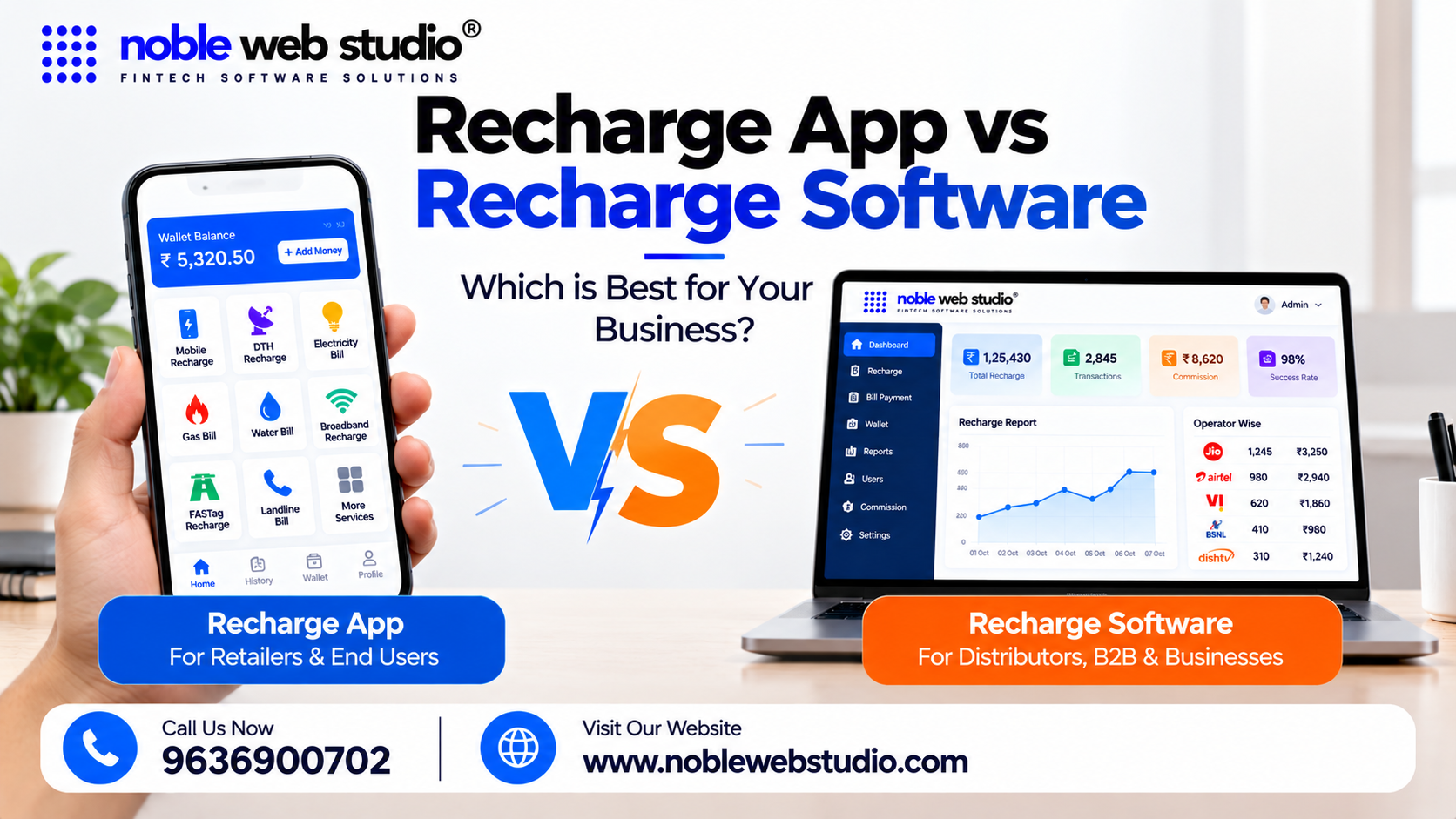
Recharge App vs Recharge Software is an important comparison for anyone planning to start, manage, or expand a mobile recharge business. Although both solutions can be used to process recharges and earn commissions, they are designed for different business requirements. A Recharge App is generally suitable for individual retailers and small businesses that need a simple mobile-first solution, while Recharge Software is better suited to distributors, startups, enterprises, and businesses that need advanced management and scalability.
The biggest difference in Recharge App vs Recharge Software is not simply the device or recharge platform used. It is the level of business control you get. A recharge app can provide essential functions such as mobile recharge, wallet management, transaction history, and commission tracking. Recharge software can add a complete business ecosystem with an admin panel, retailer and distributor management, role-based access, commission management, detailed reports, recharge API integration, multiple services, and white-label Recharge Software capabilities.
If you are running a single mobile shop or want to start offering recharge services with minimum complexity, a Recharge App may be enough. But if your goal is to build a network of retailers, manage distributors, control commission slabs, monitor transactions, integrate recharge services into your own website or application, or launch your own branded recharge platform, Recharge Software can provide much greater control.
This comparison becomes especially important when considering long-term growth. A suitable recharge platform should support not only mobile recharge but also services such as DTH recharge, FASTag, BBPS, utility bill payments, AEPS, and other digital services when required. Businesses should also compare wallet management, best recharge API connectivity, transaction status, commission automation, settlement, security, reporting, user management, customization, and scalability before choosing a solution.
With Noble Web Studio, businesses can explore recharge software solution designed for retailers, distributors, fintech startups, and entrepreneurs who want to build a scalable recharge business. The solution can support a structured business hierarchy, centralized administration, commission management, wallet operations, transaction monitoring, reporting, and additional digital services from a best recharge platform.
In this complete guide to Recharge App vs Recharge Software, we will compare both options based on features, users, commission management, wallet, admin controls, retailer and distributor management, mobile recharge API integration, white label recharge options, reporting, cost considerations, scalability, advantages, limitations, and real business use cases. By the end, you will understand whether a Recharge App or Recharge Software is the right choice for your current business and future growth.
Recharge App vs Recharge Software: What Is the Difference?
A recharge app is a consumer-facing tool used to perform individual mobile or utility top-ups, while recharge software is a comprehensive back-end platform used by businesses to run, manage, and distribute a recharge service network.
Scope & Function
Recharge App:
- Acts as the interface where the actual recharge request is submitted.
- Limited to basic user-end actions like entering a mobile number, picking an operator, paying via UPI/wallet, and viewing personal transaction history.
- Can be a white label recharge app tied to a larger system or a standalone consumer app.
Recharge Software:
- Acts as the brain and engine behind the operation.
- Manages multi-tier hierarchies (Admin, Master Distributors, Retailers), wallet fund transfers, margin/commission setups, operator recharge API routing, and automated failure refunds.
2. Target Audience
Recharge App:
- Best for individual shopkeepers (like Kirana store owners) or end-consumers who just want to process quick recharges or earn basic retail commissions.
Recharge Software:
- Essential for aspiring telecom entrepreneurs, wholesale distributors, and B2B recharge providers who want to build and manage their own retailer network under their own brand.
3. Commissions & Margins
Recharge App:
- Typically Noble web studio offers standard, fixed retail-level commissions per transaction.
Recharge Software:
- Generally yields higher overall margins and volume-based pricing because you control the entire commission tree (setting custom rates for retailers and distributors).
4. Setup & Technical Requirements
Recharge App:
- Zero technical setup required; download from an recharge commission app store (like Google Play) and start using immediately.
Recharge Software:
- Requires a recharge software setup process (often provided as a white label recharge software solution or cloud-hosted high earning recharge platform by Noble web studio, though modern recharge system feature user-friendly recharge admin dashboard that require no coding knowledge.
| Feature Comparison | Recharge App | Recharge Software |
|---|---|---|
| Primary Focus | Making recharges | Managing a business |
| User Hierarchy | Single user | Multi-level (Admin/Retailer) |
| Commission Rates | Standard retail tier | Higher volume-based tier |
| Custom Branding | Rare (Vendor branded) | White-label options |
What Is a Mobile Recharge App?
A mobile recharge commission app is a digital software tool that lets users top up prepaid mobile numbers, buy data packs, and pay telecom or utility bills directly from a smartphone.
Key Features
- Plan Browsing: Displays active special recharge offers, validity plans, and data add-ons.
- Instant Top-Ups: Recharges prepaid airtime or data packs in seconds.
- Operator Support: Works with major network providers like Jio, Airtel, Vi, and BSNL.
- Bill Payments: Handles postpaid bills, DTH connections, electricity, and gas bills.
- Secure Payments: Uses UPI, debit/credit cards, and digital wallets with encrypted transactions.
What Is Recharge Software?
Recharge software is a digital recharge platform that automates and processes prepaid and postpaid mobile recharges, DTH services, data cards, and utility bill payments through a centralized dashboard.
Recharge App vs Recharge Software: Key Differences
A recharge app is a front-end mobile tool used by individuals or retailers to process quick top-ups, while top recharge software is a comprehensive back-end recharge administrative platform used to manage entire networks, multi-level commissions, and distributors.
Core Differences
Target Users:
- Recharge App: Recharge App Designed for end-consumers or individual local retailers doing direct transactions.
- Recharge Software: Built for master distributors, recharge admin and entrepreneurs managing a large network of retailers and agents.
Management & Control:
- Recharge App: Noble web studio offers a simple user interface limited to personal or single-shop transaction history and balance checks.
- Recharge Software: Includes an advanced mobile recharge admin panel for real-time tracking, multi-tier user permission settings, and automated dispute resolution.
Commissions & Margins:
- Recharge App: Provides standard retail-level commission payouts per single transaction.
- Recharge Software: Generates volume-based pricing and multi-level recharge commission distributions across an entire downline network (1–2% higher yields).
Scalability:
- Recharge App: Best for standalone, quick utility usage or single storefront operations.
- Recharge Software: Essential for scaling a wholesale business, allowing you to add unlimited sub-distributors and branded recharge commission app.
Recharge App vs Recharge Software Differences
Recharge App
Recharge Software
Recharge App vs Recharge Software: Feature Comparison
A recharge app is an end-user mobile interface for processing single mobile, DTH, or utility payments, whereas recharge software is a complete back-end business management platform that includes recharge admin dashboard, recharge wallet system and multi-tier distributor-retailer networks.
Feature Comparison
| Feature | Recharge App | Recharge Software |
|---|---|---|
| Primary Target | End consumers or single retail users | Business owners, admins, and multi-level distributors |
| User Management | Single-tier user profile | Multi-tier hierarchy (Admin, Master Distributor, Retailer) |
| Control & Dashboard | Basic transaction history and wallet view | Comprehensive admin panel with user control and fraud detection |
| Commission Model | Standard retail-level fixed commissions | Volume-based or multi-level commission configurations |
| Branding | Standard platform branding (unless white-labeled) | Full white-label support for custom-branded apps and web portals |
| Reporting & Ledger | Basic receipts and history logs | Advanced real-time analytics, GST reports, and ledger management |
Key Differences
- Scope of Operations: Apps are built for executing individual recharges. Modern Recharge Software controls the entire operational ecosystem, including best mobile recharge API routing, member networks, and commission structures.
- Business Scaling: Apps are sufficient for personal use or single-shop cash counters. Top Recharge Software is required to run a Recharge B2B network where you onboard and manage other retailers and distributors.
- Commissions and Margins: Recharge commission Software environments often yield higher margins or multi-tier commission splits across an active agent network compared to standard consumer app payouts.
Recharge App vs Recharge Software: How Does Each One Work?
A recharge app is an end-user mobile interface for single transactions, while recharge software is the comprehensive backend and multi-level recharge admin platform that powers those transactions and manages business operations.
How a Recharge App Works
- User Interface: Provides a simple dashboard for individual mobile, DTH, or utility top-ups.
- Transaction Flow: Accepts payment via UPI or cards, then triggers an recharge API request to process the service.
- Scope: Limited to retail-level use, personal tracking, or basic consumer cashback rewards.
How Recharge Software Works
- Backend Control: Acts as the master recharge administrative system connecting payment gateways and telecom APIs.
- Hierarchy Management: Allows owners to create and manage lower-tier distributors, retailers, and branded recharge API users.
- Automation & Ledger: Handles multi-level commission payouts, automated SMS alerts, and deep financial reporting.
| Feature | Recharge App | Recharge Software |
|---|---|---|
| Target User | Individual consumers or single retailers | Business owners, admins, and distributors |
| Core Focus | Executing quick top-ups | Managing networks, margins, and b2b recharge API |
| Control Level | Retail access only | Full white-label and role-based access |
Recharge App vs Recharge Software for Retailers
A recharge app is a plug-and-play mobile application for single-user transactions, while recharge software is a complete, centralized B2B recharge business management platform that lets you manage a network of retailers, distributors, and custom commission structures.
Recharge App
- Definition: A ready-to-use best mobile recharge application used by an individual shop owner to process customer recharges.
- Setup & Use: Instant download from the high recharge commission app store, quick wallet top-up, and immediate usability with zero technical skills.
- Control & Hierarchy: Single-level access; you cannot create sub-retailers, manage agents, or set custom commission hierarchies.
- Commission: Noble web studio offers standard retail margins set by the Noble web studio.
- Best For: Small, single-location walk-in retail shops (like a local kirana store) wanting a simple tool to sell recharges.
Recharge Software
- Definition: A comprehensive web and mobile backend system (often white-labeled) that gives you total administrative control over a recharge business.
- Setup & Use: Requires registration with a Noble web studio and basic computer familiarity, though vendors handle server maintenance.
- Control & Hierarchy: Multi-level management; allows you to create and oversee distributors, retailers, and smooth recharge API switches.
- Commission: Generally yields 1% to 2% (or higher) commission benefits due to volume-based tier structures and multi-level overrides.
- Best For: Growing retail chains, aspiring distributors, or enterprises building their own branded multi-recharge network.
Recharge App vs Recharge Software for Distributors
Recharge software is a comprehensive B2B management system that controls multi-level downlines, commissions, and white-label branding, whereas a recharge app is a single-interface tool typically used for processing end-user or retail-level transactions.
Key Differences for Distributors
- Network Management: Recharge Software supports hierarchical tiers (Admin, Master Distributor, Distributor, Retailer), allowing you to add unlimited downlines and assign role-based permissions. A standalone app usually only provides basic retailer-level transaction access.
- Commission Engine: Software automates slab-wise commission margins and multi-level profit distribution across your entire network. Apps offer flat or standard retail commissions without custom downline overrides.
- Operations & Control: Software includes a centralized web dashboard and administrative panel for virtual wallet fund transfers, automated API routing, and deep financial reporting. Apps are limited to on-the-go viewing and simple mobile recharges.
- Branding (White-Labeling): Quality software packages often bundle a custom-branded Android app and web portal featuring your own logo and company name to market to your retailers.
Comparison Summary
| Feature | Recharge App | Recharge Software |
|---|---|---|
| Primary Use | Single-user execution or retail top-ups | Complete B2B network distribution |
| Hierarchy Control | None or single-level | Multi-level (Distributor/Retailer chains) |
| Reporting & Analytics | Basic transaction history | Advanced MIS, exportable Excel data, audits |
| Scalability | Low (hard to track large networks) | High (manages hundreds to thousands of users) |
Recharge App vs Recharge Software for Startups and Fintech Businesses
A recharge app is a consumer-facing or retailer-facing single mobile application for basic transactions, while recharge software is a complete, scalable backend and multi-channel system (admin panel, web portal, and app suite) built to run an entire B2B or B2C recharge business.
Core Differences
| Feature | Recharge App | Recharge Software |
|---|---|---|
| Primary Scope | Single front-end application to perform or accept recharges. | Comprehensive ecosystem including admin panels, APIs, web portals, and branded apps. |
| Target User | Individual retailers, shop owners, or end consumers. | Startups, master distributors, and fintech enterprises. |
| Business Control | Limited; uses predefined commission slabs and parent operator rules. | Full control; create custom multi-level commission structures (retailer/distributor). |
| Operations Management | Basic wallet tracking and transaction history. | Advanced reporting, user network hierarchy, automated gateway switching, and API integrations. |
| Setup Cost | Low or free download with standard commission rates. | Higher initial investment (white-label packages start around ₹7,400 to ₹25,000+). |
Key Advantages for Startups and Fintechs
- Recharge Apps are ideal for testing the market, quick deployment for small retail shops, or operating as an agent under an existing distributor network.
- Recharge Software is necessary if you intend to build your own brand via White Label Recharge Software, manage sub-agents/distributors, integrate multi-operator APIs, and bundle additional fintech services like BBPS or AEPS.
Recharge App vs Recharge Software: Commission Management
A recharge app provides a ready-made retail interface with fixed commission structures, whereas recharge software gives you admin control to set your own multi-level commission slabs and earn wholesale margins.
Comparison: Recharge App vs. Recharge Software
| Feature | Recharge App | Recharge Software |
|---|---|---|
| Control | Standard retail user | Full admin / white-label |
| Commission Control | Fixed by Noble web studio | Fully custom slabs |
| Target User | Single shopkeeper / retailer | Distributor / master admin |
| Profit Margins | Lower retail rate (~2-3%) | Higher wholesale tier (~4-8%) |
| User Hierarchy | Single level only | Multi-level (Admin → Distributor → Retailer) |
Recharge Apps: Retail Commission Mechanics
- Fixed Slabs: You earn preset percentages defined by the app owner.
- Immediate Credit: Margins are typically added instantly to your wallet upon loading balance.
- Best For: Individual retailers who just want to process customer transactions without managing a downline.
Recharge Software: Administrative & Multi-Level Commission Management
- Margin Spread: You profit from the difference between mobile recharge API cost and retailer payouts.
- Tiered Distribution: Set distinct commission percentages for individual retailers or sub-distributors.
- Volume Scaling: Adjust automated commission tiers based on monthly transaction volume.
- Best For: Growing networks and wholesale distributors managing multiple agents.
Recharge App vs Recharge Software: Commission Management
Recharge App
Recharge Software
Recharge App vs Recharge Software: Wallet & Transaction Management
A recharge app is a consumer-facing or single-tier mobile interface used to execute top-ups, whereas recharge software is an end-to-end B2B management platform that controls the entire backend, wallet ledgers, multi-tier distributor networks, and API routing.
Comparison: Recharge App vs. Recharge Software
| Feature / Attribute | Recharge App | Recharge Software |
|---|---|---|
| Primary User | Retailers, end-customers, or single agents | Admins, master distributors, and multi-tier networks |
| Scope | Front-end execution (recharge, bill payment) | Full ecosystem (admin panel, API gateway, web + app) |
| Wallet Control | Basic balance viewing and individual top-ups | Multi-level ledger, auto-debits, balance pushing to downlines |
| Commission Rates | Standard retail/agent margins | Higher volume-based margins with tier configuration |
| Network Management | None (standalone account) | Multi-tier reseller management (Admin → Distributor → Retailer) |
Wallet & Transaction Management Mechanics
Virtual Ledger Balance:
- Represents spendable funds inside the system.
- Updates in real-time seconds after a request.
Automatic Operator Routing:
- Software switches to backup APIs if a primary gateway fails.
- Auto-reconciles settlement reports down to the last paisa.
Multi-Tier Fund Pushing:
- Admins and distributors instantly allocate digital credit limits downward to sub-retailers.
Strategic Decision Framework
Choose a Recharge App if:
- You are a local shop owner or solo retailer processing day-to-day customer recharges.
- You require zero backend management and standard retail commissions.
Choose Recharge Software if:
- You want to launch a white-label B2B telecom business under your own brand.
- You manage a downline distribution chain and need automated margin engines and ledger reconciliation.
Recharge App vs Recharge Software: Wallet & Transaction Management
Recharge App
SUCCESS
SUCCESS
FAILED
SUCCESS
PENDING
Recharge Software
SUCCESS
PENDING
FAILED
Recharge App vs Recharge Software: Admin Panel & User Management
A Recharge Admin Software platform acts as a centralized dashboard for mobile, DTH, and utility bill businesses to control operations, monitor transactions, and manage user hierarchies.
Admin Panel Core Features
- Dashboard Overview: Displays real-time data on daily transactions, success/failure rates, and active wallet balances.
- Commission Management: Allows setting customized commission or surcharge structures for different tiers.
- API Integration: Connects multiple operator APIs for automated, instant recharges.
- Report Generation: Generates detailed financial, ledger, and transaction analytics for business insights.
User Management Hierarchy
- Master Distributor: Oversees regional networks, creates distributors, and allocates initial funds.
- Distributor: Manages a localized group of retailers and monitors their performance.
- Retailer: Directly interacts with end-users to process mobile, DTH, and utility payments.
- Customer/End-User: Uses the consumer-facing mobile app for personal recharges and bill payments.
Recharge App vs Recharge Software: Admin Panel & User Management
Recharge App
Recharge Software
Recharge App vs Recharge Software: API & Integration
Recharge Apps and Recharge Software serve different programmatic and architectural needs. A Recharge App is a closed, ready-to-use end-user client that does not offer recharge API access or external integration. In contrast, Recharge Software acts as a core B2B platform or backend engine that fully provides and consumes APIs, allowing you to integrate third-party recharge service API or resell programmatic access to other businesses.
Core Structural & API Differences
| Feature | Recharge App | Recharge Software |
|---|---|---|
| API Accessibility | No API Access. It is a standalone frontend application. | Full API Access. Exposes REST/RPC endpoints and webhooks. |
| Integration Role | Consumer only. It connects to a single pre-configured backend service. | Hub/Provider. Connects multiple operator APIs or distributes white-label APIs. |
| White-Label Branding | Limited to cosmetic logo/name swaps on the app interface. | Complete white-labeling with independent API credentials for clients. |
| Scalability & Automation | Requires manual input per transaction. | Supports bulk operations via CSV upload or batch API processing. |
Integration Architecture in Recharge Software
Recharge Software utilizes specific integration layers to automate digital top-ups, micro-payments, and business operations:
- Multi-Recharge API Integration: Combines prepaid mobile top-ups (Jio, Airtel, Vi), DTH services (Tata Play, Dish TV), and data cards into a unified system through a single integration point.
- Utility & BBPS API: Integrates directly with ecosystems like the Bharat Bill Payment System (BBPS) in India to process utility bills (electricity, water, gas) and insurance premiums.
- Webhooks & Event-Driven Triggers: Programmatically reacts to events such as checkout completion, failed transactions, wallet auto-debits, and instant refund triggers.
- API Reselling Modules: Specialized infrastructure within the software that allows administrators to generate distinct API credentials for external B2B clients, manage their sub-wallets, and track custom transaction margins.
Recharge App vs Recharge Software: API & Integration
Recharge App
Recharge Software: API & Integration
rk_live_8f3a91c2d7e4b0xxhttps://yoursite.com/callbackRecharge App vs Recharge Software: White-Label Business Options
A recharge app is a mobile-first tool meant for individual retailers to perform basic recharges, while a recharge software is a complete multi-user system with an admin panel designed for distributors and large businesses.
Core Differences
| Parameter | Recharge App | Recharge Software |
|---|---|---|
| Primary Use | Individual sales and single-location operations | Network management, commissions, and business scaling |
| Platform | Mobile-only (Android/iOS) | Web dashboard + branded mobile apps |
| Target Users | Single shop owners and local agents | Enterprises, master distributors, and network providers |
| User Hierarchy | Single user/agent | Multi-level (Admin, Master Distributor, Distributor, Retailer) |
| Commission Model | Standard retail margins (approx. 2.5% – 5%) | Higher volume-based/multi-level margins (approx. 4% – 7.5%) |
| Setup & Cost | Instant setup; very low or zero monthly cost | Setup takes 1–7 days; higher tier pricing based on features |
White-Label Business Options
When launching your own brand using white-label solutions (custom logo, domain, and colors), you generally choose between two models:
- White-Label Portal/Software: A turnkey, ready-to-deploy web and mobile platform provided by companies like Noble Web Studio. You manage your own network of sub-distributors and retailers without writing code.
- Recharge API Integration: Best if you already possess a functioning tech product or app and want to connect raw backend telecom/utility feeds via an Noble web studio.
Which Option Should You Choose?
- Go with a Recharge App if: You run a single retail storefront, process low monthly volumes (< ₹2 lakhs), and only need to perform direct customer recharges.
- Go with White-Label Recharge Software if: You intend to build an agent network, onboard sub-retailers, manage multi-level commission trees, and scale a full-time B2B enterprise.
Recharge App vs Recharge Software: Cost Comparison
A recharge app is a ready-to-use retail mobile tool with standard commissions, while recharge software is an end-to-end B2B management system (admin panel, white-label website, and network hierarchy) costing anywhere from ₹1,499/month to over ₹3,00,000 for custom builds.
Cost Structure Comparison
| Feature / Metric | Recharge App (Retail/Portal) | Recharge Software (White-Label / B2B) |
|---|---|---|
| Upfront Cost | Free to low download/setup fee | ₹10,000 – ₹80,000+ (Off-the-shelf) / ₹3L+ (Custom) |
| Recurring Fees | Zero or transaction-based | ₹1,499 – ₹7,400+ per month (Subscriptions) |
| Commission Rates | Standard retail margins | 1–2% higher volume-based distribution margins |
| Target User | Individual retailers / end-users | Admins, Master Distributors, & Retailer networks |
| Maintenance | Handled completely by Noble web studio | Included in SaaS / AMC separate for one-time |
Breakdown of Costs
Recharge App Costs
- Setup: Generally free or minimal activation charges.
- Hidden Limits: Lower transaction caps and restricted multi-level user hierarchy control.
- Earning Potential: Fixed retail commission model without network commission overrides.
Recharge Software Costs
- Subscription Model: Typically ranges from ₹1,499/mo (basic admin) to ₹1,999–₹7,400/mo for full white-label Android apps, DTH, and BBPS/AePS integration.
- One-Time Development: Basic setups cost ₹10,000–₹50,000; fully custom bespoke multi-recharge platforms start at ₹3,00,000+.
- Add-On Fees: API integration or service activation fees range from ₹1,000 to ₹5,000 per utility/operator module.
Recharge App vs Recharge Software: Pros and Cons
Choosing between a recharge app and a recharge software (web/admin system) depends on whether you are an end-retailer looking for quick transactions or a business owner building a multi-level distribution network.
Recharge App (Mobile-First Interface)
A recharge app is a ready-to-use mobile application designed for instant, on-the-go utility or single-store retail recharges.
Pros:
- Highly portable and convenient for mobile use.
- Simple, user-friendly interface requiring no training.
- Quick setup to start processing recharges instantly.
- Ideal for single shop owners or individual agents.
Cons:
- Limited reporting and analytics depth.
- Standard retail commission rates with less negotiation room.
- Lacks multi-level distributor and downline management.
- Harder to scale a large network of sub-retailers.
Recharge Software (Comprehensive Admin & Web Platform)
Recharge software is a backend-driven, cloud or desktop system (often paired with a white-label app) built to manage complete business operations, API switching, and large agent networks.
| Feature / Aspect | Recharge App (Mobile/Portal) | Recharge Software (Web/Admin Panel) |
|---|---|---|
| Target User | Individual consumers, local shopkeepers, or single-outlet retailers. | Master distributors, white-label business owners, and large agents. |
| Setup & Usability | Instant setup; download and log in to start. | Requires brief onboarding/training, but offers intuitive web dashboards. |
| Control & Branding | Operates under a third-party brand name with fixed standard features. | Offers White Label Recharge Software options to brand the portal and app under your own business name. |
| Commissions & Margins | Standard retail commission rates per transaction. | Higher volume-based profit margins and multi-level commission distribution for downline networks. |
| Management Features | Basic transaction history, wallet top-up, and single-user access. | Advanced distributor tools, retailer management, live tracking, and robust reporting. |
| Pros | • Zero technical knowledge required • Instant execution for small needs • Lightweight and easy to use | • Scalable to build a retailer chain • Higher earning potential/commissions • Complete administrative control |
| Cons | • Lower commission percentages • No downline network management • Dependent on third-party rules | • Higher initial investment/subscription • Requires basic computer literacy to manage backend operations |
Pros:
- Complete control with an advanced admin panel and dashboard.
- Multi-level user and distributor hierarchy management.
- Higher volume-based profit margins and better commissions.
- Deep, automated reporting, tracking, and multi-operator API switching.
Cons:
- Higher initial cost or setup investment.
- Requires basic computer literacy or brief onboarding.
- Dependent on stable internet infrastructure for backend sync.
- Overkill for solo micro-retailers who just need basic recharges.
Recharge App vs Recharge Software: Which One Should You Choose?
Choose a recharge app if you are an individual wanting quick top-ups or a small shop owner starting out with low investment; choose recharge software if you run a growing distribution business that needs to manage multiple retailers, custom branding, and multi-level commissions.
Recharge App
Best for solo use, small retailers, and instant cash-back earnings.
- Low start cost: Download and start using immediately with zero setup fees.
- Easy to use: Simple user interface requires no technical or computer skills.
- Standard commissions: Fixed, lower retail margins on transactions.
- No network control: Cannot add sub-retailers, agents, or build a downstream team.
Recharge Software
Best for distributors, wholesalers, and entrepreneurs building a branded network.
- Higher margins: Volume-based pricing yields 1%–2% higher commission returns.
- Network growth: Add unlimited sub-agents and distributors under your own brand.
- Advanced tools: Detailed financial reporting, automated callbacks, and multi-level control.
- Higher investment: Requires setup fees and basic operational oversight.
Quick Comparison
| Feature | Recharge App | Recharge Software |
|---|---|---|
| Target User | Individual / Single Shop | Distributor / Enterprise |
| Setup & Tech | Instant / None | Guided Setup / Basic Ops |
| Commissions | Standard Retail | Volume / Higher 1-2% |
| Team Management | Not Available | Unlimited Agents |
| Branding | Platform Brand | White-Label / Custom |
Can You Use a Recharge App and Recharge Software Together?
Yes, you can use a recharge app and recharge software together. In fact, most multi-recharge service providers design them as a connected ecosystem.
How They Work Together
- Backend and Frontend Connection: The Recharge Software acts as the central command center (admin dashboard, web panel, and API engine), while the Recharge App serves as the mobile interface for retail agents, distributors, and end-users.
- Real-Time Sync: Data, wallet balances, transaction logs, and commission updates sync automatically between the central software and the mobile app. When a retailer makes a transaction on the app, it is processed through the b2b mobile recharge software routing system.
- White-Label Branding: Providers often supply a matching white-label Android app that pairs directly with your custom-branded backend software under your own company logo and name.
Key Benefits of Using Both
- Multi-Level Control: Administrators use the web software to manage Master Distributors, Distributors, and Retailers, while those downline users handle quick recharges on-the-go via the best mobile recharge commission app.
- Centralized Wallets: E-wallets, fund transfers, and ledger adjustments managed in the admin software reflect instantly on the user's mobile app.
- Seamless Upgrades: Businesses can start with a basic app model and later migrate or upgrade to full multi-recharge software without losing their existing data or wallet structures.
When Should You Upgrade From a Recharge App to Recharge Software?
You should upgrade from a consumer recharge app to a dedicated multi-tier recharge software platform when your business model expands beyond single-user retail recharges into distributor networks, high-volume transactions, or custom-branded white label recharge software services.
Key Signs You Need to Upgrade
- You are managing a distributor or retailer network: Basic apps only let you perform end-user recharges. Recharge Software gives you an admin panel to create, edit, and control multi-level retailer and distributor hierarchies.
- You want higher commission margins: Recharge earning Software platforms generally offer 1% to 2% higher commission slabs due to direct volume-based routing, whereas standard apps lock you into flat retail commissions.
- You need multi-operator and utility integration: If you need to bundle mobile, DTH, data cards, AEPS (Aadhaar Enabled Payment System), bill payments, and money transfers into a single ecosystem, an admin-level trusted recharge software back-end is required.
- You require custom branding (White-Label): If you want your own branded web portal and custom Android/iOS apps rather than operating under someone else's brand identity, you must move to dedicated custom recharge software.
- You need real-time reporting and risk control: Growing transaction volumes demand live transaction tracking, automated failover support, wallet management, and anti-fraud velocity controls that basic apps lack.
What Changes During an Upgrade
- Migration of Data: Most platform providers allow seamless migration of existing wallet balances, user profiles, and active retailer chains without operational downtime.
- Scalability: You transition from a restricted retail account to a cloud-based infrastructure capable of handling thousands of concurrent API hits and automated operator recharges.
Why Choose Noble Web Studio for Recharge App & Recharge Software Solutions?
Choosing a Noble web studio for a Recharge App & Recharge Software Solution helps businesses launch, automate, and scale digital transaction services like mobile top-ups, DTH, and utility bill payments.
Core Reasons to Choose a Noble web studio
- Multi-Operator & All-in-One Support: Connects your business to multiple telecom, DTH, and utility billers through a single centralized panel or API without managing separate balances.
- Automated Commissions & Revenue: Generates steady income through real-time, volume-based commission structures on every transaction for B2B and B2C networks.
- White-Label Branding: Allows you to launch custom-branded mobile apps and web portals carrying your company's logo, domain, and identity.
- Distributor & Retailer Hierarchy: Provides advanced multi-level user management where you can create, control, and monitor sub-distributors, retailers, and agent wallets.
- High Uptime & API Redundancy: Ensures near 100% service reliability using redundant operator APIs that automatically switch routes if a specific gateway fails.
- Integrated Financial Services: Expands your business scope beyond basic recharges to include BBPS Bill Payments, AEPS Aadhaar Banking, and Domestic Money Transfer.
- Bank-Grade Security & Fraud Prevention: Features encrypted transactions, 2-Factor Authentication (2FA), and real-time fraud detection systems.
- Comprehensive Analytics & Reporting: Delivers live dashboards, transaction logs, ledger tracking, and automated refund/complaint management systems.
Conclusion
The answer to Recharge App vs Recharge Software depends on your business goals, number of users, transaction volume, and future growth plans. A recharge app is a practical choice for an individual retailer, mobile shop, Kirana store, or someone who wants to start offering recharge services directly from a smartphone. It provides a simple way to perform mobile recharges, manage transactions, and earn commissions without needing a complex business setup.
On the other hand, Recharge Software is a better option for distributors, master distributors, fintech businesses, and entrepreneurs who want to build and manage a larger recharge business. With features such as an admin panel, retailer and distributor management, multi-level commission control, wallet management, transaction monitoring, detailed reports, API integration, and white-label capabilities, recharge software provides greater control as the business grows.
The key difference is that a Recharge App is primarily designed for performing recharge transactions, while Recharge Software is designed to manage an entire recharge business. Businesses that plan to add multiple retailers, distributors, services, or their own branded platform should consider software instead of relying only on a basic recharge app.
With Noble Web Studio, you can choose a recharge solution according to your current business requirements and growth plans. Noble Web Studio offers mobile recharge software solutions that can support retailer, distributor, and admin operations, along with services such as mobile recharge, DTH, FASTag, BBPS, AEPS, utility payments, and other digital services.
So, if you are starting small and need a simple mobile solution, a Recharge App may be enough. If your goal is to build a scalable recharge business, manage a retailer or distributor network, control commissions, integrate APIs, and operate under your own brand, Recharge Software is the more suitable long-term choice.
Before selecting a platform, compare its recharge commission structure, wallet system, API connectivity, admin panel, retailer management, distributor hierarchy, transaction reports, security, white-label options, scalability, and technical support. Choosing the right solution at the beginning can help you avoid unnecessary limitations as your recharge business expands.
Recharge App vs Recharge Software is not simply a choice between two technologies it is a choice based on your business stage and growth strategy. Start with the solution that matches your current needs, but choose a platform that can support your future expansion.
Recharge App vs Recharge Software – Choose the Right Solution
Not sure whether a recharge app or complete recharge software is right for your business? Talk to our team to understand the features, business benefits, and solution that best fits your recharge and digital service requirements.
Frequently Asked Questions About Recharge App vs Recharge Software
A recharge app is generally designed for individual retailers or users to perform recharge transactions from a mobile device. Recharge software is a broader business platform that can provide an admin panel, retailer and distributor management, commission controls, wallets, reports and integrations.
It depends on the size and requirements of your business. A recharge app can be suitable for an individual retailer, while recharge software is generally more suitable for distributors, multi-user businesses and companies that need centralized management.
Yes, a recharge app can be a practical option for a retailer who mainly wants to process customer recharges from a smartphone. It usually offers a simpler setup and easier day-to-day transaction management.
Recharge software is generally better suited to distributors because it can provide tools for managing retailers, wallets, commissions, transactions and reports from a centralized dashboard.
Yes. A business can use recharge software as the backend management platform while retailers use a mobile app for daily recharge transactions. This setup can make centralized management easier while keeping transactions mobile-friendly.
Depending on the Noble web studio, recharge software can offer an admin dashboard, multi-user access, retailer and distributor management, commission configuration, wallet controls, advanced reports, API integration and business-level settings.
Most business-oriented recharge software solutions include an admin panel for managing users, wallets, transactions, commissions, services and reports. The exact controls depend on the plan.
Yes, suitable B2B recharge software can allow an administrator or distributor to manage multiple retailers from one platform. Features may include retailer onboarding, balance transfer, commission management, transaction monitoring and reporting.
There is no universal commission rate for either option. Commission depends on the Noble web studio, operator, service, business level and transaction volume, so users should compare the current rate structure before choosing a platform.
Not always. The total cost depends on features, setup, customization, API integration, hosting, maintenance and support. An app may have a lower entry cost, while software can provide additional business-management capabilities that justify a higher investment for growing businesses.
Yes, Noble web studio supports API integration. Businesses can use recharge APIs to connect mobile recharge and related services with their website, mobile application or existing business platform.
Noble web studio offer white-label options that allow businesses to operate the platform under their own brand, logo and domain. Availability depends on the selected solution.
Yes, business-focused recharge software can provide commission management for different user levels. Depending on the platform, administrators may be able to configure or monitor retailer and distributor commissions and generate related reports.
Depending on the Noble web studio, both solutions may support prepaid and postpaid mobile recharge, DTH recharge and utility bill payments. Advanced platforms may also support services such as electricity, gas, water, FASTag or other payment services.
Yes. Both can provide transaction history, although software generally offers more detailed business reporting and administrative controls. Users should check whether the platform supports successful, failed, pending and reversed transaction tracking.
You may consider moving to software when you start managing multiple retailers, need centralized reporting, require different commission levels, want API integration or plan to expand your recharge business across multiple locations.
For a single retailer or small shop, a recharge app may be sufficient because it is simpler to operate. If the business plans to add retailers or distributors, recharge software can provide better long-term management capabilities.
Recharge software is generally more appropriate for a large recharge business because it can support centralized administration, multiple users, retailer or distributor management, commission controls, reporting and integrations.
Noble Web Studio can be considered for mobile recharge software, recharge applications and related recharge technology solutions. Before selecting a solution, businesses should confirm the exact features, integrations, branding options, pricing and support currently available from Noble Web Studio.
Choose a recharge app if you mainly need simple mobile-based recharge transactions for your own retail operation. Choose recharge software if you need an admin panel, multiple users, retailer or distributor management, commission controls, reporting, integrations or a scalable business platform.