
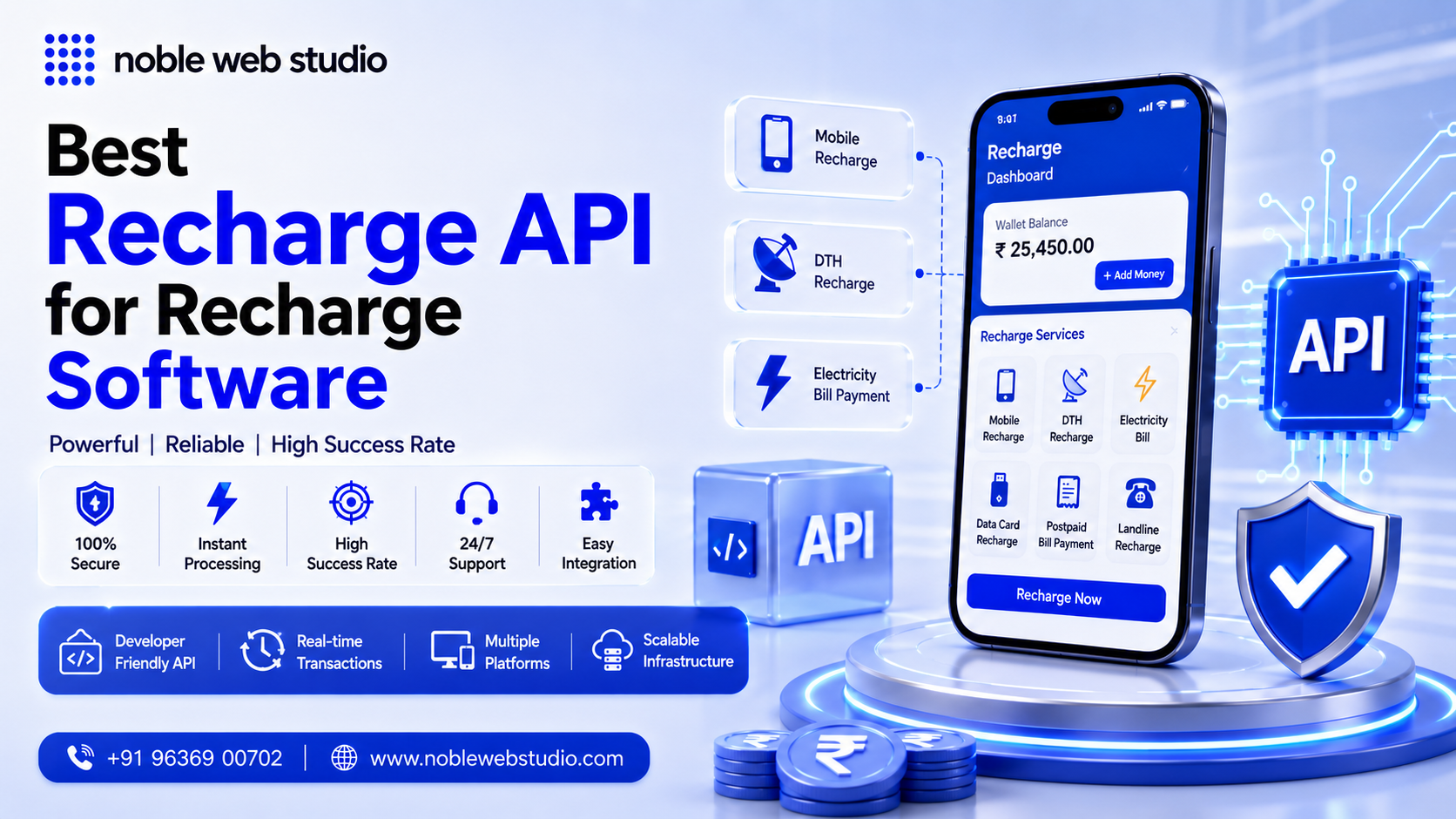
Are you searching for the best Recharge API for Recharge Software to build a fast, secure, and scalable digital recharge platform? Noble web studio one of the top Recharge API Provider is one of the most important decisions for startups, fintech companies, retailers, distributors, and entrepreneurs who want to offer reliable online recharge services across India.
A powerful Recharge API enables your recharge commission software to process prepaid mobile recharge, postpaid bill payments, DTH recharge, FASTag recharge, and utility bill payments through a single integration. With real-time transaction processing, secure recharge API connectivity, multi-operator support, and instant response, businesses can deliver a seamless recharge experience while improving customer satisfaction.
A Dedicated Recharge API acts as the core transactional engine for your Multi Recharge Software, enabling a single recharge API dashboard to process transactions across hundreds of providers without individual operator integrations. It securely bridges your recharge commission portal or higher recharge commission app with telecom operators, DTH services, and utility networks to manage instant balances and commissions.
A Recharge API integrates prepaid mobile, DTH, and utility bill payments into your highest earning recharge platform, allowing users to instantly process transactions via a single, pre-funded wallet. Noble web studio offer 99%+ uptime and high success rates.
The best Recharge Software API should include features such as high transaction reliability, secure mobile recharge API integration, automated recharge commission management, wallet management, retailer and distributor management, detailed reports, and an easy-to-use mobile recharge admin panel. These capabilities help businesses automate operations, reduce manual work, and grow their recharge network efficiently.
Noble Web Studio provides a reliable and scalable Recharge API Solution for modern recharge businesses. Our platform is designed for easy integration, fast transaction processing, secure infrastructure, and flexible business management. Whether you are launching a new recharge portal or upgrading an existing top mobile recharge platform, our Recharge API helps you deliver consistent performance and support future business growth.
In this guide, you’ll learn how to choose the best Recharge API for Recharge Software, the essential features to look for, the business benefits of API integration, and why selecting the right recharge technology is important for building a successful digital payment business.
What is a Recharge API?
A Recharge API is a software bridge that connects your website or app to telecom and utility operators. Instead of building direct, individual integrations with providers like Airtel, Jio, or Vi, you plug into one unified best recharge API. When a user makes a request, the recharge API instantly processes the top-up and sends a real-time status back to your top performance recharge platform.
How Does a Recharge API Work?
A Recharge API (Application Programming Interface) is a secure, automated bridge that connects your recharge commission app, website, or fintech platform directly to telecom, DTH, and utility networks. Instead of building separate integrations for Noble web studio, it lets you process instant mobile top-ups, data plans, and bill payments across all major networks through one unified system.
How a Recharge API Works (Step-by-Step)
The entire transaction flow happens in the background, usually taking under a second to complete:
- User Request: A customer enters their mobile number, selects an operator, inputs the amount on your application, and clicks “Pay”.
- API Payload Forwarding: Your server packages this data with your unique recharge API credential key and sends a structured HTTPS request to the Noble web studio server.
- Authentication & Wallet Check: The Noble web studio server verifies your best recharge API key and checks if your virtual B2B wallet balance is sufficient to cover the transaction cost.
- Operator Execution: The securely forwards the request to the specific telecom network (e.g., Airtel, Jio).
- Real-time Callback: The operator processes the credit, sends a success or failure status back to the Noble web studio and the recharge API relays this exact status to your website or app via an immediate callback.
Recharge API Architecture (NEW)
Recharge API Architecture (NEW)
Customer Request → Recharge Software → Recharge API → Operator Server → Success Response
Customer
Recharge Software / Website / Mobile App
Recharge API Gateway
Authentication & Validation
Recharge Processing Engine
Mobile / DTH / Fastag / BBPS Operator
Transaction Status
Commission & Wallet Update
| Architecture Layer | Purpose |
|---|---|
| Customer | User initiates the recharge request. |
| Recharge Software | Collects recharge details from the customer. |
| Recharge API Gateway | Securely sends the request to the recharge platform. |
| Authentication & Validation | Verifies API Key, Token, IP, Wallet Balance, and Request. |
| Recharge Processing Engine | Routes the transaction to the correct telecom or utility operator. |
| Operator Server | Processes the recharge request. |
| Transaction Status | Returns Success, Failed, or Pending response. |
| Commission Engine | Credits retailer, distributor, and admin commissions automatically. |
Types of Recharge API (NEW)
Recharge API are divided into two main categories depending on the industry context: Telecom & Utility Payment APIs (used to top up phones and pay bills) and Subscription Management APIs (used by e-commerce platforms like Recharge Payments to process recurring orders).
The latest breakdown of modern Recharge API across both categories includes the following variations:
Telecom & Utility Recharge APIs
These b2b recharge API allow fintech platforms, super-apps, and local retailers to automate digital top-ups and micro-payments.
- Multi-Recharge API: A unified system combining mobile, DTH, and data card recharges into a single integration.
- Prepaid Mobile Top-Up API: Automates instant talk-time, data pack additions, or bundle validations across providers like Jio, Airtel, and Vi.
- Postpaid Bill Payment API: Fetches and processes monthly cellular bills from network operators.
- DTH Recharge API: Dedicated specifically to renewing digital television services (e.g., Tata Play, Dish TV).
- BBPS API (Bharat Bill Payment System): An Indian interoperable bill payment ecosystem used for utilities like electricity, gas, water, and insurance.
- FASTag Recharge API: Specifically targets toll wallet updates using vehicle registration data.
- OTT & Digital Voucher API: Generates instant subscription codes for streaming platforms or Google Play vouchers.
- Plan View / R-Offer API: Fetches real-time personalized plans, validation dates, and special localized discounts before a payment goes through.
E-Commerce Subscription Recharge APIs
If you are looking at subscription commerce software (such as Recharge Payments), the b2b mobile recharge API are categorized by how they interact with your storefront architecture:
- Admin REST API: A backend administrative recharge API that manages customer records, processes recurring payment intervals, and handles full store architecture behind secure servers.
- Storefront API: A newer client-side secure environment that uses JSON Web Tokens (JWT) to access subscription schedules directly inside user browsers (like Shopify or BigCommerce themes) without a custom backend.
- Recharge JavaScript SDK: A fully-typed developer toolkit built to simplify coding and trigger subscription widgets programmatically.
Business Delivery Models
- B2B Recharge API: Built for higher processing capacities, allowing bulk agents to distribute recharge services downstream to sub-retailers.
- White-Label Recharge API Solutions: Allows a brand to mask the aggregator’s infrastructure completely, keeping transactions inside their own logo and domain interface.
Who Should Use Recharge API?
A Recharge API is ideal for fintech startups, e-commerce platforms, and digital wallet providers looking to instantly automate prepaid mobile, DTH, and utility bill payments directly into their own applications. It allows companies to integrate a single bridge instead of building individual connections with multiple telecom operators.
The following groups typically use a Recharge API to scale their services and earn commissions on transactions:
- Fintech & Digital Wallets: Integrate recharge options so users can top-up accounts and pay bills on an all-in-one platform.
- Retailers & White-Label Providers: Individual shop owners, vendors, and B2B aggregators use multi-recharge platforms to process payments for walk-in customers and generate commission margins.
- E-commerce & Travel Platforms: Add value by allowing customers to buy services like mobile talk-time or data packages directly on the site, boosting customer loyalty.
- Rewards & Loyalty Platforms: Used to facilitate the instant redemption of corporate rewards or loyalty points for prepaid services.
- Software Developers: Enables developers to quickly embed recharge functionality into desktop or mobile applications without dealing with complex, carrier-specific coding.
Industries Using Recharge API
Recharge APIs are widely used by Fintech & Digital Wallets, Retail Networks, and Travel & E-commerce platforms. These integrations allow businesses to process real-time prepaid/postpaid mobile, DTH, and FASTag recharges securely under their own branding.
Key Industries Using Recharge APIs
- Fintech Companies: Fintech companies are among the biggest users of branded Recharge APIs. They integrate recharge services into their platforms to provide customers with mobile recharge, DTH recharge, electricity bill payment, FASTag recharge, and other digital payment services.
- B2B Recharge Businesses: B2B recharge businesses use Multi Mobile Recharge API to serve retailers, distributors, and super distributors across India. These platforms support multiple telecom operators from one dashboard.
- Retail Shops & Kirana Stores: Small retail shops and Kirana stores use Recharge APIs to provide digital services along with their regular business. Customers can recharge their mobile numbers while shopping, making the store a one-stop service center.
- Online Recharge Websites: Recharge websites depend on Noble web studio to process instant mobile and DTH recharge requests. A reliable recharge API ensures faster processing and high transaction success.
- Mobile Recharge Apps: Android recharge app and iOS recharge apps integrated Recharge API to provide digital payment services directly to users.
- Digital Payment Platforms: Digital payment companies combine trusted Recharge API with BBPS, UPI, AEPS, and Wallet services to provide an all-in-one payment solution.
- E-Commerce Platforms: Many online shopping platforms integration Recharge API so customers can recharge their mobile numbers and pay utility bills without leaving the website or app.
- Travel Portals: Travel portals use Recharge APIs to offer additional services like mobile recharge, FASTag recharge, and utility bill payments to travelers.
- Banking & Financial Service Providers: Banks and financial institutions use Recharge API provide recharge services through internet banking, mobile recharge banking apps, and customer service platforms.
- Utility Payment Platforms: Noble web studio offering electricity, gas, water, broadband, and other utility payment services Recharge API integrate to create a complete digital payment ecosystem.
- Telecom Service Partners: Telecom partners use Recharge APIs to automate prepaid recharge processing and improve customer service through instant transactions.
- White Label Fintech Businesses: Businesses launching their own branded recharge platform use White Label Recharge API to quickly offer recharge and bill payment services without building the infrastructure from scratch.
Services Supported by Recharge API
A Recharge API primarily supports instant electronic top-ups for telecom, satellite TV, and data networks, alongside automated utility bill payments integrated into a single interface. Depending on the context, the term either refers to B2B payment recharge software API used by fintech startups and retailers, or the subscription management tool by the e-commerce platform Recharge Payments.
The primary services supported across both types of secure recharge APIs are broken down below.
1. B2B Multi-Recharge & Utility APIs
These B2B Multi recharge API are utilized by mobile recharge commission app, retail recharge portal, and digital wallets to offer payment microservices to consumers. Noble web studio bundle these services:
- Mobile Recharges: Immediate top-ups for prepaid plans and billing processing for postpaid connections across major cellular operators like Jio, Airtel, Vi, and BSNL.
- DTH (Direct-to-Home) TV: Instant television pack subscription renewals for networks like Tata Play, Dish TV, Airtel Digital TV, and Sun Direct.
- Data Card Top-ups: Prepaid internet and LTE data stick updates.
- Utility Bill Payments (BBPS): Multi-operator pipeline frameworks for state board electricity, piped gas/LPG cylinders, municipal water, and residential broadband.
- Transit & Travel: Fastag electronic toll collection recharges and integrations for metro rail network smartcards.
- Financial & Vouchers: Premium clearing for major insurance providers (e.g., LIC) and instant generation of Google Play redeem codes.
2. Recharge Payments API (E-Commerce Subscriptions)
If you are referencing the specialized branded Recharge Platform subscription tool used on storefronts like Shopify, the No.1 recharge API supports automated infrastructure for recurring monetization:
- Subscription Management: Complete administrative control over recurring order generation, intervals, product swaps, or subscription pauses.
- Storefront Customization: Tokenized endpoints that let developers build bespoke customer portals directly into themes via the Recharge JavaScript SDK.
- Payment Vaulting: Automated customer billing profiles handled securely across integrated storefront gateways.
3. Core Technical & Backend Capabilities
Regardless of the variant, high grade recharge API provide automated operational features for backend software stability:
- Real-Time Webhooks: Pushes live callback alerts to server portals immediately following successful or failed payment triggers.
- Auto-Wallet Updates: Instantly deducts or refunds dynamic operational balances directly inside a merchant’s cloud ledger.
- Operator Lookup (MNP): Automates live operator detection to verify circle information before finalizing mobile recharges.
Why Recharge API Important for Recharge Software
A Most Recharge API is the software bridge that connects your recharge b2b platform to telecom and utility providers. It automates instant prepaid/postpaid mobile, DTH, and utility bill payments. It is crucial because it saves development costs, ensures real-time transactions, prevents manual errors, and allows you to earn commissions on every successful bill payment.
Implementing reliable recharge API offers several critical advantages for any mobile recharge software:
- Automation & Instant Processing: Eliminates manual processing by automatically communicating with operator servers. Customers receive top-ups instantly, greatly improving user satisfaction.
- Revenue Generation: Allows businesses to earn consistent recharge commission margins (typically 2% to 7%) on every successful transaction made through their platform.
- Scalability: Enables your software to seamlessly scale from a few transactions to handling high traffic volumes as your business grows without needing to build custom telecom infrastructure.
- Unified Service Offerings: Consolidates multiple operators (e.g., Airtel, Jio, Vi) and services (mobile, DTH, electricity, gas) into a single, manageable platform.
- Enhanced Security: Protects sensitive financial data and ensures secure transactions through encrypted communication and fraud-prevention mechanisms.
- Real-Time Analytics: Provides your recharge admin software panel with instant tracking, logging, and reporting of transaction statuses and earnings.
Why Businesses Need the Best Recharge API
A Professional Recharge API empowers businesses to instantly and automatically process mobile, DTH, and utility bill payments directly through their own apps or websites. It eliminates the need for physical infrastructure, drastically reduces operational costs, and generates revenue through transaction commissions without building separate systems for each telecom operator.
Utilizing the best-in-class Recharge API directly benefits businesses by providing:
- Rapid Integration & Cost Reduction: Instead of negotiating and coding for hundreds of individual operators, a single recharge API integration drastically cuts development time by up to 90% and reduces overall setup costs by about 70%.
- Real-Time Processing & High Uptime: The highest-rated recharge APIs (like those from Noble Web Studio) offer sub-300ms response times, automatic failover, and near-perfect uptimes (around 99.99%), ensuring successful, instantaneous transactions.
- Expanded Service Capabilities: Businesses can easily scale from simple mobile top-ups to multi-service offerings, seamlessly adding BBPS (Bharat Bill Payment System) services, data card recharges, and utility payments.
- Operational Control: For resellers and agencies, robust recharge API networks offer white-label dashboards to manage distributor networks, control retailer hierarchies, monitor commission slabs, and track comprehensive GST reporting.
Key Features of the Best Recharge API
The best Recharge API offer robust features like sub-300ms response times, 99.99% uptime, and instant automated refunds. Noble web studio provide single-window access to multi-operator networks for prepaid, postpaid, DTH, and utility bill payments, enabling seamless real-time transactions and high-volume processing for your platform.
Essential features to look for in a top-tier Recharge API include:
- Multi-Operator & Multi-Service Support: Single integration to process recharges for all major telecom operators (Jio, Airtel, Vi, BSNL), DTH providers, data cards, and utility bills (Electricity, FASTag).
- Real-Time Processing: Lightning-fast, automated transaction execution, ensuring your end-users receive their top-ups instantly (often in under 300ms).
- Automated Refund System: Instant fund reversal to your wallet if a transaction fails due to operator downtime or network errors.
- High Success Rates & Redundancy: Intelligent routing that automatically switches to secondary operators if a primary gateway faces issues, ensuring uninterrupted service.
- Comprehensive Reporting & Analytics: Live tracking of transaction success rates, revenue, and commissions through a centralized dashboard.
- Developer-Friendly Integration: REST/JSON formats, clear recharge API documentation, and webhook support for real-time transaction updates.
- Robust Documentation and Sandbox: Comprehensive REST recharge API documentation, sample SDKs, and a free sandbox environment for smooth, developer friendly recharge API integration.
- Real-Time Webhooks: Instant callbacks to notify your system of transaction success or failure without continuous polling.
- Multi-Level Commission Management: Built-in tools for tracking distributor hierarchies and slab-based recharge commission margins if you are running a reseller network.
Benefits of Recharge API Integration
Fast Recharge API integration allows businesses to seamlessly embed instant mobile top-ups, DTH recharges, and utility bill payment functionalities directly into their existing applications or websites. By leveraging a unified system rather than building partnerships with individual telecom networks, businesses can significantly scale their offerings and automate real-time microtransactions.
Key Business Benefits
- New Revenue Streams: Earn recurring, slab-based commissions (often ranging from 2% to 7%) on every successful customer transaction.
- Minimized Operational Costs: Eliminate the need to manage physical coupons or maintain individual wallets and balances for separate network operators.
- Rapid Deployment Time: Consolidating to a single recharge API reduces recharge API development time by up to 90% compared to integrating operators individually.
- Automated Fraud Protection: Utilize enterprise-grade security protocols like SSL encryption, whitelisted IPs, and secure mobile recharge API keys.
- Real-Time Analytics Insights: Access specialized administration dashboards that compile download-ready transaction sheets, ledger records, and customer behavior trends.
Enhanced Customer Experience
- Instant Multi-Operator Fulfillment: Complete transactions for major carriers (such as Airtel, Jio, and Vi) and DTH services within milliseconds.
- No Checkout Delays: Provide standard recharge API-led transaction speeds that execute under 400ms to boost cart conversion.
- Zero-Interruption Reliability: Protect consumer checkouts via intelligent fallback routing and automated carrier failover systems.
- Immediate Transaction Status: Dispatch instant SMS, email alerts, or automatic failures to prevent funds from getting locked up unexpectedly.
Core Technical Capabilities
To help evaluate Noble web studio look for these operational features:
| Feature | System Capability | Business Impact |
|---|---|---|
| All-in-One Gateway | Multi-operator/Multi-service support | Broader customer demographic outreach |
| Automated Failover | 99.9% Uptime Intelligent routing | Zero revenue drops from operator downtime |
| Auto-Refund Triggers | Immediate failed-transaction reversals | Reduced support tickets and customer complaints |
| RESTful JSON Format | Lightweight code scripting structure | Clean, low-maintenance developer onboarding |
Recharge API Supported Recharge Services
A Multi-Recharge API generally supports telecom recharges, satellite TV top-ups, internet renewals, and utility payments through a single integration endpoint. Noble Web Studio combine these networks into one recharge B2B wallet system.
The complete breakdown of supported core recharge and bill services is categorized below.
Core Telecom & Entertainment Services
- Prepaid Mobile Recharge: Top-ups for all dominant network providers like Jio, Airtel, Vodafone Idea (Vi), and BSNL.
- Postpaid Mobile Payments: Settlement of monthly mobile cycle bills for all contract carriers.
- DTH (Direct-to-Home) Recharge: Instant payment options for satellite television networks including Tata Play, Dish TV, Airtel Digital TV, Sun Direct, and D2H.
- Data Card Top-ups: Internet credits for standalone high-speed portable Wi-Fi devices and dongles.
Transit & Digital Vouchers
- FASTag Recharge: Instant wallet top-ups linked to National Electronic Toll Collection (NETC) accounts across multiple partner banks.
- Metro Card Recharge: Electronic balance additions for urban mass transit commuter networks.
- Google Play Gift Cards: Real-time generation of digital gift codes and app store wallet credits.
Recharge API Supported Telecom Operators
A standard Multi Operator Mobile Recharge API provides single-window integration supporting all major pan-India telecom operators, including Reliance Jio, Bharti Airtel, Vodafone Idea (Vi), and BSNL (Bharat Sanchar Nigam Limited).
Supported Telecom Operators
A robust multi recharge gateway bridges your platform directly to the network backends:
- Reliance Jio: High-volume 4G/5G prepaid talktime, data packs, and postpaid monthly bills.
- Bharti Airtel: Core prepaid talktime, specialized data/roaming vouchers, and postpaid accounts.
- Vodafone Idea (Vi): Validity extensions, national voice/data bundles, and corporate billing.
- BSNL: Pan-India and regional prepaid cards, special tariff vouchers (STVs), and landline routing.
- MTNL: Circle-specific recharges for Delhi and Mumbai metropolitan areas.
Extended Services Supported by Recharge APIs
Noble web studio is an Modern recharge API aggregators often bundle supplementary telecom and digital entertainment networks into a single integration:
DTH (Direct-to-Home) Operators
- Tata Play
- Airtel Digital TV
- Dish TV
- Sun Direct
- Videocon d2h
Utility & Broadband Channels (via BBPS)
- Broadband Providers: JioFiber, Airtel Xstream, and ACT Fibernet.
- FASTag Toll Payments: Prepaid toll loads linked to vehicle numbers across top banks.
- Digital Content: Instant Google Play redeem codes and OTT media subscriptions.
Recharge API Integration Process
To integrate mobile recharge API or B2B recharge API into your website or best recharge commission APP, follow a standard four-phase process: Mobile recharge API onboarding, environment recharge Api setup, core recharge API implementation, and automated webhook tracking.
Here is the exact step-by-step roadmap to successfully build and deploy your recharge API integration:
1. Onboarding and KYC
- Select a provider: Choose an established telecom/utility aggregator or payment gateway.
- Register an account: Sign up on the Noble web studio developer dashboard to create your profile.
- Complete business verification: Submit identity proofs, address documents, and tax certifications (such as a PAN card) to pass Know Your Customer (KYC) requirements.
- Retrieve credentials: Collect your mobile recharge API Key, Secret Token, and
Merchant IDfrom your mobile recharge portal.
2. Sandbox Setup and Authorization
- Whitelist server IPs: Secure your server by logging into the recharge admin portal and adding your production/sandbox server IP addresses to the allowed list.
- Set up authorization headers: Construct your secure HTTP headers, typically using base 64 encryption, recharge API tokens or HMAC signatures.
- Fund your test wallet: Deposit nominal credits into your staging or master virtual wallet to allow testing of live-simulated transactions.
3. Core API Endpoint Implementation
Developers must map their frontend application workflows to three primary backend recharge API requests:
- Step A: The Lookup Request: Trigger an automated lookup query as soon as a customer enters their mobile number. This automatically identifies the carrier operator and circle location.
- Step B: Fetch Plans: Call the plan catalog endpoint to present valid browse plans, data packs, or DTH options directly to your user interface.
- Step C: Execute Transaction: Submit an asynchronous POST execution request containing the necessary operational body payloads to process the final payment.
4. Handling Webhooks and Failures
- Configure webhook listeners: Set up an internet-accessible callback URL on your server to handle live transaction triggers broadcasted by the telecom networks.
- Update internal ledgers: Settle customer account ledgers or update order statuses inside your local application database when you receive a STATUS: SUCCESS webhook.
- Build an auto-refund routine: Program a fallback mechanism that automatically reverts deducted funds to the customer’s app wallet if the operator responds with a STATUS: FAILED hook.
5. Sandbox Testing and Production Launch
- Test transaction edge cases: Perform end-to-end trials in the staging sandbox using test numbers to check success, delay, and failure routines.
- Point URLs to production: Swap your base URLs from staging endpoints over to the live production server endpoints.
- Deploy code changes: Migrate your code changes to live recharge application servers to open recharge features up to end users.
Recharge API Documentation Explained (NEW)
The term Recharge service API commonly refers to two completely different technologies depending on your business context: the Recharge Payment API (used for managing e-commerce subscriptions and recurring billing) or a Telecom/Utility Recharge API (used for automated mobile top-ups and bill payments).
Recharge API Cost
A Recharge API cost structure typically includes a one-time Recharge API setup fee (₹2,500 to ₹25,000+), optional monthly/annual maintenance charges (₹500 to ₹3,000+ per month), and a commission-based model. Noble web studio also require an initial wallet/security deposit to execute transactions, with commissions varying from 0.5% to 7% depending on the telecom operator or service.
Here is the detailed cost breakdown:
1. Initial Setup and Integration Fees
- Basic API Access: Costs generally range between ₹2,500 and ₹10,000 for standard recharge API credentials and technical documentation.
- White-Label Solutions: If you need a fully custom mobile recharge portal or best mobile recharge commission app (complete with an admin panel and user management), costs can range from ₹15,000 to over ₹1,00,000+.
- Zero Setup Options: Noble web studio offer free mobile recharge api setup and rely entirely on commission splits or ongoing transaction volumes.
2. Ongoing & Operational Costs
- Maintenance & Hosting: Annual or monthly maintenance fees are typically charged to cover hosting, technical support, and updates, usually ranging from ₹10,000 to ₹40,000 per year for white-label platforms.
- Security Deposit: You must maintain a minimum revolving balance or wallet/security deposit with the Noble web studio to fund ongoing customer recharges (often starting at ₹1,000 to ₹10,000).
3. Commission Rates and Margins
Instead of charging you directly for every transaction, Noble web studio compensate their business partners via revenue-sharing (margin) commissions on the successful transaction amount:
- Prepaid Mobile: Margins typically range from 2% to 5%. BSNL and Jio usually offer higher percentages, while Airtel and Vi sit slightly lower.
- DTH Recharge: Noble web studio offer the highest recharge commission margins, generally between 3% and 7%.
- Utility Bills (BBPS) / Postpaid: These often provide a flat fee (e.g., ₹5 to ₹20 per bill) or lower percentage margins (1% to 3%).
Recharge API Request & Response Flow
A Recharge API Request and Response Flow details how a consumer recharge platform securely communicates with a telecom provider to instantly process utility, mobile, or DTH top-ups. The entire transaction follows a sequence spanning from information lookup to settlement and final asynchronous callbacks.
Step-by-Step Request Flow
[Customer Application] ---> [Your Server] ---> [Recharge API Gateway] ---> [Telecom Operator]1. Plan and Operator Discovery
Before initiating a payment, your system fetches real-time details from the Noble web studio to prevent failed transactions.
- Operator Lookup: The high commission recharge app submits the customer’s phone number to automatically detect the telecom circle and operator (e.g., Vodafone, Jio).
- Plan Validation: The recharge system queries active tariff plans using the recharge b2b API so the customer selects a valid amount.
2. Request Initiation & Validation
The client-side application triggers the payment, sending an authenticated request body to the recharge API Gateway.
- Authentication: The request header contains a secret recharge API token or HMAC signature, often restricted to an IP whitelist.
- Payload Transmission: A
POSTrequest is sent containing the consumer account ID, operator code, amount, and a uniquereference_idgenerated by your server.
3. Core Processing
- Balance Deductions: The Noble web studio checks your business wallet balance to cover the cost before passing it along.
- Operator Forwarding: The gateway translates and routes the request directly to the specific telecom operator’s network.
Step-by-Step Response Flow
[Telecom Operator] ---> [Recharge API Gateway] ---> [Your Server] ---> [Customer Application]
                                                        |
                                                        └---> (Webhook Callback)
1. Immediate Synchronous Response
The mobile recharge API gateway instantly returns a JSON-encoded payload containing an HTTP status code (typically 200 OK) and a transaction status.
- SUCCESS: The transaction was instantly accepted and finalized.
- FAILED: The request was blocked immediately (e.g., insufficient balance, invalid number).
- PENDING: The operator received the request but has not yet confirmed delivery.
2. Asynchronous Status Delivery
Because network operations take time, Noble web studio rely on two main methods to deliver the final outcome:
Webhooks (Callbacks): Once the operator updates the transaction status, the mobile recharge API gateway sends a POST push notification directly to your server’s listener URL.
Status Polling: If webhooks fail or are unsupported, your server queries the transaction endpoint (GET /transaction/status/{id}) at designated intervals until a terminal state is reached.
3. Settlement and Client Update
- Wallet Reconciliation: If the webhook returns a
FAILEDstatus after initially being charged, an auto-refund logic reverses the transaction and restores your platform balance. - User Interface Notification: Your high mobile recharge commission app updates the frontend view, alerting the user via text, email, or an on-screen receipt.
Recharge API Security Features
Recharge APIs implement multi-layered, bank-grade security protocols to protect sensitive financial data and prevent fraudulent transactions during mobile, DTH, and utility top-ups. Because these reputed recharge API manage direct monetary exchanges and wallet balances, Noble Web Studio enforce strict technical guardrails to ensure end-to-end data integrity.
Core Data & Transport Security
- TLS 1.3 / SSL Encryption: All data transmitted between your server and the best mobile recharge API gateway uses HTTPS with 256-bit TLS encryption to eliminate man-in-the-middle attacks.
- IP Whitelisting: Access is restricted exclusively to pre-approved server IP addresses, blocking unauthorized external calls even if mobile recharge API credentials leak.
- Secure Payment Gateways: Integrates seamlessly with highly regulated, PCI DSS compliant external payment rails (like UPI and cards).
Identity & Access Control
- Token-Based Authentication: Employs secure, unique recharge API keys or advanced OAuth 2.0 mechanisms rather than static login credentials.
- Granular API Token Scopes: Access permissions can be tightly defined (e.g., read-only vs write-enabled) adhering to the Principle of Least Privilege.
- Browser-Safe Storefront Tokens: High volume Recharge Platform like Recharge Payments isolate front-end and back-end logic, applying distinct user permissions automatically.
Threat Prevention & Automation Guardrails
- Rate Limiting: Protects the recharge platform infrastructure against Denial of Service (DoS) attacks and high-velocity brute force script submissions.
- Automated Validation Loops: Validates parameters like phone numbers and operator codes instantly to reject garbage requests before processing.
- Comprehensive Audit Logging: Tracks data metrics including timestamps, payload arrays, and originating IPs to identify malicious trends.
- Multi-Layer Fraud Detection: Monitors financial ledgers in real-time to intercept overlapping or identical double-payment attempts.
Recharge API Performance Metrics
Key performance indicators (KPIs) help evaluate the reliability, speed, security, and efficiency of a Recharge API before deployment.
API Response Time
Measures how quickly the Recharge API processes and returns a response after receiving a request. Faster response times improve customer experience.
Transaction Success Rate
Represents the percentage of successful recharge transactions completed without failure. A higher success rate means greater reliability.
Server Uptime
Shows the availability of the Recharge API platform. Higher uptime ensures uninterrupted recharge services throughout the day.
Pending Resolution Time
Measures how quickly pending recharge transactions are automatically updated to success, failure, or refunded status.
Auto Refund Time
Tracks the average time required to process refunds for failed recharge transactions, improving customer satisfaction.
API Throughput
Indicates the number of recharge requests the API can handle per second without affecting performance.
Security Compliance
Measures the effectiveness of encryption, authentication, access control, and secure API communication.
Error Rate
Represents the percentage of failed API requests caused by validation errors, operator downtime, or server issues.
Essential Recharge API Performance Metrics
- API Response Time: Fast request processing for a better user experience.
- Transaction Success Rate: Higher successful recharge percentage.
- Server Uptime: Continuous platform availability with minimal downtime.
- Pending Resolution: Quick settlement of pending transactions.
- Auto Refund: Automatic refund processing for failed recharges.
- API Throughput: Ability to process a large volume of recharge requests.
- Security: Strong encryption and secure authentication.
- Error Rate: Lower API failures indicate a stable Recharge API platform.
Best Practices for Recharge API Integration
Successful Recharge API integration relies heavily on transaction reliability, financial accuracy, and data security to manage thousands of simultaneous top-ups without issues. Utilizing developer guides from platforms like Noble Web Studio this document outlines the fundamental technical and architectural best practices for integrating mobile, DTH, and subscription billing systems.
Transaction Security & Compliance
- Enforce TLS 1.3: Encrypt all data in transit using HTTPS with TLS 1.3 protocol.
- IP Whitelisting: Restrict recharge API access entirely to known, static application server IP addresses.
- Token Authentication: Authenticate via bearer tokens or OAuth 2.0 instead of static keys.
- Secure Vault Storage: Store your master recharge API credentials inside specialized services like AWS Secrets Manager.
- Zero Client Leakage: Never place sensitive recharge API keys inside frontend Javascript code.
- PCI DSS Adherence: Follow financial compliance regulations when collecting, saving, or parsing card details.
Fault Tolerance & Data Integrity
- Idempotency Keys: Send unique transaction UUIDs to avoid double-charging wallets during network timeouts.
- Asynchronous Webhooks: Use incoming webhooks instead of constant pooling loops to process top-up statuses.
- Automated Fallbacks: Select a Noble web studio featuring multi-route automated failover across telecom operator channels.
- Smart Local Caching: Cache local operator circles and plan data to prevent redundant validation calls.
- Auto-Refund Engines: Implement an instant balance reversion rule if the upstream telecom circle throws a hard failure.
Performance Optimization
- Sub-200ms Latency: Optimize database layers to hit sub-200ms processing times before user drops occur.
- Asynchronous Processing: Drop successful request submissions directly into a task queue like RabbitMQ.
- Database Ledger Audits: Track every request payload, IP, and transaction state within an immutable audit trail.
- Pre-fill Wallet Alerts: Program real-time slack or email updates when your virtual wallet balance dips.
Sandbox Testing
- Simulate Bad States: Intentionally test scenario errors like low wallet balance and invalid operator circles.
- Verify MNP Scenarios: Test Mobile Number Portability routines to ensure users are displayed valid operator choices.
Checklist Before Buying a Recharge API
Before buying recharge API, verify the Noble web studio success ratio (aim for >95%), bank-grade security, and direct or redundant aggregator connections. Ensure the mobile recharge admin API covers your required services like mobile, DTH, and FASTag and check that they offer an automated refund system for failed transactions.
A comprehensive evaluation checklist will ensure your platform stays reliable and profitable:
Catalog & Service Coverage
- Multi-service Support: Confirm the reputable recharge API supports the services you plan to offer (e.g., Prepaid/Postpaid Mobile, DTH, Electricity, Gas, FASTag).
- Operator Coverage: Ensure it includes all major telecom operators (such as Jio, Airtel, Vi, and BSNL) and regional DTH/utility providers relevant to your users.
- Live Updates: Check if they offer dynamic recharge APIs (e.g., Get Mobile Plans) so your high earning recharge commission app always displays the latest recharge plans and pricing.
Reliability & Performance
- High Success Ratio: Look for Noble web studio with an optimal success ratio to ensure customer satisfaction and protect your business reputation.
- Uptime Guarantee: Verify they offer at least a 99.9% uptime guarantee to prevent service disruptions during peak hours.
- Automated Callback/Webhook System: Ensure the recharge API instantly sends a status callback so you can trigger real-time push notifications or auto-refunds to customer wallets if a transaction fails.
Financials & Commission Structure
- Transparent Pricing: Check for hidden costs like setup fees, cross-currency conversion markups, or minimum monthly commitments.
- Commission Model: Review the High recharge commission or discount percentage structure. Compare whether an aggregator model or direct operator integration better suits your capital availability and profit margins.
- Wallet System: Look for a single e-wallet or prepaid model that allows you to manage transactions across all operators easily.
Technical Integration & Support
- Developer Documentation: Review the mobile recharge API documentation. Look for support for RESTful architecture and easy endpoint validation.
- Sandbox Environment: Test their sandbox environment first to evaluate integration speed and ensure you can test endpoints (like balance checks and status callbacks) before going live.
- 24/7 Support: Ensure round-the-clock technical assistance is available to resolve unexpected transaction failures.
Compliance & Security
- Data Security: Confirm the smooth recharge API employs robust encryption (e.g., SSL/TLS) to protect sensitive user and financial data.
- KYC & Legal: Check the Noble web studio regulatory compliance and ensure you have the necessary identity and business registration documents ready for recharge api onboarding.
Why Trust Our Recharge API Recommendations?
Our recommendations are rigorously vetted to ensure your business processes transactions seamlessly and securely. We focus on core operational metrics to guarantee the highest return on investment and customer satisfaction.
We evaluate Noble web studio based on six critical pillars:
- Documented Uptime: Noble web studio with a proven track record of ≥ 99.9% system availability to prevent downtime during critical operating hours.
- Transaction Success Rates: We filter for high success recharge API that guarantee a minimum 99% success rate alongside automated failover switches to minimize transaction failures and customer frustration.
- Processing Speeds: Noble web studio boasting sub-200ms recharge API latency to ensure instantaneous recharge confirmations for your users.
- Security & Compliance: Every recommended trusted mobile recharge API must utilize bank-grade encryption (TLS 1.3), secure IP whitelisting, and strict authentication to protect sensitive financial data.
- Multi-Operator Support: We highlight mobile recharge admin platform that provide unified connectivity to all major telecom (Jio, Airtel, Vi, BSNL) and DTH operators through a single integration.
- Transparent Commissions: We analyze and confirm High recharge commission structures so you can maximize revenue streams with no hidden fees.
Noble Web Studio – A Trusted Recharge API Provider with 12+ Years of Experience
Noble web studio only one of the Best Recharge API for Recharge Software is one of the most important decisions for any B2B recharge business, fintech startup, retailer, or distributor. A High speed recharge API helps deliver fast transactions, secure processing, and a better customer experience.
Noble Web Studio has been serving the digital recharge industry for 12+ years, offering scalable Recharge API solution designed for businesses of all sizes. With an experienced team of professional developers, the company focuses on building stable, secure, and high performance recharge API solutions that support business growth. If you are looking for a Noble web studio with recharge Api for affordable pricing, dependable technical support, and a strong service record, Noble Web Studio is a compelling choice.
Why Choose Noble Web Studio for Recharge API Solutions?
- 12+ Years of Industry Experience in Recharge API and Recharge Software development.
- Trusted by Businesses for reliable recharge API services and long-term technical support.
- 99.9% Transaction Success Ratio (based on the company’s service performance).
- Professional & Experienced Developers dedicated to secure and scalable API solutions.
- Fast API Response Time for smooth and quick recharge processing.
- Affordable Pricing Plans suitable for startups, retailers, distributors, and enterprises.
- Secure API Infrastructure with a focus on stability and reliable performance.
- Easy API Integration with High volume Recharge Software, B2B mobile recharge portal, websites, and mobile recharge application.
- High Security Standards to protect every transaction and customer data.
- Regular Updates and Technical Support to keep your business running without interruptions.
- Scalable Solutions that grow with your business requirements.
- Multiple Recharge Services supported through a single recharge API platform.
- Regular Updates and Feature Enhancements to keep the platform up to date with industry requirements.
- Customer-Focused Approach with dedicated assistance for setup and ongoing support.
Whether you are searching for a Best Recharge API Provider, Recharge Software API, Mobile Recharge API, B2B Recharge API, Multi Recharge API, Recharge API India, Fast Recharge API, Secure Recharge API, or an Affordable Recharge API Provider, Noble Web Studio offers a combination of experience, technology, reliable support, and cost-effective solutions that make it a strong choice for businesses looking to build or expand their digital recharge services.
How to Choose the Best Recharge API Provider
Noble web studio one of the best Recharge API Provider requires prioritizing high transaction success rates (99.9%+), sub-200ms latency, and automated auto-retry for failed requests. A robust mobile recharge API must feature comprehensive operator coverage (Jio, Airtel, Vi, BSNL, DTH, and utilities) and real-time plan verification.
When selecting an Noble web studio focus on these critical operational and technical factors:
- Transaction Success Rate & Speed: Noble web studio based on actual success rates and auto-retry mechanisms. Poor recharge API speed (latency over 300ms) leads to user drop-offs and double-payment submissions.
- Operator Coverage & Redundancy: Ensure the Noble web studio supports all major telecom operators and utilities. Noble web studio use intelligent routing and automatic fallback switches to ensure transactions go through direct telecom pipes.
- Dynamic Plan Verification: Telecom plans update frequently. Choose a Noble web studio that offers real-time plan information so end-users see accurate, up-to-date pricing.
- Commission & Pricing Models: Assess the margins and fee structures. Look for transparent commission models and instant settlement tracking on your mobile or DTH recharges.
- Security & Integration Tools: Best Mobile recharge API integration should be fast. Look for comprehensive recharge API documentation, webhook support for asynchronous status alerts, and secure communication using TLS 1.3 and IP whitelisting.
- Support & Maintenance: Technical downtime disrupts business. Noble web studio offering 24/7 technical support and a sandbox testing environment for developers.
Why Choose Noble Web Studio For Recharge API
If you are looking for a best Recharge API provider that offers fast integration, secure transactions, and reliable performance, Noble Web Studio provides a recharge API designed for businesses of all sizes. Whether you want to launch a B2B Recharge Portal, Top Mobile Recharge Commission App, Recharge Website, or BBPS platform, our Recharge business API helps you deliver a smooth and seamless recharge experience.
Why Businesses Choose Noble Web Studio
- Easy Recharge API Integration – Our developer friendly Recharge API is simple to integrate with websites, Android recharge commission app and custom recharge software, helping you go live faster.
- Supports Multiple Recharge Services – Manage Mobile Recharge, DTH Recharge, BBPS Bill Payments, and other supported services through a single mobile Recharge API.
- Fast API Response Time – Enjoy quick request processing and real-time transaction updates for a better customer experience.
- Secure Recharge API – Built with modern security practices to help protect business and customer transaction data.
- High Reliability – Mobile recharge API Designed to deliver stable performance and minimize service interruptions for your recharge business.
- Developer-Friendly API Documentation – Clear best recharge API documentation, sample requests, and response formats make integration straightforward.
- Real-Time Transaction Status – Track every recharge instantly with real time recharge API responses and transaction updates.
- Scalable for Every Business – Suitable for startups, retailers, distributors, aggregators, fintech companies, and enterprise businesses.
- 24/7 Technical Support – Our technical team is available to help with top recharge API integration, troubleshooting, and ongoing support.
- Business-Focused Solution – Whether you are creating a new recharge platform or expanding an existing one, our top performance Recharge API is built to support long-term business growth.
Future Trends Recharge APIs in India
Mobile Recharge API are evolving from simple prepaid top-up tools into comprehensive financial hubs. Future trends are heavily driven by AI for hyper-personalization and fraud detection, blockchain for security, and unified API solutions bridging telecom, DTH, and utility payments.
Future-forward trends and market evolutions include:
- AI & Machine Learning: Latest Recharge API utilize predictive analytics to offer users hyper-personalized recharge plans and automated customer support through intelligent chatbots.
- Expanded Service Portfolios: Rather than limiting platforms to mobile top-ups, faster recharge APIs are bundling services like utility bill payments (electricity, gas, water), insurance, and subscription-based digital content into a single integration.
- Blockchain Integration: Platforms are deploying distributed ledger technology to enforce tamper-proof auditing, increase transparency, and build trust among users and merchants.
- Omnichannel & IoT Compatibility: Users will increasingly process recharges not just on apps, but via voice-enabled assistants (Alexa, Google Assistant) and NFC, while the Internet of Things (IoT) will support automatic top-ups for connected devices and smart meters.
- Deeper Fintech & Wallet Embedding: Recharge Wallet API are connecting directly with central banking systems (such as BBPS in India) and e-wallets, enabling seamless fund management and micro-financial services.
Looking for the Best Recharge API for Recharge Software?
Launch your recharge platform with a reliable Recharge API that supports fast integration, multiple operators, utility bill payments, and scalable business growth. Contact our experts today and get the right solution for your recharge software business.
Conclusion
Choosing the best Recharge API for Recharge Software is one of the most important decisions for building a reliable and profitable digital recharge business. A high quality Recharge API helps businesses deliver fast, secure, and uninterrupted services for mobile recharge, DTH recharge, utility bill payments, FASTag recharge, and other digital payment solutions through a single platform.
A modern Recharge API should offer seamless integration, real-time transaction processing, support for multiple operators, high platform reliability, secure payment processing, automated commission management, wallet management, and detailed reporting. These features help businesses reduce manual work, improve customer satisfaction, and efficiently manage daily operations.
A Prepaid Recharge API is a software interface that connects your custom or white-label recharge software to multiple telecom operators and utility providers, enabling instant, automated prepaid mobile top-ups, DTH updates, and bill payments from a single unified wallet. Instead of integrating separately with individual carriers like Jio or Airtel, a Multi-Recharge API Aggregator routes all transactions via one JSON/REST framework.
A Postpaid Recharge API is a software bridge that allows your recharge business app or website to instantly process prepaid mobile, DTH, and utility top-ups. Instead of integrating with each telecom operator (like Jio, Airtel, or Vi) individually, you integrate with a Noble web studio who handles all operator routing and transaction confirmations automatically.
Noble Web Studio provides advanced Recharge API Solutions that are recharge API design for startups, fintech companies, distributors, retailers, and enterprises. With smooth recharge API integration, a scalable infrastructure, secure technology, a powerful recharge admin panel, and dedicated technical support, businesses can confidently launch and grow their recharge platform.
Whether you are starting a new recharge business or upgrading your existing best recharge software, Noble web studio is a trusted Recharge API Provider can help you expand your services, improve operational efficiency, and create long-term business growth. A reliable mobile recharge API is the foundation of a successful recharge platform that can support increasing transaction volumes while delivering a smooth user experience.
Contact Noble Web Studio today to integrate a secure and feature-rich Recharge API into your Recharge Software and build a scalable digital recharge platform with confidence.
Frequently Asked Questions (FAQs) – Best Recharge API for Recharge Software
A Recharge API is a software interface that allows websites, mobile recharge earning app, and B2B recharge portal to process mobile recharge, DTH recharge, and utility bill payment services automatically. It helps businesses provide fast, secure, and real-time recharge services without building the entire infrastructure from scratch.
A Powerful mobile Recharge API helps automate recharge transactions, reduce manual work, improve transaction speed, and offer multiple recharge services from a single recharge admin platform. It is ideal for startups, retailers, distributors, fintech companies, and B2B mobile recharge businesses.
When choosing a Noble web studio, consider:
High transaction success rate
Fast recharge API response time
Secure recharge API integration
Stable server infrastructure
Affordable pricing
Easy documentation
Technical support
Industry experience
Regular updates
Scalable solutions for business growth
Noble Web Studio has 12+ years of experience in Recharge API and mobile recharge software development. The Noble Web Studio company offers reliable recharge API integration, professional mobile recharge Api development support, affordable pricing, scalable solutions, and a reported 99.9% transaction success ratio based on its service performance. Businesses also benefit from experienced developers, ongoing technical assistance, and easy mobile recharge service API integration.
Depending on the Noble web studio and plan, a Recharge API can support:
Mobile Recharge
DTH Recharge
FASTag Recharge
Electricity Bill Payment
Gas Bill Payment
Water Bill Payment
Broadband Bill Payment
Landline Bill Payment
BBPS Services
Multi Recharge Portal Integration
Yes. Most Recharge API include developer documentation, authentication credentials, sample code, and technical support to simplify integration with websites, Android recharge apps, iOS recharge apps, and custom mobile recharge software.
The integration time depends on the recharge b2b software and project requirements. Simple integrations can often be completed quickly, while custom business solutions may require additional best recharge software development and testing.
A professional Recharge API should use secure authentication, encrypted communication (HTTPS), access control, and regular security updates to protect transactions and customer information.
A high transaction success rate is important because it improves customer satisfaction and reduces failed transactions. Businesses should ask Noble web studio how they measure and monitor their transaction success performance.
Yes. Launch Recharge APIs are suitable for startups, entrepreneurs, retailers, distributors, aggregators, and enterprises looking to launch or expand a digital recharge business.
Yes. Noble Web Studio provides technical assistance, integration guidance, troubleshooting support, and regular updates to help businesses maintain smooth operations.
Yes. Multi service Recharge API can generally be integrated with existing websites, top mobile recharge software, Android recharge applications, recharge iOS applications, and other mobile recharge business platforms, depending on the technology stack.
To start B2B recharge business, you typically need a Noble web studio, top recharge software, a secure payment system, a wallet management solution, and technical support for integration and maintenance.
Yes. Many Recharge API platforms support multiple telecom operators and recharge categories through a single best recharge API integration, depending on the Noble web studio available services.
Choose a Noble web studio with proven industry experience, transparent pricing, dependable support, secure infrastructure, comprehensive documentation, scalability, and a service portfolio that matches your business needs. Comparing these factors will help you make an informed decision.