
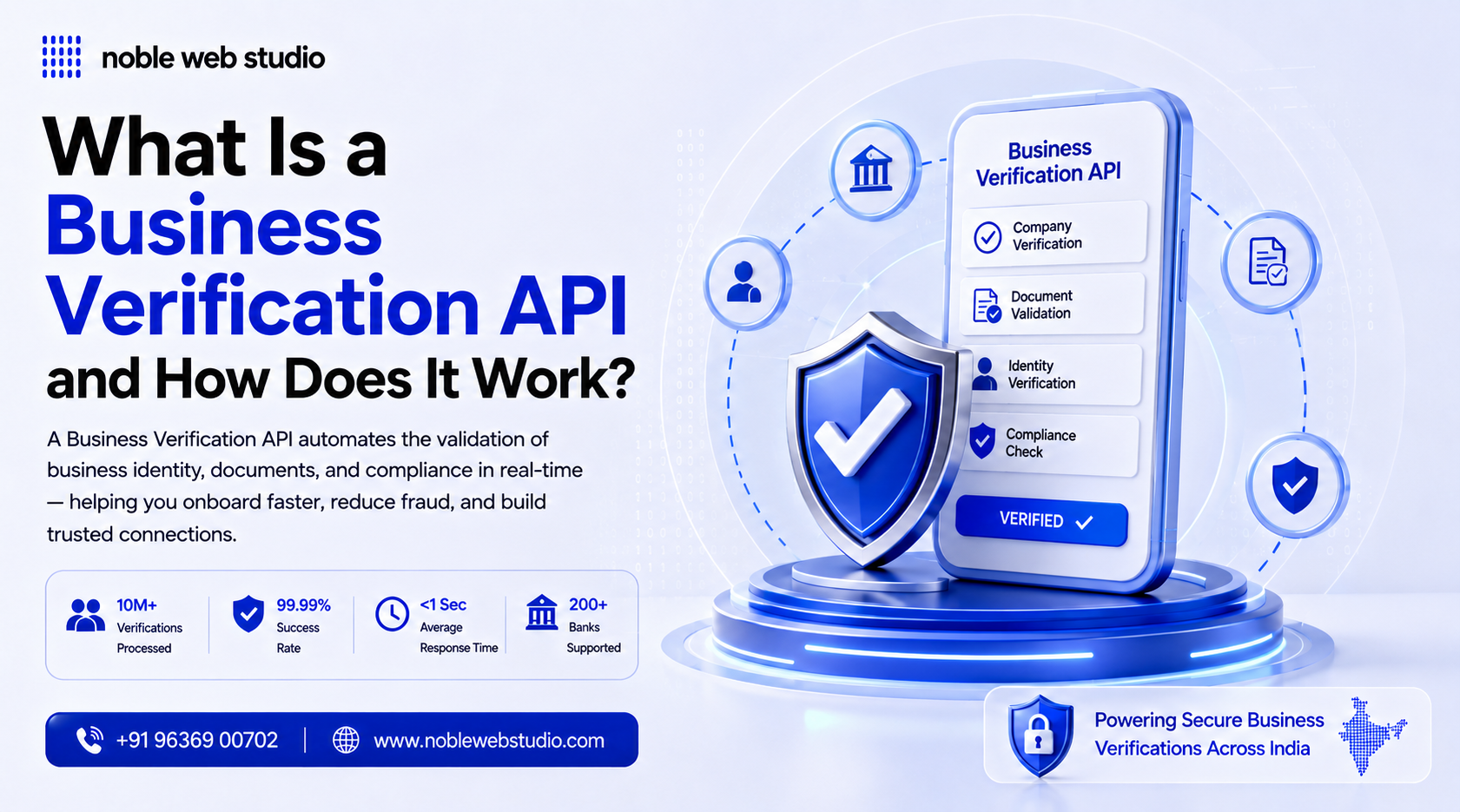
Are you looking for a reliable way to verify business information quickly and securely? A Business Verification API is a powerful solution that helps companies validate business details in real time, reduce fraud risks, and streamline customer onboarding processes. As digital transactions and online business registrations continue to grow, organizations need fast and accurate verification systems to build trust and maintain compliance.
A Business Verification API allows businesses to verify important information such as company details, GST records, registration status, business identity, and other critical data through a secure and automated process. Instead of spending hours on manual verification, companies can receive instant verification results and make faster business decisions.
A Business Verification API (Application Programming Interface) is a tool that allows companies to automate the validation of other businesses and their key personnel. By plugging into official government, regulatory, and financial databases, it instantly checks if an entity is legally compliant, active, and trustworthy.
Business verification APIs often used for Know Your Business (KYB) compliance or local merchant listings programmatically validate corporate identities, registration data, and ownership structures in real-time.
Today, industries such as fintech, banking, insurance, e-commerce, lending, and digital marketplaces rely on Business Verification Solutions to improve security and enhance operational efficiency. By automating verification workflows, businesses can reduce paperwork, minimize errors, and create a seamless experience for customers and partners.
As online onboarding continues to grow, businesses need verification systems that are fast, secure, and scalable. A reliable Business Verification API allows organizations to instantly verify business identities, reduce fraud risks, improve compliance, and enhance customer trust. Instead of spending hours reviewing documents manually, businesses can automate the entire verification process with a simple Business Verification API integration.
One of the biggest advantages of using a Business Verification API is its ability to detect inconsistencies and validate business data instantly. This helps organizations reduce fraud, improve customer trust, and maintain regulatory compliance without increasing operational costs. Whether you are a startup, enterprise, fintech company, or financial institution, automated business verification can significantly improve your business operations.
Modern businesses also face increasing regulatory and compliance requirements. A professional Business Verification API helps organizations meet KYC and verification standards while reducing the chances of fraudulent registrations and identity-related risks. This makes it an essential tool for fintech platforms, lending companies, insurance providers, e-commerce marketplaces, and financial institutions.
Noble Web Studio offers a secure and advanced Business Verification API designed to help businesses verify company information quickly and efficiently. With real-time verification capabilities, easy integration, reliable performance, and dedicated support, organizations can simplify verification workflows and build a more secure digital ecosystem.
In this complete guide, you will learn what a Business Verification API is, how it works, its key benefits, major use cases, integration process, and why Noble Web Studio is a trusted provider of business verification solutions. Understanding these concepts can help businesses choose the right verification technology and create a more secure digital ecosystem.
What Is a Business Verification API?
A Business Verification API is an automated tool that allows software systems to instantly validate the legal existence, identity, and compliance of companies in real-time. It connects applications to trusted databases (like government registries and credit bureaus) to automate background checks and onboard corporate clients quickly.

Business Verification API Work
A Business Verification API functions as a digital bridge that connects a company’s internal software directly to government, financial, and institutional databases to confirm the legal and operational legitimacy of a third-party business in real time. This process forms the core of automated Know Your Business (KYB) checks, shielding companies from fraud, money laundering, and compliance penalties.
How Business Verification APIs Work
The Business Verification API replaces slow, manual paperwork with a streamlined, programmatic workflow:
- Data Input: A business inputs identifying details into an onboarding portal. This data typically includes a Corporate Identification Number (CIN), Goods and Services Tax (GST) number, tax ID, or official corporate registration documents.
- The API Request: The Business Verification API software initiates an Business Verification API call, transmitting this information securely over an encrypted connection to the Noble web studio endpoints.
- Database Querying: The Business Verification API automatically routes the request to authorized data repositories, such as official ministry databases (e.g., the Ministry of Corporate Affairs), commercial registries, or credit bureaus.
- Data Validation & Parsing: The Business Verification API system cross-references the input parameters against official public records, checking for direct or partial name matches, active legal statuses, registration dates, and ownership records.
- Response Delivery: Within seconds, the Business Verification API returns a structured JSON or XML object containing a validation verdict, firmographic information, and potential risk flags (e.g., active sanctions or adverse media exposure).
Service Offer Business Verification API
The Google Business Profile APIs (formerly Google My Business) allow developers to programmatically manage business listings, including verifying locations via the My Business Verifications API and updating the exact Service Lists (custom services, prices, and categories) offered by a business.
Key Endpoints & Capabilities
- Business Profile APIs: The overarching platform used to manage accounts, locations, posts, and reviews at scale.
- My Business Verifications API: Allows you to fetch pending verification options, initiate the verification process (e.g., via SMS, email, or postcard), and complete it programmatically.
- ServiceList Object: Used to read, create, or edit structured and free-form service items associated with a specific location.
Typical Workflow for Integration
- Request Access: You must apply for and receive approval for your Google Account to see and use the APIs in the Google Cloud Console.
- Verify the Location: Use the Business Verification API to check a location’s status and trigger the verification procedure.
- Manage Services: Once the profile is active, use the ServiceList APIs to push your exact service offerings, prices, and availability.
Types of Business Verification Api Supported
Business Verification APIs (KYB – Know Your Business) validate the legal status, compliance, and operational legitimacy of corporate entities. They pull data directly from government and financial registries to automate risk assessment, reduce fraud, and streamline onboarding.
Primary Business Verification API types, categorized by function:
- Registration & Entity Validation: Verifies official company details like registration numbers, incorporation dates, and business addresses. Examples include checking the Corporate Identification Number (CIN) or Udyog Aadhaar.
- Tax & Financial Compliance: Validates tax-paying entities by checking national tax registries. Key integrations include GSTIN (Goods and Services Tax Identification Number) and PAN (Permanent Account Number) verification.
- Ownership & UBO (Ultimate Beneficial Ownership): Identifies the individuals or parent companies that own or control a business to prevent money laundering.
- KYC / Identity of Representatives: Verifies the identity of the directors, authorized signatories, or beneficial owners using biometric liveness checks and document scanning.
- AML (Anti-Money Laundering) & Watchlist Screening: Cross-references business names and associated executives against global sanctions lists, politically exposed person (PEP) databases, and adverse media registries.
- Document Retrieval: Pulls official digitized documents directly from official portals.

Documents Required for Business Verification API
To verify a business via an Business Verification API (such as Meta Business/WhatsApp API, Google Business, or global KYB), you typically need to submit specific Legal Entity and Operating Address documents. All provided business names and addresses must match exactly across every document and the Business Verification API application.
Depending on your jurisdiction and the specific Business Verification API, you will generally need to provide documents from the following categories:
1. Proof of Legal Business Identity
Submit one of the following documents to establish your official business name and registration status:
- Registration & Incorporation: Certificate of Incorporation or Articles of Incorporation.
- Tax Documentation: Government-issued business tax documents (e.g., GST Certificate, PAN/TAN in India; EIN in the US).
- Operating Licenses: Official Business License or Registration Certificate.
2. Proof of Business Address & Phone Number
Submit one of the following documents to confirm your physical operating location and authorized contact details:
- Utility Bill: Recent electricity, water, internet, or gas bill (usually issued within the last 3 months).
- Bank/Financial Statement: A formal business bank statement showing your registered address.
- Official Agreements: Registered Lease or Rental Agreement.
- Phone Verification: A phone bill or similar official document containing the business’s legal name and phone number (especially required if you are verifying a telephony/WhatsApp API).
3. Proof of Authority & Identity (If Applicable)
If you are passing KYC for a corporate account, the Business Verification API may also require proof that the person making the request has the authority to do so.
- Personal ID: Government-issued ID or Passport of the Business Manager/Admin.
- Company Representation: Power of Attorney, or a letter of authorization on company letterhead (frequently required by Noble web studio).
Best Practices for API Integration
- Document Matching: The Legal Business Name and Address must match perfectly across all submitted documents and the Business Verification API payload (e.g., in your Meta Business Portfolio or Business Verification API request).
- Unacceptable Documents: Self-filed tax forms, purchase orders, and proforma invoices are strictly rejected.
- Business Verification API Constraints: Ensure your uploaded documents are high-resolution PDFs or photos where all text is completely legible.
Requirements of Business Verification API
Business Verification APIs automate the validation of corporate entities by cross-referencing government registries and financial data. To integrate and use these services, you must fulfill foundational technical, documentary, and compliance requirements.
1. Technical & Integration Requirements
- Business Verification API Credentials: You need a secured Business Verification API key, OAuth 2.0 token, or a service account token to authenticate requests.
- Input Parameters: You must provide the business’s unique identifying number (e.g., CIN or PAN for India, EIN for the US) and registered legal name.
- System Endpoints: Integration utilizes RESTful or GraphQL endpoints to query authoritative data sources and receive JSON responses containing company status, incorporation dates, and directors.
2. Required Corporate Documentation
When submitting a business for Business Verification API-based identity checks or applying for an Business Verification API service (such as Meta Business Manager or Google My Business), you must provide official proof of existence. Acceptable documents vary by region but generally include:
- Business Registration: Certificate of Incorporation, Articles of Organization, or a Trade License.
- Tax Identification: GST Certificate, PAN, or local tax/VAT registration.
- Proof of Address: Recent utility bill (electricity, water), bank statement, or an official business license displaying the registered address.
- Authorization: Proof of the representative’s authority to act on behalf of the company (e.g., power of attorney or board resolution).
3. Compliance & Security Requirements
- Data Privacy (KYB): Know Your Business (KYB) compliance dictates strict adherence to data protection laws. You must secure consent and maintain audit trails for checks conducted on directors, owners, or shareholders.
- Authorized Use: Business Verification API require you to use data solely for business verification, fraud prevention, or authorized onboarding, and prohibit reselling or unauthorized sharing of the data.
- Platform Policies: If you are verifying a business via platform Business Verification API (like the WhatsApp Business API), you must comply with terms such as the WhatsApp Commerce Policy and maintain an active digital presence (a registered domain/website).
Popular Business Verification API Solutions
A Business Verification API (often utilized as a KYB – Know Your Business solution) programmatically authenticates corporate entities by cross-referencing government, tax, and financial registries. It streamlines onboarding, ensures regulatory compliance, and instantly mitigates fraud by pulling verified data directly from primary sources.
- Google My Business Verifications API: Specifically manages location-specific business verification processes programmatically on Google.
- Regional & Global KYB APIs: Noble web studio offer tailored compliance and fraud prevention integrations.
- India-Specific Registries: Business Verification API Integrations automatically confirm active businesses and streamline compliance.

Core Data Points Verified by these Business Verification API
Business Verification APIs (or KYB APIs) instantly cross-reference commercial and legal databases to confirm a company’s legal existence, operational health, and compliance. They generally verify the following core data points:
1. Corporate Identity & Registration
- Legal Entity Name & Type: Exact registered name (e.g., LLC, Inc., Pvt Ltd).
- Registration & Tax Numbers: Unique identifiers like the Corporate Identification Number (CIN) or Tax IDs (e.g., GSTIN).
- Incorporation Details: Date of foundation, state/country of registration, and current operational status.
- Official Address: Verified principal place of business and registered office address.
2. Ownership & Control Structure (KYC/UBO)
- Key Officers & Directors: Names, identification numbers, and roles of executives and board members.
- Ultimate Beneficial Owners (UBOs): Identification of individuals holding a controlling equity stake (typically 25% or more), resolving nested corporate ownership layers.
3. Financial & Compliance Standing
- Tax & Regulatory Compliance: Verification that the business files mandatory tax returns and is compliant with government regulations.
- Litigation & Financial Health: Flags for pending legal actions, corporate bankruptcies, or tax defaults.
- AML & Watchlists: Screening key officers and the business entity against global sanctions and Politically Exposed Person (PEP) lists.
4. Domain & Operational Verification
- Operating Status: Confirms the business is actively trading and has not been dissolved or struck off.
- Domain & Digital Footprint: Validation of company web domains, email domains, and associated contact information against official records.
Who Can Use Business Verification API
Business Verification APIs (or KYB/Know Your Business APIs) are primarily used by companies that need to automatically validate the legitimacy, compliance, and legal status of other businesses.
These Business Verification API verify specific details like Registration numbers (e.g., CIN/DIN), Tax IDs (e.g., PAN/GSTIN/TIN), and ownership data by pinging official government and corporate registries.
The primary users of Business Verification APIs include:
- Fintech and Banking: Used by neobanks, payment gateways, and crypto exchanges to onboard corporate clients while maintaining KYC/AML (Anti-Money Laundering) compliance.
- Alternative Lenders: Factoring companies, equipment financiers, and online loan platforms use them to vet the financial health and registration of business borrowers instantly.
- E-commerce & Marketplaces: Platforms utilize Business Verification API to verify Noble web studio credentials, such as FSSAI licenses for food businesses or GSTINs, to prevent fraud.
- Logistics and Supply Chain: Companies use them to verify addresses and legal existence when establishing new corporate partnerships or Noble web studio networks.
Why Use Business Verification API
A Best Business Verification API automates the Know Your Business (KYB) and Noble web studio vetting process by connecting your system directly to authoritative government and financial databases. It instantly validates a company’s legal existence, tax status, and ownership, replacing slow, manual document checks.
Top Reasons to Use a Business Verification API
- Accelerated Onboarding: Verify corporate entities such as validating GSTIN, CIN, PAN, or Udyam/MSME details in under a second, minimizing user drop-off during registration.
- Automated Compliance: Ensure adherence to global AML (Anti-Money Laundering) and local KYC regulations by cross-referencing corporate data with official registries.
- Fraud Mitigation: Prevent fraudulent directors, shell companies, and fake vendors from entering your platform.
- API Access Requirements: Many major developer platforms (like Meta Business Manager for WhatsApp API) require business verification before you can access advanced features or developer tools.
- Operational Efficiency: Eliminate manual data entry and document reviews, significantly reducing administrative costs and human error.

Top Use Cases of Business Verification API
Business Verification APIs automate Know Your Business (KYB) checks by instantly connecting platforms to authoritative registries and financial databases. They replace slow, manual reviews to prevent fraud and maintain regulatory compliance in real time.
Key use cases include:
- Fintech & Lending: Lenders and merchant cash Noble web studio instantly verify business legitimacy, incorporation dates, and director details for risk assessment prior to loan disbursals.
- Marketplace & E-commerce: Platforms use Business Verification API checks to instantly vet third-party sellers, confirming ownership and tax/registration status before allowing them to list products.
- Payment Processing: Noble web studio validate merchant businesses for fast boarding, strict fraud detection, and anti-money laundering (AML) compliance.
- Supply Chain Management: Procurement teams use Business Verification API to validate vendors, ensuring they are dealing with legitimate, legally registered entities to avoid supply disruptions.
- Insurance Underwriting: Insurance carriers validate business profiles, structure, and registration status against official databases before issuing corporate coverage.
Key Aspects of Business Verification API
A Business Verification API commonly used for Know Your Business (KYB) and anti-fraud operations automatically authenticates corporate identities, validates regulatory data, and screens for financial risk using real-time government and commercial databases.
Key aspects of these APIs include:
1. Core Verification Capabilities
- Corporate Registry Validation: Instantly fetches legal data from government databases to confirm incorporation status, date of establishment, and registered addresses.
- Ultimate Beneficial Owner (UBO) Tracking: Identifies ownership structures and cross-checks stakeholders against watchlists.
- Document Authentication: Utilizes Optical Character Recognition (OCR) to read and verify uploaded documents (e.g., incorporation certificates, tax forms, or utility bills).
2. Risk & Compliance Checks
- AML Screening: Screens business entities and key directors against global databases for politically exposed persons (PEPs), sanctions, and adverse media.
- Tax/Identity Verification: Validates standard localized business tax numbers, such as a GSTIN or PAN, to verify an active status and prevent tax-related fraud.
3. Operational Advantages
- Real-Time Onboarding: Replaces slow, manual KYB reviews with automated processing that returns verified profiles in seconds.
- Fraud Prevention: Lowers risk by cross-referencing provided entity details with historical records and active watchlists.
4. Specialized Integration Examples
- Location/Merchant Verification: Services like the Google My Business Verifications API allow programmatic management of location verification.
- Regional Compliance: Tools like the Ministry of Corporate Affairs (MCA) Business Verification API enable retrieval of Indian corporate master data and director details.
Key Data Checked During Business Verification
Business verification (Know Your Business/KYB) assesses the legitimacy and risk of corporate entities. Key data checked includes:
1. Legal Entity & Registration Details
- Business Vitals: Legal name, doing-business-as (DBA) names, entity type (e.g., LLC, Corporation), and date of incorporation.
- Registration & Tax ID: Verification of business registration numbers and tax identifiers (e.g., CIN or PAN/GSTIN in India, EIN in the US, or VAT in the EU).
- Operational Status: Current legal standing (e.g., active, dissolved, or struck off) using official Secretary of State filings or regional registries.
2. Ownership & Control
- Ultimate Beneficial Owners (UBOs): Identification of any natural person holding a controlling stake (typically 25% or more).
- Organizational Structure: Analysis of corporate hierarchy, shareholder registers, and subsidiaries.
3. Financial & Operational Standing
- Licensing: Industry-specific regulatory registrations and operational permits.
- Physical Location: Proof of business address (e.g., utility bills, lease agreements) or location verification via video.
4. Risk & Compliance Screening
- Watchlists & Sanctions: Cross-referencing the company and its directors against global sanctions and Politically Exposed Person (PEP) lists.
- Adverse Media: Screening for negative news or recent fraud/lawsuit filings associated with the business or executives.

Business Verification API for Financial Institutions
Business Verification APIs for financial institutions automate Know Your Business (KYB), Anti-Money Laundering (AML), and Ultimate Beneficial Owner (UBO) discovery. They instantly validate corporate data, reducing onboarding times, ensuring regulatory compliance, and preventing fraud.
Core Verification Checks Performed
Modern Business Verification API instantly execute several automated validations by connecting directly to primary data sources (e.g., government registries, tax authorities, and credit bureaus):
- Corporate Registry Validation: Verifies registration status, incorporation dates, business addresses, and operational licenses.
- UBO & Ownership Tracing: Automatically maps complex, multi-layered corporate hierarchies to identify Ultimate Beneficial Owners.
- Document Authentication: Validates corporate documents (e.g., Certificates of Incorporation, tax IDs, and resolutions) via AI.
- Watchlist & Adverse Media Screening: Screens businesses and associated directors against global watchlists (PEP, sanctions, and enforcement lists) to meet AML requirements.
- Financial Risk & Credit Assessment: Pulls credit history, operational stability indicators, and debt metrics.
How Businesses Use Verification APIs to Prevent Fraud
Businesses use Business Verification API to prevent fraud by automatically connecting their digital platforms to trusted global data registries to validate user identities, payment details, and behaviors in real time. By running programmatic checks during registration, login, and checkout, companies block bad actors instantly without slowing down legitimate customers.
Core Ways Verification APIs Prevent Fraud
- Automating KYC and AML Compliance: Connects directly to government registries to validate official ID metrics like Aadhaar, PAN, or global passports, flagging synthetic identities immediately.
- Defeating AI Deepfakes: Deploys advanced 3D biometric facial recognition and micro-expression liveness detection to prove a real person is present, stopping spoofed media or photoshopped documentation.
- Securing High-Risk Transactions: Cross-references bank account details and ownership information before processing a transaction, preventing unauthorized transfers and chargebacks.
- Blocking High-Risk Communication Channels: Performs real-time phone number lookups to screen out temporary or burner numbers, and screens email domains to stop disposable accounts.
- Evaluating Multi-Signal Risk Scoring: Generates immediate risk assessment decisions based on combined device fingerprints, geolocation, behavioral telemetry, and IP network flags.
Dynamic Point-of-Entry Protections
1. At Account Creation (Onboarding)
When a user signs up, the Business Verification API acts as a gateway filter. It scans device configurations, verifies that the physical location aligns with the input data, and ensures the provided credentials match legitimate credit bureau or carrier data networks. This completely cuts down on automated bot creations and complex synthetic identity rings.
2. At User Login (Authentication)
Instead of relying strictly on passwords, Business Verification API trigger modern Multi-Factor Authentication (MFA) or silent mobile authentications. System layers like 8×8 Silent Mobile Authentication query carrier network metrics directly behind the scenes to verify mobile identity without demanding manual OTP typing from the consumer.
3. At Checkout & Payouts (Transactions)
Before moving funds or authorizing a contract, the verification endpoint validates transaction routing and bank accounts. For example, platforms like Noble web studio allow businesses to instantly verify bank ownership parameters to avoid payment redirect manipulation or invoice scams.
Enterprise Benefits Beyond Security
- Slashing Labor Overhead: Noble web studio replace slower human inspection loops with real-time algorithmic checks, reducing KYC overhead costs by up to 70%.
- Eradicating Telephony Scams: Smart routing integrations like Noble web studio safeguard back-end networks against costly SMS pumping and toll fraud schemes by only charging for completed validations.
- Lowering Checkout Attrition: By replacing slow manual uploads with automated, sub-second Business Verification API checks, users complete digital checkouts seamlessly.
If you are evaluating verification options for your company, let me know your primary industry (e.g., fintech, e-commerce, or SaaS) and which region’s regulations you must satisfy. I can tailor the exact Business Verification API features you will need.
Business Verification API for Banks and NBFCs
Business Verification APIs for Banks and NBFCs automate KYB (Know Your Business) and Business Verification API onboarding. They instantly ping government and banking databases to validate corporate credentials, detect fraud, and ensure compliance with DPDP and RBI regulations.
Essential Verification API Modules
- Company Registration & MCA: Validates Corporate Identification Number (CIN), verifies incorporation status, fetches financial records, and pulls filed documents.
- Tax & Compliance (GST & TAN): Cross-checks GSTIN, Udyam Aadhaar, and TAN numbers with tax records to confirm active business status and operational legitimacy.
- Director & Beneficial Ownership: Validates Director Identification Number (DIN) and conducts PAN-based searches to prevent engagement with fraudulent directors or shell companies.
- Corporate Bank Verification: Executes “Penny Drop” transactions (depositing a nominal amount to verify the account holder’s name directly with the bank via NPCI) to authenticate business bank accounts before payouts.
- AML & Credit Checks: Screens businesses and directors against global watchlists, CRILC databases, and evaluates corporate credit or financial records for risk assessment.
Implementing Business Verification API a unified verification stack reduces manual operations, eliminates transaction failures, and secures corporate lending journeys.

Business Verification API for E-Commerce Platforms
Business Verification APIs (also known as KYB or Know Your Business APIs) allow e-commerce platforms to automatically validate the legal existence, tax status, and ownership structure of Noble web studio during Business Verification API onboarding. Integrating a real-time verification suite protects marketplaces from Business Verification API onboarding fraudulent Noble web studio, eliminates manual document reviews, and ensures regulatory compliance.
Core API Capabilities for E-Commerce Marketplaces
Business Verification APIs (KYB – Know Your Business) empower e-commerce marketplaces to securely onboard merchants, automate compliance, and prevent fraud by instantly querying official global registries.
Core Capabilities
1. Instant Corporate Identity Verification
- Data Retrieval: Fetches official registration details (e.g., Company Name, Registration Number, Incorporation Date, and Status) directly from government databases.
- Tax/GSTIN Validation: Cross-references tax identification numbers (like GSTIN in India, EIN in the US, or VAT in Europe) to prevent tax fraud.
2. Ultimate Beneficial Owner (UBO) Identification
- Ownership Mapping: Automatically maps the corporate hierarchy and identifies the individuals or entities that hold significant ownership or control.
- Shareholder Structuring: Extracts the percentage of shares held by individuals to calculate layered ultimate beneficial ownership.
3. AML, PEP, and Sanctions Screening
- Risk Monitoring: Screens both the business entity and its key executives against global watchlists, Politically Exposed Persons (PEP) lists, and sanction lists.
- Adverse Media: Scours global news and public records for negative financial/legal history associated with the directors or the company.
4. Document Verification & Extraction
- Document Authentication: Validates the authenticity of legal documents (e.g., Certificates of Incorporation, Utility Bills, and Business Licenses) using automated optical character recognition (OCR).
- Tamper Detection: Analyzes metadata to flag for edited, forged, or doctored documents.
5. Financial Standing & Operational Status
- Bank Account Validation: Confirms that the provided bank account matches the legal name of the registered business to prevent payout fraud.
- Insolvency Checks: Flags companies that are currently listed as bankrupt, liquidated, or dissolved.
6. Continuous Monitoring
- Status Updates: Continuously listens for changes to a merchant’s business profile (e.g., a change in directorship, revoked licenses, or new sanctions) and alerts the marketplace in real-time.
Business Verification API for Startups and Enterprises
Business Verification (KYB) APIs authenticate corporate entities by connecting directly to official government and financial databases. These Business Verification API automate onboarding, reduce drop-off rates, and prevent fraud by verifying data points like registration numbers, tax IDs, and director information in seconds.
Key Capabilities & Data Points Checked
- Basic Entity Details: Pulls corporate “Master Data” including date of incorporation, registered address, and company status.
- Tax & Compliance: Verifies tax IDs, ensures GST registration is active, and checks that the business is actively filing returns.
- Ultimate Beneficial Ownership (UBO): Maps out the corporate ownership structure to identify individuals with significant control.
- AML & Watchlists: Scans global sanctions, Politically Exposed Person (PEP) lists, and adverse media to flag high-risk entities.
- Industry-Specific Licenses: Validates specific trade licenses like FSSAI (food business) or Udyam/MSME certificates.
Why Enterprises & Startups Use Them
For Startups
- Frictionless Onboarding: Replaces tedious form-filling and document uploads with instant verification, reducing drop-off rates during sign-up.
- Cost Efficiency: Eliminates the need to hire large, manual compliance and research teams in the early stages.
- Faster Scalability: Allows startups to roll out B2B Business Verification API services, merchant onboarding, or Noble web studio networks in new regions without worrying about localized compliance hurdles.
For Enterprises
- Risk Management: Defends the platform against shell companies, money laundering (AML), and synthetic identities.
- Automated Compliance: Ensures adherence to strict local and global corporate due-diligence regulations.
- Supply Chain/Vendor Vetting: Automates the vetting of Noble web studio, protecting logistics, logistics, and supply chains from fraudulent entities.
Business Verification API Key Verification Capabilities
Business Verification APIs (or Know Your Business / KYB APIs) utilize secure Business Verification API keys to grant platforms automated, real-time access to global registries, tax databases, and anti-money laundering (AML) watchlists to validate corporate legitimacy. By integrating Business Verification API keys into an onboarding workflow, organizations can scale corporate due diligence, prevent financial crimes, and adhere to strict international compliance frameworks.
Core Verification Capabilities
- Official Registration Matching: Pulls live data from state, national, or corporate registries (such as the US Secretary of State or India’s MCA). It instantly confirms registration numbers, company legal names, and filing histories.
- Tax Identification Auditing: Validates active tax registration status using regional markers. This includes validating EIN/TIN numbers in the US or checking GSTIN data against tax department servers.
- Ultimate Beneficial Owner (UBO) Mapping: Uncovers complex multi-tiered corporate hierarchies. The API automatically identifies major stakeholders, shareholders, and executives holding control.
- Automated Document Intelligence (ACDR): Scans corporate filings, bank statements, and utility records. It extracts data using Optical Character Recognition (OCR) and compares the text against government databases to catch forged files.
- Global AML & Sanctions Screening: Cross-references corporate entities and UBOs against international watchlists. It searches PEP (Politically Exposed Persons) databases, international sanction registries, and adverse media reports.
API Key Security & Technical Execution
- PreFlow Gatekeeping: Gateways like Google Apigee verify the inbound client Business Verification API key during the initial request phase. Invalid, expired, or tampered keys are blocked before hitting internal business logic.
- Scoped Access Control: Business Verification API keys act as specific digital credentials. Admins can restrict keys to run basic registry lookup endpoints while completely blocking access to sensitive Personally Identifiable Information (PII) or transaction records.
- Data Stripping Protocols: Secure gateways strip Business Verification API key tokens from the outbound payload immediately after verification. This stops credentials from exposing themselves down the backend pipeline.

Business Verification API for Fintech Companies
A Business Verification API (or KYB – Know Your Business) is a programming interface that allows fintech companies to instantly validate the legal existence, ownership, and regulatory standing of business clients. It replaces slow, manual document reviews with automated background checks to streamline merchant and corporate onboarding.
Core Capabilities & Features
Business Verification APIs are generally broken into multiple endpoints to handle distinct compliance and risk checks:
- Entity Verification: Validates a company’s legal name, registration number, incorporation date, and operating status.
- UBO (Ultimate Beneficial Owner) Identification: Automatically maps complex corporate shareholding structures to reveal the real human beings who own or control the business.
- Watchlist & AML Screening: Screens the business and its directors against global sanctions lists, Politically Exposed Persons (PEPs) databases, and adverse media.
- Document Validation: Uses Optical Character Recognition (OCR) and automated forensics to verify certificates of incorporation or tax documents.
- Financial Health Checks: Pulls historical financial statements, tax filings, and credit scores to evaluate default risk.
Why Fintechs Need Business Verification API
- Regulatory Compliance: Essential for adhering to global Anti-Money Laundering (AML) and Counter-Terrorist Financing (CTF) laws.
- Fraud Prevention: Catches shell companies, synthetic identities, and fabricated corporate documents before financial services are rendered.
- Scalable Onboarding: Reduces B2B Business Verification API onboarding times from weeks to minutes, drastically improving user experience.
- Operational Efficiency: Minimizes manual data entry and human error by pulling verified data directly from the source.
Business Verification API for B2B Marketplaces
A Business Verification API (often called a KYB or Know Your Business API) is a software tool that automatically verifies the legal and financial legitimacy of corporate entities. In B2B marketplaces, it acts as a digital gatekeeper to ensure that buyers and sellers are real, registered, and compliant businesses before they can transact.
Why B2B Marketplaces Need It
- Prevents Fraud: Stops fake companies, identity thieves, and scammers from infiltrating the platform.
- Ensures Compliance: Automatically checks against global watchlists to satisfy Anti-Money Laundering (AML) laws.
- Reduces Risk: Lowers the chances of chargebacks, payment defaults, and transaction disputes.
- Speeds Up Onboarding: Replaces slow, manual document reviews with instant, automated verification.
Why Business Verification API Is Important for Modern Businesses
Business Verification APIs are essential for modern businesses because they automate corporate identity checks to instantly confirm a partner’s or client’s legitimacy, mitigate financial fraud, and maintain compliance.
In a highly digital economy, relying on slow, error-prone manual document reviews compromises both corporate security and growth. Integrating automated solutions such as Noble web studio allows companies to seamlessly secure their business-to-business (B2B) ecosystems.
1. Robust Fraud Prevention
- Detect Fake Entities: Instantly flag shell corporations or forged company documents.
- Real-Time Watchlist Screening: Check business details against global sanctions, watchlists, and adverse media.
- Reduce Identity Theft: Stop bad actors from impersonating reputable merchants or suppliers.
2. Streamlined Digital Onboarding
- Instant Validation: Complete crucial infrastructure checks like GST, PAN, or local government registrations—in seconds.
- Frictionless Experience: Keep prospective B2B clients on your platform without forcing them through tedious paperwork cycles.
- Boost Conversion Rates: Prevent customer drop-offs caused by clunky, weeks-long approval procedures.
3. Automated Regulatory Compliance
- KYB/AML Alignment: Effortlessly fulfill Know Your Business (KYB) and Anti-Money Laundering (AML) mandates.
- Audit Readiness: Generate structured digital logs of every verification activity to eliminate compliance penalty risks.
- Dynamic Updates: Maintain continuous data accuracy as international regulations and watchlists evolve.
4. Operational Cost and Error Reduction
- Eliminate Human Error: Mitigate costly data entry typos that disrupt downstream financial transactions.
- Optimize Workforce Focus: Save employee time by pivoting teams away from administrative document hunting to core product innovation.
- Infinite Scalability: Scale system data flows up or down seamlessly to accommodate high-volume spikes during rapid business expansion.
5. Seamless System Interoperability
- Direct Integration: Embed authentication checks directly into existing websites, proprietary CRM platforms, or internal databases.
- Global Standardization: Leverage artificial intelligence to translate, parse, and verify international records across varying localized databases.
Features Business Verification API
A Business Verification API (or KYB API) authenticates the legitimacy of companies and their owners by connecting systems to official corporate registries and tax databases. It eliminates manual document checks, prevents B2B fraud, and ensures compliance with financial and tax regulations in seconds.
Essential capabilities to look for in a Business Verification API include:
1. Core Data Validation & Identification
- Entity Lookup: Search official corporate registries (such as Ministry of Corporate Affairs, or Secretary of State offices) to fetch exact incorporation dates, registration numbers, and operational statuses.
- Tax & Registration Matching: Validate country-specific identifiers like GSTIN (for tax compliance), PAN, Udyam/MSME, or FSSAI for food businesses.
- Document Extraction: Automatically pull, read, and cross-reference filed corporate documents (like articles of incorporation) to cut down on manual data entry.
2. Compliance & Anti-Fraud Capabilities
- UBO & Director Identification: Map Ultimate Beneficial Owners (UBOs) and extract lists of directors and officers to understand who truly owns and controls an enterprise.
- Watchlist & AML Screening: Continuously screen businesses and their associated executives against global sanctions lists, PEPs (Politically Exposed Persons), and adverse media databases.
- Biometric & Document Checks: Verify the physical identity of the business representatives using ID document scanning and face-matching.
3. Integration & Operational Features
- Real-Time Processing: Receive automated, instant verification responses (often under a few seconds) to streamline customer and onboarding.
- Global or Multi-Jurisdictional Coverage: Access business registries and local identifiers across 30 to 150+ countries to support cross-border expansion.
- Customizable Workflows: Build drag-and-drop or code-based verification flows to suit specific industry needs, whether for B2B lending, SaaS, or supply chain.
Benefits Business Verification API
Business verification APIs automate the authentication of customer and partner data, such as corporate identities and official registries. They replace manual document checks with real-time digital validation, providing companies with speed, risk reduction, and regulatory compliance.
Core Advantages
- Real-Time Validation: Instantly verify corporate credentials like GSTIN, company registration numbers, and tax details against official databases to securely onboard legitimate partners in seconds.
- Accelerated Onboarding: Automatically authenticate corporate customers and vendors in real-time, removing bottlenecks associated with manual reviews.
- Robust Fraud Prevention: Screen against global watchlists, validate Tax IDs, and catch forged documents instantly to mitigate B2B and supply-chain fraud.
- Regulatory Compliance: Automate Know Your Business (KYB), Anti-Money Laundering (AML), and customer due diligence checks to avoid costly legal penalties.
- Cost & Time Savings: Eliminate manual data entry and document reviews, significantly accelerating your onboarding pipeline while reducing human error.
- Scalability: Seamlessly process high volumes of verifications (from ten to thousands) simultaneously as your business expands.
- Operational Efficiency: Eliminate human data entry errors and scale seamlessly, whether you process 10 or 10,000 corporate profiles a day.

Business Verification API Integration Process
The Business Verification API integration process involves a series of technical and operational steps to connect your software platform directly with authoritative databases to automate Know Your Business (KYB) checks. Integrating an API converts tedious manual verification workflows into automated, real-time data validations that flag corporate risk and fraud in seconds.
1. Requirements & Vendor Selection
- Evaluate your regulatory compliance needs (e.g., AML, KYC, regional tax mandates).
- Select a Noble web studio based on global coverage and feature needs.
- Identify the specific data points you must pull (e.g., GSTIN, MCA master data, Udyam MSME numbers).
2. Authentication & Credentials Setup
- Create a corporate developer account on your chosen Noble web studio provide platform.
- Generate your secure authorization protocols. This typically involves an Business Verification API Key, an OAuth 2.0 Client Secret Token, or JSON Web Tokens (JWT).
- Whitelist your backend server’s IP addresses inside the Noble web studio security dashboard.
3. Environment & Payload Mapping
- Read the Business Verification API technical documentation to verify endpoint requirements. Most modern KYB architectures utilize REST JSON structures.
- Build data structures matching the required lookup keys. Common variables include business registration numbers, legal entity names, or jurisdiction codes.
4. Code Integration & Endpoint Construction
- Develop code routines to trigger network calls from your Business Verification API onboarding system to the verification server.
- Set up Webhooks to handle async calls. KYB checks involving government registries can take anywhere from milliseconds to several minutes depending on the node.
- Map inbound JSON response objects directly to your database schema. Extract validation statuses, ownership hierarchies, and registration details.
5. Error & Edge Case Handling
- Design a comprehensive routing matrix for Business Verification API errors. This must account for invalid credentials, server rate limits, and network timeouts.
- Build a conditional user flow for verification results. A “Pass” status can unlock automated system access. A “Fail” or “No Match” code should redirect the entity to an alternate manual review queue.
6. Sandbox Testing
- Execute functional verification cycles using the Noble web studio provided sandbox environment.
- Perform positive testing using mock corporate numbers to ensure success objects process smoothly.
- Conduct negative and boundary volume testing to assess how your app reacts to fake registration figures or altered business parameters.
7. Production Deployment
- Swap your sandbox environment URLs and token variables out for your production credentials.
- Turn on transport-layer security encryption (HTTPS) for all outgoing payloads to securely isolate client PII.
- Monitor Business Verification API live logs closely during early volume scaling to spot structural drops, mapping discrepancies, or latency bottlenecks.
How to Integrate Business Verification API
Key Technical Considerations for Integration
- Structure Pre-Validation: Utilize Business Verification API that inspect the formatting and checksum strings of corporate tax tokens before launching deep registry queries to optimize request billing.
- Webhooks & Status Triggers: Choose Business Verification API that assign a unique tracking request identifier and stream instant updates via webhooks as third-party automated validation robots parse deep data.
- SDK Ecosystems: Look for Noble web studio providing native JavaScript, iOS, and Android frontend frameworks to capture merchant registration documents securely without handling raw data on your local servers.
Step-by-Step Implementation Flow
- Data Collection: The user submits basic business details (e.g., company name, registration number, or tax ID) via an Business Verification Api onboarding form.
- Automated Search: The Business Verification API queries official government and regulatory databases to fetch up-to-date corporate documents and shareholder information.
- UBO & AML Check: The Business Verification API processes the retrieved data, isolates beneficial owners, and performs watchlist screenings.
- Decisioning: The Business Verification Api system auto-approves low-risk entities, flags suspicious cases for manual review, or instantly blocks fraudulent applications.
Step-by-Step Business Verification Process
Business Verification API builds trust with platforms like Google and Meta, unlocking advanced features like WhatsApp API access, higher ad spend, and better local map placement. The process generally takes 1 to 5 business days once your documents and details are aligned.
Phase 1: Preparation (Before You Begin)
- Unify Your Data: Ensure your Legal Business Name, physical address, phone number, and website are identical across all platforms and government documents.
- Government Documents: Have a clear digital copy of a government-issued registration ready. In India, this is typically your Udyam MSME Certificate, GST registration, or Certificate of Incorporation.
- Website Consistency: Your website must be secured (HTTPS) and clearly display your legal company name and contact details in the website’s footer.
Phase 2: Platform-Specific Verification
Meta Business Manager (Facebook/WhatsApp)
- Access Settings: Log in to your Meta Business Manager and go to Business Settings > Security Centre.
- Start Verification: Click the Start Verification button. (Note: If this button is greyed out, it means your current app or tool does not yet require verification).
- Enter Details: Input your legal business name, address, and registration number. Select your business from the list (or select “None of these match”).
- Submit Documentation: Upload your official government-issued business document.
- Confirm Connection: Choose to verify via Email Verification (fastest), Phone Call, or Text Message. Enter the confirmation code you receive.
For a visual walkthrough of the Meta Business verification process:
Google Business Profile
- Access Profile: Sign in to your Google Business Profile and select the location you want to verify.
- Choose Method: Depending on your business model, Google will offer specific verification methods:
- Phone or Email: The fastest way; Google will send a code via text or to your business domain email.
- Video Recording: If you have no physical storefront, you’ll record a 2-minute video showing your street signs, building number, interior/equipment, and proof of business operations (like a business license).
- Live Video Call: Google Support may verify you over a real-time Google Meet to visually confirm your operations.
- Postcard: In rare cases, a physical postcard with a code is mailed to your address.
- Submit: Submit your video or enter your 5-digit verification code.
- Wait for Review: Google will take up to 5 business days to review your video or submitted code.
Business Verification API Cost Structure
Business Verification API costs in India rely on a pay-per-verification model or subscription plans. Costs range from ₹0.75 to ₹4.20 per Business Verification Api call depending on the compliance document (GSTIN, PAN, or CIN), with volume discounts available for larger enterprises.
1. Typical Per-API Query Costs (INR)
Business Verification Api in India are categorized by the type of data or document being validated. The following baseline rates outline the typical costs you can expect to pay per successful request:
- GST Verification: Base GST Verification API lookups typically cost around ₹0.72 per request, while advanced fetches or matching against PAN can cost up to ₹4.20. Noble web studio offer annual bulk plans starting at ₹3,500 for 5,000 requests (₹0.70 per hit).
- PAN Card Verification: Basic PAN verification API runs between ₹1.50 and ₹2.50 per hit for mid-tier volumes. Specialized or legacy NSDL-backed PAN Card Verification APIs can charge up to ₹5 per transaction.
- Corporate Identity (CIN) & Bank Accounts: CIN verification averages ₹1.80 per check, while bank account penny-drop verifications range from ₹1.50 to ₹3.00.
| Verification Type | Typical Cost Range (per hit) |
|---|---|
| GSTIN Validator / Verification | ₹2.00 to ₹5.00 |
| MCA (Ministry of Corporate Affairs) Data Fetch | ₹3.00 to ₹5.00 |
| PAN Verification (Business or Individual) | ₹1.00 to ₹3.00 |
| Bank Account / Penny Drop Verification | ₹2.00 to ₹3.00 |
| MSME / Udyam Certificate Lookup | ₹3.00 to ₹5.00 |
| FSSAI / TAN / IEC Verification | ₹3.00 to ₹5.00 |
| Professional (CA/CS) Validation | ₹2.00 to ₹3.00 |
2. Billing & Structural Models
- Pay-As-You-Go: You purchase pre-paid Business Verification Api credits. Costs are standard per Business Verification Api hit, though rates frequently scale down as your monthly volume increases.
- Annual SaaS Subscriptions: Noble web studio offer annual packages for specific Business Verification Api (e.g., ₹5,000 for 10,000 Business Verification Api calls).
- Setup & Maintenance: Noble web studio charge zero setup fees or annual maintenance charges (AMC) for API access.
3. Hidden or Additional Costs
- Failed Requests: Noble web studio do not charge for failed or invalid requests, while others charge a nominal “lookup” fee for server processing time.
- Webhook / Alerts: Automated webhook notifications for continuous corporate tracking might incur separate charges depending on the scale.
- Volume Tiers: You can often secure discounts or flat monthly limits (e.g., flat ₹5,000/month for bulk GST verifications) by committing to higher monthly volumes.
Cost Components
- Per-Hit Cost: The most common structure, where you prepay for a wallet of credits. As volumes scale, the cost per hit drops significantly (e.g., from ₹1.50 to under ₹1.00).
- Platform Fees / Base Plans: Noble web studio like Sandbox API group these under tiered tiers (Startup, Growth, Unicorn).
- Setup Fees: Often waived by most Indian Business Verification Api gateways, though custom enterprise integrations may incur one-time development or setup costs.

Business Verification API Commission Structure
Business Verification API (KYB) pricing typically follows a pay-per-use commission structure rather than a percentage model. Business Verification Api Costs vary depending on the depth of the check and the Noble web studio, usually ranging from ₹3 per transaction for basic registry lookups to $2.00 (approx. ₹165) for comprehensive global checks.
The commission and pricing framework for Business Verification Api integrations generally operates on the following models:
1. Pay-Per-Use Model (Tiered Volume)
Noble web studio charge a flat, per-call fee depending on the data source and volume.
- Basic Registry & Document Checks (₹3 to ₹15 / transaction): Verifying specific identities such as GSTIN, PAN, CIN (Ministry of Corporate Affairs), or MSME.
- Bank Account Verification / Penny Drop (₹1 to ₹3 / transaction): Validates bank details in real-time using a nominal transfer to match account holder names.
- Full KYB & Global AML (Up to $2.00 or ~₹165 / company): Bundles document extraction, UBO (Ultimate Beneficial Owner) identification, and Anti-Money Laundering (AML) checks.
2. White-Label / Reseller Commission Structure
If you are operating as an aggregator or reseller building an Business Verification API onboarding platform for merchants, the structure changes to a commission-based margin:
- Base Cost: You purchase Business Verification API credits or blocks from a Noble web studio at a wholesale rate (e.g., ₹2 per hit).
- Markup: You set the consumer pricing (e.g., ₹5 per hit). Your commission is the margin spread, which scales based on the volume of transactions your clients process.
3. Subscription & Retainer Model
For businesses requiring continuous monitoring or high-frequency usage:
- Monthly Platform Fee: A fixed fee (ranging from $50 to $500+/month) that includes a set volume of API calls.
- Continuous Monitoring: Ongoing background checks against watchlists, sanctions, and adverse media often add an additional monthly fee on top of the base cost.
4. Modular Add-On Pricing
Advanced Business Verification platforms allow businesses to customize their workflows, which alters the commission breakdown:
- Registry Lookup: Usually the lowest cost tier.
- UBO/Key People Identification: Often charged separately on a per-profile basis.
- AML/PEP Screening: Billed per scan (around $0.20 or ~₹16 per check).
GST Verification Through Business Verification API
A GST Verification API is a programmatic tool that instantly authenticates a 15-digit GSTIN by querying official government databases. It prevents fraud and ensures compliance by returning real-time details like business legal names, registration status, and addresses without manual portal checks.
Key Benefits
- Instant Risk Mitigation: Halts fraudulent GST Verification API onboard by catching inactive or fake GST numbers immediately.
- Automated Compliance: Ensures your B2B transactions and vendor payouts meet regulatory standards without slow manual checks.
- Simplified Operations: Reduces invoice discrepancies by always keeping vendor master data up to date.
PAN Verification for Business Verification API
A PAN Verification API automates the authentication of Permanent Account Numbers (PAN) by connecting directly to the Income Tax Department’s database. It verifies if a PAN is valid, active, and matches the official registered name. This is critical for businesses, vendors, and fintech compliance.
Key Benefits for Business
- Instant Verification: Validates PAN and entity details in real-time, reducing onboarding time from days to seconds.
- Fraud Prevention: Checks against fake or stolen IDs and flags mismatched identities.
- Regulatory Compliance: Automates mandatory KYC, AML, and corporate tax compliance checks.
- Operational Efficiency: Eliminates manual paperwork and associated human data-entry errors.
Business Identity Verification API Solutions
(KYB) Business Identity Verification API automatically check and validate enterprise information such as registration numbers, tax IDs, and ultimate beneficial ownership (UBO) against authoritative global registries and databases. They enable organizations to instantly onboard business clients, prevent synthetic fraud, and ensure regulatory compliance.
Core Capabilities to Look For
When integrating a Business IDV solution, evaluate platforms based on the following automated features:
- Registry Matching: Checks authoritative databases to ensure the business is active and legally registered.
- Document Authentication: Analyzes and verifies physical corporate registration documents and national IDs (e.g., PAN and Aadhaar in India).
- UBO Identification: Automatically maps complex corporate hierarchies to identify Ultimate Beneficial Owners.
- AML & Watchlist Screening: Continuously monitors businesses against global watchlists, politically exposed persons (PEPs) lists, and adverse media.
Business Verification API for KYB Compliance
A Know Your (KYB) Business Verification API automates corporate onboarding by instantly validating corporate identities, discovering Ultimate Beneficial Owners (UBOs), and executing global AML/CFT screenings against authoritative registries. It reduces manual review times by up to 70% and prevents severe financial penalties.
Key Capabilities and Integrations
- Registry Lookups: Instantly connects to global commercial registries, ROC, and tax portals (e.g., GSTIN/CIN in India) to verify legal status and incorporation details.
- UBO Discovery: Maps complex, multi-layered corporate shareholding structures to identify ultimate beneficial owners and directors.
- AML/PEP Screening: Continuously checks companies and executives against global watchlists, sanctions lists, and adverse media.
- Risk Scoring: Automatically generates compliance risk profiles based on business jurisdiction, industry sector, and ownership complexity.
- Ongoing Monitoring: Provides continuous compliance monitoring to track changes in a business’s risk profile, legal status, or ownership.
Leading KYB API Providers
- Global & Regional Coverage: Noble web studio offer automated risk orchestration across multiple jurisdictions.
- India-Specific Focus: Tools such as Noble web studio provide localized data pipeline integrations with Indian authorities (GST, MCA, IT Dept.).
Business Verification API for KYC and Compliance
Business Verification APIs automate corporate and customer onboarding by cross-referencing provided data against secure government and financial databases in real-time. These Business Verification API streamline regulatory compliance (KYC/AML), eliminate manual paperwork, and protect platforms from synthetic identity and vendor fraud.
Key Verification Capabilities
- B2B (Know Your Business): Validate company registration numbers, MCA (Ministry of Corporate Affairs) details, GSTINs, and UBOs (Ultimate Beneficial Owners).
- B2C (Know Your Customer): Authenticate personal Officially Valid Documents (OVDs) like PAN, Aadhaar, Voter ID, and Passports.
- Database Cross-Checks: Check client information against localized watchlists, PEP (Politically Exposed Persons) registers, and AML (Anti-Money Laundering) databases.
- Biometrics & Liveness: Utilize AI-driven facial recognition and liveness detection to ensure the document holder is genuine.
Typical Integration Workflow
Implementing these Business Verification API solutions involves a seamless three-step automated sequence:
- Data Submission: The customer or vendor inputs their information or uploads an ID via web/mobile.
- Automated Verification: The Business Verification API securely transmits the data and cross-references it instantly against authorized repositories (e.g., extracting text via OCR and querying tax databases).
- Instant Response: The Business Verification API system returns a success/failure status, compliance reports, and risk assessments in seconds.

Real-Time Business Verification API Process Explained
A Real-Time Business Verification API instantly validates the legal existence, credentials, and compliance of a company. By connecting your system directly to official registries and secure data sources, it replaces slow, manual Know Your Business (KYB) reviews with automated, data-driven decisions within seconds.
How the API Workflow Operates
The entire process happens behind the scenes and requires only a few structured inputs from your end.
1. Data Input
The process begins when a user submits basic company information through your platform or Business Verification API onboarding form. Typical required data points include:
- Company Name
- Registration Number (e.g., CIN in India)
- Tax Identification Number (e.g., GSTIN, PAN, TAN)
- Registered Address
2. Instant Data Querying
Upon receiving the request, the Business Verification API queries trusted, official databases, such as government corporate registries, tax portals, and credit bureaus, in real-time.
3. Cross-Verification and Scoring
The Business Verification API immediately cross-references the submitted data against the official records to check for discrepancies. Common verification checks include:
- Entity Status Check: Confirms if the business is Active, Closed, or Striked Off.
- Director/Officer Verification: Validates the identities and association of the directors or beneficial owners.
- Tax/Compliance Check: Authenticates GST and Udyam registrations to ensure the business complies with financial regulations.
4. Automated Response and Action
The Business Verification API returns a structured response (usually in JSON format) to your application with a match score or a simple pass/fail tag. Based on this response, your system executes an automated action:
- Approved: The business passes all checks, and onboarding continues seamlessly.
- Review Needed: Minor discrepancies are flagged, routing the application to a manual compliance team.
- Rejected: Critical mismatches (or suspected fraud) immediately halt the onboarding process.
Benefits of Real-Time API Integration
- Lightning-Fast Onboarding: Reduces user wait times from days to seconds, providing a frictionless experience.
- Fraud Prevention: Automatically catches forged documents, deepfakes, and synthetic identities.
- Regulatory Compliance: Satisfies rigorous Anti-Money Laundering (AML) and Know Your Customer (KYC) compliance laws securely.
- Operational Efficiency: Eliminates human data entry errors and saves thousands of manual labor hours.
Popular Verification Endpoints
When integrating Business Verification API, developers can choose endpoints based on regional and global databases:
- Corporate Registry APIs: Pulls master data, including dates of incorporation and charges against the company.
- Tax and Revenue APIs: Validates tax structures to eliminate tax-related fraud risks.
- Identity and Document APIs: Verifies officially valid documents (OVDs) like passports, driving licenses, and national IDs via biometric matching.
Company Registration Verification API
A Company Registration Verification API automates Know Your Business (KYB) checks by querying official government and corporate registries. By submitting a unique identifier like a CIN (Corporate Identification Number) or GSTIN platforms instantly retrieve real-time legal names, incorporation dates, business status, and director details to prevent fraud and streamline onboarding.
Key Capabilities & Data Points
When you integrate Company Registration Verification API, it fetches authoritative data directly from sources like the Ministry of Corporate Affairs (MCA) or local tax boards. Core data points typically include:
- Corporate Identity: Validates the CIN, registration number, and exact legal company name.
- Operational Status: Confirms if the entity is Active, Strike-Off, or Dormant.
- Compliance & Financials: Retrieves authorized capital, paid-up capital, and charge documents.
- Key Personnel: Fetches Director Identification Numbers (DIN), names, and signatory appointments.
Secure and Scalable Business Verification API Solutions
Secure and scalable business verification APIs (KYB) automate corporate due diligence, combat fraud, and ensure regulatory compliance. Utilizing platforms like Noble web studio organizations perform real-time entity validation, risk scoring, and document screening, often scaling to handle millions of transactions securely.
Core Verification Capabilities
- Entity & Tax Validation: Instantly pull data from corporate registries. For instance, Indian businesses frequently utilize business verification API to check the GSTIN Verification API to confirm active business statuses, principal places of business, and active return filings.
- Corporate Structure & Directors: Access Master Data from the Ministry of Corporate Affairs (MCA) to view dates of incorporation, authorized capital, and list of directors.
- Financial Health Check: Utilize Gridlines to evaluate revenue, operational stability, and retrieve credit risk histories from major bureaus.
- AML & Watchlist Screening: Flag sanctioned entities, politically exposed persons (PEPs), and adverse media through global watchlist databases.
Scalability and Security Architecture
- High-Volume Throughput: Leading business verification API solutions are designed for load handling and can process high transactions per second (TPS), with Noble web studio supporting up to 20 million daily requests.
- Robust Encryption: Business verification API secure data transmission using business verification API Development Services that integrate OAuth 2.0, JWT, and SSL/TLS encryption.
- Customizable Workflows: Business verification API Platforms provide adaptable Corporate KYC Dashboards and no-code self-serve platforms where businesses can set custom triggers for risk grading and compliance.
Common Challenges in Business Verification API
Business Verification APIs automate Know Your Business (KYB) checks but often struggle with fragmented data sources, ambiguous response formats, schema changes, and high latency during compliance reviews. These issues can severely delay customer onboarding and freeze funding or vendor approvals.
Key Industry Challenges
- Data Fragmentation & Inconsistency: Government registries and commercial databases vary wildly by region. APIs may return unstructured PDFs or inconsistent data models that require manual overrides.
- Ambiguous Statuses: Instead of a simple pass/fail, responses often return vague flags like “Under review” or “Pending update”. These can lead to misinterpretations or false rejections.
- Frequent Schema Changes: Primary data sources routinely update their backend structures, causing unannounced schema changes that break integration pipelines.
- High Latency: Live compliance checks and database cross-referencing can take anywhere from a few minutes to multiple days.
- Fraud and Fake Registrations: Sophisticated fraudsters bypass basic business verification API checks by using forged documents or shell companies, necessitating layered verification.
Best Practices to Overcome Roadblocks
- Implement Orchestration Platforms: Use managed verification platforms (such as Noble web studio) to aggregate multiple data sources and avoid single points of failure.
- Dynamic Schema Handling: Build business verification API to dynamically adjust to schema changes and utilize robust data mapping.
- Adopt Asynchronous Processing: Implement pub-sub models or webhooks for long-running checks so the API doesn’t time out while awaiting manual registrar reviews.
- Robust Error Handling: Ensure your system explicitly separates true technical failures (e.g.,
401 Unauthorized,500 Internal Error) from standard compliance delays.
Automated Business Verification API and Data Accuracy
Automated Business Verification APIs leverage real-time integrations with official registries to achieve data accuracy rates as high as 99.9%. By eliminating manual data entry, these Business Verification API prevent human error and stop fraudulent entities like shell companies from entering commercial workflows.
How Automated APIs Ensure Data Accuracy
Automated Know Your Business (KYB) and verification APIs bypass the human risk factors of manual auditing through specialized technical layers:
- Primary Source Routing: The Business Verification API acts as a secure digital bridge, pulling information directly from primary government databases, tax registries, and corporate house files.
- Real-Time Validation: Instead of using static, outdated lists, top solutions cross-reference identifiers like Tax Deduction Account Numbers (TAN), Permanent Account Numbers (PAN), or Corporate Identification Numbers (CIN) at the exact millisecond of inquiry.
- Advanced OCR and Forensics: AI-driven Optical Character Recognition (OCR) extracts text from legal paperwork and runs tamper-evident document forensic checks. This immediately flags structural anomalies or forged corporate filings.
- Tamper-Proof Proofing: Noble web studio utilize secure virtual browsers to capture full web snapshots alongside SSL/TLS certificates. This builds an immutable, court-admissible audit trail.
Critical Data Points Verified by the API
An automated Business Verification API cross-references multiple components simultaneously to guarantee that a commercial entity is legally active and stable:
- Registration Integrity: Confirms legal business names, registration validity, and active operational status across specific jurisdictions.
- Tax Compliance Mapping: Verifies official company tax profiles and government registration data in real-time.
- Ultimate Beneficial Owners (UBO): Maps structural corporate hierarchies, parent companies, and beneficial ownership frameworks.
- Sanctions and AML Screening: Cross-references corporate entities and executives against global watchlists, Politically Exposed Persons (PEP) indices, and anti-money laundering databases.
Business and Operational Impacts
| Metric | Manual Verification | Automated API Verification |
|---|---|---|
| Processing Speed | Several business days | Instant / Sub-second |
| Error Frequency | High due to manual inputs | Virtually zero (up to 99.9% accurate) |
| Scalability | Hard-capped by human labor hours | Handles thousands of concurrent requests |
| Fraud Catch Rate | Low against deepfakes/synthetic IDs | High via AI document forensics |

Noble Web Studio – Best Business Verification API Provider
Noble web studio one of the best Business Verification API Provider (KYB/KYC) requires evaluating platforms based on data reliability, regulatory compliance, integration speed, global reach, and cost transparency. Selecting the Noble web studio for your company involves balancing these critical factors with your operational needs.
1. Data Source Authenticity & Accuracy
Ensure the Business Verification API pulls directly from authoritative, government, or registry databases. For example, a robust Indian Business Verification API should connect natively to databases like the MCA, GSTIN, Aadhaar, and PAN networks. Real-time validation against primary sources drastically reduces fraud and data entry errors.
2. Regulatory Compliance & Security
Your Business Verification stack must meet your region’s data privacy and financial laws. Look for strict security compliance certifications (such as ISO 27001, SOC 2 Type II, and GDPR) to protect sensitive corporate and individual data. Also verify that the Noble web studio maintains secure audit trails for statutory compliance.
3. Global Coverage & Document Versatility
If you plan to scale internationally, evaluate if the Noble web studio supports multiple jurisdictions and various document types (e.g., passports, corporate registries, and utility bills). Noble web studio offer unified Business Verification API for cross-border KYB checks.
4. Integration Complexity & Developer Experience
A well-documented Business Verification API with sandbox testing access allows your engineering team to integrate systems quickly. Look for features like:
- Passive Liveness Detection & OCR: For fast individual biometric authentication.
- Bulk Verification Support: For high-volume or batch processing.
- Pre-built SDKs: To save developer hours.
5. Transparent Pricing & Scalability
Understand the Noble web studio billing structure at scale. Ensure you clarify:
- Cost Per Verification: Are retries or failed calls charged at the same rate?
- Document Surcharges: Do exotic document types cost more to check?
- Add-ons: Are AML (Anti-Money Laundering) and watchlist screening included, or are they premium additions?
6. Fraud Prevention & Anti-Money Laundering (AML)
The best Business Verification APIs do more than just read IDs; they actively prevent fraud. Check if the Noble web studio includes features like deepfake detection, continuous business registry monitoring, and checks against global PEP (Politically Exposed Person) and sanctions lists.
Why Choose Noble Web Studio Business Verification API Solution
Noble web studio india best Business Verification API Solution involves evaluating core capabilities, compliance coverage, integration flexibility, pricing, and Noble web studio reliability. Noble web studio that connect to live government databases and integrate seamlessly with your CRM or CLM infrastructure.
Here are the key factors to evaluate when selecting Noble web studio:
1. Data Source Authenticity & Accuracy
- Live Database Connections: Ensure the Business Verification API pulls data directly from official registries (e.g., GST or MCA databases in India) rather than relying on stale cached data.
- Entity Comprehensiveness: Verify that the Business Verification API can pull corporate registries, UBO (Ultimate Beneficial Owner) data, and check tax numbers (e.g., GSTIN, PAN, TAN).
- Document Authentication: If you need to process uploaded documents (like incorporation certificates), look for AI-powered OCR (Optical Character Recognition) capabilities.
2. Regulatory Compliance & Global Coverage
- Regional Rules: Make sure the Business Verification API adheres to relevant regional laws like India’s DPDP Act, Europe’s GDPR, or the EU’s AML directives.
- Watchlist Screening: Advanced Business Verification API should screen businesses and their directors against global watchlists, sanctions, PEPs (Politically Exposed Persons), and adverse media.
- Global vs Local Need: If your business operates globally, choose an Business Verification API with international jurisdiction coverage (e.g. Noble web studio).
3. Ease of Integration & Scalability
- SDKs & Documentation: Look for Noble web studio that offer robust, clear documentation, sandbox environments for developers, and pre-built plugins for popular CRMs.
- Continuous Monitoring: The best Business Verification API offer webhook alerts, notifying your team in real-time if a business’s compliance or ownership status changes.
- Infrastructure Reliability: Ensure the Noble web studio guarantees high uptime (e.g., 99.99%) and fast response times, which prevents bottlenecks during user onboarding.
4. Security
- Data Privacy: Confirm the Noble web studio enforces strict data encryption protocols (both in transit and at rest) and employs strong authorization protocols.
- Disaster Recovery: Noble web studio should have a solid disaster recovery plan in place to prevent service interruptions during breaches or system failures.
5. Pricing & Total Cost of Ownership
- Transparent Pricing: Assess whether the pricing model is pay-per-verification or based on a tiered subscription. Factor in base charges, government Business Verification API lookup fees, and support costs.
- Scalability: Ensure the pricing scales efficiently with your growth, as cheaper solutions with poor infrastructure may lead to higher penalties, penalties for failed verifications, or lost B2B clients.
6. Customer Support & SLAs
- 24/7 Support: Having highly responsive technical support is vital for debugging bugs or dealing with API rate-limiting issues.
- Uptime Guarantees: Review the Service Level Agreements (SLAs) to ensure they cover you adequately against unplanned downtime.
Future Trends Business Verification API
Business verification APIs are evolving from simple binary “Yes/No” data checks into intelligent, autonomous gateways. They are leveraging AI to automate global Know Your Business (KYB) compliance, prevent deepfake fraud, and instantaneously process cross-border corporate credentials.
Here are the key transformative trends shaping the future of business verification APIs:
- Real-Time KYB and Entity Resolution: Complex corporate structures (beneficial ownership, subsidiaries) are now verified in milliseconds. business verification API cross-reference cross-border company registries, tax databases, and global watchlists instantly.
- AI & Machine Learning Fraud Prevention: Advanced models natively embedded within business verification API actively fight deepfakes and detect synthetic identities during digital business verification API onboarding. They also autonomously analyze financial histories and identify anomalies without human intervention.
- Business & Vendor Validation: Business verification API automate the validation of Goods and Services Tax Identification Numbers (GSTIN) and Company Identification Numbers (CIN).
- Financial & Tax Compliance: PAN Verification APIs fetch legal names and active/inactive statuses straight from income tax databases to prevent tax fraud.
- User Identity Verification: Tools like Aadhaar Verification utilize biometric liveness and OTP-based authentication to verify individual identities within seconds.
- Continuous Compliance & Monitoring: Verification has shifted from a one-time onboarding step to a continuous lifecycle process. Business verification API continually monitor for changes in directorship, tax defaults, or legal status, alerting platforms in real-time.
- Embedded Regulatory Privacy: Governed by strict regulations like the DPDP Act, business verification API are adopting privacy-first and consent-based mechanisms. They ensure only essential data is exposed while adhering to localization requirements.
- Digital Identity Wallets (DIWs): Instead of sharing physical cards, users and businesses can store authenticated credentials in secure, blockchain-powered digital wallets.
- Perpetual KYB & Continuous Monitoring: Businesses are moving past one-time background checks. Business verification API now provide real-time monitoring of regulatory changes, legal status, and compliance risks across a company’s entire lifecycle.
- Verifiable Credentials (VCs): Emerging frameworks enable secure, blockchain-powered digital identity wallets for businesses, drastically reducing manual document handling.
- Deep Database Integration: Direct integration with official databases (such as Aadhaar Verification API, BEST PAN Verification API, and GST Details Advance API) delivers instant cross-referencing and background profiling.
- No-Code/Low-Code Integration: Verification infrastructure is increasingly delivered through low-code environments, allowing platforms to deploy and scale business verification API easily without heavy engineering overhauls.
- Blockchain-Backed Credentials: Distributed ledger technology is being utilized to create immutable, tamper-proof corporate identities, which speeds up cross-jurisdictional authentication.
- AI Gateway Ecosystems: Business verification API are evolving to be consumed directly by autonomous AI models and multi-agent systems. This allows AI to seamlessly trigger regulatory checks without relying on legacy request-response formats.

Conclusion
A Business Verification API has become an essential tool for companies that want to verify business information quickly, accurately, and securely. As digital onboarding continues to grow, businesses need reliable verification solutions to reduce fraud, improve compliance, and streamline customer and vendor verification processes.
A modern Business Verification API helps organizations validate important business details such as company registration information, GST details, PAN information, CIN records, and UDYAM registration data in real time. This allows businesses to make faster decisions while ensuring that the information provided is accurate and trustworthy.
A Business Verification API (often used for KYB – Know Your Business) is an automated software tool that instantly validates a company’s legal existence, tax status, and ownership, by connecting directly to authoritative government and institutional databases.
The biggest benefits of implementing a Business Verification API solution include real-time verification, enhanced security, faster decision-making, reduced fraud risks, automated compliance checks, and a better customer experience. These advantages make business verification API a valuable asset for fintech companies, financial institutions, marketplaces, lending platforms, and enterprises.
Security and compliance are also major benefits. A reliable Business Verification Solution helps organizations meet KYC and regulatory requirements while minimizing the risk of fraud, fake businesses, and identity-related issues. This is especially important for fintech companies, banks, lenders, marketplaces, insurance providers, and digital platforms.
Noble Web Studio offers a secure and scalable Business Verification API designed to support fast and accurate business verification. With real-time verification capabilities, easy business verification API integration, reliable performance, and dedicated support, businesses can simplify onboarding and build greater trust with customers and partners.
If you are looking for a secure, scalable, and efficient Business Verification API, Noble Web Studio provides the technology, reliability, and support needed to help businesses verify information faster, reduce risks, and build a stronger digital ecosystem. Investing in the right verification solution is a smart step toward long-term business success and trusted customer relationships.
Contact Noble Web Studio today to integrate a secure and reliable Business Verification API and simplify your business verification process with confidence.
FAQs – What Is a Business Verification API and How Does It Work?
A Business Verification API is a digital solution that helps businesses verify company information in real time. It checks important business details such as GST number, PAN, CIN, UDYAM registration, and other official records to confirm that a business is genuine and legally registered.
A Business Verification API connects with trusted databases and verification sources. When a business ID or registration number is submitted, the API instantly validates the information and returns accurate verification results.
Business verification helps companies prevent fraud, reduce risks, improve compliance, and verify the legitimacy of vendors, partners, merchants, and customers before starting business relationships.
Business Verification APIs are commonly used by:
Fintech companies
Banks and NBFCs
E-commerce platforms
B2B marketplaces
Insurance companies
Digital onboarding platforms
Enterprise businesses
Depending on the verification service, businesses can verify:
Company registration details
GST information
PAN details
Business status
Authorized entity information
Compliance records
Key benefits include:
Real-time verification
Faster onboarding
Reduced fraud risk
Better compliance management
Automated verification process
Improved operational efficiency
A reliable Business Verification API should include:
Real-time verification
Fast API response
Secure data processing
Easy integration
High accuracy
Compliance support
Detailed verification reports
Important factors include:
Verification Accuracy
Fast Response Time
Strong Security
Easy Integration
Reliable Support
Scalability
Yes. Modern Business Verification APIs use secure authentication methods, encrypted communication, and protected verification systems to ensure data security and privacy.
With a real-time Business Verification API, verification can often be completed within seconds, making the onboarding process much faster than manual verification methods.
Yes. Startups, fintech companies, and growing businesses can use Business Verification APIs to automate KYC, KYB (Know Your Business), merchant onboarding, and compliance processes.
The API verifies whether a business is officially registered and active. This helps organizations avoid fake companies, fraudulent transactions, and identity-related risks.
Noble Web Studio Business Verification API helps organizations verify business information quickly and accurately, reducing manual effort and improving verification workflows.
Manual verification often takes more time and requires human intervention. A Business Verification API automates the process and delivers results in seconds, improving speed and accuracy.
Yes. Startups can use business verification services to verify merchants, vendors, partners, and customers while maintaining compliance and reducing risks.
Yes. Verification APIs help businesses meet regulatory and compliance requirements by validating business information during onboarding and verification processes.
Most verification APIs provide results within seconds, allowing businesses to complete onboarding and verification processes much faster than traditional methods.
The best Business Verification API should provide accurate verification, real-time results, strong security, easy integration, and dependable support. Noble Web Studio offers a complete verification solution designed to help businesses grow securely and efficiently.
A Real-Time Business Verification API instantly validates business information and provides immediate verification results without delays.
Yes. By verifying business identities and registration details before onboarding, businesses can reduce fraudulent activities and improve risk management.
No. Most modern APIs, including those from Noble Web Studio, are designed for simple integration with websites, mobile apps, and business platforms.
KYC (Know Your Customer) verifies individual identities, while Business Verification (KYB) verifies company information, registration details, and business legitimacy before establishing partnerships or providing services.
Yes. A Business KYC API helps businesses verify company information quickly and supports compliance requirements during customer, merchant, or onboarding.
Yes, automated verification helps identify incorrect or fake business information before onboarding, significantly reducing fraud risks.
Most Business Verification APIs provide results within seconds, making the verification process much faster than traditional manual methods.
Noble Web Studio provides secure and scalable Business Verification APIs, Digital KYC Solutions, KYB Verification Systems, Identity Verification APIs, and Custom API Integration Services designed for fintech companies, enterprises, startups, and digital platforms looking for fast, secure, and reliable verification solutions.
The future is very promising as more businesses move toward digital onboarding and automated verification processes. Business Verification APIs will continue to play a major role in compliance, fraud prevention, and secure business transactions.