
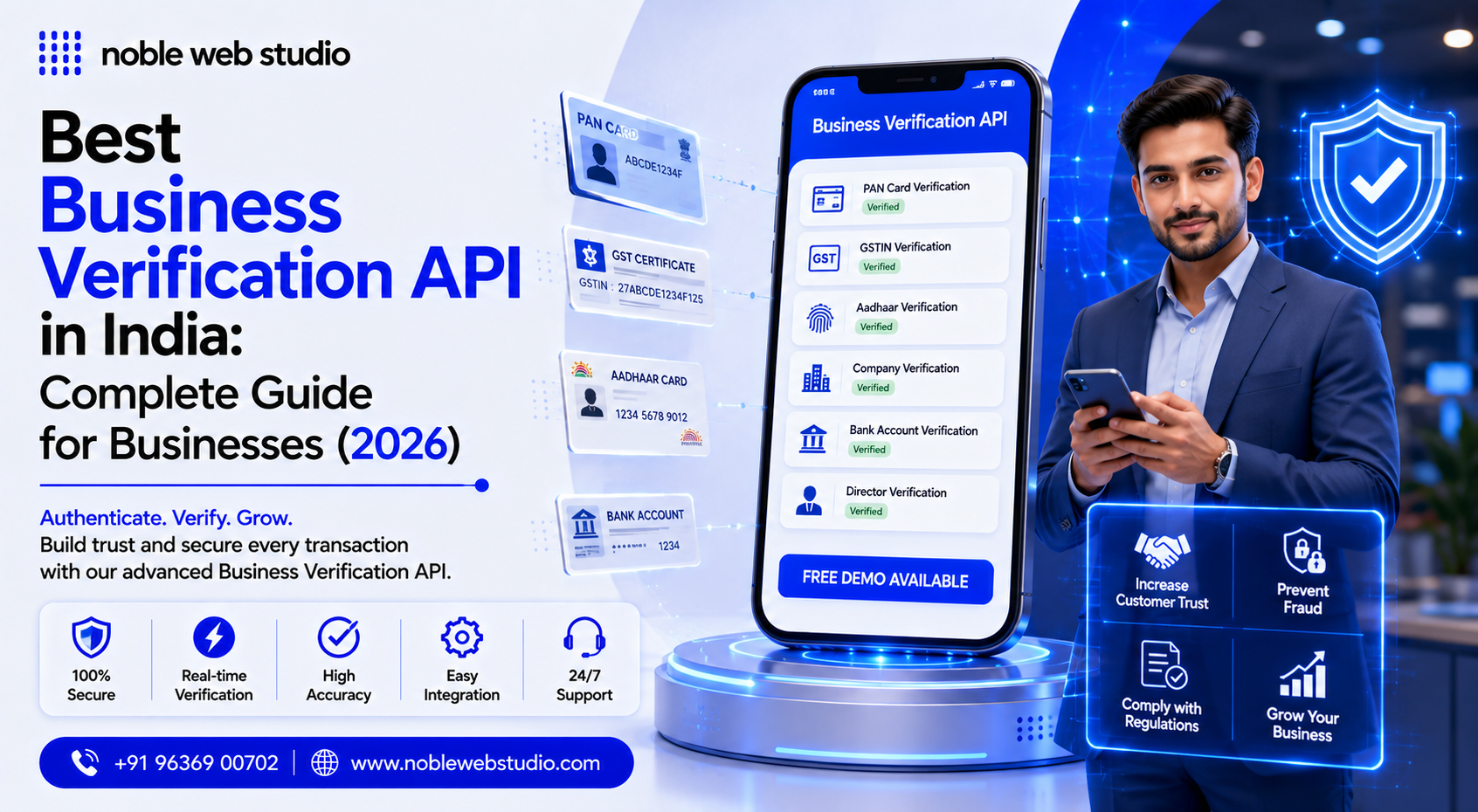
In today’s digital economy, businesses need fast, secure, and accurate verification systems to prevent fraud, simplify customer onboarding, and meet compliance requirements. A Business Verification API helps organizations verify business identities, registration details, tax information, and official records in real time, making the verification process faster and more reliable.
Whether you are a fintech company, bank, NBFC, payment gateway, insurance provider, e-commerce platform, lending company, HR platform, or enterprise business, integrating a reliable Business Verification API can improve operational efficiency, reduce manual verification, and enhance customer trust. Automated verification also helps businesses make faster decisions while maintaining data accuracy and security.
A Business Verification API (KYB / Know Your Business API) is a tool that allows Business Verification software systems to instantly check company registration data, tax numbers, and legal status from official government databases. Top Business Verification API provider include Noble web studio.
Noble Web Studio provides secure and scalable Business Verification API Solutions designed for modern businesses. Our APIs support seamless integration, real-time verification, fast response times, enterprise-grade security, and dependable technical support. With an easy integration process and reliable performance, businesses can automate verification workflows and improve the overall customer experience.
Noble Web Studio one of the right Business Verification API Provider in India is important for building a secure and scalable digital platform. A trusted Business Verification solution helps reduce verification errors, minimize fraud risks, speed up Business Verification onboarding, and support business growth across multiple industries.
In this complete 2026 guide, you will learn what a Business Verification API is, how it works, its key features, business benefits, integration process, common use cases, and how to choose the best verification API solution for your organization.
What is Business Verification (KYB)?
Business Verification, or KYB (Know Your Business), is the due diligence process used to confirm a company’s legal existence, verify its operational legitimacy, and identify its Ultimate Beneficial Owners (UBOs). It is essential for complying with Anti-Money Laundering (AML) laws and preventing fraud when onboarding corporate partners, vendors, or clients.
What is a Business Verification API?
A Business Verification API is a software tool that automatically connects a company’s system to official government, financial, and regulatory databases to confirm a company’s legal status, registration details, and key owners in seconds. It powers automated Know Your Business (KYB) checks to prevent fraud and meet legal compliance.
Business Verification API Work
A Business Verification API (often part of a Know Your Business or KYB compliance workflow) programmatically connects a company’s software system to official government, tax, and institutional registries. It functions as a data bridge that automates the validation of corporate identities, financial health, and legal status in real-time.
How a Business Verification API Works
- Data Submission: The client system initiates a request by sending core business identifiers such as a corporate name, tax identification number, or legal address through the API endpoint.
- Registry Querying: The Business Identity Verification API instantly forwards this request to official databases like corporate filing registries or tax authorities.
- Data Matching: The Business Authentication API compares the submitted parameters against primary source data using matching algorithms to confirm active status, corporate hierarchy, and official addresses.
- JSON Response: The Business Validation API delivers structured, authenticated data back to the client system, either auto-approving the business or flagging it for manual review.
Read Blog : What Is Business Verification API? How It Works Explained
Types of Business Verification Supported
Supported business verification types generally include legal entity registration, tax and financial compliance, physical address and phone validation, and ownership structure checks. Platforms like Meta Business Suite and general corporate onboarding systems process these verifications using official government and business documents.
Core Verification Categories
- Entity Registration: Validates legal business names, incorporation dates, and registration numbers via certificates of incorporation or business licenses.
- Tax and Financial Compliance: Confirms official tax identification numbers, GST/VAT certificates, and government-issued business tax filings (self-filed papers are excluded).
- Address and Contact Verification: Authenticates physical office locations and active phone lines using official utility bills or recent business bank statements.
- Ownership and Control (UBO): Identifies key stakeholders, beneficial owners, and authorized legal representatives managing the company.
- Screening and Compliance: Checks business profiles and executives against global anti-money laundering (AML) and watchlists.
Documents Verified Using Business Verification API
A Business Verification API (also known as a Know Your Business or KYB API) typically verifies corporate entities by cross-referencing and validating official government registries, tax documents, corporate formation filings, financial proofs, and operational utilities.
The primary documents and credentials categorized by their specific regulatory purpose include:
1. Legal Formation & Incorporation Documents
These primary documents prove a business exists as a legal entity:
- Certificate of Incorporation / Articles of Incorporation
- Articles of Organization (for LLCs)
- Business Registration Certificates or Licenses
- Partnership Agreements or Deeds
2. Tax & Government Identification Numbers
Online Business Verification APIs validate regional tax identifiers directly against government databases to ensure active status and prevent fraud:
- Employer Identification Number (EIN) or Taxpayer Identification Number (TIN)
- VAT / GST Certificates (e.g., GSTIN validation via the Business Verification API)
- Corporate Identification Number (CIN) / Director Identification Number (DIN) (queried via ministry databases like India’s MCA)
- PAN Cards (Permanent Account Number for corporate entities and individual owners)
3. Financial & Operational Proofs
These documents verify operational legitimacy, accurate trade locations, and current trading activity:
- Official Business Bank Statements
- Utility Bills (e.g., water, electricity, landline phone bills to verify the legal business name and physical address)
- Financial Filings and Annual Reports
- Lease/Rental Agreements for the physical storefront or headquarters
4. Sector-Specific Registrations
Depending on the industry, specific operating licenses can be called programmatically via business verification API providers like Noble web studio:
- MSME / Udyam Certificates (for micro, small, and medium enterprises)
- FSSAI Licenses (for food and restaurant operators)
- LEI Codes (Legal Entity Identifier used for global financial market tracking)
5. Ultimate Beneficial Owner (UBO) & Director ID Documents
Comprehensive KYB platforms such as Noble web studio require verification of the human operators behind the business to satisfy anti-money laundering (AML) protocols:
- Passports or National Identity Cards
- Driver’s Licenses
- Aadhaar Cards / Voter IDs (leveraged for biometric liveness and regional identity matching)
Business Verification API Supported Business Types
Business Verification APIs (Know Your Business / KYB) support corporate structures including private/public limited companies, partnerships, and sole proprietorships. They validate entities via registration, tax, and compliance identifiers.
Supported Entity and Registration Types
- Corporate Entities: Private Limited, Public Limited, One Person Companies (OPC), and Limited Liability Partnerships (LLPs) via Corporate Identification Numbers (CIN) and Master Data.
- Partnerships & Sole Proprietorships: Registered firms and individual business owners validated through national tax or small business registries.
- Micro, Small, and Medium Enterprises (MSMEs): Small businesses verified using specialized registries like Udyam or Udyog Aadhaar numbers.
Supported Identifier & Document Checks
- Tax Compliance Numbers: Goods and Services Tax Identification Numbers (GSTIN), Value Added Tax (VAT) numbers, and business Permanent Account Numbers (PAN).
- Regulatory & Industry Licenses: Food safety licenses (FSSAI), labor or trade licenses, and sector-specific permits.
- Personnel & Stakeholder Credentials: Director Identification Numbers (DIN), authorized signatory checks, and Ultimate Beneficial Ownership (UBO) structures.
Industries That Use Business Verification APIs
Business verification APIs (Know Your Business or KYB APIs) are primarily used by fintech and digital lending, banking and financial services (BFSI), and e-commerce and B2B marketplaces to instantly authenticate corporate entities, prevent fraud, and meet regulatory compliance.
Financial Services and Fintech
- Digital Lending and Alternative Finance: Neobanks, equipment financiers, and invoice factoring firms use Instant Business Verification APIs to instantly check corporate registration, director backgrounds, and credit history to approve business loans in minutes.
- Banking (BFSI): Traditional banks use corporate verification APIs for automated onboarding and continuous post-hire or ongoing risk monitoring of corporate accounts against financial crime and anti-money laundering (AML) watchlists.
- Insurance: Insurers validate company registration, tax identification numbers (like GSTIN or PAN), and active operational status before issuing commercial policies.
Commerce and Marketplaces
- E-commerce and B2B Platforms: Multi-vendor shopping platforms use merchant verification APIs to vet third-party sellers, confirm business legitimacy, and eliminate fake store listings or fraudulent shell companies.
- Supply Chain and Procurement: Enterprises utilize automated vendor onboarding tools to verify supplier tax compliance, business licenses, and legal registry data before signing contracts.
Specialized and Regulated Sectors
- Food Tech and Delivery: Food delivery networks and hospitality platforms integrate FSSAI or local health license verification APIs to ensure restaurants and cloud kitchens meet legal operating standards.
- MSME and B2B Networks: B2B service directories and government-linked portals verify micro, small, and medium enterprise (MSME) credentials using dedicated registries like the Udyam API framework.
Best Business Verification API in 2026
Core business verification API in India, known as Know Your Business (KYB) tools, instantly authenticate corporate entities, compliance status, and legal identities by connecting directly to official government and financial databases. The primary Digital Business Verification APIs used for corporate due diligence include:
- Ministry of Corporate Affairs (MCA) APIs for CIN and DIN tracking.
- Goods and Services Tax Identification Number (GSTIN) verification APIs.
- Permanent Account Number (PAN) and TAN validation APIs.
Corporate Structure and Registration APIs
- CIN Verification API: Checks the Corporate Identification Number to pull company master data, incorporation date, registered address, and active or struck-off status.
- DIN Verification API: Validates the Director Identification Number to confirm who manages the company and check for fraudulent associations.
- PAN-to-Company API: Cross-references business PAN data to verify the legal corporate name and tax registration status directly from the Income Tax department database.
Tax and Compliance APIs
- GSTIN Verification API: Confirms active tax compliance, filing history, legal business constitution, and address details associated with the Goods and Services Tax network.
- Udyam/MSME API: Validates micro, small, and medium enterprise registration credentials for sector-specific benefits and operational legitimacy.
- IEC (Import Export Code) API: A vital tool for cross-border trade, logistics, and supply chain platforms. It verifies the IEC certificate issued by the DGFT, confirming the legal authority of a business to engage in international trade.
Financial and License APIs
- Bank Account Verification API: Uses penny-drop methods to verify the corporate bank account, matching the payee name with official bank records.
- LEI (Legal Entity Identifier) API: Essential for financial institutions and investment platforms, the LEI API validates the global standard for identifying legal entities participating in financial transactions, ensuring alignment with international compliance standards.
- FSSAI and Trade License APIs: Authenticates industry-specific permits, such as food business registrations or shop and establishment licenses, to ensure complete merchant and vendor compliance.
Read Blog : Best Bank Verification API Solution for Fintech & Businesses
Complete Comparison Bank Account Verification API Guide with Decision Matrix
The business verification API market in 2026 has become highly competitive, with solutions ranging from simple GSTIN checks to comprehensive KYB (Know Your Business) platforms. Here’s a detailed breakdown to help you choose the right Business Verification API solution for your business.
| API Type | Primary Use Case | Speed | India-Specific | Global Coverage | Integration Complexity | Best For |
|---|---|---|---|---|---|---|
| GSTIN Verification | B2B Tax Compliance | <2 sec | ✅ Yes | ❌ No | Very Easy | E-commerce, Fintech B2B |
| MCA/CIN-DIN Verification | Corporate Due Diligence | <3 sec | ✅ Yes | ❌ No | Easy | High-value contracts, Vendor screening |
| PAN Verification | Financial Compliance | <1 sec | ✅ Yes | ❌ No | Very Easy | Loan approvals, KYC processes |
| Bank Account (Penny Drop) | Payment Verification | 2-5 min | ✅ Yes | ❌ No | Medium | Vendor onboarding, B2B payments |
| Udyam/Udyog Aadhaar | MSME Registration Check | <2 sec | ✅ Yes | ❌ No | Easy | Marketplace seller verification |
| FSSAI Verification | Food Business Compliance | <3 sec | ✅ Yes | ❌ No | Easy | Food delivery, Restaurant networks |
| Import-Export License | Trade Compliance | <5 sec | ✅ Yes | Limited | Easy | Logistics, B2B trade |
| Global Business Registry | Worldwide Corporate Check | 5-15 sec | ❌ No | ✅ Yes (50+ countries) | Medium-High | International B2B, AML compliance |
| Comprehensive KYB Bundle | Full Entity Verification | 10-30 sec | ✅ Yes | ✅ Partial | Medium | Enterprise fintech, NBFC |
Who Should Use Business Verification API?
A Standard Business Verification API should be used by fintech companies, online marketplaces, and payment processors to automate Know Your Business (KYB) compliance, stop fraud, and speed up user onboarding.
Key Industries and Users
- Fintech and Digital Lenders: Confirm company legal status, directors, and financial registries before granting loans or lines of credit.
- E-Commerce and Service Marketplaces: Vet third-party sellers and merchants quickly during registration to block fake vendors.
- Payment Service Providers (PSPs): Validate corporate merchant identities to meet local tax laws and anti-money laundering (AML) mandates.
- Supply Chain and Procurement Teams: Screen new suppliers and vendors to guarantee they are active, registered business entities.
- Developers Accessing Meta Tools: Complete prerequisite business checks on platforms like Meta Business Manager to unlock official messaging tools.
The Three Levels of Business Verification Explained
Business verification (Know Your Business or KYB) uses a tiered framework to prevent fraud and meet regulatory standards. The three primary levels are Level 1 (Business Identity Verification), Level 2 (Ultimate Beneficial Owner and Stakeholder Screening), and Level 3 (Multi-Level Network Graph and Risk Monitoring).
Level 1: Business Identity Verification
- Core Goal: Confirm that the company legally exists and is active.
- Key Actions: Check government and corporate registries for the legal name, registration number, incorporation date, and active operational status.
- Data Used: Certificates of incorporation, tax ID numbers, and official business address validation.
Level 2: Ultimate Beneficial Owner (UBO) Screening
- Core Goal: Identify the real people who own or control the company.
- Key Actions: Map out ownership stakes (typically individuals holding 25% or more) and run background checks on directors and key stakeholders.
- Data Used: Shareholder registries, individual KYC identity documents, and global watchlist or sanctions screening (PEP lists).
Level 3: Network Graph & Continuous Monitoring
- Core Goal: Uncover complex multi-layer ownership structures and prevent ongoing financial crime.
- Key Actions: Visualize hidden parent-subsidiary chains using network graphs and track the business for ongoing risks like bankruptcies, legal changes, or new sanctions.
- Data Used: Automated portfolio monitoring, adverse media tracking, and multi-jurisdictional corporate link analysis.
How to Get Started with Our Business Verification API (3 Simple Steps)
Step 1: Sign Up & Get Your API Key (2 minutes)
Visit our Noble web studio website provide portal, create a free account, and instantly receive your Business Verification API API key. No sales calls. No contracts. No hidden fees.
Step 2: Test in Our Free Sandbox
Use our sandbox environment with mock data to test all Business verification APIs. Get 100 free Business Verification API calls to validate your integration before going live.
Step 3: Go Live & Scale
Switch to production with your real Business Verification API key. Our RESTful endpoints, Postman collections, and SDKs (Python, Node.js, Java) ensure you can go live in under 15 minutes.
[Get Your Free API Key Now →]
Core Modules of our Business Verification Suite
The core modules of a standard business verification suite include entity registration validation, tax and compliance checking, and ultimate beneficial ownership (UBO) screening. These modules work together to confirm legal existence and assess risk.
Entity and Registration Validation
- Master Data Retrieval: Fetches official company details like legal name, registration number, and incorporation date.
- Address & Status Check: Confirms if the physical address is real and whether the company status is active.
Tax and Financial Compliance
- Tax ID Verification: Cross-checks national tax numbers (like GST or VAT) against official government registries.
- Bank Authentication: Performs micro-deposits or penny-drop checks to verify corporate bank account ownership.
Risk and Ownership Screening
- UBO Identification: Maps out corporate shareholding structures to find the real people who own or control the business.
- Watchlist & AML Screening: Scans company names and directors against global sanctions, crime lists, and politically exposed persons (PEP) databases.
Business Verification API Use Cases
Best Business Verification APIs (also known as Know Your Business or KYB APIs) allow organizations to instantly cross-reference corporate details against official government registries, tax databases, and global watchlists. By replacing slow, manual document reviews with real-time digital lookups, these tools help companies automate corporate onboarding, mitigate compliance risks, and combat B2B fraud.
Core Use Cases of Business Verification APIs
1. B2B Marketplace and Merchant Onboarding
- Merchant Vetting: E-commerce platforms and digital marketplaces run automated checks to confirm a seller is a legally registered entity before they can list products.
- Fraud Reduction: Instantly flags shell companies, fake storefronts, or businesses using stolen tax information.
- Faster Time-to-Market: New sellers transition from sign-up to active status within minutes instead of days.
2. Commercial Lending and Alternative Financing
- Due Diligence: Banks and Alternative Finance providers verify corporate registration status, active filings, and formation dates before evaluating lines of credit.
- Credit Analysis: Integrates with financial risk evaluation tools to instantly pull historical data.
- Micro-Lending Velocity: Enables automated micro-loan and Merchant Cash Advance platforms to safely issue instant capital.
3. Procurement and Supply Chain Management
- Vendor Legitimacy: Enterprise procurement teams screen suppliers to ensure they are active and fully authorized to do business.
- Niche Compliance Tracking: Verifies specific trade and regulatory clearances, such as FSSAI certifications for food-related vendors or logistics credentials.
- Tax Status Checks: Automatically verifies tax-related statuses, including active GSTIN or TAN credentials, minimizing the risk of tax-related fraud.
4. Payment Processing and Fintech Onboarding
- PSP Underwriting: Noble web studio run immediate corporate checks to determine structural legitimacy prior to setting up corporate processing accounts.
- Anti-Money Laundering (AML): Scans corporate identities against global PEP (Politically Exposed Persons) databases and international sanctions lists.
- UBO Identification: Maps out complex legal hierarchies to track down Ultimate Beneficial Owners (UBOs) and prevent financial crime concealment.
5. Insurance Underwriting
- Risk Profiling: Commercial insurance entities quickly evaluate firm authenticity and corporate parameters to generate accurate policy premiums.
- Governance Assessment: Queries corporate registry “Master Data” to evaluate structural ownership and reduce policy fraud risks.
Key Capabilities and Data Extracted via Business Verification APIs
| API Capability | Data points Verified | Target Use Case |
|---|---|---|
| Corporate Master Data | Company Name, Date of Incorporation, Active Status | Basic business existence check |
| Tax & Filing Authentication | GSTIN, PAN, TAN, Active Return Filing History | Financial compliance & vendor vetting |
| Director & Executive Checks | DIN (Director Identification Number), PAN Match | Fraud prevention & governance review |
| Structure & Ownership Maps | Ultimate Beneficial Owners (UBO), Shareholder tiers | AML/KYC strict regulatory mandates |
| Sanction Screening | Global Adverse Media, Watchlists, PEP Status | International cross-border risk assessment |
Why Business Verification Matters Right Now
The problem is getting worse, not better. Document fraud has increased 340% since 2020. Fake GST registrations, shell companies, and synthetic identities are becoming harder to spot with the naked eye.
Here’s what happens without proper verification:
- Payment fraud costs hit ₹2.5 trillion globally in 2025
- Average detection time for fraudulent vendors: 47 days
- Compliance penalties for missing KYB checks: up to ₹50 lakhs in India
- Customer trust loss: One fraud incident can cut your user base by 30%
With the right Business verification system, you flip this around completely.
Why Business Verification Matters for KYB
Business verification matters for Know Your Business (KYB) because it prevents financial crime, ensures legal compliance, and stops fraud by confirming a company’s legal existence, uncovering true owners, and blocking high-risk partners.
Compliance and Law
- Stops Illegal Acts: Blocks front companies used for money laundering, corruption, and terrorist funding.
- Meets Rules: Follows global anti-money laundering (AML) laws and local mandates like Reserve Bank of India or FinCEN guidelines.
- Avoids Fines: Protects firms from heavy legal penalties and government action.
Risk and Fraud Control
- Finds Real Owners: Identifies Ultimate Beneficial Owners (UBOs) hiding behind complex corporate structures.
- Screens Watchlists: Checks company directors against global sanctions and criminal databases.
- Validates Legitimacy: Confirms official registration numbers, tax IDs, and physical operating addresses.
Why Businesses Choose the Best Business Verification API
Businesses choose a top tier business verification API to ensure regulatory compliance, accelerate partner or customer onboarding, and prevent financial fraud. By connecting directly to official government and financial databases, these automated tools eliminate manual paperwork and scale effortlessly as transaction volumes grow.
Operational Efficiency
- Faster Onboarding: Checks corporate registration, tax IDs, and license details in seconds to stop users from leaving the registration page.
- Instant checks: Validate corporate identity numbers, tax details, and licenses in under a second.
- No manual work: Remove slow paper reviews and human data mistakes.
- Simple Compliance: Meets local and global know-your-customer (KYC) and anti-money laundering (AML) rules automatically by connecting directly to official government databases.
- Lower Costs: Removes the need for slow manual paperwork and reduces human errors during data entry.
- Better flow: Plug right into existing apps and software for a smooth user experience.
Safety and Rules
- Fraud Prevention: Blocks fake vendors, shell companies, and high-risk actors before they join a platform.
- Easy rules: Meet local KYC and global AML laws automatically by matching official registry data.
- Operational Efficiency: Cuts down processing times from days to seconds by replacing manual document collection and phone calls with automated digital workflows.
- Seamless Scalability: Adapts smoothly from low-volume testing to processing thousands of requests daily without requiring extra personnel or system overhauls.
- Platform access: Meet developer prerequisites required by major online tools and business dashboards.
Features Best Business Verification API
The best business verification APIs feature real-time primary source validation, global registry coverage, and automated risk workflows. Best Business Verification API Provider like Noble web studio offer core capabilities to streamline Know Your Business (KYB) and anti-fraud operations.
Core Verification Capabilities
- Official Registry Checks: Connects directly to government bodies and company house databases to verify registration numbers, legal names, and status.
- UBO & Ownership Tracking: Identifies Ultimate Beneficial Owners (UBOs) and maps out complex shareholder structures.
- Tax & Compliance Validation: Authenticates corporate tax IDs, Goods and Services Tax Identification Numbers (GSTIN), and regulatory filing records.
- Director Screening: Confirms the identity and past corporate affiliations of directors and key executives.
Risk Management and Performance
- AML & Watchlist Screening: Cross-references entities and owners against global sanctions, PEP (Politically Exposed Persons), and adverse media lists.
- Real-time Processing: Delivers automated verification results in seconds to eliminate manual paperwork and speed up onboarding.
- Automated Audit Trails: Records timestamps, primary source documentation, and verification results to meet regulatory compliance mandates.
- Developer-Friendly Integration: Provides robust REST Business Verification API architecture, clear Business Verification API documentation and standard SDKs for fast deployment.
Benefits Best Business Verification API
A Business Verification API provides instant, automated checks of corporate credentials by connecting directly to official government, tax, and financial registries. Its core benefits include real-time data accuracy, rapid customer and vendor onboarding, and robust fraud prevention.
Speed and Efficiency
- Instant Validation: Fetches official data like company registration, tax status (such as GSTIN), and director details in seconds.
- Fast Onboarding: Cuts down customer and vendor approval wait times from days to minutes.
- No Manual Work: Replaces slow paperwork and manual registry searches with automated processes.
- Bulk Processing: Validates hundreds or thousands of corporate entries or tax IDs at once.
Security and Compliance
- Fraud Prevention: Blocks fake suppliers, shell companies, and identity theft by matching official database records.
- Regulatory Check: Meets Know Your Business (KYB), Anti-Money Laundering (AML), and local tax laws automatically.
- Error Reduction: Cuts out human mistakes during data entry.
System Growth
- Easy Integration: Connects smoothly with existing software like CRM, ERP, and banking systems.
- Better user flow: Gives clients a fast, smooth sign-up experience.
- Global and Local Reach: Handles different regional regulations and official databases through a single connection.
- Ready to grow: Handles high volumes of checks easily as your company expands.
| Metric | 2-Year Impact |
|---|---|
| Fraudulent transactions prevented | 95% reduction |
| Chargebacks & disputes | 85% lower |
| Customer trust score | +40% higher |
| Regulatory penalties avoided | ₹10-100+ lakhs saved |
| Operational efficiency | 60% less manual review |
For most businesses: Verification costs pay for themselves within the first 3-6 months through fraud prevention alone.
Business Verification API Workflow
Step 1: User Provides Information (Your side)
User enters a GSTIN, company registration number, or other business identifier on your form.
Step 2: API Validates Format (Your system)
Your system checks: Is this the right format? Does it look legitimate? Is it using common fraud patterns (obviously fake numbers)?
Step 3: Database Query (Verification API)
The Business Verification API connects to official government databases Ministry of Corporate Affairs, GST Network, tax authority servers and asks: “Does this registration exist?”
Step 4: Response Returns (Back to you)
The Business Verification API sends back structured data:
{ "GSTIN": "27AAFCE5055K2Z0", "Status": "Active", "Business_Name": "XYZ Manufacturing", "Principal_Address": "123 Industrial Park, Karnataka", "Returns_Filed": "Last filed: March 2026", "Confidence_Score": 0.98}Step 5: Your Decision (Your system)
You set rules:
- If Status = “Active” → Accept
- If Status = “Inactive” → Request additional documents
- If Confidence_Score < 0.95 → Manual review
Step-by-Step Business Verification Api Process
A Business Verification API process programmatically validates whether a business entity is legal, active, and compliant. It automates Know Your Business (KYB) checks by cross-referencing inputted data against government registries and global watchlists.
The technical process follows seven sequential steps:
1. Requirements & Vendor Selection
- Identify compliance needs based on your industry regulations.
- Choose a high-confidence Noble web studio.
- Ensure the Noble web studio covers the geographical regions required.
2. Authentication & Credentials Setup
- Register for an account on the Noble web studio developer portal.
- Generate your unique Business Verification API keys or OAuth 2.0 access tokens.
- Secure your production credentials within your system environment variables.
3. Payload Construction & Data Collection
- Collect business details from the Business Verification API onboarding merchant.
- Format the data into a JSON payload required by the endpoint.
- Include primary keys: Legal Name, Registration Number, and Country Code.
4. API Request Transmission
- Construct the HTTP request using the method designated by the Noble web studio (typically
POST). - Pass the authentication token inside the request header.
- Send the payload securely via an HTTPS connection.
5. Automated Registry Checking & Processing
- The Business Verification API receives the payload and searches aggregated corporate registries.
- It matches the data against official government tax and incorporation databases.
- It simultaneously runs anti-money laundering (AML) and global sanction watchlist checks.
6. Error & Edge Case Handling
- Capture standard Business Verification API error responses (e.g.,
400 Bad Request,401 Unauthorized). - Program workflows for unmatched data exceptions.
- Trigger fallback prompts for users to upload manual business documents if automated matching fails.
Total development time: 4-8 hours for basic integration.
7. Response Processing & Decisioning
- Receive the JSON response containing the verification status.
- Parse the matching scores, active/inactive registration state, and Ultimate Beneficial Owner (UBO) data.
- Programmatically route the business to “Approved” or flag it for manual compliance review.
Business Verification API Pricing
Business verification API pricing in India relies on a pay-per-use, tiered volume model ranging from ₹1.00 to ₹10.00+ per successful query, structured across distinct structural billing dimensions. Business Verification API Cost vary significantly depending on whether you call basic government registry checks or deep compliance KYB/UBO suites.
Pricing Models
- Pay-Per-Use (Prepaid/Postpaid Credits): Standard volume pricing decreases as monthly request counts scale (e.g., tier splits at 10,000, 100,000, and 1M+ calls).
- Subscription / Retainer Plans: Monthly platform fees (often starting around ₹1,500 to ₹10,000+) that bundle a fixed allotment of free or discounted Business Verification API hits.
- Custom Enterprise SLAs: Dedicated enterprise invoicing with volume commitment discounts and guaranteed 99.9% uptime uptime parameters.
Approximate Per-Query Costs (INR)
- PAN Validation / Basic Check: ₹1.00 to ₹1.75 per call
- PAN Comprehensive / Detail Fetch: ₹2.50 to ₹3.50 per call
- GSTIN Verification / Filing Status: ₹2.00 to ₹5.00 per call depending on data depth (basic status vs. return history intelligence)
- Bank Account Validation (Penny Drop): ₹2.00 to ₹3.00 per transaction + the ₹1.00 penny drop amount
- MCA / Corporate Registry / Udyam Searches: ₹3.00 to ₹8.00+ per registry fetch based on document extraction depth
Additional Cost Factors
- Setup & Onboarding Fees: Most modern Indian Business Verification API gateways keep initial integration setup free, charging purely for consumption.
- Failed Attempt Policies: Noble web studio affordable pricing between successful matches, rejected hits, and invalid format errors.
- Add-On Modules: Advanced risk scoring, facial liveness/deepfake checks, or automated UBO (Ultimate Beneficial Ownership) mapping add extra modular premiums per request.
Cost Variables by Feature Set
- Basic Registry Lookup: Cheapest tier; checks corporate name, status, and incorporation date.
- Tax & Compliance (GSTIN/PAN): Moderate cost per hit for active tax return filing verification.
- Advanced KYB / UBO & AML: Highest cost tier; maps ownership chains, screens global watchlists, and checks adverse media.
Cost Per Verification (2026 Pricing)
| API Type | Cost Per Check | Bulk Discount | Hidden Fees |
|---|---|---|---|
| GSTIN | ₹5-10 | Yes (100+) | Failed checks |
| MCA | ₹10-20 | Yes | Document pulls extra |
| PAN | ₹3-7 | Yes | None usually |
| Penny Drop | ₹15-30 | Limited | Settlement delays |
| Global KYB | ₹50-150 | Limited | Country-specific variations |
Pro tip: Large vendors (100K+/month) pay ₹1-3 per check; startups pay ₹5-10.
Costs of implementing verification:
| Item | Cost |
|---|---|
| Setup & integration | ₹15,000-50,000 (one-time) |
| Monthly API usage (100 verifications) | ₹500-1,500 |
| Monthly API usage (1,000 verifications) | ₹2,000-8,000 |
| Monthly API usage (10,000 verifications) | ₹15,000-80,000 |
Read Blog : Buy Bank Account Verification API: Complete Guide for Businesses
Why Business Verification API Speed Matters for Business Onboarding
Business verification API speed matters during onboarding because it prevents user drop-off, stops manual workflow bottlenecks, and provides real-time fraud detection. Fast verification ensures a smooth experience for new merchants, clients, or partners while keeping operations secure.
Fact: If a user has to wait more than 30 seconds during onboarding, conversion drops by 45%.
Old way:
- User fills form
- You send documents to manual review
- Wait 24-48 hours
- User gets bored, leaves
- You lose customer and the sale
New way:
- User fills form
- API checks in <2 seconds
- Instant approval
- User continues
- Sale completes
The cost difference:
- With 10,000 monthly onboardings
- Old way: Lose 4,500 customers (45%)
- Cost per lost customer: ₹200-500 (lost revenue, support cost)
- Total monthly loss: ₹9-22.5 lakhs
A proper Business Verification API pays for itself on its first month by preventing this leakage.
The Business Verification API Process: What Actually Happens Behind the Scenes
A Trusted business verification API automatically validates a company’s legal existence, ownership, and compliance in seconds. It works through data input, registry querying, and risk screening.
Request and Data Input
- User Submission: A customer or partner enters a company name, tax ID, or registration number (like a CIN or GSTIN) on trusted Business Verification platform.
- API Call: Your Business Verification app packages this data into a secure request and sends it to the Noble web studio endpoint via an HTTPS protocol.
Registry Query and Document Parsing
- Official Database Matching: The Business Verification system queries government business registries, tax databases, and global registries to pull official records.
- OCR and Data Extraction: If documents like incorporation certificates are uploaded, the Live Business Verification API uses Optical Character Recognition (OCR) to read text, check tamper-proof sources, and extract key fields.
Compliance and Risk Screening
- Ownership Analysis: The tool identifies Ultimate Beneficial Owners (UBOs) and maps out the management structure.
- Watchlist Checks: It screens the business and its directors against Anti-Money Laundering (AML), Politically Exposed Persons (PEP), and global sanction lists.
Structured Response
- Decision Delivery: The Secure Business Verification API sends a structured data packet back to your system containing a pass/fail status, match scores, and official company details like the address and active status.
- Workflow Action: Business Verification platform automatically approves the business, blocks high-risk entities, or flags edge cases for a manual review.
Business Verification API Security and Compliance
Professional Business Verification API securely automate corporate onboarding by cross-referencing corporate credentials against authoritative government, legal, and financial registries in real-time. Integrating these systems requires strict adherence to cryptographic standards, access controls, and data privacy regulations to prevent the exposure of corporate data or financial transactions.
Core Security Architectures
To maintain structural integrity during real-time database lookups, business verification platforms must deploy layered network protections.
- Transport Layer Security: All Business KYB API communications require mandatory HTTPS termination utilizing TLS 1.3 to encrypt traffic in transit.
- Token Authorization: Implementation of OAuth 2.0 or stateless JSON Web Tokens (JWT) manages specific endpoint permissions.
- Infrastructure Rate Limiting: Throttling policies prevent resource starvation and mitigate potential Distributed Denial of Service (DDoS) vectors.
- Persistent Encryption: Critical identifiers, corporate tax profiles, and registration records must use AES-256 encryption at rest.
- Static Endpoint Guarding: IP whitelisting restricts Business Verification API gateway execution exclusively to recognized, authorized server environments.
Regulatory Compliance Frameworks
Business verification tools (Know Your Business / KYB) must comply with international legal frameworks designed to secure financial pipelines.
- Anti-Money Laundering (AML): Real-time queries must systematically scan global sanctions, adverse media, and Politically Exposed Persons (PEP) lists.
- Data Protection Principles: Systems must comply with regional mandates like GDPR or localized data privacy regulations.
- Explicit Consent Governance: Verification protocols require documented enterprise consent prior to extracting backend financial registry information.
- Data Residency Enforcement: Regional laws often mandate that localized business identity records remain within strict geographical borders.
- Dynamic Data Masking: Automated masking must redact sensitive corporate account details or identification numbers on receipt.
Operational Threat Mitigation
Defending the integrity of corporate identity vetting processes requires addressing risks across the entire Business Verification software development lifecycle.
- Automated Risk Profiling: Machine learning models flag highly complex, nested, or suspicious Ultimate Beneficial Ownership (UBO) setups.
- Continuous Traffic Inspection: Anomaly detection engines monitor Best Business Verification API payload exchanges to isolate unusual data leakage patterns.
- Immutable Security Logging: Cryptographically signed audit trails capture all tracking metadata to prevent manual log tampering.
- Regularized Vulnerability Scans: Automated pipeline testing actively checks endpoints against the OWASP Top 10 API vulnerabilities.
- Zero-Knowledge Architecture: Best Business Verification Platforms log transaction status codes rather than retaining raw target registration files.
Real-World Examples: When Business Verification API Saves You
A Real-Time Business Verification API saves companies from fraud, heavy fines, and bad loans by instantly checking official data. Key examples include stopping fake vendor accounts, blocking illegal money laundering, and cutting loan Business Verification API onboarding times from days to seconds.
Preventing Marketplace Fraud
- Fake Sellers: Online shops use verification tools to check company registration numbers instantly.
- Stopped Scams: This blocks ghost companies before they can list unsafe items or scam buyers.
Faster Loan Approvals
- Quick Checks: Lenders check a business license and tax status in seconds using automated data feeds.
- No Waiting: Good companies get loans fast, while risky or fake applicants are rejected right away.
Safe Business Partners
- Clean Records: Companies check if a new partner has a legal active status before signing big deals.
- Low Risk: This stops accidental work with blacklisted groups or shell corporations.
The E-commerce Marketplace
A seller applies to join your top Business Verification platform. Their GSTIN is real, registered as an electronics retailer. Without verification, you’d accept them.
What happened next:
- They immediately started listing counterfeit products
- Filed 47 different seller accounts with the same GSTIN
- Disappeared after ₹8 lakhs in sales
If deep verification was used:
- Address matching would flag multiple registrations
- Document pull would show recent registration (higher risk flag)
- Sales history check would show this is a new account with suspicious patterns
The B2B Supply Contract
A manufacturing company offers to supply raw materials. GSTIN checks out, company looks legitimate on paper.
What verification should reveal:
- Company was registered 6 months ago
- No tax filing history (red flag)
- Registered address is a shared office space (common for shell companies)
- Bank account name doesn’t match company name
Result: You catch it before signing ₹50 lakh contract with a shell company
KYC vs. KYB: The Critical Differences
KYC (Know Your Customer) and KYB (Know Your Business) are compliance processes used to prevent financial crimes, with KYC focusing on individual people and KYB focusing on corporate entities. The main differences involve target entities, required documents, and overall process complexity.
Core Focus and Target
- KYC: Verifies single human beings. It answers the question, “Is this person who they say they are?”
- KYB: Verifies company entities and legal structures. It answers the question, “Does this business exist and who controls it?”
Comparison Table
| Feature | KYC (Know Your Customer) | KYB (Know Your Business) |
|---|---|---|
| Primary Target | Individual people (natural persons) | Business entities (companies, corporations) |
| Core Question | “Who is this person?” | “What is this company and who controls it?” |
| Complexity Level | Low to moderate; straightforward check | High; involves layered structures and multiple owners |
| Required Documents | Government ID, passport, proof of address, biometrics | Certificate of incorporation, business licenses, tax ID, shareholder registers |
| Key Stakeholders | The individual customer | Directors, shareholders, and Ultimate Beneficial Owners (UBOs) |
| Primary Data Sources | Government identity databases and biometric matching | Official corporate registries, business credit bureaus, and tax databases |
Real Success Metrics: How to Know It’s Working
Track these 6 numbers:
- Verification success rate — How many verifications complete successfully? Target: >98%.
- Fraud detection rate — What percentage of fraud was caught by verification? Target: >90%.
- False positive rate — How many legitimate users were rejected? Target: <2%.
- Conversion rate — What % of users complete onboarding? Target: >85%.
- Dispute rate — How many chargebacks/fraud complaints? Target: <1% of transactions.
- Customer trust score — How many customers remain after 30 days? Target: >90%.
How Our Business Verification API Compares to Other Providers
| Feature | Surepass.io | Noble Web Studio |
|---|---|---|
| Number of APIs | 3-5 APIs | 10+ APIs |
| Average Response Time | 3-10 seconds | <1 second |
| Fallback Mechanism | Single source (fails if gov portal down) | Multi-source intelligent routing |
| Pricing Transparency | “Contact Sales” (hidden) | Transparent pay-as-you-go |
| Sandbox Environment | Limited or paid | Free sandbox with 100 mock calls |
| Documentation Quality | Basic/outdated | Comprehensive + Postman + SDKs |
| India Regulatory Coverage | Partial | Full (RBI, DPDP, AML) |
| Self-Serve Onboarding | No (sales team required) | Yes (instant API key) |
What’s New in Business Verification APIs — 2026 Updates
Business verification and KYB API in 2026 feature real-time primary registry integration, agentic AI orchestration, and deep risk intelligence. These upgrades eliminate manual delays and combat sophisticated, AI-driven corporate identity fraud.
The business verification landscape has evolved significantly in 2026. Here are the key changes that impact your verification strategy:
| Update | What Changed | Impact |
|---|---|---|
| DPDP Act Enforcement | Full enforcement from Jan 2025 | All verification APIs must implement consent architecture |
| RBI Digital Lending Update (April 2026) | New authentication rules for digital payments | Risk-based checks now allowed alongside mandatory 2FA |
| MCA V3 Portal Launch | New MCA data access framework | Faster CIN/DIN lookups with improved uptime |
| GST Network API Upgrades | Enhanced GSTIN verification endpoints | Sub-1-second response times now achievable |
| Udyam Registry Expansion | New MSME categories added | More granular business type verification |
Core Technology Upgrades
- Agentic AI Integration: Platforms now embed autonomous agents (such as Google Cloud’s Gemini Enterprise integrations) to process complex corporate structures and map Ultimate Beneficial Ownership (UBO) directly inside automated workflows.
- Deep Risk Intelligence vs. Status Checks: Modern GST, CIN, and registration endpoints go beyond basic existence flags, returning active return-filing histories, adverse media monitoring, and real-time sanction screening.
- Unified Compliance Stacks: Single Business Verification API architectures merge KYB, individual KYC, and Anti-Money Laundering (AML) signals into unified pipelines, reducing vendor fragmentation.
How to Choose the Right Business Verification API
Noble web studio is the right Business Verification API, you must align the Noble web studio data sourcing with your regional regulatory requirements and onboarding workflow velocity. Selecting an sub-optimal Strong Business Verification API leads to high operational friction, compliance penalties, and increased vulnerability to shell-company fraud.
When evaluating Noble web studio consider these essential technical and operational criteria:
1. Data Freshness and Primary Source Access
- Registry Connectivity: Ensure the best Business Verification API pulls data directly from official government registries (such as the Noble web studio registry network or India’s MCA registry) rather than stale, third-party databases.
- Real-Time Delivery: The best Business Verification system must offer immediate verification to prevent user drop-off during onboarding.
- Document Extraction: Look for automated OCR capabilities that pull digitized records directly from state filings.
2. Global Coverage and Jurisdictional Reach
- Cross-Border Support: Choose a Noble web studio with global scaling capabilities if you handle international clients.
- Localization Compliance: The Business Verification software should dynamically adjust to local regulations and tax formats across different jurisdictions.
3. Verification Depth and AML Screening
- Entity Validation: The basic tier must confirm registration numbers, incorporation dates, and active business status.
- UBO Identification: The top Business Verification API must trace Ultimate Beneficial Ownership (UBO) structures to uncover true stakeholders.
- Compliance Screening: It should continuously screen entities against global Sanctions lists, Politically Exposed Persons (PEP) registries, and adverse media.
- Financial Auditing: Financial operations benefit from integrations like the Bank Account Verification (Penny Drop) API, which validates routing and account logistics.
4. Developer Experience and Schema Consistency
- Response Architecture: Prioritize Business Verification platforms with uniform response schemas across varying entity types.
- Confidence Scoring: Downstream automation functions best when the Business Verification API delivers a standardized confidence match score.
- Error Typing: The interface must cleanly differentiate between a “record not found” error and a temporary “system unavailable” state.
5. Security Architecture
- Advanced Authentication: Confirm support for robust authentication protocols like token-based keys or mutual TLS (mTLS).
- Data Privacy: Ensure strict end-to-end TLS encryption and localized data sovereignty adherence.
Why Choose Noble Web Studio for Business Verification API Solutions?
Noble web studio only one of the business verification API provider accelerates customer onboarding, automates legal compliance, and stops fraud. Organizations select Noble web studio for real-time validation, lower operating costs, and scalable infrastructure.
- Comprehensive Verification APIs – Access multiple verification services through a single business verification platform, including PAN Verification API, Aadhaar Verification API, GST Verification API, Bank Account Verification API, Driving License Verification API, Voter ID Verification API, Passport Verification API, UDYAM Verification API, CIN Verification API, and more.
- No paperwork: Removes slow manual reviews and human data-entry mistakes.
- Fast Real-Time Verification – Verify customer, business, and document details in real time with low-latency API responses, helping you improve onboarding speed and user experience.
- Better user flow: Keeps new clients from leaving your Business Verification app or website by making sign-ups fast and smooth.
- High API Uptime & Reliable Performance – Built on scalable cloud infrastructure with high availability to ensure uninterrupted verification services for startups, enterprises, NBFCs, fintech platforms, and digital businesses.
- Easy REST API Integration – Simple RESTful Business Verification APIs with JSON request and response formats, making integration quick and developer-friendly for websites, Android apps, iOS apps, and enterprise software.
- Advanced Security & Data Protection – Business Verification APIs are secured using HTTPS, SSL/TLS encryption, Business Verification API keys, token-based authentication, IP whitelisting, and secure access controls to protect sensitive business data.
- Developer-Friendly Documentation – Well-structured Business Verification API documentation with sample requests, response examples, error codes, webhook support, SDK references, and integration guides to simplify implementation.
- Scalable for Businesses of Every Size – Whether you process hundreds or millions of verification requests, the Business Verification platform designed to handle growing business requirements efficiently.
- Instant Business & Customer Onboarding – Reduce manual verification time by automating KYC, KYB, and business verification workflows for faster customer acquisition.
- Accurate Verification Results – Multi-layer validation processes help improve verification accuracy and reduce failed verification attempts caused by incorrect or incomplete data.
- Enterprise-Grade API Infrastructure – Built for fintech companies, banks, insurance providers, marketplaces, lending Business Verification platforms, payment gateways, HR platforms, telecom businesses, and enterprise applications.
- Webhook & Callback Support – Receive instant verification status updates through secure webhook notifications, enabling seamless workflow automation.
- Fraud prevention: Blocks fake vendors, shell companies, and high-risk directors before they access your services.
- Automatic rules check: Matches user details against official government registries to meet local and global anti-money laundering (AML) laws.
- Safe data handling: Relies on secure systems with high uptime to keep private corporate information protected.
- Comprehensive Error Handling – Standardized response codes, detailed error messages, retry mechanisms, and validation responses make troubleshooting faster for developers.
- Flexible API Solutions – Choose only the Business Verification API your business requires or integrate multiple APIs through a unified platform.
- Dedicated Technical Support – Get assistance from experienced integration specialists during Business Verification API setup, testing, production deployment, and post-launch support.
- Future-Ready Architecture – Business Verification API designed to support modern Business Verification applications, cloud deployments, microservices, and enterprise integrations while remaining scalable as business requirements evolve.
- Suitable for Multiple Industries – Ideal for fintech, banking, NBFCs, insurance, eCommerce, HR technology, logistics, travel, telecom, education, healthcare, and government-enabled digital services.
- Optimized for Digital Transformation – Automate verification processes, reduce manual effort, improve compliance workflows, and enhance operational efficiency through secure Business Verification API-based verification.
- Transparent Integration Process – Clear onboarding steps, sandbox testing environment, production credentials, and technical guidance help businesses deploy Business Verification APIs with confidence.
- Handles high volume: Grows easily with your transaction volume whether you onboard dozens or thousands of accounts daily.
- Easy developer tools: Noble web studio offers ready-to-use Business Verification documentation so tech teams can plug the tools straight into existing software.
- Continuous Platform Improvements – Regular Business Verification platform enhancements, documentation updates, and infrastructure optimizations help maintain compatibility with evolving business and technology requirements.
- Trusted Technology Partner – Noble Web Studio focuses on delivering secure, scalable, and developer-friendly Business Verification API solutions that support faster digital Business Verification onboarding and reliable identity verification for modern businesses.
Conclusion
Choosing the right Business Verification API is essential for businesses that want to automate verification, reduce fraud, and build a secure digital ecosystem. Whether you are a fintech company, bank, NBFC, payment gateway, lending platform, insurance provider, HR platform, e-commerce business, or enterprise, a reliable Business Verification API helps verify business information quickly, improve compliance, and streamline onboarding.
A modern Business Verification API enables real-time verification, secure Business Verification API integration, fast response times, and automated workflows. By replacing manual verification with an intelligent Business Verification API solution, businesses can reduce operational costs, improve verification accuracy, accelerate customer onboarding, and deliver a better user experience.
A Business Verification API (KYB / Know Your Business API) is a digital tool that instantly checks and confirms a company’s legal status, registration details, and tax identity using official government databases. Top Business Verification API providers include Noble web studio.
Noble Web Studio provides secure and scalable Business Verification API Solutions designed to support modern businesses across multiple industries. With fast Business Verification API integration, reliable performance, developer-friendly Business Verification API documentation, strong security standards, and dedicated technical support, businesses can build efficient verification processes with confidence.
As digital Business Verification API onboarding and online business verification continue to grow in 2026, investing in a trusted Business Verification API can help organizations improve operational efficiency, strengthen compliance, reduce verification risks, and create a seamless experience for customers and business partners.
Contact Noble Web Studio today to integrate a secure, scalable, and high performance Business Verification API and simplify your business verification process with fast, accurate, and reliable results.
Best Business Verification API for Fast KYB and Business Onboarding
Verify businesses in real time with a secure and reliable Business Verification API built for GSTIN, company registration, and other business identifiers.
Frequently Asked Questions (FAQs)
While individual KYC (Know Your Customer) verifies a person using documents like an Aadhaar card, PAN, or passport, KYB (Know Your Business) verifies a corporate entity. KYB is much more complex because a business has a legal structure, multiple directors, shareholders, and Ultimate Beneficial Owners (UBOs). Business Verification APIs check the company’s legal existence (via MCA), tax compliance (via GSTIN), and screen its directors against global fraud watchlists to ensure you aren’t dealing with a shell company.
Yes. The Reserve Bank of India (RBI) strictly mandates that all regulated entities (banks, NBFCs, payment processors, and fintech platforms) must conduct thorough KYB checks before onboarding corporate clients, vendors, or borrowers. Failing to do so can result in severe penalties, sometimes up to ₹50 lakhs, under AML (Anti-Money Laundering) guidelines.
Yes. RBI mandates thorough KYB checks for all regulated entities. Non-compliance can result in penalties up to ₹50 lakhs.
With a modern, optimized Business Verification API, a standard GSTIN verification call returns a result in under 1 second. However, during times of heavy traffic on the government’s GST Network (GSTN) portal, it might take 2 to 3 seconds. The best APIs use an “intelligent fallback” system to ensure results are always fast.
This is a common issue with lesser Noble web studio. If a Noble web studio only relies on the primary government website and that website crashes, your verification fails. A top-tier Business Verification API uses intelligent fallback routing. If the primary MCA or GST portal is unavailable, the system automatically routes your request through authorized secondary data sources, ensuring your business operations never stop.
Pricing typically follows a “pay-as-you-go” model. A basic PAN validation might cost around ₹1.00 to ₹1.75 per call. A comprehensive GSTIN verification is usually between ₹2.00 to ₹5.00. Deep MCA data pulls or global UBO screening can cost ₹10.00 to ₹150.00+. Noble web studio offer free sandbox environments to test before paying, and bulk discounts apply if you make over 10,000 calls a month.
Yes. Advanced Business Verification APIs support “unified endpoints.” Instead of making three separate API calls for PAN, GSTIN, and CIN, you can pass all three identifiers in a single JSON payload. The system will query all databases simultaneously and return a consolidated response, saving you time and API call limits.
Absolutely. Business Verification APIs are built using standard RESTful architecture and return clean, structured JSON data. This makes them universally compatible. You can easily connect them to CRMs (Salesforce, HubSpot), ERPs (SAP, Oracle), or your own custom-built dashboard. For high-volume processing, most APIs also support Webhooks to send data asynchronously.
Yes. Dedicated bulk endpoints can process hundreds or thousands of verifications simultaneously.
A trustworthy Business Verification API operates as a pass-through service. It receives your request, queries the official database (like MCA or GSTN), and sends the verified result back to you. It does not store the data in its own permanent database, which is a critical requirement for compliance with India’s Digital Personal Data Protection (DPDP) Act 2023.
Reliable Business Verification API use intelligent fallback routing through authorized secondary data sources when primary government portals are unavailable.
It prevents fraud by cross-referencing the data a user submits against immutable government registries. For example, if a vendor claims to be an established manufacturer but their MCA status is “Struck Off” or their bank account name doesn’t match their GSTIN name, the Business Verification API flags this discrepancy instantly. This stops shell companies, fake sellers, and synthetic identities from entering your platform.
Yes. If you need to audit a massive list of vendors (for example, during tax season or when migrating from an old platform), Noble web studio offer dedicated bulk verification endpoints. You can upload a CSV file containing thousands of GSTINs or CINs, and the system will process them in the background, allowing you to verify entire databases without crashing your system.
A CIN (Corporate Identity Number) verifies the legal existence of the company itself—it tells you if the company is active, when it was incorporated, and its registered address. A DIN (Director Identification Number) verifies the specific individuals who run the company. You need CIN to verify the business, and DIN to verify the people behind it (which is crucial for UBO screening).
A UBO is the real human being who ultimately owns or controls the company (usually holding 25% or more shares), even if they hide behind complex corporate structures. The Business Verification API maps out the company’s shareholder registry and corporate hierarchy to identify these individuals, then screens their names against global AML and PEP (Politically Exposed Persons) watchlists.
That’s why Level 2 & 3 verification exist. A real GSTIN isn’t enough you need to verify company registration and bank account too.
The process is usually three simple steps:
1.Sign Up: Create a developer account on the Noble web studio provide portal to get Business Verification API keys.
2.Test: Use their free sandbox environment with mock data to test your integration.
3.Go Live: Switch to production, pay for the Business Verification API calls you use, and start verifying real businesses.
Under India’s DPDP Act 2023, you must obtain explicit consent from the data principal (the business or its authorized signatory) before pulling their data. The Noble web studio will handle the secure data extraction, but b2b Business Verification platform must ensure you have a clear consent checkbox or policy agreement before initiating the verification.
If the Business Verification API returns an error (like “400 Bad Request”), it usually means the format of the GSTIN or CIN you entered was incorrect. If the smooth Business Verification API returns a “Record Not Found” status, it means the government registry has no record of that business, which is a massive red flag. In these cases, your system should automatically flag the application for manual review by your compliance team.