
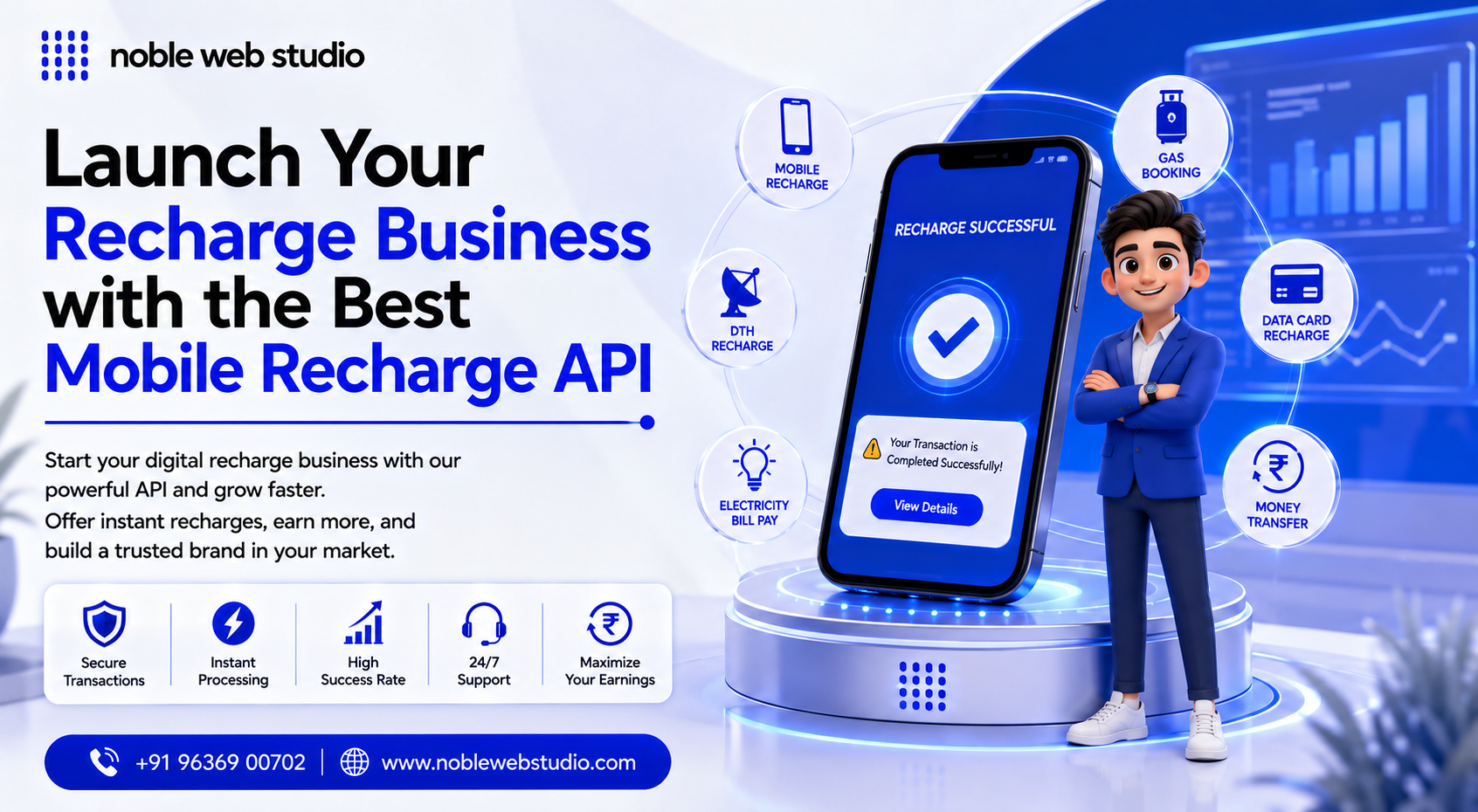
The demand for digital recharge services is growing rapidly across India, making it the perfect time to start a mobile recharge business. Millions of users recharge their prepaid mobile, pay postpaid bills, recharge DTH connections, and make utility bill payments every day. To offer these services smoothly, businesses need a secure and reliable Mobile Recharge API that delivers fast transactions, high uptime, and seamless integration.
A top mobile recharge API is a software tool that lets businesses add instant prepaid mobile top-ups, DTH recharges, and bill payments to their own mobile recharge commission app or websites. It acts as a bridge connecting your recharge platform directly to multiple telecom networks.
Whether you are a startup, retailer, distributor, fintech company, or entrepreneur, choosing the best Mobile Recharge API can help you launch a professional recharge platform with confidence. A feature rich recharge API allows you to provide mobile recharge, DTH recharge, data card recharge, and utility bill payment services from a single recharge platform while managing retailers, commissions, wallets, and transactions efficiently.
Noble Web Studio provides advanced Mobile Recharge API Solution designed for businesses that want to build a scalable and profitable recharge platform. With easy mobile recharge API integration, support for major telecom operators, real-time transaction processing, a secure admin panel, automated commission management, and dedicated technical support, businesses can deliver a reliable recharge experience to their customers.
If you are planning to launch new recharge portal or upgrade your existing recharge system, investing in a trusted Mobile Recharge API Provider like Noble web studio is the first step toward long-term business success. The right mobile recharge API improves transaction speed, enhances customer satisfaction, and helps your business grow in the competitive digital payments market.
In this complete guide, you’ll learn everything you need to know about starting a recharge business with the best Mobile Recharge API. We’ll cover how recharge APIs work, their key features, business benefits, essential factors to consider before choosing an API provider, integration process, security practices, and tips to scale your recharge platform successfully.
What Is a Mobile Recharge API?
A mobile recharge API is a software tool that lets businesses add instant prepaid top-up, DTH, and bill payment options directly into their own websites or best recharge commission app. It connects your b2b recharge platform straight to telecom networks so you do not need separate contracts for each carrier.
How Does a Mobile Recharge API Work?
A branded mobile recharge API is a recharge software bridge that lets an recharge commission app process mobile top-ups automatically by connecting to telecom networks through request initiation, authentication, and real-time processing.
Step-by-Step Workflow
- Request Initiation: A user enters their mobile number, operator name, and amount on your website or app.
- API Call: Your system sends a secure HTTP/JSON request containing these details and your mobile recharge API key to the Noble web studio.
- Validation: The Noble web studio server checks your account balance, security credentials, and the validity of the phone number.
- Operator Processing: The Noble web studio routes the transaction straight to the specific telecom operator (like Jio or Airtel) to load the talktime or data.
- Response and Confirmation: The telecom network replies with a success or failure status, which the best recharge API instantly sends back to display a receipt on your recharge b2b app.
Services You Can Offer with a Mobile Recharge API
A modern mobile recharge API allows you to offer prepaid and postpaid mobile top-ups, DTH renewals, and extensive utility bill payments.
Telecom and Media Services
- Prepaid Mobile Top-up: Instant recharges for major carriers like Jio, Airtel, Vi, and BSNL.
- Postpaid Bill Payments: Automated cycle bill clearing for cellular lines.
- DTH Recharge: TV account activations for Tata Play, Airtel Digital TV, Dish TV, and Sun Direct.
- Data Card Top-up: Internet dongle and portable router balance additions.
Utility and Digital Payments
- Electricity Bills: State and private board energy bill processing (e.g., UPPCL, BSES).
- Gas and Water Bills: Piped gas, cylinder bookings, and municipal water tax payments.
- FASTag & Metro Card: Toll tag account loading and city metro smart card top-ups.
- Financial and Gift Vouchers: Insurance premium submissions and Google Play digital redeem codes.
Multi-Operator Mobile Recharge API Support
Multi operator mobile recharge API support lets you process top-ups and bills for all major telecom providers through a single integration, featuring automatic failover and real-time status reporting.
Supported Services and Operators
- Telecom Providers: Instant prepaid and postpaid billing for Jio, Airtel, Vi (Vodafone Idea), and BSNL.
- DTH & Utilities: Satellite TV networks (Tata Play, Dish TV) alongside BBPS utility bills like electricity, gas, and FASTag.
- Data Cards: Instant online recharges for portable internet dongles and broadband plans.
Prepaid and Postpaid Mobile Recharge API Services
A High Success Mobile Recharge API allows businesses to offer both Prepaid Mobile Recharge and Postpaid Mobile Bill Payment through a single recharge platform. Instead of managing different systems for different operators, businesses can provide fast, secure, and real-time recharge services using one recharge API integration.
Whether you are building a B2B recharge portal, a fintech application, a recharge wallet platform, or a mobile recharge website, supporting both prepaid and postpaid services helps you serve a wider customer base and generate more recurring transactions.
Prepaid Mobile Recharge API
A Prepaid Mobile Recharge API enables customers to instantly recharge their prepaid mobile numbers from your website, Android recharge app, or recharge portal. The Prepaid Mobile Recharge API connects with supported telecom operators and processes recharge requests in real time.
Key benefits include:
- Instant prepaid mobile recharge
- Support for multiple telecom operators
- Real-time recharge status
- Fast recharge API response
- Secure transaction processing
- Easy integration with websites and mobile recharge earning app
- Live transaction reporting
Postpaid Mobile Bill Payment API
A Postpaid Mobile Recharge API allows customers to pay their monthly mobile bills online without visiting operator stores or payment centres. The Postpaid Mobile Recharge API securely validates the bill amount, processes the payment, and returns the transaction status within seconds.
Common features include:
- Instant postpaid bill payment
- Real-time bill validation
- Secure payment processing
- Automatic payment confirmation
- Transaction history and reports
- Multiple operator support
- Fast settlement process
Supported Telecom Operators
A quality Mobile Recharge API generally supports leading telecom operators across India, making it easier for businesses to provide recharge and bill payment services from one recharge admin platform.
Typical operator support includes:
- Jio
- Airtel
- Vi (Vodafone Idea)
- BSNL
Operator availability depends on the Noble web studio and commercial agreements.
Documents Required for Start Recharge Business
To start mobile and utility recharge business, the essential documents required depend on whether you operate as a Noble web studio. The core documents needed are a PAN Card, Aadhaar Card, and a Bank Account Proof.
Identity and Address Proof (KYC)
- PAN Card: Mandatory personal or business PAN for financial tracking and commission payouts.
- Aadhaar Card / Voter ID / Passport: Government-issued identity and address proof for owner verification.
- Passport-Size Photographs: Recent photos for application forms.
Business and Financial Proof
- Bank Account Details: Passbook copy, canceled cheque, or current account statement for loading wallet balance and receiving commissions.
- Business Registration: Udyam Registration or Shop & Establishment License (for small/proprietorship setups) or Certificate of Incorporation (for Private Limited companies).
- GST Registration: Required if you cross specific state turnover thresholds or operate a corporate/white label recharge B2B portal.
Mobile Recharge API Transaction Flow
Who Can Start a Recharge Business?
Anyone with basic digital tools and valid identity proof can start recharge business, including local shop owners, independent entrepreneurs, and rural service providers.
Who Can Become a Retailer or Distributor
- Retail Shop Owners: Grocery (Kirana) stores, mobile repair shops, pharmacies, and stationery outlets can add recharges to increase customer visits.
- Mobile Shop Owners: Increase daily revenue by adding multi-operator recharge services.
- Fintech Startups: Build your own branded recharge platform using a White Label Recharge API.
- Entrepreneurs: Launch a profitable digital recharge business with low initial investment.
- Distributors & Master Distributors – Create a retailer network and manage recharge services from a single dashboard.
- B2B Recharge Portal Owners: Noble web studio offer recharge solution to retailers, agents, and distributors through a scalable recharge platform.
- Online Service Providers: Add mobile recharge services to websites, best mobile recharge commission app or digital payment platforms.
- Software Companies: Integrate Recharge API into existing fintech products to expand service offerings.
- Digital Service Centres & CSC Operators: Provide recharge and utility payment services alongside other digital services.
- Home-Based Individuals: Anyone using mobile apps like JioPOS Lite or multi-utility distributor platforms can work independently from home.
- Village Level Entrepreneurs (VLEs): Rural operators bringing digital and financial services to underserved areas.
Why Start a Recharge Business with a Mobile Recharge API?
Starting recharge business with a fast mobile recharge API allows you to offer instant transactions, earn reliable recharge commission, and scale effortlessly. Key benefits include complete automation, multi-operator support, and low setup costs.
Core Business Advantages
- Instant Processing: Automates top-ups in real time without manual work.
- Revenue Growth: Earns commission margins (typically 2% to 7%) on every transaction.
- Single Integration: Connects your recharge service platform to multiple telecom and DTH operators at once.
- Low Investment: Removes the high cost of building custom infrastructure from scratch.
- High Scalability: Manages growing transaction volumes smoothly as your customer base expands.
- 24/7 Reliability: Operates continuously with secure data protocols and real-time activity reports.
Mobile Recharge API Use Cases
A High speed Mobile Recharge API connects businesses directly to telecom networks to automate prepaid top-ups, data packs, DTH recharges, and postpaid bill payments across multiple operators. It eliminates the need to build individual partnerships with every single carrier by providing a single, unified interface.
Core Fintech & Banking Use Cases
- Digital Wallets: Noble web studio integrated recharge API to allow instant prepaid and data top-ups directly inside the wallet.
- Neo-Banking Apps: Banks embed these multi recharge API to create financial “Super recharge commission App” handling utility bills alongside checking accounts.
- Micro-Finance Platforms: Financial systems use smooth recharge API to clear postpaid bills and collect regular localized utility payments.
Retail & B2B Business Models
- B2B White-Label Portals: Noble web studio develop recharge software for independent agents to resell airtime and earn transaction commissions.
- Merchant Point-of-Sale (POS): Physical retail networks and local grocery stores use strong recharge API to provide over-the-counter mobile recharges.
- Kiosk Operations: Automated self-service cash kiosks integrating recharge API to process walk-up prepaid talk time purchases.
Digital Commerce & Loyalty
- E-commerce Checkout Add-ons: Online marketplaces offer recharges during or after shopping to boost daily app traffic and user retention.
- Corporate Rewards Platforms: Companies leverage seamless recharge API to distribute airtime or data packs automatically as staff performance incentives or consumer rewards.
- Travel & Remittance Apps: Global platforms use International Mobile Top-Up (IMT) configurations so expatriates can send instant talk time to families overseas.
Business Models You Can Launch with a Recharge API
You can launch profitable recharge business models using a reputed recharge API, including the B2C Retailer Model, White Label Recharge B2B Reseller Network, and Super-App Utility Integration.
B2C Digital Wallet and Retail Portal
- Direct Customer Service: Serve end-users via a custom mobile recharge software or local storefront where users execute prepaid mobile, DTH, and data card top-ups.
- Revenue Driver: Earn a direct commission (typically 1.5% to 3.5%) on every successful transaction processed through your integrated payment gateway.
- Extended Utility: Combine basic recharges with BEST BBPS channels for local electricity, water, and gas bills to increase mobile recharge earning app engagement.
White-Label B2B Multi-Level Reseller Platform
- Hierarchical Distribution: Build your own chain of master distributors, secondary distributors, and local retailers under your custom brand domain.
- Automated Commission Slabs: Set volume-based commission splits across 10+ operational levels, letting lower tiers earn per transaction while you take an override margin on total network volume.
- Turnkey Software Provisioning: Sell turnkey recharge admin portal and branded best Android recharge application to other small business operators.
Super-App / Feature Integration Model
- Embedded Value-Add: Embed prepaid recharge, FASTag toll top-ups, or utility payment features inside an existing non-fintech application (such as a local delivery service or general utility portal).
- Customer Retention: Increase daily active usage and top recharge platform stickiness by keeping users inside your ecosystem for their recurring monthly bills.
- Monetization: Charge a small convenience fee per transaction or offset operational recharge software cost through high-volume telecom recharge commission margin.
Mobile Recharge API for Startups, Retailers & Distributors
A Professional mobile recharge API allows startups, retailers, and distributors to integrate automated, real-time prepaid, postpaid, and DTH services into their platforms. Key operational advantages include multi-operator support, hierarchical channel control, and automated commission tracking.
Core Features & Architecture
- Single REST/JSON Endpoint: Connects all major telecom operators (Jio, Airtel, Vi, BSNL) and DTH providers (Tata Play, Dish TV) through a single technical request line.
- Hierarchy Management: Built-in multi-level controls allow master distributors to create, fund, and oversee unlimited subordinate distributors and retail outlets.
- White-Label Customization: Fully branded mobile recharge portal and mobile recharge software configurations enable startups to resell the infrastructure under their own corporate identity.
- Real-Time Callbacks: Instant automated transaction logs, balance alerts, and webhook-driven success/failure updates.
Business Models by User Tier
- Startups: Deploy white label recharge platform to quickly launch digital wallet services or cross-sell utility and telecom value additions without heavy foundational overhead.
- Distributors: Operate master nodes, passing base mobile recharge commission margin (e.g., 3.0%) downstream to retail networks while capturing volume override margins (e.g., 3.5%).
- Retailers: Embed single-click local counter top-ups into existing point-of-sale setups, drawing immediate commission yields on every physical or digital customer transaction.
Why Mobile Recharge API Is Essential for a Recharge Business
A low cost mobile recharge API is essential because it automates transactions, supports multiple operators through a single connection, and generates commission revenue. It transforms any website or recharge admin app into an instant top up mobile recharge admin portal.
For businesses planning to enter the digital recharge market, using a reliable Recharge API helps deliver a seamless experience while reducing operational effort. Customers expect instant recharge confirmation, real-time transaction status, and support for multiple operators, and an trusted recharge API makes these features possible.
Key Reasons Why a Mobile Recharge API Is Important
- Instant Recharge Processing: Customers receive fast recharge confirmations, helping improve their overall experience.
- Multiple Operator Support: Manage recharges for major telecom operators from one platform instead of integrating each operator separately.
- Easy Business Expansion: Add services like DTH recharge, BBPS bill payments, FASTag recharge, AEPS, or DMT as your business grows.
- Automation: Recharge requests, status updates, callbacks, and reports are handled automatically, reducing manual work.
- Real-Time Transaction Tracking: Monitor recharge status, wallet balance, and transaction history from a centralized dashboard.
- Secure API Integration: Modern recharge API use secure authentication methods and encrypted communication to protect business and customer data.
- Scalable Infrastructure: Whether you process hundreds or thousands of transactions daily, a well-designed Recharge API can support business growth.
- Better Customer Experience: Faster processing, fewer failed transactions, and transparent status updates help build customer trust and encourage repeat business.
Why Mobile Recharge Businesses Use Mobile Recharge API
Mobile recharge businesses use a low budget mobile recharge API to automate transactions, provide instant multi-operator support, and reduce operational costs. It serves as a direct bridge between a company’s app or website and telecom providers.
Key Operational Benefits
- Faster Recharge Processing: Customers expect mobile recharges to be completed within seconds. A Mobile Recharge API processes recharge requests in real time, reducing manual work and helping businesses provide quick and reliable service.
- Secure Transaction Management: Professional Recharge API use secure authentication methods and encrypted communication to help protect transaction data. This improves reliability and builds customer confidence in your recharge platform.
- Real-Time Transaction Status: Businesses can track every recharge request through live status updates. Instant confirmation helps reduce customer queries and makes it easier to manage successful, pending, or failed transactions.
- Cost Reduction: Lowers operational overhead by removing the need for physical infrastructure or large manual support teams.
- Error Reduction: Manual recharge processing takes time and requires continuous monitoring. With recharge API automation, recharge requests, transaction tracking, wallet updates, and reporting become faster and more efficient, allowing businesses to focus on growth.
- Easy Business Scalability: As your customer base grows, a Mobile Recharge API makes it easier to handle a larger number of transactions without changing your existing workflow. This allows businesses to expand their retailer, distributor, and customer network more efficiently.
Service and Feature Expansion
- Easy Integration with Existing Platforms: Most Mobile Recharge API can be integrated with websites, Android mobile recharge application, B2B mobile recharge portal, and custom recharge software. This enables businesses to launch new digital services without rebuilding their entire system.
- Support for Multiple Telecom Operators: Instead of integrating with each telecom operator separately, businesses can use one multi mobile recharge API to access multiple operators from a single mobile recharge platform. This simplifies operations and reduces recharge API development time.
- Access to Detailed Reports: Recharge API provide transaction history, wallet details, operator-wise reports, and settlement information from a single RECHARGE API dashboard. These insights help businesses monitor performance and make informed decisions.
- Extra Income: Generates fresh revenue streams via recharge commission margins on every successful top-up.
- Broad Utility Options: Allows expansion into broader digital services like utility bills and data card recharges.
- Better User Experience: Keeps customers inside the host app or website, boosting long-term engagement and retention.
- Supports Business Growth: A Seamless Mobile Recharge API is more than a technology integration it provides the foundation for building a scalable digital recharge business. Many businesses also expand their modern recharge platform by adding services such as top BBPS DTH recharge, FASTag recharge and best AEPS through the same ecosystem.
Features Mobile Recharge API
A Mobile Recharge API provides core features like multi-operator support, real-time transaction processing, and automated status callbacks. It enables software applications to programmatically process top-ups and bill payments.
Core Functional Features
- Multi-Operator Coverage: Supports major telecom and DTH providers (like Airtel, Jio, Vi, BSNL, Tata Play) through a single connection.
- Real-Time Processing: Executes transactions in milliseconds with immediate success or failure callbacks.
- Automated Status Tracking: Provides instant transaction logs, automated refund handling for failed requests, and webhook notifications.
- Multi-Service Expansion: Handles data cards, FASTag, electricity, gas, and water bill payments alongside mobile top-ups.
Technical and Security Features
- REST/JSON Architecture: Uses standard, lightweight HTTP methods and JSON-encoded payloads for fast developer integration.
- Sandbox Environment: Offers a risk-free testing zone with dummy credentials before going recharge API live.
- High-Grade Encryption: Secures user credentials and financial data using industry-standard tokenization and SSL protocols.
- Automated Refund Handling: Reverses failed or dropped transactions back to the user wallet or ledger automatically.
- Scalability and High Uptime: Built to handle high-volume request concurrency with a 99.9% to 99.99% uptime SLA.
- Wallet & Commission Ledger: Tracks live balance checks, profit margins, and volume-based tier commissions in real time.
Benefits Mobile Recharge API
Integrating mobile recharge API offers key benefits including instant automated transaction processing, multi-operator support, and new revenue streams through commissions.
Business and Operational Advantages
- Instant Processing: Completes prepaid mobile, DTH, and data card top-ups in real time with high success rates.
- Revenue Generation: Earns recharge commission or margins (typically 2% to 4%) on every successful customer transaction.
- Cost Efficiency: Avoid building expensive individual connections to every telecom or utility provider by using one unified system.
- Automation & Efficiency: Removes manual work and human error by handling requests, confirmations, and auto-refunds automatically.
- Easy Scalability: Scale transaction volumes seamlessly as your user base grows without upgrading infrastructure.
- Single Integration: Eliminates the need to contract separate telecom providers by bundling hundreds of national and regional operators into one connection.
Customer Experience Benefits
- All-in-One Convenience: Allows users to pay utility bills and recharge accounts directly inside your existing top recharge commission app or website.
- High Uptime & Reliability: Delivers stable, 24/7 service infrastructure without requiring physical stock or scratch cards.
Steps Mobile Recharge API Integration
Mobile Recharge API integrate connects your recharge service platform directly to telecom operators through a single B2B aggregator to automate prepaid data and talk-time top-ups. By embedding this software bridge into an recharge service application or website, businesses bypass the need to negotiate individual contracts with Noble web studio.
The step-by-step process to successfully execute this integration spans five distinct developmental phases:
1. Vendor Selection & Onboarding
- Choose a multi-operator provider: Select an Noble web studio supporting all required telecom providers.
- Complete business verification: Submit Know Your Customer (KYC) documents to activate the service.
- Acquire development credentials: Access the mobile recharge service portal to generate your production and sandbox mobile recharge API keys.
2. Sandbox Architecture Mapping
- Review JSON/REST documentation: Study endpoint structures, mandatory parameter blocks, and authentication standards.
- Examine operator lookup tools: Connect user entry forms to Operator/Circle Lookup APIs to automatically identify network types from phone numbers.
- Render real-time tariffs: Use plan-fetching endpoints to display active plans directly to customers, preventing pricing errors.
3. Core Endpoint Integration
Developers typically implement a sequence of key HTTP methods:
- GET /account/balance: Ensures your master developer wallet holds adequate funds before attempting a top-up.
- POST /recharge/process: Transmits critical request parameters including the recipient’s phone number, unique transaction reference, operator code, and strict payment amount.
- GET /transaction/status/{id}: Polls the aggregator’s database to verify successful confirmation independent of the initial raw HTTP response code.
4. Logic & Error Handling Best Practices
- Prevent duplicate requests: Implement client-side transaction identifiers to handle accidental double clicks.
- Establish webhooks: Set up listener paths to receive asynchronous operator callbacks for processing delayed transactions.
- Configure automated refunds: Link failed status codes directly to internal wallet operations to immediately return money back to users.
5. Sandbox Testing & Deployment
- Execute mock requests: Trigger test scenarios inside a free sandbox environment across various dummy operator codes.
- Pre-fund production wallets: Deposit the minimum required working balance into your active aggregator profile.
- Update production base URLs: Swap out mock endpoint domains for live endpoints and swap in mobile recharge API live merchant credentials.
Mobile Recharge API Cost Structure
Mobile recharge API cost structures combine setup fees, ongoing recharge software cost and a commission-based model rather than per-call charges. Key components include one-time recharge API setup fees (₹1,000 to ₹35,000), white label mobile recharge portal (₹25,000 to ₹1.2 Lakhs), and transaction commissions (0.5% to 7% earnings per recharge).
Setup and Integration Costs
- Basic API Access: ₹1,000 to ₹5,000 for standard credentials and recharge API documentation.
- Multi-Operator Integration: ₹5,000 to ₹25,000 for comprehensive access to telecom, DTH, and utility endpoints.
- Minimum Wallet Deposit: ₹5,000 to ₹25,000 initial pre-funded balance required by Noble web studio to process live transactions.
Software and White-Label Fees
- Mobile Recharge Admin Panel / Mobile Recharge Admin Portal: ₹25,000 to ₹60,000 for basic web recharge admin software.
- Full White Label Recharge App & Website: ₹25,000 to over ₹1.2 Lakhs for ready-to-use branded multi-channel solutions.
- Monthly Maintenance: ₹500 to ₹2,000 per month for server storage, technical support, and updates.
Commission and Earning Structure
- Prepaid Mobile Margins: 1.5% to 4% commission earned per successful transaction, varying by operator (e.g., BSNL/Jio offer higher rates than Airtel/Vi).
- DTH Recharge Margins: 3% to 7% return on direct DTH recharges.
- Utility Bills: Flat fees ranging from ₹5 to ₹20 per bill or lower 1% to 3% margins.
Mobile Recharge API Commission Structure
Mobile recharge API commission structures typically range from 1% to 7.5% per transaction, varying by operator, service type, and monthly volume tiers. Commissions are credited instantly to digital wallets upon successful completion.
Commission Margins by Service Type
- Prepaid Mobile: 1.0% to 4.0% for major private telecom operators; BSNL often yields higher margins up to 5.0%–6.0%.
- DTH Recharge: 3.0% to 7.0% depending on the TV provider.
- Data Card: 3.0% to 5.0% per successful top-up.
- Utility Bills & Postpaid: Flat fees of ₹5 to ₹20 per transaction or lower percentage margins of 1% to 3%.
Volume and Tiered Slabs
- Low Volume (0 – ₹1 Lakh/month): 3.8% to 4.5% average return.
- Mid Volume (₹10 Lakhs – ₹50 Lakhs/month): 4.8% to 6.0% average return.
- High Volume (₹2+ Crores/month): 6.2% to 7.5% top-tier commission slabs.
Business Hierarchy Split
- Master Distributor / API Provider: Retains the highest base cut (4%–7.5%).
- Distributor: Retains an override margin (3%–5.5%) after passing allocations down.
- Retailer / Agent: Receives the final lower direct margin (1%–3%) for end-user point-of-sale use.
MULTI RECHARGE API COMMISSION LIST
Multi Recharge API Commission List
Highest commission rates guaranteed for all major operators. Instant auto-wallet updates and real-time processing.
| Sr. No. | Operators |
STARTER PLAN
₹4500
₹3000
COMMISSION (%)
|
GOLD PLAN
₹6500
₹4500
COMMISSION (%)
|
PLATINUM PLAN
₹8500
₹5500
COMMISSION (%)
|
|---|---|---|---|---|
| 1 | Vodafone | 3.30 | 3.40 | 3.50 |
| 2 | Airtel | 0.80 | 0.90 | 1.00 |
| 3 | Jio | 0.80 | 0.90 | 1.00 |
| 4 | BSNL | 3.00 | 3.10 | 3.20 |
| 5 | Idea | 3.30 | 3.40 | 3.50 |
| 6 | Dish TV | 3.60 | 3.70 | 3.80 |
| 7 | Airtel Digital TV | 4.00 | 4.10 | 4.20 |
| 8 | Sundirect DTH TV | 3.30 | 3.40 | 3.50 |
| 9 | Videocon DTH TV | 4.00 | 4.10 | 4.20 |
| 10 | Tatasky DTH TV | 3.00 | 3.10 | 3.20 |
| 11 | Postpaid Bill | 0.00 | 0.00 | 0.00 |
| 12 | Google Play Gift Card | – | 2.00 | 2.50 |
| 13 | Electricity Bill | – | 0.00 | 0.00 |
| 14 | FASTag Recharge | – | – | 0.15 |
| 15 | LIC Premium | – | – | 0.40 |
| 16 | Gas Cylinder | – | – | 0.40 |
Why Choose Our Recharge API?
- ✅ High success ratio (99.9%)
- ✅ 24/7 technical support
- ✅ Seamless integration (PHP, HTML, Android)
- ✅ Real-time callback and reporting
- ✅ Single wallet for all services
- ✅ Instant dispute resolution
Complete Mobile Recharge API Documentation
A standard mobile recharge API documentation covers authentication, core endpoints, and response handling. It typically includes methods for checking account balance, processing prepaid recharges, and verifying transaction status.
Recharge API Documentation
Integrate Mobile, DTH, and Utility recharge services seamlessly into your application.
| API Integration Master Table | |||||||||||||||||||||||||||||||||||
|---|---|---|---|---|---|---|---|---|---|---|---|---|---|---|---|---|---|---|---|---|---|---|---|---|---|---|---|---|---|---|---|---|---|---|---|
| 1. Recharge API | |||||||||||||||||||||||||||||||||||
| Endpoint | GET/POST https://business.a1topup.com/recharge/api | ||||||||||||||||||||||||||||||||||
| Parameters |
|
||||||||||||||||||||||||||||||||||
| Example URL |
https://business.a1topup.com/recharge/api?username=500011&pwd=123&operatorcode=A&number=9800000000&amount=10&orderid=485668&format=json
|
||||||||||||||||||||||||||||||||||
| JSON Response |
{
  "txid": "5804",
  "status": "Success",
  "opid": "RJ0317161622000269New",
  "number": "9800000000",
  "amount": "10",
  "orderid": "485668"
}
|
||||||||||||||||||||||||||||||||||
| 2. Balance API | |||||||||||||||||||||||||||||||||||
| Endpoint | GET/POST https://business.a1topup.com/recharge/balance | ||||||||||||||||||||||||||||||||||
| Parameters |
|
||||||||||||||||||||||||||||||||||
| Example URL |
https://business.a1topup.com/recharge/balance?username=500011&pwd=123&format=json
|
||||||||||||||||||||||||||||||||||
| JSON Response |
{
  "status": "success",
  "balance": "1542.50",
  "currency": "INR"
}
|
||||||||||||||||||||||||||||||||||
| 3. Status API | |||||||||||||||||||||||||||||||||||
| Endpoint | GET/POST https://business.a1topup.com/recharge/status | ||||||||||||||||||||||||||||||||||
| Parameters |
|
||||||||||||||||||||||||||||||||||
| Example URL |
https://business.a1topup.com/recharge/status?username=500011&pwd=123&orderid=485668&format=json
|
||||||||||||||||||||||||||||||||||
| JSON Response |
{
  "status": "Success",
  "txid": "5804",
  "opid": "RJ0317161622000269New",
  "number": "9800000000",
  "amount": "10",
  "orderid": "485668",
  "timestamp": "2023-12-15 10:30:05"
}
|
||||||||||||||||||||||||||||||||||
| 4. Callback URL | |||||||||||||||||||||||||||||||||||
| Structure | yourdomain.com/callback?txid={ORDER_ID}&status={STATUS}&opid={OPERATOR_ID} | ||||||||||||||||||||||||||||||||||
| Parameters |
|
||||||||||||||||||||||||||||||||||
| Example Code (PHP) |
<?php
$txid = $_GET['txid'];
$status = $_GET['status'];
$opid = $_GET['opid'];

// Update your database
if($status == "Success") {
    // Process success
} else {
    // Process failure
}
echo "OK"; // Always return OK to acknowledge receipt
?>
|
||||||||||||||||||||||||||||||||||