
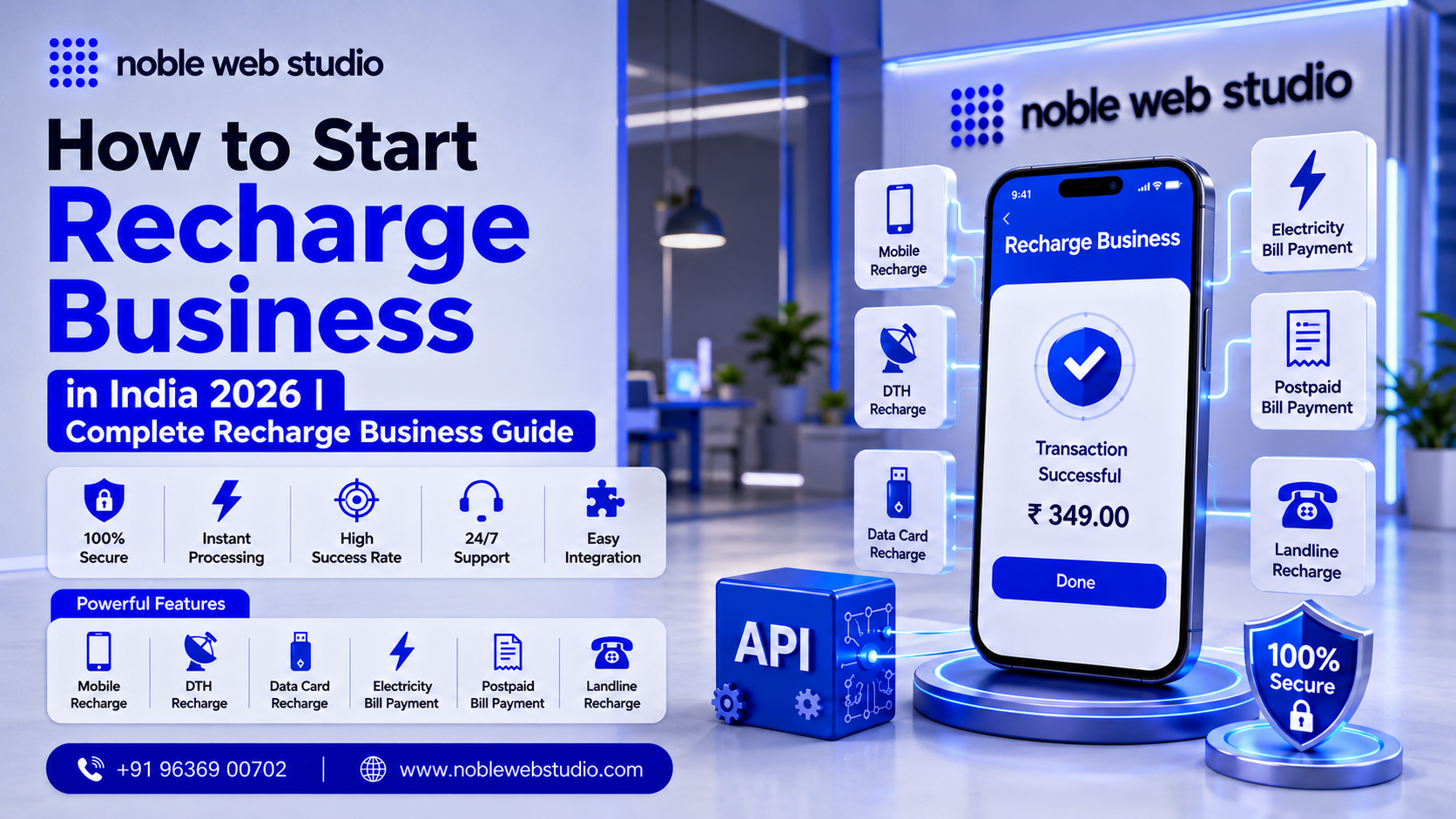
⭐ 4.8/5 Rated by Retailers | 🕐 9 min read | 📅 Updated: July 2026 | ✅ 2000+ Businesses Trust Noble Web Studio
Starting a recharge business in India is one of the easiest and most profitable ways to enter the fast-growing digital payments industry. With millions of people using mobile recharge, DTH recharge, FASTag recharge, and utility bill payment services every day, the demand for reliable recharge platforms continues to grow. Whether you are a retailer, distributor, entrepreneur, or startup, launching a recharge business can create a steady source of income with a relatively low investment.
To build a successful business, you need a trusted B2B Recharge Software, secure Recharge API Integration, and a user-friendly admin panel that can manage retailers, distributors, commissions, wallets, and transactions. A feature-rich recharge platform allows you to provide instant recharge services, real-time transaction tracking, and secure digital payments, helping you attract more customers and grow your business.
Starting a recharge business involves choosing between becoming an independent platform owner (creating a portal/app) or an agent (acting as a retailer using existing apps). Costs range from ₹5,000 for basic software to ₹1,00,000+ for custom platforms.
Many people search for how to start a recharge business in India because they want to earn regular commissions while offering useful digital services to customers. With the right Mobile Recharge Software and Recharge API Integration, you can provide prepaid recharge, postpaid bill payments, DTH recharge, and BBPS bill payment services from a single platform.
One of the biggest advantages of this business is that it can be expanded over time. You can begin as a retailer and later build your own network of retailers and distributors. A professional B2B Recharge Software helps you manage users, wallets, commissions, transactions, and reports through an easy-to-use admin panel, making business operations simple and efficient.
Choosing a trusted Recharge Software Provider is essential for long-term success. A reliable platform offers fast recharge processing, high transaction success rates, secure API integration, real-time reporting, wallet management, and dedicated technical support. These features help improve customer satisfaction, reduce transaction failures, and support business growth.
Noble Web Studio provides a complete Mobile Recharge Software Solution designed for retailers, distributors, startups, and fintech companies. With secure technology, advanced admin features, Recharge API integration, BBPS support, and scalable infrastructure, businesses can confidently start and grow their recharge business.
In this guide, you will learn how to start a recharge business in India, the investment required, the step-by-step setup process, the software and APIs you need, and practical tips to build a successful and profitable digital recharge business.
What is Recharge Business
A mobile recharge business allows customers to top up their prepaid mobile phones, pay postpaid bills, and purchase data or value-added services. Retailers and platforms process these transactions directly with telecom operators and earn a fixed percentage or flat-rate commission.
Recharge Business Work
A recharge business acts as a digital intermediary between consumers and telecom/utility providers . You provide a platform for customers to top up prepaid mobile phones, DTH services, and pay utility bills, earning a commission on every successful transaction .
How the Business Model Works
- Retailer: You serve end-customers directly via an app or web portal. When a customer gives you cash to recharge their mobile, you process it digitally and keep the operator’s commission .
- Distributor: You onboard and manage multiple retailers . You earn a percentage from the collective transaction volume of your network .
- Admin/White Label: You own the master software, set commission slabs for distributors and retailers, and manage API integrations with telecom operators.
Choose Your Business Model: Retailer vs Distributor vs Admin
Before anything else, decide which level you want to operate at this single decision shapes your investment, effort, and earning ceiling.
- Retailer: You serve end customers directly from a shop or app and earn a small commission per transaction. Lowest investment (₹5,000–₹15,000), fastest to start, but capped earning potential.
- Distributor: You onboard and manage a network of retailers, earning an override commission on their collective transaction volume in addition to your own. Medium investment (₹15,000–₹50,000).
- Admin (Platform Owner): You own the entire white-label recharge platform setting commission structures, managing distributors and retailers, and earning across every transaction in your network. Highest investment, highest long-term earning potential.
Most entrepreneurs planning a long-term business should target the Admin model from the start rather than starting as a retailer and upgrading later it avoids having to migrate your customer base to a new platform down the line.
Types of Recharge Businesses
Recharge businesses operate through various models focusing on mobile, DTH, and utility payments, categorized by their target audience and technology. Key types include B2C (individual use), B2B (agent networks), Multi-Recharge platforms, and White-label solutions. These businesses are popular for high-frequency transactions and income opportunities via commissions.
Key Types of Recharge Business Models
- B2C (Business-to-Consumer) Platform: Designed for individual consumers to perform self-recharges (e.g., Paytm, operator apps).
- B2B (Business-to-Business) Platform: Enables agents, retailers, or distributors to manage customer recharges and earn commission, catering to a network.
- White-Label Recharge Portal: Allows entrepreneurs to launch their own branded recharge platform, utilizing a third-party’s backend software.
- Multi-Recharge Software: A comprehensive system that supports multiple operators (mobile, DTH, data cards) and utility services on a single platform.
- API-Based Recharge Services: Technical solutions that allow developers or businesses to integrate recharge features into their own existing applications or websites.
- Offline Retail/Scratch Cards: Traditional retail shops selling operator-specific top-up vouchers, although this is declining in favor of online methods.
Who Can Start Recharge Business
Anyone can start a mobile recharge business, including small shop owners, entrepreneurs, students, or homemakers, requiring only a smartphone/tablet, internet connection, and a recharge app. It is a high-demand, low-investment opportunity that generates revenue through commissions on mobile, DTH, and utility bill payments.
Who Can Start the Business:
- Retail Shop Owners: Grocery stores, medical shops, and garment shops can act as retail points to increase footfall.
- Aspiring Entrepreneurs: Individuals looking for a low-cost, low-risk business venture.
- Students & Homemakers: Anyone seeking a flexible side hustle to earn extra income from home.
- Existing Business Owners: Those wanting to expand their services (e.g., cyber cafes).
Why Start a Mobile Recharge Business in 2026?
Starting a mobile recharge business in 2026 is highly lucrative due to low startup costs, minimal technical barriers, and guaranteed recurring demand . Entrepreneurs can enter the market with as little as ₹5,000 to ₹10,000 , and instantly earn consistent, commission-based revenue on every mobile and DTH top-up .
Key Reasons to Start a Recharge Business
- High Demand & Recurring Income: Telecom and satellite TV services are recurring monthly necessities, guaranteeing a steady stream of returning customers .
- Low Investment & High Scalability: You don’t need a physical location or custom software development. Platforms allow you to start as a local retailer or scale up to manage your own network of distributors and master distributors.
- Diverse Revenue Streams: You can maximize profit margins by offering value-added services like utility bill payments (BBPS), FASTag, PAN cards, and Aadhaar Enabled Payment System (AEPS) from a single smartphone or white-label platform.
- Easy Setup & High Portability: The business is easy to operate, often referred to as an “office in your pocket,” allowing transactions while traveling.
- Attractive Commission Structure: Earn consistent commissions on every mobile recharge, DTH top-up, and bill payment.
- Diversification of Services: Retailers can add more value by offering AEPS (Aadhaar Enabled Payment System) and insurance, increasing profit margins.
- Instant Processing: Modern software and Recharge APIs enable immediate transaction processing and fast commission payouts, ensuring operations are smooth and error-free.
Documents Need Start Recharge Business
To start a recharge business in India, you primarily need Aadhaar, PAN card, a business bank account, and passport-size photos for KYC verification. Retailers need a smartphone/computer, while online portals require GST registration, domain/hosting, and API integration. Partner with BBPS agents or operators like Jio for authorized services.
Key Documents Required
- Identity Proof: Aadhar card, PAN card, Voter ID, or Passport.
- Address Proof: Aadhar card, Voter ID, or Driving License.
- Business Address Proof: Electricity bill, Rent Agreement, or Property Tax Receipt (if required for shop).
- Banking Documents: Canceled cheque or Bank Passbook.
- Photographs: Recent passport-size photographs.
- Registration Documents: PAN card is mandatory. GST Registration is necessary for businesses with higher turnover or online portals.
- Legal Documents: A signed agreement if partnering with a principal company/franchise.
Key Aspects of Start Recharge Business
Starting a recharge business requires choosing a model (Retailer, Distributor, or White-Label) , registering your business with valid KYC, and partnering with a reliable Multi-Recharge API. Income is earned through instant commissions (typically 1% to 7%) on successful transactions for mobile, DTH, and utility bills .
Key Aspects to Build a Successful Business
Business Model Selection:
- Retailer: Direct sales to consumers; lowest investment . Great for local kirana store owners using specialized commission apps .
- Distributor: Manages a network of retailers; earns higher margins and overrides.
- White-Label / API Partner: You own your own brand and custom software, providing recharge access to others.
Platform & Technology:
- You need a user-friendly mobile app, website, and centralized admin panel .
- Integrate a reliable Multi-Recharge API to ensure instant, real-time transaction processing and high success rates .
Legal & Financial Compliance:
- Register your business (e.g., Sole Proprietorship) .
- Complete mandatory KYC with your chosen provider using your Aadhaar card, PAN card, and business bank account .
Service Diversification:
- Expand past prepaid mobile and DTH recharges . Include bill payments like electricity, FASTag, and insurance to boost footfall and monthly income.
Initial Investment & Margins:
- Costs vary from ₹0 (if starting on app-based systems) to ₹50,000+ for custom, white-label portals .
- Retailers typically earn a margin of 1.5% to 4% per transaction depending on the telecom operator.
Top Use Cases of Start Recharge Business
Starting a recharge business is a highly lucrative, low-investment endeavor in India’s booming digital economy, offering a steady income stream due to the continuous, daily necessity of mobile and utility services.
Here are the top use cases of a start recharge business:
1. Retailer/Agent Recharge Business (Kirana & Mobile Shops)
Local shop owners (Kirana stores, pharmacy, mobile shops) can turn their stores into one-stop digital hubs.
- Use Case: Offering instant prepaid/postpaid mobile and DTH recharges (Jio, Airtel, Vi, Tata Play) to customers.
- Benefit: Increases footfall and generates high-margin commissions (typically 1–6% per transaction).
2. White Label & Custom Recharge Platform
Entrepreneurs can launch their own branded recharge apps or websites (e.g., “XYZ Recharge”) without developing the technical infrastructure from scratch.
- Use Case: Using white-label software from Noble Web Studio to create a branded portal, including an admin panel to manage a network of sub-retailers and agents.
- Benefit: High brand authority with low initial setup costs (starting around ₹25,000 for white-label solutions).
3. B2B Recharge and Distribution Network
Master distributors and distributors can build a multi-level marketing network, adding retailers to their network to generate passive income.
- Use Case: Managing a hierarchy where a master distributor controls distributors, who in turn control retailers. The master distributor earns an “override” commission on all transactions within their network.
- Benefit: Scalable income where earnings increase with the size of the retailer network.
4. Rural Entrepreneurship & VLEs (Village Level Entrepreneurs)
VLEs can provide essential digital services in rural areas with limited banking infrastructure.
- Use Case: Providing mobile recharges, utility bill payments (BBPS), and banking services (like Aadhaar-enabled Payment Systems—AePS) in villages.
- Benefit: Bridges the digital divide, provides essential services to underserved populations, and offers a profitable business model for rural entrepreneurs.
5. E-commerce & Fintech App Integration (API Usage)
Existing e-commerce, fintech, or payment wallet apps can integrate a “Recharge API” to offer value-added services.
- Use Case: Embedding recharges into a non-fintech app (e.g., a travel app, WiFi app) to retain users and generate new revenue streams.
- Benefit: Increases customer loyalty and app engagement by offering a one-stop utility solution.
6. Utility Bill Payments (BBPS Agent)
Beyond recharges, the platform allows retailers to accept payments for recurring monthly bills.
- Use Case: Accepting payments for electricity, water, piped gas, landline, and broadband through the Bharat Bill Payment System (BBPS).
- Benefit: Provides steady, recurring monthly traffic to the store and earns consistent commissions.
7. Corporate Expense Management
Businesses can use a dedicated recharge app to manage employee mobile recharges and facility expenses.
- Use Case: Managing bulk recharges for employee phones and office DTH/broadband connections from a single dashboard.
- Benefit: Reduces administrative costs and provides a 25–40% reduction in annual telecom expenses for corporate clients.
Starting a Recharge Business in Rural India
Starting a recharge business in rural India requires minimal investment . You can begin by partnering with a trusted master distributor or registering as an agent through a B2B service portal. Your primary earnings will come from daily commission margins (typically 1-4%) on prepaid mobile, DTH, and utility bill payments.
Rural and semi-urban markets are among the fastest-growing segments for recharge businesses, driven by rising 4G penetration and limited traditional banking access. A recharge business combined with AEPS (Aadhaar-enabled banking) turns a local shop into a trusted financial services point for the community — often with lower competition than urban markets.
- Lower setup cost: Rural retailers can start with the same ₹5,000–₹15,000 entry investment as urban retailers.
- AEPS as a differentiator: Villagers without easy bank access rely on local AEPS points for cash withdrawal and balance checks — pairing this with recharge services significantly increases footfall.
- Trust-building signage: Displaying your registration ID and service branding at your shop builds the same trust larger BBPS agent networks rely on.
How to Start a Recharge Business in India — Step by Step
Starting a recharge business in India involves choosing a model (Retailer, Distributor, or White Label Admin) , setting up a digital wallet or portal, and earning margins of 1% to 6% per transaction . Here is the step-by-step guide to get started:
1. Choose Your Business Model
- Retailer: The easiest and cheapest way to start. You serve end-customers directly through apps like JioPOS Lite or multi-recharge distributor portals.
- Distributor/Master Distributor: You buy API balance in bulk and recruit a network of local retailers, earning a tiered commission.
- White-Label/Admin: You start your own Noble web studio. You can create your own custom domain, app, and retailer hierarchy.
2. Procure Necessary Infrastructure
- Software & API: Reliable, multi-recharge software API is essential . Ensure your software provider offers instant success rates, 24/7 support, and support for all major operators (Jio, Airtel, Vi, BSNL) .
- Payment Gateway & Wallets: Integrate secure gateways or automate wallet top-ups via standard digital payment methods (UPI/NetBanking).
3. Legal and Compliance Requirements
- Business Registration: Register your business with Noble web studio .
- KYC and PAN: You must provide your PAN card, Aadhaar card, and valid permanent address .
- BBPS Registration: To expand into broad utility services, become a registered agent under the Bharat Bill Payment System (BBPS). Displaying the BBPS Logo in your shop increases customer trust.
4. Market and Location Selection
- Physical Store: If starting a physical shop, pick a high-traffic area. Ideal locations include grocery stores, repair shops, and clinics .
- Online Marketing: If you launch a digital portal, utilize SEO and social media marketing to build your audience .
5. Expand Services to Boost Revenue
Recharge margins can be low, typically around 0.5% to 3% . Maximize your earnings by offering complementary high-margin services :
- DTH Recharges
- Utility Bill Payments (Electricity, Water, Gas)
- AEPS (Aadhaar Enabled Payment System)
- Money Transfers (DMT)
What You Need to Know About the Recharge Business
A mobile recharge business involves facilitating prepaid mobile, DTH, and utility bill payments through a centralized platform to earn commissions . Retailers typically earn margins of 1% to 6% per transaction . Success requires a high volume of daily transactions, strong customer retention , and a reliable business strategy.
Core Business Models
- Retailer: You register on a Noble web studio provide platform to process customer recharges instantly, earning a direct commission on every sale .
- Distributor: You recruit and manage a network of retailers, earning a higher tier of commissions on the transactions they generate .
- White Label Platform: You use a technical provider to build and launch your own branded recharge app and admin panel .
Why Business Need to start Recharge Business
Starting a recharge business is a highly profitable, low-investment venture that ensures repeat customers, drives daily footfall, and creates cross-selling opportunities for your existing products . With minimal setup costs, businesses can instantly tap into recurring revenue streams across telecom, DTH, utility bills, and financial services.
Key Reasons to Start a Recharge Business
- High Returns on Low Investment: You can start a mobile recharge and utility payment business with very little initial capital (typically ₹5,000 to ₹10,000 INR) . By using established B2B mobile recharge platforms, you can earn steady commissions on every transaction.
- Increased Footfall and Repeat Customers: Since people regularly need to recharge their prepaid mobiles and pay utility bills every month, offering these services ensures a steady stream of recurring customers to your business location .
- Cross-Selling Opportunities: As customers visit your business to top up their phones or pay bills, you have the perfect opportunity to promote and sell your core products (e.g., groceries, electronics, or daily goods) .
- Simple to Operate: You do not need technical expertise or special educational degrees. Everything can be easily managed on a single device through all-in-one recharge software or mobile applications .
- Diversification of Services: Beyond basic recharges, you can easily expand your service portfolio to include DTH recharges, FASTag top-ups, utility bill payments (electricity, gas, water), and financial services like Aadhaar-enabled payment systems (AePS).
- Scalable Business Model: You can choose your operational scale, either working as an independent retailer processing customer transactions or growing into a distributor by building and managing a network of retailers.
Benefits Start Recharge Business
Starting a recharge business is highly accessible, requiring low initial investment (₹5,000–₹10,000 INR) and minimal infrastructure. Key benefits include earning recurring commissions on transactions, building a loyal customer base with repeat visits , and the flexibility to operate from home or a local storefront.
Key Benefits of Starting a Recharge Business:
- Low Start-Up Costs: You can enter the industry with minimal capital . Software and app plans in India start as low as ₹1,499/month, eliminating the need for heavy inventory .
- Lucrative Commissions: You earn direct margins or commissions (typically 1% to 6%) on every mobile recharge, DTH top-up, or bill payment across all major operators (like Airtel, Jio, and Vi) .
- High Customer Retention: Because telecom recharges are a recurring monthly need, they guarantee regular repeat footfall to your physical store or frequent logins to your app .
- Flexibility & Simplicity: Operates as a mobile-based app or web portal, allowing you to work from home, in an office, or while traveling. It requires no specialized, high-level technical skills.
- Cross-Selling Opportunities: Frequent customer visits provide prime opportunities to cross-sell other products like groceries, daily goods, or electronics .
- Scalability & Convenience: Modern recharge software features a single-wallet system, letting you manage multiple operators and services on a single smartphone without juggling different accounts.
- Diversified Revenue Streams: You can easily scale beyond basic recharges to offer utility payments (Electricity, FASTag, Gas) and build multi-level distributor networks to multiply your earnings.
- Added Services: Boost profitability by integrating additional services like DTH recharges, utility bill payments (electricity, gas) and (AEPS).
- Easy Management: User-friendly apps and software enable instant transactions and provide 24/7 support for smooth operations.
Features Start Recharge Business
Launching a recharge business requires a robust software platform that manages transactions, commissions, and digital wallets seamlessly. Whether you are building a B2B distribution network or a B2C retail platform, the core features you need to prioritize are detailed below .
Key Features for a Successful Recharge Business
Core Operational Features
- Multi-Service & Multi-Operator Support: Enable recharges and bill payments for all major telecom operators (e.g., Jio, Airtel, Vi) , DTH services, and utility bills (Electricity, Water, FASTag) .
- Real-Time Transaction Processing: Ensure instant top-ups with live success/failure status updates.
- Multi-Recharge API Integration: Automatically route API requests through multiple gateways to maximize success rates and prevent network downtime .
- Secure Payment Gateways: Integrate trusted digital payment methods like UPI, net banking, and debit/credit cards for safe wallet top-ups .
B2B Management & Administration
- Multi-Level Commission Management: Configure, automate, and distribute customizable commission and profit margins for a network of Master Distributors, Distributors, and Retailers .
- Centralized Admin Dashboard: Monitor overall business performance, track transaction volumes, and generate live financial analytics from one control panel.
- Digital Wallet & Fund Management: An automated ledger system that allows agents and customers to easily add funds, check balances, and process instant commission payouts .
- White-Label Customization: Brand your web portal and Android/iOS mobile recharge apps with your own company’s logo, domain, and custom UI/UX .

Cost to Start a Recharge Business in India
Starting a recharge business in India costs between ₹599 to ₹5,00,000+, depending on the model you choose . You can operate as a retailer (using existing apps), a distributor (white-label portal), or a full-scale service provider requiring API integration.
The costs and requirements break down into three primary models:
1. Retailer (Small Scale / Agent)
- Cost to Start: ₹599 to ₹5,000
- Setup: Download free distributor-provided apps or pay a nominal retailer activation fee .
- Requirements: An internet-connected smartphone and working capital (₹5,000 to ₹10,000) to load into your digital wallet to conduct recharges .
- Earnings: Commissions range from 1.5% to 4% per transaction, depending on the telecom operator.
2. Distributor (White-Label Portal)
Cost to Start: ₹15,000 to ₹1,00,000+
- Setup: Involves buying pre-built “white-label” multi-recharge software. You act as an admin, recruit your own retailers, and earn a higher commission override on their sales.
- Requirements: Custom domain, website hosting, and server maintenance . Noble Web Studio offer subscription setups and upfront software/API development.
- Earnings: Tiered commissions with higher payout margins on prepaid mobile, DTH, and utility bills .
3. Service Provider (Own API & Server)
- Cost to Start: ₹1,00,000 to ₹5,00,000+
- Setup: Developing custom software from scratch and directly integrating Recharge, BBPS (Bharat Bill Payment System), and AEPS APIs.
- Requirements: Requires significant technical expertise, server infrastructure, and strict adherence to RBI guidelines, which can require high security deposit thresholds to operate an online payment/wallet platform .
| Setup Type | Approximate Investment |
| Basic Retailer Software / API access | ₹5,000 – ₹15,000 |
| Distributor-level Software Subscription | ₹15,000 – ₹50,000 (or ₹1,499–₹1,999/month on subscription plans) |
| White-Label / Branded Admin Platform | ₹25,000 – ₹3,00,000+ |
| API Integration Fee (per service) | ₹1,000 – ₹5,000 one-time |
| Working Capital (Wallet Balance) | Varies with expected daily transaction volume |
Commission potential: retailers typically earn 50 paise to ₹3 on every ₹100 recharge, with higher fixed margins (₹5–₹20) on utility bill payments see the full commission breakdown below.
Recharge Business Profit Margin and Commission Structure
Recharge business profit margins generally range from 1% to 4% per transaction for mobile, and up to 3% to 6% for DTH. Earnings rely on a multi-level B2B commission structure where an Admin (or master distributor) negotiates bulk rates with an API provider and distributes tiered margins to a network of retailers.
Commission and Margin Breakdown
Profitability is driven by transaction volume and specific operator commission slabs rather than direct customer markups.
- Prepaid Mobile: Commissions usually sit at 1% to 2% for Jio, 1.5% to 2% for Airtel, and up to 2.5% to 3% for BSNL and Vi.
- DTH Operators: Margins are typically more lucrative, ranging from 2% to 3.5% across providers like Tata Play, Airtel Digital TV, and Dish TV.
- Utility Bills & Postpaid: Often involve fixed flat-fee structures (e.g., ₹5 to ₹20 per transaction) or lower percentage margins around 1%.
The Multi-Level Hierarchy Model
Recharge software platforms utilize a tiered distribution model to scale the business. As the Admin, you source connectivity at the lowest rate and distribute the commission margins downstream:
- Master Distributor: The highest commission tier, reserving the widest margin (e.g., 3.5%) to manage their downline .
- Distributor: Buys in bulk and assigns commission rates (e.g., 3.3%) to a network of local retailers .
- Retailer: Earns the base commission (e.g., 3.0%) when performing the end-user recharge .
How Retailers Earn Commission from Recharge Business
Retailers earn commissions from the recharge business by processing prepaid mobile, DTH, and utility bill payments for end-consumers via specialized software or aggregator platforms. They earn money through flat-rate, per-transaction margins, volume-based bonuses, and ancillary footfall profits.
How the Revenue Model Works
- Per-Transaction Margins: When a customer pays for a service at the retail counter, the retailer deducts the amount from a pre-funded digital wallet they hold with a B2B recharge platform . They immediately receive a predefined commission (typically ranging from 1% to 6% for mobile and DTH recharges, depending on the operator) credited back to their wallet.
- Tiered Master Distribution: Many retailers scale up by becoming Distributors. Instead of just recharging for end-users, they onboard smaller retailers underneath them, earning a margin (usually 0.5% to 1.5%) on every single recharge processed by their retail network.
- Utility Bill Surcharges/Commissions: For bill payments (electricity, gas, FASTag, etc.), retailers either receive a fixed commission directly from the billing aggregator (e.g., ₹15 per bill) or they are permitted by the platform to charge a small, transparent convenience fee directly to the customer.
- Cross-Selling and Footfall: The core financial benefit of the recharge business is customer retention . By bringing customers into the physical shop on a recurring monthly basis, retailers generate consistent foot traffic to cross-sell other products like SIM cards, accessories, and daily goods.
Common Platforms Used by Retailers
Retailers typically partner with authorized B2B digital payment aggregators or dedicated operator apps to facilitate these transactions:
- Direct Operator Apps: Services like Noble web studio allow individuals to act as associates and earn direct commissions for specific network recharges .
- Multi-Recharge Platforms: Noble web studio enable retailers to process all major telecom and DTH operators (Airtel, Jio, Vi, BSNL) from a single digital dashboard.
- Full Utility Aggregators: Noble web studio offer bundled services where retailers can offer recharges, money transfers, PAN card applications, and travel bookings in a single place.
Profit Margin in Recharge Business
The mobile recharge business offers a low-investment, high-volume model with retail commission margins typically ranging from 1% to 6% per transaction. Retailers generally earn 0.5%–3% on mobile and 2–6% on DTH/utility payments, with higher earnings driven by increased transaction volume, often credited instantly to digital wallets.
Key Profit Margin Details:
- Retailer Earnings: A ₹100 recharge can yield a commission of 50 paise to ₹3, depending on the operator.
- Best Margins: DTH and specialized data plans often provide higher margins (up to 6-7% in some cases) compared to prepaid mobile recharges.
- Factors Affecting Profits:
- Volume: High volume is essential, as margins are slim per transaction.
- Operator Slabs: Commission rates vary by operator (e.g., Jio, Airtel, Vi).
- Recharge Platforms: Choosing apps with competitive, high-margin commissions.
- Sustainability: This is a low-risk, high-demand, and recurring income source suitable for small shops, students, or rural entrepreneurs.
Key Revenue Drivers:
- Multi-Service Platforms: Utilizing software that supports DTH, mobile, and utility bill payments together.
- Instant Refund: Reliable software that offers instant refunds on failed recharges ensures business continuity.
Recharge Business Commission Structures:
- Retailers: 1%–6%.
- Distributors: Higher commission rates by setting up sub-retailer networks.
How to Earn Profit from Recharge Business
To earn a profit in the recharge business, your primary revenue comes from commissions—typically ranging from 1% to 5% per transaction provided by telecom operators or multi-recharge platforms. To maximize your earnings, you must build high transaction volume, leverage multi-service apps, and scale as a distributor.
1. Choose the Right Platform
Instead of dealing with each telecom operator individually, you can use specialized multi-recharge and utility apps.
- For Shop Owners: Platforms like Noble web studio offer instant commission credits and voice-based recharges to help you serve busy crowds faster.
- Official Operator Apps: You can also use direct apps which allow you to register as an associate and earn a percentage on every recharge you process.
2. Diversify Your Offerings
The margins on basic mobile and DTH recharges are often small, so you should cross-sell high-margin services to boost your income.
- Add utility bill payments (electricity, gas, and water) as these typically yield higher commission rates .
- Offer allied services like domestic money transfers (DMT), Micro-ATM withdrawals, and bill payments through Noble web studio to draw in more foot traffic.
3. Scale as a Distributor
Operating as a standard retailer limits your income to your direct customer base. To make a larger profit, you can upgrade to a Distributor or Master Distributor model using specialized software platforms like Noble web studio.
- Recruit your own network of retail agents and earn a passive overriding margin (usually 0.3% to 1%) on every transaction they process.
- Scale your network to handle higher daily transaction volumes, which can potentially generate ₹15,000 to ₹40,000+ monthly .
4. Drive Foot Traffic & Retention
Your daily profit is directly tied to the volume of recharges you complete.
- Open your shop in a high-traffic or essential service location, such as a grocery store, medical clinic, or hardware shop .
- Display official Bharat Bill Payment System (BBPS) and telecom operator logos to build trust and attract walk-ins.
Tips to Grow and Scale Your Recharge Business
To grow and scale your recharge business, transition from a basic single-service provider into an all-in-one fintech platform. Key steps include adding utility bill payments (BBPS), recruiting a network of sub-distributors/retailers , ensuring a reliable API for 99% uptime , and utilizing digital payment integrations for instant wallet loading .
Key Growth and Scaling Strategies:
- Expand Your Network & Offerings: Build a strong B2B network by onboarding more agents/retailers to drive transaction volume. Expand services beyond mobile recharges to include DTH, utility bill payments, insurance premiums, and PAN card services to increase revenue streams.
- Build a Distributor Network: Maximize your income by becoming a white-label reseller or master distributor. Build a team of retailers and earn passive commissions on every recharge they process.
- Automate Commission Structures: Use a robust Recharge Admin Panel to automatically calculate and disburse varying commission margins across different retailer and distributor tiers.
- Ensure High Transaction Success Rates: Partner with Noble web studio to get stable APIs, automated failover systems, and comprehensive analytics to monitor customer behavior.
- Leverage Technology & Automation: Develop a user-friendly, responsive website and a dedicated Android app for smooth, fast, and secure recharge transactions. Integrate with a reliable Noble Web Studio that can handle high transaction volumes.
- Marketing & Customer Retention: Implement targeted marketing campaigns, such as local advertising, SEO, and social media promotions to reach new users. Retain customers through loyalty rewards, discounts on top-ups, and excellent 24/7 support.
- Operational Efficiency: Standardize operational procedures (SOPs) to reduce manual work and human error, allowing you to focus on high-value strategy rather than daily operations.
- Strategic Partnerships: Partner with trusted Noble Web Studio to reduce transaction failures and boost user trust.
- Offer Competitive Commissions: Structure your commissions to be attractive for retailers, encouraging higher volume through your platform.
- Use Data for Growth: Track payment records through an admin panel and use these insights to tailor special offers during festivals or peak times.
For increased safety in transactions, integrate a reliable payment gateway like PhonePe or others that provide high security.
Common Mistakes to Avoid When Starting Recharge Business
Starting a recharge business requires careful planning. Avoid choosing an unreliable software provider with poor technical support, as unstable APIs cause low transaction success rates . Additionally, never rely solely on mobile recharges; expand into utility bills (BBPS) and banking services (AePS) to maximize foot traffic and margins.
To ensure smooth operations and long-term profitability, avoid these critical pitfalls:
- Using Unstable APIs: Partnering with cheap but unstable APIs leads to frequent transaction failures, delayed refunds, and lost customer trust . Always evaluate and select highly reliable API providers.
- Insufficient Wallet Balance: Letting your admin or master wallet run dry means your retailers cannot process transactions, driving them to competing platforms .
- Ignoring Network Expansion: If you operate as a distributor, failing to actively recruit and support retailers will stunt your growth . Build a strong, tiered commission structure to incentivize your network.
- Poor Customer and Retailer Support: Slow response times to retailer grievances or technical glitches will cause high churn.
- Not Diversifying Services: Relying strictly on basic mobile and DTH recharges yields extremely thin margins. Expand your offerings to include FASTag, utility bill payments (electricity, gas, water), and money transfers.
- Neglecting Transaction Monitoring: Failing to track daily transaction logs and commission earnings creates financial discrepancies and makes it difficult to manage tariff controls.
How Noble Web Studio Helps in Starting Recharge Business
Starting a recharge business requires choosing the Noble web studio, integrating a highly successful API, and meeting local legal requirements. With minimal investment, entrepreneurs can build a steady income by catering to everyday utility and telecom needs.
Key factors and features a Noble web studio should offer to successfully launch your business include:
1. Reliable API & Software Solutions
The backbone of your business is your software and API (Application Programming Interface). Your provider should offer:
- Multi-Service Support: Go beyond prepaid mobile. Ensure the platform supports DTH recharges, BBPS (Bharat Bill Payment System) for utilities, FASTag, and PAN card services to increase revenue per user .
- High Success Rate: Look for Noble web studio that guarantee a 99%+ transaction success rate and utilize multi-route failover . Failed transactions damage retailer and customer trust.
- Mobile Apps & Admin Panel: The Noble web studio must offer ready-to-use Android/iOS apps and a centralized Admin Panel to track performance, commissions, and manage your network.
2. Business Model Flexibility
Your provider should allow you to scale depending on your budget and goals:
- Retailer Model: Sell direct to consumers with very low investment using a pre-built app or portal .
- Distributor/Master Distributor Model: Build and manage a network of sub-agents and retailers, earning overriding commissions on their total volume.
- White-Label Solution: The Noble web studio brands the platform with your company logo and design, providing an independent digital presence.
3. Secure Infrastructure
- Payment Gateway Integration: Noble web studio should offer highly encrypted, secure gateways for wallet reloads and digital payments to protect sensitive data and build consumer trust.
4. Setup, Licenses, and Compliance
To operate smoothly and legally, your provider or setup process should assist you in establishing:
- Business Registration: Set up a legal business entity (Sole Proprietorship, Partnership, or Private Limited).
- Required Documentation: You will need a PAN card, Aadhaar card, business mobile number, and a dedicated Business Bank Account.
- GST Number: Mandatory if your business turnover exceeds applicable local taxation thresholds.
5. Commission Structures & Earnings
- Tiered Margins: The Noble web studio should offer competitive commission slabs. Retailers typically earn 1% to 5% on prepaid mobile, 3% to 7% on DTH, and fixed fees or smaller percentages on utility bills .
Future Trends Recharge Business in India
The future recharge business is shifting toward AI-driven, 5G-enabled, and highly secure, comprehensive fintech platforms rather than just top-up services. Key trends include AI-personalized packs, blockchain for secure transactions, IoT auto-recharges, and integrating utility payments (BBPS) to operate as comprehensive financial hubs.
Future Trends in the Recharge Business (2025-2026)
- AI-Powered Personalization & Automation: AI will analyze user data to recommend specific, personalized data/voice packs. Artificial intelligence will also be used to detect fraud and automate customer support.
- Expansion to Comprehensive Fintech Services: Recharge apps are evolving beyond mobile to become financial hubs, providing Aadhaar-based payments (AEPS), bill payments (BBPS), insurance, and microloans.
- 5G and IoT Integration: As 5G grows, services will prioritize instant, high-speed transactions. IoT integration will allow smart devices to auto-recharge their own data plans.
- Advanced Security Measures: Implementation of blockchain for transparent transaction tracking and biometric authentication (facial recognition/fingerprint) will increase security and trust.
- Voice and Contactless Payments: Future portals will integrate NFC (Near Field Communication) and voice-activated commands to make transactions easier and faster.
- White-Label Solutions: Increased use of pre-built, customizable (white-label) mobile recharge apps allowing businesses to launch with their own branding, lowering entry barriers.
Key Business Opportunities
- High-Volume API Networks: Utilizing fast, reliable APIs to connect thousands of agents is vital for capturing the growing demand for digital services.
- Rural Expansion: Continued demand in semi-urban and rural areas as they transition to digital payment methods, providing consistent revenue streams through commissions.
- Revenue Diversification: Utilizing White-label software to offer BBPS (utility payments), insurance, and DTH, which increases customer engagement and earning potential.

Conclusion
Starting a mobile recharge business in India is one of the simplest and most profitable ways to enter the digital services market. With the growing use of smartphones and prepaid mobile connections, the demand for online mobile recharge, DTH recharge, and utility bill payments continues to increase every year. This creates a strong opportunity for retailers and entrepreneurs to build a stable source of income.
Starting a recharge business requires minimal investment, offering a high-demand service suitable for retail shop owners, students, or individuals seeking passive income. Key steps include selecting a Noble web studio, installing a recharge application, loading a wallet, and earning commissions on mobile and DTH recharges.
By launching a mobile recharge portal or recharge software, you can offer instant recharge services for all major telecom operators. Customers today prefer quick and convenient digital services, and a reliable recharge API platform helps you complete transactions instantly with a high success rate. Every successful transaction gives you a commission, which means your income grows as your transaction volume increases.
To build a successful online recharge business, it is important to choose a trusted Noble Web Studio that offers secure systems, real-time processing, multi-operator support, and a transparent commission structure. A strong platform ensures smooth operations and helps you gain customer trust in the competitive digital recharge market.
Partnering with Noble Web Studio makes it easier to start and manage your recharge business. With advanced mobile recharge software, recharge API integration, and complete technical support, you can quickly launch your platform and start earning commission from recharge services.
As digital payments continue to grow across India, starting a mobile recharge business with the right platform can become a long-term and profitable opportunity. With consistent service and the right strategy, you can turn your recharge service into a successful digital business and build a steady income stream.
starting a recharge business with Noble Web Studio is a smart step for anyone who wants to enter the digital payments and online recharge industry in India. With the right technology, reliable recharge API, and a strong service platform, you can build a successful and profitable online recharge business in the fast-growing fintech market.
If you are serious about how to start a recharge software business and want a reliable partner, Noble Web Studio is your one-stop solution to launch, manage, and grow your recharge software business in India.
FAQ:
Ans. Recharge software is a platform that enables users to make mobile, DTH, and utility bill payments online through integrated APIs.
Ans. To start a recharge software business, you need market research, the right software solution, API integration, and a secure payment gateway. Partnering with a trusted provider like Noble Web Studio simplifies the process.
Ans. White-label recharge software allows businesses to launch their own branded platform without developing the software from scratch. It ensures faster go-to-market and cost savings.
Ans. The cost depends on features, API integrations, and scalability. Contact NobleWebStudio for customized pricing and solutions.
Ans. You can earn through commissions on every transaction, partnering with agents and distributors, and offering premium services.
Ans.
Technology: A platform (website or mobile app), backend software for handling transactions, APIs to connect with telecom operators and service providers.
Investment: Investment in technology, licenses, and APIs.
Legal formalities: Register your business and get any necessary licenses.
Partnerships: Form partnerships with telecom operators, utility service providers, and payment gateways.
Ans.
The commission structure varies depending on the telecom operator and recharge amount. Typically, commissions range between 1% to 6% per transaction. The higher the transaction volume, the more earnings you can generate. Some services, like DTH and data recharges, offer even higher commission percentages.
Ans.
User-Friendly Interface: Easy navigation for customers.
API Integration: Seamless integration with telecom and service provider APIs.
Security: Secure payment gateways and user data protection.
Scalability: The ability to handle growing traffic and transactions.
Customer Support: Ensure reliable customer support for technical issues and user queries.
Ans.
Custom Software: Custom-built solutions tailored to your business needs.
Ready-Made Solutions: Off-the-shelf software that can be easily customized to suit your needs.
Web and Mobile Platforms: Consider both web-based and mobile solutions for wider accessibility.
Ans. Absolutely! NobleWebStudio’s recharge API is simple to integrate with your website or mobile application, enabling seamless recharge services with built-in automatic billing features.
Ans. NobleWebStudio excels with its dependable, high-speed recharge solutions and customizable portal options, making it the preferred choice for businesses seeking to provide efficient and reliable recharge services.
Ans. Becoming an online mobile recharge retailer is a profitable and low-investment business opportunity. With millions of mobile users needing frequent recharges, this business ensures a steady income stream. Additionally, it allows you to work flexibly and earn commissions on every transaction.
Ans.
✔ Low startup cost – No need for heavy investment.
✔ High demand – Mobile recharges are a daily necessity.
✔ Multiple services – Offer prepaid, postpaid, DTH, and utility bill payments.
✔ Earn commissions – Get a percentage on each recharge.
✔ Flexible operations – Work from home or set up a retail outlet.