
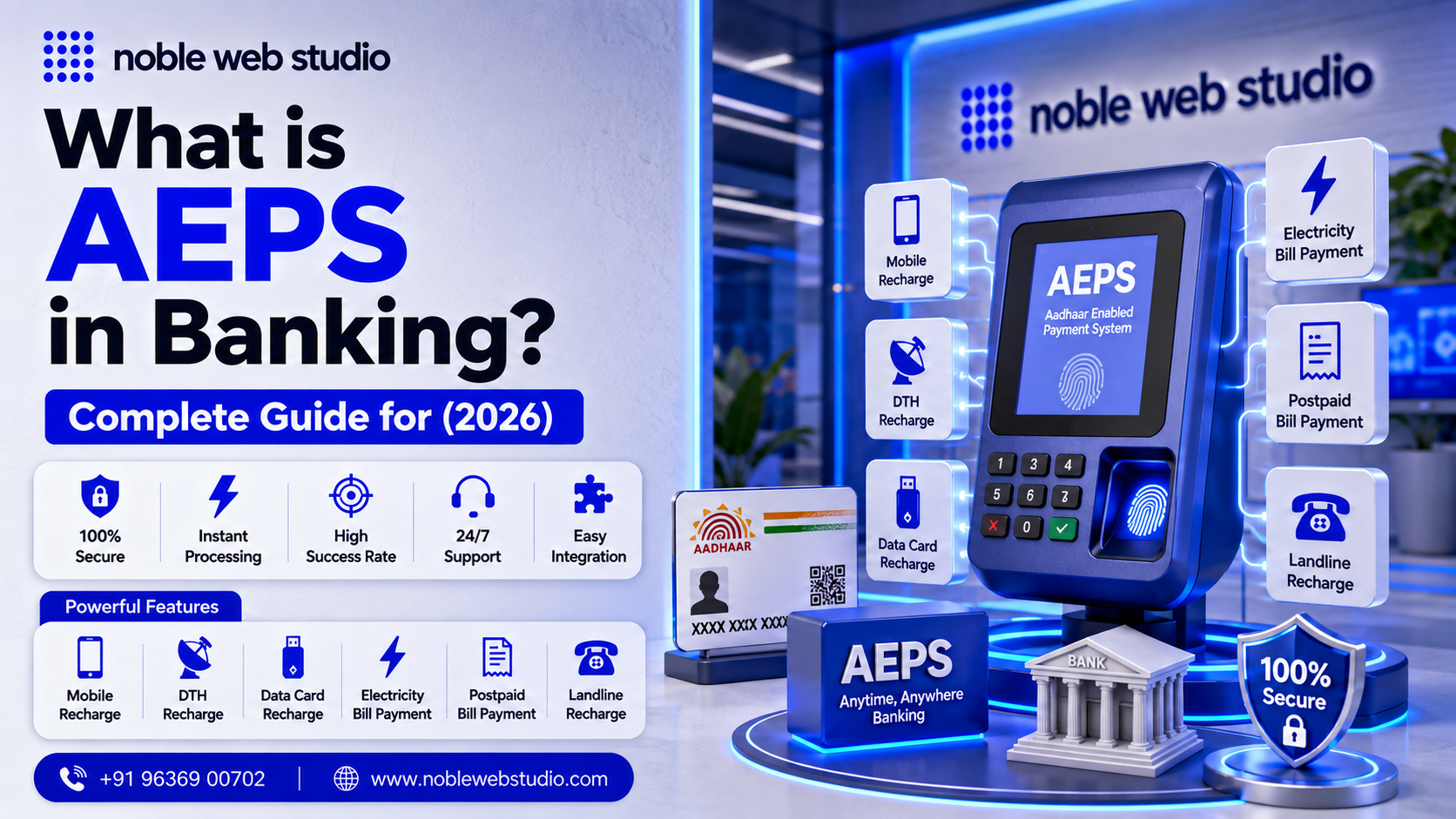
AEPS in banking, also known as Aadhaar Enabled Payment System, has become one of the most reliable ways to provide banking services in India. It allows people to access basic financial services like cash withdrawal, balance inquiry, and money transfer using just their Aadhaar number and fingerprint authentication. With this system, customers no longer need to visit a bank branch or carry an ATM card, making banking simpler and more secure.
AEPS, full form Aadhaar Enabled Payment System, is a bank-led payment service by India’s National Payments Corporation of India (NPCI) that allows users to perform basic banking transactions using their Aadhaar number and biometrics for authentication, rather than a card or smartphone. Available at micro-ATMs and through banking correspondents, AEPS supports cash withdrawals, deposits, balance inquiries, and fund transfers, making banking more accessible for financial inclusion and facilitating the disbursement of government benefits.
AEPS in banking is designed to promote financial inclusion by allowing even those without smartphones or internet access to use digital payment services. Whether it is a farmer in a remote village or a shopkeeper in a small town, AEPS provides quick, simple, and cost-effective transactions. By reducing the dependency on ATMs and traditional bank branches, AEPS makes banking more accessible, reliable, and affordable for millions of users.
The features of AEPS in banking include instant transactions, secure biometric authentication, and anytime access to funds. Its benefits range from empowering rural citizens to supporting digital payment growth in India. With trusted AEPS software providers like Noble Web Studio, agents, retailers, and distributors can offer better services to their customers and grow their digital banking network.
Noble Web Studio, a leading provider of digital payment solutions, offers advanced AEPS software and aeps portal services that help agents, distributors, and entrepreneurs deliver seamless banking facilities to customers. With features like real-time transactions, secure aeps API, and easy integration, noble web studio empowers businesses to grow in the digital payment sector while contributing to India’s financial inclusion mission.
In this blog, we will explain the key features of AEPS in banking, its benefits for customers, agents, and businesses, and how it is supporting India’s move toward digital financial inclusion.
What is AEPS?
AEPS full form Aadhaar Enabled Payment System, is a bank-led Indian payment system developed by the National Payments Corporation of India (NPCI) that allows customers to use their Aadhaar number and biometric data for financial transactions at micro ATMs. It facilitates basic banking services like cash withdrawal, balance enquiry, cash deposit, and fund transfers, providing financial inclusion by enabling transactions for Aadhaar-linked bank account holders without needing traditional banking cards or a smartphone.
How AEPS Works
- Aadhaar Authentication: The system uses Aadhaar authentication to verify a customer’s identity for financial transactions.
- Business Correspondent (BC): A customer approaches a bank’s Business Correspondent (BC) or a retailer operating a micro-ATM or other biometric-enabled device.
- Transaction: The customer provides their Aadhaar number, bank name, and the desired transaction details.
- Biometric Verification: The customer places their finger on the micro-ATM’s scanner for biometric authentication.
- Transaction Completion: The system verifies the identity and completes the financial transaction at the micro-ATM.
Services Available
Through AEPS, customers can perform several essential banking transactions: Cash Withdrawal, Balance Enquiry, Cash Deposit, Aadhaar to Aadhaar Fund Transfer, and Mini Statement.
Key Features and Benefits
- Accessibility: It brings banking services to remote areas and serves as a key tool for government benefit disbursements like pensions and subsidies.
- Security: Aadhaar-based biometric authentication makes transactions secure and eliminates the need for PINs or debit cards.
- Interoperability: It is a bank-led model that allows interoperable financial transactions between different banks.
- No Internet Needed: Transactions can be completed without an internet connection.

What is AEPS is Banking
AEPS, or the Aadhaar Enabled Payment System, is a bank-led model developed by NPCI in India that allows basic banking transactions like cash withdrawal, deposit, balance inquiry, and fund transfers using Aadhaar for authentication. It uses biometric (fingerprint) authentication via a Micro ATM at a Business Correspondent (BC) to provide financial services in both urban and rural areas, ensuring financial inclusion for customers with Aadhaar-linked bank accounts.
Services Available
- Cash Withdrawal
- Cash Deposit
- Balance Enquiry
- Mini Statement
- Aadhaar to Aadhaar Fund Transfer
- Benefit Funds Disbursement (BFD), including government welfare payments
Key Requirements for Customers A bank account linked with their Aadhaar number, Their Aadhaar number, and Biometric authentication (fingerprint).
Who Can Use AEPS
- Bank customers with an Aadhaar-linked bank account.
- Customers who have their Aadhaar linked to their bank account with any participating bank.
Requirements for the Business Correspondent
- A handheld device with a biometric reader.
- A bank account linked to the AEPS platform.
- Internet connectivity for online transactions.
Benefits
- Financial Inclusion: Provides banking services in remote areas where traditional banking branches are scarce.
- Ease of Use: Simplifies transactions, requiring only Aadhaar number and biometric authentication.
- Convenience: Allows customers to access their bank account from any bank’s BC across India.
- Cost-Effective: Facilitates access to basic banking services at a minimal cost.
How AEPS Works in Banking
AEPS (Aadhaar-Enabled Payment System) is a service by the National Payments Corporation of India (NPCI) that allows bank account holders to perform basic financial transactions like cash withdrawals, deposits, balance inquiries, and money transfers using their Aadhaar number and fingerprint authentication through micro-ATMs at business correspondent (BC) points. It is a bank-led, interoperable system that uses Aadhaar for identity verification, promoting financial inclusion by making banking accessible to customers without debit cards or internet.
Full Form of Aeps in Banking
The full form of AEPS in banking is Aadhaar Enabled Payment System. This is a secure, bank-led digital payment system in India.
How AEPS Works
- Customer Visit: A customer visits a nearby business correspondent (BC) agent and their micro-ATM.
- Data Entry : The customer provides their Aadhaar number and selects the desired transaction (e.g., cash withdrawal).
- Biometric Authentication: The customer places their finger on a biometric scanner to authenticate their identity.
- Transaction Processing: The micro ATM device connects to the NPCI’s system, which verifies the customer’s identity and allows the transaction if the linked bank account is active.
- Receipt: A receipt is generated for the completed transaction.
Services Available
- Cash Withdrawal: Withdraw cash from your bank account.
- Cash Deposit: Deposit cash into your linked bank account.
- Balance Enquiry: Check your current bank account balance.
- Mini Statement: Obtain a statement of recent transactions.
- Fund Transfer: Transfer money from one Aadhaar-linked bank account to another.
Key Features
- Financial Inclusion: AEPS is a major initiative for financial inclusion, bringing banking services to remote areas through BCs.
- Security: Aadhaar biometric authentication ensures secure transactions, as only the account holder can access funds.
- Accessibility: Customers can perform transactions without needing a debit card, smartphone, or internet connection.
- Interoperability: Customers can use their Aadhaar number to transact with any bank’s BC, regardless of their own bank.
- Aadhaar as Identity: Your Aadhaar number serves as your identity to access your bank account for transactions.
Read Blog : How AEPS B2B Portals are Transforming Digital Banking in India
How to Use AEPS in Banking
To use AEPS, visit a banking correspondent (like a merchant or mini-ATM), enter your Aadhaar number, select your bank, choose the type of transaction (like cash withdrawal or balance inquiry), enter the transaction amount, and then authenticate using your fingerprint or iris scan for verification. A receipt will be provided upon successful completion of the transaction.
Before you start:
- Link Aadhaar to your bank account: Your Aadhaar number must be linked to your bank account for AePS services to work. You can usually do this at your bank branch or online.
- Enable the system: Once linked, your account is ready for AePS transactions.
Steps to use AePS:
- Visit a banking correspondent or micro-ATM: Go to a designated merchant or a small bank ATM that offers AePS services.
- Provide your Aadhaar number: The agent will ask for your 12-digit Aadhaar number to identify your account.
- Select transaction type and bank: You’ll choose the transaction you want to perform (e.g., cash deposit, cash withdrawal, fund transfer, balance enquiry, mini statement) and then select the name of your bank.
- Enter the transaction amount: If applicable, specify the amount for the transaction.
- Biometric Authentication: You will need to place your thumb or finger on the scanner for a fingerprint scan, or have your iris scanned, to authenticate the transaction.
- Confirm and receive a receipt: Once your biometrics are verified, the transaction will be processed, and the banking correspondent will provide you with a receipt.
Why AEPS is important for banking in India
AEPS is important for banking in India because it drives financial inclusion by providing banking services to remote areas, offers convenience and security through Aadhaar biometric authentication, and facilitates the disbursement of government benefits, making banking accessible to millions who lack traditional infrastructure. It empowers bank customers to perform basic transactions like cash withdrawals, deposits, and fund transfers at any business correspondent outlet, even without a debit card or PIN.
Key reasons for AEPS importance:
- Cost-Effective for Banks: AEPS provides a cost-effective way for banks to expand their reach by leveraging business correspondents and micro-ATMs instead of building extensive physical branch networks.
- Financial Inclusion: It serves as a crucial tool to bring the unbanked and underbanked populations into the formal financial system, particularly in rural and remote regions where traditional banking branches are scarce.
- Enhanced Accessibility: Users can perform transactions at any AEPS-enabled micro-ATM or business correspondent point of service, eliminating the need to travel to a physical bank branch.
- Biometric Security: The system utilizes Aadhaar-based biometric authentication (fingerprints, iris, or face), providing a highly secure method for transaction authorization and reducing the risk of fraud and PIN theft.
- Convenience: Customers can perform various banking operations using just their Aadhaar number and biometrics, removing the need to remember PINs or carry physical debit/credit cards.
- Interoperability: AEPS enables seamless, online, and interoperable transactions across different banks, allowing customers to access their accounts and conduct transactions through any bank’s business correspondent.
- Facilitation of Government Payments: The system is used for the direct disbursement of government entitlements, such as social security pensions and NREGA wages, directly to beneficiaries’ accounts.

Why AEPS Is Important for India’s Digital Banking Growth
AEPS is important for India’s digital banking growth because it leverages Aadhaar authentication and a network of local agents to bring basic banking services to the unbanked and underbanked, especially in rural areas. By enabling cash withdrawals, deposits, and fund transfers via simple biometric authentication, AEPS bypasses the need for smartphones or high digital literacy, significantly expanding financial inclusion and facilitating the direct disbursement of government benefits, thereby accelerating the overall shift to a digital economy.
AEPS Benefits for Digital Banking Growth
- Broad Financial Inclusion: AEPS empowers citizens by providing access to banking services through local agents and micro-ATMs, even in remote areas where physical branches are scarce.
- Overcomes Digital Literacy Barriers: The system’s reliance on Aadhaar and biometric (fingerprint/iris) authentication, rather than smartphones or complex digital knowledge, makes it inclusive for a vast segment of the population.
- Convenience and Accessibility: Customers can perform various transactions, such as balance inquiries and cash withdrawals, using only their Aadhaar number and biometrics, eliminating the need for cards, PINs, or visiting a bank branch.
- Enhanced Security: Biometric authentication provides a highly secure method for transactions, minimizing the risk of fraud and unauthorized access.
- Government Entitlement Disbursement: AEPS facilitates the direct transfer of government subsidies and entitlements, such as pensions, directly to beneficiaries’ bank accounts, reducing leakage and ensuring efficient fund distribution.
- Cost-Effective Banking for Banks: AEPS offers banks an interoperable and cost-effective way to expand their reach into rural areas without the significant expense of setting up new physical branches.
- Empowerment of Vulnerable Communities: Daily wage earners, rural women, and the elderly can independently manage their finances, fostering financial autonomy and participation in the digital economy.
Read Blog : The Role of AEPS Service in India’s Digital Financial Inclusion
Key Features of AEPS in Banking
AEPS (Aadhaar Enabled Payment System) is a banking feature that allows customers to use their Aadhaar number for secure, biometric (fingerprint/iris) authentication to perform basic transactions like cash withdrawals, balance inquiries, and fund transfers via Business Correspondents (BCs) or Micro-ATMs. This system, introduced by the National Payments Corporation of India (NPCI), facilitates financial inclusion, particularly in rural areas, by providing access to essential banking services without physical bank branches or cards.
Key Features of AEPS:
- Biometric Security:Transactions are secured using the customer’s fingerprint, iris, or face scan, eliminating the need for physical cards or PINs.
- Adhaar as ID:Customers use their Aadhaar number as their identity and access to their Aadhaar-linked bank account.
- Interoperability:AEPS enables seamless transactions across different banks through a central switching and clearing agency, making it a universally accessible system.
- Assisted Banking:Transactions are conducted at the point of sale (POS) through banking correspondents (agents) and Micro ATM providing a convenient, “assisted mode” for users.
Services Offered via AEPS:
- Cash Withdrawal: Secure and easy cash withdrawal without a card or cheque book.
- Balance Enquiry: Check the balance in your bank account at any BC outlet.
- Mini Statement: Get a summary of your recent account transactions.
- Aadhaar to Aadhaar Fund Transfer: Transfer funds between Aadhaar-linked accounts.
- Cash Deposit: Deposit cash into your bank account.
How AEPS Works:
- Visit a BC: Go to a nearby Business Correspondent (a bank agent) or a Micro-ATM.
- Provide Details: Enter your Aadhaar number and select the type of transaction and your bank.
- Biometric Authentication: Scan your fingerprint or provide your iris scan for authentication.
- Transaction Completion: Complete the transaction to receive a receipt.
Importance of AEPS:
- Financial Inclusion: AEPS promotes financial inclusion by bringing banking services to the unbanked and underbanked populations.
- Government Entitlements: It helps in the direct disbursement of government benefits like pensions and subsidies to beneficiaries.
- Convenience: Offers secure, cardless, and PINless banking, providing an easy and accessible way to manage finances.
Read Blog : How AEPS Service is Transforming Digital Banking in India
Benefits of AEPS in Banking
The benefits of the AEPS Aadhaar Enabled Payment System in banking include increased financial inclusion, greater accessibility to banking services for people in remote areas, enhanced security through biometric authentication, and support for a cashless economy by simplifying digital transactions. AEPS provides convenience by eliminating the need for cards or PINs, offers a secure method for cash withdrawals and fund transfers, and facilitates the direct disbursement of government subsidies to beneficiaries.
For Customers
- Ease of Use: Users only need their Aadhaar number and biometric data (fingerprint) to perform transactions, eliminating the need for debit cards, PINs, or smartphones.
- Accessibility: AEPS provides access to basic banking services in remote and underserved areas, as services are available through micro-ATMs and banking correspondents.
- Enhanced Security: Biometric authentication provides a strong layer of security, making transactions more secure and fraud-resistant compared to traditional methods.
- Convenience: Customers can perform transactions like cash withdrawal, cash deposit, balance inquiry, and fund transfers without visiting a traditional bank branch.
- Inclusivity: AEPS extends banking services to the unbanked and underbanked, promoting financial inclusion for people in rural areas.
For Banks and the Financial System
- Financial Inclusion: AEPS helps achieve the goal of bringing more people into the formal banking system.
- Interoperability: The system allows seamless transactions between different banks using Aadhaar authentication, making it easier for customers to interact with various financial institutions.
- Reduced Costs: By leveraging existing infrastructure (micro-ATMs and banking correspondents) and biometrics, AEPS offers a cost-effective alternative to traditional banking infrastructure.
- Support for Government Initiatives: AEPS is used for the direct and secure disbursement of government subsidies and welfare payments to beneficiaries, minimizing leakages.
- Promotes Digital Economy: By facilitating secure and easy digital transactions, AEPS supports the broader objective of a cashless economy in India.

Benefits of AEPS for Agents and Retailers
For agents and retailers, AEPS provides significant additional income through transaction commissions, an increased customer base by offering essential banking services as micro-ATMs, a diversified business with expanded service offerings, and increased customer loyalty due to convenient and accessible banking services. It requires minimal investment in hardware like a biometric device and smartphone, and offers a cost-effective and efficient way to facilitate digital transactions and boost financial inclusion in rural and semi-urban areas.
Benefits for Retailers & Agents
- Additional Revenue Stream: Agents and retailers earn commissions on every AEPS transaction, providing a new and substantial source of income.
- Increased Customer Footfall: Offering AEPS services attracts more customers, particularly in rural and semi-urban areas, leading to increased store traffic and potential sales of other goods and services.
- Expanded Service Offerings: By acting as micro-ATMs, retailers can offer essential services like cash withdrawal, deposit, and balance inquiries, making their business a one-stop-shop for basic banking needs.
- Enhanced Customer Loyalty: Providing convenient, accessible banking services builds trust and loyalty with customers who may have limited access to traditional banking facilities.
- Minimal Investment: Setting up an AEPS business requires only a basic smartphone or computer and a biometric device, making it a low-cost venture with a high return on investment.
- Efficient & Secure Transactions: AEPS uses Aadhaar authentication and fingerprint biometrics, ensuring secure and quick transactions, which enhances customer satisfaction.
- Financial Inclusion: Agents act as a vital link, extending banking services to underserved communities and individuals, fostering financial inclusion and empowering the local economy.
- Optimized Cash Utilization: Retailers can fully utilize the cash they have on hand by facilitating AEPS transactions, turning available cash into an income-generating opportunity.
Read Blog : AEPS Benefits for Rural Banking and Digital Transactions
Why Banks Need AEPS for Modern Banking
Banks need AEPS to expand financial inclusion by providing banking services in remote areas, facilitating easy access to accounts through biometric authentication, and promoting a digital economy. AEPS helps banks disburse government subsidies, enable interoperability between different banks, and reduce reliance on physical branches, thereby increasing customer convenience and reducing operational costs.
Key Reasons Banks Need AEPS
- Financial Inclusion: AEPS allows banks to reach unbanked and underbanked populations in rural and remote areas, bringing them into the formal financial system.
- Simplified Authentication: It uses Aadhaar and biometric authentication (like fingerprints) instead of debit/credit cards and PINs, making banking accessible and secure for those who may not have these traditional tools.
- Government Entitlement Disbursements: Banks can effectively route and disburse government subsidies, pensions, and other welfare payments through AEPS, ensuring timely delivery directly to beneficiaries.
- Interoperability: AEPS enables seamless transactions across different banks, allowing customers to use the services of any bank at any Business Correspondent (BC) or micro-ATM outlet.
- Digital Economy Promotion: By electronifying retail payments and reducing the need for physical cash, AEPS contributes to the government’s goal of a cashless economy and encourages digital banking practices.
- Operational Efficiency: AEPS provides a bank-led model where transactions are processed through Business Correspondents, which can be more cost-effective for banks in reaching a wider customer base than traditional branches.
- Secure & Fraud-Resistant Transactions: Biometric authentication significantly reduces fraud and non-genuine activities, increasing the security of financial transactions.
Why Businesses Need Reliable AEPS Software
Businesses need reliable AEPS software to provide essential financial services, boost customer trust, and increase revenue by offering convenient cash withdrawals, balance checks, and money transfers, especially in rural or remote areas with limited access to traditional banking. Reliable aeps software ensures secure, biometric-based transactions, reducing fraud and lowering operational costs, while also facilitating financial inclusion and expanding the business’s reach into new customer segments.
Key Reasons Businesses Need Reliable AEPS Software
- Enhanced Financial Inclusion: AEPS software bridges the gap between rural and unbanked populations and traditional banking services, providing access to essential financial tools through local businesses.
- Increased Revenue and Profitability: By processing transactions, businesses earn commissions, turning their shops into local banking points and increasing footfall and revenue streams.
- Improved Customer Trust and Convenience: Reliable AEPS software provides secure, simplified, and accessible banking services, leading to greater customer satisfaction and trust.
- Cost-Effective Banking Solutions: AEPS significantly reduces the need for expensive POS machines, ATMs, and other traditional banking infrastructure, making it a more affordable solution.
- Heightened Security and Fraud Prevention: AEPS uses biometric authentication (fingerprint verification) linked to the Aadhaar database, providing a secure, fraud-resistant system for transactions.
- Business Expansion and Growth: Businesses can offer additional financial services, expanding their customer base and creating new opportunities for growth and community engagement.
- Simplified and Streamlined Transactions: Best aeps software ensures faster, more efficient transactions, reducing errors and improving overall operational efficiency.
- Regulatory Compliance: Trusted AEPS providers offer software that adheres to government regulations and security standards, ensuring smooth and compliant operations.

How AEPS Supports Financial Inclusion in India
AEPS supports financial inclusion in India by enabling basic banking transactions for people in remote areas using their Aadhaar number and biometric authentication, eliminating the need for physical bank branches or debit cards. Key contributions include increasing accessibility to services in rural areas via Micro-ATMs and Business Correspondents, simplifying access for the unbanked and illiterate, providing convenient access to social welfare payments, and reducing costs for banks to serve underserved populations.
How AEPS Works
- Aadhaar as a Key: Users provide their Aadhaar number and use fingerprint biometrics for authentication.
- Linked Bank Account: Transactions are performed on their Aadhaar-linked bank account.
- Micro-ATMs and BCs: Banking services are offered through a network of Micro-ATMs and Business Correspondents (BCs) in villages and towns.
Key Ways AEPS Promotes Financial Inclusion
- Reaching Unbanked and Remote Populations: AePS brings financial services to areas with limited traditional banking infrastructure, such as villages where banks and ATMs are scarce.
- Empowering the Underprivileged: It allows daily wage earners, farmers, and other individuals in remote areas to easily withdraw cash and access other financial services.
- Simplifying Access for All: The aeps system is designed for easy use, even for individuals with low literacy, as it relies on biometric authentication rather than complex documents or cards.
- Facilitating Direct Benefit Transfers (DBT): Government subsidies, pensions, and welfare payments are deposited directly into Aadhaar-linked accounts, making it easier for beneficiaries to receive funds.
- Reducing Transaction Costs: By leveraging existing infrastructure like Micro-ATMs, AePS significantly lowers the operational costs for banks to serve unbanked populations.
- Promoting Financial Literacy: Access to basic banking services through AePS fosters increased financial awareness and encourages responsible management of funds and long-term financial planning.
Read Blog : Latest Trends in AEPS Software Service for 2025
Why Choose Noble Web Studio for AEPS Solutions
Noble web studio is the top AEPS service provider to offer essential financial services, promote financial inclusion, and earn income by leveraging the existing Aadhaar infrastructure. Noble web studio facilitate secure, biometric-authenticated transactions like cash withdrawals and deposits, which are particularly beneficial in remote areas where traditional banking access is limited. By using AEPS, your business can become a local banking point, attracting customers, increasing footfall, and supporting the unbanked population, according to the sources provided.
Here are the key reasons to choose an AEPS service provider:
- Promotes Financial Inclusion: AEPS brings basic banking services to underserved rural and remote areas where traditional banks and ATMs are not readily available.
- Secure and Convenient: Transactions are secured through Aadhaar biometric authentication, making them fraud-proof and eliminating the need for debit cards or PINs.
- Cost-Effective Solution: It reduces infrastructure costs for Noble web studio, leading to lower transaction fees for users and enabling service expansion without building new branches.
- Earn Income: As a retailer or business owner, you can earn commissions by offering AEPS services, creating an additional revenue stream and attracting more customers to your shop.
- Interoperability: Customers of any bank can use the AEPS micro-ATM of any business correspondent, ensuring broad access to services.
- Government Benefits: AEPS facilitates the direct and transparent disbursement of government subsidies and welfare payments to beneficiaries’ accounts.
- Empowers Customers: It provides convenient access to banking, enabling customers to manage their finances using their Aadhaar number and fingerprint, even with limited digital literacy.
- Supports Cashless Economy Vision: By providing easy access to cash withdrawal and other services, AEPS helps in building a cashless economy.
Noble Web Studio as a Trusted AEPS Software Provider
Noble web studio is the best AEPS software provider for secure, reliable, and scalable financial services. Noble web studio offer user-friendly interfaces, seamless integration with existing systems, multi-bank support, multi-language options, and 24/7 technical support to ensure smooth operations and enhanced customer satisfaction.
Key Reasons to Choose the Best Provider:
- Enhanced Security: Noble web studio implement strong security measures like encryption and fraud protection to safeguard user data and transactions.
- Reliability & Availability: Noble web studio ensures uninterrupted service, critical for financial operations, by offering continuous platform availability.
- Seamless Integration:The aeps software integrate easily with your existing applications, provide aeps API and developer resources for a smooth process.
- Scalability & Flexibility: Noble web studio whose platform can handle increasing transaction volumes and adapt to your business’s growth.
- User-Friendly Interface: A simple, intuitive, and responsive interface makes it easy for both agents and customers to use, even those with limited technical knowledge.
- Multi-bank Support: The best aeps platforms support multiple banks, allowing users to conduct AEPS transactions through any participating financial institution.
- 24/7 Support: Access to round-the-clock customer and technical support is crucial for quickly resolving issues and maintaining smooth operations.
- Cost-Effectiveness & Revenue: An scalable and affordable aeps platform provides opportunities to generate income through commissions on financial transactions.
- Compliance: Noble web studio adheres to all relevant financial regulations and security standards, ensuring your operations are legally compliant.

Conclusion
AEPS in banking has become a game-changer for India’s digital payment ecosystem, especially in rural and semi-urban areas. With features like cash withdrawal, balance inquiry, fund transfer, and mini statements through Aadhaar authentication, it is making banking more secure, transparent, and accessible. The biggest benefit of AEPS is that it allows people to use basic financial services without visiting a bank branch, making digital inclusion possible even in remote villages.
AEPS, or the Aadhaar Enabled Payment System, is a bank-led payment service developed by the National Payments Corporation of India (NPCI) that allows customers to use their Aadhaar number and biometric authentication to conduct basic banking transactions through a Business Correspondent (BC) at a Micro ATM. AEPS enhances financial inclusion by providing access to services like cash withdrawal, balance enquiry, and cash deposit in underserved or rural areas, even beyond traditional bank branch hours.
For entrepreneurs, retailers, and agents, AEPS opens up new income opportunities by offering easy-to-use banking services to customers. Banks and fintech providers are also benefiting by expanding their digital reach and serving millions of people more efficiently.
If you are looking for a reliable AEPS solution provider, Noble Web Studio delivers advanced AEPS software and portal services that ensure smooth transactions, strong security, and complete support for businesses. With AEPS, the future of digital banking in India is not just about convenience it is about true financial empowerment for every citizen.
FAQ – AEPS in Banking
AEPS (Aadhaar Enabled Payment System) is a simple and secure way to make banking transactions using your Aadhaar number and biometric authentication. You don’t need a card or internet to send or receive money.
AEPS works by linking your bank account with your Aadhaar number. You can perform transactions like cash withdrawal, balance check, and fund transfer at micro-ATMs using your fingerprint authentication.
Easy to use: Transactions using Aadhaar and fingerprint.
Secure: No need to share PIN or card.
Accessible: Works even in remote areas with minimal banking infrastructure.
Multiple services: Cash withdrawal, deposit, balance check, and fund transfer.
Convenient banking: No need to visit bank branches.
Fast transactions: Immediate money transfer and withdrawal.
Inclusive: Helps people in rural and remote areas access banking.
Safe: Biometric authentication ensures secure transactions.
Yes! AEPS works on micro-ATMs or devices at bank correspondents (BCs). No internet or smartphone is required.
Almost all major banks in India, including SBI, HDFC, ICICI, Punjab National Bank, and Axis Bank, provide AEPS services.
Yes. AEPS uses biometric authentication instead of cards or passwords, reducing the risk of fraud.
Yes! AEPS allows bank-to-bank fund transfer using your Aadhaar number and fingerprint.
Withdrawal limits depend on your bank’s policy, usually up to ₹10,000 per day.
Anyone with a bank account linked to Aadhaar can use AEPS for simple and secure banking.