
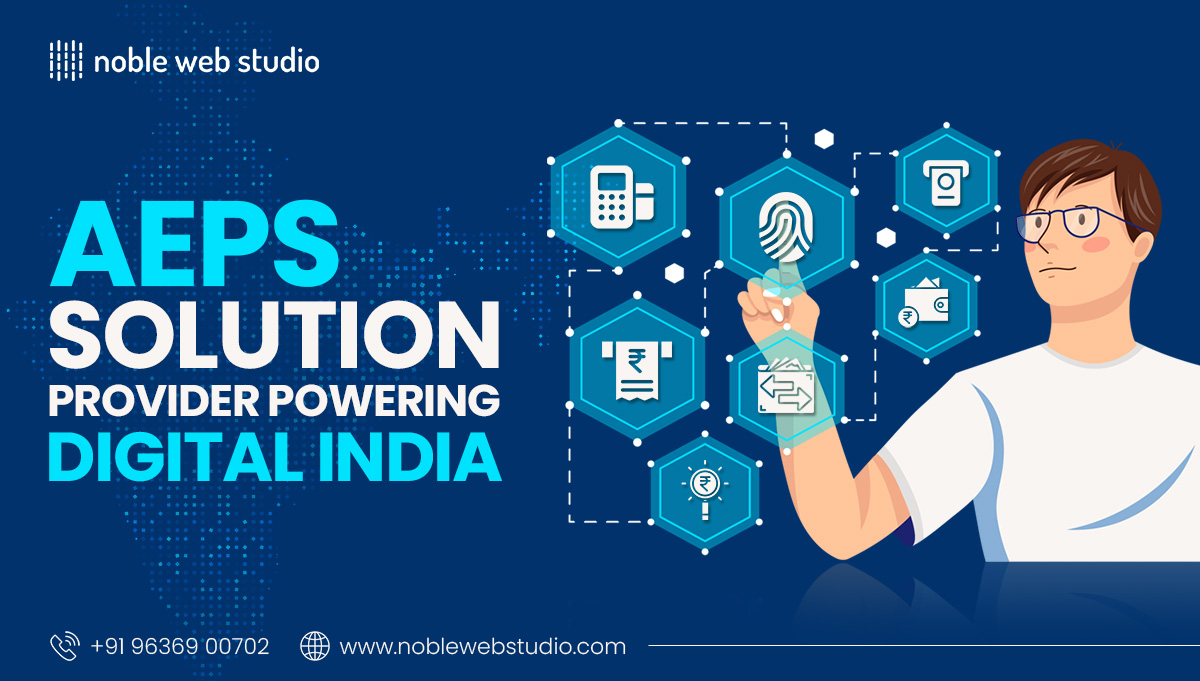
In today’s digital era, India is rapidly moving towards a cashless and inclusive economy. AEPS solution providers like Noble Web Studio are playing a vital role in transforming India’s digital landscape by powering the Aadhaar Enabled Payment System (AEPS). These providers are enabling financial inclusion by offering easy-to-use, secure, and cost-effective banking solutions, especially in rural and underserved areas. By enabling basic banking aeps transaction like cash withdrawals and balance inquiries through Aadhaar authentication, they are bridging the digital divide and promoting a cashless economy.
AEPS solution providers like Noble web studio are playing a big role in making this possible. They are helping shop owners, small businesses, and digital service centers offer these banking services right in their local areas. This is a big step towards building a cashless and Digital India.
In this blog, we’ll explore how AEPS Solution Providers Are Powering Digital India and making financial services available to everyone.
What is AEPS?
Aeps full form – Aadhaar Enabled Payment System, is a bank-led model that allows customers to carry out financial aeps transaction at Micro ATMs using their Aadhaar number and biometric authentication according to the National Payments Corporation of India (NPCI). It facilitates various banking services like cash withdrawal, deposit, balance inquiry, and fund transfer through Aadhaar authentication.
Aeps Means – Aadhaar Enabled Payment System
Here’s a more detailed explanation:
What it is: AEPS is a system developed by NPCI that allows users to access their bank accounts through Aadhaar authentication. It is designed to promote financial inclusion by providing banking services in remote areas through Business Correspondents (BCs) at Micro ATMs.
How AEPS Works
AEPS (Aadhaar Enabled Payment System) allows users to perform basic banking transactions like aeps cash withdrawal, deposits, and balance inquiries using their Aadhaar number and biometric authentication. It’s a bank-led model that utilizes Micro ATM and Business Correspondents to carry out these transactions. Essentially, it enables access to financial services through Aadhaar, promoting financial inclusion, especially in underserved areas.
Here’s a more detailed breakdown:
How it works:
- Linking Aadhaar and Bank Account: Users need to have their Aadhaar number connected to their bank account.
- Visiting a BC or Micro-ATM: Customers visit a Business Correspondent (BC) or a Micro ATM, which are equipped with biometric scanners.
- Transaction Selection: The customer chooses the desired aeps transaction type (e.g., aeps cash withdrawal, balance inquiry).
- Biometric Authentication: The customer’s fingerprint is scanned and checked against the Aadhaar database.
- Transaction Processing: If the authentication is successful, the aeps transaction is completed in real-time.
- Confirmation: A confirmation receipt is generated, and the aeps transaction is finished.
AEPS is used for:
- Cash withdrawals and deposits: Enabling access to cash in areas where traditional bank branches are limited.
- Balance inquiries: Allowing users to quickly check their account balance.
- Fund transfers: Helping the money transfer between accounts, potentially linked to government subsidies or social security payments.
- Disbursements of government entitlements: AEPS is used to distribute various government benefits directly to beneficiaries’ accounts.
- Payments at merchant locations: Some merchants can accept payments via AEPS using Aadhaar and biometric authentication.

Why is AEPS important in India’s digital economy?
AEPS (Aadhaar Enabled Payment System) is an important part of India’s digital economy, particularly for financial inclusion and rural development. It allows users to perform basic banking aeps transaction like aeps cash withdrawal and balance inquiries using their Aadhaar number and fingerprint authentication, even in remote areas with limited banking access.
Here’s why AEPS is important:
- Financial Inclusion: AEPS connects the unbanked population with formal financial services, especially in rural areas where traditional banking infrastructure is scarce.
- Accessibility: It enables access to banking services for those who may not have regular bank accounts or access to ATMs, promoting financial empowerment.
- Security: AEPS uses biometric authentication (fingerprint) to improve transaction security, reducing the risk of fraud compared to traditional methods like PINs or passwords.
- Government Initiatives: It plays an important role in delivering government subsidies and welfare payments directly to citizens’ bank accounts through Direct Benefit Transfers (DBT), ensuring transparency and efficiency.
- Cost-effectiveness: AEPS transactions are affordable for both users and service providers due to minimal infrastructure requirements.
- Rural Development: AEPS makes it easier to access financial services in remote areas, promoting economic activity and development in these regions.
AEPS is a key contributor in India’s journey towards a more inclusive and digitally empowered economy.
Read Blog : Why Every Retailer Needs a Reliable AEPS App in 2025
What is The Future of The AEPS?
The future of AEPS in India is focused on increased security, wider adoption, and integration with emerging technologies. Future developments include enhanced security measures like advanced encryption, wider awareness campaigns, and integration with technologies such as blockchain and mobile technology.
Here’s a more detailed look at the future of AEPS:
Enhanced Security:
- Advanced Encryption: Expect to see stronger encryption methods to protect sensitive data during transactions.
- Fraud Detection: AI-powered insights and smart alerts will be crucial in identifying and preventing fraudulent activities.
- Real-time Monitoring: Continuous tracking of transactions will help in detecting and addressing suspicious activity quickly.
Wider Adoption:
Increased Awareness: More efforts to educate the public about AEPS and its benefits will drive wider adoption, especially in rural areas.
Integration with Mobile Technology: Smartphone use and improved internet connectivity will make AEPS more accessible to a larger population.
Seamless Integration: AEPS will be integrated with other payment systems like UPI and digital wallets, making transactions more convenient.
Technological Advancements:
- Blockchain Integration: Blockchain technology can improve transparency and security in AEPS transactions.
- AI and Data Analytics: AI will play a significant role in fraud prevention, transaction monitoring, and enhancing the overall user experience.
- Improved User Experience: Focus on making the AEPS interface more user-friendly and simple.
Growth in Fintech Sector:
- Cost-effective solution: AEPS provides an affordable way for businesses to offer digital financial services, especially in underserved areas.
- Strong Agent Networks: Fintech companies can use AEPS to build strong agent networks, extending their reach with minimal infrastructure.
- Government Support: Government initiatives promoting digital financial inclusion will further encourage the growth of AEPS.
In essence, AEPS is expected to play a crucial role in India’s digital economy by:
- Promoting financial inclusion: Bringing banking services to underserved and underbanked populations.
- Empowering individuals: Helping users manage their finances effectively and access basic banking services.
- Driving digital transformation: Supporting a shift towards a cashless economy and encouraging digital payments.
Read Blog :Future Trends in AEPS Admin Software Development for 2025 and Beyond
Who Are AEPS Solution Providers?
AEPS solutions provide by Noble web studio in India. Some prominent AEPS service provider include Noble web studio. The Noble web studio offer services like cash withdrawal, balance inquiry, and Aadhaar-to-Aadhaar fund transfers through retailers equipped with micro ATMs or PoS devices.
Noble web studio are AEPS solution provider that offer services which allow users to conduct financial transactions using their Aadhaar number and biometric authentication. These Noble web studio include both banks, enabling various banking services like cash withdrawals, balance inquiries, and money transfers through Aadhaar-linked bank accounts.
Here’s a more detailed look:
Key AEPS Solution Providers:
- Noble Web Studio: Noble Web Studio specializes in providing AEPS solutions and is a leading provider of digital financial services, including AEPS. As a major player in the assisted payments space, Noble Web Studio offers AEPS services as part of its broader range of digital payment solutions. Focused on delivering financial services to rural and semi-urban areas, this Jaipur-based fintech company is well-known for its AEPS software development. The platform enables agents to carry out AEPS transactions easily and promotes cashless transactions through its services. In addition to offering AEPS services via its network of retailers and merchants, Noble Web Studio also specializes in AEPS API development, allowing businesses to integrate AEPS functionality into their platforms seamlessly.
AEPS and the Digital India Mission
The Aadhaar Enabled Payment System (AEPS) is a key part of India’s Digital India Mission, aiming to provide financial inclusion and access to banking services, especially in underserved areas. AEPS enables users to conduct basic banking transactions like aeps cash withdrawal and deposits using their Aadhaar number and biometric authentication, effectively bringing banking services to the doorstep of every citizen.
Here’s how AEPS aligns with the Digital India Mission:
1. Financial Inclusion:
- Digital India aims to empower citizens through digital literacy and access to services, and AEPS directly helps this by providing access to basic banking for those previously excluded from the formal financial system.
- By enabling transactions through Aadhaar and biometrics, AEPS overcomes barriers like lack of formal identification or bank accounts, making financial services accessible to a wider population.
2. Digital Infrastructure:
- The Digital India Mission focuses on building a strong digital infrastructure, and AEPS utilizes this infrastructure by leveraging Aadhaar and mobile technology to facilitate transactions.
- This includes promoting digital payments and reducing reliance on cash, which is a core objective of the Digital India initiative.
3. Last-Mile Connectivity:
- AEPS plays an important role in reaching the last mile, particularly in rural and remote areas where traditional banking infrastructure is limited.
- By enabling transactions through micro-ATMs and other points of sale, AEPS brings banking services closer to people, regardless of their location.
4. Government Services:
- The Digital India Mission aims to connect various government services and make them accessible online, and AEPS facilitates direct benefit transfers (DBT) and other government schemes directly into beneficiaries’ accounts.
- This reduces losses and ensures that subsidies and welfare payments reach the intended recipients efficiently.
5. Promoting Digital Payments:
- AEPS is a key contributor to the growth of digital payments in India, promoting a cashless economy as envisioned by the Digital India Mission.
- By providing a convenient and secure platform for transactions, AEPS promotes the adoption of digital payment methods among the population.
In essence, AEPS is a practical example of the Digital India vision, leveraging technology to bridge the digital divide, promote financial inclusion, and empower citizens through access to essential financial services.

Services Offered by AEPS Solution Providers
Aeps service meaning– AEPS offers essential services like aeps cash withdrawal, balance inquiries, and fund transfers using Aadhaar authentication. It enables users to conduct banking transactions at local retailers or Business Correspondents (BCs) without needing traditional banking methods. Key providers include banks and fintech companies like Noble web studio.
Here’s a more detailed look at the services:
Core AEPS Services:
- Cash Withdrawal: Customers can take withdraw cash from their bank accounts linked with Aadhaar using biometric authentication.
- Balance Inquiry: Users can see their bank account balance through the AEPS service.
- Fund Transfer: AEPS allows the transfer of funds between Aadhaar-linked bank accounts.
- Mini Statement: Users can check a mini-statement of their recent transactions.
Other AEPS Related Services:
- eKYC: Electronic Know Your Customer, used for account opening and other identity processes.
- Best Finger Detection: Improves the accuracy of biometric verification.
- Demo Auth: Used for testing and practice purposes.
- Tokenization: A method to enhance security by replacing sensitive data with unique codes.
- Aadhaar Seeding Status: Checking the status of an Aadhaar number connected to a bank account.
Read Blog : AEPS Cash Withdrawal Software: Secure, Fast & Reliable Transactions
Best Features of AEPS Services
AEPS (Aadhaar Enabled Payment System) is a bank-led model that uses Aadhaar authentication to allow basic banking transactions like aeps cash withdrawal, balance inquiry, and fund transfers through a Business Correspondent. It leverages Aadhaar for secure and convenient access to bank accounts, promoting financial inclusion, especially in underserved areas.
Key Features of AEPS:
- Cash Withdrawal: Customers can take out cash from their Aadhaar-linked bank accounts using biometric authentication.
- Cash Deposit: AEPS also allows for cash deposits into linked accounts through authorized Business Correspondents.
- Balance Enquiry: Users can view their bank account balance using Aadhaar authentication.
- Fund Transfers: AEPS facilitates Aadhaar-to-Aadhaar fund transfers, enabling smooth transactions between linked accounts.
- BHIM Aadhaar Pay: This feature makes merchant payments easier using Aadhaar authentication, promoting digital payments.
- Biometric Authentication: AEPS uses fingerprint or iris scans for secure and authorized access to bank accounts, minimizing the risk of fraud.
- Interoperability: AEPS allows transactions across multiple banks, increasing convenience for users.
- Financial Inclusion: AEPS brings banking services to previously excluded or underserved populations, particularly in rural areas, fostering financial inclusion.
- Mini Statement: AEPS can generate mini-statements for Aadhaar-linked accounts.
- eKYC: It also supports eKYC (electronic Know Your Customer) for various financial services.
- Simplified Transactions: AEPS simplifies transactions by requiring only the Aadhaar number, bank name, and biometric information.
- Disbursement of Government Schemes: AEPS is used for disbursing government benefits like MNREGA wages and pensions.
Best Benefits of AEPS Services
AEPS (Aadhaar Enabled Payment System) offers several benefits, mainly focused on financial inclusion and convenience. It allows users to perform basic banking transactions like cash withdrawal, deposit, balance inquiry, and fund transfers using their Aadhaar number and biometric authentication, even without traditional banking infrastructure. This system is particularly beneficial in rural and underserved areas, promoting financial inclusion for those previously excluded from formal banking.
Key Benefits of AEPS:
- Financial Inclusion: AEPS helps bridge the gap in financial access for people in remote areas or those without access to traditional banking services.
- Ease of Use: Transactions are made simpler, requiring only Aadhaar and biometric verification, eliminating the need for debit cards, PINs, or physical documents.
- Security: Biometric authentication greatly reduces the risk of fraud and unauthorized access to accounts.
- Accessibility: AEPS services are available through micro-ATMs and business correspondents, making banking services easily available even in remote locations.
- Cost-Effectiveness: For banks and customers, AEPS reduces the need for physical branches and associated costs.
- Interoperability: AEPS enables transactions across different banks, making it easier for users to access their accounts regardless of their bank.
- Government Disbursement: AEPS enables the direct transfer of government subsidies and other benefits to citizens’ accounts.
- Time and Money Savings: AEPS removes the need for travel to banks for basic transactions, saving time and money for users.
- Empowering the Underprivileged: AEPS offers access to essential banking services for marginalized communities, fostering financial independence.
- Reduced Cash Reliance: By enabling digital transactions, AEPS helps lessen the need to carry large amounts of cash.
- Real-time Transactions: AEPS provides instant transaction confirmations and balance updates, offering transparency and convenience.
Read Blog : What Are The Advantages and Disadvantages of AePS in 2025?
Impact of AEPS on Rural and Underserved Communities
AEPS (Aadhaar Enabled Payment System) has significantly impacted rural and underserved communities by bringing financial services to those previously left out. It enables access to banking facilities, facilitates direct benefit transfers for government schemes, and reduces reliance on cash through digital transactions.
Key Impacts:
- Increased Financial Inclusion: AEPS provides access to banking services in remote areas where physical bank branches are scarce, closing the gap between the banked and unbanked population.
- Direct Benefit Transfers (DBT): AEPS plays a crucial role in delivering government subsidies and welfare payments directly to beneficiaries, minimizing losses and corruption.
- Empowerment of Women: Women in rural areas are supported through AEPS by gaining access to financial services and managing their finances independently.
- Digital Transformation: AEPS is a key driver of digital financial inclusion in rural India, promoting digital transactions and reducing reliance on cash.
- Job Creation: The system has created income-generating opportunities for individuals who become banking correspondents (BCs) or agents, further boosting the local economy.
- Convenience and Security: AEPS transactions are simple, secure, and faster than traditional banking methods, utilizing Aadhaar-based biometric authentication.
- Cost-Effectiveness: For banks, AEPS is a cost-effective solution as it reduces the need for extensive physical branch networks.
- Financial Literacy: AEPS exposure helps individuals become more financially aware and make better decisions, promoting financial literacy.
- Addressing Infrastructure Gaps: AEPS overcomes the limitations of poor infrastructure in rural areas by providing banking services through micro-ATMs and BCs.

Future of AEPS in India Digital Economy
The Aadhaar Enabled Payment System (AEPS) is set to play a significant role in India’s expanding digital economy, particularly in enhancing financial inclusion and accessibility. Future trends indicate a focus on security enhancements, seamless integration with other payment systems, and improved user experience. This will involve leveraging technologies like AI, blockchain, and mobile advancements to create a more secure, efficient, and user-friendly system for both agents and customers.
Here’s a more detailed look at the future of AEPS in India’s digital economy:
1. Enhanced Security and Fraud Prevention:
- Advanced Encryption: Future AEPS software will use stronger encryption methods to protect sensitive user data and prevent fraudulent activities.
- Biometric Authentication: Continued improvements in biometric devices will improve the speed and accuracy of fingerprint and iris scanning for transactions.
- Integration with Hardware Security: Noble web studio experts recommend the need for hardware-level security to further enhance the safety of digital transactions.
2. Seamless Integration with Other Digital Platforms:
- UPI Integration: AEPS is expected to integrate more closely with the Unified Payments Interface (UPI) to facilitate a wider range of transactions.
- Other Payment Systems: Seamless integration with digital wallets, BBPS (Bharat Bill Payment System), and other payment platforms will expand AEPS’s functionality.
- Mobile Technology: Mobile devices will become even more important to AEPS, with improved accessibility in rural and semi-urban areas.
3. Improved User Experience and Accessibility:
- User-Friendly Interfaces: AEPS software will prioritize user-friendly interfaces to make it easier for both agents and customers to navigate and use the system.
- Simplified Processes: Focus will be on simplifying transaction processes and reducing complexities for users.
- Expanded Reach: AEPS is expected to extend its reach to more remote areas, bringing financial services to previously underserved populations.
4. Growing Role of Data Analytics and AI:
- Personalized Services: Data analytics will be used to personalize services and offer tailored financial solutions to users.
- Fraud Detection: AI and machine learning algorithms will be used to identify and prevent fraudulent transactions.
- Predictive Analysis: Data analytics can be used to predict transaction patterns and optimize system performance.
5. Business-to-Business (B2B) AEPS Platforms:
- Agent Management: B2B platforms will help businesses manage multiple agents, monitor their activities, and provide comprehensive support.
- Financial Literacy: B2B platforms can support promoting financial literacy and digital adoption among citizens.
- Scalability: B2B platforms will support the scalability of AEPS services, enabling businesses to expand their reach and offerings.
6. Overall Impact:
- Financial Inclusion: AEPS will continue to be a key force of financial inclusion, bringing banking and financial services to millions of unbanked and underbanked individuals.
- Economic Empowerment: By providing access to financial services, AEPS helps individuals and communities, contributing to economic growth.
- Digital Economy Growth: AEPS will be a vital part of India’s digital economy, facilitating a shift towards a more cashless and digitally enabled society.
Read Blog : Aadhaar Pay API Services: The Seamless Solution for Instant Payments
Step-by-Step Guide to Partnering with Noble Web Studio for AEPS Solutions
To integrate or partner with an AEPS solution provider, you need to register as an AEPS agent, complete KYC, and then choose a provider like noble web studio that offers the necessary Aeps API and support for your business needs. This allows you to offer services like cash withdrawal, balance inquiry, and fund transfer to customers using their Aadhaar authentication.
By following these steps and carefully considering the key aspects, you can successfully collaborate with an AEPS solution provider and offer convenient and accessible financial services to your customers.
Steps to Partner or Integrate with an AEPS Solution Provider:
Choose a Reliable AEPS API Provider: Noble web studio is a trusted provider that offers a robust and secure AEPS API, comprehensive documentation, and reliable customer support. Some popular providers include Noble web studio.
Register as an AEPS Agent: Sign up with the chosen AEPS service provider and complete the required Know Your Customer (KYC) process.
Integrate the AEPS API: Integrate the provider AEPS API into your system or use their platform to offer AEPS services. This typically involves setting up your software or platform to interact with the API to handle transactions.
Start Offering AEPS Services: Once integrated, you can begin offering AEPS services to your customers, allowing them to perform various banking transactions using their Aadhaar number and biometric authentication.
Key Aspects to Consider When Choosing a Provider:
- API Features and Functionality: Ensure the Aeps API offers the specific features you need, such as cash withdrawal, balance inquiry, fund transfer, and other relevant services.
- Security and Compliance: Verify the provider’s security measures and compliance with relevant regulations to ensure the safety and reliability of transactions.
- Integration Process: Evaluate the ease and speed of integration, as well as the support offered during the integration process.
- Transaction Charges and Fees: Understand the pricing structure and transaction charges associated with using the AEPS API.
- Customer Support: Choose a Noble web studio provider that offers reliable and helpful customer support to assist you with any issues or queries.
- Reputation and Reliability: Noble Web Studio has a reputation and track record to ensure they are a reliable and trustworthy partner.
By following these steps and carefully considering the key aspects, you can successfully partner with an AEPS solution provider and offer convenient and accessible financial services to your customers.

Conclusion
AEPS solution providers like Noble Web Studio are essential in driving Digital India by offering convenient, secure, and accessible digital banking services, particularly in rural and semi-urban areas. By leveraging Aadhaar authentication, AEPS empowers individuals to perform financial transactions like cash withdrawals, balance inquiries, and fund transfers through micro-ATM, bridging the gap in traditional banking access. This system not only promotes financial inclusion but also fosters a cashless economy and provides income opportunities for local agents and retailers. Noble Web Studio, with its innovative AEPS solution, is helping expand the reach of digital financial services and supporting India’s vision of an inclusive, digitally empowered society.
If you’re looking to step into this field, choosing a reliable AEPS software partner like NobleWebStudio can help you deliver secure, efficient, and customer-friendly financial services.
FAQs
Ans: AEPS (Aadhaar Enabled Payment System) allows users to perform basic banking services like cash withdrawal, deposit, balance inquiry, and fund transfer using Aadhaar authentication. It plays a crucial role in Digital India by promoting financial inclusion, especially in rural and semi-urban areas.
Ans: AEPS solution providers like NobleWebStudio empower small businesses, merchants, and startups to offer secure banking services to unbanked populations, enabling cashless transactions and digital financial services under one platform.
Ans: NobleWebStudio stands out with its secure, scalable, and customizable AEPS software solutions, real-time transaction reports, multi-bank support, biometric device integration, and 24/7 dedicated technical assistance.
Ans: Key features include Aadhaar-based biometric authentication, instant settlement, multi-bank support, admin and retailer portals, transaction history, commission management, and integrated DMT and bill payment services.
Ans: Startups can launch an AEPS business by partnering with a certified AEPS solution provider like NobleWebStudio, integrating AEPS APIs, setting up biometric devices, and registering with NPCI-authorized banking networks.
Ans: AEPS services bring essential banking facilities to unbanked and underbanked areas, reduce dependency on cash, increase merchant earnings through transaction commissions, and promote digital financial inclusion.
Ans: Yes, AEPS operates under the NPCI (National Payments Corporation of India) guidelines, ensuring secure, encrypted, and Aadhaar-authenticated transactions, fully compliant with government regulations.
Ans: Business owners and agents earn commissions on every AEPS transaction, including cash withdrawals, deposits, balance inquiries, and fund transfers, offering a steady income stream through digital financial services.