
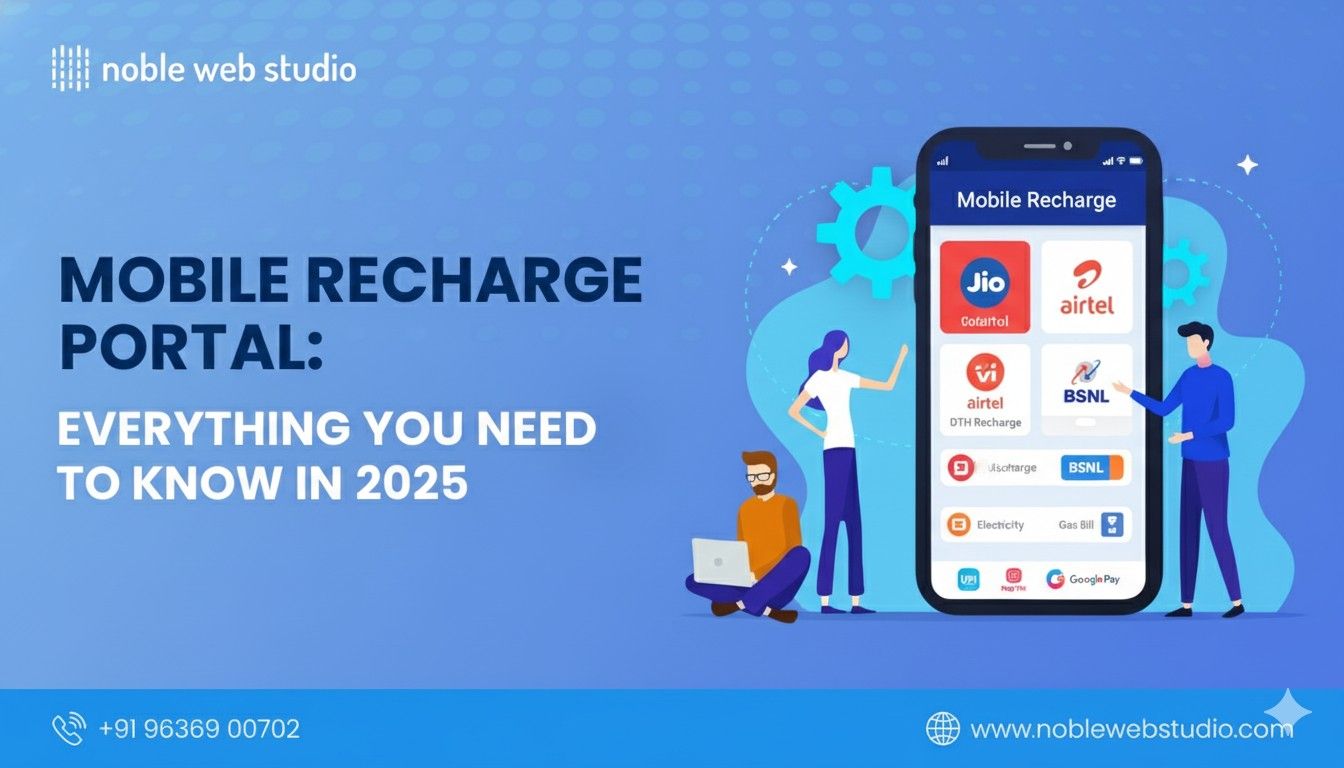
A Mobile Recharge Portal is one of the most powerful online tools for businesses that want to offer quick and secure prepaid, postpaid, DTH, and data card recharge services. In 2026, customers expect fast digital services, and a reliable recharge platform helps retailers and entrepreneurs deliver smooth, real-time recharges anytime. With advanced mobile recharge software, API integration, and an easy dashboard, businesses can manage all transactions in one place and serve more users instantly.
A mobile recharge portal is a web-based or app-based platform that allows users to pay for mobile services like topping up prepaid numbers or paying postpaid bills. These portals connect with mobile network operators to process transactions instantly after users enter their details, select a plan, and make a payment through various methods like credit cards, debit cards, or digital wallets. Popular examples include Ezeepay.
Noble Web Studio provides a complete mobile recharge portal solution built for high performance, strong security, and fast processing. Whether you run a small shop or a large online platform, our recharge system helps you grow your business, earn more commission, and offer seamless digital services to your customers. With multi-operator support, instant transactions, and a user-friendly interface, your recharge business becomes more efficient and profitable.
If you want a smart, modern, and high-earning recharge business in 2025, choosing a reliable mobile recharge portal provider like Noble Web Studio is the key to ranking higher, serving better, and growing faster.
In this guide, you’ll learn everything about mobile recharge portals in 2026 how they work, their benefits, essential features, and how they can help your business succeed in the competitive online recharge industry.
What is Mobile Recharge Portal
A mobile recharge portal is a web or app-based service that allows users to top up prepaid mobile credit or pay postpaid bills online. These portals connect with mobile network operators via Application Programming Interfaces (APIs) to process transactions, which are completed through various secure payment methods. Examples of popular mobile recharge portals include Ezeepay.

Mobile Recharge Portal Work
A mobile recharge portal is a web-based or app-based platform that allows users to top up prepaid mobile numbers, pay postpaid bills, and sometimes purchase other digital services by integrating with mobile network operators and secure payment gateway. Users select their operator, enter the mobile number and amount, choose a payment method, and the portal uses APIs to instantly send the request to the operator for processing.
How it works
- User interaction: A user accesses the portal and chooses to recharge a mobile number or pay a bill.
- Information entry: They select the telecom operator, enter the mobile number, and choose a recharge plan or amount.
- Payment: The user selects a payment method, such as a credit card, debit card, or digital wallet, and completes the transaction.
- API integration: The portal uses recharge API (Application Programming Interfaces) to securely communicate with the relevant telecom operator’s system.
- Instant processing: The request is sent to the telecom operator for immediate processing.
- Confirmation: Once the recharge is successful, the portal confirms the transaction to the user, often providing a transaction ID.
Why Recharge Portals are Important for Businesses
Recharge portals are important for businesses because they provide a centralized platform for offering digital services, increasing revenue, improving efficiency, and building customer loyalty. A recharge portal enables businesses, from small retailers to large enterprises, to automate transactions, manage multiple services, and streamline operations.
Operational advantages
- Centralized management. A single dashboard can be used to oversee all recharge activities, including mobile and DTH top-ups, utility bill payments, and more. This reduces complexity and simplifies operations.
- Increased efficiency through automation. Recharge software automates processes like transaction handling, commission tracking, and report generation, minimizing manual effort and the potential for errors.
- Seamless integration. Application Programming Interface (API) integrations connect the portal with Noble web studio and payment gateways. This ensures fast, secure, and real-time processing of transactions.
- Scalability. Portals can easily scale to accommodate a growing customer base and an increasing volume of transactions, supporting long-term business growth.
Financial benefits
- New revenue streams. By offering a high-demand service like recharges, businesses can attract more customers and generate a steady income from commissions on every transaction.
- Low investment. Starting recharge business can be relatively inexpensive, with minimal setup costs, especially with readymade white-label solutions.
- Cost savings. Automating tasks and consolidating services on a single recharge platform can lead to reduced operational costs, such as eliminating the need for manual processing or using multiple systems.
- Detailed analytics. Business owners and administrators can access reports and dashboards that offer real-time insights into sales, commissions, and customer behavior. This data helps in making informed strategic decisions.
Customer experience improvements
- Convenience and accessibility. Customers can make recharges and bill payments anytime, anywhere, via a website or mobile app. This eliminates the need to visit physical stores and offers 24/7 service.
- Enhanced loyalty. Offering a fast, reliable, and convenient service builds customer trust and encourages repeat business.
- One-stop solution. Customers can access multiple services including mobile, DTH, and utility bill payments from a single platform, creating a better, hassle-free experience.
- Multiple payment options. Secure payment gateways allow customers to pay using various methods, including UPI, net banking, and debit/credit cards, catering to a wider audience.
Social and economic impact
- Digital inclusion. Mobile recharge portals help extend digital and financial services to underserved areas, particularly in rural regions. This bridges the digital divide and promotes financial literacy among those with limited access to traditional banking services.
- Support for small businesses. For small retailers, adding a recharge portal service is a simple way to attract more foot traffic, become a local hub for digital services, and increase overall earnings.
Benefits Mobile Recharge Portal
Mobile recharge portals provide convenience, efficiency, and security for users by allowing 24/7, online recharges from anywhere. For retailers, these recharge portals offer benefits like earning commissions on recharges and other services, increased customer service options, and potential for increased income through promotions and bonuses.
Benefits for users
- Convenience: Recharge is possible from any location at any time, eliminating the need to visit physical stores.
- Time-saving: Users can recharge instantly without waiting in queues or traveling to a store.
- Security: Portals use secure payment gateways to ensure transactions are safe.
- Variety of plans: Users can easily browse and compare different recharge plans before selecting one.
- Multiple payment options: Portals support various payment methods like credit/debit cards, net banking, and UPI.
Benefits for retailers
- Earn extra income: Retailers can earn commissions on every mobile recharge and other services like bill payments.
- Expand business: A single platform can be used for multiple services, turning a shop into a one-stop solution.
- Reduced operational costs: Portals can reduce paperwork and the need for managing physical recharge cards.
- Promotions and bonuses: Retailers can take advantage of special offers to earn higher commissions with mobile recharge commission app.
- Digital literacy: The use of these portals can help improve digital literacy and promote digital payments.
Other benefits
- Automated process: The process is automated for speed and efficiency.
- Instant refunds: Most mobile recharge portal provide instant refunds in case of a recharge failure.
Features Mobile Recharge Portal
A feature-rich mobile recharge portal includes a user-friendly interface, support for multiple network providers, and a variety of secure payment options such as credit/debit cards, digital wallets, and UPI. Key features also include the ability to browse and compare real-time recharge plans, a history of past transactions, and integration with customer support. For businesses, additional features might include commission structures and multi-recharge capabilities.
Core features for users
- User-friendly interface: An intuitive design that makes it easy to navigate and complete transactions quickly.
- Multiple network providers: Support for various telecom operators to offer customers flexibility.
- Real-time plan information: Access to the latest and most accurate recharge plans, tariffs, and offers from different providers.
- Secure payment options: A range of secure payment methods, including credit/debit cards, digital wallets (like Ezeepay), and UPI.
- Recharge history: The ability to view and track all previous recharge transactions.
- Customer support: Integration with customer support channels within the app or website to help with issues.
- Cashback and rewards: Offers, discounts, and cashback incentives on recharges.
Business and enterprise features
- Multi-recharge: A Mobile recharge platform that allows for recharging multiple mobile numbers, DTH connections, or other services from a single account.
- Commission structure: A system where agents or retailers can earn a commission on each successful transaction.
- White-label solutions: The option for businesses to create their own branded recharge portal.

Steps to Start Your Mobile Recharge Portal
To start a mobile recharge portal, conduct market research, define your business model (B2B or B2C), register your business, and secure necessary licenses. Develop mobile recharge portal by partnering with recharge API providers like Noble web studio for recharge services and integrating secure payment gateways. Finally, perform thorough testing and implement effective marketing strategies to launch and grow your business.
1. Planning and legal setup
- Conduct market research: Identify your target market (B2B or B2C) and analyze the competition to find your unique selling proposition.
- Create a business plan: Outline your services, target customers, and financial projections.
- Register your business: Choose a legal structure like a sole proprietorship, partnership, or private limited company and register it.
- Obtain licenses and permits: Secure all necessary licenses and permits to operate legally in your area.
- Ensure compliance: Adhere to data protection and tax regulations.
2. Technology and development
- Partner with API providers: Connect with a reliable recharge API provider like Noble web studio to enable real-time transactions for various telecom and DTH services.
- Develop the portal: Build a user-friendly website and/or build mobile recharge software with an recharge admin panel to manage users, transactions, and accounts.
- Integrate a secure payment gateway: Set up a payment gateway that accepts multiple payment methods like UPI, net banking, and credit/debit cards to process transactions securely.
3. Launch and marketing
- Test thoroughly: Conduct comprehensive testing on all features, especially the recharge process and payment gateways, before launching.
- Market your portal: Use digital marketing strategies like SEO to reach your target audience and attract initial customers.
- Provide customer support: Establish systems to handle customer queries and issues effectively to ensure a positive user experience.
- Maintain security: Regularly update your platform to protect customer data and transactions.
How to Integrate Mobile Recharge Portal
To integrate mobile recharge portal, you must first choose a best mobile recharge API provider and a secure payment gateway. Then, register for an API account to get credentials, and use the provider’s documentation to integrate recharge API calls into your website or app to automate the recharge process. The integration allows your platform to handle customer requests and process recharges for mobile, DTH, and utility bills, creating a new revenue stream.
Step 1: Select a recharge API provider
- Noble Web Studio offers the services you need, such as mobile and DTH recharge.
- Sign up for an account and obtain mobile recharge API credentials, such as an API key or token, for authentication.
- Familiarize yourself with the recharge API documentation to understand how to make requests and handle responses.
Step 2: Integrate the recharge API
- Use the Noble web studio documentation to understand the endpoints and how to structure your requests and responses.
- Integrate mobile recharge API into your platform’s codebase to enable automated recharges.
- This will connect your system to telecom operators, allowing you to offer services like talktime, data, and DTH recharges.
Step 3: Integrate a payment gateway
- Select a secure payment gateway and integrate it with your portal.
- This will allow customers to make payments through various methods like net banking, UPI, or credit/debit cards.
- Choose between a hosted payment page or direct recharge API integration based on your needs.
4. Build the user interface and admin panel
- Develop a user-friendly website and mobile app that is intuitive for customers to use.
- Create an admin panel to manage users, commissions, and transactions.
5. Test and launch
- Thoroughly test the integration in a sandbox environment to ensure it works correctly across different operators and scenarios.
- Once testing is complete, go live and monitor the performance to resolve any issues that arise.
Mobile Recharge Portal Cost
The cost for a mobile recharge portal varies significantly, from around ₹7,000 for basic recharge software to ₹1,50,000 or more for advanced, custom-built B2B recharge software/B2C recharge software platforms. The final price depends on factors like the type of portal (single vs. multi-recharge), features (API integration, wallet system, recharge agent panels), and whether you choose a ready-made solution or a custom development.
Cost breakdown by portal type and features
| Portal Type | Estimated Cost | Key Features |
|---|---|---|
| Basic/Standalone | ₹7,000 – ₹25,000 | A simple web-based platform for single recharge services. |
| Multi-Recharge | ₹20,000 – ₹35,000 | Includes website and app, with features like DTH and bill payments. |
| B2B/B2C | ₹40,000 – ₹1,50,000+ | A more comprehensive platform for businesses, often including a white-label solution. |
| API Portal | ₹25,000+ | A portal that provides API access for other applications to perform recharges. |
Factors that Mobile Recharge Portal Cost
The cost of a mobile recharge portal depends on factors like the level of customization, from basic white-label solutions (under ₹50,000) to custom-built platforms (₹5 lakhs to ₹50 lakhs+), and specific features such as user management, multi recharge API integration, and advanced reporting. Other costs include integrating third party mobile recharge API (₹10,000-₹20,000 per API), mobile recharge software development, and ongoing expenses like security and maintenance.
- Development type:
Features and functionality:
- Basic portal: Minimal features like simple mobile recharge and basic reporting are the most affordable.
- Advanced features: Costs increase with features like user management, multiple recharge API integrations (DTH, data cards), advanced reporting, and transaction history.
API and integration:
- API integration: Each third party recharge API for services like mobile, DTH, or data cards can add approximately ₹10,000 to ₹20,000.
- Payment gateways: Integration with various payment methods like UPI, net banking, and wallets will add to the cost.
Mobile app development:
- Developing mobile recharge software adds to the cost, with more advanced features increasing the price significantly.
Ongoing costs:
- Maintenance: Regular updates and server maintenance are necessary.
- Security and compliance: Costs are incurred for robust security measures, like PCI certification, and to handle regulations.
- Support: Ongoing customer and technical support is an additional cost.
Developer and location:
- The cost can vary depending on the developer’s location, experience, and the development team’s structure.
How to Choose the Best Mobile Recharge Portal Provider
Noble web studio is the best mobile recharge portal provider, evaluate factors like service coverage, reliability and security, pricing, customer support, and ease of integration. Look for Noble web studio that offer a robust, scalable platform with a good transaction success rate and transparent pricing without hidden fees.
Key factors to consider
Service coverage and features:
- Ensure the Noble web studio supports all necessary services, including prepaid/postpaid mobile, DTH, and data card recharges.
- Look for features like multi-recharge capabilities and various secure payment gateway options (UPI, credit/debit cards, wallets).
Reliability and security:
- Check for a high uptime guarantee and a strong track record of transaction success rates to ensure uninterrupted service.
- Verify that the Noble web studio uses secure payment gateways to protect customer data.
Ease of integration and scalability:
- Choose a Noble web studio with a user-friendly recharge API and clear documentation that is easy to integrate with your existing systems.
- Select a Noble web studio that can accommodate business growth, allowing you to scale your operations up or down as needed.
Pricing and commission:
- Compare different pricing models, such as per-transaction fees or monthly subscriptions.
- Ensure the Noble web studio pricing is competitive and transparent, with no hidden costs.
Customer support and reputation:
- Opt for a Noble web studio with responsive customer and technical support, especially for troubleshooting and issue resolution.
- Research the Noble web studio reputation and read user reviews to gauge their service quality and reliability.
Admin tools:
- Look for a Noble web studio that offers a robust recharge admin panel with tools for managing transactions, commissions, and user roles.
- Check for real-time transaction processing and reporting tools to monitor business performance.

Why Choose Noble Web Studio for Recharge Portal Development
You should choose a Noble web studio for recharge portal development to access their expertise, secure and reliable infrastructure, and existing mobile recharge API integration, which saves you time and money compared to building from scratch. Noble web studio offers a feature-rich, scalable, and secure recharge platform with robust security, comprehensive support, and a wide service coverage, allowing you to launch faster and focus on your business growth.
Expertise and Speed
- Leverage existing technology: Noble web studio have already built the core technology, saving you years of development time.
- Expert developers: Noble web studio has a core technical team with the expertise to build a high-quality, high-performance product.
Reliability and Security
- High uptime: Noble web studio with robust infrastructure ensure your services are always available to customers.
- Secure payments: They implement strong encryption and security protocols to protect sensitive customer data, which is crucial for a payment portal.
Features and Scalability
- Multi-operator and service support: Choose a Noble web studio that supports various services like mobile, DTH, and bill payments from one platform.
- Scalable solutions: Noble web studio solution can grow with your business, handling increased transaction volumes as you expand.
- White label options: Noble web studio offer white label recharge solutions, allowing you to launch a branded recharge service quickly without developing the underlying technology.
Support and Integration
- Ease of integration: Noble web studio offer user friendly recharge API with clear documentation to minimize integration time with your existing systems.
- Responsive customer support: Access to 24/7 responsive support is essential for troubleshooting and smooth operations.
Business advantages
- Increased revenue: You can earn commissions on transactions, creating a steady income stream.
- Enhanced customer experience: You can offer convenience, 24/7 access, and a wide range of services to attract and retain customers.
- Simplified operations: Automation and a central mobile recharge admin panel simplify tasks like managing transactions and services.
Top Technologies Used in Recharge Portal Development
Top technologies for recharge portal development include best mobile recharge API integration with telecom providers, payment gateways and utility bill systems (like BBPS), along with modern programming frameworks and languages. Artificial intelligence (AI) is used for security and analytics, while blockchain provides secure and transparent transactions. Additionally, NFC technology is being adopted for faster payments, and edge computing is emerging for offline transaction capabilities.
Core technologies
- API Integration: This is a foundational technology that connects the recharge portal to other services.
- Telecom APIs: To handle mobile and DTH recharges.
- Payment Gateway APIs: To process payments securely via credit card, net banking, UPI, etc.. Examples include Stripe, PayPal, and CCavenue.
- Utility APIs: To integrate bill payments for services like electricity and water (e.g., through BBPS).
- SMS/Email APIs: For sending transaction confirmations and notifications.
Programming languages and frameworks:
- While specific language use varies, frameworks that support robust, scalable applications are essential. Examples of technologies used by developers include Ionic and Firebase.
- The use of languages that support RESTful APIs is critical for modern integration.
- Database technologies: Secure and scalable database solutions are necessary to manage user data and transactions, though specific database choices are often project-dependent.
Emerging and advanced technologies
Artificial Intelligence (AI):
- Enhances user experience through chatbots for customer support.
- Improves security by detecting and preventing fraudulent activities.
- Provides data analysis for better business decisions.
Blockchain:
- Ensures highly secure and transparent transactions.
- Allows for the acceptance of cryptocurrency payments.
Near-Field Communication (NFC):
- Enables contactless and quick payments directly from devices.
Edge Computing:
- Allows devices like kiosks to process transactions offline, synchronizing with the main system later when a connection is available.
Supporting technologies
- Secure payment gateways: These are crucial for protecting sensitive data and are a core part of the technology stack.
- User management systems: Features like automated commission distribution, retailer/distributor panels, and e-wallet integration are supported by backend systems.
- Reporting and Analytics: Robust reporting tools are used to track transactions and user activity.
Top Trends in Mobile Recharge Portal
Top trends in mobile recharge portals include integration of AI and blockchain for security and user trust, the growth of all-in-one platforms for multiple services, and the increased use of contactless payments like NFC. Other key trends are fast recharge API-driven solutions for businesses, biometric authentication, and voice-activated options to improve user experience.
Technology and security
- AI and Blockchain: Artificial intelligence is used to enhance user experience and improve transaction accuracy, while blockchain technology increases security and builds user trust.
- Biometric authentication: Enhanced security is provided through biometric authentication, such as fingerprint or facial recognition, for accessing accounts and authorizing transactions.
- Voice-enabled recharge: The use of voice assistants makes the recharge process more convenient and accessible.
Service and integration
- All-in-one platforms: Platforms are evolving into comprehensive hubs that offer more than just mobile recharges, including DTH and utility bill payments.
- API-driven solutions: Businesses are integrating recharge functionality into their own applications through APIs, enabling fast and secure transactions for their customers.
- Integration with banking apps: Mobile recharge services are being integrated directly into banking apps to provide a seamless experience for users who want to manage their finances and recharges in one place.
- Expanded services: There is a trend towards expanding service offerings to include features like microloans, savings plans, and bill payment systems like the Bharat Bill Payment System (BBPS).
Payment and user experience
- Contactless payments (NFC): Near-Field Communication (NFC) technology is increasingly used for quick and easy contactless recharges.
- QR code-based recharges: Innovative solutions like QR code-based recharges are enhancing user engagement.
- Enhanced user experience features: Portals are adding features like instant refunds for failed transactions, 24/7 customer support, and automatic notifications (e.g., on WhatsApp) to improve user satisfaction.

Conclusion
A mobile recharge portal has become one of the most powerful digital tools for retailers, distributors, and entrepreneurs who want to start an online recharge and utility service business. In 2026, customers expect fast recharge, secure payment options, and a smooth user experience and all of this is possible only when your business uses a trusted mobile recharge API and a strong backend system.
A mobile recharge portal is an online platform that allows users to top up prepaid mobile phones and pay other bills, like electricity and DTH, through a single, convenient interface. These portals act as intermediaries, connecting users directly to Noble web studio through integrated payment gateway and telecom APIs, making the process fast and accessible from anywhere with an internet connection.
Choosing the right platform decides the success of your recharge business. That’s why companies prefer Noble Web Studio, a leading mobile recharge portal provider known for secure technology, high success rates, fast API integration, and easy admin control. Their multi recharge software helps businesses manage prepaid recharge, DTH recharge, postpaid bills, and multiple services in one dashboard making operations simple and profitable.
With a reliable mobile recharge portal solution, you can grow your digital business faster, attract more customers, and offer real-time services without downtime. In today’s competitive market, the right recharge portal gives you the strength to stay ahead and build long-term income. If you want your business to run smoothly, earn more, and deliver the best user experience, a powerful mobile recharge portal by Noble Web Studio is the smartest choice.
At Noble Web Studio, we help businesses develop reliable and scalable mobile recharge portal solutions designed for success in 2026.
Now is the perfect time to take the next step launch your own Mobile Recharge Portal and make your business future-ready with advanced digital solutions.
FAQs – Mobile Recharge Portal 2026 with Noble Web Studio
A mobile recharge portal is an online platform that allows users to recharge mobile numbers, pay bills, and manage digital payments through a single dashboard. It’s ideal for retailers, distributors, and startups looking to start a recharge business.
It connects with telecom operators and APIs to process real-time mobile recharges and bill payments. Users enter details, select plans, and complete secure transactions instantly.
The demand for online recharge and digital payment services continues to grow in 2025. Starting your own portal helps you earn commissions, attract customers, and build a long-term online business.
Key features include multi-operator support, secure payment gateways, commission tracking, best recharge API integration, and real-time reports for smooth operations.
You earn commissions on every recharge and bill payment transaction. The more users and agents you onboard, the higher your revenue grows.
Yes. Most portals allow Recharge API integrate, enabling faster and automated transactions with different operators for prepaid, postpaid, DTH, and utility services.
Absolutely. Reliable portals use encrypted payment gateways, OTP verification, and user authentication to ensure safe and secure transactions.
Noble Web Studio specializes in custom mobile recharge software, offering secure recharge API, advanced recharge admin portal, user-friendly designs, and full technical support to help businesses succeed online in 2025.
Yes, Noble Web Studio’s recharge portal software uses secure mobile recharge API protocols and encrypted systems to ensure safe and fast online transactions.
Absolutely! Noble Web Studio designs easy-to-use portals that require no technical background, making them perfect for startups, small retailers, and entrepreneurs.
You can start by contacting Noble Web Studio for a demo or consultation. Their experts will guide you through recharge API setup, best mobile recharge software customization, and business launch.