
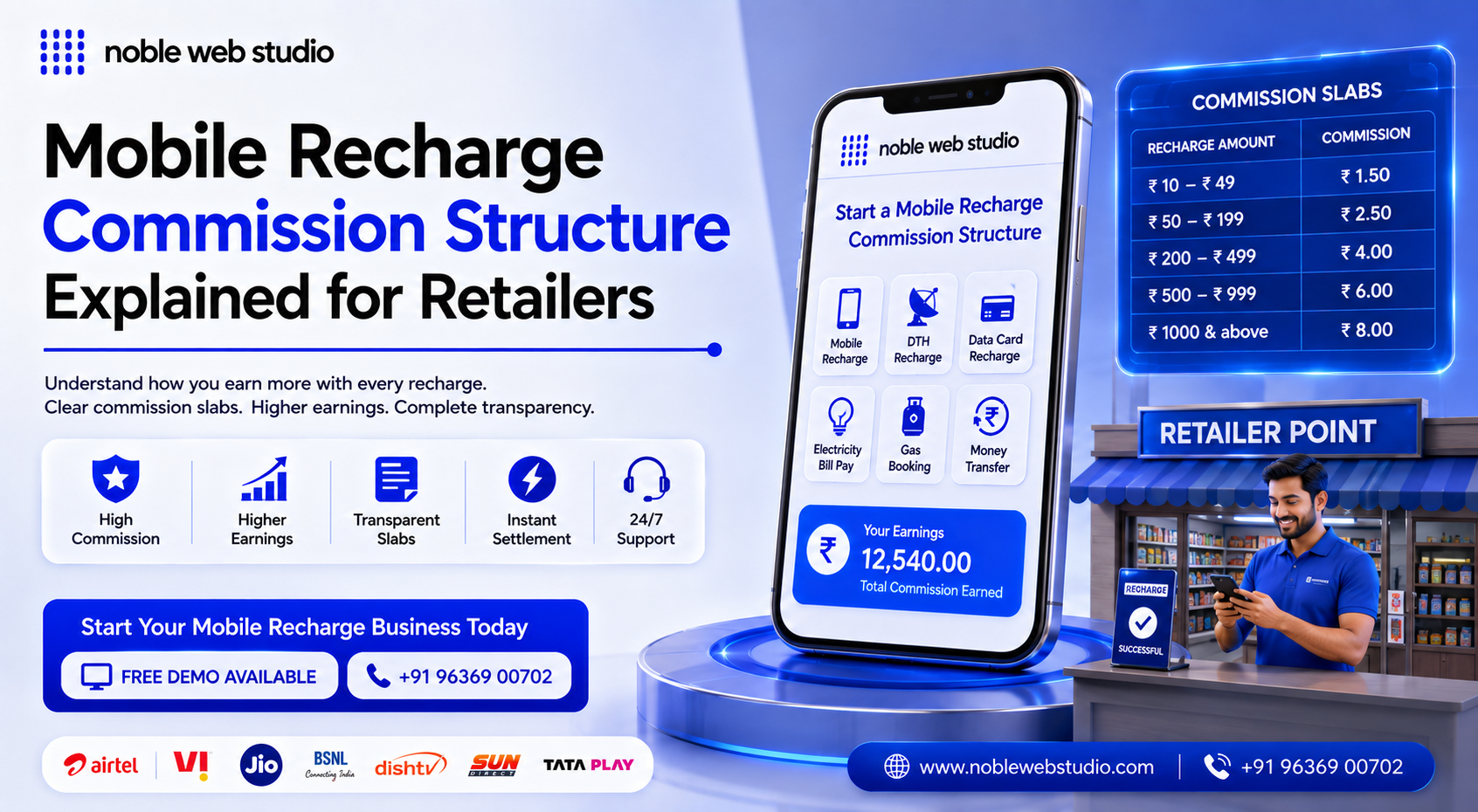
Understanding the Mobile Recharge Commission Structure is essential for every retailer who wants to earn consistent income from the digital recharge business. Whether you own a mobile shop, Kirana store, CSC center, or digital service outlet, knowing how recharge commissions work can help you choose the right platform and maximize your monthly earnings.
A Mobile Recharge Commission App or B2B Recharge Software allows retailers to provide prepaid mobile recharge, postpaid bill payment, DTH recharge, FASTag recharge, and utility bill payment services while earning recharge commission on every successful transaction. However, commission rates can vary depending on the telecom operator, recharge category, service type, and the recharge software provider like Noble web studio you choose. Understanding these factors helps retailers make informed business decisions.
Mobile recharge commission is the money or percentage a shop owner, agent, or app user earns for doing a prepaid mobile, DTH, or utility bill payment for someone else. When you use a special B2B recharge portal or recharge commission app to pay a telecom operator, you get a small cut (usually 1% to 5%) of the recharge value as a profit.
A reliable Mobile Recharge Software should offer transparent commission management, real-time transaction tracking, instant recharge processing, secure recharge API integration, and an easy-to-use recharge retailer dashboard. These features not only simplify day-to-day operations but also help retailers monitor earnings, manage wallets, and grow their recharge business efficiently.
Whether you are starting new recharge business or already operating a retail recharge outlet, knowing how commission is calculated helps you improve profitability, manage transactions efficiently, and make better business decisions. A modern B2B Recharge Software also provides automated commission calculation, wallet management, real-time transaction tracking, retailer management, and detailed earning reports, making it easier to manage your business.
Noble Web Studio provides advanced B2B Mobile Recharge Software with a smart commission management system, secure Mobile Recharge API Integration, multi-operator support, wallet management, real-time reports, and a powerful recharge admin panel. The recharge platform designed to help retailers, distributors, and entrepreneurs build a scalable recharge business with reliable technology and dedicated technical support.
In this guide, you’ll learn how the Mobile Recharge Commission Structure works, what factors affect retailer commissions, how to increase your recharge income, and how choosing the right recharge software can help you build a profitable digital payment business.
What is Mobile Recharge Commission?
Mobile recharge commission is the money or percentage reward paid to an agent, retailer, or app user when they successfully top up a prepaid mobile phone, pay a utility bill, or recharge a DTH connection. It typically ranges from 1% to 4% of the total transaction value depending on the telecom operator.
How Does Mobile Recharge Commission Work?
Mobile recharge commission work lets retailers and agents earn a small percentage (usually 1% to 5%) or flat margin on every prepaid mobile, DTH, or utility bill payment processed for customers through specialized digital recharge B2B application.
How the Process Works
- Registration: Sign up on a multi recharge platform or dedicated recharge agent portal or recharge business apps.
- Wallet Loading: Add funds to your in-mobile recharge commission app digital wallet using UPI, net banking, or debit cards.
- Customer Transaction: Enter the customer’s mobile number, operator, and plan amount, then pay using your wallet balance.
- Commission Credit: The mobile recharge system processes the recharge instantly and credits a fixed commission percentage straight to your wallet.
Mobile Recharge Commission by Service
Mobile recharge and utility service commissions in India typically range from 0.5% to 4.0% per transaction depending on the telecom operator, service category, and mobile recharge B2B platform or high recharge commission app used (such as Multi mobile recharge portal).
Prepaid Mobile Recharge Commissions
- Airtel: 2.0% to 3.5% per transaction.
- Reliance Jio: 1.5% to 3.0% per transaction.
- Vi (Vodafone Idea): 2.5% to 4.0% per transaction (often higher to attract agents).
- BSNL / MTNL: 3.0% to 4.5% per transaction (highest due to promotional margins).
DTH Recharge Commissions
- Tata Play, Airtel Digital TV, Dish TV, Videocon d2h, Sun Direct: 2.0% to 3.5% per transaction.
Bill Payments & Utility Services
- Postpaid Mobile Bills: 0% to 0.5% (or fixed small fee/flat reward).
- Electricity & Gas Bills (BBPS): Flat ₹0 to ₹5 per bill, or small percentage rewards depending on platform slabs.
- FASTag & Data Cards: 0.5% to 1.0% per transaction.
Read Blog: Best Mobile Recharge Commission App in India (2026) – Top 10 Highest Commission Apps
Types of Mobile Recharge Commissions for Retailers
Retailer mobile recharge commissions typically range from 1% to 6% per transaction, divided across categories like prepaid mobile, DTH, and utility bills. Payout types depend on the telecom operator, service category, and whether commissions are credited instantly via a digital B2B wallet or structured through a multi-level distributor hierarchy.
Commission Categories by Service Type
- Prepaid Mobile Recharge: Earn a percentage-based margin (1% to 4%) varying by network operator (e.g., BSNL/Vi often offer higher percentages than Airtel/Jio).
- DTH Recharge: Yields higher margins (2% to 7%) for providers like Tata Play, Dish TV, and Airtel Digital TV.
- Postpaid & Utility Bill Payments: Paid either as a small percentage (1% to 3%) or a fixed flat fee (₹5 to ₹20 per bill) for electricity, gas, or FASTag.
Who Pays the Recharge Commission?
The telecom operator (such as Jio, Airtel, or Vi) or the digital wallet/recharge platform pays the recharge commission out of their own margins to incentivize agents, retailers, and distributors.
How the Commission Flow Works
- Telecom Operators: Companies like Jio or Airtel build the commission into their wholesale pricing structure. When a retailer or partner loads money into a portal or wallet, they receive a discounted rate or an instant percentage margin (typically ranging from 1% to 4%).
- Distributors and Sub-Distributors: In traditional retail chains, master distributors take a cut from the telecom company and pass a smaller percentage down to local area distributors and neighborhood shopkeepers.
- Digital Apps: Consumer-facing or agent-assisted apps absorb the commission cost as a customer acquisition or retention expense, rewarding users with flat percentages or cashback.
Industries Use Recharge Commission
The multi recharge and digital utility industry utilizes a best recharge commission model where platform admins, distributors, and local retailers earn a percentage or fixed margin on prepaid mobile, DTH, and bill payment transactions.
Business Roles & Distribution Hierarchy
- Admin / API Provider: Owns the core recharge software or gateway, making money on high-volume aggregated traffic.
- Distributor: Manages a network of local shops, earning a spread margin between the recharge admin rate and the retailer payout.
- Retailer / Agent: Operates a local storefront or mobile app (like multi-service portals) to capture walk-in consumer transactions and earn instant per-transaction margins.
Why Use Recharge Commission
Using a recharge commission platform allows you to turn everyday mobile top-ups, DTH renewals, and utility bill payments into a source of immediate cash-back or passive income, earning a 1% to 5% return on every transaction instead of paying extra convenience fees.
Key Benefits
- Instant Earnings: Get a percentage-based recharge commission credited straight to your digital wallet immediately after a successful transaction.
- Low Investment: Start a micro-business or side income using just your smartphone and an internet connection with no heavy setup costs.
- All-in-One Dashboard: Manage multiple telecom operators (like Jio, Airtel, Vi, BSNL) and utility services from a single recharge commission app.
- No Hidden Platform Fees: Avoid extra service charges typically added by standard consumer payment apps.
- Easy Withdrawals: Transfer accumulated earnings safely back to your personal bank account.
Key Aspects of Mobile Recharge Commission
Higher Mobile recharge commission refers to the percentage-based earnings or cashbacks that retailers, agents, or platform users receive for successfully processing prepaid mobile, DTH, or utility top-ups. Rates typically range between 1% and 5% depending on the operator and service type.
Core Commission Structures
- Percentage Margins: Earn a fixed slice (e.g., 1% to 4%) of the total transaction value per successful top-up.
- Operator Variability: Rates vary significantly across telecom providers like Jio, Airtel, Vi, and BSNL.
- Multi-Tier Hierarchies: Best Mobile recharge B2B platform distribute margins across master distributors, standard distributors, and local retailers.
Financial & Operational Mechanics
- Instant Wallet Credits: Commissions usually route directly back into the user’s mobile recharge portal wallet immediately after processing.
- Automated Reversals: Failed or dropped transactions trigger instant, automated refunds to protect agent funds.
- Extended Services: Earnings stretch past basic talk-time into DTH renewals, FASTag recharges, and utility bills via BBPS.
Mobile Recharge Commission Structure Explained
Mobile recharge commission structures typically range from 1% to 5% per transaction. Retailers and agents earn this percentage instantly as a margin or wallet credit when performing prepaid recharges, DTH top-ups, or utility bill payments. Rates vary significantly by telecom operator, service category, and distribution tier.
Commission Rates by Operator & Service
- Prepaid Mobile: 1% to 4% (Jio: 1%-2%, Airtel: 2%-3%, Vi & BSNL: 2.5%-4%).
- DTH Recharge: 2% to 6% (Tata Play, Dish TV, Airtel Digital TV).
- Utility & Postpaid Bills: 0% to 3% or flat fees (₹2 to ₹20 per transaction).
Multi-Tier Distribution Levels
- Admin / API Provider: Controls the core gateway and sets baseline margins.
- Master Distributor: Receives the highest recharge commission tier (up to 3.6%–5%+) and oversees distributors.
- Distributor: Earns a mid-tier override commission from managed retailers.
- Retailer / Agent: Earns instant cash-back or direct wallet margins (1%–4%) on end-customer recharges.
Mobile Recharge Commission Structure
Understanding the distribution of profit margins
Mobile Recharge Commission by Operator
High Mobile recharge commissions typically range from 1.5% to 6.5% per transaction depending heavily on the telecom operator and the specific B2B recharge retailer platform or Noble web studio being used. BSNL generally offers the highest percentage, while private operators like Airtel and Jio provide lower margins.
Average Commission Rates by Operator
- BSNL (Top-Up / RCV): 3.5% to 6.5% (Highest margins due to government promotional structures)
- Vi (Vodafone Idea): 2.5% to 4.0%
- Reliance Jio: 1.5% to 3.5% (Direct apps offer structured earnings)
- Airtel: 1.5% to 2.5%
Commission Rates by Service Type
- Prepaid Mobile: 1.5% – 6.5% (Varies by operator)
- DTH Recharge: 2.0% – 3.5%
- Postpaid / Utility Bills (BBPS): 0% to 1% or flat ₹5 to ₹20 per transaction
Factors That Affect Recharge Commission Rates
Recharge commission rates typically range from 1% to 6% per transaction. They are primarily influenced by the specific telecom or service operator, the volume of transactions processed, the service category (such as mobile prepaid versus DTH or utility bills), and the hierarchical tier of the user (retailer, distributor, or master distributor).
Key Factors Influencing Commission Rates
- Service Category: Different utilities offer varying margins. For instance, prepaid mobile recharges yield roughly 1%–4%, DTH recharges average 2%–4%, and electricity or utility bill payments typically operate on fixed flat fees (e.g., ₹5 to ₹20 per bill) or lower percentage slabs.
- Telecom Operator: Individual operators (like Jio, Airtel, Vi, or BSNL) set distinct margins based on their internal commercial policies and promotional push periods, resulting in fluctuating commission percentages between 1.5% and 5%.
- Transaction Volume and Slabs: High-volume vendors or recharge admin platform utilizing tiered pricing models qualify for elevated commission slabs as an incentive for driving massive daily network traffic.
- User Hierarchy / Channel Level: Recharge Commissions scale according to your business level. Retailers deal directly with end-users at base commission rates, whereas distributors and master distributors extract an override margin (0.25% to 1.5% extra) from the downline traffic they manage.
- Platform Provider & API Pricing: Noble web studio dictates the final payout structure depending on whether you use a basic white label recharge portal or a direct carrier integration.
How Mobile Recharge Commission is Calculated
Mobile recharge commission is calculated as a percentage of the transaction value (or via a flat fee for utility bills), determined by the telecom operator, service type, and distribution hierarchy. For example, a ₹200 mobile recharge at a 2.5% commission yields an immediate ₹5 profit credited to the agent’s digital wallet.
How the Calculation Works
- Transaction Value: The total face value of the prepaid recharge or bill amount requested by the customer.
- Commission Percentage (Slab): The agreed margin rate assigned to a specific operator (e.g., lower for Jio, higher for Vi or BSNL).
- Formula: Commission = Recharge Amount × (Commission Rate % )
- Distribution Cut (Multilevel): In Recharge B2B setup, the master distributor, distributor, and retailer split a cumulative margin pool, where each tier takes a small overriding percentage.
Typical Rates by Service Type
| Service Category | Commission Type | Typical Rate Range |
|---|---|---|
| Prepaid Mobile (Jio/Airtel) | Percentage | 1.0% to 3.5% |
| Prepaid Mobile (Vi/BSNL) | Percentage | 2.5% to 5.0% |
| DTH Recharge | Percentage | 2.0% to 6.0% |
| Utility Bills (BBPS) | Flat Fee or Percentage | ₹5 to ₹20 flat or 0.5%–2% |
Commission Calculation Logic
Step-by-step breakdown of how profit is derived
Read Blog: Best Mobile Recharge Commission App | Highest Cashback & Commission
Mobile Recharge Commission Chart
Mobile recharge commission rates typically range from 1% to 6% per transaction, varying by telecom operator, service type, and Noble web studio.
Service Commission Rate Chart
Detailed breakdown of margins for Prepaid, DTH, and Utility services
📱 Mobile Prepaid Operator Rates
| Operator | Commission Range | Remark |
|---|---|---|
| Jio | 1% to 3.5% | Per successful top-up |
| Airtel | 2% to 3.5% | Per transaction |
| Vi (Vodafone Idea) | 2.5% to 4.8% | Highest among major networks |
| BSNL | 2.5% to 4% | Per transaction |
🔌 Other Services and Utilities
| Service Type | Commission Range | Details |
|---|---|---|
| DTH Recharge | 2% to 7% | Tata Play, Dish TV, Videocon d2h |
| Postpaid Bill Payment | 1% to 3% | Per transaction |
| Electricity & Utility Bills | ₹2 to ₹20 / 1% to 3% | Flat fee or percentage margin |
| FASTag Recharge | 1% to 2% | Per transaction |
Features Mobile Recharge Commission
Mobile recharge commission platforms allow users and retailers to earn cash margins typically 1% to 5% on prepaid mobile, DTH, and utility bill payments. Key features include multi-operator support, instant wallet top-ups via UPI, automated refunds for failed transactions, and real-time dashboard earnings tracking.
Core Services
- Prepaid & Postpaid Top-ups: Support for major telecom networks like Jio, Airtel, Vi, and BSNL.
- DTH Renewals: Instant recharges for Tata Play, Dish TV, Airtel Digital TV, Videocon d2h, and Sun Direct.
- Utility Bill Payments: Electricity, water, gas, and landline bill processing through the Bharat Bill Payment System (BBPS).
- Financial Utilities: FASTag recharges, insurance premium payments, and micro-ATM/AEPS services on select portals.
App & Platform Features
- Zero Joining Fees: Free or low-cost digital sign-up with immediate wallet activation.
- Instant Refunds: Automatic credit reversal to the recharge commission app wallet for failed or dropped transactions.
- Real-time Tracking: Dashboards to monitor daily earnings, passbooks, and transaction histories.
- Wallet Management: Easy fund loading via UPI, net banking, or debit cards, alongside direct commission payouts.
Benifits Mobile Recharge Commission
Mobile recharge commission platforms allow shop owners and individuals to earn instant margins (typically 1% to 6%+) on prepaid top-ups and utility bill payments for major operators like Jio, Airtel, Vi, and BSNL without maintaining physical inventory.
Financial and Business Benefits
- Instant Earnings: Commissions are credited directly to your digital wallet the exact moment a transaction finishes.
- Low Start-up Cost: Requires only a smartphone and an active internet connection with no physical stock or heavy infrastructure investments.
- Expanded Services: Broaden your revenue scope by adding DTH top-ups, FASTag recharges, electricity, and water bill payments.
- Zero Inventory Risks: Eliminate the need to store physical scratch cards or paper stock.
- 24/7 Availability: Run transactions and accumulate revenue around the clock using automated wallet systems.
- Increased Footfall: Local shop owners can draw walk-in clients who may purchase other goods.
Read Blog: Mobile Recharge Commission App Benefits in 2026
How Retailers Earn from Every Recharge Transaction
Retailers earn money from every mobile or utility recharge transaction through a direct recharge commission or cashback percentage typically ranging from 0.5% to 4% of the transaction value. When a customer pays for a service, the digital recharge B2B portal, recharge app commission, or telecom operator instantly credits a small margin back into the retailer’s digital wallet.
Core Earning Mechanisms
- Prepaid Mobile Commission: Earn 1% – 4% per transaction depending on the telecom operator (such as Jio, Airtel, or Vi) and the platform slab.
- DTH Recharge Commission: Earn 2% – 3% on direct television and satellite connection top-ups.
- Utility & BBPS Payments: Earn 0.5% – 2% or a flat rate of ₹3 – ₹15 for processing electricity, gas, water, or broadband bills.
- Ancillary Financial Services: Augment income via flat fees (₹5 to ₹15) on cash withdrawals and money transfers using AePS integration.
Distributor and Master Distributor Recharge Commission Model
A distributor and master distributor recharge commission model is a multi-tier B2B distribution hierarchy where profit is earned via a commission spread (margin differential). The recharge platform admin sets root margins from telecom/utility APIs, passing residual margins down through Master Distributors, Distributors, and Retailers based on network volume.
Hierarchical Structure & Roles
- Admin / API Provider: Controls core infrastructure, connects with telecom operators, and establishes baseline commission caps.
- Master Distributor (MD): Oversees broad regional zones or multiple districts; creates and supports sub-distributors while earning an overriding commission on total downline volume.
- Distributor (Dist): Manages local clusters of neighborhood retailers, allocates physical/digital wallet funds, and earns a direct spread from retailer transactions.
- Retailer: Interfaces directly with end consumers to execute mobile, DTH, or bill payments.
Typical Commission Spread Breakdown
Service Commission Structure
Detailed breakdown of margins for Retailers, Distributors, and Master Distributors
Prepaid Mobile Recharge (Jio, Airtel, Vi, BSNL)
| Role | Commission / Margin |
|---|---|
| Retailer | 1.0% to 4.0% of transaction value |
| Distributor | 0.10% to 0.50% extra override above retailer slab |
| Master Distributor | 0.05% to 0.25% override above distributor slab |
DTH Recharge
| Role | Commission / Margin |
|---|---|
| Retailer | 2.0% to 3.0% |
| Distributor | 0.10% to 0.20% override |
| Master Distributor | 0.05% to 0.10% override |
Utility Bills (BBPS) / Money Transfer (DMT)
Financial Mechanics & Profit Flow
- Wallet-to-Wallet (W2W) Transfers: Master Distributors fund Distributors, who in turn fund Retailers via pre-funded digital ledger systems.
- Automated Commission Credit: Every time a retailer processes a ₹500 recharge, the specific percentage split calculates instantaneously via the recharge platform software, crediting margins to the respective distributor wallets in real time.
Read Blog: Best Mobile Recharge API with High Commission for Business
API-Based Mobile Recharge Commission System
An Recharge API-based mobile recharge commission system connects your mobile recharge software or app to telecom operators through a single digital wallet. It automatically processes prepaid, DTH, or utility top-ups in real-time, tracks transaction success, and instantly credits a percentage-based or flat-fee commission back to your account.
Standard Commission Ranges
- BSNL: 5.0% to 6.5%
- Vi (Vodafone Idea): 3.0% to 4.8%
- Jio: 1.5% to 3.5%
- Airtel: 1.5% to 3.0%
- DTH Operators: 3.0% to 7.0%
- Utility Bills: Flat ₹5 to ₹20 per bill or 1.0% to 3.0%
Key System Components
- Single E-Wallet: Fund all operator transactions from one pooled balance.
- Automatic Refund Engine: Instantly or dynamically reverse funds for failed or dropped calls.
- Multi-Tier Hierarchy: Split margins dynamically if managing Master Distributors, Distributors, and Retailers.
- Real-time Webhooks: Receive immediate push notifications on delivery status and margin credits.
Mobile Recharge Commission Business Model
The mobile recharge commission business model operates on a recharge B2B or multi-tier aggregation framework where agents, retailers, or platform owners earn a 1% to 6% margin per transaction. Revenue is generated through telecom operator margins, Mobile recharge API redistribution, and value-added utility services credited instantly to a digital wallet.
Business Tiers & Hierarchy
- Retailers: Direct customer interface; process individual prepaid mobile, DTH, or utility payments for immediate per-transaction commissions.
- Distributors: Oversee a network of retailers; earn mobile recharge commission or residual percentage on the collective transaction volume generated by their downline.
- Admin / Platform Owners: Own the white label recharge software or best Recharge API network; set custom commission slabs and clip a fraction of every transaction processed across the entire network.
Typical Commission Slabs
- Prepaid Mobile (Jio, Airtel, Vi, BSNL): 1% – 4% per transaction depending on the telecom operator.
- DTH Recharge: 2% – 3% (sometimes up to 7% via specific aggregators).
- Utility Bills (BBPS / Electricity / FASTag): 0.5% – 2% or flat fee structures per bill paid.
Revenue Generation Mechanics
- Wallet Pre-funding: Operators load money into a master digital wallet via UPI or net banking before initiating transactions.
- Instant Margin Credit: Commissions are calculated in real-time and auto-credited back to the user’s operational wallet upon success.
- Ancillary Services: Cross-selling financial services like Aadhaar Enabled Payment System (AEPS) to supplement core recharge margins.
Mobile Recharge Commission Flow
How the earnings move from Operator to Retailer
Commission Logic Example:
Prepaid vs Postpaid Recharge Commission
Prepaid mobile recharges offer significantly higher retailer and Recharge API commission margins (1% to 5%) compared to postpaid bill payments, which usually yield lower percentages (0% to 3%) or small flat convenience fees (₹5 to ₹20 per bill).
Commission Comparison Structure
Prepaid Mobile Recharge
- Retailer Margin: 1% – 4% per transaction (varies by carrier).
- Operator variance: Vodafone Idea (Vi) and BSNL typically provide higher margins (2.5% – 5%), while Airtel (2% – 3.5%) and Jio (1% – 2.5%) offer tighter percentage yields.
- Volume: High frequency, making it the primary income driver for digital micro-retailers.
Postpaid Bill Payment
- Retailer Margin: 0% – 3% or flat fees (₹5 to ₹20 per transaction).
- Operator variance: Many legacy Recharge API gateways provide near 0% commission on specific postpaid utility cycles unless processed via structured BBPS channels.
- Volume: Lower transaction frequency, treated mostly as a value-added service to retain customers rather than a core profit generator.
Read Blog: Best Mobile Recharge Commission App Provider in India 2026
Mobile Recharge Commission Calculator
To calculate mobile recharge commission earnings, multiply your total monthly or daily recharge sales amount by the operator’s commission percentage rate (divided by 100). For example, ₹10,000 in monthly recharges at a 2.5% commission rate yields a ₹250 payout.
Typical Commission Rates by Operator
- Jio: 1.5% to 3%
- Airtel: 2% to 3.5%
- Vi (Vodafone Idea): 2% to 4%
- BSNL: 3% to 4.5%
Formula & Estimation Example
- Formula: Total Recharge Amount × (Commission Rate Percentage / 100) = Your Earnings
- Daily Volume Example: 20 recharges averaging ₹240 each equals ₹4,800 daily volume. At a flat 2.5% average commission, your daily earning is ₹120 (approx. ₹3,600 monthly).
📱 Recharge Profit Calculator
Calculate your earnings per recharge instantly
Monthly Recharge Commission Income Examples
Monthly recharge commission income depends on your transaction volume and commission percentages, which typically range from 1% to 4% for mobile prepaid and 2% to 3% for DTH recharges. A small local shop or individual agent processing an average volume can realistically earn ₹15,000 to ₹30,000 per month.
Small Retailer Example (Part-Time / Local Shop)
- Daily Volume: 50 mobile recharges (average ₹250 each) = ₹12,500 daily turnover.
- Monthly Turnover: ₹3,75,000.
- Average Commission Rate: 2.5% on prepaid mobile recharges.
- Monthly Income: ₹3,75,000 × 2.5% = ₹9,375 from mobile recharges alone, plus extra from DTH or utility bills.
High-Volume Retailer Example (Busy Local Store / Cyber Cafe)
- Daily Volume: 150 mixed transactions (Mobile recharges, DTH, and BBPS utility bills) averaging ₹300 per transaction = ₹45,000 daily turnover.
- Monthly Turnover: ₹13,50,000.
- Blended Commission Rate: ~2% across services.
- Monthly Income: ₹13,50,000 × 2% = ₹27,000 per month.
Distributor Network Example (B2B Volume Model)
- Network Size: Overseeing 20 active local retailers.
- Retailer Volume: Each retailer generates ₹1,50,000 in monthly recharges (Total network volume: ₹30,000,000).
- Distributor Commission Spread: 0.5% override margin from lower-tier retailer transactions.
- Monthly Income: ₹30,00,000 × 0.5% = ₹15,000 passive volume income plus direct retail earnings.
How to Maximize Mobile Recharge Commission
To maximize mobile recharge commissions, register as an official retailer or agent on specialized multi recharge admin platform, diversify into high-margin DTH and utility bill payments, and leverage operator-specific apps. Focus on high transaction volume and referral networks to substantially increase overall earnings.
Choose High-Commission Platforms
- Compare and select best recharge commission app offering transparent, tiered margins (typically 2% to 6%) without hidden maintenance or annual fees.
- Register specifically as an agent or retailer rather than using standard consumer UPI apps to unlock direct margin credits.
Diversify Service Offerings
- DTH Recharges: Target Tata Play, Airtel Digital TV, and Dish TV top-ups, which usually yield higher commission percentages than standard mobile recharges.
- Utility Bills: Process electricity, gas, water, and FASTag recharges to earn secondary margins from the same customer base.
- Financial Add-ons: Incorporate Aadhaar Enabled Payment System (AEPS) if supported by mobile recharge portal.
Scale Volume and Networks
- Increase Daily Footfall: Target high-density local areas or establish a quick-service digital counter to drive repeat transactions.
- Build Referral Chains: Invite sub-agents or other local shopkeepers to join your chosen recharge service platform using your referral link to earn passive commission bonuses.
Read Blog: Best Mobile Recharge Commission App 2026 – Full Comparison Guide
How Retailers Increase Mobile Recharge Commission
Retailers increase their mobile recharge earnings by switching to high-margin B2B recharge commission platform, upgrading to distributor tiers to earn overrides from sub-agents, and cross-selling high-commission utility services.
Methods to Maximize Earnings
- Upgrade to Distributor Status: Move from a basic retailer to a distributor role on multi service recharge platform, allowing you to recruit sub-retailers and collect overriding margins (0.5% to 1.5%) on their transaction volumes.
- Switch to Aggregator B2B Apps: Compare B2B multi recharge application (such as Noble web studio) that offer 1% to 6%+ payouts, which often exceed standard direct operator caps.
- Diversify Service Offerings: Bundle mobile recharges with higher-margin ancillary services like DTH recharges, best BBPS service, Fastag and best AEPS service to accumulate flat or tiered bonuses.
- Target High-Commission Operators: Prioritize operators or specific promotional slabs that provide peak percentage returns (which can scale up to 4%–6% depending on the telecom circle).
- Drive Transaction Volume: Negotiate custom volume-based slab upgrades with master distributors or mobile recharge platform admin by consistently hitting high daily transaction counts.
How Distributors Earn Higher Recharge Commission
Distributors earn higher recharge commissions by leveraging network volume and optimizing the commission spread (the margin between the rate received from the Noble web studio server and the lower rate passed down to sub-retailers). Maximizing earnings requires expanding active agent networks, integrating high-margin utility services, and negotiating competitive slabs.
Core Strategies to Increase Earnings
- Expand Active Retailer Network: Onboard more shopkeepers and agents. Total commission is cumulative; a larger active network multiplies passive override earnings per transaction.
- Optimize Commission Slabs: Fine-tune the margin spread. Offer competitive rates to attract retailers while retaining a sustainable per-transaction cut for yourself.
- Diversify Service Mix: Encourage your network to process high-margin ancillary services instead of basic prepaid mobile recharges alone.
- Promote:
- DTH Recharges (2%–3%)
- BBPS Utility Bills (Electricity, Water, Gas: 0.5%–2% or fixed ₹3–₹15 per bill)
- AePS & Domestic Money Transfers (DMT) (Flat ₹5–₹15 or 0.4%–1%)
- Source Direct High-Commission APIs: Noble web studio offering lower baseline trusted recharge API price. Lower sourcing costs leave a wider margin to split or retain.
- Promote Volume Incentives: Set tiered performance goals or bonuses for top-performing retailers in your downline to drive higher daily transaction volumes.
Read Blog: Earn Daily Income with Mobile Recharge Commission
Common Mistakes That Reduce Recharge Earnings
Common mistakes that reduce mobile recharge and utility earnings include maintaining low wallet balances that cause failed transactions, relying on unreliable b2b recharge API, restricting offerings to only basic recharges while skipping high-margin services like BBPS software service or AEPS software service, and failing to track daily sales or commission performance.
Operational and Service Errors
- Low wallet balance: Running out of funds stops transactions instantly and loses customers.
- Poor API selection: Slow or failing networks ruin success rates and commissions.
- Limited service range: Offering only mobile top-ups misses out on extra income from utility bills and money transfers.
- Ignoring promotional terms: Missing deadlines or skipping specific cashback rules wastes extra earning opportunities.
Management and Tracking Mistakes
- No sales records: Forgetting to write down transactions leads to lost cash and customer arguments.
- Unmonitored commissions: Failing to check provider rates means missing better commission structures.
- Using unsafe platforms: Falling for fake dealer websites results in stolen capital.
- Poor customer follow-up: Slow responses push regular buyers away to other agents.
Best Mobile Recharge Software for Commission Management
The best mobile recharge software for commission management includes platforms like Noble web studio. These white label recharge and multi recharge system let you set multi-tier recharge commission structures for distributors and retailers, track live wallet credits, and automate payouts for operators like Jio, Airtel, Vi, and BSNL.
Core Commission Features to Look For
- Multi-Tier Slabs: Ability to configure distinct commission percentages or flat fees for master distributors, distributors, and individual retailers.
- Real-Time Auto-Credit: Instant crediting of commissions to the user’s digital wallet upon successful transaction completion.
- Operator-Wise Customization: Fine-tuning margins separately for prepaid mobile (1%–4%), DTH (2%–7%), and utility bills/BBPS.
- Instant Refund Management: Automated, error-free reversals and commission deductions if a recharge fails.
Features to Look for in a Mobile Recharge Commission Platform
A reliable mobile recharge commission platform should provide high, transparent margins, multi-operator support, robust security, and instant automated refunds for failed transactions. Look for comprehensive mobile recharge service integration and administrative tools to maximize earning potential and operational efficiency.
Core Service & Financial Features
- Multi-Operator & Multi-Service Support: Ensure support for major telecom providers (Jio, Airtel, Vi, BSNL), DTH connections (Tata Play, Dish TV), and BBPS utility bills (electricity, water, gas, FASTag).
- High & Dynamic Commission Slabs: Look for transparent, competitive margins (typically 1%–4% for mobile and higher for DTH/utilities) with instant wallet crediting upon transaction success.
- Instant Auto-Refunds: Automatic, real-time refunds credited back to your digital wallet for any failed or dropped transactions.
- Flexible Payment Gateway Loading: Easy wallet top-ups via UPI, net banking, or debit/credit cards with immediate balance updates.
Management & Business Scalability
- Multi-Tier Hierarchy & Controls: Essential for mobile recharge B2B setup to manage master distributors, distributors, and downline retail agents.
- White-Label Customization: The option to rebrand the web portal or mobile commission recharge app with your own company name, logo, and color theme.
- Robust Admin Dashboard: Centralized tracking for live transaction monitoring, dispute handling, and automated ledger generation.
- High Uptime API Integration: High Uptime Recharge API Integration Stable routing with high success rates (99.9% uptime) to prevent service bottlenecks.
Read Blog: Best Mobile Recharge Commission App Features in 2026
Mobile Recharge Commission Settlement Process
The mobile recharge commission settlement process is usually instant. When you complete a customer’s prepaid mobile or DTH recharge through a recharge earning B2B platform, the system deducts the net amount from your digital wallet and instantly credits your specified percentage commission back into that same working wallet or a separate earnings ledger.
Key Steps in the Settlement Workflow
- Wallet Pre-funding: You add working capital into your recharge B2B app wallet using UPI, net banking, or a direct bank transfer.
- Order Placement: You enter the customer’s phone number or DTH ID and select the correct telecom operator and plan amount.
- API Routing: The platform routes the request through telecom APIs to complete the transaction with the operator in real time.
- Instant Credit: Upon a successful response code from the operator, the commission (typically ranging from 1% to 5% based on the Noble web studio) is added to your balance immediately.
- Bank Payout: Accumulated profit or primary balances can later be transferred via IMPS, NEFT, or UPI to your linked bank account.
💰 Recharge Settlement Process
Step-by-step flow of commission credits
Mobile Recharge Commission Reports & Analytics
Mobile recharge commission reports and analytics track transaction volume, success rates, and earned margins across telecom operators. They provide real-time dashboards for retailers and admins to audit earnings, monitor wallet credits, and evaluate customer recharge trends.
Core Report Types
- Transaction Logs: View lists of successful, pending, or failed recharges with unique IDs, operator names, and timestamps.
- Commission Summaries: Calculate exact margins earned per transaction categorized by operator (e.g., Jio, Airtel, Vi, BSNL).
- Ledger & Wallet Reports: Track opening balances, recharges, refunds, and closing wallet amounts.
- Success/Failure Ratio Reports: Analyze best recharge system uptime and operator performance to reduce failed requests.
Key Analytics Features
- Real-Time Tracking: Monitor live sales data and instant recharge commission credits.
- Visual Dashboards: Review graphical breakdowns of daily, weekly, or monthly revenue.
- Export Options: Download detailed statements in CSV, Excel, or PDF formats for accounting and tax filing.
- Multi-Tier Insights: Track subordinate retailer or distributor margins if running a white label mobile recharge software or mobile recharge B2B network.
📊 Business Analytics Dashboard
Real-time tracking of recharge commissions & volume
Operator-wise Earnings
Recent Activity Log
| User | Operator | Amount | Comm. |
|---|---|---|---|
| +91 98***12 | Jio | ₹299 | ₹8.9 |
| +91 87***45 | Airtel | ₹719 | ₹21.5 |
| +91 70***89 | VI | ₹155 | ₹4.6 |
Mobile Recharge Commission Security Features
Mobile recharge commission platform and top recharge commission app use bank-grade security features like 256-bit SSL encryption, two-factor authentication (2FA), and PCI-DSS-compliant payment gateways to protect user funds, digital wallet balances, and daily margin settlements.
Core Security Mechanisms
- Data Encryption: Utilizes 256-bit SSL technology to secure all personal info and financial data in transit.
- Two-Factor Authentication (2FA): Requires extra login checks and transaction PINs or OTPs before processing wallet payouts or balance transfers.
- IP/MAC Whitelisting: Restricts recharge API access and mobile recharge admin control to trusted, pre-approved server or device addresses.
- Role-Based Access Control: Separates permissions cleanly between admins, distributors, and individual retailers.
- KYC & Compliance: Integrates mandatory identity verification protocols (such as PAN or Aadhaar checks) for safe agent recharge API onboarding.
Transaction & Wallet Protections
- PCI-DSS Gateways: Secures direct wallet top-ups through verified UPI, net banking, or debit channels.
- Automated Refunds: Triggers instantaneous and secure balance reversals for dropped or failed operator requests.
- Real-Time Audit Trails: Maintains live, unalterable system logs on the RECHARGE Admin Dashboard to trace every commission credit and debit.
Mobile Recharge Commission for Retailers vs Distributors
Mobile recharge commission structures typically vary by telecom operator (such as Jio, Airtel, Vi, and BSNL) and your hierarchical level in the best Recharge Software platform. Retailers deal directly with end-users, while distributors earn an override commission (the spread) based on their downline retailers’ transaction volume.
Operator-wise Commission Comparison
| Telecom Operator | Retailer Commission Range | Distributor Commission / Margin |
|---|---|---|
| Jio | 0.5% – 3.5% | 0.15% – 0.5% |
| Airtel | 2.0% – 2.5% | 0.10% – 0.4% |
| Vi (Vodafone Idea) | 2.0% – 3.5% | 0.10% – 0.4% |
| BSNL | 3.0% – 4.0% | 0.20% – 0.6% |
| DTH Recharge | 2.0% – 3.0% | 0.10% – 0.5% |
Key Structural Differences
- Retailer Earnings: Earns a direct percentage per transaction performed for customers. Income is strictly active and volume-based.
- Distributor Earnings: Earns through a passive “margin spread” the difference between the higher rate provided by the mobile recharge admin panel and the lower rate passed down to active retailers. They profit from the cumulative turnover of all recharge API onboarded retailers.
Read Blog: Best Mobile Recharge Commission App in India (Highest Margin List)
Common Mistakes That Reduce Recharge Commission
Common mistakes that reduce mobile or DTH recharge commission earnings include relying on low-margin operators, using unstable RECHARGE API platform with high failure rates, failing to expand into higher-paying utility services, and ignoring multi-level network building.
Operational and Platform Mistakes
- Choosing low-margin operators: Focusing heavily on operators that offer minimal margins (like standard 1% slabs) instead of balancing across operators with better promotional or base commissions.
- Using unstable software/APIs: Partnering with Noble web studio that have high transaction failure rates leads to lost commission opportunities and wasted time.
- Failing to monitor reports: Neglecting daily transaction logs and commission tracking causes missed discrepancy adjustments or unrecognized slab demotions.
Business Strategy Mistakes
- Sticking to mobile recharges only: Limiting services to prepaid mobile instead of adding DTH, BBPS utility bills, and financial services that often carry higher flat or percentage payouts.
- Ignoring network expansion: Operating strictly as an individual retailer rather than recruiting and managing a distributor network to earn passive commission overrides.
- Inadequate wallet funding: Letting your main operational balance run dry at critical peak hours prevents you from processing high-demand customer requests.
Mobile Recharge Commission Trends in India (2026)
Mobile recharge commission trends in 2026 show blended retail margins ranging from 1% to 5% per transaction. Best Recharge Platform focus heavily on multi-service utility apps, tiered recharge B2B wallet payouts, and higher margins for alternative operators like BSNL compared to lower margins on high-volume Jio recharges.
Key Market Trends
- Tariff Pressures: Major telecom operators like Jio and Airtel face analyst projections for a 12% to 15% tariff hike to increase Average Revenue Per User (ARPU), altering absolute commission values.
- Tiered & Override Models: Distributors leverage multi-level structures, earning an extra 0.5% to 1.5% passive override margin from sub-retailer volumes.
- All-in-One Ecosystems: All in one recharge commission App in india focus on multi-service convergence, combining prepaid top-ups with DTH, FASTag, and BBPS utility payments.
- App Integration: Recharge B2B platform provide instant UPI settlement and bundled utility services (Fastag, electricity) to stabilize retailer earnings.
- Zero Hidden Fees: Leading Recharge B2B software and white label mobile recharge portal compete by removing annual maintenance fees and providing instant 24/7 UPI commission withdrawals.
- Tiered Structures: Higher initial cash wallet deposits unlock elevated commission slabs for heavy-volume local vendors.
White Label Mobile Recharge Commission Software
White label mobile recharge commission software is a ready-made, customizable recharge platform enabling you to launch your own branded B2B or B2C multi recharge business. It lets you set custom profit margins, manage a multi-level user network (admin, distributors, retailers), and process operator recharges under your own company name and domain.
Core Features
- Custom Branding: Add your own company logo, design theme, and unique domain name.
- Commission Management: Define and split multi-tier commission structures for master distributors, retailers, and API users.
- Operator Integration: Pre-integrated support for major mobile networks (Jio, Airtel, Vi, BSNL) and DTH providers (Tata Play, Dish TV, Sun Direct).
- Automated Wallet System: Digital fund loading, auto-approval requests, and real-time ledger tracking.
- Admin & Mobile Control: Comprehensive web dashboard alongside an Android mobile recharge commission app for end-users or field agents.
Read Blog: Best B2B Mobile Recharge Commission App for Recharge Businesses
Four Steps to Launch Your Mobile Recharge Commission APP Business
From Recharge platform setup to live mobile recharges launch your business quickly with a streamlined setup process.
Choose Your Partner Model
Select the Noble web studio model that best matches your business goals whether you’re a white label owner, master distributor, or enterprise-level network operator.
Platform Setup
Your Mobile Recharge Commission APP is configured from end to end, including prepaid & postpaid operators, commission slabs, wallet management, recharge API integrate, and a multi-tier distribution network. Complete recharge API onboarding assistance is provided.
Build Your Network
Add distributors, retailers, and agents through a centralized recharge admin panel. Configure role-based access, define commission margins for each level, and activate recharge services with ease.
Go Live And Earn
Start processing mobile recharges through your live recharge platform. Transactions are processed in real time, commissions are calculated automatically, and your network begins earning from every successful recharge.
How to Choose Recharge Commission APP Provider
Noble web studio only one of the best recharge commission app provider, prioritize high transaction success rates (99%+), transparent commission margins (1% to 6%), instant wallet settlements for successful and failed recharges, multi-operator support (Jio, Airtel, Vi, BSNL, and DTH), and responsive 24/7 customer service.
Reliability and Performance
- Success rate: Look for a Noble web studio with a 99% or higher success rate to prevent failed client orders.
- Speed: Fast processing times under 5 seconds ensure a smooth user experience.
- Uptime: Reliable server infrastructure keeps the system active 24/7 without sudden crashes.
Commission and Payouts
- Rates: Compare percentage margins across operators (typically 1%–6% for mobile and DTH).
- Instant credit: Ensure commissions are credited directly to your digital wallet the moment a transaction finishes.
- Hidden fees: Avoid recharge platform charging sneaky subscription setups, high convenience charges, or secret maintenance deductions.
Features and Services
- Operator coverage: Check if they support all major telecom networks and popular DTH providers.
- Extra utilities: Choose top recharge platform offering utility bill payments, FASTag, electricity, and money transfers (AEPS) to grow recharge business.
- Easy interface: A clean, simple recharge dashboard helps you track history and check earnings quickly.
Why Choose Noble Web Studio for Recharge Business Solutions?
Noble web studio is a professional mobile recharge commission app provider for recharge business solution ensures high uptime (99.9%), instant transaction processing (under 400ms), multi-operator support, automated recharge commission management, and bank-grade security. The Noble web studio helps you scale operations smoothly while offering diverse digital services.
Operational Efficiency & Performance
- High Uptime: Guarantees 99.9% to 99.99% system availability to prevent downtime during peak hours.
- Fast Processing: Delivers instant top-ups and real-time success confirmations in milliseconds.
- Multi-Operator Connectivity: Connects trusted recharge platform to major telecom and DTH networks through a single integration.
Business Growth & Management
- Automated Commissions: Manages multi-level hierarchies, margins, and wallet distributions seamlessly.
- White-Label Branding: Customizes web panels and Earn Commission on Mobile Recharge apps with your own company logo and domain name.
- Expanded Services: Enables cross-selling opportunities like utility bill payments (BBPS) and AEPS.
Security & Support
- Advanced Security: Protects user data and funds using SSL encryption and automated fraud detection.
- 24/7 Technical Support: Resolves routing errors, Smart Recharge API failures, and gateway issues around the clock.
- Real-Time Analytics: Provides detailed dashboards to monitor success rates, revenue streams, and transaction logs.
Conclusion
Understanding the Mobile Recharge Commission Structure is essential for every retailer who wants to build a profitable and sustainable recharge business. A clear recharge commission model helps retailers estimate their earnings, choose the right recharge platform, and maximize revenue from every successful mobile recharge transaction.
The best Mobile Recharge Software should offer transparent commission management, real-time transaction processing, multi-operator support, secure recharge API integration, instant settlements, and a user-friendly retailer recharge dashboard. These features not only improve day-to-day operations but also help retailers provide faster and more reliable services to their customers.
Mobile recharge commission is the money or percentage a shop owner, agent, or recharge earning app user earns for doing a prepaid mobile, DTH, or utility recharge for a customer. The payout usually ranges from 1% to 5% of the total amount paid.
Noble Web Studio offers a complete B2B Mobile Recharge Software with an advanced mobile recharge commission management system, powerful mobile recharge admin panel, retailer and distributor management, secure Mobile Recharge API Integrate, wallet management, and detailed transaction reports. Our mobile recharge commission app designed to help businesses simplify recharge operations, improve efficiency, and support long-term business growth.
If you are planning to start a recharge business or upgrade your existing high volume recharge platform, Noble web studio is a reliable Mobile Recharge Software Provider with a transparent commission system can help you increase customer satisfaction, improve operational efficiency, and create consistent earning opportunities.
Contact Noble Web Studio today to explore our feature rich Mobile Recharge Software, understand the commission structure, request a live demo, and launch a scalable recharge business with secure technology and dedicated technical support.
Mobile Recharge Commission is the amount earned by retailers, distributors, or recharge businesses for successfully processing prepaid or postpaid mobile recharge transactions. The commission structure varies depending on the operator, business model.
Every successful recharge generates a predefined commission for the retailer or distributor. The commission may be percentage-based, fixed per transaction, or volume-based, depending on the highest commission recharge platform and operator agreements.
Recharge commission differs across operators and providers and may change over time. Instead of choosing a highest volume recharge platform only for advertised recharge commission rates, compare settlement speed, recharge platform reliability, support, and overall business value.
Recharge commission is generally calculated based on factors such as:
Recharge amount
Mobile operator
Retailer or distributor level
Monthly transaction volume
Platform commission policy
Recharge commission is the earnings credited for processing a recharge transaction, whereas recharge margin refers to the overall profit retained after considering all applicable costs and business expenses.
Yes. Retailers may increase their earnings by growing transaction volume, expanding their customer base, offering multiple digital payment services, and choosing modern recharge platform with transparent commission policies and reliable support.
Mobile Recharge Commission is commonly earned by:
Retailers
Distributors
Master Distributors
B2B Recharge Portals
FinTech Companies
White Label Recharge Businesses
Digital Service Centers
Mobile Recharge Commission rates can vary based on:
Mobile operator
Recharge category
Business partnership level
Transaction volume
Promotional offers
Provider policies
No. Mobile Recharge Commission structures are not uniform across all telecom operators or recharge providers. Rates and terms differ and may be updated over time.
Distributors generally earn by managing retailer networks and receiving distributor-level commissions in accordance with their agreement and business model. Exact structures vary by provider.
Before selecting a best Mobile Recharge Commission platform, compare:
Commission transparency
Settlement process
Supported operators
Recharge API stability
Dashboard features
Wallet management
Technical support
Platform uptime
Security
Scalability
Yes. Depending on the mobile recharge commission model, earnings may vary according to recharge value, operator, transaction category, and applicable commission slabs.
Tax treatment depends on the applicable laws, business structure, and nature of the income. Businesses should consult a qualified tax professional for guidance specific to their situation.
Most modern B2B recharge software platform provide dashboards where retailers and distributors can view recharge history, commission details, settlements, wallet balances, and transaction reports in real time.
A clear understanding of the commission structure helps businesses estimate potential earnings, compare providers effectively, plan pricing strategies, and choose a professional recharge platform that aligns with their long-term growth goals.