
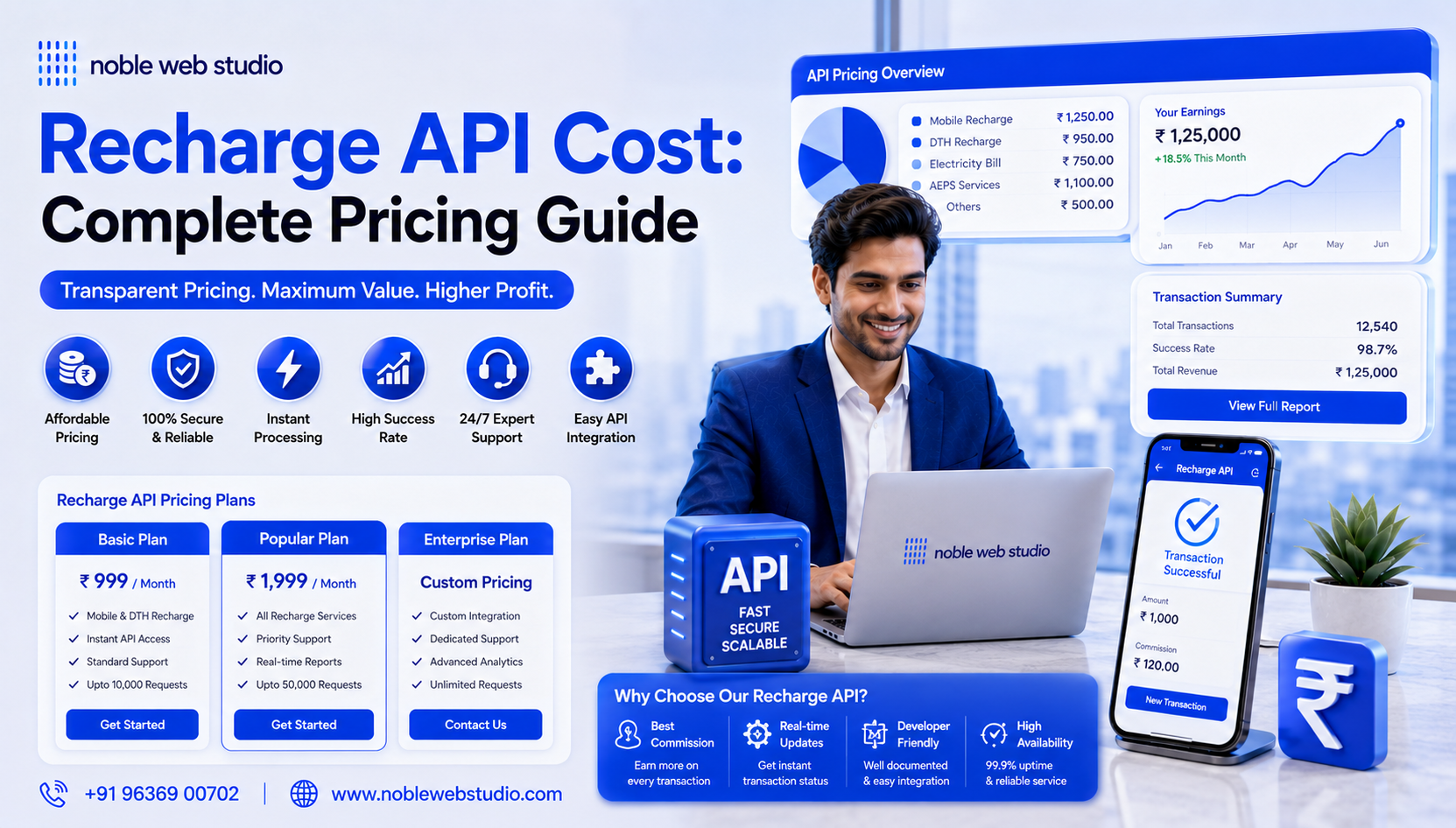
For startups and businesses planning to enter the digital recharge and payment space, understanding Recharge API cost is essential. A Recharge API allows companies to provide seamless services like mobile recharge, DTH recharge, data card recharge, and bill payments directly through their apps or platforms. Choosing the right API with transparent pricing helps businesses maximize profits, reduce operational costs, and deliver faster transactions to customers.
The cost for a recharge API varies significantly, from a one-time purchase of around ₹5,000 to ₹15,000 for basic software, or monthly plans that can range from ₹1,000 upwards. More complex solutions with custom apps or websites can cost over ₹1,00,000, while the total cost also depends on factors like integration fees, payment gateway integration, and ongoing maintenance and support.
Many businesses often search for Recharge API pricing in India, affordable B2B recharge API, and cost-effective solutions to start their digital service business without heavy investment. The right Recharge API should not only be affordable but also secure, reliable, and easy to integrate with your platform.
Startups and businesses often search for affordable, reliable, and feature-rich Recharge API providers in India to ensure smooth transactions, quick settlements, and minimal downtime. A well-chosen Recharge API not only saves time but also helps expand your digital services, attract more customers, and generate steady income.
This complete pricing guide will help you understand Recharge API cost structures, including setup costs, subscription models, transaction fees, and factors affecting pricing, enabling you to choose the best Recharge API solution for your business growth with Noble Web Studio.
What Is Recharge API
A recharge API is an application programming interface that allows businesses to integrate mobile, DTH, and utility bill payment services into their own applications or websites. It acts as a digital bridge to automate recharges and bill payments, enabling users to perform transactions directly through the business’s platform without manual intervention. A single recharge API can often handle multiple services, like mobile and DTH recharges, through a single integration.

How Recharge API Work
A Recharge API facilitates communication between a host platform (e.g., a website or mobile app) and a vendor’s system to enable various recharge services like mobile top-ups, DTH recharges, and bill payments. The working process typically involves the following steps:
Initiation of Recharge Request:
- A user initiates a recharge on the host platform, providing details such as the service type (mobile, DTH, bill payment), target number/account, and recharge amount.
- The host platform constructs a request containing this information, along with authentication details like an recharge API key or token ID, to be sent to the mobile recharge API.
API Processing and Validation:
- The Recharge API receives the request from the host platform.
- It validates the authentication credentials and the provided recharge details (e.g., mobile number format, amount validity).
Communication with Service Provider:
- Upon successful validation, the Recharge API forwards the request to the appropriate service provider’s system (e.g., telecom operator, DTH provider, utility company).
Transaction Processing:
- The Noble web studio system processes the recharge or bill payment. This may involve checking account balances, applying the recharge, or updating billing records.
Response and Confirmation:
- The Recharge API receives a response from the service provider, indicating the success or failure of the transaction. This response often includes a transaction ID and status code.
- The Recharge API then relays this response back to the host platform.
User Notification:
- The host platform receives the transaction status from the Recharge API and informs the user about the success or failure of the recharge, often displaying a confirmation message or an error code.
Read Blog : What is Recharge API? Everything You Need to Know
Types of Recharge API
Recharge APIs can be categorized by their service type, such as Mobile Recharge API (prepaid/postpaid), DTH Recharge API, and Data Card Recharge API. Other types include Multi Recharge API (combining multiple services), Utility Bill Payment API (for electricity, gas, water, etc.), and specialized APIs like B2B Recharge API (for businesses) or White-label Recharge API (for branded platforms).
Types of Recharge APIs
- Mobile Recharge API: Specifically for topping up prepaid mobile numbers and paying bills for postpaid connections.
- DTH Recharge API: Designed for recharging satellite television subscriptions from various providers.
- Data Card Recharge API: Facilitates the recharging of internet data cards for different service providers.
- Multi Recharge API: A comprehensive solution that integrates mobile, DTH, and data card recharges into a single platform.
- Utility Bill Payment API: Extends beyond recharges to cover payments for various utility bills like electricity, gas, and water.
- BBPS API: A specific type of utility payment API in India that offers a standardized system for a wide range of bill payments.
- B2B Recharge API: Built for businesses to integrate recharge services into their own platforms to offer to their customers.
- White-label Recharge API: Allows businesses to offer recharge services under their own brand name using the Noble web studio infrastructure.
Read Blog : How to Earn Commission Using Recharge API Services
Who Can Use AEPS API
A wide range of businesses and individuals can use a Recharge API, including e-commerce platforms, banks, payment wallets, and small retailers, to integrate mobile, DTH, and utility bill payments into their own services. Developers can use it to build new applications, and distributors can manage their network of retailers. Essentially, any business that wants to offer instant recharge and bill payment services to its customers can leverage this technology.
Who can use a Recharge API
- E-commerce and Retail Businesses: Retailers can offer in-store or online recharges as an added service, while e-commerce platforms can include it as a value-added service to increase customer loyalty and create a new revenue stream.
- Banks and Payment Wallets: Financial institutions and mobile payment apps can integrate recharge services to become a one-stop financial solution for their users and drive engagement.
- B2B and Distribution Platforms: Companies that manage a network of smaller retailers or agents can use the API to streamline operations, track transactions, and handle commissions.
- Developers and Startups: Individuals or small companies can use the API to quickly launch their own recharge or bill payment applications without needing to build the entire infrastructure from scratch.
- Utility and Content Providers: Businesses that provide other services can use the API to add recharge and bill payment options, creating a more comprehensive and convenient platform for their customers.

Documents Required for Recharge API Registration
The documents required for Recharge API registration can vary slightly Noble web studio and the nature of your business. However, generally, you will need to provide documentation to complete a Know Your Customer (KYC) process and verify your business legitimacy.
Here’s a list of commonly requested documents:
For Individuals/Sole Proprietorships:
Identity Proof:
- Aadhaar Card
- PAN Card
- Passport
- Voter ID Card
- Driving License
Address Proof:
- Aadhaar Card (if it includes your address)
- Utility Bills (electricity, water, gas)
- Bank Statement
- Rent Agreement
For Businesses (Partnerships, Companies, etc.):
Business Registration Proof:
- Certificate of Incorporation (for companies)
- Partnership Deed (for partnerships)
- Shop & Establishment License
- PAN Card of the Business Entity
- GST Registration Certificate (if applicable)
- Bank Account Details:
- Bank Statement or Canceled Cheque with the business name
- Authorized Signatory Details:
- Identity and Address Proof of the authorized person accessing the API.
- Memorandum of Association (MoA) and Articles of Association (AoA) (for companies)
Additional Information:
- Website/Application Details: Information about where you intend to integrate the Recharge API.
- Contact Information: Email address and phone number for communication.
Important Notes:
- Always refer to the specific documentation and requirements provided by the Noble web studio you choose, as they may have unique policies.
- Ensure all documents are clear, valid, and up-to-date to avoid delays in the registration process.
- Noble web studio may require additional security measures or verification steps, such as IP whitelisting, to ensure secure transactions.
Read Blog : Mobile Recharge API Integration: Everything You Need to Know in 2025
Factors That Affect Recharge API Pricing
Recharge API pricing is influenced by a combination of factors related to the Noble web studio model, the scope of services, and required features and support.
Key factors include:
Pricing Model and Provider
- Pricing Structure: Noble web studio use various models, including one-time setup or integration fees, annual or monthly subscription plans, and pay-per-transaction models.
- Commission Rates: A primary component is the commission (or margin) offered on each successful transaction, which typically varies by operator and service type (e.g., mobile recharges might offer 2-4%, DTH 2-3%).
- Provider Reputation & Reliability: Established Noble web studio with a proven track record of high uptime and stability may charge more for their reliable services.
- Volume of Transactions: Noble web studio offer tiered pricing or higher commission rates for businesses that handle a larger volume of transactions.
Service Scope and Features
- Range of Services: The cost depends on the breadth of services the secure recharge API supports through a single integration (e.g., mobile recharges only vs. multi service recharge API for DTH, data cards, and utility bill payments).
- Number of Operators: The more operators (e.g., Jio, Airtel, BSNL) and service providers covered, the more comprehensive and potentially expensive the recharge API solution will be.
- Advanced Features: Additional functionalities such as a customer wallet system, advanced reporting, user management panels, automated refunds, and security features (e.g., SSL encryption, PCI compliance) can increase the overall price.
- Customization Level: A custom-built solution with specific features or branding requirements is significantly more expensive than a ready-made or white-label product.
Integration and Ongoing Costs
- Integration Complexity: The time and effort required to integrate recharge API into your existing platform or app (including documentation quality and developer support) affects the initial cost.
- Payment Gateway Integration: The need to integrate secure payment gateway for processing transactions can involve separate recharge api setup fees and transaction charges.
- Ongoing Maintenance & Support: Some plans include maintenance and technical support in the fee, while others may charge for ongoing support and updates separately.
- Additional Charges: Other potential costs include service taxes, operator surcharges, and domain/hosting expenses.
Read Blog : Instant Mobile Recharge API: A Complete Guide
How Much Does Recharge API Cost in India?
Recharge API cost vary widely, from around ₹2,499/year for basic packages to ₹25,000/piece for more comprehensive solutions. Other options can range from approximately ₹5,000 to ₹15,000, with potential for additional one-time integration charges, service taxes, and operator-specific surcharges. Noble web studio offer free demos and trials.
Cost breakdown
- One-time setup fee: A one-time charge for recharge API integration, typically ranging from ₹12,000 to ₹35,000.
- Software costs:
- One-time purchase: Costs for a basic recharge admin portal can range from ₹25,000 to ₹60,000.
- Monthly/annual fees: Noble web studio charge recurring fees, with annual costs around ₹40,000 for certain software.
- Transaction fees: A recharge commission is charged for each transaction, usually between 0.5% and 1% of the transaction amount. This may also have a fixed cap.
- White-label solutions: If you need a pre-branded, ready-to-use recharge portal, the cost is higher, ranging from ₹25,000 to over ₹1.2 Lakhs.
- Support and hosting: Ongoing costs for technical support and hosting may also apply.
Example cost ranges
- Annual packages: Approximately ₹2,499 per year for a basic multi-recharge API.
- Other options: You may find options for around ₹3,500/piece or ₹5,000/unit.
Additional costs to consider
- One-time integration: Noble web studio may charge an additional one-time fee for system integration.
- Taxes: A service tax (e.g., 14.50%) may be applicable on top of the base price.
- Operator surcharges: You might be charged an extra amount for operators that have surcharges, and pricing may need to be recalculated if operator margins change.
- Ongoing costs: Noble web studio show one-time costs, keep in mind that integration projects can have ongoing personnel and maintenance costs, potentially ranging from thousands to tens of thousands of dollars per year.

Features Recharge API
A recharge API features include multi-operator support, real-time transaction processing, and secure payment gateway integration, which allow businesses to embed automated recharge capabilities for mobile, DTH, and data cards into their own apps and websites. Additional features often include customization, detailed reporting and analytics, scalability for high-volume transactions, and support for utility bill payments.
Core features
- Multi-operator and multi-channel support: Enables recharges across numerous telecom and DTH operators, as well as for data cards and potentially utility bills.
- Real-time transaction processing: Processes recharges instantly, providing immediate completion and enhancing user experience.
- Secure payment gateway integration: Connects to payment gateways to ensure secure transactions via various methods like UPI, credit/debit cards, and net banking.
- Automated processes: Streamlines the entire recharge workflow, reducing manual effort and potential for errors.
Business and integration features
- Integration with existing systems: Allows businesses to seamlessly embed recharge functionalities into their own recharge platforms.
- Customization and branding: Offers the ability to tailor the user interface and experience to match a company’s brand.
- Reporting and analytics: Provides detailed reports to track transaction history, performance, and customer behavior.
- Scalability: Designed to handle a large volume of transactions and users, supporting business growth.
- High success rates and uptime: Ensures reliable and consistent performance with minimal service interruptions.
Read Blog : Everything You Need to Know About Recharge API Services in 2025
Benefits Recharge API
A recharge API provides benefits such as increased revenue, enhanced operational efficiency through automation, and improved customer experience with fast, real-time transactions. It allows businesses to expand service offerings, handle high transaction volumes through scalability, reduce costs, and provide secure and convenient services for mobile, DTH, and utility bill payments.
Benefits for businesses
- Increased revenue: Businesses can generate income through commissions on each transaction and attract more customers by offering a valuable service.
- Improved operational efficiency: Automation of the recharge process reduces manual effort, minimizes errors, and lowers operational costs.
- Scalability: Recharge API designed to handle a large volume of transactions, allowing businesses to accommodate growing customer demand without significant infrastructure investment.
- Cost-effectiveness: Using a pre-built recharge API solution can be more cost-effective than developing and maintaining an in-house system from scratch.
- Business growth: The b2b recharge API allows businesses to expand their service portfolio by offering a wide range of recharge options and attract new customers.
Benefits for customers
- Enhanced customer experience: Provides customers with a convenient, fast, and seamless way to recharge their services directly within an mobile recharge software or website.
- Real-time processing: Ensures instant completion of transactions, providing immediate value and a smooth user experience.
- Convenience: Offers a user-friendly, one-stop platform for various services like mobile and DTH recharges, and utility bill payments.
Technical and security benefits
- Multi-operator support: A single mobile recharge API integration can support a wide range of telecom and DTH operators, simplifying management.
- Secure transactions: Ensures the security of sensitive customer data and prevents fraud.
- Integration flexibility: Allows for integration into existing websites, apps, and platforms, enabling a more seamless experience.

Recharge API Integration Process
Integrating Recharge API involves several key steps to enable automated mobile, DTH, or other bill payment services within your platform.
1. Choose a Recharge API Provider:
Select a Noble web studio offering the desired services (mobile, DTH, data card, utility bills), competitive commission structures, and features like multi-operator support, real-time processing, and secure payment gateways.
2. Obtain API Credentials:
Register with the Noble web studio provide platform and acquire the necessary fast recharge API keys, tokens, or credentials for authentication purposes. Configure any required permissions for your recharge software within the system.
3. Understand API Documentation:
Thoroughly review the recharge API documentation provided by the Noble web studio. This documentation will detail the available endpoints, required request formats, expected response structures, and methods for error handling.
4. Implement API Calls:
Integrate mobile recharge API endpoints into your platform (website, mobile app, or b2b recharge software). This involves writing code to construct and send recharge requests, including details like the mobile number, operator, and amount, and then processing the multi mobile recharge API responses, handling both successful transactions and potential errors.
5. Integrate Payment Gateway:
Implement a secure payment gateway within your platform to handle customer payments for recharge services. This ensures secure transaction processing and supports various payment methods.
6. Develop Admin Panel (Optional but Recommended):
Create a backend system or recharge admin panel to manage users, track transactions, monitor commissions, and handle other operational aspects of your recharge business.
7. Test the Integration:
Utilize the Noble web studio sandbox or testing environment to simulate transactions and thoroughly test the integration, ensuring all functionalities work as expected before deploying to a live environment.
8. Deploy and Monitor:
After successful testing, deploy the integrated recharge solution to your live environment. Continuously monitor the system for any errors, performance issues, or transaction failures, and implement robust error handling and logging mechanisms.
Read Blog : Mobile Recharge API: Complete Guide for Businesses and Startups in 2025
Affordable Recharge API Cost in 2025
Affordable recharge API costs can vary widely, with some providers offering one-time purchase options for as low as ₹1,000, while others charge a yearly fee of ₹25,000 or more. Noble web studio offer recharge api solutions priced at around ₹15,000 for a one-time purchase or even more for comprehensive multi-recharge software solution.
Examples of recharge API costs:
- One-time purchase: Noble web studio offer a one-time fee for the Recharge portal API, with prices ranging from ₹1,000 to ₹21,000 or more.
- Yearly subscription: Noble web studio have a yearly subscription model, with prices starting around ₹25,000 per year for the online recharge software and online recharge API.
- Other pricing models: Costs can also depend on the type of service, such as a “piece” or “per number” based on your specific needs.
How to find the right API for your budget:
- Compare providers: Look for Noble web studio with transparent pricing and a wide range of services, such as mobile and DTH recharge, bill payments, and more.
- Check for hidden fees: Be aware of additional costs like one-time system integration charges or service taxes that may not be included in the initial price.
- Consider a free demo: Noble web studio offer free demos or trials, which can help you test the Multi operator recharge API before making a purchase.
Potential Costs of Recharge APIs (2025-2026)
Recharge API costs are highly variable and depend on several factors, including the provider, features, and level of customization.
| Cost Component | Typical Price Range (INR) | Pricing Model |
|---|---|---|
| Basic API Access/License | ₹5,000 – ₹25,000+ | One-time fee (for the API key/license) |
| API Integration (one-time) | ₹10,000 – ₹50,000 (per API or set of APIs) | One-time service charge |
| Basic Software/White-Label Solution | ₹15,000 – ₹100,000+ | One-time purchase |
| Custom Software Development | ₹500,000 – ₹5,000,000+ | Project-based |
| Ongoing Costs | Varies widely (e.g., ₹45,000+/month for a B2B portal) | Monthly/Annual subscription, transaction fees, maintenance/support fees |
Recharge API Commission Structure Explained
Recharge API commission structures typically involve a percentage-based or fixed commission that a business earns on every successful transaction processed through its platform. The specific rates vary widely depending on the service, operator, and the Noble web studio itself.
Key Aspects of Commission Structures
- Percentage-Based vs. Fixed:
- Percentage: Common for mobile and DTH recharges (e.g., 2% to 6.5% of the transaction amount). A ₹100 mobile recharge with a 3% commission would earn ₹3.
- Fixed Amount: Often used for utility bill payments (e.g., ₹5 to ₹20 per electricity bill payment), regardless of the bill’s total amount.
Varying Rates:
- Service Type: Commissions for mobile recharges might differ from those for DTH recharges or data card recharges.
- Operator-Specific: Different telecom operators (e.g., Jio, Airtel, BSNL) and DTH providers (e.g., Tata Sky, Dish TV) set their own rates. BSNL commissions can be as high as 6.5%, while Jio might be around 3.5-4%.
- Platform-Specific: Noble web studio establishes its own unique commission rates and structures. Some providers may offer higher commissions for specific operators to attract more business.
- Tiered Structures: Noble web studio offer higher commission percentages for businesses that process a higher volume of transactions, incentivizing growth.
- Instant Payouts: Commissions are often credited instantly to the retailer’s in-app wallet or account upon a successful transaction, providing immediate earnings.
Commission ranges vary depending on the service and provider:
Businesses earn commissions on successful transactions, which contributes to revenue. Noble web studio offer higher commission rates for larger transaction volumes, and commissions are usually credited instantly to an in-app wallet.
| Service Type | Typical Commission Range |
|---|---|
| Prepaid Mobile Recharges | 2% to 4% |
| Postpaid Mobile Bill Payments | 2% to 4% or a small service fee |
| DTH Recharges | 2% to 7% |
| Data Card Recharges | 3% to 5% |
| Utility Bill Payments | Fixed amount (e.g., ₹5 to ₹20) or percentage-based |
Factors Influencing Commission Rates
Commission rates are influenced by the service and operator, the Noble web studio, transaction volume (often using tiered models), the type of recharge plan, and promotional offers.
Factors that affect commission
- Provider-Specific Rates: Noble Web Studio have their own unique commission structures.
- Operator-Specific Rates: Commission can differ between operators. Some platforms may offer higher commission for specific operators like Jio or Airtel to attract partners.
- Volume and Plan: Some plans or services, particularly for high-volume transactions, may offer higher commissions.
- Promotional Offers: Noble Web Studio may offer special introductory or additional commissions for certain services.

How to Choose the Right Recharge API Provider
Noble web studio is the right Recharge API provider involves evaluating several key factors to ensure it aligns with your business needs and provides reliable, efficient service.
1. Reliability and Uptime:
- Noble web studio with a proven track record of high uptime to minimize service disruptions and maintain consistent availability for your customers.
- Look for guarantees or service level agreements (SLAs) regarding uptime.
2. Security:
- Ensure the Noble web studio employs robust security protocols, such as SSL encryption, secure payment gateways, and data privacy measures, to protect sensitive customer information and prevent fraud.
3. Transaction Speed and Efficiency:
- Fast and efficient transaction processing is crucial for a positive user experience and customer satisfaction.
- Evaluate the recharge API response times and how quickly transactions are processed and confirmed.
4. Comprehensive Coverage:
- Verify that the recharge API supports all the operators and services you intend to offer, including mobile (prepaid/postpaid), DTH, data cards, and potentially utility bill payments.
5. Ease of Integration and Support:
- Choose a Noble web studio with clear, comprehensive documentation and readily available, responsive customer support to assist with integration and troubleshooting.
- Consider the availability of integration guides, sample code, and dedicated support channels.
6. Pricing and Commission Structure:
- Evaluate the pricing model, including transaction fees, subscription costs, and commission rates, to ensure it aligns with your business model and profitability goals.
- Look for transparency in pricing with no hidden fees.
7. Scalability:
- Select a Noble web studio whose infrastructure can handle increased transaction volumes as your business grows without compromising performance or stability.
8. Features and Functionality:
- Assess whether the recharge API offers features relevant to your business, such as real-time transaction processing, detailed reporting, refund mechanisms, and support for various recharge options (e.g., plans, denominations).
9. Reputation and Reviews:
- Noble web studio reputation, read customer reviews, and seek testimonials to understand their reliability and service quality from other users’ perspectives.
Read Blog : Top Online Recharge API Providers in India for Retailers and Startups
Why Noble Web Studio Offers the Best Recharge API Pricing
Noble web studio offer competitive recharge API pricing through benefits like cost-effectiveness compared to in-house recharge software development, a transparent and flexible pricing model, and features that reduce operational costs. The “best” pricing depends on factors like the pricing structure (e.g., one-time fees, subscriptions), the integration type, and the features included, such as scalability for high transaction volumes, security, and 24/7 support.
Factors influencing pricing
- Cost-effectiveness: Using a pre built mobile recharge API is often more cost-effective than developing and maintaining an in-house system from scratch, as it saves on development time and resources.
- Transparent pricing: Noble web studio offer a transparent pricing structure with competitive rates that provide value for the investment, avoiding hidden costs.
- Flexible pricing models: Pricing can vary based on the model chosen, such as a one-time purchase, a pay-per-transaction model, or a monthly/annual subscription.
Integration and features:
- Setup and integration fees: Costs can include one-time setup fees or charges for complex integrations.
- Feature sets: More complex APIs with multiple functionalities, like white-labeling or BBPS integration, can affect the price.
- Operational efficiency: By automating the recharge process, an API can reduce operational costs by minimizing manual effort and errors.
- Scalability: Noble web studio with robust infrastructure can handle high transaction volumes, allowing businesses to scale without infrastructure issues, which is more efficient and cost-effective than managing it internally.
- Support and reliability: Competitive pricing often goes hand-in-hand with high uptime and 24/7 support, ensuring hassle-free operations.
Read Blog : Trusted Recharge API Provider to Boost Your Business Earnings
Future Scope of Recharge API Cost
The future scope of Recharge API costs points towards a stable or potentially decreasing trend in recharge API integrated and recharge software costs due to market competition and the rise of cost-effective white-label recharge solutions, while the overall transaction volume and market value are set to increase. The business model will continue to rely on commissions from transactions, rather than high upfront API costs.
Key Future Trends Affecting Recharge API Costs and Business
- Market Growth & Transaction Volume: The overall Master Recharge API market is expanding rapidly, projected to grow from USD 14.0 billion in 2024 to an estimated USD 21.0 billion by 2032, driven by increased smartphone use, internet penetration, and government digitalization initiatives. This growing volume of transactions means revenue generation through commissions will be the primary focus, making the APIs themselves more accessible.
- Cost-Effectiveness & Accessibility: Integration with third-party recharge API is seen as a cost-effective alternative to building a system from scratch. Noble web studio are offering competitive pricing for recharge API access, with one-time integration costs potentially ranging from ₹20,000 to ₹30,000, and some even offering low-cost or basic free options to attract partners and generate revenue through commissions.
- Automation & Integration: The future involves greater automation, real-time transaction processing, and deeper integration with digital wallets and UPI systems, which streamline operations and reduce manual effort and associated costs.
- Service Expansion: Recharge API will expand beyond just mobile and DTH recharges to include utility bills (electricity, gas), insurance payments, and potentially more advanced financial services like microloans. This broadens revenue streams for businesses using the APIs.
- Enhanced Technology & Security: The adoption of technologies like AI for personalized plans and fraud detection, blockchain for security, and the rollout of 5G infrastructure will be key. While initial implementation of these advanced features might involve higher development costs, the long-term benefit is increased security and efficiency.
- Rural Digitalization: Significant growth opportunities are expected in rural and underbanked areas, supported by increasing mobile connectivity and government-sponsored financial inclusion programs. This expansion will increase the market footprint and potential for high transaction volumes.
Current & Estimated API Costs
While specific ongoing costs vary by Noble web studio and plan (some charge annual fees, others do not), the general trend is to keep API access affordable, as the provider’s revenue is tied to the commission structure. costs, and this model is expected to continue. Costs vary widely and features, and level of customization.
| Cost Component | Estimated Current Cost (INR) | Future Outlook |
|---|---|---|
| API Purchase/License (One-time fee) | ₹5,000 – ₹30,000+ | Costs will remain competitive, with feature-rich or custom recharge API being more expensive. |
| API Integration (One-time fee) | ₹10,000 – ₹30,000 per API integration | Complexity of integrations may increase with more features, potentially raising integration costs. |
| Basic Recharge Software | ₹15,000 – ₹80,000+ | One-time or package fee |
| Custom/White-Label Solutions | ₹100,000 – ₹300,000+ | Project-based fee |
| Software Development (Website/App) | ₹50,000 – ₹1,00,000+ (depending on complexity) | Mobile apps are generally more expensive to develop than web platforms; custom solutions cost more than white-label options. |
| Payment Gateway Integration | ₹5,000+ (setup fees) | Integration costs may be bundled with integration Recharge API (total ₹30,000 – ₹50,000). |
| Ongoing Fees | Maintenance, support, hosting (approx. ₹10,000-₹20,000/year), potential transaction fees/surcharges | Ongoing fees are essential for reliable service and will likely continue to be a significant operational cost. |
| Commission Model | Retailers earn 2% – 4% commission on transaction amounts (mobile recharges) | Commission rates are expected to remain the primary revenue model, varying by operator and service type. |
In the future, the emphasis for businesses will be on partnering with Noble web studio that offer high commissions and robust, secure platforms, rather than focusing on the initial recharge API cost itself.
Conclusion
Understanding the Recharge API cost is crucial for startups, retailers, and businesses looking to enter the digital recharge and payments market. The right Recharge API not only ensures fast and secure transactions but also allows businesses to maximize earnings with transparent pricing and commission structures.
Recharge API costs vary widely, from around ₹5,000 to over ₹25,000 for a single license, with ongoing fees for integration, support, and maintenance. One-time software packages can range from ₹7,500 to ₹45,000 or more, while complex, customized recharge software solutions can cost significantly higher. Factors influencing cost include the number of features, such as multi-recharge support, multi recharge API integration, payment gateway integrate, and ongoing support.
While the cost may vary depending on features, recharge API speed, integration options, and white-label customizations, investing in a reliable Recharge API can save time, reduce technical issues, and boost customer satisfaction. For startups and small businesses, a low-cost yet feature-rich API is the key to entering the market quickly and scaling effectively.
With Noble Web Studio, businesses get a secure, fast, and scalable Recharge API solution that offers transparent pricing, easy integration, and robust support. Choosing the Noble web studio ensures that your recharge platform runs smoothly, your transactions remain secure, and your business grows steadily.
Investing in the right Recharge API is not just about cost it’s about scalability, reliability, and long-term growth. Choose a trusted provider like Noble Web Studio to build a successful digital recharge business in India.
Frequently Asked Questions (FAQs)
Recharge API cost by on the Noble web studio, features, server quality, and security standards. Most businesses start with basic plans, while advanced plans offer more services. Choosing a Noble web studio helps ensure stable pricing and better performance.
Recharge API pricing is based on API speed, uptime, security, multi-operator support, and dashboard features. High-quality providers like noblewebstudio offer stable servers and transparent pricing.
Some providers charge a setup fee, while others include it in their package. Setup cost depends on service quality, support, and integration requirements.
Noble web studio include annual renewal fees for server maintenance, updates, and support. Always check the renewal cost before finalizing Noble web studio.
Yes, startups can begin with affordable Recharge API plans. Look for transparent pricing and reliable service rather than choosing very cheap recharge API provider like Noble web studio that offer poor uptime.
A good Recharge API package includes multi-operator support, high uptime, secure API connections, fast response speed, and a user-friendly dashboard.
Server uptime is essential because failed transactions can increase losses. Reliable uptime ensures more successful recharges and higher earnings.
Noble Web Studio offers secure servers, fast API response, affordable pricing, and trusted support, making it a reliable choice for Mobile Recharge API services.
Yes, most providers offer support, but the quality varies. Choose a Noble web studio with quick, friendly, and 24/7 support to avoid downtime issues.
Compare features, uptime, security, commission structure, and provider reliability. The best Recharge API cost is one that balances pricing with high service quality.