
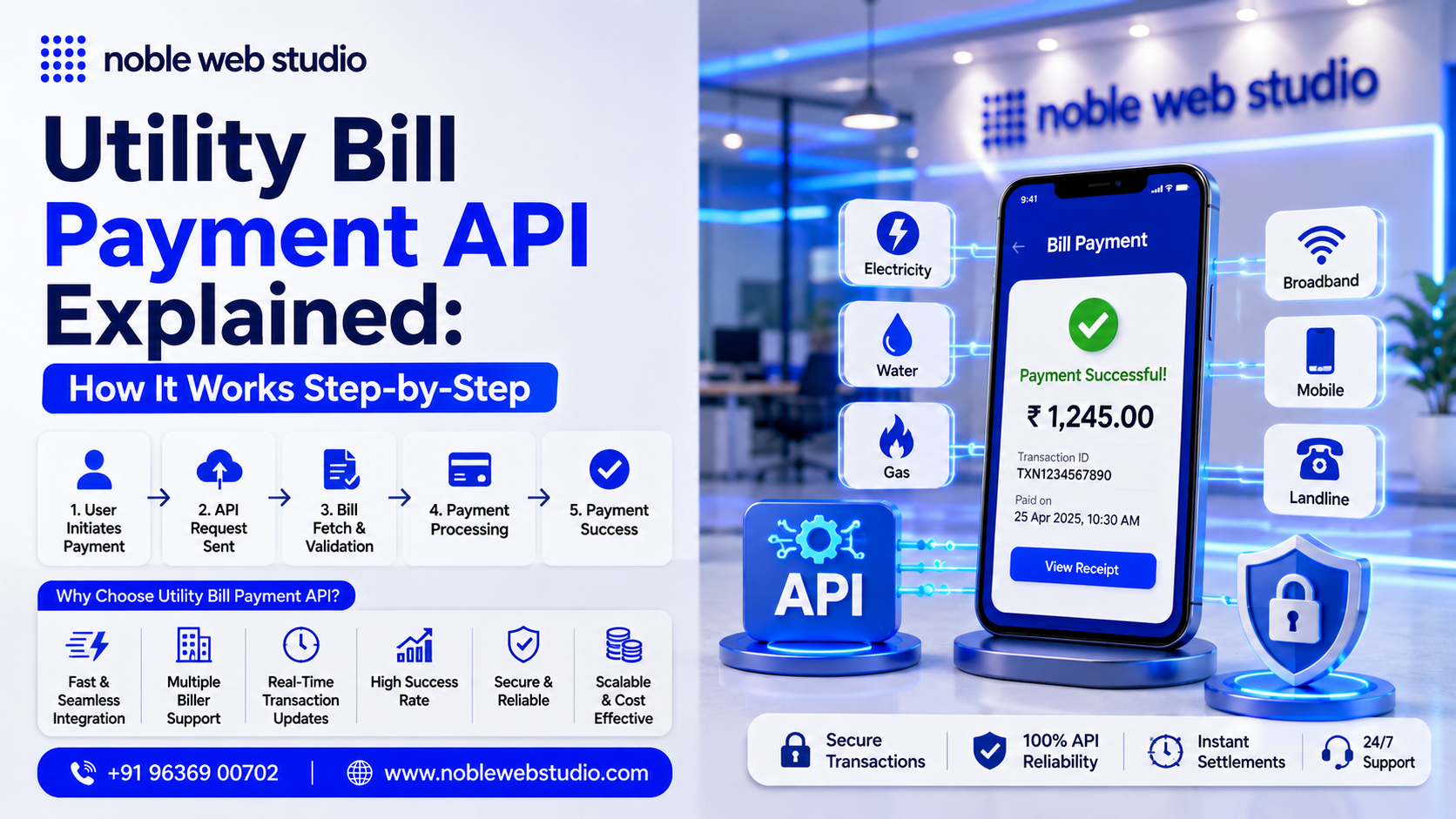
Are you a retailer, startup, or fintech business looking to simplify bill payments for your customers? A Utility Bill Payment API allows you to integrate seamless, real-time payment solutions into your platform, enabling services like electricity, water, gas, and DTH bill payments.
A Utility Bill Payment API is a software interface that enables businesses and platforms to integrate and offer bill payment services for various utilities directly within their own applications. This allows users to pay bills for services such as electricity, water, gas, broadband, and mobile recharges from a single point of access, without needing to visit individual utility provider websites or physical payment centers.
Choosing the right Utility Bill Payment API provider can help you offer a seamless payment experience while earning commission on every transaction. In 2025, the demand for reliable, affordable, and easy-to-integrate Utility Bill Payment API is growing rapidly, making it essential for businesses to select a solution that is secure, scalable, and user-friendly.
In this complete guide, we’ll cover what a Utility Bill Payment API is, how it works, its key features, benefits for businesses, and how to integrate it into your platform. By the end of this guide, you’ll understand how to add a powerful bill payment solution to your business and provide smooth, hassle-free payments to your customers.
What is Utility Bill Payment API
A Utility Bill Payment API is a software interface that allows businesses to integrate utility bill payment features into their applications, enabling users to pay for services like electricity, water, and broadband directly within the app. These Utility Bill Payment API provide benefits such as convenience, automated workflows, and real-time transaction updates for users, while for businesses they offer a unified payment experience, potential for profit, and increased customer loyalty. Popular provider in the Indian market include Noble web studio which offer integration services for various billers and operators.

Utility Bill Payment API Work
A Utility Bill Payment API facilitates the integration of utility bill payment functionalities into various applications or platforms. This allows users to pay bills for services like electricity, water, gas, and internet directly through the integrated application, rather than needing to visit the utility provider’s website or office.
Here is how a Utility Bill Payment API typically works:
- User Initiates Payment: The user selects the bill type (e.g., electricity, water) and enters their account details and desired payment method within the application or platform.
- API Request Triggered: The application sends a request to the Utility Bill Payment API, containing the user’s details, bill information, and payment method.
- Validation and Bill Retrieval: The API validates the user’s details and communicates with the relevant utility provider’s system to retrieve the outstanding bill amount and confirm payment eligibility.
- Transaction Processing: Once the payment is authorized by the user’s chosen payment method (e.g., credit card, digital wallet), the API processes the transaction, securely transferring funds.
- Status Update and Confirmation: The API updates the bill status in real-time and provides confirmation of the successful payment to both the user and the integrated application. This may include sending a receipt to the user and updating internal financial records for businesses.
Types of Utility Bill Payment API
We provide an electricity bill payment API for seamless integration with third-party platforms, allowing your website to connect effortlessly with various retailers. Our API is secure and works with trusted payment gateways, with no hidden fees on energy bills. Our team of experienced professionals is skilled in developing both web and mobile applications. We offer tailored solutions to meet the unique needs of our clients.
In addition to electricity bill payments, we are expanding our API offerings to include Mobile Recharge, Travel Booking (including Flight, Bus Ticket, and Hotel bookings), and Money Transfer APIs. Among our wide range of APIs, the electricity and gas bill APIs stand out, as they connect with numerous service providers nationwide. Say goodbye to long queues our API allows you to pay your bills conveniently from home.
Utility bill payment API facilitate the online payment of various recurring bills. These APIs can be categorized based on the type of utility they handle and the payment system they integrate with.
Types of Utility Bill Payment APIs by Utility Type:
- Electricity Bill Payment API: Enables users to pay electricity bills from various providers.
- Gas Bill Payment API: Facilitates the payment of natural gas bills.
- Water Bill Payment API: Allows for the payment of water and sewage bills.
- Telecom Bill Payment API: Covers mobile postpaid, broadband, and landline bill payments.
- DTH Recharge API: Supports the recharging of Direct-to-Home (DTH) satellite television services.
- Insurance Premium Payment API: Enables the payment of insurance premiums.
- Loan EMI Payment API: Facilitates the payment of Equated Monthly Installments (EMIs) for loans.
Types of Utility Bill Payment APIs by System/Integration:
- Bharat Bill Payment System (BBPS) API: A centralized platform in India for all types of recurring bill payments, offering a standardized and secure way to pay bills across various categories.
- Payment Gateway APIs: Integrate with various payment gateway (e.g., credit/debit card processors, net banking) to enable the financial transactions for bill payments.
- Wallet Integration APIs: Allow users to pay bills using funds stored in digital wallets.
- Direct Debit/Credit APIs: Facilitate recurring bill payments through direct debits or credits from bank accounts.
- Virtual Account APIs: Enable the use of virtual accounts for simplified and efficient bill payments, often linked to real-time payment systems like PayID.
Why Need for Utility Bill Payment API
A utility bill payment API is needed to streamline and automate the entire bill payment process, offering benefits like enhanced user experience, improved operational efficiency, increased revenue opportunities for businesses, and greater digital inclusion for consumers. By integrating utility bill payment API, businesses can provide a single, convenient platform for various utility bill payments, leading to higher customer satisfaction, secure transactions, and the ability to scale operations effectively.
Benefits for Consumers
- Convenience:Users can pay multiple bills (electricity, water, gas, telecom, etc.) from a single application or platform, eliminating the need to visit multiple physical locations.
- Enhanced User Experience:A unified interface provides easy access to bills, payment history, and secure payment initiation, leading to greater satisfaction.
- Digital Inclusion:The utility bill payment API helps bring digital bill payment services to more people, including those in areas with limited traditional banking access.
Benefits for Businesses and Service Providers
- Increased Revenue:Businesses can generate new revenue streams through transaction fees or by offering value-added services alongside bill payments.
- Operational Efficiency:Automation of billing and payment processes reduces manual intervention, minimizes errors, and saves time and resources.
- Customer Retention:Offering a seamless bill payment service adds value to a business’s offerings, making customers more loyal and increasing retention.
- Attract New Customers:Providing this essential service can attract more foot traffic and customers to a business or platform.
- Scalability: APIs are built to handle large volumes of transactions, allowing businesses to grow without performance issues.
- Security and Transparency:Robust security measures and real-time confirmations ensure data protection and a more transparent transaction process.
Why Businesses Need to Utility Bill Payment API
Businesses need a utility bill payment API to streamline operations, enhance customer experience, increase revenue, and improve operational efficiency. By integrating with a utility payment API, businesses can offer customers a secure, convenient way to pay bills across multiple channels, automate manual processes, reduce errors, and generate revenue through commissions, ultimately leading to greater customer satisfaction and stronger business outcomes.
Key Benefits for Businesses
Operational Efficiency:
- Automation: Automates the collection, reconciliation, and payment of utility bills, reducing the manual effort and cost associated with these tasks.
- Error Reduction: Minimizes the human errors that can occur during manual data entry and payment processing.
- Streamlined Billing: Provides a centralized system for managing various billers and transactions, making it easier to keep track of payments.
Enhanced Customer Experience:
- Convenience: Allows customers to pay bills through their preferred platforms, such as mobile apps or websites, providing a seamless and user-friendly payment process.
- Flexibility: Supports various payment methods and can accommodate multiple currencies, catering to diverse customer needs.
- Timely Payments: Ensures that bills are paid promptly, preventing service disruptions for users.
Increased Revenue and Business Growth:
- New Revenue Streams: Businesses can earn commissions by facilitating bill payments for their customers, creating an additional income source.
- Customer Acquisition & Retention: Offering a comprehensive bill payment service attracts new customers and helps retain existing ones by adding value and convenience.
- Expanded Service Offerings: Provides a valuable, value-added service that can be integrated into existing applications, strengthening customer relationships.
Security and Data Management:
- Secure Transactions: Incorporates robust security measures to protect sensitive financial and user data, ensuring confidentiality.
- Actionable Insights: Provides transaction reports and analytics, offering valuable data for managing finances and understanding payment trends.

Top Utility Bill Payment API Providers
Top Utility Bill Payment API Providers include Noble web studio all of which offer solutions for integrating utility bill payments into business platforms in India. These platforms provide Utility Bill Payment API to handle various bill types, such as electricity, gas, water, and postpaid mobile bills, often integrating with India’s Bharat Bill Payment System (BBPS).
Key Features and Services
- Comprehensive Bill Coverage: Noble web studio offer Utility Bill Payment API that can process payments for a wide range of utilities including electricity, gas, water, landline, mobile, and DTH.
- BBPS Integration: Many platforms are integrated Bharat Bill Payment System (BBPS), a national payment system that standardizes bill payments and boosts customer satisfaction.
- Secure Transactions: The Utility Bill Payment API are designed with security in mind, ensuring safe processing of financial transactions for businesses and their customers.
- Scalability: These Utility Bill Payment API solutions are built to handle high transaction volumes, making them suitable for various business sizes, from startups to large corporations.
- Customization & White-Labeling: Noble web studio offer tailored solutions and white-labeling options to align with a company’s specific branding and requirements.
- Developer-Friendly Documentation: Comprehensive and detailed Utility Bill Payment API documentation is provided to guide developers through the integration process, ensuring a smooth and quick implementation.
Features Utility Bill Payment API
A utility bill payment API enables businesses and developers to integrate bill payment functionalities into their platforms, offering features like multi-utility support, secure and real-time processing, multiple payment method options (cards, wallets, UPI), recurring payment scheduling, payment history tracking, automated reminders, and seamless integration with various platforms and banking systems. These features provide convenience for users, improve payment efficiency for businesses, reduce operational costs, and enhance customer satisfaction by simplifying bill management.
Key Features of a Utility Bill Payment API
- Multi-Utility Support:Connects to a wide range of service providers for electricity, water, gas, internet, mobile, and other essential utilities, offering a centralized payment solution.
- Real-Time Processing & Updates:Payments are processed instantly, with real-time confirmation and updates on transaction status and payment history.
- Multiple Payment Methods:Supports various payment options, including credit/debit cards, net banking, digital wallets, and UPI, providing flexibility for users.
- Secure Transactions:Employs robust security measures like end-to-end encryption and two-factor authentication to protect sensitive user data.
- Recurring Payments & Automation:Allows users to set up automated, recurring payments to ensure timely bill payments and avoid late fees.
- Automated Reminders:Sends out automated reminders to users before their bills are due, helping them manage deadlines and avoid penalties.
- Account Management:Provides a dashboard for users to manage their accounts, update payment methods, and view billing summaries and transaction history.
- Seamless Integration:Offers easy-to-integrate REST APIs and SDKs for integration into mobile apps, banking platforms, e-commerce sites, and other software.
- Transaction History: Maintains a detailed record of all past transactions for users to access and review.
- Vendor & Supplier Payments:Facilitates payments to various vendors and utility suppliers, streamlining accounts payable for businesses.
- Scalability:Designed to handle a large volume of transactions, allowing businesses to scale their payment services as their customer base grows.
- Responsive Customer Support:Provides 24/7 technical support and customer assistance to help users and businesses with any inquiries or issues.
Benefits for Businesses
- Enhanced Customer Experience: Offers a convenient, centralized platform for bill payments, improving customer satisfaction and loyalty.
- Increased Efficiency: Automates manual billing and payment processes, saving time and effort for both businesses and users.
- Reduced Operational Costs: Lowers expenses associated with manual payment processing and customer service inquiries.
- Revenue Generation: Allows businesses to provide utility payments as a valuable service, attracting new customers and retaining existing ones.
- Error Handling and Status Tracking: Robust mechanisms for managing successful, pending, and failed transactions, along with detailed status updates.
- Competitive Advantage: Differentiates a business by offering a comprehensive and integrated financial service.
Benefits of Utility Bill Payment API
A Utility Bill Payment API provides a standardized and efficient way to integrate utility bill payment functionalities into various applications and platforms. The benefits of using such an API are numerous, impacting both businesses and end-users:
Benefits for Businesses:
- Enhanced User Experience: Offers a convenient, single platform for users to manage and pay various utility bills (electricity, water, gas, internet, etc.), reducing friction and improving customer satisfaction.
- Increased Revenue Opportunities: Enables businesses to generate revenue through commissions on bill payments or by offering value-added services alongside the payment functionality.
- Operational Efficiency: Automates bill payment processes, reducing manual interventions, minimizing errors, and saving time and resources.
- Scalability: Designed to handle high transaction volumes, making it suitable for businesses of all sizes and those anticipating growth.
- Faster Integration: Provides a streamlined way to incorporate bill payment features into existing applications or new platforms, often with developer-friendly documentation and tools.
- Digital Inclusion: Facilitates access to digital bill payment services for a broader audience, including those in areas with limited access to traditional banking.
- Customer Retention and Loyalty: Providing a comprehensive platform that includes utility bill payments can make an application more valuable to users, fostering loyalty and reducing churn.
- Security and Transparency: Offers real-time payment confirmations and digital receipts, fostering trust and a transparent transaction process.
Benefits For End-Users:
- Convenience and Accessibility: Users can pay multiple utility bills (electricity, water, gas, internet, etc.) from a single platform, at any time and from any location, eliminating the need to visit multiple websites or physical payment centers.
- Multiple Payment Options: Utility Bill Payment API typically support diverse payment methods, including credit/debit cards, net banking, UPI, and digital wallets, offering flexibility to users.
- Real-time Updates: Users receive immediate confirmation of successful payments and can easily track their payment history and upcoming bills.
- Reduced Time and Effort: Automating bill payments and consolidating billing information saves users significant time and effort compared to manual bill processing.
- Improved Financial Management: Centralized bill payment and tracking features can assist users in better managing their expenses and ensuring timely payments.
- Security: Reputable utility bill payment API incorporate robust security measures, including encryption and secure payment gateways, to protect user data and financial information.

How do Utility Bill Payment APIs Solve These Issues
Utility bill payment API solve issues by automating the payment process, improving operational efficiency, enhancing the user experience through convenient payment options, and providing real-time transaction updates and analytics for businesses. They bridge the gap between businesses, customers, and financial institutions, creating a centralized, scalable, and secure system that supports various payment methods and ensures timely, accurate record-keeping.
For Businesses:
- Operational Efficiency: Utility Bill Payment API automate manual bill entry and payment workflows, significantly reducing errors, saving time, and allowing staff to focus on other tasks.
- Revenue Growth: By offering more convenient payment options, businesses can attract more customers and generate new revenue streams through additional services or a broader customer base.
- Data-Driven Insights: Utility Bill Payment API provide detailed reporting and analytics, enabling businesses to monitor payment trends, identify potential issues, and make informed decisions to optimize operations and manage cash flow effectively.
- Scalability: Built to handle high volumes of transactions, Utility Bill Payment API can scale with a business, making them suitable for both startups and large corporations.
- Improved Record-Keeping: The automation and centralized nature of Utility Bill Payment API integration simplify financial record-keeping and invoice generation, ensuring accurate tracking of all payments.
For Users (Customers):
- Enhanced Customer Experience: Users benefit from a unified platform to manage multiple utility bills and can make payments through their preferred channels, such as mobile apps or websites.
- Convenience: Utility Bill Payment API provide flexible payment options and support various payment methods, catering to diverse user preferences.
- Transparency and Information: Users receive instant updates on their transaction status, fostering confidence and loyalty.
Overall Ecosystem Benefits:
- Security: Utility Bill Payment API often incorporate advanced security features, such as encryption and adherence to compliance standards, to protect payment details and ensure secure transactions.
- Centralization: Utility Bill Payment API create a single, centralized system for billers, customers, and payment providers, simplifying the payment process and ensuring interoperability across various services.
- Real-Time Processing:The integration Utility Bill Payment API allows for real-time fetching of bill dues and instant confirmation of transactions, keeping customers connected without interruption.
Challenges in Implementing Utility Bill Payment API
Implementing a Utility Bill Payment API presents several challenges that businesses need to address for a successful integration. These challenges include:
1. Technical Integration Complexity:
- Legacy Systems: Integrating modern Utility Bill Payment API with older, legacy systems can be difficult, requiring significant technical upgrades and potential re-architecture.
- Diverse Biller Formats: Utilities often have varying bill formats and data structures, requiring the API to accommodate these differences for accurate bill fetching and processing.
- API Downtime and System Failures: Reliance on external Utility Bill Payment API means potential disruptions due to technical downtime or system failures, impacting service availability and user satisfaction.
2. Security and Compliance:
- Data Security: Protecting sensitive customer and payment data is paramount, requiring robust security measures, encryption, and adherence to data privacy regulations (e.g., PCI DSS, GDPR).
- Regulatory Compliance: Utility billing is subject to various regulations and compliance standards that are constantly evolving. Staying updated and ensuring adherence requires continuous monitoring and adaptation.
- Fraud Prevention: Implementing strong fraud detection and prevention mechanisms is crucial to mitigate the risks of fraudulent transactions and protect both the business and its customers.
3. Customer Service and User Experience:
- High Volume of Inquiries: Automated payment systems can still generate customer inquiries regarding billing discrepancies, payment status, and technical issues, requiring efficient customer support infrastructure.
- Managing Complaints and Disputes: Resolving complaints and disputes effectively is vital for maintaining customer satisfaction and trust, demanding clear processes and responsive support.
- User Experience Design: The Utility Bill Payment API integration needs to be seamless and intuitive for users, offering a smooth payment experience across different platforms and devices.
4. Operational and Financial Considerations:
- Reconciliation: Reconciling payments across multiple billers and payment methods can be complex, requiring robust reconciliation processes and integration with accounting systems.
- Cost Management: Implementing and maintaining the Utility Bill Payment API, including potential upgrades and security measures, can incur significant costs that need to be carefully managed.
- Scalability: The Utility Bill Payment API solution needs to be scalable to handle increasing transaction volumes and a growing number of billers and users without compromising performance.
Integrate Utility Bill Payment API
Integrating a Utility Bill Payment API involves several key steps to enable seamless bill payment functionality within an application or platform.
1. Obtain API Credentials:
- Select a reputable Utility Bill Payment API provider like Noble web studio specializing in utility bill payments .
- Sign up for an account and choose a suitable service plan.
- Access your unique Utility Bill Payment API keys and secrets from the provider’s developer dashboard; these are crucial for authentication.
2. Review API Documentation:
- Thoroughly study the Utility Bill Payment API documentation provided by your chosen provider.
- Understand the available endpoints, required parameters for different requests (e.g., fetching bill details, making payments), and the expected response formats.
- Familiarize yourself with the types of utility bills supported (electricity, water, gas, DTH, etc.).
3. Integrate Frontend and Backend:
- Frontend: Design and develop a user-friendly interface where customers can input their bill details (e.g., consumer number, biller ID) and confirm payments.
- Backend: Implement server-side logic to handle API requests. This involves:
- Sending requests to the Utility Bill Payment API to fetch bill details based on user input.
- Processing payment requests securely, including integrating with a payment gateway if necessary.
- Handling Utility Bill Payment API responses, including success messages, error handling, and updating transaction status.
4. Implement Core Functionality:
- Biller Fetching: Integrate the Utility Bill Payment API to retrieve a list of supported billers and their details.
- Bill Fetching: Implement functionality to fetch specific bill details for a given customer account number or identifier.
- Payment Processing: Integrate Utility Bill Payment API to initiate and process payments using various methods (credit/debit cards, e-wallets, bank transfers).
- Transaction Status: Implement mechanisms to track and update the status of bill payment transactions.
5. Ensure Security and Compliance:
- Implement robust security measures, including encryption protocols (SSL/TLS) for data transmission.
- Adhere to relevant industry standards and regulations, such as PCI compliance, if handling card payments directly.
6. Testing and Quality Assurance:
- Utilize the Noble web studio sandbox or UAT (User Acceptance Testing) environment to thoroughly test your integration.
- Verify that bill fetching, payment processing, and error handling work as expected across various scenarios and biller types.
- Ensure data security and compliance with relevant regulations (e.g., PCI DSS if handling card data directly).
7. Go Live and Monitor:
- Once testing is complete and successful, switch your integration to the production environment by updating Utility Bill Payment API endpoints and credentials.
- Monitor Utility Bill Payment API usage and performance metrics through the provider’s dashboard.
- Implement caching for frequently accessed data (e.g., list of service providers) to optimize performance.
- Continuously monitor for any issues and optimize your integration as needed.

Best Utility Bill Payment API Provide
Noble Web Studio provide best utility bill payment API, with the best choice depending on factors like your location, the types of bills you want to support, and your budget. In India, th BBPS API provides a secure and dependable solution for integrating multiple utility payments into your platform.
Key Considerations for Choosing an API
- Location and Regulation: Many utility bill payment API are country-specific. If you operate in India, the BBPS API is a standard and highly integrated option.
- Features and Billers: Check if the utility bill payment API supports the specific types of utility bills you need to pay (electricity, water, gas, broadband, postpaid, etc.).
- Security and Reliability: Ensure the utility bill payment API uses secure protocols for transactions and has a reliable history of uptime.
- Scalability: Choose an utility bill payment API that can handle your current and future transaction volume.
- Integration Ease: Look for clear documentation and developer-friendly tools to simplify the integration process.
- Cost: Compare the costs for transaction fees, setup, and ongoing usage to find a budget-friendly solution.
- Customer Support: Good technical support is crucial if you encounter any issues during or after integration.
Highlights For Utility Bill Payment API
- Over 15 years of extensive experience in IT software development.
- Trusted by 300+ clients using our top-notch Mobile Recharge API.
- Leading partner for reliable Utility Payment solutions.
- Access to all major billers for seamless transactions.
- Pay your electricity bills conveniently even after due dates.
- High success rate with efficient complaint management.
- Innovative implementation strategies for better results.
- Exclusive postpaid bill offers tailored for corporate clients.
- Advanced Multi-SMS API integration system for smooth communication.
- Top DTH operators with competitive DTH API rates and services.
Why Choose Noble Web Studio for Utility Bill Payment API
Choosing a Noble web studio for a Utility Bill Payment API offers businesses benefits such as increased customer convenience, revenue generation through commissions, simplified operations, enhanced security and compliance, and scalability to handle growth. A good utility bill payment API provider offers robust, secure infrastructure, easy integration, real-time reporting, and 24/7 support to ensure seamless service for your customers and efficient management for your business.
Key Benefits of Choosing a Utility Bill Payment API Provider
Enhanced Customer Experience:
- Convenience: Offer a single, centralized platform for customers to pay multiple utility bills (electricity, gas, water, telecom), saving them time and effort.
- Real-Time Updates: Provide real-time bill status, payment confirmations, and digital receipts, building trust and transparency.
Business Growth & Profitability:
- Revenue Generation: Earn commissions on each bill payment processed through your platform.
- Increased Customer Footfall: Attract more customers by offering this essential service, leading to increased engagement with your platform or store.
Streamlined Operations & Efficiency:
- Simplified Integration: Providers offer easy-to-integrate REST APIs with comprehensive documentation and SDKs, allowing for quick setup.
- Automated Processes: Streamline payments, reduce paperwork, and achieve faster settlements by automating billing and payment workflows.
Security & Compliance:
- Bank-Grade Security: The utility bill payment API ensures secure, end-to-end encrypted transactions, protecting sensitive customer data.
- Regulatory Compliance: Adherence to industry standards ensures that your platform meets security and data privacy regulations, building customer confidence.
Robust Infrastructure & Scalability:
- Scalable Infrastructure: Choose a Noble web studio with robust servers and systems that can handle high transaction volumes and fluctuating demand, ensuring uninterrupted service.
- Reliable Connectivity: A Noble web studio with end-to-end connectivity ensures a high success rate for bill payments.
Support & Resources:
- 24/7 Technical Support: Access a dedicated support team for assistance with any technical issues, ensuring smooth operations.
- Real-Time Reporting: Monitor transaction status, reports, and earnings in real-time, providing valuable insights into your business performance.
Utility Bill Payment API Provider
Utility Bill Payment API providers like Noble web studio offer platforms, often through India’s Bharat Bill Payment System (BBPS), that allow businesses to integrate utility bill payments into their services. These Utility Bill Payment API enable functions such as checking bill amounts, processing payments for electricity, water, gas, and telecom bills, and providing real-time payment confirmations.
How to Find a Provider
- Identify your needs: Determine which utility bill categories you want to offer (electricity, water, gas, telecom, etc.).
- Look for BBPS integration: The Bharat Bill Payment System (BBPS) is a major platform in India for bill payments, so look for providers that support BBPS APIs.
- Check for API features: Ensure the provider’s API offers the specific functionalities you require, such as real-time updates, automated payments, and secure transaction processing.
- Research providers: Use resources like IndiaMART or direct searches for providers such as Noble web studio.
Key Considerations
- Security: Choose a provider with robust security measures to protect customer payment information.
- Reliability: Look for providers with a proven track record of reliable service and fast transaction processing.
- Integration: Verify that the API is easy to integrate with your existing system and supports your chosen programming language.
- Pricing: Compare different API providers’ rates to find one that offers competitive pricing for the services you need.
Future of Utility Bill Payment API
The future of Utility Bill Payment API is characterized by enhanced integration, intelligence, and a focus on customer experience. Key trends and advancements include:
Key Trends Shaping the Future:
AI and Machine Learning Integration:
- AI and Machine Learning: Integration of AI and ML for predictive insights, personalized billing recommendations, automated customer service, and fraud detection. This allows for smarter, more efficient operations and tailored user experiences.
- Predictive Insights: Utility bill payment API will leverage AI to offer predictive insights into utility consumption and billing, enabling better financial planning for consumers.
- Automated Customer Service: AI-powered solutions will provide automated customer support for billing inquiries and payment assistance.
- Fraud Detection: ML algorithms will enhance security by identifying and preventing fraudulent activities in real-time.
IoT Integration and Real-time Data:
- IoT Integration: Connecting with smart meters and other IoT devices to provide real-time utility consumption data, automate payments, and offer customized insights to users, promoting efficient utility management.
- Smart Meter Connectivity: Integration with smart meters and other IoT devices will enable real-time consumption data, facilitating automated payments and personalized usage insights.
- Proactive Management: Real-time data analytics will allow both consumers and utility providers to monitor usage and make proactive adjustments for cost management.
Enhanced Financial Inclusion:
- Digital Payment Solutions: Utility bill payment API will play a crucial role in expanding digital payment options to rural and semi-urban areas, reducing reliance on cash.
- Multilingual Support: Utility bill payment API will support localized languages and regional service providers to cater to diverse user bases and promote accessibility.
- Localization: Supporting localized languages and regional service providers to cater to diverse user bases.
Enhanced Security and Authentication:
- Robust Security Measures: Continued emphasis on strong encryption, secure networks, and stringent data access controls to protect user data and financial information.
- Biometric Authentication: Integration of biometric methods like fingerprint or facial recognition will streamline and secure the payment process.
- Blockchain Technology: Implementation of blockchain technology to create more secure and transparent transaction records, minimizing fraudulent activities and enhancing trust.
- Analytics and Insights: Providing businesses with comprehensive analytics dashboards to gain insights into transaction volumes, customer behavior, and trends, enabling data-driven decision-making.
Seamless Integration and User Experience:
- Seamless Integration: Utility bill payment API will continue to offer easy integration into various platforms, allowing businesses to offer comprehensive bill payment services within their existing applications.
- Unified Platforms: Utility bill payment API will continue to drive the creation of unified platforms for managing various bills, simplifying the payment experience for users.
- Flexible Payment Options: Support for diverse payment methods, including mobile wallets, UPI, and potentially cryptocurrencies, will cater to evolving user preferences.
- Real-time Processing and Reconciliation: Faster transaction processing and real-time reconciliation to improve cash flow management for utility providers and ensure timely payments for consumers.
Data Analytics and Reporting:
- Insights for Businesses: Utility bill payment API will provide robust analytics dashboards for utility companies to understand transaction volumes, customer behavior, and trends, aiding in service optimization and revenue growth.
- Personalized Recommendations: Data analysis will enable personalized billing recommendations and usage insights for consumers.
The future of Utility Bill Payment APIs points towards a more intelligent, secure, and user-centric ecosystem that leverages cutting-edge technologies to streamline and enhance the entire billing and payment process for all stakeholders.

Conclusion
A Utility Bill Payment API is a must-have solution for businesses, retailers, and fintech startups looking to offer fast, secure, and reliable bill payment services to their customers. By integrating Utility Bill Payment API, you can provide services like electricity, water, gas, and DTH payments in real time, while ensuring biometric or secure authentication and smooth transaction processing.
The utility bill payment API serves as a crucial component in modern financial technology, significantly streamlining the process of managing and paying utility bills for both consumers and providers. Its comprehensive capabilities enhance user experience, improve operational efficiency, and provide valuable insights.
Choosing the right Utility Bill Payment API provider, like Noble Web Studio, ensures you get a secure, scalable, and easy-to-integrate solution. With features like real-time payments, commission tracking, and multi-service support, your business can enhance customer satisfaction, expand digital services, and increase revenue.
With Noble Web Studio, you get an affordable and trusted utility bill payment API solution that supports businesses of all sizes. Whether you are a retailer looking to grow your income or a fintech startup aiming for reliable payment infrastructure, integrating utility bill payment API can transform your digital payment services in 2025 and beyond.
Start integrating a Utility Bill Payment API today to simplify payments for your customers, grow your business, and stay ahead in India’s digital payments ecosystem.
FAQ: Utility Bill Payment API
A Utility Bill Payment API is a software interface that allows businesses, retailers, and fintech startups to automate and process payments for utilities like electricity, water, gas, and DTH directly from their platform.
The API connects your system to utility service providers. When a customer enters their account details, the API processes the payment in real time, ensuring secure and instant transactions.
Retailers, fintech startups, banks, and digital payment platforms can integrate a Utility Bill Payment API to offer convenient and fast bill payment services to their customers.
Real-time bill payment processing
Multi-utility support (electricity, water, gas, DTH)
Secure and encrypted transactions
Commission tracking for retailers
Easy integration with existing platforms
Simplifies bill payments for customers
Reduces manual errors and delays
Increases revenue through transaction commissions
Provides a seamless and secure payment experience
Choose a trusted provider like Noble Web Studio, obtain API credentials, follow the integration guide, test in a sandbox environment, and deploy it to start processing payments.
Yes. Modern APIs use secure encryption and authentication protocols, ensuring customer data and transactions are safe.
Every successful transaction through the API generates a commission for the business or retailer. Commission rates depend on the provider and the type of utility service.
Yes. A reliable API supports multiple service providers, allowing customers to pay different types of bills from a single platform.
Noble Web Studio offers secure, scalable, and easy-to-integrate Utility Bill Payment API solutions with real-time processing, high uptime, and comprehensive support for startups and retailers in India.