
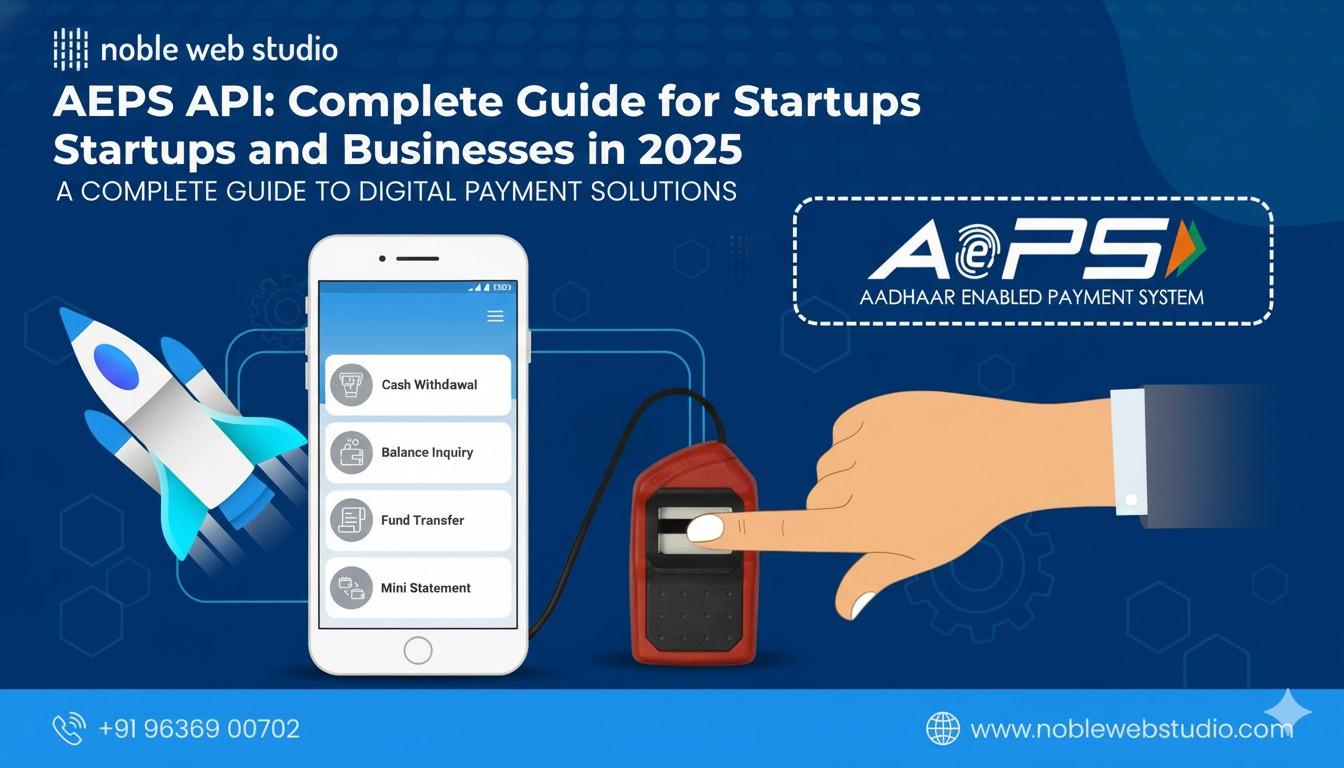
In today’s digital banking world, using a reliable AEPS API in India is one of the best ways for businesses to offer secure and easy financial services. AEPS (Aadhaar Enabled Payment System) allows customers to perform basic banking transactions like cash withdrawal, balance enquiry, and mini statement using only their Aadhaar number and fingerprint, without needing a debit card or PIN.
An AePS (Aadhaar Enabled Payment System) API is a secure software interface developed by the NPCI that allows financial transactions using only an Aadhaar number and biometrics (fingerprint/iris). It enables banking services like cash withdrawal, balance inquiry, and mini-statements through fintech apps, websites, or retail micro-ATMs.
With the growing demand for AEPS services in rural and urban areas, retailers, agents, and fintech startups are rapidly adopting AEPS API solutions to expand their business and generate regular income. It helps businesses provide real-time banking services and earn commission on every successful transaction.
For startups and businesses, integrating AEPS API opens new revenue streams by enabling secure, real-time banking services like cash withdrawal, deposit, and fund transfers directly from their platforms. It not only helps companies serve a wider audience but also builds trust and customer loyalty through seamless financial services.
Integrating a trusted AEPS API provider in India not only improves customer experience but also helps automate operations and reduce manual work. It is a great opportunity for businesses to enter the digital banking sector and build a scalable and profitable model.
Noble Web Studio offers a powerful and secure AEPS API solution designed for smooth integration and high performance. With features like fast transaction processing, high success rate, secure biometric authentication, multi-bank support, and easy-to-use system, it helps businesses deliver reliable services to their customers.
If you want to grow your fintech business, choosing a strong and reliable AEPS API like Noble Web Studio can help you achieve higher earnings, better service quality, and long-term success in the digital payment industry.
This complete guide will help you understand how AEPS APIs work, their benefits, setup process, and how they can help your business grow in 2026.
What is AEPS API
The Aadhaar Enabled Payment System (AePS) API is a secure, NPCI-driven interface that enables fintechs, banks, and businesses to process banking transactions using a customer’s Aadhaar number and biometric authentication. It facilitates real-time, cardless, and PIN-less services like cash withdrawals, deposits, and balance inquiries.

AEPS API Work
AEPS API (Aadhaar Enabled Payment System) works by enabling merchants to conduct secure, cardless banking transactions—cash withdrawals, balance checks, and mini-statements using a customer’s Aadhaar number and biometric scan (fingerprint or iris). It connects fintech platforms to the NPCI network, allowing instantaneous, real-time transaction settlement in 2–3 seconds.
How AEPS API Works: Step-by-Step
- Initiation: The agent/merchant selects the service (e.g., Cash Withdrawal) on a smartphone or Micro-ATM.
- Authentication: The customer enters their 12-digit Aadhaar number, selects their bank, and scans their fingerprint/iris via a registered biometric device.
- Encrypted Request: The AEPS API sends the encrypted biometric and bank data securely to the National Payments Corporation of India (NPCI).
- Verification: NPCI verifies the data with the Unique Identification Authority of India (UIDAI) and the customer’s bank.
- Settlement: Upon successful validation, the bank account is debited, and the agent’s wallet is credited instantly.
Read Blog : AEPS API Integration: Step-by-Step Guide for Businesses in 2025
Services You Can Offer Using Aeps API
AePS (Aadhaar Enabled Payment System) API allows businesses to turn retail outlets into banking touchpoints, enabling secure, biometric-based transactions using only an Aadhaar number. Key services include cash withdrawals, balance inquiries, mini-statements, cash deposits, and Aadhaar Pay (merchant payments), facilitating financial inclusion.
Key Services Offered via AePS API:
- Cash Withdrawal (Mini-ATM): Enables customers to withdraw cash from their bank account at a local shop using only their Aadhaar number and fingerprint/iris scan.
- Balance Inquiry: Provides real-time, instant account balance checks for customers without needing a debit card or PIN.
- Mini Statement: Generates a mini-statement showing the last 5–10 transactions for a quick account overview.
- Aadhaar Pay (Merchant Payments): Enables merchants to accept payments directly from a customer’s bank account using biometric authentication, often used for higher transaction limits above typical withdrawal caps.
- Cash Deposit: Allows customers to deposit cash directly into their Aadhaar-linked bank accounts through authorized Business Correspondent (BC) agents.
- Aadhaar-to-Aadhaar Fund Transfer: Facilitates immediate, secure money transfers between two Aadhaar-linked bank accounts.
- Best Finger Detection (BFD): A preliminary authentication service to detect the best fingerprint, improving success rates for biometric transactions.
- eKYC Services: Provides paperless, real-time Electronic Know Your Customer verification for onboarding users.
Top Function of AEPS API
The key function of an AEPS (Aadhaar Enabled Payment System) API is to facilitate secure, interoperable banking transactions cash withdrawals, deposits, balance inquiries, and mini-statements using only biometric authentication (fingerprint/iris) linked to an Aadhaar number. It empowers merchants to operate as mini-ATMs, driving rural financial inclusion and ensuring real-time fund settlement.
Core Functions of AEPS API:
- Cash Withdrawal: Allows customers to withdraw money from their Aadhaar-linked bank accounts at any micro-ATM or agent point.
- Balance Enquiry: Enables instant checking of bank account balances without a debit card or PIN.
- Mini Statement: Provides access to the last 5-10 transactions, allowing users to track their account activity.
- Cash Deposit: Facilitates depositing cash into an Aadhaar-linked account at agent outlets, improving accessibility.
- Aadhaar to Aadhaar Fund Transfer: Enables secure, real-time money transfers between two Aadhaar-linked bank accounts.
- Interoperability: Enables a customer from one bank to transact at any business correspondent (BC) outlet of another bank.

Documents Required for AEPS API
To integrate an AEPS (Aadhaar Enabled Payment System) API, you must submit KYC documents including an Aadhaar card (linked to mobile), PAN card, cancelled cheque/bank passbook, passport-sized photos, and business address proof (e.g., Udyam registration, utility bill). Mandatory requirements include a STQC-certified biometric scanner (fingerprint/iris) and an active, linked bank account for settlement.
Mandatory Documents for AEPS API Registration:
- Aadhaar Card: Must be linked to a current mobile number for OTP verification.
- PAN Card: Mandatory for tax compliance and identity verification.
- Bank Account Details: A cancelled cheque or front page of the passbook is required for transaction settlements.
- Business Address Proof: Udyam Registration, GST Certificate, Shop & Establishment license, or a recent utility bill (electricity/water).
- Passport-sized Photograph: Recent photos.
- Active Mobile Number & Email: For registration, communication, and API key delivery.
Mandatory AEPS API Technical Requirements
Mandatory AEPS API technical requirements effective from 2026 include using STQC-certified L1 biometric Registered Devices (RD) for encrypted authentication, enforcing the “One Operator, One Bank” rule, and adhering to strict KYC. Technical integration must support HTTPS/TLS 1.2+ protocols, real-time liveness detection, and prohibit biometric data storage.
Key Technical & Compliance Requirements (2026):
- L1 Biometric Device (Mandatory): Only L1-compliant STQC-certified fingerprint or iris scanners (e.g., Mantra MFS100/110) are permitted to ensure on-device encryption (PID block).
- RD Service Drivers: Devices must use Registered Device (RD) service software to prevent storing raw biometric data.
- API Security & Protocols: Secure HTTPS/TLS 1.2+ connections are mandatory for all high-volume transaction API requests.
- One Operator, One Bank: Operators are restricted to a single acquiring bank, prohibiting multiple bank mapping for a single agent.
- Liveness Detection: Real-time AI-driven liveness detection is required to distinguish live users from fraudulent spoofing, such as photos or fake prints.
- System Environment: Android 7.0+ or Windows PC/Laptop with stable, secure internet access (4G/5G/Broadband).
- Data Protection: No biometric data is allowed to be stored on agent devices or API provider servers.
- Mandatory Re-KYC: Agents must complete Re-KYC if inactive for three consecutive months.
Who Can Use AEPS API
AePS API (Aadhaar Enabled Payment System) allows authorized Fintech companies, banks, Business Correspondents (BCs), and retail shop owners (Kirana, pharmacies) to provide biometric-based banking services like cash withdrawals and balance inquiries. It enables secure, cardless transactions by connecting to NPCI’s infrastructure.
Key Entities Eligible to Use AEPS API
- Fintech & Tech Firms: Companies that integrate AePS services into apps, websites, or banking software.
- Business Correspondents (BCs) & Bank Agents: Authorized individuals acting on behalf of banks to provide services in rural or underbanked areas.
- Retailers & Small Business Owners: Small shops (Kirana, pharmacies) turning their outlets into “mini-ATMs” to facilitate cash withdrawals.
- Common Service Centers (CSC) & E-Mitra Centers: Providing digital financial services in rural India.
- Microfinance Institutions (MFIs): Using biometric authentication for secure, cash-based loan collections and disbursements.

Why Use AEPS API
AEPS API (Aadhaar Enabled Payment System) is used to enable secure, cardless, and PIN-less banking transactions (cash withdrawal, balance inquiry, mini-statement) directly via Aadhaar authentication. It turns retail shops into micro-ATMs, providing high-profit commissions, increased customer footfall, and easy, real-time financial services to rural, underbanked areas.
Key Reasons to Use AEPS API:
- Secure & Compliant: Transactions are authorized using biometric data (fingerprint or iris scan), significantly reducing fraud and complying with NPCI/RBI guidelines.
- Cardless & PIN-less Banking: Customers can access their bank accounts without debit cards or PINs, requiring only their Aadhaar number and biometrics.
- High Revenue Generation: Retailers can earn competitive commissions, often ₹12–₹15+ per transaction, particularly on high-value withdrawals.
- Boosts Financial Inclusion: Essential for reaching rural and underserved populations, enabling banking services at local, trusted retail outlets.
- Interoperability: Users can access their bank account through any AEPS-enabled agent, regardless of their home branch or bank.
- Instant Settlements: Offers, Instant Settlements (T+0) of funds to the retailer’s account, enhancing cash flow.
- Low Infrastructure Costs: Businesses only require a smartphone and a biometric scanner to start, eliminating the need for expensive ATM infrastructure.
- 24/7 Availability: Provides constant access to banking services, enhancing customer trust and satisfaction.
Top Use Cases of AEPS API
AEPS (Aadhaar Enabled Payment System) APIs enable secure, biometric-based banking, primarily driving financial inclusion by turning local shops into mini-ATMs. Key use cases include cash withdrawals, balance inquiries, cash deposits, mini-statements, and Aadhaar Pay for merchants. It, especially in 2026, facilitates Aadhaar-to-Aadhaar transfers and Direct Benefit Transfers (DBT) for government subsidies.
Top Use Cases of AEPS API:
- Cash Withdrawal (Micro-ATM): Allows customers to withdraw cash from their bank accounts using only their Aadhaar number and fingerprint, reducing reliance on physical bank branches.
- Balance Inquiry & Mini-Statement: Enables instant, real-time access to account balances and recent transaction histories, providing crucial banking services to rural populations.
- Cash Deposits: Enables customers to deposit cash directly into their Aadhaar-linked accounts via authorized banking correspondent (BC) agents.
- Aadhaar Pay (Merchant Payments): Empowers merchants to accept payments from customers via biometric authentication, acting as a cardless, PIN-less, and phone-less payment solution.
- Direct Benefit Transfer (DBT) Distribution: Simplifies the disbursement of government subsidies, pensions, and welfare payments directly into beneficiaries’ accounts, ensuring transparency and ease.
- Aadhaar-to-Aadhaar Fund Transfer: Facilitates secure, immediate, and direct money transfers between two Aadhaar-linked bank accounts.
- eKYC (Electronic Know Your Customer): Provides a paperless, instantaneous way for financial institutions to authenticate customer identity using biometric data.
Why Startups Should Choose AEPS API
Choosing the Aadhaar Enabled Payment System (AEPS) API is a strategic move for startups, particularly in the fintech, retail, and rural service sectors, as it allows them to tap into India’s largest, secure, and cardless banking network with minimal infrastructure investment. By leveraging the 1.3 billion+ Aadhaar-linked user base, startups can offer essential banking services—such as cash withdrawals, deposits, and balance inquiries directly through their apps or websites, turning local retail outlets into “mini-ATMs”.
Here is why startups should choose AEPS API:
1. New Revenue Streams & High Profitability
- Commission-Based Income: Startups can generate consistent revenue through commissions (typically ₹2 to ₹15+ per transaction) on services like cash withdrawals.
- Tiered Commission Structure: Higher transaction amounts (e.g., ₹3,000–₹10,000) offer maximum earnings, allowing active agents to make ₹10,000–₹30,000+ monthly.
- Increased Footfall: For retail-focused startups, AEPS services increase customer visits, leading to higher sales of other products.
- Added Services: Beyond withdrawals, APIs enable earnings from mini-statements (₹2–₹7), balance inquiries, and Domestic Money Transfers (DMT).
2. Low-Cost Infrastructure & Rapid Market Entry
- Minimal Setup: Startups can launch with only a smartphone/computer, an internet connection, and a low-cost, STQC-certified biometric scanner (e.g., Mantra, Morpho).
- Faster Time-to-Market: Integrating a pre-built AEPS API is far faster and more affordable than building a custom banking infrastructure, allowing startups to enter the market quickly.
- White Label Opportunities: Many providers offer white-label AEPS API solutions (₹15,000–₹35,000+), enabling startups to build their own brand identity.
3. High Security & Compliance
- Biometric Authentication: AEPS relies on Aadhaar-linked fingerprints or iris scans, significantly reducing fraud risks compared to traditional card-based transactions.
- NPCI-Approved Interoperability: The API connects to the National Payments Corporation of India (NPCI) network, enabling transactions across all Aadhaar-linked bank accounts.
- 2026 Compliance Standards: Top AEPS API providers are compliant with the latest Jan 1, 2026, regulations, including L1 Registered Devices (RD), “One Operator, One Bank” rules, and mandatory full agent KYC, building long-term trust.
4. Real-Time Processing & High Success Rates
- Instant Settlement (T+0): Modern APIs offer immediate or same-day (T+0/T+1) settlement of funds, ensuring high liquidity for agent cash management.
- >98% Success Rates: Noble Web Studio boast over 98% transaction success rates and 99.9% uptime, crucial for building user trust, particularly in areas with poor network connectivity.
5. Driving Financial Inclusion
- Access to Underserved Areas: AEPS is crucial for reaching the rural and “unbanked” population, bringing banking services to the doorstep.
- Direct Benefit Transfer (DBT): It supports government initiatives by allowing beneficiaries to easily withdraw subsidies, pensions, and wages directly from their accounts.

Why AEPS API is Important for Startups and Businesses
AEPS (Aadhaar Enabled Payment System) APIs are important for startups and businesses because they enable financial inclusion by providing basic banking services in areas with limited traditional infrastructure, which allows businesses to create new revenue streams through commissions. The Aeps API also helps attract more customers and expand market reach, while offering secure and convenient biometric-based transactions that build customer trust.
Key Reasons AEPS API is Important for Startups and Businesses:
- New Revenue Stream: Businesses earn high-margin commission income (up to ₹15+ per transaction) on cash withdrawals and other services.
- Increased Customer Footfall: By transforming retail shops into “mini-banking hubs,” businesses attract more customers, leading to higher sales of core products.
- Low Setup Cost & Ease of Integration: It requires minimal investment (typically just a smartphone/PC and a biometric device).
- High-Security Transactions: Transactions are authorized via Aadhaar-linked biometrics (fingerprint or iris scan), which is safer than traditional PIN-based systems, reducing fraud risk.
- Financial Inclusion & Rural Access: It provides essential banking services to rural and underserved populations who may not have debit cards.
- Instant Settlements: Modern AEPS API providers often offer instantaneous or T+0/T+1 settlements, improving cash flow and liquidity.
- Interoperability: The system allows customers from any bank to transact, broadens the customer base, and operates 24/7.
Read Blog : Step-by-Step Guide to AEPS API Service for Businesses
Benefits AEPS API
AEPS API (Aadhaar Enabled Payment System) offers significant benefits by transforming local shops into banking points, allowing secure, cardless, and PIN-less transactions using biometric authentication. Key advantages include increased revenue for agents (₹2–₹15+ per transaction), 24/7 financial access for rural users, real-time settlement, high-security transaction authentication, and interoperability across all banks.
Key Benefits of AEPS API:
- Financial Inclusion & Reach: It provides banking access in remote areas, allowing local,, trusted retail shops (kirana stores) to function as micro-ATMs.
- High Security (Biometric): Transactions use Aadhaar-linked fingerprint or iris scans, which is more secure than PIN-based systems and reduces fraud.
- Interoperability: Users can access any Aadhaar-linked bank account at any AEPS-enabled agent location, regardless of which bank the agent is affiliated with.
- Instant Settlements (T+0): Agents and retailers enjoy immediate or same-day (T+0) fund settlement, enhancing cash flow.
- High Revenue Potential: Agents earn competitive commissions—often ranging from ₹2 to ₹15+ per transaction—and benefit from higher customer footfall.
- Core Banking Services: Supports essential services including cash withdrawal, balance inquiries, mini-statements, and cash deposits.
- Improved Success Rates: Leading API providers Aeps India claim over 98–99% success rates, with multi-bank routing for higher uptime.
- No Physical Cards/PINs: Removes the requirement for debit cards or passwords, allowing users to transact using only their Aadhaar number and biometric scan.
Benefits for Businesses and Fintechs:
- Low Cost/Low Infrastructure: Integration is straightforward, requiring only a smartphone/computer and a biometric device.
- Easy Integration: API documentation allows fast deployment into existing B2B apps, websites, or Point of Sale (POS) systems.
- Direct Benefit Transfer (DBT): Assists in the distribution of government subsidies, pensions, and MNREGA funds.
Read Blog : Key Features to Look for in an AEPS API
Features AEPS API
Aadhaar Enabled Payment System (AEPS) API enables secure, real-time banking transactions using biometric authentication (fingerprint/iris) linked to Aadhaar. Key features include 24/7 cash withdrawals, balance inquiries, mini-statements, and cash deposits. It provides high-security, low-fraud banking (T+0 settlement), interoperability, and high success rates for retailers and B2B platforms.
Key Features of AEPS API
- Biometric Authentication: Uses UIDAI-compliant fingerprint or iris scans, eliminating the need for PINs or debit cards.
- Core Banking Services: Supports Cash Withdrawal, Cash Deposit, Balance Enquiry, and Mini Statements.
- Interoperability: Allows customers to access bank accounts from any bank at any Business Correspondent (BC) outlet.
- Real-Time Settlement (T+0): Instant money transfers and immediate settlement of funds into the merchant’s wallet.
- High Success Rates & Uptime: Often offers >98% success rates and 99.9% uptime, ensuring reliable 24/7 service.
- Aadhaar Pay (High Value): Enables high-value transactions (often above ₹10,000/day) directly from the customer’s account.
- Easy Integration: Developer-friendly APIs easily integrate into Android apps, websites, and point-of-sale (POS) systems.
- Security & Compliance: Fully compliant with NPCI and RBI regulations, utilizing advanced encryption to prevent fraud.
- White-Label Options: Allows brands to customize the platform, offering tailor-made AEPS apps and admin panels.
- Earning Potential: Retailers can earn commissions (often ₹2–₹17+) on every transaction.

How AEPS API Helps Businesses Earn More Commission
AEPS API (Aadhaar Enabled Payment System) helps businesses earn high commissions, typically ₹1–₹15+ per transaction, by transforming retail shops into “mini-ATMs” that provide secure, biometric-based banking services (cash withdrawals, balance inquiries). It boosts revenue through high-volume, commission-based transactions, attracts more foot traffic, and allows for low-cost infrastructure (smartphone + biometric device).
How AEPS API Drives Higher Commission Earnings:
- High-Margin Transaction Commissions: Retailers can earn up to ₹10,000–₹30,000+ monthly, with higher commission tiers for higher-value transactions.
- Tiered Commission Structure: Commissions increase based on the transaction amount, with higher payouts for transactions typically between ₹3,000 and ₹10,000.
- Increased Customer Footfall & Cross-Selling: Providing essential cash withdrawal and banking services increases store traffic, creating opportunities to cross-sell primary products (e.g., Kirana store products).
- Low Operational Costs: The system requires minimal setup essentially a smartphone or computer and a biometric device maximizing profit margins.
- Instant Settlements: Fast T+0 (same-day) or T+1 settlements provide liquidity, allowing businesses to use the cash they have managed.
Additional Benefits for Business Growth:
- High-Volume Incentives: Many providers offer bonuses and incentives for hitting high-volume transaction targets.
- Wide Market Reach: Useful for both rural and urban areas, helping bridge the gap for customers without easy ATM access.
- Secure Transactions: Uses Aadhaar and biometric authentication, which is highly secure and prevents fraudulent activities.
Read Blog : AEPS API Portal: Step-by-Step Guide for Businesses
Step-by-Step Process to Integrate AEPS API
Integrating AEPS (Aadhaar Enabled Payment System) API snippets into an existing platform involves several key steps:
Select a Trusted AEPS API Provider:
- Identify a reliable AEPS API provider like Noble web studio registered with the National Payments Corporation of India (NPCI) and compliant with security standards.
- Evaluate Noble web studio based on Aeps API infrastructure, uptime guarantees, multi-bank support, real-time logging, RD device compatibility, and technical support.
Registration and KYC Completion:
- Register your business with the Noble web studio.
- Complete the Know Your Customer (KYC) verification process by submitting required documents such as Aadhaar card, PAN card, bank account details, and business verification documents if applicable.
Acquire and Set Up Biometric Device:
- Obtain an RD-service compliant biometric device (e.g., fingerprint scanner) necessary for capturing customer biometrics during transactions.
- Ensure the device is properly configured and integrated with your system according to the Noble web studio instructions.
Integrate the AEPS API:
- Access the AEPS API key, documentation, and any provided SDKs from Noble web studio.
- Integrate AEPS functionalities into your Aeps software, web portal, or Point-of-Sale (POS) system. This involves incorporating code snippets to handle various AEPS transactions like cash withdrawal, balance inquiry, and fund transfer.
- Utilize the provided Aeps API endpoints and data formats to send transaction requests and receive responses.
Enable AEPS Services and Testing:
- Activate the AEPS service for your retailers or merchants within your platform.
- Conduct thorough testing of the integrated AEPS Portal provider system in a sandbox or staging environment to ensure all functionalities work as expected and transactions are processed correctly.
Go Live:
- Once testing is complete and successful, deploy the integrated AEPS solution to your production environment.
- Begin offering AEPS services to your customers, ensuring compliance with all regulatory requirements.
Read Blog : Affordable AEPS API Providers in India for Startups
How Much Does AEPS API Cost
AEPS API costs in India generally include a one-time integration fee ranging from ₹12,000 to ₹50,000 for standard setups, with premium white-label solutions extending up to ₹1.2 lakhs. Annual Maintenance Charges (AMC) typically cost between ₹9,999 and ₹40,000, enabling banking services with agent commissions of ₹2–₹15+ per transaction.
Key AEPS API Cost Factors (2026)
- Setup/Integration Fee: Standard API integration costs around ₹12,000–₹35,000, while premium direct-to-bank APIs (e.g., ICICI, Yes Bank) can cost ₹2.5 Lakhs – ₹4.5 Lakhs.
- White Label Solutions: Branded, ready-made portals typically cost between ₹15,000 and ₹1.2 lakhs.
- AMC (Annual Maintenance): Ongoing charges for support and maintenance are generally ₹9,999–₹30,000+ per year.
- Hardware: L1 biometric fingerprint scanners (e.g., Mantra, Morpho) cost roughly ₹1,500–₹3,000, while Mini ATM devices cost ₹10,000–₹15,000.
- Transaction Charges: While often free for users, providers may charge agents based on a commission model, earning them up to ₹13 per transaction.
Common Fee Structure
| Component | Estimated Cost |
|---|---|
| Standard API Setup | ₹12,000 – ₹35,000 |
| White Label Solution | ₹15,000 – ₹1.2 Lakhs |
| Direct Bank API | ₹2.5 Lakhs – ₹4.5 Lakhs |
| Annual Maintenance | ₹9,999 – ₹40,000 |
| Biometric Device | ₹1,500 – ₹3,000 |
Key providers, including Noble Web Studio, recommend ensuring high success rates (>98%) when selecting an API partner.

Earn High Commissions with AEPS API
High-commission AEPS APIs (2026) offer competitive payout structures for fintechs, enabling retailers to earn up to ₹15–₹20+ per transaction, particularly on high-value withdrawals (₹3,000–₹10,000). Key providers, such as Noble web studio, offer tiered commissions, fast T+0 settlements, and API integration fees generally ranging from ₹12,000 to ₹35,000.
Typical AEPS Commission Structure (2026)
Commissions are tiered based on the withdrawal amount, providing higher rewards for larger transactions:
- ₹100 – ₹999: ₹0.50 – ₹2.00
- ₹1,000 – ₹1,499: ₹2.00 – ₹3.50
- ₹1,500 – ₹1,999: ₹3.50 – ₹5.00
- ₹2,000 – ₹2,499: ₹5.00 – ₹7.00
- ₹2,500 – ₹2,999: ₹5.00 – ₹8.00
- ₹3,000 – ₹10,000: ₹8.00 – ₹15.00+
- Mini Statement/Balance Query: ₹1 – ₹7
- Aadhaar Pay: Up to 1% commission on high-value transactions (up to ₹50,000)
High-Commission API Features
- Maximized Payouts: High-value transactions (
3
,
000–
10
,
000) yield the highest commissions, often up to ₹15 or more.
- Instant Settlement (T+0): Immediate wallet settlement for improved cash flow.
- Additional Services: Access to Aadhaar Pay (up to 1% on transactions up to
50
,
000).
- White Labeling: Full white-label AEPS software solutions available for API integration, ranging from ₹10,000 to over ₹1,00,000.
Read Blog : Boost Your Digital Payment Business with AEPS API Integration
Hire Professional AEPS API Developers
Hiring AEPS API developers involves finding individuals or teams with expertise in integrating Aadhaar Enabled Payment System (AEPS) functionality into your existing platforms or developing Aeps Software that leverage AEPS. This process typically requires developers with a strong understanding of best Aeps API integration, secure authentication protocols, and potentially mobile Aeps software development.
Key considerations when hiring AEPS API developers:
- API Integration Expertise: Developers should be proficient in consuming and external top Aadhaar Enabled Payment System API integration, including handling data formats, authentication mechanisms (like API keys), and error handling.
- Security and Compliance: AEPS involves sensitive financial transactions and personal data. Developers must have a strong understanding of security best practices, data encryption, and compliance with relevant regulations (e.g., PCI DSS if handling card data alongside AEPS).
- Biometric Device Integration: AEPS relies on biometric authentication. Developers should have experience integrating with STQC-certified biometric devices (e.g., fingerprint scanners) and their associated SDKs or drivers.
- Platform Specifics: Depending on your existing infrastructure, developers might need expertise in specific programming languages (e.g., Java, Python, Node.js), frameworks, and database technologies.
- UI/UX Development (if applicable):If you are building a front-end application for AEPS, partnering with Noble Web Studio a leading AEPS software development company is crucial, as their developers have extensive experience in creating intuitive and user-friendly interfaces.
- Testing and Quality Assurance:Thorough testing in a sandbox environment is essential before deploying AEPS functionality to a live production environment. Developers should be adept at testing and debugging.
Estimated Costs & Pricing (2026)
The cost varies significantly based on whether you are buying a pre-built solution or hiring for custom development:
| Service Type | Estimated Cost Range |
|---|---|
| AEPS API Setup/Integration | ₹12,000 – ₹35,000 (one-time) |
| White-Label AEPS Portal | ₹15,000 – ₹1.2 Lakhs |
| Freelance Developer (India) | $20 – $50 per hour |
| Annual Maintenance Fees | ₹30,000 – ₹40,000 |
| Custom B2B Admin Panel | ₹60,000 – ₹2.5 Lakhs+ |
Where to find AEPS API developers:
- Best Affordable Developers Provide: Websites like Noble web studio can connect you with experiance and affordable developers specialized in Aeps API integration and financial technology.
- Software Development Companies: Noble web studio specializing in fintech or Aeps API development can provide dedicated teams or individual developers for your project.
Read Blog : AEPS API for Cash Withdrawal, Balance Inquiry, and Fund Transfer
Noble Web Studio is the Right AEPS API Provider
Noble web studio is the right AEPS API provider, prioritize regulatory compliance and security by verifying NPCI and RBI certification and checking for robust security measures like encryption and multi-factor authentication. Evaluate the Noble web studio reliability and performance, looking for high transaction success rates and minimal downtime. Additionally, consider factors such as ease of integration, scalability, transparent pricing, multi-bank support, and 24/7 customer support.
Security and compliance
- NPCI and RBI certification: Ensure the Noble web studio is certified by the National Payments Corporation of India (NPCI) and follows Reserve Bank of India (RBI) guidelines.
- Robust security: Look for Noble web studio that use strong security measures, such as end-to-end encryption, secure authentication, and fraud detection systems.
- Data handling: Confirm that the Noble web studio does not store customer biometric data on its servers, as this should be handled securely by UIDAI.
Reliability and performance
- High success rates: Choose a Noble web studio with a proven track record of high transaction success rates and minimal errors.
- High uptime: Ensure the Aeps API has a stable infrastructure and high uptime to guarantee uninterrupted service.
- Fast transactions: Check for quick transaction processing speeds for a better user experience.
Integration and features
- Seamless integration: Select an top Aeps API that is well-documented and integrates smoothly with your existing systems, such as mobile apps or point-of-sale (POS) devices.
- Scalability: The free Aeps API should be able to handle increased transaction volumes as your business grows.
- Multi-bank support: A wider network of bank support provides greater flexibility for your customers.
- Value-added services: Noble web studio may offer additional services like mobile recharge, bill payments, or Micro ATM integration.
Cost and support
- Transparent pricing: Understand the complete cost structure, including licensing fees, transaction charges, and commission structures.
- 24/7 customer support: Reliable and responsive technical and customer support is crucial for resolving issues quickly and minimizing downtime.
Reputation
- Research and reviews: Read customer reviews and testimonials to gauge the Noble web studio service quality, responsiveness, and overall customer satisfaction.

Why Noble Web Studio Is the Best AEPS API Provider in India
Noble web studio is the best AEPS API provider in India depends on individual needs, but top contenders are often praised for features like robust security, high transaction success rates, fast and reliable processing, seamless Aeps API integration with clear documentation, and competitive commissions. Key factors to consider when choosing a Noble web studio include compliance with regulations like those from the NPCI and RBI, 24/7 customer support, a user-friendly interface, and multi-bank compatibility.
Key factors for choosing an AEPS API provider:
Security and compliance:
- The Noble web studio must be compliant with regulations from the National Payments Corporation of India (NPCI) and the Reserve Bank of India (RBI).
- Look for features like biometric authentication, strong encryption, SSL protection, and two-factor authentication to ensure secure transactions.
Performance and reliability:
- A high transaction success rate and low failure rates are critical.
- The Noble web studio should offer fast, real-time transaction processing with quick settlement times.
Integration and support:
- Seamless API integration: The Noble web studio should offer well-documented Aeps API that are easy to integrate into your existing application.
- 24/7 Customer support: Responsive technical and customer support is essential for resolving issues promptly.
Features and user experience:
- User-friendly interface: The Aeps platform should be intuitive for both agents and customers to minimize errors.
- Multi-bank support: The ability to connect with a wide range of banks offers greater convenience to a diverse customer base.
Business and revenue model:
- Competitive commission structure: Compare commission rates to maximize earning potential.
- Scalability: The platform should be able to handle a large volume of transactions and scale with your business growth.
- Transparent reporting: A robust Aeps admin panel should provide clear, real-time earnings reports.
Read Blog : How Much Does AEPS API Cost in India? A Complete Guide
Future Trends AEPS API
Future AEPS API trends focus on enhanced security via AI/ML fraud detection, Mandatory L1 biometric devices, and liveness detection (iris/facial). By 2026, systems will emphasize “One Operator, One Bank” compliance, real-time settlements, and mobile-first, integrated fintech services (micro-loans, BBPS, Insurance).
Key Future Trends of AEPS API (2026-2027):
Enhanced Security & Compliance:
- Mandatory L1 Devices: Use of STQC-certified Level 1 (L1) biometric devices is mandatory for better security, replacing older L0 devices.
- AI/ML Fraud Detection: Artificial Intelligence will be used to analyze transaction patterns in real-time, reducing fraud and improving success rates.
- Stricter Authentication: Mandatory Liveness Detection ensures the biometric presented is real skin, not a replica.
- “One Operator, One Bank” Rule: Effective Jan 2026, agents can only link to one bank for settlement to prevent fraudulent activity.
Technological Advancements:
- Advanced Biometrics: Integration of facial recognition and iris scanning alongside fingerprinting.
- Blockchain Integration: Implementation of blockchain to ensure immutable, secure, and transparent transaction records.
- Mobile-First Approach: Development of intuitive, app-focused APIs for easier use on mobile devices by banking correspondents.
Service Expansion & Business Models:
- Micro-Banking Hubs: Rural retail shops are evolving into comprehensive “micro-banks” offering cash withdrawals, mini-statements, loans, insurance, and BBPS bill payments.
- Real-time Settlements: The industry is moving towards 99.9%+ uptime with instant (T+0) settlements, improving cash flow for agents.
- Fintech Collaboration: AEPS APIs are increasingly being bundled with UPI and other digital services for interoperable payments.
These advancements aim to make the ecosystem more robust, reducing fraud while enabling deeper financial inclusion across India.

Conclusion
Choosing the right AEPS API in India is very important for building a successful digital banking and payment business. A reliable AEPS API (Aadhaar Enabled Payment System API) helps you offer essential services like cash withdrawal, balance enquiry, and mini statement in a fast, secure, and user-friendly way.
An Aadhaar Enabled Payment System (AePS) API is a secure, developer-friendly interface that allows fintech apps, websites, and retail point-of-sale (POS) systems to conduct banking transactions using Aadhaar biometric authentication. It enables cardless, PIN-less cash withdrawals, deposits, balance inquiries, and mini-statements directly from a user’s linked bank account, primarily aiding rural financial inclusion.
By integrating a reliable AEPS API provider, you can automate your services, offer seamless banking solutions, and earn commission on every transaction. It is one of the best ways to build a scalable and profitable business in the digital payments industry.
Noble Web Studio provides a trusted and high-performance AEPS API solution designed for businesses, retailers, and fintech startups. With features like real-time transaction processing, high success rate, secure biometric authentication, and fast settlement, it helps you manage your operations efficiently and grow faster.
If you want long-term success and higher earnings, choosing a powerful AEPS API like Noble Web Studio is the right step toward building a strong presence in India’s fast-growing fintech market.
FAQs – AEPS API Guide 2026
AEPS API (Aadhaar Enabled Payment System API) is a digital payment solution that allows users to make secure and instant transactions using their Aadhaar number and biometric verification. It helps startups and businesses offer easy cash withdrawals, balance inquiries, and fund transfers directly through bank accounts.
The AEPS API integration connects your system with banks. Customers enter their Aadhaar number and verify using fingerprint, and the transaction is processed instantly in real time.
Retailers, agents, fintech companies, startups, and distributors can use AEPS API for business to offer banking services and earn commission.
With a best AEPS API provider in India, you can offer:
Cash withdrawal
Balance enquiry
Mini statement
Aadhaar-based banking services
You need:
Aadhaar card
PAN card
Bank account details
KYC documents
The main benefits include:
Easy to start business
High earning potential
Growing demand for Aadhaar banking
Services in rural and urban areas
Choose a provider that offers:
High success rate
Fast transaction processing
Secure biometric system
Good commission structure
Strong support
AEPS API enables startups and retailers to earn commissions on every transaction, attract more customers, and provide essential banking services without heavy investment. It’s a great way to expand digital payment services and increase revenue.
Businesses earn commission on every AEPS transaction, making it a low investment and high earning digital business model.
Yes, AEPS API solutions use biometric authentication and encrypted systems, ensuring safe and secure transactions.
Yes, the AEPS API for website and mobile app integration allows businesses to offer services on both platforms easily.
Yes, AEPS API is completely secure and regulated by NPCI (National Payments Corporation of India). It uses biometric verification and encrypted data to ensure every transaction is safe and reliable.
You can start by registering with NobleWebStudio, complete the setup, and integrate the API to launch your AEPS banking services business quickly.
Businesses can integration AEPS API by partnering with a trusted AEPS API provider like Noble Web Studio. The integration process includes Aeps API setup, KYC verification, and testing before going live to ensure smooth and secure operation.
Absolutely. Every successful transaction, such as withdrawals, balance checks, or fund transfers, earns a commission for the retailer or agent. It’s one of the most profitable digital payment models for local businesses.
Yes, AEPS works using Aadhaar and biometric authentication, so users do not need internet banking.
With a trusted provider like NobleWebStudio, you can start your AEPS API business quickly after registration and setup.
NobleWebStudio offers:
High commission AEPS API
Fast and real-time transactions
Multi-bank support
Secure and reliable system
Full technical support
Noble Web Studio provides secure, scalable, and easy-to-integrate AEPS API solutions for startups, retailers, and fintech businesses. With expert support, real-time analytics, and smooth setup, they help you grow your business and earn more commissions.
The AEPS API business in India is growing rapidly due to increasing digital banking adoption, especially in rural areas.