Ankit
Most payment businesses in India don’t fail because of a lack of demand. Retailers want AEPS, money transfers, bill payments, and mobile recharges. Customers in Tier 2 and Tier 3 cities rely on these digital financial services every day. The real challenge often lies beneath the surface: outdated technology, unreliable integrations, settlement mismatches, incorrect commission calculations, and payment gateway or banking API failures that go unnoticed for hours.
We have been building and working with fintech and payment software solutions since 2014. Over the years, we have noticed one common pattern: businesses that invest in the right technology infrastructure early are better positioned to scale, while those relying on cheap, poorly maintained software often struggle as their retailer and distributor networks grow.
Fintech business software helps companies automate payments, manage banking operations, streamline lending, and maintain regulatory compliance.
This is where the right Fintech Business Software makes a difference. A reliable platform helps Payment Service Providers (PSPs) manage transactions, automate commissions, monitor settlements, manage retailer networks and streamline daily financial operations through a unified system.
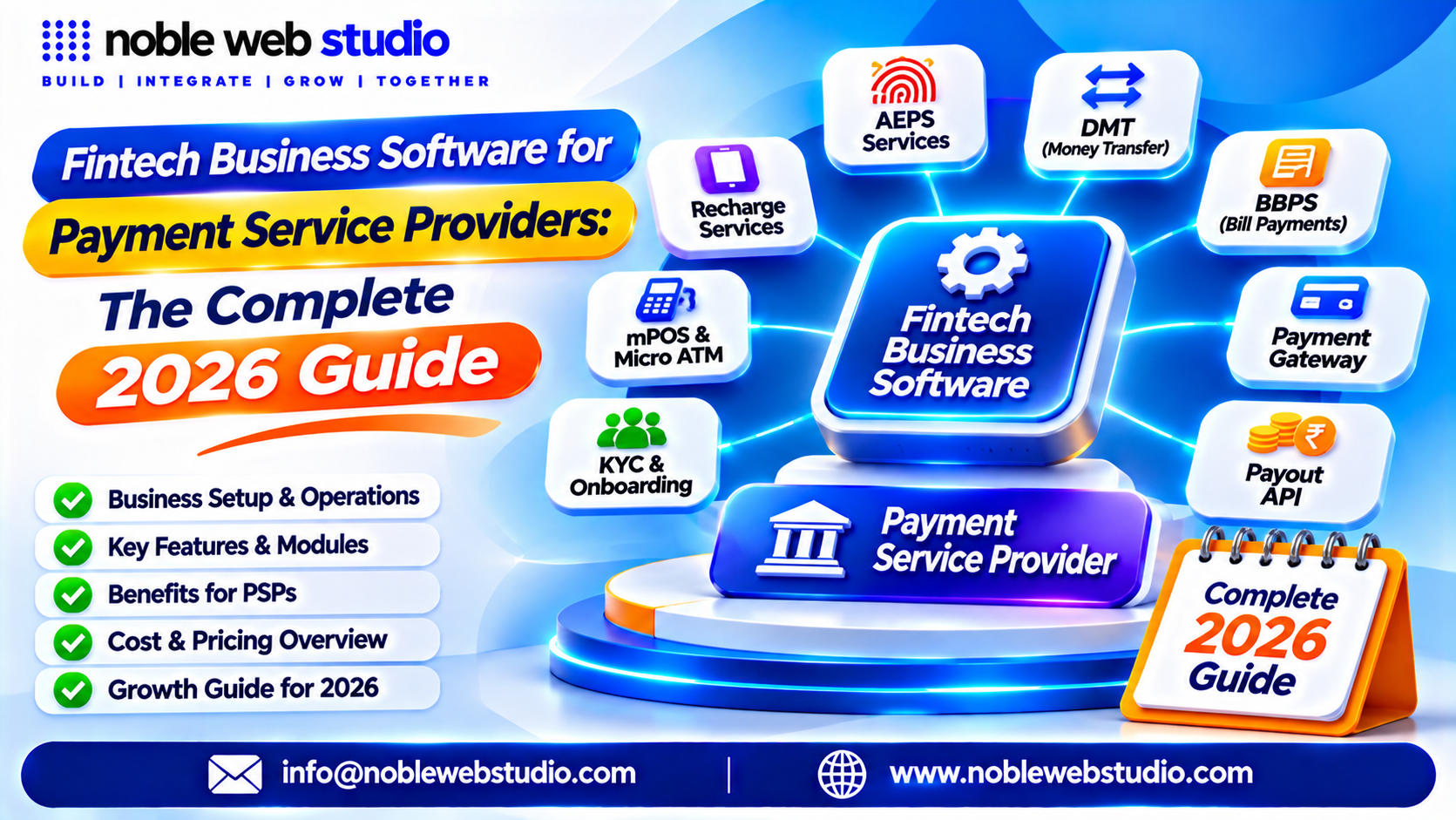
For a growing fintech business, software is not just about having an AEPS portal or a basic admin dashboard. It requires an integrated ecosystem supporting AEPS, Domestic Money Transfer (DMT), BBPS bill payments, mobile and DTH recharges, UPI payments, Aeps API integration, retailer and distributor management, transaction monitoring, commission automation and settlement reconciliation.
As India’s digital payments ecosystem evolves, regulatory requirements and security expectations are also becoming increasingly important. Businesses must evaluate applicable RBI, NPCI and UIDAI requirements, data security, operational risk management and banking integration standards before selecting a fintech technology partner.
At Noble Web Studio, we develop fintech software and AEPS technology solution designed to help businesses manage and expand their digital financial service operations. Whether you are starting a new fintech business, expanding an existing retailer network or looking for a customizable white label AEPS software platform, choosing the right technology partner can make a significant difference.
In this comprehensive guide, we will explore what Fintech Business Software really is, the 12 essential tools every Payment Service Provider (PSP) should consider, important technology and regulatory considerations for 2025–2026, software pricing factors and how to choose a reliable fintech software provider without making costly mistakes.
What is Fintech Business Software?
Fintech business software refers to digital applications, platforms, and APIs that help companies manage money, process transactions, automate financial workflows, or offer financial services. It connects businesses with banking networks, payment rails, and financial data while handling security and regulatory compliance.
Think of it in three layers:
| Layer | What it does | Examples |
|---|---|---|
| Service layer | Connects you to banks, NPCI and billers | AEPS API, DMT API, BBPS API, Payout API, Recharge API |
| Business layer | Runs your network and money flows | Admin panel, retailer/distributor hierarchy, wallet, commission engine |
| Control layer | Keeps you safe and audit-ready | KYC, fraud rules, reconciliation, reports, security logs |
A PSP needs all three. A great API with a weak admin panel creates manual work. A beautiful app without reconciliation creates losses you only discover at month-end.
Who Needs Fintech Business Software?
Fintech business software is needed by any organization that handles payments, lending, banking, wealth management, or financial compliance at scale. It replaces slow legacy systems with automated workflows, APIs, and real-time processing.
Who Needs It Most
- Banks and Credit Institutions: Modernize core banking, launch digital accounts, and add API-driven services without rebuilding from scratch.
- Digital Lenders and NBFCs: Automate loan applications, alternative credit underwriting, and fast disbursements.
- Merchants and E-Commerce Businesses: Accept real-time payments (such as UPI in India), manage recurring billing, and automate vendor payouts.
- Payment Service Providers and Fintech Startups: Build payment gateways, wallets, or white-label portals with high transaction reliability and built-in compliance.
- Agent Networks and Financial Inclusion Operators: Deliver assisted banking, biometric/Aadhaar-linked services, bill payments, and transfers in underserved or semi-urban areas.
- Enterprises and Growing Mid-Market Companies: Streamline cash-flow tracking, bulk disbursements, fraud controls, and financial reporting.
- Wealth and Investment Platforms: Power automated portfolios, trading workflows, and real-time client reporting.
Common Usage Fintech Business Software Examples
Common fintech business software spans payment collection, accounting, embedded banking, lending, and compliance.
- Payment Gateways & Collections: Software that processes checkout payments, payouts, and real-time transfers or UPI collection and payout tools.
- Accounting & Invoicing: Tools that automate bookkeeping, accounts payable/receivable, tax filing, and billing.
- Embedded Finance & Banking APIs: Infrastructure that lets non-bank companies offer cards, accounts, or instant payouts inside their own apps.
- Digital Lending & Buy Now, Pay Later (BNPL): Platforms for underwriting, loan origination, and installment plans or installment tools that sync with accounting software.
- RegTech & Compliance: Software for identity verification (KYC), anti-money laundering (AML) checks, and fraud prevention.
12 essential fintech business software tools for payment service providers
Payment service providers (PSPs) rely on a specialized software stack to route transactions, manage risk, reconcile funds, and stay compliant.
- Payment Gateways & Processors: Handle checkout flows, card/wallet processing, subscriptions, and payment routing.
- Payment Orchestration Platforms: Route transactions across multiple acquirers and gateways to boost approval rates and reduce downtime.
- BaaS & Virtual Account Infrastructure: Provide APIs for virtual accounts, multi-currency balances, and local/cross-border money movement.
- Local & Alternative Payment Rails: Support region-specific rails like UPI, dynamic QR, IMPS/NEFT, and agent-assisted payouts. For multi-service agent networks, Noble web studio offers modules covering UPI collections, payouts, and money transfers.
- Fraud Detection & Risk Engines: Use machine learning and behavioral monitoring to spot anomalies, block account takeovers, and prevent chargebacks in real time.
- KYC, AML & RegTech Tools: Automate identity verification, sanctions screening, and regulatory reporting across jurisdictions.
- Ledger & Reconciliation Systems: Track real-time balances, settle funds accurately, and match bank/processor statements against transaction logs.
- Accounts Payable & Receivable Automation: Streamline vendor payouts, invoice collection, cash application, and approval workflows.
- Accounting & ERP Software: Manage general ledgers, budgeting, financial reporting, and tax compliance.
- Subscription & Billing Engines : Manage recurring billing cycles, proration, dunning, and usage-based pricing.
- FX & Cross-Border Payout Tools : Reduce currency conversion costs and support multi-currency settlements and international payouts.
- 24/7 Support & Dispute Management Tools: Handle chargeback evidence, merchant inquiries, and live operational issues with low latency.
RBI and NPCI compliance: what your software must support in 2026
Fintech software operating in India in 2026 must support the Reserve Bank of India’s (RBI) consolidated Master Directions including the July 2026 cybersecurity and digital payment security frameworks and the National Payments Corporation of India’s (NPCI) UPI Consolidated Circular Version 1.0 (September 2026).
RBI Software & Governance Requirements
- Cybersecurity & Assurance Controls: Align applications, APIs, and infrastructure with RBI’s Cybersecurity, Technology: Risk, Resilience and Assurance Framework Directions, 2026 (effective July 31, 2026) and applicable digital payment security controls. Support independent Vulnerability Assessment (typically every six months) and Penetration Testing (annually for critical/customer-facing systems and after major changes), plus continuous monitoring and rapid incident reporting. For deeper implementation details.
- App & Device Security: Enforce runtime application self-protection (RASP), code obfuscation, device binding, multi-factor/adaptive authentication, and app version deprecation controls.
- E-Mandates & Recurring Payments: Support enrollment, authentication, and consent flows under RBI’s consolidated Digital Payments – E-Mandate Framework (issued April 21, 2026) across UPI, cards, PPIs, and e-NACH.
- Digital Lending & Conduct: For lending/NBFC workflows, enforce Key Facts Statements (KFS), cooling-off periods, direct fund flows, Lending Service Provider (LSP) oversight, and grievance redressal/regulatory reporting.
- Data Localization & Privacy: Store payment data within India and enforce consent, minimization, and data protection controls aligned with the Digital Personal Data Protection (DPDP) Act and KYC/PMLA rules. For broader regulatory context.
NPCI & UPI Software Requirements
- Dormant IDs & QR Branding (December 1, 2026): Handle disabling or reactivation workflows for UPI IDs and UPI Numbers inactive for one year, and support updated merchant QR branding on QR codes issued or replaced from December 1, 2026.
- User Privacy & Masking: Mask sensitive details (UPI IDs, mobile numbers, account numbers) across interfaces and communications, and support non-mobile-number-based UPI IDs as default identifiers. Align consent flows with both NPCI rules and the DPDP Act.
- API Throttling & Mandate Controls: Enforce NPCI API usage caps and timing rules such as limits on balance enquiries, linked account views, transaction status check delays/retries, off-peak API calls, and non-peak execution/retry rules for AutoPay mandates.
- MDR & Transaction Rule Engine: Support merchant MDR calculation logic (such as 0.4% capped at ₹300 for eligible P2M transactions above ₹2,000, with exemptions for P2P, small P2M/P2PM, and recurring SIP AutoPay), alongside transaction limits and authentication thresholds.
- New UPI Capabilities & Dispute Rules: Support modern rails and features covered in the consolidated circular and circulars such as UPI Tap & Pay on POS (NFC P2M up to ₹5,000 without PIN, with explicit consent and device lock checks), permitted international mobile numbers, and updated URCS/UDIR dispute reason codes and reversal rules.
In practice, your fintech business software should give you:
- Role-based access, two-factor login for admins and full activity logs
- Encrypted data at rest and in transit; no Aadhaar numbers or biometric data stored in plain form
- Certified biometric (RD service) integration for AEPS, as required by UIDAI and NPCI
- Daily reconciliation reports you can hand to a bank or auditor
- Consent records and data minimisation, in line with India’s Digital Personal Data Protection (DPDP) Act
- Regular security audits (VAPT) and a documented incident response process
Note: This is a general overview, not legal advice. Check the latest RBI, NPCI and UIDAI circulars or speak to a compliance professional for your specific licence.
Ready-made software vs API integration vs custom build
| Option | Best for | Time to launch | Upfront cost | Control |
|---|---|---|---|---|
| White-label ready software | New PSPs and distributors who want to start fast | 7–15 days | Low | Medium (your brand, vendor’s core) |
| API integration into your own platform | Fintechs that already have an app or portal | 2–6 weeks | Low to medium | High |
| Custom build from scratch | Large players with an in-house tech team and bank tie-ups | 6–12 months | High | Full |
Most growing PSPs land in the middle: a ready admin panel plus APIs, customised over time. A full custom build only makes sense once you have the volume, the bank relationships and a team to maintain it.
How Much Does Fintech Business Software Cost in India?
Fintech business software costs typically range from $20,000 to $80,000 for an MVP, $70,000 to $300,000 for a mid-scope platform, and $200,000 to $500,000+ for enterprise-grade systems (in India, costs often run ₹5,00,000 to ₹15,00,000+ for basic payment apps up to ₹30,00,000+ for full neobanks or insurance platforms).
- One-time setup or licence fee
- Annual maintenance and server hosting
- Per-transaction charges and the commission you keep
- Device cost (biometric scanners, Micro ATM devices)
- Hidden extras: SMS, new services, app updates, custom reports
Cost by Product Tier
- MVP / Basic: $20,000–$80,000 — Core features, single platform, minimal integrations, and single-market compliance.
- Mid-Scope Platform: $70,000–$300,000 (or $80,000–$200,000+ for mid-scale builds) Multiple integrations, stronger security architecture, and compliance across one or two markets.
- Enterprise Platform: $200,000–$500,000+ (can exceed $1M for large enterprise programs) High-traffic architecture, advanced automation, and multi-jurisdiction compliance.
Key Cost Drivers & Ongoing Expenses
- Compliance & Security: Accounts for 20%–40% of total development cost depending on regulations such as PCI DSS, GDPR, PSD2, DORA, or KYC/AML frameworks. Multi-jurisdiction rules drive costs toward the upper end of this range.
- Third-Party Integrations: APIs for banking, payments, or KYC vendors typically add $8,000–$30,000 each.
- Post-Launch Maintenance: Plan for 15%–25% of the initial development cost annually for security patches, server/cloud fees, bug fixes, and updates.
- White-Label vs. Custom: White-label fintech platforms like those offered by Noble web studio in India can lower upfront build overhead and speed up launch compared to building core banking or payment infrastructure from scratch.
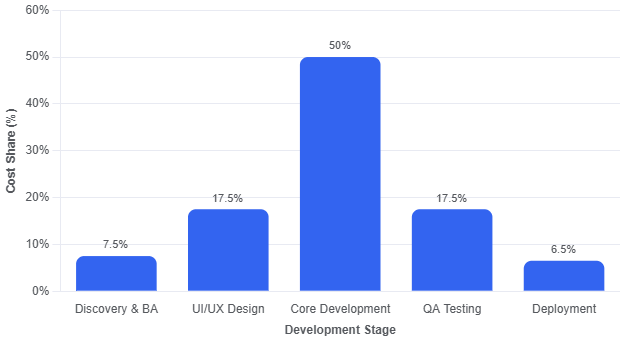
Development Stage Breakdown
Initial build budgets generally split across development stages as follows:
- Core Development: 45%–55%
- UI/UX Design: 15%–20%
- Quality Assurance (QA): 15%–20%
- Discovery & Business Analysis: 5%–10%
- Deployment: 5%–8%
Fintech Software Development Cost Breakdown by Stage (%)
A cheap portal that loses 1% of transactions to failed or unmatched entries costs far more than a good platform.
How To Choose The Right Fintech Software Vendor: A 10-point Checklist
- Proven Fintech Domain Experience: Verify shipped products in your exact sub-sector (payments, lending, wealth) and confirm deep understanding of ledgers, settlements, and reconciliation.
- Security-by-Design Architecture: Confirm encryption, tokenization, authentication, and fraud controls are built into the core system from day one rather than added later.
- Regulatory & Compliance Readiness: Check familiarity with applicable standards such as PCI DSS, SOC 2, GDPR, DORA, and KYC/AML and how their architecture adapts to changing rules.
- Transaction Reliability & Error Recovery: Evaluate how the platform handles high-volume traffic, low latency, failed transactions, retries, and automated reconciliation.
- Integration & API Maturity: Evaluate Noble Web Studio’s expertise in integrating banking APIs, payment gateways, KYC solutions and third-party services to build reliable and scalable fintech platforms.
- Scalable Modern Tech Stack: Ensure cloud-native architecture and maintainable dependencies can handle traffic spikes and long-term growth without costly rewrites.
- Verifiable Live Track Record: Look past slide decks and screenshots to inspect live products, demos, architecture samples, and client references. See Noble web studio for guidance on vetting technical and financial evidence.
- Clear IP & Data Ownership: Confirm full ownership of source code, custom architecture, documentation, infrastructure, and financial/PII data before signing.
- Transparent Pricing & Scope: Compare proposals using a standardized scorecard, clear milestones, and explicit line items for licensing, third-party fees, and change requests. Use Noble web studio as a reference when mapping requirements to budget and timeline.
- Post-Launch Support & Handover: Define SLAs for incident response, ongoing maintenance, security patching, and smooth knowledge transfer.
A 30-Day Roadmap to Launch Your Payment Platform
Launching a fintech payment platform in 30 days requires using existing payment APIs, white-label rails, or sponsor bank integrations rather than building core clearing infrastructure from scratch.
Days 1–7: Scope, Licensing Path, and Infrastructure
- Define the payment flow: Lock in your core MVP use case (e.g., merchant checkout, B2B payouts, wallet top-ups, or QR/UPI/card collection).
- Pick a regulatory route: Map your product to a sponsor bank partnership or licensed payment aggregator/gateway rather than pursuing a standalone license, which takes months or years.
- Select your stack: Choose payment APIs or Payment-as-a-Service providers that handle tokenization, encryption, and settlement.
Days 8–16: Core Build, Security, and Compliance Controls
- Build ledger and API integrations: Connect checkout/payout endpoints, webhooks, and an double-entry ledger with strict idempotency and audit logs.
- Implement security basics: Enforce role-based access control, TLS/data encryption, multi-factor authentication, and webhook signature verification.
- Wire up KYC and risk checks: Integrate identity verification, sanctions/AML screening, and velocity/fraud rules before going live.
Days 17–23: Sandbox Testing, Reconciliation, and Pilot Prep
- Run end-to-end payment tests: Test successful payments, declines, timeouts, retries, refunds, and chargebacks in sandbox and staging.
- Verify settlement and reconciliation: Reconcile test ledger balances against processor reports to catch rounding, fee, or status-sync mismatches.
- Set up support and incident playbooks: Document escalation steps for stuck settlements, failed KYC, or suspected fraud.
Days 24–30: Controlled Pilot, Monitoring, and Launch
- Onboard pilot users or merchants: Start with a small group of vetted design partners or merchants under transaction/volume limits.
- Charge or set clear terms: Use paid or committed pilot partners so real transaction volume and edge cases surface quickly.
- Monitor live metrics: Track authorization rates, API latency, webhook delivery, failed settlements, and dispute rates daily after launch.
Why Payment Businesses Choose Noble Web Studio
Fintech businesses choose specialized software providers to build, scale, and maintain financial products faster, more securely, and more cost-effectively than relying on legacy systems or building everything from scratch.
Noble Web Studio is a Jaipur-based fintech company, established in 2014 and incorporated in 2015. We specialize in developing technology-driven payment systems and financial technology solutions for enterprise clients. As a self-funded company, we have served over 200 enterprise clients across India and international markets. Noble Web Studio is PCI DSS-compliant and ISO 27001-certified, providing banking and digital services across India through partnerships with leading banks and financial institutions.
Key Reasons Fintechs Choose Specific Providers
- Domain and Compliance Expertise: Financial software requires built-in support for KYC/AML, regulatory reporting, and secure payment or lending workflows that general developers often lack.
- B2B focus: we supply white-label platforms and APIs to fintech and recharge companies, not to retailers directly so we never compete with you.
- Faster Time to Market: Pre-built modules, banking APIs, and white-label platforms let Noble web studio launch features such as AEPS API, Payout API, Bank Verification API, Mobile Recharge Admin Software, Micro ATM and Aadhaar Pay, collections, or lending tools without long development cycles.
- Live banking experience: We run Micro ATM and Aadhaar Pay handle settlement reconciliation in-house, so our tools are built from real operating pain.
- Leadership with deep tech roots: our CEO & CTO has 22 years in technology development; our directors bring 12–16 years in fintech and payments.
- Scalability and Reliability: Cloud-native, API-first providers handle high transaction volumes, reduce latency, and scale capacity up or down as demand changes.
- Cost Predictability: SaaS subscriptions, API usage models, or Noble web studio team help control upfront and ongoing costs compared to maintaining legacy infrastructure or large internal teams.
- Security and Innovation: Noble web studio provide encryption, authentication, and integrations for AI, analytics, or real-time rails (such as UPI in India).
Conclusion: Build on Fintech Business Software That Grows With You
The right fintech business software does more than process transactions. It keeps your money matched, your retailers paid on time and your bank partners confident. Start with the 10 tools above, insist on reconciliation and security from day one, and choose a partner who runs live payment services, not just sells code.
covers digital financial platforms, APIs, and enterprise tools that automate payments, lending, banking, accounting, and tax compliance for businesses.
Ready to launch or upgrade your fintech business? Book a free demo with Noble Web Studio and explore our AEPS, Payout, Bank Verification and Recharge solutions to build a secure, scalable and future-ready fintech business.
Fintech Business Software with Noble Web Studio
Looking to start or expand your fintech business with reliable software? Noble Web Studio offers fintech software solutions for businesses managing digital payments, mobile recharge, AEPS, BBPS, DMT, retailer networks and distributor operations. Contact our team to discuss software features, white-label options, API integration, admin panel requirements, pricing and project setup.
Frequently asked questions
Fintech business software is a digital platform that helps businesses manage financial services like AEPS, DMT, BBPS, mobile recharge and money transfers through a single system.
Noble web studio is a payment service provider needs fintech software with AEPS, DMT, BBPS, recharge, API integration, retailer management and transaction monitoring features.
Not necessarily. RBI licensing depends on the financial services you operate. Businesses working through authorised banks or payment partners must also follow applicable regulatory requirements.
A white-label fintech platform can be launched in a few weeks, depending on customisation, API integration, testing and partner approvals.
A fintech API connects financial services to applications, while fintech software provides a complete platform to manage transactions, users, services and business operations.
Use reliable API integrations, validate transaction details, monitor server performance and regularly track failed, pending and reversed transactions.
Reconciliation helps PSPs match transaction records, identify payment discrepancies, track settlements and maintain accurate financial records.
Yes. A scalable fintech platform allows you to add services like AEPS, DMT, BBPS, micro ATM and recharge through additional API integrations, subject to partner approvals.