
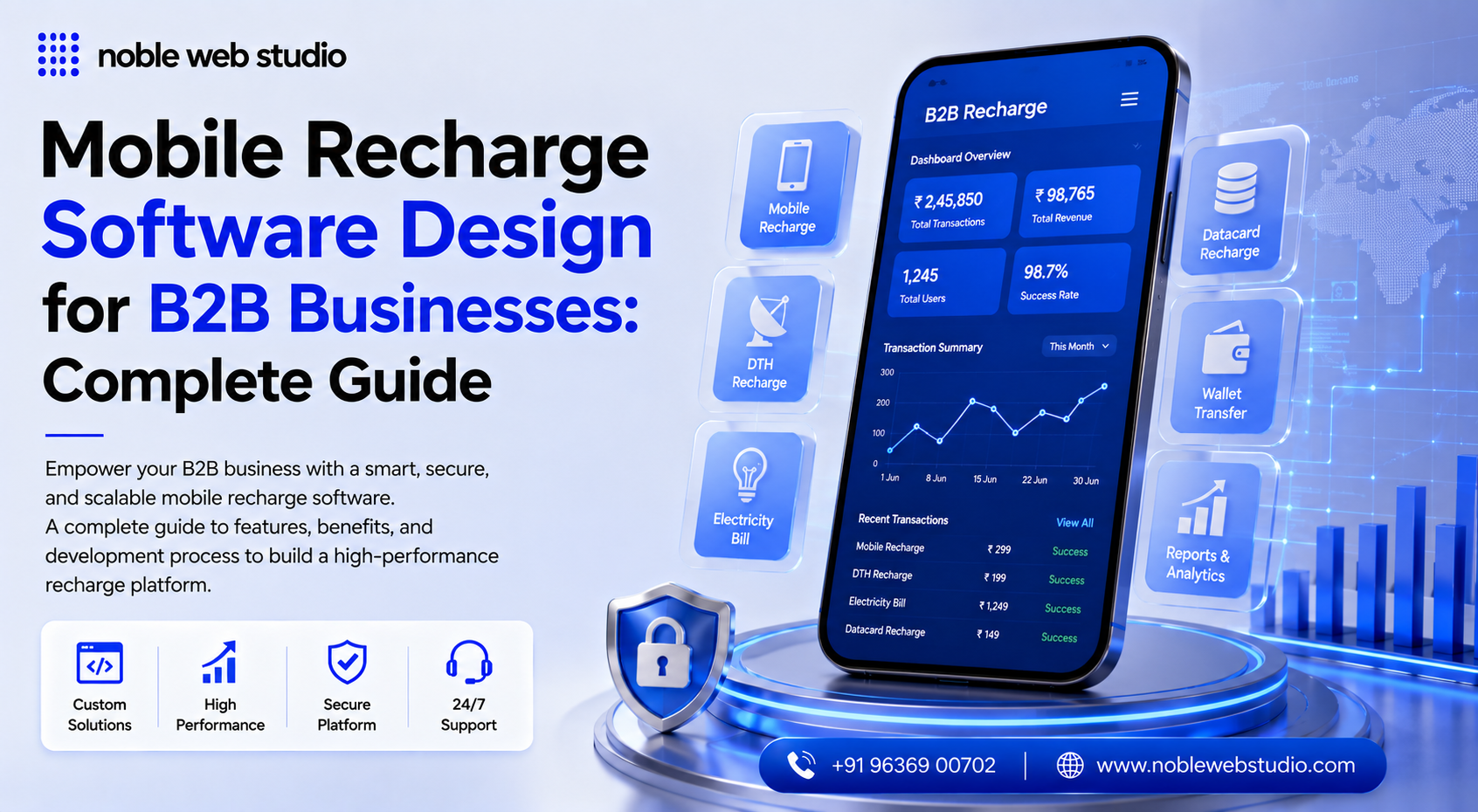
Are you looking for professional Mobile Recharge Software Design to launch your own recharge business or improve your existing recharge platform? A well-designed Mobile Recharge Software should do more than process recharges it should make it easy to manage retailers, distributors, transactions, wallets, commissions, reports, and recharge API from one centralized mobile recharge platform.
For businesses planning to start online recharge business, B2B recharge business, recharge company, or multi recharge platform, the right software design can make daily operations simpler and provide a better experience for both retailers and distributors. A scalable B2B Mobile Recharge Software can support multiple user levels, automated transaction processing, wallet management, recharge commission distribution, and real-time transaction tracking.
Mobile recharge software design involves a multi-tier architecture (Admin, Distributor, Retailer, and B2C User) focused on high-speed transaction processing, secure wallet management, and seamless recharge API integration with telecom operators or aggregator gateways.
Noble Web Studio provides Mobile Recharge Software Design and Mobile Recharge Software development solutions for businesses that want a ready-made or customized B2B Recharge Software. Depending on your requirements, the platform can include Mobile Recharge, DTH Recharge, BBPS, Mobile Recharge API Integration, Recharge Retailer Management, Distributor Management, Recharge Wallet Management, Commission Management, Transaction Reports, Recharge Admin Panel, and White Label Recharge Software.
A professional Mobile Recharge Software Design should also focus on usability, scalability, security, mobile recharge API connectivity, responsive screens, and simple navigation. Retailers should be able to perform recharges and check transaction details easily, while administrators need complete control over users, wallets, commissions, services, and reports.
Whether you want to buy ready made Mobile Recharge Software, develop custom recharge software, build B2B Recharge Software, integrate Mobile Recharge API, or launch White Label Recharge Software, Noble Web Studio can help you choose and build a solution according to your business requirements.
In this guide, you will learn about Mobile Recharge Software Design, essential features, B2B recharge platform structure, admin and recharge retailer panels, API integration, wallet and commission management, responsive design, customization, development options, pricing factors, and how to choose the right Mobile Recharge Software provider in India.
What Is Mobile Recharge Software Design?
Mobile recharge software design is the architectural and visual planning of a digital recharge platform used to process prepaid and postpaid mobile top-ups, DTH payments, and utility bills. It maps out user interfaces, multi operator recharge API connections, database structures, and secure transaction workflows for apps and web portals.
Mobile Recharge Software Work?
Mobile recharge software acts as an automated digital bridge connecting users or shop owners with telecom operators. It processes mobile top-ups, DTH, and utility bills instantly through a single digital recharge wallet using application programming interfaces (APIs).
Step-by-Working Process
- User Input: A customer or retail agent opens the recharge commission app or recharge portal, enters the mobile number, picks an operator (like Jio, Airtel, or Vi), and selects a plan.
- Wallet Deduction: The recharge system deducts the recharge amount from the user’s or retailer’s digital balance.
- API Routing: The recharge software sends the request safely through a best recharge API to the target telecom provider.
- Operator Approval: The telecom company checks the number and applies the recharge instantly.
- Confirmation & Commission: A success message goes back to the app, and the system credits a small commission to the agent’s wallet.
Mobile Recharge Software Design Services
Mobile recharge software design services build custom, white label recharge , and multi recharge web or mobile recharge platform. These systems handle automated prepaid mobile, DTH, data card, and utility bill payments via secure recharge API integration, recharge admin control panels, and multi-level user hierarchies (Admin, Distributor, Retailer).
Key Features Included
- Multi-Operator & API Integration: Support for major telecom and utility providers with automated switching and routing.
- Role-Based Panels: Dedicated recharge dashboard for mobile recharge Admin, Distributors, and Retailers with custom recharge commission settings.
- Wallet & Payment Gateway: Secure digital recharge wallet management, fund transfers, and integrated payment gateways.
- Reporting & Analytics: Real-time transaction tracking, success-failure logs, and earning/commission reports.
Business Models Supported
- B2B / White Label: Build your own branded recharge network and recharge API onboard sub-distributors or retailers.
- B2C Portals: Direct-to-consumer online recharge websites and Android recharge application.
- AEPS & Utility Add-ons: Expanded service scope to include Aadhaar Enabled Payment Systems.
Who Needs Mobile Recharge Software Design?
Mobile recharge software design is needed by entrepreneurs, telecom entrepreneurs, multi-level marketing (MLM) networks, and fintech startups wanting to launch B2B recharge or B2C top-up portals, white label recharge service provider systems, or agent-based retail networks.
Who Needs It
- B2B Recharge Distributors & Master Distributors: Individuals or companies managing a multi-tier downline network of regional dealers, shopkeepers, and local retailers.
- White-Label Resellers: Businesses looking to provide customized, branded mobile and DTH recharge platforms under their own company name and logo.
- Fintech & Utility Service Startups: Enterprises integrating prepaid mobile top-ups, DTH, and utility bill payments (like BBPS) into a unified application.
- Independent Retail Shops & Chains: Local store owners who need dedicated POS or mobile recharge commission app with integrated wallet and mobile recharge commission tracking.
Why Needs Mobile Recharge Software Design
A good mobile recharge software design is needed to automate instant transactions, reduce human errors, and manage multi-operator networks like Jio, Airtel, and BSNL from one place. It gives users and shopkeepers a clean interface to process payments, track commissions, and handle utility bills safely.
Key Reasons for Mobile Recharge Software Design
- Automation & Speed: Replaces slow manual work with fast recharge API routing for instant success or failure updates.
- User-Friendly UI/UX: A simple screen layout helps customers and retailers make fast recharges without confusion.
- Multi-Operator Support: Handles mobile top-ups, DTH, and utility bills across different telecom networks in one portal.
- Secure Transactions: Protects user money and data using safe payment gateways (like UPI or cards) and encryption.
- Commission Management: Helps recharge B2B admin and distributors track sales and credit commissions at every level.
- Central Dashboard: Gives business owners real-time reports and analytics to monitor daily transactions.
Mobile Recharge Software Design for Different Business Models
Mobile recharge software design requires distinct architectural approaches depending on whether the target model is B2C (direct consumer), recharge B2B (multi-level reseller agent networks), white label mobile recharge (rebrandable software), or top recharge API-driven. Success relies on robust wallet tracking, multi-operator best mobile recharge API routing, and instant failover execution.
Core Software Architecture by Business Model
1. B2C (Business-to-Consumer) Model
Designed for individual end-users who top-up their own mobile lines, data cards, or pay household utility bills directly.
UI/UX Focus: Highly simplified, fast-loading, guest or single-tap login interface, integrated promotion/cashback modules, and saved beneficiary details.
Payment Integration: Heavy reliance on direct retail payment gateways (UPI, credit/debit cards, net banking).
Wallet System: Optional lightweight consumer wallet for instant refunds and one-click checkout.
2. B2B / Reseller / Multi-Level Marketing Model
Built for a hierarchical channel structure typically best mobile recharge Admin, Master Distributor, Distributor, and Retailer/Agent.
- UI/UX Focus: Dense operational dashboard optimized for rapid data entry, SMS-fallback commands, and balance tracking.
- Hierarchy & Commission Engine: Complex rule engine to split, calculate, and credit margins or multi-tier commissions dynamically per transaction.
- Fund Management: Virtual credit ledger control where upper tiers manually or digitally transfer operational limits/funds down the chain.
3. White-Label Platform Model
Provided as a turnkey, ready-to-brand recharge software solution enabling third-party entrepreneurs to run a proprietary recharge business using their own logos, domains, and customized mobile recharge commission app.
- Multi-Tenant Architecture: Isolated database schemas or secure tenant partitions ensuring client branding, custom recharge commission matrices, and private configurations remain independent.
4. API / Enterprise Integration Model
Functions as a backend processing engine allowing external recharge b2b software system to trigger recharges programmatically.
- Protocol Focus: Secure RESTful endpoints (JSON responses), IP whitelisting, webhook callbacks for asynchronous status updates, and sandbox testing environments.
Top Use Cases of Design Mobile Recharge Software
Best Mobile recharge software automates prepaid/postpaid airtime, DTH, and utility payments through multi-tier reseller architectures, top mobile recharge API and white label recharge portal. It empowers local shopfronts, fintech startups, and enterprises to manage high-volume digital transactions and commission distribution seamlessly.
Retail Convenience Hubs
- Over-the-counter top-ups: Local grocery shops and neighborhood kiosks use the b2b mobile recharge software to process instant mobile, data card, and DTH recharges for walk-in customers.
- Foot traffic & commissions: Transforms standard retail stores into neighborhood payment centers that earn per-transaction margins.
B2B Distributor-Retailer Networks
- Hierarchical management: Recharge Platform admin manage multi-level business chains (Master Distributor → Distributor → Retailer).
- Automated margins: Dynamically calculates and splits slab-based commission percentages across different agent tiers instantly.
White-Label Fintech Solutions
- Brand customization: Aspiring entrepreneurs rebrand ready made mobile recharge commission app and web panels with their own logos and themes.
- Fast market entry: Eliminates the need to build telecom integrations and backend server architecture from scratch.
API Integration for Existing Platforms
- Value-Added Services (VAS): E-commerce websites and digital mobile recharge wallet app plug in recharge APIs to offer in-app mobile top-ups.
- High-uptime routing: Routes requests dynamically through multiple telecom gateways to ensure near 100% transaction success rates.
Automated Utility & Bill Payments
- BBPS integration: Connects with electronic billing networks (Bharat Bill Payment System) to handle electricity, water, and gas bills.
- All-in-one wallet: Lets users clear utility obligations and top-up mobile numbers from a single unified digital balance.
Corporate Bulk Recharges
- Mass processing: Businesses upload spreadsheet lists of employee or client contact numbers to execute simultaneous bulk recharges.
- Expense management: Simplifies corporate mobile allowance distributions and tracking.
Mobile Recharge Software Modules
Mobile recharge software packages rely on an interconnected suite of core administrative, user, and financial modules to manage multi-level B2B or B2C operations smoothly.
Core User & Hierarchy Panels
- Admin Panel: Gives super-administrators total control over trusted recharge system configurations, operator management, and monitoring overall network traffic.
- Master Distributor & Distributor Panels: Allow mid-tier partners to oversee their specific chain of sub-distributors and retailers, distribute funds, and track margins.
- Retailer Panel: Provides point-of-sale functionality for storefronts or individual users to initiate instant recharges and view daily sales.
- API User Panel: Enables external developers or partner sites to access and consume recharge gateways programmatically.
Financial & Transaction Modules
- Wallet Management: Handles secure digital balance storage, online fund loading, and automatic balance deductions or credits.
- Commission Engine: Automates multi-level profit margins and commission distributions for admins, distributors, and retailers.
- Fund Transfer Module: Facilitates peer-to-peer or top-down virtual credit transfers across hierarchy layers with approval logs.
- Payment Gateway Integration: Connects platforms like UPI, net banking, or debit cards for instant self-полнение of wallets.
Service & Integration Modules
- Recharge & Bill Payment Module: Executes prepaid/postpaid mobile, DTH, and utility bills through best BBPS software frameworks.
- API Integration Module: Connects backend routing to multiple telecom and utility service providers with auto-switching failovers.
- Value-Added Services (VAS): Optional add-ons such as best AePS and PAN card processing.
Management & Support Modules
- Reports & Analytics: Generates filtered logs for transactions, profit/loss statements, and tax tracking.
- Notification Module: Sends automated alerts via SMS, email, or WhatsApp for transaction updates.
- Complaint & Dispute Tracking: Logs failed or stuck transaction queries and tracks resolution statuses.
How to Design Mobile Recharge Software?
To design mobile recharge software, define your business model, pick a reliable tech stack, and integrate secure telecom and recharge payment API. Build core components like a user-friendly UI, a master recharge admin panel, and an automated recharge wallet system to process real-time top-ups safely.
Key Design Steps
- Plan the Business Model: Decide if you are building a B2C app for direct consumers or a B2B multi recharge portal featuring retailer and distributor hierarchies with custom commission rules.
- Select the Tech Stack: Use cross-recharge platform frameworks like Flutter or React Native for the top mobile recharge commission app, Node.js or Django for a scalable backend, and PostgreSQL or Firebase for the database.
- Design the UI/UX: Keep the user recharge dashboard clean with auto-operator detection from phone numbers, saved payment methods, and one-click quick recharges.
- Integrate APIs: Connect robust third-party telecom APIs for carrier recharges and reliable payment gateways to handle user deposits and transactions.
- Build an Admin Panel: Create a central management dashboard to track live transactions, monitor wallet balances, manage user commissions, and pull analytical reports.
- Secure the System: Implement end-to-end encryption, OTP/biometric authentications, and automated fraud detection tools.
Mobile Recharge Software Design for B2B Businesses
B2B mobile recharge software design is a wholesale digital mobile recharge platform that automates multi-tier distribution networks. It connects a central best recharge admin to master distributors, regional agents, and local retailers. The best mobile recharge system handles high-volume telecom recharges, utility bill payments, and automated commission payouts via integrated digital wallets.
Core Structural Layers
- Admin Dashboard: Central control panel for network oversight,high speed recharge API switching, and global margin setups.
- Distributor Panels: Mid tier mobile recharge portal to manage sub-agents, monitor down-line wallet loads, and view local profits.
- Retailer Interface: Fast point-of-sale web or mobile app screen for processing end-user recharges.
- API Gateway: Automated bridge linking transaction requests to telecom operators and BBPS software.
Essential Functional Features
- Multi-Level Hierarchy: Build and control unlimited tiers like Master Distributor, Distributor, and Retailer.
- Automated Commission Engine: Custom margin slabs and profit splits mapped dynamically to each tier.
- Smart API Routing: Automatic failover routing to backup telecom APIs to ensure high success rates.
- White-Label Branding: Custom logos, color themes, and branded mobile recharge commission app for reseller networks.
- Real-Time Wallet System: Instant digital fund transfers, top-ups via UPI or net banking, and ledger tracking.
- Dispute Management: Automated ticketing system for failed or stuck vendor transactions.
Mobile Recharge Software Design for Retailers & Distributors
Mobile recharge software design for retailers and distributors is a multi tier mobile recharge B2B platform that manages digital wallets, automated smooth recharge API switching, and custom commission hierarchies across recharge b2b admin, master distributor, distributor, and mobile recharge retailer panel for seamless prepaid, DTH, and utility bill payments.
Core User Panels & Hierarchies
- Admin Panel: Centralized control to manage multiple telecom APIs, allocate funds, monitor system traffic, and oversee total network margins.
- Distributor Panel: Tools for managing sub-networks, transferring virtual balance down to retailers, and tracking tiered commission earnings.
- Retailer Panel: Simplified interface for processing end-user recharges, checking instant commission credits, and viewing live transaction statuses.
- API & Switching Layer: Automated routing of requests to the highest-uptime telecom operator gateway.
Essential System Features
- Multi-Tier Commission Engine: Dynamic calculation of profit margins per operator and per user tier.
- Virtual Wallet & Fund Transfer: Instant credit/debit ledger with automatic refunds on failed transaction routing.
- White-Label Branding: Complete custom domain, logo, and branded Android recharge application support for distribution networks.
- Robust API & Operator Switching: Fallback mechanisms routing traffic through secondary telecom providers if primary gateways lag.
Mobile Recharge Software Design for White Label Businesses
White label mobile recharge software design gives businesses a ready-to-deploy recharge b2b platform to offer multi-telecom recharges, DTH, and utility payments under their own proprietary brand identity, logo, and domain. It eliminates core mobile recharge software development overhead while providing a scalable multi-level B2B or B2C framework.
Core Design Components
- Admin Panel: Centralized recharge admin dashboard to oversee transactions, configure multi operator mobile recharge b2b API, manage user wallets, and pull live financial logs.
- Hierarchy Management: Multi-tier structures for master distributors, normal distributors, and individual retailers.
- Digital Wallet: Secure balance storage, instant fund requests, and automated ledger updates.
- Multi-Operator API: Backend connections to major telecom and utility providers for high transaction success rates.
Essential Feature Set
- Multi-API Switching: Automated failover routing across providers to maintain high uptime and success rates.
- Broad Utility Coverage: Integration hooks for prepaid mobile, DTH, electricity, gas, water bills, and FASTag.
- Automated Commission Engine: Flexible slab setups to distribute margins across distribution channels dynamically.
- Secure Payment Gateways: UPI, net banking, and debit/credit card integrations for instant wallet top-ups.
Mobile Recharge Software Design for B2B Businesses
B2B mobile recharge software design is a hierarchical wholesale system. It links a central admin to master distributors, local agents, and telecom APIs. It automates high-volume prepaid recharges, DTH, and utility bill payments while managing multi-tier high recharge commission margins and digital wallets.
Core Structural Layers
- Admin Dashboard: Oversees the entire network, controls system settings, manages trusted recharge API switches, and sets global profit margins.
- Distributor Panel: Allows master and sub-distributors to monitor down-line retailers, transfer funds, and allocate local commissions.
- Retailer Interface: A simple web or mobile view for agents to process quick customer recharges and check live balances.
Essential Design Features
- Multi-Tier Hierarchy: Manages nested user roles from admin down to local shop agents.
- Automated API Routing: Connects instantly to telecom operators and switches traffic to backup lines during server drops.
- Custom Commission Engine: Automatically calculates and distributes tiered profit margins for each transaction.
- White-Label Branding: Enables businesses to rebrand the web portal and best mobile recharge application with their own logos and domains.
- Digital Wallet & Gateway: Secures fund loading via UPI, net banking, and debit cards for instant balance updates.
Mobile Recharge Software Architecture
Live Recharge Dashboard Live
Airtel Recharge
9876543210 • Just now
Jio Recharge
9123456789 • 2 min ago
Vi Recharge
9988776655 • 5 min ago
BSNL Recharge
9445566778 • 12 min ago
Features Mobile Recharge Software Design
A mobile recharge software design needs a fast user interface, secure mobile recharge API routing, and a multi-level user structure to process prepaid, postpaid, and utility bill payments instantly.
Core User & Admin Panels
- Admin Dashboard: Control system configurations, switch operator routing recharge service API, track revenue, and monitor live recharge platform traffic.
- User Hierarchy: Manage multi-tier roles including Master Distributors, Distributors, and Retailers.
- White-Label Branding: Customize logos, domain names, and layouts for distinct brand identities.
- Customer Interface: Simple mobile recharge earning app or web portal for quick self-service top-ups.
Transaction & Processing Features
- Real-Time API Integration: Connects instantly with major telecom and utility providers (like Airtel, Jio, VI, BSNL).
- Instant Auto-Reversal: Automatically refunds failed or dropped transactions back to the user wallet.
- Multi-Service Support: Handles mobile recharges, DTH, data cards, electricity, gas, and water bills.
- Smart Routing: Automatically shifts traffic to backup APIs if a primary telecom gateway slows down.
Financial & Security Tools
- Commission Management: Configure and calculate automated profit margins and slabs for retailers and distributors.
- Digital Wallet: Integrated virtual fund loading, credit/debit tracking, and balance requests.
- Secure Gateways: Encrypted payment processing backed by multi-factor OTP validation.
- Advanced Reports: Export daily, weekly, or monthly logs into Excel or PDF files.
Benefits Mobile Recharge Software Design
Well-designed mobile recharge software automates telecom transactions, unifies multi-service utility bill payments, and provides robust multi-tier commission management for mobile recharge B2B network and B2C networks, maximizing operational efficiency, user security, and scalable business growth.
Key Operational Benefits
- Real-Time Processing: Delivers instant top-ups and immediate transaction feedback via automated recharge API connections.
- Unified Wallet System: Simplifies fund management, enabling seamless credit distribution across master distributors and retailers.
- Multi-Level Hierarchy & Margins: Automates customizable, tiered recharge commission structures to incentivize agent sales.
- White-Label Branding: Allows companies to deploy fully customized recharge app and recharge admin portal featuring their own corporate identity.
Core Software Design Elements
- Intuitive UI/UX: Simplifies navigation for end-users and retail agents across mobile and web layouts.
- Auto-Operator Detection: Identifies telecom providers instantly upon entering a mobile number.
- Enterprise Security: Protects sensitive financial data with advanced encryption and two-factor authentication.
- Comprehensive Analytics: Tracks sales volume, success/failure ratios, and ledger balances in real time.
Mobile Recharge API Integration in Software Design
Integrating Mobile Recharge API involves choosing a reliable provider, writing back-end logic to trigger top-up requests, and configuring webhooks to handle real-time transaction updates. By implementing this bridge, your application can instantly process prepaid, postpaid, and DTH transactions directly through telecom operators.
Step 1: Choose a Noble Web Studio & Get Credentials
Select a reputable Recharge API aggregate partner (such as Noble Web Studio) based on their success rate and response time.
Register an account on the developer recharge portal.
Download the documentation explaining REST/JSON endpoints.
Generate your API credentials, which usually include an recharge API Key, Secret, and recharge Merchant ID.
Whitelist your server IP within the recharge dashboard to secure your recharge API wallet.
Step 2: Set Up the Development Environment
Prepare your back-end server to send secure HTTP requests and receive payloads.
Create a Sandbox environment to run safely isolated test transactions.
Configure environment variables to securely store your mobile recharge API Keys and Secrets.
Build the front-end interface allowing users to enter phone numbers and view operator plans.
Step 3: Integrate Core recharge API Endpoints
Write your back-end codebase to map out the customer journey through these major recharge API functions:
[ User Input ] ---> 1. GET /lookup ---> (Auto-detects Network/Circle)
                          |
[ Show Plans ] <--- 2. GET /plans  <--- (Displays available options)
                          |
[ Initiated ]  ---> 3. POST /pay   ---> (Triggers the top-up instantly)
- Operator Lookup: Implement a
GETrequest to automatically look up the telecom network and geographical circle when a user types their phone number. - Plan Fetch: Call the plan endpoint to dynamically display real-time daily, monthly, or data packs, minimizing manual selection errors.
- Wallet Balance Check: Program your system to periodically call the
GET/balanceendpoint to ensure your business wallet has sufficient funds to fulfill requests.
Step 4: Execute the Recharge Request
When the customer submits a payment, trigger a secure POST request to send the transaction details to the Noble web studio.
Generate a unique Reference ID for every request to safely avoid processing duplicate transactions.
Format the JSON payload containing the key parameters required by the server:
{
  "number": "9876543210",
  "operator_code": "JIO",
  "amount": 299,
  "reference_id": "TXN_2026A89B"
}
Step 5: Implement Webhooks and Status Polling
Network drops or operator downtime can cause transaction lag. Do not rely solely on the initial HTTP response.
Create a Webhook listener URL on your server to receive immediate asynchronous success/failure updates directly from the network operator.
Set up a Status Polling fallback script using a GET /status/{transaction_id} route to verify the transaction delivery if a webhook fails to arrive within a minute.
Map API error codes into simple, reader-friendly messages on the client side (e.g., “Invalid Number” instead of “Error 412”).
Step 6: Test and Go Live
- Run automated test cases for every major operator (such as Jio, Airtel, and Vi) inside the sandbox environment.
- Verify edge cases, like handling failed payments, checking timeouts, and testing ledger balance deductions.
- Switch configuration variables from the test sandbox URLs over to the production endpoints to launch live mobile recharge API.
Mobile Recharge Software Development Process
Mobile recharge software development involves planning requirements, recharge app designing user panels, integrating telecom APIs and payment gateways, running rigorous tests, and deploying best recharge platform. It supports prepaid, postpaid, and DTH transactions across multi level recharge admin or B2B hierarchies.
1. Requirements Gathering and Planning
- Define your target audience (B2C customer apps or recharge B2B reseller networks).
- Outline user roles like Admin, Master Distributor, Retailer, and End User.
- Finalize required services (Prepaid/Postpaid mobile, DTH, utility bills, FASTag).
2. UI/UX Design and Prototyping
- Design simple, fast recharge software for instant number and operator entry.
- Create wireframes for mobile apps (Android/iOS) and web panels.
- Build interactive prototypes to test workflow efficiency.
3. Core Development and API Integration
- Build the backend database to log transactions and user wallets.
- Integrate a reliable Recharge API and BBPS API for multi-operator connectivity.
- Implement secure Payment Gateway and digital wallet options for balance loading and instant refunds.
4. Testing and Quality Assurance
- Run high-concurrency load testing for fast transaction routing.
- Test auto-operator detection and real-time failure reversals.
- Check cross-platform responsiveness on web browsers and mobile apps.
5. Deployment and Maintenance
- Launch recharge software on secure cloud servers with automated backups.
- Provide recharge admin training on commission structures and report tracking.
- Maintain ongoing technical support and periodic telecom recharge API updates.
How Much Does Mobile Recharge Software Design Cost?
The cost to design and develop mobile recharge software ranges from ₹15,000 to ₹1,00,000+ ($200 to $1,500+) for a standard white label recharge setup, while a completely custom fintech or B2B/B2C multi recharge app starts from ₹3,00,000 to ₹15,00,000+ ($3,600 to $20,000+). If you isolate the UI/UX design stage alone, it typically accounts for 15% to 20% of the total budget, translating roughly to ₹50,000 to ₹2,00,000+ ($600 to $2,500) for custom interface flows.
Quick Price Reference Table
Below is a comparison of typical costs based on software complexity and deployment type:
| Software Type | Key Capabilities | Estimated Price Range (INR) | Estimated Price Range (USD) |
|---|---|---|---|
| Starter / Ready-made White-label | Pre-built template UI, basic admin portal, single recharge platform app. | ₹15,000 – ₹50,000 | $200 – $600 |
| Advanced Multi-Recharge Package | Custom UI/UX, B2B/B2C reseller panels, multi operator mobile recharge API switching. | ₹50,000 – ₹3,00,000 | $600 – $3,600 |
| Custom MVP App / Web Portal | Tailored frontend/backend, multi-tier commission structures, SMS integration. | ₹3,00,000 – ₹7,00,000 | $3,600 – $8,500 |
| Enterprise Fintech Suite | Cross-platform (iOS+Android), BBPS utility bills, bank-grade security protocols. | ₹15,00,000+ | $18,000+ |
Core Cost Factors
- Design Framework (Template vs. Custom): Using pre-made components from aggregators like Noble web studio keeps costs minimal. A tailored, pixel-perfect custom UI/UX system requires professional recharge software designers and will expand your budget.
- Platform Selection: A desktop-only web portal or a single Android recharge software setup costs much less than a native, cross-recharge commission platform Android + iOS app ecosystem built on Flutter or React Native.
- API Integrations: Integrating multiple recharge API (Airtel, Jio, DTH) and local secure payment gateways introduces third-party overhead.
- Development Sourcing: Hiring boutique tech agencies or freelance recharge earning software groups from India generally costs less than hiring Western regional recharge software development teams.
Hidden & Operational Expenses
A simple recharge app development estimate rarely accounts for the full first-year operational budget. Keep these ongoing costs in mind:
- API Setup Fees: Often varies between ₹0 to ₹50,000 depending on the scale of your utility aggregator.
- Hosting & Security: Cloud servers (AWS or Google Cloud Platform) scale dynamically with your volume and can cost ₹5,000 to ₹50,000 monthly.
- Maintenance & Support: Bug fixes, security upgrades, and operating system compliance demand 15% to 20% of your initial production cost annually.
- App Distribution Accounts: A Google Play Developer account is a flat $25 (₹2,100) fee, whereas an Apple Developer program costs $99 (₹8,500) per year.
How to Design Scalable Mobile Recharge Software?
Designing scalable mobile recharge software requires a high-availability cloud architecture, microservices for independent scaling, intelligent trusted mobile recharge API routing with auto-failover for telecom operators, and a robust real-time ledger for secure wallet and commission management.
To build a high-performance, enterprise-grade recharge platform, focus on these core design pillars:
Architecture and Core Services
- Microservices Design: Split user management, wallet ledgers, commission engines, and operator request handlers into independent deployable services.
- Load Balancing: Use horizontal scaling behind cloud load balancers to distribute heavy traffic spikes evenly across servers.
- Smart API Routing: Integrate multiple telecom and utility aggregators simultaneously with automatic failover routing to guarantee high transaction success rates if one operator link lags.
Data Management and Security
- Distributed Caching: Implement in-memory layers like Redis or Memcached for operator prefix lookups, user sessions, and frequently accessed configurations to minimize database strain.
- Idempotency in Transactions: Assign unique transaction IDs to every recharge request to prevent double-charging or duplicate recharges during network timeouts.
- Wallet and Ledger Consistency: Use ACID-compliant relational databases for ledger balances and atomic wallet updates to prevent race conditions during concurrent agent transactions.
Business Logic and Hierarchy
- Multi-Tier Commissions: Build a flexible configuration engine to compute complex, multi-level margins dynamically for master distributors, sub-distributors, and retailers.
- Automated Reconciliation: Schedule background worker queues to match operator callback logs against local ledger entries for automated error reversals and settlement reports.
- White-Label Infrastructure: Structure multi-tenant databases so that individual clients can run branded recharge portal and best recharge app commission sharing the same optimized backend core.
Mobile Recharge Software and App UI/UX Design
A High commission mobile recharge app UI/UX design focuses on speed, clarity, and trust, turning multi-step payment tasks into a seamless user flow. Critical features include fast number input, smart plan sorting, and secure one-tap checkouts.
Key UX Principles
- Frictionless Entry: Auto-fetch phone numbers from contacts or permit fast manual entry with automatic operator and circle detection.
- Smart Plan Categorization: Group plans logically (e.g., Popular, Unlimited, Data-only, Validity, Top-up) with clear text highlights for data limits and talk time.
- Error Prevention: Show clear validation messages for incorrect number lengths or unsupported operators before the user proceeds to payment.
- Transaction Feedback: Provide immediate loading states, instant success/failure confirmation screens, and easy access to transaction receipts.
Essential UI Elements
- Dashboard Layout: Keep the primary search/input field at the top thumb zone, followed by quick-access shortcut icons for recent recharges and bill payments.
- Visual Hierarchy: Use high-contrast call-to-action (CTA) buttons for payment steps and subtle cards for individual plans.
- Dark and Light Modes: Support recharge admin system themes to improve night-time visibility and battery efficiency.
- Trust Badges: Display secure payment indicators and encrypted processing symbols near checkout buttons.
Mobile Recharge Admin Panel Design
A trusted mobile recharge admin panel is a secure web-based backend dashboard used by business owners and operators to manage users, monitor live transactions, configure profit margins, and control telecom API connections.
Core Design Layout & Sections
Central Dashboard
- Live metrics showing total successful, pending, and failed recharges.
- Quick graphs for daily, weekly, and monthly revenue.
- Instant wallet balance alerts for operator and provider accounts.
User & Channel Management
- Hierarchical controls for recharge service admin, distributors, retailers, and end customers.
- Options to approve, block, edit profiles, or reset credentials.
Commission & Margin Settings
- Tier-based commission matrix setup for different operators (Airtel, Jio, Vi, etc.) and services like DTH or utility bills.
- Profit margin rules per user role.
Transaction & Dispute Control
- Real-time logs with search filters for transaction IDs, mobile numbers, and dates.
- Manual refund and complaint ticket resolution system for failed or stuck recharges.
API & Operator Management
- Gateway settings to add, switch, or prioritize multiple telecom recharge APIs.
- Status switches to turn specific operators or services on or off during downtime.
Recent Live Transactions
View All →| TXN ID | User / Retailer | Service | Amount | Status |
|---|---|---|---|---|
| #TXN88392 | Rahul Kumar (RET-01) | Jio Prepaid | ₹239 | Success |
| #TXN88391 | Amit Sharma (RET-04) | Airtel DTH | ₹350 | Success |
| #TXN88390 | Priya Singh (RET-12) | Electricity Bill | ₹1,240 | Processing |
| #TXN88389 | Vikram Patel (RET-08) | Vi Prepaid | ₹199 | Success |
Distributor and Retailer Panel Design for Mobile Recharge Software
A distributor and retailer recharge panel design for branded mobile recharge software requires a clear, hierarchical layout. The Retailer mobile recharge Panel focuses on fast, single-click utility and recharges, while the Distributor mobile recharge Panel prioritizes downline management, fund transfers, and margin tracking.
Retailer Panel Design (Agent Interface)
The retailer interface must be ultra-fast, mobile-responsive, and optimized for high-frequency transactions with minimal clicks.
- Quick Action Dashboard: Large, tap-friendly buttons for Prepaid Mobile, Postpaid, DTH, and BBPS utility bills (Electricity, Gas, Water).
- Live Wallet Widget: High-visibility display of current balance with an instant “Add Fund / Request Top-up” button linked to the parent distributor.
Operator Picker: Auto-detects telecom operator (Jio, Airtel, Vi) via number-series lookup with integrated R-offer/plan fetcher.
Recent Transactions Feed: A clean, scannable list showing instant status badges (Success, Pending, Failed) with one-click dispute/complaint raising.
Distributor Panel Design (Reseller Interface)
The distributor interface functions as a mini-admin hub to monitor, fund, and support managed retailers.
Network Overview Metrics: Top-level summary cards showing total active retailers, daily downline turnover, and total commission earned.
Fund Transfer Ledger: Secure module to credit or debit virtual wallet balance to specific retailer IDs with instant password/OTP confirmation.
Retailer Management Table: List view of downline agents with options to activate/deactivate accounts, reset PINs, and check individual balances.
Commission & Margin View: Transparent breakdown of margins received from the admin versus margins passed down to retailers.
Core UI/UX Best Practices
- Color Coding & Status: Use distinct, standard indicators (Green for success, Yellow for pending/processing, Red for failure/refunded).
- Role-Based Access Control (RBAC): Restrict lower tiers from viewing global recharge b2b API configurations, profit margins of upper channels, or unrelated data pools.
- Multi-Language & Light/Dark Support: Essential for field agents operating in diverse regional environments.
Live Panel Dashboard
| Service | Amount | Status |
|---|---|---|
| Jio Prepaid | ₹ 239 | Success |
| Airtel DTH | ₹ 350 | Success |
| Electricity | ₹ 840 | Success |
| Retailer Name | ID | Volume | Status |
|---|---|---|---|
| Rahul Kumar | RET-01 | ₹ 45,200 | Active |
| Amit Sharma | RET-04 | ₹ 32,100 | Active |
| Priya Singh | RET-12 | ₹ 28,500 | Active |
| Vikram Patel | RET-08 | ₹ 15,400 | Active |
Recharge Wallet and Payment System Design
A recharge wallet and payment system requires high consistency, strict idempotency to prevent double-charging, and double-entry ledger tracking. Core components include recharge API gateway, user/wallet microservices, asynchronous message queues (like Kafka), and third-party payment gateways (such as UPI, cards, or net banking).
Core Architecture Components
- API Gateway & Client Layer: Handles SSL termination, rate limiting, authentication, and routes client requests.
- Wallet Service: Manages user balances, account states, and concurrent updates safely using database-level row locking or optimistic concurrency.
- Payment Orchestration Service: Interacts with external Payment Service Providers (PSPs) for top-ups.
- Ledger Service: Maintains an immutable, append-only double-entry bookkeeping record of every debit and credit.
- Recharge/Utility Engine: Connects to external telecom or bill payment operators to complete final recharges.
Key Design Principles
- Idempotency: Every wallet top-up or spend request must include a unique client-generated
idempotency_keyto make retries safe and block duplicate processing. - Strong Consistency: Wallet balances require ACID-compliant relational databases or partitioned ledgers to ensure money is never created or lost out of thin air.
- Webhook Handling: Asynchronous notifications from PSPs must be logged raw, validated via signatures, queued via message brokers, and processed idempotently.
- Reconciliation Job: Run daily background jobs to match internal ledger balances against third-party settlement files to catch discrepancies.
Recharge Wallet
Secure Payment System
Quick Services
Payment Methods
UPI Payment
GPay, PhonePe, Paytm
Debit/Credit Card
Visa, Mastercard, RuPay
Net Banking
All major banks
Wallet Balance
₹45,230.50 available
Recent Transactions
| Transaction ID | Service | Date & Time | Amount | Commission | Status |
|---|---|---|---|---|---|
| #TXN20260824001 | Mobile Recharge – Airtel | 24 Aug 2026, 10:15 AM | – ₹299.00 | + ₹13.45 | Success |
| #TXN20260824002 | DTH Recharge – Tata Sky | 24 Aug 2026, 09:45 AM | – ₹450.00 | + ₹18.00 | Success |
| #TXN20260824003 | Wallet Top-up | 24 Aug 2026, 09:30 AM | + ₹5,000.00 | – | Success |
| #TXN20260823015 | Electricity Bill Payment | 23 Aug 2026, 06:20 PM | – ₹1,250.00 | + ₹6.25 | Pending |
| #TXN20260823014 | Mobile Recharge – Jio | 23 Aug 2026, 05:45 PM | – ₹749.00 | + ₹31.46 | Success |
| #TXN20260823013 | Gas Bill – Indane | 23 Aug 2026, 04:30 PM | – ₹850.00 | + ₹6.80 | Success |
| #TXN20260823012 | Mobile Recharge – Vi | 23 Aug 2026, 03:15 PM | – ₹399.00 | + ₹19.15 | Failed |
Recharge Commission Management Design
A Recharge Commission Management Design defines the structural framework, database schema, and user interface (UI) rules used to calculate, distribute, and track profit margins for mobile, DTH, and utility bill payments across multi-tier mobile recharge B2B networks.
Core Architecture & User Hierarchy
- Admin / Super Admin: Controls master slabs, upstream recharge API switching, and global profit margins.
- Master Distributor: Oversees regional networks and sets customized sub-distributor margins.
- Distributor: Manages local retailers and receives chain override commissions.
- Retailer / Agent: End user executing direct customer recharges via trusted mobile portal or web portal.
Commission Slabs & Calculation Logic
- Percentage-Based Slabs: Variable commission tied to operator values (e.g., Jio 1.5%, Airtel 2%, Vi 3%, DTH 4%).
- Flat-Fee Slabs: Fixed payout per transaction for utility bill payments via BBPS (e.g., ₹5 to ₹20 flat).
- Slab Matrices: Database design mapping
User_ID→Operator_ID→Service_Type→Commission_%. - Instant Wallet Credit: Real-time calculation script triggers commission deposit immediately upon recharge API success callback.
Essential Dashboard & UI Components
- Rule Engine UI: Matrix grid allowing admins to update operator-wise percentage rates instantly.
- Ledger & Audit Trail: Real-time log tracking debit, credit, and override splits for every individual transaction.
- Wallet Management: Clear visual separation of main operational balance vs. accumulated commission earnings.
- Automated Dispute/Refund Module: Instant reversal logic for failed transactions with proportional commission clawback.
Security Features in Mobile Recharge Software Design
Mobile recharge software design requires robust, bank-level security features to protect sensitive user data, prevent financial fraud, and ensure safe transaction processing across networks and digital wallets.
Data Protection and Encryption
- SSL/TLS Encryption: Secures data in transit between the client recharge app commisison and the server.
- Database Encryption: Encrypts user credentials, PINs, and transaction logs at rest.
- Tokenization: Replaces sensitive payment data (like credit card numbers) with unique identification tokens.
Authentication and Access Control
- Two-Factor Authentication (2FA): Requires a password plus a secondary confirmation code for login or high-value actions.
- OTP Verification: Uses One-Time Passwords via SMS or email to validate critical transactions and fund transfers.
- Biometric Login: Incorporates fingerprint or facial recognition for quick yet secure user access.
- Role-Based Access Control (RBAC): Restricts administrative functions, separating permissions for admins, distributors, and retailers.
Fraud Detection and Network Safety
- Automated Fraud Detection: Flags unusual transaction volumes, suspicious login locations, or rapid successive attempts.
- IP and MAC Whitelisting: Limits smooth recharge API or top recharge admin panel access to pre-approved device addresses.
- Session Management: Automatically logs out inactive user sessions to prevent unauthorized physical access.
Ready-Made vs Custom Mobile Recharge Software Design
Choosing between ready made and custom mobile recharge software design depends on your budget, launch timeline, and scaling strategy. Ready made mobile recharge software solution offer quick deployment and low upfront costs, while custom designs provide unique branding, tailored multi-tier commissions, and flexible scaling for large best mobile recharge B2B network.
Ready-Made Software Design
- Cost: Low initial investment; typically ₹15,000 to ₹45,000 one-time for white label recharge app scripts or ₹1,499–₹5,000 monthly subscriptions.
- Timeline: Instant to a few days for domain setup and branding.
- Features: Standard multi recharge panel, fixed commission structures (Admin, Distributor, Retailer), and basic recharge wallet system.
- Pros & Cons: Fast market entry, but limited layout changes, rigid features, and shared structural constraints.
White Label Mobile Recharge Software Design
White label mobile recharge software design is a ready-to-use, brandable recharge platform that lets you launch your own multi-service top-up business using your company name, logo, and domain. It includes a central brand mobile recharge admin panel, web user portals, and Android recharge commission app backed by integrated telecom and utility APIs.
Core System Architecture
- Admin Dashboard: Control overall margins, view deep analytics, manage user wallets, and monitor live server uptime.
- Multi-Level Hierarchy: Create and assign permissions for Master Distributors, Distributors, and Retailers.
- Recharge & Bill APIs: Integrate automated rails for prepaid/postpaid mobile, DTH, utility bills (BBPS), and money transfers.
- Wallet & Commission Engine: Manage automated fund credits, debit updates, and custom margin distributions per user tier.
Essential Design Modules
- Branding Interface: Custom color palettes, logos, splash screens, and best white label recharge software APK generation for mobile devices.
- Transaction Engine: High-concurrency queues to handle rapid request routing with instant failover support.
- Reporting System: Real-time ledger tracking, disputed transaction logs, and automated success/failure callback audits.
Custom vs Ready-Made Mobile Recharge Software Design
Choosing between a custom-built or ready made mobile recharge platform depends on your budget, timeline, and scaling needs. Ready made recharge software solution offer fast deployment at a low initial cost, while custom options deliver complete ownership and unique workflow adaptation.
Feature Comparison
| Design Parameter | Ready-Made Mobile Recharge Software | Custom Mobile Recharge Software |
|---|---|---|
| Initial Cost | Low (Monthly SaaS or low white-label setup) | High (Bespoke coding from scratch) |
| Time to Launch | Instant to a few days | 3 to 9 months |
| Source Code Ownership | No (Vendor controlled) | Yes (Full proprietary ownership) |
| Customization & UI/UX | Rigid, template-bound layouts | Fully tailored to exact branding and needs |
| API & Gateway Switching | Limited to vendor-supported integrations | Unlimited custom API failover routing |
| Long-Term Expenses | High recurring subscription fees | Minimal maintenance and hosting updates |
Mobile Recharge Software Design With Noble Web Studio
A mobile recharge software design integrates a multi-tier user hierarchy, a secure recharge wallet system, and third-party recharge API to process automated telecom, DTH, and utility transactions in real time.
Software Architecture Design Layers
- User Interface (UI/UX): Responsive web panels and Android recharge mobile app/iOS recharge mobile apps tailored for Admin, Master Distributors, Distributors, and Retailers.
- Application Core: Built with PHP/Laravel or Node.js to manage request routing, wallet debit/credit logic, and commission distribution.
- Database Layer: MySQL or PostgreSQL to safely log user profiles, transaction ledgers, and audit trails.
- API Gateway: Manages outbound requests to telecom aggregators and inbound requests from client high recharge commission app.
Core Features & Workflows
- Hierarchical Wallet System: Virtual fund allocation flows downward from Admin → Master Distributor → Distributor → Retailer.
- Multi-Operator Switching: Automatically routes failed or slow operator requests to backup recharge API channels to maintain high uptime.
- Commission Engine: Configures margins per operator dynamically for different user tiers (e.g., higher commission for retailers, lower for master distributors).
- Automated Refund & Dispute Management: Instantly reverses funds to the wallet for failed or dropped transaction callbacks.
Noble Web Studio is a Mobile Recharge Software Design Company?
Noble web studio one of the right mobile recharge software development company requires evaluating key technical, financial, and operational capabilities to ensure high uptime and secure transactions.
Key Factors to Evaluate
- API Reliability & Uptime: Confirm the Noble web studio company provides high-performance telecom APIs (supporting Airtel, Jio, VI) with robust failover routing to handle peak-hour traffic without lagging.
- Multi-Tier Distribution Hierarchy: Ensure the software supports a complete [Admin → Master Distributor → Distributor → Retailer] chain with independent commission controls at every level.
- White-Label Customization: Look for trusted recharge platform offering full custom branding your logo, domain, and layout so your business identity remains front and center for downline users.
- Multi-Service Coverage (BBPS & Utility): Choose a Noble web studio whose system extends beyond basic telecom to include DTH renewals, FASTag, and BBPS bill payments under a unified wallet.
- Security & Auto-Reversals: Verify compliance with data safety standards, alongside automated fund-reversal workflows that instantly credit user wallets if a transaction fails or times out.
- Pricing & Support Transparency: Review ongoing subscription fees, per-transaction charges, and check if the developer offers reliable, long-term technical assistance.
Why Choose Noble Web Studio for Mobile Recharge Software Design?
Noble web studio one of the right mobile recharge software provider requires evaluating key factors like uptime reliability, white-label branding options, and commission structure transparency.
Key Factors to Evaluate
- API Reliability and Uptime: Look for Noble web studio offering at least 99.9% uptime and high transaction success rates to prevent failed recharges during peak hours.
- White-Label Solution: Ensure the Noble web studio offers full custom branding your logo, domain, and colors so your retailers see your business name instead of a generic third-party interface.
- Multi-Tier Commission Engine: Verify that the trusted mobile recharge software supports a clear hierarchy (Admin \(\rightarrow \) Master Distributor \(\rightarrow \) Distributor \(\rightarrow \) Retailer) with independent commission controls for each level.
- Multi-Service Coverage: Check if the top mobile recharge platform extends beyond basic mobile recharges to support DTH renewals, BBPS utility bill payments, and FASTag.
- Pricing Transparency: Understand the exact cost breakdown, including setup fees, monthly subscriptions, and any per-transaction or maintenance charges.
- Security Standards: Confirm the system utilizes robust security measures such as end-to-end encryption, two-factor authentication (2FA), and IP whitelisting.
- Customer Support: Choose a Noble web studio providing 24/7 technical assistance and automated dispute or complaint-handling tools.
Conclusion – Choose the Right Mobile Recharge Software Design
A professional Mobile Recharge Software Design should do more than look attractive. It should make mobile recharge, DTH recharge, recharge API integrated, retailer management, distributor management, wallet management, best recharge commission tracking, transaction monitoring, and reporting simple for your business and its users. The right design can help create a faster, easier, and more scalable Recharge Software experience.
A mobile recharge software design combines a multi-tiered user architecture, secure wallet system, and fast recharge API integration to process prepaid, postpaid, and utility transactions seamlessly. It manages operations across administrative, distributor, and customer levels in real time.
A good Recharge Software Design should also be responsive, easy to navigate, secure, scalable, and compatible with the required recharge admin API. Before choosing a provider, evaluate the recharge admin dashboard, retailer and distributor panels, wallet and commission management, best recharge API integration, transaction status handling, reports, customization options, technical support, and future scalability.
With Noble Web Studio, businesses can develop or customize Mobile Recharge Software Design according to their business model. Whether you need a trusted B2B Recharge Software, best Recharge Admin Panel, White Label Recharge Software, Mobile Recharge API Integrate, recharge retailer portal, or recharge distributor panel, the high commission recharge platform can be structured around your required features, branding, and workflow.
If you are planning to buy Mobile Recharge Software, develop custom recharge platform, or redesign your existing recharge software, Noble Web Studio can help you choose the right solution according to your business requirements.
Ready to build a professional Mobile Recharge Software Design? Contact Noble Web Studio to discuss your requirements, explore the software features, and request a live demo or customized development solution.
Get Professional Mobile Recharge Software Design for Your Business
Looking for a professional Mobile Recharge Software Design for your business? Discuss your requirements with our team and get a suitable recharge software solution designed around your business needs.
Frequently Asked Questions About Mobile Recharge Software Design
Mobile Recharge Software Design is the process of planning and creating the user interface, features, workflow, dashboard, mobile recharge API connections, wallet system, and other components required to run a mobile recharge platform. A well designed recharge system should be easy to use for customers, retailers, distributors, and administrators while supporting secure and reliable recharge transactions.
Start by defining your business requirements and target users. Then plan the best recharge software structure, create the UI/UX design, design the admin, retailer, and distributor panels, integrate the required reputable recharge API, develop the wallet and commission system, test transactions, and finally deploy the platform. The design should be responsive so users can access recharge software comfortably on different devices.
Important features can include mobile recharge, DTH recharge, supported bill payments, operator selection, recharge plans, wallet management, transaction history, commission management, retailer and distributor management, reports, notifications, mobile recharge API integrated, transaction-status tracking, and customer support. The exact feature set should depend on the business model and services being offered.
There is no single fixed price because the cost depends on the design complexity, number of panels, custom UI/UX, recharge API integrating, highest mobile recharge commission app, wallet and commission features, bill-payment services, security requirements and customization. A simple ready made recharge b2b platform will generally require less investment than a fully custom recharge ecosystem.
Yes. Custom mobile recharge software can be designed according to your business requirements, branding, user roles, transaction workflow, trusted recharge API integration, high recharge commission structure, wallet system, and reporting needs. Custom recharge software development is useful when standard recharge software does not provide the functionality or flexibility your business requires.
A recharge software dashboard should provide a clear overview of transactions, wallet balance, users, recharge activity, commissions, failed or pending transactions, fund requests and reports. Trusted recharge Admin users should also have access to appropriate controls for retailers, distributors, operators and system settings.
Yes. A white label mobile recharge platform can be designed around your own brand identity. Depending on the solution, you can customize the logo, colors, domain, website, top recharge admin panel, retailer panel, distributor panel and top mobile recharge application.
Yes. Best B2B mobile recharge software can include separate retailer and distributor panels. Retailers can use their panel to process recharges, manage wallet balance, view transactions, and track commissions, while distributors can manage retailers, wallets, commissions, transactions, and reports from their own recharge panel.
Yes. A reputable mobile recharge API can connect your website, best mobile recharge earning app, or existing trusted b2b mobile recharge software with supported recharge services. A typical integration includes high speed recharge API authentication, recharge requests, operator information, transaction responses, status verification, error handling, and reporting. The recharge API documentation provided by the selected Noble web studio should be followed during integration.
Yes. Custom recharge software designed according to your business model, branding, user hierarchy, recharge services, commission structure, wallet system, brand recharge API requirements and reporting needs. Custom mobile recharge software development is useful when a ready made recharge platform does not provide the required workflow or features.
Yes. Recharge software can be designed for B2B, B2C or both models. B2B recharge earning platform generally require retailer and distributor management, wallets and commissions, while B2C platforms focus more on direct customer registration, recharge, payments and transaction history.
Development time depends on the scope of the project. A basic recharge platform can take less time than a fully customized recharge B2B solution with admin, retailer and distributor panels, mobile recharge commission apps, multiple recharge API integration, wallet and commission management, and advanced reporting. The timeline should be estimated after finalizing the features and technical requirements.
Yes, if the selected Noble web studio support these services. A b2b recharge commission platform can be designed to support mobile recharge, DTH recharge, electricity, water, gas, broadband, FASTag, and other supported bill-payment services. Available services depend on the integrations and business setup.
The UI/UX should keep the most-used actions simple and easy to find. Recharge screens should make mobile-number entry, operator selection, plan selection, payment and transaction-status checking straightforward. Admin, retailer and distributor dashboards should show important information without unnecessary complexity.
Yes. Recharge earning software can include a commission management system that calculates and records commissions for retailers and distributors based on configured rules or slabs. An reputed recharge admin can manage commission settings, view transaction-wise earnings, and generate commission reports according to the platform’s capabilities.
Use secure recharge API communication, strong authentication, role-based access control, protected payment and wallet systems, secure database practices, transaction monitoring, audit logs, controlled admin permissions, regular security testing, and proper backup procedures. Sensitive customer and transaction information should also be handled according to applicable security and privacy requirements.
Design focuses on how the software looks, feels and works for users, including UI/UX, screen layouts, navigation and user flows. Recharge software Development company converts that design into a working reputed recharge platform by building the frontend, backend, database, branded recharge API, business logic, security and integrations.
A secure recharge platform should use protected user authentication, role-based access, secure recharge service API communication, transaction validation, controlled admin permissions, activity logs and appropriate protection of sensitive information. Payment and wallet-related functions should also follow the security requirements of the relevant service providers.
The high volume recharge platform can maintain separate wallet and ledger records for eligible users. When a transaction is processed, the system can record the applicable debit, commission, refund or reversal according to its configured business rules. Most recharge Admins can use reports to monitor balances, transactions and commission records.
The timeline depends on whether you choose ready-made, white-label or custom recharge admin software. A basic platform can be prepared faster, while a custom mobile recharge software solution with multiple panels, mobile recharge b2b software, top recharge API integration, wallet management, commission logic and advanced reporting requires more design, best recharge software development and testing time.
Yes, high volume recharge software can be designed for higher transaction volumes using scalable infrastructure, efficient database design, recharge API management, transaction queues, monitoring and appropriate server architecture. The actual capacity depends on the system architecture, infrastructure and Noble web studio being used.
The software should provide a clear transaction status instead of showing every request simply as successful or failed. A proper system should support status verification, transaction IDs, reconciliation and appropriate refund or reversal handling according to the noble web studio response and business rules.
Best the Noble web studio company’s experience with recharge platforms, UI/UX capability, B2B and B2C support, stable recharge API integration, admin/retailer/distributor panels, wallet and commission management, security, scalability, customization, technical support and maintenance. Ask to see actual product demonstrations or relevant work instead of relying only on “best recharge software company” claims.
Yes. Noble Web Studio can position its recharge software service around custom UI/UX, B2B and B2C recharge platforms, admin dashboards, retailer and distributor panels, multi recharge API integration, wallet and commission management, mobile applications and white label recharge software solutions. The page should support these capabilities with actual screenshots, product demonstrations, workflow examples and technical details.