Ankit
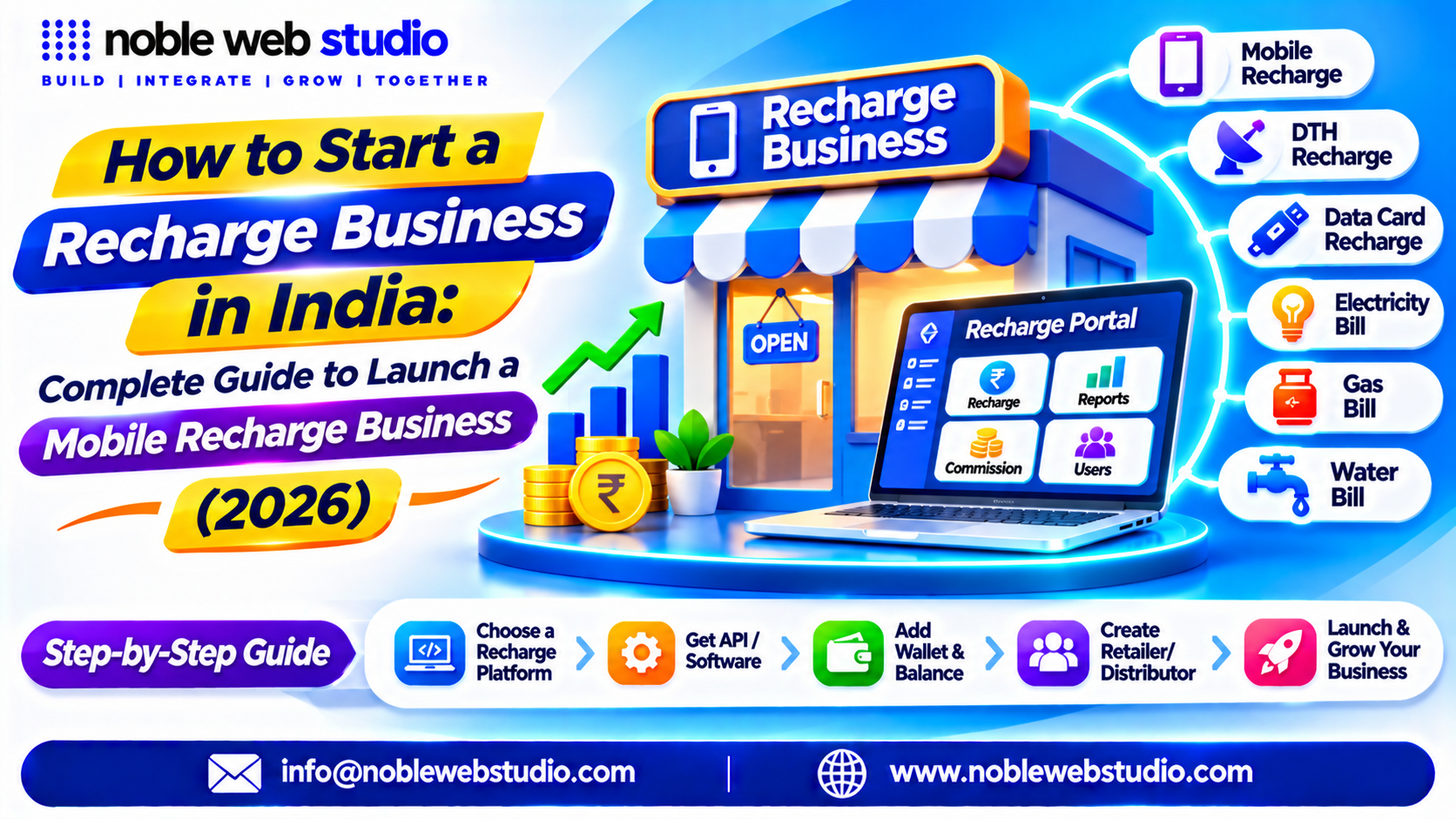
Starting a Recharge Business in India can be an interesting opportunity for entrepreneurs who want to enter the digital payment and fintech industry. With the growing demand for mobile recharges, DTH services, and online bill payments, individuals and business owners can build a revenue-generating mobile recharge business by offering convenient recharge services to customers, retailers, and distributors. However, before you start a recharge business, it is important to understand how the business works, what investment is required, and which technology you need to manage daily transactions.
A mobile recharge business lets you earn commissions by processing prepaid/postpaid mobile top-ups, DTH recharges, and utility bill payments for customers. You can start a mobile recharge business with low capital as a local retailer, distributor, or platform owner.
A Recharge Business is not limited to operating a small mobile recharge shop. You can start a recharge business as an individual retailer, become a distributor by building a network of retailers, or launch a recharge business under your own brand as a B2B recharge platform with an recharge admin panel, recharge distributor panel, recharge retailer panel, and integrated recharge API. Each business model has different investment requirements, earning opportunities, operational responsibilities, and growth potential.
One of the most important decisions when starting a Recharge Business is choosing the right recharge software and mobile recharge API integration partner. A reliable recharge platform allows you to manage mobile prepaid and postpaid recharges, DTH recharges, retailer wallets, commission structures, transaction records, and payment operations from a centralized system. You can also explore additional services such as utility bill payments and other supported digital financial services to expand your business offerings.
But how much investment do you actually need to start a Recharge Business? How do you earn recharge commissions on every successful transaction? Which recharge software features should you look for, and how can you build a profitable retailer and distributor network?
In this complete guide by Noble Web Studio, we will explain how to start a Recharge Business in India, explore different business models, understand investment and profit factors, choose the right recharge software, integrate recharge API, and launch a mobile recharge business that can scale. Whether you are a beginner, an existing retailer, or an entrepreneur planning to launch your own recharge company, this guide will help you understand the process and make informed business decisions.
Quick Answer: How to Start a Mobile Recharge Business in India (6 Steps)
- Choose your model: Retailer, distributor, master distributor, white-label B2B portal owner, or B2C app.
- Arrange KYC documents: PAN, Aadhaar, photograph, address proof, and a bank account.
- Pick recharge software or a recharge API provider: Check operator coverage, success rate, commission slabs, and support.
- Fund your wallet: Load working capital through UPI, net banking, or bank transfer.
- Start recharging: Process Jio, Airtel, Vi, BSNL, and DTH recharges and earn commission on every successful transaction.
- Expand and scale: Add BBPS bill payments, FASTag, AePS, and DMT, then onboard retailers to grow your recharge business.
What is a Mobile Recharge Business?
mobile recharge business is a service where you add talktime, data, or calling plans to a customer’s prepaid phone and earn a small commission on each transaction. Many sellers also offer DTH recharges and electricity or water bill payments from a shop or mobile app.
How Does Mobile Recharge Business Work?
A mobile recharge business works by letting you load wallet balance to process recharges and earn a commission on each successful transaction. In India, you can offer prepaid mobile recharges, DTH top-ups, and BBPS utility bills (like electricity, water, or FASTag) from a shop or mobile app.
How It Works
- Wallet-Based Transactions: You add funds to a retailer or distributor wallet using UPI, net banking, or a bank transfer.
- API & Operator Routing: Your app or portal connects through best recharge API or operator apps to telecom operators, DTH providers, and billers.
- Commission Earnings: You earn a percentage margin or flat fee on completed recharges and bill payments; failed transactions typically refund automatically to your wallet. For example, recharge commission app base margin of 2% (with an introductory offer bringing total margin to 4% at balance purchase).
- Expanded Services: Many agents boost income by adding electricity, water, insurance, FASTag, or travel bookings alongside mobile top-ups.
Recharge Business Models
Recharge business models in India generally fall into B2B agent/distributor networks, white label recharge software/recharge admin platform, and B2C consumer apps, earning per-transaction commissions across mobile, DTH, FASTag, and BBPS utility bill payments.
Here is a breakdown of common mobile and utility recharge business models in India you can choose from when you start a recharge business:
| Model | What You Do | Investment Level | Best For |
|---|---|---|---|
| Retailer | Process recharges and bill payments for walk-in customers using an app or portal. | Very low | Shop owners and local merchants wanting extra footfall income. |
| Distributor | Onboard and support retailers under you, earning a margin on their transaction volume. | Low | People with strong local networks looking to scale commissions. |
| Master Distributor | Manage multiple distributors across a larger territory or region. | Medium | Experienced operators managing multi-tier networks. |
| B2B Portal / White-Label Owner | Run your own branded platform or white-label software with full hierarchy and API controls. | Higher | Entrepreneurs building a standalone recharge or fintech network. |
| B2C App / Website | Offer self-service recharges and bill payments directly to end consumers. | Higher | Brands or startups with an existing user base or marketing reach. |
Is a Mobile Recharge Business Profitable in India?
Yes, a mobile recharge business in India can be profitable with steady daily volume and bundled services. Individual recharge commissions are modest, so earnings depend on transaction volume, lower competition in semi-urban or rural areas (including towns and neighborhoods around Jaipur and across Rajasthan), and adding higher-margin services.
Ways to Boost Recharge Business Profitability
- Bundle extra services: Pairing mobile recharges with DTH top-ups, utility bill payments (BBPS), money transfers, AePS cash withdrawals, or travel bookings brings more footfall and extra commission streams.
- Target assisted customers: Even with widespread UPI apps, customers in smaller towns, semi-urban areas, and rural belts as well as people who prefer cash or assisted payments still use local counters.
- Choose the right role: Retailers earn on direct customer recharges, distributors earn overrides across a retailer network, and recharge platform or recharge API owners earn across their broader network (though higher tiers require more capital and tech/network setup).
Different Types of Mobile Recharge Business Models
Mobile recharge businesses in India generally operate across five primary models Retailer, Distributor, Master Distributor, B2B recharge Portal/White Label Owner, and B2C recharge App structured around wallet balances, multi-level commission sharing, and recharge API integrate.
1. Retailer Model
- What you do: Process prepaid/postpaid mobile recharges, DTH renewals, and utility bill payments (such as BBPS electricity, water, and gas bills) for walk-in customers using a distributor’s app or web portal.
- Investment: Very low; typically requires only a small initial wallet balance and a smartphone or computer.
- Best for: Local shop owners, kiosks, and individuals seeking side income from existing foot traffic without managing software or GST invoicing under an upstream distributor.
2. Distributor Model
- What you do: Recharge API Onboard retailers into your network, transfer wallet funds to them, provide local support, and earn a commission margin on every transaction they process.
- Investment: Low to moderate, often involving a white label recharge portal or distributor panel and higher wallet float.
- Best for: Entrepreneurs with strong local merchant networks who want to scale earnings through retailer volume.
3. Master Distributor Model
- What you do: Manage multiple distributors across a broader territory or region and earn a tier margin on transactions flowing through your distributor-retailer hierarchy.
- Investment: Medium.
- Best for: Experienced operators capable of recruiting and overseeing regional sub-distributors.
4. B2B Portal / White-Label Owner (Admin)
- What you do: Run your own branded recharge platform using a mobile recharge API and multi-level software, managing Master Distributors, Distributors, and Retailers while setting commission slabs and adding services like AEPS, FASTag, or bill payments.
- Investment: Higher upfront cost recharge software/white label recharge licensing, recharge API setup, business compliance (such as KYC/KYB and GST where applicable), and working wallet float.
- Best for: Entrepreneurs who want to launch a recharge business as a standalone multi-tier fintech or recharge brand with full hierarchy control.
5. B2C App Model
- What you do: Noble web studio offer a consumer-facing best recharge commission app or website where end users recharge their own numbers and pay bills directly.
- Investment: Higher due to app/recharge platform development, mobile recharge API integrated, payment gateways, and customer acquisition costs.
- Best for: Businesses or mobile recharge platform with an existing consumer user base or strong digital marketing reach.
How Much Investment Is Required to Start a Mobile Recharge Business?
In India, to start a mobile recharge business you may need as little as a few thousand rupees for a basic retail wallet to tens of thousands or lakhs of rupees if you build a distributor network or launch your own recharge software/app.
Your exact investment depends on the business model you choose:
1. Basic Retailer (Lowest Investment)
- Cost: Often just a few thousand rupees for your initial wallet balance (plus minimal/no software cost when using an existing provider or operator app).
- Setup: Use a smartphone, internet connection, and an existing shop or home setup. Best Mobile recharge commission App let you register and load wallet balance to start earning commissions.
- Best for: Individuals, grocery/medical stores, or mobile shops adding extra walk-in income.
2. Local Shop / Working Capital Setup
- Example budget: Around ₹5,000 in initial fixed setup (registration, signage/accessories) plus daily rotating wallet capital (for instance, ₹10,000 rotated across transactions).
- Best for: Steady daily foot traffic handling mobile recharges, DTH, and utility bill payments.
3. Distributor / White-Label / Own Platform (Higher Investment)
- Cost: Higher upfront costs than retail. B2B recharge software subscriptions can start around ₹1,499/month, with one-time recharge API integration charge often around ₹1,000–₹5,000 per fast recharge API, plus wallet liquidity. Building custom recharge commission app, b2b recharge API, marketing, and support teams scales much higher.
- Compliance: Operating as a Noble web studio team issuing invoices or crossing GST thresholds typically requires GST registration.
Mobile Recharge Business Investment at a Glance
| Business Model | Starting Investment | Main Cost Items |
| Retailer | A few thousand rupees | Wallet balance, smartphone, internet |
| Local Shop | ~₹5,000 setup + ~₹10,000 rotating wallet | Registration, signage, daily wallet float |
| Distributor / Master Distributor | Tens of thousands of rupees | Distributor panel, higher wallet float for retailers, local support |
| White-Label B2B Portal | Software from ~₹1,499/month + API integration (~₹1,000–₹5,000 per API) + wallet float | Recharge software, recharge API, domain, KYC/GST, support |
| Custom B2C App | Lakhs of rupees | App development, payment gateway, marketing, support team |
Key Cost Factors to Plan For
- Wallet balance (working capital): You fund a digital wallet and earn a commission percentage per transaction.
- Device & connectivity: A reliable smartphone or computer and stable internet.
- Service mix: Adding DTH, BBPS utility bill payments, or AEPS/DMR services can increase repeat visits and earnings.
Step-by-Step Guide to Start a Mobile Recharge Business in India
To start a recharge business, you need to choose a model, complete KYC, and fund a wallet. Margins on recharge alone are thin, so adding bill payments and banking services helps boost income.
Mobile recharge business guide helps you outline business models, recharge software setup, and commission structures for launching in India.
1. Choose Your Business Model
- Retailer: Serve walk-in customers directly from a shop or high commission mobile recharge app using a single balance for operators like Jio, Airtel, Vi, and BSNL.
- Distributor: Onboard and manage multiple retailers and earn a commission spread on their transactions.
- Portal / White-Label Owner: Launch your own branded recharge commission app or website using top recharge API and manage your own distributor and retailer network.
2. Gather Basic Requirements & Register
- Device & Internet: A smartphone or computer with a reliable internet connection.
- KYC Documents: PAN card, Aadhaar card, photograph, and address proof.
- Business Setup & Bank Account: Register your business entity if scaling up, and set up a dedicated bank account for settlements and wallet funding.
3. Pick a Platform or API Provider
- Retailer Apps: Join an established multi-recharge or utility platform and check operator coverage, commission charts, and support responsiveness before signing up.
- API / White-Label Software: If building your own standard recharge platform, choose a Noble web studio.
4. Complete KYC & Fund Your Wallet
- Submit your KYC details through the high commission recharge app or onboarding team to activate your ID.
- Add working capital to your digital wallet via UPI, net banking, or bank transfer each recharge or bill payment deducts from this balance.
5. Start Recharging & Expand Services
- Begin processing prepaid mobile recharges for customers and collecting commissions per transaction.
- Add higher-retention services such as DTH, electricity and gas bill payments (BBPS), FASTag, AePS (Aadhaar-enabled banking), and domestic money transfer (DMT).
6. Promote Your Recharge Business and Build a Network
- Once you launch your mobile recharge business, put up shop signage, share your services on WhatsApp groups, and list your outlet on Google Business Profile so nearby customers can find you.
- Distributors and portal owners can onboard local kirana, mobile and photocopy shops as retailers, train them on the app, and offer quick wallet top-ups and support to keep them active.
What Is Mobile Recharge Software and How Does It Work?
Mobile recharge software is a digital tool that lets people and businesses add talk time, data, or plans to mobile phones. It connects to telecom networks and payment tools so payments happen fast.
How It Works
- Fund the Wallet: Users or retailers add balance to their digital wallet via UPI, cards, net banking, or direct fund transfers.
- Enter Details & Validate: The user selects the mobile number, operator (such as Airtel, Jio, Vodafone Idea, or BSNL), or biller and enters the recharge or bill amount.
- API Routing: The software sends the request through a recharge or utility API (such as BBPS) to the service provider.
- Settlement & Status: The Noble web studio processes the top-up in real time. If successful, the wallet balance is deducted and commissions are credited; if it fails, the amount is automatically refunded to the wallet.
Must-Have Features in Recharge Business Software
Before you launch a recharge business on your own brand, make sure your recharge software covers these essential features. The right feature set decides how smoothly you can run daily transactions and how fast you can scale your retailer and distributor network.
Services
- Prepaid and postpaid mobile recharge for Jio, Airtel, Vi, and BSNL, plus DTH and data card recharge.
- BBPS bill payments (electricity, water, gas, broadband, FASTag) with an upgrade path to AePS, DMT, and Micro ATM.
Wallet and Hierarchy [NEW]
- Separate wallets for admin, master distributor, distributor, and retailer with fund transfer down the hierarchy.
- UPI / payment gateway wallet top-up, fund request approval, and a complete wallet ledger.
Commission and Operations [NEW]
- Operator-wise and user-wise commission slabs, multi-level commission distribution, and surcharge settings.
- Automatic refund on failed transactions, pending status check, and multi recharge API switching.
Reports, Apps and Support [NEW]
- Day book, transaction, commission, and GST reports, with complaint and dispute management.
- White-label web portal and Android app for retailers and distributors, with live plan and operator detection.
Security
- Two-factor login, IP whitelisting for API users, encrypted connections (HTTPS/TLS), and role-based access control.
What Is a Mobile Recharge API and Why Do You Need It?
A mobile recharge API is a software tool that lets an highest recharge commission app or website add mobile top-ups automatically. It sends a user’s phone number, plan or amount, and network choice to a Noble web studio, completes the top-up, and sends back the result in real time.
Why a Recharge Business Needs It
- One connection for many networks: In India, a business can connect to Jio, Airtel, and Vodafone Idea through one reliable recharge API instead of making separate deals with each telecom company.
- Instant, automated top-ups: Recharges run 24/7 without manual work, reducing errors and delays.
- More services in one place: Reputed recharge API also support DTH recharges, postpaid bills, and utility payments.
- Extra revenue and retention: Local shops, fintech apps, or businesses in places like Jaipur can earn recharge commission on recharges and keep customers coming back to their branded recharge platform.
What Is Recharge API Switching?
Recharge API switching means connecting more than one recharge API to your platform and routing each transaction to the best available API by operator, success rate, or commission. If one API is slow or down, the software automatically sends the recharge through a backup API. This keeps your success rate high and protects your mobile recharge business from downtime.
Which Services Can You Offer Through a Recharge Business?
A recharge business in India typically offers mobile and DTH recharges, BBPS utility bill payments, banking/best AEPS services, and travel or insurance bookings.
Core Recharge Services
- Prepaid & Postpaid Mobile Recharges: Top-ups, data packs, and validity plans for operators like Jio, Airtel, Vi, and BSNL.
- DTH & Cable TV Recharges: Connections and plans for providers such as Tata Play (Tata Sky), Dish TV, Airtel Digital TV, Sun Direct, and Videocon D2H.
- Data Card & Broadband Recharges: Dongle and internet plan renewals.
- OTT Subscriptions: Digital streaming bundles and passes depending on the recharge service platform.
Bill Payments (BBPS & Utilities)
- Electricity, Water, and Gas: Monthly utility bill payments processed through the Bharat Bill Payment System (BBPS).
- FASTag & Credit Card Bills: Highway toll tag recharges and credit card repayments.
- Landline & Postpaid Bills: Fixed-line telephone and postpaid mobile billing.
Banking & Financial Services
- AEPS (Aadhaar Enabled Payment System): Cash withdrawals, balance inquiries, and mini statements using Aadhaar authentication.
- Domestic Money Transfer (DMT) & Micro-ATM: IMPS/NEFT fund transfers and debit card cash withdrawals.
- Insurance & Loan Assistance: Motor, health, life, and LIC policy issuances or premium payments, plus loan leads or account openings on supported mobile recharge portal.
Travel & Citizen Services
- Ticket Bookings: Bus, train (IRCTC), and flight bookings on multi-service platforms.
- PAN & Government/Subsidy Services: PAN card applications or direct benefit/subsidy assistance where supported by the Noble web studio.
How Recharge Business Earnings Work
In India, recharge business earnings come from percentage commissions or flat transaction fees on prepaid mobile recharges, DTH top-ups, utility bill payments (BBPS), and allied services like AePS or money transfers. Instead of buying physical vouchers, you keep a prepaid balance in a digital wallet and earn a margin on every successful transaction.
How the Money Flows
- Prepaid Wallet (Float): You load money into your b2b recharge app or mobile recharge portal wallet. When a customer pays you ₹299 for a plan, the recharge admin platform deducts the net amount (after your commission) from your wallet.
- Instant or Daily Settlement: Highest recharge commission are typically credited per successful transaction or built into your wallet balance discount. Failed recharges are refunded to your wallet.
- Basic Profit Formula:
Monthly Profit = (Daily Transaction Value × Average Commission %) × Working Days − Operating Costs.
Retailer vs. Distributor Earnings
- Retailer: Earns direct commission on walk-in customer transactions. Best if you already have a shop or steady foot traffic in a neighborhood or market area (like around Jaipur).
- Distributor / Master Distributor: Earns a smaller override margin (often ~0.25% to 1.5%) on the volume generated by the retailers onboarded under them. Earnings scale with how many active retailers you support rather than just your own counter.
Recharge Business Earnings Example (Illustrative)
Here is a simple example using the profit formula above, assuming 26 working days in a month. Actual earnings depend on your platform’s commission slabs and daily volume.
| Retailer (Single Outlet) | Daily Volume | Commission | Monthly Earning |
| Mobile recharge | ₹5,000 | 2.5% | ₹3,250 |
| DTH recharge | ₹1,500 | 3% | ₹1,170 |
| BBPS bill payments | ₹10,000 | 0.75% | ₹1,950 |
| Total (before operating costs) | ₹16,500 | — | ₹6,370 |
Distributor example: 50 active retailers × ₹6,000 average daily volume = ₹3,00,000 per day. At a 0.5% override margin, that is ₹1,500 per day, or about ₹39,000 per month (26 days), before operating costs. This is why distributors focus on keeping retailers active.
How Much Commission Can You Earn from a Mobile Recharge Business?
Commissions on mobile recharges in India typically range from 1% to 5% per transaction, depending on the operator, plan, and brand recharge platform. Most standalone recharge retailers earn around ₹3,000 to ₹8,000 per month from mobile recharges alone.
Typical Commission Rates
- General mobile recharge: Usually 1% to 5% of the recharge value.
- Operator differences: Rates vary by Noble web studio team and recharge b2b API/reputed recharge platform slab (for example, one recharge API rate card lists roughly 0.80% for Jio, 1.30% for Airtel, and 3.00% for Vi and BSNL on starter slabs, while other platforms or promotional offers cite up to 2%–4% on Jio or up to 5% on Airtel).
- Related services: Adding DTH recharges (2%–4.5%) or utility bill payments (0.5%–1%) helps bring in repeat footfall.
Monthly Earnings Potential
- Mobile recharge only: Roughly ₹3,000–₹8,000/month (for instance, ₹1–₹2 lakh in monthly recharge volume at 2%–3% commission).
- Full service stack (recharge, DTH, BBPS bills, AePS, DMT): Can reach ₹15,000–₹40,000/month for an active outlet.
- Distributors & admins: Earn smaller per-transaction spreads across a network of retailers, making total income dependent on active retailer volume and multi-service usage.
Legal Requirements and Documents for Starting a Recharge Business in India
To start a mobile recharge and bill payment business in India, you do not need a telecom operator license; instead, you operate through authorized all in one recharge API or trusted recharge platform and complete Know Your Customer (KYC) and business registration requirements.
Legal & Regulatory Requirements
- Business Structure: Choose a Noble web studio company such as a Sole Proprietorship, Partnership, Limited Liability Partnership (LLP), or Private Limited Company.
- Telecom & API Compliance: Individual retailers and portals generally do not need a separate telecom license, as recharge API/aggregator providers handle operator-level integrations. If you expand into regulated financial services (such as AePS, domestic money transfers, or payment aggregation), additional RBI/partner compliance and onboarding checks apply.
- Local & MSME Registrations: Depending on your setup, you may obtain a Shop & Establishment Act license (for a physical storefront) and Udyam (MSME) registration.
- GST Registration: Required once your turnover crosses the applicable statutory threshold or if required for B2B invoicing and specific platform onboarding. Confirm your exact threshold and tax obligations with a Chartered Accountant (CA).
- Platform Agreement & KYC: Complete KYC/KYB verification and sign the service agreement with your chosen recharge or fintech provider before activating your retailer/distributor ID or b2b mobile recharge API.
Required Documents to Start a Recharge Business
Identity & Address Proof (Proprietor / Partners / Directors):
- PAN Card (mandatory for tax and identity verification)
- Aadhaar Card, Voter ID, Passport, or Driving License
- Passport-size photograph
Business & Premises Proof (as applicable):
- Business registration/license proof (such as Udyam/MSME Certificate, Shop & Establishment Certificate, or GST Certificate)
- Business address proof (utility bill, rent/lease agreement, or property tax receipt, if operating from a dedicated premises)
- For companies/LLPs: Certificate of Incorporation, MoA/AoA, and Board Resolution
Bank Account Details:
- Active bank account details with a cancelled cheque, bank passbook copy, or bank statement matching your name or registered business name for wallet loading and commission settlements.
How to Choose the Best Mobile Recharge Software Provider
Noble web studio is a mobile recharge software provider in India, prioritize transaction reliability, commission structure, supported services, and scalable management tools.
Key Factors to Evaluate
- Transaction Success Rate & Speed: Look for Noble web studio with high success rates (such as 99%+), fast response times, direct operator routing, and automatic fallback switching to prevent failed recharges.
- Commission Margins & Pricing: Compare commission slabs across operators and check for transparent pricing with no hidden setup or per-transaction fees. Full recharge software platform often offer volume-based commissions compared to basic retail apps.
- Service Coverage: Professional Recharge platform supports prepaid, postpaid, and DTH recharges along with add-on services like BBPS utility bill payments, AePS, or money transfer (DMT) as your business expands.
- Admin & Network Management: If you plan to act as a distributor or run a multi-level network, verify support for multi-level commissions, retailer/distributor onboarding, role access, and automated reporting (including GST and ledger tracking).
- API, White-Label & App Support: Check if the Noble web studio offers web portals, Android/iOS recharge apps, white-label branding, dynamic plan checks, and webhook notifications for smooth integration.
- Security & Support: Confirm strong security measures (such as encrypted connections, IP whitelisting, and secure wallet ledgers) and 24/7 technical or complaint-resolution support.
How to Start a Mobile Recharge Business from Home
You can start a mobile recharge business from home in India with a smartphone, an internet connection, basic KYC documents (such as PAN and Aadhaar), and a small starting wallet balance.
1. Choose Your Business Model & Platform
- Operator-specific app: Register on an official Higher recharge commission app using an active number and email to handle recharges for that network.
- Multi-operator & utility app: Join a multi service recharge platform such as Noble web studio to offer recharges across major telecom operators alongside DTH, electricity, gas, or FASTag payments. (Registration terms vary; for example,One-time ₹2,000 retailer registration fee with no monthly charges.)
- Distributor or portal model: If you plan to onboard sub-agents or launch your own branded recharge portal, look into distributor tiers or white label mobile recharge software and strong recharge API.
2. Register and Complete KYC
- Download your chosen best recharge app commission or sign up with the Noble web studio.
- Verify your phone number and submit required KYC documents (typically PAN, Aadhaar, photograph, and address proof).
- Link your bank account so you can fund your wallet and track payouts or commissions.
3. Fund Your Wallet and Track Cash Flow
- Load an initial balance into your digital wallet via UPI, net banking, or debit card.
- Start with a modest wallet balance and scale it up as repeat demand grows.
- Collect payment from customers upfront or via UPI/cash, and reconcile your wallet balance and daily ledger at the end of each day to catch pending or failed transactions early.
4. Grow Your Customer Base from Home
- Begin with family, friends, neighbors, and local contacts who prefer quick assistance or help with bill payments.
- Compare commission charts and test customer support responsiveness before committing larger working capital to any single platform.
How Long Does It Take to Launch a Recharge Business?
The time to launch a mobile recharge business depends on the model you choose and how quickly your KYC and API activation are completed:
- Retailer ID: Usually 1–2 days after KYC approval and first wallet load.
- Distributor ID: Around 2–5 days, including KYC, panel access, and commission setup.
- White-label recharge portal: Typically 7–15 working days for branding, domain, recharge API activation, and testing.
- Custom B2C recharge app: 30–60 days or more, depending on features, app store approval, and payment gateway onboarding.
How to Grow Your Mobile Recharge Business
Because mobile recharge alone has thin margins, growing a mobile recharge business in India relies on expanding into higher-demand services, scaling your network, and keeping wallet liquidity ready.
Add Higher-Frequency & Complementary Services
- Utility & BBPS bills: Offer electricity, water, gas, municipal, and insurance bill payments alongside mobile and DTH recharges.
- FASTag & transit: Add FASTag recharges for regular commuters and highway travelers.
- Assisted banking services: Layer on Aadhaar Enabled Payment System (AePS) and domestic money transfers (DMT) once your basic transaction flow is steady.
Scale Beyond Single-Counter Retail
- Build a distributor network: Onboard local shops and sub-retailers under you to earn margin overrides on their transaction volume.
- Launch a white-label platform: Use white-label recharge software with your own brand, higher commission mobile recharge app, or recharge admin API to control pricing and onboard agents directly. You can explore options from Noble web studio.
Improve Retention & Cash Flow
- Keep wallet balance topped up: Maintain enough balance in your recharge wallet during peak hours and month-end bill cycles so you do not miss transactions.
- Remind repeat customers: Track plan expiry dates for regular walk-in customers and prompt them to renew before their pack runs out.
- Promote visibility: Put clear signage outside your shop advertising recharge and bill payment services, and compare commission rates across platforms to maximize margins.
Common Mistakes to Avoid in a Mobile Recharge Business
In a mobile recharge business in India, the biggest mistakes center on thin margins, cash flow disruptions, unreliable tech, and weak compliance.
Operations & Cash Flow
- Relying only on mobile recharges: Per-transaction margins are thin, so skipping add-ons like DTH, BBPS utility bills, FASTag, AePS, or money transfers limits profit growth.
- Running out of wallet balance: Low wallet float during peak hours forces you to turn away customers and erodes retailer trust.
- Repeating pending transactions: Recharging again before a “pending” status resolves can cause duplicate deductions and financial losses.
- Setting unsustainable commissions: Noble web studio offering overly high commission rates to retailers or distributors without sufficient margin cushion hurts long-term viability.
Technology & Vendors
- Depending on a single API: Using only one multi recharge API with poor uptime or low success rates causes frequent failures. Multi mobile recharge API switching helps route failed attempts elsewhere.
- Picking providers on commission alone: Chasing slightly higher payouts while ignoring uptime, speed, or settlement reliability leads to costly downtime.
- Ignoring scalability and integration: Choosing rigid top recharge software that cannot handle transaction growth or add new payment and service integrations slows expansion.
Support & Compliance
- Slow refunds and poor retailer support: Delayed refunds on failed recharges and lack of real-time support drive retailers away.
- Ignoring customer complaints: Unresolved issues quickly hurt local word-of-mouth and repeat footfall.
- Skipping KYC and tax compliance: Onboarding retailers without KYC or overlooking licensing, data protection, and GST/tax rules creates legal and fraud risks.
Recharge Business Risks and How to Reduce Them
| Risk | How to Reduce It |
| Fraud or fake retailer accounts | Complete KYC before activating any ID, use two-factor login, and set daily transaction limits. |
| Pending and failed recharges | Use software with auto status check and auto refund; never repeat a pending recharge. |
| API downtime | Connect a backup recharge API and enable API switching. |
| Wallet and commission disputes | Keep a clear wallet ledger, daily reports, and a ticket-based complaint system. |
| Compliance gaps | Maintain KYC records, GST invoices, and partner agreements, and review them with your CA. |
Why Choose Noble Web Studio for Recharge Business Solution
Noble web studio only one of the recharge business solution in India, prioritize reliability, transparent commissions, scalability, and regulatory compliance over the lowest headline price.
Key Factors to Evaluate
- API Reliability & Speed: Look for high transaction success rates (around 99.9% is a common benchmark), fast response times (sub-200ms latency), direct operator connections with automatic fallback switching, and real-time webhook callbacks.
- Commissions & Settlement Clarity: Compare commission slabs across operators and services, check how commissions are settled, and watch for hidden fees or frequent downtime that erodes margins.
- Service Expansion (Multi-Service Suite): Many businesses expand beyond mobile recharge into DTH, FASTag, BBPS utility bill payments, AePS, and money transfer (DMT). Choosing a single-dashboard multi service recharge platform avoids migrating later.
- White-Label & Network Scalability: If you plan to onboard distributors and retailers or build a branded recharge app/mobile recharge admin portal, check for white label recharge admin panel, custom domains, slab management, and upgrade paths.
- Security & Regulatory Compliance: Verify company registration and GST details alongside security controls like TLS/HTTPS encryption, IP whitelisting, two-factor authentication, auto-reversals, and adherence to RBI, NPCI, and TRAI norms.
- Developer Docs & Support: Check for clear recharge API documentation, live plan/operator detection APIs, and responsive phone, WhatsApp, or technical support for dispute resolution.
Conclusion: Start and Launch Your Recharge Business the Right Way
Starting a Recharge Business in India can be a practical opportunity for entrepreneurs who want to enter the digital services and fintech industry. Whether you want to become a mobile recharge retailer, build a distributor network, or launch branded recharge platform, the key to long-term success is choosing the right business model, reliable technology, and a sustainable earning strategy.
A mobile recharge business earns commission by processing prepaid mobile recharges, DTH top-ups, FASTag, and utility bill payments for customers. It requires low upfront capital and relies on high transaction volume.
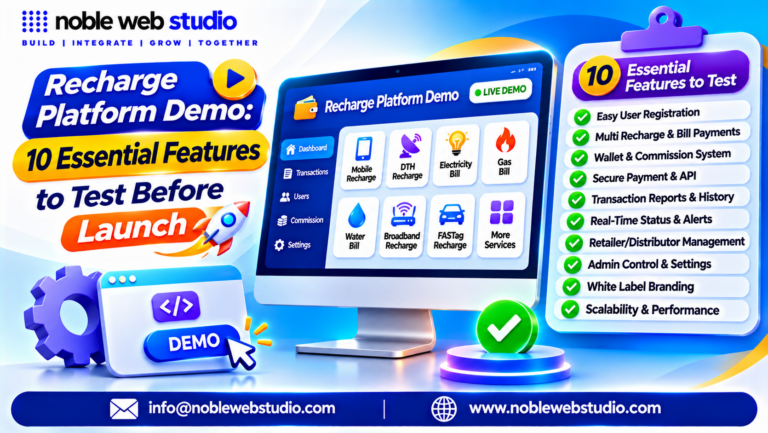
Before you start a mobile recharge business, understand your target customers, estimate your initial investment, compare available Noble web studio, and select right mobile recharge software that supports smooth transactions and transparent commission management. A reliable mobile recharge platform should offer essential features such as multi-operator mobile recharge, DTH recharge, utility bill payments, retailer and distributor management, secure wallet operations, real-time transaction tracking, and automated refund handling.
Remember, earning from a recharge business is not determined by transaction volume alone. Your actual profitability depends on the commission you receive, operating expenses, recharge API charges, payment costs, customer retention, and the number of active retailers. Instead of depending only on mobile recharges, you can gradually expand your services by adding eligible bill payment and other digital services to create additional revenue opportunities.
This is where choosing the right technology partner becomes important. Noble Web Studio helps entrepreneurs and fintech businesses build recharge platform with solutions such as B2B mobile recharge software, white label recharge software, mobile recharge API integrating, and customised web and mobile applications.
Whether you are starting a small recharge business or planning to establish a complete B2B recharge network, having the developed recharge software infrastructure can make business management easier and support future expansion.
Ready to launch your own recharge business? Connect with Noble Web Studio to discuss your business requirements, explore suitable recharge software solutions, and find the right mobile recharge platform for your business goals. Build your brand, develop your retailer network, and take the next step towards establishing your own digital recharge business in India.
Recharge Business with Noble Web Studio
Planning to start or expand your recharge business? Noble Web Studio offers recharge software solutions for retailers, distributors and business owners. Manage mobile recharge, DTH, BBPS and other digital services through a centralized platform. Contact our team to discuss software features, B2B business options, white-label solutions, pricing and setup requirements.
Frequently Asked Questions About Recharge Business
A Recharge Business is a digital service business that allows entrepreneurs to provide mobile recharge, DTH recharge and bill payment services through an high volume recharge app or online recharge portal. Business owners can earn commissions on successful transactions.
To start a recharge business in India, choose your business model, arrange a reliable recharge software platform, integrated mobile recharge API, set up payment facilities and onboard retailers or customers. You can also launch your own branded mobile recharge portal.
The investment depends on your business model, recharge software features, API integration, mobile application and operational requirements. A retailer setup generally requires less investment than launching your own recharge business platform.
Yes, a recharge business can generate income through transaction commissions. However, profitability depends on daily transaction volume, commission rates, operating expenses and customer retention.
A mobile recharge business earns through commissions on successful prepaid, postpaid, DTH and other supported bill payment transactions. Distributors and retailers can also earn according to their commission structure.
You need mobile recharge software with an mobile recharge admin panel, retailer and distributor panels, wallet management, commission management, recharge API integrated, transaction reports and failed recharge tracking.
A Recharge API connects your recharge commission software with recharge service providers. It helps process mobile and DTH recharge requests, receive transaction responses and manage recharge status automatically.
Yes. You can operate an online recharge business through a website or mobile application. You need a suitable business setup, reliable mobile recharge software connections and customer support.
You can become a mobile recharge distributor by partnering with a suitable recharge b2b platform, creating a retailer network, managing retailer wallets and providing transaction support.
Check recharge API reliability, multiple operator support, secure wallet management, automatic commission calculation, refund handling, transaction reports, retailer management and technical support.
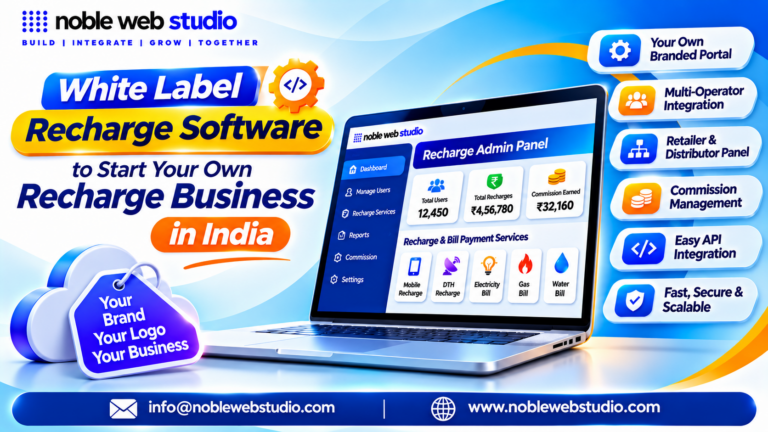
Yes. With white label mobile recharge software, you can launch recharge platform using your own company name, logo, branding and customized business requirements.
Noble Web Studio can help entrepreneurs build their recharge business with top mobile recharge software, API integration, recharge admin dashboards, retailer and distributor panels, wallet management and customized platform solutions.
No separate telecom licence is needed to start a mobile recharge business, because you work through an authorised recharge API or platform. You need KYC, a bank account, and GST registration where applicable. Services like AePS and DMT need additional partner and RBI-related compliance.
A retailer ID can be active in 1–2 days after KYC. A white-label recharge portal typically takes 7–15 working days, while a custom B2C recharge app can take 30–60 days or more.
Recharge API switching routes each recharge through the best available API based on operator, success rate, or commission. If one API fails or is slow, the transaction automatically moves to a backup API.
A retailer doing only mobile recharges typically earns around ₹3,000–₹8,000 per month. An active outlet offering recharge, DTH, BBPS, AePS, and DMT can earn ₹15,000–₹40,000 per month. Distributor income depends on the number of active retailers.
Yes. You only need a smartphone, internet connection, PAN, Aadhaar, a bank account, and a small wallet balance to start a mobile recharge business from home.
Yes. Most recharge software includes an Android app for retailers and distributors to do recharges, load wallets, check reports, and raise complaints from their phone.
Yes. A multi-service recharge platform lets you start with mobile and DTH recharge and later add BBPS, AePS, DMT, and Micro ATM, subject to KYC and partner onboarding.