Ankit
Ankit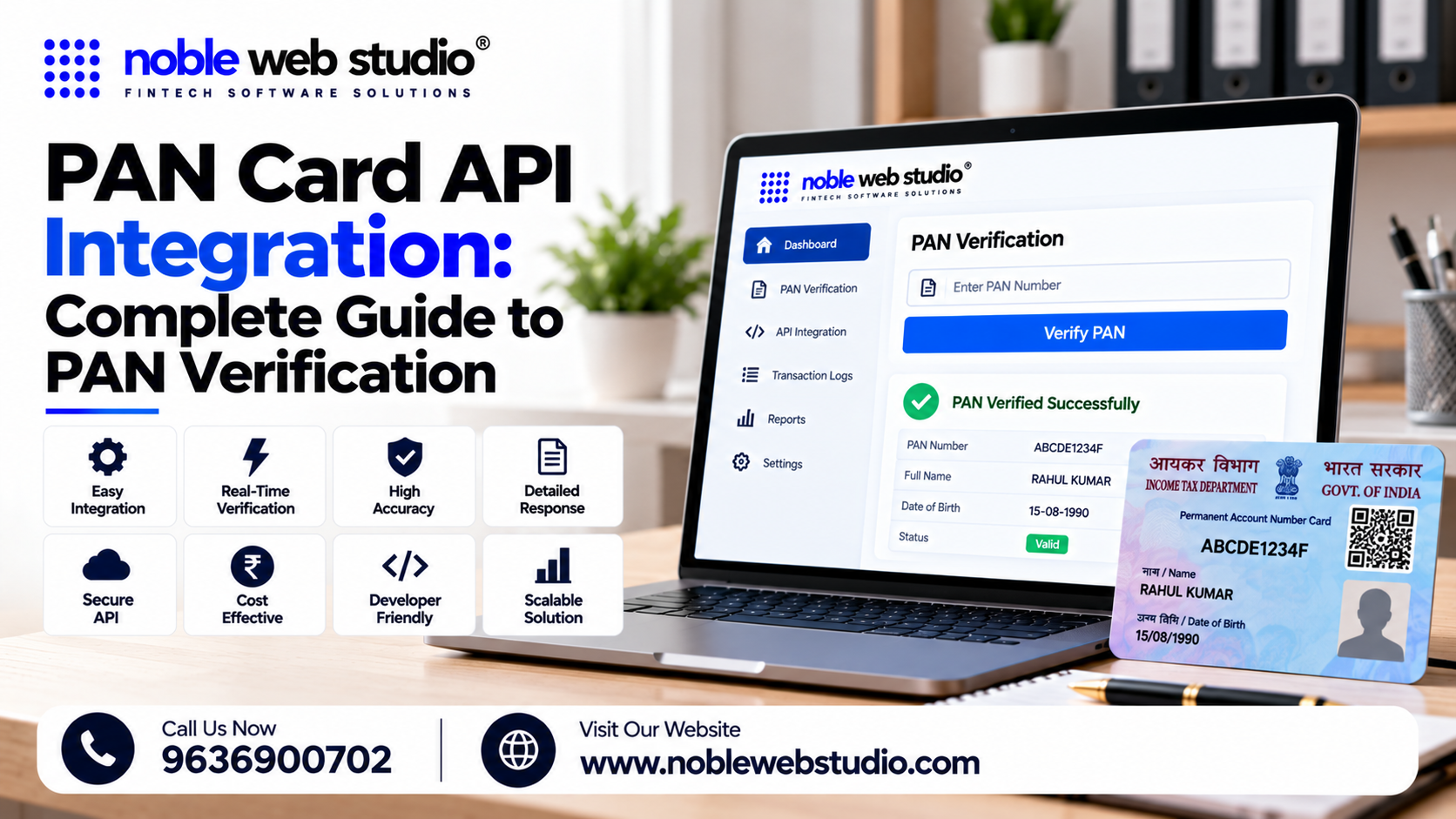
Businesses today need fast and reliable ways to verify customer identities during onboarding, KYC, financial transactions, and digital service registration. PAN Card API Integration allows businesses to connect PAN verification capabilities directly with their website, mobile application, fintech platform, or existing business software, helping automate PAN verification instead of depending on manual checking.
A PAN Card API Integration can be used to verify PAN details, check the validity of a PAN number, match customer information, and receive verification responses through an PAN Verification API based workflow. This makes PAN verification useful for fintech companies, banks, NBFCs, insurance businesses, lending platforms, payment companies, marketplaces, HR platforms, and other businesses that need reliable customer or partner verification.
A PAN Card Verification API is a digital service that connects your application directly to official government databases (such as Protean/NSDL and the Income Tax Department) to validate a Permanent Account Number in 2 to 3 seconds.
A well-designed PAN Verification API can simplify the verification process by allowing a business application to send the required PAN information to the verification service and receive a structured response. Depending on the Noble web studio and service configuration, verification may include PAN validity, associated name matching, status information, and other permitted verification data. Noble web studio for example, documents real-time PAN verification and name association through its PAN API.
Modern PAN verification solutions can also support broader automation requirements. AuthBridge highlights capabilities such as real-time verification, AI-based OCR, GST validation, bulk PAN verification, fraud detection, webhooks, and integration with existing workflows. This makes PAN Validation API based PAN verification particularly useful for businesses handling large numbers of customer, merchant, employee, vendor, or partner onboarding requests.
The PAN Card API Integration Process generally involves obtaining PAN Number Verification API access, configuring authentication, sending PAN verification requests from the business application, processing the online PAN verification API response, and displaying or storing the permitted verification result according to the application’s requirements. A secure integration should also protect pan number verification api credentials and sensitive customer information throughout the verification workflow. Noble web studio developer documentation, for example, describes authenticated PAN number verification API requests and security mechanisms for its PAN KYC verification API services.
For businesses, Noble web studio is the right PAN Card API Provider is therefore important. Factors such as API documentation, response format, integration method, authentication, verification coverage, scalability, security, technical support, pricing, and compatibility with the existing technology stack should be evaluated before implementation.
Aeps India provides PAN Card API Integration solutions for businesses that want to add PAN verification to their digital platforms. The integration can be designed around business requirements such as customer onboarding, KYC workflows, retailer or merchant verification, fintech applications, and other identity-verification processes.
In this complete guide, you will learn what PAN Card API Integration is, how PAN Verification API works, how to integrate PAN verification into an application, key features, benefits, use cases, security considerations, API requirements, development process, and PAN API integration cost. This will help businesses understand how to choose and implement a PAN verification solution that fits their digital onboarding and verification requirements.
What Is PAN Card API Integration?
A PAN Card API integration is a software connection that lets a business check a customer’s Permanent Account Number against official government tax records in real time.
PAN Card API Integration Works
A PAN Card Verification API acts as a real-time digital bridge allowing your software application whether a website, mobile app, or ERP system to communicate directly with government-authorized databases (such as NSDL or the Income Tax Department). Instead of manually checking the Permanent Account Number on a portal, the instant PAN verification API automates identity validation during user onboarding or KYC compliance checks in just 2 to 3 seconds.
How the PAN Card API Integration Works
The entire end-to-end integration workflow follows a streamlined four-step loop built into your platform’s backend architecture:
- Data Input: The customer inputs their 10-digit alphanumeric PAN number, name, and date of birth during registration. Alternatively, an advanced PAN Card OCR API allows users to take a photo of the card, and the system automatically extracts the text fields to eliminate manual typing errors.
- Secure Request Transmission: Your platform’s backend packages the data into a stateless JSON format over a secure HTTPS request. To prevent tampering or man-in-the-middle attacks, official endpoints require the request to be digitally signed using a Class 2 or Class 3 Digital Signature Certificate (DSC).
- Real-Time Database Verification: The Noble web studio routes the secure packet to verify authenticity against live government database records.
- Structured JSON Response: The real time PAN verification API returns an instantaneous payload mapping vital customer parameters back to your system.
PAN Card API Integration Service Offered
A PAN Card API Integration Service allows businesses to connect their internal software, applications, or websites directly with authorized government intermediaries like NSDL or UTIITSL. This integration automates the verification and processing of Permanent Account Numbers (PAN) in real-time, eliminating manual verification errors, mitigating fraud, and streamlining Know Your Customer (KYC) compliance.
Types of PAN APIs Available
- PAN Verification API (PAN Lite/Advanced): Instantly validates if a 10-digit alphanumeric PAN is active, checking it against the official database to confirm the holder’s full name, date of birth, and status.
- Bulk PAN Verification API: Enables financial institutions or platforms to verify thousands of PAN cards concurrently via a single batch request.
- Mobile Number to PAN API: Retrieves or verifies a user’s PAN by utilizing their registered mobile number and full name.
- PAN Card Application & Generation API: Used by authorized agents and digital service portals to let users submit new PAN applications or request corrections directly through their front-end system.
Documents Required for PAN Card API Integration
To integrate the official Online PAN Verification (OPV) API via authorized channels like Noble web studio must submit organizational compliance documents and technical credentials.
Entity Registration Documents
- Signed Noble web studio Terms & Conditions (1 stamped copy)
- Executed Non-Disclosure Agreement (NDA)
- Formal Authorization Letter on company letterhead
- Entity Declaration and Additional Information letter
- Certificate of Incorporation (2 copies)
- Company PAN Card copy (2 copies)
- Latest audited Balance Sheet and P&L statement
- Latest ITR-V acknowledgment of the entity
- Category-specific regulatory license (e.g., RBI, SEBI, IRDAI) if applicable
Technical & Security Prerequisites
- Valid user ID registered through the official portal
- Class 2 or Class 3 Digital Signature Certificate (DSC) in
.pfx/.jksformat - DSC change request-cum-authorization letter (for renewals)
- Server configuration supporting HTTPS/TLS and JSON/XML request signing
Who Can Use PAN Card API Integration
PAN Card API integration can be used by any legally registered business entity in India that has a legitimate need to verify user identities, prevent financial fraud, and maintain regulatory compliance. It is primarily designed for commercial B2B use and is not available for individual or personal use.
The primary sectors and organizations that utilize PAN verification APIs include:
1. Banking and Financial Institutions
- Commercial Banks & NBFCs: To process loan applications, verify credit histories, and open checking or savings accounts instantly.
- Fintech Startups & Lending Platforms: For frictionless digital customer onboarding and immediate risk evaluation during digital lending.
- Wealth Management & Trading Platforms: Stockbrokers and investment applications use it to complete mandatory Central KYC (cKYC) workflows before users can buy stocks or mutual funds.
2. Digital Payments and E-commerce
- Payment Gateways & Digital Wallets: To clear merchant onboarding and set up user profiles under strict regulatory guidelines.
- E-commerce Marketplaces: To authenticate the tax identities of third-party vendors and sellers, ensuring compliance with Tax Deducted at Source (TDS) and Tax Collected at Source (TCS) mandates.
3. Corporate HR and Operations
- Background Screening Agencies: Human Resource departments and verification firms use it during employee onboarding to cross-reference identity documents and confirm background details.
- Vendor Management Systems: Large enterprises use it to quickly validate contractors, corporate clients, and supply chain partners before onboarding them onto their ERP systems.
4. Other Regulated Industries
- Insurance Providers: To verify customer identity during policy issuance and claims processing.
- Telecommunications: Telecom operators require it to clear Know-Your-Customer (KYC) requirements during new SIM card activation or digital service sign-ups.
- Real Estate & Gaming Platforms: Used to run high-value anti-money laundering checks or verify winners for tax reporting purposes.
Why Use PAN Card API Integration
Integrating a PAN Card Verification API allows businesses to instantly validate an individual’s or entity’s Permanent Account Number (PAN) against official government databases like Noble web studio Server. Implementing PAN data verification API into existing systems, websites, or mobile apps removes the friction of manual identity checks, providing critical security and operational advantages.
Businesses use PAN Card API integration primarily for the following reasons:
1. Instant & Automated KYC Compliance
Instead of forcing teams to manually look up card details or collect physical copies, the PAN details verification API automates the Know Your Customer (KYC) flow.
- Real-time processing: Validates information in seconds, accelerating user onboarding.
- Regulatory alignment: Helps financial institutions effortlessly adhere to strict guidelines mandated by governing bodies like the RBI and SEBI.
2. Eliminates Manual Data Entry Errors
Manual data entry frequently introduces typos, leading to failed verifications or mismatched records. Advanced PAN verification API integrations often utilize AI-powered Optical Character Recognition (OCR), which automatically reads and converts text from an uploaded photo of a PAN card into digital text. This drastically improves data accuracy.
3. Comprehensive Fraud Prevention
The instant PAN card verification API acts as a gateway to detect fraud and identity theft before a bad actor can access your services.
- Name & Identity Verification: Cross-checks whether the submitted name exactly matches the registered PAN holder’s information in the database.
- Status Detection: Confirms if the card is currently valid, invalid, or deactivated.
- Tamper Identification: Advanced layers can detect if a physical card image has been digitally altered.
4. Support for Bulk Verification & Diverse Categories
Unlike single-portal manual checks, automated PAN verification API protocols scale alongside a growing enterprise:
- Bulk checks: Allows platforms to verify hundreds or thousands of PAN records in a single programmatic call, which is highly beneficial for vendor registration or massive corporate HR payroll rollouts.
- Diverse entities: Handles individual PAN cards as well as cards belonging to companies, firms, HUFs, and trusts in a unified system.
Who Needs PAN Card API Integration
Businesses and platforms dealing with financial transactions, customer onboarding, and regulatory compliance in India need PAN Card API integration for instant identity verification, fraud prevention, and seamless KYC/AML processes, including banks, e-commerce sites, fintechs, HR departments, telecom companies, and insurance providers.
Key Industries & Use Cases:
- Banking & Financial Services: For opening accounts, processing loans, issuing credit cards, and fulfilling KYC/AML mandates.
- E-commerce & Marketplaces: To verify sellers and high-value buyers for tax compliance and to prevent fraud.
- Human Resources (HR): For verifying new employee details for payroll, tax filings, and background checks.
- Telecom: For verifying customers during SIM activation and new service sign-ups.
- Insurance Providers: During policy issuance and claims processing for policyholder verification.
- Mutual Funds & Capital Markets: To validate investor PANs for SEBI compliance.
- Legal & Financial Service Providers: To confirm client identities and meet regulatory standards.
- Online Gaming & Other Services: For age verification, security, and compliance.
Why It’s Needed:
- Faster Onboarding: Automates identity checks, reducing manual effort and accelerating customer/vendor onboarding.
- Fraud Prevention: Detects fake details and prevents illegal transactions.
- Regulatory Compliance: Helps meet strict KYC (Know Your Customer) and AML (Anti-Money Laundering) norms.
- Data Accuracy: Ensures accurate tax filings and TDS deductions.
- Enhanced Security: Builds trust by verifying identities in digital processes.
What Information Can a PAN Verification API Verify?
A PAN Verification API connects directly to official Income Tax Department databases to validate and retrieve details associated with a Permanent Account Number in real time.
Core Information Verified
- PAN Validity & Status: Confirms whether the 10-digit PAN number is active, valid, or obsolete (deactivated/surrendered).
- Holder’s Name Match: Cross-checks the provided first, middle, and last name with government records, returning a name-match score or confirmation.
- Category / PAN Type: Identifies if the holder is an individual, company, HUF (Hindu Undivided Family), partnership firm, or trust.
Advanced / Extended Details (Depending on API Tier)
- Date of Birth (DOB) / Incorporation: Validates the date of birth for individuals or the date of incorporation for corporate entities.
- Aadhaar Seeding Status: Verifies if the PAN is successfully linked with the user’s Aadhaar card.
- Demographic Information: Advanced endpoints can return masked Aadhaar details, gender, registered address, or contact details (email/phone) when explicit user consent is secured.
- Additional Relatives’ Names: Can include father’s name verification depending on the specific authorized database query parameters.
- ✓PAN Statuspan_status
- ✓Registered Nameregistered_name
- ✓Name Match Scorename_match_score
- ✓Date of Birth Matchdob_match
- ✓PAN Typepan_type
- ✓Aadhaar Seeding Statusaadhaar_seeding_status
PAN Card API Integration With Name and DOB Verification
Integrating a PAN Card Verification API with Name and Date of Birth (DOB) verification allows businesses to execute automated, real-time KYC compliance by cross-referencing input details directly against official Income Tax Department (NSDL/Protean/UTIITSL) databases. In this workflow, a user provides their PAN, Full Name, and DOB. The secure PAN verification API returns a validation status along with a fuzzy match score for the name and a boolean check for the DOB.
Core Workflow Strategy
Most fintechs and enterprises utilize third-party aggregators to bypass the complex, direct NSDL/Income Tax SOAP/XML protocols. A standard production-grade JSON API flow operates under a single HTTP POST request architecture:
[User Interface] ──(PAN, Name, DOB)──> [Your Backend] ──(Auth Token + JSON Payload)──> [Noble web studio Server]
                                                                                                 │
[User Onboarded] <──(Pass/Fail Status)── [Your Backend] <──(JSON Response with Match Scores)─────┘
Technical Specification & Request Structure
Reliable PAN verification API endpoints generally expect a standard JSON request payload. The standard parameters required to perform explicit validation are detailed below:
Request Body Parameters
| Parameters | Data Type | Mandatory/Optional | Description and Example |
|---|---|---|---|
pan | varchar | Mandatory | The 10-digit alphanumeric Permanent Account Number (e.g., ABCDE1234F). |
name | varchar | Mandatory | Full combination of first, middle, and last name (e.g., Rahul Sharma). |
dob | date | Mandatory | Date of Birth. Format varies by Noble web studio (commonly YYYY-MM-DD or DD/MM/YYYY). |
fathername | varchar | Optional | Used for higher-level screening categories if required. |
Implementation Example (Python / cURL)
Below is a typical RESTful implementation utilizing standard bearer token authentication:
curl -X POST "https://noblewebstudio.com" \
  -H "Authorization: Bearer YOUR_API_KEY" \
  -H "Content-Type: application/json" \
  -d '{
    "pan": "ABCDE1234F",
    "name": "Rahul Sharma",
    "dob": "1990-08-15"
  }'
Expected JSON Response Output
A successful call returns explicit verification metrics rather than raw regulatory records to comply with data privacy policies:
{
  "status": "success",
  "data": {
    "pan_status": "ACTIVE",
    "taxpayer_category": "Individual",
    "name_match_score": 98.7,
    "dob_match": "EXACT",
    "aadhaar_linked": true,
    "overall_result": "PASS"
  }
}
How Does PAN Name Matching Work?
PAN name matching works by comparing string fields (first, middle, last name or exact string sequences) against the Income Tax Department (ITD) database using strict or fuzzy algorithms, depending on the portal being used.
How the Matching Algorithm Works
- Exact String Matching: Most portal validations (like initial registration or Aadhaar linking) look for exact character-by-character parity including spaces and punctuation.
- Token-Based Comparison: Splits names into individual components (tokens) to check if first, middle, and last names exist, even if sequence handling varies slightly.
- Initial Expansion Check: Evaluates whether single-letter initials match the expanded first or middle name (though many automated systems flag this as a mismatch).
Common Causes of Failure
- Sequence Reversal: Swapping first name and surname order.
- Initial vs Full Name: Using “R. Kumar” instead of “Ramesh Kumar”
- Spelling Typos: Minor typographical differences in records.
How to Fix a Mismatch
- Check Income Tax Portal: Verify exact details via the Income Tax e-Filing Portal.
- Update PAN Records: File a correction form via the Protean (NSDL) Portal if PAN has the error.
- Update Aadhaar Records: Modify demographics via the UIDAI Portal if Aadhaar is outdated.
| Input Name | PAN Record Name | Score | Result |
|---|---|---|---|
| RAHUL KUMAR | RAHUL KUMAR | 100.00 | EXACT_MATCH |
| RAHUL K | RAHUL KUMAR | Partial | PARTIAL_MATCH |
| AMIT SHARMA | RAHUL KUMAR | Low | NO_MATCH |
How Does PAN Date of Birth Verification Work?
You can instantly verify a date of birth and status using the Income Tax e-Filing Portal by cross-referencing your inputs against government tax records.
How the Verification Process Works
- Data Input: Provide your 10-digit PAN, full name, date of birth, and any valid mobile number.
- OTP Authentication: Enter the one-time password (OTP) sent to the mobile number to authorize the check.
- Database Cross-Check: The system queries the official Income Tax Department database managed via authorized Noble web studio Server.
- Response Generation: The portal compares the submitted date of birth and name against official records.
Possible Verification Outcomes
- Match Confirmed: Displays “PAN is active and details are as per PAN” if everything aligns.
- Mismatch Found: Displays “PAN is active but details are not as per PAN” if the DOB or name differs.
- Invalid/Inoperative: Flags if the PAN is inactive, inoperative (unlinked from Aadhaar), or non-existent.
Y| Input DOB | PAN Record DOB | dob_match |
|---|---|---|
| 15/08/1992 | 15/08/1992 | Y |
| 16/08/1992 | 15/08/1992 | N |
Why Growing PAN Card API Integration
The demand for PAN Card API integration is growing rapidly due to the massive acceleration of India’s digital economy and strict regulatory mandates. Businesses across finance, e-commerce, and HR are moving away from manual verification to secure, automated pipelines to scale their operations securely.
1. The Mandate for Instant Digital KYC
Manual PAN verification is slow, error-prone, and scales poorly. Real-time Pan API integration allows systems to securely connect directly to authorized government databases (like NSDL or the Income Tax Department). This drops customer onboarding times from hours or days down to mere seconds, drastically reducing user drop-off rates during sign-ups.
2. Regulatory Compliance & Inoperative PAN Tracking
With the government enforcing strict Aadhaar-PAN linking mandates, unlinked PAN cards are labeled as inoperative, resulting in heavy processing restrictions on financial transactions. Integrating PAN verification API allows fintech platforms and banks to instantly perform a PAN linkage status check before dispensing credit or opening bank accounts, saving institutions from legal and financial non-compliance.
3. Radical Cost Reductions
Transitioning from manual compliance teams to automated infrastructure provides substantial financial relief. According to industry cost-benefit analyses by identity platforms shifting to online PAN verification API verification reduces processing costs down to just ₹10–15 per check, saving mid-to-large-scale organizations an estimated ₹4–7 lakhs monthly.
4. Advanced Fraud & Identity Theft Prevention
Identity theft and fake documentation present high risks for online platforms. A PAN API mitigates this by providing immediate:
- Name Matching: Validating that the user-submitted name aligns exactly with official government registries.
- Category Verification: Determining if the PAN belongs to an individual, company, firm, or trust.
- Validity Checks: Identifying whether a card is active, invalid, or deactivated before transactions proceed.
5. Multi-Sector Adoption Beyond Fintech
While traditional banking and NBFCs remain dominant users, the integration ecosystem has broadened extensively into diverse markets:
| Industry Sector | Primary Use Case for PAN API Integration |
|---|---|
| Fintech & Lending | Fetching credit history, loan approvals, and opening bank accounts. |
| E-Commerce | Rapid daily onboarding and validation of thousands of third-party marketplace sellers. |
| HR Departments | Instant background checks and identity screening during bulk employee onboarding. |
| Gig Economy & Travel | Verifying Noble web studio, drivers, or high-value booking clients to maintain network safety. |
6. Preparation for the PAN 2.0 System
The ongoing rollout of the PAN 2.0 Project which consolidates disparate portals (e-filing, UTI, Protean) into a unified core registry places APIs at the center of tax and identity infrastructure. Businesses integrating modern RESTful PAN card verification API now ensure they are future-proofed for automated tax compliance ecosystems and advanced QR code processing systems.
Why Do Businesses Need PAN Card API Integration?
Businesses need PAN card API integration to instantly verify customer and vendor identities against official government databases.
Real-Time Verification
- Instant database check: Validates PAN status instantly.
- Eliminates manual delays: Replaces slow manual checks.
- Active status confirmation: Checks if a PAN is active or deactivated.
Fraud Prevention
- Identity matching: Confirms name matches government records.
- Risk reduction: Stops fake accounts and impersonation.
- Secure onboarding: Blocks invalid tax identifiers early.
Regulatory Compliance
- KYC automation: Simplifies Know Your Customer workflows.
- Tax accuracy: Ensures correct vendor and employee tax reporting.
- Audit readiness: Maintains reliable digital verification logs.
Operational Efficiency
- High-speed processing: Returns JSON data within milliseconds.
- Bulk verification: Processes hundreds of records simultaneously.
- Seamless workflows: Embeds directly into apps and CRM systems.
PAN Card API Integration for Automated KYC
PAN Card API integration allows businesses to programmatically validate a customer’s Permanent Account Number (PAN) against the official Income Tax Department database in real-time. By embedding this technology into your onboarding workflows, you can completely automate identity checks (KYC), reducing onboarding time from days to seconds while eliminating manual data-entry errors and identity fraud.
How Automated PAN KYC Works
The typical automated integration utilizes two core capabilities, often combined for a frictionless user experience:
- Optical Character Recognition (OCR) API: The user uploads a photo of their physical PAN card. The OCR API extracts the text (PAN number, Name, Date of Birth) and turns it into structured JSON data.
- PAN Verification API: The system securely routes the extracted 10-digit PAN number directly to authorized Noble web studio Server. The official database validates the status and returns the associated demographic details within 2–3 seconds.
[User Uploads PAN] ➔ [OCR Extraction] ➔ [API Sends Data to Protean/NSDL] ➔ [Real-Time Verification Result]PAN Card API Integration for Fintech, Banking, Lending & Insurance
A PAN Card Verification API is a digital tool that instantly checks a Permanent Account Number against official Indian tax databases to validate user identity in under two seconds.
Industry Use Cases
- Banking: Automates Know Your Customer (KYC) checks during instant digital account creation.
- Lending (NBFCs): Validates borrower identity and links with credit scoring systems.
- Insurance: Confirms policyholder identity to speed up policy issuance and claims.
- Fintech: Prevents duplicate or fake account registrations in wallets and trading apps.
- PAN
- ABCDE1234F
- Name
- RAHUL KUMAR
- Status
- Valid
- PAN-Aadhaar Link
- Linked
POST /api/v1/pan/verify
{
  "pan": "ABCDE1234F"
}
PAN Card API Integration Workflow
PAN Card API Integration Workflow
For Fintech, Banking, Lending & Insurance- 1User Enters PANCustomer submits PAN number
- 2API RequestYour system sends PAN to the API
- 3Real-Time VerificationPAN checked with NSDL / Income Tax data
- 4API ResponseName, status & PAN-Aadhaar link returned
- 5KYC DecisionApprove, reject or retry
Benefits PAN Card API Integration
Integrating a PAN (Permanent Account Number) Card Verification API allows businesses in India to instantly cross-reference tax identification data directly with authorized government databases like Noble web studio Server. This Noble web studio bridge automates user identity checks, transforming traditional, slow paperwork into a digital-first operational advantage.
The primary business benefits of integrating a PAN Card API include:
1. Instant, Real-Time Verification
Instead of waiting hours or days for manual back-office compliance reviews, the PAN Card API establishes a direct link to the Income Tax Department’s database. It returns the cardholder’s validity status, legal name, and category type within seconds, significantly reducing friction.
2. Accelerated Customer Onboarding & Improved UX
By automating the validation process, digital platforms can drastically shorten their Know Your Customer (KYC) workflows.
- Frictionless Sign-ups: Users input their details and can be instantly approved for financial products.
- OCR Add-ons: Many modern iterations integrate with an Optical Character Recognition (OCR) API that lets users simply take a photo of their card, automatically extracting their name and numbers to populate application fields.
3. Mitigation of Fraud and Identity Theft
The PAN number verification API serves as a vital gatekeeper against financial crime. It cross-checks user inputs against live government records to flag fake, inactive, or duplicate PAN cards. Advanced solutions also compare PAN information against other datasets, helping prevent identity masking or illegal account creation.
4. Elimination of Human Error
Manual data entry is highly susceptible to typos, misread numbers, and mismatched names. An PAN details verification API automate-fetches structured records directly, ensuring near 100% accuracy for internal compliance storage and database maintenance.
5. Regulatory Compliance Assurance
Financial institutions, NBFCs, neo-banks, and fintech apps face rigorous compliance frameworks dictated by regulators like the Reserve Bank of India (RBI) and the Securities and Exchange Board of India (SEBI). Implementing PAN details verification API provides secure, timestamped transaction logs that can serve as formal audit trails.
6. Reduction in Operational Costs
Manual document checks require dedicated staff and overhead resources. Scaling a business without automation means linearly growing compliance costs. The best PAN verification API model transforms this into a highly cost-effective, pay-per-click or tiered subscription utility.
Features PAN Card API Integration
Integrating a PAN (Permanent Account Number) Card Verification API allows businesses to connect their onboarding systems directly to the official Income Tax Department database (via authorized Noble web studio). This automates identity verification, ensures compliance, and mitigates financial risk.
The core features of a modern PAN Card API integration include:
1. Real-Time Validation & Status Checks
- Instant Verification: The top PAN verification API processes data and delivers a response within 2–3 seconds, enabling instantaneous customer onboarding.
- Active Status Confirmation: It checks whether the submitted PAN is currently valid and active, preventing the acceptance of deactivated, fake, or structural anomalies.
2. Comprehensive Data Retrieval
When a 10-digit PAN is queried, the trusted PAN verification API returns official, machine-readable JSON data directly from government records:
- Legal Name & Title: The exact name printed on the physical card, allowing businesses to run name-matching algorithms to prevent identity mismatch.
- PAN Category Type: Identifies whether the holder is an Individual, Company, Firm, Trust, or HUF (Hindu Undivided Family).
- Demographic Details: Returns registered information such as Date of Birth (DOB) and Gender.
3. Regulatory Alignment & Seeding Checks
- Aadhaar Linking Status: Modern PAN number verification API explicitly indicate whether the PAN is seeded/linked with an Aadhaar card.
- Masked Aadhaar Return: Provides the last 4 digits of the linked Aadhaar number (
XXXX XXXX 1234) to respect user privacy while validating identity links. - Tax Compliance Verification: Some advanced layers verify the holder’s tax return filing history to help businesses apply appropriate TDS (Tax Deducted at Source) rates under Section 206AB.
4. High-Volume Processing Capabilities
- Bulk Verification: Operations teams can upload CSV or Excel files containing thousands of PAN records for asynchronous batch processing, avoiding system bottlenecks.
- High Availability Scalability: Top-tier enterprise PAN details verification API systems boast a 99.5% to 99.99% uptime SLA, built to manage traffic scaling from hundreds to hundreds of thousands of requests seamlessly.
5. Enterprise-Grade Security
- Data Encryption & Signing: Data payloads utilize HTTPS/TLS protocols alongside AES encryption.
- Digital Signatures (DSC): Requires integration testing using Class 2 or Class 3 Digital Signing Certificates to sign JSON/XML requests, eliminating the risk of man-in-the-middle tampering.
6. Intelligent OCR Add-ons (Optical Character Recognition)
Fast PAN verification API ecosystems bundle an image-to-text OCR feature that allows users to upload a photo of their physical PAN card:
- AI Image Enhancement: Automatically cleans up blurry, low-light, or tilted photos to accurately extract information.
- Document Tampering Detection: Flags edited documents, duplicate uploads, screenshots, or fake card templates before they hit the database level.
PAN Card API Integration Process: Step-by-Step
Integrating a PAN (Permanent Account Number) Card Verification API allows businesses to automate identity verification, prevent fraud, and streamline customer KYC workflows.
Below are the step-by-step phases required to integrate PAN Card API into your application backend.
Phase 1: Registration & Compliance Setup
Before writing code, you must obtain authorized access to the Income Tax Department’s data infrastructure, either directly or through a Noble web studio.
Select a Service Model:
- Direct Model: Register directly with authorized Noble web studio.
- Aggregator Model: Choose a verified Noble web studio for simpler REST PAN number using API setups.
- Generate API Credentials: Create your business account to obtain your unique
Client ID,API Key, orJWT Bearer Tokens.
Establish Security Protocols:
- IP Whitelisting: Register your application server’s static IP addresses with the Noble web studio to permit inbound network traffic.
- Digital Signing Certificates (DSC): If you are connecting directly through official government utilities, procure a Class 2 or Class 3 DSC to digitally sign your outbound JSON payloads and prevent tampering.
Phase 2: Technical Integration & Implementation
This phase involves collecting user input and constructing the PAN checking API connection on your application backend.
- Capture Data Input (Frontend): Build a UI form to collect data fields from the user. Alternatively, implement a PAN OCR API that lets users upload a photo of the card to automatically extract text fields.
- Construct Request Payload: Structure the captured data into a secure
HTTPSPOSTrequest (typically using standard JSON or XML/SOAP formats depending on the Noble web studio). - Execute the Backend API Call: Transmit the request from your secure server backend (to avoid exposing your private PAN verification API keys).
Sample API Specification Architecture
The table below outlines a standard configuration based on official Income Tax Department (ITD) specifications:
| Parameter Type | Field Name | Status | Description / Requirements |
|---|---|---|---|
| Headers | Authorization | Mandatory | Bearer Token / API Key / Digital Signature |
| Body Params | pan | Mandatory | 10-digit alphanumeric PAN format (ABCDE1234F) |
| Body Params | fullName | Mandatory | Full name matching the physical PAN card |
| Body Params | dob | Mandatory | Date of birth formatted as YYYY-MM-DD |
| Optional Params | fName / gender | Optional | Father’s name or gender matching official records |
Phase 3: Response Processing & Logic Flow
Once the database processes the request, your backend must parse the returned payload instantly.
- Verify Database Status: The server will validate the records against the official repository and return structured parameters.
- Handle Status Enums: Evaluate the payload flags to route your user flow:
- Active/Valid: The details match exactly. Automatically approve the user and proceed to the next onboarding phase.
- Inconsistent/Mismatch: The PAN exists but name/DOB parameters fail validation logic. Route the user to a manual review queue or prompt a retry.
- Invalid: The PAN does not exist in the government database.
- Handle Errors: Set up exception handlers for standard network error exceptions (e.g., validation errors, duplicate request IDs, or temporary government server downtime).
Phase 4: Sandbox Testing & Production Go-Live
- Utilize Sandbox Environment: Test mock validation requests inside the Noble web studio UAT/sandbox environment using trial credits to check response stability and error exceptions.
- Orchestrate Workflows: For high-security sectors like fintech or banking, chain your PAN verification flow with a secondary verification tier (such as an Aadhaar OTP verification flow) to create cross-validated identity confirmation.
- Switch to Production: Swap your endpoint URLs from UAT to the production server and replace sandbox keys with live production credentials.
PAN Card API Integration Cost
The cost structure for PAN Card API integration in India typically depends on whether you procure direct access from official government-authorized Noble Web Studio. The pricing model is generally broken down into upfront registration/setup fees and pay-per-use transaction charges.
Direct Model vs. Aggregator Model Comparison
| Cost Component | Direct Official Model | Reseller Model |
|---|---|---|
| Annual Setup / Registration Fee | ₹12,000 + 18% GST (Total: ₹14,160) | ₹1,999 to ₹25,000+ (one-time or lifetime license) |
| Per-Verification Charge (Volume-Based) | ₹0.05 to ₹0.30 per successful hit (for high volumes) | ₹0.30 to ₹5.00 per hit (based on usage tiers) |
| Advance Deposit Requirements | Minimum advance rolling balance required | Variable (some allow small prepaid wallets or monthly packs) |
Key Components of the Cost Structure
1. Setup and Licensing Fees
- Direct Access: Noble web studio Website mandate a strict fixed Annual Registration Fee of ₹12,000 (plus ₹2,160 GST).
- Third-Party Resellers: Noble web studio structure this as a licensing or technical onboarding setup fee. For instance, Noble web studio listed on IndiaMART offer lifetime integration support ranging from ₹3,000 to ₹10,000 upfront.
2. Pay-Per-Hit Transaction Fees
- High Volume Enterprises: If your platform runs massive numbers of checks monthly direct integration drops the pricing down to 5 to 30 paise per PAN verification.
- Low to Medium Volume / Startups: Noble web studio scale their transactional Pan API charges dynamically. Basic PAN verification starts at around ₹1.20 per hit via platforms like PAN Card Service API and scales up to ₹5.00 per verification for small, on-demand query limits through smaller local software vendors.
3. Functional Tiers & Features
The depth of data required changes the PAN card verification API tier and its corresponding price point:
- PAN Lite / Basic Validation: Simply confirms if the 10-digit alphanumeric string is active and returns the name matching status. (Cheapest tier)
- PAN Advanced / Full KYC Data: Pulls complete cardholder name, active status, category, and Aadhaar-linking status directly from the data repository. (Medium tier)
- AI-Powered PAN OCR API: Programmatically extracts information and compares data/signatures from an uploaded photo or PDF scan of the physical card, typically running between ₹0.50 to ₹5.00 per successful extraction.
PAN Card API Authentication and Security
You can securely access and implement official verification workflows through the Income Tax Department Portal or via authorized Aeps india.
Authentication Mechanisms
- API Keys & OAuth: Systems use unique PAN verification API keys, tokens, or OAuth credentials to identify and authorize client applications.
- Digital Signatures (DSC): Official government and enterprise endpoints require Digital Signature Certificates to validate the source of requests.
- Request Payload Signing: Payloads are signed with cryptographic hashes to prevent tampering during transmission.
Security Protocols
- Transport Layer Security (TLS/SSL): All data moving between the client and the server uses HTTPS/TLS encryption.
- Data Encryption: Sensitive fields like PAN numbers and dates of birth are encrypted using standards like AES during processing.
- Zero Data Retention: Noble web studio enforce strict no-storage policies, meaning personal identification data is not saved after verification is complete.
- Role-Based Access Control (RBAC): Access to endpoints is restricted strictly to verified business entities with authorized audit permissions.
PAN Verification API Request and Response
A PAN (Permanent Account Number) Verification API allows businesses to programmatically validate an individual’s or business’s tax identity against official government databases like Income Tax Department. It is a critical component of real-time onboarding and Know Your Customer (KYC) workflows.
Below are the standard structure, payload examples, and responses for a modern, rest-based JSON PAN Verification API widely adopted by Noble web studio.
1. API Request Structure
- Method:
POST - Content-Type:
application/json - Authentication: Typically requires API keys passed via headers (e.g.,
x-client-id,x-client-secret).
Example JSON Request Body
{
  "pan": "ABCDE1234F",
  "name_as_per_pan": "RAHUL KUMAR",
  "date_of_birth": "15/08/1992",
  "consent": "Y",
  "reason": "For customer onboarding KYC verification processes"
}
Key Request Parameters
panStringMandatory
The 10-character alphanumeric Permanent Account Number string matching the regex^[A-Z]{5}[0-9]{4}[A-Z]{1}$.name_as_per_panStringMandatory/Optional depending on Noble web studio
The full name of the user to check matching scores against.date_of_birthStringOptional
Date of birth (or incorporation date for companies) formatted asDD/MM/YYYY.consentStringMandatory
Explicit user permission (YorN) authorizing the check.reasonStringMandatory
A brief string detailing the compliance purpose of the check (typically minimum 20 characters).
2. API Response Structure
- When the request is processed successfully, the system returns a 200 OK status accompanied by metadata and validity scores.
Example JSON Success Response
{
  "status": "SUCCESS",
  "status_code": 200,
  "message": "PAN verified successfully",
  "data": {
    "pan": "ABCDE1234F",
    "registered_name": "RAHUL KUMAR",
    "pan_type": "Individual",
    "pan_status": "Existing & Valid",
    "aadhaar_seeding_status": "Operative",
    "name_match_score": "100.00",
    "name_match_result": "EXACT_MATCH",
    "dob_match": "Y"
  }
}
Key Response Fields
pan_status: Indicates the exact state of the token in the tax records (e.g.,Existing & Valid,Not Found,Deactivated, orFake).pan_type: Evaluates the category code embedded in the PAN (e.g.,Individual,Company,Firm,Trust,HUF).aadhaar_seeding_status: Confirms linking metrics required by Indian regulations (Operative,Inoperative, orNot Applicable).name_match_score: A fuzzy logic percentage calculation indicating how closely the queried name mirrors the database records.
3. Alternative Formats (Government/Protean Direct Native Integration)
If you are doing a direct native integration with the branded Pan API or the Income Tax Department (SOAP/XML), expect variations:
- Headers: Requires asymmetric digital signature standard (DSC) parameters alongside the payload wrapper.
- Status Indicators: Employs abbreviated system flags (e.g.,
Efor Valid,Nfor Not Found) instead of verbose descriptors. - Additional Fields: Integrates mandatory components like
fathernamewhen validating queries classified under Department of Commercial Taxes (DCT) accounts.
PAN Card API Sandbox and Testing
You can test PAN verification workflows using the Sandbox Co.in PAN Verification Docs or explore alternative implementations like the PAN Card Verification API.
Overview of PAN Testing & Sandbox APIs
- Purpose: Verify Permanent Account Number (PAN) details, check name matches, dates of birth, or Aadhaar-PAN seeding status against government records without hitting live production data directly.
Common Sandbox Base URLs
- Sandbox.co.in:
https://test-api.sandbox.co.in - Setu:
https://dg-sandbox.setu.co - Cashfree:
https://sandbox.cashfree.com/verification
Typical Request Payload Structure
- Method:
POST - Headers: Requires client credentials such as
x-client-id,x-client-secret,x-api-key, or JWT Bearer tokens depending on the Noble web studio.
Body Parameters:
pan: Standard 10-character alphanumeric PAN format (^[A-Z]{5}[0-9]{4}[A-Z]{1}$).name/name_as_per_pan: Registered name of the cardholder.consent: Explicit user consent parameter set toYory.reason: Mandatory text string explaining the purpose of data fetching (typically minimum 20 characters).
PAN Card API Integration With SDKs and Programming Languages
PAN Card API integration uses secure HTTPS REST endpoints and official SDKs to validate identity details against government-authorized databases in under two seconds.
SDKs and Language Support
- Supported Languages: Noble web studio offer documentation and libraries for Python, Java, Node.js, PHP, Go, and .NET.
- Boilerplate Reduction: Official SDKs skip manual request-signing boilerplate and streamline error handling.
Regex Examples:
- PHP:
/^[A-Z]{5}[0-9]{4}[A-Z]{1}$/ - Python:
r"^[A-Z]{5}[0-9]{4}[A-Z]{1}$"
PAN Card API Security, Authentication & Data Protection
You can access official developer documentation and integration services through the PAN API Documentation to implement secure real-time taxpayer verification against Indian Income Tax Department databases.
Security & Authentication Standards
- Secure Protocols: All verification payloads transmit via stateless requests over HTTPS using TLS/SSL encryption.
- Access Control: Integrations require token-based authentication, OAuth, or unique online PAN verification API keys paired with restricted role-based access controls (RBAC).
- Digital Signing: Enterprise requests often require digital signatures via Class 2 or Class 3 certificates to eliminate data tampering during transmission.
Data Protection & Compliance
- Data Minimization: Systems avoid unnecessary long-term storage of raw identity numbers or source documents post-validation.
- Audit Trails: Platforms maintain timestamped logs and transactional audit trails required for regulatory KYC and AML compliance.
- Regulatory Alignment: Workflows adhere to guidelines set by the Reserve Bank of India (RBI) and the Information Technology Act.
How to Handle PAN API Errors and Failed Verification?
Handling Permanent Account Number (PAN) API errors and failed verifications effectively requires a robust two-sided approach: technical error resilience in your codebase and intuitive user experience (UX) guardrails on the client side.
1. Pre-API Request Validation (Client-Side & Middleware)
Prevent unnecessary PAN card verification API costs and overhead by trapping obvious data-entry mistakes before hitting the Noble web studio endpoints.
- Format & Structure Regex: Ensure the input strictly matches the standard
AAAAA9999Apattern (5 letters, 4 digits, 1 letter). - Entity Character Verification: Strip accidental spaces and convert all input characters to uppercase. Check the 4th character against valid entity classifications (e.g.,
Pfor Individual,Cfor Company,Ffor Firm) to fail invalid structural entries immediately. - UX Improvements: Use microcopy instructions (e.g., “Enter your 10-character PAN number without spaces”) and inline real-time feedback to drastically decrease input errors.
2. Standardizing and Mapping Error Codes
Noble web studio return varying response codes. Build a centralized internal wrapper to map vendor-specific errors into unified actionable metrics:
| Error Code Category | Typical Root Cause | Recommended Action |
|---|---|---|
| Authentication / DSC Errors | Invalid PAN number verification API keys, expired Digital Signature Certificates (DSC). | Alert internal DevOps; do not expose this infrastructure issue to the end-user. |
| Validation Failures (4xx / Cryptic Status) | PAN not found, incorrect name, or structural mismatch. | Prompt the user to re-verify their physical card details. |
| System / Noble web studio Downtime (5xx) | Income Tax Department or NSDL database servers are offline. | Log the event and trigger network fallback logic. |
3. Engineering Technical Fallbacks & Resilience
Because government gateways experience high traffic and periodic instability, your backend architecture must be built defensively:
- Implement Circuit Breakers and Retries: For standard
500 Internal Server Errorresponses, implement an exponential backoff retry mechanism (e.g., retry after 1s, 3s, 5s) before marking it failed. - Multi-Vendor Redundancy: Route your requests through a Noble web studio Server if Noble web studio encounters persistent timeouts or high failure patterns.
- Smart Caching: Cache successful verification results for a specific period (e.g., 24 hours) to save costs and bypass PAN number verification API dependencies on repetitive onboarding checks.
4. Handling Failed Verification Statuses
When the PAN details verification API returns successfully but indicates a failed validation match (e.g., pan_status flags indicate mismatched fields), use these logical paths:
- Apply Fuzzy Name Matching: Names recorded in the Income Tax database frequently contain minor spelling permutations or formatting differences (e.g., swapping first and last name) compared to what a user types. Use a string metrics algorithm (like Levenshtein distance) set to a threshold of 80%+ similarity before triggering a flat rejection.
- Check Aadhaar Seeding Status: A primary source of verification failure is an unlinked PAN-Aadhaar combination. If the secure PAN verification API status shows the PAN is “Inoperative,” guide the user to check their linkage status on the Income Tax portal.
- OCR Backups: Integrate an Optical Character Recognition (OCR) API option. If manual text typing fails multiple times, prompt the user to upload a clear photograph of their physical PAN card to extract information directly and minimize human entry errors.
PAN Card API Integration vs PAN Card Verification API
PAN Card API Integration and PAN Card Verification API are not competing technologies, but rather two sides of the same coin. The PAN Card Verification API is the software tool itself (the “what”), while PAN Card API Integration is the technical process of connecting that tool to your software platform.
Here is the direct breakdown of how they compare:
| Metric | PAN Card Verification API (The Product) | PAN Card API Integration (The Action) |
|---|---|---|
| What it is | A backend tool that connects your software to the Income Tax Department’s database. | The technical implementation work done by your development team. |
| Core Function | Checks if a PAN is valid, active, and matches the user’s legal name. | Links the Pan Service API to your UI fields, handles error codes, and maps the incoming data. |
| Output | Raw data payload (typically a secure JSON or XML response). | A functional, automated onboarding step inside your application. |
| Involved Parties | Provided by tech vendors or official licenses authorized by the Income Tax Department. | Managed by your internal software engineers and product managers. |
How They Work Together in Practice
To roll out an automated customer onboarding system for banking, fintech, or e-commerce, your business must address both elements:
- Acquiring the PAN Card Verification API: You partner with a Noble web studio. This grants you access to an modern Pan API key and technical documentation detailing what information the database can return (e.g., individual vs. company status, Aadhaar-linking status).
- Executing the PAN Card API Integration: Your developers use those PAN Card APII keys to write code into your platform. They configure a secure request (using HTTPS protocols and Digital Signature Certificates) so that when a user types in their PAN, it automatically triggers the Pan verification API in real-time.
Noble Web Studio One of The Right PAN Card API Provider in India?
Noble web studio one of the right PAN Card verification API provider requires evaluating data source reliability, response speed, and regulatory compliance standards.
Key Factors for Evaluation
Data Source & Accuracy
- Direct Income Tax Department/NSDL/UTI integration for live data.
- Accurate name-match score algorithms.
Uptime & Latency (SLA)
- Sub-second or 2–3 second response times.
- Guaranteed 99.9% uptime SLA.
Security & Compliance
- End-to-end data encryption.
- RBI/SEBI regulatory alignment.
Pricing & Volume Model
- Pay-per-call vs. tiered monthly subscription plans.
- Transparent failure-fee policies (do they charge for invalid PAN requests?).
Developer Experience
- Clear documentation with REST/JSON support.
- Functional sandbox environment for testing.

Why Choose Noble Web Studio for PAN Card API Integration?
Integrating a PAN Card Verification API into your business infrastructure allows you to instantly validate Permanent Account Numbers against official government databases. While Noble Web Studio serves as a placeholder for a specific technology vendor, choosing the Noble Web Studio transforms your Know Your Customer (KYC), vendor onboarding, and compliance operations.
The primary business advantages of Noble web studio is a top-tier PAN API integration provider include:
Real-Time Onboarding & Velocity
- Instant Validation: Noble Web Studio deliver verification responses in under 2 seconds, completely removing the delays of manual document checks.
- Automated Workflows: Rapid, real-time responses ensure that fintech platforms, banks, and digital wallets can activate customer accounts on the spot.
Enterprise Security & Regulation Compliance
- Authorized Data Sourcing: Noble web studio rely on direct, authorized integrations with Noble web studio to ensure absolute data validity.
- Strict Security Architectures: Trusted PAN Card Verification API utilize enterprise-grade encryption standardizations (such as AES-256 and HTTPS) and fully align with modern privacy regulations like India’s DPDP Act.
- Audit Trails: Built-in tracking generates comprehensive logging and clear audit trails required to satisfy RBI, SEBI, and IRDAI compliance audits.
Unmatched Accuracy & Deep Data Insights
- 99.9% Matching Precision: Advanced matching algorithms mitigate manual entry mistakes by intelligently accounting for spelling variations, typos, or name structural differences.
- Comprehensive Parameter Checks: A single PAN Card Verification API callback can securely extract and cross-verify structural components, including:
- Name printed on the physical card
- DOB and Gender
- PAN holder category type (Individual, Firm, Company, Trust)
- Aadhaar linkage status
Developer-First Scale and Versatility
- Dual-Flow Integration: High-security use cases (like digital lending) can easily link a single-step PAN check with an Aadhaar OTP flow for multi-layered identity fraud prevention.
- OCR Compatibility: Noble Web Studio offer mobile camera SDKs, allowing users to scan a physical card to auto-populate and verify fields via Optical Character Recognition.
- PAN 2.0 Preparedness: Noble Web Studio feature built-in backward compatibility ready to handle upgraded PAN 2.0 features, including quick response QR code validation.
Future Trends of PAN Card API Integration
The integration of PAN Card APIs is undergoing a massive transformation, driven by the Indian government’s PAN 2.0 initiative and breakthroughs in Artificial Intelligence. As India consolidates its digital infrastructure, PAN APIs are evolving from simple standalone data-matching tools into core engines for multi-document, biometric, and fraud-resistant identity ecosystems.
Here are the key future trends shaping PAN Card API integration.
1. Readying for the PAN 2.0 Ecosystem
The government’s upgrade to PAN 2.0 completely restructures how tax identities are handled. Modern APIs are adapting to these core structural modifications:
- Dynamic QR Code Integration: PAN 2.0 cards feature a dynamic QR code. Next-gen PAN Card Verification API will allow businesses to scan this QR code directly to fetch real-time, tamper-proof details from the central database.
- Unified Platform Infrastructure: The government is merging three existing portals (e-filing, UTI, and Protean) into a single system. Noble web studio are upgrading their endpoints to connect seamlessly to this centralized database, lowering downtime risks.
- Consolidation with TAN: With the government linking PAN and TAN (Tax Deduction and Collection Account Number), business-focused PAN Card Verification API will allow B2B platforms to verify corporate tax profiles under a single PAN Card Verification API handshake.
2. Multi-Document Orchestration & Cross-Validation
Fintechs and regulated industries are shifting away from solo identity verification. PAN Card Verification API are moving toward unified “single-call” multi-document verification workflows:
- Simultaneous Checks: Instead of making separate queries, advanced PAN Card Verification API verify PAN, Aadhaar, and GST details at the exact same time.
- Automated Linkage Verification: Compliance requirements demand strict alignment between IDs. PAN Card Verification API now include built-in features to instantly check PAN-Aadhaar linkage status and map corporate PANs directly to Corporate Identification Numbers (CIN).
3. AI-Powered OCR and Advanced Fraud Detection
AI is heavily altering the performance metrics of PAN Card Verification API.
- Advanced OCR Engines: Users will no longer have to manually input text. Intelligent Optical Character Recognition (OCR) APIs pull names, numbers, and dates of birth instantly from messy or poorly lit photo uploads, removing user error.
- Liveness & Biometrics: To combat deepfakes and identity theft, PAN OCR APIs are being bundled alongside facial recognition, voice authentication, and liveness detection. This ensures that the person submitting the card is its actual owner.
4. Edge and Decentralized Security Architecture
As financial data faces stricter regulatory oversight, security practices at the PAN Card API layer are tightening.
- Blockchain Explorations: Developers and government agencies are looking into decentralized ledger concepts to log verification attempts safely without risking the underlying data.
- DigiLocker Synergy: Next-gen PAN Card API leverage native links to DigiLocker. This allows users to digitally share their verified PAN credentials without exposing the physical card or unencrypted text string, safeguarding data privacy.
Future Trends at a Glance
| Trend | Current Approach | Next-Gen Evolution |
|---|---|---|
| Data Entry | Manual typing or basic photo scanning | AI-driven OCR with automatic liveness checks |
| Verification Basis | Text string lookup against database | Dynamic QR code scanning and real-time database sync |
| Workflow | Separate online PAN Verification API calls for PAN, Aadhaar, and GST | Multi-document cross-validation in a single call |
| Architecture | Multiple legacy database connection hubs | Unified connection to the central PAN 2.0 system |
Conclusion
Choosing the right PAN Card API Integration solution can help businesses automate PAN verification, simplify customer onboarding, strengthen KYC workflows, and reduce the need for manual document checks. For fintech companies, banks, NBFCs, insurance businesses, e-commerce platforms, lending companies, and other digital businesses, PAN verification can become an important part of a reliable identity-verification process.
A complete PAN Card API Integration should be easy to connect with an existing website, mobile application, fintech platform, CRM, or onboarding workflow. Businesses should look for important capabilities such as real-time PAN verification, PAN number validation, name matching, PAN status checking API-based responses, secure data handling, error handling, transaction logs, and scalable PAN status checking API infrastructure. Depending on the Noble web studio and use case, additional verification capabilities may also be available.
The main advantage of PAN API integration is automation. Instead of depending on a completely manual verification process, businesses can connect the professional Pan API with their existing workflow and receive verification responses programmatically. This can help streamline customer onboarding, KYC verification, merchant onboarding, financial services, lending workflows, vendor verification, and other business processes. Competitor solutions also position real-time verification, easy integration, and automated workflows as key use cases.
Aeps India provides PAN Card API Integration solutions for businesses that want to add PAN verification capabilities to their digital platforms. The integration can be planned according to the application’s workflow, pan card API requirements, verification process, security requirements, and business use case.
Before selecting a PAN Card API Provider, businesses should evaluate more than pan verification API pricing. Important factors include pan verification API documentation, integration process, verification response time, data security, scalability, authentication, error handling, transaction monitoring, technical support, testing environment, and compatibility with the existing technology stack. A reliable integration should also be designed according to applicable legal, regulatory, privacy, and data-protection requirements.
Whether you are developing a fintech application, improving digital KYC, automating customer onboarding, or adding PAN verification to an existing platform, the right PAN Card API Integration can make verification workflows faster, more structured, and easier to manage.
With Aeps India, businesses can integrate PAN verification into their digital ecosystem and build a more efficient verification workflow around their specific operational requirements. A properly planned PAN Card API Integration can become an important component of a broader KYC, identity verification, and pan card verification API solution, helping businesses create a smoother onboarding experience while maintaining appropriate security and compliance practices.
Looking for a reliable PAN Card API Integration solution for your business? Connect with our team to discuss API integration, verification requirements, business use cases, and the right solution for your platform.
Frequently Asked Questions About PAN Card API Integration
PAN Card API Integration is the process of connecting a PAN verification service with a website, mobile app, fintech platform, or business software. It allows businesses to submit PAN details digitally and receive verification results through an reliable Pan API, helping automate identity verification, KYC, and customer onboarding.
PAN Card API Integration works by sending the required PAN details from your application to the standard pan verification API. The fast pan card API processes the information against its authorised data source and returns a verification response. Businesses can then use the response in their KYC, onboarding, or verification workflow.
A PAN Verification API is an application programming interface that enables businesses to verify PAN information digitally. Instead of manually checking every PAN, businesses can integrate PAN information API into their existing system and automate PAN verification for customers, vendors, merchants, or other users.
The information available depends on the PAN information API and authorised data source being used. Depending on the service, verification may include PAN validity or status and matching of information such as the PAN holder’s name or date of birth. Businesses should check the PAN API documentation for the exact response fields.
Yes, PAN verification services can support PAN and name matching where this functionality is available. The business submits the PAN number and required name details, and the Pan Card API returns the relevant verification or matching result according to the Pa Card API specification.
Yes. A PAN API can be connected to the backend of a website or web application to automate PAN verification. Once integrated, PAN details submitted through the application can be securely sent to the brand Pan API and the verification result can be used within the business workflow.
Yes. PAN verification can be incorporated into mobile-app onboarding and KYC workflows through a secure backend integration. Sensitive Pan card API credentials should generally remain on the server rather than being exposed directly inside the mobile application.
Yes. PAN APIs are commonly suitable for fintech and digital KYC workflows that require PAN verification. Integration can help automate identity checks during customer, merchant, vendor, partner, or other eligible onboarding processes.
Many PAN verification APIs are designed to return verification results in real time or within seconds. Actual response time can vary depending on the Noble web studio, upstream data source, network conditions, Pan Card API availability, and the type of verification being performed.
Noble web studio offer a sandbox or testing environment so developers can test requests, responses, authentication, and error handling before production. Sandbox availability and the data supported in testing should be confirmed with the selected Noble web studio.
PAN APIs may use Pan verification API keys, access credentials, signed requests, tokens, HTTPS, or other authentication mechanisms. Credentials should be stored securely on the server and never exposed in public source code, browser-side scripts, mobile applications, or public repositories.
Some PAN API platforms support webhooks or callbacks for status updates, particularly where a verification workflow is asynchronous. Whether webhooks are required or available depends on the Noble web studio developers should follow the relevant integration documentation.
A failed verification does not always mean that a PAN is fraudulent. Failure may result from incorrect input, mismatched details, invalid formatting, authentication issues, upstream service availability, or another PAN Verification API error. The returned status or error code should be checked before deciding the next action.
Common errors can include invalid PAN format, missing parameters, authentication failure, invalid credentials, request validation errors, rate limits, server errors, or temporary upstream-service issues. Exact error codes and their meanings vary by Noble web studio and should be handled according to the API documentation.
PAN Card API Integration cost varies according to the Noble web studio, verification type, transaction volume, required features, support, and commercial plan. Noble web studio use per-verification or volume-based pricing, while enterprise businesses may receive customised pricing based on usage requirements.
Yes. A PAN API can be useful for startups and growing businesses that need to automate eligible PAN verification and reduce repetitive manual checks. Businesses should choose an PAN Verification API based on their verification volume, integration requirements, security needs, compliance obligations, support, and budget.
PAN data can be sensitive and should be protected throughout the integration. Businesses should use secure HTTPS connections, strong authentication, controlled access, secure credential management, appropriate logging practices, and data-retention controls while following applicable privacy and security requirements.
A PAN verification workflow can be combined with other verification services where legally permitted and supported by the Noble web studio. For example, a business may use PAN verification alongside GST, bank-account, or other identity/business verification services to build a broader onboarding or KYC workflow.
Aeps India based on API documentation, available verification fields, security, authentication, response handling, sandbox access, reliability, scalability, pricing, technical support, and integration experience. Also confirm that the service and intended use meet your organisation’s applicable legal and compliance requirements.
Businesses considering Aeps India for PAN Card API Integration should evaluate its available PAN verification features, PAN Verification API documentation, integration process, pricing, technical support, security measures, and production requirements. The right solution should fit the business’s actual KYC or onboarding workflow while providing a secure and manageable integration process.