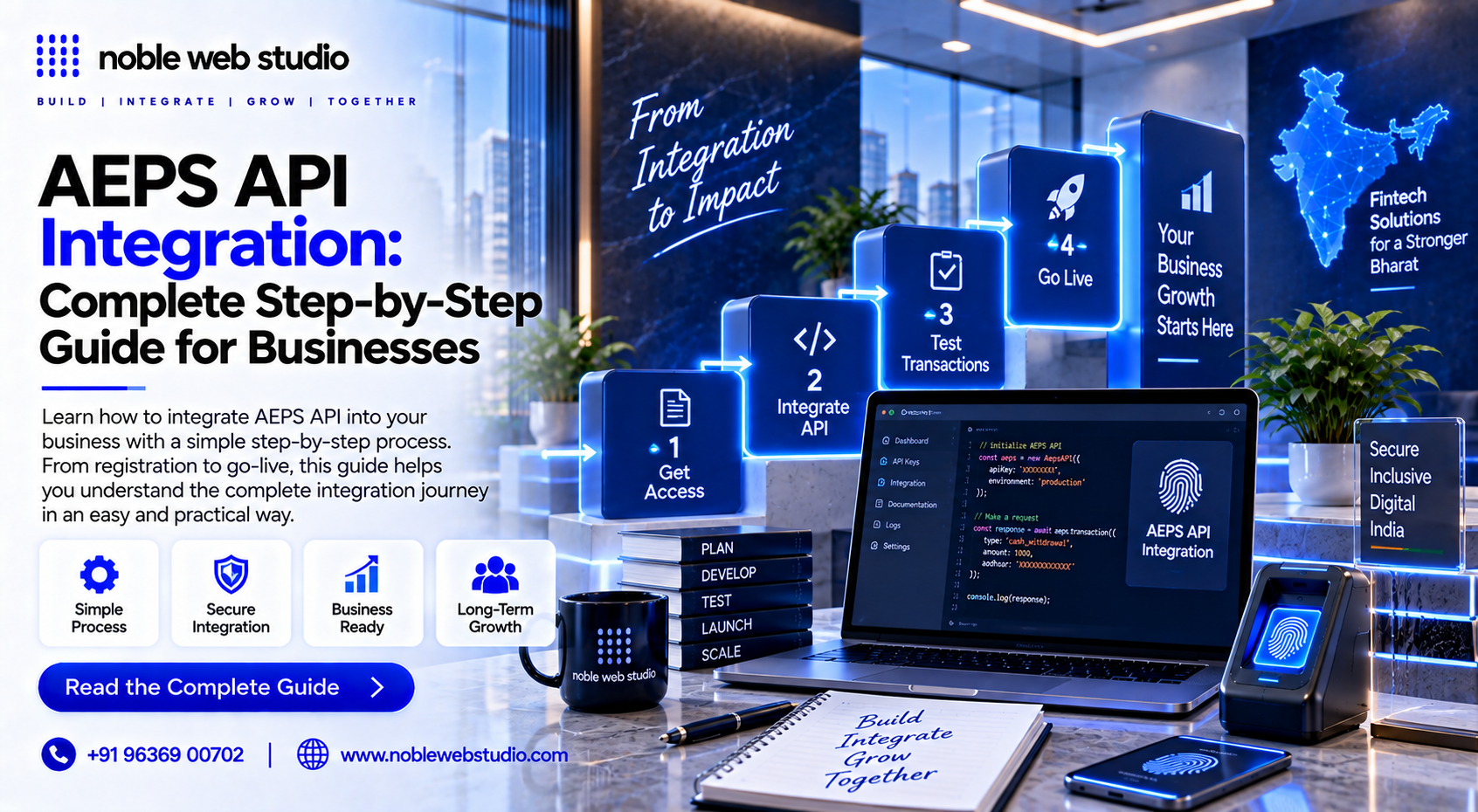
If you want to add Aadhaar Enabled Payment System services to your website, mobile application, fintech platform, or digital banking solution, AEPS API Integration allows you to connect AEPS services with your existing software. It helps businesses build a platform where authorised retailers or agents can offer supported Aadhaar-based banking services through a single application.
An AEPS API can be used to connect your application with the required AEPS service infrastructure and process supported transactions. Depending on the best Aeps API and banking arrangement, services can include cash withdrawal, balance enquiry, mini statement, and other supported AEPS transactions. Noble web studio developer documentation, for example, AEPS API for biometric-based cash-out and related services.
An AEPS (Aadhaar Enabled Payment System) API integration connects your software, app, or website directly to the National Payments Corporation of India (NPCI) network. It lets you offer biometric-based banking services like cash withdrawals, balance inquiries, and mini-statements using an Aadhaar number and a fingerprint scanner.
The AEPS API Integration process involves more than simply adding an Aeps API URL to a website. A complete integration can include retailer onboarding, AEPS service activation, biometric device and RD Service integration, secure Aeps API authentication, transaction requests, response handling, callbacks, transaction status, and backend processing. Aeps API documentation specifically separates frontend/gateway integration from backend callback and transaction confirmation handling.
For example, when a retailer starts an AEPS cash withdrawal, the application can collect the required transaction information and biometric capture data through a supported device. The application then sends the required request to the top AEPS API, receives the transaction response, and updates the retailer or customer with the transaction status. The exact request, authentication method, device requirements, and workflow depend on the selected Noble web studio and integration model.
A reliable AEPS API Integration Solution should also focus on security. Sensitive credentials should be protected on the server side, biometric information should be handled according to the applicable requirements, and transaction callbacks should be validated before your system updates the final transaction status. Noble web studio developer guidance, for instance, uses server-side callbacks for transaction status and secure transaction confirmation.
At Noble Web Studio, we provide AEPS API integration solutions for businesses that want to add AEPS functionality to their existing website, Android Aeps application, Aeps platform, or digital financial services system. The integration can be planned around your business model, required best AEPS services, retailer network, technical environment, and Noble web studio requirements.
A properly planned AEPS API Integration can make it easier to manage AEPS transactions from your own platform while giving retailers a simple interface for their daily banking operations. It can also be combined with an admin panel, retailer management, transaction reports, wallet management, commission management, and other digital financial services when required.
If you are planning to build or expand an AEPS-based fintech or digital Aeps banking platform, choosing the right Aeps API and integration approach is an important first step. The goal should be to create a secure, reliable, and easy-to-use AEPS workflow that fits your business requirements and can scale as your transaction volume grows.
In this complete guide, we will explain what AEPS API Integration is, how AEPS APIs work, how to integrate AEPS API into a website or mobile app, retailer onboarding, biometric and RD Service requirements, API authentication, cash withdrawal API, balance enquiry API, mini statement API, transaction response, callback integration, error handling, security, testing, production setup, integration cost, and how to choose the right AEPS API Integration provider in India.
What Is AEPS API Integration?
An AEPS API integration is the technical process of connecting a software app, website, or terminal to the Aadhaar Enabled Payment System so users can complete cardless, PIN-less banking transactions using their 12-digit Aadhaar number and fingerprint.
AEPS API Integration Work
AEPS Integration Guide enables platforms to process cardless banking transactions using Aadhaar and biometric authentication through the NPCI network.
How AEPS API Integration Works
- Initiation: Input the customer’s 12-digit Aadhaar number, bank identifier, and transaction type.
- Biometric Capture: The customer scans their biometric data using an STQC-certified device with RD services.
- Data Encryption & Routing: Biometric data is locally encrypted before the AEPS API Testing Guide routes the request via NPCI to UIDAI and the issuer bank.
- Settlement: The bank authorizes and processes the transaction, updating the merchant’s wallet.
AEPS API Services You Can Integrate
You can integrate core banking capabilities using the AEPS Portal to turn mobile apps and web platforms into micro-ATMs.
Core AEPS Services to Integrate
- Cash Withdrawal: Let users take out money using an Aadhaar number and a fingerprint or iris scan.
- Cash Deposit: Allow real-time cash deposits straight into Aadhaar-connected bank accounts.
- Balance Enquiry: Provide instant checks for available bank account funds.
- Mini Statement: Generate a summary of the last 5 to 10 recent transactions.
- Aadhaar Pay: Help merchants accept direct digital payments via biometric confirmation without a card or PIN.
- Fund Transfer: Facilitate secure money transfers between Aadhaar-linked accounts.
- eKYC Services: Support paperless and instant identity verification for customer onboarding.
AEPS API Integration Requirements
Integrating an Aadhaar Enabled Payment System (AEPS) API allows your B2B network, fintech platform, or application to handle real-time, cardless banking transactions (like cash withdrawals, balance inquiries, and mini-statements). Because AEPS routes sensitive data directly through the National Payments Corporation of India (NPCI) and UIDAI networks, your business must meet strict regulatory, business, and technical compliance prerequisites.
The complete core requirements for AEPS API integration are outlined below:
1. Partnership & Licensing Requirements
You cannot connect directly to the NPCI switch. Instead, you must partner with an authorized intermediary:
- Licensed API Provider: Partner with an NPCI-approved and RBI-licensed bank, payment aggregator, or certified technology provider. These Noble web studio grant you access to their sandbox environments and production endpoints.
- “One Operator, One Bank” Rule: Your corporate entity must strictly align with regulatory onboarding guidelines enforced by the processing bank.
2. Legal & Corporate KYC Documents
Before receiving active Aeps API keys (Merchant ID, Client ID, License Key), you must submit verified business and corporate KYC documents:
- Business Registration Proof: Valid GST Certificate, MSME/Udyam Registration, or a Shop & Establishment License.
- Identity Compliance: PAN Card of the company and individual directors/owners, alongside Aadhaar Cards linked to active mobile numbers for e-KYC authentication.
- Financial & Settlement Proof: A cancelled cheque, recent bank statement, or front page of a passbook. The bank account must match your registered business name to ensure safe automated settlement of funds.
- Physical Address Verification: A utility bill (electricity, water) or commercial rent agreement for your workspace (not older than 3 months).
3. Technical & Server Infrastructure
Your backend environment must guarantee data security during transmission:
- Secure Environment: Applications must run over an enforced HTTPS/SSL protocol layer to handle payloads securely.
- Data Encryption (PID Block): Biometric fingerprint payloads must be securely encrypted at the exact time of capture into a compliant PID (Personal Identity Data) block before transmission.
- Callback URL Integration: Webhooks and secure callback URLs must be configured in your application to process real-time transaction responses (success/failure) asynchronously from the bank.
4. Hardware & SDK Requirements
For end-retailers or agents to successfully capture biometric data, your client-facing application (Android/Windows) must support external device peripherals:
- Certified Biometric Devices: Only UIDAI/STQC-certified fingerprint or iris scanners are permitted. L1 certified devices (such as newer Mantra models) are standard for modern implementations.
- RD Service SDKs: You must bundle or trigger manufacturer-specific Registered Device (RD) service applications and SDKs into your Aeps app interface to ensure encrypted data capture.
AEPS API Integration for Different Businesses
AEPS (Aadhaar Enabled Payment System) API integration allows businesses to embed secure, biometric-based banking services directly into their existing software platforms. Developed by the National Payments Corporation of India (NPCI), this infrastructure eliminates the need for debit cards or PINs, relying instead on an individual’s Aadhaar number and fingerprint to authorize real-time transactions.
How Different Businesses Use AEPS API
- Fintech Startups: Build custom financial apps or add micro ATM features to mobile Aeps platform.
- Local Retail Stores: Turn regular storefronts into cash points to earn per-transaction commissions and draw foot traffic.
- Banking Correspondents (BC): Noble wbe studio Offer remote banking and cash-in/cash-out services in rural or semi-urban regions.
- Microfinance Institutions: Process loan disbursements or collections securely using biometric scans.
Who Can Use AEPS API Integration
An AEPS API Integration can be used by fintech companies, banks, and local businesses to offer secure, biometric-based banking services like cash withdrawals and balance inquiries.
Who Can Use AEPS API Integration?
- Fintech Startups and Developers: Noble web studio building digital wallets, Aeps apps, or custom Aeps payment software.
- Banks and NBFCs: Noble web studio expanding their rural reach and interoperable banking infrastructure.
- Business Correspondents (BCs) and Agents: Authorized banking agents providing last-mile financial services.
- Retailers and Shop Owners: Local Kirana stores, medical shops, and small businesses turning their counters into micro-ATMs.
- Common Service Centers (CSCs) and E-Mitra: Government-backed or private digital service kiosks offering citizen-centric banking.
- Microfinance Institutions (MFIs): Organizations managing localized credit disbursement and repayments.
Why Use AEPS API Integration
Integrating AEPS API Solution allows your mobile app or website to offer cardless, biometric-backed banking services using only a customer’s Aadhaar number and fingerprint scan.
Key Reasons to Use AEPS API Integration
- Cardless and PIN-less Transactions: Customers do not need physical debit cards, credit cards, or secret PINs to complete transactions. Their fingerprint and Aadhaar number serve as total verification.
- Turns Devices into Micro-ATMs: Regular smartphones, tablets, or computers connected to a certified fingerprint scanner transform into functional banking kiosks or micro ATM.
- Drives Financial Inclusion: It brings essential banking services to rural, semi-urban, and remote areas where physical bank branches or standard ATMs are sparse.
- Interoperable Multi-Bank Support: A single AePS API for Cash Withdrawal connects your platform to all major banks across India through the National Payments Corporation of India (NPCI) switch.
- Real-Time Processing: Transactions settle instantly, giving users immediate confirmation for balance checks, cash withdrawals, and mini-statements.
- New Revenue Opportunities: Local retailers, kirana store owners, and fintech agents can earn commissions on every successful transaction while increasing customer footfall.
- High-Level Security: UIDAI-certified biometric authentication and end-to-end encryption keep transactions safe and fully compliant with Reserve Bank of India (RBI) regulations.
Top Use Cases of AEPS API Integration
AEPS API integration lets apps and websites offer cardless, biometric banking services like cash withdrawals and balance checks using an Aadhaar number and fingerprint scan.
Top Use Cases of AEPS API Integration
- Micro-ATM and Localized Banking: Turns ordinary local kirana shops, pharmacies, or retail outlets into portable micro-ATMs using a smartphone and a fingerprint scanner.
- Financial Inclusion in Rural Areas: Brings basic financial services to unbanked or remote populations who lack nearby physical bank branches or traditional ATMs.
- Government Subsidy and Benefit Distribution: Simplifies the transparent and direct disbursement of government welfare funds and Direct Benefit Transfers (DBT) to citizens.
- Fintech Platform Expansion: Empowers neobanks and digital Aeps wallet apps to add biometric authentication and cardless cash-out options to their product suites.
- Retail Revenue and Customer Footfall: Helps local merchants earn commission on transactions while driving more physical foot traffic to their main retail business.
- Microfinance Institution (MFI) Collections: Allows field agents to collect loan repayments or disburse funds instantly using biometric verification in the field.
Key Aspects of AEPS API Integration
AEPS API integration allows businesses to add cardless, biometric banking services like cash withdrawals and balance checks to their apps using customer Aadhaar numbers.
Core Features Provided
- Cash transactions: Enables cash withdrawals, deposits, and Aadhaar Pay API merchant checkouts.
- Inquiry tools: Pulls real-time balance checks and mini-statements.
- Fund routing: Supports Aadhaar-to-Aadhaar transfers and direct benefit disbursements.
Technical & Security Requirements
- Biometric hardware: Requires STQC-certified L1 Aeps fingerprint or iris scanners for UIDAI verification.
- Compliance: Must align with NPCI and RBI regulatory guidelines for data encryption and token security.
- Data parameters: Requests require credentials, 12-digit Aadhaar, IIN bank code, transaction type, and an encrypted biometric block.
Why Mobile App and Website Need for AEPS API Integration
Integrating an Aadhaar Enabled Payment System (AEPS) API into a mobile app or website is a strategic move for fintech companies, startups, and B2B retail networks in India. By connecting your digital Aeps platform directly to the National Payments Corporation of India (NPCI) network, you instantly transform any smartphone, PC, or point-of-sale device into a secure, biometric-powered micro-ATM.
Businesses leverage AEPS API Integration on their applications and websites for several critical operational and commercial reasons:
1. Delivery of Essential Financial Services
Integrating the API allows platforms to offer core banking services without requiring physical credit/debit cards or PINs. Users only need their 12-digit Aadhaar number and a fingerprint or iris scan. The primary functionalities include:
- Cash Withdrawals & Deposits: Enabling instant cash payouts and collections directly at retail points.
- Balance Inquiries & Mini Statements: Allowing customers to check their account balances and view recent transactions in real time.
- Aadhaar Pay: Empowering merchants to accept cashless merchant payments seamlessly.
2. High Commission Earnings & New Revenue Streams
For B2B platforms, adding an AEPS API Solution serves as a highly profitable model. Business correspondents (BCs), distributors, and local shop owners earn lucrative transaction commissions typically ranging from ₹1 to ₹15+ per transaction. This drives higher customer footfall to local merchant points while building a steady stream of recurring revenue.
3. Promoting Financial Inclusion in Rural Areas
Traditional banking infrastructure and physical ATMs are often scarce in rural and semi-urban areas. Integrating an Advanced AEPS API into an Android app or website bridges this gap. It enables local merchants to serve as localized banking agents, driving financial inclusion by bringing everyday banking directly into underserved neighborhoods.
4. Robust Security and Fraud Prevention
Security is built directly into the system infrastructure:
- Biometric Authentication: Transactions use UIDAI-approved fingerprint or iris scanners, making identity theft and card skimming impossible.
- Compliance & Encryption: The architecture complies with strict RBI and NPCI frameworks. Encrypted biometric PID data is transmitted safely without being stored on local merchant devices.
5. Seamless Technical Interoperability & Instant Settlements
A single AEPS API Integration Service offers cross-bank compatibility. Customers can access accounts at any bank linked to the central switch through your platform. Furthermore, it supports Instant Settlements (T+0), immediately crediting the merchant’s wallet to ensure steady liquidity and fast transaction processing times of just a few seconds.
Why Do Businesses Need AEPS API Integration?
Businesses need AEPS API Integration to offer essential, cardless banking services such as cash withdrawals, balance checks, and mini-statements directly through their own apps, websites, or local storefronts using Aadhaar and biometric verification.
Key Reasons Businesses Need AEPS API Integration
- Drive New Revenue Streams: Retail shops, pharmacies, and fintech platforms earn attractive commission-based earnings on every successful cash withdrawal or balance inquiry.
- Increase Customer Footfall: Local storefronts and Kirana shops turn into virtual micro ATMs, attracting more people who often buy primary products during their visit.
- Promote Financial Inclusion: Businesses can bridge the gap in rural and semi-urban areas where physical bank branches and ATMs are far away or missing.
- Ensure High Security: Biometric fingerprint authentication tied to UIDAI and NPCI networks makes transactions far safer than traditional cards, PINs, or paper.
- Low Setup Costs: Companies do not need heavy infrastructure; a basic smartphone or POS device with a certified fingerprint scanner is enough to launch.
- Real-Time Settlement: Instant processing reduces customer wait times and automates the back-end workflow for Aeps B2B platform.
AEPS API Integration Architecture
AEPS API Integration Architecture
Live End-to-End System Design • NPCI • UIDAI • Banking Switch
Benefits AEPS API Integration
AEPS (Aadhaar Enabled Payment System) API integration lets apps and websites offer cardless, PIN-less banking services like cash withdrawals and balance checks using just an Aadhaar number and a fingerprint scanner.
Key Benefits for Businesses and Users
- Cardless and PIN-less Convenience: Customers do not need a debit card, credit card, or secret PIN to complete basic banking tasks. They only need their Aadhaar number and fingerprint.
- High-Level Security: Biometric verification through UIDAI-approved fingerprint scanners ensures that only the authorized account holder can approve a transaction, which lowers fraud risks.
- Financial Inclusion: Local retailers and small shop owners can turn their normal smartphones or devices into a mini-ATM. This brings banking to rural or remote areas where physical banks and ATMs are hard to find.
- Real-Time Processing: Transactions happen instantly through direct connection to the National Payments Corporation of India (NPCI) switch, providing immediate confirmation to the customer.
- Bank Interoperability: A single Aeps system connects customers to almost all major participating banks, removing traditional banking silos.
- New Revenue and Footfall: Store owners and fintech agents earn direct commission on cash withdrawals and balance inquiries while bringing more people into their physical shops.
Features AEPS API Integration
AEPS API integration allows businesses to provide cardless, biometric-driven banking services like cash withdrawals and balance inquiries through an AEPS Integration Guide.
Security and Compliance
- Biometric Verification: Authenticate users securely via UIDAI-approved fingerprint or iris scanners.
- Data Encryption: Protect sensitive financial details using high-level encryption standards during transit.
- Regulatory Compliance: Follow all guidelines set by the National Payments Corporation of India (NPCI) and RBI.
Technical and Business Features
- Real-Time Processing: Connect instantly with bank servers through NPCI switches for fast responses.
- Multi-Bank Support: Access all major Indian banking networks through a single unified interface.
- Easy Software Embedding: Add functionality smoothly into existing Android Aeps apps, POS terminals, or web portals.
AEPS API Integration for Website and Mobile App
Integrating an Aadhaar Enabled Payment System (AEPS) API allows fintech companies, retail networks, and businesses to transform standard smartphones, tablets, or PCs into biometric “Micro-ATMs”. Because direct integration with the National Payments Corporation of India (NPCI) is not open to standard businesses, you must partner with an authorized Noble web studio.
The step-by-step process to successfully execute an AEPS API integration includes:
1. Business Onboarding and Compliance (KYC)
Before touchpoints with the production environment are permitted, your business must satisfy strict Reserve Bank of India (RBI) and Unique Identification Authority of India (UIDAI) compliance protocols.
- Documentation: You must provide business registration documents, PAN cards, corporate address proof, and individual promoter KYC details.
- Aggregator Partnership: Establish a contract with an authorized Noble web stuido.
- Credential Issuance: Once the compliance team clears your corporate KYC, the provider generates your integration sandbox credentials: Client ID, Aeps API Keys, and a unique License Key.
2. Device Integration & RD Service Setup
AEPS requires a certified biometric scanner (such as Mantra devices) to capture user authentication data. You cannot capture biometrics directly into your custom application without a registered device service layer.
- RD Service Registration: Register your physical biometric scanners via the official RD Service Online Portal using the device serial number.
- Driver Deployment: Install the corresponding Registered Device (RD) service package on the client environment (e.g., the Android application or Windows background service).
3. Core Technical API Development
Using the Noble web studio provide Aeps API documentation and SDK packages, Aeps software development team hooks the core endpoint interactions into Aeps Software architecture:
- Front-End Design: Build UI elements to capture the customer’s Aadhaar Number and select their Issuer Bank (linked via its Issuer Identification Number or IIN).
- Biometric Capture (PID Block): Call the local RD Service interface to fire up the scanner. The device internally processes the biometric image and outputs a highly encrypted XML string called the PID Block. Do not attempt to read or modify this block; it must remain raw to pass UIDAI security.
- Payload Construction: Package the Aadhaar Number, Bank IIN, Transaction Type (e.g.,
CASH_WITHDRAWAL,BALANCE_INQUIRY,MINI_STATEMENT), and the encrypted PID Block into a secure HTTPS request payload. - Callback (Webhook) Infrastructure: Set up secure, tokenized callback URLs on your server. The banking switch uses these webhooks to update your database regarding transaction settlement status in real-time.
Sandbox Testing & UAT
- Perform exhaustive unit tests inside the Noble web studio test environment using dummy merchant balances and simulated biometric blocks.
- Test extreme edge cases like connection timeouts, invalid Aadhaar configurations, and mismatched bank IINs to ensure error-handling functions accurately display status codes to your agents.
5. Production Deployment & Merchant Onboarding
- Go-Live: Swap sandbox environment endpoints out for production Aeps API routes and introduce your live master keys.
- Downstream Merchant Onboarding: To legally roll out the tool to agents, use Noble web studio specific Onboard User / Merchant KYC API to register individual retail points before they are authorized to submit biometric transaction payloads on the network.
AEPS API Integration Cost in India
Standard AEPS API integration costs in India generally range from ₹12,000 to ₹35,000 for standard Aeps setup, alongside recurring operational and transaction fees.
Setup and Integration Fees
- Standard Developer API: ₹12,000 to ₹35,000 (one-time) for direct endpoint access and testing environment.
- White Label Solutions: ₹15,000 to ₹1,20,000 for pre-built, rebrandable Aeps admin panel and retailer portals.
- Proper Direct Bank API (ICICI/Yes Bank): ₹2,55,000 to ₹4,50,000 for dedicated enterprise-grade direct bank tie-ups.
Ongoing Maintenance and Operational Fees
- Annual Maintenance Charges (AMC): ₹9,999 to ₹40,000 per year.
- Per-Transaction Charges / Fees: ₹0.25 to ₹1.50 per query or transaction based on volume slabs.
- GST: 18% GST applies separately to setup fees and service charges.
AEPS Retailer Onboarding Through API
You can start Aeps onboarding retail agents through an trusted Aeps API by integrating with platforms or registering via Noble web studio to automate merchant creation and verification.
Onboarding Workflow via API
- API Signup & Auth: Register on the Noble web studio and acquire Aeps API key, Aeps Merchant ID (MID), and secret tokens.
- Data Submission Endpoint: Send retailer personal, business, and bank details via the merchant registration POST endpoint.
- Biometric & Video KYC: Complete the mandatory digital or video KYC verification workflow for the agent.
- Activation: Receive webhook confirmation upon approval, typically within 24 to 48 hours, enabling transaction endpoints.
AEPS Biometric Device Integration
You can integrate Aeps biometric devices for the Aadhaar Enabled Payment System (AePS) by following the technical guides provided by Noble web studio.
Hardware and Software Requirements
- Biometric Device: Use a UIDAI-compliant and STQC-certified Level-1 (L1) fingerprint or iris scanner, such as the Mantra MFS110.
- RD Service: Install the specific Registered Device (RD) service application for your hardware on an Android device, Windows PC, or POS machine to handle encrypted PID block creation AEPS API Services.
- API Connection: Partner with a certified Noble web studio to get secure HTTPS REST/JSON endpoints AEPS Setup in India.
AEPS API Authentication and Security
AEPS APIs use AEPS Banking API and multi-layered security frameworks to ensure secure, cardless financial transactions.
Authentication Layers
- OAuth 2.0 & JWT: Noble web studio that Aeps API requests rely on OAuth 2.0 protocols and JSON Web Tokens (JWT) for secure session validation and API key management.
- Biometric Verification: Customer identity is verified via UIDAI-approved fingerprint or iris scanners through a registered Registered Device (RD) service, which generates an encrypted
PidDataXML payload. - Two-Factor/Server Validation: Client requests pass through an Aeps API gateway with strict rate-limiting before reaching the fast AEPS API core engine and banking switch.
Security Architecture
- Data Encryption: All communication payloads utilize HTTPS and TLS 1.3 encryption in transit, safeguarding sensitive Aadhaar and biometric data.
- Perimeter Defense: Web Application Firewalls (WAF) and DDoS mitigation tools filter anomalous or malicious HTTP traffic.
- Compliance & Logging: Systems maintain strict regulatory compliance under RBI and NPCI frameworks, backed by real-time fraud detection and comprehensive audit logging.
AEPS API Transaction Flow Example
An Aadhaar Enabled Payment System API processes cardless banking transactions through secure biometric and server-to-server communication.
Agent Onboarding and Authentication
- Agent Registration: The business or retailer completes Aeps onboarding via the Aeps Onboard Agent API.
- One-Time eKYC: The agent completes biometric verification using UIDAI-approved fingerprint scanners.
- Daily Authentication: Agents perform a daily e-KYC login before initiating customer requests.
Transaction Initiation
- Customer Input: The customer provides their 12-digit Aadhaar number, selects their bank name, and chooses a service (like cash withdrawal or balance check).
- Biometric Capture: The customer scans their fingerprint or iris on a certified device connected to the merchant’s app.
Processing and Settlement
- Encryption & Routing: The local Aeps b2b app securely encrypts the biometric data and sends an smooth Aeps API request to the banking gateway.
- UIDAI / NPCI Verification: The National Payments Corporation of India (NPCI) and UIDAI verify the identity against centralized records.
- Bank Response: The core Aeps banking system debits or credits the account in real-time, returning a success or failure status to the Aeps Service API, which instantly updates the merchant’s digital wallet and sends a confirmation SMS.
AEPS API Transaction Status and Callback Handling
You can set up transaction status tracking and webhooks using the AEPS 2 Transaction Callback guidelines for handling asynchronous responses.
Transaction Status & Callback Overview
- Callback URL Configuration: Must be a secure HTTPS
POSTendpoint acceptingapplication/jsonpayloads. - Intimation vs. Response: Gateways often trigger a pending debit hook first, followed by a final success or failure response payload once processed by the bank.
- Key Payload Parameters: Look for fields like
status(SUCCESS/FAILED),statusDesc,txnAmount,txnDateTime, and unique transaction reference numbers. - Security: Verify webhook signatures and enforce strict CORS policies to protect server-to-server data exchange.
AEPS API Testing and Go-Live Process
You can get started with the Noble web studio to build Aadhaar-enabled banking services into your trusted Aeps platform.
Sandbox Testing Process
- Mock Environment: Connect your application to sandbox endpoints using simulated test Aadhaar numbers and mock biometric data.
- Scenario Validation: Test all transaction flows, including balance inquiries, cash withdrawals, and mini-statements.
- Error Handling: Verify how your system processes negative triggers like “invalid biometrics” or “bank server down” messages.
Go-Live (Production) Process
- IP Whitelisting: Register and whitelist your live server IP addresses with Noble web studio.
- Credential Swapping: Replace your sandbox best Aeps API keys and endpoints with live Aeps API production credentials.
- Deployment & Monitoring: Push your build to the live server and track initial real-time transaction logs closely via your Aeps admin dashboard.
AEPS API Compliance Requirements
Aadhaar Enabled Payment System (AEPS) API integration requires strict adherence to regulatory, hardware, and security mandates set by the National Payments Corporation of India (NPCI), the Reserve Bank of India (RBI), and the Unique Identification Authority of India (UIDAI).
Regulatory and Partner Compliance
- Banking Partnership: You must partner with an NPCI-approved sponsor bank or payment service provider (PSP) to route and settle transactions.
- Agent KYC: Mandatory Know Your Customer (KYC) verification is required for all agents and merchants before activation.
- Policy Adherence: Operations must comply with regional frameworks, including the “One Operator, One Bank” policy where applicable.
Hardware and Device Standards
- Biometric Devices: You must use STQC-certified Level 1 (L1) or UIDAI-approved biometric scanners (such as fingerprint or iris devices) for secure customer authentication.
- Compatible Terminals: End-user interfaces require an internet-connected Android, Windows, or web-enabled host device.
Data Security and Architecture
- Encryption Standards: Data packets require high-grade encryption (such as AES-256) during transit alongside tokenized or asymmetric cryptography for Aeps API calls.
- Audit Trails: Best Aeps System must maintain real-time transaction logging, comprehensive audit trails, and strict rate-limiting to prevent fraud.
AEPS API vs AEPS Gateway
An AEPS API is a set of programming instructions that lets Aeps developers build custom Aadhaar-based banking features into their own apps, while an AEPS Gateway is the underlying routing and processing infrastructure (often accessed via an interface or reliable Aeps API endpoint) that securely connects those transaction requests to the National Payments Corporation of India (NPCI) switch and bank networks.
AEPS API vs. AEPS Gateway at a Glance
| Feature | AEPS API (Application Programming Interface) | AEPS Gateway |
|---|---|---|
| Definition | The software code and protocol set used to plug banking functions into a third-party app. | The secure processing, encryption, and routing engine that handles the data transit. |
| Primary Role | Enables software developers to design custom user interfaces and trigger financial requests. | Validates tokens, encrypts biometric blocks, balances loads, and talks to bank servers. |
| Customization | High; allows businesses to brand and structure their own retailer/customer dashboards. | Lower; acts as the rigid, compliant bridge between the app and the banking switch. |
| Scope | Functional layer (what actions the app can request like cash withdrawal or balance check). | Transactional/Routing layer (how the secure payload safely reaches the destination bank). |
AEPS API vs Traditional AEPS Software
An AEPS API is a backend programming interface that lets businesses plug Aadhaar biometric banking functions into their existing apps, while a traditional AEPS software is a standalone, ready made Aeps portal or application built for managing end-to-end micro-ATM and retailer networks.
AEPS API
- Definition: A set of protocols that connects your custom platform directly to banking switches and the NPCI network.
- Customization: Fully customizable; you design the user interface and workflow.
- Target Audience: Tech-savvy fintech startups, banks, and enterprises with existing top Aeps software.
- Control: Gives you complete control over branding, user management, and business logic.
Traditional AEPS Software
- Definition: A complete, pre-built white label Aeps software package with an best Aeps admin panel, retailer/distributor login, and Aeps wallet system.
- Customization: Limited to changing logos, color themes, and basic settings provided by the Aeps developer.
- Target Audience: Noble web studio wanting an instant, ready-to-launch Aeps portal.
- Control: Relies heavily on the software vendor for core updates, security patches, and structural changes.
Future Trends Of AEPS API Integration
Future trends in Aadhaar Enabled Payment System (AEPS) API integration focus on hyper-security, advanced biometrics, and expanding rural merchant locations into comprehensive digital financial hubs.
Enhanced Security and Compliance
- L1 Biometric Mandate: Mandatory adoption of STQC-certified L1 biometric and fingerprint devices to prevent spoofing.
- AI/ML Fraud Prevention: Real-time behavioral monitoring to flag transaction anomalies instantly.
- Liveness Detection: Integration of face and iris recognition with anti-spoofing technology to verify real skin.
- Stricter Regulations: Enforcement of policies like “One Operator, One Bank” and mandatory re-KYC for inactive agents.
Ecosystem and Service Expansion
- Beyond Basic Banking: Evolution from cash withdrawals and balance checks into micro-loans, insurance, and Direct Benefit Transfers (DBT).
- Embedded Finance: Deep integration of AEPS APIs into non-financial mobile Aeps apps and everyday software.
- Unified Platforms: Cross-integration with UPI and best BBPS for smoother utility and multi-service management.
Performance and Infrastructure
- Real-Time Settlements: Shift toward instant T+0 fund settlements and 99.9%+ uptime guarantees.
- Blockchain Adoption: Exploration of decentralized ledgers for immutable and transparent transaction tracking.
Noble Web Studio One Of The AEPS API Integration Provider in India
Noble Web Studio One of the right AEPS API integration provider, you must evaluate key factors like regulatory compliance, uptime reliability, and transaction success rates to ensure a stable and profitable Aeps platform.
Key Factors to Consider
- Security and Compliance: Verify that the Noble web studio strictly adheres to NPCI (National Payments Corporation of India) and RBI guidelines, offering biometric authentication and end-to-end data encryption.
- Transaction Success Rate and Uptime: Look for a top Aeps system uptime of 99.9% and success rates above 98% to prevent failed transactions and maintain customer trust.
- Commission Structure: Compare per-transaction earnings, payout frequency, and potential hidden fees to maximize your platform’s revenue.
- Integration and Documentation: Choose an low cost AEPS API that offers clear developer documentation, SDK support, and a sandbox testing environment.
- Settlement Speed: Ensure the Noble Web Studio supports instant (T+0) or same-day (T+1) fund settlements so retailers maintain steady liquidity.
- Device Compatibility: Check if the Aeps API supports certified L0/L1 biometric scanners from major hardware brands like Morpho, Mantra, and Startek.
- Customer Support: Reliable 24/7 technical assistance is crucial for resolving live transaction errors and integration roadblocks quickly.
Why Choose Noble Web Studio for AEPS API Integration?
Noble web studio one of the right provider for AEPS (Aadhaar Enabled Payment System) API integration requires evaluating key performance, security, and financial factors to ensure smooth and reliable micro ATM services.
Key Factors to Consider
- Security and Compliance: Ensure the Noble web studio complies fully with NPCI and UIDAI mandates, offering end-to-end encryption without storing raw biometric fingerprint data on servers.
- Uptime and Success Rate: Look for a minimum of 99% uptime and robust failover banking routing to minimize transaction failures during cash withdrawals.
- Settlement Speed: Opt for Noble web studio supporting real-time or T+0/T+1 instant settlements to maintain healthy liquidity and cash flow for your business wallet.
- Commission Structure: Compare per-transaction earnings, payout margins, and check for hidden operational or setup charges.
- Integration Ease and Developer Support: Prioritize clear Aeps API documentation, Aeps API developer-friendly SDKs, and a functional sandbox environment for seamless testing.
- Biometric Device Compatibility: Verify that the modern Aeps API supports standard RD-service registered biometric scanners like Mantra.
Conclusion: Build a Reliable AEPS API Integration for Your Business
AEPS API Integration allows businesses to connect Aadhaar Enabled Payment System services with their website, mobile application, top Aeps platform, or digital banking software. With the right Aeps integration, businesses can provide supported trusted AEPS services such as cash withdrawal, balance enquiry, mini statement and other available banking services through their own Aeps earning platform.
However, successful AEPS API integration is not only about connecting one high speed Aeps API. The complete setup can involve retailer or merchant onboarding, AEPS service activate, KYC, biometric device integration, authentication, transaction processing, response handling, callbacks, reports and transaction status management. Aeps API Developer documentation from Noble web studio, for example, separates retailer onboarding and service activation from the actual AEPS transaction integration and requires the merchant to complete the applicable authentication steps before transactions.
AEPS API Integration is the technical process of connecting a software application, website, or mobile app to the Aadhaar Enabled Payment System (AEPS) via an Application Programming Interface (API).
For this reason, businesses should choose an AEPS API Integration Solution based on their actual technical and business requirements. Important points to check include professional Aeps API documentation, supported reliable AEPS services, biometric device compatibility, authentication process, sandbox or testing environment, transaction response handling, security controls, error handling, reporting, scalability and technical support.
A good AEPS integration should also make the experience simple for the retailer. The retailer should be able to complete the required fast Aeps onboarding and authentication, use a compatible biometric device, initiate an eligible transaction and clearly see whether the transaction is successful, pending or failed. Noble web studio documentation, for example, includes RD-service device setup, fingerprint capture, PID data handling and AEPS transaction Aeps API requirements.
At Noble Web Studio, we provide software development and Aeps API integration solutions for businesses that want to add smooth AEPS services to their digital Aeps commission platform. The integration can be planned around your business model, retailer network, required fast AEPS services, application type and technical requirements.
Whether you are building a fintech platform, AEPS application, retailer portal, digital banking platform, B2B financial services platform or multi-service recharge platform, the right AEPS API integration can help bring supported Aadhaar-enabled banking services into one system.
Before going live, businesses should also verify the applicable requirements of their Noble web studio is anAEPS service provider. Aeps API features, transaction limits, supported devices, onboarding requirements and authentication flows can vary by Noble web studio and may change over time.
In short, the goal of AEPS API Integration should be more than simply making Aeps API call. A well-designed integration should create a complete and manageable transaction workflow from Aeps retailer onboarding and authentication to biometric capture, transaction processing, response handling and reporting.
If you are planning to integrated AEPS into your website, Aeps Android application or fintech platform, Noble Web Studio can help you plan and develop an AEPS API integration according to your business and technical requirements.
Frequently Asked Questions About AEPS API Integration
AEPS API integration is the process of connecting Aadhaar Enabled Payment System (AEPS) services to a website, mobile app, fintech platform, or existing software. It allows businesses to offer services such as cash withdrawal, balance inquiry, mini statement, and Aadhaar-based payments through an API.
AEPS API integration connects your application with an AEPS service provider. The typical flow includes retailer onboarding, service activation, biometric device setup, customer authentication, API request, transaction processing, and receiving the transaction response.
To integrate AEPS API into a website, you generally need API credentials, technical documentation, a secure backend, retailer onboarding, and biometric device support where required. Your development team then connects the required AEPS APIs, handles requests and responses, tests the integration, and moves it to production.
AEPS API can be integrated into an Android or other supported mobile application through the provider’s API and device integration process. The app normally connects to your secure backend, while biometric capture and AEPS transaction processing are handled according to the provider’s integration requirements.
The requirements can vary by API provider, but commonly include a registered business, API credentials, retailer or merchant onboarding, KYC or required verification, a supported biometric device, RD Service where applicable, secure server integration, and a testing environment.
For biometric-based AEPS transactions, a supported biometric device is required to capture the customer’s fingerprint or other approved authentication data. The exact device requirements depend on the AEPS provider and its supported integration method. Noble web studio documentation, for example, describes fingerprint-device registration and RD Service as part of its AEPS API flow.
RD Service, or Registered Device Service, is the software layer used with supported registered biometric devices to capture and provide biometric authentication data to an application. In an AEPS integration, the application can send a capture request to the RD Service and use the returned data as required by the API.
PID data is the biometric authentication data returned by a registered biometric device during a capture request. In an AEPS API integration, this data may be passed to the transaction API in the required format. Noble web studio documentation specifies that the biometric device can return PidData in XML format for its AEPS API flow.
Yes. Cash withdrawal is one of the main uses of an AEPS API. A customer can authenticate through the supported AEPS process, and the application can send the required transaction information to the AEPS API for processing. Noble web studio identifies cash-out as a primary use case of its AEPS transaction API.
Yes. AEPS APIs can support balance inquiry, allowing customers to check their linked bank account balance through the supported Aadhaar and biometric authentication process. Noble web studio also lists AEPS balance inquiry as one of its core services.
Yes. An AEPS API can provide a mini statement service when supported by the provider. It can be used to retrieve recent transaction information after successful customer authentication. Noble web studio lists mini statement as one of its AEPS services, while Noble web studio identifies mini statement as a supported AEPS transaction type.
Aadhaar Pay API enables businesses to integrate Aadhaar-based payment functionality into their applications or platforms. It can use Aadhaar and biometric authentication for supported payment transactions. AEPS and Aadhaar Pay are related but can be provided as separate services depending on the API provider.
AEPS retailer onboarding normally involves collecting the required retailer details, completing the provider’s onboarding process, activating the AEPS service, and checking the retailer’s service status. After successful activation and any required verification, the retailer can use the AEPS transaction services. Noble web studio documentation follows an onboarding → service activation → service-status-check flow.
Yes, AEPS retailer onboarding can require KYC or other verification steps before the retailer is allowed to use AEPS services. The exact documents and verification process depend on the API provider, banking partner, and applicable requirements.
The integration time depends on the API documentation, development work, biometric-device setup, retailer onboarding, testing, and required verification. A simple API integration may be completed faster than a complete fintech platform integration involving multiple services and custom workflows.
AEPS API integration cost depends on factors such as development requirements, API or transaction charges, onboarding, biometric devices, software customisation, testing, and ongoing support. For an accurate cost, businesses should request a quotation based on their required AEPS services and integration scope.
The programming language depends on the API provider and your application architecture. Common technologies used for API integration include PHP, Java, Python, JavaScript, Node.js, .NET, and other languages that can send secure HTTP requests and process API responses. Noble web studio, for example, highlights code samples for Java, PHP, Python, and .NET.
AEPS API integration should use secure authentication, encrypted sensitive information, HTTPS communication, protected API credentials, secure server-side processing, and proper transaction validation. Security requirements can vary by provider and banking partner, so the integration should follow the provider’s current technical and compliance requirements.
If an AEPS transaction fails, the application should read the API response and transaction status, show the appropriate status to the retailer, and avoid creating a duplicate transaction. The exact reason can vary, such as authentication failure, incorrect information, device issues, bank response, timeout, or another API error.
Transaction status can normally be checked using the transaction response, transaction-status API, callback or webhook mechanism provided by the AEPS provider. Your software should store the transaction reference and update the final status after receiving the provider’s response.
First check that the biometric device is supported, properly connected, registered, and that its required RD Service or driver is running. You should also check device permissions and the application’s connection to the RD Service. If the problem continues, check the provider’s device troubleshooting documentation or contact technical support. AEPS documentation specifically includes device registration and RD Service installation steps.
An AEPS API generally gives developers direct API-level integration for building AEPS functionality into their own software. An AEPS Gateway can provide a more packaged integration experience for adding AEPS functionality to a website or application. The exact difference depends on the provider’s architecture and available integration options.
You can integrate AEPS API with existing fintech software by connecting the required API endpoints to your backend, mapping retailer and customer data, adding authentication, integrating biometric-device functionality where required, handling transaction responses, and connecting status, reporting, and settlement workflows. Testing should be completed before production deployment.
To start AEPS API integration with Noble Web Studio, first discuss your business requirement, platform, required AEPS services, retailer network, and integration scope. The technical team can then determine the required API flow, integration requirements, testing process, and production setup for your fintech application.