Ankit
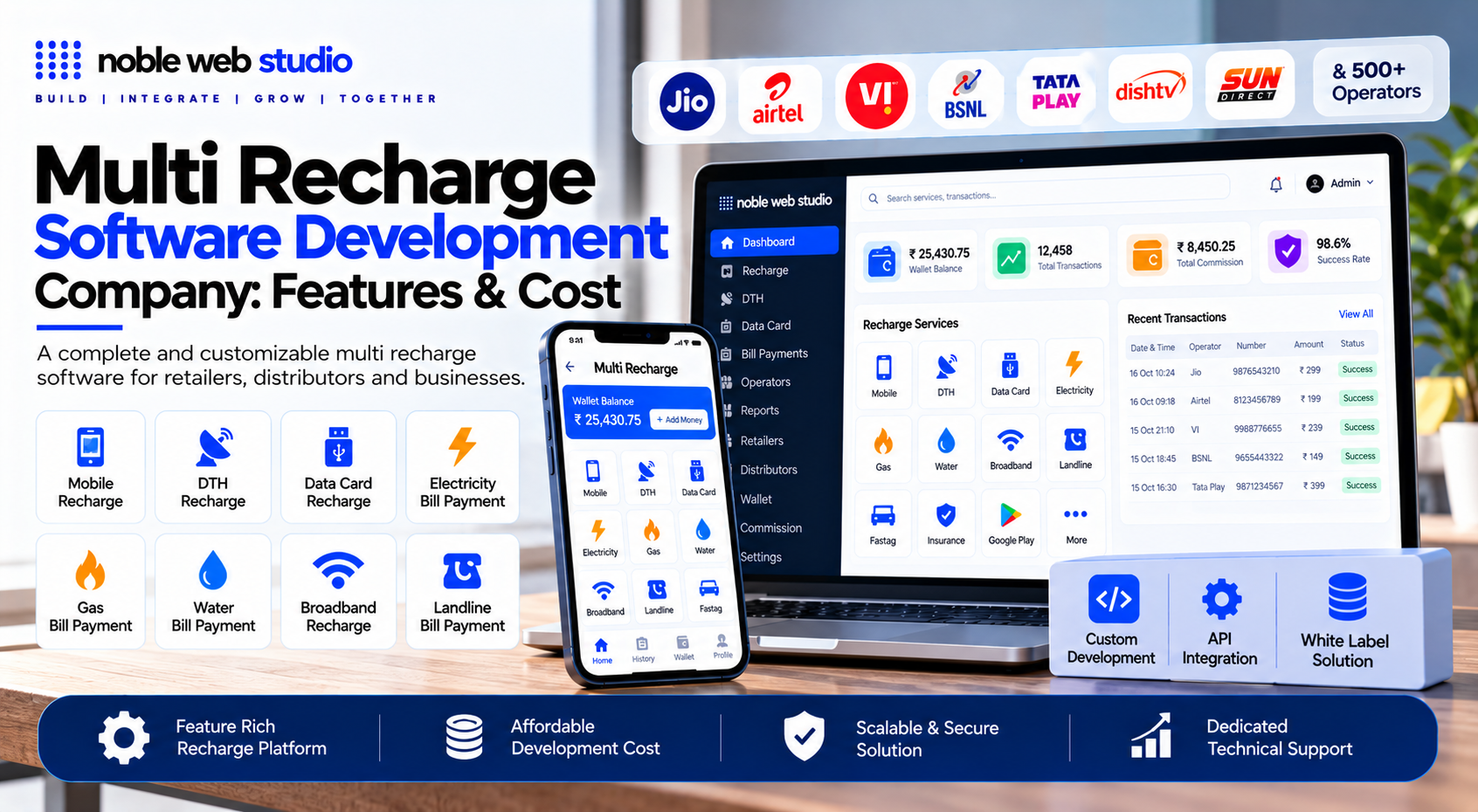
Looking for a reliable Multi Recharge Software Development Company to start or expand your digital recharge business? Choosing the right mobile recharge software is an important step toward managing recharge services, supporting retailers, and building a platform that fits your business goals. With the right solution, you can manage supported recharge services from one system instead of handling every service separately.
A multi recharge software platform can include mobile recharge, DTH recharge, FASTag, transaction tracking, retailer and distributor management, commission settings, reports, and an administrative dashboard. Depending on your business model, you may also need a B2B recharge portal, a B2C platform, a white label recharge solution, or Recharge API integration with authorized Noble web studio. The features you need should depend on your target customers, budget, and future plans.
Multi recharge software development companies build centralized fintech and utility payment platforms that let businesses run white-label B2B, B2C, or B2B2C networks.
Noble Web Studio develops ready-made B2B Mobile Recharge Software for businesses that want to establish or grow their recharge operations. Before choosing a package, consider the available features, customization options, supported integrations, security controls, technical support, and ongoing costs. A clear understanding of these factors can help you select a practical solution for your business.
In this guide, you will learn what to look for in a Multi Recharge Software Development Company, which features matter most, how recharge software can support different business models, and what to consider before launching recharge platform. If you are planning a new recharge business or upgrading an existing system, Noble Web Studio can help you discuss your requirements and explore a suitable mobile recharge software solution.
What Is Multi Recharge Software Development?
Multi recharge software development is the process of designing and building unified digital platforms that allow businesses to process mobile, DTH, data card, and utility bill recharges through a single interface and shared wallet.
Core Components of Multi Recharge Software
- Admin Panel: A master dashboard to configure Noble web studio, monitor real-time transactions, manage commission slabs, and resolve customer complaints.
- Distributor & Retailer Hierarchies: Multi-level structures that let master distributors manage local agents and automate commission splits.
- API Integrations: Direct or multi operator recharge API connections to telecom networks, payment gateways (UPI, net banking, debit/credit cards), and the Bharat Bill Payment System (BBPS).
- Virtual Wallet System: An internal e-wallet that lets users pre-load funds and execute instant transactions without entering card details for every single recharge.
Multi Recharge Software Work
Multi recharge software is a digital B2B recharge platform that lets you run a branded bill-payment and top-up business by combining mobile, DTH, and utility services into a single interface.
How It Works
- Unified Dashboard: It replaces multiple individual operator logins with one central web panel or Android recharge commission app for handling recharges.
- API & BBPS Connection: The software connects in the background to telecom operators, DTH providers, and the Bharat Bill Payment System (BBPS) via recharge API.
- Virtual Wallet System: Recharge Admin, distributors, and retailers each operate through e-wallets. When a recharge happens, the system immediately deducts the amount from the user’s wallet.
- Multi-Level Hierarchy: The mobile recharge platform supports a chain typically Admin → Master Distributor → Distributor → Retailer.
- Automatic Commission & Slabs: Commissions are pre-configured per operator/circle and automatically credited to the respective wallet level upon each transaction.
- Multi-API Routing: If one operator or best recharge API slows down or fails, the software automatically shifts traffic to a backup recharge service API to maintain high uptime.
Services Supported by Multi Recharge Software
Multi recharge software typically supports a wide range of telecommunication, utility, financial, and digital services from a single centralized best recharge platform:
Telecom & DTH
- Mobile Recharge: Prepaid and postpaid top-ups for all major operators including Jio, Airtel, Vi (Vodafone Idea), and BSNL.
- DTH Recharge: Direct-to-home television recharges for services like Tata Play, Dish TV, Airtel Digital TV, and Sun Direct.
- Data Card & Broadband: Internet data card top-ups and landline or broadband bill payments.
Utility & Bill Payments (BBPS)
- Electricity Bills: Power and utility bill payments via the Bharat Bill Payment System (BBPS).
- Gas & Water Bills: Piped gas, cylinder bookings, and municipal water bill payments.
- Insurance & Loan EMIs: Insurance premium collections and financial service payments.
- FASTag: Electronic toll collection recharges for vehicle tags.
Banking & Financial Services
- Aadhaar Enabled Payment System (AePS): Cash withdrawals, balance inquiries, and mini-statements using Aadhaar biometric authentication.
- Domestic Money Transfer (DMT): IMPS and UPI-based fund transfers to bank accounts.
- Payouts & QR Collections: Instant bank payouts and merchant QR code-based collections.
Additional Digital & Travel Services
- Google Play & Gaming Top-ups: Digital voucher codes and gaming currency recharges.
- PAN Card Services: Digital applications and status tracking through NSDL or UTI.
- Travel Booking: Flight, hotel, and bus ticket reservations.
Why Businesses Invest in Custom Recharge Software
Businesses invest in custom recharge software to build tailored transaction workflows, integrate specific telecom and utility APIs, and scale multi-tiered B2B distributor or retailer networks that off-the-shelf b2b mobile recharge platform cannot accommodate.
Core Reasons for Investing in Custom Recharge Software
- Exact Workflow Alignment: Custom recharge software designed around specific business models, commission structures, and user hierarchies (such as recharge admins, distributors, and retailers) rather than forcing the business to adapt to a generic template.
- Multi-Service & API Integration: Noble web studio can natively connect with multiple telecom operators, DTH providers, BBPS (Bharat Bill Payment System), and payment gateways to ensure seamless, real-time transaction processing.
- Competitive Differentiation: Unlike standard off-the-shelf recharge admin software used by competitors, a custom recharge platform allows businesses to launch unique features, branded white label recharge portal and custom loyalty or wallet features.
- Scalability & Downline Control: Custom recharge system easily accommodate growing network sizes, enabling unhindered addition of new services, recharge API service, and high-volume transaction loads as the business expands.
- Enhanced Security & Compliance: Trusted recharge software lets organizations build data protection, role-based access controls, and encryption standards that meet their specific industry or regional compliance requirements.
- Reduced Long-Term Reliance: Eliminates recurring per-seat licensing fees or rigid constraints imposed by Noble web studio, improving long-term operational cost efficiency.
Types of Projects a Multi Recharge Software Development Company Can Build
Noble web studio is a multi-recharge software development company build digital recharge platform that process mobile recharges, DTH renewals, utility bill payments, and financial transactions.
Major Project Types
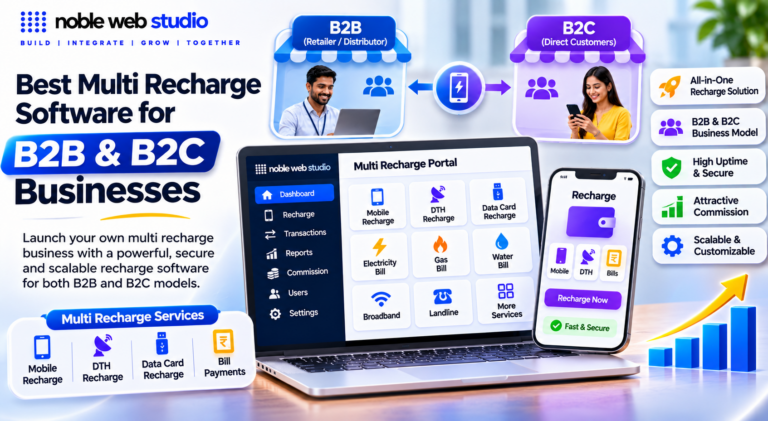
- B2B Recharge Portals: Multi-tiered web and mobile recharge platforms built for master distributors, distributors, and retail agents, featuring hierarchical accounts and automated commission slabs.
- B2C Self-Service Apps: Direct-to-consumer mobile recharge application and websites allowing individual users to top up numbers, pay bills, and manage digital wallets.
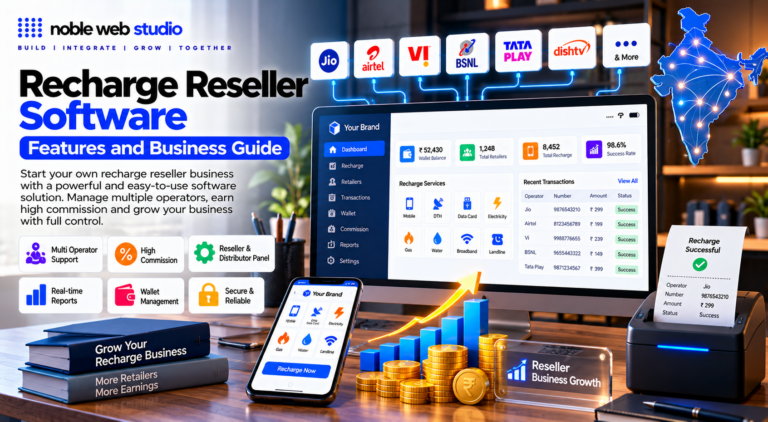
- White-Label Recharge Solutions: Ready-made, customizable recharge software package that entrepreneurs and new brands can launch under their own company name and logo.
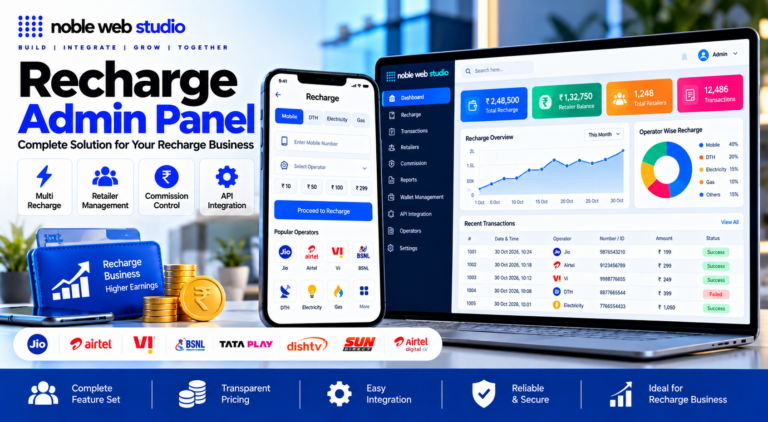
- Recharge Admin Panels: Centralized management dashboards for branded recharge platform owners to monitor live transactions, switch recharge API operators, configure margins, and generate financial reports.
- Recharge API & Developer Portals: Backend systems and developer docs with sandbox keys and webhooks that let third-party websites embed instant recharge functionality.
- BBPS & Utility Bill Payment Systems: Integrated recharge platform connected to the Bharat Bill Payment System (BBPS) for electricity, water, gas, broadband, and landline bills.
- Custom Digital Wallet & Ledger Systems: Closed-loop or semi-closed wallet modules with built-in instant refund handlers for failed or dropped transactions.
The Development Lifecycle: From Planning to Deployment
A multi-recharge software development lifecycle (SDLC) is a structured process that transforms an idea for a centralized digital payment and top-up recharge earning platform into a live, scalable production system.
1. Planning and Requirement Analysis
- Define Business Model: Choose between a B2C (self-service app for individual end-users) or a B2B model featuring multi-tier hierarchies like Mobile recharge Admin, Master Distributors, Distributors, and Retailers.
- Compliance & Legal Scope: Outline mandatory Know Your Customer (KYC) documents, business registration proofs, financial/banking compliance, and Noble web studio agreements.
- Feature Scope & Architecture: Plan core capabilities like real-time wallet management, multi-level commission structures, and multi-currency or multi-language support.
2. UI/UX Design and Prototyping
- Role-Based Wireframing: Build distinct, intuitive dashboards for the Mobile recharge Admin, Distributors, Retailers, and End-Users.
- Transaction Flow Optimization: Design low-friction checkout steps (e.g., Select Operator → Enter 10-digit Mobile Number → Choose Plan → Pay).
3. Core Development and API Integration
- Tech Stack Selection: Build the frontend using frameworks like React.js, Angular, or Flutter, backed by a scalable server side (such as Node.js) and databases.
- Third-Party Integrations: Connect to telecom operators, DTH service providers, and utility networks via APIs, alongside payment gateways like UPI and digital wallets.
- Security Guardrails: Secure sensitive data by storing Recharge API credentials and secret keys strictly on the server rather than exposing them in front-end code.
4. Testing and Quality Assurance
- Transaction & Fault Testing: Simulate server timeouts, high network latency, and dropped packets to verify that automated refund and auto-reversal mechanisms work without ledger mismatches.
- Load & Uptime Testing: Stress-test the system to ensure it handles concurrent distributor and retail transactions with high uptime.
5. Deployment and Maintenance
- Cloud Infrastructure: Host the platform on scalable cloud environments like AWS or Google Cloud.
- Modular Scaling: Mobile Recharge software Design the system so adding new utility operators, additional retailer accounts, or best mobile recharge commission app does not break existing interfaces.
- Ongoing Operations: Monitor transaction logs, track fast mobile recharge API rate limits, and apply security patches or feature updates.
Multi Recharge Software Development Cost in India
The cost structure for multi-recharge software ranges from ₹3,999 to over ₹2,00,000+ for turnkey white label recharge software package, and can scale up to ₹50,000 – ₹3,00,000+ (or $15,000–$85,000+ globally) if built completely custom from scratch.
1. Ready-Made / White-Label Turnkey Packages (One-Time Cost)
Most businesses launch using pre-built white-label multi recharge platform rather than coding from scratch. Typical pricing tiers in India include:
Entry-Level / Basic Packages (₹3,999 to ₹15,000):
- Single or limited operator support
- Basic Recharge admin panel and web/app interface
- Minimal API integration
Standard B2B / White-Label Packages (₹25,000 to ₹50,000):
- Branded website, Android app, and central admin control
- Multi-level hierarchy (Retailers, Distributors, Master Distributors)
- Multi service recharge API and basic BBPS (Bharat Bill Payment System) integration
Advanced / Enterprise White-Label Packages (₹75,000 to ₹2,00,000+):
- Custom domain and white-label branding rights
- Unlimited Recharge API, payment gateway integration, FASTag, LIC, and gas utility modules
- Reseller rights and priority/24×7 support
2. Custom-Built Software Cost Breakdown (From Scratch)
If you hire a dedicated recharge software development team to build a proprietary multi-recharge ecosystem (App, Web Portal, Mobile Recharge Admin Panel, Wallet, and APIs), costs are broken down by component:
- Recharge & Utility APIs: ₹20,000 – ₹30,000 (per operator/Recharge API setup)
- Payment Gateway Integration: ₹5,000 (gateway fee) + ₹30,000 – ₹50,000 (custom recharge API & webhook integration)
- UI/UX Design & Architecture: ₹15,000 – ₹50,000 (multi-role Recharge dashboard for admin, distributors, retailers)
- Web & Mobile App Development (Android/iOS): ₹50,000 – ₹1,50,000+ (depending on native vs. cross-Standard Recharge platform frameworks)
- Domain & Cloud Hosting: ₹10,000 – ₹20,000 per year (VPS/Dedicated server, SSL security, and database backups)
3. Recurring & Ongoing Costs (Post-Launch)
The initial build is only a fraction of total ownership. Budget separately for recurring expenses:
- Server & Cloud Infrastructure: ₹2,000 – ₹10,000+ per month based on transaction volume
- SMS & OTP Gateways: Pay-per-SMS usage for user verification and transaction alerts
- API Wallet Balances / Working Capital: Floating liquidity required to process real-time operator recharges
- Maintenance, Bug Fixes, & Security Patches: 15% to 20% of the initial mobile recharge software development cost annually
- App Store Developer Fees: Apple App Store ($99/year) and Google Play Console ($25 one-time)
Core Modules to Include in the Multi Recharge Software Project Scope
A complete Multi-Recharge Software Project Scope requires breaking down the system into core user mobile recharge panel, service integrations, backend ledger engines, and administrative modules.
1. User Hierarchy & Role Management (B2B / B2C)
- Super Admin Panel: Full system control, operator configuration, profit margin setups, High speed Recharge API routing, and global reporting.
- Master Distributor / Distributor Panel: Manages downstream retailers, assigns custom commission slabs, and monitors wallet flows.
- Retailer / Agent Panel: Processes customer recharges, views live commission, and manages local cash-to-wallet loading.
- End-User / Customer App (Optional for B2C): Self-service interface for direct mobile/DTH top-ups and bill payments.
2. Core Service Integration Modules
- Mobile & DTH Recharge Module: Supports prepaid and postpaid mobile recharges (auto-detecting operator and circle) alongside DTH renewals (Airtel, Tata Play, Dish TV, Sun Direct).
- Utility Bill Payment (BBPS) Module: Integrated Bharat Bill Payment System for electricity, water, gas, broadband, and landline bills.
- Financial & Value-Added Services (VAS) Module:
- DMT (Domestic Money Transfer)
- AEPS (Aadhaar Enabled Payment System) & Micro-ATM
- FASTag recharge
- PAN Card / Insurance services
3. Wallet & Fund Management Module
- Digital Ledger: Tracks real-time credits, debits, opening/closing balances, and operational fees.
- Fund Request & Approval: Retailers request top-ups via payment gateways, UPI, or manual bank deposit proof; Admins/Distributors approve or auto-credit.
- Credit Limit / Udhar Management: Allows trusted retailers to operate under a temporary negative balance or credit threshold.
4. API & Operator Routing Engine
- Multi-API Aggregation: Connects with multiple third-party recharge and utility APIs.
- Smart Auto-Switching & Failover: Automatically routes a failed or timeout request to a Noble web studio to maintain high uptime.
- Operator & Circle Fetcher: Automatically parses mobile prefixes to identify the telecom circle and operator before payment.
5. Commission & Slab Management Module
- Tiered Commission Slabs: Configure flat-rate or percentage-based margins split across Admin -> Master Distributor -> Distributor -> Retailer.
- Operator/Plan-Wise Rules: Different margins for Jio, Airtel, VI, BSNL, and specific DTH or utility billers.
6. Transaction & Dispute Handling Module
- Real-Time Status Tracking: Distinguishes between Success, Failed, and Pending/Disputed states.
- Auto-Refund / Reconciliation: Automatically reverses funds to the retailer wallet if an operator transaction fails or times out without confirmation.
- Grievance/Dispute Ticket System: Allows agents to raise transaction complaint tickets with operator transaction IDs (RRN/Reference number) for manual audit.
7. Security, Compliance & Admin Tools
- KYC & Onboarding: Document verification (Aadhaar, PAN, GST) for agents as per regional financial regulations.
- Role-Based Access Control (RBAC) & 2FA/OTP: Secures admin and high-value wallet transfer actions.
- Audit Trails: Logs every administrative change, wallet adjustment, and commission slab modification.
Features Multi Recharge Software Development
Multi recharge software is a digital recharge platform that processes mobile, DTH, data card, and utility bill payments through a single centralized system.
Core Features
- Multi-Service & Multi-Operator Support: Handles prepaid and postpaid mobile recharges (Airtel, Jio, Vi, BSNL), DTH connections (Tata Play, Dish TV, Sun Direct), broadband/data cards, and utility bill payments (electricity, gas, water).
- Auto Operator & Circle Detection: Automatically identifies the telecom operator and service circle when a user types in a mobile number.
- API & Switch Routing: Integrates with multiple recharge and payment APIs with automated load-balancing and backup routing to ensure high uptime.
- Virtual Wallet System: Allows users, retailers, and distributors to maintain e-wallets for instant recharges, commission settlements, and balance transfers.
- Multi-Level Network Hierarchy: Supports tiered business models including Admin, Master Distributors, Distributors, and Retailers with custom commission slabs.
- Automated Failure Handling: Processes instant refunds or fund reversals to the wallet if a transaction fails due to network or operator downtime.
- Centralized Admin Dashboard: Tracks live transactions, operator margins, retailer complaints, ledgers, and automated reporting.
- White-Label Customization: Enables businesses to launch the software under their own brand identity, logo, and domain.
- Secure Payment Gateways: Integrates UPI, net banking, credit/debit cards, and popular digital wallets.
Benefits Multi Recharge Software Development
Multi-recharge software development provides a centralized, automated high volume recharge platform to handle mobile, DTH, data card, and utility bill payments through a single interface.
Key Benefits of Multi-Recharge Software
- Multi-Operator & All-in-One Support: Manage all telecom operators, DTH providers, and utility billers from one wallet and dashboard without switching platforms.
- Real-Time Transaction Processing: Deliver instant recharges and automated status updates to reduce failures and build customer trust.
- White-Label Branding: Run recharge platform under your own brand name, logo, and custom domain with ready-to-publish Android or iOS recharge commission app.
- Multi-Tier Commission Management: Create and manage distinct margins and commission structures for retailers, distributors, and master distributors automatically.
- API Integration: Connect seamlessly with telecom APIs, payment gateways, and banking API to cut down manual entry and automate fund transfers.
- Enhanced Security: Protect wallets and transactions with data encryption, secure payment gateways, and OTP-based authentication.
- Business Scalability: Easily recharge API onboard sub-distributors and retailers to expand your network and grow profit margins based on transaction volumes.
- Detailed Reporting & Analytics: Track daily earnings, commission reports, fund flows, and operator-wise success ratios from an recharge admin dashboard.
Recharge API Integration and Transaction Reliability
Recharge API integration bridges the gap between your digital platform (website, mobile app, or retail portal) and telecom/DTH network switches. In high-volume environments, achieving transaction reliability requires a rigid implementation framework. Minor infrastructure delays or network dropouts can cause problems like double-debits, stuck orders, or missing confirmations.
1. The Core Integration Process Workflow
A resilient integration avoids sending requests directly from a client-facing web page to the Noble web studio. It handles requests sequentially through a secure, backend-to-backend model:
[Customer App] ➔ 1. Input ➔ [Your Backend Server] ➔ 3. Unique Ref ID ➔ [API Provider Switch]
                      │                  ▲ (5. Webhook Callback)       │
                      ▼                  │                             ▼
               2. Validate & Bal. Check ─┘                      4. Telecom Operator
- Input Collection & Client Validation: The customer inputs the mobile number, operator, region (circle), and plans.
- Backend Validation & Wallet Lock: The backend verifies that the data is complete, validates transaction rules, and checks if your agent or retail wallet has enough funds. The wallet amount is held provisionally before firing the trusted recharge API.
- Unique ID Generation (Idempotency): The system generates a distinct internal transaction reference ID. This is critical for preventing double charges.
- API Execution: The system transmits an encrypted HTTP POST request to the Noble web studio containing your recharge API token and whitelisted server IP.
- Asynchronous Processing: The switch responds within milliseconds with an initial status code (e.g.,
SUCCESS,FAILURE, orPENDING).
2. Ensuring Transaction Reliability (System Resilience)
The true test of a top mobile recharge API is how it handles failures. Implementing these architectural patterns ensures high uptime and accurate balance management:
| Architectural Challenge | Operational Solution | Technical Implementation |
|---|---|---|
| Network Disconnection Mid-Transit | Idempotent Requests | Send your unique transaction_id in the header. If a network timeout happens and you retry the request, the Noble web studio recognizes the ID and returns the existing result instead of running a new recharge. |
| Delayed Operator Responses | Webhook Callbacks & Polling | Never let a transaction hang open indefinitely. If the initial response is PENDING, drop it into a queue. Listen for an asynchronous HTTP Webhook Callback from the Noble web studio, while running a fallback cron job that polls the Noble web studio’s status endpoint every 30 seconds. |
| Transient Errors / Dropouts | Smart Auto-Retry Queues | If the upstream switch returns a temporary server error (e.g., HTTP 503), route the request into an auto-retry queue using exponential backoff. Do not retry if the operator returns definitive errors like “Invalid Mobile Number”. |
| Ledger Discrepancies | Automated Reconciliation | Run an automated script daily at midnight. Compare your internal database logs with the Noble web studio exported transaction ledger to catch and auto-refund any silent failures or edge cases. |
3. Critical Security Considerations
- IP Whitelisting: Restrict Professional Recharge API authorization solely to your specific application server’s static IP address. Even if your recharge API keys are exposed, unauthorized servers cannot execute transactions.
- Payload Encryption: Use secure protocols (HTTPS TLS 1.3) and sign payloads with SHA-256 cryptographic hashes to prevent tampering or mid-transit balance adjustments.
- Concurrency Locking: Implement atomic database locks on user/agent wallets. This stops race conditions where multiple rapid clicks could exploit latency to drain a wallet past zero.
4. Sandbox Testing Checklist
Before switching your configuration to production, thoroughly test these four distinct states in the Noble web studio staging environment:
- Success Path: Verify that the internal wallet debits correctly, the system saves the transaction reference, and it prints clean receipt screens.
- Immediate Failure: Ensure that incorrect numbers or invalid amounts trigger immediate wallet rollbacks and show clear error messages.
- The “Pending” State: Intentionally simulate network timeouts to verify that your system drops the order into a pending queue, processes incoming webhooks, and avoids double-charging the customer.
- Duplicate Requests: Fire identical transaction packages rapidly within a 5-second window to confirm that your server filters out duplicate attempts.
Retailer, Distributor and Super Distributor Management
Multi-recharge software streamlines B2B distribution hierarchies by allowing an best recharge Admin to manage a multi-tiered sales network (Super Distributors, Distributors, and Retailers) from a single dashboard. Instead of logging into separate applications for different telecom operators, the entire downline processes mobile, DTH, and utility bill payments through one unified digital wallet infrastructure.
The Distribution Hierarchy & Roles
        [ Admin / White-Label Owner ]
                     │
         [ Super / Master Distributor ]
                     │
               [ Distributor ]
                     │
                [ Retailer ]
| Role | Network Responsibility | Core Financial Mechanism |
|---|---|---|
| Super / Master Distributor | Recruits and onboard regional Distributors. | Earns a passive master margin (typically 0.5% – 1.0%) on every transaction occurring in their entire downline network. |
| Distributor | Manages, trains, and funds localized networks of Retailers. | Buys bulk wallet balance from the Super Distributor/Admin and distributes it downward, earning a split commission override. |
| Retailer | Serves the walk-in end consumer at a physical or digital shopfront. | Executes direct recharges and BBPS bill payments. Earns the highest instant retail commission per transaction. |
Multi Recharge Software Admin Panel, Wallet and Commission Management
Multi-recharge software platforms cost around ₹5,000 to ₹15,000+ for standard recharge systems, and provide a centralized digital ecosystem for running prepaid mobile, DTH, utility, and banking services.
Admin Panel Capabilities
- Centralized Dashboard: Monitor live recharges, transaction volumes, success/failure rates, and server/API uptimes from one screen.
- Hierarchical User Management: Oversee multi-tier networks including Admin, Master Distributor, Distributor, and Retailer accounts.
- API & Operator Integration: Connect multiple telecom, BBPS, and utility APIs with automatic failover routing.
- Role-Based Access Control: Assign granular permissions to staff and support agents.
Wallet Management
- Digital E-Wallet System: Integrated wallet tracking for instant credit, debit, and balance adjustments.
- Fund Requests & Approvals: Retailers and distributors submit online fund deposit requests that the admin approves manually or via payment gateways.
- Wallet-to-Wallet Transfers: Allow upper-tier channel partners to push or transfer balance down to their sub-distributors and retailers.
- Automated Ledger & Logs: Maintain immutable double-entry style audit trails for every rupee moved inside the ecosystem.
Commission Management
- Slab-Wise Payouts: Configure different percentage-based or flat-rate commissions depending on the operator (Airtel, Jio, Vi, DTH) and service category.
- Multi-Level Margin Splitting: Automatically distribute and deduct margins across the chain (Admin → Master Distributor → Distributor → Retailer) upon transaction settlement.
- Real-Time Earnings Tracker: Generate automated commission and profit-loss statements daily, weekly, or monthly.
Multi Recharge Software Security and Maintenance Requirements
Multi-recharge software handles sensitive financial data and live transactions, making strict security and maintenance protocols essential from initial mobile recharge software development through long-term operation.
Security Requirements
- Data Encryption: Apply end-to-end encryption (SSL/TLS) for data in transit and strong encryption standards for sensitive customer and transaction data at rest.
- PCI-DSS Compliance: Ensure payment gateways adhere to Payment Card Industry Data Security Standards (PCI-DSS) for processing credit cards, debit cards, and digital wallets.
- Authentication & Access Control: Implement Multi-Factor Authentication (MFA) for user and admin logins, alongside role-based access permissions (RBAC) so administrative privileges remain restricted to authorized personnel.
- Backend API Protection: Keep mobile recharge API credentials, operator secrets, and gateway keys strictly on the backend; never expose secrets in public-facing website code or mobile app packages.
- IP Whitelisting & Fraud Detection: Use IP restrictions for critical admin panels and automated monitoring systems to flag abnormal transaction patterns.
- Input Validation & Protected Logs: Validate all user and reliable mobile recharge API inputs to prevent injection attacks, and maintain tamper-evident, protected system logs.
Maintenance Requirements
- Regular Dependency & API Updates: Keep recharge commission software libraries, server frameworks, and telecom/DTH operator APIs updated to prevent vulnerabilities and service disruptions.
- Automated Backups & Disaster Recovery: Schedule regular automated database and system backups, and periodically test restoration procedures to ensure business continuity.
- Platform & Service Expansion Planning: Review and scale security rules whenever adding new utility or payment integrations to protect growing transaction workflows.
- Incident Response Protocol: Establish a clear workflow for detecting, investigating, and resolving security alerts or failed transaction anomalies.
- Formal Maintenance Agreement: Outline response times, defect fixes, update cycles, and support terms in a written service-level or maintenance contract with Noble web studio.
How to Compare Multi Recharge Software Development Companies
Comparing multi-recharge software development companies requires evaluating their technical capabilities, Recharge API integrated, commission structures, and post-launch support.
1. Core Service & API Integrations
- Recharge Scope: Check if the high recharge earning platform covers mobile (prepaid and postpaid), DTH, data cards, electricity bills, gas, water, FASTag, and insurance premiums.
- API Quality & BBPS: Confirm whether they integrate Bharat Bill Payment System (BBPS)-ready APIs and auto-detect telecom operators and circles in under 3 seconds.
- Offline/SMS Support: Look for fallback features like SMS-based recharge capabilities for low-connectivity zones.
2. Multi-Tier Management & Commission Engine
- Hierarchy Controls: Ensure the software allows you to build distinct panels for Administrators, Master Distributors, Distributors, Retailers, and Customers.
- Commission Flexibility: Verify automated multi-level commission and margin-sharing structures (e.g., customizable percentage or flat-rate splits).
- Real-Time Reporting: Look for comprehensive ledger management, balance tracking, and automated failure/refund logs.
3. Development Model & Transparency
- In-House vs. Outsourced: Ask if the Noble web studio build recharge software with an in-house team or relies on blind third-party outsourcing.
- Source Code vs. White Label: Clarify if you are getting a white-label rental/license or full source-code ownership.
- Pricing & Hidden Costs: Demand a clear written quote covering setup fees, server hosting, Recharge API wallet integration costs, and annual maintenance contracts (AMC).
4. Security & Error Handling
- Transaction Reliability: Test how the branded mobile recharge platform handles pending, dropped, or failed transactions, and whether it has auto-refund mechanisms.
- Security Standards: Check for data encryption, role-based access control, and secure wallet/payment gateway connections.
5. After-Sales Support & Demos
- Technical Support SLA: Confirm availability for 24/7 or prompt technical assistance when operator APIs or gateway links go down.
- Live Sandbox / Demo: Always request a working trial or live demo of the admin and retailer recharge panel before making a financial commitment.
Budget Planning for Recharge Software Development
Budget planning for mobile recharge software requires dividing costs across phases, technical features, and ongoing maintenance.
Key Cost Breakdown & Estimates (India Market)
- Pre-Built / White-Label Solutions: ₹10,000 to ₹3,00,000+ depending on customization, multi operator mobile recharge API connections, and white label mobile recharge software branding.
- Custom Mobile App / Portal Development: ₹75,000 to ₹25,00,000+ depending on whether you build a simple MVP or a multi-tier distributor/retailer network.
Core Architecture & Features to Budget For:
- User & Agent Panels: Web dashboard, Android/iOS app, and retailer/distributor commission management.
- API Integrations: Multi operator mobile recharge API (DTH, mobile, utility bill payments) and payment gateway integration.
- Wallet & Ledger System: Real-time balance updates, credit/debit logs, and failed/pending transaction handlers.
Phase-Wise Budget Structure
1. Discovery & Scope (5%–10% of budget):
- Define core workflows, gather stakeholder rules, write product requirements, and build a clickable prototype.
2. First Release / MVP (40%–50% of budget):
- Build core recharge flows, user authentication, basic wallet logic, and primary operator recharge API hooks.
3. Iteration & Testing (15%–20% of budget):
- Fix bugs identified during user testing and add high-demand features.
4. Contingency / Reserve (10%–15% of budget):
- Keep a separate reserve fund for recharge API documentation changes, regulatory updates, or unexpected design tweaks.
5. Running & Maintenance Costs (Ongoing Monthly/Yearly):
- Crucial oversight: Budget monthly for cloud server hosting, SSL, security patches, Android/iOS OS updates, and emergency bug fixes.
Preparing Your Recharge Platform for Growth
Growing a mobile recharge and utility bill platform requires upgrading technology, expanding service offerings, and strengthening security and trust.
Core Growth Strategies
- Expand Multi-Service Offerings: Move beyond basic mobile top-ups to include DTH recharges, utility bill payments (electricity, water, gas), Domestic Money Transfers (DMT), and Aadhaar Enabled Payment Systems (AePS) using unified balances.
- Integrate Reliable APIs: Partner with Noble web studio to ensure real-time transaction routing, high uptime, and instant failure refunds.
- Upgrade Software & White-Label Solutions: Transition to a scalable B2B/B2C architecture featuring an intuitive user web portal, a dedicated Android/iOS mobile app, and a robust recharge admin panel to track commissions and agent hierarchies.
- Enhance Payment Gateways & Security: Implement high-grade SSL encryption, DSS certification, and diverse payment gateway options (UPI, credit/debit cards, net banking) to build customer confidence.
- Complete Legal & KYC Compliance: Formalize your business structure (sole proprietorship, partnership, or private limited), obtain necessary trade licenses, and strictly enforce KYC guidelines for bill payment or retail agents.
Platform Framework Comparison
| Growth Area | Traditional / Basic Setup | Scaled / Growth-Ready Setup |
|---|---|---|
| Services | Single mobile prepaid top-up | Multi-utility bills, DTH, AePS, and money transfer |
| Architecture | Manual or single-vendor routing | Multi-recharge API integration with automated failovers |
| User Interface | Basic web form | Dedicated mobile app + responsive web dashboard |
| Business Model | B2C direct-only | Hybrid B2B/B2C agent network with tier commissions |
Custom vs. White Label Multi Recharge Software: Which Is Better?
White label multi-recharge software is usually better for most businesses because it offers a fast launch time, lower upfront costs, and built-in maintenance, whereas custom mobile recharge software is only better if you need unique, proprietary workflows and have a large development budget.
White Label Multi-Recharge Software
- Best for: Businesses, startups, or entrepreneurs who want to start a B2B/B2C mobile recharge, utility, and bill-payment platform quickly under their own brand.
Pros:
- Fast Launch: Ready made recharge platform with pre-integrated recharge API (recharge, BBPS, etc.), a website, and an Android mobile recharge commission app that can go live in days.
- Lower Cost: Inexpensive one-time or subscription pricing (typically ranging from ₹7,500 to ₹25,000 INR depending on the tier) compared to building from scratch.
- Zero Maintenance: The Noble web studio handles server hosting, security patches, bug fixes, and telecom operator updates.
Cons:
- Limited Control: You are restricted to the features, UI options, and configurations provided by the Noble web studio.
- Noble web studio Dependency: You rely on the Noble web studio for core system stability, updates, and long-term support.
Custom Multi-Recharge Software
- Best for: Established fintech companies or large enterprises with specific, non-standard business logic, proprietary architecture, or unique compliance needs.
Pros:
- Complete Ownership & Control: You own the source code outright and can design every screen, database structure, and user rule from the ground up.
- Unique Scalability: Built specifically to scale around your exact operational demands without being bound by a third-party template.
Cons:
- High Cost: Requires a massive initial capital expenditure (CapEx) for development, often starting at tens or hundreds of thousands of dollars/rupees.
- Slow Time-to-Market: Takes months to design, code, test, and debug before your first retailer or customer can use it.
- Ongoing Maintenance Burden: You must retain an in-house development or IT team permanently to handle security updates, bug fixes, and shifting operator recharge API guidelines.
Summary Comparison
| Feature | White Label Software | Custom Software |
|---|---|---|
| Time to Market | Days | Months |
| Initial Cost | Low (₹7,500 – ₹25,000+ INR) | Very High |
| Customization | Branded (Logo, colors, domain, preset commission tiers) | Unlimited / Tailored to exact specs |
| Maintenance | Handled by the Noble web studio | Managed by your own Noble web studio team |
| Recommended For | Resellers, new networks, and fast market entry | Large enterprises with custom tech requirements |
Noble Web Studio One Of The Best Multi Recharge Software Development Company
Noble Web Studio one of the best multi-recharge software development company requires evaluating core technical capabilities, commercial transparency, and long-term operational support.
Key Factors to Consider
- Multi-Operator & Service Coverage: Ensure the recharge b2b platform supports all major telecom operators (Prepaid/Postpaid), DTH providers, Data Cards, Bill Payments (BBPS), and extra financial or utility services like AEPS or money transfers.
- Single API & Automatic Failover (Routing): Look for a Noble web studio offering a unified single recharge API with intelligent automatic route switching or failover mechanisms. If one recharge gateway fails, the system should instantly switch to a working operator to keep your transaction success rate high.
- White-Label & Customization Options: The mobile recharge admin software should allow you to run mobile recharge portal, web app, and Android app under your own brand name, domain, custom logos, and tiered commission structures (Master Distributor, Distributor, Retailer).
- Transaction Uptime & Speed: Real-time transaction processing and high system uptime are non-negotiable. Slow or hanging recharges destroy customer trust and choke cash flow.
- In-House Development Team: Noble web studio that build and maintain recharge software with an in-house team rather than those who blindly outsource or act as middle-men. An in-house team can roll out custom updates and fix recharge admin API changes faster.
- Transparent Pricing & Cost of Ownership: Avoid vague flat-rate quotes without scope definition. Demand an itemized quote detailing the one-time mobile recharge API setup fee, hosting, ongoing maintenance, support ticket terms, and any per-transaction or wallet-transfer fees.
- 24/7 Technical Support & After-Sales Service: Technical glitches can happen at any hour. Choose a Noble web studio with reliable, responsive, around-the-clock technical support.
- Security & Compliance: Ensure recharge platform implement robust wallet security, encrypted databases, secure payment gateways, and necessary regulatory or compliance standards.
Why Choose Noble Web Studio for Multi Recharge Software Development?
Choosing a Noble web studio for Multi Recharge Software Development gives your business a centralized, automated, and scalable recharge platform to manage multiple telecom, DTH, and utility services through a single interface.
Key Reasons to Choose a Noble web studio
- Centralized Service Management: Consolidate mobile (prepaid/postpaid), DTH, data cards, FASTag, and utility bill payments into a single dashboard without switching between multiple systems.
- Pre-Integrated Operators & APIs: Save time and recharge software development cost using top recharge software already connected to major telecom operators, DTH networks, and payment gateways (UPI, net banking, wallets).
- Multi-Tier Role Management: Get custom recharge panel for administrators, master distributors, distributors, and retailers, allowing you to build and manage a complete agent network.
- Automated Commission & Wallet System: Track real-time transactions, manage multi-level commission structures per operator and circle, and automate wallet balance updates.
- Custom Business Workflows: Unlike rigid out-of-the-box templates, custom recharge software development lets you define specific approval steps, transaction limits, branding, and reporting formats.
- Security & Reliability: Professional developers deliver bug-fixed, encrypted platforms with fast mobile recharge API response times to prevent transaction failures and secure user data.
- Scalability & Technical Support: Ensure continuous system maintenance, updates for new utility billers or telecom rules, and dedicated tech support as your transaction volume grows.
Conclusion
Choosing the right Multi Recharge Software Development Company is an important step for businesses that want to launch or expand their online recharge business. The right recharge software should help you manage multiple recharge services, simplify daily operations, track transactions, manage retailer and distributor accounts, and provide a smooth experience for users. Before selecting a mobile recharge software development company, compare its features, customization options, mobile recharge API integrated capabilities, security measures, technical support, and total cost.
Noble web studio is a multi recharge software development company builds white-label, all in one recharge platform that allow businesses to run their own mobile, DTH, utility bill payment, and money transfer services under their own brand.
Noble Web Studio develops ready made B2B Mobile Recharge Software for businesses looking to establish or grow their reliable recharge platform. Depending on your selected recharge business software version and required integrations, you can plan a solution for mobile recharge, DTH recharge, FASTag, and other supported digital services. Whether you are a startup, retailer network operator, distributor, or entrepreneur, discuss your business requirements before deciding which features recharge platform needs.
If you are looking for a Noble web studio is a Multi Recharge Software Development Company that can help you plan your next recharge software project, connect with Noble Web Studio to discuss the available solution, required integrations, customization options, and pricing. Choose high volume recharge software based on your actual business needs, not just a long list of advertised features, so you can make an informed decision for your long-term growth.
Ready to start your recharge software business? Contact Noble Web Studio to discuss your requirements and explore the right B2B Mobile Recharge Software solution for your business.
Multi Recharge Software Development Company with Noble Web Studio
Looking for a reliable Multi Recharge Software Development Company? Contact Noble Web Studio to discuss multi-recharge software, retailer and distributor panels, white-label solutions, and features tailored to your business requirements.