Ankit
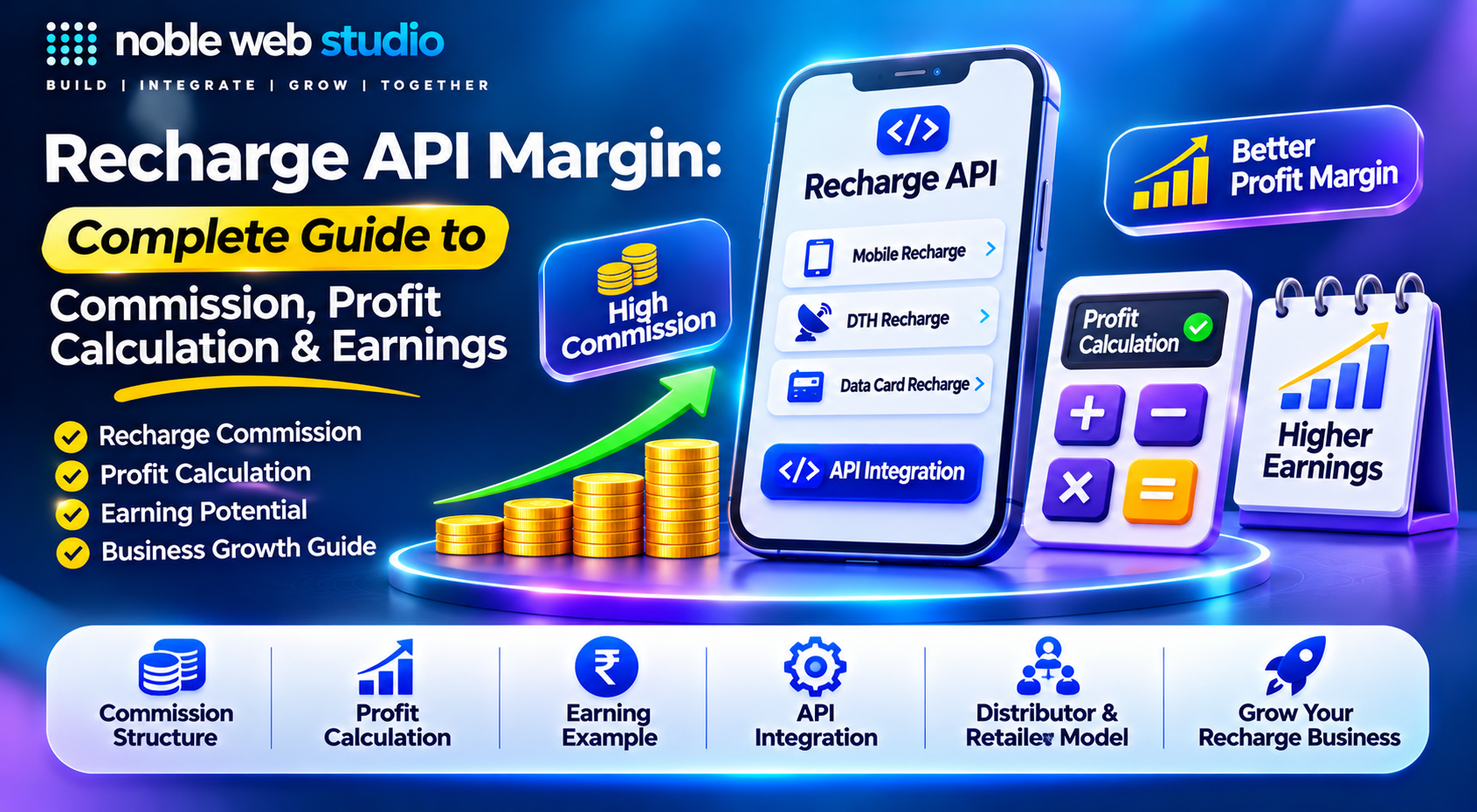
Recharge API Margin is one of the most important factors to consider before starting or expanding a mobile recharge business in India. Whether you are a retailer, distributor, master distributor, fintech startup, or recharge software provider, understanding how recharge API margins work can help you plan your commission structure, manage business expenses, and identify opportunities to increase your earnings. A recharge API connects your website, mobile application, or B2B recharge portal with Noble web studio, allowing you to process mobile, DTH, and other supported recharge transactions while earning commission according to the applicable commercial agreement.
Recharge API margins in India represent the commission percentage or flat amount retained by recharge platform owners, distributors, or recharge API integrate after transactions are processed through telecom and utility operators.
However, earning from a recharge API involves more than simply receiving a commission on every transaction. Your actual Recharge API Margin depends on operator-wise commission rates, transaction volume, retailer and distributor commission sharing, recharge API charges, wallet management, and successful transaction settlements. For example, if your business receives a commission on a successful recharge, the amount you retain after sharing commissions with your business partners and covering applicable expenses determines your actual earnings. Understanding this difference between gross commission, retained margin, and net profit is essential for building a sustainable recharge business.
With Noble Web Studio, businesses can explore ready-made B2B Mobile Recharge Software designed to support retailer, distributor, and multi-level business operations. The recharge software helps manage recharge transactions, commission distribution, wallet balances, user accounts, and business activities through a centralized mobile recharge platform. Whether you want to start a new recharge business, build your own branded recharge platform, or expand your existing retailer network, choosing the right recharge API and commission management system can help you manage your business more efficiently.
In this guide, you will learn how Recharge API Margin works, how to calculate recharge commission, what factors affect retailer and distributor earnings, how recharge API providers structure their margins, and how to manage your recharge business for better profitability. You will also understand what to check before choosing a recharge API provider so that you can make informed business decisions instead of relying only on advertised commission rates.
What Is Recharge API Margin?
A recharge API margin is the percentage-based or flat-rate commission retained by a platform, distributor, or retailer from a mobile, DTH, or utility recharge transaction after accounting for provider splits and direct fees.
How Does Recharge API Margin Work?
A recharge API margin is the financial gain or commission retained from a prepaid mobile, DTH, or utility recharge transaction after subtracting partner payouts, mobile recharge API charges, and operational costs.
How the Recharge API Margin Flow Works
Upstream Commission from Operators/Aggregates
- When a customer completes a recharge through best mobile recharge platform, the telecom or utility operator passes down a base commission (typically structured as a percentage of the recharge value or a flat fee).
- Example: Mobile recharge margins generally range from 1% to 4%, DTH margins range from 2% to 3%, and bill payments via BBPS range from 0.5% to 2%.
The Multi-Level “Spread” (B2B2C Model)
- If you run a reseller, white label recharge software, or multi-level distributor network (Admin → Master Distributor → Distributor → Retailer), the commission is sliced across tiers:
- Your gross margin is the spread—the difference between the commission rate given to you by the upstream Noble web studio and the lower commission rate you pass down to your sub-distributors or retailers.
- Example: Noble web studio gives you a 3.5% commission on a ₹500 recharge (₹17.50 gross), and you share 2.5% (₹12.50) with your retailer, your retained margin is 1.0% (₹5.00).
Deducting Hidden Costs & Friction
- Your headline percentage is not your net profit. To calculate your true working margin, you must subtract:
- Wallet loading or payment gateway fees used to maintain recharge API balance.
- Per-transaction or monthly subscription fees charged by the Noble web studio.
- Failed, pending, or reversed transactions (if refunds or gateway locks chew up liquidity).
Mobile Recharge API Margin by Operator
Mobile recharge API margins in India typically range from 1% to 4% for prepaid mobile operators, 2% to 3% for DTH, and 0.5% to 2% for BBPS bill payments.
Average Commission Margins by Operator
Margins vary depending on the Noble web studio and your volume-based plan (e.g., Basic vs. Gold tiers):
| Operator / Service | Typical API Margin Range | Example Plan Rates |
|---|---|---|
| BSNL | 3.5% – 6.5% | 5.0% to 6.50% |
| Vi (Vodafone Idea) | 3.0% – 4.5% | 3.5% to 4.10% (Idea) |
| Jio | 2.5% – 3.5% | 2.80% to 3.20% |
| Airtel | 2.0% – 3.3% | 2.00% to 3.30% |
| DTH Recharge | 2.0% – 3.0% | Varies by provider (Tata Play, Dish TV, etc.) |
| BBPS Bill Payments | 0.5% – 2.0% | Varies by utility board |
How Recharge API Margin Is Calculated
Recharge API margin is calculated by subtracting downstream partner payouts and direct transaction charges from the gross commission earned on a successful recharge. While gross commission is the headline percentage offered by Noble web studio, your actual retained margin often called the “spread” reflects what your business keeps after sharing commissions with distributors or retailers and paying operational fees.
The Step-by-Step Margin Formula
To find your true earnings per transaction or over a billing cycle, calculate your margin in three stages:
1. Gross Commission. Multiply the eligible transaction value by the operator-specific commission percentage provided by Noble web studio.
Formula:
Gross Commission = Transaction Amount × (API Commission % / 100)
2. Commission Spread (If Using a B2B2C Network). If you distribute recharges through sub-dealers or retailers, subtract the commission slab you pass down to them.
Formula:
Commission Spread = Gross Commission − Partner/Retailer Payout
3. Net Retained Margin. Deduct direct transaction costs, such as per-best recharge API hit fees, payment gateway charges, or wallet-loading fees.
Formula:
Net Margin = Commission Spread − Direct Transaction Fees
Sample Calculation
Suppose a customer completes a ₹1,000 mobile recharge on your platform Noble web studio offers a 3.2% commission, you pay your retailer 2.5%, and you incur a ₹0.50 per-transaction API/gateway fee:
- Gross Commission. ₹1,000 × 3.2% = ₹32.00
- Retailer Payout. ₹1,000 × 2.5% = ₹25.00
- Direct Transaction Fee. ₹0.50
- Net Retained Margin. ₹32.00 − ₹25.00 − ₹0.50 = ₹6.50 (an effective net margin of 0.65%)
Factors That Affect Recharge API Margin
Recharge API margins are determined by a combination of gross commission structures set by telecom/utility operators, downline distribution splits, and hidden operational costs.
Key Factors That Affect Recharge API Margin
- Operator-Wise Commission Rates: Base margins vary significantly depending on the telecom or DTH services. For example, margins on providers like BSNL often range higher (3.0% to 6.5%), while major operators like Jio and Airtel generally offer tighter baseline percentages (typically 0.7% to 3.2%).
- Service-Wise Revenue Mix: Different service categories yield distinct margins. Prepaid mobile recharges, DTH top-ups, and Bharat Bill Payment System (BBPS) utilities (such as electricity, water, or gas bills) carry different commission slabs with bill payments often offering lower flat or percentage margins (0.1% to 2%) compared to mobile or DTH recharges.
- Tiered Distribution & Retailer Payouts (“The Spread”): If you operate a multi-tier B2B2C model, your net margin depends on the spread the difference between the commission rate received from the Noble web studio server and the portion passed down to master distributors, distributors, and retail agents. Higher payouts to retailers attract more partners but shrink your retained cut.
- API Pricing and Subscription Models: The upfront and recurring costs charged by the Noble web studio directly erode gross earnings:
- One-time setup fees
- Per-transaction charges
- Monthly subscription or platform fees (which charge you even during low-volume months)
- Transaction Failure, Pending, and Refund Ratios: Failed, stuck, or delayed recharges that require manual intervention, customer support overhead, or reversal adjustments can wipe out thin commission margins on high-volume routes.
- Wallet Loading and Payment Gateway Charges: Fees incurred when adding funds to your API wallet or processing merchant loads reduce your net profitability per transaction.
- Transaction Volume and Negotiated Tiers: Higher daily and monthly transaction volumes give you leverage to negotiate better slab rates, tier upgrades (such as Basic, Gold, or Platinum plans), and custom commercial terms from Noble web studio.
Recharge API Margin in Different Business Models
Recharge API margin is the net commission or commercial spread a business retains from a transaction after paying upstream fees and sharing commissions with downstream partners. In India, gross industry commissions generally range from 1% to 4% for mobile recharges, 2% to 3% for DTH, and 0.5% to 2% for BBPS utility bills, though actual net earnings vary sharply depending on your business model.
Margin Structure by Business Model
Different roles in the telecom and fintech distribution chain earn money in distinct ways:
| Business Model | How Margin Is Earned | Typical Margin Share | Key Cost Drivers |
|---|---|---|---|
| B2C App / Consumer Portal | Keeps 100% of the API commission, often using part of it to fund user cashbacks or rewards. | Full API rate (e.g., 1%–4%) minus customer discounts. | Payment gateway fees (1.5%–2%), customer acquisition, and cashback offers. |
| White-Label Admin / Platform Owner | Earns the spread—the difference between the upstream API rate and the commission given to distributors/retailers. | 0.20% to 1.00% per transaction across high network volume. | Software licensing, server hosting, customer support, and GST/TDS compliance. |
| Master Distributor / Distributor | Earns an override commission on every recharge processed by their onboarded retailer network. | 0.15% to 0.50% per transaction from downline volume. | Retailer onboarding, field sales, and working capital management. |
| Retailer / Kirana Store | Earns a direct flat or percentage commission on each walk-in customer recharge. | 1.5% to 3.5% depending on the telecom or DTH operator. | Minimal overhead; relies on foot traffic and multi-service cross-selling. |
| API Reseller / Aggregator | Buys high-volume bulk API access at top-tier rates and resells API endpoints to smaller portals. | 0.10% to 0.50% spread plus setup or monthly API subscription fees. | Technical infrastructure, uptime SLAs, and bulk wallet liquidity. |
How Recharge Software Helps Manage Margins
Recharge software and Recharge API platform help businesses track, control, and optimize profit margins through automated commission structures, multi-tier partner allocations, and real-time transaction reconciliation.
Key Ways Recharge Software Manages Margins
- Commission Configuration & Slab Management: Allows b2b recharge platform owners to set tier-based or volume-based commission structures for different services (such as mobile prepaid, DTH, and utility/BBPS bills) and partner levels (retailers vs. distributors).
- Retailer & Distributor Allocations: Automatically calculates and splits margins across downline networks, ensuring that retailer payouts attract partners while retaining enough net revenue for the platform host.
- Transaction-Level Tracking & Ledger Management: Links every transaction to its reference code, status, and associated wallet debits/credits to eliminate leakage, manual errors, or unrecorded failures.
- Settlement Reconciliation: Compares expected commissions against actual payouts or credits reported by Noble web studio, flagging discrepancies immediately.
- Service-Wise Revenue Mix Analysis: Tracks profitability per category (e.g., higher-margin utility and bill payments vs. lower-margin mobile top-ups) so businesses can shift focus toward more lucrative services.
- Network Scaling (App to Software Upgrade): Moving from a basic standalone app to full multi-user recharge admin software enables higher commission tiers (often scaling from ~2.5%–5% up to 4%–7.5% or higher depending on volume) as monthly transaction volume increases past baseline thresholds.
Prepaid, Postpaid and DTH Recharge Commission
Check current retailer and recharge API commission structures for prepaid mobile, postpaid bill payments, and DTH recharges across major Indian operators and multi recharge platform:
1. Typical Mobile Prepaid Commission Rates
Retailer and recharge API commission percentages vary by operator and the chosen plan slab (typically ranging from 0.7% to 4.5%):
- BSNL Prepaid: ~3.5% to 4.5%
- Vi (Vodafone Idea) Prepaid: ~3.0% to 4.0%
- Airtel Prepaid: ~1.3% to 3.0%
- Jio Prepaid: ~0.7% to 2.0%
2. DTH Recharge Commission Rates
DTH operator commission rates generally range from 2.6% to 4.5% depending on the Noble web studio:
- Videocon d2h: ~3.6% to 4.2%
- Dish TV: ~3.6% to 4.5%
- Airtel Digital TV: ~3.5% to 4.5%
- Sun Direct: ~3.3% to 4.5%
- Tata Play (formerly Tata Sky): ~2.6% to 4.5%
3. Postpaid Bill Payment Commission
- Mobile Postpaid Bills: Typically 0% commission on standard utility/postpaid payment APIs, though some promotional retailer slabs or cash-back programs may offer minor incentives.
Retailer, Distributor and Master Distributor Margin Structure
In a multi level recharge API and recharge software system (Master Distributor → Distributor → Retailer), commissions flow downward from the Noble web studio, and the profit margin is distributed as a “spread” across each tier.
Typical Commission & Margin Structure
| Service Type | API / Admin Rate | Master Distributor Margin / Override | Distributor Margin / Override | Retailer Commission |
|---|---|---|---|---|
| Mobile Prepaid | 3.5% – 5.0% | 0.25% – 0.5% | 0.5% – 1.0% | 1.0% – 4.0% |
| DTH Recharge | 4.5% – 6.0% | 0.25% – 0.5% | 0.5% – 1.0% | 2.0% – 3.0% |
| Electricity / Utility Bills (BBPS) | 1.0% – 2.0% | 0.10% – 0.25% | 0.25% – 0.5% | 0.5% – 2.0% |
| Postpaid Bills | 2.0% – 3.0% | 0.15% – 0.25% | 0.30% – 0.5% | 1.0% – 2.0% |
| Money Transfer (DMT) / AePS | Flat / % slab | Flat ₹1–₹2 per ₹1000 | Flat ₹2–₹5 per ₹1000 | Flat ₹5–₹10 per ₹1000 |
Breakdown by Tier
Retailer (End Agent):
- Role: Processes direct recharges and bill payments for end customers through a mobile recharge commission app or web portal.
- Margin: Earns the bulk of the direct commission per transaction (typically 1% to 4% on mobile recharges and 2% to 3% on DTH).
- Earnings Model: Volume and direct customer count-based.
Distributor (Sub-Distributor):
- Role: Onboards, manages, and supports a network of retailers in a local or regional area.
- Margin: Earns a differential spread (override commission) of 0.5% to 1.5% above the retailer rate (or roughly 0.5% net profit per transaction processed by their downline retailers).
- Earnings Model: Generates passive/override income from active retailer transactions (e.g., a distributor managing 15–30 active retailers typically makes ₹15,000 to ₹40,000+ per month).
Master Distributor / Super Distributor:
- Role: Oversees multiple distributors or manages state/national expansion channels.
- Margin: Earns an upper-tier override of 0.25% to 0.75% above the distributor level.
- Earnings Model: High-volume network accumulation across multiple districts or states, often supporting white-label branding options.
Practical Ways to Improve Recharge API Margin
To improve your recharge API profit margins, you need to combine better commercial negotiations with strict operational efficiency and service diversification.
1. Negotiate Volume-Based Slabs & Multi-Operator Routing
- Leverage Verified Data: Track your actual monthly transaction volumes and success rates, then approach Noble web studio or switch to a hybrid multi operator recharge API switch to negotiate higher commission slabs.
- Smart Routing: Use an Noble web studio that implements automatic backup routes and intelligent switching. If a primary operator route drops margin or experiences high failure rates, dynamic routing shifts traffic to a better-performing upstream channel.
2. Diversify Your Service-Wise Revenue Mix
- Go Beyond Basic Mobile: Relying solely on prepaid mobile recharges leaves you vulnerable to razor-thin operator commissions. Expand into higher-margin or complementary services:
- DTH Recharges (Airtel Digital TV, Tata Play, Dish TV, Sun Direct)
- Utility Bill Payments via BBPS (Electricity, gas, water)
- Financial & Value-Add Services like FASTag recharges, Domestic Money Transfer (DMT), or AePS
- Track Unit Economics Separately: Monitor the net margin, commission earned, and gateway/infrastructure cost individually for every service category to trim loss-making or low-yield offerings.
3. Eliminate Operational Leakage & Support Costs
- Reduce Failed & Duplicate Transactions: Prevent duplicate hit requests and blind retries by enforcing strict server-side idempotency keys and unique transaction reference IDs.
- Automate Status Polling & Refunds: Relying on HTTP 200 responses instead of real-time status webhooks or polling can lead to stuck balances and disputed charges. Ensure automated, instant wallet refunds for failed transactions to cut down manual customer-support overhead.
- Prevent Wallet Dry-Ups: Set up low-balance alerts for your retailers and your own master balance to avoid missed-peak-hour recharges during morning/evening rushes.
4. Optimize Retailer & Distributor Payout Structures
- Restructure Tiered Commissions: If you run a B2B network with distributors and retailers, audit your payout distribution. Over-incentivizing lower tiers destroys platform net revenue; set attractive yet tightly capped commission rules backed by transparent reporting.
- White-Label & API Reselling: Scale your margin by offering white-label mobile recharge software or reselling your aggregated recharge service API to smaller third-party local businesses.
Gross Commission vs Net Profit in Recharge Business
Gross commission in a recharge business is the raw percentage or fixed reward earned from a Noble web studio on the face value of a transaction (typically 1% to 4% for retail mobile recharges), whereas net profit is the actual money left in your pocket after subtracting all operational expenses, best recharge software or mobile recharge portal subscription fees, SMS charges, and overhead costs.
Key Differences
Gross Commission
- Definition: The initial earning calculated directly as a rate or fixed commission on the recharge amount.
- Example: On ₹50,000 worth of monthly prepaid recharges at a 2% commission rate, your gross commission is ₹1,000.
- What it ignores: Does not factor in fast recharge platform/recharge API subscription costs, internet, electricity, staff, or transaction failures.
Net Profit
- Definition: Gross commission minus all direct and indirect business expenses.
- Example (Standalone Retailer):
- Gross Commission: ₹1,000
- Less Software/App Subscription or API fee: -₹200
- Less Shop Overhead (Power, Internet allocation): -₹300
- Net Profit: ₹500
- What it includes: Reflects true financial viability.
Comparison Table
| Metric | Gross Commission | Net Profit |
|---|---|---|
| Base Calculation | Face Value × Commission Rate (1–4%) | Gross Commission – Operating Expenses |
| Who Gets a Cut | May be shared across Multi-Level or Master Distributors | Retained entirely by the business owner after bills |
| Primary Focus | Measures volume and tier agreement efficiency | Measures overall business health and sustainability |
Factors That Shrink Gross Commission Down to Net Profit
- Multi-Level Cuts: If you operate via a distributor or sub-distributor hierarchy, a portion of the commission is siphoned off at higher tiers before it reaches you.
- Platform & Software Costs: Monthly charges for white label recharge software, recharge API key, or payment gateway charges.
- Operational Overheads: Shop rent, electricity, mobile data, customer support time, or failed/reversed transaction reconciliation issues.
Recharge API Charges, Wallet and Settlement Costs
Recharge API cost in India depend on the pricing model, which typically splits into setup fees, wallet loading requirements, operator commissions, and settlement terms.
1. API Charges & Setup Costs
- Setup / License Fees: Range from ₹0 to ₹10,000 for basic setups, ₹5,000 to ₹25,000 for recharge software licensing, and ₹25,000 to ₹1,00,000+ for white label mobile recharge software reseller or B2B2C panels.
- Integration & Development: Custom website, recharge commission app, or mobile recharge API integration ranges from ₹10,000 to ₹50,000+ (or higher if building full B2B/B2C systems from scratch). Noble web studio offer one-time plans (e.g., ₹3,000 to ₹5,500) with zero monthly maintenance.
- Monthly / Ongoing Fees: Noble web studio charge ₹0 monthly fees, while others or enterprise platforms charge recurring subscription or maintenance fees (ranging up to ₹45,000/year or higher depending on support).
2. Wallet & Funding Costs
- Wallet Loading: You must pre-load a working balance into your wallet via UPI, IMPS, NEFT, or RTGS before processing top-ups.
- Wallet Charges: Noble web studio do not charge extra to load money via standard bank transfers (IMPS/NEFT/UPI), though payment gateway collection channels (if you collect money from end-users online) incur standard payment gateway fees (typically around 1% to 2% or flat fees per transaction).
- Working Capital / Spread: Your profit depends on the spread the difference between the commission rate provided to you by the mobile recharge API and the lower commission you pass down to your sub-distributors or retailers.
3. Commission Margins & Settlement Structure
- Mobile Recharge Commissions: Typically range from 1% to 3.5% depending on the operator (e.g., Jio around 1%–6% depending on promotional/plan margins, Airtel ~1%, Vi ~2.56%, BSNL ~3.04%).
- DTH Recharge Commissions: Typically range from 2% to 2.56% (Tata Play, Videocon, etc.).
- Utility & BBPS Payments: Often structured with fixed cashbacks or small slab-based commissions (e.g., ₹5 to ₹20 or 0.5% to 2%).
- Settlement Timing:
- Online / Instant Settlement: Real-time wallet deduction and instant operator confirmation (standard for mobile/DTH/FASTag online processing).
- Offline / Deferred Settlement: Slower reconciliation windows (e.g., 6-hour cycles) which may carry different rate structures or higher verification dependencies with certain noble web studio hubs.
Common Mistakes in Recharge API Margin Management
Managing margins in a mobile or utility Recharge API network requires careful calculation and structural control. Several critical missteps can erode profits or cause partner churn:
Common Mistakes in Recharge API Margin Management
- Confusing Turnover with Net Income: Treating total gross transaction volume (GMV) as actual profit. You must isolate your net spread (the difference between the commission earned from the Noble web studio and what you pay out to master distributors, distributors, and retailers) after deducting fixed/variable costs.
- Setting Unsustainable Commissions: Noble web studio offering flat-rate or overly aggressive commission percentages to attract retailers without verifying operator-wise caps or slab structures. If downstream payouts exceed your upstream margins, every transaction loses money.
- Depending on a Single API: Relying on Noble web studio prone to low uptime or high failure rates. Without implementing recharge API switching (routing transactions across multiple providers), failed drops hurt customer trust and disrupt commission flow.
- Ignoring Failed, Pending, and Reversed Transactions: Failing to account for how operator timeouts, pending states, and chargebacks reconcile. Inaccurate handling of refunds or delayed wallet settlements can lock up capital or double-credit users.
- Overlooking Hidden Overheads: Forgetting to factor in server hosting, SMS/notification gateways, current account maintenance fees, and recharge API setup/wallet deposit requirements into your unit economics.
- Offering Recharge Exclusively: Relying solely on low-margin mobile recharges. Thin margins can be supplemented by integrating high-value utility and financial services like BBPS (Bill Payment System), AePS (Aadhaar Enabled Payment System), and DMT (Domestic Money Transfer).
- Poor Dispute and Support Infrastructure: Providing slow manual refund resolution or lacking transparent tracking logs for retailers, which quickly drives active agents to competitor portals.
How to Evaluate Your Recharge API Business Performance
Evaluating a recharge API business requires tracking financial health, technical reliability, and operational efficiency.
1. Financial & Profitability Metrics
True earnings depend on net margins after accounting for all fees and expenses, not just headline commission rates.
- Total Eligible Transaction Value (ETV): The total monetary volume of successful recharges processed through your platform.
- Gross Commission & Operator Margins: The recharge commission earned across different operators (such as Jio, Airtel, Vi, and BSNL) and service types (prepaid mobile, DTH). Compare full commission structures rather than peak promotional rates.
- Partner Payouts & Direct Charges: The share of commission passed down to retailers/distributors, plus direct transaction or gateway charges.
- Operating Expenses & Net Profit: Subtract hosting, support, compliance, and recharge platform maintenance costs from your gross earnings to calculate real net profit.
2. Technical & Performance Metrics
Recharge API speed and stability directly dictate customer retention and failure costs.
- Transaction Success Rate: The percentage of total recharge requests that complete successfully on the first attempt.
- API Latency & Response Time: The average and peak time it takes for the top mobile recharge API to receive a request and return a confirmation. High latency causes bottlenecks and dropped user sessions.
- Requests Per Minute (RPM) & Throughput: The volume of concurrent requests your system handles during peak vs. off-peak hours.
- Error & Failure Rates: The frequency of timeouts, network drops, or authentication errors, tracked alongside automated failure retry logic and webhook callback reliability.
3. Operational & Reconciliation Metrics
- Pending Transaction Volume: The number of recharges stuck in an intermediate state awaiting operator confirmation.
- Reconciliation Speed: The time taken to reconcile daily account logs, match operator settlements, and process automatic refunds for failed or reversed transactions.
- Uptime & Direct Connectivity: The depth of operator connectivity (direct vs. multi-hop connections) which dictates system reliability during heavy traffic loads.
How to Choose a Recharge API Provider with Better Margins
Noble web studio one of the recharge API provider with better margins, evaluate net profitability rather than just advertised peak percentages. True margins depend on operator-wise commission slabs, transaction success rates, settlement speeds, and hidden platform fees.
1. Analyze the Real Commission Structure
Headline commission rates often apply only to low-volume operators. Look closely at the complete payout breakdown before signing up.
- Operator-Wise Rates. Check individual margins for high-volume telecom operators like Jio and Airtel alongside higher-margin operators like Vi, BSNL, and DTH services.
- GST vs. Non-GST Slabs. Compare P2P (GST-inclusive) and P2A (Non-GST) commission structures to see how tax deductions impact your actual take-home margin.
- Volume-Based Tiers. Noble web studio offers slab upgrades or better rates once your daily or monthly transaction volume crosses specific thresholds.
- Service Bundling. Choose an high speed recharge API that includes higher-margin value-added services like BBPS utility bill payments, FASTag, AePS, and domestic money transfers alongside mobile recharges.
2. Prioritize Technical Reliability Over High Rates
A high commission percentage is useless if transactions fail or get stuck in pending states, as manual refunds eat into your operating profit.
- Direct Operator Pipes. Noble web studio with direct operator connectivity and automatic fallback routing to maintain a 99.9% transaction success rate.
- Fast Response and Callbacks. Noble web studio low latency and automated webhook callbacks so your system updates statuses instantly without server polling.
- Instant Refund Turnaround. Verify how quickly failed transaction amounts are credited back to recharge API wallet so your working capital does not get locked up.
3. Check Commercial Terms and Hidden Costs
As outlined in the Noble web studio Profit Guide, calculating net earnings requires accounting for all operational costs.
- Setup and Wallet Fees. Check for one-time mobile recharge API setup charges, annual maintenance fees, minimum wallet balance locks, or payment gateway charges when adding funds.
- Distributor Controls. If you run a B2B network, verify that the b2b recharge software allows configurable commission rules so you can easily set margins for sub-retailers and distributors.
- Transparent Agreements. Noble web studio gives you a written commission list and clear contract terms regarding sudden rate revisions.
4. Test Before Committing Capital
Before depositing large sums into an mobile recharge API wallet, follow a structured verification checklist like the one recommended by Noble web studio.
- Sandbox Testing. Request free sandbox credentials and clear recharge API documentation to test request flows and webhook callbacks.
- Live Pilot Runs. Perform small live recharges across different operators during peak hours to check actual speed and success rates.
- Support Responsiveness. Raise a test ticket or call support during off-hours to verify that technical help is available when live transactions fail.
Recharge API Integration Solutions with Noble Web Studio
Noble web studio is a reliable Recharge API integration solution allows businesses, portals, and retailers to automate Choosing the Noble web studio for Recharge API Integration Solutions depends primarily on transaction success rates, response speed, and service breadth rather than commission margins alone. Evaluating a partner across technical reliability, financial terms, and operational support ensures smooth daily operations and room to scale.
1. Technical Performance & Reliability
- Transaction success rate. Noble web studio that guarantee a 99% or higher success rate, as frequent failed transactions drive away users and tie up working capital.
- API response speed. Look for an average processing time under 5 seconds, especially during peak evening hours.
- Documentation and sandbox. Review the recharge API developer documentation before buying to verify it includes clear parameters, JSON or XML sample requests, error codes, and a working sandbox for testing.
- Webhook and callback handling. Ensure the trusted recharge API uses automated callbacks to update pending transaction statuses without requiring manual intervention.
- Security standards. Verify that the Noble web studio enforces IP whitelisting, token authentication, and encrypted data transmission.
2. Service Coverage & Ecosystem
- Multi-operator support. Check that the reliable recharge API covers all major prepaid, postpaid, and DTH operators across every telecom circle.
- Value-added utility APIs. Noble web studio offering BBPS integration so you can add electricity, gas, water, and FASTag payments later through the same partner.
- Plan and operator lookup tools. Ask if they include a live recharge API and an operator detection modern recharge API, which automatically identify a user’s circle and network to prevent wrong recharges.
- Business model compatibility. Confirm whether their setup fits a B2C app (typically web-based APIs) or a B2B retailer network (often requiring higher-volume routing and white-label hierarchy tools).
3. Commercials & Wallet Settlement
- Operator-wise commission margins. Compare margins only after confirming technical uptime, checking whether they offer flat rates or tiered operator-specific slabs.
- Wallet top-up speed. Verify how quickly mobile recharge API wallet is credited after a fund transfer and whether automated bank or UPI top-ups are supported.
- Instant failure refunds. Confirm that funds from failed recharges are credited back to best recharge API wallet immediately and logged clearly in downloadable ledgers.
- Setup fees and deposits. Check for one-time integration charges, minimum wallet balance locks, or refundable security deposits.
4. Credibility & Support
- Responsive dispute resolution. Test their phone and WhatsApp support channels before signing up to ensure real humans handle stuck transactions and operator disputes quickly.
- Company registration and track record. Verify the GST registration, corporate credentials, and years of active operation in the fintech or telecom space.
Conclusion
Choosing the right Recharge API Margin is an important step in building a sustainable mobile recharge business. However, a good commission rate alone does not determine how much your business earns. You also need to understand operator-wise commission terms, retailer and distributor shares, transaction charges, wallet requirements, settlement conditions, and other operating expenses.
Recharge API margins and commission structures in India typically range from 1% to 6.5%+ depending on the telecom operator, the Noble web studio tier plan, and whether the service is for mobile, DTH, or bill payments.
Before selecting a fast mobile recharge API, compare the actual margin available for each supported service and calculate your expected earnings after all applicable deductions. Keep track of successful, pending, failed, and reversed transactions so your commission records reflect the amount your business has genuinely earned. A transparent commission structure and accurate transaction reporting can help you manage costs and make better business decisions as your transaction volume grows.
Noble Web Studio can help businesses explore recharge API integrating and branded recharge software requirements based on their business model, whether they are planning a mobile recharge retailer platform, distributor network, or a multi recharge software solution. Discuss your requirements with the team to understand the available integration options, commission management needs, and implementation scope.
Build your recharge business with a clear understanding of costs, commissions, and profitability. Choose a solution that supports your business operations and helps you manage every transaction with greater clarity.
Contact Noble Web Studio today to explore the right recharge software solution for your business.
Recharge API Margin with Noble Web Studio
Want to understand Recharge API Margin and improve your recharge business earnings? Connect with Noble Web Studio to discuss operator-wise commission structures, API integration, recharge services, transaction management and business requirements. Contact our team to explore suitable recharge API solutions, pricing and setup options for your business.
Frequently Asked Questions About Recharge API Margin
Recharge API Margin is the commission or earning a business receives when processing mobile recharges through a recharge API. The actual margin depends on the service provider, mobile operator, recharge category and agreed commission structure.
A recharge API connects a business platform with supported mobile recharge services. When a customer completes a successful recharge, the business receives the applicable commission according to its Noble web studio agreement. The final earning depends on the transaction amount and any applicable deductions.
There is no fixed Recharge API Margin for every business. Commission rates can vary by operator, recharge type, Noble web studio agreement and business volume. Noble web studio for its latest commission chart before estimating your potential earnings.
The highest-margin operator can change depending on the Noble web studio current commission structure and commercial agreement. Compare the latest rates for each supported operator instead of assuming that one operator always offers the highest recharge commission.
Recharge API commission is generally calculated as a percentage of the successful recharge amount or as a fixed amount per transaction, depending on the Noble web studio terms.
Example: If a successful recharge is ₹500 and the applicable commission is 2%, the gross commission is ₹10, before any additional charges or deductions.
Recharge API Margin refers to the commission earned on recharge transactions, whereas profit is the amount remaining after applicable expenses. mobile recharge API charge, operational costs, payment-related fees and other deductions may reduce the final profit.
Not necessarily. Prepaid and postpaid recharge services may have different commission arrangements, depending on the operator and Noble web studio. Always check the applicable rates separately before launching these services.
Yes, DTH recharge commission may differ from mobile prepaid or postpaid recharge commission. The applicable margin depends on the DTH operator and agreed commercial terms.
A retailer generally earns commission on transactions processed through their retail account. A distributor may receive a different commission arrangement based on their network structure and agreement. The exact margin depends on the business model.
Several factors can influence Recharge API Margin, including:
Mobile operator and recharge category
Recharge commission structure
Retailer and distributor commission sharing
Transaction volume
API or platform charges
Payment and settlement costs
Applicable deductions and commercial terms
Depending on the Noble web studio and service agreement, additional costs may include mobile recharge API integrated, recharge software development, recharge platform maintenance, wallet funding or payment processing charges. Confirm all applicable costs before calculating your net earnings.
To calculate net profit, subtract all applicable business expenses from the total commission earned.
Formula:
Net Profit = Total Commission Earned − Total Applicable Expenses
For example, if your business earns ₹1,000 in gross commission and has ₹300 in applicable expenses, the remaining amount is ₹700.
You can improve business profitability by comparing commission structures, managing operating expenses, maintaining accurate transaction records, reducing avoidable transaction issues and building a consistent retailer or distributor network. Always evaluate net profit rather than commission rates alone.
Noble web studio based on their latest operator-wise commission chart, supported recharge services, mobile recharge API documentation, transaction status management, settlement terms, technical support and complete pricing structure. Choose a Noble web studio that offers transparent commercial terms and meets your integration requirements.
Noble Web Studio offers fintech software and integration services for businesses exploring recharge solutions. Businesses can discuss their Mobile Recharge API integrating requirements, recharge platform features, commission management needs and technical scope with the team. Contact Noble Web Studio to confirm the currently available integration options and commercial terms.